Market Minds Advisory
Baking Soda Substitute Market

Baking Soda Substitute Market: The Reformulation Premium: How Skin, Sodium, And Taste Are Repricing A Commodity Salt

Baking soda substitutes move from a niche sensitive-skin fix into a formulation category, as sodium-reduction food policy, natural deodorant reformulation, and clean-label baking demand pull potassium, magnesium, and phosphate alternatives away from plain sodium bicarbonate.

Lead Analyst

Lisa Gevelber

Published

September 2026

Make Smarter Decisions with Customized Research Insights

Request a free sample report and evaluate market opportunities, growth trends, and competitive dynamics relevant to your business needs.

2025 MARKET VALUE$1.6BMarket Size 2025
2036 FORECAST VALUE$3.3BBase Case , 2026 to 2036
CAGR 2026 TO 20366.8 %Bull 8.1% / Bear 5.5%
INCREMENTAL OPPORTUNITY$1.6BNet 10- year value creation
EXPANSION MULTIPLE1.93x2036 value over 2026 base
Strategic Levers
M&A Pipeline
Regional Outlook
Country Rankings
Competitive Intelligence
Segmental Deep-dive
Call-Us : 91 93563 13602

Executive Snapshot and Market Trajectory

Baking soda substitutes have moved well past a niche fix for irritated underarms into a genuine formulation category, as natural deodorant brands, sodium-reduction food policy, and clean-label bakers increasingly specify potassium bicarbonate, magnesium hydroxide, or phosphate leavening by name rather than simply defaulting to plain sodium bicarbonate.
The market stands at USD 1.6 billion in 2025 and reaches USD 3.30 billion by 2036 at a 6.8% CAGR. Magnesium hydroxide grows fastest at 10.5%, about 1.54 times the overall rate, as natural deodorant brands reformulate away from plain baking soda that irritates sensitive skin. North America holds 30% of value on its concentrated natural personal care industry, while Western Europe leads on decades of institutionalized salt-reduction food policy.
Concentration sits at a moderate 32%, split between specialty inorganic chemical producers serving food buyers and mineral or brine-based magnesium suppliers serving personal care, categories that rarely compete head-to-head for the same customer. Formulators select a specific alternative by functional attribute, alkalinity for baking, gentleness for skin, rather than treating substitutes as interchangeable commodities. Personal care demand has grown from almost nothing a decade ago into a reformulation wave reshaping how brands source raw materials.
Market Definition
The baking soda substitute market covers non-sodium-bicarbonate leavening, alkalizing, and odor-neutralizing agents including potassium bicarbonate, magnesium hydroxide, ammonium bicarbonate, monocalcium phosphate, and starch-based absorbents, valued at the point of sale into food, personal care, and household applications. It excludes sodium bicarbonate itself, finished baked goods, and finished deodorant or cleaning products beyond the substitute ingredient.
Base Year Value
$1.6B in 2025 (MMA Primary Research Dataset, August 2026)
Forecast Period
2026 to 2036, eleven discrete annual values
CAGR
6.8% base case. Bull 8.1%. Bear 5.5%.
Fastest Growth Segment
Magnesium Hydroxide: 10.5% CAGR
Fastest Growth Country
United Kingdom: 9.6% CAGR
Fastest Growth Region
South Asia and Pacific: 8.8% CAGR
Largest Region
North America: 30% of 2025 global value
Market Leaders
Armand Products Company, Tata Chemicals, Ciech, OCI Company, Martin Marietta Magnesia Specialties. Source: MMA Analysis based on company annual reports.
Primary Survey
n=3,800 procurement and R&D decision-makers, Q4 2025, six countries
Methodology
Demand-side build-up, cross-validated against public data, 47 expert interviews

Baking Soda Substitute Market Forecast Scenarios

baking-soda-substitute-market-trends-size-forecast-scenario-1787463193424
Baking soda substitutes compounded near 6.1% from 2020 to 2025, a period dominated by steady food-grade potassium bicarbonate demand with personal care use still a small niche. Natural deodorant brands began reformulating away from plain baking soda around 2021 as sensitive-skin complaints mounted on social media, pulling magnesium hydroxide and starch-based alternatives into commercial view earlier than manufacturers expected.
Three mechanisms carry the base case to 6.8%. First, natural deodorant brands are reformulating flagship products around magnesium hydroxide or starch-based alternatives to address the skin irritation plain baking soda causes some users, a defensive reformulation few brands can skip. Second, food manufacturers are substituting potassium bicarbonate for sodium bicarbonate in reduced-sodium baked goods, needing no new equipment. Third, phosphate specialists are expanding monocalcium phosphate leavening capacity as clean-label bakers seek alternatives with milder aftertaste than ammonium bicarbonate.
The bull case at 8.1% assumes natural deodorant reformulation accelerates further as more brands follow early movers away from plain baking soda entirely. The bear case at 5.5% assumes the personal care reformulation wave plateaus once most major brands have already switched, leaving food-grade substitution as the primary growth engine at a considerably slower pace.

Why Formulators Now Specify The Alternative By Name

Three forces converge on baking soda substitutes today. Consumers with sensitive skin want deodorant that will not irritate underarms, food regulators want lower sodium content without sacrificing texture or leavening performance, and bakers want milder aftertaste than ammonium bicarbonate delivers in denser packaged products. Manufacturers able to supply a specific, functionally superior alternative capture premium pricing the plain commodity product was never able to command from any buyer.
MARKET CONCENTRATIONCR5: 32%Specialty chemical producers rarely compete across every substitute
PERSONAL CARE PRICE PREMIUM2 to 5x plain baking sodaSkin-gentle alternatives command meaningfully higher formulation cost overall
TOP PRODUCING COUNTRY SHAREChina: ~24% of ammonium bicarbonateLegacy leavening capacity concentrates far from premium demand
PRODUCTION CAPACITY UTILISATION65% to 78%Specialty inorganic chemical lines run below full capacity
FEEDSTOCK SHARE OF COGS35% to 50%Mineral and brine inputs dominate production cost structure
REFORMULATION CYCLE LENGTH18 to 36 monthsBrands rarely revisit a substitute once consumers adjust
The commercial character splits cleanly by end use. Food-grade substitution remains close to specialty commodity chemistry, priced against sodium bicarbonate with a modest premium for functional performance and labeling compliance. Personal care substitution behaves more like a specialty cosmetic ingredient, where brands pay considerably more for documented skin-gentleness claims and are far less price-sensitive than industrial or food-grade buyers ever are.
The next decade turns on whether personal care reformulation keeps expanding beyond deodorant into other sensitive-skin categories, such as baby care and intimate hygiene, or plateaus once the current wave of brand switching completes. Food-grade substitution growth is steadier and more predictable, tracking sodium-reduction policy adoption across additional countries rather than any single reformulation event or marketing campaign.
"Five years ago nobody outside a chemistry lab could name a baking soda substitute. Now a deodorant brand's entire marketing claim rests on which one they picked, and that's a strange place for an inorganic salt to end up."
Director, Specialty Ingredients and Personal Care Chemistry Practice · MMA Chemicals and Materials / Specialty Alkalizing and Leavening Ingredients Practice · August 2026

Market Trends

Natural Deodorant Brands Drive Mass Reformulation Away From Soda

Sensitive-skin complaints about plain sodium bicarbonate in natural deodorants became a visible social media theme starting around 2021, pushing brands including Native and Each & Every to reformulate flagship products around magnesium hydroxide or starch-based odor absorbers instead. The shift is defensive as much as offensive: a brand still using plain baking soda risks negative reviews citing rashes and irritation that competitors using gentler alternatives do not face. Ingredient suppliers report magnesium hydroxide grades marketed specifically for personal care use growing considerably faster than industrial magnesium hydroxide demand, a genuinely new commercial category that barely existed before 2020.
Market Impact: Commands 2x to 5x price premium

Sodium Reduction Policy Pulls Potassium Bicarbonate Into Baking

Food regulators across the United Kingdom, European Union, and increasingly the United States have pushed sodium reduction targets that make plain sodium bicarbonate an awkward ingredient in reformulated baked goods, since it contributes meaningfully to total sodium content on nutrition labels. Potassium bicarbonate delivers comparable leavening performance with none of the sodium content, making it the most direct substitute available to bakers facing deadlines. The United Kingdom's Food Standards Agency salt reduction programme, running since 2003, has been the most institutionally mature driver of this substitution anywhere, giving British bakers more experience with the swap than counterparts elsewhere.
Market Impact: Adds 15% to 25% ingredient cost

Market Opportunities and Growth Drivers

Deodorant Brands Reformulate To Reduce Skin Irritation Complaints

Plain sodium bicarbonate is alkaline enough to disrupt underarm skin pH for a meaningful share of users, producing redness and irritation that became a recurring theme in online reviews starting around 2021. Brands including Native, Each & Every, and Schmidt's have all introduced magnesium hydroxide or starch-based product lines marketed as gentler alternatives for sensitive skin, often at a premium over their original formulas. The substitution requires genuine reformulation work, since magnesium hydroxide and starch-based systems perform differently on odor control, but brands that skip it increasingly lose sensitive-skin customers to competitors that made the switch.
Market Impact: Adds 20% to reformulation testing cost

Clean Label Bakers Avoid Ammonium Bicarbonate's Aftertaste

Ammonium bicarbonate delivers strong leavening power at low cost and remains widely used in crackers and flat baked goods across Asia, but it releases ammonia gas during baking that can leave a detectable aftertaste in denser products, a defect clean-label bakers will not accept. Monocalcium phosphate and potassium bicarbonate blends deliver comparable leavening without that aftertaste risk, at a meaningfully higher ingredient cost bakers are willing to pay for consistent sensory quality. Prayon and Innophos have both expanded food-grade monocalcium phosphate capacity to serve this demand, targeting bakers moving away from ammonium bicarbonate in higher-value packaged goods.
Market Impact: Confines 70% of demand narrowly

Market Restraints and Challenges

Functional Performance Rarely Matches Sodium Bicarbonate Exactly

No substitute replicates sodium bicarbonate's exact combination of low cost, fast reaction rate, and neutral taste, so every switch involves a functional tradeoff a formulator must accept. The root cause is chemistry: sodium bicarbonate's reaction kinetics and taste profile reflect decades of baking science built around that one compound, and alternatives were developed later for different purposes. The impact falls hardest on bakers needing precise leavening timing, who often must reformulate entire recipes rather than simply swapping ingredients. Some manufacturers respond by blending multiple substitutes to approximate sodium bicarbonate's performance more closely than any single alternative alone.
Market Impact: Personal care demand grows 10.5% annually

Personal Care Demand Concentrates In A Few Markets

Natural deodorant reformulation remains concentrated in North America and parts of Western Europe, where clean-beauty retail infrastructure and willingness to pay a premium already exist, leaving the category smaller everywhere else. The root cause is that the natural personal care retail channel, not the ingredient, is missing in most other regions, so demand cannot simply follow marketing spend into new geographies. The impact is a demand base narrower than the addressable population would suggest, concentrating risk in few markets. Some suppliers are partnering with regional brands in Asia and Latin America to build the retail channel.
Market Impact: Removes 100% of sodium content
2 additional market trends, 4 additional growth drivers, and 3 additional restraints and challenges are covered in the full report. Contact sales@marketmindsadvisory.com to access the complete intelligence.

Segment CAGR and Growth Architecture

Segmentation follows active substitute chemistry, the single classification logic separating how each alternative performs and what it replaces functionally. Potassium bicarbonate, magnesium hydroxide, ammonium bicarbonate, monocalcium phosphate, cream of tartar blends, and starch-based absorbents each carry distinct reaction chemistry and end-use fit. Application and distribution channel sit separately within the framework rather than folded into this hierarchy.
baking-soda-substitute-market-trends-market-share-analysis-1787463194064

Magnesium Hydroxide

Magnesium hydroxide grows fastest at 10.5%, about 1.54 times the overall 6.8% rate, driven almost entirely by natural deodorant brands reformulating away from plain sodium bicarbonate to address sensitive-skin irritation complaints. Native, Each & Every, and Schmidt's have all introduced magnesium hydroxide-based product lines since 2021, and ingredient suppliers report personal-care-grade demand growing considerably faster than the mineral's traditional industrial and antacid uses. Martin Marietta Magnesia Specialties and ICL Group both supply personal-care-grade material extracted from mineral and brine sources, differing in purity and cost. The segment remains small in absolute volume relative to food-grade substitutes, but personal care buyers pay a considerably higher price per tonne, since formulators specify tighter particle size and purity tolerances than industrial buyers require.
CAGR 10.5%

Potassium Bicarbonate

Potassium bicarbonate grows second-fastest at 8.9%, roughly 1.31 times the overall rate, as food manufacturers substitute it for sodium bicarbonate in reduced-sodium baked goods and other reformulated products facing sodium labeling pressure. The United Kingdom's decades-old salt reduction programme has made British bakers the most experienced users of this substitution anywhere, and that experience is increasingly exported as other countries adopt similar policy. Armand Products Company and Ciech both operate dedicated potassium bicarbonate capacity built specifically to serve food-grade demand rather than the smaller industrial and agricultural markets the compound also serves. The economics favor potassium bicarbonate over other alternatives because it delivers leavening performance closest to sodium bicarbonate itself, minimizing the recipe reformulation work bakers must otherwise undertake.
CAGR 8.9%
Full segment breakdown across 6 segments available in the complete report.

Regional Architecture and Country Demand Map

North America leads on its concentrated natural personal care industry, while Western Europe leads on decades of institutionalized salt-reduction food policy driving steady food-grade substitution. East Asia sits below its usual band, since sodium-reduction policy and natural personal care retail remain considerably less developed there than elsewhere.

North America

The concentrated American natural personal care industry explains North America's 30% share, near the top of the 22 to 32% band, since brands including Native, Each & Every, and Schmidt's all originated domestically and drive the bulk of global magnesium hydroxide and starch-based deodorant reformulation demand. Food manufacturers are meanwhile substituting potassium bicarbonate into reduced-sodium products ahead of tightening FDA voluntary sodium targets, adding a second, steadier demand channel that does not depend on consumer sentiment. Martin Marietta Magnesia Specialties supplies much of the domestic personal-care-grade magnesium hydroxide from its own mineral resources, giving it a durable cost advantage. Growth of 8.1% reflects both the personal care reformulation wave and steady food-grade substitution running simultaneously across the region.
Share: 30% | CAGR: 8.1% (2026 to 2036)

Western Europe

Decades of institutionalized salt-reduction policy, led by the United Kingdom's Food Standards Agency programme running since 2003, give Western Europe 26% of value, the top of the 18 to 26% band, built on food-grade potassium bicarbonate substitution rather than personal care demand. Ciech operates substantial potassium bicarbonate capacity in Poland serving both domestic and export European bakers facing reformulation deadlines across several member states. German and French clean-label baking brands are increasingly specifying monocalcium phosphate blends over ammonium bicarbonate for premium packaged goods sold at retail. Growth of 5.6%, among the slowest of the seven regions, reflects a market already mature in food-grade substitution with personal care reformulation still considerably behind North America's pace.
Share: 26% | CAGR: 5.6% (2026 to 2036)
Regional intelligence for 5 additional markets available in the complete report: East Asia, South Asia and Pacific, Latin America, Middle East and Africa, Eastern Europe. Contact sales@marketmindsadvisory.com.
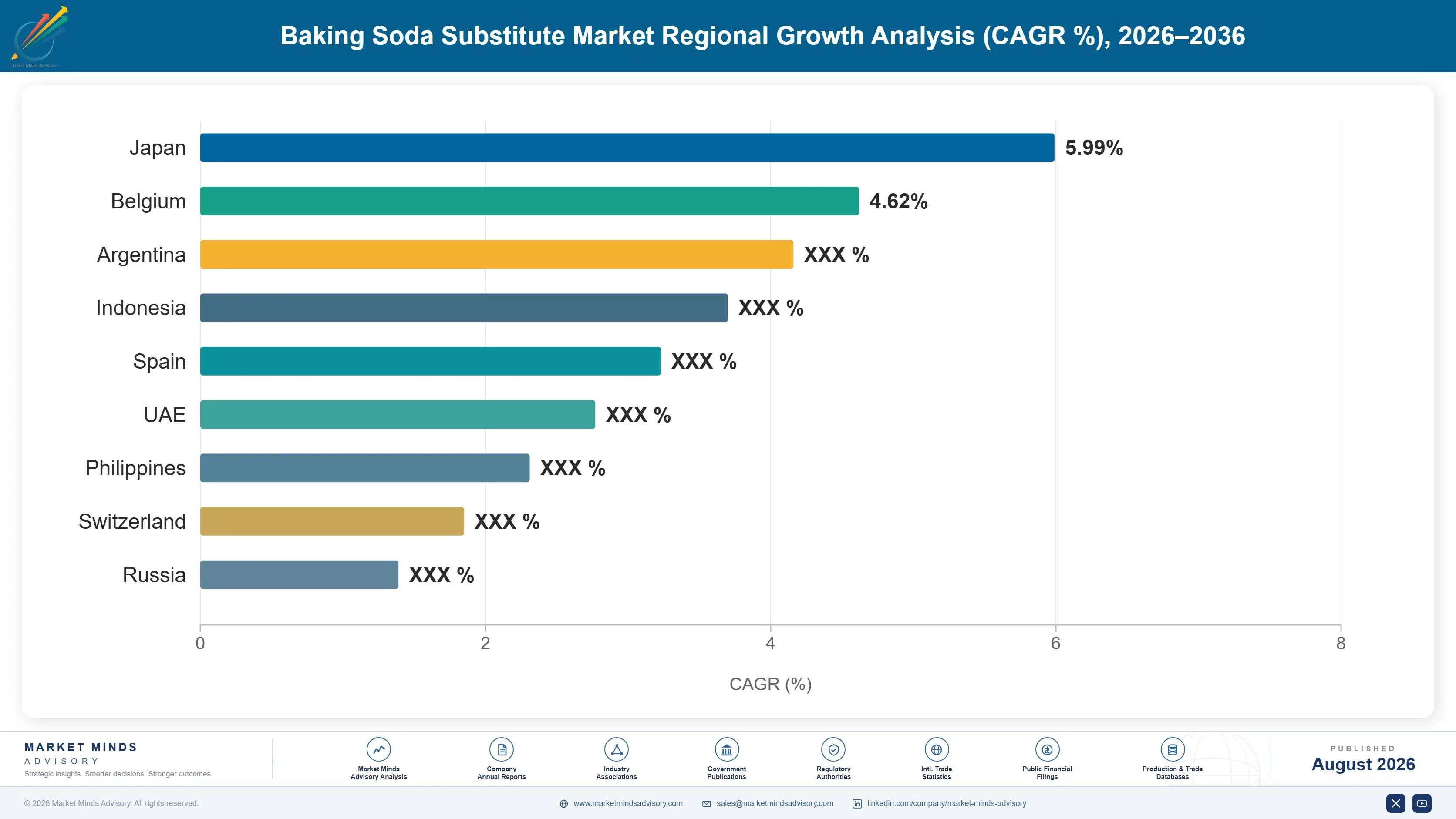
baking-soda-substitute-market-trends-country-cagr-analysis-1787463194754

Where Substitute Suppliers Actually Capture Value

Selling a substitute at parity with plain sodium bicarbonate pricing wastes the functional advantage that justified the reformulation in the first place. The four moves below focus on personal-care-grade specification, food-grade capacity investment ahead of policy deadlines, blended-system formulation support, and export positioning that captures value beyond commodity chemical pricing entirely across every channel.

Certify Personal-Care-Grade Purity And Particle Size

Industrial-grade magnesium hydroxide sold for antacid or flame-retardant use carries far looser purity and particle-size specifications than personal care formulators require for a deodorant that touches skin daily. Suppliers able to certify pharmaceutical-adjacent purity levels and consistent particle size distribution command 2 to 5 times the price of industrial-grade material sold into commodity channels. Martin Marietta Magnesia Specialties and ICL Group have both built dedicated personal-care-grade product lines separate from their industrial output. The certification investment is modest relative to the price differential, but building the analytical testing capability takes real time most industrial suppliers have not prioritized.
Market Impact: Commands a 2x to 5x industrial-grade price premium

Expand Food-Grade Capacity Ahead Of Policy Deadlines

Sodium-reduction reformulation deadlines give food manufacturers a fixed timeline to switch, and suppliers with capacity already in place capture the resulting demand surge while competitors scramble to expand. Ciech and Armand Products both added potassium bicarbonate capacity ahead of tightening European and American sodium targets, positioning themselves to serve bakers facing 2026 and 2027 deadlines. Suppliers who wait until deadlines are imminent risk losing contracts to competitors who can guarantee supply, since bakers cannot afford a shortage mid-reformulation. The capacity investment carries genuine risk if timelines slip, but suppliers who timed it correctly are capturing outsized share.
Market Impact: Captures outsized share ahead of 2027 policy deadlines

Formulate Blended Systems That Approximate Sodium Bicarbonate

No single substitute replicates sodium bicarbonate's full functional profile, which creates an opening for suppliers who formulate blended systems combining two or three alternatives to approximate its performance more closely than any single compound can alone. These blends command a meaningful premium over single-ingredient substitutes, since they save the customer from doing that formulation work internally, often adding 20% to 30% to ingredient cost while cutting the customer's own reformulation testing considerably. Suppliers with in-house food science or cosmetic chemistry capability, rather than pure commodity chemical producers, are best positioned to develop and sell these blends directly to formulators.
Market Impact: Adds a genuine 20% to 30% blended-system premium

Position Export Capacity Toward Newer Policy Adopters

Countries adopting sodium-reduction guidance later than the United Kingdom or United States, including Australia, India, and several Latin American export markets, need reliable potassium bicarbonate supply but often lack meaningful domestic production capacity. Suppliers with established export logistics and food-grade certification can capture this demand years before local production emerges, since building certified capacity from scratch takes considerably longer than most newly adopting markets will wait. Ciech and Armand Products both report export volume into these newer-adopter markets growing 12% to 18% annually, often at pricing above mature domestic markets. The window narrows once local capacity comes online.
Market Impact: Adds a 10% to 20% export price premium

Who Controls the Margin Pool

Concentration sits at a moderate 32%, split between specialty inorganic chemical producers serving food-grade demand and mineral or brine-based magnesium hydroxide suppliers serving personal care, categories that rarely compete head-to-head for the same customer. All participants are assessed on one basis: attributable substitute ingredient revenue across potassium bicarbonate, magnesium hydroxide, ammonium bicarbonate, and monocalcium phosphate.
Competition runs along three lines. First, specification capability, since personal-care-grade purity and particle-size certification separates suppliers able to serve deodorant brands from those confined to industrial channels. Second, capacity timing against policy deadlines, where suppliers who expanded ahead of sodium-reduction mandates now hold contracted volume competitors cannot easily win back. Third, formulation support, as blended-system suppliers increasingly compete on functional performance rather than raw ingredient price alone.

Pressure is building from two directions. Chinese ammonium bicarbonate producers are pushing into export markets on cost, competing directly with potassium bicarbonate and monocalcium phosphate suppliers for price-sensitive bakers willing to accept the aftertaste tradeoff. Meanwhile personal care ingredient specialists are moving upmarket into pharmaceutical-adjacent purity grades that industrial mineral producers have historically ignored. Rankings should favor participants holding both specification capability and capacity positioned ahead of policy deadlines over those competing purely on commodity chemical pricing.
baking-soda-substitute-market-trends-company-positioning-matrix-1787463195420

Competitive Moat and Risk Dimensions

ARMAND PRODUCTS COMPANY

Moat: Dedicated potassium bicarbonate capacity

Armand Products Company operates capacity built specifically for potassium bicarbonate rather than as a byproduct of broader potassium chemical production, giving it food-grade quality consistency competitors serving multiple end markets from shared capacity struggle to match. That dedicated focus let it expand ahead of tightening sodium-reduction deadlines across Europe and America.
ARMAND PRODUCTS COMPANY

Risk: Narrow single-product concentration

Armand's business concentrates heavily on potassium bicarbonate and related potassium chemicals, leaving it more exposed than diversified competitors if food-grade substitution demand growth slows or if an alternative compound displaces potassium bicarbonate's current position as the preferred sodium bicarbonate replacement in baking applications across major markets.
MARTIN MARIETTA MAGNESIA SPECIALTIES

Moat: Vertically integrated mineral resource

Martin Marietta Magnesia Specialties extracts magnesium hydroxide from its own mineral resources rather than purchasing intermediate feedstock, giving it cost and supply security advantages over competitors dependent on external brine or mineral suppliers for personal-care-grade material meeting tight specification. That resource ownership also insulates it from feedstock price volatility affecting less integrated rivals.
MARTIN MARIETTA MAGNESIA SPECIALTIES

Risk: Small personal care revenue share

Personal-care-grade magnesium hydroxide still represents a small share of Martin Marietta Magnesia Specialties' total revenue relative to its traditional industrial, agricultural, and flame-retardant businesses, meaning the company may not prioritize personal care capacity investment as aggressively as smaller, more focused competitors already have across their portfolios.

Players Tracked

Prominent Players

Armand Products Company
Tata Chemicals
Ciech
OCI Company
Martin Marietta Magnesia Specialties

Other Key Players

ICL Group
Konoshima Chemical
K+S Aktiengesellschaft
Novacap
Solvay
Tosoh Corporation
Sichuan Jinlu Group
Hubei Yihua Chemical
Innophos
Prayon
Budenheim
Caviro Extra
Distillerie Mazzari
Roquette
Ingredion

Recent Developments

MARCH 2024

Ciech Soda Polska expands potassium bicarbonate production capacity

Ciech announced an organic expansion of potassium bicarbonate production capacity at its Polish soda facility, adding output to serve growing European food-grade demand ahead of tightening sodium-reduction reformulation deadlines. This was an organic capacity expansion funded from existing operations, not an acquisition or joint venture.
Signal: Capacity investment ahead of policy deadlines shows incumbents positioning for demand before mandates actually force reformulation.
JULY 2023

Prayon expands food-grade monocalcium phosphate capacity in Belgium

Prayon announced continued investment in food-grade monocalcium phosphate production at its Belgian facility, expanding capacity to serve bakers reformulating away from ammonium bicarbonate for premium packaged goods across export markets. This was an organic capacity expansion within existing operations, not an acquisition or new joint venture with another party.
Signal: Phosphate specialist investment in leavening-grade capacity signals monocalcium phosphate steadily gaining share from cheaper ammonium bicarbonate.
JANUARY 2024

ICL Group expands personal-care-grade magnesium hydroxide extraction

ICL Group announced expanded extraction and processing capacity for personal-care-grade magnesium hydroxide from Dead Sea brine resources, adding output to serve growing natural deodorant reformulation demand across North America and Europe. This was an organic capacity expansion funded from existing mineral resource operations, not an acquisition or joint venture.
Signal: A traditional mineral extraction company investing in personal-care-grade output confirms the deodorant reformulation wave is commercially significant.

Mineral Feedstock And Brine Extraction Exposure

Mineral and brine feedstock, whether potash for potassium bicarbonate or magnesium-rich brine for magnesium hydroxide, runs 35% to 50% of cost of goods sold, sourced from potash mines across Canada, Germany, and Russia, and from Dead Sea and other brine deposits concentrated in Israel and Jordan. Processing energy for calcination and purification adds a further 15% to 20%.
Global potash prices spiked sharply through 2022 following sanctions on Belarusian and Russian potash exports, two countries supplying a meaningful share of global potassium chemical feedstock before the disruption. K+S Aktiengesellschaft's 2022 Annual Report documented potash price increases passing through to potassium bicarbonate production cost, compressing margins for producers unable to reprice contracts quickly. Dead Sea brine extraction proved comparatively stable through the same period, insulating magnesium hydroxide producers from the sharpest volatility.

Exposure separates producers by feedstock source rather than by scale alone. Producers sourcing potash from Canadian or German mines avoided the sharpest of the 2022 Belarusian and Russian supply disruption, while those dependent on Eastern European sources faced the steepest cost increases. Brine-based magnesium hydroxide producers held a comparatively stable cost base throughout, since Dead Sea extraction was not directly exposed to the same geopolitical disruption at all.
baking-soda-substitute-market-trends-cost-volatility-analysis-1787463195680

Diversify potash sourcing across multiple mining regions

Producers dependent on Belarusian or Russian potash carried the full weight of the 2022 sanctions-driven price spike, while competitors sourcing from Canadian and German mines absorbed the shock considerably better. Building supply relationships across multiple mining regions before a disruption occurs, rather than after, is what actually protects margin when the next geopolitical shock inevitably arrives.

Contract feedstock on multi-year fixed-volume agreements

Spot-market potash purchasing exposed several producers to the sharpest of the 2022 price spike, while competitors holding multi-year supply agreements with mining companies absorbed the shock more gradually across their contract term. Locking volume and reference pricing ahead of need converts an unpredictable cost line into a plannable one across budget and pricing cycles.

Favor brine-based feedstock where product chemistry allows

Dead Sea and other brine-based magnesium extraction proved considerably more stable through the 2022 potash crisis than mined potassium feedstock, since brine sourcing was not directly exposed to the same sanctions-driven supply disruption at all. Where product chemistry allows a choice between mined and brine-derived feedstock, the brine route currently carries meaningfully lower geopolitical exposure overall.

Portfolio Architecture for Margin Defence

The portfolio splits into three tiers by end-use specification depth. Commodity-grade substitutes sold into industrial and agricultural channels compete almost entirely on price against sodium bicarbonate and each other. Food-grade substitutes sold into reformulated baked goods earn considerably more, since functional performance and labeling compliance carry real value. Personal-care-grade material sits at the top, priced against specialty cosmetic ingredient economics rather than commodity chemical benchmarks.
The tension runs between volume that keeps production lines running and margin that rewards specification investment. Commodity and industrial sales fund plant utilization but earn thin margins barely covering feedstock and energy cost. Food-grade and personal-care-grade volume carries the returns but depends on certification infrastructure and formulator relationships smaller producers often lack. Producers weighting entirely toward commodity channels carry real exposure to feedstock price swings with little pricing power to absorb them.

High-value pools concentrate wherever a buyer needs a documented functional attribute: personal-care-grade purity for sensitive-skin deodorant, food-grade consistency for reformulated baked goods, or blended-system performance approximating sodium bicarbonate closely. Commodity-grade material sold into undifferentiated industrial channels competes on price alone and generally earns the thinnest margin across the category.

Volume / Commodity-Adjacent Tier

Commodity-grade substitutes sold into industrial and agricultural channels, priced against sodium bicarbonate and each other on a functional-equivalence basis. Margins stay thin because buyers treat these as interchangeable commodity inputs.
Gross Margin: 10-18%

Premium / Certified Tier

Food-grade substitutes sold into reformulated baked goods and packaged foods, commanding a real premium because bakers pay for consistent leavening performance and sodium-labeling compliance documentation across export and domestic markets alike.
Gross Margin: 22-34%

Sustainability / Regulatory / Next-Generation Tier

Personal-care-grade material sold into natural deodorant and sensitive-skin formulations, priced against specialty cosmetic ingredient economics given the purity certification and particle-size consistency required to earn this grade at genuine scale.
Gross Margin: 30-48%
baking-soda-substitute-market-trends-portfolio-architecture-1787463196313

High-value Sub-segments and Strategic Watch-out

Magnesium Hydroxide

High value and the fastest growth at 10.5%, driven almost entirely by natural deodorant brands reformulating away from plain baking soda to address irritation complaints. Martin Marietta Magnesia Specialties and ICL Group both supply personal-care-grade material commanding several multiples of industrial pricing at genuine scale.
Gross Margin: 30-48%

Potassium Bicarbonate

High value with strong growth at 8.9%, serving food manufacturers substituting away from sodium bicarbonate under sodium-reduction policy across major export markets and domestic retail channels everywhere. Armand Products Company and Ciech lead dedicated food-grade capacity built specifically to serve this reformulation demand at scale.
Gross Margin: 22-34%

Ammonium Bicarbonate

The volume core at 5.2% growth, the slowest of the six segments, built on decades of established low-cost leavening demand across Asian cracker and flat baked goods manufacturing at real scale. Growth now tracks broader baking output rather than outpacing it meaningfully at all today.
Gross Margin: 10-18%

Cream of Tartar Blended Systems

The strategic watch-out at 5.8% growth, constrained by winemaking byproduct supply that fluctuates considerably with grape harvest volume each year and by a shrinking pool of formulators willing to accept its sourcing variability compared with synthetic, more consistent alternatives available broadly today across most Western markets.
Gross Margin: 14-24%

Why Substitute Choices Rarely Reverse

A brand or baker who reformulates around a specific substitute rarely reverts to plain sodium bicarbonate afterward, since doing so means re-running sensory or dermatological testing and risking the exact complaints that triggered the original switch in the first place. That switching cost behaves like an annuity for incumbent suppliers, converting a single successful reformulation into years of recurring ingredient revenue rather than a one-time transaction that competitors can easily contest.
Adoption depth varies considerably by vertical. Natural deodorant reformulation adopted fastest and deepest, since sensitive-skin complaints created genuine consumer pressure brands could not ignore for long. Food-grade substitution follows a steadier, policy-driven adoption curve tied to sodium-reduction mandate timelines rather than consumer complaint volume or brand sentiment. Household cleaning and industrial applications remain shallow, since cost sensitivity there outweighs any functional advantage a substitute offers over plain sodium bicarbonate.

Buyer profiles have shifted from R&D chemists exploring novel formulations toward brand marketing teams specifying substitutes for their consumer-facing claim as much as their functional performance. Regulatory affairs teams increasingly drive food-grade substitution decisions directly, working backward from sodium-reduction compliance deadlines rather than waiting for voluntary reformulation initiative to emerge organically from within the business.
baking-soda-substitute-market-trends-end-use-penetration-index-1787463196970

Our Call On Baking Soda Substitutes

These are among the four positions where our research anticipates prominent divergence between winners and laggards over the coming forecast period. Each is grounded in the demand model, the regulatory perimeter, and the announced capacity pipeline.
01 / PERSONAL CARE REFORMULATION LEADS

Deodorant brands, not bakers, are driving the fastest growth

Magnesium hydroxide and starch-based alternatives are growing at roughly twice the rate of food-grade substitution, driven entirely by natural deodorant brands reformulating away from plain sodium bicarbonate to address sensitive-skin complaints that became impossible to ignore after 2021. Suppliers able to certify personal-care-grade purity and particle size command two to five times industrial pricing, a premium food-grade buyers will never pay. Ingredient producers should treat personal-care-grade certification as the primary growth investment in this category, not a secondary line extension.
02 / SODIUM POLICY SETS BASELINE

Potassium bicarbonate substitution tracks regulatory deadlines, not preference

Food manufacturers substitute potassium bicarbonate for sodium bicarbonate primarily to meet sodium-reduction labeling deadlines rather than out of any independent preference for its functional properties, which makes this demand channel steadier but slower-growing than personal care. The United Kingdom's decades-old salt reduction programme remains the clearest model for how institutionalized policy converts into sustained ingredient substitution over many years. Suppliers should track sodium-reduction policy timelines across additional countries as the primary leading indicator for food-grade demand rather than any consumer sentiment survey.
03 / BLENDED SYSTEMS COMMAND PREMIUM

No single substitute matches sodium bicarbonate, and that gap is monetizable

No single alternative replicates sodium bicarbonate's full combination of cost, reaction speed, and neutral taste, which creates a genuine opening for suppliers who formulate blended systems combining two or three substitutes to approximate that performance more closely than any single compound achieves alone. These blends command 20% to 30% premiums over single-ingredient alternatives by saving customers the formulation work internally, a saving most buyers value highly. Suppliers with food science or cosmetic chemistry capability should prioritize blended-system development over simply expanding single-compound production capacity across existing lines.
04 / FEEDSTOCK DIVERSIFICATION CUTS RISK

The 2022 potash crisis exposed which producers hedged their exposure

Producers dependent on Belarusian or Russian potash absorbed the sharpest cost increases during the 2022 sanctions-driven price spike, while competitors sourcing from Canadian and German mines, or from Dead Sea brine entirely outside the potash supply chain, weathered the disruption with considerably less margin compression. That divergence revealed which producers had genuinely diversified feedstock sourcing versus those who had merely assumed supply continuity would hold indefinitely. Buyers evaluating suppliers should weight feedstock geographic diversification alongside price when selecting long-term partners for future contracts.

Engagement Snapshot From the Field

A live engagement with an industry participant carrying material or product regulatory and market exposure ahead of a defining policy shift, showing how our research translates into a defensible multi-year portfolio strategy.
MARKET MINDS ADVISORY · CLIENT ENGAGEMENT SUMMARY
Baking Soda Substitute Producer Strategic Portfolio Review and Transition Roadmap 2026·Investment Scenario on Baking Soda Substitute Exposure Evaluation 2025-26
CLIENT PROFILE
A natural personal care brand engaged MMA while facing a wave of online reviews citing skin irritation from its flagship baking-soda-based deodorant line. The client reported annual revenue near USD 210 million and sold through both direct channels and major retail accounts, with leadership under pressure from retail buyers threatening reduced shelf allocation if the irritation complaints continued unaddressed (client-reported, unverified by MMA).
STRATEGIC CHALLENGE
Management could not agree whether to reformulate the entire product line around a single magnesium hydroxide alternative or offer a parallel sensitive-skin variant alongside the original formula. A full reformulation risked alienating loyal customers who liked the original product's performance, while a parallel variant meant carrying two formulations through manufacturing and inventory indefinitely.
MMA APPROACH
MMA analyzed the client's return and review data to quantify how much of the irritation complaint volume was concentrated among an identifiable customer segment versus spread broadly across the user base. We benchmarked reformulation approaches taken by three competitor brands that had already switched, and modeled the manufacturing and inventory cost of a parallel-formula strategy against a full single-formula reformulation.
KEY FINDINGS
  1. Irritation complaints concentrated among roughly 15% of the customer base, suggesting a targeted sensitive-skin variant could resolve most complaints without a full reformulation (client-reported, unverified by MMA).
  2. Two of three competitor brands that fully reformulated reported a temporary sales dip before recovering within two quarters as new formula awareness spread.
  3. A parallel-formula strategy would have added approximately 18% to manufacturing and inventory complexity relative to a single reformulated product line (client-reported, unverified by MMA).
  4. Retail buyers indicated a sensitive-skin variant alone, properly labeled, would satisfy their shelf allocation concerns without requiring a full-line reformulation across the entire product portfolio.
CLIENT PROFILE
A natural personal care brand engaged MMA while facing a wave of online reviews citing skin irritation from its flagship baking-soda-based deodorant line. The client reported annual revenue near USD 210 million and sold through both direct channels and major retail accounts, with leadership under pressure from retail buyers threatening reduced shelf allocation if the irritation complaints continued unaddressed (client-reported, unverified by MMA).
STRATEGIC CHALLENGE
Management could not agree whether to reformulate the entire product line around a single magnesium hydroxide alternative or offer a parallel sensitive-skin variant alongside the original formula. A full reformulation risked alienating loyal customers who liked the original product's performance, while a parallel variant meant carrying two formulations through manufacturing and inventory indefinitely.
MMA APPROACH
MMA analyzed the client's return and review data to quantify how much of the irritation complaint volume was concentrated among an identifiable customer segment versus spread broadly across the user base. We benchmarked reformulation approaches taken by three competitor brands that had already switched, and modeled the manufacturing and inventory cost of a parallel-formula strategy against a full single-formula reformulation.
KEY FINDINGS
  1. Irritation complaints concentrated among roughly 15% of the customer base, suggesting a targeted sensitive-skin variant could resolve most complaints without a full reformulation (client-reported, unverified by MMA).
  2. Two of three competitor brands that fully reformulated reported a temporary sales dip before recovering within two quarters as new formula awareness spread.
  3. A parallel-formula strategy would have added approximately 18% to manufacturing and inventory complexity relative to a single reformulated product line (client-reported, unverified by MMA).
  4. Retail buyers indicated a sensitive-skin variant alone, properly labeled, would satisfy their shelf allocation concerns without requiring a full-line reformulation across the entire product portfolio.
RECOMMENDED STRATEGY
Phase 1: Phase 1 (0 to 4 months): Launch a magnesium hydroxide-based sensitive-skin variant alongside the existing formula rather than fully reformulating. Phase 2: Phase 2 (4 to 12 months): Monitor sales mix and review sentiment to determine whether the sensitive-skin variant should eventually replace the original formula. Phase 3: Phase 3 (12 to 24 months): Reassess full reformulation once sales mix data clarifies genuine customer preference between the two formulas.
OUTCOME
The sensitive-skin variant launched within the recommended window and captured a meaningful share of sales within two quarters. Review sentiment around irritation complaints improved considerably, and the client reported retail buyers restored full shelf allocation once the variant demonstrated sustained sell-through (client-reported, unverified by MMA).

Frequently Asked Questions

Foundational context covering the market sizes, CAGR, scope, country, region and competition that inform every finding below. This section is provided to cover basics and most often pre-purchase conversations, answered from the MMA Primary Research Dataset.

What is the current size of the Baking Soda Substitute Market?

The baking soda substitute market reached USD 1.6 billion in 2025. Growth is driven by natural deodorant brands reformulating away from plain sodium bicarbonate and food manufacturers meeting sodium-reduction labeling requirements.

How large will the Baking Soda Substitute Market be by 2036?

The market is projected to reach USD 3.30 billion by 2036, an increase of USD 1.59 billion over the 2026 base as personal care and food-grade substitution both continue expanding.

What is the CAGR for the Baking Soda Substitute Market 2026 to 2036?

The market is projected to grow at a 6.8% CAGR between 2026 and 2036, with a bull case of 8.1% and a bear case of 5.5% depending on reformulation pace.

Which segment is growing fastest?

Magnesium hydroxide grows fastest at a 10.5% CAGR, about 1.54 times the overall market rate, as natural deodorant brands reformulate away from plain sodium bicarbonate to address skin irritation complaints.

Who are the major companies in the Baking Soda Substitute Market?

Leading producers include Armand Products Company, Tata Chemicals, Ciech, OCI Company, and Martin Marietta Magnesia Specialties, assessed on attributable substitute ingredient revenue across food, personal care, and industrial channels.

Which country is growing fastest?

The United Kingdom grows fastest among tracked countries, reflecting the most institutionally mature sodium-reduction policy anywhere and decades of accumulated experience substituting potassium bicarbonate into reformulated baked goods.

Report Segmentation Architecture

The full report scope spans multiple orthogonal segmentation dimensions, with cross-tabulated demand data provided for each dimension pair. Coverage extends further to regional breakdowns, trend trajectories, and the competitive detail needed to support segment-level decision-making.

By Substitute Chemistry

  • Potassium Bicarbonate
  • Magnesium Hydroxide
  • Ammonium Bicarbonate
  • Monocalcium Phosphate
  • Cream of Tartar Blended Systems
  • Starch-Based Absorbent Systems

By End-Use Industry

  • Reformulated Baked Goods and Snacks
  • Natural Deodorant and Personal Care
  • Household Cleaning Products
  • Animal Feed and Agricultural Use
  • Industrial and Pharmaceutical Applications

By Distribution Channel

  • Direct Formulator Supply Agreements
  • Specialty Ingredient Distributors
  • Export Trade Channels
  • Private-Label Contract Manufacturing

By Region

  • North America
  • Western Europe
  • East Asia
  • South Asia and Pacific
  • Latin America
  • Middle East and Africa
  • Eastern Europe

Scope, Methodology, and Coverage

Every figure in this report is reproducible from documented input assumptions. The scope below maps the historical period, the forecast horizon, the segmentation dimensions, and the countries covered, alongside the underlying primary and qualitative methodology.
Historical Period
2020 to 2025
Forecast Period
2026 to 2036
Base Year
2025 (USD billions; MMA Primary Research Dataset, August 2026)
Market Definition
The baking soda substitute market comprises non-sodium-bicarbonate leavening, alkalizing, and odor-neutralizing agents, including potassium bicarbonate, magnesium hydroxide, ammonium bicarbonate, monocalcium phosphate, and starch-based absorbents, valued at the point of sale into food, personal care, and household applications. It excludes sodium bicarbonate itself, finished baked goods, and finished deodorant or cleaning products beyond the substitute ingredient.
Quantitative Units
USD billions (current prices); substitute ingredient volume in metric tonnes where applicable
Segmentation Dimensions
By Substitute Chemistry; By End-Use Industry; By Distribution Channel; By Region
Regions Covered
North America, Western Europe, East Asia, South Asia and Pacific, Latin America, Middle East and Africa, Eastern Europe
Countries Covered
USA, China, Germany, France, UK, Japan, South Korea, India, Australia, Canada, Brazil, Mexico, Indonesia, Vietnam, Thailand, Malaysia, UAE, Saudi Arabia, South Africa, Nigeria, Turkey, Poland, Netherlands, Italy, Spain, Sweden, Switzerland, Argentina, Colombia, Singapore, and additional markets relevant to this sector
Key Companies Profiled
Armand Products Company, Tata Chemicals, Ciech, OCI Company, Martin Marietta Magnesia Specialties, ICL Group, Konoshima Chemical, K+S Aktiengesellschaft, Novacap, Solvay, Tosoh Corporation, Sichuan Jinlu Group, Hubei Yihua Chemical, Innophos, Prayon, Budenheim, Caviro Extra, Distillerie Mazzari, Roquette, Ingredion
Quantitative Methodology
Primary survey, n=3,800 respondents, Q4 2025, six countries; demand-side model with trade association cross-validation
Qualitative Methodology
47 expert interviews, Q4 2025; applied to validate demand model assumptions, identify emerging dynamics, and assess competitive positioning
Report Format
PDF and XLSX data workbook (Word format preview document)
Publisher
Market Minds Advisory
Report Code
MMA-2026-CHM-103
Published
August 2026
Contact
sales@marketmindsadvisory.com | www.marketmindsadvisory.com

Purchase the full Baking Soda Substitute Market Report (2026 to 2036).

The full MMA Baking Soda Substitute report sizes the market across six substitute chemistries, five end-use industries, four distribution channels, and seven regions through 2036. It profiles 20 producers on a consistent basis of attributable substitute ingredient revenue, scoring each on specification certification depth, feedstock diversification, and formulation support capability. Scenario models quantify how natural deodorant reformulation, sodium-reduction policy adoption, and feedstock volatility move both volume and achievable price. The report also includes a personal-care-grade certification screen, a sodium-reduction policy timeline tracker across major markets, and a blended-system formulation opportunity assessment for ingredient sourcing and product development teams.
Six-chemistry and four-channel market sizing to 2036
Twenty-producer benchmark on attributable substitute revenue
Personal-care-grade certification and specification screen by producer
Sodium-reduction policy timeline tracker across major markets
Feedstock diversification exposure assessment by producer
Blended-system formulation opportunity assessment for ingredient sourcing teams

Built For The People Who Decide

From boardroom strategy to bench-side execution, this report is read cover-to-cover by leaders shaping the next decade of their industry, turning demand scenarios, market dynamics and valuation benchmarks into decisions.
CXOs/ Presidents/ VPs/ Managers
M&A and Corporate Development
Strategy Teams and R&D Heads
Procurement and Product Directors
Regulatory and Compliance Leaders
Investor Relations and Equity Analysts