Market Minds Advisory
Bakery Products Market

Bakery Products Market: Oven Economics, Wheat Exposure, and the Quiet Industrialisation of the Craft Shelf

Energy and wheat costs have closed thousands of craft bakeries across Europe while frozen part-baked lines fill the same shelves, and retailers now decide who bakes what, where, and at which margin.

Lead Analyst

Lisa Gevelber

Published

September 2026

Make Smarter Decisions with Customized Research Insights

Request a free sample report and evaluate market opportunities, growth trends, and competitive dynamics relevant to your business needs.

2025 MARKET VALUE$486.0BMarket Size 2025
2036 FORECAST VALUE$772.3BBase Case , 2026 to 2036
CAGR 2026 TO 20364.3 %Bull 5.5% / Bear 3.1%
INCREMENTAL OPPORTUNITY$265.4BNet 10- year value creation
EXPANSION MULTIPLE1.52x2036 value over 2026 base
Strategic Levers
M&A Pipeline
Regional Outlook
Country Rankings
Competitive Intelligence
Segmental Deep-dive
Call-Us : 91 93563 13602

Executive Snapshot and Market Trajectory

Bakery is the most fragmented large food category on earth, and it is consolidating from an unexpected direction. Not through acquisition of craft bakers, but through frozen part-baked dough, which lets a supermarket produce an artisan-looking loaf with one oven and no baker on the payroll.
Commercial power has moved to whoever controls the frozen dough line and the retailer relationship behind it. European craft bakeries closed in significant numbers through the 2022 energy crisis and have not returned, while bake-off installations in grocery multiplied. Flatbreads and pizza bases grow fastest at 6.4%, roughly 1.49 times the market, carried by tortillas in the Americas and by wraps and naan formats across Europe and Asia. East Asia holds 30% of global value.
Concentration remains extraordinarily low, with the top five holding around 9% of output, because in-store and independent baking still accounts for enormous volume. Regulation now bites at both ends: EU Regulation 2017/2158 sets acrylamide benchmarks across biscuits and bread, while the United Kingdom's restrictions on advertising less healthy food have reshaped promotional planning for sweet bakery. Private label has taken a third of packaged shelf value.
Market Definition
This report covers bakery products manufactured for human consumption and sold through retail, foodservice, and in-store bakery channels, spanning bread and rolls, cakes and sweet bakery, biscuits and cookies, morning goods and viennoiserie, flatbreads and pizza bases, and savoury pies and filled pastry. Both industrial and craft production are included at final product value. Bakery ingredients, mixes, improvers, and equipment sold to bakers are excluded, as are cereal-based snacks that are not baked.
Base Year Value
$486.0B in 2025 (MMA Primary Research Dataset, August 2026)
Forecast Period
2026 to 2036, eleven discrete annual values
CAGR
4.3% base case. Bull 5.5%. Bear 3.1%.
Fastest Growth Segment
Flatbreads and Pizza Bases: 6.4% CAGR
Fastest Growth Country
India: 7.1% CAGR
Fastest Growth Region
South Asia and Pacific: 6.5% CAGR
Largest Region
East Asia: 30% of 2025 global value
Market Leaders
Grupo Bimbo, Yamazaki Baking, Mondelez International, Flowers Foods, Aryzta. Source: MMA Analysis based on company annual reports.
Primary Survey
n=3,800 procurement and R&D decision-makers, Q4 2025, six countries
Methodology
Demand-side build-up, cross-validated against public data, 47 expert interviews

Bakery Products Market Forecast Scenarios

bakery-products-market-size-forecast-scenario-1787462484933
The 2020 to 2025 period was defined by two shocks rather than by any demand trend. Lockdown drove a home-baking surge and a collapse in foodservice bakery, then the 2022 wheat and energy spike pushed input costs to levels that closed thousands of independent bakeries across Germany, France, and the United Kingdom. Almost all of the 3.6% historical growth was price, and volumes in several mature markets actually fell.
The 4.3% base case rests on three mechanisms. Frozen part-baked and bake-off supply keeps replacing scratch production, which transfers volume from unmeasured craft output into recorded industrial value. Flatbread and wrap formats keep expanding well beyond their traditional geographies, adding genuinely incremental consumption. And premiumisation in sourdough, high-protein, and high-fibre bread supports unit pricing in markets where loaf volumes are flat or declining. Emerging market penetration supplies most of the actual volume growth.
The 5.5% bull case assumes wheat prices stay near trend while flatbread and premium bread formats accelerate in Asia. The 3.1% bear case reflects a repeat energy shock combined with sustained trading down, where consumers shift to the cheapest available loaf and retailers push private label harder still. Wheat and gas prices, not consumer preference, decide between them.

Why Ovens, Not Recipes, Set Margin

Three forces are reorganising this category simultaneously, and none of them is consumer taste. Energy cost turned baking from a low-capital trade into a capital-intensive one, closing independents that could not absorb a tripled gas bill. Retailers filled the resulting gap with in-store bake-off, which needs frozen dough rather than skilled labour. And wheat, which had been dependably cheap for a generation, stopped being so after 2021.
TOP-FIVE CONCENTRATION9%Share of global bakery output held by largest producers
AVERAGE SELLING PRICE$3.12/kgBlended retail equivalent across packaged and in-store formats
WHEAT COST SHARE23%Flour as proportion of industrial bakery cost of goods
ENERGY COST SHARE11%Oven and proofing energy within total production cost
PRIVATE LABEL PENETRATION34%Retailer own-brand portion of packaged bakery shelf value
CAPACITY UTILISATION78%Average industrial line loading across large-scale bakery plants
The commercial character that follows is unusual for a category this large. Value accrues to whoever supplies the frozen dough and to whoever owns the retail shelf, while the actual baking step has been pushed to the lowest-cost location in the chain, which is often a supermarket back room. Brand equity in bread is weak almost everywhere outside the United Kingdom and Japan, so retailers set price. Industrial bakers compete on line efficiency, waste rates, and delivered cost per unit rather than on recipe.
The next decade turns on whether premiumisation can outrun trading down. Against that, private label now holds a third of packaged shelf value and keeps improving in quality. Where those two curves cross determines whether bakery grows in value or merely in tonnage.
"The most consequential machine in bakery is not in a bakery. It is the deck oven at the back of a supermarket, and every one installed removes a craft baker from the market permanently."
Director, Packaged Food and Bakery Practice · MMA Packaged Food / Bakery Manufacturing Practice · August 2026

Market Trends

In-Store Bake-Off Displaces Independent Craft Production Permanently

Grocery retailers across Europe and North America have installed bake-off capability at scale, using frozen part-baked dough delivered from centralised industrial plants. The economics are decisive: a supermarket produces a crusty loaf at any hour without employing a baker, holds almost no waste risk, and captures the full retail margin. Independent bakeries closed in large numbers through the 2022 energy crisis across Germany, France, and the United Kingdom, and few have reopened. The volume did not disappear; it transferred to frozen dough suppliers and retailers, which is why recorded industrial bakery value keeps rising while craft employment falls.
Market Impact: Commands 2.4x standard loaf pricing
Flatbread Formats Expand Far Beyond Traditional Geographies

Tortillas, wraps, pita, naan, and thin pizza bases have moved from ethnic specialty into everyday use across markets where they had no historical presence. American tortilla consumption now rivals sliced bread in several states, driven by demographics and by the convenience of a format that needs no toaster. European retailers have expanded wrap and flatbread ranges considerably, and Indian and Southeast Asian packaged flatbread is industrialising rapidly from a base of home production. The format also suits foodservice better than loaves do, because portion control is simpler and waste is lower, which is why it compounds at 6.4%.
Market Impact: Converts 9 million tonnes annually

Market Opportunities and Growth Drivers

Premium Bread Formats Support Pricing Where Volumes Stall

Sourdough, high-protein, seeded, and high-fibre breads sell at two to three times the price of a standard white loaf and have grown consistently across the United Kingdom, Germany, Australia, and urban North America. The pull is genuine: shoppers reading protein and fibre content on pack behave differently from those buying on price alone. For industrial bakers facing flat or declining loaf volumes in mature markets, these lines are the only reliable route to value growth. They also resist private label imitation better, because fermentation time and ingredient cost are hard to strip out without the product visibly changing.
Market Impact: Raised energy to 25% of cost

Emerging Market Packaged Penetration Converts Home Baking Into Sales

Across India, Indonesia, Vietnam, Nigeria, and much of Latin America, bread and biscuit consumption is shifting from home and informal production into packaged retail as urbanisation, cold chain, and modern trade expand. Britannia, Grupo Bimbo, and regional players have built distribution reaching hundreds of thousands of small outlets, and each new outlet converts unmeasured consumption into recorded market value. Biscuits lead this transition because shelf life and unit price suit low-income purchasing patterns particularly well. Volume growth here is real rather than statistical, and it is the principal reason global bakery still grows at all.
Market Impact: Cuts margin 50% versus branded supply

Market Restraints and Challenges

Energy Cost Volatility Threatens the Economics of Baking

Ovens and proofing chambers consume energy continuously, and unlike most food processing the load cannot be shifted or reduced without changing the product. European gas prices in 2022 pushed energy from a manageable line to roughly a quarter of production cost for many independents, and thousands closed. The root cause is exposure to a single input with no substitute and little demand elasticity. Participants respond with heat recovery from oven flues, electrification where grid pricing supports it, batch consolidation to reduce idle heating, and longer-dated energy contracts that spread rather than remove the exposure.
Market Impact: Transfers 12% of craft volume

Private Label Expansion Compresses Branded Bakery Margins

Retailer own-brand now takes around 34% of packaged bakery shelf value, and in bread specifically it runs much higher across Western Europe. The cause is weak brand equity: most shoppers cannot distinguish branded from own-label bread in blind testing, so price decides. Contract manufacturing for retailers keeps industrial lines loaded but at margins roughly half those of branded supply, and it hands the retailer control of the specification. Bakers counter by concentrating brand investment on formats where difference is visible, by pursuing foodservice channels retailers do not control, and by exiting contracts that no longer cover overhead.
Market Impact: Adds 6.4% annual segment growth
4 additional market trends, 3 additional growth drivers, and 2 additional restraints and challenges are covered in the full report. Contact sales@marketmindsadvisory.com to access the complete intelligence.

Segment CAGR and Growth Architecture

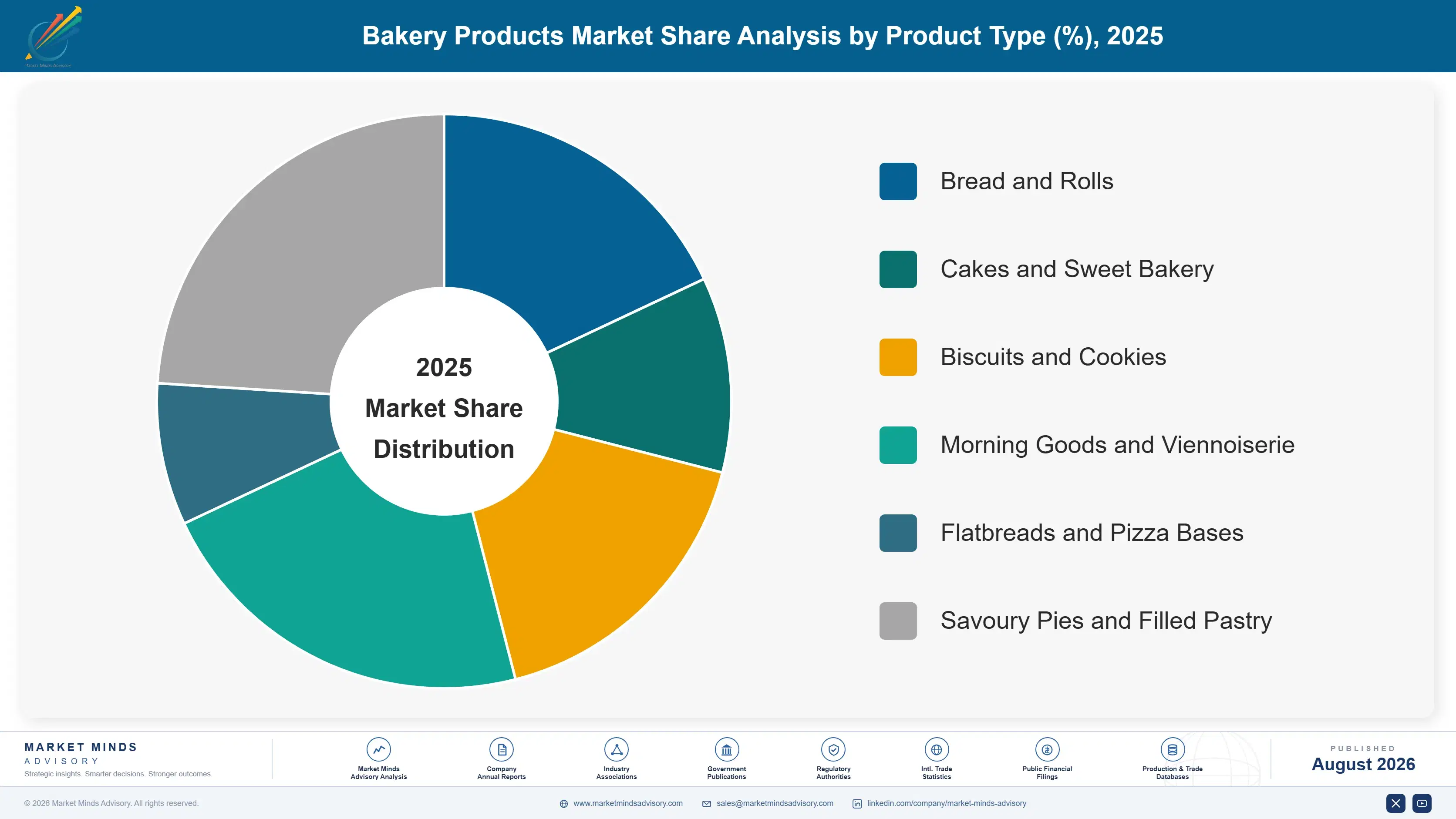
Segmentation follows product type, the single logic that consumers, retailers, and production planners all recognise. Product type determines the dough system, the oven profile, the shelf life, and the merchandising position, so competitive advantage tracks the product rather than the plant or the channel. Distribution channel and production format sit in the framework as separate commercial dimensions entirely.
bakery-products-market-market-share-analysis-1787462485619

Flatbreads and Pizza Bases

Growth of 6.4%, roughly 1.49 times the market, comes from a format that travels unusually well between cuisines. Tortillas and wraps have become everyday items across North America and increasingly across Europe, while packaged naan, roti, and pita industrialise rapidly in South Asia and the Gulf. The production economics help: flatbread lines run faster than loaf lines, need less proofing time, and produce lower waste, so the same capital delivers more saleable tonnage per shift. Foodservice adoption reinforces the trend because portioning is predictable. The competitive risk is that low technical barriers invite regional entrants, and margin discipline depends on distribution reach rather than on any product advantage. Distribution reach decides who keeps the volume.
CAGR 6.4%

Morning Goods and Viennoiserie

Croissants, pains au chocolat, danishes, and filled pastries have become the flagship of the bake-off shelf, because they look artisanal, smell powerful, and arrive frozen. Growth of 5.8% is driven almost entirely by that retail installation rather than by any change in appetite. Unit margins are healthy: consumers pay a premium for something that appears freshly baked, while the retailer's marginal production cost is an oven cycle. Lamination is the technical barrier, since laminated dough requires precise butter handling, freezing tolerance, and proofing control that few entrants get right at scale. European producers hold a clear capability advantage here and export frozen product globally, which supports pricing well above commodity bakery.
CAGR 5.8%
Full segment breakdown across 6 segments available in the complete report.

Regional Architecture and Country Demand Map

East Asia holds the largest share at 30%, reflecting the scale of Chinese and Japanese packaged bakery alongside rapid premium format adoption. Western Europe and North America follow with mature, high-value but slow-growing bases, while South Asia and Pacific grows fastest as packaged penetration rises.

North America

Tortilla and wrap consumption is the defining growth mechanism here, and it now rivals sliced bread volumes in several southwestern American states. Sliced loaf demand itself has been declining slowly for a decade, and Flowers Foods and Grupo Bimbo compete for a shrinking pool through distribution efficiency rather than product innovation. Premium sourdough and high-protein lines are the exception, growing well in urban markets and at higher price points. Canadian demand follows the same pattern with stronger artisanal retail presence. Mexican bakery is both large and industrialised, anchored by Bimbo's domestic network, and cross-border frozen dough movement is substantial. Regional growth of 3.4% therefore reflects mix rather than volume. Frozen dough imports remain significant.
Share: 23% | CAGR: 3.4% (2026 to 2036)

Western Europe

Nowhere has the craft-to-industrial transfer been more visible than in Western Europe. German bakery closures accelerated sharply through the 2022 energy crisis and continued afterwards, and French boulangerie numbers have fallen for years under the same pressure. Retailers absorbed the volume through bake-off, which is why frozen part-baked suppliers such as Aryzta, Europastry, and La Lorraine have grown while the visible craft sector shrank. Regulation matters here more than elsewhere: EU Regulation 2017/2158 sets acrylamide benchmark levels across bread and biscuits, and Nutri-Score labelling influences reformulation in France, Belgium, and Germany. Growth of 2.6% reflects a saturated base where value comes only from premiumisation. Craft closure has proved permanent rather than cyclical.
Share: 24% | CAGR: 2.6% (2026 to 2036)
Regional intelligence for 5 additional markets available in the complete report: East Asia, South Asia and Pacific, Latin America, Middle East and Africa, Eastern Europe. Contact sales@marketmindsadvisory.com.
bakery-products-market-country-cagr-analysis-1787462486160

Where Bakers Can Still Earn Margin

Selling standard loaves to supermarkets is a way to keep ovens warm, not a way to make money. The four moves below shift revenue toward positions the retailer cannot commoditise: frozen dough supply, laminated pastry capability, formats where premium claims are visible on pack, and foodservice channels outside grocery control entirely. None of the four requires a new plant.

Supply Frozen Part-Baked Dough to Retail Bake-Off

Every bake-off oven installed in a supermarket is a permanent demand point for frozen dough, and the retailer has no realistic route to backward integration because dough production needs scale they will not build. Suppliers holding these contracts earn gross margins roughly 6 to 9 points above equivalent finished bread supply, with far lower distribution cost because frozen product ships weekly rather than daily. The contracts also last longer, since requalifying a dough that performs consistently in the retailer's specific ovens is a project nobody undertakes casually. Weekly frozen delivery also removes the daily service failure risk.
Market Impact: Lifts gross margin by 6 to 9 points

Build Laminated Pastry Capability Ahead of Demand

Croissants and danishes require butter lamination, freezing tolerance, and proofing control that most bakers cannot execute consistently at industrial scale, and that difficulty is exactly what protects the margin. Morning goods grow at 5.8% while standard bread grows at 3.2%, and the price premium runs above 100% per kilogram of finished product. A commercial lamination line costs roughly $22 million, which deters opportunistic entry. European producers have exported this capability successfully for years, and Asian and Middle Eastern demand is now growing faster than local capability can serve it. Local production would remove that freight cost entirely.
Market Impact: Delivers over 100% price premium on finished product

Reformulate Toward Visible Protein and Fibre Claims

Consumers reading a pack respond to numbers they can compare, and protein and fibre are the two that currently move purchase decisions. Reformulating a standard loaf to carry a credible high-protein or high-fibre claim costs perhaps 12% more in ingredients while supporting a retail price 60% to 90% higher. The claim also resists private label imitation, because retailers pricing on cost cannot easily match the ingredient spend without abandoning their own value positioning. Execution matters: a high-protein loaf with poor texture fails quickly and damages the range. Texture testing before launch is not optional here.
Market Impact: Supports a 60 to 90% retail price uplift

Develop Foodservice Channels Outside Grocery Control

Quick service restaurants, coffee chains, catering groups, and institutional feeding all buy bakery in volume and none of them run a private label programme designed to undercut suppliers. Margins sit roughly 4 to 7 points above retail contract supply, specifications are stable for years, and buns, wraps, and pastry formats suit industrial production well. The trade-off is service intensity, since foodservice customers demand daily delivery reliability that retail contracts rarely require. Bakers building this channel typically find it counter-cyclical to grocery private label pressure, which is worth as much as the margin.
Market Impact: Adds 4 to 7 points of gross margin

Who Controls the Margin Pool

Bakery is barely concentrated at all: the top five hold roughly 9% of global output, measured consistently as bakery product revenue at manufacturer level. Grupo Bimbo and Yamazaki Baking operate at a scale nobody else approaches, yet even they are regional champions rather than global ones. The gap between leaders and challengers is distribution density, not product, and in bread that density is near impossible to rebuild.
Competitive activity concentrates in three places. Frozen dough capacity is the first, with Aryzta, Europastry, La Lorraine, and Lantmännen Unibake all investing to serve retail bake-off expansion. Premium bread and morning goods capability is the second, where lamination carries genuine technical barriers. The third is emerging market distribution, where Bimbo and Britannia keep extending reach into small-format retail that competitors cannot economically serve.

Two pressures will reshape rankings. Retailers moving further into vertical bakery production, particularly own-plant bread manufacturing in the United Kingdom and parts of Europe, remove volume from branded suppliers entirely. Meanwhile regional flatbread and biscuit specialists in Asia and Latin America are scaling fast on formats the majors underweight. The vulnerable position is a mid-sized industrial baker with commodity bread lines, no frozen dough presence, and heavy private label dependence.
bakery-products-market-company-positioning-matrix-1787462486691

Competitive Moat and Risk Dimensions

GRUPO BIMBO

Moat: Direct Store Delivery Density

Bimbo runs one of the largest direct store delivery networks in food, reaching millions of outlets across the Americas including small stores competitors cannot serve profitably. That network is decades old, expensive to operate, and impossible to replicate. It also gives the company shelf control and daily demand visibility that inform production planning far better than retailer data feeds do.
GRUPO BIMBO

Risk: Sliced Bread Volume Decline

The core packaged loaf category is shrinking slowly across North America, and the distribution network that constitutes Bimbo's advantage also carries a heavy fixed cost that requires volume to justify. Tortilla and premium bread growth partly offsets it, but neither matches the tonnage lost. Sustained decline in the base category would turn the network from an asset into an obligation.
YAMAZAKI BAKING

Moat: Convenience Store Integration Depth

Yamazaki supplies Japanese convenience store chains under service levels that require multiple daily deliveries, extremely short lead times, and near-perfect availability. Meeting that standard demands plant density and logistics discipline built over decades. The relationship makes the company effectively part of the retailers' operating model rather than a supplier to it, which protects volume against price-driven substitution.
YAMAZAKI BAKING

Risk: Domestic Demographic Contraction

Japan's shrinking and ageing population reduces the volume base underneath a network sized for a larger market, and per capita bakery consumption is not rising fast enough to compensate. International expansion has been cautious and remains small relative to domestic operations. Without meaningful growth outside Japan, the efficiency advantage eventually applies to a steadily contracting pool of demand.

Players Tracked

Prominent Players

Grupo Bimbo
Yamazaki Baking
Mondelez International
Flowers Foods
Aryzta

Other Key Players

Barilla Group
Lantmannen Unibake
Associated British Foods
Europastry
La Lorraine Bakery Group
Vandemoortele
Warburtons
Bakkavor Group
Premier Foods
Britannia Industries
Rich Products Corporation
Dawn Foods
The Campbell's Company
Greggs plc
McKee Foods

Recent Developments

MAY 2025

Europastry expands frozen bakery capacity in the United States

Europastry continued building American frozen bakery production capability, targeting retail bake-off and foodservice customers seeking European-style morning goods without transatlantic freight. The expansion adds laminated pastry capacity specifically, a capability where domestic supply has consistently lagged demand across grocery and coffee chain accounts. Commissioning is phased through 2026.
Signal: Laminated pastry capability is now migrating toward demand rather than continuing to ship frozen across oceans.
NOVEMBER 2024

Aryzta reports continued bake-off channel volume growth

Aryzta reported sustained growth in frozen bakery volumes supplied to European retail bake-off and convenience channels, citing continued installation of in-store baking capability by grocery customers. Management pointed to independent bakery closures as a persistent contributor to volume transfer into the frozen dough channel. Volume growth continued into 2025.
Signal: Craft bakery closure is a durable volume source for frozen dough suppliers, not a temporary energy crisis effect.
AUGUST 2025

Grupo Bimbo strengthens premium and protein bread portfolio

Grupo Bimbo continued extending its premium bread range across North American markets, adding high-protein and high-fibre formats positioned well above standard sliced loaf pricing. The move responds to a shrinking base category and to shopper behaviour that increasingly reads nutritional panels before choosing between loaves.
Signal: Value growth in mature bread markets now depends entirely on formats that carry a visible nutritional claim.

Wheat, Gas, and Oven Economics

Flour accounts for roughly 23% of industrial bakery cost of goods, milled from wheat grown in Russia, the United States, Canada, France, Australia, and Ukraine. Fats and oils contribute a further 14%, with butter driving laminated pastry economics. Energy for ovens and proofing takes 11%, sourced from natural gas across Europe and North America. Packaging, sugar, yeast, and labour absorb the remainder.
The 2022 disruption to Black Sea grain flows pushed wheat to levels not seen in over a decade, and European gas prices rose several times over according to IEA reporting. Bakery took both hits simultaneously, because it is exposed to grain and to thermal energy at once. Aryzta and Premier Foods both referenced input inflation in their 2022 and 2023 reporting, and thousands of independent European bakeries closed rather than pass through prices customers would not accept.

Exposure divides sharply by scale and by ownership of the energy contract. Large industrial bakers hedge wheat, contract gas forward, and pass costs through retailer price negotiations with a lag of one to two quarters. Craft and small independent operators buy flour at spot, pay variable rate energy, and have no negotiating position with customers at all.
bakery-products-market-cost-volatility-analysis-1787462486893

Forward wheat cover matched to retailer price review cycles

Hedge flour requirements on a horizon that matches the contractual price review window with major retail customers, typically two to three quarters ahead. Hedging further out than the pass-through mechanism allows simply converts price risk into basis risk. Aligning the two means input increases arrive at the same time the negotiated price change does, which protects margin through the transition.

Oven heat recovery and load consolidation across production shifts

Flue gas heat recovery feeding proofing chambers and hot water systems typically cuts thermal energy demand by a tenth to a fifth, with payback inside three years at current gas pricing. Consolidating production into fewer, longer runs removes the heating and cooling cycles that waste the most energy. Neither measure changes the product, which is why both survive procurement scrutiny.

Butter substitution strategies confined to non-laminated applications

Butter price volatility hits laminated pastry hardest, yet lamination is precisely where substitution destroys the product and the premium alongside it. Vegetable fat systems work acceptably in cakes, biscuits, and standard morning goods, protecting margin on volume lines. Confining substitution to those applications preserves the credibility of butter-based premium ranges when dairy markets move sharply.

Portfolio Architecture for Margin Defence

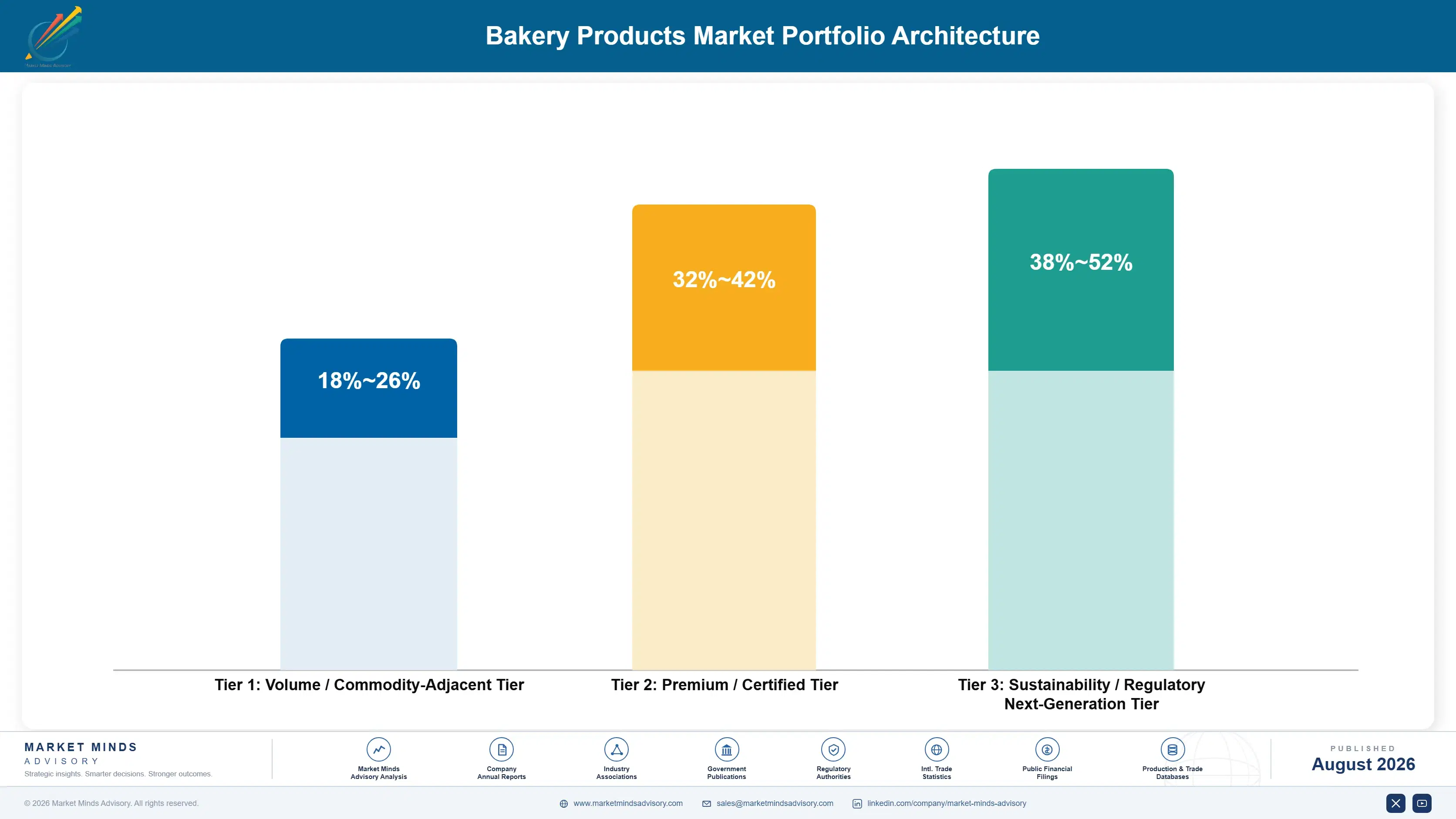
Three tiers separate on how visible the difference is to a shopper. Standard sliced bread, rolls, and value biscuits compete purely on price against private label and earn 18% to 26%. Premium sourdough, seeded, and high-protein lines, plus branded biscuits with real equity, earn 32% to 42% because the difference survives comparison on shelf. Frozen part-baked dough and laminated pastry earn most of all, and that gap has widened since 2022.
The tension is that volume tiers pay for the plant. A large bakery line needs high utilisation to recover fixed cost, and standard bread contracts deliver exactly that at almost no margin. Several European bakers have discovered that dropping the volume tier leaves an unrecoverable overhead gap, while keeping it leaves them one energy shock away from trouble. The workable answer is usually to price volume at marginal cost recovery while funding growth entirely from premium and frozen dough.

High-value pools sit where the retailer cannot easily substitute. Frozen dough for bake-off, laminated morning goods, and nutritionally differentiated bread all resist own-label imitation, either technically or because the ingredient cost cannot be stripped out invisibly.

Volume / Commodity-Adjacent Tier

Standard sliced bread, rolls, and value biscuits sold into retail contract and private label supply. Competes on delivered cost alone. The wide margin range reflects large differences in plant scale, distribution model, and energy contracting between operators.
Gross Margin: 18%-26%

Premium / Certified Tier

Sourdough, seeded, high-protein, and high-fibre breads plus branded biscuits with genuine consumer equity. Shoppers can see and taste the difference. Range width separates modest premium formats from long-fermentation artisan lines within the same tier.
Gross Margin: 32%-42%

Sustainability / Regulatory / Next-Generation Tier

Frozen part-baked dough, laminated viennoiserie, and clean-label formulations meeting acrylamide and reformulation requirements. Technical barriers and contract durability, rather than brand equity, sustain the margin structure across this tier. Contract tenure reinforces both.
Gross Margin: 38%-52%
bakery-products-market-portfolio-architecture-1787462487411

High-value Sub-segments and Strategic Watch-out

Frozen Part-Baked Dough for Retail Bake-Off

Highest value and among the fastest growing. Every oven installed in grocery creates a permanent demand point that retailers cannot backward integrate. Contract tenure is long because requalifying dough in specific ovens is disruptive, and distribution cost is far lower than daily fresh delivery. Incumbency tends to persist.
Gross Margin: 40%-52%

Laminated Viennoiserie and Morning Goods

High value with 5.8% growth, protected by butter lamination and freezing tolerance that few producers execute consistently at scale. European capability leads and exports globally. Range width reflects the gap between standard croissant lines and filled premium pastry within the same segment. Asian demand now outpaces local capability.
Gross Margin: 36%-48%

Standard Sliced Bread and Value Rolls

The volume core, declining slowly in mature markets and fully exposed to private label pricing. It keeps industrial lines loaded, which fixed-cost recovery genuinely requires, but it should be priced as ballast rather than treated as a source of margin growth. Utilisation is the only reason to hold it.
Gross Margin: 16%-24%

Mainstream Packaged Cakes and Sweet Bakery

The strategic watch-out. Advertising restrictions on less healthy food in the United Kingdom and reformulation pressure elsewhere are narrowing promotional options just as shoppers trade down. Reformulate toward reduced sugar or accept a category that shrinks in value terms. Promotional recovery alone will not work here.
Gross Margin: 24%-34%

Why Bread Buyers Rarely Switch

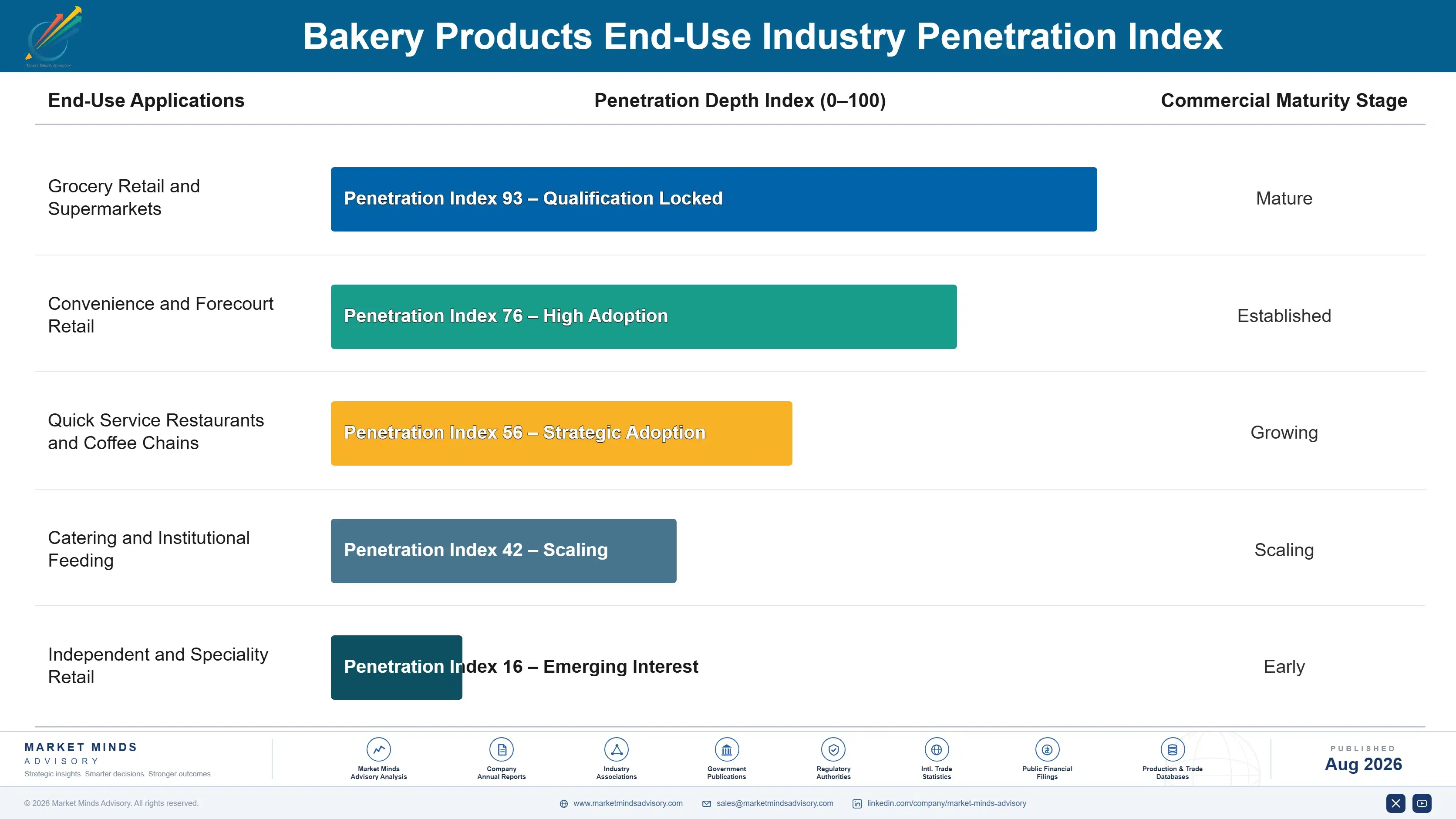
Bakery supply behaves as an annuity at the account level even though the product itself is bought daily. Once a retailer qualifies a bread specification, agrees delivery windows, and integrates a supplier into replenishment systems, that arrangement runs for years because switching means renegotiating logistics rather than merely tasting a sample. Typical retail contract tenure runs four to seven years, and frozen dough relationships run longer still because oven performance has to be revalidated.
Stickiness varies considerably by channel. Frozen dough for bake-off is the most durable, since the dough is tuned to the retailer's specific ovens and proofing schedules and any change risks visible product failure in store. Foodservice contracts come next, protected by specification stability and delivery reliability requirements. Retail private label is the least sticky of all, tendered on price at intervals of one to three years with little sentiment attached to the incumbent.

Buyer profiles have changed markedly. Category managers now arrive with nutritional reformulation targets and packaging recyclability requirements alongside cost expectations, and younger shoppers behind them read protein and fibre content before price. Recyclable packaging specifications now appear in tenders as often as price schedules do.
bakery-products-market-end-use-penetration-index-1787462487914

Where Bakery Capital Should Go

These are among the four positions where our research anticipates prominent divergence between winners and laggards over the coming forecast period. Each is grounded in the demand model, the regulatory perimeter, and the announced capacity pipeline.
01 / FROZEN DOUGH POSITIONING

Own the bake-off supply chain before retailers standardise suppliers

Every in-store oven installed becomes a permanent demand point that the retailer will not backward integrate, because dough production at scale is not a business grocers want to run. Suppliers holding these contracts earn 6 to 9 gross margin points above finished bread supply while shipping weekly rather than daily, which transforms distribution economics across the whole account base. Requalifying dough in a retailer's specific ovens is disruptive enough that incumbency, once won, tends to last well beyond the initial contract term.
02 / LAMINATION CAPABILITY INVESTMENT

Build viennoiserie capacity where technical difficulty protects the margin

Morning goods grow at 5.8% against 3.2% for standard bread, and finished product carries a price premium above 100% per kilogram because butter lamination, freezing tolerance, and proofing control defeat most would-be entrants. A commercial line costs roughly $22 million, which is precisely why the pricing has held rather than eroding. Asian and Middle Eastern demand is now growing considerably faster than local capability can serve it, and imported frozen product still carries freight and handling cost that local production would remove entirely.
03 / VOLUME TIER PRICING

Treat standard bread contracts as utilisation cover, not profit

Private label holds around 34% of packaged bakery shelf value and most shoppers cannot distinguish own-label bread from branded in blind testing, so price will keep deciding this tier for the foreseeable future. Dropping the volume entirely leaves an unrecoverable fixed-cost gap in any large plant, which is why exit is rarely the right answer for a large operator. Price it to recover marginal cost and protect utilisation, then fund every growth initiative from frozen dough and premium formats instead of from volume.
04 / NUTRITIONAL CLAIM REFORMULATION

Move the bread portfolio toward protein and fibre positioning

Shoppers comparing packs respond to protein and fibre numbers in a way they no longer respond to brand heritage, and reformulated loaves support retail pricing 60% to 90% above standard while adding perhaps 12% to ingredient cost per unit. The claim also resists private label imitation, since retailers pricing on cost cannot match the ingredient spend without undermining their own value proposition. Execution risk is real, because a high-protein loaf with poor texture fails fast and damages the wider range for months.

Engagement Snapshot From the Field

A live engagement with an industry participant carrying material or product regulatory and market exposure ahead of a defining policy shift, showing how our research translates into a defensible multi-year portfolio strategy.
MARKET MINDS ADVISORY · CLIENT ENGAGEMENT SUMMARY
Bakery Products Producer Strategic Portfolio Review and Transition Roadmap 2026·Investment Scenario on Bakery Products Exposure Evaluation 2025-26
CLIENT PROFILE
A Western European industrial bakery group operating six plants across three countries, producing sliced bread, rolls, and packaged cakes with annual revenue near EUR 780 million (client-reported, unverified by MMA). Roughly 61% of volume went to retail private label contracts, the branded portfolio had lost shelf space steadily since 2021, and two plants were running well below the utilisation their fixed cost base required.
STRATEGIC CHALLENGE
Energy and wheat inflation had compressed group margin to 4.1%, and the largest retail customer had signalled a tender that would likely cut prices further. Management was considering closing a plant, but could not establish whether the private label volume it carried was genuinely loss-making or merely absorbing overhead that would simply move elsewhere in the network.
MMA APPROACH
MMA rebuilt plant and contract profitability on a marginal cost basis rather than fully absorbed standard costing, isolating which volumes covered cash cost and which did not. Frozen dough and laminated pastry conversion options were assessed for each site against capital cost, local bake-off installation rates, and competitor capacity. Findings were tested against 47 expert interviews conducted during Q4 2025.
KEY FINDINGS
  1. Private label bread covered marginal cost at every plant but contributed nothing to fixed overhead, meaning closure would move the loss rather than remove it entirely.
  2. Two of the six sites had oven configurations suitable for frozen part-baked conversion at roughly a third of the capital cost of a new dedicated facility.
  3. Bake-off installations among grocery customers within the group's delivery radius had risen by more than half since 2022, with frozen dough sourced mainly from imports.
  4. The branded cake portfolio faced advertising restrictions in two of the three countries, making promotional recovery of lost shelf space unlikely without reformulation first.
CLIENT PROFILE
A Western European industrial bakery group operating six plants across three countries, producing sliced bread, rolls, and packaged cakes with annual revenue near EUR 780 million (client-reported, unverified by MMA). Roughly 61% of volume went to retail private label contracts, the branded portfolio had lost shelf space steadily since 2021, and two plants were running well below the utilisation their fixed cost base required.
STRATEGIC CHALLENGE
Energy and wheat inflation had compressed group margin to 4.1%, and the largest retail customer had signalled a tender that would likely cut prices further. Management was considering closing a plant, but could not establish whether the private label volume it carried was genuinely loss-making or merely absorbing overhead that would simply move elsewhere in the network.
MMA APPROACH
MMA rebuilt plant and contract profitability on a marginal cost basis rather than fully absorbed standard costing, isolating which volumes covered cash cost and which did not. Frozen dough and laminated pastry conversion options were assessed for each site against capital cost, local bake-off installation rates, and competitor capacity. Findings were tested against 47 expert interviews conducted during Q4 2025.
KEY FINDINGS
  1. Private label bread covered marginal cost at every plant but contributed nothing to fixed overhead, meaning closure would move the loss rather than remove it entirely.
  2. Two of the six sites had oven configurations suitable for frozen part-baked conversion at roughly a third of the capital cost of a new dedicated facility.
  3. Bake-off installations among grocery customers within the group's delivery radius had risen by more than half since 2022, with frozen dough sourced mainly from imports.
  4. The branded cake portfolio faced advertising restrictions in two of the three countries, making promotional recovery of lost shelf space unlikely without reformulation first.
RECOMMENDED STRATEGY
Phase 1: Phase 1 (months one to six): reprice private label contracts to marginal cost recovery and decline the tender terms rather than defending volume at any price. Phase 2: Phase 2 (months seven to eighteen): convert two sites to frozen part-baked production, targeting bake-off customers currently served by imported dough. Phase 3: Phase 3 (months nineteen to thirty-six): reformulate the cake portfolio for reduced sugar and redirect brand investment toward high-protein bread lines.
OUTCOME
The group retained four of five contested private label contracts at improved terms and reported group margin recovering from 4.1% to 7.3% within twenty months (client-reported, unverified by MMA). The first frozen dough conversion commissioned on schedule and reached 71% utilisation inside two quarters. No plant closure was required.

Frequently Asked Questions

Foundational context covering the market sizes, CAGR, scope, country, region and competition that inform every finding below. This section is provided to cover basics and most often pre-purchase conversations, answered from the MMA Primary Research Dataset.

What is the current size of the Bakery Products Market?

The market was valued at USD 486.0 billion in 2025, rising to an estimated USD 506.9 billion in 2026. East Asia holds the largest regional share at 30% of global value.

How large will the Bakery Products Market be by 2036?

MMA forecasts USD 772.3 billion by 2036 under the base case, an expansion multiple of 1.52 times the 2026 level. Incremental value creation across the period reaches USD 265.4 billion.

What is the CAGR for the Bakery Products Market 2026 to 2036?

The base case CAGR is 4.3%, with a bull case of 5.5% and a bear case of 3.1%. Historical growth between 2020 and 2025 ran at 3.6%, carried almost entirely by pricing.

Which segment is growing fastest?

Flatbreads and pizza bases, at 6.4%, roughly 1.49 times the overall market rate. Tortillas, wraps, and packaged naan are expanding well beyond their traditional consumption geographies.

Who are the major companies in the Bakery Products Market?

Grupo Bimbo, Yamazaki Baking, Mondelez International, Flowers Foods, and Aryzta lead, though the top five hold only about 9% of global output. Barilla and Britannia follow.

Which country is growing fastest?

India, at 7.1%, driven by biscuit distribution reaching millions of small outlets and by packaged bread penetration in urban centres. Packaged flatbread industrialisation adds further momentum.

Report Segmentation Architecture

The full report scope spans multiple orthogonal segmentation dimensions, with cross-tabulated demand data provided for each dimension pair. Coverage extends further to regional breakdowns, trend trajectories, and the competitive detail needed to support segment-level decision-making.

By Product Type

  • Bread and Rolls
  • Cakes and Sweet Bakery
  • Biscuits and Cookies
  • Morning Goods and Viennoiserie
  • Flatbreads and Pizza Bases
  • Savoury Pies and Filled Pastry

By End-Use Industry

  • Grocery Retail and Supermarkets
  • Convenience and Forecourt Retail
  • Quick Service Restaurants and Coffee Chains
  • Catering and Institutional Feeding
  • Independent and Speciality Retail

By Commercial Dimension

  • Branded Manufacturer Supply
  • Retailer Private Label Contract
  • Frozen Part-Baked and Bake-Off Supply
  • Foodservice Direct Supply

By Region

  • North America
  • Western Europe
  • East Asia
  • South Asia and Pacific
  • Latin America
  • Middle East and Africa
  • Eastern Europe

Scope, Methodology, and Coverage

Every figure in this report is reproducible from documented input assumptions. The scope below maps the historical period, the forecast horizon, the segmentation dimensions, and the countries covered, alongside the underlying primary and qualitative methodology.
Historical Period
2020 to 2025
Forecast Period
2026 to 2036
Base Year
2025 (USD billions; MMA Primary Research Dataset, August 2026)
Market Definition
The market comprises baked products manufactured for human consumption and sold through retail, foodservice, and in-store bakery channels, covering bread and rolls, cakes and sweet bakery, biscuits and cookies, morning goods and viennoiserie, flatbreads and pizza bases, and savoury pies and filled pastry. Industrial, in-store, and craft production are all captured at final product value. Bakery ingredients, dough improvers, mixes, and production equipment sold to bakers fall outside scope, as do extruded or fried cereal snacks.
Quantitative Units
USD billions (current prices); tonnes of finished product; USD per kilogram retail equivalent price
Segmentation Dimensions
By Product Type; By End-Use Industry; By Commercial Dimension; By Region
Regions Covered
North America, Western Europe, East Asia, South Asia and Pacific, Latin America, Middle East and Africa, Eastern Europe
Countries Covered
USA, China, Germany, France, UK, Japan, South Korea, India, Australia, Canada, Brazil, Mexico, Indonesia, Vietnam, Thailand, Malaysia, UAE, Saudi Arabia, South Africa, Nigeria, Turkey, Poland, Netherlands, Italy, Spain, Sweden, Switzerland, Argentina, Colombia, Singapore, and additional markets relevant to this sector
Key Companies Profiled
Grupo Bimbo, Yamazaki Baking, Mondelez International, Flowers Foods, Aryzta, Barilla Group, Lantmannen Unibake, Associated British Foods, Europastry, La Lorraine Bakery Group, Vandemoortele, Warburtons, Bakkavor Group, Premier Foods, Britannia Industries, Rich Products Corporation, Dawn Foods, The Campbell's Company, Greggs plc, McKee Foods
Quantitative Methodology
Primary survey, n=3,800 respondents, Q4 2025, six countries; demand-side model with trade association cross-validation
Qualitative Methodology
47 expert interviews, Q4 2025; applied to validate demand model assumptions, identify emerging dynamics, and assess competitive positioning
Report Format
PDF and XLSX data workbook (Word format preview document)
Publisher
Market Minds Advisory
Report Code
MMA-2026-AGR-207
Published
August 2026
Contact
sales@marketmindsadvisory.com | www.marketmindsadvisory.com

Purchase the full Bakery Products Market Report (2026 to 2036).

The full report sizes bakery demand across six product types and seven regions with 2026 to 2036 forecasts under base, bull, and bear cases. It quantifies the transfer of volume from craft baking into frozen part-baked supply, market by market, using bake-off installation data alongside independent bakery closure rates. Competitive profiles cover twenty producers assessed consistently on manufacturer-level bakery revenue, distribution reach, and frozen dough capability. Input cost modelling traces wheat, butter, and thermal energy exposure by production scale. Commercial guidance addresses frozen dough contracting, lamination investment cases, private label pricing discipline, and nutritional reformulation.
Six product types sized and forecast separately
Bake-off transfer quantified across seven regional markets
Twenty producer profiles on consistent revenue basis
Wheat, butter, and energy exposure modelled by scale
Private label penetration tracked by country and format
Lamination and frozen dough investment payback benchmarks

Built For The People Who Decide

From boardroom strategy to bench-side execution, this report is read cover-to-cover by leaders shaping the next decade of their industry, turning demand scenarios, market dynamics and valuation benchmarks into decisions.
CXOs/ Presidents/ VPs/ Managers
M&A and Corporate Development
Strategy Teams and R&D Heads
Procurement and Product Directors
Regulatory and Compliance Leaders
Investor Relations and Equity Analysts