

Market Minds Advisory
Bakery Fat Market

Bakery Fat Market: Trans-Fat Rules Force a Slow Industrial Reformulation

Shortening and margarine producers are re-engineering bakery fat formulations around interesterification as trans-fat restrictions and palm sourcing scrutiny reshape a mature ingredient category built on decades-old hydrogenation chemistry across most producing regions.

Lead Analyst

Lisa Gevelber

Published

September 2026

Make Smarter Decisions with Customized Research Insights

Request a free sample report and evaluate market opportunities, growth trends, and competitive dynamics relevant to your business needs.

2025 MARKET VALUE$12.6BMarket Size 2025
2036 FORECAST VALUE$19.8BBase Case , 2026 to 2036
CAGR 2026 TO 20364.2 %Bull 5.4% / Bear 3.0%
INCREMENTAL OPPORTUNITY$6.7BNet 10- year value creation
EXPANSION MULTIPLE1.51x2036 value over 2026 base
Strategic Levers
M&A Pipeline
Regional Outlook
Country Rankings
Competitive Intelligence
Segmental Deep-dive
Call-Us : 91 93563 13602

Executive Snapshot and Market Trajectory

Bakery fat reached USD 12.6 billion in 2025, a mature industrial ingredient category now undergoing its most significant technical shift in decades as partial hydrogenation gives way to interesterification across nearly every major producing region worldwide, a slow but decisive shift several years already in the making today.
Interesterified trans-fat-free fats grow fastest at 6.8%, about 1.62 times the overall 4.2% rate, as national trans-fat bans and retailer reformulation deadlines push producers away from the partially hydrogenated oils that once defined the category's texture and cost profile for decades across most markets. East Asia leads on packaged bakery consumption scale, while India posts the quickest national growth as branded bakery penetration expands into previously informal, unbranded segments of the market.
Concentration sits moderately high at a CR5 of 52%, dominated by vertically integrated oils and fats majors with direct palm, soy, and rapeseed supply chains rather than pure-play ingredient formulators lacking upstream access to feedstock supply. Palm oil sourcing scrutiny and interesterification capacity investment are the two forces deciding which producers hold pricing power as the transition continues through the next decade of gradual change.
Market Definition
The bakery fat market covers shortenings, margarines, and specialty fats formulated for bread, cake, pastry, and biscuit manufacturing, including palm-based, interesterified, and cocoa butter alternative fat systems. It excludes cooking and frying oils sold for non-bakery food service use and butter or dairy-based fats sold as standalone retail products.
Base Year Value
$12.6B in 2025 (MMA Primary Research Dataset, August 2026)
Forecast Period
2026 to 2036, eleven discrete annual values
CAGR
4.2% base case. Bull 5.4%. Bear 3.0%.
Fastest Growth Segment
Interesterified Trans-Fat-Free Fats: 6.8% CAGR
Fastest Growth Country
India: 7.5% CAGR
Fastest Growth Region
South Asia and Pacific: 6.2% CAGR
Largest Region
East Asia: 27% of 2025 global value
Market Leaders
AAK AB, Bunge Limited, Cargill, IOI Loders Croklaan, Fuji Oil Holdings. Source: MMA Analysis based on company annual reports.
Primary Survey
n=3,800 procurement and R&D decision-makers, Q4 2025, six countries
Methodology
Demand-side build-up, cross-validated against public data, 47 expert interviews

Bakery Fat Market Forecast Scenarios

bakery-fat-market-trends-growth-size-forecast-scenario-1787461996340
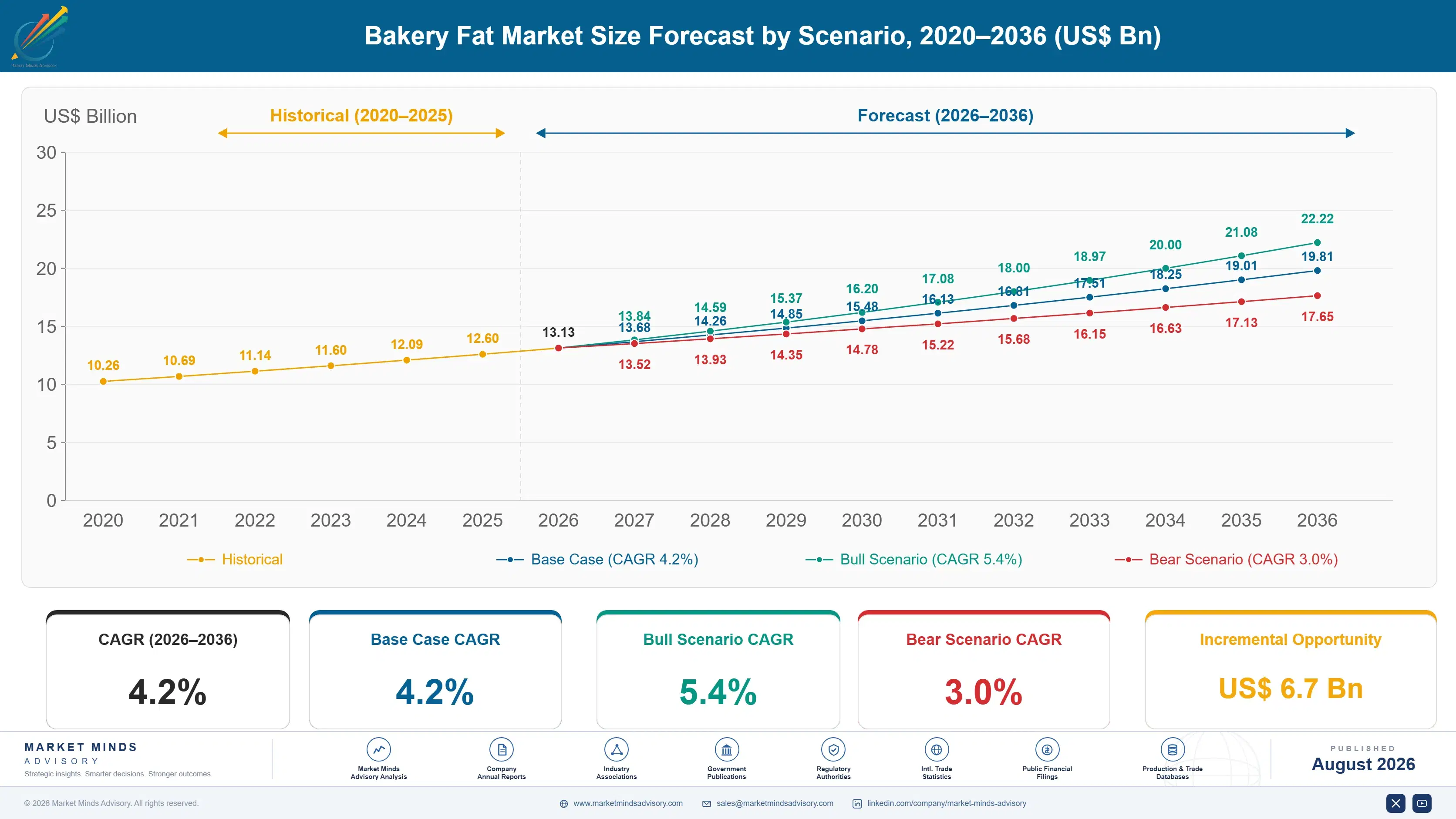
Between 2020 and 2025 the market grew near 3.6% annually, a mature pace typical of an established food ingredient category where volume tracks packaged bakery consumption more than any specific formulation trend. Interesterification capacity additions began accelerating late in the period as more national governments finalized trans-fat restrictions following the World Health Organization's global elimination target.
The base case carries the market to 4.2% through 2036 on three mechanisms. First, national trans-fat bans and retailer specification changes keep pushing volume from partially hydrogenated fats toward interesterified alternatives across markets not yet complete. Second, packaged and branded bakery consumption keeps expanding across East Asia and South Asia as formal retail replaces informal purchasing. Third, cocoa butter equivalent demand grows steadily as manufacturers seek cost-managed alternatives to volatile cocoa pricing.
The bull case reaches 5.4% if additional major markets finalize trans-fat restrictions faster than currently scheduled, compressing the reformulation timeline industry-wide. The bear case falls to 3.0% if palm oil sourcing costs rise sharply enough to slow bakery fat volume growth in price-sensitive emerging markets, a pattern already visible during past palm price spikes that depressed packaged bakery consumption in several Asian markets.

A Mature Category Mid-Way Through a Slow Technical Transition

Bakery fat is not a growth category in the way plant protein or functional beverages are, and nobody in the industry pretends otherwise. It is a mature, technically demanding ingredient business where the real competitive action lives in reformulation cycles, feedstock sourcing strategy, and the quiet migration away from partially hydrogenated oils that regulators worldwide have spent two decades steadily restricting.
MARKET CONCENTRATIONCR5: 52%Dominated by vertically integrated oils and fats majors
AVERAGE SELLING PRICEUSD 1.10 to 2.60/kgReflects formulation complexity and feedstock sourcing origin closely
TOP PRODUCING REGION SHAREEast Asia: 27%Anchored by packaged bakery and biscuit manufacturing scale
CAPACITY UTILISATION76% to 84%Reflects a mature category with modest incremental capacity growth
FEEDSTOCK SHARE OF COGS60% to 70%Palm, soy, and rapeseed oil pricing dominates cost structure
REPLACEMENT CYCLE LENGTH3 to 5 yearsTime between major bakery producer formulation requalification rounds
Commercially, the category behaves like a specialty industrial input dressed in food packaging. Formulators sell functional performance, melting profile, texture, shelf stability, alongside the fat itself, and switching costs are real once a bakery has requalified its recipe around a specific fat's crystallization behavior. That technical lock-in supports steadier margins than the category's mature growth rate might otherwise suggest to an outside observer.
Over the next decade, the pace of remaining national trans-fat restrictions and the direction of palm oil sourcing scrutiny will decide how much reformulation spend still lies ahead versus how much of the transition is already behind the industry. Producers with interesterification capacity already built are positioned to capture the remaining conversion volume regardless of how quickly individual national deadlines eventually arrive.
"This is not an exciting ingredient category, and that is precisely the point. Bakeries do not want excitement from their fat supplier. They want the same melt curve, batch after batch, for the next five years, and whoever guarantees that wins the account."
Director, Food and Agricultural Ingredients Practice · MMA Food and Agricultural Ingredients Practice · August 2026

Market Trends

Interesterification Capacity Investment Accelerates Across the Industry

Major oils and fats producers have committed significant capital to interesterification capacity over the past several years, converting fat modification processes away from partial hydrogenation toward enzymatic and chemical interesterification that avoids trans-fat formation entirely. This shift follows the World Health Organization's global elimination target and subsequent national regulatory action across dozens of countries. AAK, Bunge, and Cargill have each expanded interesterification lines at existing facilities rather than building entirely new plants, reflecting the technology's maturity. The remaining capacity gap is concentrated in emerging markets where regulation has arrived more recently.
Market Impact: Affects formulation in 50 countries

Branded Bakery Penetration Expands Across South Asia

Packaged and branded bakery products are steadily displacing informal, unbranded bakery purchasing across India and other South Asian markets, a shift that increases bakery fat demand per unit of bread or biscuit sold since branded manufacturers specify consistent fat formulations rather than sourcing whatever is locally available. This transition mirrors a pattern already completed in East Asia over the previous decade and is now following a similar trajectory across the subcontinent. Multinational and domestic branded bakery manufacturers expanding retail distribution into smaller Indian cities are the primary driver, requiring bakery fat suppliers to scale distribution alongside them.
Market Impact: Cuts cost 30% versus pure cocoa

Market Opportunities and Growth Drivers

National Trans-Fat Bans Force Systematic Reformulation

More than 50 countries have implemented mandatory limits on industrially produced trans fat following the World Health Organization's REPLACE initiative, forcing bakery fat producers to complete reformulation away from partially hydrogenated oils on defined regulatory timelines rather than at their own preferred pace and schedule. Countries finalizing restrictions more recently, including several in South Asia and Africa, are creating fresh reformulation demand even as more mature markets complete their own transitions. This regulatory sequencing effectively staggers reformulation-driven demand over a longer period than a single global deadline would have produced.
Market Impact: Adds 8% to 15% cost

Cocoa Butter Price Volatility Lifts Equivalent Demand

Sustained cocoa butter price increases, driven by West African crop shortfalls and rising global chocolate demand, have pushed confectionery and bakery manufacturers toward cocoa butter equivalents and substitutes formulated from palm and shea fractions. These alternatives replicate cocoa butter's melting profile at a fraction of the cost during periods of extreme cocoa price volatility, making them an increasingly standard component of chocolate coating and filling formulations rather than a purely cost-driven substitution used only during price spikes. Fuji Oil and AAK have both expanded cocoa butter equivalent capacity specifically to capture this durably growing demand.
Market Impact: Excludes uncertified suppliers, 40% of contracts

Market Restraints and Challenges

Interesterified Fats Carry Higher Production Costs Than Hydrogenated Alternatives

Interesterification processing, whether chemical or enzymatic, adds meaningful cost relative to the partial hydrogenation it replaces, since the process requires additional catalysts, longer processing times, or costlier immobilized enzyme systems depending on the method used. The root cause is technical: interesterification rearranges fatty acid positions on the glycerol backbone through a more controlled process than simple hydrogenation ever required. This cost gap falls hardest on smaller regional producers lacking scale to absorb the added processing expense, squeezing margins during the transition period. Several producers are investing in enzymatic interesterification for its lower long-term cost.
Market Impact: Adds 8 new interesterification lines

Palm Oil Sourcing Faces Mounting Deforestation Scrutiny

Palm oil, the primary feedstock for a large share of global bakery fat production, faces sustained scrutiny over deforestation and land use practices in Indonesia and Malaysia, pushing major bakery brands to require certified sustainable sourcing as a purchasing condition. The root cause is the industry's continued reliance on plantation expansion in carbon-dense tropical forest and peatland areas to meet rising global demand. This restricts smaller producers without established Roundtable on Sustainable Palm Oil certification from competing for major branded contracts, regardless of their pricing. Larger producers are expanding certified plantation partnerships.
Market Impact: Lifts branded bakery fat demand 15%
3 additional market trends, 3 additional growth drivers, and 4 additional restraints and challenges are covered in the full report. Contact sales@marketmindsadvisory.com to access the complete intelligence.

Segment CAGR and Growth Architecture

Segmentation follows fat modification technology, a single processing dimension shared across every bakery fat product sold into global food manufacturing worldwide today. Each technology carries distinct cost, regulatory, and functional performance characteristics, so commercial position tracks the underlying processing method itself rather than the specific bakery application, geography, or buyer type it ultimately serves.
bakery-fat-market-trends-growth-market-share-analysis-1787461996871

Interesterified Trans-Fat-Free Fats

Interesterified trans-fat-free fats grow fastest at 6.8%, about 1.62 times the overall 4.2% rate, as national trans-fat bans and retailer specification changes push volume away from partially hydrogenated alternatives across markets still completing the transition. Growth concentrates most heavily in South Asia, Africa, and parts of Eastern Europe, where trans-fat regulation has arrived more recently than in North America and Western Europe, which largely completed their own conversion years earlier. Producers with established interesterification capacity, whether chemical or enzymatic, are capturing this remaining conversion volume ahead of smaller regional competitors still relying on partial hydrogenation. Enzymatic interesterification is gaining share as producers seek lower long-term processing costs than chemical alternatives can offer.
CAGR 6.8%

Non-Hydrogenated Vegetable Oil Blends

Non-hydrogenated vegetable oil blends, formulated from naturally solid or fractionated oils without any hydrogenation step, grow at 5.9% as clean label pressure pushes some bakery manufacturers to avoid interesterification processing entirely rather than simply avoiding trans fat. This segment appeals particularly to premium and artisanal bakery brands willing to accept somewhat different functional performance in exchange for a simpler ingredient declaration on packaging labels. Palm fractionation technology, separating naturally solid and liquid fractions without chemical modification, underpins most commercial products in this category today. Growth trails the fastest segment because functional performance limitations still restrict broader adoption across mainstream, cost-sensitive bakery applications where interesterified fats remain the more practical and widely accepted choice.
CAGR 5.9%
Full segment breakdown across 6 segments available in the complete report.

Regional Architecture and Country Demand Map

East Asia leads on packaged bakery and biscuit manufacturing scale, followed by North America and Western Europe, both mature markets that completed most trans-fat reformulation years ago already. South Asia and Pacific posts the fastest regional growth as branded bakery penetration continues expanding steadily nationwide.

North America

The United States anchors regional demand through an established packaged bakery and quick-service restaurant sector that completed most of its trans-fat reformulation following the Food and Drug Administration's 2015 determination that partially hydrogenated oils are not generally recognized as safe. That regulatory action, among the earliest and strictest globally, means American bakery fat producers now compete primarily on cost and formulation refinement rather than on completing a reformulation transition still underway elsewhere. Canada follows a broadly similar regulatory and commercial pattern, having implemented its own trans-fat restrictions shortly after the United States. Mexico contributes a smaller, faster-growing market where branded bakery penetration still has meaningful room to expand beyond established urban centers into smaller cities and towns.
Share: 22% | CAGR: 3.3% (2026 to 2036)

Western Europe

Germany, France, and the United Kingdom drive regional demand through mature bakery manufacturing sectors operating under European Union trans-fat limits finalized in 2019, among the more recent major regulatory actions globally despite the region's early reputation for food safety leadership. Growth trails the global average because both the reformulation transition and packaged bakery penetration are largely complete across most of the region's major markets. Southern European markets, including Spain and Italy, add modest additional demand tied to traditional pastry and bread manufacturing that has been slower to shift toward fully industrialized production methods. Scandinavian markets contribute a smaller but steadily growing segment oriented toward clean label and non-hydrogenated fat formulations specifically.
Share: 19% | CAGR: 2.8% (2026 to 2036)
Regional intelligence for 5 additional markets available in the complete report: East Asia, South Asia and Pacific, Latin America, Middle East and Africa, Eastern Europe. Contact sales@marketmindsadvisory.com.
bakery-fat-market-trends-growth-country-cagr-analysis-1787461997395

Margin Levers in a Mature Fat Category

Genuine growth in bakery fat is scarce, so margin improvement depends on capturing the remaining reformulation transition and technical service value rather than chasing broad volume expansion across price-sensitive emerging markets everywhere today. The four moves below target where producers can extract real margin from a mature but still technically evolving category over time.

Prioritize Enzymatic Interesterification Capacity Investment Now

Chemical interesterification remains the more common processing method today, but enzymatic interesterification delivers meaningfully lower long-term per-unit processing cost once the upfront immobilized enzyme investment is recovered, typically within 3 to 4 years of commissioning a new production line. Producers who commit to enzymatic capacity now, ahead of full amortization pressure across the category, will hold a durable cost advantage over competitors still running chemical processes as the remaining trans-fat reformulation volume gets contested on price. This positions early movers to win reformulation contracts in emerging markets where cost sensitivity remains highest.
Market Impact: Cuts long-term processing cost by 12% to 18%

Build Certified Sustainable Palm Supply Chains

Major branded bakery manufacturers increasingly require Roundtable on Sustainable Palm Oil certified sourcing as a non-negotiable purchasing condition, excluding uncertified suppliers from roughly 40% of premium branded contracts regardless of their pricing competitiveness or existing customer relationships built over years. Producers investing in traceable, certified plantation partnerships ahead of broader industry mandates are winning long-term supply agreements with multinational bakery brands seeking to lock in compliant sourcing before certification requirements tighten further across the category. This certification investment increasingly functions as market access infrastructure rather than a discretionary sustainability initiative.
Market Impact: Gains access to roughly 40% more premium contracts

Expand Cocoa Butter Equivalent Production Capacity

Sustained cocoa butter price volatility has made cocoa butter equivalents and substitutes, formulated from palm and shea fractions, an increasingly standard rather than opportunistic component of chocolate coating formulations, cutting formulation cost by roughly 30% relative to pure cocoa butter during price spikes. Producers expanding dedicated equivalent capacity are capturing share from cocoa butter itself as confectionery manufacturers permanently shift a portion of their formulation toward these alternatives rather than treating them as temporary substitutes during price spikes alone. Fuji Oil and AAK have both prioritized this expansion ahead of smaller competitors.
Market Impact: Captures 30% cost advantage over pure cocoa butter

Offer Technical Requalification Support Bundled With Supply

Bakery manufacturers requalifying recipes around interesterified fats need formulation and technical support more than they need a marginally cheaper fat, since a failed reformulation risks visible texture or shelf-life defects in a finished branded product sold nationally across major retail grocery channels. Suppliers offering embedded application labs and rapid melting-profile testing capture reformulation projects at pricing 10% to 15% above suppliers offering no technical service, because the service compresses a bakery's own requalification timeline meaningfully. This technical bundling also raises switching costs once a bakery completes a full requalification cycle.
Market Impact: Lifts realized pricing by 10% to 15% per contract

Who Controls the Margin Pool

Concentration sits moderately high at a CR5 of 52%, dominated by vertically integrated oils and fats majors with direct palm, soy, and rapeseed supply chains rather than pure-play formulators lacking upstream access. The gap between AAK, the category's technical leader, and the next tier of integrated producers is meaningful but not decisive. All participants are assessed on one basis: revenue attributable to bakery fat product lines.
Current competitive activity runs along three lines. Interesterification capacity, particularly enzymatic capability, increasingly differentiates producers competing for remaining reformulation volume in markets completing their transition. Certified sustainable palm sourcing has become a genuine market access requirement rather than a differentiator, excluding uncertified suppliers from major branded contracts outright. Cocoa butter equivalent capacity expansion is emerging as a meaningful growth opportunity for producers positioned to capture volume from cocoa volatility.

Emerging pressure comes from Asian domestic oils and fats processors building interesterification and certification capability close to their feedstock base, challenging the advantage global majors held through technical depth alone. Rankings over the next five years will likely shift toward whichever producers combine enzymatic cost advantages with fully certified palm supply chains, since that addresses both the category's technical transition and tightening market access requirements.
bakery-fat-market-trends-growth-company-positioning-matrix-1787461997914

Competitive Moat and Risk Dimensions

AAK AB

Moat: Deep technical formulation expertise

AAK's decades of specialty fat customization experience give it formulation depth that vertically integrated commodity oil producers cannot easily replicate, letting it solve precise melting-profile and texture requirements for premium bakery and confectionery brands worldwide. This technical reputation supports pricing well above commodity-grade fat suppliers.
AAK AB

Risk: Concentrated palm sourcing exposure

AAK's substantial reliance on palm-derived feedstock exposes it directly to deforestation scrutiny and certification cost pressure, and any further tightening of sustainable sourcing requirements or Indonesian and Malaysian export policy could compress margins faster than its technical differentiation can realistically offset over the long run.
CARGILL

Moat: Integrated global oilseed supply chain

Cargill's direct ownership across soy, palm, and rapeseed origination gives it cost and reliability advantages that pure-play formulators buying through intermediaries cannot match, particularly during periods of feedstock price volatility across multiple commodities. That integration also supports faster reformulation turnaround for large multinational bakery accounts.
CARGILL

Risk: Commodity exposure across multiple oils

The same feedstock breadth that supports Cargill's sourcing advantage also exposes it to simultaneous price swings across soy, palm, and rapeseed markets, complicating margin stability during periods when several commodity categories move sharply against the company at the same time and in the same direction.

Players Tracked

Prominent Players

AAK AB
Bunge Limited
Cargill
IOI Loders Croklaan
Fuji Oil Holdings

Other Key Players

Wilmar International
Musim Mas Group
IFFCO Group
Sime Darby Oils
Vandemoortele
Puratos Group
Zeelandia
CHS Inc
Adani Wilmar
Walter Rau Neusser Ol und Fett
Mewah Group
Emmelev
Oleon NV
PT Salim Ivomas Pratama
Colin Ingredients

Recent Developments

JANUARY 2025

AAK Expands Enzymatic Interesterification Capacity in Malaysia

AAK commissioned additional enzymatic interesterification capacity at its Port Klang facility to serve growing trans-fat-free reformulation demand across South and Southeast Asia. The expansion was funded from AAK's own capital budget as an organic capacity addition, not an acquisition or partnership. Full production ramp is expected within twelve months.
Signal: Confirms enzymatic processing is now a priority capital allocation decision, not merely a pilot-scale experimental technology.
MAY 2025

Fuji Oil and a Ghanaian Shea Cooperative Form Supply Joint Venture

Fuji Oil entered a joint venture with a Ghanaian shea butter cooperative to secure long-term feedstock supply for its cocoa butter equivalent lines. The venture combines Fuji Oil's processing capability with the cooperative's grower relationships to reduce exposure to price volatility. Initial contracted volume covers several thousand tonnes annually.
Signal: Signals that alternative feedstock security is now viewed as important as processing technology itself in this category.
SEPTEMBER 2025

Bunge Acquires Regional Interesterification Facility in India

Bunge acquired a mid-sized Indian interesterification facility to expand its trans-fat-free bakery fat capacity ahead of the country's continued branded bakery growth. The acquired facility brought established local distribution relationships that Bunge previously lacked domestically. Integration is expected to complete within nine months of close.
Signal: Confirms global majors now see Indian processing capacity as a direct, worthwhile acquisition target rather than a supply partner.

Palm, Soy, and Rapeseed Feedstock Exposure

Palm, soy, and rapeseed oils together account for 60% to 70% of cost of goods sold across bakery fat producers, sourced from Indonesian and Malaysian palm plantations, North and South American soybean crush facilities, and European and Canadian rapeseed processors. This concentration leaves the category exposed to weather and policy shocks in any single major producing region.
Indonesia's 2022 palm oil export ban, implemented to manage domestic cooking oil shortages and documented in Ministry of Trade policy announcements, disrupted global palm supply chains sharply and pushed bakery fat input costs up by more than 25% within a single quarter. Producers without diversified sourcing across multiple origin countries absorbed the bulk of that spike directly, since most supply contracts do not allow rapid cost pass-through mid-contract.

Exposure varies by producer integration and feedstock diversification. Vertically integrated majors with direct plantation and crush facility ownership absorb feedstock volatility more smoothly than formulators buying through spot markets, who face sudden margin compression during supply disruptions. Geography matters too: producers sourcing rapeseed from Canadian and European growers face different seasonal risk than those dependent primarily on tropical palm supply.
bakery-fat-market-trends-growth-cost-volatility-analysis-1787461998110

Diversify Feedstock Sourcing Across Multiple Oil Types

Producers blending palm, soy, and rapeseed inputs rather than relying primarily on one single feedstock reduce exposure to any single origin country's weather, policy, or export disruption events over a full growing season each year. This adds formulation complexity but meaningfully smooths aggregate input cost volatility across a full multi-year sourcing cycle and planning horizon.

Secure Multi-Year Plantation Partnership Agreements

Direct multi-year partnerships with certified palm plantations, bypassing intermediate traders entirely, lock pricing terms and protect against the export policy shocks that have periodically disrupted unsecured spot buyers in recent years across the wider industry. This requires closer grower relationship management but delivers meaningfully more predictable feedstock costs over time and across full budgeting cycles.

Expand Rapeseed and Soy-Based Formulation Alternatives

Some producers are developing bakery fat formulations that shift a greater share of feedstock toward rapeseed and soy relative to palm, reducing concentrated exposure to Indonesian and Malaysian export policy specifically and directly over time and each season. This raises formulation complexity but genuinely diversifies the underlying feedstock risk profile across the whole business.

Portfolio Architecture for Margin Defence

The portfolio splits into three tiers with meaningful margin separation tied to formulation technology and certification status rather than raw feedstock cost alone. Commodity palm-based shortenings compete mainly on price and delivery reliability, while certified, interesterified, and specialty fat systems command durable premiums tied to technical performance and sourcing credentials across every major market.
The tension between volume and premium is sharpening as certified and interesterified capacity requirements expand faster than commodity shortening demand, pulling producer investment toward the higher-margin segment even though commodity-grade fat remains the larger volume base globally today. Producers that maintain a foothold in both segments preserve optionality, while those chasing only certified premium volume risk losing the stable cash flow that commodity bakery fat demand still reliably provides across price-sensitive emerging markets.

High-value margin pools concentrate specifically in enzymatic interesterified fats and certified cocoa butter equivalents, both requiring real capital investment and certification infrastructure ahead of confirmed long-term contract volume. Commodity palm-based shortenings, by contrast, remain a large but slow-growing volume base offering thin, stable margins rather than genuine expansion opportunity for most producers going forward into the next decade.

Volume / Commodity-Adjacent Tier

Standard palm-based shortenings and margarines sold primarily on price and delivery reliability into cost-sensitive emerging market bakery manufacturing and informal, unbranded bakery segments still transitioning toward packaged branded products nationwide.
Gross Margin: 12-20%

Premium / Certified Tier

Roundtable on Sustainable Palm Oil certified and interesterified trans-fat-free fat systems serving major branded bakery manufacturers with mandatory sourcing requirements and consistent quality specifications across every single production run nationwide.
Gross Margin: 24-34%

Sustainability / Regulatory / Next-Generation Tier

Enzymatic interesterified fats and certified cocoa butter equivalents representing the newest and most technically demanding corner of the portfolio, requiring significant upfront capital and formulation expertise to commercialize successfully today.
Gross Margin: 28-40%
bakery-fat-market-trends-growth-portfolio-architecture-1787461998611

High-value Sub-segments and Strategic Watch-out

Enzymatic Interesterified Fats

High value and high growth, delivering lower long-term processing cost than chemical alternatives once upfront enzyme investment is fully recovered after several years of commissioned operation. Producers investing early are capturing the category's fastest-growing reformulation contracts across emerging markets worldwide, well ahead of slower-moving competitors.
Gross Margin: 28-40%

Certified Cocoa Butter Equivalents

High value with moderate growth, benefiting from sustained cocoa price volatility that has made equivalents a standard rather than opportunistic formulation choice across confectionery manufacturing worldwide today. Fuji Oil and AAK lead this increasingly strategic and rapidly expanding segment, well ahead of smaller regional competitors.
Gross Margin: 26-38%

Standard Palm-Based Shortenings

The volume core, serving cost-sensitive bakery manufacturing across emerging markets still transitioning toward branded and packaged products from informal, unbranded purchasing patterns nationwide and across smaller towns. Steady growth tracks packaged bakery penetration rather than any specific formulation trend or premium pricing shift emerging soon.
Gross Margin: 12-20%

Uncertified Commodity Palm Fat Supply

The strategic watch-out, facing accelerating exclusion from major branded contracts as sustainable sourcing certification becomes a non-negotiable purchasing requirement across most developed and emerging markets worldwide today and increasingly going forward. Remaining demand concentrates in markets with weaker certification enforcement and regulatory oversight standards overall.
Gross Margin: 10-16%

Formulation Lock-In Around Fat Crystallization

Demand compounds through formulation lock-in tied to fat crystallization behavior rather than repeat commodity purchasing. Once a bakery requalifies a recipe around a fat's melting profile and texture contribution, switching suppliers means repeating shelf-life testing that typically runs several months. That lock-in makes won formulations closer to an annuity than a spot sale, since a bakery rarely revisits a working system absent a regulatory mandate or a serious cost disruption.
Adoption depth varies by end-use vertical. Industrial biscuit and cracker manufacturers show the deepest lock-in, often running one qualified formulation for years given the complexity of large-scale continuous lines. Artisanal and premium bakery brands behave differently, more willing to reformulate around non-hydrogenated or clean label systems as a marketing differentiator. Confectionery and chocolate coating manufacturers sit between the two, updating formulations mainly when cocoa pricing shifts.

Generational buyer shifts are reshaping who makes these decisions. Procurement authority is moving from centralized global sourcing teams toward regional formulation specialists closer to local feedstock and regulatory conditions, particularly across fast-growing South Asian and African markets completing their own transitions. Younger formulation teams entering premium bakery categories weigh sourcing certification and ingredient simplicity more heavily than legacy procurement focused on cost.
bakery-fat-market-trends-growth-end-use-penetration-index-1787461999097

Where Bakery Fat Producers Should Focus

These are among the four positions where our research anticipates prominent divergence between winners and laggards over the coming forecast period. Each is grounded in the demand model, the regulatory perimeter, and the announced capacity pipeline.
01 / ENZYMATIC CAPACITY TIMING

Commit to Enzymatic Processing Ahead of Amortization Pressure

Enzymatic interesterification delivers meaningfully lower long-term processing cost than chemical alternatives, but only once the upfront immobilized enzyme investment is fully recovered, typically within three to four years of commissioning a new line. Producers who commit capital now, while remaining trans-fat reformulation volume is still being contested, will hold a durable cost advantage over competitors still running chemical processes as that volume gets priced more competitively. Waiting until the transition nears completion means competing on price against producers who locked in this advantage years earlier.
02 / PALM CERTIFICATION INVESTMENT

Build Certified Supply Before Access Requirements Tighten

Major branded bakery manufacturers already exclude uncertified suppliers from roughly 40% of premium contracts, and that requirement will almost certainly tighten further as more retailers and brands finalize their own sustainable sourcing commitments over the coming years. Producers investing in traceable, certified plantation partnerships now secure market access before certification becomes table stakes across the entire branded segment rather than a differentiator. This positions early movers to win long-term supply agreements from bakery brands seeking to lock in compliant sourcing ahead of tightening requirements.
03 / COCOA BUTTER SUBSTITUTION

Expand Equivalent Capacity While Cocoa Prices Stay Volatile

Sustained cocoa butter price volatility has made cocoa butter equivalents a permanent rather than opportunistic component of chocolate coating formulations, and producers expanding dedicated capacity now are capturing share that will likely persist even if cocoa prices eventually stabilize in future seasons. Fuji Oil and AAK have already prioritized this expansion, and competitors delaying investment risk ceding this increasingly strategic segment permanently. The window to establish equivalent capacity ahead of broader industry investment is narrowing each year cocoa prices remain elevated.
04 / EMERGING MARKET REFORMULATION

Prioritize South Asian and African Reformulation Contracts Now

South Asia and Africa are completing their trans-fat transitions later than North America and Western Europe, creating fresh reformulation demand that producers with established local distribution and technical service capability are best positioned to capture. Global majors without regional presence risk losing this remaining conversion volume to domestic processors building interesterification capability closer to local feedstock and regulatory conditions. Establishing technical service infrastructure in these markets now, ahead of full reformulation completion, secures relationships that will persist well beyond the transition itself.

Engagement Snapshot From the Field

A live engagement with an industry participant carrying material or product regulatory and market exposure ahead of a defining policy shift, showing how our research translates into a defensible multi-year portfolio strategy.
MARKET MINDS ADVISORY · CLIENT ENGAGEMENT SUMMARY
Bakery Fat Producer Strategic Portfolio Review and Transition Roadmap 2026·Investment Scenario on Bakery Fat Exposure Evaluation 2025-26
CLIENT PROFILE
A regional Indian packaged bakery manufacturer approached MMA after the Food Safety and Standards Authority of India finalized trans-fat limits requiring reformulation of its core biscuit and bread product lines within an eighteen-month compliance window. The client reported annual revenue near USD 85 million and operated three production facilities across northern and western India (client-reported, unverified by MMA).
STRATEGIC CHALLENGE
Management needed to reformulate its flagship biscuit line around an interesterified fat system while preserving the specific texture and shelf-life characteristics that had defined the brand for over a decade in a highly price-competitive regional market. Internal technical staff had limited direct experience evaluating interesterified fat suppliers at the scale required for national compliance.
MMA APPROACH
MMA benchmarked delivered cost and functional performance across four candidate interesterified fat suppliers under the client's specific biscuit formulation parameters, including both global majors and regional Indian processors serving the area. We modeled total reformulation cost including requalification testing across all three facilities and assessed each supplier's feedstock sourcing security given recent palm export policy volatility.
KEY FINDINGS
  1. A regional Indian interesterification supplier matched global major pricing while offering substantially faster technical support response times given local facility proximity (client-reported, unverified by MMA).
  2. Two of the four candidate suppliers lacked Roundtable on Sustainable Palm Oil certification, disqualifying them from the client's largest retail partner's sourcing requirements entirely.
  3. Reformulating all three facilities simultaneously would have exceeded the client's technical staff capacity, risking inconsistent texture results during the compliance transition window.
  4. The regulatory compliance deadline carried limited informal flexibility, unlike some comparable retailer-driven deadlines observed in other reformulation cases MMA had previously reviewed.
CLIENT PROFILE
A regional Indian packaged bakery manufacturer approached MMA after the Food Safety and Standards Authority of India finalized trans-fat limits requiring reformulation of its core biscuit and bread product lines within an eighteen-month compliance window. The client reported annual revenue near USD 85 million and operated three production facilities across northern and western India (client-reported, unverified by MMA).
STRATEGIC CHALLENGE
Management needed to reformulate its flagship biscuit line around an interesterified fat system while preserving the specific texture and shelf-life characteristics that had defined the brand for over a decade in a highly price-competitive regional market. Internal technical staff had limited direct experience evaluating interesterified fat suppliers at the scale required for national compliance.
MMA APPROACH
MMA benchmarked delivered cost and functional performance across four candidate interesterified fat suppliers under the client's specific biscuit formulation parameters, including both global majors and regional Indian processors serving the area. We modeled total reformulation cost including requalification testing across all three facilities and assessed each supplier's feedstock sourcing security given recent palm export policy volatility.
KEY FINDINGS
  1. A regional Indian interesterification supplier matched global major pricing while offering substantially faster technical support response times given local facility proximity (client-reported, unverified by MMA).
  2. Two of the four candidate suppliers lacked Roundtable on Sustainable Palm Oil certification, disqualifying them from the client's largest retail partner's sourcing requirements entirely.
  3. Reformulating all three facilities simultaneously would have exceeded the client's technical staff capacity, risking inconsistent texture results during the compliance transition window.
  4. The regulatory compliance deadline carried limited informal flexibility, unlike some comparable retailer-driven deadlines observed in other reformulation cases MMA had previously reviewed.
RECOMMENDED STRATEGY
Phase 1: Phase 1 (0 to 3 months): Select the certified regional interesterified fat supplier and begin biscuit-specific requalification testing across facilities. Phase 2: Phase 2 (3 to 10 months): Roll out the reformulated recipe across all three facilities sequentially, starting with the highest-volume site. Phase 3: Phase 3 (10 to 18 months): Complete final regulatory compliance documentation and renegotiate long-term certified supply terms with the chosen partner.
OUTCOME
The client completed reformulation across all three facilities within the eighteen-month regulatory deadline without triggering any compliance non-conformance findings. Selecting the regional supplier over a global major reduced projected reformulation cost by an estimated 14% while meeting the client's largest retail partner's certification requirements in full (client-reported, unverified by MMA).

Frequently Asked Questions

Foundational context covering the market sizes, CAGR, scope, country, region and competition that inform every finding below. This section is provided to cover basics and most often pre-purchase conversations, answered from the MMA Primary Research Dataset.

What is the current size of the Bakery Fat Market?

The market stood at approximately USD 12.6 billion in 2025, according to MMA's primary research dataset. This reflects global demand across shortenings, margarines, and specialty bakery fat systems.

How large will the Bakery Fat Market be by 2036?

MMA projects the market will reach approximately USD 19.81 billion by 2036 under the base case scenario. This represents roughly 1.51 times the 2026 market entry value.

What is the CAGR for the Bakery Fat Market 2026 to 2036?

The base case CAGR is 4.2%, with a bull case of 5.4% and a bear case of 3.0%. The range reflects uncertainty around the pace of remaining trans-fat reformulation.

Which segment is growing fastest?

Interesterified trans-fat-free fats grow fastest at 6.8%, about 1.62 times the overall market rate. National trans-fat bans in markets completing their transition are the primary driver.

Who are the major companies in the Bakery Fat Market?

Leading producers include AAK AB, Bunge Limited, Cargill, IOI Loders Croklaan, and Fuji Oil Holdings. These five companies together hold an estimated 52% of the market on a bakery fat revenue basis.

Which country is growing fastest?

India posts the fastest national growth at 7.5% CAGR, driven by branded bakery products displacing informal purchasing nationwide. This outpaces the broader South Asia and Pacific regional average.

Report Segmentation Architecture

The full report scope spans multiple orthogonal segmentation dimensions, with cross-tabulated demand data provided for each dimension pair. Coverage extends further to regional breakdowns, trend trajectories, and the competitive detail needed to support segment-level decision-making.

By Fat Modification Technology

  • Palm-Based Bakery Shortenings
  • Interesterified Trans-Fat-Free Fats
  • Margarine and Table Spreads for Baking
  • Cocoa Butter Equivalents and Substitutes
  • Specialty Laminating and Pastry Fats
  • Non-Hydrogenated Vegetable Oil Blends

By End-Use Bakery Application

  • Bread and Rolls
  • Cakes and Pastries
  • Biscuits and Crackers
  • Chocolate Coatings and Fillings
  • Laminated and Puff Pastry

By Commercial Dimension

  • Direct Industrial Bakery Supply
  • Distributor and Trader Supply
  • Private Label Specification Contracts
  • Artisanal and Regional Bakery Supply

By Region

  • North America
  • Western Europe
  • East Asia
  • South Asia and Pacific
  • Latin America
  • Middle East and Africa
  • Eastern Europe

Scope, Methodology, and Coverage

Every figure in this report is reproducible from documented input assumptions. The scope below maps the historical period, the forecast horizon, the segmentation dimensions, and the countries covered, alongside the underlying primary and qualitative methodology.
Historical Period
2020 to 2025
Forecast Period
2026 to 2036
Base Year
2025 (USD billions; MMA Primary Research Dataset, August 2026)
Market Definition
The bakery fat market comprises shortenings, margarines, and specialty fats formulated for bread, cake, pastry, and biscuit manufacturing, including palm-based, interesterified, and cocoa butter alternative fat systems. It excludes cooking and frying oils sold for non-bakery food service use and butter or dairy-based fats sold as standalone retail products.
Quantitative Units
USD billions (current prices); metric tonnes of bakery fat volume where applicable
Segmentation Dimensions
By Fat Modification Technology; By End-Use Bakery Application; By Commercial Dimension; By Region
Regions Covered
North America, Western Europe, East Asia, South Asia and Pacific, Latin America, Middle East and Africa, Eastern Europe
Countries Covered
USA, China, Germany, France, UK, Japan, South Korea, India, Australia, Canada, Brazil, Mexico, Indonesia, Vietnam, Thailand, Malaysia, UAE, Saudi Arabia, South Africa, Nigeria, Turkey, Poland, Netherlands, Italy, Spain, Sweden, Switzerland, Argentina, Colombia, Singapore, and additional markets relevant to this sector
Key Companies Profiled
AAK AB, Bunge Limited, Cargill, IOI Loders Croklaan, Fuji Oil Holdings, Wilmar International, Musim Mas Group, IFFCO Group, Sime Darby Oils, Vandemoortele, Puratos Group, Zeelandia, CHS Inc, Adani Wilmar, Walter Rau Neusser Ol und Fett, Mewah Group, Emmelev, Oleon NV, PT Salim Ivomas Pratama, Colin Ingredients
Quantitative Methodology
Primary survey, n=3,800 respondents, Q4 2025, six countries; demand-side model with trade association cross-validation
Qualitative Methodology
47 expert interviews, Q4 2025; applied to validate demand model assumptions, identify emerging dynamics, and assess competitive positioning
Report Format
PDF and XLSX data workbook (Word format preview document)
Publisher
Market Minds Advisory
Report Code
MMA-2026-CHM-132
Published
August 2026
Contact
sales@marketmindsadvisory.com | www.marketmindsadvisory.com

Purchase the full Bakery Fat Market Report (2026 to 2036).

The full MMA Bakery Fat report sizes the market across six fat modification technologies, five end-use bakery applications, and seven regions through 2036. It profiles 20 participants on a consistent bakery fat revenue basis, scoring each on interesterification capacity, certified palm sourcing, and technical formulation support capability. Scenario models quantify how remaining trans-fat regulation and cocoa price volatility move reformulation demand and pricing. The report also includes delivered feedstock cost modeling, a palm certification exposure screen, and an enzymatic interesterification investment tracker built for procurement, formulation, and category strategy teams.
Six-technology segmentation with detailed growth forecasts
Palm, soy, and rapeseed feedstock risk assessment
Trans-fat regulation completion tracking and monitoring tool
Enzymatic versus chemical interesterification margin model
Regional bakery fat capacity investment mapping
Twenty-company competitive benchmarking scorecard and assessment

Built For The People Who Decide

From boardroom strategy to bench-side execution, this report is read cover-to-cover by leaders shaping the next decade of their industry, turning demand scenarios, market dynamics and valuation benchmarks into decisions.
CXOs/ Presidents/ VPs/ Managers
M&A and Corporate Development
Strategy Teams and R&D Heads
Procurement and Product Directors
Regulatory and Compliance Leaders
Investor Relations and Equity Analysts