Market Minds Advisory
Bakery Enzymes Market

Bakery Enzymes Market: Clean-Label Substitution and Industrial Baking Efficiency Through 2036

Industrial bakers are replacing chemical dough conditioners with enzyme blends as clean-label pressure spreads from retail shelves into contract manufacturing, while xylanase suppliers race to capture the reformulation contracts this shift is creating.

Lead Analyst

Lisa Gevelber

Published

September 2026

Make Smarter Decisions with Customized Research Insights

Request a free sample report and evaluate market opportunities, growth trends, and competitive dynamics relevant to your business needs.

2025 MARKET VALUE$1.2BMarket Size 2025
2036 FORECAST VALUE$2.5BBase Case , 2026 to 2036
CAGR 2026 TO 20367.0 %Bull 8.2% / Bear 5.8%
INCREMENTAL OPPORTUNITY$1.2BNet 10- year value creation
EXPANSION MULTIPLE1.97x2036 value over 2026 base
Strategic Levers
M&A Pipeline
Regional Outlook
Country Rankings
Competitive Intelligence
Segmental Deep-dive
Call-Us : 91 93563 13602

Executive Snapshot and Market Trajectory

Industrial bakeries are quietly re-engineering their dough chemistry, swapping chemical oxidants and emulsifiers for enzyme blends that let a clean ingredient label sit next to the same shelf-stable, machine-friendly dough performance packaged bread manufacturers have relied on for decades of continuous production. and packaging lines.
Xylanase and glucose oxidase suppliers are the clearest beneficiaries, since both enzymes directly replace the potassium bromate and ascorbic acid combinations that regulators and retailers increasingly discourage. North American and Western European bakers lead this substitution, but East Asian and South Asian packaged bread manufacturers are adopting enzyme systems even faster as their own industrial baking capacity scales rapidly from a much smaller starting base than the West already had in place.
A handful of large biotechnology suppliers control roughly half of global capacity, leaving bakery-specific formulation expertise, not raw enzyme production cost, as the real differentiator between competitors fighting for the same accounts. Regulatory approval timelines for new enzyme blends and shelf-life extension claims are shaping which suppliers win multi-year contracts with the largest global bread and pastry manufacturers currently reformulating their entire product lines from the ground up.
Market Definition
The bakery enzymes market covers amylases, xylanases, lipases, proteases, glucose oxidase, and transglutaminase sold as functional processing aids for bread, pastry, cake, and biscuit manufacturing. It excludes enzymes used in brewing, dairy, or other non-bakery food applications.
Base Year Value
$1.2B in 2025 (MMA Primary Research Dataset, August 2026)
Forecast Period
2026 to 2036, eleven discrete annual values
CAGR
7.0% base case. Bull 8.2%. Bear 5.8%.
Fastest Growth Segment
Xylanases: 8.5% CAGR
Fastest Growth Country
India: 9.8% CAGR
Fastest Growth Region
South Asia and Pacific: 9.0% CAGR
Largest Region
North America: 30% of 2025 global value
Market Leaders
Novonesis, International Flavors and Fragrances, DSM-Firmenich, AB Enzymes, Kerry Group. Source: MMA Analysis based on company annual reports.
Primary Survey
n=3,800 procurement and R&D decision-makers, Q4 2025, six countries
Methodology
Demand-side build-up, cross-validated against public data, 47 expert interviews

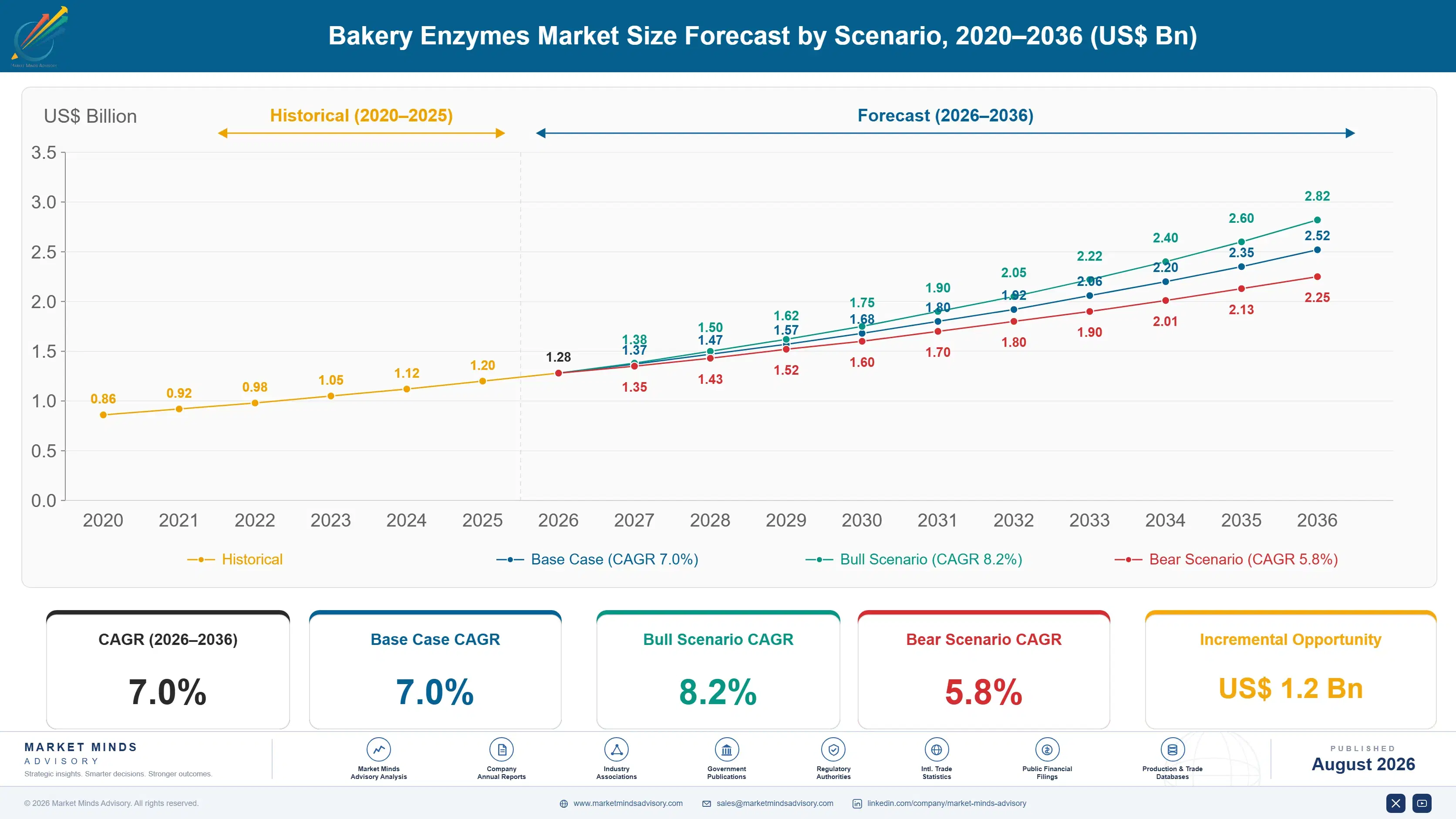
Bakery Enzymes Market Forecast Scenarios

bakery-enzymes-market-trends-growth-insights-size-forecast-scenario-1787461334256
Between 2020 and 2025 the market grew at roughly 6.0 percent a year, with early pandemic disruption to industrial bakery capital spending briefly slowing enzyme adoption before clean-label reformulation programs resumed and accelerated through the back half of the period as retailers pushed harder on ingredient transparency commitments tied to their own private label bakery lines and supplier scorecards.
The base case assumes 7.0 percent annual growth to 2036, built on three mechanisms: continued substitution of chemical dough conditioners with enzyme blends as clean-label retail pressure spreads into food-service and contract manufacturing, rapid industrial bakery capacity growth across East Asia and South Asia as packaged bread consumption rises, and expanding shelf-life-extension use cases that let bakers reduce product waste and returns. Together these three mechanisms sustain growth well above simple bakery output volume trends.
A bull case near 8.2 percent depends on regulators in additional markets restricting chemical dough conditioners faster than currently expected, forcing accelerated enzyme reformulation. The bear case near 5.8 percent assumes packaged bread volume growth slows in mature markets enough that enzyme suppliers compete mainly on price rather than technical differentiation across their broader customer base.

Reformulation Economics and Enzyme Supplier Consolidation

Bakery enzymes have moved from a niche technical additive to a core reformulation tool as clean-label pressure forces manufacturers to remove chemical dough conditioners without sacrificing the machine-line consistency that large-scale bread production depends on every single shift. That shift has turned enzyme suppliers into formulation partners rather than simple ingredient vendors selling on price alone. That shift is redefining what bakers expect a supplier relationship to actually deliver.
PRODUCER CONCENTRATIONCR5 48%top five hold roughly half of global capacity
AVERAGE SELLING PRICE$18.50/kgblended average price across major enzyme categories sold globally
NORTH AMERICA SHARE30%share of global bakery enzyme demand originating here
DOSAGE EFFICIENCY GAIN22%average reduction in chemical additive use achieved overall
TRADE INTENSITY38%share of volume crossing a border before final use
R&D COST SHARE14% of revenueresearch and application development spending burden across suppliers
Commercially, the market splits between standardized enzyme products sold at scale to large industrial bakeries and customized enzyme blends developed jointly with bakery customers to solve specific dough handling or shelf-life problems. Margins concentrate heavily in the customized blend segment, where suppliers with strong application laboratories capture value that commodity enzyme producers cannot easily replicate. Suppliers without that laboratory investment increasingly struggle to compete for premium contracts.
Over the next decade, regulatory approval speed for new enzyme blends and application science depth will matter more to competitive position than raw production scale, since the underlying fermentation technology is now widely accessible across multiple large biotechnology suppliers competing for the very same bakery accounts across every region this report tracks. This dynamic favors suppliers who commit early to deep technical account support.
"Bakers used to think of enzymes as a footnote on the ingredient panel. Now the enzyme blend is often the single line item standing between a clean label claim and a loaf that falls apart on the delivery truck."
Director, Food and Beverage Ingredients Practice · MMA Food and Beverage Ingredients Practice · August 2026

Market Trends

Clean-Label Reformulation Drives Broad Enzyme Substitution

Retailers across North America and Western Europe have removed potassium bromate and several other chemical dough conditioners from more than 60 percent of private label bakery SKUs since 2021, forcing manufacturers to find enzyme-based replacements that preserve dough strength and gas retention during industrial mixing and proofing. Novonesis and International Flavors and Fragrances have both expanded application laboratories specifically to support this reformulation wave, offering bakers custom enzyme blends rather than single-molecule products. This substitution trend is now spreading into food-service and contract manufacturing channels that historically lagged retail on clean-label adoption timelines.
Market Impact: Adoption pulled forward 2-3 years
Industrial Bakery Capacity Expansion Across Asia Lifts Demand

Packaged bread and bakery consumption in China and India has grown at a double-digit pace over the past several years as Western-style eating habits spread through urban retail and quick-service restaurant channels previously dominated by rice and wheat flatbread staples. New industrial bakery capacity coming online across both countries is built around modern high-speed production lines that depend on enzyme systems for consistent dough handling at a scale traditional artisan methods cannot support. This capacity build-out is pulling enzyme demand growth well above the pace seen in mature Western markets where bakery capacity additions have largely plateaued.
Market Impact: Cuts bakery waste 8-10%

Market Opportunities and Growth Drivers

Regulatory Restriction of Chemical Dough Conditioners

National food safety authorities in a growing number of countries have restricted or banned potassium bromate as a dough conditioner over the past decade, and the underlying driver is accumulating research linking the chemical to potential carcinogenic risk at sustained exposure levels. Bakers operating in markets that have not yet banned the chemical are reformulating proactively anyway, anticipating that regulation will eventually catch up and preferring to avoid a disruptive last-minute reformulation scramble. This proactive shift has pulled enzyme adoption timelines forward by an estimated two to three years across several major markets tracked in this analysis.
Market Impact: Delays run 12-18 months

Shelf-Life Extension Demand Reduces Bakery Product Waste

Packaged bread manufacturers lose an estimated 8 to 10 percent of production to returns and spoilage under standard shelf-life windows, and enzyme based anti staling systems using specialized amylases can extend usable shelf life by several additional days without preservative chemicals that clean label retailers now discourage across most private label bakery lines they carry. Major retailers have begun setting explicit waste reduction targets tied to supplier sustainability scorecards, giving bakery manufacturers a direct financial incentive to adopt anti staling enzyme systems well beyond the clean label motivation alone that is driving broader reformulation.
Market Impact: Cuts small-bakery adoption by 25%

Market Restraints and Challenges

Regulatory Approval Timelines Slow New Enzyme Launches

New enzyme blends require food safety approval in each jurisdiction before commercial sale, and the underlying cause of delay is that approval processes in several major markets still take twelve to eighteen months even for enzymes with established safety profiles in other jurisdictions already. The commercial impact falls hardest on smaller specialty enzyme producers without dedicated regulatory affairs teams, since they cannot absorb multi-year approval timelines the way larger diversified suppliers can while continuing other revenue streams. Mitigation efforts include industry associations lobbying for mutual recognition agreements between major regulatory bodies to shorten approval cycles.
Market Impact: Bromate-free SKUs exceed 60%

Application Complexity Limits Small Bakery Adoption

Enzyme performance varies significantly with flour quality, mixing time, and proofing conditions, and the underlying cause is that enzymes are biological catalysts sensitive to process variables that chemical additives handle more predictably across variable operating conditions found in smaller facilities. The commercial impact shows up most clearly among smaller bakeries without dedicated technical staff, who often stick with familiar chemical conditioners rather than risk inconsistent results from an unfamiliar enzyme system. Suppliers are mitigating this barrier through simplified pre-blended enzyme systems designed specifically for smaller-scale bakery operations lacking in-house technical support staff.
Market Impact: Asian bakery capacity up 12%
3 additional market trends, 3 additional growth drivers, and 3 additional restraints and challenges are covered in the full report. Contact sales@marketmindsadvisory.com to access the complete intelligence.

Segment CAGR and Growth Architecture

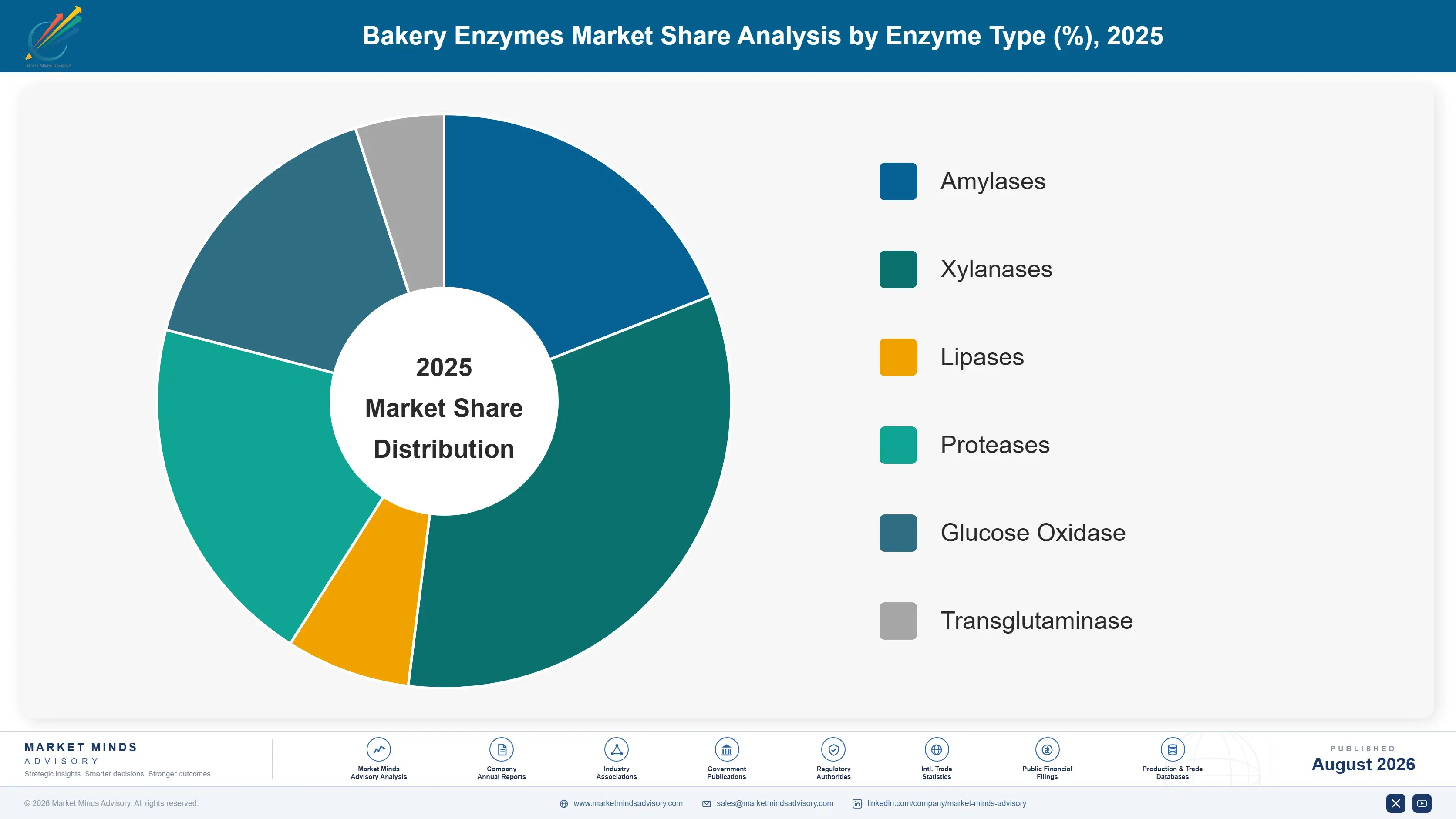
The market segments by enzyme type rather than application, since a single enzyme category such as amylase or xylanase typically serves multiple bakery formats interchangeably depending on the specific dough handling problem a manufacturer needs solved during industrial mixing, proofing, and baking across every production line a modern facility runs each day worldwide and beyond.
bakery-enzymes-market-trends-growth-insights-market-share-analysis-1787461334788

Xylanases

Xylanases are the fastest-growing enzyme segment as bakers use them to replace chemical dough strengtheners while improving dough machinability and gas retention during industrial proofing at scale. Demand is concentrated among large packaged bread manufacturers reformulating away from potassium bromate and similar oxidants under both regulatory pressure and retailer clean-label mandates that continue to spread across new markets each year. Novonesis and AB Enzymes both lead xylanase innovation, offering blended formulations tailored to specific flour types and regional wheat quality variations that affect dough performance differently across markets. Pricing carries a meaningful premium over legacy chemical conditioners, but bakers increasingly accept that premium given the clean-label marketing value it delivers on finished product packaging.
CAGR 8.5%

Glucose Oxidase

Glucose oxidase demand is climbing as bakers seek a direct enzymatic replacement for ascorbic acid and bromate combinations used to strengthen gluten networks and improve loaf volume in industrial bread production lines. The enzyme works by oxidizing specific dough components to create stronger protein cross-links, delivering a similar strengthening effect to chemical oxidants without the regulatory scrutiny those chemicals now attract in an expanding number of jurisdictions worldwide. International Flavors and Fragrances and Kerry Group have both expanded glucose oxidase production specifically to meet reformulation demand from large industrial bakery customers across multiple continents. Supply remains concentrated among a small group of established fermentation producers with the specific technical expertise this enzyme category requires to manufacture reliably.
CAGR 7.8%
Full segment breakdown across 6 segments available in the complete report.

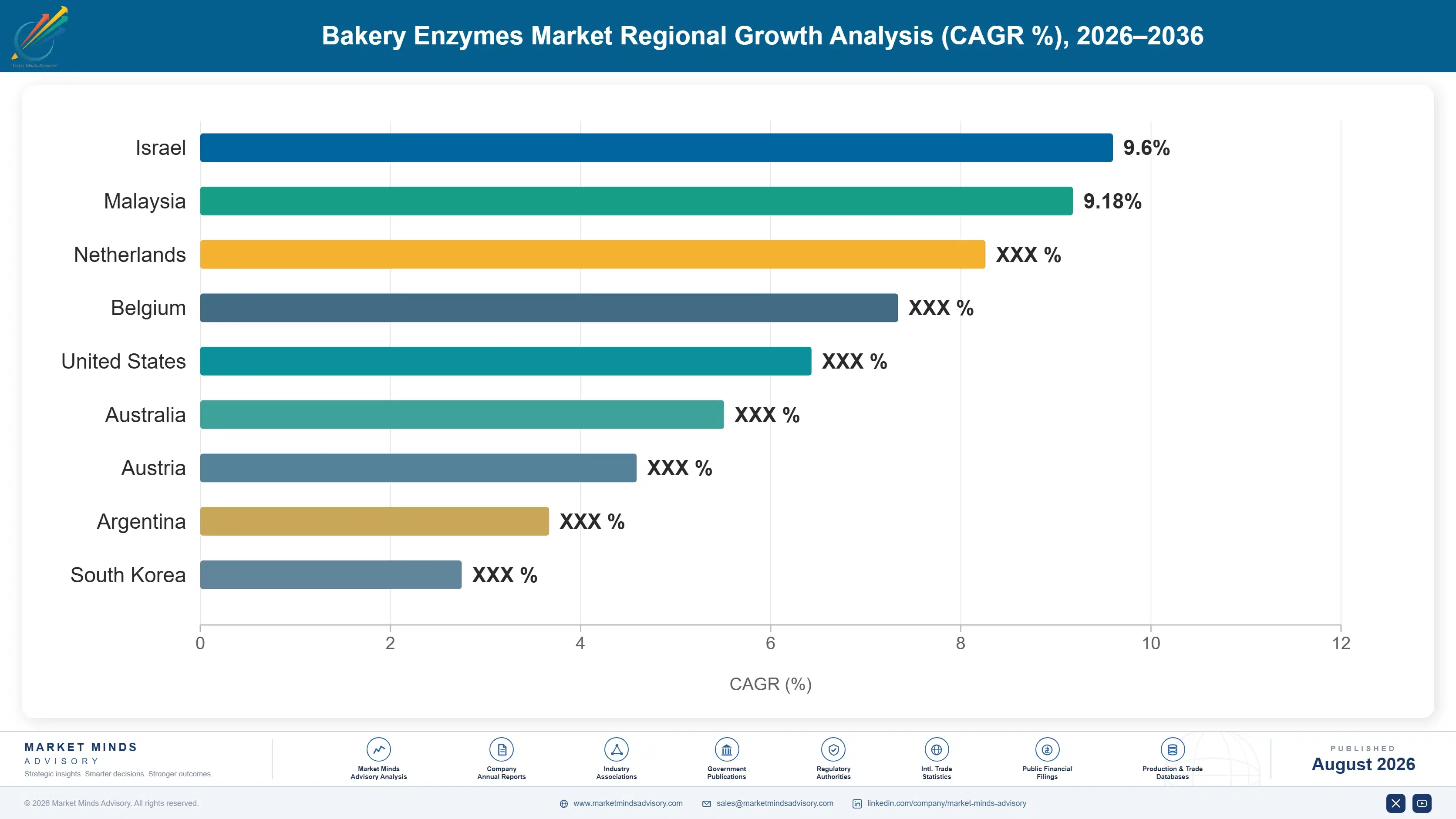
Regional Architecture and Country Demand Map

North America holds the largest regional share on the strength of deep industrial bakery infrastructure and early clean-label reformulation, with Western Europe and East Asia following as mature and rapidly scaling bakery markets and South Asia and Pacific posting the fastest regional growth off a smaller base.

North America

The United States hosts the world's most heavily industrialized packaged bread sector, and decades of consolidation among large commercial bakeries have made enzyme adoption close to universal across major production lines that run continuously in shifts around the clock. Clean-label reformulation started earliest here, with major retailers removing potassium bromate from private label bread years before most other regions began similar programs of their own. Canadian demand tracks closely with the United States given shared supply chains and cross-border ingredient sourcing among the largest North American bakery groups operating across both countries. Shelf-life extension use cases are also most mature in this region, reflecting the long transport distances packaged bread often travels domestically.
Share: 30% | CAGR: 7.5% (2026 to 2036)

Western Europe

German and French bakers combine deep artisan bread tradition with some of the world's strictest clean-label retail standards, creating steady demand for enzyme systems that let large industrial bakeries mimic artisan dough characteristics at commercial scale and speed across their production networks. UK retailers have been particularly aggressive in removing chemical dough conditioners from private label ranges, pushing suppliers to develop enzyme blends that replicate the exact texture consumers expect from familiar sliced bread products sold nationwide. Growth trails the global average here mainly because so much of the reformulation transition already happened in the years immediately following each major retailer's clean-label commitment announcement, leaving less room for further enzyme adoption gains.
Share: 24% | CAGR: 5.5% (2026 to 2036)
Regional intelligence for 5 additional markets available in the complete report: East Asia, South Asia and Pacific, Latin America, Middle East and Africa, Eastern Europe. Contact sales@marketmindsadvisory.com.
bakery-enzymes-market-trends-growth-insights-country-cagr-analysis-1787461335298

Where Enzyme Suppliers Can Capture More Margin

Suppliers who move beyond standardized enzyme sales toward custom formulation, regulatory support, and shelf-life application science capture materially better margins than those competing purely on price for commodity amylase and protease sold into bakeries without any technical service or dedicated laboratory support attached at all across the full range of products sold worldwide today.

Custom Enzyme Blend Formulation Service Bundles

Bundling pre-optimized enzyme blends with dedicated application laboratory support lets suppliers charge a service premium of 20 to 30 percent over standardized enzyme pricing, since bakers save significant internal reformulation time during clean-label transitions that would otherwise require months of trial-and-error testing on their own production lines. Novonesis and International Flavors and Fragrances have both expanded application labs specifically to support this model, positioning themselves as reformulation partners rather than commodity enzyme suppliers. The approach works especially well for mid-sized bakeries lacking in-house enzyme chemistry expertise of their own to run these trials internally.
Market Impact: Adds a 20 to 30 percent pricing premium

Regulatory Approval Fast-Track Support Program Development

Offering dedicated regulatory affairs support to help bakery customers navigate the 12 to 18 month approval timelines new enzyme blends face in several major markets gives suppliers a durable advantage over competitors selling enzymes without this assistance included. Large diversified suppliers with in-house regulatory teams across multiple jurisdictions can shorten a customer's effective time-to-market meaningfully compared with smaller specialty producers navigating each approval independently on a market-by-market basis. This support becomes a genuine competitive moat as more countries tighten scrutiny on chemical dough conditioners, pushing bakers to prioritize suppliers who can move fastest through the approval process.
Market Impact: Shortens approval timelines by 4 to 6 months

Shelf-Life Extension Application Partnership Programs Development

Partnering directly with packaged bread manufacturers on anti-staling enzyme systems tied to explicit waste-reduction targets gives suppliers a foothold in a demand channel that can cut bakery production waste by 8 to 10 percent, increasingly linked to retailer sustainability scorecards rather than simple ingredient cost comparisons alone in most contract negotiations today. This requires technical trial support well beyond simply supplying enzyme product, but suppliers willing to invest in joint shelf-life testing programs are winning multi-year supply agreements that commodity-only competitors cannot access without building similar testing capability of their own.
Market Impact: Cuts bakery waste by 8 to 10 percent

Emerging Market Application Laboratory Expansion Strategy

Building application laboratories closer to fast-growing East Asian and South Asian bakery capacity rather than serving those markets remotely from Western technical centers captures customer relationships before local competitors scale enough to compete directly on service quality and response time. Suppliers making this move early can lock in long-term contracts with rapidly expanding regional bakery groups before those customers develop relationships with lower-cost domestic enzyme producers still building out their own support capabilities. The capital outlay for a regional application lab is modest relative to the 2 to 3 times greater multi-year contract value such proximity typically delivers.
Market Impact: Locks in contracts 2 to 3 years early

Who Controls the Margin Pool

CR5 sits near 48 percent, reflecting real consolidation among a handful of large industrial biotechnology suppliers with the fermentation scale and regulatory infrastructure this category increasingly requires from every serious competitor. The gap between these leaders and the long tail of specialty enzyme producers is wide on application science depth, though considerably narrower on raw fermentation production cost itself.
Current competitive activity centers on three fronts: application laboratory expansion by large suppliers to capture clean-label reformulation contracts, regulatory affairs investment to shorten approval timelines for new enzyme blends across multiple jurisdictions simultaneously, and early expansion into fast-growing East Asian and South Asian bakery capacity ahead of local competitors who have not yet built comparable technical support networks of their own.

Emerging pressure comes from Chinese and Indian enzyme producers scaling domestic fermentation capacity to serve their own rapidly growing bakery sectors, potentially challenging Western suppliers on cost within local markets over the next decade. Rankings among the largest global suppliers are unlikely to shift quickly given their application science advantage, but regional producers are gaining ground faster in their home markets than in export competition elsewhere.
bakery-enzymes-market-trends-growth-insights-company-positioning-matrix-1787461335816

Competitive Moat and Risk Dimensions

NOVONESIS

Moat: Fermentation scale and enzyme breadth

Novonesis combines the largest fermentation capacity in the entire industry with the broadest enzyme portfolio spanning nearly every bakery application, letting it serve customers as a single-source supplier in a way that smaller specialty producers focused on one or two enzyme categories simply cannot match at comparable scale.
NOVONESIS

Risk: Integration complexity after merger

The recent merger with Chr. Hansen adds organizational complexity that could slow decision-making and application lab responsiveness in the near term, a risk that competitors with simpler corporate structures are actively highlighting to prospective bakery customers during ongoing sales negotiations each quarter as well too.
INTERNATIONAL FLAVORS AND FRAGRANCES

Moat: Broad flavor and enzyme cross-selling

IFF's combined flavor and enzyme portfolio, inherited through its acquisition of DuPont's nutrition business, lets it cross-sell enzyme solutions alongside flavor systems to the same bakery customer relationships, an integrated commercial approach very few pure-play enzyme competitors can realistically replicate at scale today or beyond.
INTERNATIONAL FLAVORS AND FRAGRANCES

Risk: Post-acquisition integration overhead

Integrating the acquired enzyme business into IFF's much larger flavor and fragrance organization has created some customer-facing inconsistency during the ongoing transition, giving focused competitors an opening to win contracts on responsiveness while integration work continues internally for the foreseeable future and beyond in most cases.

Players Tracked

Prominent Players

Novonesis
International Flavors and Fragrances
DSM-Firmenich
AB Enzymes
Kerry Group

Other Key Players

BASF
Advanced Enzyme Technologies
Amano Enzyme
Puratos
Lesaffre
Enzyme Development Corporation
Prozyn
Specialty Enzymes and Biotechnologies
Jiangsu Boli Bioproducts
Sunson Industry Group
Aum Enzymes
Creative Enzymes
Biocatalysts Limited
Dyadic International
Enzybel International

Recent Developments

MARCH 2026

Novonesis Expands Xylanase Production Capacity in Denmark

Novonesis completed a capacity expansion at its Danish fermentation complex, adding xylanase and glucose oxidase output aimed at European and North American bakery customers pursuing clean-label reformulation. The expansion followed eighteen months of construction and targets contracts previously served through allocated capacity from other facilities.
Signal: Dedicated capacity growth signals reformulation demand has moved well past a temporary trend into durable, sustained volume
OCTOBER 2025

AB Enzymes Signs Application Partnership With Asian Bakery Group

AB Enzymes entered a multi-year application development partnership with a major Southeast Asian bakery group to co-develop enzyme blends suited to local flour varieties and high-speed production lines specifically. The partnership reflects growing demand for regionally tailored enzyme solutions well outside AB Enzymes' traditional European customer base.
Signal: Asian bakery customers now expect the same application support depth Western customers have received for years
JANUARY 2026

Advanced Enzyme Technologies Expands Indian Manufacturing Footprint

Advanced Enzyme Technologies announced an expansion of its Indian manufacturing footprint specifically to serve the country's rapidly growing packaged bread sector, adding new capacity for amylase and xylanase products tailored precisely to domestic wheat varieties and local production conditions across several states nationwide this year.
Signal: Domestic Indian capacity growth signals local producers are positioning to compete directly with multinational suppliers on price

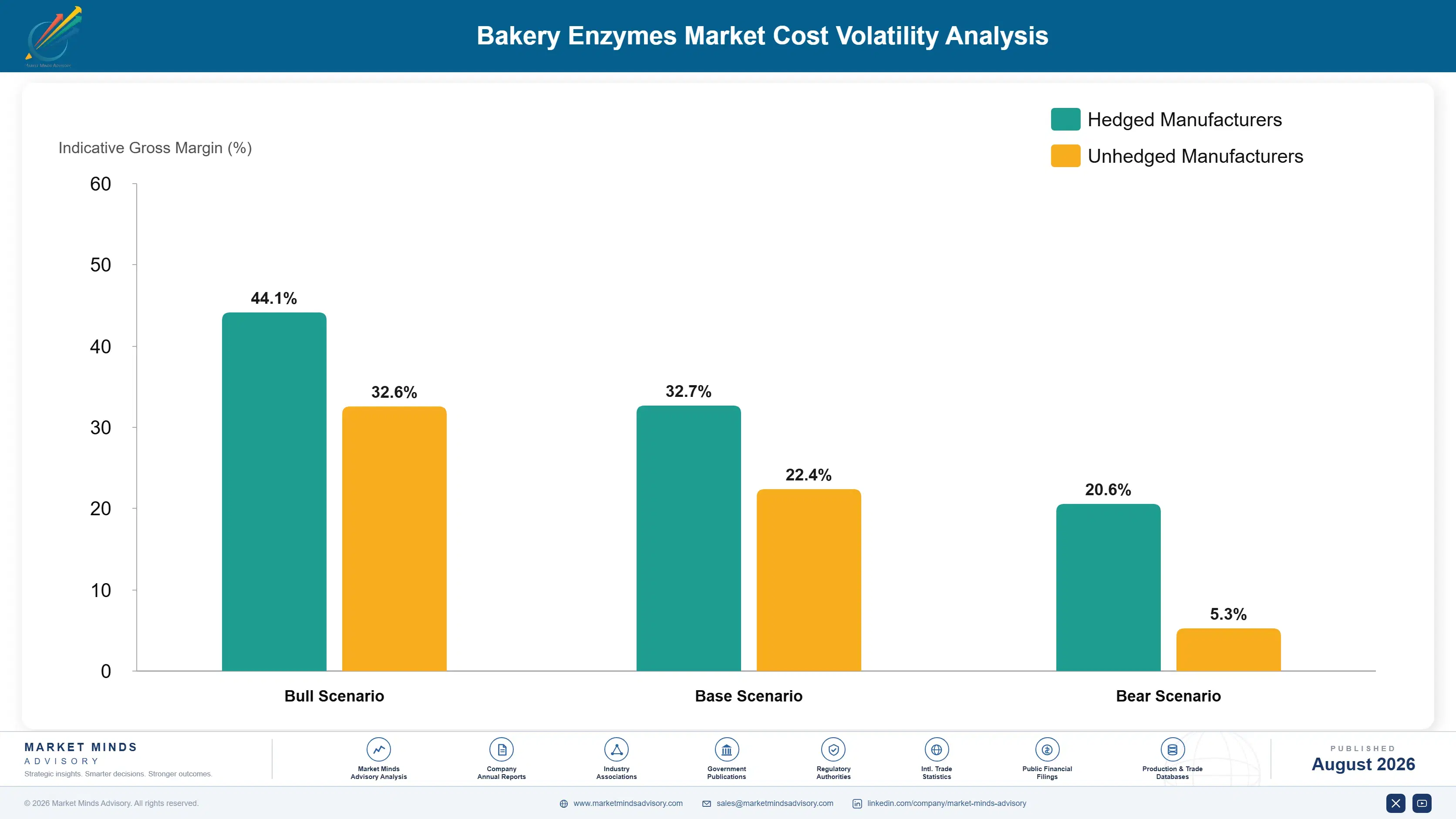
Fermentation Feedstock and R&D Cost Exposure

Fermentation feedstock, primarily corn-derived dextrose and specialized growth media, accounts for a meaningful share of production cost for bakery enzyme manufacturers, while research and application development spending represents roughly 14 percent of revenue for the largest suppliers as regulatory approval work and custom formulation projects both demand sustained technical investment across every product line the company sells.
Corn price swings of more than 25 percent within single crop years since 2021 have pushed fermentation input costs higher for enzyme producers without long-term feedstock contracts in place, according to USDA crop production reporting that tracks these swings closely each season. Larger suppliers with grain-trading relationships or diversified feedstock sourcing absorbed these swings more comfortably than smaller specialty producers, who passed a larger share of cost increases through to bakery customers within the same fiscal year.

Smaller specialty enzyme producers without diversified feedstock sourcing or in-house regulatory teams absorb cost and timeline risk directly, while larger diversified suppliers with both capabilities smooth pricing and approval speed for their downstream bakery customers. That gap in resilience increasingly determines which suppliers can offer multi-year fixed-price contracts that large industrial bakeries now prefer over shorter agreements.
bakery-enzymes-market-trends-growth-insights-cost-volatility-analysis-1787461336011

Diversified Feedstock Sourcing Contracts

Larger suppliers are securing feedstock through multiple grain origins and forward purchase contracts rather than relying on a single supply source, smoothing cost volatility during years when corn prices spike sharply due to weather disruption or competing ethanol and animal feed demand pressures building nationwide across the season, a practice now standard among the five largest suppliers.

Shared Regulatory Affairs Infrastructure

Mid-sized producers are pooling regulatory affairs resources through industry associations to reduce the per-product cost of navigating approval processes across multiple jurisdictions at once, an approach that helps smaller suppliers compete more effectively with larger rivals' well-funded in-house regulatory teams, particularly across the European Union and North American markets. where filing requirements can differ meaningfully.

Application Lab Cost Sharing With Customers

Some suppliers are structuring joint development agreements where bakery customers co-invest directly in application trial costs, reducing the supplier's standalone research burden while giving the customer earlier access to a formulation tailored specifically to their own production lines and flour specifications, a model that has grown more common since 2023, as customers seek more input into product design decisions.

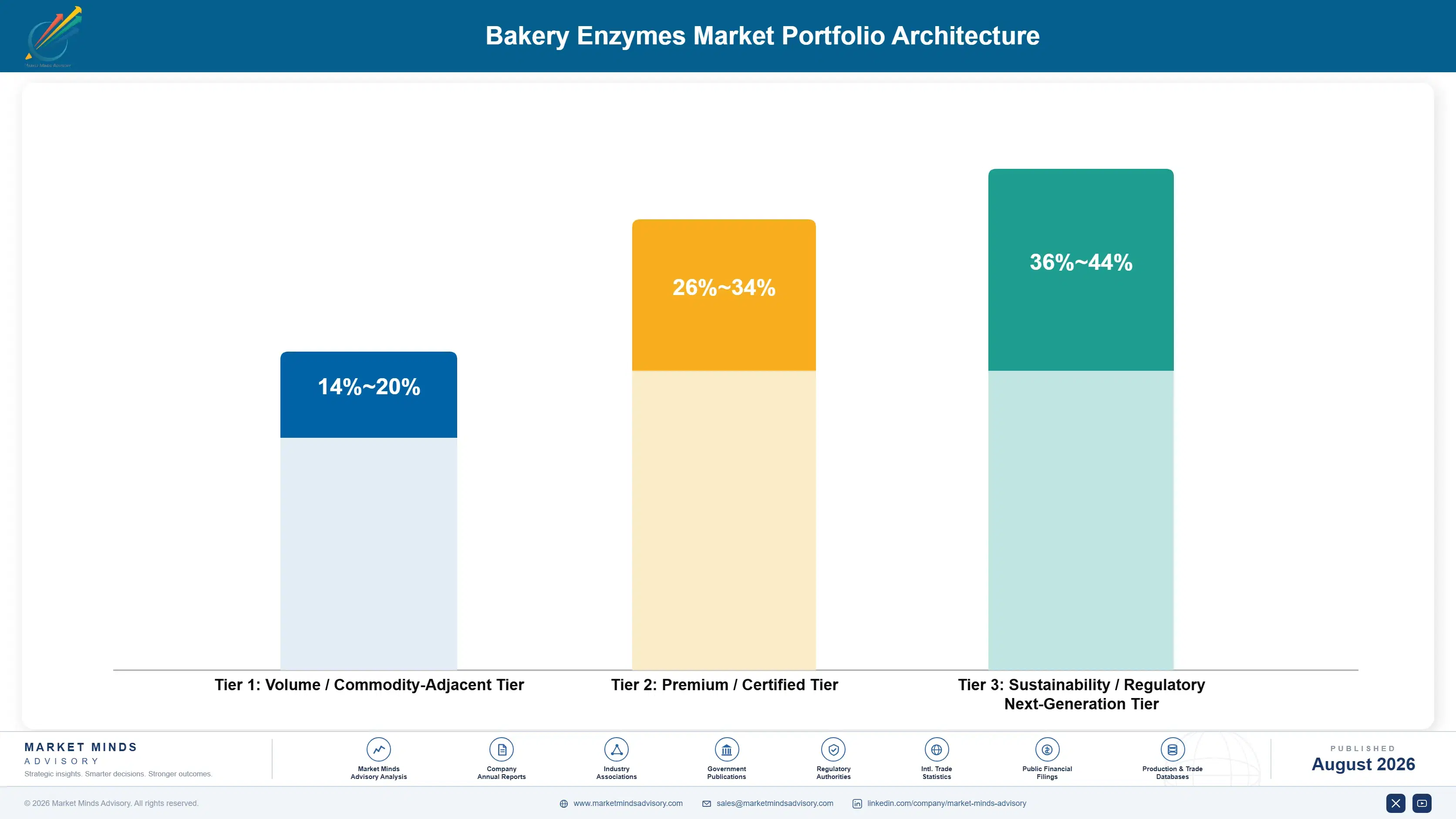
Portfolio Architecture for Margin Defence

The market splits across three tiers: standardized commodity enzymes sold on tight margins against multi-year volume contracts, certified and technically supported specialty blends sold with formulation services attached, and an emerging tier of shelf-life-extension and clean-label certified systems commanding the highest margins as retailer sustainability scorecards spread rapidly across major grocery markets worldwide, a structure that mirrors the broader specialty ingredients sector.
Volume sits overwhelmingly in the commodity tier, where standardized amylase and protease contracts with major industrial bakeries generate revenue scale but comparatively thin margins that leave little room for reinvestment. Premium tension is sharpest in xylanase and glucose oxidase, where custom-formulated and regulatory-supported blends earn meaningfully better margins than standardized equivalents, pulling supplier investment toward capacity that can serve both tiers simultaneously without compromise.

High-value margin pools concentrate in custom formulation services and shelf-life extension systems tied to retailer sustainability targets, categories still small in absolute volume but growing faster than the commodity base and attracting disproportionate application R&D investment from the leading global suppliers each and every year without exception, particularly among suppliers already serving the largest retail accounts. Suppliers positioned early in this shift are compounding a durable competitive advantage.

Volume / Commodity-Adjacent Tier

Standardized amylase and protease enzymes sold on multi-year volume contracts to major industrial bakeries, competing primarily on price, delivery reliability, and consistency of supply across large-scale production runs. Suppliers here typically operate at low double-digit margins given the scale of these contracts.
Gross Margin: 14%-20%

Premium / Certified Tier

Custom xylanase and glucose oxidase blends sold with formulation and regulatory support, commanding a service premium over standardized enzyme pricing across most reformulation contracts negotiated with large bakery groups. Suppliers with strong technical service teams typically win this business over pure price competitors.
Gross Margin: 26%-34%

Sustainability / Regulatory / Next-Generation Tier

Shelf-life extension and clean-label certified enzyme systems tied to retailer sustainability scorecards, sold into the industry's highest-margin reformulation contracts available to suppliers with strong application science depth. This tier remains small in volume but is expanding fastest across every region tracked.
Gross Margin: 36%-44%
bakery-enzymes-market-trends-growth-insights-portfolio-architecture-1787461336512

High-value Sub-segments and Strategic Watch-out

Shelf-Life Extension Enzyme Systems

Anti-staling enzyme systems tied to retailer waste-reduction targets command the category's highest margins and are growing fastest as sustainability scorecards spread across major grocery chains nationwide, drawing new supplier investment into this segment each year. Suppliers with existing retail relationships hold a clear early advantage in this segment.
Gross Margin: 36%-44%

Custom Xylanase Blends

Custom-formulated xylanase blends for clean-label reformulation command steady premium pricing, growing reliably as more bakeries phase out chemical dough conditioners across every major retail market this analysis tracks in detail. Suppliers with strong technical support win the bulk of new contracts in this category consistently.
Gross Margin: 26%-33%

Standardized Amylase Contracts

The largest volume pool by far, standardized amylase contracts generate scale revenue for top suppliers but offer little margin expansion room given intense multi-year price competition among established fermentation producers competing for the same accounts. Suppliers here compete mainly on manufacturing scale rather than any meaningful technical differentiation.
Gross Margin: 14%-18%

Domestic Asian Enzyme Producers

Chinese and Indian domestic enzyme producers scaling fermentation capacity could challenge multinational suppliers on cost within their home markets over the next decade, a shift in regional cost position worth monitoring closely. Multinational suppliers are responding by deepening application support rather than competing purely on unit price.
Gross Margin: 16%-22%

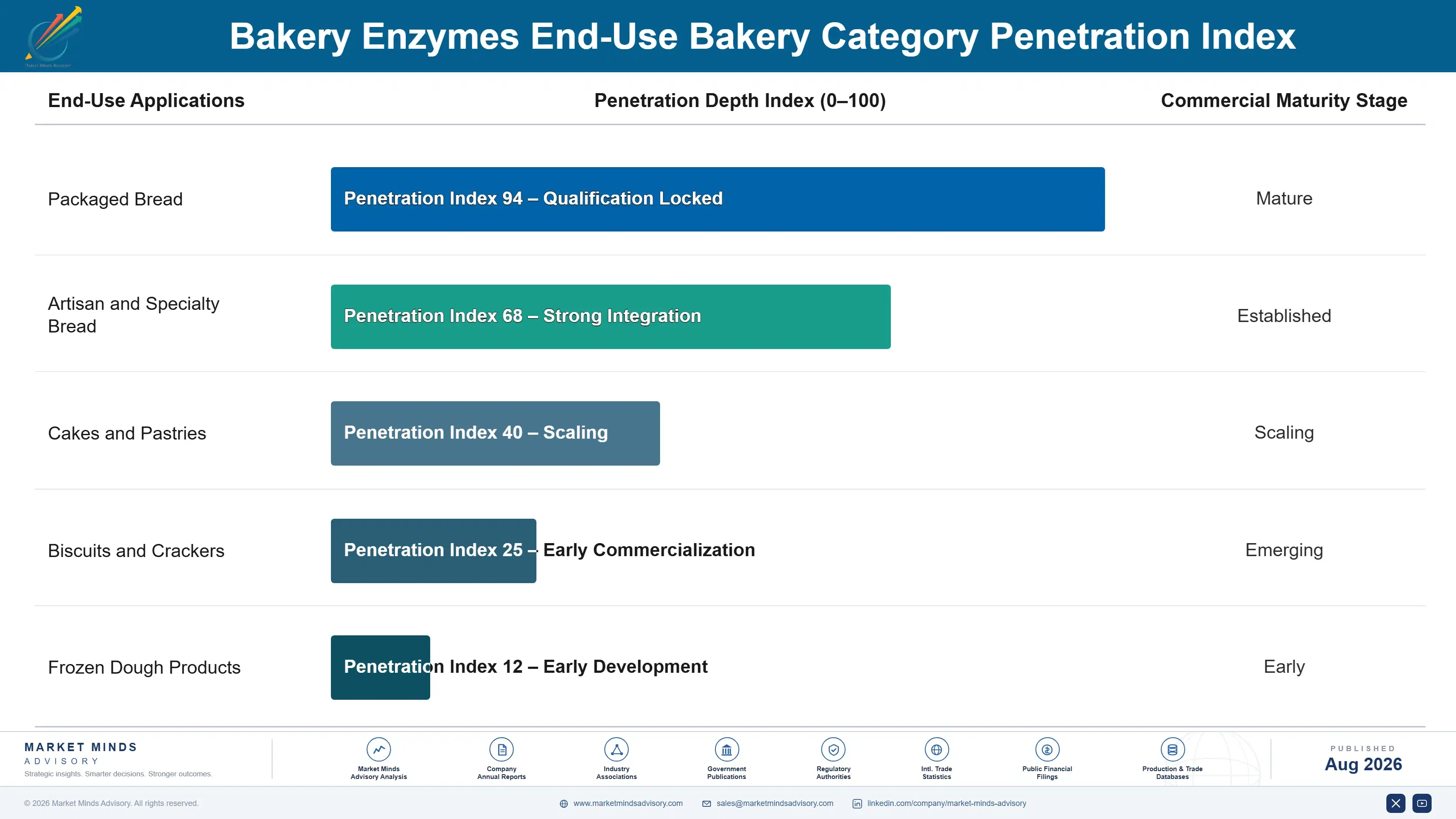
Reformulation Cycles and Contract Renewal

Enzyme demand behaves like an annuity once a bakery locks a reformulated recipe into production, since changing enzyme systems again requires re-running dough trials and shelf-life validation that most manufacturers avoid repeating more than once every several years, giving incumbent suppliers durable volume once they win the initial reformulation contract and successfully pass the first renewal cycle without disruption. Suppliers who lose that initial contract rarely win it back.
Adoption depth varies by vertical: large packaged bread manufacturers show the deepest supplier stickiness given the scale of dough trial validation required across their production network, while smaller artisan and specialty bakeries switch suppliers more readily since their production runs are smaller and validation costs correspondingly lower relative to the total enzyme spend involved in each production batch. This split shapes how suppliers allocate their technical account teams.

A generational shift among newer bakery brand founders toward transparent, clean-label formulation as a core marketing asset rather than a back-office technical decision is pulling enzyme selection earlier into product development, giving technically differentiated suppliers a seat at the table that legacy commodity vendors historically never had access to at all. That shift favors suppliers who invest early in brand-facing technical relationships.
bakery-enzymes-market-trends-growth-insights-end-use-penetration-index-1787461337004

Positioning for the Reformulation Wave

These are among the four positions where our research anticipates prominent divergence between winners and laggards over the coming forecast period. Each is grounded in the demand model, the regulatory perimeter, and the announced capacity pipeline.
01 / APPLICATION LAB INVESTMENT

Build application labs ahead of the clean-label reformulation wave

Clean-label reformulation has already removed chemical dough conditioners from more than 60 percent of private label bakery SKUs across North America and Western Europe. Suppliers without dedicated application laboratories cannot offer the custom formulation support bakers increasingly require during this transition, ceding ground to Novonesis and International Flavors and Fragrances on the highest-margin contracts available today. Building or expanding application capacity now, even at meaningful upfront cost, positions a supplier to capture reformulation volume before competitors lock in the largest accounts.
02 / REGULATORY AFFAIRS CAPABILITY

Invest in regulatory affairs capability to shorten approval timelines

New enzyme blends still face approval timelines of twelve to eighteen months in several major markets, a delay that smaller specialty producers without dedicated regulatory teams struggle to absorb while larger competitors move faster. Suppliers who build or expand in-house regulatory affairs capability, or who pool resources through industry associations, can offer bakery customers a meaningfully shorter path to market for new formulations. That speed advantage increasingly determines which suppliers win multi-year contracts as more countries tighten scrutiny on legacy chemical dough conditioners.
03 / ASIAN CAPACITY EXPANSION

Expand application capacity across East Asia and South Asia early

Packaged bread and bakery consumption in China and India is growing at a double-digit pace, and new industrial bakery capacity coming online in both countries is built from the start around enzyme-dependent high-speed production lines rather than legacy chemical processes. Suppliers who establish application laboratories in the region now can build customer relationships before domestic Chinese and Indian enzyme producers scale enough to compete directly on cost and service responsiveness. Waiting until regional competitors mature risks ceding the fastest-growing bakery capacity build-out in the world to lower-cost local suppliers.
04 / SHELF-LIFE CHANNEL ENTRY

Pursue shelf-life extension partnerships tied to retailer waste targets

Packaged bread manufacturers lose an estimated 8 to 10 percent of production to returns and spoilage, and major retailers are now setting explicit waste-reduction targets tied directly to supplier sustainability scorecards rather than treating this as a purely internal bakery cost problem. Enzyme suppliers who develop anti-staling systems jointly with bakery customers and document the resulting waste reduction can tie their product directly to a retailer commitment that carries real commercial weight in contract renewals. This positioning differentiates a supplier from commodity competitors selling enzymes purely on unit price.

Engagement Snapshot From the Field

A live engagement with an industry participant carrying material or product regulatory and market exposure ahead of a defining policy shift, showing how our research translates into a defensible multi-year portfolio strategy.
MARKET MINDS ADVISORY · CLIENT ENGAGEMENT SUMMARY
Bakery Enzymes Producer Strategic Portfolio Review and Transition Roadmap 2026·Investment Scenario on Bakery Enzymes Exposure Evaluation 2025-26
CLIENT PROFILE
A multinational packaged bread manufacturer with production facilities across North America and Western Europe engaged MMA to guide an enzyme reformulation strategy tied to a public commitment to remove chemical dough conditioners from its entire private label portfolio. The client's annual enzyme procurement spend exceeded 45 million dollars (client-reported, unverified by MMA) across its global bakery network, making supplier selection a material cost and reformulation risk decision for senior leadership.
STRATEGIC CHALLENGE
The client needed to remove potassium bromate and ascorbic acid combinations from its core bread portfolio within eighteen months while preserving loaf volume and crumb texture, but its existing supplier lacked the xylanase and glucose oxidase application expertise required to match its current dough performance without extensive line-by-line trial and error across every facility.
MMA APPROACH
MMA benchmarked the client's global enzyme supplier base against application science depth and regulatory approval speed, modeled landed cost and dough performance outcomes across three candidate suppliers, and structured a phased regional rollout plan that avoided disrupting existing production schedules across the client's largest facilities, distribution centers, and regional logistics hubs.
KEY FINDINGS
  1. Xylanase and glucose oxidase blends from two candidate suppliers matched existing loaf volume within a narrow, acceptable performance margin during formal trials.
  2. The client's incumbent supplier lacked sufficient application lab capacity to support a full portfolio-wide reformulation within the stated eighteen-month project timeline overall.
  3. A phased regional rollout reduced production disruption risk substantially compared with the client's original all-at-once conversion plan across every major facility. overall.
  4. Dual sourcing across two qualified suppliers gave the client meaningful negotiating leverage during final contract pricing discussions and subsequent annual renewal talks.
CLIENT PROFILE
A multinational packaged bread manufacturer with production facilities across North America and Western Europe engaged MMA to guide an enzyme reformulation strategy tied to a public commitment to remove chemical dough conditioners from its entire private label portfolio. The client's annual enzyme procurement spend exceeded 45 million dollars (client-reported, unverified by MMA) across its global bakery network, making supplier selection a material cost and reformulation risk decision for senior leadership.
STRATEGIC CHALLENGE
The client needed to remove potassium bromate and ascorbic acid combinations from its core bread portfolio within eighteen months while preserving loaf volume and crumb texture, but its existing supplier lacked the xylanase and glucose oxidase application expertise required to match its current dough performance without extensive line-by-line trial and error across every facility.
MMA APPROACH
MMA benchmarked the client's global enzyme supplier base against application science depth and regulatory approval speed, modeled landed cost and dough performance outcomes across three candidate suppliers, and structured a phased regional rollout plan that avoided disrupting existing production schedules across the client's largest facilities, distribution centers, and regional logistics hubs.
KEY FINDINGS
  1. Xylanase and glucose oxidase blends from two candidate suppliers matched existing loaf volume within a narrow, acceptable performance margin during formal trials.
  2. The client's incumbent supplier lacked sufficient application lab capacity to support a full portfolio-wide reformulation within the stated eighteen-month project timeline overall.
  3. A phased regional rollout reduced production disruption risk substantially compared with the client's original all-at-once conversion plan across every major facility. overall.
  4. Dual sourcing across two qualified suppliers gave the client meaningful negotiating leverage during final contract pricing discussions and subsequent annual renewal talks.
RECOMMENDED STRATEGY
Phase 1: Phase 1 (Months 1-4): Complete dough trials and select two primary enzyme suppliers across major regions and production facilities. teams. Phase 2: Phase 2 (Months 5-12): Roll out reformulated recipes across three pilot facilities before making a full network-wide commitment. fully. first. Phase 3: Phase 3 (Months 13-18): Scale successful formulations across the full production network under a permanent dual sourcing structure. terms. company-wide.
OUTCOME
The client completed portfolio-wide reformulation within the stated eighteen-month window and reported a successful removal of chemical dough conditioners from its entire private label range (client-reported, unverified by MMA), alongside a modest reduction in overall enzyme procurement cost achieved through the dual-sourcing structure MMA recommended.

Frequently Asked Questions

Foundational context covering the market sizes, CAGR, scope, country, region and competition that inform every finding below. This section is provided to cover basics and most often pre-purchase conversations, answered from the MMA Primary Research Dataset.

What is the current size of the Bakery Enzymes Market?

The global bakery enzymes market was valued at approximately $1.2 billion in 2025. Growth is concentrated in xylanase and glucose oxidase as bakers pursue clean-label reformulation.

How large will the Bakery Enzymes Market be by 2036?

MMA projects the market will reach approximately $2.52 billion by 2036, roughly 1.97 times its 2026 value. Reformulation and Asian bakery capacity growth drive this expansion.

What is the CAGR for the Bakery Enzymes Market 2026 to 2036?

The market is projected to grow at a 7.0 percent compound annual rate between 2026 and 2036. Bull and bear scenarios range from 5.8 to 8.2 percent.

Which segment is growing fastest?

Xylanases are the fastest-growing segment at an 8.5 percent CAGR, roughly 1.2 times the overall market rate. Clean-label reformulation away from chemical oxidants drives this gap.

Who are the major companies in the Bakery Enzymes Market?

Leading producers include Novonesis, International Flavors and Fragrances, DSM-Firmenich, AB Enzymes, and Kerry Group. Together they hold a CR5 near 48 percent of global capacity.

Which country is growing fastest?

India posts the fastest national growth at roughly 9.8 percent, driven by rapid packaged bread expansion from a smaller base. New bakery capacity is adopting enzyme systems from the outset.

Report Segmentation Architecture

The full report scope spans multiple orthogonal segmentation dimensions, with cross-tabulated demand data provided for each dimension pair. Coverage extends further to regional breakdowns, trend trajectories, and the competitive detail needed to support segment-level decision-making.

By Enzyme Type

  • Amylases
  • Xylanases
  • Lipases
  • Proteases
  • Glucose Oxidase
  • Transglutaminase

By End-Use Bakery Category

  • Packaged Bread
  • Artisan and Specialty Bread
  • Cakes and Pastries
  • Biscuits and Crackers
  • Frozen Dough Products

By Distribution Channel

  • Direct Contract Supply
  • Distributor Networks
  • Bakery Ingredient Formulators
  • Private Label Bakery Groups

By Region

  • North America
  • Western Europe
  • East Asia
  • South Asia and Pacific
  • Latin America
  • Middle East and Africa
  • Eastern Europe

Scope, Methodology, and Coverage

Every figure in this report is reproducible from documented input assumptions. The scope below maps the historical period, the forecast horizon, the segmentation dimensions, and the countries covered, alongside the underlying primary and qualitative methodology.
Historical Period
2020 to 2025
Forecast Period
2026 to 2036
Base Year
2025 (USD billions; MMA Primary Research Dataset, August 2026)
Market Definition
The bakery enzymes market covers amylases, xylanases, lipases, proteases, glucose oxidase, and transglutaminase sold as functional processing aids for bread, pastry, cake, and biscuit manufacturing. It excludes enzymes used in brewing, dairy, or other non-bakery food applications.
Quantitative Units
USD billions (current prices); metric tonnes for volume detail
Segmentation Dimensions
By Enzyme Type; By End-Use Bakery Category; By Distribution Channel; By Region
Regions Covered
North America, Western Europe, East Asia, South Asia and Pacific, Latin America, Middle East and Africa, Eastern Europe
Countries Covered
USA, China, Germany, France, UK, Japan, South Korea, India, Australia, Canada, Brazil, Mexico, Indonesia, Vietnam, Thailand, Malaysia, UAE, Saudi Arabia, South Africa, Nigeria, Turkey, Poland, Netherlands, Italy, Spain, Sweden, Switzerland, Argentina, Colombia, Singapore, and additional markets relevant to this sector
Key Companies Profiled
Novonesis, International Flavors and Fragrances, DSM-Firmenich, AB Enzymes, Kerry Group, BASF, Advanced Enzyme Technologies, Amano Enzyme, Puratos, Lesaffre, Enzyme Development Corporation, Prozyn, Specialty Enzymes and Biotechnologies, Jiangsu Boli Bioproducts, Sunson Industry Group, Aum Enzymes, Creative Enzymes, Biocatalysts Limited, Dyadic International, Enzybel International
Quantitative Methodology
Primary survey, n=3,800 respondents, Q4 2025, six countries; demand-side model with trade association cross-validation
Qualitative Methodology
47 expert interviews, Q4 2025; applied to validate demand model assumptions, identify emerging dynamics, and assess competitive positioning
Report Format
PDF and XLSX data workbook (Word format preview document)
Publisher
Market Minds Advisory
Report Code
MMA-2026-AGR-103
Published
August 2026
Contact
sales@marketmindsadvisory.com | www.marketmindsadvisory.com

Purchase the full Bakery Enzymes Market Report (2026 to 2036).

The full Bakery Enzymes Market report delivers a comprehensive 2026 to 2036 forecast across six enzyme types, seven regions, and twenty profiled companies active in this category. It includes detailed segmentation by end-use bakery category, feedstock and R&D cost modeling, and competitive benchmarking measured against a single consistent basis throughout. Analysts document the clean-label reformulation and Asian capacity trends reshaping supplier positioning across the industry. Buyers receive full access to the underlying data tables, regional breakouts, and a customizable Excel model built for scenario planning.
2026-2036 volume and value forecasts by segment
Six-segment enzyme type breakdown and detailed analysis
Seven-region market sizing and share detail
Twenty-company competitive profiles and full benchmarking
Feedstock and R&D cost sensitivity modeling included
Editable Excel forecast workbook with scenario toggles

Built For The People Who Decide

From boardroom strategy to bench-side execution, this report is read cover-to-cover by leaders shaping the next decade of their industry, turning demand scenarios, market dynamics and valuation benchmarks into decisions.
CXOs/ Presidents/ VPs/ Managers
M&A and Corporate Development
Strategy Teams and R&D Heads
Procurement and Product Directors
Regulatory and Compliance Leaders
Investor Relations and Equity Analysts