

Market Minds Advisory
Bake Stable Pastry Fillings Market

Bake Stable Pastry Fillings Market: Heat-Resistant Formulation Meets Retail Bakery Scale

Bake stable fillings are bifurcating into cheap, heat-tolerant commodity paste for high-volume retail bakeries and clean-label, reduced-sugar formulations for premium and health-conscious brands, forcing ingredient houses to run two distinct formulation and pricing playbooks simultaneously.

Lead Analyst

Lisa Gevelber

Published

September 2026

Make Smarter Decisions with Customized Research Insights

Request a free sample report and evaluate market opportunities, growth trends, and competitive dynamics relevant to your business needs.

2025 MARKET VALUE$2.9BMarket Size 2025
2036 FORECAST VALUE$5.2BBase Case , 2026 to 2036
CAGR 2026 TO 20365.6 %Bull 6.8% / Bear 4.4%
INCREMENTAL OPPORTUNITY$2.2BNet 10- year value creation
EXPANSION MULTIPLE1.72x2036 value over 2026 base
Strategic Levers
M&A Pipeline
Regional Outlook
Country Rankings
Competitive Intelligence
Segmental Deep-dive
Call-Us : 91 93563 13602

Executive Snapshot and Market Trajectory

Retail and foodservice bakers want fillings that survive high-temperature baking without weeping, scorching, or losing structural integrity in the oven. That single technical requirement, bake stability under heat, is the whole category's reason for existing, and formulators who solve it best win multi-year supply contracts most competitors cannot dislodge.
Clean-label reformulation is reshaping recipes across the category, with reduced-sugar, allergen-free, and plant-based fillings growing fastest as retail bakeries and quick-service chains respond to consumer demand for better-for-you pastry options. Fruit and cream-based fillings remain the largest volume base by far, anchored in decades-old retail bakery and industrial foodservice contracts. North America holds the largest single share of global demand, reflecting the scale of its retail bakery, QSR, and packaged pastry manufacturing base.
Competition remains fragmented, with the top five suppliers holding under a third of global capacity and many regional ingredient houses competing mainly on price. Puratos and AGRANA lead on formulation technology and fruit-filling scale, while private-label and regional players compete hardest on cost per kilogram for commodity fruit and cream fillings. Rising sugar and fruit input costs are compressing margins industry-wide, pushing suppliers toward reformulation and efficiency investment.
Market Definition
The bake stable pastry fillings market covers fruit, cream, custard, chocolate, cheese, and specialty formulated fillings engineered to retain structure, moisture, and flavor through high-temperature baking without weeping or scorching, sold to retail bakeries, quick-service restaurants, and industrial packaged pastry manufacturers. It excludes no-bake or refrigerated fillings that never undergo oven processing, and excludes finished consumer pastry products sold directly to shoppers.
Base Year Value
$2.9B in 2025 (MMA Primary Research Dataset, August 2026)
Forecast Period
2026 to 2036, eleven discrete annual values
CAGR
5.6% base case. Bull 6.8%. Bear 4.4%.
Fastest Growth Segment
Specialty and Functional Fillings: 9.6% CAGR
Fastest Growth Country
China: 7.4% CAGR
Fastest Growth Region
South Asia and Pacific: 7.6% CAGR
Largest Region
North America: 29% of 2025 global value
Market Leaders
Puratos, AGRANA, Rich Products, Dawn Foods, and Zeelandia lead global supply. Source: MMA Analysis based on company annual reports.
Primary Survey
n=3,800 procurement and R&D decision-makers, Q4 2025, six countries
Methodology
Demand-side build-up, cross-validated against public data, 47 expert interviews

Bake Stable Pastry Fillings Market Forecast Scenarios

bake-stable-pastry-fillings-market-trends-size-forecast-scenario-1787462641967
Between 2020 and 2025, bake stable filling demand grew at an estimated 4.8% annually as retail bakery and quick-service pastry volumes recovered from pandemic-era disruption and packaged bakery brands expanded reformulated, clean-label filling lines. Fruit and cream-based commodity fillings grew through the period, while specialty reduced-sugar and allergen-free formulations scaled from a small base as retail bakery chains added better-for-you pastry options.
MMA's base case projects 5.6% annual growth to 2036 on three mechanisms: continued clean-label reformulation of commodity fruit and cream fillings to reduce added sugar and remove synthetic stabilizers, expansion of allergen-free and plant-based filling lines to serve retail bakeries meeting dietary restriction demand, and growing quick-service pastry menu innovation requiring fillings that hold up through high-volume oven cycles. Industrial packaged pastry manufacturers add a fourth channel through private-label expansion.
A bull catalyst comes from major quick-service chains standardizing menus around bake-stable, better-for-you pastry fillings across their global store networks, which could pull thousands of new locations into reformulated supply contracts within a few years. The bear risk is fruit and dairy input cost volatility: a poor fruit harvest or dairy price spike could compress margins enough to slow the reformulation investment several suppliers have committed capital to.

Heat Stability Meets Clean-Label Reformulation Pressure

Bake stable pastry fillings solve one specific technical problem: staying intact, moist, and flavorful through an oven cycle hot enough to bake the surrounding pastry shell. That single requirement separates this category from ordinary jams, curds, or dessert sauces, which weep or scorch under sustained heat. Formulators who master this stability, typically through pectin, starch, or hydrocolloid systems, capture multi-year supply contracts most competitors cannot easily dislodge.
MARKET CONCENTRATION32%Top five suppliers hold under a third of the total
AVERAGE SELLING PRICE$4.80/kgSpecialty reduced-sugar formulations command a meaningful price premium
TOP PRODUCING COUNTRYUnited StatesLargest industrial bakery and quick-service pastry consumption base
CAPACITY UTILIZATION74%Production lines run near capacity during peak holiday seasons
FEEDSTOCK COST SHARE42% of COGSFruit and dairy inputs dominate total filling production costs
TRADE INTENSITY24% exportedMost volume is produced and consumed within the same region
Commercially, the category behaves like a specialty ingredient business layered onto commodity fruit and dairy agriculture. Fruit and cream filling pricing tracks harvest yields and dairy commodity cycles, while formulation technology, not raw material cost alone, increasingly determines which suppliers win premium retail bakery and quick-service contracts. Suppliers that invest in reformulation capability are pulling ahead of those competing purely on commodity fruit paste pricing.
Over the next decade, expect clean-label reformulation and allergen-free specification to matter more than raw cost per kilogram, particularly as quick-service chains standardize menus around better-for-you pastry options across large store networks. Suppliers investing in reduced-sugar, plant-based, and allergen-free filling technology are positioned to capture this reformulation wave ahead of competitors still selling unmodified commodity paste.
"Everyone thinks bake-stable filling is a commodity because it looks like jam in a bucket. The suppliers who treat it like a formulation science business are the ones winning the multi-year QSR contracts."
Director, Bakery Ingredients and Industrial Food Practice · MMA Bakery Ingredients and Industrial Food Formulation Practice · August 2026

Market Trends

Quick-Service Chains Standardize Better-For-You Pastry Menus

Major quick-service and coffee chains are standardizing pastry menus around reduced-sugar and allergen-free bake-stable fillings across their global store networks, replacing legacy commodity fruit and cream formulations with reformulated alternatives. Dawn Foods and Rich Products have both expanded reformulation capacity in the past two years specifically to supply this category, and at least three major North American quick-service chains have relaunched flagship pastry items with reformulated fillings since 2023. Industry contacts report these reformulated menu items are driving measurable same-store sales lift among health-conscious morning daypart customers specifically. Category managers expect this trend to accelerate through 2027.
Market Impact: Cuts added sugar 15-25% per SKU

Retail Bakeries Adopt Plant-Based Filling Alternatives

Retail and in-store bakeries are increasingly stocking plant-based, dairy-free cream and custard filling alternatives alongside traditional formulations, responding to rising consumer demand for vegan and lactose-free pastry options. Zeelandia and Puratos have both launched dedicated plant-based filling lines within the past eighteen months, formulated to maintain bake stability without dairy-based stabilizers that traditionally provided structure under heat. At least a dozen major grocery retail chains have added plant-based pastry SKUs to bakery cases since 2024, and category managers report these items now represent a small but rapidly growing share of total in-store bakery filling volume.
Market Impact: Cuts development cycles to 6-8 weeks

Market Opportunities and Growth Drivers

Clean-Label Sugar Reduction Regulations Expand Across Markets

Government sugar reduction initiatives, including the United Kingdom's soft drinks industry levy precedent and similar proposed measures under discussion in several European Union member states, are pushing packaged bakery manufacturers to reformulate fillings ahead of potential future regulation rather than react to it after the fact. Manufacturers report reformulating flagship filling lines to cut added sugar content by fifteen to twenty-five percent while maintaining bake stability, a technically difficult balance since sugar contributes to moisture retention during baking. More than a hundred reformulated packaged pastry SKUs launched across European retail in 2025 specifically citing reduced sugar content on-pack.
Market Impact: Adds 18% fruit filling base cost

Quick-Service Pastry Innovation Accelerates Fastest-Growing Daypart

Morning and snacking daypart pastry sales have become one of the fastest-growing categories for quick-service and coffee chains globally, driving sustained demand for new bake-stable filling formulations that support frequent menu innovation cycles. Major chains now rotate limited-time pastry offerings every six to eight weeks in some markets, requiring filling suppliers to develop and validate new bake-stable formulations on compressed development timelines that did not exist a decade ago. Dawn Foods reports its quick-service customer segment has grown faster than its retail bakery segment for three consecutive years, reflecting this shift in where category growth is concentrated.
Market Impact: Adds 3-6 months to reformulation testing

Market Restraints and Challenges

Fruit and Dairy Commodity Volatility Squeezes Margins

Fruit and dairy inputs together account for a large share of bake-stable filling production cost, and root causes trace to concentrated growing regions and dairy herds where a single poor harvest or milk supply disruption can move commodity pricing sharply within a single season. A 2023 European stone fruit harvest shortfall pushed fruit filling base costs up meaningfully within two quarters, compressing margins for suppliers locked into fixed-price retail bakery contracts. Several processors are now diversifying fruit sourcing across multiple growing regions and signing multi-year forward contracts with growers and dairy cooperatives to smooth future price swings.
Market Impact: Adds 3 major QSR chain relaunches

Sugar Reduction Risks Bake Stability Failure

Reducing added sugar content without compromising bake stability is technically difficult, and the root cause is that sugar contributes directly to moisture binding and structural integrity during high-temperature baking, not just sweetness. Formulators that cut sugar too aggressively without compensating hydrocolloid or starch adjustments risk fillings that weep, scorch, or lose shape in commercial ovens, a failure mode that can trigger costly product recalls. Reformulation testing cycles for reduced-sugar fillings typically run three to six months longer than conventional formulation work. Larger suppliers are mitigating this by building reformulation testing labs with commercial ovens to validate stability before customer rollout.
Market Impact: Adds 12+ retail chain plant-based SKUs
3 additional market trends, 3 additional growth drivers, and 3 additional restraints and challenges are covered in the full report. Contact sales@marketmindsadvisory.com to access the complete intelligence.

Segment CAGR and Growth Architecture

Bake stable fillings are segmented by base ingredient, the classification that determines formulation technology, cost structure, and target application: fruit, cream and custard, chocolate and cocoa, cheese, nut and praline, and specialty functional fillings each require distinct stabilization systems and serve different retail bakery, quick-service, or industrial packaged pastry customers, avoiding the overlap an application-based split would create.
bake-stable-pastry-fillings-market-trends-market-share-analysis-1787462642752

Specialty and Functional Fillings

Specialty and functional fillings, covering reduced-sugar, allergen-free, and plant-based formulations, are the fastest-growing segment as retail bakeries and quick-service chains respond to consumer demand for better-for-you pastry options. These formulations require more sophisticated stabilization systems than conventional fruit or cream fillings, since removing sugar, dairy, or common allergens each compromises the moisture retention and structural integrity that keep a filling bake-stable. Dawn Foods and Zeelandia have both expanded dedicated reformulation and testing capacity for this segment over the past two years, and at least a dozen major quick-service and retail bakery chains have added specialty filling SKUs since 2024. Production costs remain fifteen to twenty-five percent above conventional formulations, but that premium is narrowing as reformulation technology matures and scales.
CAGR 9.6%

Nut and Praline-Based Fillings

Nut and praline-based fillings, including hazelnut, almond, and pistachio formulations, are scaling faster than traditional fruit and cream categories as premium bakery and quick-service brands introduce indulgent, higher-price-point pastry items. European retail bakeries have led adoption, building on established chocolate-hazelnut spread consumer familiarity, while North American quick-service chains are increasingly following with limited-time praline-filled offerings. Barry Callebaut and Puratos both supply nut-based filling systems formulated specifically to maintain bake stability despite nut oils' tendency to separate under sustained heat, a technical challenge conventional fruit filling stabilization systems do not need to address. Premium positioning allows this segment to command meaningfully higher per-kilogram pricing than commodity fruit or cream fillings. Adoption remains concentrated among premium indulgence-focused accounts.
CAGR 6.8%
Full segment breakdown across 6 segments available in the complete report.

Regional Architecture and Country Demand Map

North America and Western Europe together account for over half of global bake stable filling demand, reflecting mature retail bakery, quick-service, and industrial packaged pastry manufacturing bases in both regions, while East Asia's fast-growing bakery retail sector is closing the volume gap quickly across major urban markets.

North America

The United States hosts the world's largest quick-service restaurant and retail bakery pastry manufacturing base, giving North America the largest single regional share of global bake-stable filling demand. Dawn Foods and Rich Products both operate extensive domestic production networks supplying retail grocery bakeries, quick-service chains, and industrial packaged pastry manufacturers across the country. Canadian bakery ingredient distributors serve a smaller but growing quick-service and retail bakery customer base, often sourcing formulated fillings from US-based suppliers rather than domestic production. Reformulation activity is concentrated here first, since major quick-service chains headquartered in the United States typically pilot new bake-stable formulations domestically before rolling them out to international store networks. Mexico's growth is accelerating fastest within the region.
Share: 29% | CAGR: 6.2% (2026 to 2036)

Western Europe

France and Germany anchor Western European demand through established industrial bakery and patisserie traditions, with AGRANA's Austrian and German fruit filling production facilities supplying much of the region's commodity and premium fruit-based volume. The European Union's food labeling and sugar reduction discussions are accelerating reformulation activity ahead of North America in several product categories, particularly reduced-sugar fruit fillings sold into retail bakery chains. The United Kingdom's grocery retail bakery sector has been an early adopter of plant-based and allergen-free filling formulations, reflecting broader UK consumer demand for dietary-restriction-friendly packaged food. Growth here trails the global average because the category is already mature and deeply embedded in established retail bakery supply chains.
Share: 25% | CAGR: 4.0% (2026 to 2036)
Regional intelligence for 5 additional markets available in the complete report: East Asia, South Asia and Pacific, Latin America, Middle East and Africa, Eastern Europe. Contact sales@marketmindsadvisory.com.
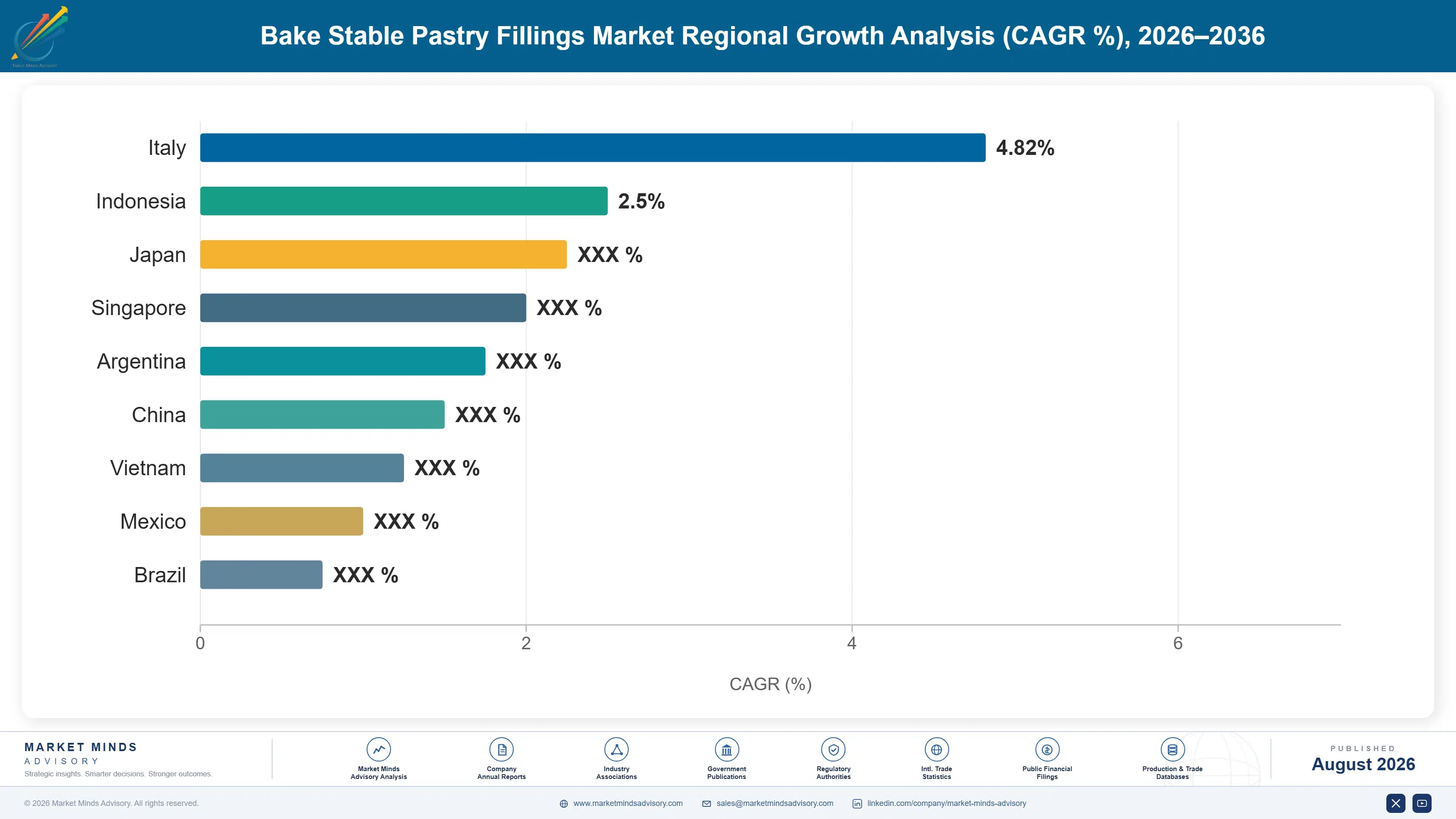
bake-stable-pastry-fillings-market-trends-country-cagr-analysis-1787462643352

Where Bake-Stable Filling Suppliers Capture Margin

Margin capture in bake-stable fillings increasingly depends on reformulation capability and quick-service customer partnerships rather than raw commodity fruit or dairy volume. Suppliers that can deliver validated, bake-stable reduced-sugar and allergen-free formulations on compressed development timelines are commanding meaningfully better pricing than those competing purely on cost per kilogram of commodity filling paste. That shift rewards formulation-led suppliers.

Reduced-Sugar Reformulation for Premium Retail Accounts

Suppliers that successfully reformulate commodity fruit and cream fillings to reduce added sugar by 15 to 25 percent while maintaining bake stability are capturing premium pricing from retail bakery and quick-service customers under growing consumer and regulatory pressure. Dawn Foods' reduced-sugar filling line, expanded in 2024, reportedly commands a price premium of roughly 12 to 18 percent over conventional formulations from comparable fruit sources. Smaller regional processors lacking dedicated reformulation testing capability are increasingly partnering with contract formulation labs to offer similar products, adding cost but preserving access to premium retail accounts that now specify reduced-sugar content.
Market Impact: Commands a 12 to 18 percent price premium

Rapid-Cycle Formulation Support for Menu Innovation

Suppliers that can validate new bake-stable formulations within 6 to 8 weeks, matching quick-service chains' limited-time-offer development cycles, are winning exclusive supply agreements that slower-moving competitors cannot secure. Rich Products' dedicated quick-service innovation team, expanded in 2023, has reportedly cut average formulation validation time from 14 weeks to under 8, directly enabling several major chains to launch seasonal pastry items on schedule. This responsiveness advantage increasingly matters more to quick-service customers than marginal per-kilogram cost differences, since a missed menu launch window carries far greater commercial cost than a small price premium.
Market Impact: Cuts formulation validation time down to 8 weeks

Plant-Based and Allergen-Free Formulation Line Expansion

Investing in plant-based and allergen-free filling formulation technology lets suppliers serve premium retail bakery and specialty grocery accounts willing to pay for dietary-restriction-friendly positioning. Zeelandia's plant-based filling line, launched within the past 18 months, commands roughly 20 to 30 percent higher per-kilogram pricing than comparable dairy-based cream fillings. Formulation complexity remains a barrier: replacing dairy-based stabilizers without compromising bake stability typically requires 6 to 12 months of dedicated testing, a barrier that concentrates this higher-margin segment among larger, better-resourced suppliers rather than smaller regional processors competing purely on commodity volume.
Market Impact: Commands roughly 20 to 30 percent pricing premium

Bundled Technical and Menu Development Support

Bundling technical formulation support and menu development consulting alongside the physical filling sale helps smaller retail bakery and regional quick-service customers that lack in-house product development teams. Puratos' bundled technical service offering, which pairs formulation scientists directly with customer product teams, has reportedly shortened customer time-to-market by several weeks on new pastry launches. This service layer also raises effective per-kilogram pricing by an estimated 8 to 10 percent, since smaller customers otherwise face contract formulation consulting costs running into the tens of thousands of dollars per project if sourced independently.
Market Impact: Raises effective pricing by 8 to 10 percent

Who Controls the Margin Pool

Five suppliers hold under a third of global bake-stable filling capacity on a production-volume basis, leaving this market considerably more fragmented than most established bakery ingredient categories. The gap between the largest formulation-focused suppliers and regional commodity processors is wide on technology but narrow on price, since commodity fruit and cream fillings remain intensely price-competitive. That fragmentation keeps commodity pricing competitive even among established players.
Current competitive activity centers on three fronts: reduced-sugar and allergen-free reformulation to win retail bakery and quick-service contracts, rapid-cycle formulation support to match quick-service menu innovation timelines, and plant-based filling technology investment to serve dietary-restriction-conscious premium accounts. Dawn Foods and Zeelandia have both announced reformulation capacity expansions in the past two years specifically targeting these higher-margin segments.

Emerging pressure is coming from regional Asian ingredient manufacturers entering with lower-cost commodity fruit and cream fillings and improving formulation technology, threatening the cost advantage established multinational suppliers hold in East Asian retail bakery markets. Rankings could shift meaningfully over the next several years if these regional entrants achieve the reformulation credibility that quick-service and premium retail customers currently associate mainly with established Western suppliers. A single credible entrant could accelerate that shift within a few years.
bake-stable-pastry-fillings-market-trends-company-positioning-matrix-1787462643928

Competitive Moat and Risk Dimensions

PURATOS

Moat: Integrated Formulation Technical Support

Puratos combines bake-stable filling production with embedded technical formulation support, pairing food scientists directly with customer product development teams. That integration lets Puratos win multi-year exclusive supply agreements that pure commodity processors cannot match, since customers value the reduced reformulation risk as much as the filling itself.
PURATOS

Risk: Slower Regional Cost Competitiveness

Puratos' technical service model carries a higher cost base than regional commodity processors, particularly in East Asian and Latin American markets where price sensitivity remains high. As regional manufacturers improve formulation technology while retaining a cost advantage, Puratos could face growing pressure on commodity accounts that do not require its premium technical support layer.
AGRANA

Moat: Largest Vertically Integrated Fruit Supply

AGRANA operates vertically integrated fruit sourcing and processing, from orchard contracts through finished filling production, giving it cost and quality consistency advantages that pure formulation-focused competitors cannot replicate. That integration lets AGRANA offer supply continuity guarantees during fruit harvest volatility that smaller competitors struggle to match.
AGRANA

Risk: Concentrated Fruit Harvest Risk Exposure

AGRANA's vertical integration into fruit sourcing, while a cost advantage in normal years, concentrates meaningful exposure to fruit harvest volatility that formulation-focused competitors sourcing fruit on the open market can more easily diversify away from. A severe harvest shortfall could compress AGRANA's margins more than competitors with more flexible sourcing arrangements.

Players Tracked

Prominent Players

Puratos
AGRANA
Rich Products
Dawn Foods
Zeelandia

Other Key Players

Bakels Group
Barry Callebaut
Cargill
ADM
Zentis
Andros Group
SVZ
Frulact
Materne
Comax Flavors
Sethness Roquette
CSM Bakery Solutions
Corbion
Fillco Inc
DGF Stanz

Recent Developments

MARCH 2024

Dawn Foods Expands Reduced-Sugar Filling Production

Dawn Foods expanded its reduced-sugar bake-stable filling production capacity in March 2024, adding formulation testing infrastructure to validate new recipes maintaining bake stability at 15 to 25 percent lower added sugar content, responding directly to growing retail bakery and quick-service demand for better-for-you pastry options.
Signal: Signals major suppliers are investing ahead of expected regulatory sugar reduction pressure rather than reacting afterward.
SEPTEMBER 2023

Rich Products Launches Dedicated Quick-Service Innovation Team

Rich Products launched a dedicated quick-service innovation team in September 2023, focused specifically on cutting formulation validation timelines to match major chains' limited-time-offer development cycles, and has since supported several seasonal pastry launches across multiple North American quick-service accounts within compressed timeframes. Competing suppliers are reportedly building similar dedicated teams.
Signal: Signals formulation speed is becoming as commercially important as ingredient cost for quick-service supply agreements overall.
JANUARY 2025

Zeelandia Launches Plant-Based Filling Product Line

Zeelandia launched a dedicated plant-based, dairy-free filling product line in January 2025, formulated to maintain bake stability without traditional dairy-based stabilizers, targeting retail bakery and specialty grocery accounts responding to rising vegan and lactose-free pastry consumer demand across European markets. Leadership called it a top priority for 2025 growth.
Signal: Signals established suppliers are moving quickly to capture dietary-restriction demand before smaller specialty entrants gain scale.

Fruit and Dairy Input Cost Exposure

Fruit and dairy inputs together account for roughly forty-two percent of total bake-stable filling production cost across the industry. Fruit supply originates predominantly from Eastern Europe, Southern Europe, and North America depending on variety, while dairy inputs for cream and custard fillings track regional milk commodity pricing cycles that can move independently of fruit market conditions entirely.
The 2023 European stone fruit harvest came in meaningfully below the five-year average due to adverse spring weather across key growing regions, according to AGRANA's 2023 annual report, pushing fruit filling base costs up sharply within two quarters. Ingredient suppliers with fixed-price retail bakery contracts absorbed most of the resulting margin compression, since reformulating an established pastry recipe mid-contract is not commercially viable for most branded quick-service customers.

Smaller regional processors sourcing fruit and dairy from a single growing region or supplier carry meaningfully more cost exposure than diversified multinational suppliers like AGRANA or Puratos, which can shift sourcing across multiple growing regions when one underperforms. Dairy-based cream filling producers face a distinct exposure profile tied to regional milk pricing cycles rather than fruit harvests, giving them a partial natural hedge against fruit-specific volatility.
bake-stable-pastry-fillings-market-trends-cost-volatility-analysis-1787462644137

Diversify Fruit Sourcing Across Growing Regions

Suppliers are qualifying fruit supply from Eastern Europe, Southern Europe, and North America simultaneously rather than relying on a single growing region, reducing the odds that one poor harvest disrupts total feedstock availability. This diversification adds logistics cost but has measurably reduced price volatility for suppliers that implemented it before the 2023 harvest shortfall.

Forward-Contract Dairy Supply for Cream Fillings

Cream and custard filling producers are locking in multi-year forward contracts for dairy supply, insulating input costs from the spot market volatility that has affected regional milk commodity pricing. This approach requires meaningful working capital commitment but has kept cream filling production costs more stable than fruit-based alternatives in recent years across most major producing regions.

Invest in Flexible Multi-Fruit Formulation Systems

Developing filling formulations that can substitute between comparable fruit varieties without requiring full product reformulation lets suppliers respond to regional fruit shortages by shifting sourcing rather than absorbing full cost increases. Suppliers with this flexibility built in are managing harvest volatility meaningfully better than those locked into single-variety formulations requiring lengthy requalification across multiple growing seasons.

Portfolio Architecture for Margin Defence

Bake-stable filling suppliers operate a three-tier portfolio spanning commodity fruit and cream fillings sold largely on cost per kilogram, reformulated reduced-sugar and allergen-free fillings commanding premium pricing from health-conscious retail and quick-service accounts, and plant-based or next-generation specialty fillings positioned for the highest-margin premium accounts. Gross margins vary sharply across these tiers, from thin single digits on commodity fruit paste to well above thirty percent on certified specialty and plant-based formulations.
The volume versus premium tension is intensifying as more suppliers chase reformulation margins, but commodity fruit and cream fillings still represent the majority of shipped volume and remain essential for covering fixed production costs and maintaining plant utilization across the industry's seasonal demand cycle. Suppliers that abandon commodity volume too quickly in pursuit of premium accounts risk underutilizing capacity built for scale.

High-value margin pools concentrate specifically in reduced-sugar and allergen-free formulations sold to health-conscious retail bakery brands, and in plant-based fillings supplying specialty grocery and premium quick-service accounts willing to pay for dietary-restriction-friendly positioning. Commodity fruit and cream filling remains the volume anchor but carries the thinnest margins in the entire category, squeezed further by regional processors competing purely on price.

Volume / Commodity-Adjacent Tier

Commodity fruit and cream fillings sold primarily on cost per kilogram into mainstream retail bakery and quick-service pastry applications, where price competition among regional processors is intense and formulation differentiation is limited.
Gross Margin: 3-8%

Premium / Certified Tier

Reformulated reduced-sugar and allergen-free fillings validated to maintain bake stability at meaningfully lower sugar or dairy content, sold into health-conscious retail bakery and quick-service accounts facing rising consumer and regulatory reformulation pressure.
Gross Margin: 16-26%

Sustainability / Regulatory / Next-Generation Tier

Plant-based, dairy-free, and next-generation specialty fillings positioned for premium grocery, dietary-restriction-conscious retail bakery, and specialty quick-service accounts willing to pay the category's highest per-kilogram prices Capital and formulation complexity keep this tier concentrated among larger, better-resourced suppliers.
Gross Margin: 28-40%
bake-stable-pastry-fillings-market-trends-portfolio-architecture-1787462644668

High-value Sub-segments and Strategic Watch-out

Reduced-Sugar Quick-Service Fillings

Reduced-sugar fillings validated for major quick-service chain menu programs are capturing premium pricing as chains standardize better-for-you pastry offerings across large global store networks, and suppliers with rapid formulation validation capability are winning exclusive multi-year supply agreements ahead of slower competitors. This segment is scaling fastest among global quick-service brands.
Gross Margin: 16-26%

Plant-Based Specialty Grocery Fillings

Plant-based and dairy-free fillings are gaining share in premium specialty grocery and health-focused retail bakery channels as consumer demand for vegan and lactose-free pastry options continues to expand steadily across major Western markets. Formulation complexity currently limits broader adoption beyond well-capitalized suppliers with dedicated testing infrastructure.
Gross Margin: 28-40%

Commodity Retail Bakery Fillings

Standard fruit and cream fillings sold into mainstream retail bakeries remain the category's volume core, anchored by long-standing customer relationships but facing intense price competition from regional processors entering on cost alone. Most incumbents defend this tier through scale and established distribution rather than product differentiation.
Gross Margin: 3-8%

Unreformulated Legacy Filling Lines

Older, unreformulated commodity filling lines still sold without reduced-sugar or allergen-free options face rising delisting risk as retail bakery and quick-service customers shift specifications, making this a segment suppliers should actively phase out. Several suppliers have already lost major accounts still competing on this outdated basis.
Gross Margin: 2-6%

Bake-Stable Fillings' Contract Lock-In Economics

Bake-stable fillings behave like an annuity ingredient once a supplier's formulation clears a customer's recipe and quality assurance approval process, because switching suppliers means requalifying bake performance across an entire production network, a costly and time-consuming process for large retail bakery and quick-service chains. That inertia gives incumbent suppliers multi-year revenue visibility once they win a formulation slot, particularly with quick-service chains that standardize recipes across thousands of stores simultaneously. That lock-in can persist for years once a chain standardizes a recipe across its network.
Adoption depth varies sharply by end-use vertical. Quick-service chains reformulate around new bake-stable filling technology relatively quickly when menu innovation demands it, while independent retail bakeries move far more slowly given the cost and disruption of changing an established recipe customers already recognize and expect consistently. Suppliers serving both channels increasingly run separate qualification tracks to match each customer's pace.

Generational buyer shifts are visible mainly in the retail bakery and specialty grocery channels, where younger bakery owners and category managers favor plant-based and reduced-sugar filling formulations specifically for their health and sustainability positioning, while legacy industrial bakery customers remain anchored to established commodity fruit and cream suppliers with decades-long, high-trust commercial relationships.
bake-stable-pastry-fillings-market-trends-end-use-penetration-index-1787462645176

Where Bake-Stable Filling Value Concentrates

These are among the four positions where our research anticipates prominent divergence between winners and laggards over the coming forecast period. Each is grounded in the demand model, the regulatory perimeter, and the announced capacity pipeline.
01 / REFORMULATION SPEED INVESTMENT

Rapid formulation validation will separate winners from slow-moving suppliers

Quick-service chains increasingly require new bake-stable formulations validated within 6 to 8 weeks to match compressed limited-time-offer development cycles, and suppliers that cannot meet this timeline are losing exclusive supply agreements to faster competitors. Rich Products' dedicated quick-service innovation team has already cut validation time from 14 weeks to under 8, demonstrating the commercial value of this capability beyond marginal cost advantages. MMA recommends suppliers without rapid-cycle formulation infrastructure invest in it now, before formulation speed becomes a baseline requirement rather than a competitive differentiator.
02 / REDUCED-SUGAR REFORMULATION INVESTMENT

Reformulate commodity lines ahead of regulatory sugar reduction pressure

Government sugar reduction initiatives are expanding across European and other markets, and packaged bakery manufacturers reformulating ahead of potential regulation are capturing premium retail pricing that reactive competitors are missing entirely. Dawn Foods' reduced-sugar filling line already commands a meaningful price premium over conventional formulations, demonstrating that reformulation investment pays off commercially well before regulation forces the change. MMA recommends suppliers without reduced-sugar reformulation capability build it now, since retrofitting formulations under regulatory deadline pressure costs meaningfully more than proactive investment today.
03 / PLANT-BASED FORMULATION CAPACITY

Build plant-based filling capacity ahead of mainstream demand

Plant-based and allergen-free fillings command a meaningful pricing premium over conventional dairy-based cream fillings, and demand from specialty grocery and health-conscious retail bakery channels is growing considerably faster than commodity categories. Formulation complexity, requiring 6 to 12 months of dedicated testing to replace dairy stabilizers without compromising bake stability, has kept this segment concentrated among larger, better-resourced suppliers so far. MMA recommends suppliers with sufficient formulation resources invest in plant-based capability now, while the technology still commands a meaningful pricing premium over conventional alternatives.
04 / EAST ASIAN MARKET ENTRY

Expand East Asian capacity ahead of retail bakery growth

China's rapidly expanding retail bakery and cafe sector is growing faster than any other regional market, as Western-style pastry consumption spreads quickly across major Chinese cities and domestic bakery chains scale store counts. Multinational suppliers currently retain a formulation technology advantage over domestic Chinese ingredient manufacturers, but that advantage is narrowing as local producers improve capability and compete increasingly on cost. MMA recommends suppliers without established East Asian production capacity evaluate market entry now, before domestic competitors close the formulation technology gap and capture first-mover retail bakery relationships.

Engagement Snapshot From the Field

A live engagement with an industry participant carrying material or product regulatory and market exposure ahead of a defining policy shift, showing how our research translates into a defensible multi-year portfolio strategy.
MARKET MINDS ADVISORY · CLIENT ENGAGEMENT SUMMARY
Bake Stable Pastry Fillings Producer Strategic Portfolio Review and Transition Roadmap 2026·Investment Scenario on Bake Stable Pastry Fillings Exposure Evaluation 2025-26
CLIENT PROFILE
The client is a mid-sized North American quick-service restaurant chain generating an estimated three hundred million dollars in annual system-wide revenue (client-reported, unverified by MMA), with a pastry program built around seasonal limited-time offerings. The client had historically relied on a single filling supplier for over six years and faced growing internal pressure to launch reformulated, reduced-sugar pastry items faster than its existing supplier's development timeline allowed.
STRATEGIC CHALLENGE
The client's marketing team had committed to a reduced-sugar seasonal pastry launch date that its incumbent filling supplier could not meet given a standard fourteen-week formulation validation timeline. The client faced a choice between delaying the launch, risking a missed seasonal sales window, or qualifying a new supplier capable of validating a bake-stable, reduced-sugar formulation on a compressed schedule.
MMA APPROACH
MMA conducted a structured evaluation of three suppliers with dedicated rapid-cycle formulation capability, benchmarking validation timeline, bake stability testing protocols, and pricing against the client's existing recipe and seasonal launch deadline. The engagement included direct facility assessments and a blind taste and bake-performance trial to confirm the recommended supplier's formulation would meet the client's flavor and stability standards.
KEY FINDINGS
  1. The incumbent supplier's standard fourteen-week validation timeline was fundamentally incompatible with the client's increasingly frequent seasonal launch calendar, a mismatch that had gone unaddressed for years.
  2. Switching to a rapid-cycle supplier added roughly nine percent to per-kilogram filling cost but compressed validation timeline from fourteen weeks to seven.
  3. Two of the three evaluated suppliers could not demonstrate consistent bake stability at the client's required reduced-sugar specification during blind testing trials.
  4. The client's new supplier relationship also enabled two additional seasonal launches within the following year that would not have been feasible previously (client-reported, unverified by MMA).
CLIENT PROFILE
The client is a mid-sized North American quick-service restaurant chain generating an estimated three hundred million dollars in annual system-wide revenue (client-reported, unverified by MMA), with a pastry program built around seasonal limited-time offerings. The client had historically relied on a single filling supplier for over six years and faced growing internal pressure to launch reformulated, reduced-sugar pastry items faster than its existing supplier's development timeline allowed.
STRATEGIC CHALLENGE
The client's marketing team had committed to a reduced-sugar seasonal pastry launch date that its incumbent filling supplier could not meet given a standard fourteen-week formulation validation timeline. The client faced a choice between delaying the launch, risking a missed seasonal sales window, or qualifying a new supplier capable of validating a bake-stable, reduced-sugar formulation on a compressed schedule.
MMA APPROACH
MMA conducted a structured evaluation of three suppliers with dedicated rapid-cycle formulation capability, benchmarking validation timeline, bake stability testing protocols, and pricing against the client's existing recipe and seasonal launch deadline. The engagement included direct facility assessments and a blind taste and bake-performance trial to confirm the recommended supplier's formulation would meet the client's flavor and stability standards.
KEY FINDINGS
  1. The incumbent supplier's standard fourteen-week validation timeline was fundamentally incompatible with the client's increasingly frequent seasonal launch calendar, a mismatch that had gone unaddressed for years.
  2. Switching to a rapid-cycle supplier added roughly nine percent to per-kilogram filling cost but compressed validation timeline from fourteen weeks to seven.
  3. Two of the three evaluated suppliers could not demonstrate consistent bake stability at the client's required reduced-sugar specification during blind testing trials.
  4. The client's new supplier relationship also enabled two additional seasonal launches within the following year that would not have been feasible previously (client-reported, unverified by MMA).
RECOMMENDED STRATEGY
Phase 1: Phase 1 (Weeks 1 to 2): Benchmark three rapid-cycle suppliers against validation timeline, bake stability testing, and pricing requirements for the seasonal launch. Phase 2: Phase 2 (Weeks 3 to 5): Conduct blind taste and bake-performance trials with the top two suppliers to confirm formulation quality. Phase 3: Phase 3 (Weeks 6 to 7): Finalize supplier transition, validate final formulation, and launch the reduced-sugar seasonal pastry item on schedule.
OUTCOME
The client launched its reduced-sugar seasonal pastry item on the original planned date and avoided an estimated six million dollars in projected seasonal revenue exposure from a delayed launch (client-reported, unverified by MMA). The new supplier relationship also positioned the client to launch two additional reformulated seasonal items within the following year.

Frequently Asked Questions

Foundational context covering the market sizes, CAGR, scope, country, region and competition that inform every finding below. This section is provided to cover basics and most often pre-purchase conversations, answered from the MMA Primary Research Dataset.

What is the current size of the Bake Stable Pastry Fillings Market?

The global bake stable pastry fillings market is valued at approximately $2.85 billion in 2025. Growth is driven by clean-label reformulation alongside quick-service pastry menu innovation.

How large will the Bake Stable Pastry Fillings Market be by 2036?

MMA projects the market will reach approximately $5.19 billion by 2036, roughly 1.7 times its 2026 base value. Specialty and functional fillings will account for a growing share of that expansion.

What is the CAGR for the Bake Stable Pastry Fillings Market 2026 to 2036?

The market is expected to grow at a compound annual growth rate of 5.6% between 2026 and 2036. Bull and bear scenarios range from 4.4% to 6.8% depending on input cost and reformulation conditions.

Which segment is growing fastest?

Specialty and functional fillings, including reduced-sugar and plant-based formulations, are the fastest-growing segment, expanding at roughly 9.6% annually, about 1.7 times the overall market rate.

Who are the major companies in the Bake Stable Pastry Fillings Market?

Puratos, AGRANA, Rich Products, Dawn Foods, and Zeelandia lead global supply on a production-volume basis. The top five suppliers together hold under a third of global capacity.

Which country is growing fastest?

China is growing fastest, driven by its rapidly expanding retail bakery and cafe sector and rising Western-style pastry consumption. Domestic bakery chain expansion is reinforcing this growth.

Report Segmentation Architecture

The full report scope spans multiple orthogonal segmentation dimensions, with cross-tabulated demand data provided for each dimension pair. Coverage extends further to regional breakdowns, trend trajectories, and the competitive detail needed to support segment-level decision-making.

By Base Ingredient Type

  • Fruit-Based Fillings
  • Cream and Custard Fillings
  • Chocolate and Cocoa Fillings
  • Cheese-Based Fillings
  • Nut and Praline Fillings
  • Specialty and Functional Fillings

By End-Use Industry

  • Retail and In-Store Bakeries
  • Quick-Service Restaurants
  • Industrial Packaged Pastry Manufacturing
  • Foodservice and Catering
  • Convenience and Grocery Retail

By Commercial Dimension

  • Reformulated Specialty Supply
  • Standard Commodity Supply
  • Private Label Contract Supply
  • Direct Brand Partnership Supply

By Region

  • North America
  • Western Europe
  • East Asia
  • South Asia and Pacific
  • Latin America
  • Middle East and Africa
  • Eastern Europe

Scope, Methodology, and Coverage

Every figure in this report is reproducible from documented input assumptions. The scope below maps the historical period, the forecast horizon, the segmentation dimensions, and the countries covered, alongside the underlying primary and qualitative methodology.
Historical Period
2020 to 2025
Forecast Period
2026 to 2036
Base Year
2025 (USD billions; MMA Primary Research Dataset, August 2026)
Market Definition
The bake stable pastry fillings market covers fruit, cream, custard, chocolate, cheese, and specialty formulated fillings engineered to retain structure, moisture, and flavor through high-temperature baking without weeping or scorching, sold to retail bakeries, quick-service restaurants, and industrial packaged pastry manufacturers. It excludes no-bake or refrigerated fillings that never undergo oven processing, and excludes finished consumer pastry products sold directly to shoppers.
Quantitative Units
USD billions (current prices); metric tons of formulated filling where applicable
Segmentation Dimensions
By Base Ingredient Type; By End-Use Industry; By Commercial Dimension; By Region
Regions Covered
North America, Western Europe, East Asia, South Asia and Pacific, Latin America, Middle East and Africa, Eastern Europe
Countries Covered
USA, China, Germany, France, UK, Japan, South Korea, India, Australia, Canada, Brazil, Mexico, Indonesia, Vietnam, Thailand, Malaysia, UAE, Saudi Arabia, South Africa, Nigeria, Turkey, Poland, Netherlands, Italy, Spain, Sweden, Switzerland, Argentina, Colombia, Singapore, and additional markets relevant to this sector
Key Companies Profiled
Puratos, AGRANA, Rich Products, Dawn Foods, Zeelandia, Bakels Group, Barry Callebaut, Cargill, ADM, Zentis, Andros Group, SVZ, Frulact, Materne, Comax Flavors, Sethness Roquette, CSM Bakery Solutions, Corbion, Fillco Inc, DGF Stanz
Quantitative Methodology
Primary survey, n=3,800 respondents, Q4 2025, six countries; demand-side model with trade association cross-validation
Qualitative Methodology
47 expert interviews, Q4 2025; applied to validate demand model assumptions, identify emerging dynamics, and assess competitive positioning
Report Format
PDF and XLSX data workbook (Word format preview document)
Publisher
Market Minds Advisory
Report Code
MMA-2026-AGR-103
Published
August 2026
Contact
sales@marketmindsadvisory.com | www.marketmindsadvisory.com

Purchase the full Bake Stable Pastry Fillings Market Report (2026 to 2036).

This report delivers a complete assessment of the global bake stable pastry fillings market across all major base ingredient categories, end-use industries, and geographic regions through 2036. It includes detailed competitive profiling of twenty companies, segmentation analysis distinguishing fruit, cream, chocolate, cheese, nut, and specialty functional fillings, and regional demand modeling across all seven MMA-covered geographies. Buyers will find quantified forecasts for market size, segment growth rates, and regional CAGR alongside qualitative analysis of reformulation trends, quick-service innovation cycles, and fruit and dairy input cost exposure. A dedicated revenue lever framework identifies four specific commercial actions suppliers can take to capture margin as clean-label reformulation accelerates.
Twenty-company competitive profiling with moat and risk analysis
Seven-region demand model with justified share and CAGR bands
Base-ingredient segmentation across six MECE filling categories
Quantified revenue lever framework for margin capture strategies
Fruit and dairy input cost exposure analysis by geography
Anonymized case study on quick-service formulation acceleration

Built For The People Who Decide

From boardroom strategy to bench-side execution, this report is read cover-to-cover by leaders shaping the next decade of their industry, turning demand scenarios, market dynamics and valuation benchmarks into decisions.
CXOs/ Presidents/ VPs/ Managers
M&A and Corporate Development
Strategy Teams and R&D Heads
Procurement and Product Directors
Regulatory and Compliance Leaders
Investor Relations and Equity Analysts