Market Minds Advisory
Bag in Box Market

Bag in Box Market: The Tap Decides Whether the Format Works

The film and the carton are commodities bought on price, while the dispensing fitment is where failure, shelf life, and almost all of the defensible margin in this format actually concentrate.

Lead Analyst

Bilal Shaikh

Published

September 2026

Make Smarter Decisions with Customized Research Insights

Request a free sample report and evaluate market opportunities, growth trends, and competitive dynamics relevant to your business needs.

2025 MARKET VALUE$4.1BMarket Size 2025
2036 FORECAST VALUE$8.6BBase Case , 2026 to 2036
CAGR 2026 TO 20367.0 %Bull 8.2% / Bear 5.8%
INCREMENTAL OPPORTUNITY$4.2BNet 10- year value creation
EXPANSION MULTIPLE1.97x2036 value over 2026 base
Strategic Levers
M&A Pipeline
Regional Outlook
Country Rankings
Competitive Intelligence
Segmental Deep-dive
Call-Us : 91 93563 13602

Executive Snapshot and Market Trajectory

Buyers tender bag in box on film gauge and carton board grade, then discover that roughly 71% of field complaints trace to the tap. Fitment leakage, oxygen ingress at the spout weld, and dispensing failure at low residual volume are what actually determine whether the format holds.
Growth runs at 7.0% and aseptic liquid food applications lead it. Aseptic bag in box grows at 10.5%, exactly 1.50 times the market rate, replacing drums and cans for fruit purees, dairy bases, and tomato paste where ambient shelf life removes cold chain cost entirely. East Asia holds the largest share at 30%, on liquid food processing volume rather than on any wine tradition at all.
Concentration reaches 38% across the top five measured on annual units shipped, with converters, fitment specialists, and filling equipment builders each holding different parts of the value. The fitment makers are the smallest group and hold the strongest position, because a filler qualified around one spout geometry does not requalify casually. Pouch formats take smaller applications where dispensing does not matter at all. Rigid bulk containers hold the larger end where reuse economics work.
Market Definition
This market covers flexible bag in box liquid packaging systems, spanning standard multilayer bags with dispensing fitments, aseptic bag in box for liquid foods, wine and beverage bag in box formats, industrial and chemical liquid bag in box, and dispensing fitments and taps supplied separately. Rigid intermediate bulk containers, flexible bulk bags for solids, pouches without dispensing fitments, drums and pails, and filling equipment sold as capital machinery fall outside scope.
Base Year Value
$4.1B in 2025 (MMA Primary Research Dataset, August 2026)
Forecast Period
2026 to 2036, eleven discrete annual values
CAGR
7.0% base case. Bull 8.2%. Bear 5.8%.
Fastest Growth Segment
Aseptic Bag in Box for Liquid Foods: 10.5% CAGR
Fastest Growth Country
India: 9.2% CAGR
Fastest Growth Region
South Asia and Pacific: 9.0% CAGR
Largest Region
East Asia: 30% of 2025 global value
Market Leaders
Smurfit Westrock, Liqui-Box, Scholle IPN, DS Smith, Amcor. Source: MMA Analysis based on company annual reports.
Primary Survey
n=3,800 procurement and R&D decision-makers, Q4 2025, six countries
Methodology
Demand-side build-up, cross-validated against public data, 47 expert interviews

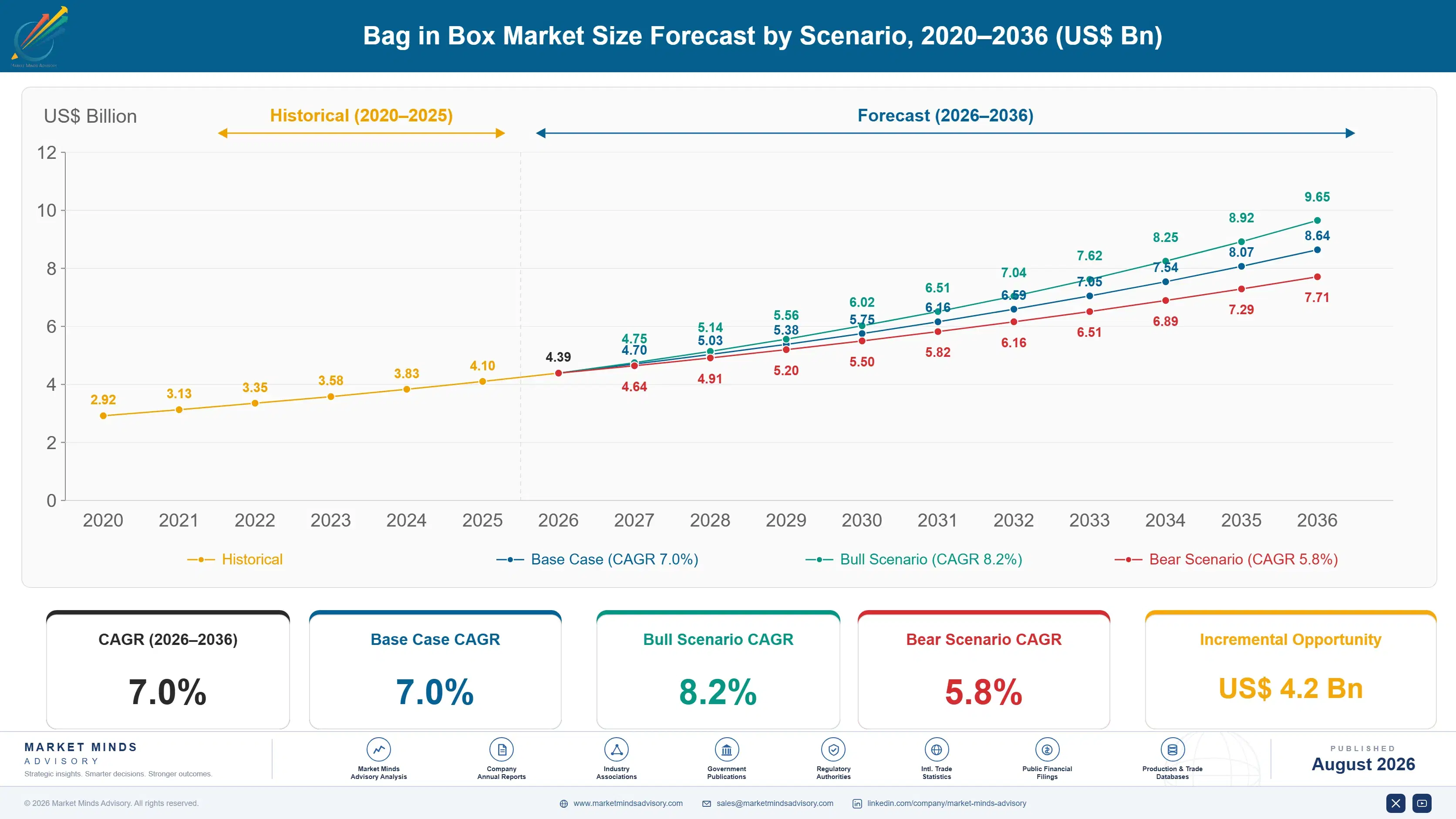
Bag in Box Market Forecast Scenarios

bag-in-box-market-size-forecast-scenario-1787300363305
The 2020 to 2025 period grew at 6.0% and the composition changed more than the total did. Wine bag in box gained sharply during 2020 and 2021 on at-home consumption, then gave much of it back. Aseptic liquid food applications grew steadily throughout and never depended on that swing. Resin and board pricing moved violently across the middle of the period, compressing converter margins on fixed-price contracts.
Three mechanisms carry the 7.0% base case. Aseptic liquid food conversion is the largest, since replacing drums and steel cans removes cold chain cost and cuts freight weight on the same shipment. Fitment engineering is the second, because dispensing reliability determines whether a converted customer stays converted. And industrial chemical adoption is the third, where bag in box displaces small drums on handling and disposal cost. None depends on a barrier film breakthrough.
The 8.2% bull case rests on aseptic conversion accelerating in dairy and plant-based liquid bases, where ambient distribution economics are strongest and cold chain investment is being avoided. The 5.8% bear case is resin price weakness combined with wine format decline in mature markets, where premiumisation keeps pushing consumers back toward glass regardless of the format's practical advantages.

Everything Fails at the Spout

Purchasing departments buy this format the way they buy corrugated board. They tender film gauge, barrier structure, and carton grade, compare unit prices, and award. The specification is thorough on everything that can be measured in a laboratory. It is usually thin on the one component that decides whether the pack works in a customer's hands, which is the tap.
COMPLAINTS FROM FITMENT71%Of field complaints traced to the dispensing tap assembly
ASEPTIC SHELF LIFE18 monthsAmbient, against weeks for chilled equivalent liquid formats
FILM SHARE OF COGS44%Making converter revenue follow resin pricing more than volume
FREIGHT WEIGHT SAVING82%Against steel drums at equivalent filled liquid volume
TOP FIVE CONCENTRATION38%Moderate across converters, fitment makers, and equipment builders
FILLER REQUALIFICATION TIME14 weeksTo change spout geometry on an installed filling line
Roughly 71% of field complaints trace to the fitment. Leakage at the spout weld, oxygen ingress through the seal that cuts shelf life well short of specification, and dispensing failure at low residual volume when the bag collapses around the outlet. None of these show up in an incoming goods inspection. They show up at a restaurant, a bottling line, or a kitchen, long after the converter has been paid.
That asymmetry explains where the margin sits. Film and board are commodities with resin at roughly 44% of converter cost. Fitments are engineered components, made by a small group of specialists, and a filling line qualified around one spout geometry takes around fourteen weeks to requalify around another. Converters who treat the fitment as a bought-in part are competing on resin buying, which is not a contest anyone wins.
"A customer ran a full tender on film specification, saved four percent, and switched. Six months later they switched back over tap failures nobody had tested for. The film was fine. It was always going to be fine."
Principal, Flexible Packaging and Liquid Systems Practice · MMA Flexible Packagi

Market Trends

Aseptic Conversion Displaces Drums And Steel Cans

Fruit purees, tomato paste, dairy bases, and plant-based liquids are moving from steel drums and cans into aseptic bag in box, and the driver is distribution economics rather than packaging preference. Ambient shelf life near eighteen months removes cold chain cost entirely, and freight weight falls roughly 82% against filled steel drums at the same volume. Growth runs at 10.5% against 7.0% for the market, and the converted volume very rarely reverts afterward. Requalifying an aseptic filling line is expensive and slow, which is precisely why that converted volume stays where it went.
Market Impact: Shelf life reaches 18 months
Fitment Specification Moves Into Purchase Tenders

Buyers who tendered on film gauge alone are beginning to write fitment performance into specifications, after field complaint analysis kept pointing at the tap rather than at the bag. Oxygen transmission at the spout weld, dispensing performance at low residual volume, and leak testing under transport vibration are the clauses appearing. The shift favours converters holding fitment engineering capability and disadvantages those buying spouts as a commodity component and passing them through. Oxygen transmission at the weld is the clause that separates capable suppliers most sharply. Converters passing spouts through at cost carry a risk they neither test nor control.
Market Impact: Cuts freight weight by 82%

Market Opportunities and Growth Drivers

Cold Chain Avoidance Drives Liquid Food Conversion

Aseptic filling gives ambient shelf life near eighteen months against weeks for chilled equivalents, which removes refrigerated storage, refrigerated transport, and the loss that follows any cold chain interruption. For processors shipping fruit puree or dairy base across long distances into secondary manufacturing, that removal is worth considerably more than the packaging costs. It also opens export routes that chilled distribution could not serve at all, which is where the fastest conversion is happening. Secondary manufacturers importing puree and dairy base are driving most of that conversion. Reversion afterward is rare, because requalification costs more than the original switch did.
Market Impact: Around 71% of complaints

Freight And Disposal Economics Displace Steel Drums

A filled bag in box weighs roughly 82% less in packaging terms than a steel drum at equivalent liquid volume, and the empty bag folds flat into general waste rather than requiring drum reconditioning, return logistics, or hazardous residue handling. Industrial chemical and food ingredient users are converting on those two costs together rather than on unit packaging price, which usually favours the drum. Disposal regulation tightening across most jurisdictions accelerates it further. Packaging procurement rarely sees those two lines, since they sit in logistics and waste budgets. Selling into operations changes which numbers are in the room.
Market Impact: Shelf life falls below 18 months

Market Restraints and Challenges

Fitment Failure Damages Trust In The Whole Format

Roughly 71% of field complaints trace to the dispensing tap rather than to the bag or carton, and the root cause is that fitments are engineered components frequently bought in as commodity parts and never tested under real dispensing conditions. Commercial impact runs beyond the individual complaint, since a customer whose tap failed questions the format rather than the supplier. Mitigation runs through fitment performance clauses in specifications, transport vibration testing, and dispensing trials at low residual volume. A converter buying spouts as a commodity part carries risk it neither designs nor tests.
Market Impact: Aseptic growing at 10.5%

Multilayer Barrier Films Resist Recycling Streams

The barrier structures that give bag in box its shelf life combine polyethylene with ethylene vinyl alcohol or metallised layers, and those laminates are rejected by most mechanical recycling streams. The root cause is that barrier performance and material simplicity pull directly against each other. Commercial impact is exposure to packaging waste regulation and to brand recycled content commitments. Mitigation runs through mono-material polyethylene structures with coated barriers, which sacrifice some shelf life for stream compatibility. Regulation is tightening fastest in exactly the markets buying the highest barrier specifications today.
Market Impact: About 71% of complaints
4 additional market trends, 3 additional growth drivers, and 2 additional restraints and challenges are covered in the full report. Contact sales@marketmindsadvisory.com to access the complete intelligence.

Segment CAGR and Growth Architecture

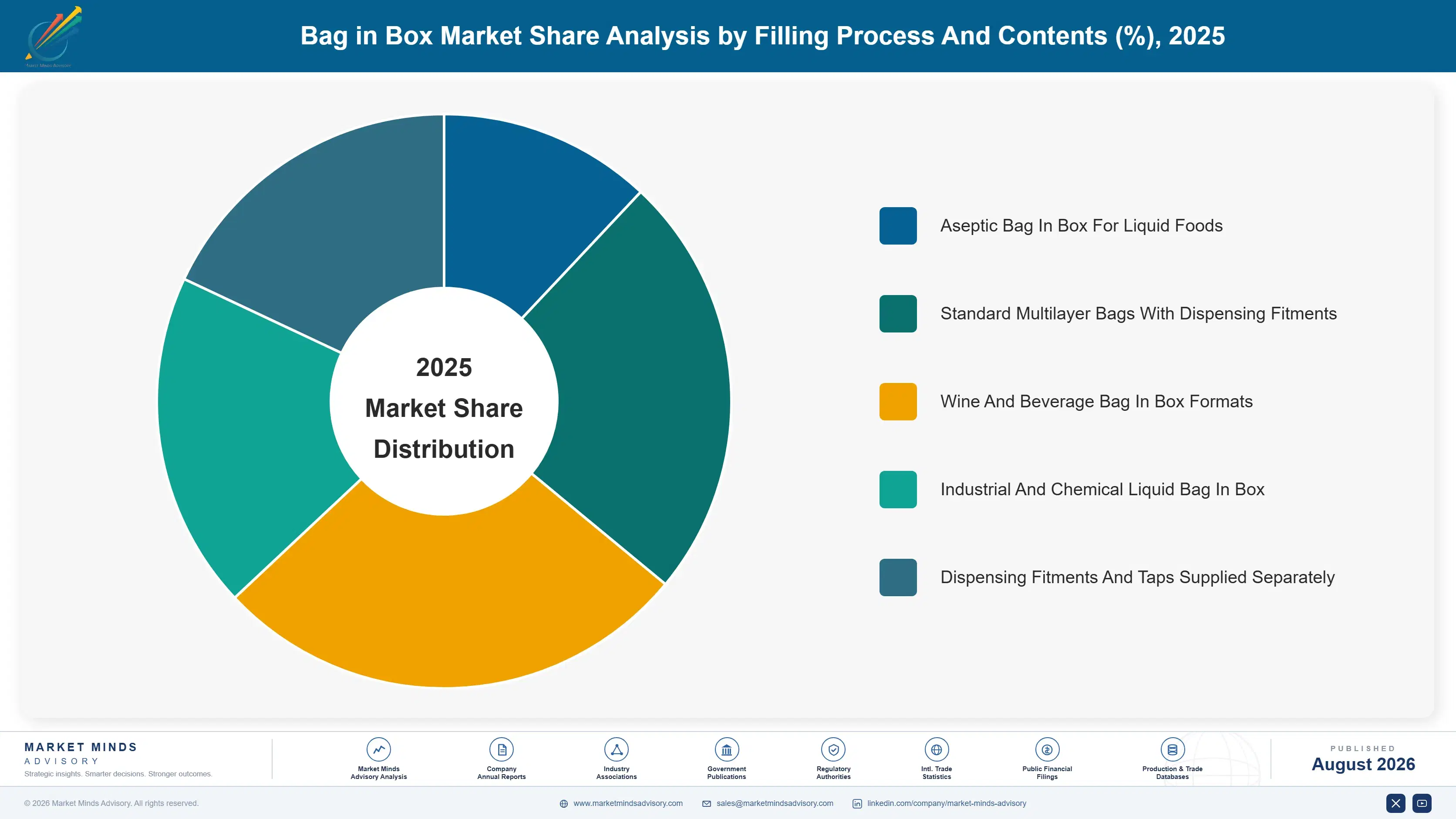
Segmentation follows the filling process and the contents category together, because those two determine barrier requirement, fitment specification, shelf life, and the alternative format each application actually competes against. Bag size and end-use industry both cut across every filling route rather than separating them, which makes either a considerably weaker primary dimension here. Filling process decides the fitment specification outright.
bag-in-box-market-market-share-analysis-1787300363835

Aseptic Bag In Box For Liquid Foods

The fastest route at 10.5%, exactly 1.50 times the market rate, and the only one displacing steel rather than competing against another flexible format. Ambient shelf life near eighteen months removes cold chain cost, and freight weight falls roughly 82% against filled drums at the same volume. Barrier and fitment specifications are the most demanding in this market, since aseptic integrity failure spoils an entire shipment rather than one pack. That difficulty is precisely why converted volume so rarely reverts and why margins hold better here. Requalifying an aseptic line takes around fourteen weeks plus validation runs nobody undertakes casually. Secondary manufacturers importing puree and dairy base are driving most of the conversion volume.
CAGR 10.5%

Industrial And Chemical Liquid Bag In Box

Second fastest at 8.6%, displacing small steel drums and pails on handling, freight, and disposal cost together rather than on unit packaging price, which generally favours the drum. Empty bags fold flat into general waste and avoid drum reconditioning, return logistics, and residue handling entirely. Chemical compatibility testing is the gating requirement, since aggressive contents attack both film layers and fitment polymers over time. Tightening disposal regulation across most jurisdictions has accelerated conversion faster than any packaging argument managed on its own. Fitment polymer selection matters as much as film structure in these applications. Buyers here compare against drum reconditioning and residue handling rather than against packaging price. Conversion very rarely reverses afterward.
CAGR 8.6%
Full segment breakdown across 5 segments available in the complete report.

Regional Architecture and Country Demand Map

East Asia leads at 30% on liquid food processing volume rather than on any wine tradition. Western Europe follows on wine and aseptic food, ahead of North America. South Asia and Pacific grows fastest as fruit and dairy processing capacity is built out. Fitment specification rises with contents value everywhere.

East Asia

Thirty percent, the largest share, and liquid food processing volume rather than any wine tradition explains it. Chinese fruit concentrate, tomato paste, and dairy base processing operate at a scale that dominates aseptic bag in box demand globally, much of it destined for export where ambient distribution is the only practical route. Japanese and Korean food processors buy the highest barrier and fitment specifications in this market. Growth at 7.8% runs above the market rate, driven by continued aseptic capacity investment across Chinese fruit processing regions. Fitment sourcing here is increasingly domestic rather than imported from European specialists. Export destinations rather than domestic requirements set the barrier specification across most of this volume.
Share: 30% | CAGR: 7.8% (2026 to 2036)

Western Europe

Wine and aseptic food together carry this 24%, and the region remains the reference point for format quality specification. French, Spanish, and Italian wine bag in box is a mature category with declining volume as premiumisation pushes consumers toward glass, while Italian tomato and fruit processing sustains strong aseptic demand. Packaging waste regulation is also sharpest here, pushing mono-material structures ahead of other regions. Growth at 5.4% is the slowest of any region, with aseptic gains offsetting steady wine format erosion rather than exceeding it. Fitment specialists based here supply spout geometry standards used well beyond the region itself. Mono-material barrier development is furthest advanced anywhere, driven by regulation rather than by demand. Wine volume continues eroding steadily.
Share: 24% | CAGR: 5.4% (2026 to 2036)
Regional intelligence for 5 additional markets available in the complete report: North America, South Asia and Pacific, Latin America, Middle East and Africa, Eastern Europe. Contact sales@marketmindsadvisory.com.
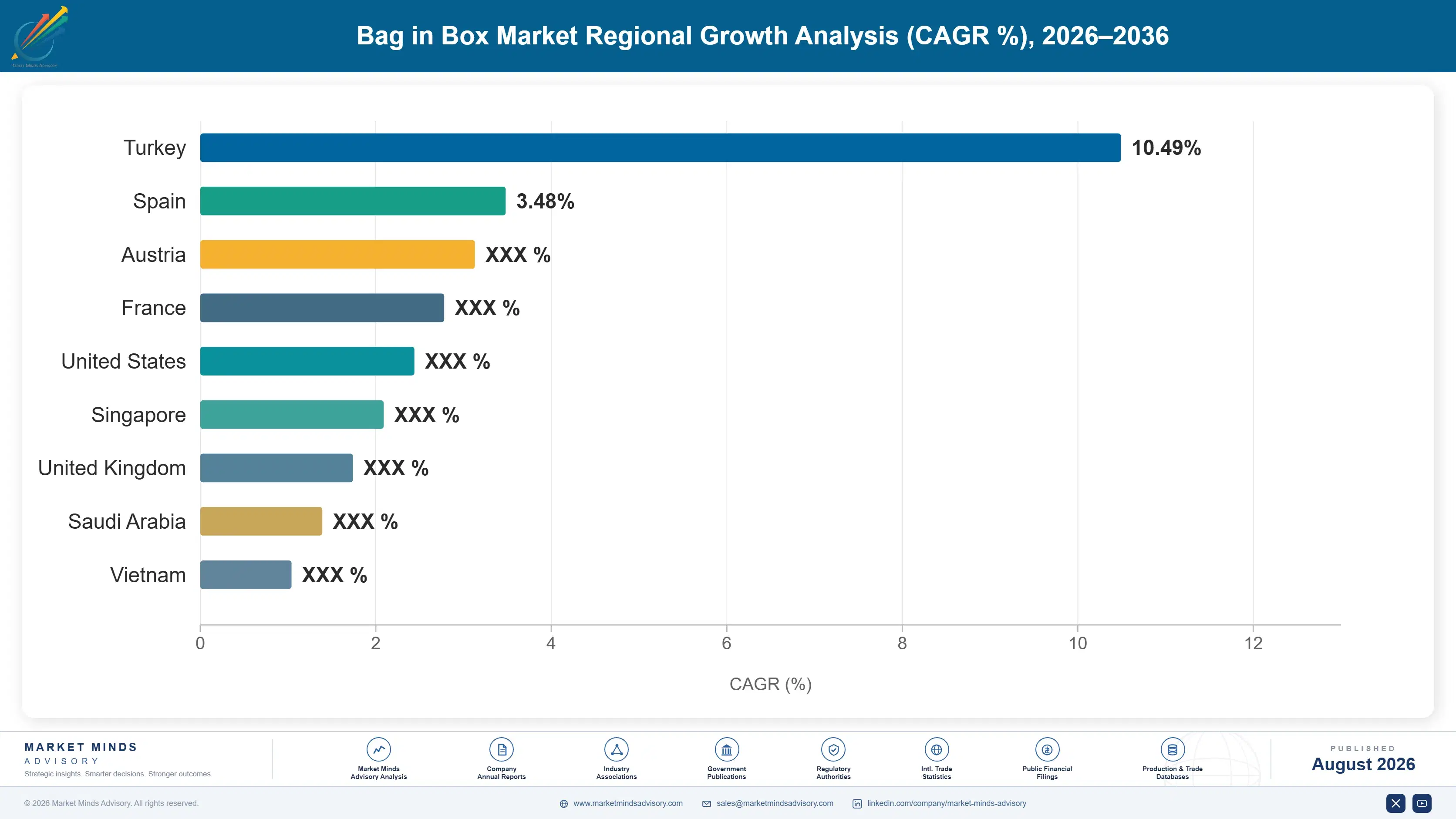
bag-in-box-market-country-cagr-analysis-1787300364348

Owning the Component That Fails

Around 71% of complaints trace to the fitment, aseptic shelf life reaches eighteen months, film carries 44% of converter cost, and requalifying a filler takes fourteen weeks. Value comes from owning fitment engineering, from selling distribution cost rather than packaging price, and from indexing resin exposure. The component that fails is also the one that defends margin.

Own The Fitment Instead Of Buying It

Roughly 71% of field complaints trace to the tap, and a converter buying spouts as a commodity part carries the reputational cost of a component it neither designs nor controls. Fitment engineering capability converts the single largest failure mode into the single strongest differentiator, and it prices well above film. A filling line qualified around one spout geometry needs around fourteen weeks to requalify around another, which makes the position considerably more defensible than any film specification. Fitment engineering also prices well above film on any comparable volume basis, and it always has.
Market Impact: Filler requalification takes about 14 weeks to complete

Sell Distribution Cost Not Packaging Price

Bag in box loses on unit packaging price against a steel drum almost every time, and wins comfortably once cold chain removal, an 82% freight weight reduction, and avoided drum reconditioning are included in the comparison. Buyers running packaging tenders never see those lines, because they sit in logistics and waste budgets. Selling into supply chain and operations rather than into packaging procurement changes which numbers are in the room when the decision gets made. Cold chain removal on its own frequently exceeds the entire packaging cost difference under discussion.
Market Impact: Freight weight falls roughly 82% against steel drums

Index Resin Exposure Out Of Supply Agreements

Film carries around 44% of converter cost of goods sold, so multi-year supply agreements at fixed prices convert every polyethylene increase directly into margin loss, as the movement through 2021 and 2022 demonstrated across the sector. Indexation against a published resin benchmark moves that exposure to a customer generally indexing their own inputs already. Buyers resist that clause until the alternative is explained to them properly, which is several years of material risk priced defensively into the opening quote. Barrier resin allocation also matters considerably more than commodity polyethylene purchasing scale during any shortage.
Market Impact: Film carries 44% of converter cost of goods

Develop Mono-Material Barriers Before Regulation Forces It

Multilayer barrier laminates combining polyethylene with ethylene vinyl alcohol are rejected by most mechanical recycling streams, and packaging waste regulation is tightening fastest in the markets buying the highest specifications. Mono-material polyethylene structures with coated barriers sacrifice some of the eighteen month aseptic shelf life for stream compatibility. Converters developing them ahead of the requirement sell a solution; those waiting will be answering a specification somebody else has already written for them. Mono-material structures currently cut ambient shelf life below the 18 month multilayer benchmark. That trade-off is narrowing as coating technology improves.
Market Impact: Shelf life drops below the 18 month benchmark

Who Controls the Margin Pool

Concentration reaches 38% across the top five measured on annual units shipped, and the moderate figure hides an unusual structure. Large converters hold the volume and compete on film and board buying. A much smaller group of fitment specialists holds the component that decides field performance, and filling equipment builders hold the qualification relationships that make switching slow. Value and volume sit in different hands, which keeps the leader to challenger gap narrower than unit share
Competitive activity runs on three fronts. Fitment engineering and dispensing performance is the first and the least visible in any tender document. Aseptic filling qualification is the second, since a converter approved on a customer's installed line holds a position measured in requalification weeks rather than in price. And barrier structure development against packaging waste regulation is the third, increasingly a qualifying requirement.

Pressure arrives from two directions. Pouch formats without fitments take smaller volume applications where dispensing does not matter. And rigid intermediate bulk containers hold the larger end where reuse economics work. Mono-material barrier requirements are also arriving from regulators rather than from customers, which changes the negotiating position entirely.

Rankings shift on aseptic line qualifications more than on tenders.
bag-in-box-market-company-positioning-matrix-1787300364867

Competitive Moat and Risk Dimensions

SMURFIT WESTROCK

Moat: Integrated board and converting scale

Owning board production alongside bag converting removes a margin layer and gives supply security on the carton element that independent converters buy on the open market. Scale in resin purchasing compounds it, since film carries roughly 44% of converter cost of goods sold. For high-volume standard applications where price decides, that integration is genuinely difficult to compete against.
SMURFIT WESTROCK

Risk: Volume position ignores fitment value

Scale advantages sit almost entirely in film and board, which are the components that never fail, while roughly 71% of complaints trace to a fitment generally bought in. Integration does nothing for the differentiator that actually decides customer retention. Competing on the commodity elements of a pack whose value concentrates elsewhere caps what the scale position can ultimately earn.
SCHOLLE IPN

Moat: Fitment engineering plus installed base

Designing and manufacturing dispensing fitments alongside bags, with filling equipment installed at customer sites qualified around that spout geometry, creates a position measured in requalification time rather than in price. Around fourteen weeks of filler requalification stands between a customer and a competitor. Very few converters hold both the component engineering and the equipment relationship together.
SCHOLLE IPN

Risk: Equipment installed base ages

A position resting on installed filling equipment weakens as customers replace lines and reconsider fitment standards at exactly that moment, which is the one point where requalification cost is being paid anyway. Line replacement cycles therefore create recurring competitive openings. Defending them requires equipment investment that pure converters never have to fund at all.

Key Players

Smurfit Westrock
Liqui-Box
Scholle IPN
DS Smith
Amcor

Others

Sealed Air
Mondi
Coesia
Optopack
Rapak
CDF Corporation
Zacros
Vitop
Aran Group
Goglio
TPS Rental Systems
Hoover Ferguson
Parish Manufacturing
Astrapak
Nihon Matai

Recent Developments

FEBRUARY 2025

Food processor writes fitment performance into supply specification

A liquid food processor added oxygen transmission at the spout weld, dispensing performance at low residual volume, and transport vibration leak testing to its bag in box purchase specification. The change was a procurement specification revision rather than any joint venture, acquisition, or development agreement with a converter.
Signal: Fitment performance is moving into tender documents that previously covered only film specification and board grade.
MAY 2025

Concentrate producer converts drum volume to aseptic bag

A fruit concentrate producer converted substantial steel drum volume to aseptic bag in box for export shipments, citing freight weight and avoided drum reconditioning ahead of any packaging cost comparison. The conversion was an internal procurement decision rather than any joint venture, acquisition, or equity arrangement with the converter.
Signal: Distribution and disposal cost rather than packaging price is what actually moves drum volume out of steel.
SEPTEMBER 2025

Converter launches mono-material polyethylene barrier bag structure

A flexible packaging converter introduced a mono-material polyethylene bag with a coated barrier layer compatible with existing polyethylene recycling streams, at reduced shelf life against multilayer equivalents. The launch was organic product development rather than any acquisition, joint venture, or licensing arrangement with a film supplier.
Signal: Recyclability and barrier performance still trade directly against each other in this format in this format today.

Resin, Board and Fitment Moulding

Film resin carries roughly 44% of converter cost of goods sold, predominantly polyethylene with ethylene vinyl alcohol or metallised barrier layers, sourced regionally since film freight is uneconomic over distance. Carton board adds about 18%, dispensing fitments near 15%, converting and lamination energy around 9%, and labour, quality, and outbound freight the balance. Barrier resin is the input with least substitutability at short notice.
Polyethylene and ethylene vinyl alcohol pricing moved sharply through 2021 and 2022 across North American and European markets, and converters holding multi-year fixed-price agreements with food processors absorbed those increases directly into margin, with several disclosing the compression in annual filings for the period. Barrier resin availability was the more acute problem, since ethylene vinyl alcohol supply concentrates among very few producers globally. Availability rather than price was the binding constraint.

The competitive disadvantage mechanism runs through barrier resin access rather than through commodity polyethylene buying. Converters without allocation agreements for ethylene vinyl alcohol face both price and availability exposure that scale in standard polyethylene does nothing to offset. Regional exposure differs too, since European converting energy cost sits persistently above North American and Asian equivalents rather than moving cyclically with them.
bag-in-box-market-cost-volatility-analysis-1787300365061

Secure barrier resin allocation ahead of commodity resin scale

Ethylene vinyl alcohol supply concentrates among very few producers globally, and allocation through 2021 and 2022 showed that availability rather than price is the binding constraint in a shortage. Volume agreements for barrier resin protect production continuity in a way commodity polyethylene purchasing scale does not. Converters who secured allocation during the disruption hold flexibility those who waited still lack.

Index multi-year agreements to a published resin benchmark

Film carries around 44% of converter cost of goods sold, and multi-year food processing agreements at fixed prices convert every polyethylene increase directly into margin loss across the contract. Indexation against a published resin benchmark transfers that exposure to a customer who is generally indexing their own input contracts already. Buyers resist and then accept.

Bring fitment moulding in-house where volume supports it

Dispensing fitments carry around 15% of cost of goods sold and cause roughly 71% of field complaints, which makes them simultaneously the worst component to buy in and the best to control. In-house moulding requires tooling capital and injection capability most converters lack. Where volume supports the investment, it converts the largest failure mode into the strongest differentiator available.

Portfolio Architecture for Margin Defence

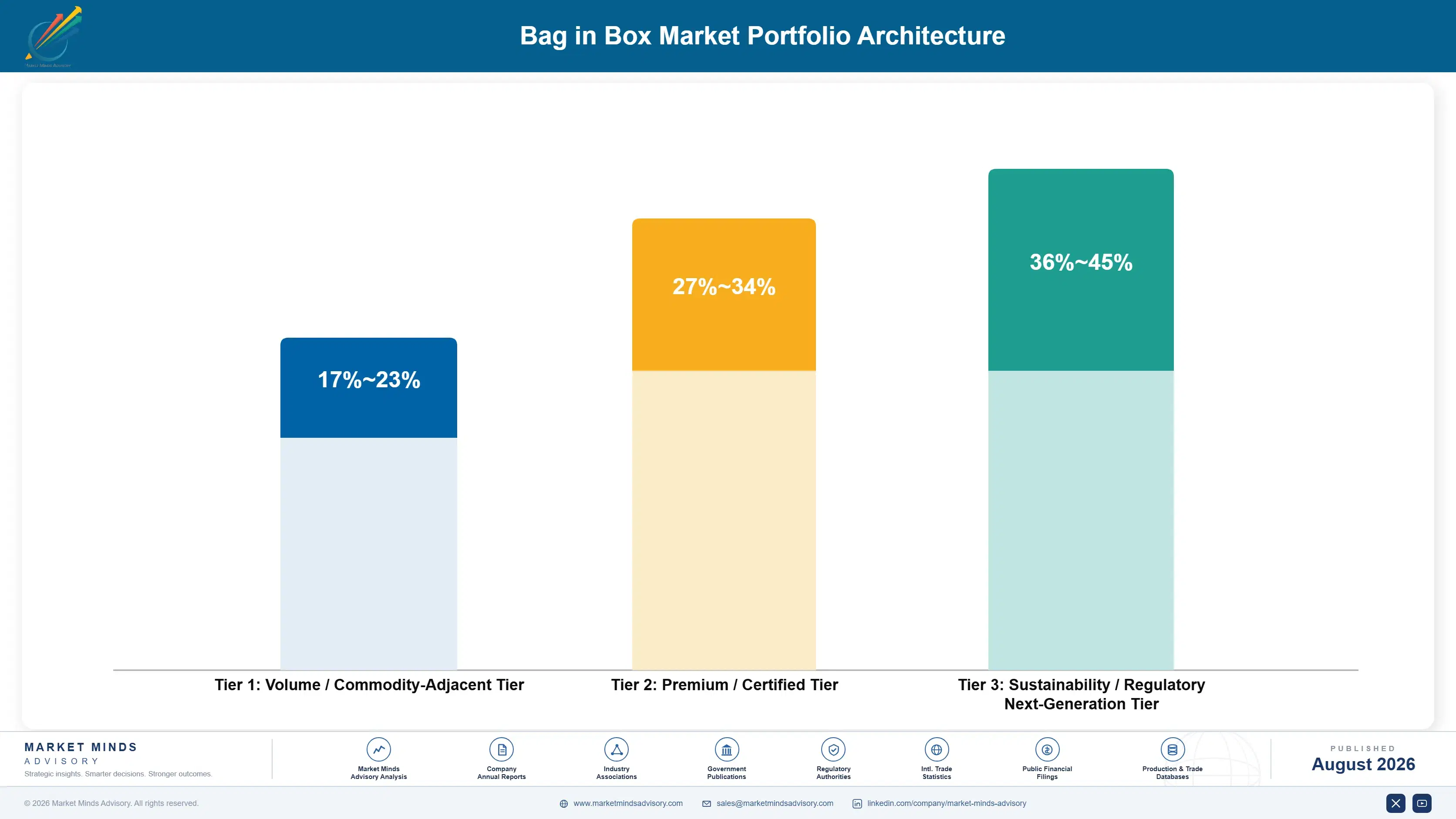
Three tiers describe this business and the spread is set by barrier and fitment engineering rather than by size. Standard bags for wine and non-critical liquids sit at the bottom, competing on film and board price with resin at 44% of converter cost. Foodservice dispensing formats occupy the middle, where fitment reliability commands a genuine premium. Aseptic food and chemical-compatible structures sit at the top on barrier performance and qualification difficulty.
The tension is that volume bags build the converting scale that makes resin buying competitive, while the engineered formats carry the margin and the customer retention. Converters chasing volume alone compete on resin purchasing against integrated board producers, which is not a contest they win. Those leading with engineered structures struggle to reach the converting scale that fixed cost absorption requires. Durable positions hold both across shared converting assets.

High-value pools concentrate where a failure spoils a shipment rather than a pack. Aseptic integrity is the clearest case, since a barrier or fitment failure ruins an entire container load in transit. Foodservice dispensing pools value similarly, because a tap failure interrupts service in front of a paying customer. Both pools reward fitment engineering rather than resin buying.

Volume / Commodity-Adjacent Tier

Standard bags for wine and non-critical liquid applications, competing on film and board price where resin at roughly 44% of converter cost dominates. Engineering content is limited and integrated board producers hold a genuine purchasing advantage.
Gross Margin: 17-23%

Premium / Certified Tier

Foodservice dispensing formats where fitment reliability commands a real premium, since a tap failure interrupts restaurant service directly. Filler qualification around a spout geometry takes roughly fourteen weeks, which makes these positions considerably more durable.
Gross Margin: 27-34%

Sustainability / Regulatory / Next-Generation Tier

Aseptic food structures and chemical-compatible formats plus mono-material barrier developments. Best margin by a clear distance, defended by qualification difficulty and by failure consequences that spoil an entire shipment rather than a single pack.
Gross Margin: 36-45%
bag-in-box-market-portfolio-architecture-1787300365558

High-value Sub-segments and Strategic Watch-out

Aseptic Liquid Food Structures

Fastest growth at 10.5%, exactly 1.50 times the market rate, displacing steel drums on cold chain removal and an 82% freight weight reduction. Converted volume very rarely reverts, because requalifying an aseptic line is expensive and slow. Barrier and fitment specifications are the most demanding here.
Gross Margin: 36-45%

Engineered Dispensing Fitments

Where roughly 71% of field complaints originate and where the strongest defensible margin sits simultaneously. Filler requalification near fourteen weeks protects an incumbent position far better than any film specification advantage ever manages to. Very few converters hold the moulding capability at all. Tooling capital is the obstacle.
Gross Margin: 36-45%

Standard Wine And Beverage Bags

The volume core, competing on film and board price against integrated board producers holding a purchasing advantage. Premiumisation continues pushing mature market wine consumers back toward glass regardless of the format's practical merits. Retendering happens routinely and largely on film price. Retention here is genuinely weak.
Gross Margin: 17-23%

Multilayer Barrier Laminate Exposure

The strategic watch-out, since ethylene vinyl alcohol and metallised structures are rejected by most mechanical recycling streams. Packaging waste regulation tightens fastest in exactly the markets buying the highest barrier specifications today. Mono-material alternatives sacrifice shelf life for stream compatibility. Development timing decides who sells the answer.
Gross Margin: 27-34%

Filling Lines and Repeat Volume

Revenue is almost entirely recurring once a line is qualified, which makes this business considerably more predictable than packaging tendering suggests. A processor filling aseptic bags orders continuously against production, and the converter supplying that line holds volume no competitor can bid for until a requalification is contemplated. Initial qualification is where competition actually happens, and it is slow, technical, and expensive for everyone involved.
Stickiness follows qualification depth rather than commercial relationship. An aseptic line validated around a specific bag and spout geometry represents fourteen weeks of requalification and a batch of validation runs, which no ordinary price difference justifies. Foodservice dispensing sits similar, tied by tap compatibility across installed dispensers. Standard wine and non-critical liquid volume sticks hardly at all and is retendered routinely on film price.

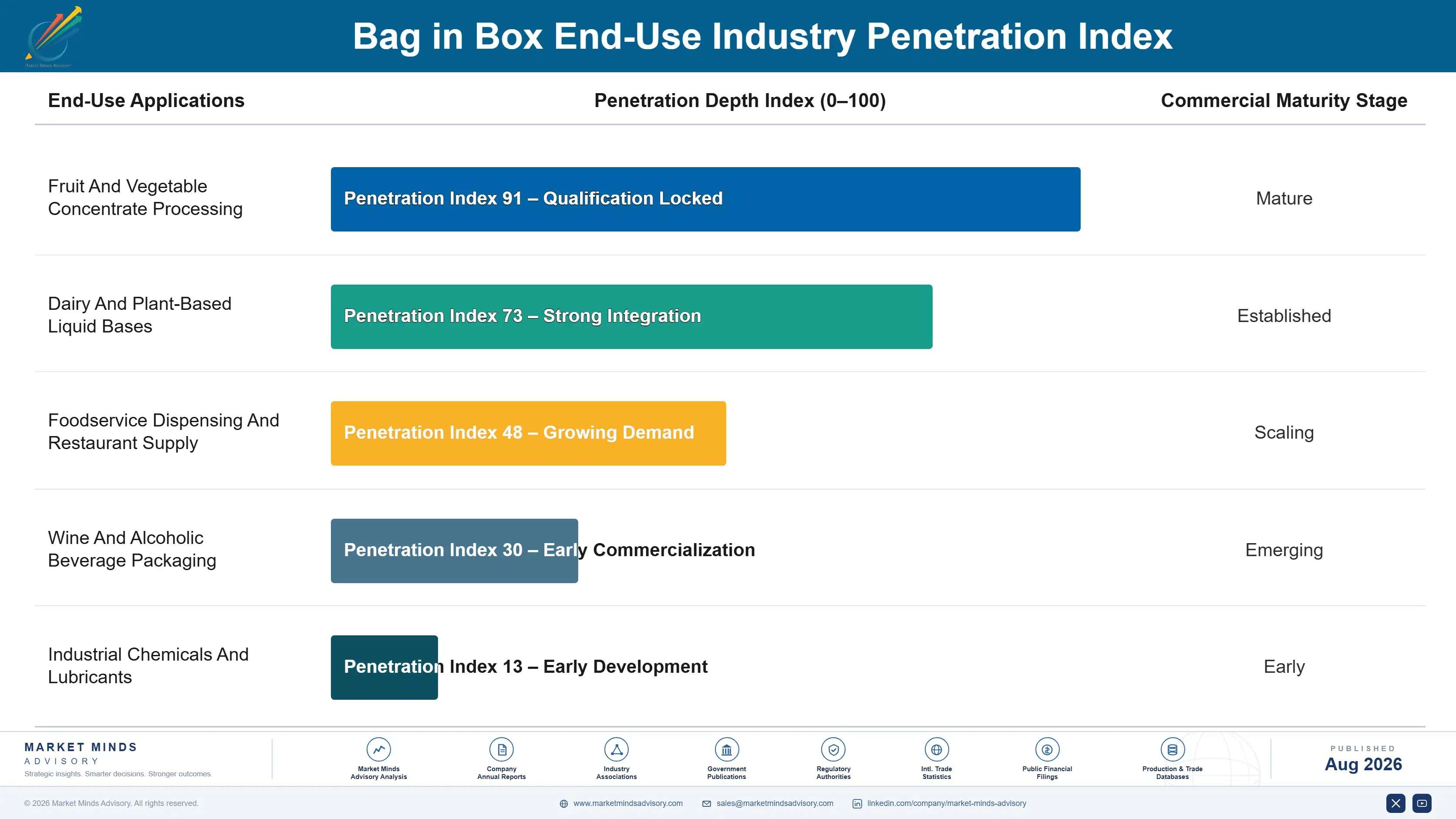
Buyer profiles shifted as field complaint analysis reached procurement functions. The earlier buyer specified film gauge and barrier structure. The current one increasingly writes fitment performance, transport vibration testing, and dispensing behaviour at low residual volume into the same document. Complaint root cause analysis has become a standard supplier review input. Converters unable to answer at component level are losing accounts they never understood losing.
bag-in-box-market-end-use-penetration-index-1787300366044

What We Would Tell a Board

These are among the four positions where our research anticipates prominent divergence between winners and laggards over the coming forecast period. Each is grounded in the demand model, the regulatory perimeter, and the announced capacity pipeline.
01 / FITMENT CAPABILITY OWNERSHIP

Own the component that causes the complaints

Roughly 71% of field complaints trace to the dispensing tap, so a converter buying spouts as a commodity part carries the reputational cost of a component it neither designs, tests, nor controls in any meaningful way. Fitment engineering converts the single largest failure mode into the strongest available differentiator, and it prices considerably above film on any comparable volume. Filler requalification running near fourteen weeks then defends that position considerably better than any film specification advantage ever will on its own.
02 / COMMERCIAL FRAMING DISCIPLINE

Sell distribution cost, because packaging price loses

Bag in box loses on unit packaging price against a steel drum in almost every direct comparison, and it wins comfortably once cold chain removal, an 82% freight weight reduction, and avoided drum reconditioning all enter the same calculation properly. Packaging procurement never sees those lines, because they sit inside logistics and waste budgets held by entirely different functions. Selling into supply chain and operations rather than into packaging procurement changes which numbers are actually in the room when the decision gets made.
03 / RESIN COST INDEXATION

Fixed multi-year pricing hands over every resin move

Film carries around 44% of converter cost of goods sold, so a multi-year food processing agreement at fixed prices converts each polyethylene increase directly into margin loss with no recovery mechanism available anywhere in the contract. The polyethylene movement through 2021 and 2022 demonstrated that exposure clearly enough across the whole converting sector. Indexation against a published resin benchmark moves that exposure onto a customer who is generally indexing their own input contracts already, and buyers accept it once explained.
04 / BARRIER MATERIAL TRANSITION

Build mono-material structures before somebody specifies them

Multilayer barrier laminates combining polyethylene with ethylene vinyl alcohol are rejected outright by most mechanical recycling streams, and packaging waste regulation is now tightening fastest in exactly the markets that buy the highest barrier specifications today. Mono-material polyethylene structures with coated barriers sacrifice part of that eighteen month aseptic shelf life in exchange for recycling stream compatibility. Converters developing them early are selling a solution, while those waiting will be answering a specification that a competitor has already written for them.

Engagement Snapshot From the Field

A live engagement with an industry participant carrying material or product regulatory and market exposure ahead of a defining policy shift, showing how our research translates into a defensible multi-year portfolio strategy.
MARKET MINDS ADVISORY · CLIENT ENGAGEMENT SUMMARY
Bag in Box Producer Strategic Portfolio Review and Transition Roadmap 2026·Investment Scenario on Bag in Box Exposure Evaluation 2025-26
CLIENT PROFILE
A flexible packaging converter with approximately 285 million dollars in annual revenue (client-reported, unverified by MMA), supplying bag in box across wine, foodservice dispensing, and liquid food processing customers in two regions. Fitments were bought in from third-party specialists, film and board were the focus of the technical organisation, and customer retention had weakened in foodservice accounts over two years.
STRATEGIC CHALLENGE
Management read the retention problem as price competition and proposed investing in wider film extrusion capacity to improve resin cost position. The board wanted evidence on why foodservice customers were leaving before approving capital that would take three years to install and would deepen the commodity position further. Complaint records had never been analysed by component.
MMA APPROACH
We analysed lost accounts against complaint records, separating film and board issues from fitment and dispensing failures. Field complaints were reclassified by root component across three years. Bought-in fitment suppliers were assessed on testing regimes, and retained accounts were compared against lost ones on whether fitment performance had ever appeared in the customer specification.
KEY FINDINGS
  1. The substantial majority of complaints across lost foodservice accounts traced to dispensing fitments rather than to any film, board, or lamination defect.
  2. No bought-in fitment supplier performed transport vibration or low residual volume dispensing testing, and the client had never specified either requirement. Testing gaps were never identified.
  3. Retained accounts were concentrated where fitment performance clauses existed in the specification, which had forced testing the other accounts never received. Specification content explained the pattern.
  4. Film cost position against competitors was within a narrow band, and the proposed extrusion investment would have changed it only marginally. Capital would have deepened commodity exposure.
CLIENT PROFILE
A flexible packaging converter with approximately 285 million dollars in annual revenue (client-reported, unverified by MMA), supplying bag in box across wine, foodservice dispensing, and liquid food processing customers in two regions. Fitments were bought in from third-party specialists, film and board were the focus of the technical organisation, and customer retention had weakened in foodservice accounts over two years.
STRATEGIC CHALLENGE
Management read the retention problem as price competition and proposed investing in wider film extrusion capacity to improve resin cost position. The board wanted evidence on why foodservice customers were leaving before approving capital that would take three years to install and would deepen the commodity position further. Complaint records had never been analysed by component.
MMA APPROACH
We analysed lost accounts against complaint records, separating film and board issues from fitment and dispensing failures. Field complaints were reclassified by root component across three years. Bought-in fitment suppliers were assessed on testing regimes, and retained accounts were compared against lost ones on whether fitment performance had ever appeared in the customer specification.
KEY FINDINGS
  1. The substantial majority of complaints across lost foodservice accounts traced to dispensing fitments rather than to any film, board, or lamination defect.
  2. No bought-in fitment supplier performed transport vibration or low residual volume dispensing testing, and the client had never specified either requirement. Testing gaps were never identified.
  3. Retained accounts were concentrated where fitment performance clauses existed in the specification, which had forced testing the other accounts never received. Specification content explained the pattern.
  4. Film cost position against competitors was within a narrow band, and the proposed extrusion investment would have changed it only marginally. Capital would have deepened commodity exposure.
RECOMMENDED STRATEGY
Phase 1: Phase 1 (months one to nine): defer the extrusion investment, introduce fitment testing protocols, and requalify every bought-in spout supplier against them. Phase 2: Phase 2 (months nine to twenty-four): evaluate in-house fitment moulding capability against volume, tooling capital, and available injection capacity. and tooling lead times. Phase 3: Phase 3 (months twenty-four to forty-two): shift mix toward aseptic and foodservice formats where fitment engineering commands genuine premium pricing.
OUTCOME
The extrusion investment was deferred. Fitment testing protocols were introduced within two quarters and complaint rates in foodservice accounts fell materially, while an in-house moulding business case was approved for the largest spout format on volume grounds (client-reported, unverified by MMA). Extrusion capital was redirected toward moulding tooling.

Frequently Asked Questions

Foundational context covering the market sizes, CAGR, scope, country, region and competition that inform every finding below. This section is provided to cover basics and most often pre-purchase conversations, answered from the MMA Primary Research Dataset.

What is the current size of the Bag in Box Market?

The market is valued at USD 4.1 billion in 2025, rising to USD 4.39 billion in 2026. Scope covers bags, cartons, and dispensing fitments, but not rigid bulk containers, drums, or filling machinery.

How large will the Bag in Box Market be by 2036?

MMA forecasts USD 8.64 billion by 2036, an increase of USD 4.25 billion over the 2026 base. That represents an expansion multiple of 1.97 times across the forecast period.

What is the CAGR for the Bag in Box Market 2026 to 2036?

The base case CAGR is 7.0%, with a bull case of 8.2% and a bear case of 5.8%. The historical rate from 2020 to 2025 was 6.0%, with wine volume swinging sharply inside that period.

Which segment is growing fastest?

Aseptic bag in box for liquid foods at 10.5%, exactly 1.50 times the market rate. Ambient shelf life near eighteen months removes cold chain cost and cuts freight weight roughly 82% against steel drums.

Who are the major companies in the Bag in Box Market?

Smurfit Westrock, Liqui-Box, Scholle IPN, DS Smith, and Amcor lead on annual units shipped. The top five hold 38%, and value sits with fitment specialists rather than with volume converters.

Which country is growing fastest?

India at 9.2%, where mango, guava, and tomato processing capacity is being built for export markets requiring ambient distribution. Aseptic bag in box is the only workable format on those routes.

Report Segmentation Architecture

The full report scope spans multiple orthogonal segmentation dimensions, with cross-tabulated demand data provided for each dimension pair. Coverage extends further to regional breakdowns, trend trajectories, and the competitive detail needed to support segment-level decision-making.

By Filling Process And Contents

  • Aseptic Bag In Box For Liquid Foods
  • Standard Multilayer Bags With Dispensing Fitments
  • Wine And Beverage Bag In Box Formats
  • Industrial And Chemical Liquid Bag In Box
  • Dispensing Fitments And Taps Supplied Separately

By End-Use Industry

  • Fruit And Vegetable Concentrate Processing
  • Dairy And Plant-Based Liquid Bases
  • Foodservice Dispensing And Restaurant Supply
  • Wine And Alcoholic Beverage Packaging
  • Industrial Chemicals And Lubricants

By Commercial Model

  • Direct Supply To Filling Operations
  • Contract Filling And Co-Packing Supply
  • Fitment Component Supply To Converters
  • Distributor And Regional Reseller Channels
  • Bundled Bag And Equipment Agreements

By Region

  • East Asia
  • Western Europe
  • North America
  • South Asia and Pacific
  • Latin America
  • Middle East and Africa
  • Eastern Europe

Scope, Methodology, and Coverage

Every figure in this report is reproducible from documented input assumptions. The scope below maps the historical period, the forecast horizon, the segmentation dimensions, and the countries covered, alongside the underlying primary and qualitative methodology.
Historical Period
2020 to 2025
Forecast Period
2026 to 2036
Base Year
2025 (USD billions; MMA Primary Research Dataset, August 2026)
Market Definition
This market comprises flexible bag in box liquid packaging systems, measured at converter and component supplier revenue across bags, cartons, and dispensing fitments. Coverage spans aseptic bag in box for liquid foods, standard multilayer bags with dispensing fitments, wine and beverage bag in box formats, industrial and chemical liquid bag in box, and dispensing fitments and taps supplied separately to converters or fillers. Rigid intermediate bulk containers, flexible bulk bags for solid materials, stand-up pouches without dispensing fitments, steel and plastic drums and pails, aseptic filling machinery sold as capital equipment, and corrugated packaging sold independently fall outside scope.
Quantitative Units
USD billions (current prices); bag units shipped annually; filled litres by contents category; field complaint rates by component
Segmentation Dimensions
By Filling Process And Contents; By End-Use Industry; By Commercial Model; By Region
Regions Covered
East Asia, Western Europe, North America, South Asia and Pacific, Latin America, Middle East and Africa, Eastern Europe
Countries Covered
China, Japan, South Korea, France, Spain, Italy, Germany, Netherlands, United States, Canada, Mexico, Brazil, Chile, Argentina, India, Thailand, Australia, Saudi Arabia, United Arab Emirates, South Africa, Egypt, Poland, Hungary, and additional markets relevant to this sector
Key Companies Profiled
Smurfit Westrock, Liqui-Box, Scholle IPN, DS Smith, Amcor, Sealed Air, Mondi, Coesia, Optopack, Rapak, CDF Corporation, Zacros, Vitop, Aran Group, Goglio, TPS Rental Systems, Hoover Ferguson, Parish Manufacturing, Astrapak, Nihon Matai
Quantitative Methodology
Primary survey, n=3,800 respondents, Q4 2025, six countries; demand-side model with trade association cross-validation
Qualitative Methodology
47 expert interviews, Q4 2025; applied to validate demand model assumptions, identify emerging dynamics, and assess competitive positioning
Report Format
PDF and XLSX data workbook (Word format preview document)
Publisher
Market Minds Advisory
Report Code
MMA-2026-PAC-588
Published
August 2026
Contact
sales@marketmindsadvisory.com | www.marketmindsadvisory.com

Purchase the full Bag in Box Market Report (2026 to 2036).

The full report sizes bag in box across five filling and contents routes, five end-use industries, five commercial models, and seven regions, with field complaint rates analysed by failing component rather than by supplier. Fitment engineering is treated as a separate value pool from bag converting, since the two sit in different hands and carry very different margins. Aseptic conversion economics are modelled against steel drum alternatives including cold chain and disposal cost. Competitive profiling covers twenty companies on annual units shipped, and barrier resin allocation exposure is assessed separately.
Field complaint rates analysed by failing component type
Fitment value pool separated from bag converting economics
Aseptic conversion modelled against steel drum total cost
Barrier resin allocation exposure assessed across converter groups
Filler requalification timelines mapped by spout geometry standard
Mono-material barrier development tracked against packaging waste regulation

Built For The People Who Decide

From boardroom strategy to bench-side execution, this report is read cover-to-cover by leaders shaping the next decade of their industry, turning demand scenarios, market dynamics and valuation benchmarks into decisions.
CXOs/ Presidents/ VPs/ Managers
M&A and Corporate Development
Strategy Teams and R&D Heads
Procurement and Product Directors
Regulatory and Compliance Leaders
Investor Relations and Equity Analysts