Market Minds Advisory
Bacteriophage Market

Bacteriophage Market: Regulatory Absence, Food Safety Revenue, and the Engineering Escape

A century after phage therapy was first used on patients, no regulator anywhere has approved a single human product, which is why the companies earning revenue are selling food safety rather than medicine.

Lead Analyst

Alice Ballenger

Published

September 2026

Make Smarter Decisions with Customized Research Insights

Request a free sample report and evaluate market opportunities, growth trends, and competitive dynamics relevant to your business needs.

2025 MARKET VALUE$0.9BMarket Size 2025
2036 FORECAST VALUE$3.5BBase Case , 2026 to 2036
CAGR 2026 TO 203613.2 %Bull 14.5% / Bear 11.9%
INCREMENTAL OPPORTUNITY$2.5BNet 10- year value creation
EXPANSION MULTIPLE3.45x2036 value over 2026 base
Strategic Levers
M&A Pipeline
Regional Outlook
Country Rankings
Competitive Intelligence
Segmental Deep-dive
Call-Us : 91 93563 13602

Executive Snapshot and Market Trajectory

Zero phage products are approved as human therapeutics by any major medicines regulator anywhere in the world. Every clinical use is compassionate, magistral or investigational, and that single fact cleanly separates the companies in this field earning real money from the field from the companies merely raising it.
Genetically engineered phage compounds at 19.8%, a full 1.50x the market rate, because engineering makes a phage definable, patentable and manufacturable to a fixed written specification, which addresses the regulatory and the commercial problem simultaneously rather than either one of them at a time. East Asia holds the largest share at 28%, on aquaculture and agricultural biocontrol volumes that comfortably dwarf every human therapeutic programme in existence combined.
Concentration is very low at 33%, and Intralytix and Micreos lead because they sell cleared food safety products with customer revenue behind them rather than investment capital. Roughly 61% of category value comes from food and agriculture rather than from medicine of any kind. Personalised preparations matched to a patient isolate take 28 days and cannot be approved anywhere. Belgium operates the only functioning legal route anywhere, and no other jurisdiction has replicated it.
Market Definition
This market covers bacteriophage products and phage-derived preparations across human, animal, food and agricultural applications, spanning fixed phage cocktails, personalised isolate-matched preparations, genetically engineered phage, phage-derived endolysins, phage detection and biosensing reagents, and bulk phage for biocontrol. Measurement is at producer revenue including magistral and compassionate supply. Phage display antibody libraries, probiotic and microbiome products without phage content, conventional antibiotics, and academic research reagents sold in laboratory quantities are excluded.
Base Year Value
$0.9B in 2025 (MMA Primary Research Dataset, August 2026)
Forecast Period
2026 to 2036, eleven discrete annual values
CAGR
13.2% base case. Bull 14.5%. Bear 11.9%.
Fastest Growth Segment
Genetically Engineered Phage: 19.8% CAGR
Fastest Growth Country
India: 19.2% CAGR
Fastest Growth Region
South Asia and Pacific: 15.4% CAGR
Largest Region
East Asia: 28% of 2025 global value
Market Leaders
Intralytix, Micreos, Phagelux, Armata Pharmaceuticals, and BiomX. Source: MMA Primary Research Dataset, July 2026.
Primary Survey
n=3,800 procurement and R&D decision-makers, Q4 2025, six countries
Methodology
Demand-side build-up, cross-validated against public data, 47 expert interviews

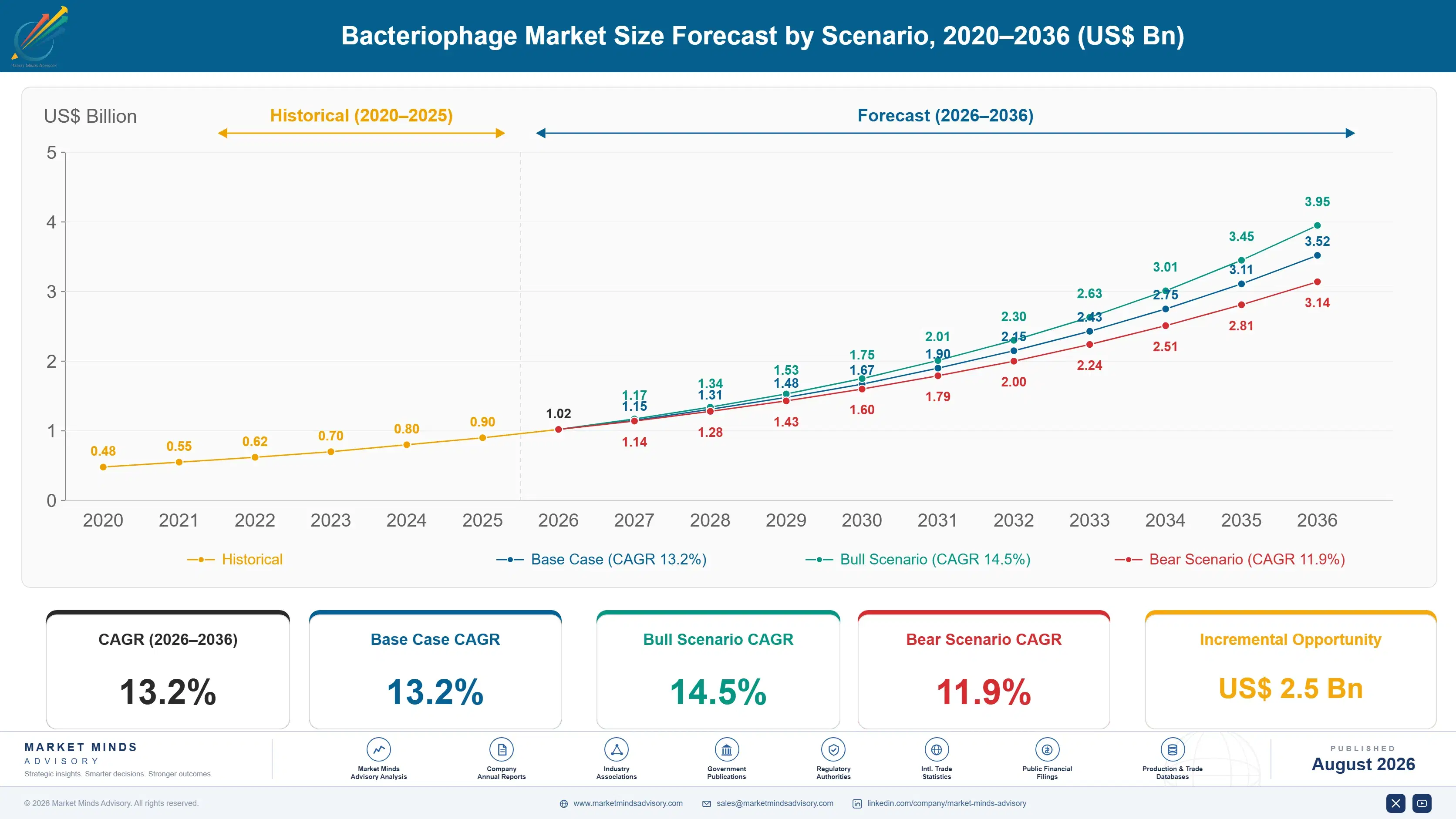
Bacteriophage Market Forecast Scenarios

bacteriophage-market-size-forecast-scenario-1787304847028
Growth ran at roughly 11.8% between 2020 and 2025, and almost all of it came from food safety and agriculture rather than from medicine. Antibiotic restrictions in aquaculture and livestock across Asia and Europe pushed producers toward biological alternatives, while food processors adopted phage treatments against listeria and salmonella. Human therapeutic programmes advanced clinically and generated essentially no revenue at all.
Base case growth of 13.2% rests on three separate commercial mechanisms rather than on any single expected regulatory event. Antibiotic restriction keeps widening across food production, which is the only application where phage competes against a product being taken away rather than against one that works. Engineered phage makes the product definable enough for conventional regulatory review. And endolysins offer a route through existing biologics pathways without the personalisation problem that blocks whole phage preparations entirely.
The bull case at 14.5% assumes a regulator approves a fixed phage cocktail or endolysin for a human indication, which would establish a pathway the whole field could follow. The bear case at 11.9% is continuation: another decade of compassionate use, trials failing on dosing rather than biology, and a category commercially confined to food and agriculture regardless of clinical promise.

Bacteriophage: Approval Absence and Biocontrol Revenue

The defining fact about this field is an absence. Phage therapy has been used on patients for a century, compassionate programmes report clinical improvement in roughly 68% of otherwise untreatable infections, and no regulator has licensed a single human product. That is not an oversight. A phage matched to one patient's isolate is a different product each time, and no framework accommodates a medicine changing with every prescription.
TOP FIVE CONCENTRATION33%Fragmented across food safety producers and clinical stage developers
APPROVED HUMAN THERAPEUTICS0 productsPhage preparations licensed by any major medicines regulator worldwide
FOOD SAFETY REVENUE SHARE61%Category value from food, agriculture and animal applications combined
PERSONALISED PREPARATION TIME28 daysInterval from patient isolate to matched preparation ready for administration
COMPASSIONATE USE RESPONSE68%Treated patients showing clinical improvement under compassionate access programmes
AVERAGE TREATMENT COSTUSD 4,200Blended cost of a personalised course excluding hospital care
So the money went somewhere else. Roughly 61% of category revenue comes from food safety, agriculture and aquaculture, where phage preparations against listeria, salmonella and vibrio hold regulatory clearances that human products do not. Antibiotic restriction in livestock and fish farming created genuine demand for alternatives, and phage arrived as one of very few options that actually works against specific pathogens at commercial scale.
Two routes now exist around the regulatory obstacle. Engineered phage can be built to a fixed genetic specification, manufactured consistently and patented properly, which makes conventional review plausible. Endolysins avoid the problem altogether by being ordinary protein biologics that kill bacteria without replicating, and they follow the pathway every other therapeutic protein uses. Both are less elegant than personalised phage and far more likely to reach a market.
"Everybody in this field talks about the antimicrobial resistance crisis, and the only people making money are selling phage to spray on ready-to-eat deli meat. That is not a criticism of the science. It is a description of what regulators have and have not made approvable."
Principal Analyst, Anti-Infectives and Biological Alternatives Practice · MMA He

Market Trends

Engineering makes phage definable enough for conventional approval

A wild-type phage isolated from sewage and matched to a patient's bacterial strain is genetically variable and impossible to define as a fixed product. Engineered phage built to a specified genome, including CRISPR-enhanced constructs designed to kill rather than merely lyse, can be characterised, manufactured consistently and protected by patent. That converts an intractable regulatory object into an ordinary biological medicine. The trade is that engineered constructs lose some of the adaptability that makes natural phage interesting, which several developers regard as an acceptable price. Regulators review specifications, and a specification is exactly what wild phage cannot supply.
Market Impact: Restrictions across 3 major regions
Endolysins bypass the personalisation problem entirely

Phage-derived lysins are proteins that break bacterial cell walls without any self-replication, which makes them conventional biologics following the same regulatory pathway as any other therapeutic protein. No isolate matching, no product that changes per patient, no live agent multiplying inside a treated person. Clinical programmes have reached late-stage trials in staphylococcal bacteraemia, and failures there concerned trial design rather than mechanism. Manufacturing is conventional protein production rather than propagation in a living bacterial host, which removes the endotoxin burden that dominates therapeutic phage purification cost. That combination explains where the capital went.
Market Impact: Improvement in 68% of cases

Market Opportunities and Growth Drivers

Antibiotic restriction in food production creates genuine substitution demand

Regulators across the European Union, China and increasingly elsewhere have restricted routine antibiotic use in livestock and aquaculture, removing a tool producers relied upon without providing a replacement. Phage preparations targeting specific pathogens in fish, shrimp and poultry production fill part of that gap, and unlike human medicine they carry the regulatory clearances required. This is the only application where phage competes against a product being withdrawn rather than one working well. Producers are substituting rather than adopting, and substitution demand is far more durable than enthusiasm. Regulatory clearance for agricultural use already exists across the major producing regions.
Market Impact: Exactly 0 products licensed

Untreatable infections drive compassionate access programmes worldwide

Patients with infections resistant to every available antibiotic present clinicians with no options, and compassionate phage access has become the recognised last resort in that situation. Programmes in Belgium, the United States, Israel and Australia report clinical improvement in roughly 68% of treated cases, which is remarkable for a population defined by having exhausted everything else. That evidence base accumulates without any regulator accepting it, because compassionate cases cannot substitute for controlled trials. The result is a growing body of published case evidence alongside a complete absence of licensed products, an unusual position for any medical field.
Market Impact: Under 30% of trials succeeded

Market Restraints and Challenges

No approval framework accommodates a product that changes per patient

A phage preparation matched to an individual patient's bacterial isolate is a different medicine each time it is made, and every medicines regulator is built around approving fixed products with defined specifications. The root cause is regulatory architecture rather than any safety concern. Commercial impact is that a century of clinical use has produced zero licensed human products anywhere. Belgium's magistral preparation framework is the only functioning legal route, it is national, and nobody has replicated it. Belgium treats preparations as compounded formulations rather than as licensed medicines, which works nationally and travels nowhere.
Market Impact: Compounding at 19.8% annually

Clinical trials keep failing on formulation rather than on biology

Controlled phage trials have repeatedly reported disappointing results, and post-hoc analysis has generally identified insufficient dosing, unstable preparations or poorly matched cocktails rather than any failure of the underlying mechanism. The root cause is that phage manufacturing and stability science lagged the clinical enthusiasm by many years. Commercial impact is a field whose trial record looks weaker than its compassionate use record. Standardised manufacturing, titre verification and stability testing are now receiving the attention they always needed. Until that work is finished, further trials risk repeating the same avoidable result at considerable cost.
Market Impact: Growing at 16.4% each year
3 additional market trends, 4 additional growth drivers, and 2 additional restraints and challenges are covered in the full report. Contact sales@marketmindsadvisory.com to access the complete intelligence.

Segment CAGR and Growth Architecture

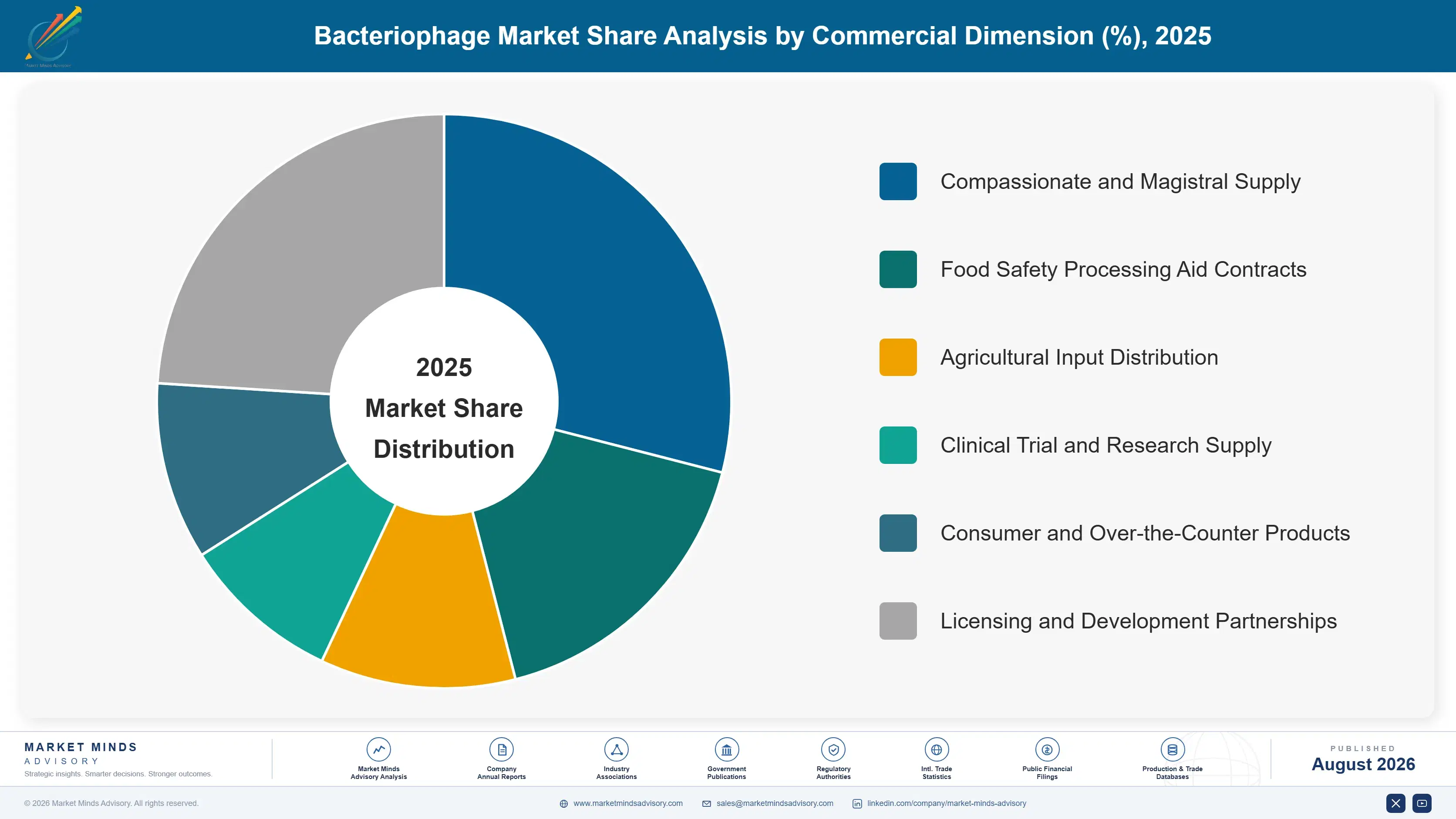
Segmentation follows product type, because type determines whether a preparation can be defined and approved, how it is manufactured, who supplies it and what regulatory route applies. Six product types cover phage supply without overlap. Application, whether human, veterinary, food or agricultural, cuts across several types and is treated here as a use attribute.
bacteriophage-market-market-share-analysis-1787304847595

Genetically Engineered Phage

Growing at 19.8%, a full 1.50x the market rate, engineered phage is built to a specified genome rather than isolated from the environment, which makes it characterisable, manufacturable to consistent specification and protectable by patent. CRISPR-enhanced constructs designed to cut bacterial genomes rather than rely on ordinary lysis extend that further. The commercial argument is regulatory rather than clinical: a defined product can enter conventional review while a variable one cannot. Developers accept losing some of the adaptability that makes wild phage biologically interesting, which most regard as an entirely reasonable trade. Patent position is the second argument, since a wild-type phage isolated from sewage is difficult to protect commercially in any durable way.
CAGR 19.8%

Phage-Derived Endolysins

Endolysins grow at 16.4% by removing the phage from phage therapy. These proteins break bacterial cell walls directly, do not replicate, and are therefore ordinary therapeutic biologics following the same regulatory pathway as any other protein medicine. No isolate matching is required and no live agent multiplies inside a patient. Late-stage clinical programmes in staphylococcal bacteraemia have run into trial design difficulties rather than mechanistic ones. This is where capital seeking an approvable product has concentrated, and it is the most likely source of a first licensed product. Manufacturing is conventional protein production rather than propagation in bacterial hosts, which removes the endotoxin burden dominating therapeutic phage purification cost. Cosmetic and consumer applications provide revenue alongside clinical development.
CAGR 16.4%
Full segment breakdown across 6 segments available in the complete report.

Regional Architecture and Country Demand Map

Regional value follows agricultural and food production rather than clinical activity, because those applications carry regulatory clearances human therapeutics do not. Scientific leadership and commercial value sit in almost entirely different places here. Read the shares as a map of regulatory clearance rather than of scientific capability or clinical experience.

East Asia

East Asia takes the largest share at 28% on aquaculture and agriculture rather than on anything clinical. Chinese fish and shrimp farming is the largest such industry anywhere, antibiotic restriction there has been genuine rather than nominal, and phage preparations against vibrio and aeromonas fill a gap producers cannot otherwise fill. Poultry and swine applications add further volume. Japanese and South Korean food processors use phage against listeria and salmonella in ready-to-eat production. Human therapeutic activity across the region is modest and mostly academic, which is true almost everywhere. Regulatory frameworks for agricultural biological control agents are comparatively accommodating across the region, which matters more to adoption than any efficacy argument.
Share: 28% | CAGR: 14.4% (2026 to 2036)

North America

Twenty-six per cent of value, growing at 12.4%. Food safety applications hold regulatory clearances allowing phage treatment of ready-to-eat meats, produce and processing surfaces, and Intralytix built a genuine commercial business on exactly that. Clinical activity is the most concentrated anywhere, with compassionate access programmes at several academic centres and the largest cluster of therapeutic developers, though none of it generates meaningful revenue. Regulatory engagement with personalised preparations has advanced further here than elsewhere without producing an approval pathway that anybody can actually use. Investment capital for therapeutic phage has been raised and lost here in roughly equal measure across two funding cycles, and the current cycle favours engineered constructs over wild-type banks.
Share: 26% | CAGR: 12.4% (2026 to 2036)
Regional intelligence for 5 additional markets available in the complete report: Western Europe, South Asia and Pacific, Latin America, Middle East and Africa, Eastern Europe. Contact sales@marketmindsadvisory.com.
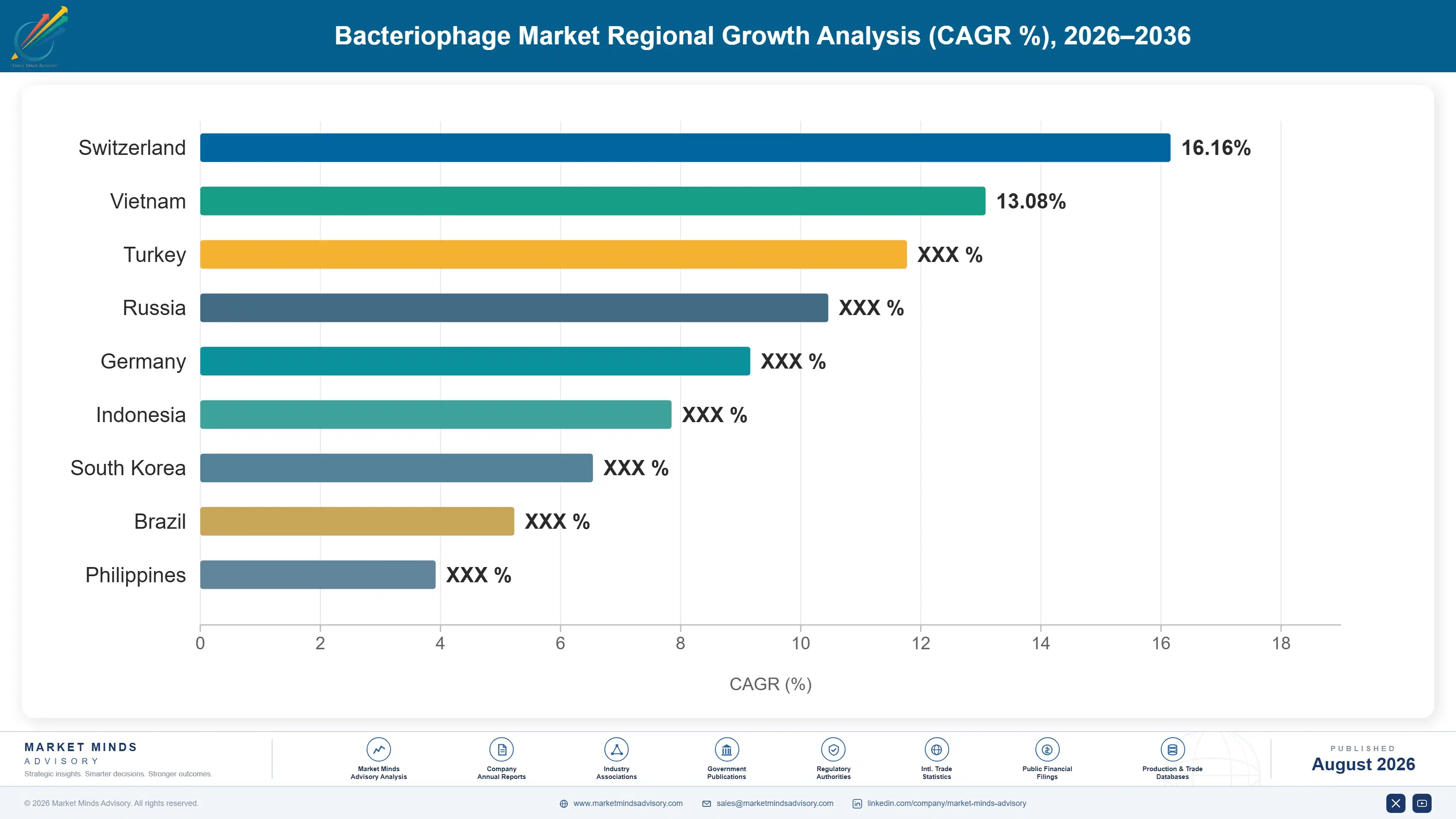
bacteriophage-market-country-cagr-analysis-1787304848122

Where Phage Value Can Actually Be Captured

No human product is approved anywhere and personalised preparations cannot be, so clinical promise converts into revenue only where regulators have already made a route available. Value accrues to food and agricultural applications today, and to whichever developer makes a phage product definable enough to review. Everything else in this field is scientifically interesting and commercially theoretical.

Build revenue in food and agriculture while medicine waits

Roughly 61% of category value comes from applications where phage already holds regulatory clearance, principally food safety and animal production, and antibiotic restriction there created demand for something that works against specific pathogens. Those businesses generate cash today rather than in some future regulatory scenario. Developers funding clinical programmes entirely from investment capital are competing for the same scientific talent as companies with actual customers, and the difference in durability shows across a funding cycle. Food safety and agricultural revenue is unglamorous, and it survives funding winters that clinical programmes do not.
Market Impact: Delivers 61% of all category revenu

Engineer the product into something a regulator can define

A wild-type phage matched to a patient isolate is a different medicine each time, and 0 such products have ever been licensed anywhere. Engineering to a specified genome makes a phage characterisable, consistently manufacturable and patentable, which converts an intractable regulatory object into an ordinary biological medicine. That sacrifices some adaptability and it is the only route through conventional review that anyone has demonstrated. Investment in construct design and manufacturing consistency matters far more than expanding a phage bank. Patent protection follows definability, since a phage isolated from sewage is hard to protect commercially.
Market Impact: Exactly 0 variable phage products h

Pursue endolysins as the pragmatic approvable alternative

Lysins kill bacteria without replicating and are therefore conventional therapeutic proteins following the same pathway as any other biologic, with no isolate matching and no live agent involved. Late-stage failures have concerned trial design rather than mechanism. Endolysins compound at 16.4% and represent the most likely source of a first licensed product in this field. Developers committed to whole phage on philosophical grounds are choosing a harder regulatory road for reasons that are scientific rather than commercial. Manufacturing is conventional protein production, which also removes the endotoxin purification burden entirely.
Market Impact: Endolysin segment is compounding at

Fix manufacturing and stability before running another trial

Controlled trials have repeatedly disappointed, and post-hoc analysis usually identifies insufficient dosing, degraded preparations or poorly matched cocktails rather than mechanistic failure. Under 30% of registered trials have met their endpoints. Titre verification, stability testing and standardised manufacturing were neglected while clinical enthusiasm ran ahead of them. Developers investing there before designing another study protect both their capital and the field's credibility, which repeated visible failures have already damaged considerably. A trial that fails on preparation quality teaches the field nothing and costs it a great deal in credibility. Stability data should precede protocol design rather than follow it.
Market Impact: Under 30% of registered phage trial

Who Controls the Margin Pool

Concentration is very low at 33% across the top five, measured on annual revenue from phage products across all applications, the single basis applied throughout. Intralytix and Micreos lead because they sell food safety products commercially, while Phagelux spans agricultural and clinical work. Armata Pharmaceuticals and BiomX are clinical-stage developers with substantial valuations and minimal revenue, which describes the field's split precisely.
Competition therefore runs in two separate arenas that barely interact. Food safety and agricultural producers compete on regulatory clearance breadth, pathogen coverage and price against a customer buying a processing aid. Therapeutic developers compete for investment capital, clinical trial credibility and regulatory engagement, with no product revenue at stake for any of them. Very few organisations operate credibly in both, and the skills required have almost nothing in common.

Pressure builds from two directions. Conventional antibiotic development, however troubled its own economics, keeps producing approved products against resistant organisms, which reduces the urgency phage developers depend upon. Separately, engineered phage and endolysin approaches are drawing capital away from wild-type personalised programmes. Rankings shift most where a developer reaches a regulatory approval of any kind, since the first licensed product would reset the entire field's credibility.
bacteriophage-market-company-positioning-matrix-1787304848647

Competitive Moat and Risk Dimensions

INTRALYTIX

Moat: Cleared food safety portfolio

Intralytix holds regulatory clearances for phage preparations applied to ready-to-eat meats, produce and processing environments, which took years to obtain and which competitors must replicate individually rather than inherit. Food processors adopting a treatment write it into hazard control plans, and changing that requires revalidation nobody undertakes casually once a plan is approved.
INTRALYTIX

Risk: Limited therapeutic optionality

The commercial position sits in food safety, where market size is bounded by processing volumes and pricing by what a processing aid can command. Therapeutic potential remains largely unrealised and would require capabilities and capital the company does not currently hold. Competing biocontrol approaches and improved sanitation practices both erode the addressable problem.
MICREOS

Moat: Endolysin and consumer positioning

Micreos built both food safety products and endolysin-based consumer applications for skin conditions, which gave it revenue from two directions while purely clinical developers had none. Endolysin expertise positions it for the regulatory route most likely to produce an approved therapeutic, and the consumer channel generates cash without requiring medicines approval at all.
MICREOS

Risk: Regulatory classification ambiguity

Consumer products containing bacteria-killing proteins sit awkwardly between cosmetics, devices and medicines, and classification decisions vary by jurisdiction in ways that can remove a market abruptly. Therapeutic endolysin development requires clinical capital at a scale the company has not historically deployed. Food safety competition from cleared alternatives continues intensifying.

Players Tracked

Prominent Players

Intralytix
Micreos
Phagelux
Armata Pharmaceuticals
BiomX

Other Key Players

Locus Biosciences
SNIPR Biome
Adaptive Phage Therapeutics
Pherecydes Pharma
Eliava BioPreparations
Proteon Pharmaceuticals
APS Biocontrol
Fixed Phage
ContraFect
Technophage
Phage Biotech
Vesale Bioscience
Deerland Probiotics and Enzymes
Kerry Group
Charles River Laboratories

Recent Developments

MARCH 2025

Belgian magistral framework treats further international referral cases

Belgium's magistral preparation framework, the only functioning legal route for personalised phage anywhere, handled a further increase in internationally referred patients as clinicians elsewhere continued encountering infections resistant to every available antibiotic option. No other jurisdiction has replicated the framework despite a decade of discussion about doing so.
Signal: One small national framework is quietly ca
AUGUST 2025

Engineered phage developers advance CRISPR-enhanced constructs into trials

Developers including Locus Biosciences and SNIPR Biome advanced genetically engineered phage constructs incorporating CRISPR nuclease activity into clinical study, pursuing products defined by a specified genome rather than by isolation from environmental sources. Both programmes target defined bacterial indications with fixed constructs rather than matched preparations.
Signal: Engineering is being pursued primarily for
JANUARY 2026

Aquaculture phage adoption widens as antibiotic restrictions tighten

Aquaculture producers across Asia and Latin America expanded phage biocontrol use against vibrio and aeromonas infections, an organic commercial adoption driven by tightening antibiotic restrictions and by export market residue requirements rather than by any new product introduction. Adoption widened across shrimp and salmon production in particular.
Signal: Phage competes successfully in practice on

Fermentation, Purification and Characterisation Exposure

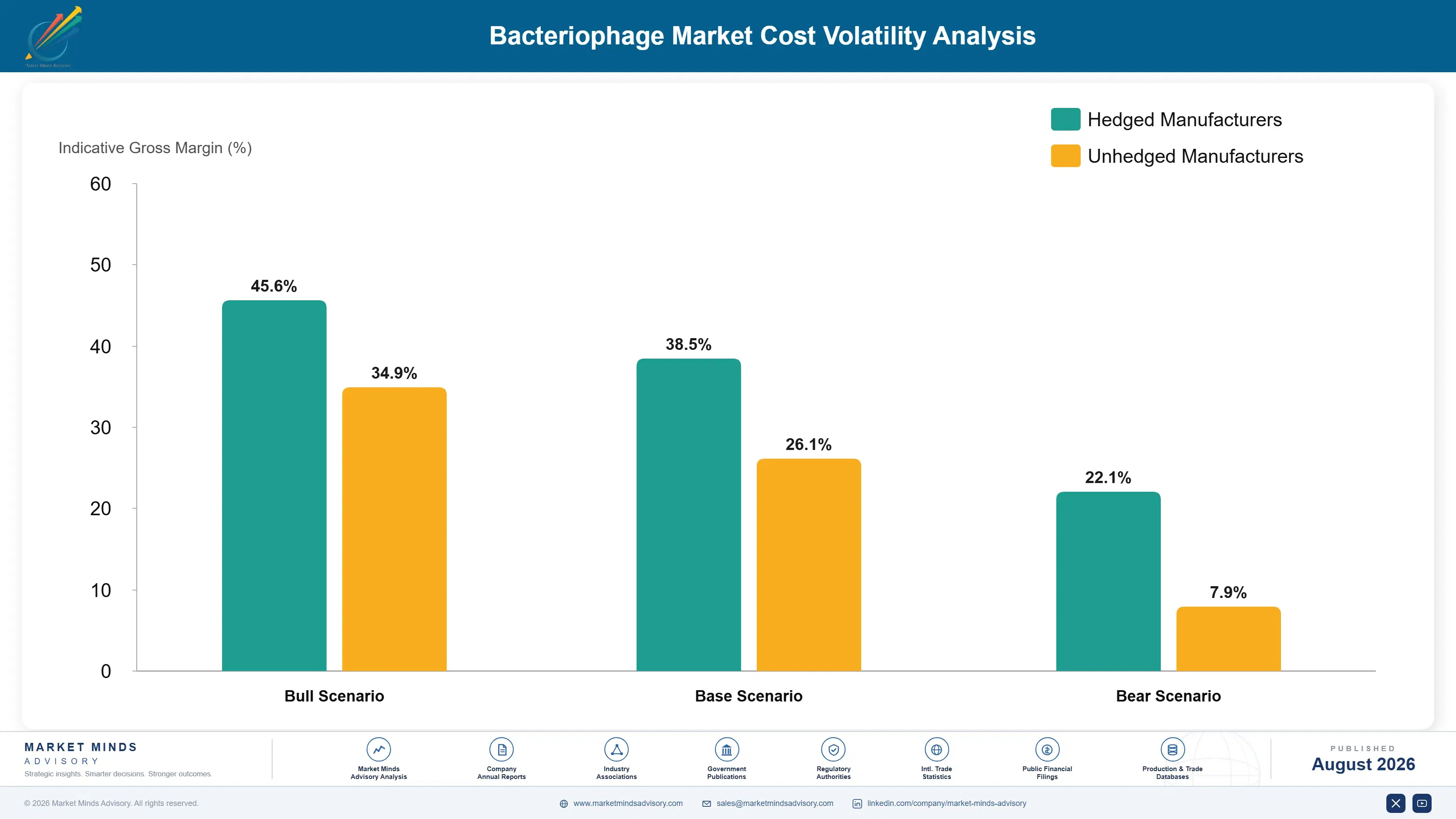
Cost structures differ enormously between applications, which is unusual for a single category. Agricultural and food safety phage is produced by straightforward bacterial fermentation with modest purification, and fermentation media plus downstream processing account for roughly 38% of cost of goods. Therapeutic preparations require endotoxin removal, sterility assurance and genomic characterisation that together contribute far more, frequently exceeding fermentation cost several times over.
Endotoxin removal is where therapeutic phage economics break. Phage are propagated in bacterial hosts, and the resulting lysate carries host cell endotoxin at levels no injectable product can tolerate, so purification must be far more rigorous than the fermentation itself. Charles River and comparable testing providers documented rising demand for endotoxin and characterisation services in reporting across recent years. Compassionate preparations frequently absorb that cost without any reimbursement behind them.

The disadvantage falls hardest on clinical-stage developers producing small batches. A personalised preparation carries full characterisation and release testing cost across a single course, which is why treatment costs around four thousand dollars before hospital care. Geography compounds it: fermentation and testing capacity is inexpensive in India and China and expensive in Western Europe and North America, where most clinical programmes actually run.
bacteriophage-market-cost-volatility-analysis-1787304848845

Standardise release testing across preparations rather than per batch

Personalised preparations carry full characterisation and endotoxin release testing across a single patient course, which dominates cost entirely. Platform release specifications validated once across a preparation type, with only strain-specific elements repeated, reduce that substantially. Regulators have accepted comparable platform approaches for other individualised biologics, which is the precedent worth pursuing here. Batch-level repetition is the avoidable cost here.

Locate fermentation and purification in lower-cost testing markets

Fermentation capacity and analytical testing cost several times more in Western Europe and North America than in India or China, and the process itself transfers readily because it uses conventional microbiology rather than anything specialised. Clinical programmes running entirely in high-cost locations are carrying an avoidable expense across every batch they produce. Transfer risk is genuinely low for this process.

Build endotoxin removal capability rather than contracting each batch

Endotoxin burden from bacterial host lysate is the defining purification challenge in therapeutic phage, and contracting it per batch is expensive and slow for preparations needed within twenty-eight days. Owned capability shortens turnaround and reduces unit cost, and it becomes essential at any volume beyond occasional compassionate supply. Turnaround time matters as much as unit cost for compassionate supply.

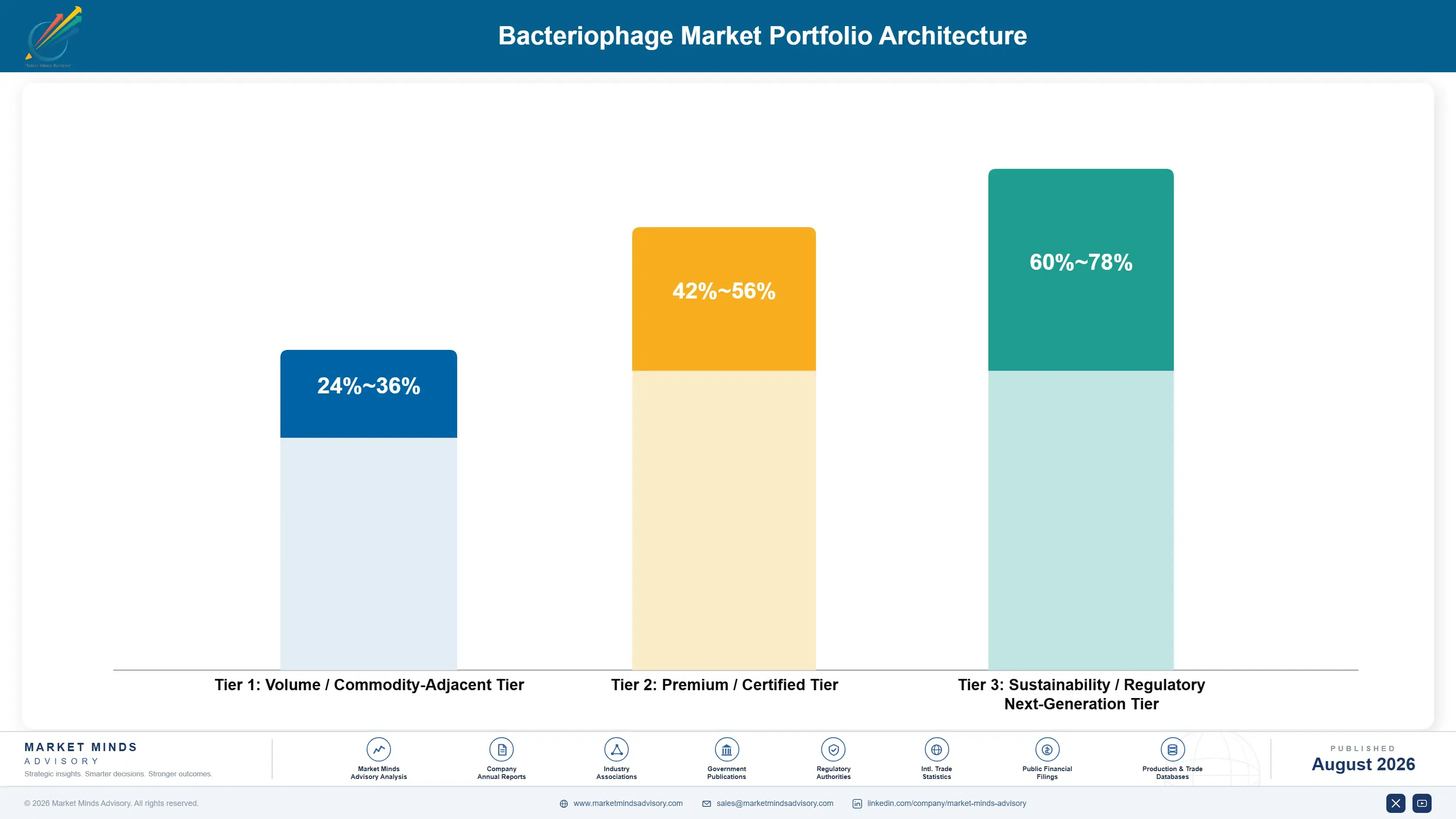
Portfolio Architecture for Margin Defence

Margin architecture divides on whether a product has a regulatory route. Bulk phage for agricultural and aquaculture biocontrol is produced cheaply, sold as an input and earns input margins accordingly. Cleared food safety preparations earn considerably better, because clearance took years and a processor writing a treatment into a hazard control plan does not change it lightly. Engineered phage and endolysins earn most in principle and almost nothing in practice, having produced no approved pro
The volume versus premium tension here is really a present versus future tension. Food and agricultural applications generate essentially all current revenue at modest margins, and they fund nothing glamorous. Therapeutic programmes carry enormous notional value and no customers, funded entirely by investment capital that has already proved cyclical. Few organisations run both, and those that do survive funding downturns better.

High-value pools sit where regulatory clearance already exists or where definability makes it achievable. Cleared food safety applications, veterinary products with established approval routes, and engineered constructs designed for conventional review all have paths to revenue. Personalised wild-type preparations, whatever their clinical results, sit outside every approval framework in existence and will earn compassionate-use cost recovery rather than commercial margin.

Volume / Commodity-Adjacent Tier

Bulk phage preparations for aquaculture, livestock and crop biocontrol, produced by straightforward fermentation and sold as production inputs competing on delivered cost against other biological control agents. Pricing tracks fermentation cost closely across producers.
Gross Margin: 24-36%

Premium / Certified Tier

Cleared food safety preparations written into processor hazard control plans, protected by regulatory clearances that took years to obtain and by revalidation costs that discourage any casual substitution. Clearance breadth is the competitive variable that matters here.
Gross Margin: 42-56%

Sustainability / Regulatory / Next-Generation Tier

Engineered phage constructs and phage-derived endolysins pursuing conventional medicines approval, protected by patent position and by manufacturing consistency that wild-type preparations cannot achieve. No product in this tier has yet earned an approval anywhere in the world, so margins remain notional rather than realised.
Gross Margin: 60-78%
bacteriophage-market-portfolio-architecture-1787304849341

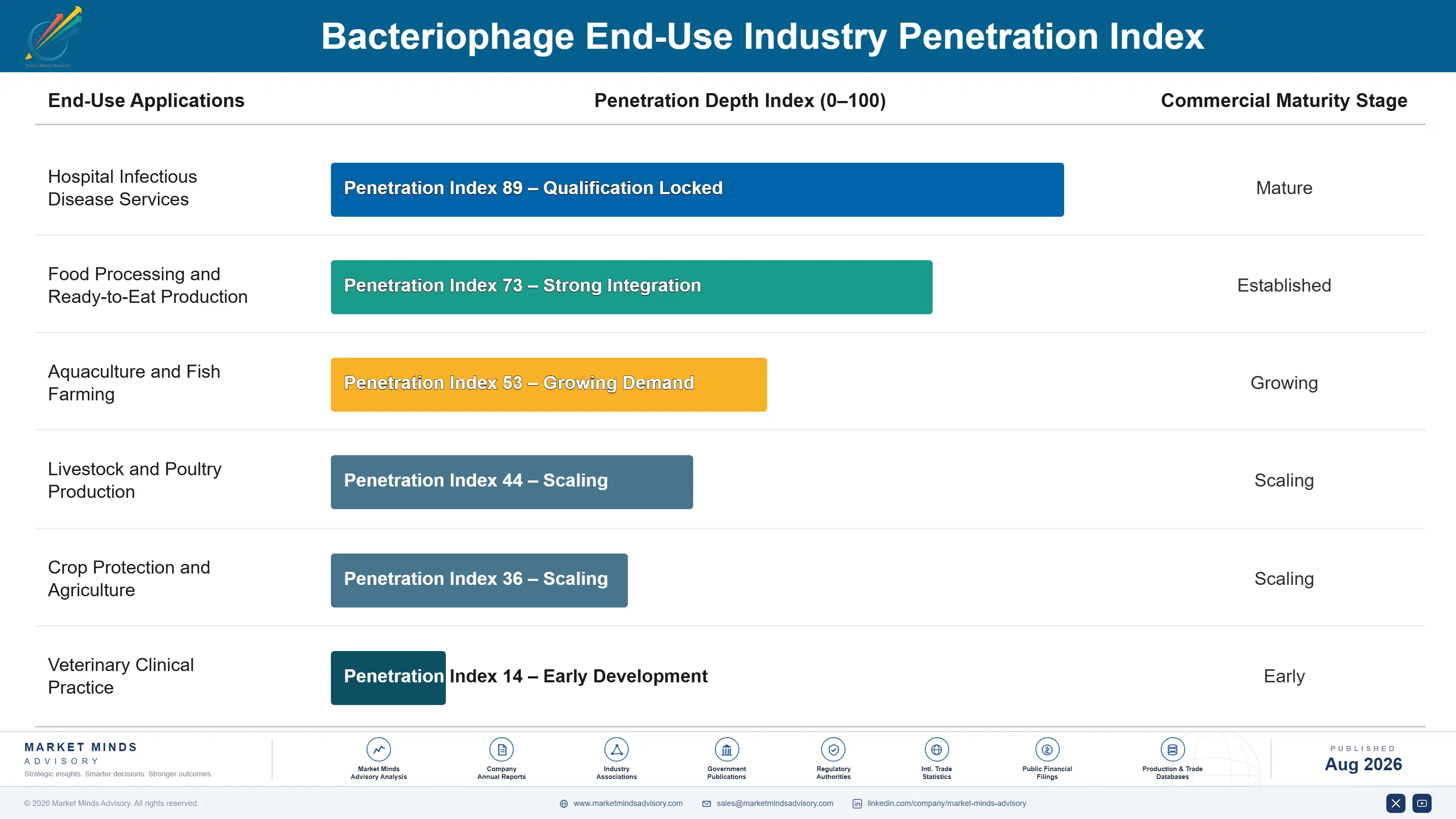
Recurring Biocontrol Against Episodic Rescue

Two demand patterns exist here and they share almost nothing. Agricultural and food safety phage is consumed continuously as a production input, applied to every batch processed or every pond treated, which produces predictable recurring volume tied to output rather than to any clinical event. That is the revenue underpinning the category and it behaves like any other processing consumable.
Therapeutic demand is entirely episodic and desperate. A patient with an infection resistant to every available antibiotic is treated once, urgently, usually through compassionate access, and the preparation takes roughly twenty-eight days to make from their isolate. There is no repeat purchase, no formulary relationship and no reimbursement pathway. Roughly 68% show clinical improvement, which sustains referrals without sustaining any business.

Buyer profiles reflect that split completely. Food processors and aquaculture producers buy through procurement on price, efficacy data and regulatory clearance, exactly as they buy any other input. Therapeutic access is arranged by infectious disease clinicians contacting a handful of programmes directly, often internationally, with hospitals absorbing costs that no payer has agreed to cover. Almost nobody serves both sets of customers. That separation is unlikely to close on any commercial timetable.
bacteriophage-market-end-use-penetration-index-1787304849834

Where Bacteriophage Strategy Must Land

These are among the four positions where our research anticipates prominent divergence between winners and laggards over the coming forecast period. Each is grounded in the demand model, the regulatory perimeter, and the announced capacity pipeline.
01 / REVENUE SOURCE REALISM

The money is in food safety and always has been

Roughly 61% of category value comes from food, agriculture and animal applications where phage already holds the regulatory clearances that human therapeutics conspicuously lack after a full century of clinical use. Those businesses generate cash today rather than in some hypothetical future regulatory scenario that nobody in the field is able to date with any confidence. Developers funding clinical programmes entirely from investment capital compete for the same scientific talent as companies with actual paying customers, and durability differs sharply across a funding cycle.
02 / DEFINABILITY OVER ADAPTABILITY

Regulators approve products, not biological processes

A wild-type phage matched to an individual patient's isolate is a different medicine every time it is prepared, and exactly zero such products have been licensed anywhere in a century of use. Engineering to a specified genome makes a phage characterisable, consistently manufacturable and patentable, converting an intractable regulatory object into an ordinary biological medicine. That sacrifices some biological adaptability quite deliberately, and it remains the only route through conventional regulatory review that anybody in this field has actually demonstrated to date.
03 / ENDOLYSIN ROUTE PRAGMATISM

The approvable answer removes the phage entirely

Lysins break bacterial cell walls without replicating, which makes them conventional therapeutic proteins following exactly the same regulatory pathway as any other biologic, with no isolate matching and no live agent multiplying inside a patient. Late-stage failures have concerned trial design rather than mechanism, and the segment compounds at 16.4% on that basis. Developers committed to whole phage preparations on philosophical grounds are choosing a considerably harder regulatory road for reasons that are scientific rather than in any sense commercial.
04 / MANUFACTURING BEFORE TRIALS

Studies keep failing on dosing, not on biology

Controlled phage trials have repeatedly disappointed and post-hoc analysis usually identifies insufficient dosing, degraded preparations or poorly matched cocktails rather than any mechanistic failure, with well under 30% of all registered studies to date meeting their stated endpoints. Titre verification, stability testing and standardised manufacturing were neglected for years while clinical enthusiasm ran well ahead of them. Investing in that groundwork before designing another study protects both the capital involved and a field whose credibility repeated and highly visible trial failures have already damaged considerably.

Engagement Snapshot From the Field

A live engagement with an industry participant carrying material or product regulatory and market exposure ahead of a defining policy shift, showing how our research translates into a defensible multi-year portfolio strategy.
MARKET MINDS ADVISORY · CLIENT ENGAGEMENT SUMMARY
Bacteriophage Producer Strategic Portfolio Review and Transition Roadmap 2026·Investment Scenario on Bacteriophage Exposure Evaluation 2025-26
CLIENT PROFILE
A European phage biotechnology company operating a substantial environmental phage bank, a compassionate access programme supplying personalised preparations to referring clinicians, and an early-stage agricultural biocontrol business. Annual revenue was approximately USD 11 million (client-reported, unverified by MMA), almost entirely from agricultural products, with compassionate supply recovering costs at best and no approved therapeutic product of any kind.
STRATEGIC CHALLENGE
Investment capital for personalised phage programmes had become considerably harder to raise as regulatory ambiguity persisted, while the agricultural business was growing steadily and funding the clinical work. The board wanted to know whether to pursue a personalised preparation approval pathway with regulators, or to redirect development capital toward engineered constructs and endolysins where conventional review was actually available.
MMA APPROACH
MMA conducted 47 expert interviews across infectious disease clinicians, regulatory affairs specialists, aquaculture and food processing technical directors, phage manufacturing operators and compassionate access programme leads in six countries. A quantitative survey of 3,800 respondents established treatment access behaviour, procurement criteria and regulatory expectations across clinical and industrial buyers. We then modelled revenue and capital requirements under both options against observed approval timelines.
KEY FINDINGS
  1. Regulatory affairs specialists in five of six jurisdictions saw no realistic route to approving a preparation that changes with every patient, and none expected frameworks to change within the decade.
  2. Infectious disease clinicians valued compassionate access highly and had no mechanism to pay for it, with hospitals absorbing preparation costs that no payer had agreed to reimburse anywhere.
  3. Aquaculture and food processing buyers purchased on regulatory clearance, pathogen coverage and delivered price, and none regarded the client's clinical programme as relevant to their decision.
  4. Engineered construct and endolysin programmes were attracting the capital that wild-type personalised approaches had been raising three years earlier, on definability rather than efficacy grounds.
CLIENT PROFILE
A European phage biotechnology company operating a substantial environmental phage bank, a compassionate access programme supplying personalised preparations to referring clinicians, and an early-stage agricultural biocontrol business. Annual revenue was approximately USD 11 million (client-reported, unverified by MMA), almost entirely from agricultural products, with compassionate supply recovering costs at best and no approved therapeutic product of any kind.
STRATEGIC CHALLENGE
Investment capital for personalised phage programmes had become considerably harder to raise as regulatory ambiguity persisted, while the agricultural business was growing steadily and funding the clinical work. The board wanted to know whether to pursue a personalised preparation approval pathway with regulators, or to redirect development capital toward engineered constructs and endolysins where conventional review was actually available.
MMA APPROACH
MMA conducted 47 expert interviews across infectious disease clinicians, regulatory affairs specialists, aquaculture and food processing technical directors, phage manufacturing operators and compassionate access programme leads in six countries. A quantitative survey of 3,800 respondents established treatment access behaviour, procurement criteria and regulatory expectations across clinical and industrial buyers. We then modelled revenue and capital requirements under both options against observed approval timelines.
KEY FINDINGS
  1. Regulatory affairs specialists in five of six jurisdictions saw no realistic route to approving a preparation that changes with every patient, and none expected frameworks to change within the decade.
  2. Infectious disease clinicians valued compassionate access highly and had no mechanism to pay for it, with hospitals absorbing preparation costs that no payer had agreed to reimburse anywhere.
  3. Aquaculture and food processing buyers purchased on regulatory clearance, pathogen coverage and delivered price, and none regarded the client's clinical programme as relevant to their decision.
  4. Engineered construct and endolysin programmes were attracting the capital that wild-type personalised approaches had been raising three years earlier, on definability rather than efficacy grounds.
RECOMMENDED STRATEGY
Phase 1: Phase one: maintain the compassionate access programme at cost recovery for scientific and reputational value, without expecting it to become a commercial business. Phase 2: Phase two: redirect development capital toward an engineered construct against a defined indication, since conventional regulatory review requires a definable product above all else. Phase 3: Phase three: expand the agricultural biocontrol business deliberately, since it funds everything else and its demand is created by antibiotic restriction that keeps widening.
OUTCOME
The client redirected roughly USD 9 million from personalised preparation development into an engineered construct programme (client-reported, unverified by MMA) and expanded agricultural production capacity. Agricultural revenue grew by about half within eighteen months, the compassionate programme continued at cost recovery, and the engineered candidate entered formal regulatory discussion for the first time.

Frequently Asked Questions

Foundational context covering the market sizes, CAGR, scope, country, region and competition that inform every finding below. This section is provided to cover basics and most often pre-purchase conversations, answered from the MMA Primary Research Dataset.

What is the current size of the Bacteriophage Market?

The global bacteriophage market was valued at USD 0.9 billion in 2025, covering fixed cocktails, personalised preparations, engineered phage, endolysins, detection reagents and bulk biocontrol. Roughly 61% of that value sits in food and agricultural applications.

How large will the Bacteriophage Market be by 2036?

MMA forecasts the market at USD 3.52 billion by 2036, expanding 3.45 times from the 2026 base of USD 1.02 billion. That represents roughly USD 2.5 billion of incremental value across the forecast decade.

What is the CAGR for the Bacteriophage Market 2026 to 2036?

The base case compound annual growth rate is 13.2%, with a bull case of 14.5% and a bear case of 11.9%. The bull case assumes a regulator approves a fixed cocktail or endolysin for human use.

Which segment is growing fastest?

Genetically engineered phage grows at 19.8%, a full 1.50x the overall market rate. Building to a specified genome makes the product definable enough for conventional regulatory review, which wild-type preparations are not.

Who are the major companies in the Bacteriophage Market?

Intralytix, Micreos, Phagelux, Armata Pharmaceuticals and BiomX together hold 33% of revenue. The companies with revenue sell food safety products, while the clinical-stage developers carry valuations without customers.

Which country is growing fastest?

India grows fastest at 19.2%, as aquaculture and poultry production adopt phage against bacterial disease under tightening antibiotic restrictions. East Asia is the largest region at 28% of value.

Report Segmentation Architecture

The full report scope spans multiple orthogonal segmentation dimensions, with cross-tabulated demand data provided for each dimension pair. Coverage extends further to regional breakdowns, trend trajectories, and the competitive detail needed to support segment-level decision-making.

By Product Type

  • Fixed Phage Cocktail Preparations
  • Personalised Isolate-Matched Preparations
  • Genetically Engineered Phage
  • Phage-Derived Endolysins
  • Phage Detection and Biosensing Reagents
  • Bulk Phage for Biocontrol

By End-Use Industry

  • Hospital Infectious Disease Services
  • Food Processing and Ready-to-Eat Production
  • Aquaculture and Fish Farming
  • Livestock and Poultry Production
  • Crop Protection and Agriculture
  • Veterinary Clinical Practice

By Commercial Dimension

  • Compassionate and Magistral Supply
  • Food Safety Processing Aid Contracts
  • Agricultural Input Distribution
  • Clinical Trial and Research Supply
  • Consumer and Over-the-Counter Products
  • Licensing and Development Partnerships

By Region

  • East Asia
  • North America
  • Western Europe
  • South Asia and Pacific
  • Latin America
  • Middle East and Africa
  • Eastern Europe

Scope, Methodology, and Coverage

Every figure in this report is reproducible from documented input assumptions. The scope below maps the historical period, the forecast horizon, the segmentation dimensions, and the countries covered, alongside the underlying primary and qualitative methodology.
Historical Period
2020 to 2025
Forecast Period
2026 to 2036
Base Year
2025 (USD billions; MMA Primary Research Dataset, August 2026)
Market Definition
This market comprises bacteriophage products and phage-derived preparations supplied across human clinical, veterinary, food safety and agricultural applications, measured at producer revenue including compassionate and magistral supply, processing aid contracts, agricultural distribution and licensing arrangements. Coverage spans fixed phage cocktail preparations, personalised isolate-matched preparations produced for individual patients, genetically engineered and CRISPR-enhanced phage constructs, phage-derived endolysins and lysin proteins, phage-based detection and biosensing reagents for pathogen identification, and bulk phage preparations for aquaculture, livestock and crop biocontrol. Phage display antibody and peptide libraries, probiotic and microbiome products containing no phage, conventional small molecule and biologic antibiotics, bacteriocins and other non-phage antimicrobial peptides, academic research reagents supplied in laboratory quantities, and phage genomics or sequencing services fall outside scope.
Quantitative Units
USD billions (current prices); preparation volumes by product type; treatment courses supplied; average cost per course or litre; regulatory clearances held by application
Segmentation Dimensions
By Product Type; By End-Use Industry; By Commercial Dimension; By Region
Regions Covered
East Asia, North America, Western Europe, South Asia and Pacific, Latin America, Middle East and Africa, Eastern Europe
Countries Covered
China, Japan, South Korea, Vietnam, United States, Canada, Mexico, Belgium, Netherlands, Germany, France, United Kingdom, Switzerland, Spain, India, Australia, Thailand, Indonesia, Philippines, Brazil, Chile, Argentina, Ecuador, Israel, Saudi Arabia, Egypt, South Africa, Georgia, Poland, Czechia, Russia, and additional markets relevant to phage application analysis
Key Companies Profiled
Intralytix, Micreos, Phagelux, Armata Pharmaceuticals, BiomX, Locus Biosciences, SNIPR Biome, Adaptive Phage Therapeutics, Pherecydes Pharma, Eliava BioPreparations, Proteon Pharmaceuticals, APS Biocontrol, Fixed Phage, ContraFect, Technophage, Phage Biotech, Vesale Bioscience, Deerland Probiotics and Enzymes, Kerry Group, Charles River Laboratories
Quantitative Methodology
Primary survey, n=3,800 respondents, Q4 2025, six countries; demand-side model with trade association cross-validation
Qualitative Methodology
47 expert interviews, Q4 2025; applied to validate demand model assumptions, identify emerging dynamics, and assess competitive positioning
Report Format
PDF and XLSX data workbook (Word format preview document)
Publisher
Market Minds Advisory
Report Code
MMA-2026-HLT-241
Published
August 2026
Contact
sales@marketmindsadvisory.com | www.marketmindsadvisory.com

Purchase the full Bacteriophage Market Report (2026 to 2036).

The full MMA report separates where phage generates revenue from where it generates attention, quantifying the food and agricultural business that funds a field whose clinical promise remains commercially unrealised. It sizes six product types and seven regions to 2036, modelling preparation volumes, treatment courses, pricing and regulatory clearance coverage separately so that industrial revenue can be distinguished from clinical activity. Competitive assessment covers twenty producers and developers on one consistent revenue basis. Cost exposure is traced through fermentation, endotoxin removal and characterisation testing. Four commercial levers and a strategic verdict close the report, grounded in 47 expert interviews and a 3,800-respondent survey.
Six product types sized separately to 2036
Regulatory clearance coverage mapped by application and jurisdiction
Food and agricultural revenue separated from clinical activity
Twenty producers assessed on one consistent basis
Engineered construct and endolysin pathways modelled against wild-type
Anonymised client engagement with tested strategic recommendations

Built For The People Who Decide

From boardroom strategy to bench-side execution, this report is read cover-to-cover by leaders shaping the next decade of their industry, turning demand scenarios, market dynamics and valuation benchmarks into decisions.
CXOs/ Presidents/ VPs/ Managers
M&A and Corporate Development
Strategy Teams and R&D Heads
Procurement and Product Directors
Regulatory and Compliance Leaders
Investor Relations and Equity Analysts