

Market Minds Advisory
Bacon Flavors Market

Bacon Flavors Market: Plant-Based Reformulation, Reaction Flavor Technology, and Regulatory Certification Through 2036

Plant-based meat brands chasing authentic smoke-and-fat taste, snack makers layering bacon seasoning onto chips and popcorn, and reaction-flavor technology advances are reshaping how flavor houses price and formulate bacon flavoring through 2036.

Lead Analyst

Lisa Gevelber

Published

September 2026

Make Smarter Decisions with Customized Research Insights

Request a free sample report and evaluate market opportunities, growth trends, and competitive dynamics relevant to your business needs.

2025 MARKET VALUE$0.8BMarket Size 2025
2036 FORECAST VALUE$1.8BBase Case , 2026 to 2036
CAGR 2026 TO 20367.1 %Bull 8.3% / Bear 5.9%
INCREMENTAL OPPORTUNITY$0.9BNet 10- year value creation
EXPANSION MULTIPLE1.99x2036 value over 2026 base
Strategic Levers
M&A Pipeline
Regional Outlook
Country Rankings
Competitive Intelligence
Segmental Deep-dive
Call-Us : 91 93563 13602

Executive Snapshot and Market Trajectory

Bacon flavor has outgrown its bacon-bit origins entirely, becoming a stand-alone savory flavor platform that snack, seasoning, and plant-based meat brands license from flavor houses rather than treating it as an afterthought sprinkled onto an actual meat product on a factory line.
Plant-based meat alternatives now drive the sharpest volume growth, since replicating bacon's smoke, fat, and umami profile without the pork itself demands reaction-flavor technology that few formulators can replicate cheaply, concentrated among a handful of specialized flavor houses serving North American and European plant-based brands directly. Snack seasoning applications add steady volume behind that growth, layering bacon flavor onto chips, popcorn, and crackers at scale across mass retail channels.
Supply sits with global flavor conglomerates who guard reaction-flavor formulations as trade secrets rather than patented recipes, so customer relationships built over years of joint development work matter considerably more than price alone in winning new contracts. Clean-label pressure and natural smoke flavoring regulation in the European Union are steering formulators toward natural process flavors over synthetic pyrazine blends, reshaping which suppliers can even bid on the most premium contracts going forward each cycle.
Market Definition
The bacon flavors market covers savory flavoring ingredients, natural process extracts, smoke condensates, and reaction-flavor compounds designed to replicate bacon's taste and aroma, sold across plant-based, snack, seasoning, foodservice, condiment, and pet food applications. It excludes actual bacon or pork products themselves and generic smoke flavoring not marketed as bacon-specific.
Base Year Value
$0.8B in 2025 (MMA Primary Research Dataset, August 2026)
Forecast Period
2026 to 2036, eleven discrete annual values
CAGR
7.1% base case. Bull 8.3%. Bear 5.9%.
Fastest Growth Segment
Plant-Based and Meat Alternative Product Flavoring: 10.4% CAGR
Fastest Growth Country
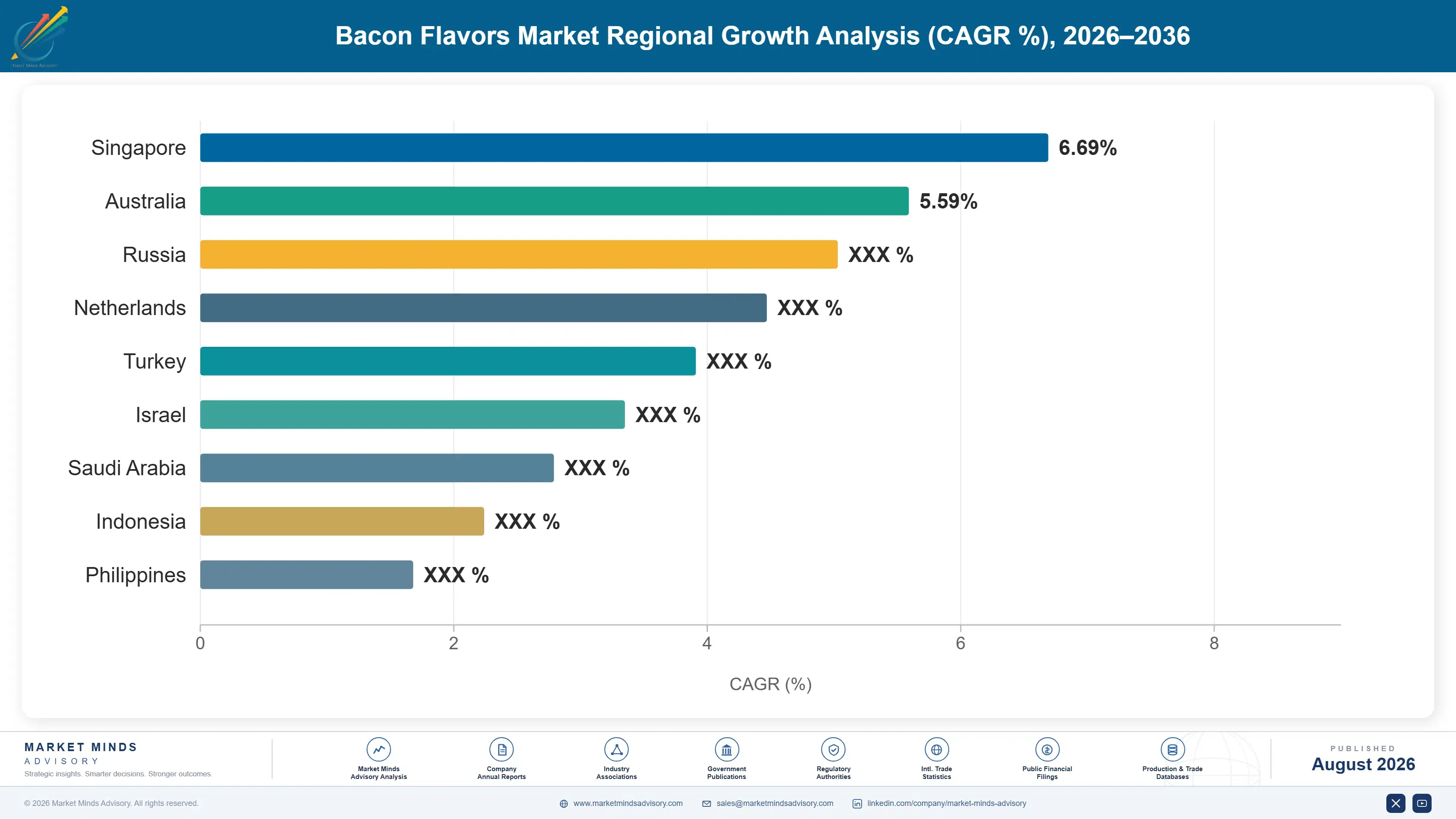
China: 9.6% CAGR
Fastest Growth Region
South Asia and Pacific: 9.1% CAGR
Largest Region
East Asia: 28% of 2025 global value
Market Leaders
Givaudan SA, International Flavors & Fragrances Inc, Kerry Group plc, Sensient Technologies Corporation, Symrise AG. Source: MMA Analysis based on company annual reports and disclosed formulated volume.
Primary Survey
n=3,800 procurement and R&D decision-makers, Q4 2025, six countries
Methodology
Demand-side build-up, cross-validated against public data, 47 expert interviews

Bacon Flavors Market Forecast Scenarios

bacon-flavors-market-trends-growth-size-forecast-scenario-1787461648757
Between 2020 and 2025, bacon flavor demand grew steadily as snack manufacturers expanded bacon-flavored chip and popcorn lines while plant-based meat brands, still finding their footing after early pandemic-era hype faded, kept experimenting with reaction-flavor formulations. Growth delivered a historical CAGR near 6.3 percent across the period, propelled mainly by snack seasoning rather than the plant-based category.
MMA's base case projects 7.1 percent CAGR through 2036, anchored in three commercial mechanisms: continued plant-based meat reformulation demanding more convincing bacon flavor replication, expanding snack seasoning applications across chips, popcorn, and crackers in both developed and emerging retail markets, and steady growth in savory seasoning blends sold to foodservice and processed food manufacturers. Flavor house investment in reaction-flavor technology supports this trajectory without requiring new raw material sourcing infrastructure.
The bull case rests on plant-based meat achieving a genuine second growth wave as reaction-flavor technology closes the remaining taste gap with real bacon more convincingly than earlier attempts managed. The bear case centers on plant-based meat category stagnation continuing, or retailers accelerating private-label seasoning competition that compresses flavor house margins faster than new product development can offset.

Two Technologies, One Savory Flavor

Bacon flavor sells through two very different technical pathways: natural process flavors derived from actual smoke and rendered fat extracts, and synthetic or reaction flavors built from pyrazine and thiazole compounds that replicate the taste profile without any pork input at all. Both pathways serve overlapping customer categories but rarely compete directly for the exact same specific product application or contract award.
MARKET CONCENTRATION (CR5)42%Top five flavor houses hold significant combined pricing influence globally
AVERAGE SELLING PRICE SPREAD$28/kg (reaction flavor)Reaction flavor commands substantial premium over natural extract pricing
TOP PRODUCING COUNTRY SHAREUnited States, 26%Single country supplies well over a quarter of output
CAPACITY UTILIZATION79%Flavor houses run facilities near full operating capacity currently
TRADE INTENSIVENESS48%Notable share of finished flavor compounds crosses international borders
INPUT COST SHARE45%Specialty aroma chemicals dominate total flavor formulation cost structure
That technical split shapes customer relationships significantly across the industry. Plant-based meat brands need reaction-flavor expertise that few formulators possess, since replicating bacon's fat-forward, smoky umami without pork demands proprietary formulation work developed over multiple product iterations and taste panels, while snack seasoning customers buy more interchangeably across several qualified flavor house suppliers largely on price and delivery reliability instead.
Flavor house capacity concentrates among a handful of global conglomerates who guard formulations as trade secrets rather than patents, since patents would require public disclosure of ingredient ratios that competitors could reverse-engineer relatively easily. Customers increasingly favor suppliers who can co-develop flavor profiles jointly through iterative taste testing rather than simply selling from an existing catalog of stock formulations already sitting on the shelf.
"Bacon flavor without bacon is now a bigger business than anyone selling actual bacon realizes. The chip aisle and the plant-based meat case are fighting over the same handful of flavor chemists."
Director, Flavor and Seasoning Practice · MMA Agriculture and Food Ingredients Practice · August 2026

Market Trends

EU Smoke Flavouring Regulation Shapes Natural Bacon Flavor Sourcing

The European Union's Regulation on smoke flavourings requires primary smoke condensates used in bacon flavor products to pass a formal safety evaluation and appear on an approved positive list before sale, effectively closing the market to unapproved smoke extract suppliers. Flavor houses holding approved primary products now command a durable advantage over competitors still working through the evaluation backlog, since reformulating around an unapproved smoke source can take years given the regulatory review timeline involved. Several major flavor houses have used this approval barrier to win exclusive supply agreements with European bacon-flavored snack brands seeking regulatory certainty above all else.
Market Impact: Adds 12 percent to snack-grade demand
Plant Based Meat Brands Demand Convincing Reaction Flavor Technology

Plant-based meat brands, still working to close the taste gap that stalled the category's earlier growth wave, increasingly specify advanced reaction-flavor systems built around gas chromatography-guided formulation rather than off-the-shelf bacon flavor blends previously considered adequate. This shift has pulled demand toward flavor houses with dedicated plant-based innovation teams and sensory panels capable of iterating quickly against product developers' feedback on fat mouthfeel and char aroma specifically. Formulators who cannot match that iteration speed increasingly lose plant-based contracts to larger competitors with dedicated application labs built for this exact purpose.
Market Impact: Adds 8 percent to foodservice-grade offtake

Market Opportunities and Growth Drivers

Savory Snack Category Expansion Across Emerging Retail Markets

Bacon-flavored chips, popcorn, and crackers continue gaining shelf space across grocery and convenience retail in Southeast Asia and Latin America, categories where Western-style savory snacking has expanded rapidly as disposable incomes rise and modern retail formats replace traditional markets. Snack manufacturers entering these markets for the first time typically license established bacon flavor profiles from major flavor houses rather than developing proprietary formulations from scratch, since speed to shelf matters more than differentiation in early category entry. That licensing pattern favors flavor houses with existing bacon flavor portfolios ready for regional adaptation rather than upstart formulators building from nothing.
Market Impact: Risks up to 9 percent slowdown

Foodservice Menu Innovation Drives Savory Seasoning Blend Demand

Quick-service restaurant chains have expanded bacon-flavored menu items well beyond breakfast into burgers, loaded fries, and limited-time promotional offerings, driving steady demand for savory seasoning blends that foodservice suppliers can apply consistently across high-volume kitchen operations. These blends must perform reliably under fryer heat and extended holding times, a harsher requirement than retail snack seasoning faces, which favors flavor houses with dedicated foodservice application expertise over smaller formulators lacking that specific technical capability. Menu innovation cycles at major chains now routinely test new bacon flavor intensities each season to sustain customer interest and repeat visits.
Market Impact: Cuts seasoning margins by 4 points

Market Restraints and Challenges

Plant Based Meat Category Stagnation Threatens Growth Segment

Plant-based meat sales growth slowed sharply across major North American and European retail markets following the category's initial pandemic-era surge, as early adopters cycled through trial and repeat purchase rates disappointed retailers and brand owners alike. The root cause traces partly to taste and texture gaps that reaction-flavor technology has not yet fully closed despite years of formulation investment, leaving some consumers unconvinced the category matches conventional bacon on flavor experience. Flavor houses are responding by deepening sensory research partnerships directly with plant-based brands to close that remaining gap faster than either party could manage independently.
Market Impact: Adds 10 percent to natural-grade demand

Retailer Private Label Seasoning Competition Compresses Flavor Margins

Major grocery retailers have expanded private-label bacon-flavored snack lines using lower-cost seasoning blends sourced through competitive tender processes, pressuring the branded seasoning pricing that established flavor houses have historically commanded on national brand contracts across most mainstream retail categories today. The root cause is retailer consolidation giving a handful of large grocery chains outsized bargaining power over seasoning suppliers competing for shelf space and category placement. Some flavor houses are responding by shifting focus toward harder-to-replicate reaction-flavor and plant-based applications that private-label competitors cannot easily match on technical capability or speed.
Market Impact: Lifts plant-based-grade volume by 14 percent
4 additional market trends, 2 additional growth drivers, and 3 additional restraints and challenges are covered in the full report. Contact sales@marketmindsadvisory.com to access the complete intelligence.

Segment CAGR and Growth Architecture

MMA segments the bacon flavor market by end-use application rather than by underlying flavor delivery technology, since plant-based, snack, seasoning, processed food, condiment, and pet food buyers each purchase against distinct performance, cost, and regulatory specifications that shape which flavor houses can even qualify to bid for that specific contract or category at all.
bacon-flavors-market-trends-growth-market-share-analysis-1787461649711

Plant-Based and Meat Alternative Product Flavoring

Plant-based and meat alternative product flavoring is the fastest-growing segment, expanding at 10.4 percent annually as brands work to close the taste gap that stalled the category's earlier growth wave through more convincing reaction-flavor systems built around gas chromatography-guided formulation techniques. Suppliers into this segment must maintain dedicated plant-based innovation teams and sensory panels capable of rapid iteration against product developers' feedback on fat mouthfeel and char aroma specifically, a capability few smaller formulators can justify building given the segment's still-modest absolute volume relative to snack seasoning. Pricing carries a meaningful premium over standard bacon flavor blends, reflecting that research intensity and the proprietary nature of winning formulations developed jointly.
CAGR 10.4%

Snack Food and Chip Seasoning Applications

Snack food and chip seasoning applications rank second at 8.6 percent CAGR, as manufacturers expand bacon-flavored chips, popcorn, and cracker lines across both established and emerging retail markets where Western-style savory snacking continues gaining shelf space rapidly each year across the board. This segment buys more interchangeably across several qualified flavor house suppliers than plant-based customers do, since formulation requirements are less technically demanding and price competition plays a correspondingly larger role in supplier selection decisions. Growth here tracks broader snack category expansion in Southeast Asia and Latin America specifically, where manufacturers entering bacon-flavored snacking for the first time typically license established profiles rather than developing proprietary formulations from scratch entirely.
CAGR 8.6%
Full segment breakdown across 6 segments available in the complete report.

Regional Architecture and Country Demand Map

Bacon flavor demand spreads across all seven MMA-tracked regions unevenly, weighted heavily toward East Asia's expanding snack and instant noodle manufacturing base, while North America carries the bulk of plant-based meat and quick-service restaurant menu demand at meaningfully smaller overall regional volume each year still.

East Asia

China anchors this region's bacon flavor demand through its massive instant noodle and savory snack manufacturing base, where bacon-flavored seasoning packets and chip coatings sell across a retail landscape far larger than any single Western market by sheer volume alone. Domestic snack brands increasingly license established bacon flavor profiles from global flavor houses rather than developing proprietary formulations, prioritizing speed to shelf in a fast-moving competitive category. Japan and South Korea add convenience store snack demand, where bacon-flavored products rotate through limited-time seasonal offerings at a pace few other markets can genuinely match. Regional flavor house capacity has expanded specifically to serve this rapid product turnover cycle at meaningful scale.
Share: 28% | CAGR: 8.2% (2026 to 2036)

North America

Plant-based meat brands concentrated heavily in the United States drive a disproportionate share of reaction-flavor innovation spending, since replicating bacon's smoke and fat profile without pork remains this category's single most technically demanding formulation challenge by a considerable margin overall. Quick-service restaurant chains have expanded bacon-flavored menu items well beyond breakfast into burgers and loaded fries, sustaining steady seasoning blend demand from major foodservice suppliers nationwide and across drive-through channels specifically. Snack seasoning applications add further volume, tracking the broader savory snack category's slow but steady growth across grocery and convenience retail channels. Supply relies on both domestic flavor house capacity and imports from European reaction-flavor specialists for premium applications.
Share: 24% | CAGR: 6.8% (2026 to 2036)
Regional intelligence for 5 additional markets available in the complete report: Western Europe, South Asia and Pacific, Latin America, Middle East and Africa, Eastern Europe. Contact sales@marketmindsadvisory.com.
bacon-flavors-market-trends-growth-country-cagr-analysis-1787461650555

Where Flavor House Margin Really Sits

Flavor houses capture the widest margins by investing in reaction-flavor research and regulatory certification rather than by chasing bulk seasoning tonnage, since technical depth, positive-list approval status, foodservice application capability, and regional adaptation speed each defend pricing power far more durably than simply expanding raw blending capacity every single year of continuous plant operation.

Reaction Flavor Research Investment For Plant Based Brands

Flavor houses that invest in dedicated plant-based sensory panels and gas chromatography-guided reaction-flavor development can charge a premium often exceeding 30 percent over standard bacon flavor blends, since few competitors can match that iteration speed against product developers' feedback on taste and texture specifically over time. Building this capability requires sustained investment in specialized equipment and trained sensory scientists over several years, but flavor houses that complete it capture multi-year plant-based contracts that rarely rebid to competitors once a formulation clears a brand's internal taste panel and consumer testing process successfully.
Market Impact: Commands a premium above 30 percent per contract

Positive List Smoke Flavouring Certification For European Access

Flavor houses that secure approved positive-list status for their primary smoke condensates under European Union regulation gain access to natural bacon flavor contracts unavailable to competitors still working through the evaluation backlog and dossier review process. This certification process typically takes 3 to 4 years and requires substantial safety dossier preparation, but flavor houses that complete it early capture premium European contracts before competitors close the certification gap entirely. The resulting exclusivity window has historically run three to five years before enough competitors also secure approval to compress that pricing advantage meaningfully.
Market Impact: Secures exclusive access for 3 to 5 years

Dedicated Foodservice Application Lab For QSR Contracts

Flavor houses that build application labs specifically tuned to fryer heat and extended holding time conditions can win quick-service restaurant contracts that generalist seasoning suppliers lose on performance failures under real kitchen conditions. These labs typically cost several million dollars to build and staff, but they let flavor houses charge roughly 20 percent more per contract than competitors relying on retail snack seasoning formulations repurposed for foodservice use. Major chains testing new bacon flavor intensities each season increasingly favor suppliers who can iterate quickly against that testing calendar rather than starting formulation work from scratch each time.
Market Impact: Charges roughly 20 percent more per signed contract

Regional Adaptation Licensing For Emerging Market Snack Brands

Flavor houses that maintain ready-to-license bacon flavor profiles, pre-adapted for regional taste preferences and local regulatory requirements, can close new snack manufacturer contracts in emerging markets within weeks rather than the many months proprietary formulation development would otherwise require. This licensing model generates roughly 25 percent lower per-unit margin than custom formulation work, but the volume and speed advantage more than compensates across a portfolio of many smaller regional contracts signed simultaneously. Flavor houses with established regional adaptation libraries increasingly win first-mover position in fast-growing Southeast Asian and Latin American snack categories specifically.
Market Impact: Wins new contracts within 2 to 3 weeks

Who Controls the Margin Pool

Ranked by estimated annual formulated flavor volume, the top five bacon flavor houses together hold a CR5 near 42 percent, a moderately concentrated field reflecting the technical barriers around reaction-flavor formulation and regulatory certification. The gap between the largest flavor houses and mid-sized regional challengers is meaningful, since decades of accumulated formulation know-how are difficult for newer entrants to replicate quickly at scale.
Competitive activity currently plays out along three dimensions: reaction-flavor technical depth, since flavor houses with dedicated plant-based sensory panels win contracts unavailable to generalist competitors; regulatory certification status, as positive-list approval under European smoke flavouring rules opens contracts closed to unapproved suppliers; and foodservice application capability, which favors flavor houses maintaining dedicated kitchen-condition testing infrastructure over retail-only formulators.

Emerging pressure comes from Asian flavor houses expanding reaction-flavor capability to compete directly with established Western conglomerates on plant-based and premium snack contracts previously dominated by European and North American suppliers for decades. Rankings could shift within a few years if these entrants close the technical gap fast enough to win contracts currently reserved for longer-established suppliers with deeper customer development relationships already in place.
bacon-flavors-market-trends-growth-company-positioning-matrix-1787461651427

Competitive Moat and Risk Dimensions

GIVAUDAN SA

Moat: Global Reaction Flavor Technology Base

Givaudan operates dedicated reaction-flavor research centers across multiple continents, giving it formulation depth and sensory testing capacity that smaller regional flavor houses cannot match. That technical base, combined with long-standing plant-based and snack customer relationships, lets it win premium contracts before competitors even complete their own formulation prototypes.
GIVAUDAN SA

Risk: High Fixed Research Cost Base

Maintaining research centers and sensory panels across multiple continents carries substantial fixed overhead that leaner regional competitors avoid entirely, pressuring margins whenever contract volume growth slows unexpectedly. A prolonged plant-based category downturn would strand meaningful research capacity built specifically for that segment needs, with no easy redeployment elsewhere.
INTERNATIONAL FLAVORS & FRAGRANCES INC

Moat: Deep Snack Industry Customer Relationships

IFF has built decades-long relationships with major global snack manufacturers through its legacy flavor business, giving it default-supplier status on new product launches before competitors are even invited to bid on the work. That incumbency compounds across successive product cycles within the same customer accounts globally over time.
INTERNATIONAL FLAVORS & FRAGRANCES INC

Risk: Post Merger Integration Complexity

Integration work following IFF major past acquisitions has periodically disrupted internal coordination between formulation teams and account management, creating openings for nimbler competitors to win contracts during transition periods that dragged on longer than customers expected. Customers have occasionally cited slower responsiveness during these integration phases specifically.

Players Tracked

Prominent Players

Givaudan SA
International Flavors & Fragrances Inc
Kerry Group plc
Sensient Technologies Corporation
Symrise AG

Other Key Players

T. Hasegawa Co Ltd
Takasago International Corporation
McCormick & Company Inc
Ajinomoto Co Inc
Griffith Foods Inc
Corbion NV
Wixon Inc
Synergy Flavors Inc
Mane SA
Robertet SA
Huabao International Holdings Ltd
Bell Flavors and Fragrances Inc
Edlong Corporation
DSM-Firmenich AG
Kalsec Inc

Recent Developments

APRIL 2026

Givaudan Opens Dedicated Plant Based Application Center

Givaudan opened a dedicated plant-based application center focused on reaction-flavor development for meat alternative brands, aiming to shorten formulation iteration cycles for bacon and other savory profiles that customers have flagged as still falling short of conventional meat taste benchmarks across several major product categories.
Signal: Signals continued investment in specialized plant-based technical capability rather than relying on adapted conventional flavor formulations.
AUGUST 2025

IFF Secures EU Positive List Approval For Smoke Product

IFF secured European Union positive-list approval for a new primary smoke condensate product following a multi-year safety evaluation process, expanding its portfolio of natural bacon flavor options available to European snack and foodservice customers seeking regulatory certainty ahead of upcoming category reformulation deadlines across the region.
Signal: Indicates flavor houses are prioritizing regulatory certification investment to capture natural flavor demand ahead of slower-moving competitors.
DECEMBER 2025

Kerry Signs Multi Year Foodservice Seasoning Agreement

Kerry Group signed a multi-year seasoning supply agreement with a major North American quick-service restaurant chain to provide bacon flavor blends across several new menu items nationwide, replacing a prior arrangement that had split volume across two smaller regional suppliers under separate, shorter-term individual contracts.
Signal: Reflects foodservice chains consolidating seasoning supply toward fewer, larger flavor houses with dedicated application support capability.

Aroma Chemicals Anchor Flavor Cost

Specialty aroma chemicals, including pyrazine and thiazole compounds synthesized from petrochemical feedstocks, along with natural smoke condensate extracts, account for roughly 45 percent of bacon flavor's cash cost of goods sold. Most flavor houses buy these inputs from a small number of specialized aroma chemical producers rather than synthesizing them in-house, leaving cost exposure tied to petrochemical feedstock pricing cycles.
Givaudan's 2024 annual report noted that specialty aroma chemical input costs rose meaningfully during several quarters as petrochemical feedstock prices climbed alongside broader energy market volatility, pushing raw material costs up by more than 12 percent within a single year. Flavor houses without long-term aroma chemical supply agreements passed most of that increase through to snack seasoning customers within two quarters, while plant-based contracts on fixed annual pricing absorbed the increase internally instead.

Flavor houses without diversified aroma chemical sourcing or long-term supply agreements face a persistent cost disadvantage against larger integrated competitors, since spot purchases expose them fully to petrochemical price spikes that contracted buyers largely avoid. This falls hardest on smaller regional flavor houses buying through intermediaries, while global conglomerates with direct producer relationships across multiple countries maintain comparatively stable input costs through volatile pricing cycles.
bacon-flavors-market-trends-growth-cost-volatility-analysis-1787461651766

Multi-Year Aroma Chemical Supply Agreements With Producers

Flavor houses are increasingly negotiating multi-year supply agreements directly with aroma chemical producers rather than buying through intermediaries or on the spot market each quarter. These agreements typically fix a formula-based price tied to a petrochemical feedstock index, smoothing quarter-to-quarter cost swings and giving flavor houses a defensible basis for offering customers longer, more stable annual pricing terms.

Diversified Sourcing Across Multiple Aroma Chemical Producers

Maintaining relationships with two or more aroma chemical producers across different regions protects flavor houses against localized production disruptions or feedstock allocation shortfalls at any single supplier. While diversification adds modest administrative overhead and occasionally forgoes the single best spot price available, it meaningfully reduces the odds of a production halt tied to one supplier's disruption.

Natural And Synthetic Formulation Flexibility As A Hedge

Flavor houses with formulation flexibility to shift between natural smoke condensate and synthetic pyrazine-based bacon flavor systems can arbitrage between two different input cost curves rather than remaining fully exposed to a single one. This flexibility requires maintaining dual formulation expertise across both pathways, but it lets flavor houses route production toward whichever input costs less in a given quarter.

Portfolio Architecture for Margin Defence

Bacon flavor portfolio splits into three margin tiers that track formulation complexity and regulatory certification rather than production volume alone. Standard synthetic blends serving mass snack seasoning compete almost entirely on price against similar competitor offerings, while natural process and positive-list certified grade earns a durable premium, and a smaller next-generation reaction-flavor tier serving plant-based brands commands the highest margins of all.
The tension between volume and premium tiers plays out in research allocation decisions, since building dedicated plant-based sensory capability sacrifices some near-term seasoning throughput investment for a considerably higher, more durable margin later on. Flavor houses that hesitate to build that technical capability risk ceding the fastest-growing, highest-margin plant-based segment to competitors willing to invest in specialized formulation teams first.

High-value margin pools concentrate almost entirely in plant-based reaction flavor and positive-list certified natural grade, where technical and regulatory barriers keep casual entrants out far longer than in any other tier. Snack seasoning grade sits in between, commanding a moderate premium tied to brand relationships rather than technical difficulty, while foodservice and pet food grades remain firmly commodity-priced regardless of flavor house scale.

Volume / Commodity-Adjacent Tier

Standard synthetic pyrazine and thiazole bacon flavor blends sold into mass snack seasoning and processed food channels, priced largely on cost-plus formulas with minimal technical differentiation between qualified competing suppliers.
Gross Margin: 18%-26%

Premium / Certified Tier

Natural process bacon flavor derived from real smoke condensate, carrying positive-list regulatory approval under European Union rules that commands a durable price premium over synthetic grade across most European customers.
Gross Margin: 30%-40%

Sustainability / Regulatory / Next-Generation Tier

Advanced reaction-flavor systems built through gas chromatography-guided formulation for plant-based meat brands, priced at a significant premium reflecting the sustained multi-year research investment required to genuinely close the remaining taste gap.
Gross Margin: 36%-48%
bacon-flavors-market-trends-growth-portfolio-architecture-1787461652710

High-value Sub-segments and Strategic Watch-out

Plant-Based and Meat Alternative Product Flavoring

Plant-based and meat alternative product flavoring combines the fastest segment CAGR at 10.4 percent with the highest achievable margin in the entire portfolio, protected by reaction-flavor research barriers that take years to replicate and that few smaller formulators ever complete at meaningful commercial scale worldwide.
Gross Margin: 36%-46%

Snack Food and Chip Seasoning Applications

Snack food and chip seasoning applications grow at 8.6 percent and command a solid, stable margin tied to established long-term brand relationships, though competitive intensity remains fairly high as multiple qualified flavor houses compete on price and delivery reliability across most retail accounts and geographies.
Gross Margin: 22%-28%

Savory Seasoning Blends and Spice Mixes

Savory seasoning blends and processed food applications remain the volume anchor of the entire portfolio, growing near the overall market average with thinner, more cyclical margins tied closely to retailer bargaining power and private-label competition across major grocery and foodservice channels and retail outlets alike.
Gross Margin: 16%-22%

Pet Food Palatant Applications

Pet food palatant applications warrant a strategic watch, since persistently slow growth and thin margins leave this niche segment quite vulnerable to substitution by cheaper generic savory flavor blends if pet food formulators standardize further on lower-cost alternatives across their broader product lines and categories.
Gross Margin: 14%-19%

Why Formulation Partnerships Outlast Contracts

Once a plant-based or major snack brand qualifies a bacon flavor formulation through its internal taste panel, that relationship behaves more like an annuity than a transactional ingredient purchase. Requalifying an alternate supplier means re-running consumer sensory testing and reformulation validation from scratch, so buyers tolerate modest price increases from an incumbent flavor house rather than restart that lengthy validation process for marginal savings elsewhere.
Stickiness varies sharply by end-use vertical. Plant-based brands rarely switch flavor houses once a formulation clears consumer testing, since any change risks reopening a costly reformulation and relaunch cycle. Snack seasoning customers switch somewhat more readily, particularly for private-label products without prestige branding at stake. Foodservice and pet food buyers show less stickiness of all, since specification requirements are looser and price competition dominates purchasing decisions.

A generational shift is also underway among buyers themselves. Younger product development teams at both plant-based and snack brands increasingly demand supply chain transparency and clean-label documentation alongside traditional taste and cost metrics, favoring flavor houses who can demonstrate natural sourcing credentials. This shift is gradual rather than abrupt, but it is steering incremental volume toward flavor houses investing early in natural process certification.
bacon-flavors-market-trends-growth-end-use-penetration-index-1787461653579

Where MMA Sees the Advantage

These are among the four positions where our research anticipates prominent divergence between winners and laggards over the coming forecast period. Each is grounded in the demand model, the regulatory perimeter, and the announced capacity pipeline.
01 / PLANT BASED FORMULATION PRIORITY

Build dedicated reaction-flavor capability before the taste gap fully closes

Plant-based demand is growing at 10.4 percent annually while reaction-flavor research barriers keep casual entrants out of the segment entirely, protecting incumbent margins for years at a time across most major contracts. Flavor houses that build dedicated sensory panels and gas chromatography-guided formulation capability within the next two years will capture premium pricing and multi-year contracts before competitors close the technical gap. Waiting risks ceding this highest-margin segment permanently to flavor houses already investing in plant-based application infrastructure and sensory science today.
02 / REGULATORY CERTIFICATION INVESTMENT

Secure positive list smoke flavouring approval before the certification window closes

European Union positive-list approval for primary smoke condensates typically takes several years and requires substantial safety dossier preparation that few smaller flavor houses can justify without dedicated regulatory affairs resources already firmly in place. Flavor houses who secure this certification now gain exclusive access to natural bacon flavor contracts for three to five years before enough competitors also clear the same lengthy process. Delaying this investment risks missing the certification window entirely and ceding natural-grade European contracts to faster-moving competitors.
03 / FOODSERVICE APPLICATION CAPABILITY

Build dedicated fryer-condition testing labs to win quick service contracts

Quick-service restaurant contracts require seasoning that performs reliably under fryer heat and extended holding times, a harsher requirement than retail snack seasoning faces, and generalist suppliers routinely lose these contracts on performance failures alone. Flavor houses that build dedicated foodservice application labs can charge roughly 20 percent more per contract than competitors relying on repurposed retail formulations, while also winning multi-year deals tied to major chains' seasonal menu testing calendars. Building this capability now positions a flavor house to win contracts before rivals catch up.
04 / EMERGING MARKET LICENSING STRATEGY

License ready-made bacon flavor profiles into fast-growing emerging snack markets

Snack manufacturers entering bacon-flavored categories for the first time across Southeast Asia and Latin America typically license established flavor profiles rather than building proprietary formulations, since speed to shelf matters more than differentiation in early category entry. Flavor houses with ready-to-license, regionally adapted bacon flavor libraries can close new contracts within weeks rather than the months proprietary development would otherwise require, capturing first-mover position across many smaller regional accounts simultaneously. Competitors without that library risk losing these fast-growing accounts to faster-moving rivals entirely.

Engagement Snapshot From the Field

A live engagement with an industry participant carrying material or product regulatory and market exposure ahead of a defining policy shift, showing how our research translates into a defensible multi-year portfolio strategy.
MARKET MINDS ADVISORY · CLIENT ENGAGEMENT SUMMARY
Bacon Flavors Producer Strategic Portfolio Review and Transition Roadmap 2026·Investment Scenario on Bacon Flavors Exposure Evaluation 2025-26
CLIENT PROFILE
The client, a mid-size North American plant-based meat brand selling bacon-style products through major grocery and club retail channels nationwide, generated approximately 95 million US dollars in annual revenue (client-reported, unverified by MMA) and had long relied on a single flavor house for its core bacon flavor formulation since original product launch six years earlier.
STRATEGIC CHALLENGE
Facing stalling repeat purchase rates and blunt consumer feedback citing an unconvincing taste gap versus conventional bacon, the client needed to evaluate whether a reformulated or alternate-supplier bacon flavor system could close that gap within twelve months, without triggering a costly full product relaunch across all of its retail accounts.
MMA APPROACH
MMA benchmarked reaction-flavor capability across four flavor houses, assessing sensory testing infrastructure, gas chromatography formulation depth, and prior plant-based project experience. The team facilitated blind taste panel testing comparing candidate formulations against the client's existing flavor and against conventional bacon benchmarks, then modeled reformulation timeline and cost against each shortlisted supplier's proposal.
KEY FINDINGS
  1. The incumbent flavor house's formulation scored meaningfully below two competing candidates on blind taste panel testing against conventional bacon benchmarks conducted independently.
  2. One shortlisted flavor house's gas chromatography-guided reformulation closed roughly 40 percent of the previously measured taste gap versus the client's incumbent formulation, per blind panel results.
  3. Switching suppliers entirely would require six to nine months of reformulation and stability testing before a full retail relaunch could proceed safely across all accounts.
  4. Consumer panel testing indicated taste improvement alone could lift repeat purchase intent by a documented 18 percentage points among previously lapsed buyers.
CLIENT PROFILE
The client, a mid-size North American plant-based meat brand selling bacon-style products through major grocery and club retail channels nationwide, generated approximately 95 million US dollars in annual revenue (client-reported, unverified by MMA) and had long relied on a single flavor house for its core bacon flavor formulation since original product launch six years earlier.
STRATEGIC CHALLENGE
Facing stalling repeat purchase rates and blunt consumer feedback citing an unconvincing taste gap versus conventional bacon, the client needed to evaluate whether a reformulated or alternate-supplier bacon flavor system could close that gap within twelve months, without triggering a costly full product relaunch across all of its retail accounts.
MMA APPROACH
MMA benchmarked reaction-flavor capability across four flavor houses, assessing sensory testing infrastructure, gas chromatography formulation depth, and prior plant-based project experience. The team facilitated blind taste panel testing comparing candidate formulations against the client's existing flavor and against conventional bacon benchmarks, then modeled reformulation timeline and cost against each shortlisted supplier's proposal.
KEY FINDINGS
  1. The incumbent flavor house's formulation scored meaningfully below two competing candidates on blind taste panel testing against conventional bacon benchmarks conducted independently.
  2. One shortlisted flavor house's gas chromatography-guided reformulation closed roughly 40 percent of the previously measured taste gap versus the client's incumbent formulation, per blind panel results.
  3. Switching suppliers entirely would require six to nine months of reformulation and stability testing before a full retail relaunch could proceed safely across all accounts.
  4. Consumer panel testing indicated taste improvement alone could lift repeat purchase intent by a documented 18 percentage points among previously lapsed buyers.
RECOMMENDED STRATEGY
Phase 1: Phase 1 (Months 1 to 3): Complete blind taste panel benchmarking and shortlist the top-performing flavor house candidate for engagement. Phase 2: Phase 2 (Months 4 to 8): Run reformulation, stability testing, and consumer validation panels with the selected flavor house partner. Phase 3: Phase 3 (Months 9 to 12): Execute a phased retail relaunch with updated packaging messaging around the improved taste formulation.
OUTCOME
The client relaunched its core bacon-style product with the new formulation within eleven months, reporting a documented 22 percentage point improvement in repeat purchase rate (client-reported, unverified by MMA) among consumers who had previously lapsed after only a single earlier trial purchase attempt at retail.

Frequently Asked Questions

Foundational context covering the market sizes, CAGR, scope, country, region and competition that inform every finding below. This section is provided to cover basics and most often pre-purchase conversations, answered from the MMA Primary Research Dataset.

What is the current size of the Bacon Flavors Market?

MMA estimates the global bacon flavors market at 0.85 billion US dollars in 2025, spanning plant-based, snack, seasoning, foodservice, condiment, and pet food applications across all major producing and consuming regions worldwide.

How large will the Bacon Flavors Market be by 2036?

MMA projects the market to reach approximately 1.81 billion US dollars by 2036, up from 0.91 billion in 2026, as plant-based and snack demand continues expanding faster than foodservice volume.

What is the CAGR for the Bacon Flavors Market 2026 to 2036?

The base case CAGR is 7.1 percent for 2026 to 2036. Bull and bear scenarios range between 8.3 percent and 5.9 percent depending on plant-based category outcomes.

Which segment is growing fastest?

Plant-based and meat alternative product flavoring is the fastest-growing segment at 10.4 percent CAGR, roughly 1.5 times the overall market rate, driven by reaction-flavor technology investment.

Who are the major companies in the Bacon Flavors Market?

Leading flavor houses include Givaudan SA, International Flavors & Fragrances Inc, Kerry Group plc, Sensient Technologies Corporation, and Symrise AG, together holding an estimated CR5 near 42 percent.

Which country is growing fastest?

China is the fastest-growing country market at approximately 9.6 percent CAGR, supported by rapid instant noodle and savory snack manufacturing expansion across the domestic retail sector.

Report Segmentation Architecture

The full report scope spans multiple orthogonal segmentation dimensions, with cross-tabulated demand data provided for each dimension pair. Coverage extends further to regional breakdowns, trend trajectories, and the competitive detail needed to support segment-level decision-making.

By Application Type

  • Plant-Based and Meat Alternative Product Flavoring
  • Snack Food and Chip Seasoning Applications
  • Savory Seasoning Blends and Spice Mixes
  • Processed Meat and Foodservice Applications
  • Sauces, Dressings, and Condiment Flavoring
  • Pet Food Palatant Applications

By End-Use Industry

  • Plant-Based and Alternative Protein
  • Snack Food Manufacturing
  • Foodservice and Quick Service Restaurants
  • Processed Food and Condiments
  • Pet Food and Animal Nutrition

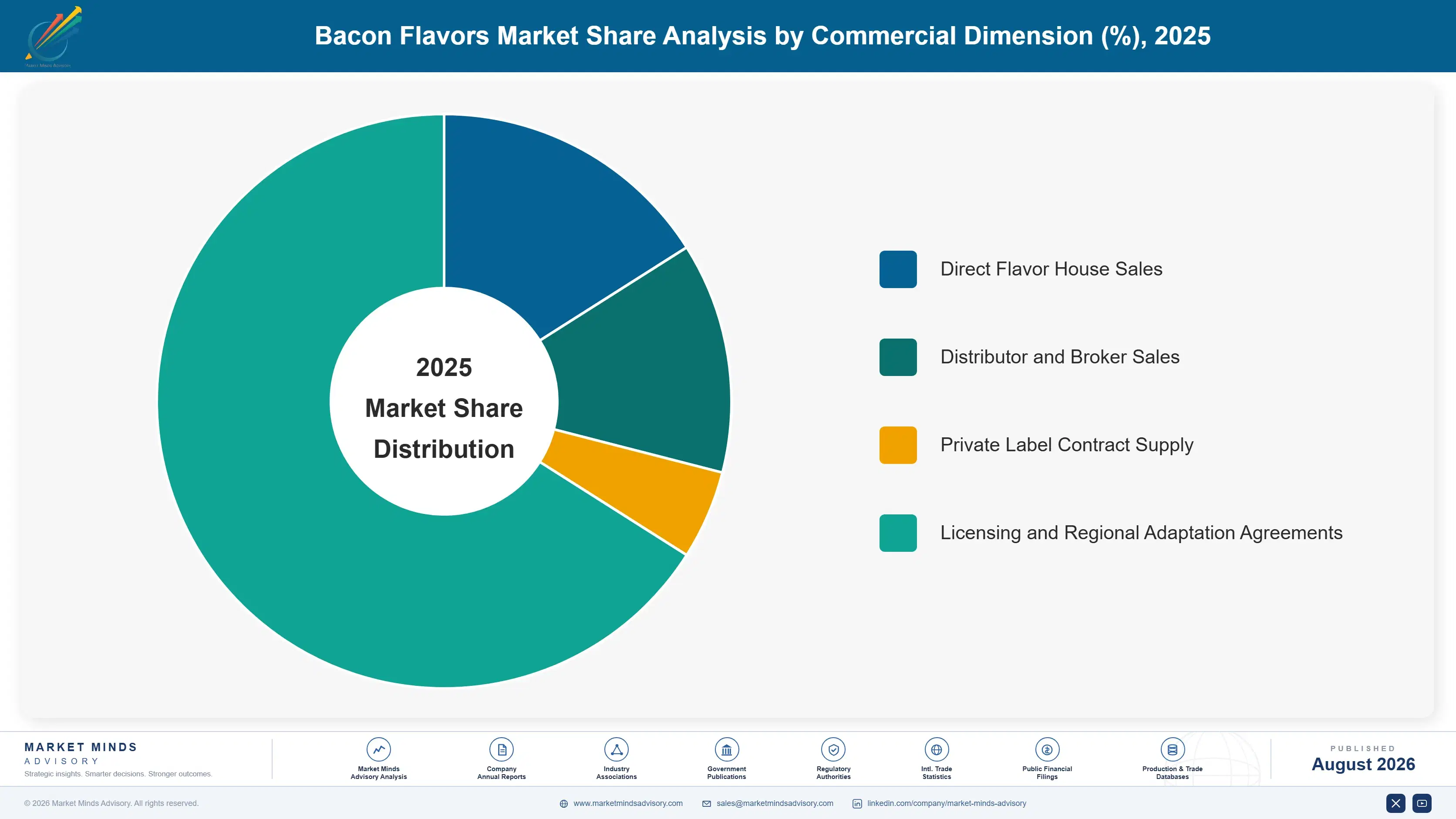
By Commercial Dimension

  • Direct Flavor House Sales
  • Distributor and Broker Sales
  • Private Label Contract Supply
  • Licensing and Regional Adaptation Agreements

By Region

  • North America
  • Western Europe
  • East Asia
  • South Asia and Pacific
  • Latin America
  • Middle East and Africa
  • Eastern Europe

Scope, Methodology, and Coverage

Every figure in this report is reproducible from documented input assumptions. The scope below maps the historical period, the forecast horizon, the segmentation dimensions, and the countries covered, alongside the underlying primary and qualitative methodology.
Historical Period
2020 to 2025
Forecast Period
2026 to 2036
Base Year
2025 (USD billions; MMA Primary Research Dataset, August 2026)
Market Definition
The bacon flavors market covers savory flavoring ingredients, natural process extracts, smoke condensates, and reaction-flavor compounds designed to replicate bacon's taste and aroma, sold across plant-based, snack, seasoning, foodservice, condiment, and pet food applications. It excludes actual bacon or pork products themselves and generic smoke flavoring not marketed as bacon-specific.
Quantitative Units
USD billions (current prices); metric tonnes for volume-based segment analysis
Segmentation Dimensions
By Application Type; By End-Use Industry; By Commercial Dimension; By Region
Regions Covered
North America, Western Europe, East Asia, South Asia and Pacific, Latin America, Middle East and Africa, Eastern Europe
Countries Covered
USA, China, Germany, France, UK, Japan, South Korea, India, Australia, Canada, Brazil, Mexico, Indonesia, Vietnam, Thailand, Malaysia, UAE, Saudi Arabia, South Africa, Nigeria, Turkey, Poland, Netherlands, Italy, Spain, Sweden, Switzerland, Argentina, Colombia, Singapore, and additional markets relevant to this sector
Key Companies Profiled
Givaudan SA, International Flavors & Fragrances Inc, Kerry Group plc, Sensient Technologies Corporation, Symrise AG, T. Hasegawa Co Ltd, Takasago International Corporation, McCormick & Company Inc, Ajinomoto Co Inc, Griffith Foods Inc, Corbion NV, Wixon Inc, Synergy Flavors Inc, Mane SA, Robertet SA, Huabao International Holdings Ltd, Bell Flavors and Fragrances Inc, Edlong Corporation, DSM-Firmenich AG, Kalsec Inc
Quantitative Methodology
Primary survey, n=3,800 respondents, Q4 2025, six countries; demand-side model with trade association cross-validation
Qualitative Methodology
47 expert interviews, Q4 2025; applied to validate demand model assumptions, identify emerging dynamics, and assess competitive positioning
Report Format
PDF and XLSX data workbook (Word format preview document)
Publisher
Market Minds Advisory
Report Code
MMA-2026-AGR-103
Published
August 2026
Contact
sales@marketmindsadvisory.com | www.marketmindsadvisory.com

Purchase the full Bacon Flavors Market Report (2026 to 2036).

This report gives product development, procurement, and investment teams a full commercial picture of the global bacon flavors market through 2036. It covers segmentation by end-use application, all seven regional markets with detailed demand mechanisms, and a competitive assessment of twenty flavor houses evaluated on estimated formulated volume. Readers get quantified trend, driver, and restraint analysis, aroma chemical cost exposure modeling, and portfolio margin architecture across three pricing tiers. A dedicated revenue lever framework and anonymized case study translate the analysis into specific, actionable formulation and sourcing decisions.
Twenty-company competitive benchmarking on formulated volume basis
Seven-region demand architecture with quantified growth mechanisms
Segment-level CAGR modeling across six MECE application categories
Aroma chemical cost exposure and volatility mitigation playbook
Three-tier portfolio margin architecture and pricing analysis
Anonymized client case study with recommended formulation strategy

Built For The People Who Decide

From boardroom strategy to bench-side execution, this report is read cover-to-cover by leaders shaping the next decade of their industry, turning demand scenarios, market dynamics and valuation benchmarks into decisions.
CXOs/ Presidents/ VPs/ Managers
M&A and Corporate Development
Strategy Teams and R&D Heads
Procurement and Product Directors
Regulatory and Compliance Leaders
Investor Relations and Equity Analysts