Market Minds Advisory
Baby Toiletries Market

Baby Toiletries Market: Baby Toiletries Market: Litigation, Dermatology and a Shrinking Preservative List

A category-defining product was removed by litigation rather than by regulation, the preservative list keeps shrinking, and the fastest-growing segment is prescribed by a dermatologist rather than chosen by a parent.

Lead Analyst

Published

August 2026

Make Smarter Decisions with Customized Research Insights

Request a free sample report and evaluate market opportunities, growth trends, and competitive dynamics relevant to your business needs.

2025 MARKET VALUE$12.8BMarket Size 2025
2036 FORECAST VALUE$23.8BBase Case , 2026 to 2036
CAGR 2026 TO 20365.8 %Bull 7.0% / Bear 4.6%
INCREMENTAL OPPORTUNITY$10.2BNet 10- year value creation
EXPANSION MULTIPLE1.76x2036 value over 2026 base
Strategic Levers
M&A Pipeline
Regional Outlook
Country Rankings
Competitive Intelligence
Segmental Deep-dive
Call-Us : 91 93563 13602

Executive Snapshot and Market Trajectory.

Talc-based baby powder left this category through a courtroom rather than a regulator, and nothing about consumer preference caused it. That is unusual and it tells you something: the decisions that move this market are made by lawyers, dermatologists and preservative chemists rather than by any parents.
Barrier repair and eczema management creams grow at 8.7%, half again the market rate of 5.8%, because paediatric dermatology guidance has turned daily emollient use into a management routine rather than a cosmetic choice. South Asia holds 24% of demand, far above its usual band, because daily infant oil massage is an embedded household practice across India rather than a discretionary purchase anybody has to be persuaded into. Western sizing models miss that entirely.
Concentration is high at 41%, held by names a mother recognises from a maternity ward rather than from advertising, which is a position nobody buys. The technical squeeze underneath is real: fragrance is the leading contact allergen in personal care and the permitted preservative list for leave-on infant products has narrowed to roughly seven systems, so formulators are working with less than they had a decade ago instead.
Market Definition
The baby toiletries market covers cleansing, moisturising and skin protection products formulated for infants and toddlers up to around three years, spanning baby bath and wash, baby shampoo, lotions and moisturisers, oils and massage products, powders and talc alternatives, and barrier repair and eczema management creams. Scope includes retailer own-label infant ranges. Excluded are diapers and absorbent hygiene products, wet wipes, oral care for children, sun care formulated for infants, prescription topical medicines, and general family products used on children.
Base Year Value
$12.8B in 2025 (MMA Primary Research Dataset, August 2026)
Forecast Period
2026 to 2036, eleven discrete annual values
CAGR
5.8% base case. Bull 7.0%. Bear 4.6%.
Fastest Growth Segment
Barrier Repair and Eczema Management Creams: 8.7% CAGR
Fastest Growth Country
India: 7.8% CAGR
Fastest Growth Region
South Asia and Pacific: 7.8% CAGR
Largest Region
East Asia: 25% of 2025 global value
Market Leaders
Kenvue, Beiersdorf, Unilever, Dabur India and Pigeon Corporation. Source: MMA Analysis, July 2026.
Primary Survey
n=3,800 procurement and R&D decision-makers, Q4 2025, six countries
Methodology
Demand-side build-up, cross-validated against public data, 47 expert interviews

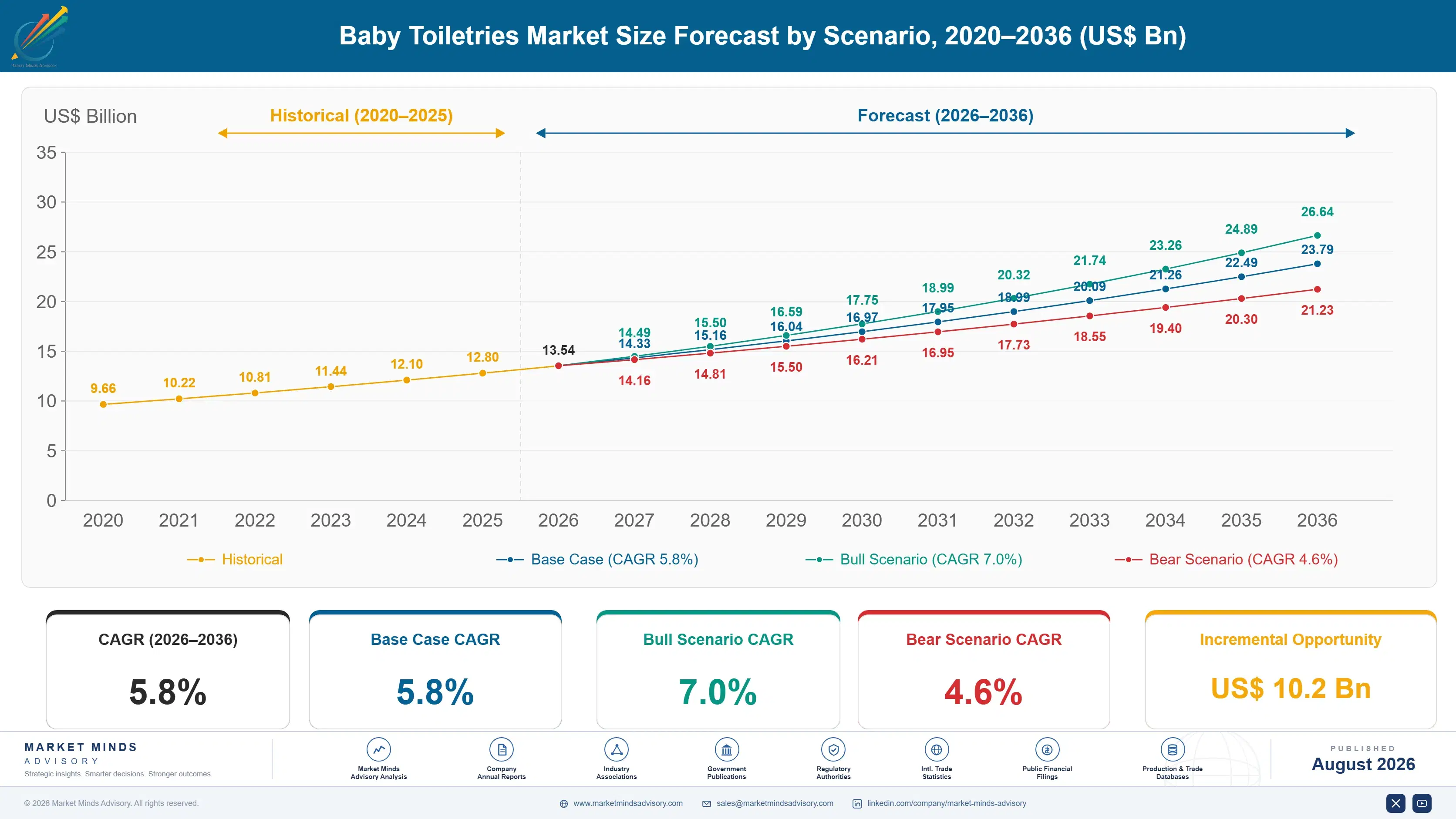
Baby Toiletries Market Forecast Scenarios

baby-toiletries-market-size-forecast-scenario-1788175848839
Between 2020 and 2025 the sector compounded at 4.8%, and the composition changed far more than the total did. Talc powder withdrew from major markets and cornstarch and kaolin alternatives took part of the volume back at lower value. Barrier repair creams grew through the same period on dermatological recommendation rather than on marketing. Western birth numbers fell throughout and Asian volume carried the aggregate.
The 5.8% base case rests on three mechanisms. Paediatric dermatology guidance keeps converting daily emollient use from a cosmetic habit into a management routine at considerably higher prices. Fragrance-free and minimal ingredient formulation keeps moving households upward as parents read labels rather than brands. And South Asian branded penetration continues expanding across a birth cohort larger than every Western market combined. None of the three depends on Western birth numbers recovering.
The bull case at 7.0% turns on early emollient use gaining a formal preventive recommendation rather than a management one, which would convert a treatment purchase into a universal routine. The bear case at 4.6% is preservative narrowing: further restriction of the systems available for leave-on infant products would force reformulation across ranges that already have very little room to work with.

Decided By Lawyers And Dermatologists

The talc withdrawal is the most instructive event in this category's recent history and almost nobody draws the right lesson from it. A product that had been sold for generations left major markets on litigation exposure rather than on any regulatory finding or consumer rejection, and alternatives took back only part of the volume at lower value. Powders now grow at 3.0%, the slowest segment on the shelf.
TOP FIVE CONCENTRATION41%Share held by the five largest baby toiletries sellers
AVERAGE SELLING PRICEUSD 4.60Mean retail price per unit across major consumer channels
INFANT ECZEMA PREVALENCE19%Portion of infants affected in developed market populations
FRAGRANCE-FREE SHARE31%Portion of volume formulated without any added fragrance compound
PERMITTED PRESERVATIVE COUNT7 systemsNumber of systems available for leave-on infant product formulation
CATEGORY EXIT AGE3 yearsMedian age at which households move to family products
Infant eczema affects around 19% of babies in developed markets and paediatric dermatology has moved decisively toward daily emollient use, which converts a cosmetic purchase into a management routine. That changes the buyer: a parent following a dermatologist's instruction asks about ingredients, buys through pharmacy and repurchases without comparing prices. Barrier repair creams grow at 8.7% for that reason rather than anything a brand did.
The formulation squeeze underneath is genuine and rarely discussed. Fragrance is the leading contact allergen in personal care, and preservative options for leave-on infant products have narrowed to roughly seven workable systems after successive restrictions. A formulator now has to build a very mild product with fewer tools than a decade ago, which favours participants with laboratory depth over those buying contract formulations.
"The most important people in this category never buy anything from it. A paediatric dermatologist recommending a daily emollient moves more volume than a national campaign, and most of these businesses have no relationship with a single one of them."
Director, Infant Care and Dermatological Products Practice · MMA Chemicals and Materials Practice · August 2026

Market Trends

Dermatology turned moisturising into a management routine

Paediatric dermatology guidance has moved firmly toward daily emollient application for infants with or at risk of atopic dermatitis, and peer-reviewed work on early skin barrier support has strengthened the case considerably. That converts a discretionary lotion purchase into an instructed routine that a parent follows rather than chooses. Around 19% of infants in developed markets are affected, which is a large addressable population arriving with a professional recommendation attached. Barrier repair creams grow at 8.7% against a market rate of 5.8%, and almost none of that growth was generated by anybody selling anything.
Market Impact: Anchors 24% South Asian share
Preservative options narrowed faster than formulators expected

Successive restrictions have removed isothiazolinones from leave-on products, limited parabens in nappy area applications for children under three and tightened several other systems, leaving roughly seven workable preservative options for infant leave-on formulations. The root difficulty is that an infant product must be exceptionally mild while remaining microbiologically safe, and those two requirements pull directly against each other. Participants with formulation laboratories absorb each restriction; those buying contract formulations discover the problem when a supplier reformulates for them. The gap between the two groups has widened noticeably in recent years.
Market Impact: Holds 31% of category volume

Market Opportunities and Growth Drivers

Daily oil massage anchors enormous South Asian volume

Infant oil massage is a near-universal daily household practice across India and neighbouring markets rather than an occasional indulgence, which produces baby toiletries consumption at frequencies Western households never approach. Combined with the largest birth cohort in the world, that gives South Asia 24% of category demand against a band that would normally cap it far lower. Indian growth at 7.8% is the fastest of any country covered and comes from branded penetration replacing loose and unbranded oil rather than from any new habit being created. Nobody had to create the habit.
Market Impact: Removed 1 category-defining product

Label reading replaced brand trust in Western markets

Western parents increasingly select infant products by reading an ingredient list rather than by recognising a brand, and fragrance is the specific thing they look for first because it is the leading contact allergen in personal care. Fragrance-free formulations now account for 31% of volume and grow at 7.4% against a market rate of 5.8%. The commercial consequence is that a heritage brand's recognition advantage matters less than it did, and a small entrant with a short ingredient list competes on ground the incumbents once owned outright. That is a genuine change.
Market Impact: Ends the relationship at 3

Market Restraints and Challenges

Litigation exposure can remove a product entirely

Talc-based baby powder left major markets on litigation exposure rather than on any regulatory finding, which demonstrated that a category-defining product can be withdrawn without a regulator ever ruling against it. The root cause is that infant products carry a liability profile no other consumer category matches, and a plaintiff needs only plausible association rather than proof of mechanism. Commercial impact was a permanent reduction in powder volume that alternatives recovered only partly. Participants are responding with ingredient risk reviews, insurance restructuring, proactive reformulation ahead of any challenge and considerably more conservative raw material selection.
Market Impact: Addresses 19% of infants directly

The category loses the household at three years

Households move children onto general family products at a median age of around three, at the point where a separate infant range stops feeling necessary and the price premium stops feeling justified. The root cause is that the perceived need is tied to newborn fragility rather than to any continuing formulation requirement, and nobody in the category argues otherwise. Commercial impact is a hard ceiling on the household relationship at roughly three years. Mitigation runs through toddler and pre-school range extensions, eczema management positioning that continues past infancy, and family formats that keep the brand in the bathroom.
Market Impact: Leaves only 7 preservative systems
3 additional market trends, 4 additional growth drivers, and 2 additional restraints and challenges are covered in the full report. Contact sales@marketmindsadvisory.com to access the complete intelligence.

Segment CAGR and Growth Architecture

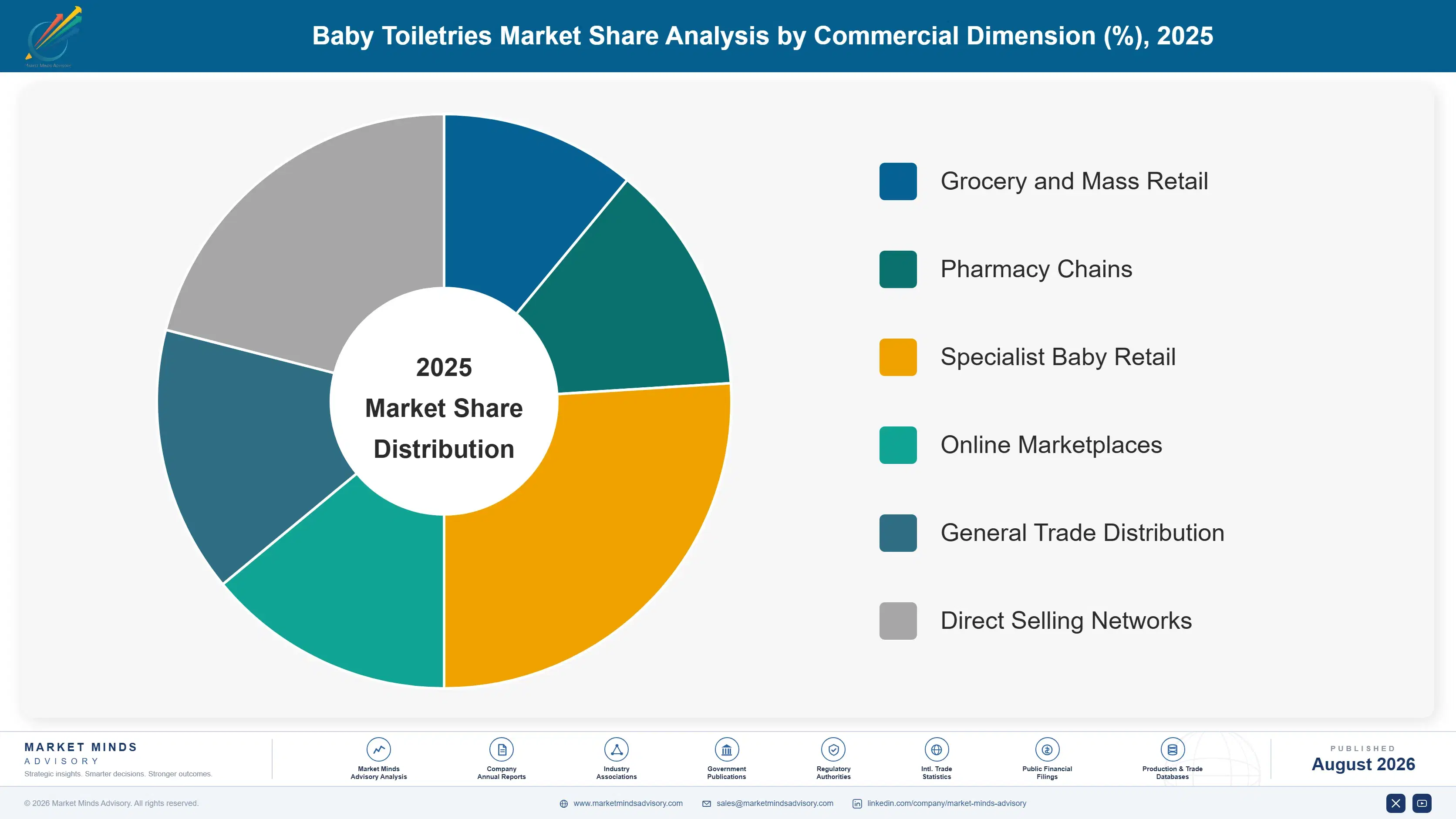
Segmentation follows product function, the dimension on which formulation constraint, recommendation channel and price point all operate together. Bath, wash and oil carry the volume at accessible prices and heavy repeat purchase. Barrier repair creams and fragrance-free ranges carry the growth, because one arrives with a clinical instruction and the other with a label-reading parent.
baby-toiletries-market-market-share-analysis-1788175849414

Barrier Repair and Eczema Management Creams

Barrier repair creams grow at 8.7%, half again the market rate of 5.8%, and the growth is clinical rather than commercial in origin. Around 19% of infants in developed markets are affected by atopic dermatitis, and paediatric dermatology guidance now recommends daily emollient application rather than treatment only during flares, which converts an occasional purchase into an instructed routine. The buyer behaves completely differently: pharmacy channel, ingredient questions rather than price comparison, and repurchase without deliberation. Unit prices run two to three times the general lotion tier on a formulation cost difference considerably smaller than that, and retention runs longer because the condition does not resolve at three years of age.
CAGR 8.7%

Fragrance-Free Minimal Ingredient Ranges

Fragrance-free and minimal ingredient formulations grow at 7.4% and account for 31% of volume, driven by parents who read an ingredient list before they read a brand name. Fragrance is the leading contact allergen in personal care and it is the first thing a label-reading parent looks for, which makes its removal a genuine formulation decision rather than a marketing one. Removing it also removes a masking agent, so every raw material odour becomes noticeable and the formulation work gets harder rather than easier. The commercial effect has been to erode the recognition advantage heritage brands held, because a short ingredient list is something a small entrant can offer immediately.
CAGR 7.4%
Full segment breakdown across 6 segments available in the complete report.

Regional Architecture and Country Demand Map

South Asia takes 24%, far above its usual band, because daily infant oil massage is an embedded household practice and the birth cohort is the largest anywhere. Western shares sit below band on small cohorts rather than on weak demand. Neither Western figure reflects weak demand.

South Asia and Pacific

This region takes 24%, far above the usual band, and the justification is a daily practice rather than a purchasing preference: infant oil massage is close to universal across Indian households and it happens every day rather than occasionally. That produces consumption frequencies Western markets never reach, on the largest birth cohort in the world. Indian growth at 7.8% is the fastest of any country covered and comes from branded product replacing loose and unbranded oil rather than from creating any new habit. Domestic manufacturers reached the accessible price points long before importers did, and they hold the resulting positions comfortably. No Western sizing model has ever captured that volume correctly.
Share: 24% | CAGR: 7.8% (2026 to 2036)

East Asia

Spend per child rather than the number of children explains this position, and the gap against Western markets is wider than most participants assume. Japanese and Korean households buy infant care at price points Western markets reach only in pharmacy, and Chinese premium demand followed the same pattern within a decade. Dermatological positioning is considerably more developed here than elsewhere, with barrier repair and sensitivity products occupying mainstream shelf rather than specialist channels. Falling birth numbers are the constraint that will eventually bite, and premium mix has offset it so far. The formulation and contract manufacturing base for infant care also sits in this region. That matters more than the demographic headline suggests.
Share: 25% | CAGR: 6.8% (2026 to 2036)
Regional intelligence for 5 additional markets available in the complete report: North America, Western Europe, Latin America, Middle East and Africa, Eastern Europe. Contact sales@marketmindsadvisory.com.
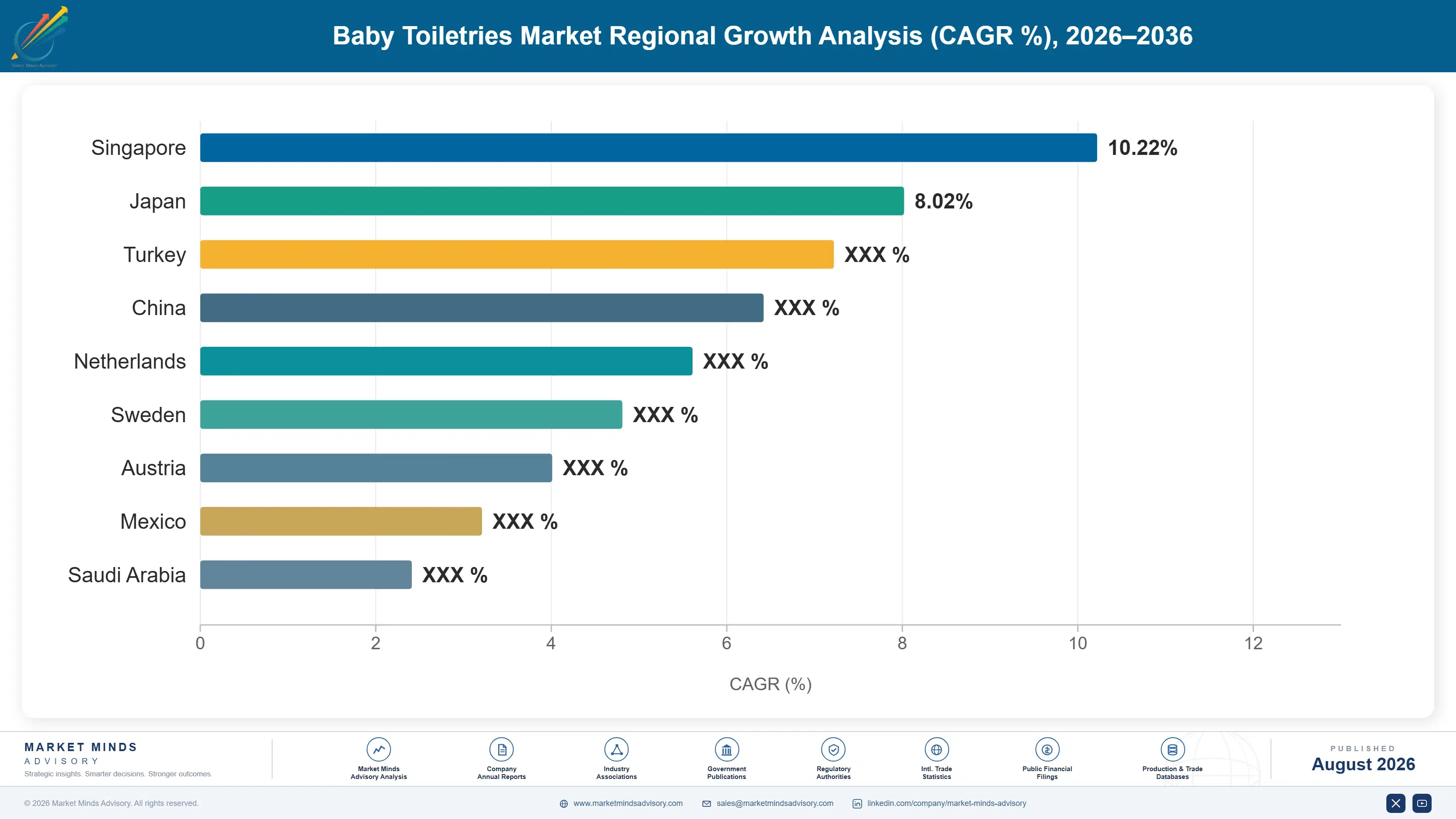
baby-toiletries-market-country-cagr-analysis-1788175849938

Four Moves The Category Missed

None of these four requires a new formulation, which is fortunate, because the permitted preservative list has narrowed and the formulation room available has narrowed with it. Each reaches somebody who already influences the purchase, or holds a household that this category has always let go far too early. Neither position is contested by anybody.

Build the paediatric dermatology relationship properly

A dermatologist recommending daily emollient use for an infant with atopic dermatitis moves more volume than a national campaign, and roughly 19% of infants in developed markets are affected. That recommendation reaches a parent at the exact moment a decision is being made, at no acquisition cost to anybody. Barrier repair creams already grow at 8.7% against a market rate of 5.8% because of it. Sample programmes and clinical education cost a fraction of retail marketing, and most participants in this category have no relationship with the profession at all.
Market Impact: Reaches the 19% of infants affected by eczema

Extend the range past the third birthday

Households leave this category at a median age of 3 because a separate infant range stops feeling necessary, and nothing in the formulation actually requires them to. A toddler and pre-school extension with the same mildness and different presentation holds the household several years longer at similar price points, and the development work is presentational rather than technical. Eczema management ranges hold longer still, because the condition does not resolve on a birthday. Almost nobody has built the extension properly, which leaves years of lifetime value entirely unclaimed. That is money left on the shelf.
Market Impact: Extends the household relationship beyond age 3 by years

Publish the preservative and allergen rationale

Parents now read ingredient lists before brand names, and fragrance-free formulations already hold 31% of volume for exactly that reason. A brand that publishes why each of its roughly 7 available preservative options was chosen, and what it excluded, converts a defensive list into a credibility position that competitors cannot copy without the same laboratory work behind them. It costs a communications decision rather than a reformulation. Heritage brands are unusually badly placed to do this, which is precisely why a challenger should. The laboratory work is what makes it defensible.
Market Impact: Explains all 7 available preservative choices openly to parents

Build for the South Asian daily practice

Infant oil massage happens every day across Indian households rather than occasionally, which produces consumption frequency no Western market approaches, on the largest birth cohort in the world. South Asia already takes 24% of category demand and Indian growth runs at 7.8%, the fastest of any country covered. The constraint is price rather than interest, and domestic manufacturers reached those points long ago. A Western participant designing deliberately for that price, rather than discounting a premium range toward it, reaches a genuinely enormous volume base. That base is not going to shrink.
Market Impact: Serves a 24% regional share growing at 7.8% annually

Who Controls the Margin Pool

CR5 stands at 41%, measured on retail unit shipment volume, since almost no participant discloses infant toiletries separately from wider personal care. That is high and the reason is generational: parents buy the brand they were themselves washed with, and maternity ward familiarity is a position that cannot be purchased at any price. The gap between the heritage names and the field below them has narrowed on ingredient credibility.
Competition runs on professional recommendation, ingredient credibility and formulation depth. Recommendation decides what a parent is told to buy at the moment they ask. Ingredient credibility decides what a label-reading parent selects without asking anybody. Formulation depth decides who absorbs the next preservative restriction and who discovers it through a supplier. Advertising decides considerably less than it did a decade ago.

Rankings will move on the segments where a professional rather than a brand makes the choice. A participant holding dermatological relationships and a barrier repair range competes for a recommendation rather than for shelf attention, and that recommendation carries no acquisition cost at all. Several specialist brands already sit there. The pressure comes from a profession rather than from competitors, which this category is poorly organised to answer.
baby-toiletries-market-company-positioning-matrix-1788175850465

Competitive Moat and Risk Dimensions

KENVUE

Moat: Maternity ward familiarity endures

Generational recognition built through decades of maternity presence gives the group a starting position with new parents that no campaign reproduces, because the first product a mother is handed carries disproportionate weight afterwards. That familiarity operates below conscious brand preference. Building an equivalent requires a generation of consistent presence rather than any amount of marketing spend.
KENVUE

Risk: Litigation and ingredient scrutiny concentrate

The most recognised name attracts both litigation and ingredient scrutiny first, as the talc withdrawal demonstrated at considerable cost, and a label-reading parent checks ownership as readily as composition. Defending a heritage portfolio against that scrutiny consumes resource a challenger never spends. Recognition and exposure turn out to be the same asset viewed from different directions.
DABUR INDIA

Moat: Daily practice rather than purchase

Infant oil massage is a daily household practice across India rather than an occasional purchase, and the group has supplied that practice through general trade for generations, which produces consumption frequency no Western brand position generates. Distribution reach across small format retail compounds it. Neither the practice nor the distribution is something a competitor acquires quickly at any price.
DABUR INDIA

Risk: Western dermatological positioning limited

Revenue concentration in South Asia leaves the group away from the dermatological channel driving growth in Western and East Asian markets, where clinical recommendation rather than tradition decides purchase. Building that position means competing on formulation evidence and professional relationships rather than on distribution reach. Traditional positioning translates poorly into a paediatric dermatology conversation.

Players Tracked

Prominent Players

Kenvue
Beiersdorf
Unilever
Dabur India
Pigeon Corporation

Other Key Players

Artsana Group
Laboratoires Expanscience
Sebapharma
Himalaya Wellness
Marico
Honasa Consumer
Galderma
Weleda
Kao Corporation
LION Corporation
Procter and Gamble
The Honest Company
Bubchen
Emami
Wipro Consumer Care

Recent Developments

FEBRUARY 2025

European preservative restrictions narrowed leave-on infant options

European restrictions tightened further on preservative systems permitted in leave-on cosmetic products, with infant formulations affected disproportionately because they already used the mildest options available. Manufacturers with internal formulation laboratories reformulated ahead of the date, while brands relying on contract formulators learned when a supplier presented a revised specification.
Signal: Formulation depth has quietly become the difference between reformulating early and being told about it later.
JUNE 2025

Paediatric guidance strengthened daily emollient recommendation

Updated paediatric dermatology guidance strengthened the recommendation for daily emollient application in infants with or at risk of atopic dermatitis, moving it from flare treatment toward routine maintenance. Pharmacy demand for barrier repair creams rose measurably within two quarters, entirely without any corresponding increase in manufacturer marketing activity.
Signal: A guidance update moved more volume in one quarter than the category's advertising did all year.
OCTOBER 2025

Dabur expanded infant oil manufacturing capacity in India

Dabur India brought additional infant oil and massage product capacity into operation, an organic capacity expansion rather than any acquisition or joint venture. The investment supports general trade distribution across smaller towns, where branded product is replacing unbranded oil in a daily practice rather than creating new demand.
Signal: The largest volume growth in this category comes from replacing unbranded product in an existing habit.

Emollients, Preservatives And Liability

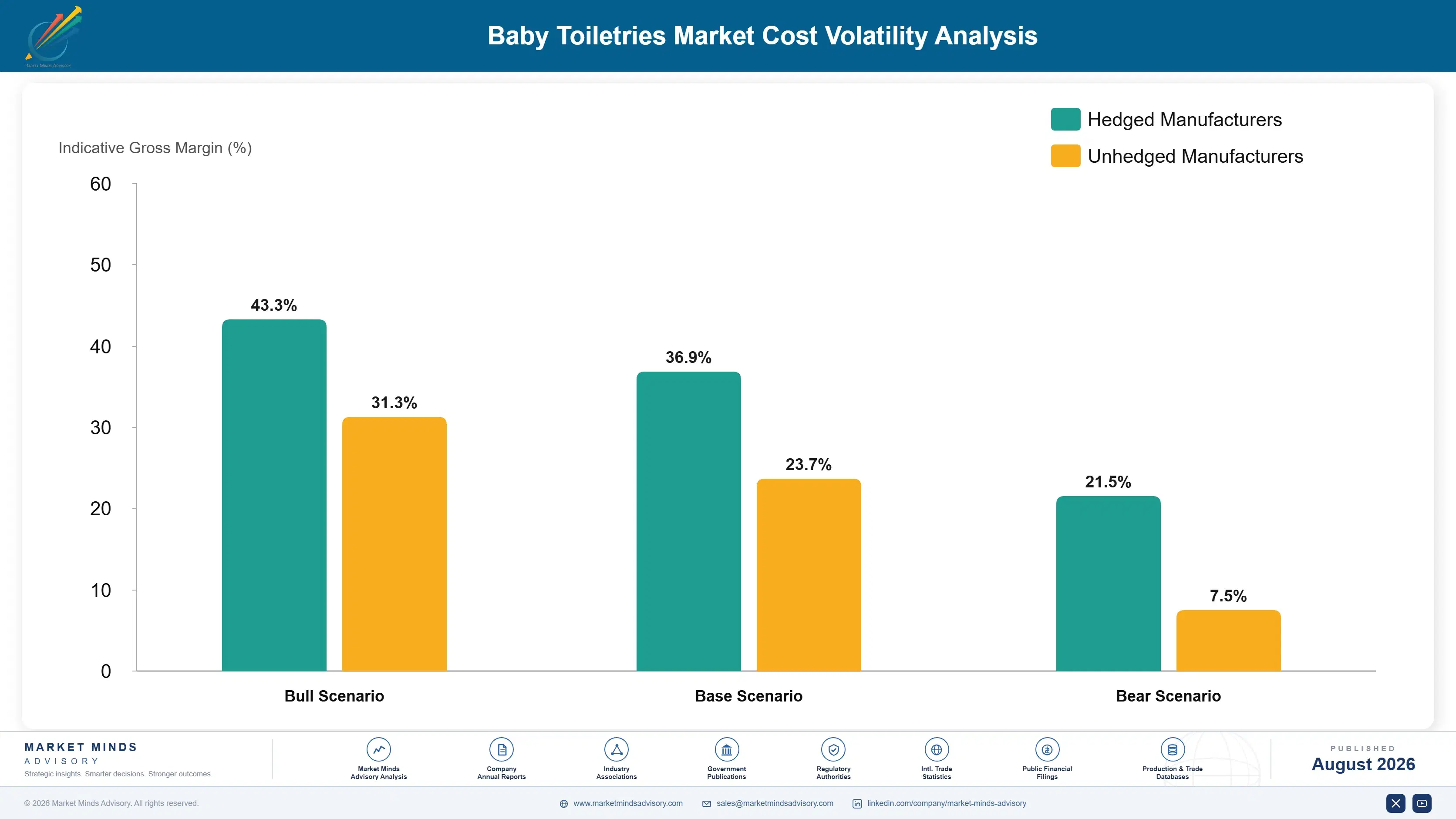
Emollient oils and esters account for roughly 28% of cost of goods, mild surfactant systems a further 16%, and packaging around 23%. Preservative systems cost little in material terms and a great deal in testing. Mineral oil derived emollients come from petrochemical supply while plant derived alternatives come from agricultural processors, which are two entirely different supply chains sitting inside one formulation.
Plant oil pricing gave this category its clearest recent lesson. Sunflower, coconut and shea inputs moved sharply through supply disruption and harvest variability across 2022 and 2023, and the USDA Foreign Agricultural Service tracked the resulting trade movement. Brands holding annual contracts came through with pricing intact. Spot buyers absorbed the move and several found their plant derived positioning had acquired a cost volatility the mineral alternative never carried.

The disadvantage falls on formulation capability rather than on scale or geography. A participant with an internal laboratory absorbs each preservative restriction by reformulating ahead of the date. A brand buying contract formulations learns of the change when a supplier presents a revised specification, and inherits both the cost and the stability testing that follows. Insurance and liability provisioning compound it for anybody selling into litigious markets.
baby-toiletries-market-cost-volatility-analysis-1788175850661

Contract plant oil supply on annual volume terms

Plant derived emollients carry the positioning advantage and the harvest exposure together, which is a trade most brands made without pricing it. Annual agreements with a processor cost a premium over spot in a soft market and remove a volatility the mineral alternative never had. Brands holding contracts through the last disruption kept both their pricing and their positioning intact.

Build internal preservative reformulation capability

The permitted list for leave-on infant products has narrowed to roughly seven workable systems and further restriction is likelier than reversal. A participant reformulating ahead of each change controls timing, cost and stability testing. A participant relying on contract formulators is told after the decision, and absorbs both the reformulation and the delay without any say in either.

Review ingredient liability exposure before a challenge

Talc left this category on litigation exposure rather than on a regulatory finding, which established that plausible association is enough to remove a product permanently. A standing ingredient risk review, run against emerging litigation rather than against current regulation, gives a participant time to reformulate on its own terms. Reacting after a filing is considerably more expensive than acting early.

Portfolio Architecture for Margin Defence

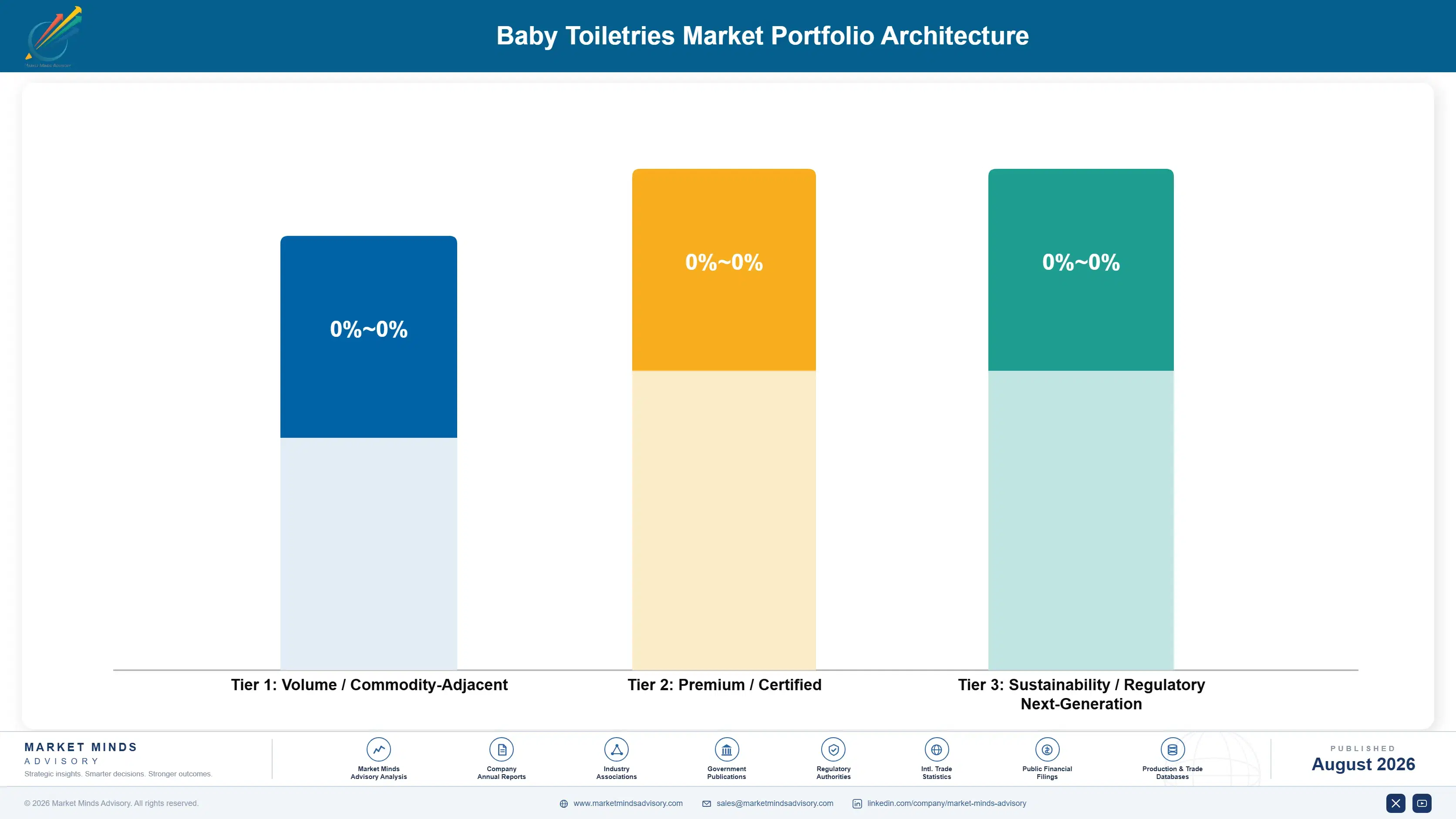
Margin here follows recommendation channel rather than formulation cost, which is not how the shelf is arranged. A barrier repair cream recommended by a dermatologist earns two to three times a general lotion at a formulation cost difference far smaller than that, because the buyer is following an instruction rather than comparing options. Participants costing by channel rather than by product run a completely different portfolio from the rest.
Volume and premium pull against each other through the maternity relationship rather than the factory. Bath, wash and oil carry the volume and the frequency that establish a brand in the household during the first months, and that establishment is what makes the dermatological and premium tiers reachable later. Dropping the volume tier saves margin and loses the relationship that everything else in the range depends on entirely.

High-value pools sit in barrier repair, in fragrance-free ranges and in the toddler extension almost nobody has built. The third is the largest and least contested: households leave at three for presentational reasons rather than formulation ones, and the years between three and six are unserved by anybody in this category. A brand holding the household through that period materially lengthens the relationship.

Volume / Commodity-Adjacent

Baby bath, wash, oil and general lotion sold through grocery, mass retail and general trade at accessible prices. Competes on price and shelf presence against own-label and near-identical branded product. The 9 point spread reflects whether manufacturing is held internally or contracted out.
Gross Margin: 32 to 41%

Premium / Certified

Fragrance-free, dermatologically tested and minimal ingredient ranges sold through pharmacy and specialist baby retail. Ingredient credibility rather than brand recognition supports the price and the repeat purchase. The 9 point spread reflects channel mix between pharmacy and grocery distribution routes.
Gross Margin: 46 to 55%

Sustainability / Regulatory / Next-Generation

Barrier repair and eczema management creams, toddler range extensions and formulation platforms supplied to other brands. Margins are high because clinical recommendation carries the sale and capability is scarce. The 14 point spread separates finished product from platform and development supply.
Gross Margin: 52 to 66%
baby-toiletries-market-portfolio-architecture-1788175851170

High-value Sub-segments and Strategic Watch-out

Barrier Repair and Eczema Creams

High value and high growth at 8.7%. A dermatologist's instruction rather than a brand decision drives the purchase, and the condition does not resolve when the child turns three. The 8 point spread reflects whether distribution runs through pharmacy or through specialist retail channels instead.
Gross Margin: 54 to 62%

Fragrance-Free Minimal Ingredient Ranges

High value with strong growth at 7.4% from 31% of volume. Parents read the ingredient list before the brand name, which erodes the recognition advantage heritage names once held. The 8 point spread reflects whether formulation is developed internally or simply bought in from elsewhere.
Gross Margin: 48 to 56%

Baby Bath, Wash and Oil

The volume core. It earns modestly but it establishes the brand in the household during the first months, which is what makes every premium tier above it reachable at all. The 9 point spread reflects whether production is owned outright or contracted to a third party.
Gross Margin: 30 to 39%

Powders and Talc Alternatives

The strategic watch-out. A category-defining product left major markets on litigation rather than regulation, and alternatives recovered only part of the volume at lower value. The 22 point spread reflects how much still sells still sells today in markets carrying no equivalent litigation exposure at all.
Gross Margin: 26 to 48%

Three Years And A Handover

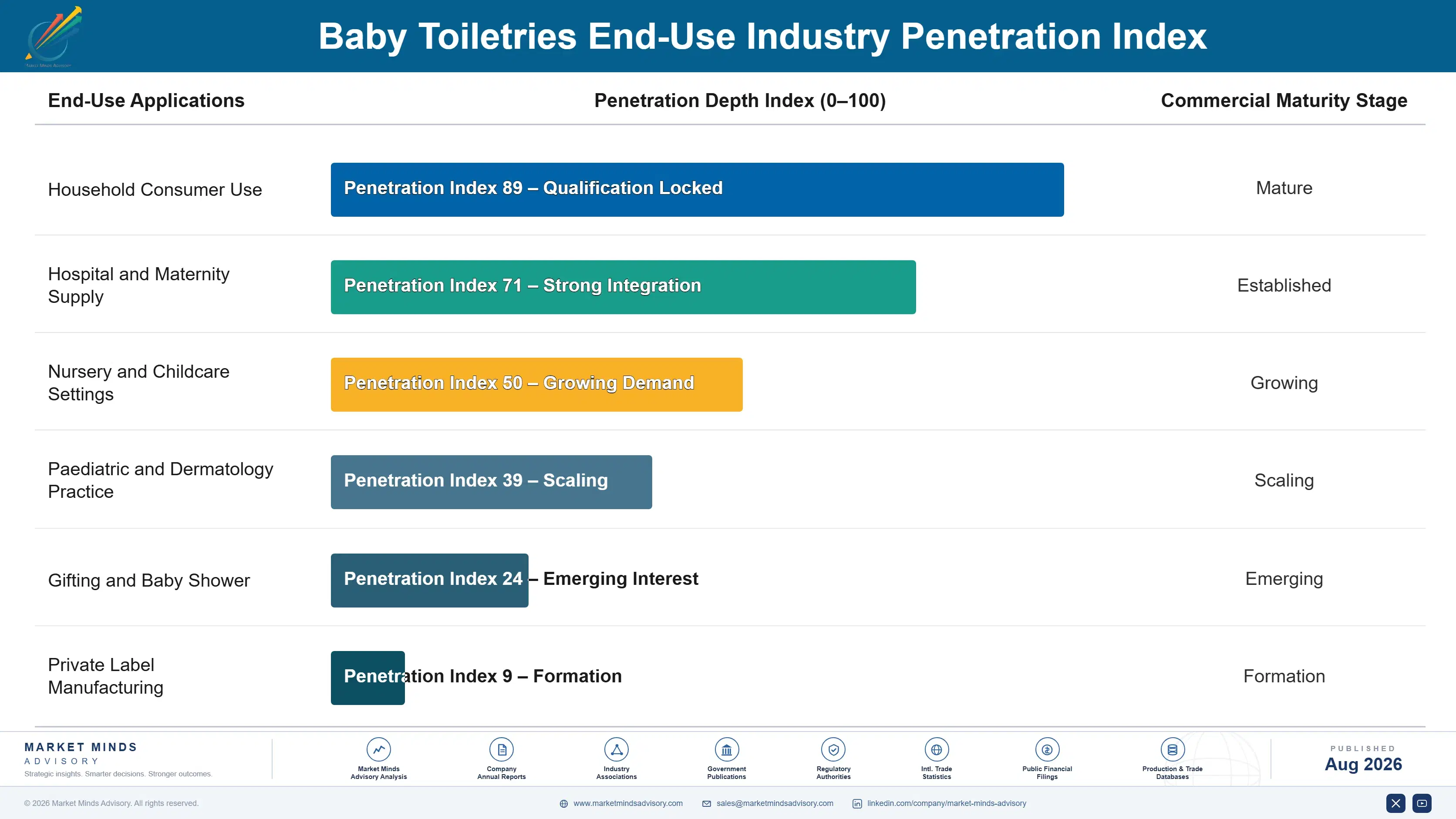
The annuity here is intense, predictable and short. A household buys bath, wash, lotion and oil weekly from the first days of a child's life until it moves onto family products at around three, which produces a dense revenue stream with a visible end date. Acquisition cost amortises comfortably inside that window, and almost every participant optimises the first purchase and ignores the last one entirely.
Stickiness inside the window is exceptionally high and mechanical rather than emotional. A parent who found something that did not irritate an infant's skin does not experiment again, because being wrong means a distressed baby rather than a wasted purchase. Eczema households are the stickiest of all, since a working emollient is not something anybody risks substituting. Nobody switches out of curiosity here at all.

Buyer profiles have shifted from trusting a brand toward reading a label, and heritage participants have been slow to adjust. The previous generation bought the name their own mother used. The current parent checks the ingredient list, searches the preservative, asks a dermatologist and only then considers the brand. A business built on recognition is competing on ground that has moved considerably since it was won.
baby-toiletries-market-end-use-penetration-index-1788175851656

Who Actually Decides Here

These are among the four positions where our research anticipates prominent divergence between winners and laggards over the coming forecast period. Each is grounded in the demand model, the regulatory perimeter, and the announced capacity pipeline.
01 / DERMATOLOGY CHANNEL ACCESS

Reach the profession that makes the recommendation

A paediatric dermatologist recommending daily emollient use moves more volume than a national campaign, and roughly 19% of infants in developed markets are affected by atopic dermatitis at some point. That recommendation reaches a parent at the exact moment the decision is being made and carries no acquisition cost whatever. Barrier repair creams already grow at 8.7% against a market rate of 5.8% because of it, and most participants in this category hold no relationship with the profession at all.
02 / TODDLER RANGE EXTENSION

Hold the household past the third birthday

Households leave this category at a median age of 3 because a separate infant range stops feeling necessary, and nothing about the formulation actually requires them to go anywhere. A toddler and pre-school extension with the same mildness and different presentation holds the household several years longer at comparable price points, and the work involved is presentational rather than technical. Almost nobody has built one properly, which leaves several years of lifetime value sitting there entirely unclaimed on the shelf today.
03 / FORMULATION DEPTH INVESTMENT

Own the reformulation before somebody hands it to you

The permitted preservative list for leave-on infant products has narrowed to roughly 7 workable systems, and further restriction is considerably likelier than any reversal of it. A participant with an internal laboratory reformulates ahead of each change and controls the timing, the cost and the stability testing that follows. A participant buying contract formulations is told after the decision and inherits all three of those things without having any say in a single one of them, which is an expensive place to sit.
04 / INGREDIENT LIABILITY REVIEW

Assess the exposure before a filing arrives

Talc left this category on litigation exposure rather than on any regulatory finding, which established that plausible association is enough to remove a product from major markets permanently. A standing ingredient risk review run against emerging litigation rather than against current regulation buys a participant time to reformulate on its own terms and its own timetable. Reacting after a filing costs considerably more than acting early, as the powder segment's growth rate of 3.0% now demonstrates plainly enough to everybody still selling it.

Engagement Snapshot From the Field

A live engagement with an industry participant carrying material or product regulatory and market exposure ahead of a defining policy shift, showing how our research translates into a defensible multi-year portfolio strategy.
MARKET MINDS ADVISORY · CLIENT ENGAGEMENT SUMMARY
Baby Toiletries Producer Strategic Portfolio Review and Transition Roadmap 2026·Investment Scenario on Baby Toiletries Exposure Evaluation 2025-26
CLIENT PROFILE
A European infant care manufacturer with bath, wash, lotion and oil ranges sold through grocery, pharmacy and specialist baby retail across fifteen countries, with annual revenue in the mid hundreds of millions of euros (client-reported, unverified by MMA). The range carried no barrier repair product and nothing formulated for children above about three years of age.
STRATEGIC CHALLENGE
Volume had declined for three consecutive years in line with falling birth numbers, and management had concluded the decline was demographic and therefore unaddressable. They wanted to know whether that was actually true, and whether anything in the range or the channel mix could offset a shrinking cohort rather than simply tracking it downward.
MMA APPROACH
MMA rebuilt four years of category volume by product function and by channel rather than by brand, separating grocery from pharmacy and infant from toddler demand across all fifteen markets. Forty-seven expert interviews with paediatric dermatologists, pharmacists, retail buyers and parents of toddlers established what was being recommended, what was being bought instead, and why.
KEY FINDINGS
  1. Pharmacy channel volume had grown across the period while the client's grocery volume fell, and the client held almost no pharmacy presence anywhere.
  2. Barrier repair creams were the only growing segment in every one of the fifteen markets, and the client had no product competing in it.
  3. Households left the client's range at a median age of two and a half, six months earlier than the category norm, on presentation rather than formulation.
  4. Not one of the paediatric dermatologists interviewed could name a product from the client's range, while all of them named two competitors immediately.
CLIENT PROFILE
A European infant care manufacturer with bath, wash, lotion and oil ranges sold through grocery, pharmacy and specialist baby retail across fifteen countries, with annual revenue in the mid hundreds of millions of euros (client-reported, unverified by MMA). The range carried no barrier repair product and nothing formulated for children above about three years of age.
STRATEGIC CHALLENGE
Volume had declined for three consecutive years in line with falling birth numbers, and management had concluded the decline was demographic and therefore unaddressable. They wanted to know whether that was actually true, and whether anything in the range or the channel mix could offset a shrinking cohort rather than simply tracking it downward.
MMA APPROACH
MMA rebuilt four years of category volume by product function and by channel rather than by brand, separating grocery from pharmacy and infant from toddler demand across all fifteen markets. Forty-seven expert interviews with paediatric dermatologists, pharmacists, retail buyers and parents of toddlers established what was being recommended, what was being bought instead, and why.
KEY FINDINGS
  1. Pharmacy channel volume had grown across the period while the client's grocery volume fell, and the client held almost no pharmacy presence anywhere.
  2. Barrier repair creams were the only growing segment in every one of the fifteen markets, and the client had no product competing in it.
  3. Households left the client's range at a median age of two and a half, six months earlier than the category norm, on presentation rather than formulation.
  4. Not one of the paediatric dermatologists interviewed could name a product from the client's range, while all of them named two competitors immediately.
RECOMMENDED STRATEGY
Phase 1: Phase one: develop a barrier repair cream and build direct paediatric dermatology relationships before any further retail marketing spend is committed. Phase 2: Phase two: extend the range with toddler and pre-school presentation, holding households several years past the point they currently leave. Phase 3: Phase three: rebalance distribution investment from grocery toward pharmacy, where the professional recommendation actually reaches the parent making the decision.
OUTCOME
Within six quarters the barrier repair range held pharmacy listings in nine markets and the toddler extension had moved the median exit age past three (client-reported, unverified by MMA). Total volume stopped declining for the first time in four years, against a birth cohort that continued falling throughout the period.

Frequently Asked Questions

Foundational context covering the market sizes, CAGR, scope, country, region and competition that inform every finding below. This section is provided to cover basics and most often pre-purchase conversations, answered from the MMA Primary Research Dataset.

What is the current size of the Baby Toiletries Market?

The global baby toiletries market was valued at USD 12.8 billion in 2025, covering cleansing, moisturising and skin protection products for infants and toddlers. The 2026 figure reaches USD 13.54 billion.

How large will the Baby Toiletries Market be by 2036?

MMA forecasts USD 23.79 billion by 2036, an increase of USD 10.25 billion over the 2026 base. That represents an expansion multiple of 1.76 times across the forecast period.

What is the CAGR for the Baby Toiletries Market 2026 to 2036?

The base case compound annual growth rate is 5.8%, with a bull case at 7.0% and a bear case at 4.6%. Historical growth between 2020 and 2025 ran at 4.8%.

Which segment is growing fastest?

Barrier repair and eczema management creams grow at 8.7%, half again the market rate of 5.8%, on paediatric dermatology recommendation rather than marketing. Fragrance-free ranges follow at 7.4%.

Who are the major companies in the Baby Toiletries Market?

Kenvue, Beiersdorf, Unilever, Dabur India and Pigeon Corporation lead on retail unit shipment volume, with combined CR5 of 41%. Concentration is high for a personal care category.

Which country is growing fastest?

India grows fastest at 7.8%, where daily infant oil massage is an embedded household practice and branded product is replacing unbranded oil. South Asia and Pacific leads regionally at 7.8%.

Report Segmentation Architecture

The full report scope spans multiple orthogonal segmentation dimensions, with cross-tabulated demand data provided for each dimension pair. Coverage extends further to regional breakdowns, trend trajectories, and the competitive detail needed to support segment-level decision-making.

By Product Function

  • Baby Bath and Wash
  • Baby Shampoo
  • Baby Lotions and Moisturisers
  • Baby Oils and Massage Products
  • Powders and Talc Alternatives
  • Barrier Repair and Eczema Management Creams

By End-Use Industry

  • Household Consumer Use
  • Hospital and Maternity Supply
  • Nursery and Childcare Settings
  • Paediatric and Dermatology Practice
  • Gifting and Baby Shower
  • Private Label Manufacturing

By Commercial Dimension

  • Grocery and Mass Retail
  • Pharmacy Chains
  • Specialist Baby Retail
  • Online Marketplaces
  • General Trade Distribution
  • Direct Selling Networks

By Region

  • North America
  • Western Europe
  • East Asia
  • South Asia and Pacific
  • Latin America
  • Middle East and Africa
  • Eastern Europe

Scope, Methodology, and Coverage

Every figure in this report is reproducible from documented input assumptions. The scope below maps the historical period, the forecast horizon, the segmentation dimensions, and the countries covered, alongside the underlying primary and qualitative methodology.
Historical Period
2020 to 2025
Forecast Period
2026 to 2036
Base Year
2025 (USD billions; MMA Primary Research Dataset, August 2026)
Market Definition
The baby toiletries market covers cleansing, moisturising and skin protection products formulated for infants and toddlers up to around three years, spanning baby bath and wash, baby shampoo, lotions and moisturisers, oils and massage products, powders and talc alternatives, and barrier repair and eczema management creams. Scope includes retailer own-label infant ranges. Excluded are diapers and absorbent hygiene products, wet wipes, oral care for children, sun care formulated for infants, prescription topical medicines, and general family products used on children.
Quantitative Units
USD billion, 2025 base year, 2026 to 2036 forecast period
Segmentation Dimensions
Product function, end-use setting, commercial channel, region
Regions Covered
North America, Western Europe, East Asia, South Asia and Pacific, Latin America, Middle East and Africa, Eastern Europe
Countries Covered
United States, Canada, Germany, France, United Kingdom, Italy, Spain, Poland, China, Japan, South Korea, India, Australia, Brazil, Mexico, Saudi Arabia, United Arab Emirates, South Africa
Key Companies Profiled
20 companies across personal care groups, dermatological specialists and regional manufacturers
Quantitative Methodology
Primary survey, n=3,800 respondents, Q4 2025, six countries; demand-side model with trade association cross-validation
Qualitative Methodology
47 expert interviews, Q4 2025; applied to validate demand model assumptions, identify emerging dynamics, and assess competitive positioning
Report Format
PDF and XLSX data workbook (Word format preview document)
Publisher
Market Minds Advisory
Report Code
MMA-2026-CHM-261
Published
August 2026
Contact
sales@marketmindsadvisory.com | www.marketmindsadvisory.com

Purchase the full Baby Toiletries Market Report (2026 to 2036).

The full MMA report on the baby toiletries market runs to detailed product and regional models across the 2026 to 2036 forecast period, with formulation cost benchmarks separated by emollient and preservative system. It profiles 20 companies on a consistent retail unit shipment basis, covering personal care groups, dermatological specialists and regional manufacturers. Preservative restriction status and ingredient liability exposure are mapped by market alongside the channels through which recommendation actually travels. Regional chapters cover the seven MMA regions with country-level detail on the eighteen markets surveyed. Primary research draws on a quantitative survey of 3,800 respondents across six countries and 47 expert interviews conducted in Q4 2025.
Formulation cost benchmarks by emollient and preservative system
Preservative restriction status mapped across regulated markets
Dermatological recommendation channel sizing by regional market
Twenty company profiles on consistent shipment volume basis
Category exit age analysis by brand and by market
Seven regional chapters with eighteen country detail tables

Built For The People Who Decide

From boardroom strategy to bench-side execution, this report is read cover-to-cover by leaders shaping the next decade of their industry, turning demand scenarios, market dynamics and valuation benchmarks into decisions.
CXOs/ Presidents/ VPs/ Managers
M&A and Corporate Development
Strategy Teams and R&D Heads
Procurement and Product Directors
Regulatory and Compliance Leaders
Investor Relations and Equity Analysts