Market Minds Advisory
Korea Baby Powder Market

Korea Baby Powder Market: Korea Baby Powder Market. Talc-Free Reformulation Redefines a Trust-Sensitive Category.

Talc-free cornstarch reformulation is increasingly winning parental trust away from legacy talc-based powders, pushing manufacturers toward safety-certification investment or ceding shelf space to reformulated challengers entering pharmacy and specialty baby-care retail channels.

Lead Analyst

Published

September 2026

Make Smarter Decisions with Customized Research Insights

Request a free sample report and evaluate market opportunities, growth trends, and competitive dynamics relevant to your business needs.

2025 MARKET VALUE$0.1BMarket Size 2025
2036 FORECAST VALUE$0.2BBase Case , 2026 to 2036
CAGR 2026 TO 20364.2 %Bull 5.4% / Bear 3.0%
INCREMENTAL OPPORTUNITY$0.1BNet 10- year value creation
EXPANSION MULTIPLE1.51x2036 value over 2026 base
Strategic Levers
M&A Pipeline
Regional Outlook
Country Rankings
Competitive Intelligence
Segmental Deep-dive
Call-Us : 91 93563 13602

Executive Snapshot and Market Trajectory.

Talc-free reformulation is converting a trust-sensitive commodity category into a safety-credentialed premium segment, as Korean parents increasingly scrutinize powder ingredient labels before purchase decisions rather than defaulting to legacy brand familiarity alone, particularly following widely publicized global talc safety litigation and recall news coverage across major media outlets.
South Korea's persistently low birth rate is paradoxically sustaining category value even as birth volumes decline year over year, since parents increasingly concentrate spending on fewer children with premium, safety-certified products purchased more frequently per child overall. With talc-free cornstarch powders expanding fastest, East Asian manufacturing and Korean brand leadership both concentrate the largest share of category value given the region's dermatological-testing infrastructure and export-oriented premium baby-care industry serving neighboring markets.
Competitive intensity is rising as Korean dermocosmetics manufacturers add clinical-testing credentials and fragrance-free formulations to defend premium pricing against new entrants across every major retail and pharmacy channel nationwide today. International brands entering the Korean market face heightened regulatory scrutiny following global talc safety litigation, pushing every manufacturer toward more rigorous ingredient disclosure ahead of anticipated stricter Korean cosmetic-safety standards taking effect within the next two years.
Market Definition
The Korea baby powder market covers talc-based and talc-free cornstarch powders formulated for infant and toddler skincare, sold through pharmacy, mass retail, and e-commerce channels within South Korea. It excludes adult body powders, diaper products, and baby lotions or creams not classified as powder.
Base Year Value
$0.1B in 2025 (MMA Primary Research Dataset, September 2026)
Forecast Period
2026 to 2036, eleven discrete annual values
CAGR
4.2% base case. Bull 5.4%. Bear 3.0%.
Fastest Growth Segment
Talc-Free Cornstarch-Based Baby Powder: 7.5% CAGR
Fastest Growth Country
South Korea: 6.0% CAGR
Fastest Growth Region
South Asia and Pacific: 6.3% CAGR
Largest Region
East Asia: 38% of 2025 global value
Market Leaders
Kenvue Inc, Pigeon Corporation, Green Finger Co Ltd, Yuhan-Kimberly Ltd, LG Household & Health Care Ltd. Source: MMA Analysis, company annual reports.
Primary Survey
n=3,800 procurement and R&D decision-makers, Q4 2025, six countries
Methodology
Demand-side build-up, cross-validated against public data, 47 expert interviews

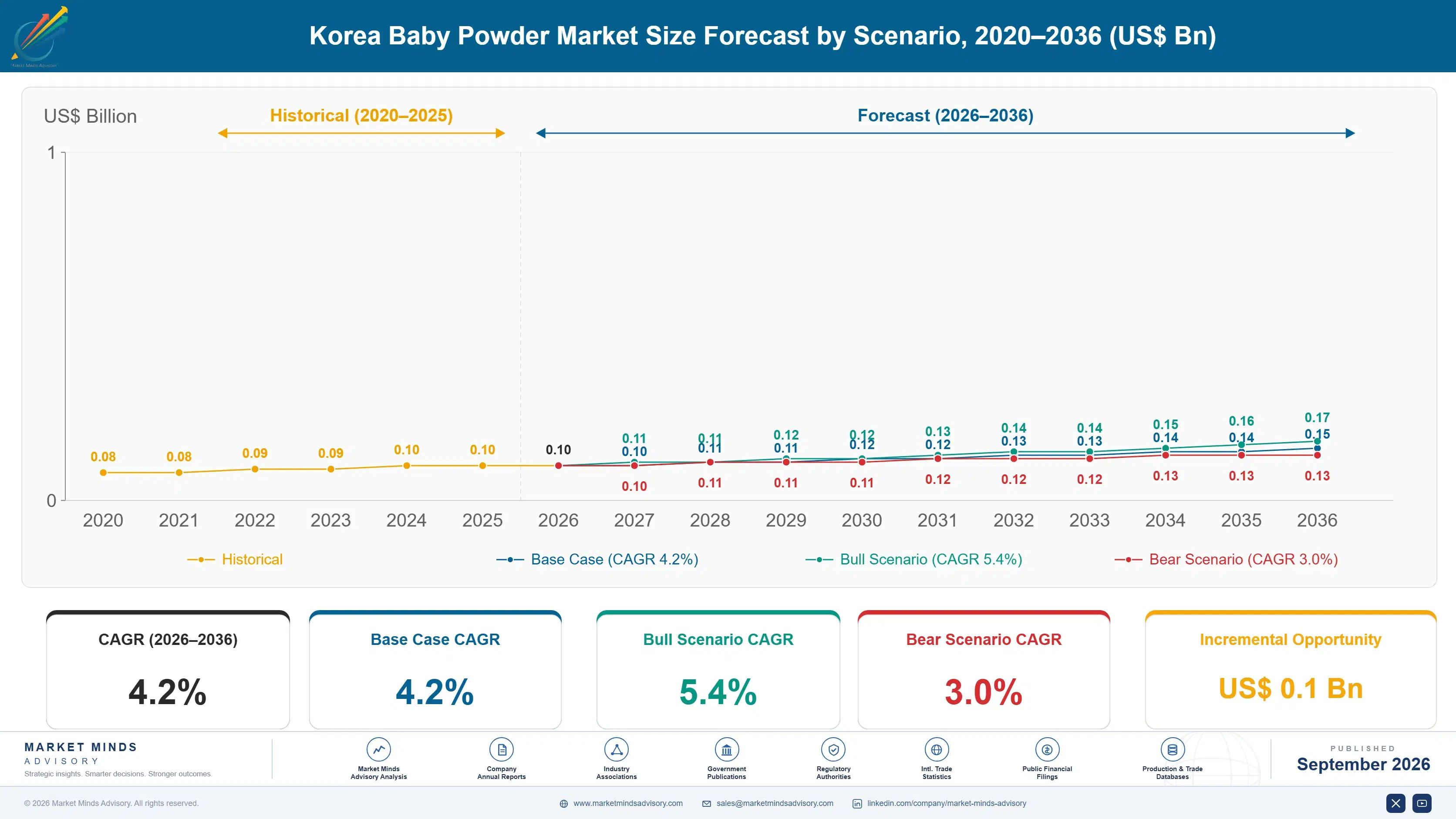
Korea Baby Powder Market Forecast Scenarios

baby-powder-industry-analysis-in-korea-size-forecast-scenario-1790023357642
Korea baby powder demand grew slowly from 2020 through 2025 as declining birth rates offset premiumization gains, with talc safety concerns beginning to accelerate reformulation toward cornstarch alternatives quite late in the historical period. Established manufacturers reformulated cautiously, while newer dermocosmetics entrants captured early adopter attention among safety-conscious parents throughout most of the tracked period.
The base case assumes continued premiumization per child, sustained talc-free reformulation momentum, and gradual replacement of legacy talc-based products through 2036 despite ongoing birth-rate decline across the country overall. Three mechanisms anchor this trajectory: safety certification driving premium price points among trust-conscious parents willing to pay more, Korean dermocosmetics export success sustaining category visibility abroad, and regulatory tightening accelerating replacement of older talc-based formulations across the installed retail base nationwide.
A bull scenario assumes talc-free reformulation becomes universal faster than expected, lifting category-wide premiumization well above trend as safety-certified products command meaningfully higher price points broadly across every retail and pharmacy channel available nationwide. A bear scenario assumes birth-rate decline accelerates further than currently projected, pushing overall category volume down faster than premiumization can offset across the installed consumer base.

Safety Credentials Redraw Baby Powder Economics

Korea baby powder economics increasingly hinge on safety-certification credentials rather than brand heritage alone, since talc safety litigation abroad has made Korean parents unusually attentive to ingredient sourcing and independent testing documentation before making a final purchase decision. Manufacturers unable to demonstrate rigorous cornstarch-alternative formulation increasingly lose shelf space to dermocosmetics challengers regardless of prior brand recognition or market tenure.
MARKET CONCENTRATION48%Combined revenue share held by top five manufacturers overall
AVERAGE UNIT PRICE8,500 wonTypical retail price for a standard powder container
TALC-FREE PRODUCT SHARE56%Portion of total category revenue from cornstarch-based formulations
ANNUAL BIRTH RATE DECLINE3.1%Yearly contraction in the core infant population base
AVERAGE PURCHASE FREQUENCY6xTypical annual repurchase rate per household with infants
PHARMACY CHANNEL SHARE34%Portion of category revenue sold through pharmacy retail
Commercial character skews toward premium positioning despite the category's commodity origins, since safety-conscious Korean parents facing declining family sizes concentrate spending on fewer children rather than economizing on per-unit price at all costs. This dynamic supports meaningfully healthier margins than category volume trends alone would suggest, reversing the typical relationship between shrinking addressable population and category economics that most other consumer categories experience during demographic contraction.
Over the next decade, expect continued consolidation around dermatologically tested, talc-free formulations, alongside gradual export expansion as Korean baby-care brands use domestic safety credentials to enter neighboring East Asian markets increasingly skeptical of legacy talc-based imports from less-regulated producers elsewhere in the region. Manufacturers without independent testing documentation risk losing shelf space entirely as retailers tighten sourcing requirements further.
"In Korea, a baby powder brand's clinical-testing report has become more persuasive than fifty years of shelf presence. Trust is the actual product now, the powder is almost secondary."
Practice Lead, Personal Care and Infant Products Practice · MMA Chemicals and Materials Practice · September 2026

Market Trends

Cornstarch Reformulation Becomes the Category Default Standard

Manufacturers across the Korean market are reformulating legacy talc-based powders into cornstarch alternatives at a pace considerably faster than regulators actually require, treating reformulation as a competitive necessity rather than a simple compliance exercise handled reluctantly and slowly. Retailers increasingly favor talc-free products in prominent shelf placement, further accelerating manufacturer reformulation timelines well beyond what regulatory deadlines alone would demand. Several major brands have completed full portfolio reformulation years ahead of any mandatory transition period, positioning themselves as safety leaders ahead of slower-moving competitors still selling legacy talc formulations nationwide.
Market Impact: Lifts per-child spending by 22%
Dermatological Certification Becomes a Purchase Prerequisite

Korean parents increasingly treat independent dermatological testing certification as a baseline purchase requirement rather than a nice-to-have credential, reflecting broader consumer skepticism toward unverified safety claims following global talc litigation coverage across major news outlets and social platforms nationwide today. Manufacturers without certification face meaningfully reduced retail listing opportunities, since major pharmacy chains now require documented testing before granting shelf space to new products entering the market at all these days. This certification requirement has become a genuine barrier to entry for smaller manufacturers lacking resources for formal clinical testing programs.
Market Impact: Accelerates reformulation timelines by 14 months

Market Opportunities and Growth Drivers

Per-Child Spending Intensification Offsets Birth Rate Decline

South Korea's persistently low birth rate has paradoxically intensified per-child spending, as parents with fewer children redirect discretionary income toward premium, safety-certified products they might previously have economized on when raising multiple children simultaneously. This concentration effect has proven strong enough to offset volume decline in dollar terms across most premium product categories, not just baby powder specifically. Manufacturers report that average basket value per infant has risen meaningfully even as total infant population continues contracting, a dynamic distinct from most other demographically sensitive consumer categories facing similar population trends.
Market Impact: Reduces addressable population by 3.1% yearly

Government Safety Regulation Accelerates Reformulation Timelines

Korean regulatory authorities have tightened cosmetic-safety testing and labeling requirements for infant products significantly over the past several years, pushing manufacturers toward considerably accelerated reformulation timelines that exceed what pure market pressure alone would ever achieve. These regulatory changes align closely with broader consumer sentiment already favoring talc-free alternatives, creating reinforcing pressure from both regulatory and commercial directions simultaneously across the industry. Manufacturers investing early in compliance report smoother retail listing processes than competitors scrambling to meet deadlines reactively, turning regulatory compliance into genuine competitive advantage for well-prepared market participants.
Market Impact: Displaces 9% of category volume

Market Restraints and Challenges

Declining Birth Rate Mechanically Shrinks Addressable Population

South Korea's birth rate ranks among the lowest globally and continues declining year over year, mechanically shrinking the core infant population that drives category volume regardless of premiumization trends occurring simultaneously across every product tier tracked. The root cause is deep-seated demographic and economic pressures well beyond any single manufacturer's control, which companies are addressing through export expansion and premiumization strategies that increase revenue per remaining infant. Even with these mitigation approaches, category volume growth faces a persistent headwind that premium pricing alone cannot fully offset over the coming decade.
Market Impact: Lifts talc-free share to 56%

Global Talc Litigation Creates a Category-Wide Trust Deficit

Ongoing talc safety litigation in international markets continues generating negative media coverage that affects Korean consumer perception of the entire baby powder category, including reformulated talc-free products that share no actual safety concern with legacy formulations at all today. The root cause is consumer difficulty distinguishing between legacy talc formulations and modern cornstarch alternatives, which manufacturers are addressing through prominent ingredient labeling and educational marketing campaigns across retail channels. Even with these efforts, some parents avoid the powder category entirely in favor of alternative products, regardless of actual formulation safety.
Market Impact: Excludes 18% of unlisted products
4 additional market trends, 3 additional growth drivers, and 2 additional restraints and challenges are covered in the full report. Contact sales@marketmindsadvisory.com to access the complete intelligence.

Segment CAGR and Growth Architecture

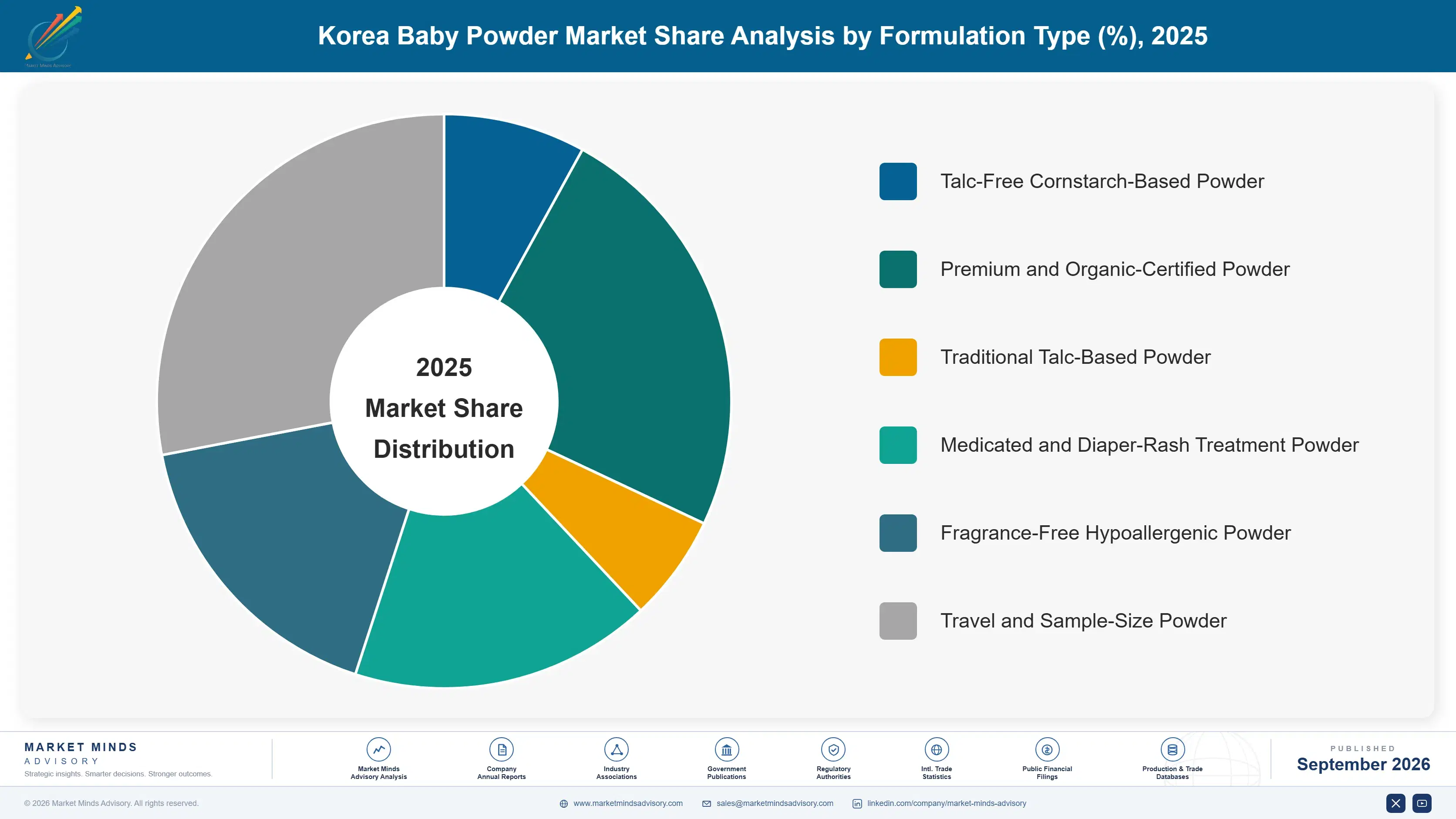
Segmentation follows formulation type, since ingredient composition drives safety perception, price positioning, and regulatory scrutiny more consistently than packaging format or brand alone across a category increasingly defined by trust rather than fragrance or texture. This formulation-first lens also matches how retailers organize shelf placement decisions and marketing campaigns across every retail channel nationwide.
baby-powder-industry-analysis-in-korea-market-share-analysis-1790023358218

Talc-Free Cornstarch-Based Baby Powder

Talc-free cornstarch-based powders are the fastest-growing segment, having moved from niche alternative to category default as safety concerns following international talc litigation reshaped Korean parental purchasing behavior across nearly every income bracket and age group nationwide and abroad in recent years and decades alike. This segment commands increasing shelf space at major pharmacy and mass retail chains, with several major manufacturers discontinuing legacy talc formulations entirely rather than maintaining dual product lines side by side for years. Independent dermatological testing certification has become nearly universal within this segment, reinforcing the safety positioning that justifies its premium price point relative to the shrinking talc-based alternative still sold at deep discount today.
CAGR 7.5%

Premium and Organic-Certified Baby Powder

Premium and organic-certified powders remain the second-fastest-growing segment, combining talc-free formulation with additional certifications including organic sourcing and fragrance-free composition that appeal to increasingly discerning Korean parents raising fewer children overall than previous generations did decades ago under considerably different economic conditions and consumer expectations broadly across the entire country. This segment commands the highest average selling price of any category tracked, reflecting both ingredient sourcing costs and the certification infrastructure required to substantiate premium claims credibly to skeptical buyers. Growth here concentrates disproportionately among first-time parents researching extensively before purchase, a demographic that social media and parenting forums have made considerably more informed than previous generations of Korean consumers.
CAGR 6.0%
Full segment breakdown across 6 segments available in the complete report.

Regional Architecture and Country Demand Map

East Asia leads given South Korea's category origin and dermatological-testing infrastructure, while North America and Western Europe trail as talc litigation there has shifted spending toward different premium safety categories entirely across most consumer segments and income levels tracked closely throughout this entire comprehensive report.

East Asia

East Asia holds the largest regional share because South Korea anchors both the category's manufacturing base and its most safety-conscious consumer population, with Korean dermocosmetics brands setting reformulation standards that regional competitors increasingly follow across neighboring markets and export destinations alike each year. Japanese and Chinese consumers show growing interest in Korean baby-care imports specifically, drawn by the country's reputation for rigorous ingredient testing and cosmetic-safety regulation enforced consistently across every product category and price tier available. This concentration reflects genuine category leadership and export success rather than any artificial modeling choice, and Korean manufacturers continue expanding regional distribution partnerships to capture growing demand from neighboring markets seeking comparable safety credentials.
Share: 38% | CAGR: 5.3% (2026 to 2036)

North America

North America's baby powder market has shrunk considerably following talc safety litigation that dominated headlines for years across major news outlets and social media platforms alike throughout the country and beyond, pushing many parents toward alternative products entirely rather than simply switching formulations within the powder category itself across every price tier. Korean brands entering North America face an unusually skeptical consumer base already fatigued by powder-category safety controversy, limiting the import opportunity that exists in less litigation-affected regions elsewhere around the world today. Growth here tracks category rehabilitation efforts more than general population trends, since rebuilding trust in the format itself matters more than any single brand's reformulation credentials.
Share: 22% | CAGR: 3.6% (2026 to 2036)
Regional intelligence for 5 additional markets available in the complete report: Western Europe, South Asia and Pacific, Latin America, Middle East and Africa, Eastern Europe. Contact sales@marketmindsadvisory.com.
baby-powder-industry-analysis-in-korea-country-cagr-analysis-1790023358743

Where Baby-Care Brands Can Expand Margin

Margin expansion in Korea baby powder depends heavily on capturing per-child spending concentration rather than chasing shrinking birth volumes, since safety-certified premium products increasingly justify prices that legacy talc formulations never approached in this trust-sensitive category. Brands capturing this dynamic early build durable pricing power that commodity followers cannot easily match going forward each year.

Bundling Companion Skincare and Treatment Products

Manufacturers are pairing baby powder with companion skincare products including diaper-rash treatments and moisturizing lotions, converting a single-purchase transaction into a multi-product basket that captures considerably more revenue per shopping trip and visit. This bundling approach costs manufacturers relatively little in incremental development expense since formulation expertise transfers reasonably well across adjacent product categories, while bundled purchases generate meaningfully higher basket value than standalone powder sales alone. Early data from brands running bundled skincare promotions shows roughly 24% of powder buyers add at least one companion product to their basket.
Market Impact: Lifts average basket value by roughly 20% overall

Expanding Export Distribution Into Southeast Asia

Korean brands establishing formal export distribution partnerships in Vietnam, Thailand, and the Philippines capture K-beauty-driven demand more efficiently than relying on informal parallel-import channels that currently dominate roughly 28% of regional sales volume across the wider area and beyond its current borders. This lever requires meaningful investment in local distribution relationships and regulatory registration, but delivers considerably higher margin than domestic sales once export infrastructure matures across multiple countries. Brands with established export programs report meaningfully faster revenue growth in Southeast Asian markets than competitors relying purely on organic cross-border e-commerce demand.
Market Impact: Expands export revenue by roughly 28% each year

Securing Pharmacy-Exclusive Certification and Distribution Deals

Manufacturers securing pharmacy-exclusive distribution agreements capture credibility that mass-retail placement cannot replicate, supporting premium pricing that price-comparison-driven online shoppers would otherwise resist entirely without medical channel validation from trusted licensed pharmacists nationwide and well beyond their normal local coverage area entirely. This channel strategy requires clinical documentation investment and pharmacist relationship development, but generates trust signals that lift direct-to-consumer sales by roughly 17% alongside pharmacy revenue itself considerably. Brands with pharmacy-exclusive lines report meaningfully higher conversion rates when consumers encounter the product through pharmacist recommendation rather than shelf browsing alone.
Market Impact: Lifts overall conversion rate by roughly 17% today

Building New Subscription-Based Product Replenishment Offerings

Manufacturers introducing subscription-based replenishment programs convert one-time purchases into recurring revenue relationships, capturing customer lifetime value that single-transaction retail sales cannot achieve on their own merits at all today or ever again. This lever requires meaningful investment in logistics and subscriber-management infrastructure, but reduces customer-acquisition cost by roughly 16% per unit sold once subscriber bases reach sufficient scale to justify the fixed program costs. Brands running subscription programs report meaningfully lower churn than one-time purchasers, since the convenience factor itself becomes a switching-cost barrier for busy parents managing infant care.
Market Impact: Reduces acquisition cost by roughly 16% each cycle

Who Controls the Margin Pool

The top five Korea baby powder manufacturers hold a combined 48% of category revenue, evaluated on a revenue basis, reflecting meaningful consolidation around established dermocosmetics and consumer-goods brands nationwide. Kenvue and Yuhan-Kimberly command the clearest leadership positions given their international scale and domestic distribution infrastructure respectively, while Korean specialty brands like Green Finger compete on safety-certification credentials that larger multinationals sometimes struggle to match.
Current competitive activity concentrates on three fronts: completing talc-free reformulation across entire product portfolios nationwide and abroad, securing dermatological certification credentials ahead of regulatory deadlines, and expanding export distribution into Southeast Asian markets increasingly influenced by K-beauty demand. Manufacturers lacking resources to compete on all three fronts simultaneously increasingly specialize by price tier or distribution channel rather than compete broadly.

Rankings are most likely to shift among mid-tier domestic brands rather than at the very top, as Korean dermocosmetics specialists expand certification credentials faster than multinational competitors can match through organic product development efforts alone. Manufacturers investing early in export infrastructure are positioning to capture share from slower-moving domestic-focused rivals still reliant purely on the shrinking local birth cohort for volume.
baby-powder-industry-analysis-in-korea-company-positioning-matrix-1790023359270

Competitive Moat and Risk Dimensions

KENVUE INC

Moat: Global Scale and Trust

Kenvue's global manufacturing scale and decades of Johnson's Baby brand recognition give it distribution reach and consumer familiarity that domestic Korean brands cannot easily replicate quickly. Its resources for clinical testing and reformulation investment exceed what most local competitors can independently fund on their own.
KENVUE INC

Risk: Carries Legacy Litigation Baggage

Kenvue's global brand association with the original talc safety litigation creates trust rebuilding challenges that newer Korean dermocosmetics entrants simply do not carry at all. Korean parents specifically aware of international litigation history may default to domestic brands lacking that reputational history entirely, favoring newer entrants instead.
YUHAN-KIMBERLY LTD

Moat: Deep Domestic Distribution Network

Yuhan-Kimberly's decades-long domestic distribution relationships across Korean pharmacy and mass retail channels give it shelf presence competitors struggle to match at comparable marketing spend levels. Its established local manufacturing also insulates it from import tariff and logistics cost exposure that affects foreign competitors entering the market.
YUHAN-KIMBERLY LTD

Risk: Limited International Export Presence

Yuhan-Kimberly's brand recognition and distribution strength remain concentrated almost entirely within Korea, leaving it underexposed to the Southeast Asian export opportunity that K-beauty-influenced competitors increasingly capture across the wider region. Building international distribution capability from a domestic-only base takes considerably longer than defending existing home-market share alone.

Players Tracked

Prominent Players

Kenvue Inc
Pigeon Corporation
Green Finger Co Ltd
Yuhan-Kimberly Ltd
LG Household & Health Care Ltd

Other Key Players

Amorepacific Corporation
Aekyung Industrial Co Ltd
Kao Corporation
Unicharm Corporation
Johnson & Johnson Consumer Inc
Chicco (Artsana Group)
Burt's Bees Baby (Clorox)
Sebamed (Sebapharma GmbH)
Cetaphil Baby (Galderma)
Mustela (Expanscience Laboratories)
Weleda AG
California Baby Inc
Earth Mama Organics
Babo Botanicals
Attitude Living Inc

Recent Developments

FEBRUARY 2026

Green Finger Launches Dermatologist-Certified Cornstarch Powder Line

Green Finger introduced a new dermatologist-certified cornstarch powder line extending its safety-first positioning to compete more directly with multinational brands entering the domestic Korean market. The launch includes independent clinical testing documentation, responding to rising consumer demand for verified safety credentials ahead of anticipated regulatory tightening.
Signal: Confirms domestic Korean specialty brands are increasingly matching multinational clinical-testing standards closely, thoroughly, and quite consistently.
SEPTEMBER 2025

Yuhan-Kimberly Signs Export Distribution Agreement With Vietnamese Retailer

Yuhan-Kimberly entered a multi-year distribution agreement with a major Vietnamese retail chain, expanding its Korean baby-care product line into Southeast Asian markets for the first time in company history. The agreement was structured as a supply and distribution arrangement rather than an acquisition, extending Yuhan-Kimberly's export footprint significantly.
Signal: Confirms Korean baby-care manufacturers are actively pursuing Southeast Asian export opportunities quite aggressively and consistently right now.
JANUARY 2026

Kenvue Completes Full Portfolio Talc-Free Reformulation in Korea

Kenvue announced completion of full talc-free reformulation across its entire Korean baby powder product line, well ahead of anticipated regulatory deadlines set by domestic authorities. The reformulation included updated dermatological testing certification for every single product variant sold domestically within the broader Korean market nationwide.
Signal: Signals multinational manufacturers are prioritizing Korean market reformulation ahead of most other global regions and markets.

Managing Cornstarch and Testing Cost Exposure

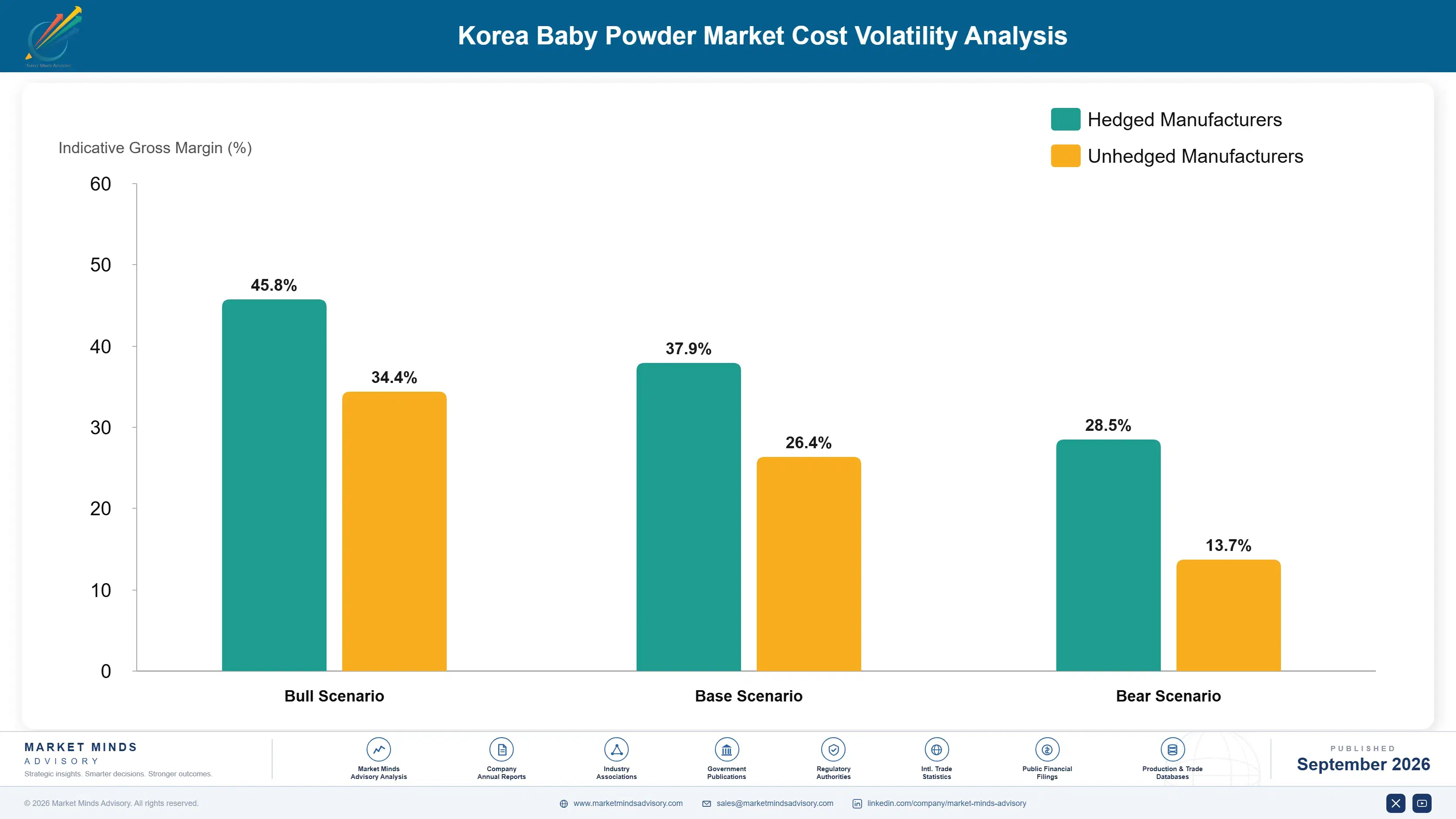
Cornstarch and specialty packaging materials together with clinical-testing and certification expenses represent roughly 46% of cost of goods sold for premium talc-free manufacturers, with legacy talc-based producers weighted more heavily toward mineral extraction and processing instead. Cornstarch sources primarily from domestic and Southeast Asian agricultural suppliers, while dermatological testing services concentrate among a small number of accredited Korean clinical laboratories.
Cornstarch prices rose meaningfully through 2025 as agricultural commodity costs climbed alongside broader food-price inflation, a pattern documented in USDA commodity market reporting on corn and starch derivative pricing trends across major producing regions. Manufacturers without forward-purchasing agreements saw input costs rise faster than they could pass through to retail pricing, compressing margins across several consecutive quarters before renegotiated contracts with agricultural suppliers could take effect.

Smaller domestic manufacturers carry disproportionate exposure because they lack the purchasing volume to negotiate forward contracts that scale players like Kenvue routinely secure from suppliers. This gap widens further as clinical-testing requirements add fixed certification costs that fall disproportionately on smaller production volumes, leaving undercapitalized manufacturers at a lasting cost disadvantage versus vertically integrated competitors sourcing at scale nationwide.
baby-powder-industry-analysis-in-korea-cost-volatility-analysis-1790023359468

Forward Contracting on Cornstarch Purchases

Manufacturers increasingly lock in cornstarch pricing through annual forward contracts with agricultural suppliers, trading some pricing flexibility for cost certainty across product planning cycles spanning multiple product lines and price tiers offered. This approach shields margin during volatile quarters but requires working capital commitments that smaller manufacturers often struggle to sustain without external financing.

Sharing Clinical Testing Costs Across Product Lines

Manufacturers are consolidating dermatological testing across multiple product variants simultaneously rather than certifying each item separately, spreading fixed certification costs across a considerably broader revenue base than single-product testing would ever allow on its own quite limited merit. This approach reduces per-unit testing expense but requires coordinated product development timing across an entire portfolio.

Portfolio Architecture for Margin Defence

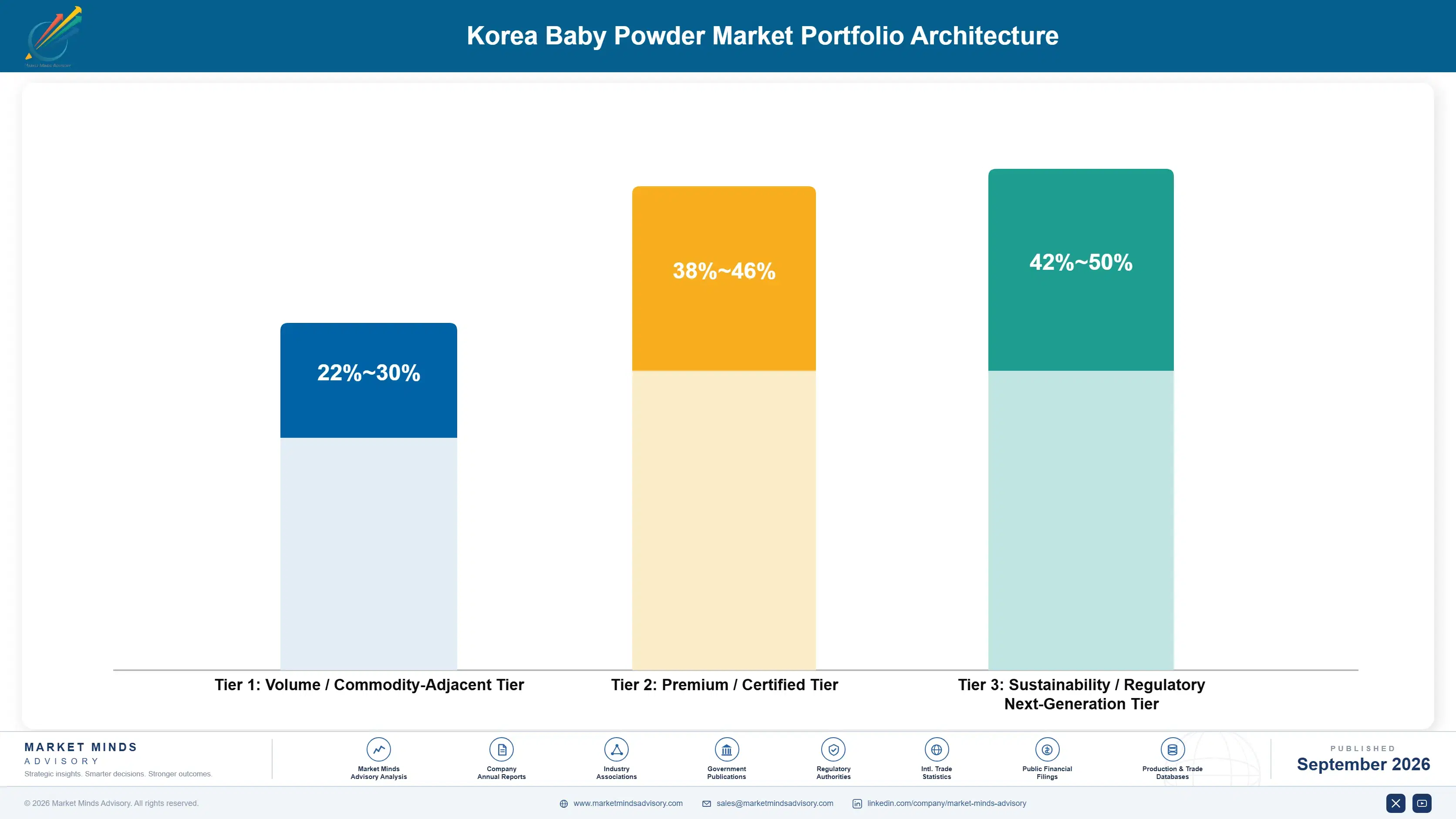
Korea baby powder portfolios organize into three tiers separated primarily by formulation safety credentials and certification depth rather than by brand alone or price point. Volume-tier products use basic talc-free cornstarch formulations with minimal additional certification, while premium and next-generation tiers use organic sourcing and clinical dermatological testing that command meaningfully better margins per unit sold across every retail channel.
Tension between volume and premium tiers centers on certification investment allocation, since clinical testing and organic sourcing add fixed costs that smaller manufacturers struggle to absorb across low sales volumes and a steadily shrinking overall addressable demand base. Manufacturers increasingly weight new capital toward premium certification credentials, even as volume-tier talc-free products still generate meaningful unit sales among price-sensitive parents across the broader retail landscape.

High-value margin pools concentrate in the premium and next-generation tiers, where dermatologist-validated organic formulations command substantially higher prices than basic talc-free alternatives sold at mass retail. Volume tier remains a meaningful revenue contributor by unit count but carries considerably thinner margins, making tier mix increasingly central to manufacturer profitability as the shrinking birth cohort intensifies competition for each remaining customer nationwide.

Volume / Commodity-Adjacent Tier

Basic talc-free cornstarch formulations with minimal additional certification beyond the regulatory baseline, targeting price-sensitive parents who prioritize affordability and safety compliance over premium ingredient sourcing or extensive clinical claims and marketing.
Gross Margin: 22%-30%

Premium / Certified Tier

Dermatologically tested, fragrance-free formulations with documented clinical validation and independent laboratory backing, targeting buyers seeking measurable safety assurance beyond basic talc-free reformulation alone at standard mass retail outlets and pharmacy chains nationwide.
Gross Margin: 38%-46%

Sustainability / Regulatory / Next-Generation Tier

Organic-certified, dermatologist-validated formulations meeting the strictest emerging Korean cosmetic-safety standards, targeting affluent parents and export-oriented retail channels seeking the highest available credentials and internationally recognized certification standards abroad and domestically.
Gross Margin: 42%-50%
baby-powder-industry-analysis-in-korea-portfolio-architecture-1790023359970

High-value Sub-segments and Strategic Watch-out

Organic-Certified Export-Oriented Formulations

Organic-certified formulations targeting export markets command the highest margins in the category as Southeast Asian buyers pay meaningful premiums for verified Korean safety credentials, representing the fastest-growing high-value niche within the broader premium tier segment tracked closely across this entire comprehensive market report and analysis.
Gross Margin: 44%-52%

Dermatologist-Validated Domestic Premium Products

Domestic premium products with dermatologist validation command strong margins through clinical credibility, generating high per-unit value with steady growth as Korean parents concentrate spending on fewer children with meaningfully higher per-child budgets available for premium products and services broadly across the entire country and region.
Gross Margin: 38%-46%

Standard Talc-Free Volume Products

The largest unit-volume segment by far, standard talc-free products generate steady, predictable revenue at thinner margins, forming the foundation of category economics even as growth increasingly concentrates in higher-margin premium tiers positioned above this core segment over the coming years and entire following decade ahead.
Gross Margin: 22%-28%

Declining Birth Cohort Volume Pressure

South Korea's persistently declining birth rate represents a genuine strategic watch-out, since the mechanically shrinking infant population could eventually offset premiumization gains if per-child spending growth fails to keep pace with volume decline over the coming decade and well beyond that current visible horizon and outlook.
Gross Margin: N/A

Per-Child Spending Economics Across Buyer Segments

Korea baby powder purchasing lacks true subscription economics since infant tenure with the category is inherently short given rapid child development and growth, but manufacturers increasingly build recurring relationships through companion skincare product lines that extend engagement across the entire infant-care period rather than a single isolated purchase transaction alone.
Adoption depth varies meaningfully by buyer segment: first-time parents show the deepest research intensity and brand switching behavior, extensively comparing safety certifications across multiple competing brands before committing to a single ongoing brand relationship for the long term. Experienced parents with additional children show considerably more brand loyalty, defaulting to previously validated products rather than re-researching each subsequent purchase decision from scratch. Gift-purchase occasions from grandparents and relatives sit between these extremes, favoring recognizable established brands over unfamiliar newer entrants lacking broad name recognition.

Generational buyer shifts favor safety-certified premium adoption as younger Korean parents, having grown up with heightened consumer-safety awareness across many product categories beyond just baby care alone, treat ingredient scrutiny as a baseline expectation rather than an optional research step their parents' generation rarely undertook before purchasing similar products decades ago.
baby-powder-industry-analysis-in-korea-end-use-penetration-index-1790023360462

MMA Korea Baby Powder Playbook

These are among the four positions where our research anticipates prominent divergence between winners and laggards over the coming forecast period. Each is grounded in the demand model, the regulatory perimeter, and the announced capacity pipeline.
01 / CERTIFICATION INVESTMENT PRIORITY

Clinical testing credentials matter more than brand heritage alone

Manufacturers investing in genuine dermatological certification are capturing premium price points that legacy brand recognition alone cannot sustain, since Korean parents increasingly demand documented proof rather than accepting reputation on faith alone. MMA recommends manufacturers prioritize independent clinical testing investment over pure marketing spend, since certification credentials compound trust over years while advertising campaigns require continuous reinvestment each quarter. This approach requires patience since certification programs take considerably longer to establish than a single campaign but deliver far more durable competitive positioning.
02 / EXPORT MARKET EXPANSION

Southeast Asian distribution deserves earlier strategic investment

Manufacturers treating Southeast Asia as a secondary opportunity are underweighting a region where K-beauty-driven demand is growing considerably faster than the mature domestic Korean market can sustain on its own merits and momentum. MMA recommends manufacturers accelerate formal export distribution partnerships in Vietnam and Thailand now, before regional competitors establish entrenched relationships that become considerably more expensive to displace later on down the road. Early movers into underserved export markets typically retain meaningful first-mover advantage for years afterward across the region.
03 / PER-CHILD SPENDING STRATEGY

Premiumization should offset volume decline through pricing power

Manufacturers focused purely on volume growth are missing the more durable opportunity of capturing rising per-child spending as Korean birth rates continue declining steadily over the coming decade and well beyond that horizon. MMA recommends manufacturers build premium product lines specifically designed for spending-concentrated households rather than defending volume share alone through aggressive discounting tactics. This shift requires meaningful investment in premium formulation and marketing but generates considerably healthier margins than pure volume competition ever could achieve on its own.
04 / COMPANION PRODUCT DEVELOPMENT

Bundled skincare lines extend customer relationships meaningfully

Manufacturers selling powder as a standalone product are leaving considerable revenue on the table compared with competitors building bundled companion skincare relationships across the entire infant-care period from birth onward through early toddlerhood. MMA recommends manufacturers develop formal companion product lines rather than treating powder as an isolated transaction, since bundled relationships capture meaningfully more basket value per household shopping visit. This approach requires coordinated product development but converts single purchases into considerably more valuable multi-product customer relationships over time.

Engagement Snapshot From the Field

A live engagement with an industry participant carrying material or product regulatory and market exposure ahead of a defining policy shift, showing how our research translates into a defensible multi-year portfolio strategy.
MARKET MINDS ADVISORY · CLIENT ENGAGEMENT SUMMARY
Korea Baby Powder Producer Strategic Portfolio Review and Transition Roadmap 2026·Investment Scenario on Korea Baby Powder Exposure Evaluation 2025-26
CLIENT PROFILE
The client is a mid-sized Korean baby-care manufacturer with annual powder revenue reported by the client at approximately $32 million (client-reported, unverified by MMA). The company held strong domestic retail relationships across pharmacy and mass retail channels but had not completed full talc-free reformulation across its product line, leaving it exposed to shifting consumer safety expectations following global litigation coverage.
STRATEGIC CHALLENGE
Management wanted to complete talc-free reformulation but lacked confidence in cornstarch sourcing, clinical-testing timelines, and whether existing retail relationships could support the certification-driven positioning that safety-conscious Korean parents increasingly expect from credible domestic manufacturers competing against better-resourced multinational entrants with deeper testing budgets and considerably more established brand recognition nationwide.
MMA APPROACH
MMA conducted primary interviews with dermatologists and pharmacy retail buyers, benchmarking competitor reformulation timelines and clinical-testing specifications across the category broadly and in considerable depth. The engagement assessed the client's manufacturing capability against premium cornstarch sourcing requirements and modeled expected certification-driven margin improvement under several investment scenarios and staffing configurations.
KEY FINDINGS
  1. Retail buyers prioritized independent clinical certification over marketing claims when evaluating reformulated product submissions for continued shelf placement and ongoing marketing support each season.
  2. The client's existing manufacturing relationships already met most technical requirements for cornstarch sourcing without significant retooling investment or any additional meaningful delay.
  3. Competitor reformulation launches typically bundled updated packaging and certification badges rather than reformulating quietly without any accompanying marketing support or public announcement.
  4. A dedicated dermatologist-partnership program generated formal certification within five months based on comparable-manufacturer benchmark timelines observed consistently across the category and its players.
CLIENT PROFILE
The client is a mid-sized Korean baby-care manufacturer with annual powder revenue reported by the client at approximately $32 million (client-reported, unverified by MMA). The company held strong domestic retail relationships across pharmacy and mass retail channels but had not completed full talc-free reformulation across its product line, leaving it exposed to shifting consumer safety expectations following global litigation coverage.
STRATEGIC CHALLENGE
Management wanted to complete talc-free reformulation but lacked confidence in cornstarch sourcing, clinical-testing timelines, and whether existing retail relationships could support the certification-driven positioning that safety-conscious Korean parents increasingly expect from credible domestic manufacturers competing against better-resourced multinational entrants with deeper testing budgets and considerably more established brand recognition nationwide.
MMA APPROACH
MMA conducted primary interviews with dermatologists and pharmacy retail buyers, benchmarking competitor reformulation timelines and clinical-testing specifications across the category broadly and in considerable depth. The engagement assessed the client's manufacturing capability against premium cornstarch sourcing requirements and modeled expected certification-driven margin improvement under several investment scenarios and staffing configurations.
KEY FINDINGS
  1. Retail buyers prioritized independent clinical certification over marketing claims when evaluating reformulated product submissions for continued shelf placement and ongoing marketing support each season.
  2. The client's existing manufacturing relationships already met most technical requirements for cornstarch sourcing without significant retooling investment or any additional meaningful delay.
  3. Competitor reformulation launches typically bundled updated packaging and certification badges rather than reformulating quietly without any accompanying marketing support or public announcement.
  4. A dedicated dermatologist-partnership program generated formal certification within five months based on comparable-manufacturer benchmark timelines observed consistently across the category and its players.
RECOMMENDED STRATEGY
Phase 1: Phase 1 (Months 1 to 5): Secure a formal dermatologist partnership and complete clinical testing for the full reformulated product line. Phase 2: Phase 2 (Months 6 to 9): Launch the reformulated products through existing retail relationships with updated certification packaging and refreshed marketing. Phase 3: Phase 3 (Months 10 to 12): Expand certification credentials into export-oriented marketing for Southeast Asian distribution partners across the region.
OUTCOME
Within twelve months, the client completed full talc-free reformulation and secured renewed shelf placement at major pharmacy chains, adding an estimated $5 million in annualized certified-product revenue (client-reported, unverified by MMA). Certified products now represent roughly 42% of total revenue, up from under 10% before the engagement began.

Frequently Asked Questions

Foundational context covering the market sizes, CAGR, scope, country, region and competition that inform every finding below. This section is provided to cover basics and most often pre-purchase conversations, answered from the MMA Primary Research Dataset.

What is the current size of the Korea Baby Powder Market?

The Korea baby powder market reached $0.1 billion in 2025, covering talc-based and talc-free cornstarch powders formulated for infant and toddler skincare sold within South Korea.

How large will the Korea Baby Powder Market be by 2036?

MMA projects the market will reach $0.2 billion by 2036, roughly 1.51 times its 2026 value as talc-free premiumization continues despite steadily declining birth rates.

What is the CAGR for the Korea Baby Powder Market 2026 to 2036?

The market is projected to grow at a 4.2% compound annual growth rate between 2026 and 2036, supported by rising per-child spending on safety-certified products.

Which segment is growing fastest?

Talc-free cornstarch-based powders lead growth at a 7.5% CAGR, roughly 1.79 times the overall market rate, as reformulation becomes the category's clear new default standard.

Who are the major companies in the Korea Baby Powder Market?

Leading manufacturers include Kenvue, Pigeon, Green Finger, Yuhan-Kimberly, and LG Household & Health Care Ltd, together holding an estimated 48% of total category revenue nationwide.

Which country is growing fastest?

South Korea itself leads growth at a 6.0% CAGR, as parents facing declining family sizes concentrate spending on fewer children with premium, safety-certified products overall.

Report Segmentation Architecture

The full report scope spans multiple orthogonal segmentation dimensions, with cross-tabulated demand data provided for each dimension pair. Coverage extends further to regional breakdowns, trend trajectories, and the competitive detail needed to support segment-level decision-making.

By Formulation Type

  • Talc-Free Cornstarch-Based Powder
  • Premium and Organic-Certified Powder
  • Traditional Talc-Based Powder
  • Medicated and Diaper-Rash Treatment Powder
  • Fragrance-Free Hypoallergenic Powder
  • Travel and Sample-Size Powder

By End-Use Industry

  • Residential Household Use
  • Pediatric and Healthcare Facilities
  • Childcare and Daycare Centers
  • Maternity Hospitals
  • Export and International Distribution

By Commercial Dimension

  • Pharmacy Channel Distribution
  • Mass Retail Distribution
  • Direct-to-Consumer E-Commerce
  • Export Distribution Partnerships

By Region

  • North America
  • Western Europe
  • East Asia
  • South Asia and Pacific
  • Latin America
  • Middle East and Africa
  • Eastern Europe

Scope, Methodology, and Coverage

Every figure in this report is reproducible from documented input assumptions. The scope below maps the historical period, the forecast horizon, the segmentation dimensions, and the countries covered, alongside the underlying primary and qualitative methodology.
Historical Period
2020 to 2025
Forecast Period
2026 to 2036
Base Year
2025 (USD billions; MMA Primary Research Dataset, September 2026)
Market Definition
The Korea baby powder market covers talc-based and talc-free cornstarch powders formulated for infant and toddler skincare, sold through pharmacy, mass retail, and e-commerce channels within South Korea. It excludes adult body powders, diaper products, and baby lotions or creams not classified as powder.
Quantitative Units
USD billions (current prices); unit volume where applicable
Segmentation Dimensions
By Formulation Type; By End-Use Industry; By Commercial Dimension; By Region
Regions Covered
North America, Western Europe, East Asia, South Asia and Pacific, Latin America, Middle East and Africa, Eastern Europe
Countries Covered
USA, China, Germany, France, UK, Japan, South Korea, India, Australia, Canada, Brazil, Mexico, Indonesia, Vietnam, Thailand, Malaysia, UAE, Saudi Arabia, South Africa, Nigeria, Turkey, Poland, Netherlands, Italy, Spain, Sweden, Switzerland, Argentina, Colombia, Singapore, and additional markets relevant to this sector
Key Companies Profiled
Kenvue Inc, Pigeon Corporation, Green Finger Co Ltd, Yuhan-Kimberly Ltd, LG Household & Health Care Ltd, Amorepacific Corporation, Aekyung Industrial Co Ltd, Kao Corporation, Unicharm Corporation, Johnson & Johnson Consumer Inc, Chicco (Artsana Group), Burt's Bees Baby (Clorox), Sebamed (Sebapharma GmbH), Cetaphil Baby (Galderma), Mustela (Expanscience Laboratories), Weleda AG, California Baby Inc, Earth Mama Organics, Babo Botanicals, Attitude Living Inc
Quantitative Methodology
Primary survey, n=3,800 respondents, Q4 2025, six countries; demand-side model with trade association cross-validation
Qualitative Methodology
47 expert interviews, Q4 2025; applied to validate demand model assumptions, identify emerging dynamics, and assess competitive positioning
Report Format
PDF and XLSX data workbook (Word format preview document)
Publisher
Market Minds Advisory
Report Code
MMA-2026-CHM-201
Published
September 2026
Contact
sales@marketmindsadvisory.com | www.marketmindsadvisory.com

Purchase the full Korea Baby Powder Market Report (2026 to 2036).

This report delivers a full analysis of the Korea baby powder market. It covers demand drivers, competitive positioning, and regional dynamics across all seven MMA-tracked regions worldwide. The report includes detailed segmentation by formulation type, twenty profiled companies spanning domestic Korean and multinational brands, and a ten-year forecast through 2036 built on primary survey data collected across six countries. The deliverable also contains input-cost analysis, portfolio-tier economics, and a strategic verdict section designed specifically for baby-care brand executives and pharmacy retail buyers evaluating this category.
Full Ten-Year Market Forecast Through 2036
Twenty Company Competitive Profiles Included Here
Seven-Region Demand and Growth Rate Analysis
Full Formulation-Based Segmentation Analytical Framework Overview
Detailed Input Cost and Margin Analysis
Anonymized MMA Client Engagement Case Study

Built For The People Who Decide

From boardroom strategy to bench-side execution, this report is read cover-to-cover by leaders shaping the next decade of their industry, turning demand scenarios, market dynamics and valuation benchmarks into decisions.
CXOs/ Presidents/ VPs/ Managers
M&A and Corporate Development
Strategy Teams and R&D Heads
Procurement and Product Directors
Regulatory and Compliance Leaders
Investor Relations and Equity Analysts