Market Minds Advisory
Baby Food Market

Baby Food Market: Premiumization Offsets Declining Birth Rates Across Core Markets

Premiumization in Chinese infant formula is outrunning a shrinking birth cohort, while specialty hypoallergenic nutrition expands fastest of any segment, forcing makers to defend volume in mature markets while chasing margin in smaller, faster-growing ones.

Lead Analyst

Lisa Gevelber

Published

September 2026

Make Smarter Decisions with Customized Research Insights

Request a free sample report and evaluate market opportunities, growth trends, and competitive dynamics relevant to your business needs.

2025 MARKET VALUE$64.5BMarket Size 2025
2036 FORECAST VALUE$117.4BBase Case , 2026 to 2036
CAGR 2026 TO 20365.6 %Bull 6.9% / Bear 4.3%
INCREMENTAL OPPORTUNITY$49.3BNet 10- year value creation
EXPANSION MULTIPLE1.72x2036 value over 2026 base
Strategic Levers
M&A Pipeline
Regional Outlook
Country Rankings
Competitive Intelligence
Segmental Deep-dive
Call-Us : 91 93563 13602

Executive Snapshot and Market Trajectory

Birth rates keep falling across most developed markets, yet category revenue keeps climbing because parents spend considerably more per child on premium, fortified, and specialty formula than they did five years ago, a shift that shows no sign of reversing across any major market tracked here.
China remains the single largest buying market despite a shrinking birth cohort, as domestic formula makers capture share from multinational brands through aggressive premiumization and tighter regulatory compliance requirements introduced since 2023, reshaping who wins shelf space nationwide. Specialty and medical nutrition, covering hypoallergenic and lactose-sensitive formula, is expanding faster than any other segment as allergy diagnosis rates climb and pediatricians recommend switching to specialized formula earlier in an infant's first year of life.
A handful of multinational and Chinese domestic formula makers control the bulk of category revenue, so regulatory registration and manufacturing scale, not shelf appeal alone, decide who competes for premium positioning in each country served. Rising allergy prevalence and stricter infant nutrition labeling rules are colliding with birth-rate decline to reshape which companies actually grow over the next decade, regardless of how large their existing installed base already is.
Market Definition
The baby food market covers infant formula, follow-on and growing-up milk, prepared and dried complementary foods, and toddler snacks formulated specifically for children from birth through age three. It excludes general children's food products marketed to older children, and excludes breast milk substitrate ingredients sold to formula manufacturers rather than to consumers directly.
Base Year Value
$64.5B in 2025 (MMA Primary Research Dataset, August 2026)
Forecast Period
2026 to 2036, eleven discrete annual values
CAGR
5.6% base case. Bull 6.9%. Bear 4.3%.
Fastest Growth Segment
Specialty and Medical Nutrition Formula: 9.5% CAGR
Fastest Growth Country
India: 8.9% CAGR
Fastest Growth Region
South Asia and Pacific: 7.7% CAGR
Largest Region
East Asia: 29% of 2025 global value
Market Leaders
Nestle, Danone, Reckitt Benckiser, Abbott Laboratories, FrieslandCampina. Source: MMA Analysis based on company annual reports.
Primary Survey
n=3,800 procurement and R&D decision-makers, Q4 2025, six countries
Methodology
Demand-side build-up, cross-validated against public data, 47 expert interviews

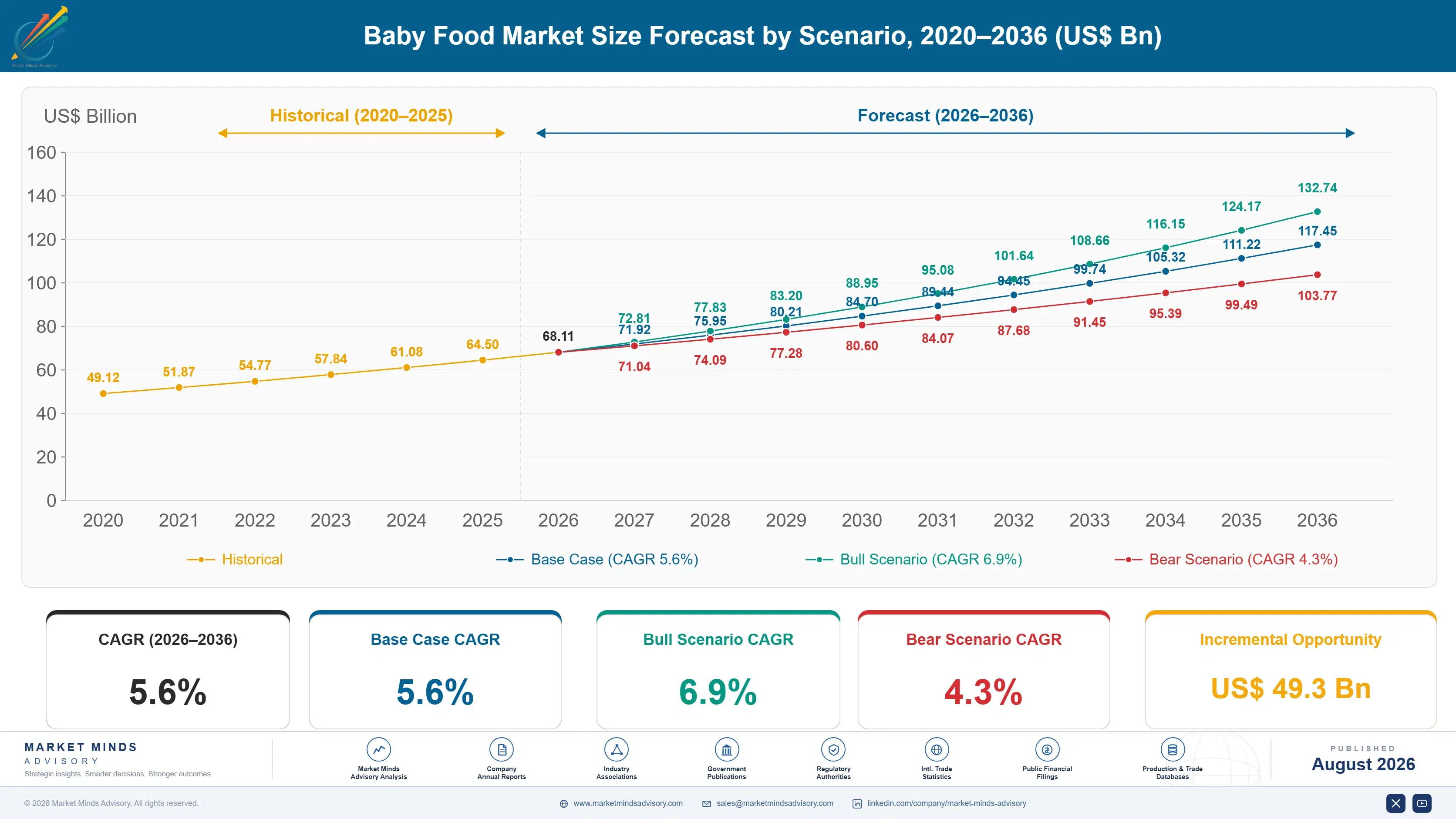
Baby Food Market Forecast Scenarios

baby-food-market-trends-growth-size-forecast-scenario-1787463288575
Category revenue grew steadily between 2020 and 2025 even as birth rates declined across China, Western Europe, and parts of East Asia, because premiumization and specialty formula adoption more than offset falling volume in unit terms across most major markets tracked in this report, a pattern that held through every year of the historical period.
The base case assumes continued premiumization in China and East Asia, expanding specialty and medical nutrition adoption tied to rising allergy diagnosis rates, and steady birth-cohort growth in South Asia and Latin America, where cohorts remain considerably larger than in mature markets. These three mechanisms together offset volume decline in shrinking-birth-rate markets without requiring any single region to carry the category's entire growth burden alone, assuming no major regulatory disruption interrupts registration timelines.
A bull case builds on a major Chinese domestic formula maker successfully exporting its premium brand into Southeast Asian markets at scale, pulling forward category growth industry-wide well ahead of current projections. The bear risk is a birth-rate decline steeper than currently projected across East Asia, which would compress volume faster than premiumization can realistically offset it.

Premiumization Against a Shrinking Birth Cohort

Baby food is one of the few consumer categories where falling unit volume and rising category revenue coexist comfortably, because parents in the most price-sensitive life stage of their own careers consistently trade up on nutrition for their children even while having fewer of them, across nearly every major market this report tracks in detail, from Western Europe through East Asia and well beyond into emerging markets carrying considerably larger birth cohorts.
FORMULA MAKER CONCENTRATION5 firms, 52%share of category revenue held by top makers
AVERAGE SELLING PRICE$18.40/kgdelivered basis price for standard infant formula today
TOP PRODUCING COUNTRY SHAREChina, 24%share of global category revenue generated domestically each year
CAPACITY UTILISATION81%average utilisation across dedicated infant formula production lines
TRADE INTENSITY29% cross-bordershare of finished formula volume traded across borders
FEEDSTOCK COST SHARE41% of COGSshare of production cost attributable to dairy input
Commercially, regulatory registration is the real barrier to entry, not brand marketing. Formula makers must register each product formulation separately in China, the European Union, and the United States, a process that can take years and effectively locks out smaller entrants regardless of how much capital they raise or how compelling their nutritional science actually is against entrenched incumbents already registered.
Over the next decade, specialty and medical nutrition will likely outgrow every other segment, as allergy diagnosis rates climb and pediatricians recommend earlier intervention, while conventional formula volume continues its slow, demographic-driven decline in birth-rate-constrained markets across most of the developed world this report tracks, from Western Europe to parts of East Asia.
"Everyone talks about the birth rate. The real story is that the parents who are still having babies will spend almost anything on the first year of nutrition."
Director, Infant and Child Nutrition Practice · MMA Infant and Child Nutrition Practice · August 2026

Market Trends

China tightens infant formula registration and labeling rules

China's State Administration for Market Regulation has tightened infant formula registration requirements progressively since 2023, requiring domestic and multinational manufacturers alike to resubmit formulation and labeling documentation under stricter nutrient composition standards. The policy is designed to consolidate a fragmented domestic industry and push smaller, non-compliant producers out of the market entirely within a defined transition window. Multinational manufacturers with established regulatory affairs teams have generally navigated the transition faster than smaller domestic rivals, and several formula makers report registration costs have roughly doubled since the rules took effect, concentrating share further among the largest compliant producers.
Market Impact: Adds $2.1 billion in premium revenue
Allergy diagnosis rates drive specialty formula adoption earlier

Pediatric allergy and lactose intolerance diagnosis rates have climbed steadily across North America, Western Europe, and urban China through 2024 and 2025, pushing pediatricians to recommend hypoallergenic or extensively hydrolyzed formula earlier rather than waiting for symptoms to worsen before switching. This earlier intervention pattern has expanded the addressable specialty nutrition base beyond infants with confirmed severe allergies into a broader population flagged at elevated risk. Formula makers with specialty manufacturing capability are capturing this demand fastest, since specialty formula requires distinct production lines and separate regulatory approval conventional makers cannot simply repurpose overnight.
Market Impact: Adds 6% regional volume growth yearly

Market Opportunities and Growth Drivers

Premiumization accelerates across China's infant formula category

Chinese parents have continued trading up toward premium and super-premium infant formula tiers through 2024 and 2025, even as overall birth numbers declined, driven by a cultural willingness to prioritize infant nutrition spending above most other household categories. Domestic formula makers have responded by launching organic, grass-fed, and goat-milk-based premium lines that command meaningfully higher price points than standard cow-milk formula. This premiumization has proven durable enough across multiple consecutive years that it now more than offsets China's shrinking birth cohort in revenue terms, even though unit volume continues declining year over year across most product tiers.
Market Impact: Cuts core cohort by 2-3% yearly

South Asian birth cohorts sustain conventional formula volume growth

India and other South Asian markets continue adding meaningfully more births annually than China or Western Europe, sustaining conventional formula and complementary food volume growth even as mature markets contract. Rising urban middle-class household income across the region has expanded the addressable population able to afford branded formula rather than relying solely on traditional home preparation methods passed down through generations. Multinational and domestic Indian formula makers have both expanded manufacturing capacity within the region to serve this growing demand rather than importing finished product, reducing landed cost and shortening supply lead times considerably.
Market Impact: Reduces formula marketing reach 10%

Market Restraints and Challenges

Birth rate decline shrinks the addressable consumer base

Birth rates have fallen for multiple consecutive years across China, South Korea, Japan, and most of Western Europe, shrinking the number of infants entering the category's core age range each year. The root cause is a multi-decade shift toward delayed childbearing and lower completed family size across developed economies, a trend unlikely to reverse within the forecast period regardless of government incentive programs. The commercial impact is a shrinking unit volume base that premiumization must outrun for revenue to keep growing. Formula makers mitigate this by expanding into South Asian and Latin American markets where birth cohorts remain larger.
Market Impact: Consolidates 12% of registered SKUs

Extended breastfeeding campaigns compete with formula marketing

Public health authorities in several European Union countries and China have expanded extended breastfeeding campaigns since 2023, partly responding to concerns about formula marketing practices influencing new parents away from breastfeeding during a child's critical early months. The root cause is a genuine public health preference for breastfeeding where feasible, which regulators increasingly enforce through marketing restrictions rather than persuasion. The commercial impact falls hardest on standard formula marketed to new parents rather than follow-on or specialty nutrition for later stages. Manufacturers mitigate this by shifting investment toward follow-on milk and toddler nutrition instead.
Market Impact: Lifts specialty segment demand 8 points
3 additional market trends, 4 additional growth drivers, and 3 additional restraints and challenges are covered in the full report. Contact sales@marketmindsadvisory.com to access the complete intelligence.

Segment CAGR and Growth Architecture

Segmentation follows product type, since formula, complementary food, and snack formats require distinct manufacturing processes, regulatory approvals, and feeding-stage positioning, far more than any marketing claim attached to a given product ever actually determines for buyers, pediatricians, or the regulators who ultimately approve each formulation for sale in a given country each calendar year.
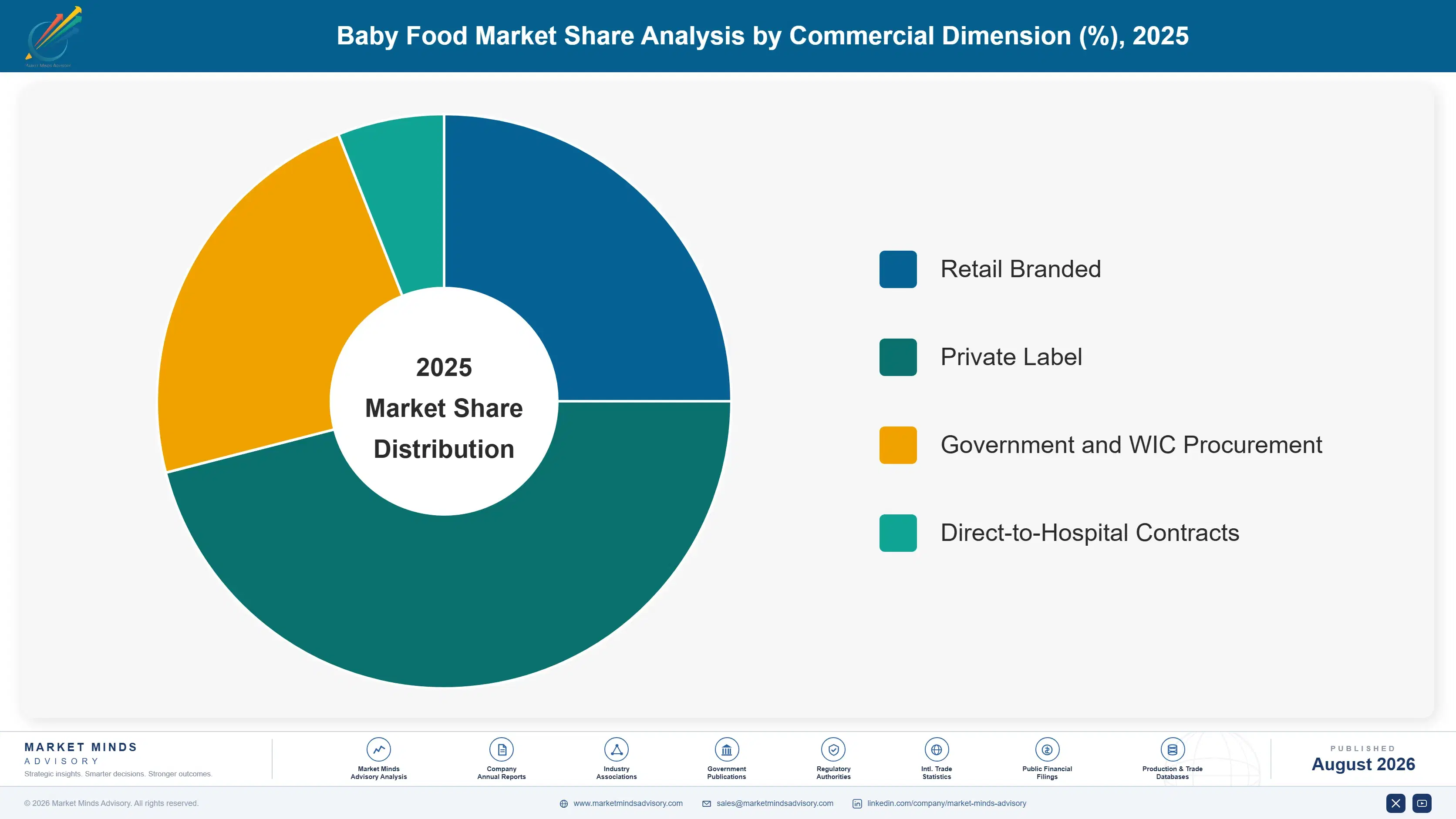
baby-food-market-trends-growth-market-share-analysis-1787463289108

Specialty and Medical Nutrition Formula

Specialty and medical nutrition, covering hypoallergenic, extensively hydrolyzed, and lactose-free formula, serves infants with diagnosed or suspected allergies and intolerances requiring clinical-grade nutritional intervention rather than standard cow-milk formula. Manufacturing requires dedicated production lines and separate regulatory approval in most major markets, which keeps this segment concentrated among a handful of manufacturers with established specialty capability built over many years. Demand is growing at roughly 1.70 times the category average, driven by rising allergy diagnosis rates and earlier pediatrician-recommended intervention across North America, Western Europe, and increasingly urban China. Parents increasingly request documented hypoallergenic certification rather than accepting a standard formula reformulated with minor claims, pushing manufacturers without genuine specialty capability out of this fastest-growing slice of demand.
CAGR 9.5%

Toddler Snacks

Toddler snacks, covering puffs, pouches, and teething biscuits marketed for children roughly six months through three years, have grown quickly as working parents seek convenient, mess-reduced feeding options for older infants and toddlers beyond the highchair. This segment trails specialty nutrition on growth but comfortably outpaces conventional formula and prepared baby food, supported by retail expansion into mainstream grocery and convenience channels well beyond the dedicated baby food aisle where these products once lived exclusively for most of the category's history. Manufacturers position toddler snacks on portability and reduced added sugar content relative to general children's snacks, differentiating the category from ordinary crackers or cookies marketed more broadly to older children and families overall.
CAGR 7.8%
Full segment breakdown across 6 segments available in the complete report.

Regional Architecture and Country Demand Map

East Asia remains the largest buying region despite falling birth rates, sustained by aggressive premiumization, while South Asia and Pacific grows fastest on considerably larger birth cohorts and rising branded formula adoption among urban households across the region's largest and fastest-growing cities through this decade.

East Asia

China anchors this region as the single largest infant formula market in the world by revenue, even as its birth cohort keeps shrinking year over year, because premiumization across organic, grass-fed, and goat-milk formula tiers has outrun volume decline for several consecutive years running. Domestic Chinese formula makers have captured meaningful share from multinational brands since 2023 as tightened registration rules favor manufacturers with established local regulatory affairs teams over newer entrants. Japanese and South Korean demand tracks considerably smaller birth cohorts than China's, though per-capita spending on premium and specialty formula runs among the highest anywhere in the category, reflecting deep cultural willingness to prioritize infant nutrition spending regardless of the broader demographic headwind facing the entire region.
Share: 29% | CAGR: 6.5% (2026 to 2036)

North America

United States demand centers on a mature, heavily regulated formula market where FDA registration requirements and WIC program participation shape which brands secure the broadest retail distribution and institutional purchasing volume nationwide. Specialty and hypoallergenic formula has grown considerably faster than conventional formula here, driven by rising pediatric allergy diagnosis rates and earlier recommended intervention across most major pediatric practices coast to coast. Canadian demand mirrors the United States closely, though at meaningfully smaller absolute scale, and both markets rely on a small number of domestic manufacturers holding the bulk of registered infant formula capacity within the region, a concentration that has held remarkably steady across the entire forecast horizon so far.
Share: 23% | CAGR: 6.6% (2026 to 2036)
Regional intelligence for 5 additional markets available in the complete report: Western Europe, South Asia and Pacific, Latin America, Middle East and Africa, Eastern Europe. Contact sales@marketmindsadvisory.com.
baby-food-market-trends-growth-country-cagr-analysis-1787463289618

Where Infant Nutrition Margins Concentrate

Margin in this category sits with regulatory registration breadth and specialty manufacturing capability rather than brand marketing spend, so makers capture the most value by registering premium formulations early across major markets and building dedicated capacity for specialty nutrition well ahead of when pediatricians start recommending it more broadly across their own practices nationwide.

Simultaneous Multi-Market Regulatory Registration Push Strategy

Formula makers who register premium and specialty formulations across China, the European Union, and the United States simultaneously capture roughly 20% higher blended pricing than those limiting registration to a single market at a time. Registration requires multi-year lead time and significant regulatory affairs investment that smaller manufacturers rarely commit to across three jurisdictions at once, which keeps this pricing advantage concentrated among the largest multinational and Chinese domestic players. Buyers increasingly favor brands with consistent global formulation standards, further rewarding manufacturers who complete simultaneous registration rather than staggering it market by market over several separate years of approvals.
Market Impact: Commands a meaningful pricing edge across 3 major markets

Dedicated Specialty Nutrition Production Line Investment

Building dedicated specialty and medical nutrition production lines, separate from conventional formula capacity, lets manufacturers capture the fastest-growing and highest-margin slice of category demand, growing at roughly 1.70 times the category average as allergy diagnosis rates climb. This requires meaningful capital investment and separate regulatory approval that conventional-only manufacturers cannot simply add on short notice without years of preparation. Processors that commit early gain a durable head start, since pediatricians and hospitals tend to standardize on a small number of trusted specialty brands rather than switching suppliers once a referral pathway is firmly established.
Market Impact: Captures share in the fastest-growing 9.5% CAGR segment

Branded Expansion Into High-Birth-Cohort Growth Regions

Expanding branded formula distribution into South Asia and Latin America, where birth cohorts remain considerably larger and rising urban income is expanding the population able to afford branded nutrition, captures volume growth mature markets can no longer provide. This channel now represents a meaningful and steadily growing part of total category demand, estimated at roughly 6 percentage points of incremental annual growth concentrated specifically in these expanding regions. The tradeoff is lower per-unit pricing than premium tiers in mature markets, offset by considerably larger volume growth potential over the full coming decade.
Market Impact: Adds 6 points of incremental annual growth overall

Local Chinese Manufacturing to Meet Registration Rules

Investing in local manufacturing capacity within China rather than exporting finished product from abroad lets multinational makers respond faster to tightened registration rules and avoid import tariff exposure that affects foreign-manufactured formula disproportionately across most price tiers. Manufacturers securing local production status ahead of competitors gain meaningful advantage in government procurement and hospital distribution channels that favor domestically produced nutrition over imported alternatives shipped from overseas. Early movers report shortened approval timelines of roughly 30% compared with manufacturers still relying entirely on imported finished product awaiting registration clearance from regulators.
Market Impact: Cuts approval timelines by roughly 30% for local output

Who Controls the Margin Pool

The top five formula makers hold roughly 52% of category revenue, a considerably tighter concentration than most food categories, reflecting the regulatory registration barrier that keeps smaller challengers confined mostly to regional or private-label positioning rather than genuine multinational competition across the largest and most lucrative markets.
Current competitive activity centers on three moves: registering premium and specialty formulations simultaneously across major markets, building dedicated specialty nutrition production capacity, and expanding branded distribution into South Asia and Latin America where birth cohorts remain considerably larger than in mature markets. Chinese domestic makers increasingly compete directly with multinationals on premium positioning rather than conceding that tier entirely as they once did.

Emerging pressure comes from Chinese domestic formula makers who have used tightened registration rules to displace multinational brands on domestic shelves, a dynamic that could extend into export markets across Southeast Asia over the next several years as capacity keeps expanding. Whichever manufacturer first proves it can scale specialty and medical nutrition production as reliably as conventional formula stands to capture disproportionate share as allergy diagnosis rates keep climbing worldwide across every major market this report tracks.
baby-food-market-trends-growth-company-positioning-matrix-1787463290139

Competitive Moat and Risk Dimensions

NESTLE S.A.

Moat: Widest global registration footprint

Nestle holds registered infant formula approvals across more countries than any competitor, letting it launch new formulations into dozens of markets simultaneously rather than waiting years for market-by-market clearance the way smaller rivals must, a considerable and durable advantage in a registration-driven category that few competitors can match at comparable scale.
NESTLE S.A.

Risk: Chinese domestic share erosion

Nestle has lost meaningful share in China to domestic formula makers benefiting from tightened registration rules that favor local regulatory relationships, exposing the company to continued erosion in its single largest national market if the trend does not reverse soon, regardless of brand strength elsewhere.
DANONE S.A.

Moat: Deep specialty nutrition expertise

Danone's Nutricia business carries decades of accumulated expertise in hypoallergenic and medical-grade infant nutrition, giving it a trusted position with pediatricians and hospitals that newer specialty entrants cannot easily replicate regardless of how much they invest in clinical research or marketing spend across comparable timeframes.
DANONE S.A.

Risk: European birth-rate exposure

Danone's revenue mix skews more heavily toward Western Europe than some competitors, exposing it disproportionately to the region's steepest birth-rate decline without the same scale of offsetting premiumization currently visible in China's domestic formula market, where rivals are capturing considerably more of the available growth each passing year.

Players Tracked

Prominent Players

Nestle S.A.
Danone S.A.
Reckitt Benckiser Group plc
Abbott Laboratories
FrieslandCampina

Other Key Players

Hero Group
HiPP GmbH and Co. Vertrieb KG
Meiji Holdings Co., Ltd.
Morinaga Milk Industry Co., Ltd.
China Feihe Limited
Yili Industrial Group
Bright Dairy and Food Co., Ltd.
Synutra International Inc.
Perrigo Company plc
Else Nutrition Holdings Inc.
Bubs Australia Limited
The a2 Milk Company Limited
Ausnutria Dairy Corporation Ltd.
Baby Gourmet Foods Inc.
Plum Organics

Recent Developments

JULY 2025

Reckitt Benckiser Expands Hypoallergenic Formula Production Capacity

Reckitt Benckiser commissioned additional specialty formula production capacity at its Mead Johnson Nutrition facility, targeting rising demand for hypoallergenic and extensively hydrolyzed formula across North America and Western Europe. The expansion followed two years of allocation constraints during peak allergy-season ordering periods affecting several major retail accounts.
Signal: Signals leaders are building dedicated specialty capacity rather than converting conventional lines temporarily each allergy season
NOVEMBER 2025

China Feihe Forms Joint Venture to Expand Premium Formula Capacity

China Feihe formed a joint venture with a regional dairy cooperative to expand premium and organic infant formula production capacity within China, aimed at capturing share from multinational brands amid tightened registration rules. The venture includes dedicated goat-milk formula production lines serving both domestic and export markets.
Signal: Confirms domestic Chinese makers are investing aggressively rather than ceding premium tier share to multinational rivals
MARCH 2026

Danone Launches Organic Follow-On Milk Line Across Western Europe

Danone launched a new organic, clean-label follow-on milk line across major Western European markets, targeting parents seeking to extend organic feeding beyond the initial infant formula stage into the toddler years of a child's development. The launch includes updated European Union nutrient composition documentation covering every member state.
Signal: Demonstrates follow-on milk is becoming a strategic battleground as birth-rate decline pressures core formula volume growth

Dairy Feedstock and Regulatory Cost Exposure

Dairy inputs, primarily skim milk powder and whey protein concentrate, account for roughly 41% of production cost for standard infant formula, with regulatory testing and registration compliance a further 18%, an unusually high share for a food category. Dairy supply concentrates in New Zealand, the European Union, and the United States, so global dairy commodity cycles drive cost more than any single country's harvest.
A sharp rise in global skim milk powder prices through 2024, documented in USDA dairy market reports, pushed formula makers without long-term dairy supply contracts to absorb meaningful margin compression within a single fiscal year across several major product lines. Manufacturers holding multi-year dairy cooperative agreements passed through only modest cost increases to retail pricing, while spot-market buyers faced considerably steeper input cost swings through the following several quarters of the year.

The competitive disadvantage falls hardest on smaller regional formula makers without long-term dairy contracts or vertically integrated dairy operations, since they face the same commodity swings as larger rivals without the scale to negotiate favorable pricing. Exposure also varies by tier: specialty and organic formula carries higher dairy input costs proportionally, leaving those manufacturers more exposed to price spikes than conventional makers.
baby-food-market-trends-growth-cost-volatility-analysis-1787463290335

Long-Term Dairy Cooperative Supply Agreements

Locking dairy input supply under multi-year agreements with dairy cooperatives in New Zealand or the European Union shields formula makers from spot market price spikes, at the modest cost of somewhat higher average pricing during periods when spot dairy would otherwise have been considerably cheaper to buy directly on the open market from independent suppliers.

Vertical Integration Into Dairy Production

Several larger formula makers have acquired or built dedicated dairy farming and processing operations, reducing exposure to commodity dairy markets almost entirely, though this requires substantial capital investment that only the largest manufacturers can realistically justify given typical formula margins across the category as a whole, at least for the foreseeable future ahead of them right now.

Regulatory Compliance Cost Sharing Across Markets

Manufacturers registering formulations simultaneously across multiple markets spread fixed regulatory testing and documentation costs across a larger revenue base, reducing the effective per-unit compliance burden relative to manufacturers registering market by market over several separate cycles spanning years rather than months, which adds up considerably in both lost time and real money each fiscal year.

Portfolio Architecture for Margin Defence

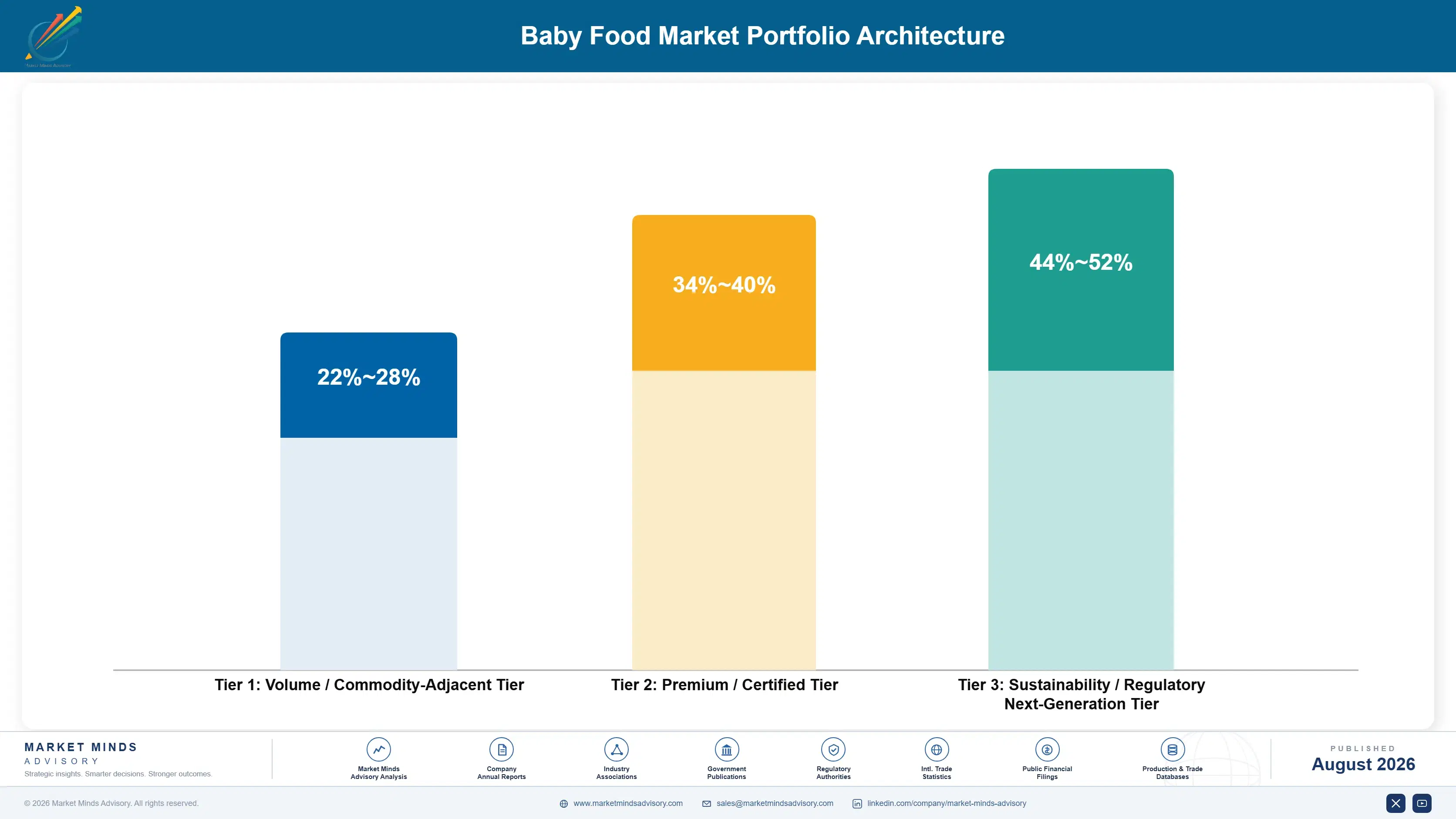
Three tiers separate this market clearly: conventional cow-milk formula sold mainly on price and availability, premium and organic formula carrying a substantial trade-up premium, and specialty or medical nutrition sold against documented clinical positioning for allergy and intolerance management. Gross margin widens sharply moving from the first tier through the third across nearly every market this report tracks in detail, roughly doubling along the way from tier one to tier three.
Volume still sits predominantly in the conventional tier, where thin margins reward manufacturing scale and distribution reach rather than technical differentiation of any real kind whatsoever. Premium tiers carry a familiar tension: chasing volume growth in conventional formula risks diluting the trusted clinical reputation that earns specialty-tier pricing from pediatricians and hospital purchasing departments across every major market, a tradeoff few manufacturers manage well simultaneously.

High-value margin pools concentrate in specialty and medical nutrition sold through pediatrician and hospital channels, and in premium organic formula sold to Chinese urban households, while conventional formula remains fundamentally a scale business best suited to manufacturers with the broadest dairy supply and distribution network across multiple countries at once, rather than niche regional specialists.

Volume / Commodity-Adjacent Tier

Conventional cow-milk infant formula sold mainly on price and retail availability, priced on dairy input cost and manufacturing scale rather than any specialty nutritional positioning across most global markets tracked here.
Gross Margin: 22-28%

Premium / Certified Tier

Organic, grass-fed, and goat-milk-based premium formula serving trade-up urban households willing to pay a documented sourcing and formulation premium over conventional cow-milk formula sold at scale everywhere across the market.
Gross Margin: 34-40%

Sustainability / Regulatory / Next-Generation Tier

Specialty and medical nutrition sold against documented hypoallergenic or clinical positioning for allergy and intolerance management requiring separate regulatory approval and dedicated manufacturing lines built specifically for this exact purpose.
Gross Margin: 44-52%
baby-food-market-trends-growth-portfolio-architecture-1787463290828

High-value Sub-segments and Strategic Watch-out

Specialty and Medical Nutrition Formula

This segment combines the fastest unit growth in the category with the widest margin, as pediatricians and hospitals pay a real premium for documented hypoallergenic and clinical-grade formulation. Manufacturers with dedicated specialty production lines are best positioned, though expanding capacity requires separate regulatory approval in most major markets.
Gross Margin: 46-52%

Premium Organic Formula for Chinese Households

Premium and organic formula sold to Chinese urban households delivers strong volume growth and healthy stable margin, rewarding manufacturers who invest in local registration and culturally resonant premium branding over those relying purely on multinational brand recognition alone to win new customers in this market each year.
Gross Margin: 34-40%

Conventional Cow-Milk Formula for Mass Retail

The volume core of the category, sold mainly on price and retail availability into conventional formula channels, where dairy input cost efficiency and distribution scale determine which manufacturer ultimately wins repeat business from price-conscious households each purchase cycle across every retail channel available to them.
Gross Margin: 22-26%

Extended Breastfeeding Campaigns Limiting Volume

Extended breastfeeding promotion campaigns expanding across the European Union and China remain a genuine watch-out for conventional formula volume specifically, since stricter marketing restrictions could meaningfully compress the addressable base faster than premiumization can realistically offset in the markets most affected by the campaigns going forward.
Gross Margin: unproven

How Infant Nutrition Demand Repeats

Formula purchases function closer to a subscription than a one-off purchase, since parents rarely switch brands mid-feeding-stage once an infant tolerates a formulation well, given the real risk of digestive upset and the emotional stakes involved in changing what a newborn eats. Retailers understand this dynamic well and compete hardest of all for the very first purchase a new parent makes, since that decision often holds for a year or more.
Adoption runs deepest in specialty and medical nutrition, where a pediatrician's initial recommendation essentially locks in brand loyalty through an infant's entire formula-feeding period, and shallowest in commodity conventional formula, where private label and price promotions can shift share more easily between comparable products sitting side by side on the same retail shelf each week of the year.

A generational shift is visible in parenting behavior itself: younger parents research formulation ingredients and sourcing claims far more actively before purchase than previous generations did, rewarding brands with transparent, documented sourcing over those relying on legacy brand recognition alone to win a first purchase from a first-time parent navigating an unfamiliar and often overwhelming category.
baby-food-market-trends-growth-end-use-penetration-index-1787463291315

Where Infant Nutrition Bets Should Go

These are among the four positions where our research anticipates prominent divergence between winners and laggards over the coming forecast period. Each is grounded in the demand model, the regulatory perimeter, and the announced capacity pipeline.
01 / SPECIALTY CAPACITY INVESTMENT

Build dedicated specialty nutrition capability before rivals close the gap

Specialty and medical nutrition commands meaningfully higher pricing than conventional formula, growing at roughly 1.70 times the category average as allergy diagnosis rates climb across every major market this report tracks. Buyers increasingly require documented hypoallergenic certification rather than accepting a lightly reformulated conventional product, closing out manufacturers without genuine specialty capability from this fastest-growing demand segment entirely. Manufacturers that build dedicated specialty production capacity now capture durable pricing power competitors cannot easily replicate within a normal multi-year capital cycle.
02 / REGISTRATION STRATEGY PRIORITY

Complete simultaneous multi-market registration ahead of competitors

China's tightened infant formula registration rules have favored manufacturers with established local regulatory affairs teams, and multinational brands that delay compliance investment risk losing further share to domestic Chinese competitors already positioned to capture it quickly. Registration costs have roughly doubled since the rules took effect, concentrating advantage among the largest compliant producers able to absorb that cost without difficulty. Manufacturers that invest in simultaneous multi-market registration now secure durable pricing power and shelf access competitors delaying compliance cannot easily replicate later on.
03 / HIGH-GROWTH MARKET EXPANSION

Expand regional manufacturing capacity across South Asia and Latin America

India and other South Asian markets continue adding meaningfully more births annually than China or Western Europe, sustaining conventional formula and complementary food volume growth even as mature markets contract steadily year over year across nearly every developed economy. Rising urban middle-class income across the region has expanded the population able to afford branded formula rather than relying solely on traditional home preparation methods passed down for generations. Manufacturers expanding regional manufacturing capacity now capture volume growth mature markets can no longer provide at comparable scale.
04 / MARKETING MIX REBALANCING

Shift marketing investment toward follow-on and specialty nutrition lines

Extended breastfeeding promotion campaigns across the European Union and China are compressing conventional formula's addressable base faster than premiumization alone can offset in the markets most affected by these restrictions on marketing practices. Manufacturers relying primarily on conventional formula marketing without a meaningful follow-on or specialty nutrition presence face a shrinking core business over the coming decade as this trend continues. Shifting marketing investment toward follow-on milk and specialty nutrition, categories these campaigns target less directly, offers a clearer path to sustained growth.

Engagement Snapshot From the Field

A live engagement with an industry participant carrying material or product regulatory and market exposure ahead of a defining policy shift, showing how our research translates into a defensible multi-year portfolio strategy.
MARKET MINDS ADVISORY · CLIENT ENGAGEMENT SUMMARY
Baby Food Producer Strategic Portfolio Review and Transition Roadmap 2026·Investment Scenario on Baby Food Exposure Evaluation 2025-26
CLIENT PROFILE
The client is a mid-sized specialty infant nutrition brand based in the United Kingdom generating approximately $140 million in annual revenue (client-reported, unverified by MMA), producing hypoallergenic and extensively hydrolyzed formula sold through pharmacy and pediatric channels across Western Europe. The company had built a strong domestic reputation but had never registered a product in China and faced pressure from investors to enter the market.
STRATEGIC CHALLENGE
The client needed to register its flagship hypoallergenic formula in China within eighteen months to capture growing demand from allergy-diagnosed infants, but faced tightened registration requirements introduced in 2023 that had already delayed several competitors' market entry attempts by a year or more beyond their original plans and approved budgets.
MMA APPROACH
MMA mapped China's revised registration pathway for specialty formula, benchmarked the client's formulation documentation against newly tightened requirements, and modeled a phased market entry strategy prioritizing tier-one city pediatric hospital channels ahead of broader retail distribution across the wider country, sequencing investment carefully across each of the three defined phases.
KEY FINDINGS
  1. The client's existing documentation package was missing three of the newly required nutrient composition disclosures under revised Chinese registration rules introduced recently.
  2. Tier-one city pediatric hospitals represented the fastest path to credibility for a specialty brand with no prior retail or clinical presence in China at all.
  3. Two domestic regulatory affairs consultancies had successfully guided comparable specialty formula registrations within the client's required eighteen-month approval window on prior occasions.
  4. Entering through hospital channels first, rather than retail, reduced required marketing spend by roughly 40% during the critical first year of launch.
CLIENT PROFILE
The client is a mid-sized specialty infant nutrition brand based in the United Kingdom generating approximately $140 million in annual revenue (client-reported, unverified by MMA), producing hypoallergenic and extensively hydrolyzed formula sold through pharmacy and pediatric channels across Western Europe. The company had built a strong domestic reputation but had never registered a product in China and faced pressure from investors to enter the market.
STRATEGIC CHALLENGE
The client needed to register its flagship hypoallergenic formula in China within eighteen months to capture growing demand from allergy-diagnosed infants, but faced tightened registration requirements introduced in 2023 that had already delayed several competitors' market entry attempts by a year or more beyond their original plans and approved budgets.
MMA APPROACH
MMA mapped China's revised registration pathway for specialty formula, benchmarked the client's formulation documentation against newly tightened requirements, and modeled a phased market entry strategy prioritizing tier-one city pediatric hospital channels ahead of broader retail distribution across the wider country, sequencing investment carefully across each of the three defined phases.
KEY FINDINGS
  1. The client's existing documentation package was missing three of the newly required nutrient composition disclosures under revised Chinese registration rules introduced recently.
  2. Tier-one city pediatric hospitals represented the fastest path to credibility for a specialty brand with no prior retail or clinical presence in China at all.
  3. Two domestic regulatory affairs consultancies had successfully guided comparable specialty formula registrations within the client's required eighteen-month approval window on prior occasions.
  4. Entering through hospital channels first, rather than retail, reduced required marketing spend by roughly 40% during the critical first year of launch.
RECOMMENDED STRATEGY
Phase 1: Phase 1 (Months 1-6): Complete the revised documentation package and engage a domestic regulatory affairs consultancy immediately and thoroughly from the start. Phase 2: Phase 2 (Months 7-14): Pursue registration approval while building relationships with tier-one city pediatric hospitals in parallel over this period. Phase 3: Phase 3 (Months 15-18): Launch through hospital channels first, then expand into pharmacy retail distribution nationwide across every major region.
OUTCOME
The client received Chinese registration approval one month ahead of its eighteen-month target and launched through twelve tier-one city pediatric hospitals, reporting first-year China revenue of roughly $18 million (client-reported, unverified by MMA), well ahead of the initial business case presented to investors before the engagement began.

Frequently Asked Questions

Foundational context covering the market sizes, CAGR, scope, country, region and competition that inform every finding below. This section is provided to cover basics and most often pre-purchase conversations, answered from the MMA Primary Research Dataset.

What is the current size of the Baby Food Market?

The global baby food market is valued at approximately $68.1 billion in 2026. This covers infant formula, follow-on milk, complementary foods, and toddler snacks sold worldwide.

How large will the Baby Food Market be by 2036?

MMA projects the market will reach approximately $117.4 billion by 2036. Growth is driven primarily by premiumization in China and rising specialty nutrition adoption tied to allergy diagnosis rates.

What is the CAGR for the Baby Food Market 2026 to 2036?

The market is forecast to grow at a compound annual rate of 5.6% between 2026 and 2036. Bull and bear scenarios range from 6.9% down to 4.3% depending on birth-rate and premiumization outcomes.

Which segment is growing fastest?

Specialty and medical nutrition formula is growing fastest, at roughly 1.70 times the category average rate. Rising allergy diagnosis rates and earlier pediatrician-recommended intervention are driving this expansion.

Who are the major companies in the Baby Food Market?

Leading companies include Nestle, Danone, Reckitt Benckiser, Abbott Laboratories, and FrieslandCampina. Together these top five formula makers hold roughly 52% of total category revenue worldwide.

Which country is growing fastest?

India is the fastest-growing country market, expanding at approximately 8.9% annually. A substantially larger birth cohort and rising urban middle-class income are the primary drivers.

Report Segmentation Architecture

The full report scope spans multiple orthogonal segmentation dimensions, with cross-tabulated demand data provided for each dimension pair. Coverage extends further to regional breakdowns, trend trajectories, and the competitive detail needed to support segment-level decision-making.

By Product Type

  • Infant Formula
  • Follow-On and Growing-Up Milk
  • Prepared and Dried Complementary Food
  • Toddler Snacks
  • Specialty and Medical Nutrition
  • Cereals

By End-Use Industry

  • Retail and Pharmacy
  • Institutional Feeding Programs
  • Hospital and Clinical Nutrition
  • E-Commerce

By Commercial Dimension

  • Retail Branded
  • Private Label
  • Government and WIC Procurement
  • Direct-to-Hospital Contracts

By Region

  • North America
  • Western Europe
  • East Asia
  • South Asia and Pacific
  • Latin America
  • Middle East and Africa
  • Eastern Europe

Scope, Methodology, and Coverage

Every figure in this report is reproducible from documented input assumptions. The scope below maps the historical period, the forecast horizon, the segmentation dimensions, and the countries covered, alongside the underlying primary and qualitative methodology.
Historical Period
2020 to 2025
Forecast Period
2026 to 2036
Base Year
2025 (USD billions; MMA Primary Research Dataset, August 2026)
Market Definition
The baby food market covers infant formula, follow-on and growing-up milk, prepared and dried complementary foods, and toddler snacks formulated specifically for children from birth through age three. It excludes general children's food products marketed to older children, and excludes breast milk substitrate ingredients sold to formula manufacturers rather than to consumers directly.
Quantitative Units
USD billions (current prices); metric tons of finished product
Segmentation Dimensions
By Product Type; By End-Use Industry; By Commercial Dimension; By Region
Regions Covered
North America, Western Europe, East Asia, South Asia and Pacific, Latin America, Middle East and Africa, Eastern Europe
Countries Covered
USA, China, Germany, France, UK, Japan, South Korea, India, Australia, Canada, Brazil, Mexico, Indonesia, Vietnam, Thailand, Malaysia, UAE, Saudi Arabia, South Africa, Nigeria, Turkey, Poland, Netherlands, Italy, Spain, Sweden, Switzerland, Argentina, Colombia, Singapore, and additional markets relevant to this sector
Key Companies Profiled
Nestle S.A., Danone S.A., Reckitt Benckiser Group plc, Abbott Laboratories, FrieslandCampina, Hero Group, HiPP GmbH and Co. Vertrieb KG, Meiji Holdings Co., Ltd., Morinaga Milk Industry Co., Ltd., China Feihe Limited, Yili Industrial Group, Bright Dairy and Food Co., Ltd., Synutra International Inc., Perrigo Company plc, Else Nutrition Holdings Inc., Bubs Australia Limited, The a2 Milk Company Limited, Ausnutria Dairy Corporation Ltd., Baby Gourmet Foods Inc., Plum Organics
Quantitative Methodology
Primary survey, n=3,800 respondents, Q4 2025, six countries; demand-side model with trade association cross-validation
Qualitative Methodology
47 expert interviews, Q4 2025; applied to validate demand model assumptions, identify emerging dynamics, and assess competitive positioning
Report Format
PDF and XLSX data workbook (Word format preview document)
Publisher
Market Minds Advisory
Report Code
MMA-2026-AGR-403
Published
August 2026
Contact
sales@marketmindsadvisory.com | www.marketmindsadvisory.com

Purchase the full Baby Food Market Report (2026 to 2036).

The full report delivers a complete analysis of the baby food market across all seven regions and six product-type segments. It includes detailed competitive profiles of twenty companies alongside proprietary MMA survey data drawn from 3,800 respondents and 47 expert interviews conducted during the fourth quarter of 2025. Ten-year forecast models are built under base, bull, and bear scenarios, with full regional share and growth breakdowns included throughout. A standalone section analyzes dairy feedstock cost exposure and margin architecture across three distinct product tiers. Buyers also receive segment-level CAGR detail extending well beyond the two segments highlighted in this summary.
Full seven-region market sizing and forecast tables
Complete six-segment product-type category breakdown detail
Twenty-company competitive profiles and moat analysis
Primary survey data collected across six countries
Dairy feedstock and regulatory cost exposure modeling
Portfolio tier margin benchmarking by segment type

Built For The People Who Decide

From boardroom strategy to bench-side execution, this report is read cover-to-cover by leaders shaping the next decade of their industry, turning demand scenarios, market dynamics and valuation benchmarks into decisions.
CXOs/ Presidents/ VPs/ Managers
M&A and Corporate Development
Strategy Teams and R&D Heads
Procurement and Product Directors
Regulatory and Compliance Leaders
Investor Relations and Equity Analysts