Market Minds Advisory
Baby Changing Station Market

Baby Changing Station Market: Baby Changing Station Market. Gender-Neutral Access Laws Redraw a Fixture's Standard Placement

Gender-neutral changing table mandates and heightened hygiene expectations are pushing facility owners toward antimicrobial, family-restroom-ready stations, forcing legacy washroom fixture makers to retrofit product lines they once left largely unchanged for decades.

Lead Analyst

Published

September 2026

Make Smarter Decisions with Customized Research Insights

Request a free sample report and evaluate market opportunities, growth trends, and competitive dynamics relevant to your business needs.

2025 MARKET VALUE$1.1BMarket Size 2025
2036 FORECAST VALUE$1.8BBase Case , 2026 to 2036
CAGR 2026 TO 20364.4 %Bull 5.7% / Bear 3.1%
INCREMENTAL OPPORTUNITY$0.6BNet 10- year value creation
EXPANSION MULTIPLE1.54x2036 value over 2026 base
Strategic Levers
M&A Pipeline
Regional Outlook
Country Rankings
Competitive Intelligence
Segmental Deep-dive
Call-Us : 91 93563 13602

Executive Snapshot and Market Trajectory.

The baby changing station market is shifting from a men's-restroom compliance afterthought to a mandatory fixture across all public restroom types as legislation closes long-standing gender access gaps affecting caregivers of both sexes nationwide and across every facility type, jurisdiction, and venue category.
Retail and hospitality venues remain the largest buyer segment, but antimicrobial and family restroom combination units are the fastest-growing product categories as facility owners respond to both legislative mandates and heightened hygiene expectations from parents across every demographic and income level nationwide today. Retrofit demand is accelerating as older facilities install stations in previously unequipped men's and family restrooms to comply with expanded access laws taking effect across multiple jurisdictions and municipalities nationwide.
Competition centers on a handful of established washroom fixture manufacturers defending share against newer specialty entrants offering hygiene-focused designs built specifically for high-traffic public facilities and demanding maintenance schedules across every venue type. Building code updates and municipal enforcement of gender-neutral access requirements are accelerating replacement cycles across retail, hospitality, and transportation facility categories nationwide, widening the gap between compliant and non-compliant existing installations still awaiting mandated upgrades industry-wide.
Market Definition
The baby changing station market covers wall-mounted, portable, and antimicrobial fixtures installed in public restrooms for infant diaper changing, spanning retail, hospitality, transportation, and institutional facility categories. It excludes residential changing tables and furniture, diaper disposal units sold separately from changing surfaces, and general restroom accessibility fixtures unrelated to infant care.
Base Year Value
$1.1B in 2025 (MMA Primary Research Dataset, September 2026)
Forecast Period
2026 to 2036, eleven discrete annual values
CAGR
4.4% base case. Bull 5.7%. Bear 3.1%.
Fastest Growth Segment
Antimicrobial and Sanitizing Stations: 8.0% CAGR
Fastest Growth Country
United States: 4.9% CAGR
Fastest Growth Region
South Asia and Pacific: 6.3% CAGR
Largest Region
North America: 30% of 2025 global value
Market Leaders
Bobrick Washroom Equipment, ASI Group, Rubbermaid Commercial Products, Foundations Worldwide, and Bradley Corporation lead the market. Source: MMA Primary Research Dataset, July 2026.
Primary Survey
n=3,800 procurement and R&D decision-makers, Q4 2025, six countries
Methodology
Demand-side build-up, cross-validated against public data, 47 expert interviews

Baby Changing Station Market Forecast Scenarios

baby-changing-station-market-size-forecast-scenario-1790014291829
The category grew steadily from 2020 to 2025 as pandemic-era hygiene awareness and early state-level gender-neutral access legislation drove initial adoption, with a historical CAGR near 3.8 percent reflecting a mature fixture category entering a legislation-driven growth phase after decades of relatively flat demand tied primarily to new construction cycles alone across most facility types and geographies.
The base case assumes 4.4 percent annual growth through 2036, driven by three commercial mechanisms: expanding gender-neutral access legislation requiring stations in men's and family restrooms nationwide, growing antimicrobial and hygiene-focused product adoption among facility owners, and steady new construction in retail and hospitality sectors incorporating changing stations as a standard specification from the outset nationwide. Retrofit demand in older facilities sustains a durable replacement cycle independent of new construction alone.
The bull case reaches 5.7 percent if additional jurisdictions adopt gender-neutral access mandates faster than expected, accelerating retrofit demand across previously unequipped facilities nationwide and across every venue type. The bear case falls to 3.1 percent if enforcement of existing legislation remains inconsistent, allowing facility owners to delay compliance-driven upgrades longer than currently planned across multiple facility categories.

From Compliance Afterthought to Standard Fixture

Baby changing stations have moved from a fixture found almost exclusively in women's restrooms to a standard requirement across men's and family restrooms as legislation increasingly recognizes caregiving as a responsibility not limited to any one gender or parenting role across every type of public facility nationwide and across every jurisdiction and municipality.
MARKET CONCENTRATIONCR5 48%Top five manufacturers hold under half of category revenue
AVERAGE UNIT PRICE$180 per unitReflects typical wall-mounted commercial changing station unit price
RETAIL CHANNEL SHARE42% of revenueRetail and shopping center facilities remain the largest buyer segment
AVERAGE INSTALLATION CYCLE10 years typicalTypical duration before facilities replace existing changing station fixtures
RETROFIT INSTALLATION SHARE38% of unit volumeShare of installations occurring in previously unequipped existing restrooms
ANTIMICROBIAL COATING PENETRATION27% of units soldShare of stations featuring documented antimicrobial surface treatment
Antimicrobial and family restroom combination units represent the fastest-growing product categories as facility owners respond to heightened hygiene expectations alongside legislative compliance requirements across every jurisdiction and facility category. Manufacturers increasingly design products specifically for retrofit installation, recognizing that most new demand comes from adding stations to existing restrooms rather than new construction specification alone across the broader category and every major retail and hospitality segment.
Retail and hospitality facilities drive the largest share of category revenue, though transportation hubs and institutional facilities represent a growing addressable market as gender-neutral access requirements extend beyond their initial retail and restaurant focus into airports, government buildings, and educational institutions across the country and beyond. This expansion favors manufacturers with broad product lines spanning multiple facility types, installation requirements, and building code compliance standards nationwide.
"Facility owners who only put a changing table in the women's room are one lawsuit away from a very expensive retrofit. The manufacturers winning contracts today are the ones selling compliance, not just a fixture."
Director, Commercial Washroom Equipment Practice · MMA Commercial Washroom Equipment and Fixtures Practice · September 2026

Market Trends

Gender-Neutral Access Laws Reshape Fixture Placement

State and local governments are increasingly passing legislation requiring baby changing stations in all public restrooms regardless of gender designation, a shift from the historical default of installing stations only in women's facilities across most jurisdictions and building types. This legislative wave is forcing facility owners to retrofit existing men's restrooms with fixtures many buildings never previously accommodated, creating demand independent of any new construction activity. Jurisdictions that have passed comprehensive gender-neutral access laws report retrofit installations increasing by roughly 40 percent in men's restrooms during the compliance period following enactment.
Market Impact: Drives 45 percent of installations

Antimicrobial Surface Treatment Becomes Standard Expectation

Facility owners increasingly specify antimicrobial surface treatments on changing station fixtures as standard practice rather than a premium upgrade, reflecting heightened hygiene expectations that persisted well beyond the acute pandemic period and into routine facility maintenance planning across most building categories and geographic markets. This shift affects product specification across nearly every facility category, from retail to healthcare-adjacent institutional buildings where hygiene standards carry additional regulatory weight. Antimicrobial-treated stations now represent roughly 27 percent of new unit sales, up meaningfully from a much smaller base only a few years ago.
Market Impact: Accounts for 35 percent of volume

Market Opportunities and Growth Drivers

Legislative Mandates Drive Widespread Retrofit Demand

Federal, state, and municipal legislation increasingly mandates baby changing stations in all public restrooms regardless of gender designation, creating a substantial retrofit market among buildings that previously equipped only women's facilities across most regions and building types. This regulatory push guarantees demand independent of typical economic cycles that might otherwise slow discretionary facility upgrades, since compliance deadlines create a hard requirement rather than an optional improvement. States that have enacted comprehensive access legislation report compliance-driven installations accounting for roughly 45 percent of category unit volume within affected jurisdictions during the compliance window.
Market Impact: Delays compliance in 30 percent

New Commercial Construction Sustains Baseline Demand

New retail, hospitality, and institutional construction continues incorporating baby changing stations as a standard restroom specification from the outset, providing a steady baseline demand independent of retrofit and legislative-driven installation cycles across every major construction category and building type. Architects and facility planners increasingly specify multiple stations across all restroom types during initial design phases rather than treating the fixture as an afterthought added during final fit-out. This construction-driven demand represents roughly 35 percent of total category unit volume and provides manufacturers with predictable specification-driven revenue independent of legislative timing.
Market Impact: Adds 25 percent to retrofit cost

Market Restraints and Challenges

Inconsistent Enforcement Slows Overall Compliance Timelines

Gender-neutral access legislation varies significantly in enforcement rigor across jurisdictions, a root cause tracing back to limited municipal inspection resources dedicated specifically to monitoring restroom fixture compliance relative to other building code priorities competing for the same enforcement budget. This allows some facility owners to delay compliance-driven installations well beyond legislated deadlines without meaningful consequence, slowing the pace of category growth relative to what legislation alone would predict. Advocacy groups and manufacturers are addressing the gap through public awareness campaigns highlighting non-compliant facilities and pressuring municipalities to allocate more enforcement resources.
Market Impact: Raises men's restroom retrofits 40 percent

Retrofit Installation Costs Deter Older Buildings

Older buildings with limited restroom space or outdated plumbing infrastructure face meaningfully higher retrofit installation costs than new construction, a root cause tracing back to the structural modifications sometimes required to accommodate wall-mounted fixtures in restrooms not originally designed with adequate wall space or clearance for these installations and their required plumbing access. This cost differential slows retrofit adoption among older, space-constrained facilities relative to newer buildings designed with compliance in mind from the outset. Manufacturers are addressing the gap by developing compact and portable station formats requiring minimal structural modification for installation.
Market Impact: Captures 27 percent of sales
3 additional market trends, 2 additional growth drivers, and 4 additional restraints and challenges are covered in the full report. Contact sales@marketmindsadvisory.com to access the complete intelligence.

Segment CAGR and Growth Architecture

The baby changing station market splits into six product-based segments: wall-mounted horizontal stations, wall-mounted vertical stations, portable and freestanding stations, antimicrobial and sanitizing stations, family restroom combination units, and other specialty formats. Antimicrobial and family restroom combination units are gaining share fastest as hygiene and gender-neutral access requirements reshape specification standards across every facility type.
baby-changing-station-market-market-share-analysis-1790014292361

Antimicrobial and Sanitizing Stations

Antimicrobial and sanitizing stations incorporate treated surfaces and self-cleaning mechanisms designed to reduce bacterial transfer on a fixture handled by both caregivers and infants during changing, addressing hygiene concerns that persisted well beyond the acute pandemic period into routine facility specification standards across nearly every venue category and building type nationwide and internationally as well. This segment commands a meaningful price premium over standard stations, and facility owners increasingly specify antimicrobial treatment as a baseline requirement rather than an optional upgrade across healthcare-adjacent and high-traffic retail environments. Manufacturers are investing in third-party efficacy certification to substantiate antimicrobial claims as buyers grow more skeptical of unverified marketing language across the category.
CAGR 8.0%

Family Restroom Combination Units

Family restroom combination units integrate baby changing functionality directly into single-occupancy family restroom fixtures, combining toilet, sink, and changing surface into a coordinated design intended for parents managing multiple children or requiring privacy beyond standard multi-stall restroom configurations common in older buildings and legacy facility layouts nationwide, abroad, and internationally. This segment is expanding rapidly as building codes increasingly require family restroom facilities in new construction across retail, hospitality, and transportation categories, creating a natural specification point for integrated changing station design. Manufacturers offering coordinated family restroom fixture packages capture more of the total project specification value than those selling standalone changing stations alone across the broader category and industry.
CAGR 7.0%
Full segment breakdown across 6 segments available in the complete report.

Regional Architecture and Country Demand Map

North America leads global demand, driven by comprehensive United States gender-neutral access legislation requiring stations in every public restroom, followed by East Asia's large retail and commercial construction base. South Asia and Pacific is expanding fastest as retail modernization broadens fixture adoption across the region.

North America

North America holds the largest regional share given the United States' comprehensive gender-neutral access legislation, commonly known as the BABIES Act, requiring baby changing stations in all federal buildings and extending to state-level mandates covering private facilities nationwide and across every jurisdiction and municipality nationwide and beyond entirely and completely. The United States accounts for the large majority of regional volume given both its large retail and hospitality facility base and its aggressive legislative push toward gender-neutral fixture access nationwide and across every state and territory. Canada follows at meaningfully smaller scale, with demand concentrated in similar retail and institutional facility categories adopting comparable access standards across its provinces and territories.
Share: 30% | CAGR: 5.2% (2026 to 2036)

Western Europe

Western Europe's growth trails North America and East Asia as gender-neutral access legislation remains less standardized across national markets, with adoption varying by country rather than following a unified regional mandate across every member state and jurisdiction served nationwide and internationally as well and consistently over time. Germany and the United Kingdom remain the largest national markets, reflecting their substantial retail and hospitality facility base and growing hygiene-focused fixture specification nationwide and across every price tier and building type served. France's market follows a similar pattern, with demand concentrated in newer commercial construction rather than widespread retrofit activity across older existing facilities and legacy retail infrastructure nationwide and beyond entirely.
Share: 20% | CAGR: 2.9% (2026 to 2036)
Regional intelligence for 5 additional markets available in the complete report: East Asia, South Asia and Pacific, Latin America, Middle East and Africa, Eastern Europe. Contact sales@marketmindsadvisory.com.
baby-changing-station-market-country-cagr-analysis-1790014292874

Where Manufacturers Can Capture More Value

Selling a changing station at a one-time fixture price is a cyclical, construction-driven business tied to building cycles and legislative compliance deadlines across every facility type and jurisdiction. The larger recurring margin opportunities sit in maintenance service contracts, compliance consulting, and coordinated family restroom fixture packages that manufacturers are increasingly building alongside core fixture sales.

Offering Compliance Consulting for Facility Owners

Facility owners navigating complex and varying gender-neutral access legislation across jurisdictions increasingly need guidance on which fixtures satisfy specific state and local requirements, and manufacturers who offer compliance consulting alongside product sales capture additional service revenue while deepening customer relationships across every project and jurisdiction served nationwide and beyond. This consulting service also positions manufacturers as trusted advisors rather than pure equipment vendors, increasing the likelihood that facility owners return to the same manufacturer for future locations and renovations, adding an estimated 10 percent to overall project revenue through consulting fees.
Market Impact: Adds an estimated 10 percent to project revenue

Selling Maintenance Service Contracts for High-Traffic Facilities

High-traffic facilities such as airports, shopping centers, and transportation hubs require regular maintenance and sanitization of changing station fixtures, and manufacturers offering maintenance service contracts capture recurring revenue beyond the initial fixture sale across every managed location and facility type nationwide and beyond. This service relationship also gives manufacturers early visibility into replacement needs, positioning them favorably to win the next fixture upgrade cycle when facilities eventually replace aging equipment. Maintenance contracts now represent an estimated 12 percent of total revenue for manufacturers offering this option to high-traffic facility operators.
Market Impact: Adds an estimated 12 percent of total revenue

Bundling Coordinated Family Restroom Fixture Packages

Manufacturers offering coordinated family restroom fixture packages, combining changing stations with toilets, sinks, and accessories in a single specification, capture more of the total project value than those selling standalone changing stations alone across every construction project and renovation nationwide and beyond entirely and completely. This bundling approach simplifies procurement for facility owners managing complex construction projects, giving manufacturers a competitive advantage over single-product competitors during the specification process and vendor selection stage. Bundled family restroom packages command roughly 18 percent higher total project value than equivalent standalone fixture purchases.
Market Impact: Commands roughly 18 percent higher total project value

Licensing Proprietary Antimicrobial Coating Technology Nationwide

Manufacturers holding proprietary antimicrobial coating technology can license this capability to smaller fixture makers entering the hygiene-focused segment, generating high-margin royalty revenue without requiring additional manufacturing capacity investment of their own capital or production lines and tooling costs of their own to develop entirely and completely and permanently. This model lets technology leaders monetize their research and development spend across a wider base of installed fixtures than their own direct manufacturing could reach alone, adding an estimated 6 percent to overall technology supplier revenue through licensing agreements with other manufacturers nationwide.
Market Impact: Adds an estimated 6 percent in licensing revenue

Who Controls the Margin Pool

Ranked on global revenue from commercial baby changing station sales, the market is moderately concentrated with a CR5 near 48 percent, reflecting decades of established washroom fixture manufacturing expertise concentrated among a handful of companies. Bobrick Washroom Equipment and ASI Group lead through broad commercial washroom equipment distribution relationships built over decades, while Foundations Worldwide holds a distinct position as a specialist focused specifically on baby changing station design. The gap between diversified washroom fixture manufacturers and dedicated changing station specialists is widening as legislative compliance increasingly determines specification decisions.
Current competitive activity centers on expanding antimicrobial and family restroom combination product lines, compliance consulting services supporting facility owners navigating varying legislation, and acquisitions of smaller specialty manufacturers by larger diversified washroom equipment companies. Several manufacturers launched coordinated family restroom fixture packages in the past year to bundle alongside standard sales.

Emerging pressure comes from smaller specialty manufacturers offering hygiene-focused designs at competitive prices, threatening to compress margins for established diversified manufacturers whose broader product catalogs dilute focus on this specific category. Rankings are most likely to shift as gender-neutral access legislation expands, rewarding manufacturers who invested early in compliance-focused product development over those relying solely on legacy fixture designs.
baby-changing-station-market-company-positioning-matrix-1790014293402

Competitive Moat and Risk Dimensions

BOBRICK WASHROOM EQUIPMENT

Moat: Broad Washroom Distribution Network

Bobrick Washroom Equipment's decades-long relationships with commercial construction contractors and facility management companies give it privileged access to specification decisions that newer entrants cannot easily replicate. This distribution depth lets Bobrick cross-sell changing stations into existing customer relationships built around its broader washroom accessory portfolio spanning multiple product categories.
BOBRICK WASHROOM EQUIPMENT

Risk: Slower Hygiene-Focused Product Innovation

Bobrick's broad washroom accessory portfolio has historically prioritized product breadth over rapid innovation in any single category, leaving an opening for specialized competitors like Foundations Worldwide to introduce hygiene-focused features first. Facility owners prioritizing the latest antimicrobial technology could favor competitors with more focused product development if Bobrick's pace does not accelerate.
FOUNDATIONS WORLDWIDE

Moat: Dedicated Category Specialization

Foundations Worldwide focuses exclusively on baby changing stations rather than diversifying across broader washroom accessories, giving it deeper category expertise and faster innovation cycles specific to this fixture type. This specialization lets Foundations respond more quickly to emerging legislative and hygiene trends than diversified competitors managing dozens of unrelated product lines.
FOUNDATIONS WORLDWIDE

Risk: Limited Cross-Category Distribution Reach

Foundations Worldwide's narrower product focus limits its ability to win comprehensive washroom fixture contracts that bundle changing stations alongside toilets, sinks, and other accessories in a single specification. Diversified competitors with broader catalogs could capture these bundled contracts even when Foundations offers superior changing station design specifically.

Players Tracked

Prominent Players

Bobrick Washroom Equipment
ASI Group
Rubbermaid Commercial Products
Foundations Worldwide
Bradley Corporation

Other Key Players

Brocar Products
Continental Commercial Products
Gamco Commercial Products
Palmer Fixture Company
Metpar Corporation
Alpine Industries
Renown Products
Impact Products
Frost Products
Bemis Manufacturing Company
Global Partitions
Scranton Products
Hadrian Manufacturing
Georgia-Pacific
Excel Dryer

Recent Developments

JANUARY 2026

Bobrick Launches Antimicrobial Changing Station Line

Bobrick Washroom Equipment launched a new antimicrobial-treated changing station line targeting healthcare-adjacent and high-traffic retail facilities, its first major entry into hygiene-focused product design at this scale and price point across the industry. The launch aims to defend Bobrick's specification position against specialty hygiene-focused challenger brands.
Signal: Signals established washroom fixture manufacturers are finally committing meaningfully to hygiene-focused product development nationwide and abroad
OCTOBER 2025

ASI Group Acquires Family Restroom Fixture Specialist

ASI Group acquired a smaller family restroom fixture specialist to expand its coordinated bundled product offerings for new commercial construction projects nationwide and across every facility type. The acquisition reflects ASI's strategy of capturing more total project specification value rather than competing on standalone changing stations alone.
Signal: Signals diversified manufacturers are acquiring specialists to capture more bundled project revenue nationwide and abroad consistently
APRIL 2026

Foundations Worldwide Signs Retail Compliance Consulting Deal

Foundations Worldwide signed a multi-year compliance consulting partnership with a major retail chain to guide changing station specification across its stores nationwide ahead of expanding state-level access legislation and stricter enforcement activity. The agreement reflects growing demand for expert compliance guidance beyond simple product supply.
Signal: Signals compliance consulting is becoming a meaningful competitive differentiator beyond standard product sales nationwide and abroad

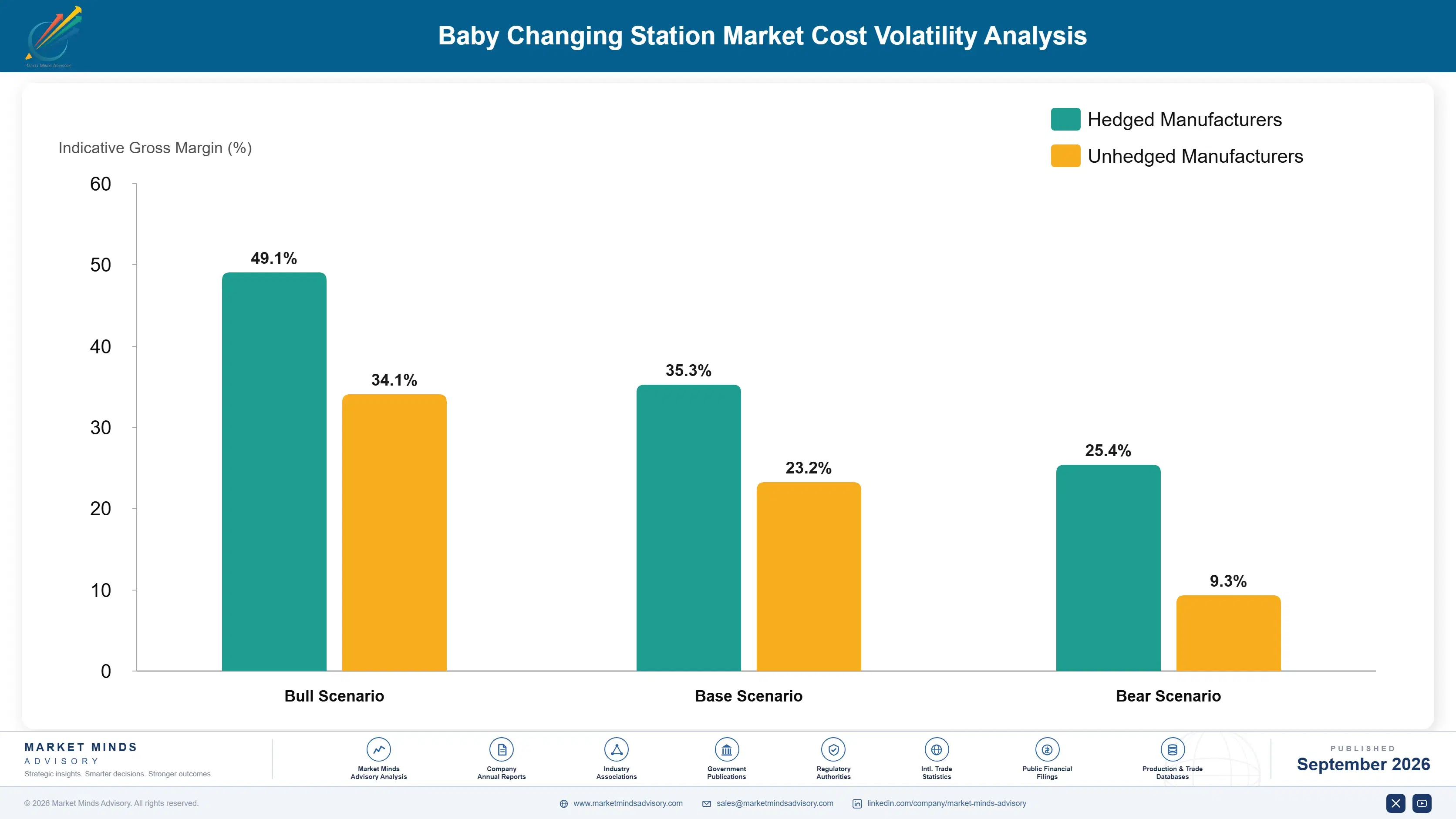
Plastic Resin and Steel Hardware Costs

High-density polyethylene plastic represents roughly 45 percent of cost of goods sold for standard changing station manufacturers, sourced primarily from petrochemical producers in the United States, China, and South Korea serving global markets. Steel mounting hardware and hinges represent a further meaningful cost share, sourced mainly from metal fabrication specialists concentrated in the United States and Mexico.
Plastic resin prices spiked sharply in 2022 amid oil price volatility and supply chain disruptions affecting petrochemical production broadly across major manufacturing regions, based on Census Bureau commentary on industrial materials supply chains and global trade flows. Several manufacturers reported input cost increases of 15 to 22 percent during that period before prices partially normalized through 2024, compressing margins across standard commodity-tier product lines most exposed to raw material costs.

Manufacturers reliant on single-source plastic resin suppliers face greater margin exposure during price spikes than diversified competitors who can shift sourcing across multiple petrochemical producers or regions on short notice. Smaller manufacturers without the purchasing scale to secure priority resin allocation carry the steepest exposure, since they lack the volume commitments larger manufacturers can offer during a shortage.
baby-changing-station-market-cost-volatility-analysis-1790014293601

Diversifying Plastic Resin Supply Across Regions

Larger manufacturers are securing supply contracts with petrochemical producers across multiple regions rather than relying on a single domestic source, reducing exposure to regional plant outages or energy cost spikes affecting any one market. This diversification requires more complex logistics and inventory management but meaningfully reduces the risk of production disruption during a regional supply shock.

Shifting Toward Metal and Composite Materials

Manufacturers are increasingly offering steel and composite material changing stations as alternatives to standard plastic construction, reducing overall exposure to petrochemical price volatility affecting the category broadly and across every product tier. This approach also appeals to facility owners seeking more durable fixtures for high-traffic installations facing heavy daily use and demanding maintenance schedules.

Portfolio Architecture for Margin Defence

The category splits into three commercial tiers with distinct margin economics. Volume commodity-adjacent standard plastic wall-mounted stations sold across mainstream retail and commercial facilities carry moderate margins given intense price competition among numerous compliant alternatives. Premium certified antimicrobial and hygiene-focused stations command higher margins through documented surface treatment and durability features, and the next-generation family restroom combination tier, while smallest in volume, captures a growing share of category gross profit through bundled specification value.
Volume producers compete on price and manufacturing scale, leaving moderate room to differentiate beyond basic compliance in a category with many similar entry-level competitors meeting minimum legislative requirements. Premium and next-generation suppliers instead compete on documented hygiene performance, coordinated fixture packages, and compliance consulting, letting them expand margin as facility owners prioritize total project value over unit price alone.

High-value margin pools concentrate in antimicrobial and family restroom combination products purchased as part of coordinated new construction and major renovation projects, where manufacturers can charge premium pricing for bundled specification value across the entire project. Standard wall-mounted stations remain the largest volume base but the thinner margin pool in the category, a gap that continues widening as legislative compliance increasingly favors hygiene-focused product lines.

Volume / Commodity-Adjacent Tier

Standard plastic wall-mounted stations sold across mainstream retail and commercial facilities, competing primarily on price and manufacturing scale rather than differentiated hygiene features or documentation and certification across the category.
Gross Margin: 18-26%

Premium / Certified Tier

Certified antimicrobial and hygiene-focused stations with documented surface treatment, sold to facility owners requiring verified bacterial resistance beyond standard compliance minimums for public restroom fixtures and installations nationwide and internationally.
Gross Margin: 30-38%

Sustainability / Regulatory / Next-Generation Tier

Family restroom combination units integrating changing functionality into coordinated fixture packages, sold into premium new construction applications commanding the category's highest specification value per project and installation nationwide and abroad.
Gross Margin: 40-50%
baby-changing-station-market-portfolio-architecture-1790014294099

High-value Sub-segments and Strategic Watch-out

Antimicrobial and Sanitizing Stations

Antimicrobial and Sanitizing Stations: the fastest-growing, highest-margin segment as facility owners increasingly treat documented hygiene features as a baseline requirement rather than an optional upgrade across every major facility category and price tier nationwide and internationally as well, especially in healthcare-adjacent settings and high-traffic public venues.
Gross Margin: 42-52%

Family Restroom Combination Units

Family Restroom Combination Units: strong growth and healthy margins as building codes increasingly require coordinated family restroom facilities in new construction across every major facility category and construction segment nationwide and internationally, especially in newer developments and renovation projects across every region, market, and building type.
Gross Margin: 40-50%

Wall-Mounted Horizontal Stations

Wall-Mounted Horizontal Stations: the largest volume base today, generating steady but moderate margins as manufacturers compete intensely on price across mainstream retail and commercial facility categories nationwide and internationally across every price tier, geographic market, and building type served today, tomorrow, and well into the future.
Gross Margin: 18-26%

Enforcement Consistency Risk

Enforcement Consistency Risk: a segment to watch as municipal inspection resources determine actual compliance timelines, potentially accelerating or delaying category growth depending on enforcement rigor across different jurisdictions, municipalities, and regulatory bodies nationwide and internationally over time, across every region, market, and facility type served.
Gross Margin: 20-30%

The Compliance Cycle Economics of Fixtures

Baby changing station purchasing behaves as a capital-cycle rather than repeat-purchase business, tied directly to construction timing and legislative compliance deadlines rather than periodic replenishment, which makes specification decisions during new construction or major retrofit projects more important than individual repeat sales relationships across the entire facility portfolio and every location within it nationwide and beyond.
Adoption stickiness varies by facility type. Large retail and hospitality chains show the deepest lock-in, since chain-wide equipment standardization simplifies maintenance and staff training across hundreds of locations spanning multiple regions and building types. Independent and smaller facilities show far less stickiness, with owners frequently selecting whichever manufacturer offers the best combination of price and compliance documentation at the specific time of their individual renovation project.

Buyer profiles are shifting as younger facilities managers and building compliance officers, more attentive to legal risk and documented hygiene standards than previous generations, increasingly treat changing station specification as a compliance requirement demanding careful vendor selection rather than a routine procurement decision handled without much consideration for legal exposure or reputational risk to the organization and its brand reputation with the public.
baby-changing-station-market-end-use-penetration-index-1790014294596

Where Manufacturers Should Focus Next

These are among the four positions where our research anticipates prominent divergence between winners and laggards over the coming forecast period. Each is grounded in the demand model, the regulatory perimeter, and the announced capacity pipeline.
01 / GENDER-NEUTRAL COMPLIANCE POSITIONING

Position products explicitly around gender-neutral access compliance

Manufacturers still marketing changing stations as a generic fixture rather than explicitly addressing gender-neutral access compliance are missing the primary purchase driver reshaping the category today across every major facility segment and price tier. Facility owners increasingly search for solutions framed specifically around legislative requirements rather than general product features or specifications alone. The manufacturers winning specification decisions today are the ones that built marketing and sales materials directly around compliance language facility owners actually search for and reference during procurement.
02 / COMPLIANCE CONSULTING EXPANSION

Build compliance consulting capability before competitors capture the advisory role

Facility owners navigating varying state and local legislation increasingly need expert guidance beyond basic product specifications, and manufacturers who position themselves as trusted compliance advisors capture deeper customer relationships than pure equipment vendors ever could achieve alone across the category and its many jurisdictions. This advisory positioning also generates consulting revenue independent of product margin, diversifying income beyond cyclical construction demand tied to broader economic conditions and construction cycles. Manufacturers slow to build this capability will watch competitors capture the advisory relationship first.
03 / BUNDLED FIXTURE PACKAGE DEVELOPMENT

Develop coordinated family restroom packages ahead of building code expansion

Building codes increasingly require coordinated family restroom facilities in new construction, and manufacturers offering bundled fixture packages capture more total project value than those selling standalone changing stations alone across every construction category, facility type, and price tier. This bundling trend will likely accelerate as more jurisdictions adopt family restroom requirements alongside gender-neutral access mandates already reshaping the category nationwide. Manufacturers who develop these coordinated packages now will be positioned to capture disproportionate specification value as this trend continues expanding.
04 / PLASTIC RESIN SUPPLY DIVERSIFICATION

Diversify resin sourcing before the next petrochemical price spike

Plastic resin price volatility has already forced temporary cost increases once this decade, and petrochemical supply concentration among a handful of producers means another disruption remains entirely plausible over the coming years. Manufacturers relying on a single resin supply contract carry meaningfully more margin risk than those who diversified sourcing after the last spike affected their production costs directly. The manufacturers best positioned for the next shock are the ones treating diversification as standard practice rather than a reactive response.

Engagement Snapshot From the Field

A live engagement with an industry participant carrying material or product regulatory and market exposure ahead of a defining policy shift, showing how our research translates into a defensible multi-year portfolio strategy.
MARKET MINDS ADVISORY · CLIENT ENGAGEMENT SUMMARY
Baby Changing Station Producer Strategic Portfolio Review and Transition Roadmap 2026·Investment Scenario on Baby Changing Station Exposure Evaluation 2025-26
CLIENT PROFILE
The client is a mid-sized regional retail chain operating 32 stores across the southeastern United States, serving family shopping traffic across suburban shopping centers. The chain had installed baby changing stations only in women's restrooms across most locations and faced a compliance deadline under newly enacted state gender-neutral access legislation requiring stations in all public restrooms.
STRATEGIC CHALLENGE
The chain needed to evaluate retrofit options across 32 stores with varying restroom layouts and plumbing infrastructure, while managing a constrained capital budget and a firm legislative compliance deadline within the current fiscal year and limited internal facilities management staffing capacity and expertise needed to coordinate a large-scale multi-site rollout.
MMA APPROACH
MMA benchmarked five changing station suppliers against the chain's store layouts and compliance timeline, evaluating retrofit installation complexity, unit pricing, and manufacturer support for multi-store rollout logistics across all 32 locations. The engagement combined primary interviews with facilities management staff and comparative cost modeling across phased and simultaneous rollout approaches.
KEY FINDINGS
  1. A phased rollout approach reduced peak capital outlay by approximately 30 percent (client-reported, unverified by MMA) compared to a simultaneous 32-store installation.
  2. Two of five evaluated suppliers offered compact, low-structural-modification station formats suited to the chain's older store restroom layouts and narrower spatial dimensions.
  3. The chain's oldest ten stores required meaningfully more complex retrofit work given narrower restroom dimensions than newer locations built more recently and to modern specifications.
  4. A twelve-month phased installation schedule allowed the chain to meet its compliance deadline while spreading capital investment across two separate fiscal years.
CLIENT PROFILE
The client is a mid-sized regional retail chain operating 32 stores across the southeastern United States, serving family shopping traffic across suburban shopping centers. The chain had installed baby changing stations only in women's restrooms across most locations and faced a compliance deadline under newly enacted state gender-neutral access legislation requiring stations in all public restrooms.
STRATEGIC CHALLENGE
The chain needed to evaluate retrofit options across 32 stores with varying restroom layouts and plumbing infrastructure, while managing a constrained capital budget and a firm legislative compliance deadline within the current fiscal year and limited internal facilities management staffing capacity and expertise needed to coordinate a large-scale multi-site rollout.
MMA APPROACH
MMA benchmarked five changing station suppliers against the chain's store layouts and compliance timeline, evaluating retrofit installation complexity, unit pricing, and manufacturer support for multi-store rollout logistics across all 32 locations. The engagement combined primary interviews with facilities management staff and comparative cost modeling across phased and simultaneous rollout approaches.
KEY FINDINGS
  1. A phased rollout approach reduced peak capital outlay by approximately 30 percent (client-reported, unverified by MMA) compared to a simultaneous 32-store installation.
  2. Two of five evaluated suppliers offered compact, low-structural-modification station formats suited to the chain's older store restroom layouts and narrower spatial dimensions.
  3. The chain's oldest ten stores required meaningfully more complex retrofit work given narrower restroom dimensions than newer locations built more recently and to modern specifications.
  4. A twelve-month phased installation schedule allowed the chain to meet its compliance deadline while spreading capital investment across two separate fiscal years.
RECOMMENDED STRATEGY
Phase 1: Phase one: install compliant stations at the ten oldest and most restroom-constrained stores within the first six full calendar months. Phase 2: Phase two: complete installation across the remaining twenty-two stores within the following six months to meet the firm compliance deadline. Phase 3: Phase three: establish a maintenance service contract with the selected supplier to ensure ongoing fixture compliance across the entire chain.
OUTCOME
The chain completed its 32-store retrofit within the twelve-month compliance window and achieved full gender-neutral access compliance ahead of the legislative deadline (client-reported, unverified by MMA). The phased approach preserved capital for other store improvements while meeting all regulatory requirements on schedule and within budget.

Frequently Asked Questions

Foundational context covering the market sizes, CAGR, scope, country, region and competition that inform every finding below. This section is provided to cover basics and most often pre-purchase conversations, answered from the MMA Primary Research Dataset.

What is the current size of the Baby Changing Station Market?

The market reached $1.1 billion globally in 2025. This covers wall-mounted, portable, and antimicrobial fixtures installed in public restrooms for infant diaper changing across commercial facility categories.

How large will the Baby Changing Station Market be by 2036?

MMA projects the market will reach $1.77 billion by 2036 under the base case scenario. That represents roughly 1.54 times the 2026 starting value over the ten-year forecast window.

What is the CAGR for the Baby Changing Station Market 2026 to 2036?

The base case CAGR is 4.4 percent annually through 2036. Bull and bear scenarios range from 3.1 to 5.7 percent depending on legislative enforcement consistency.

Which segment is growing fastest?

Antimicrobial and sanitizing stations lead at an 8.0 percent CAGR, roughly 1.82 times the overall market rate. Family restroom combination units follow as the second-fastest segment.

Who are the major companies in the Baby Changing Station Market?

Bobrick Washroom Equipment, ASI Group, Rubbermaid Commercial Products, Foundations Worldwide, and Bradley Corporation lead the market. Together they hold an estimated CR5 near 48 percent of category revenue.

Which country is growing fastest?

The United States leads at an estimated 4.9 percent CAGR, driven by comprehensive gender-neutral access legislation requiring stations nationwide. South Asia and Pacific follows closely as retail modernization accelerates adoption.

Report Segmentation Architecture

The full report scope spans multiple orthogonal segmentation dimensions, with cross-tabulated demand data provided for each dimension pair. Coverage extends further to regional breakdowns, trend trajectories, and the competitive detail needed to support segment-level decision-making.

By Primary Market Dimension

  • Wall-Mounted Horizontal Stations
  • Wall-Mounted Vertical Stations
  • Portable and Freestanding Stations
  • Antimicrobial and Sanitizing Stations
  • Family Restroom Combination Units
  • Other Specialty Formats

By End-Use Industry

  • Retail and Shopping Centers
  • Hospitality and Foodservice
  • Transportation and Travel Facilities
  • Institutional and Government Buildings
  • Healthcare and Educational Facilities

By Commercial Dimension

  • New Construction Specification
  • Retrofit Installation
  • Compliance Consulting Services
  • Maintenance and Service Contracts

By Region

  • North America
  • Western Europe
  • East Asia
  • South Asia and Pacific
  • Latin America
  • Middle East and Africa
  • Eastern Europe

Scope, Methodology, and Coverage

Every figure in this report is reproducible from documented input assumptions. The scope below maps the historical period, the forecast horizon, the segmentation dimensions, and the countries covered, alongside the underlying primary and qualitative methodology.
Historical Period
2020 to 2025
Forecast Period
2026 to 2036
Base Year
2025 (USD billions; MMA Primary Research Dataset, September 2026)
Market Definition
The baby changing station market covers wall-mounted, portable, and antimicrobial fixtures installed in public restrooms for infant diaper changing, spanning retail, hospitality, transportation, and institutional facility categories. It excludes residential changing tables and furniture, diaper disposal units sold separately from changing surfaces, and general restroom accessibility fixtures unrelated to infant care.
Quantitative Units
USD billions (current prices); unit volume of stations sold where applicable
Segmentation Dimensions
By Primary Market Dimension; By End-Use Industry; By Commercial Dimension; By Region
Regions Covered
North America, Western Europe, East Asia, South Asia and Pacific, Latin America, Middle East and Africa, Eastern Europe
Countries Covered
USA, China, Germany, France, UK, Japan, South Korea, India, Australia, Canada, Brazil, Mexico, Indonesia, Vietnam, Thailand, Malaysia, UAE, Saudi Arabia, South Africa, Nigeria, Turkey, Poland, Netherlands, Italy, Spain, Sweden, Switzerland, Argentina, Colombia, Singapore, and additional markets relevant to this sector
Key Companies Profiled
Bobrick Washroom Equipment, ASI Group, Rubbermaid Commercial Products, Foundations Worldwide, Bradley Corporation, Brocar Products, Continental Commercial Products, Gamco Commercial Products, Palmer Fixture Company, Metpar Corporation, Alpine Industries, Renown Products, Impact Products, Frost Products, Bemis Manufacturing Company, Global Partitions, Scranton Products, Hadrian Manufacturing, Georgia-Pacific, Excel Dryer
Quantitative Methodology
Primary survey, n=3,800 respondents, Q4 2025, six countries; demand-side model with trade association cross-validation
Qualitative Methodology
47 expert interviews, Q4 2025; applied to validate demand model assumptions, identify emerging dynamics, and assess competitive positioning
Report Format
PDF and XLSX data workbook (Word format preview document)
Publisher
Market Minds Advisory
Report Code
MMA-2026-CON-217
Published
September 2026
Contact
sales@marketmindsadvisory.com | www.marketmindsadvisory.com

Purchase the full Baby Changing Station Market Report (2026 to 2036).

This report delivers a comprehensive assessment of the baby changing station market, covering market sizing, segmentation, and regional demand through 2036 across seven major world regions. It profiles the twenty leading washroom fixture manufacturers, benchmarking competitive positioning, moat durability, and emerging risk across the top two market leaders in depth. The analysis includes detailed input cost exposure, portfolio margin architecture, and revenue diversification opportunities specific to commercial fixture manufacturers. A dedicated case study illustrates how a regional retail chain navigated a live compliance retrofit engagement.
Ten-year market sizing and forecast to 2036
Six-segment MECE product segmentation overview detailed
Seven-region demand, share, and growth rate analysis
Twenty-company competitive benchmarking with moat and risk assessment
Input cost exposure and mitigation pathways
Anonymized retail chain compliance retrofit case study

Built For The People Who Decide

From boardroom strategy to bench-side execution, this report is read cover-to-cover by leaders shaping the next decade of their industry, turning demand scenarios, market dynamics and valuation benchmarks into decisions.
CXOs/ Presidents/ VPs/ Managers
M&A and Corporate Development
Strategy Teams and R&D Heads
Procurement and Product Directors
Regulatory and Compliance Leaders
Investor Relations and Equity Analysts