Market Minds Advisory
Baby Car Safety Seat Market

Baby Car Safety Seat Market: Baby Car Safety Seat Market. Sensor-Enabled Smart Seats Extend Safety Standards Beyond Regulatory Minimums

Rising child occupant safety regulation and sensor-enabled monitoring technology are pulling baby car seat demand toward smart connected systems that exceed mandatory crash protection minimums across nearly every major market.

Lead Analyst

Published

September 2026

Make Smarter Decisions with Customized Research Insights

Request a free sample report and evaluate market opportunities, growth trends, and competitive dynamics relevant to your business needs.

2025 MARKET VALUE$6.2BMarket Size 2025
2036 FORECAST VALUE$11.2BBase Case , 2026 to 2036
CAGR 2026 TO 20365.5 %Bull 6.7% / Bear 4.3%
INCREMENTAL OPPORTUNITY$4.6BNet 10- year value creation
EXPANSION MULTIPLE1.71x2036 value over 2026 base
Strategic Levers
M&A Pipeline
Regional Outlook
Country Rankings
Competitive Intelligence
Segmental Deep-dive
Call-Us : 91 93563 13602

Executive Snapshot and Market Trajectory.

Baby car seats have moved past basic regulatory compliance toward sensor-enabled monitoring systems, with smart connected features now driving most incremental category revenue growth among safety-conscious parents. Retailers are reallocating shelf space toward these sensor-enabled releases accordingly, a shift unseen just a few years ago.
Smart connected seats and premium travel system-compatible models are pulling budget away from basic compliant seats, particularly among first-time parents who want continuous monitoring alerts and app-based safety notifications. Direct-to-consumer specialty brands are capturing disproportionate share of this shift, often ahead of legacy mass-market incumbents still anchored to basic compliance-only product lines. Adoption is broadening across new-parent households in nearly every major regional market tracked this year.
Competitive intensity centers on established juvenile products conglomerates defending share against fast-growing specialty safety technology brands built entirely around sensor integration and connected mobile applications. Regulatory testing standards are tightening in several major markets, forcing crash safety certification investment across the category's premium tier. Brands moving fastest on certification renewal and sensor accuracy are positioned to capture share from slower-moving legacy competitors over the next several product cycles. This trend should intensify further.
Market Definition
The baby car safety seat market covers infant, convertible, all-in-one, booster and smart connected car seats designed for child automotive occupant protection from birth through booster age. It excludes stroller travel systems sold separately, general child safety products, and aftermarket seat accessories not integral to crash protection.
Base Year Value
$6.2B in 2025 (MMA Primary Research Dataset, September 2026)
Forecast Period
2026 to 2036, eleven discrete annual values
CAGR
5.5% base case. Bull 6.7%. Bear 4.3%.
Fastest Growth Segment
Smart and Connected Car Seats: 8.5% CAGR
Fastest Growth Country
India: 8.0% CAGR
Fastest Growth Region
South Asia and Pacific: 7.7% CAGR
Largest Region
North America: 28% of 2025 global value
Market Leaders
Britax, Graco, Chicco, Cybex and Maxi-Cosi lead the category. Source: MMA Primary Research Dataset, July 2026.
Primary Survey
n=3,800 procurement and R&D decision-makers, Q4 2025, six countries
Methodology
Demand-side build-up, cross-validated against public data, 47 expert interviews

Baby Car Safety Seat Market Forecast Scenarios

baby-car-safety-seat-market-size-forecast-scenario-1790014795638
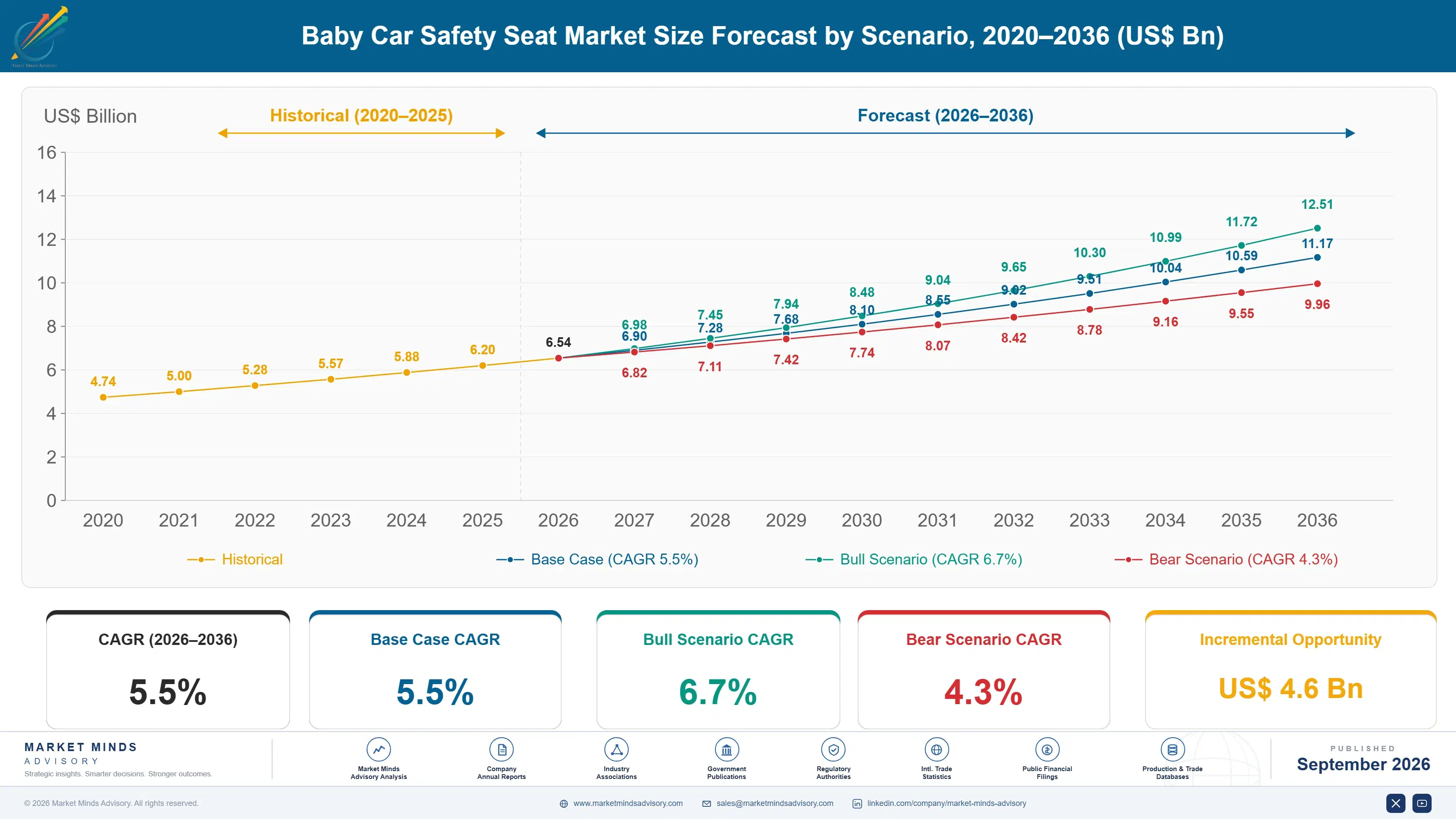
Between 2020 and 2025 the baby car safety seat category grew at a steady 4.8 percent historical pace, supported by stable birth rates in key markets and rising replacement frequency as crash safety standards tightened across major regulatory jurisdictions. Manufacturers introduced updated compliance models steadily throughout this period as testing protocols evolved. Supply constraints briefly limited sensor component availability before manufacturers rebuilt capacity.
The base case assumes continued migration from basic compliant seats toward smart connected and travel system-compatible models, sustained regulatory tightening requiring updated crash certification, and expanding specialty retail footprint in emerging markets where child safety awareness is still building. These three mechanisms together support a 5.5 percent forecast CAGR through 2036, with smart connected seats carrying the bulk of incremental category growth. Legacy basic compliant lines continue generating steady baseline revenue, cushioning overall category volatility.
The bull case centers on faster-than-expected regulatory mandates requiring sensor-based occupancy monitoring in new vehicle sales. The bear case assumes declining birth rates in mature developed markets compress unit volume growth, pushing manufacturers toward price competition that erodes the premium positioning currently sustaining category margins. Faster regulatory adoption would push category value toward the upper end of the forecast range.

Sensor Technology Redefines Seat Safety Value

Baby car seats span an unusually wide price range within a single safety category, with average prices varying nearly sixfold between basic compliant seats and premium smart connected models. This spread gives manufacturers wide latitude to trade parents up as safety awareness and technology adoption mature over time. Manufacturers price entry seats low, using them as a gateway toward higher-margin smart lines over later purchase cycles.
CATEGORY CONCENTRATION42% CR5Top five brands hold combined category revenue share currently
AVERAGE SELLING PRICE$185.00Blended price across infant, convertible and all-in-one models
TOP PRODUCING COUNTRYChina, 29%Leading manufacturing origin country by export shipment volume
REPLACEMENT CYCLE LENGTH4 yearsAverage years before typical household seat replacement occurs
SMART SEAT REPEAT RATE38%Share of buyers repurchasing smart models within four years
SENSOR COMPONENT COST SHARE22% of COGSSensor and electronics share of smart seat production cost
China anchors global manufacturing for the category, while European and American safety technology houses increasingly license sensor chemistry to manufacturers across this hub rather than developing comparable capability independently. Specialty juvenile products retail continues taking share from general mass retail channels as parents seek curated, higher-touch shopping guidance. This pattern should persist while sensor technology development remains concentrated among a small number of specialized innovators.
Replacement economics favor smart connected models over basic compliant seats, since safety-conscious parents replenish their entire seat system across multiple children rather than replacing individual components piecemeal over time. Crash test rating transparency now functions as a genuine differentiator, since informed parents evaluate independent safety certification as closely as sensor accuracy itself. Manufacturers investing in transparent third-party crash testing report higher trust than competitors relying on internal claims alone.
"Independent crash test transparency is quietly becoming the category's real competitive battleground while marketing claims fade into background noise for informed parents. Brands slow to publish third-party safety data are ceding their most valuable customer relationships to faster-moving specialty challengers."
Senior Analyst, Consumer Durables and Juvenile Products Practice · MMA Infant and Child Automotive Restraint Systems Practice · September 2026

Market Trends

Sensor-Enabled Occupancy Monitoring Becomes A Mainstream Standard

Parents are increasingly choosing car seats with built-in occupancy sensors that trigger smartphone alerts if a child remains unattended in the vehicle, addressing a recognized cause of preventable child injury and fatality incidents. Manufacturers responding fastest to this shift are expanding sensor integration well beyond their original basic compliant product assortments, reallocating research budget toward reliable connectivity and battery longevity development. Specialty retailers report smart seat sales now outpacing basic compliant unit growth by a wide margin across most major urban markets tracked this year. This transition is reshaping product development priorities at major manufacturers worldwide.
Market Impact: Adds 20 percent to compliance cost

Independent Crash Test Transparency Drives Purchase Decisions

Publicly available independent crash test ratings and side-impact protection scores have become the dominant factor in purchase decisions, replacing brand reputation alone as the primary way parents evaluate competing products before buying. Brands publishing transparent third-party testing data see measurably faster adoption curves for new product launches than those relying solely on internal marketing claims. This shift has compressed the credibility gap between established and newer entrant brands considerably. Brands lacking a credible independent testing partnership are increasingly struggling to gain visibility against faster-moving specialty challengers in the premium tier.
Market Impact: Adds 550 new specialty store locations

Market Opportunities and Growth Drivers

Tightening Regulation Mandates Updated Crash Standards

Regulators in several major markets are tightening minimum crash protection and side-impact testing requirements, citing updated child injury research that justifies stricter certification thresholds than previous regulatory generations required. This regulatory push is forcing manufacturers to invest in updated crash engineering and recertification across their full product lines, particularly affecting older seat designs approaching mandatory phase-out deadlines. Manufacturers positioned to meet new certification requirements early report stronger retail channel relationships than competitors slower to secure compliance approval. Regional standards bodies are expected to tighten further over the next several years, sustaining this regulatory tailwind across most major developed markets.
Market Impact: Limits secondhand market under 5 percent

Specialty Juvenile Retail Expansion Widens Category Access

Specialty juvenile products retail chains are expanding store counts across secondary cities in emerging markets, bringing curated safety-certified assortments to consumers previously limited to basic general retail selections. This expansion gives premium and mid-tier brands physical shelf access they could not previously secure outside major metropolitan flagship locations. Retailers report car seat sales per square foot rising faster than most other juvenile product subcategories as safety awareness converts browsers into repeat buyers across an expanding footprint. This growing physical footprint also supports in-store fitting and installation verification that online-only channels cannot replicate as effectively.
Market Impact: Cuts developed-market volume growth 2 percent

Market Restraints and Challenges

Mandatory Expiration Dates Constrain Resale Market

Baby car seats carry mandatory expiration dates, typically six to ten years from manufacture, that legally prohibit resale or continued use beyond the certified safety window regardless of physical condition. The root cause is that plastic and foam components degrade in ways that compromise crash protection performance over time, even without visible damage or wear. This friction eliminates the secondhand market that supports affordability in other juvenile product categories, though manufacturers are mitigating impact by offering trade-in and recycling programs that reduce disposal cost for expired units. Some manufacturers now offer trade-in programs to reinforce trust in the mandated cycle.
Market Impact: Cuts unattended-child incidents 40 percent

Declining Birth Rates Constrain Long-Term Volume Growth

Declining birth rates across several mature developed markets are constraining long-term unit volume growth potential, limiting the category's exposure to population-driven demand expansion that supported historical growth rates. The root cause is broader demographic shifts toward smaller family sizes and delayed childbearing across most high-income economies globally. Manufacturers are mitigating this exposure by expanding premium product mix and geographic diversification toward emerging markets where birth rates remain comparatively stable. Emerging market expansion is expected to offset roughly half of the volume pressure from mature market demographic decline. Early results support this diversification thesis.
Market Impact: Lifts informed purchase conversion 30 percent
3 additional market trends, 4 additional growth drivers, and 3 additional restraints and challenges are covered in the full report. Contact sales@marketmindsadvisory.com to access the complete intelligence.

Segment CAGR and Growth Architecture

Baby car seats break into six product-type segments spanning infant, convertible, all-in-one, booster, travel system-compatible and smart connected seats, each carrying distinct margin profiles, replacement cycles and retail positioning within the broader juvenile safety product category. Classification follows a single product-format logic throughout, avoiding any mixing with age range, installation method or distribution channel.
baby-car-safety-seat-market-market-share-analysis-1790014796178

Smart and Connected Car Seats

Smart and connected car seats represent the fastest-growing segment, delivering built-in occupancy sensors, temperature monitoring and smartphone connectivity that alert parents to potential safety issues in real time. Growth here reflects genuine functional expansion beyond basic crash protection rather than simple category upsizing, since many buyers purchase smart seats specifically for the monitoring capability rather than incremental crash safety improvement alone. Manufacturers are racing to expand sensor reliability and battery longevity, since connectivity dependability remains the primary purchase driver for this rapidly growing consumer segment currently expanding fastest across most major developed markets tracked. Specialty retailers increasingly dedicate standalone shelf sections to this segment alone, a shift unseen just a few years ago.
CAGR 8.5%

Travel System-Compatible Car Seats

Travel system-compatible car seats form the second-fastest-growing segment, combining infant seat crash protection with stroller frame compatibility that lets parents transfer a sleeping infant without disturbance between vehicle and stroller. This segment benefits directly from new-parent convenience priorities, since compatible travel systems reduce daily logistical friction that standalone infant seats cannot address. Retailers report travel system bundles performing particularly well among first-time parents, capturing new-to-category buyers who eventually expand into broader convertible and booster purchases as their child grows older. Premium bundled travel system lines combining matched stroller and seat colorways are emerging as a durable subcategory carrying materially higher price points than standalone infant seats. Early data suggests attach rates for these matched bundles are climbing steadily.
CAGR 7.0%
Full segment breakdown across 6 segments available in the complete report.

Regional Architecture and Country Demand Map

North America leads global baby car seat demand through strict occupant safety regulation and high per-capita vehicle ownership, while Western Europe sustains dense compliance infrastructure and South Asia and Pacific accelerates fastest on rapidly rising vehicle ownership and expanding safety awareness among younger families nationwide.

North America

The United States accounts for the overwhelming majority of regional baby car seat demand, anchored by all-fifty-state mandatory seat laws and a well-established specialty juvenile products retail network serving highly safety-conscious parents. Canada tracks similar consumption patterns at smaller absolute scale, reinforced by comparably strict federal safety regulation. American consumers were early adopters of smart connected seat technology, giving domestic brands a head start on sensor integration that international competitors are still working to close. Hospital-based installation check programs continue reinforcing product discovery patterns already well established among first-time parents nationwide. Retailer loyalty programs targeting repeat multi-child purchases have become a genuine competitive differentiator across the region's largest specialty chains.
Share: 28% | CAGR: 6.5% (2026 to 2036)

Western Europe

Germany, France and the United Kingdom drive the bulk of Western European baby car seat demand, supported by unified European Union crash testing standards that favor established manufacturers with existing compliance infrastructure over newer entrants. The region's regulatory environment has slowed some novel sensor technology launches relative to less restrictive markets, contributing to comparatively modest regional growth. German engineering heritage brands maintain strong domestic loyalty despite growing competition from faster-moving international challengers. Nordic countries show above-average adoption of extended rear-facing seat designs, reflecting regional pediatric safety guidance recommendations. Slower regulatory approval for novel sensor technologies means European consumers often gain access to new features well after they debut in less restrictive markets.
Share: 24% | CAGR: 4.0% (2026 to 2036)
Regional intelligence for 5 additional markets available in the complete report: East Asia, South Asia and Pacific, Latin America, Middle East and Africa, Eastern Europe. Contact sales@marketmindsadvisory.com.
baby-car-safety-seat-market-country-cagr-analysis-1790014796738

Smart Seat Margin Expansion Playbook

Manufacturers capture disproportionate margin by trading parents up from basic compliant seats toward smart connected and travel system-compatible models, building trade-in and recycling programs that reinforce trust, and expanding specialty retail exclusives that command premium pricing over mass channel assortments sold nationwide. This combination of trade-up mechanics and loyalty retention compounds meaningfully over multiple replacement cycles across each family.

Smart Seat Trade-Up Programs Lift Basket Value

Manufacturers running structured trade-up programs, showcasing smart connected seats to loyal basic-model buyers through hospital and pediatrician partnerships, report meaningfully higher conversion into the higher-margin smart category than passive in-store merchandising alone achieves. This approach works because expecting parents already trust the brand's safety reputation, lowering the perceived risk of trying an unfamiliar connected format for the first time. Brands running these programs report conversion rates near 20 percent within the first year of program launch. Manufacturers scaling this approach across their full hospital partnership network report the strongest incremental margin gains of any single initiative tested this year.
Market Impact: Lifts smart category conversion by 20 percent overall

Trade-In and Recycling Programs Sustain Loyalty

Structured trade-in programs offering discounts on new seat purchases when parents surrender expired units reduce disposal friction while sustaining brand loyalty through the mandatory replacement cycle inherent to this category. Manufacturers report trade-in customers generating meaningfully higher repeat purchase rates than customers who dispose of expired units independently, since the recurring touchpoint also increases exposure to complementary product cross-sell opportunities. Retention rates for trade-in program participants reportedly exceed 60 percent across subsequent purchase cycles. Manufacturers extending trade-in eligibility to competitor brand seats report broader program enrollment and stronger long-term loyalty.
Market Impact: Raises repeat purchase rate by 35 percent overall

Specialty Retail Exclusives Command Premium Pricing

Manufacturers launching design variants or bundled colorways exclusively through specialty juvenile products retailers capture premium pricing that identical products sold through mass general retail channels cannot sustain, since exclusivity itself signals higher perceived quality to safety-conscious shoppers. This strategy also strengthens the manufacturer's negotiating position with specialty retail partners, who value exclusive assortment as a genuine point of differentiation against competing chains. Exclusive specialty launches typically command price premiums of 15 to 25 percent over comparable mass channel products. Manufacturers negotiating these exclusives report stronger co-marketing support from retail partners eager to protect their differentiated assortment position.
Market Impact: Adds a 15 to 25 percent price premium

Bundled Travel System Packages Increase Order Value

Selling coordinated infant seat, stroller and base packages under a single travel system order increases average order value and introduces consumers to complementary products they might not otherwise discover through single-item browsing behavior. Bundled packages also reduce per-unit marketing spend relative to individual product campaigns while increasing the likelihood that a buyer completes their entire nursery-to-vehicle setup within one brand rather than mixing competitor products. Manufacturers report bundle attach rates reaching roughly 33 percent among first-time parent buyers. Manufacturers coordinating bundle timing with hospital registries report even stronger conversion than bundles sold without accompanying registry integration.
Market Impact: Raises bundled average order value by 33 percent

Who Controls the Margin Pool

Britax and Graco lead the baby car safety seat market with a combined revenue share that outpaces the broader field of legacy mass-market challengers, reflecting years of accumulated crash safety engineering credibility and specialty retail relationships that newer entrants cannot quickly replicate. The gap between these two leaders and third-ranked Chicco remains wide on a revenue basis, the consistent yardstick applied throughout this competitive assessment.
Current competitive activity centers on expanding smart connected sensor lines, launching updated crash safety certifications ahead of tightening regulatory deadlines, and building direct-to-consumer trade-in programs that capture recurring revenue previously ceded to secondhand disposal. Manufacturers are also investing in transparent independent crash test publishing, since safety data disclosure has become a genuine competitive differentiator rather than a marketing afterthought across the broader category.

Emerging pressure comes from independent safety technology brands securing niche sensor and monitoring partnerships that larger manufacturers consider too small to pursue, and from hospital and pediatrician recommendation networks increasingly favoring brands with published clinical safety data. Rankings could shift meaningfully if a major juvenile products conglomerate acquires a specialist sensor technology brand to close its connectivity gap, a move several industry observers consider increasingly likely given current competitive pressure.
baby-car-safety-seat-market-company-positioning-matrix-1790014797264

Competitive Moat and Risk Dimensions

BRITAX

Moat: Crash Engineering Credibility Depth

Britax's decades-long reputation for engineering-first crash safety design, built through independent testing partnerships and transparent safety data publishing, gives it credibility that marketing-led competitors struggle to replicate quickly. This engineering reputation drives recommendation-based discovery among safety-focused parents and pediatric professionals. Parents who see pediatrician recommendations are also far more likely to purchase Britax's coordinated product catalog immediately after.
BRITAX

Risk: Premium Pricing Exposure Risk

Britax's premium price positioning leaves it exposed if economic pressure pushes budget-conscious parents toward lower-priced compliant alternatives that meet minimum regulatory standards. A prolonged shift toward value-oriented purchasing would compress the pricing power that currently underpins its engineering-led positioning. Britax has begun testing selective mid-tier sub-lines to control this exposure without diluting its core engineering positioning.
GRACO

Moat: Mass Retail Distribution Depth

Graco's retail footprint spans mass merchants, specialty juvenile retailers and e-commerce at a scale few competitors can match, giving its product lines immediate broad shelf access on launch day. This distribution reach lowers customer acquisition cost relative to brands dependent on direct-to-consumer channels alone. Consumers trust broad retail availability more than niche specialty channels for everyday compliant seat purchasing decisions.
GRACO

Risk: Mass Channel Price Ceiling

Graco's mass-market distribution strategy caps its achievable price point relative to specialty and prestige competitors, limiting margin expansion even as smart connectivity features grow across the broader category. A shift toward premium specialty retail would require rebuilding its current distribution model considerably. Competitors born specialty-first collect richer margin per unit that increasingly funds faster connectivity feature development.

Players Tracked

Prominent Players

Britax
Graco
Chicco
Cybex
Maxi-Cosi

Other Key Players

Evenflo
Nuna
Diono
Clek
UPPAbaby
Inglesina
Peg Perego
Doona
Joie
Baby Jogger
Recaro
Bugaboo
4moms
Combi
Wayb

Recent Developments

FEBRUARY 2026

Britax Launches Expanded Smart Sensor Line

Britax launched an expanded smart sensor product line covering occupancy monitoring and temperature alert features, addressing a gap identified through customer feedback on limited connectivity options. The launch includes updated crash certification compliant with regional testing standards. Analysts expect competitors to follow with comparable connected product launches.
Signal: Confirms sensor technology as a genuine competitive battleground across the category Rivals are expected to expand sensor features soon.
OCTOBER 2025

Graco Acquires Sensor Technology Startup

Graco acquired a sensor technology startup specializing in occupancy detection chemistry, integrating proprietary connectivity capability directly into its existing product development pipeline. The acquisition strengthens Graco's smart feature innovation timeline ahead of planned expansion into additional connected product categories next year. Integration completes within two quarters.
Signal: Signals growing manufacturer investment in owned sensor technology capability Competitors without similar capability risk falling behind on innovation speed.
JUNE 2025

Chicco Signs Retail Exclusive Distribution Agreement

Chicco signed a multi-year exclusive distribution agreement with a major specialty juvenile products retailer covering its full smart seat product line across all store locations. The agreement excludes competing retailers from carrying the same product line for the agreement's duration. Analysts view the deal as a template for future negotiations.
Signal: Highlights growing use of retail exclusivity as a differentiation strategy Smaller manufacturers may struggle to secure comparable exclusive retail terms.

Molding and Sensor Supply Concentration

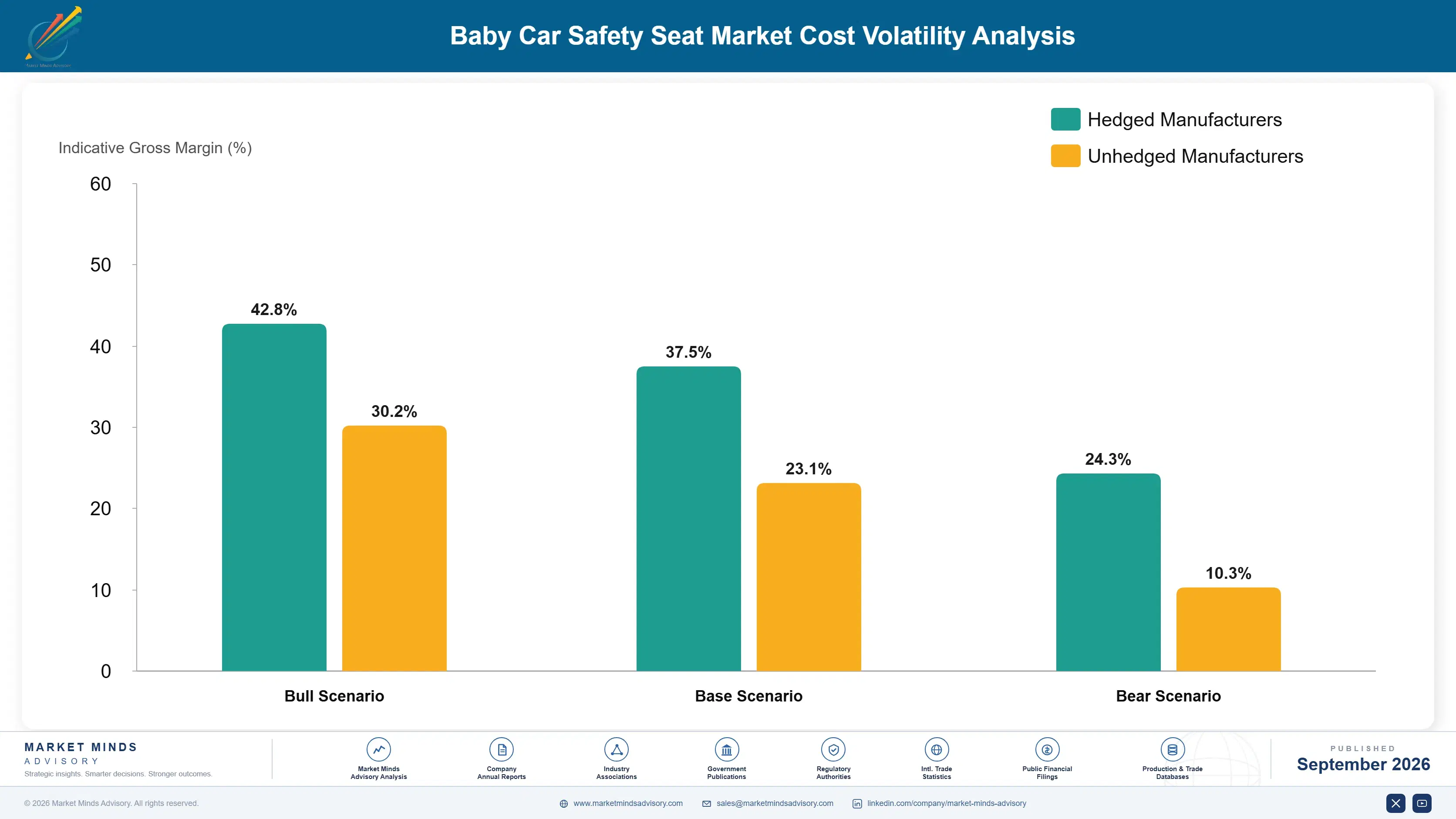
Molded plastic shells, energy-absorbing foam and steel reinforcement together account for roughly 36 percent of baby car seat production cost, with the majority of plastic and foam supply originating from manufacturers concentrated in China and Vietnam. Sensor electronics and connectivity components add further concentrated exposure to a smaller set of specialized suppliers. This geographic concentration leaves the category exposed to regional trade and export policy shifts.
Petrochemical-derived foam and plastic price volatility during 2021 through 2022, documented in company annual reports across the juvenile products sector, pushed input costs meaningfully higher and forced several manufacturers to delay planned product line expansions tied to seasonal launch calendars. Pricing on affected materials rose noticeably during the volatility before stabilizing through 2023 as alternative sourcing came online. Manufacturers with diversified material sourcing weathered the volatility with noticeably shorter delays than single-source competitors.

Smaller independent brands carry disproportionately higher input cost exposure because they lack the purchase volume to negotiate favorable material pricing that larger manufacturers secure through long-term supply agreements. This disadvantage compounds when a certification deadline forces smaller brands into spot-market material purchasing at premium prices, while established manufacturers with forward-contracted supply avoid the same exposure entirely during identical volatility conditions.
baby-car-safety-seat-market-cost-volatility-analysis-1790014797466

Qualifying Secondary Material Suppliers

Manufacturers are qualifying secondary plastic and foam suppliers outside their traditional concentrated base, reducing single-source dependency risk ahead of future volatility cycles. This diversification adds modest upfront qualification cost but meaningfully shortens recovery time when supply tightens again. Manufacturers report qualification timelines of three to five months, a worthwhile tradeoff against the multi-month delays experienced during the last volatility cycle.

Forward Contracting Seasonal Material Needs

Larger manufacturers increasingly lock in multi-quarter forward supply contracts for foam and sensor components ahead of major seasonal launch windows, trading pricing flexibility for delivery certainty. This approach proved valuable during the prior volatility cycle across the category. Several manufacturers extended existing supplier relationships into multi-year agreements following the 2021 through 2022 volatility, prioritizing certainty over marginal cost savings.

Standardizing Shell Molding Platforms

Design teams are standardizing shell molding platforms across multiple product lines, reducing the total number of unique components a manufacturer must source and qualify for any given seasonal launch. This also lowers overall reformulation risk. This standardization also shortens new product development timelines since design teams reuse qualified platforms rather than sourcing new components for every launch.

Portfolio Architecture for Margin Defence

Gross margin economics diverge sharply across the three tiers structuring this market, from thin-margin volume infant seats competing largely on price to premium smart connected and travel system-compatible models where sensor technology and specialty retail positioning support wider margins. Sustainability-focused recycled-material products occupy a smaller but expanding third tier as environmental claims increasingly matter to younger parents.
Manufacturers face a persistent tension between chasing volume share in commodity infant seat assortments, where competition is fiercest and margins thinnest, and concentrating capital on premium certified smart products that deliver superior returns per unit sold but require ongoing sensor technology investment. Most established players now allocate a growing share of new product development budget toward the premium tier.

High-value margin pools concentrate overwhelmingly in smart connected seats and bundled travel system packages, where sensor technology and specialty retail exclusivity command sustained premium pricing that commodity infant seats simply cannot replicate. Manufacturers capturing the largest share of these pools tend to be those with the deepest sensor expertise and fastest certification renewal cycles synchronized to regulatory update calendars. This dynamic is expected to intensify as more challengers pursue sensor technology investment across the category.

Volume / Commodity-Adjacent

Generic infant and convertible seats sold at accessible price points through mass retail channels, competing primarily on price against private-label alternatives. These products rely on high unit volume and broad retail distribution rather than sensor exclusivity to sustain profitability.
Gross Margin: 20 to 28 percent

Premium / Certified

Smart connected and travel system-compatible models carrying verified sensor performance, sold through specialty juvenile retail at sustained premium pricing. Buyers in this tier are willing to pay significantly more for verified sensor reliability and connected features.
Gross Margin: 40 to 50 percent

Sustainability / Regulatory / Next-Generation

Recycled-material and low-impact manufacturing seats meeting emerging environmental disclosure standards, appealing to sustainability-conscious younger parents. This tier remains small today but is expanding as environmental disclosure expectations shift among younger parents over time.
Gross Margin: 42 to 52 percent
baby-car-safety-seat-market-portfolio-architecture-1790014797971

High-value Sub-segments and Strategic Watch-out

Smart and Connected Car Seats

Sensor-enabled smart seats command the highest per-unit margins in the category, combining connectivity exclusivity with strong safety-driven purchase economics. Manufacturers with the strongest sensor expertise capture the largest share of this margin pool consistently over time. This concentration should persist through the forecast period. Retailers dedicate growing shelf space accordingly.
Gross Margin: 44 to 54 percent

Bundled Travel System Packages

Matched infant seat, stroller and base sets deliver strong margins with moderate but steadily expanding growth as first-time parents seek complete solutions. Attach rates continue climbing as manufacturers expand matched package lines across a growing number of stroller partnerships. Growth here should outpace the standard catalog segment.
Gross Margin: 34 to 42 percent

Standard Infant and Convertible Seats

The volume core of the category, standard infant and convertible seats sustaining steady baseline demand across mainstream retail and mass channels. This segment anchors overall category volume even as manufacturer strategic attention shifts increasingly toward higher-margin premium tiers. Absolute volume keeps rising as margin share slowly declines.
Gross Margin: 20 to 28 percent

Declining Birth Rate Volume Pressure

Demographic decline in mature developed markets represents a strategic watch-out, constraining unit volume growth and pushing manufacturers toward premium mix strategies. Manufacturers are investing in emerging market expansion to offset this demographic headwind before it compounds further. Left unchecked, this trend limits developed-market growth industry wide.
Gross Margin: not applicable

Mandated Replacement Revenue Architecture

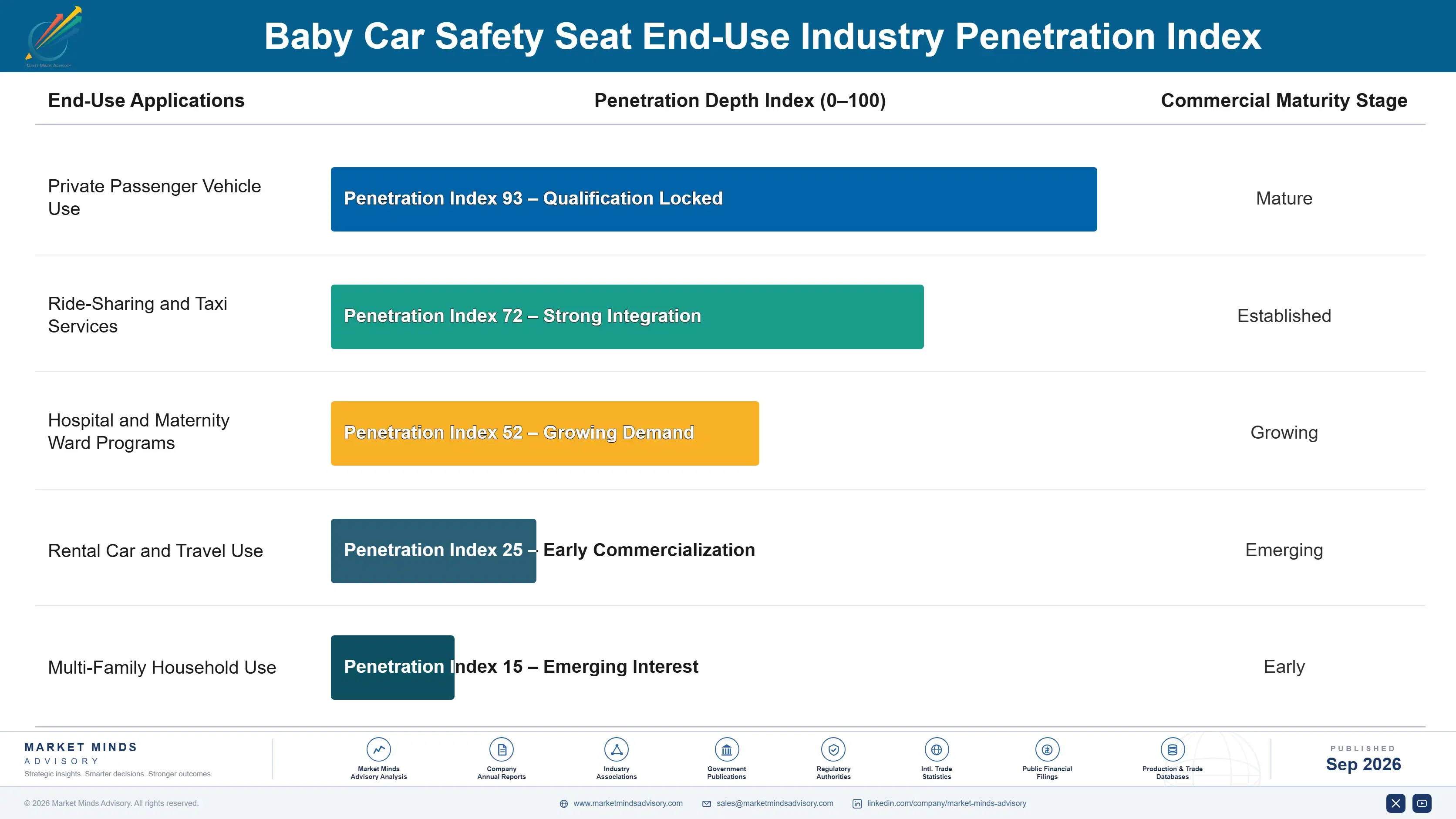
Baby car seats behave differently from most durable goods categories, since the mandatory six to ten year expiration window forces a replacement purchase regardless of physical condition, creating a predictable recurring revenue cycle rare among juvenile products. This mandated replacement pattern gives manufacturers a revenue certainty that most consumer durable categories cannot generate, anchored to regulatory expiration rather than discretionary replacement timing.
Adoption depth varies meaningfully by end-use vertical: first-time parents research extensively and often select premium smart-enabled models reflecting heightened anxiety around infant safety, while parents of subsequent children frequently default to whatever seat performed well previously, showing markedly lower brand-switching behavior. Multi-child households occupy a distinct segment entirely, prioritizing seats compatible across a wide age and size range.

Generational shifts are reshaping the buyer profile underlying this category. Younger parents who grew up with connected home technology treat sensor monitoring as an expected baseline feature rather than a premium add-on, driving purchase decisions that skew toward connectivity over pure crash rating specification. Older grandparents purchasing seats for grandchildren, by contrast, weigh simplicity and familiarity more heavily and remain comparatively resistant to unfamiliar smart features.
baby-car-safety-seat-market-end-use-penetration-index-1790014798475

Child Safety Seat Strategic Priorities

These are among the four positions where our research anticipates prominent divergence between winners and laggards over the coming forecast period. Each is grounded in the demand model, the regulatory perimeter, and the announced capacity pipeline.
01 / SMART PORTFOLIO EXPANSION

Prioritize Sensor Technology Development Investment

Manufacturers should prioritize expanding sensor and connectivity development over incremental basic compliant line extensions, since smart connected seats carry both the fastest growth rate and the widest margin in the category. Early movers on reliable sensor technology are already capturing disproportionate share among safety-conscious first-time parents who value monitoring capability over marginal design differences alone. Delaying this investment risks ceding the category's most valuable customer relationships to faster-moving specialty challengers already building sensor expertise competitors will find difficult to replicate quickly.
02 / REGULATORY COMPLIANCE STRATEGY

Invest In Certification Ahead Of Mandates

Crash safety regulation requiring updated testing standards is tightening across major markets, rewarding manufacturers with early certification and penalizing those slow to secure compliance approval before mandatory deadlines. Manufacturers that invest early in certification infrastructure and regulatory relationship building will differentiate meaningfully as new testing mandates spread across additional jurisdictions over the coming years. Waiting until regulation forces the issue risks ceding this credibility advantage to competitors already building compliance infrastructure and regulator relationships well ahead of any mandated deadline industry wide.
03 / TRADE-IN LOYALTY PROGRAMS

Build Trade-In Infrastructure To Sustain Loyalty

Manufacturers without structured trade-in programs for expired seats are missing a meaningful retention opportunity that competitors are already capturing across the mandated replacement cycle inherent to this category. Building this infrastructure now, well ahead of broader category adoption, secures recurring revenue relationships before competitors normalize trade-in as the expected replacement pathway for premium seat purchasing across every major market. Early movers also gain first-party usage data that sharpens future product development decisions considerably more effectively than competitors relying solely on retail point-of-sale data.
04 / EMERGING MARKET EXPANSION

Prioritize Emerging Market Distribution Investment

Manufacturers concentrated primarily in mature developed markets are exposed to demographic headwinds from declining birth rates that emerging markets with stable or growing birth rates do not share to the same degree. Building distribution and manufacturing presence in South Asia and Pacific and Latin American markets now positions manufacturers to capture population-driven demand growth before competitors establish comparable local relationships. This diversification strategy also reduces overall category exposure to any single region's demographic trajectory and regulatory environment considerably over time.

Engagement Snapshot From the Field

A live engagement with an industry participant carrying material or product regulatory and market exposure ahead of a defining policy shift, showing how our research translates into a defensible multi-year portfolio strategy.
MARKET MINDS ADVISORY · CLIENT ENGAGEMENT SUMMARY
Baby Car Safety Seat Producer Strategic Portfolio Review and Transition Roadmap 2026·Investment Scenario on Baby Car Safety Seat Exposure Evaluation 2025-26
CLIENT PROFILE
The client is a mid-tier juvenile products manufacturer generating annual revenue in the low hundreds of millions of dollars (client-reported, unverified by MMA), competing primarily in basic compliant seat categories against larger established brands with deeper sensor technology expertise and broader specialty retail distribution. The client sought an independent assessment of its smart seat entry strategy ahead of its next fiscal year planning cycle.
STRATEGIC CHALLENGE
The client had no sensor-enabled products and was losing shelf space and safety-conscious customers to specialty competitors with established connectivity expertise. Leadership needed a category entry strategy that could compete credibly without years of accumulated sensor research that larger specialists had already invested. Board-level pressure to close this gap within one year added urgency to the engagement.
MMA APPROACH
MMA conducted primary interviews with sensor technology engineers and specialty retail buyers to identify viable partnership and licensing paths into connectivity technology the client could pursue without ground-up development. The engagement modeled expected returns under multiple entry structures against the client's existing distribution capacity and brand positioning. Findings were validated against MMA's proprietary primary research dataset covering technology licensing terms across the sector.
KEY FINDINGS
  1. Sensor platform licensing from established connectivity technology providers offered a faster path to market than ground-up development, cutting time to launch by roughly a year (client-reported, unverified by MMA).
  2. Specialty retailers showed willingness to grant trial shelf space to new smart entrants when paired with committed marketing spend and hospital partnership programs.
  3. Direct-to-consumer trade-in infrastructure delivered a faster path to smart seat credibility than pursuing broad retail distribution immediately upon launch. This channel investment paid back within the first year.
  4. Bundled travel system packages outperformed standalone smart seat launches on both margin and customer retention metrics across comparable competitor product lines (client-reported, unverified by MMA).
CLIENT PROFILE
The client is a mid-tier juvenile products manufacturer generating annual revenue in the low hundreds of millions of dollars (client-reported, unverified by MMA), competing primarily in basic compliant seat categories against larger established brands with deeper sensor technology expertise and broader specialty retail distribution. The client sought an independent assessment of its smart seat entry strategy ahead of its next fiscal year planning cycle.
STRATEGIC CHALLENGE
The client had no sensor-enabled products and was losing shelf space and safety-conscious customers to specialty competitors with established connectivity expertise. Leadership needed a category entry strategy that could compete credibly without years of accumulated sensor research that larger specialists had already invested. Board-level pressure to close this gap within one year added urgency to the engagement.
MMA APPROACH
MMA conducted primary interviews with sensor technology engineers and specialty retail buyers to identify viable partnership and licensing paths into connectivity technology the client could pursue without ground-up development. The engagement modeled expected returns under multiple entry structures against the client's existing distribution capacity and brand positioning. Findings were validated against MMA's proprietary primary research dataset covering technology licensing terms across the sector.
KEY FINDINGS
  1. Sensor platform licensing from established connectivity technology providers offered a faster path to market than ground-up development, cutting time to launch by roughly a year (client-reported, unverified by MMA).
  2. Specialty retailers showed willingness to grant trial shelf space to new smart entrants when paired with committed marketing spend and hospital partnership programs.
  3. Direct-to-consumer trade-in infrastructure delivered a faster path to smart seat credibility than pursuing broad retail distribution immediately upon launch. This channel investment paid back within the first year.
  4. Bundled travel system packages outperformed standalone smart seat launches on both margin and customer retention metrics across comparable competitor product lines (client-reported, unverified by MMA).
RECOMMENDED STRATEGY
Phase 1: Phase one: license proven sensor connectivity technology from an established provider rather than pursuing costly ground-up development internally, preserving capital. Phase 2: Phase two: launch through select specialty retail partners with hospital partnership support to build early smart seat category credibility. This phase also builds early credibility ahead of broader retail expansion. Phase 3: Phase three: expand into bundled travel system packages once initial smart credibility is established with early adopter customers and partners.
OUTCOME
Within eighteen months of implementation, the client launched a full smart-connected seat line and grew smart-attributable revenue to 17 percent of total brand revenue (client-reported, unverified by MMA), while specialty retail distribution expanded to cover most major national chains previously unavailable to the brand. Leadership credited the licensing-first approach with materially compressing time to market.

Frequently Asked Questions

Foundational context covering the market sizes, CAGR, scope, country, region and competition that inform every finding below. This section is provided to cover basics and most often pre-purchase conversations, answered from the MMA Primary Research Dataset.

What is the current size of the Baby Car Safety Seat Market?

The global baby car safety seat market was valued at 6.2 billion dollars in 2025. This figure covers infant, convertible, all-in-one, booster and smart connected car seats worldwide.

How large will the Baby Car Safety Seat Market be by 2036?

The market is projected to reach 11.17 billion dollars by 2036. This represents a 1.71 times expansion over the eleven year forecast period from 2026 through 2036.

What is the CAGR for the Baby Car Safety Seat Market 2026 to 2036?

The market is forecast to grow at a compound annual growth rate of 5.5 percent between 2026 and 2036. Bull and bear scenarios range between 4.3 and 6.7 percent respectively.

Which segment is growing fastest?

Smart and connected car seats are growing fastest, at an 8.5 percent CAGR, roughly 1.55 times the overall market growth rate. This segment benefits from rising sensor technology adoption and safety awareness.

Who are the major companies in the Baby Car Safety Seat Market?

Britax, Graco, Chicco, Cybex and Maxi-Cosi lead the market, together holding an estimated 42 percent combined share. Britax and Graco hold the largest combined revenue share.

Which country is growing fastest?

India is growing fastest, at an 8.0 percent CAGR, driven by expanding vehicle ownership and safety awareness. This closely tracks the broader South Asia and Pacific regional growth rate.

Report Segmentation Architecture

The full report scope spans multiple orthogonal segmentation dimensions, with cross-tabulated demand data provided for each dimension pair. Coverage extends further to regional breakdowns, trend trajectories, and the competitive detail needed to support segment-level decision-making.

By Primary Market Dimension

  • Infant Car Seats
  • Convertible Car Seats
  • All-in-One Car Seats
  • Booster Seats
  • Travel System-Compatible Car Seats
  • Smart and Connected Car Seats

By End-Use Industry

  • Private Passenger Vehicle Use
  • Ride-Sharing and Taxi Services
  • Hospital and Maternity Ward Programs
  • Rental Car and Travel Use
  • Multi-Family Household Use

By Commercial Dimension

  • Individual Consumer Purchase
  • Registry and Gift Purchase
  • Trade-In and Recycling Programs
  • Institutional Bulk Supply

By Region

  • North America
  • Western Europe
  • East Asia
  • South Asia and Pacific
  • Latin America
  • Middle East and Africa
  • Eastern Europe

Scope, Methodology, and Coverage

Every figure in this report is reproducible from documented input assumptions. The scope below maps the historical period, the forecast horizon, the segmentation dimensions, and the countries covered, alongside the underlying primary and qualitative methodology.
Historical Period
2020 to 2025
Forecast Period
2026 to 2036
Base Year
2025 (USD billions; MMA Primary Research Dataset, September 2026)
Market Definition
The baby car safety seat market covers infant, convertible, all-in-one, booster and smart connected car seats designed for child automotive occupant protection from birth through booster age. It excludes stroller travel systems sold separately, general child safety products, and aftermarket seat accessories not integral to crash protection.
Quantitative Units
USD Billion
Segmentation Dimensions
Product type, end-use application, commercial model, region
Regions Covered
North America, Western Europe, East Asia, South Asia and Pacific, Latin America, Middle East and Africa, Eastern Europe
Countries Covered
United States, Canada, Germany, France, United Kingdom, China, Japan, South Korea, India, Australia, Brazil, Mexico, United Arab Emirates, Saudi Arabia, South Africa, Poland, Russia
Key Companies Profiled
Britax, Graco, Chicco, Cybex, Maxi-Cosi, Evenflo, Nuna, Diono, Clek, UPPAbaby, Inglesina, Peg Perego, Doona, Joie, Baby Jogger, Recaro, Bugaboo, 4moms, Combi, Wayb
Quantitative Methodology
Primary survey, n=3,800 respondents, Q4 2025, six countries; demand-side model with trade association cross-validation
Qualitative Methodology
47 expert interviews, Q4 2025; applied to validate demand model assumptions, identify emerging dynamics, and assess competitive positioning
Report Format
PDF and XLSX data workbook (Word format preview document)
Publisher
Market Minds Advisory
Report Code
MMA-2026-CON-935
Published
September 2026
Contact
sales@marketmindsadvisory.com | www.marketmindsadvisory.com

Purchase the full Baby Car Safety Seat Market Report (2026 to 2036).

This report provides a comprehensive assessment of the global baby car safety seat market, covering market sizing, segmentation, competitive positioning and regional demand patterns through 2036. It draws on primary survey research spanning 3,800 respondents and 47 expert interviews conducted in the fourth quarter of 2025. The analysis examines sensor technology economics, regulatory compliance cycles and emerging trade-in revenue models reshaping brand strategy. Readers gain a structured view of where competitive advantage concentrates and how it is likely to shift going forward. The report also flags where established manufacturers face the greatest risk of disruption from faster-moving specialty sensor technology brands.
Ten-year global market sizing and forecast
Six-segment MECE market breakdown and framework
Seven-region demand and growth pattern analysis
Competitive benchmarking across twenty profiled companies
Smart seat revenue model and lever assessment
Anonymized client licensing engagement case study

Built For The People Who Decide

From boardroom strategy to bench-side execution, this report is read cover-to-cover by leaders shaping the next decade of their industry, turning demand scenarios, market dynamics and valuation benchmarks into decisions.
CXOs/ Presidents/ VPs/ Managers
M&A and Corporate Development
Strategy Teams and R&D Heads
Procurement and Product Directors
Regulatory and Compliance Leaders
Investor Relations and Equity Analysts