Market Minds Advisory
B2B Sports Nutrition Market

B2B Sports Nutrition Market: Ingredient Supply, Private Label Manufacturing, and the Formulation Race

Sports nutrition brands are outsourcing formulation and production faster than ever, pushing ingredient suppliers and contract manufacturers to compete on protein sourcing, creatine capacity, and private label speed rather than price alone.

Lead Analyst

Lisa Gevelber

Published

September 2026

Make Smarter Decisions with Customized Research Insights

Request a free sample report and evaluate market opportunities, growth trends, and competitive dynamics relevant to your business needs.

2025 MARKET VALUE$18.5BMarket Size 2025
2036 FORECAST VALUE$39.0BBase Case , 2026 to 2036
CAGR 2026 TO 20367.0 %Bull 8.2% / Bear 5.7%
INCREMENTAL OPPORTUNITY$19.2BNet 10- year value creation
EXPANSION MULTIPLE1.97x2036 value over 2026 base
Strategic Levers
M&A Pipeline
Regional Outlook
Country Rankings
Competitive Intelligence
Segmental Deep-dive
Call-Us : 91 93563 13602

Executive Snapshot and Market Trajectory

B2B sports nutrition suppliers are shifting from simple ingredient sales toward full formulation partnerships, as brand owners outsource protein sourcing, creatine supply, and private label production to specialists rather than building in-house capability, reshaping who actually captures margin across the category's supply chain.
Growth concentrates in private label and contract manufacturing services as emerging brands launch without owning a single production line, and in performance actives like creatine and citrulline as formulation trends move beyond protein alone. North America and East Asia together host the largest ingredient processing and contract manufacturing capacity, while India's expanding domestic fitness market is pulling new private label production capacity online faster than any other country tracked.
Competitive character splits between ingredient giants like Glanbia that supply whey protein at global scale and specialized private label manufacturers like Makers Nutrition that own the brand relationship end to end. Regulatory pressure around banned substance testing and label claim substantiation is rising steadily, pushing suppliers toward third-party certification investment that smaller regional players increasingly cannot afford to match without losing margin elsewhere in their business, particularly smaller contract manufacturers serving niche brands.
Market Definition
This report covers business-to-business supply of sports nutrition ingredients, performance actives, and private label or contract manufacturing services to sports nutrition and functional food brand owners. It excludes direct-to-consumer retail sales of finished sports nutrition products and general dietary supplement categories outside performance and sports-specific formulation.
Base Year Value
$18.5B in 2025 (MMA Primary Research Dataset, August 2026)
Forecast Period
2026 to 2036, eleven discrete annual values
CAGR
7.0% base case. Bull 8.2%. Bear 5.7%.
Fastest Growth Segment
Private Label / Contract Manufacturing Services: 10.2% CAGR
Fastest Growth Country
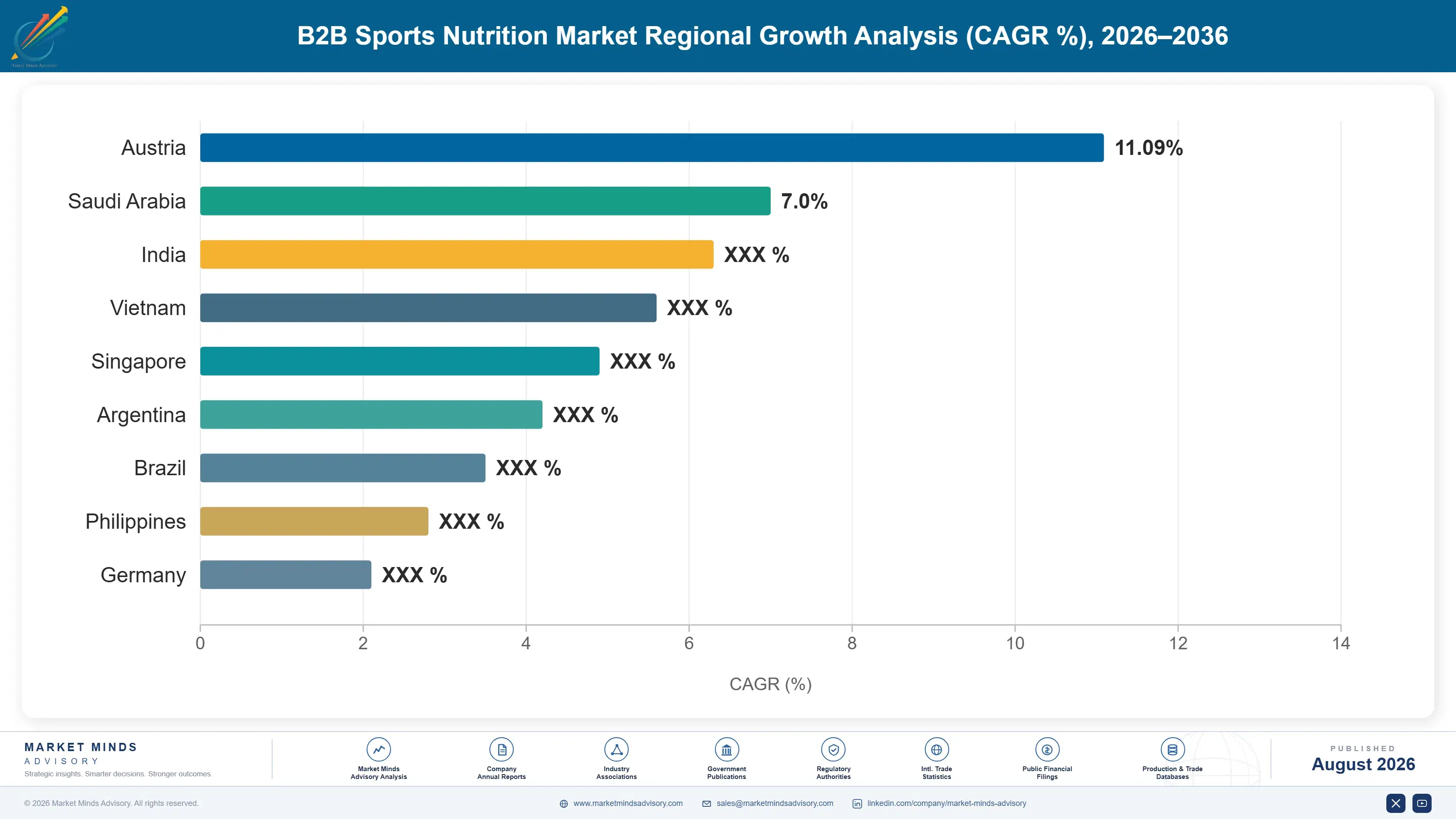
India: 11.0% CAGR
Fastest Growth Region
South Asia and Pacific: 9.2% CAGR
Largest Region
North America: 30% of 2025 global value
Market Leaders
Glanbia plc, Kerry Group plc, Archer-Daniels-Midland Company, Ingredion Incorporated, Makers Nutrition. Source: MMA Analysis based on company annual reports.
Primary Survey
n=3,800 procurement and R&D decision-makers, Q4 2025, six countries
Methodology
Demand-side build-up, cross-validated against public data, 47 expert interviews

B2B Sports Nutrition Market Forecast Scenarios

b2b-sports-nutrition-market-trends-growth-size-forecast-scenario-1787462148666
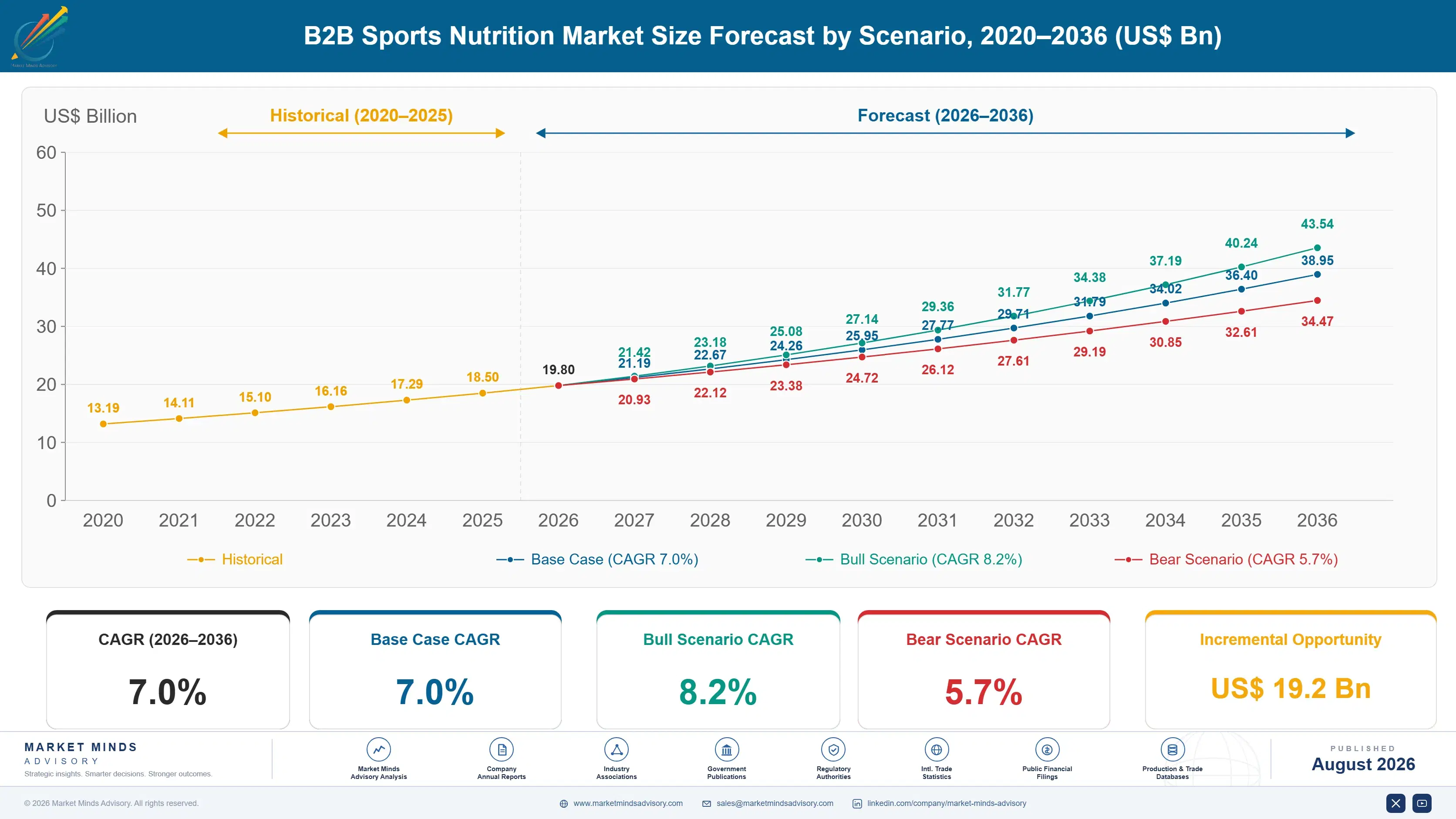
B2B sports nutrition ingredient and manufacturing demand grew steadily between 2020 and 2025 as pandemic-era home fitness habits persisted into gym reopening and broader mainstream protein adoption. A historical CAGR of 5.8% reflects that steady build, with private label and contract manufacturing capacity expanding fastest as emerging brands entered the category without committing capital to owned production.
The base case assumes 7.0% annual growth through 2036, anchored by three mechanisms: continued brand outsourcing of formulation and production to specialized contract manufacturers, rising performance actives demand as creatine and citrulline formulations move mainstream beyond core bodybuilding audiences, and expanding private label capacity in India and other emerging fitness markets. Together these push B2B suppliers further up the value chain from simple ingredient sales toward full formulation and regulatory compliance partnerships with brand owners.
A bull scenario assumes mainstream protein and creatine adoption accelerates faster than expected across new demographic groups, pushing growth toward 8.2%. The bear case turns on dairy and amino acid input cost volatility squeezing supplier margins enough that consolidation slows new capacity investment, dragging growth down toward roughly 5.7% as brands delay formulation expansion plans.

Formulation Partnerships and the Outsourcing Curve

B2B sports nutrition sits behind a much larger consumer retail category, supplying the protein, performance actives, and manufacturing capability that brand owners need without building their own production infrastructure. This outsourcing model let a wave of digitally native brands enter the category over the past decade without the capital intensity that vertically integrated manufacturers historically required to compete at meaningful scale just a decade ago.
MARKET CONCENTRATION (CR5)34%Ingredient giants and contract manufacturers share meaningful scale
AVERAGE CONTRACT VALUE$2.4 million per brandTypical annual supply agreement value for mid-size brands
TOP PRODUCING COUNTRY SHAREUnited States, 21%Largest single national base for ingredient and contract supply
PRIVATE LABEL PENETRATION38% of brand launchesNew sports nutrition brands launching without owned production capacity
CONTRACT MANUFACTURING UTILIZATION76%Average capacity utilization across specialized contract manufacturing facilities
KEY INPUT COST SHARE51% of COGSWhey protein and amino acid inputs dominate total cost
Commercially, the category splits between ingredient suppliers selling whey, plant protein, and performance actives at meaningful volume to established manufacturers, and contract manufacturers that own formulation, production, and increasingly regulatory compliance for emerging brands. Suppliers with integrated formulation science, Glanbia and Kerry among them, capture disproportionate margin even where their raw ingredient volume share stays flat year over year across most accounts.
Over the next decade, capacity additions concentrate in India and other emerging fitness markets as domestic brands scale faster than incumbent manufacturers can serve them from existing facilities. Regulatory scrutiny around banned substance testing and label claims will keep pushing suppliers toward certification investment that increasingly separates credible partners from lower-cost, less compliant competitors in the market as scrutiny keeps rising each year.
"Brands used to compete on formulation secrets. Now most of the real competitive advantage sits with whichever contract manufacturer can get a new SKU to market first without a compliance misstep."
Director, Sports and Performance Nutrition Practice · MMA Sports Nutrition Ingredients & Contract Manufacturing Practice · August 2026

Market Trends

Private Label Brand Launches Without Owned Production

Digitally native and influencer-founded sports nutrition brands increasingly launch without owning any production capacity, contracting formulation, manufacturing, and even regulatory filing entirely to specialized partners like Makers Nutrition. This model lets a new brand reach market within months rather than the years historically required to build compliant manufacturing capability from scratch. Contract manufacturers are responding by building tiered service offerings, from basic white-label formulations to fully customized proprietary blends, capturing brands at every stage of growth. The trend is compressing the capital barrier to entry that once protected established vertically integrated manufacturers from new competition entering the category.
Market Impact: Adds 8-10% outsourced production share
Creatine and Performance Actives Mainstream Adoption

Creatine monohydrate and newer performance actives like citrulline malate and beta-alanine are moving from core bodybuilding audiences into mainstream fitness and even general wellness formulations, widening the addressable ingredient market considerably. AlzChem and Kyowa Hakko Bio have both expanded production capacity to meet rising demand from brands formulating beyond traditional protein powders into ready-to-drink and gummy formats. This mainstreaming is pulling performance actives into everyday supplement aisles rather than specialty sports nutrition retailers alone, requiring ingredient suppliers to adapt packaging, dosing, and formulation science for a meaningfully broader and less specialized customer base.
Market Impact: Adds 12-15% certified contract premium

Market Opportunities and Growth Drivers

Brand Outsourcing of Formulation and Production

Sports nutrition brand owners, particularly newer and digitally native entrants, increasingly outsource formulation, manufacturing, and quality compliance entirely to contract partners rather than building owned production infrastructure that requires significant upfront capital and specialized regulatory expertise. Makers Nutrition and similar private label manufacturers have expanded service tiers to capture brands at every stage from initial product launch through scaled national distribution. This shift is measurable in contract manufacturing facility utilization rates, which have risen meaningfully as more brands choose to launch without ever owning a single piece of production equipment themselves.
Market Impact: Cuts supplier margin 180 basis points

Regulatory Certification as a Competitive Differentiator

Rising brand and retailer demand for third-party banned substance testing certification, particularly Informed Sport and NSF Certified for Sport, is turning regulatory compliance into a genuine competitive differentiator rather than a background cost. Suppliers and contract manufacturers that invested early in certified facilities now win preferential placement with major retailers and professional sports league partnerships that require certified supply chains. This certification requirement is becoming a genuine barrier for smaller or newer manufacturers lacking the capital to build dedicated certified production lines, concentrating premium contract volume among a smaller set of qualified suppliers overall.
Market Impact: Raises liability insurance costs 20-30%

Market Restraints and Challenges

Dairy and Amino Acid Input Cost Volatility

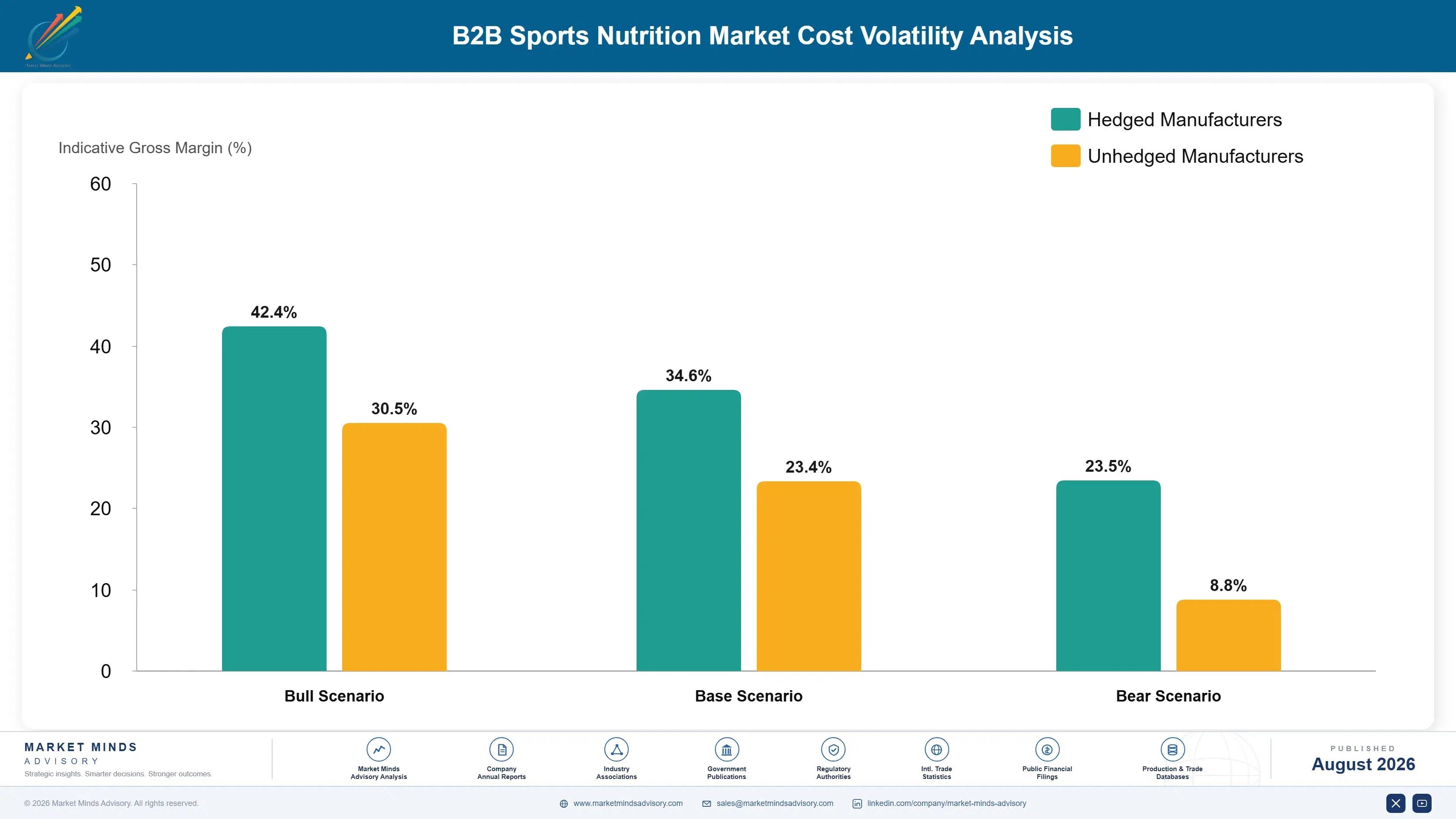
Whey protein and amino acid pricing tracks volatile global dairy and fermentation feedstock markets, squeezing supplier margins during periods when brand owners resist passing higher ingredient costs through to consumer retail pricing. The root cause is the category's dependence on a small number of globally traded commodity inputs whose pricing is set well outside the sports nutrition industry's own supply and demand dynamics. The commercial impact falls hardest on smaller ingredient suppliers without long-term dairy cooperative contracts or diversified amino acid sourcing. Larger suppliers are mitigating exposure through multi-year supply agreements and geographic sourcing diversification across multiple producing regions.
Market Impact: Adds 10.2% private label segment growth

Banned Substance Testing Liability Exposure Risk

Contract manufacturers and ingredient suppliers face meaningful liability exposure if a banned substance contamination event traces back to their facility, since professional athlete clients and major brands can pursue significant damages and reputational fallout well beyond the value of the original supply contract. The root cause is trace cross-contamination risk in shared manufacturing facilities producing both certified and non-certified product lines simultaneously. The commercial impact includes insurance cost increases and lost contracts following any documented incident at a facility. Suppliers are mitigating exposure by dedicating separate certified production lines entirely rather than sharing equipment across product tiers.
Market Impact: Adds 9.1% performance actives growth
3 additional market trends, 2 additional growth drivers, and 4 additional restraints and challenges are covered in the full report. Contact sales@marketmindsadvisory.com to access the complete intelligence.

Segment CAGR and Growth Architecture

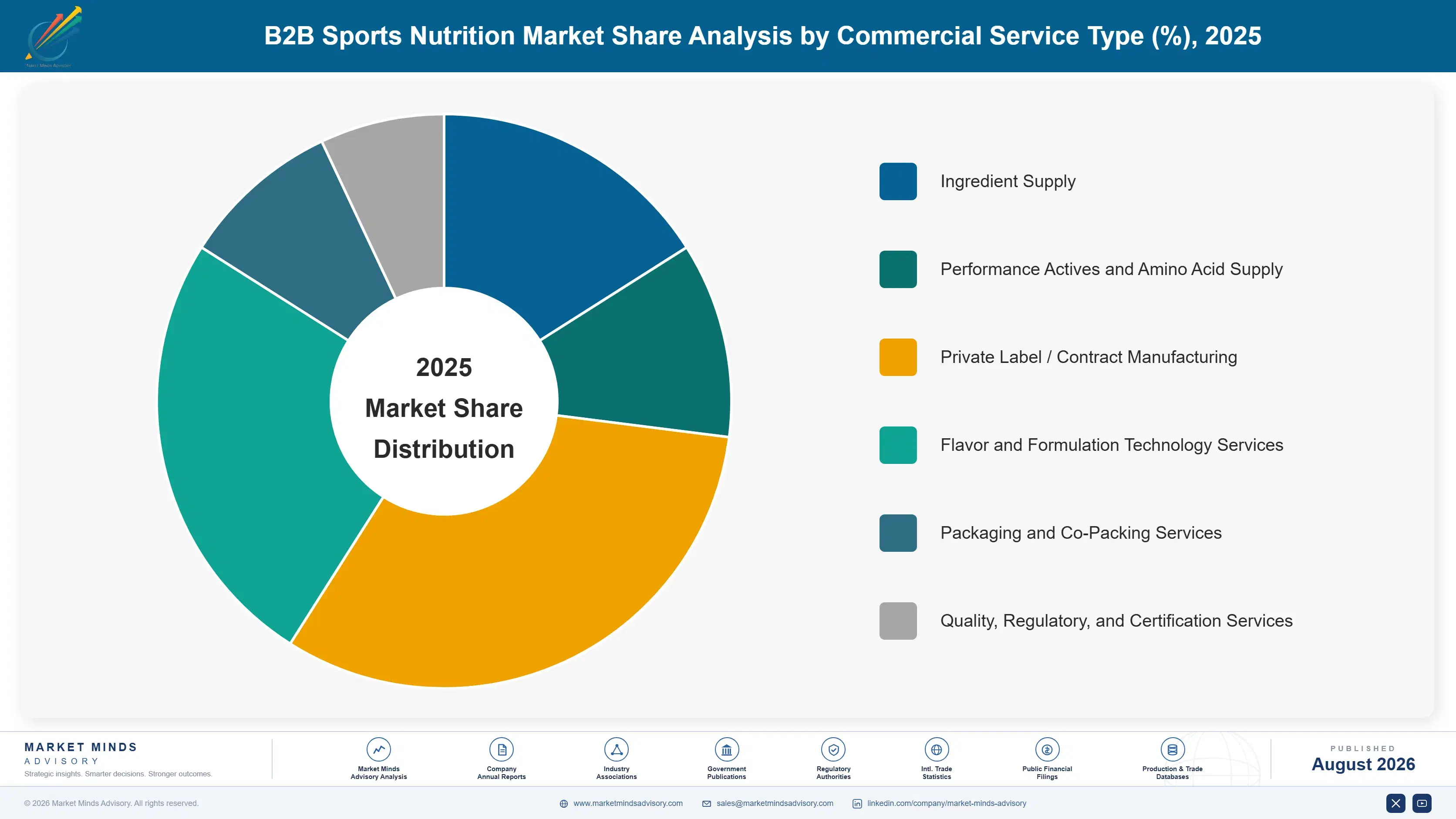
MMA segments the B2B sports nutrition market by commercial service type rather than by ingredient category, since the business model, whether selling raw ingredients or full contract manufacturing services, determines margin structure and customer relationship depth more than any single ingredient distinction across whey, plant, or performance active inputs sold today across every major world region.
b2b-sports-nutrition-market-trends-growth-market-share-analysis-1787462149210

Private Label / Contract Manufacturing Services

Private label and contract manufacturing services form the fastest-growing segment, pulled by a wave of digitally native and influencer-founded brands that want to enter the category without owning any production infrastructure themselves. Makers Nutrition and similar specialized manufacturers have built tiered service offerings ranging from basic white-label formulations to fully customized proprietary blends, capturing brands at every stage of growth from initial launch through national retail distribution. The segment increasingly includes regulatory filing and certification management as part of the core service offering, since brand owners want a single accountable partner managing the entire path to market. Demand concentrates in North America and India, where domestic fitness brands are scaling faster than they can build capacity.
CAGR 10.2%

Performance Actives and Amino Acid Supply

Performance actives and amino acid supply is the second-fastest segment, driven by creatine, citrulline malate, and beta-alanine formulations moving from specialist bodybuilding products into mainstream fitness and general wellness formats. AlzChem and Kyowa Hakko Bio have both expanded production capacity to meet rising demand from brands formulating beyond traditional protein powders into ready-to-drink beverages and gummy formats aimed at a broader consumer base. This segment commands meaningful margin for suppliers with established manufacturing scale and quality certification, since performance actives require more precise dosing and purity documentation than bulk protein ingredients typically do. Growth concentrates in North America and East Asia, where mainstream adoption beyond core fitness audiences is advancing fastest.
CAGR 9.1%
Full segment breakdown across 6 segments available in the complete report.

Regional Architecture and Country Demand Map

B2B sports nutrition ingredient and manufacturing capacity concentrates across North America and East Asia's established supply chains, while India's expanding domestic fitness market is pulling new private label production capacity online faster than any other country tracked here across this report's full seven-region analysis this year.

North America

Glanbia, ADM, and Makers Nutrition anchor the largest B2B sports nutrition base anywhere, built on decades of dairy protein processing infrastructure and a fast-growing contract manufacturing sector serving both established brands and new digitally native entrants. The United States hosts the deepest bench of certified contract manufacturing facilities capable of meeting Informed Sport and NSF Certified for Sport requirements demanded by major retailers and professional sports partnerships. Private label penetration runs highest here of any region, as venture-backed and influencer-founded brands continue entering the category without owning production infrastructure themselves. Canada contributes a smaller but growing ingredient processing base, particularly in plant protein supply chains serving both domestic and export markets.
Share: 30% | CAGR: 7.8% (2026 to 2036)

Western Europe

Kerry Group and a deep bench of specialized ingredient technology suppliers anchor a Western European market built more on formulation science and flavor masking technology than on raw ingredient volume alone. The region's stricter regulatory environment around novel ingredient approval and label claim substantiation has pushed suppliers toward documentation and compliance capability as a core competitive offering rather than a background cost. Growth trails the global average here, since the region's sports nutrition category is already mature and most incremental demand comes from formulation upgrades rather than entirely new brand formation. The United Kingdom and Germany remain the region's largest national markets for both ingredient supply and contract manufacturing services.
Share: 20% | CAGR: 5.5% (2026 to 2036)
Regional intelligence for 5 additional markets available in the complete report: East Asia, South Asia and Pacific, Latin America, Middle East and Africa, Eastern Europe. Contact sales@marketmindsadvisory.com.
b2b-sports-nutrition-market-trends-growth-country-cagr-analysis-1787462149733

Formulation Services and Certification Value Capture

B2B sports nutrition suppliers extract more value from existing customer relationships by moving up the service stack rather than competing purely on ingredient price. The levers below concentrate on capturing formulation services, defending certified capacity premium, and building faster speed-to-market capability that brand owners increasingly treat as a genuine competitive requirement rather than a nice-to-have add-on.

Certified Facility Investment for Premium Contract Volume

Contract manufacturers that invested early in Informed Sport and NSF Certified for Sport facility certification now command a price premium of roughly 12 to 15% over non-certified contract manufacturing, since major retailers and professional sports partnerships increasingly require certified supply chains before signing agreements. This certification requires dedicated production lines separate from non-certified product, a capital commitment smaller manufacturers often cannot justify without guaranteed volume first. Manufacturers without certification increasingly lose access to the highest-value retail and partnership contracts entirely, regardless of their underlying formulation quality or production capability otherwise.
Market Impact: Adds a 12 to 15% contract price premium

Tiered Private Label Service Offerings for Brand Stages

Contract manufacturers that built tiered service offerings, from basic white-label formulations to fully customized proprietary blends, capture brands at every stage of growth rather than losing them to a competitor once they outgrow a basic offering. Makers Nutrition and similar manufacturers report that brands graduating from basic to premium tiers generate roughly 2 to 3 times the annual contract value of their initial agreement, since formulation complexity and volume both scale together. Manufacturers offering only a single service tier increasingly lose growing brands to competitors capable of scaling the relationship alongside them.
Market Impact: Adds 2 to 3 times contract value per brand

Regional Manufacturing Capacity in Fast-Growing Fitness Markets

Suppliers and contract manufacturers building dedicated capacity in India and similar fast-growing fitness markets are capturing brand relationships years ahead of competitors still serving these markets through import-only distribution. Establishing local manufacturing typically requires a multi-year capital commitment and regulatory navigation that can take 2 to 3 years to fully clear, but it lets a supplier offer meaningfully faster speed-to-market than import-dependent competitors can match. Suppliers without local capacity risk losing the fastest-growing brand relationships entirely to competitors already positioned inside these markets well ahead of them, often by several years of accumulated local relationship building.
Market Impact: Cuts speed-to-market by roughly 4 to 6 months overall

Formulation Science Bundling for Ingredient Margin Defense

Ingredient suppliers that bundle formulation science, flavor masking, and stability testing alongside raw ingredient sales capture meaningfully more value per contract than those competing purely on commodity ingredient pricing. Kerry Group and similar formulation-focused suppliers report that bundled service contracts carry roughly 15 to 20% higher margin than standalone ingredient supply agreements, since brand owners pay for reduced formulation risk and faster development timelines. Suppliers without formulation science capability increasingly compete only on price against lower-cost commodity ingredient suppliers, ceding the more defensible bundled relationship to better-resourced competitors already active in the category.
Market Impact: Adds 15 to 20% bundled contract margin overall

Who Controls the Margin Pool

CR5 in B2B sports nutrition sits near 34%, reflecting meaningful concentration among a handful of global ingredient giants and specialized contract manufacturers relative to more fragmented consumer-facing categories. Glanbia leads through dairy protein processing scale, with Makers Nutrition close behind in private label contract manufacturing, while the gap to mid-tier challengers stays wide enough that further consolidation looks likely as certification requirements raise the capital bar to compete.
Current competitive activity centers on three fronts: certified facility investment to capture premium contract volume, tiered private label service expansion to retain brands through every growth stage, and regional manufacturing capacity build-out in fast-growing fitness markets like India. Larger suppliers with formulation science and certification capability are moving fastest on all three, while smaller regional manufacturers without capital access risk losing both premium contracts and growing brand relationships.

Emerging pressure comes from Asian ingredient suppliers like Kyowa Hakko Bio scaling amino acid and performance actives production fast enough to challenge Western suppliers on cost without sacrificing purity or certification credibility. Indian contract manufacturers are also building genuine scale faster than most incumbents anticipated, positioning some to eventually serve export markets beyond their domestic customer base.
b2b-sports-nutrition-market-trends-growth-company-positioning-matrix-1787462150274

Competitive Moat and Risk Dimensions

GLANBIA PLC

Moat: Global Whey Processing Scale

Glanbia's dairy protein processing scale across multiple continents gives it raw ingredient cost advantages that smaller regional suppliers cannot match, while its formulation science capability lets it bundle value-added services beyond simple ingredient sales. This combination insulates group margin from the sharpest commodity price swings that hit pure ingredient traders hardest during volatile dairy markets.
GLANBIA PLC

Risk: Dairy Commodity Price Exposure

Glanbia's core whey protein business remains exposed to volatile global dairy commodity pricing that can compress margin sharply during periods of oversupply or feed cost inflation, even with formulation diversification elsewhere in the business. Managing this exposure requires sophisticated hedging capability that smaller ingredient suppliers typically lack entirely.
MAKERS NUTRITION

Moat: Vertically Integrated Private Label Platform

Makers Nutrition's integrated formulation, manufacturing, and regulatory filing capability under one roof lets emerging brands launch faster than competitors relying on multiple separate vendors for each stage of production. This single-partner model creates meaningful switching costs once a brand's entire supply chain depends on one manufacturer's systems and certifications.
MAKERS NUTRITION

Risk: Customer Concentration Risk

Makers Nutrition depends heavily on a portfolio of emerging and mid-size brands whose own growth trajectories remain uncertain, meaning any wave of brand failures or consolidation among its customer base could meaningfully affect utilization across its manufacturing facilities. Diversifying its customer base across more established, larger brands remains an ongoing strategic priority.

Players Tracked

Prominent Players

Glanbia plc
Kerry Group plc
Archer-Daniels-Midland Company
Ingredion Incorporated
Makers Nutrition

Other Key Players

Cambridge Commodities
Lonza Group AG
Sirio Pharma Co. Ltd.
Amerilab Technologies
Aenova Group
AlzChem Group AG
Kyowa Hakko Bio Co. Ltd.
Compound Solutions Inc.
NNB Nutrition
Wacker Biosolutions
Prinova Group
Layn Corp
Bioenergy Life Science
Nutralliance
Gencor Pacific

Recent Developments

APRIL 2025

Glanbia Expands Whey Protein Processing Capacity in Idaho

Glanbia completed an expansion of whey protein concentrate and isolate processing capacity at its Idaho facility, adding production lines dedicated to specialized sports nutrition formulations separate from standard dairy ingredient output. The expansion supports rising demand from brand customers seeking higher-purity protein fractions for premium formulations.
Signal: Confirms leading ingredient suppliers are dedicating separate capacity to premium sports nutrition formulations rather than shared dairy lines.
SEPTEMBER 2025

Makers Nutrition Opens New Certified Contract Manufacturing Facility

Makers Nutrition opened a new Informed Sport and NSF Certified for Sport certified manufacturing facility in the United States, expanding its capacity to serve brands requiring certified supply chains for retail and professional sports partnerships. The facility adds meaningful capacity dedicated entirely to certified production separate from standard lines.
Signal: Signals certified capacity is becoming a distinct, separately built production category rather than a shared facility feature.
JANUARY 2026

Kyowa Hakko Bio Expands Amino Acid Production in Japan

Kyowa Hakko Bio completed an expansion of amino acid fermentation capacity at its Japanese production facilities, adding output dedicated to performance actives demand from sports nutrition brand customers globally. The expansion followed sustained order growth from both domestic and export customers over the prior two years.
Signal: Confirms Asian amino acid producers are scaling specifically for sports nutrition demand rather than broader food industry use.

Dairy Protein and Amino Acid Exposure

Whey protein and amino acid inputs account for roughly 51% of cost of goods sold across the category, sourced from global dairy cooperatives and fermentation producers whose pricing tracks broader commodity and feedstock markets rather than sports nutrition-specific demand alone. This exposure sits meaningfully higher than in most packaged food categories, given how concentrated the category's core ingredient inputs remain.
Global dairy prices rose sharply following supply disruption and feed cost inflation across 2022 and 2023, with the USDA's dairy market reports documenting sustained price volatility across major exporting regions through 2024. Amino acid and performance actives pricing followed a similar pattern as fermentation feedstock costs rose alongside broader agricultural commodity inflation. Suppliers without long-term dairy cooperative agreements or diversified amino acid sourcing absorbed meaningfully higher per-unit ingredient costs than competitors with existing multi-year contracts already in place.

Exposure varies by supplier type: large ingredient processors with direct dairy cooperative relationships and multi-region amino acid sourcing absorb volatility more evenly than smaller contract manufacturers dependent on spot market purchasing. Brand owners with diversified supplier relationships across multiple ingredient categories face less concentrated risk than newer brands relying on one contract manufacturer for their entire supply chain.
b2b-sports-nutrition-market-trends-growth-cost-volatility-analysis-1787462150472

Multi-Year Dairy Cooperative Supply Agreements

Larger ingredient processors increasingly lock in multi-year supply agreements directly with dairy cooperatives, trading some pricing flexibility for predictable long-term input cost visibility across consecutive production cycles. Smaller suppliers without the volume commitments to negotiate multi-year cooperative terms remain more exposed to spot dairy price spikes during periods of tight supply each production season worldwide.

Diversified Amino Acid Sourcing Across Regions

Suppliers are increasingly sourcing amino acids and performance actives from multiple fermentation producers across different geographic regions rather than depending on a single supplier, reducing exposure to any single facility disruption or regional feedstock cost spike. This diversification requires supplier qualification investment but meaningfully smooths input cost volatility over time each year across the supplier's full network.

Formulation Flexibility Across Protein Sources

Some suppliers have built formulation flexibility that allows substituting between whey, casein, and plant protein sources based on relative pricing without meaningfully affecting finished product performance, reducing exposure to any single protein commodity price spike. This flexibility requires meaningful formulation science investment but pays back through pricing resilience over time across most market cycles observed.

Portfolio Architecture for Margin Defence

B2B sports nutrition portfolios split across three tiers with different margin economics: a volume tier built on commodity protein and amino acid ingredient sales, a premium tier built on certified contract manufacturing and formulation services, and an emerging next-generation tier tied to clean-label and novel performance actives that brands are only beginning to pay a defined premium for consistently.
The tension between volume and premium runs deep in how suppliers allocate limited certified production capacity: every production line dedicated to certified manufacturing is a line unavailable for standard commodity volume that still generates the bulk of category revenue today. Get the mix wrong and a supplier either misses premium certified contracts or overinvests in certified capacity that outpaces actual brand demand for it right now across most of the industry.

High-value margin pools concentrate overwhelmingly in certified contract manufacturing and formulation services, not in commodity ingredient sales alone. Suppliers that built certification and formulation capability early, Glanbia and Makers Nutrition among them, now capture a share of total category profit well above their share of total ingredient volume sold each year across nearly every account they serve each contract cycle.

Volume / Commodity-Adjacent Tier

Commodity whey, plant protein, and basic amino acid ingredient sales priced close to global dairy and fermentation benchmarks, competing primarily on volume and price rather than formulation differentiation or certification across most accounts.
Gross Margin: 10-15%

Premium / Certified Tier

Certified contract manufacturing and formulation services sold to brands requiring Informed Sport or NSF Certified for Sport compliance, commanding meaningful price premiums through certification, quality documentation, and faster speed-to-market capability.
Gross Margin: 22-28%

Sustainability / Regulatory / Next-Generation Tier

Clean-label, novel performance actives, and next-generation formulation science aimed at brands differentiating beyond traditional protein and creatine, still a small volume tier but growing as ingredient innovation expectations continue rising across the category.
Gross Margin: 20-26%
b2b-sports-nutrition-market-trends-growth-portfolio-architecture-1787462150967

High-value Sub-segments and Strategic Watch-out

Private Label / Contract Manufacturing (High-Value, High-Growth)

Private label and contract manufacturing services combine the fastest unit growth in the category with meaningfully above-average margins, making it the single most attractive segment for suppliers with certification and formulation capability already in place. Demand continues to outpace available certified capacity across North America and India alike.
Gross Margin: 22-28%

Performance Actives and Amino Acid Supply (High-Value, Moderate-Growth)

Performance actives and amino acid supply carries better margin than bulk protein and continues gaining share as creatine and citrulline mainstream beyond core bodybuilding audiences, though growth is more moderate than contract manufacturing since it depends on fermentation capacity investment cycles that take real time to complete.
Gross Margin: 18-24%

Commodity Protein Ingredient Supply (Volume Core)

Commodity whey and plant protein ingredient sales remain the largest single category by volume and the backbone of supplier cash flow, even though margin sits well below the specialty tiers. Nearly every supplier depends on this volume base to fund certification and formulation investment elsewhere.
Gross Margin: 10-15%

Non-Certified Contract Manufacturing (Strategic Watch-Out)

Contract manufacturing without banned substance testing certification carries the thinnest margin in the portfolio and faces the most direct competition on price alone, making it the segment most exposed to being excluded from premium retail and partnership contracts entirely in the years directly ahead of this forecast.
Gross Margin: 8-12%

Contract Depth and Switching Costs

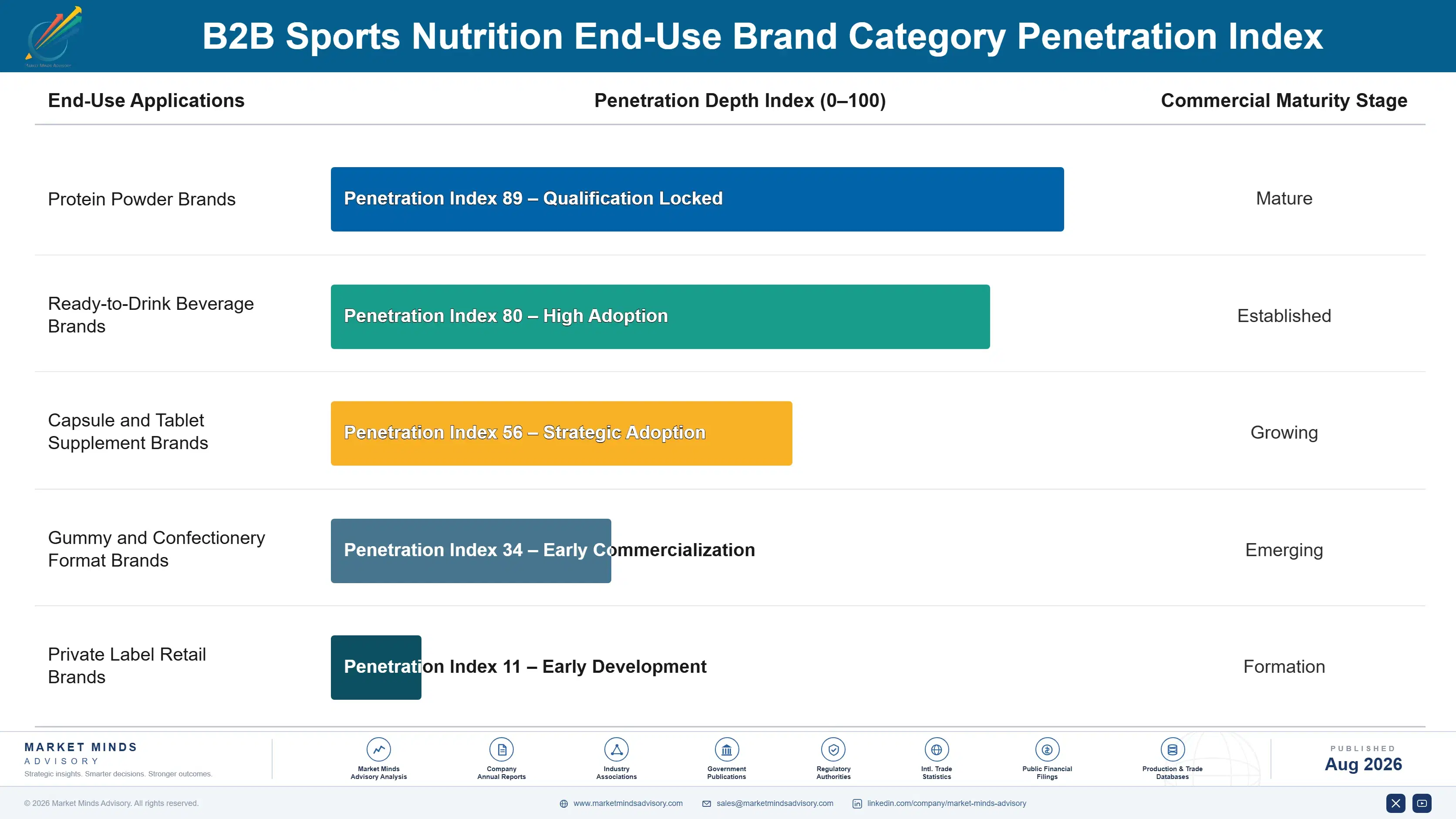
B2B sports nutrition demand runs on multi-year supply and manufacturing contracts rather than transactional purchasing, since qualifying a new ingredient supplier or contract manufacturer requires regulatory filing, quality testing, and formulation validation that most brands would rather not repeat unnecessarily. This gives incumbent suppliers a meaningful retention advantage once a brand's entire formulation and certification depends on their systems and facilities.
Adoption depth varies sharply by brand type: established brands with in-house formulation science teams treat suppliers as interchangeable commodity vendors more readily, switching on price when contracts renew, while emerging brands entirely dependent on a single contract manufacturer's formulation and regulatory capability show far stronger lock-in since switching means rebuilding their entire product from scratch. Brands serving certified retail channels show the least willingness to switch of any group, given the cost of requalifying certification.

A generational shift is underway among brand founders too: newer digitally native brand owners increasingly treat contract manufacturers as strategic partners embedded in product development from day one, rather than simply commodity vendors selected after a formulation is already finalized, rewarding manufacturers that offer genuine formulation science over those competing purely on price.
b2b-sports-nutrition-market-trends-growth-end-use-penetration-index-1787462151464

Where B2B Sports Nutrition Margin Concentrates

These are among the four positions where our research anticipates prominent divergence between winners and laggards over the coming forecast period. Each is grounded in the demand model, the regulatory perimeter, and the announced capacity pipeline.
01 / CERTIFICATION TIMING ADVANTAGE

Early certified capacity investment now defends a durable contract lead

Manufacturers that invested in Informed Sport and NSF Certified for Sport certification before competitors now hold contract relationships that later movers cannot quickly replicate, since retailers and professional sports partnerships rarely switch away from an established certified supplier once a relationship forms around it. This timing advantage matters more than raw processing scale, because premium retail and partnership contracts increasingly require certification as a baseline requirement. Manufacturers without early certification investment now face a multi-year capital and qualification process before they can compete for the same premium contracts.
02 / FORMULATION SERVICE DEPTH

Bundled formulation science is separating suppliers from commodity ingredient traders

Suppliers that bundle formulation science, flavor masking, and stability testing alongside raw ingredient sales capture meaningfully more value per contract than those still competing purely on commodity ingredient pricing alone. This gap widens further as brand owners increasingly value reduced formulation risk and faster development timelines over marginal ingredient cost savings that rarely matter once a product actually reaches shelf. Suppliers still competing purely on price risk being commoditized entirely, ceding the more defensible bundled relationship to better-resourced formulation-focused competitors within the category.
03 / EMERGING MARKET CAPACITY RACE

India is where the next wave of contract manufacturing scale gets built

India's domestic fitness brand formation is outpacing existing contract manufacturing capacity fast enough that suppliers building local facilities now will hold a meaningful head start over competitors still serving the market through import-only distribution channels. This capacity race is distinct from mature market dynamics, since it reflects genuinely new brand formation rather than share shifting among already-established competitors. Suppliers and ingredient producers that build relationships in India now will be better positioned than those waiting for the opportunity to become obvious in trade data later.
04 / CUSTOMER CONCENTRATION RISK

Contract manufacturers depending on emerging brands face real customer concentration risk

Contract manufacturers whose customer base concentrates heavily among emerging and mid-size brands face real exposure if a wave of brand failures or consolidation reduces their utilization meaningfully within a short period. This risk compounds because emerging brands often lack the balance sheet resilience of larger, more established customers during demand downturns or funding environment shifts. Manufacturers diversifying their customer base toward larger, more established brands reduce this concentration risk, though often at the cost of somewhat thinner per-contract margin in exchange for greater stability.

Engagement Snapshot From the Field

A live engagement with an industry participant carrying material or product regulatory and market exposure ahead of a defining policy shift, showing how our research translates into a defensible multi-year portfolio strategy.
MARKET MINDS ADVISORY · CLIENT ENGAGEMENT SUMMARY
B2B Sports Nutrition Producer Strategic Portfolio Review and Transition Roadmap 2026·Investment Scenario on B2B Sports Nutrition Exposure Evaluation 2025-26
CLIENT PROFILE
The client is a venture-backed, digitally native sports nutrition brand that had grown quickly through direct-to-consumer sales but relied on a single regional contract manufacturer without certification for banned substance testing. Revenue exceeded $45 million in the most recent fiscal year (client-reported, unverified by MMA), and leadership was preparing to pursue major retail distribution that required certified supply chain documentation the brand did not yet have.
STRATEGIC CHALLENGE
The brand's existing contract manufacturer lacked Informed Sport certification and could not commit to a timeline for achieving it, threatening the retail distribution and professional athlete partnership opportunities central to the brand's next growth phase. Leadership needed to decide whether to wait for its current manufacturer to certify, switch entirely to a certified partner, or dual-source across both options during the transition.
MMA APPROACH
MMA benchmarked certified contract manufacturers against the brand's existing partner on cost, capacity, and formulation compatibility, modeled the retail revenue at risk from continued delay, and evaluated a phased dual-sourcing transition that would preserve existing product continuity while onboarding a certified manufacturing partner for new retail-bound formulations specifically, comparing timelines across each option in detail.
KEY FINDINGS
  1. The brand's existing contract manufacturer had no credible timeline for achieving banned substance testing certification, putting major retail partnership discussions at genuine risk of collapse.
  2. Certified contract manufacturers with available capacity commanded meaningfully higher per-unit pricing, but the premium was smaller than the retail revenue the brand stood to lose without certification.
  3. A phased dual-sourcing transition let the brand maintain existing product continuity while qualifying new formulations through a certified manufacturing partner in parallel with existing operations.
  4. Retail partners confirmed that certified supply chain documentation, not price, was the binding constraint on finalizing the brand's expanded distribution agreement discussions.
CLIENT PROFILE
The client is a venture-backed, digitally native sports nutrition brand that had grown quickly through direct-to-consumer sales but relied on a single regional contract manufacturer without certification for banned substance testing. Revenue exceeded $45 million in the most recent fiscal year (client-reported, unverified by MMA), and leadership was preparing to pursue major retail distribution that required certified supply chain documentation the brand did not yet have.
STRATEGIC CHALLENGE
The brand's existing contract manufacturer lacked Informed Sport certification and could not commit to a timeline for achieving it, threatening the retail distribution and professional athlete partnership opportunities central to the brand's next growth phase. Leadership needed to decide whether to wait for its current manufacturer to certify, switch entirely to a certified partner, or dual-source across both options during the transition.
MMA APPROACH
MMA benchmarked certified contract manufacturers against the brand's existing partner on cost, capacity, and formulation compatibility, modeled the retail revenue at risk from continued delay, and evaluated a phased dual-sourcing transition that would preserve existing product continuity while onboarding a certified manufacturing partner for new retail-bound formulations specifically, comparing timelines across each option in detail.
KEY FINDINGS
  1. The brand's existing contract manufacturer had no credible timeline for achieving banned substance testing certification, putting major retail partnership discussions at genuine risk of collapse.
  2. Certified contract manufacturers with available capacity commanded meaningfully higher per-unit pricing, but the premium was smaller than the retail revenue the brand stood to lose without certification.
  3. A phased dual-sourcing transition let the brand maintain existing product continuity while qualifying new formulations through a certified manufacturing partner in parallel with existing operations.
  4. Retail partners confirmed that certified supply chain documentation, not price, was the binding constraint on finalizing the brand's expanded distribution agreement discussions.
RECOMMENDED STRATEGY
Phase 1: Phase 1 (Months 1 to 3): Qualify a certified contract manufacturing partner for new retail-bound product formulations while maintaining the existing manufacturing relationship. Phase 2: Phase 2 (Months 4 to 9): Transition retail-bound production entirely to the certified partner, maintaining the original manufacturer for direct-to-consumer volume only. Phase 3: Phase 3 (Months 10 to 12): Consolidate all production with the certified partner once retail volume justified full transition away from dual-sourcing.
OUTCOME
Within twelve months, the brand secured its targeted retail distribution agreement using certified supply chain documentation from its new manufacturing partner (client-reported, unverified by MMA). The phased dual-sourcing transition preserved direct-to-consumer product continuity throughout, avoiding the disruption a full manufacturer switch would have caused during the brand's most important growth phase to date.

Frequently Asked Questions

Foundational context covering the market sizes, CAGR, scope, country, region and competition that inform every finding below. This section is provided to cover basics and most often pre-purchase conversations, answered from the MMA Primary Research Dataset.

What is the current size of the B2B Sports Nutrition Market?

The global B2B sports nutrition market was valued at approximately $18.5 billion in 2025. This covers ingredient supply, performance actives, and private label or contract manufacturing services sold to brand owners.

How large will the B2B Sports Nutrition Market be by 2036?

MMA projects the market will reach approximately $39.0 billion by 2036, up from roughly $19.8 billion in 2026. That represents an expansion multiple of about 1.97 times over the ten-year forecast period.

What is the CAGR for the B2B Sports Nutrition Market 2026 to 2036?

The base case CAGR is 7.0% annually, with a bull scenario near 8.2% and a bear scenario near 5.7%. This range reflects sensitivity to dairy input costs and certification investment pace.

Which segment is growing fastest?

Private label and contract manufacturing services are the fastest-growing segment, expanding at roughly 10.2% annually, about 1.5 times the overall market's pace. Performance actives and amino acid supply follows at approximately 9.1% annually.

Who are the major companies in the B2B Sports Nutrition Market?

Leading players include Glanbia plc, Kerry Group plc, Archer-Daniels-Midland Company, Ingredion Incorporated, and Makers Nutrition. Together these five hold an estimated 34% combined market concentration today.

Which country is growing fastest?

India is the fastest-growing national market, expanding near 11.0% annually as domestic fitness brands outpace existing contract manufacturing capacity. China follows as a significant secondary growth center in the region.

Report Segmentation Architecture

The full report scope spans multiple orthogonal segmentation dimensions, with cross-tabulated demand data provided for each dimension pair. Coverage extends further to regional breakdowns, trend trajectories, and the competitive detail needed to support segment-level decision-making.

By Commercial Service Type

  • Ingredient Supply
  • Performance Actives and Amino Acid Supply
  • Private Label / Contract Manufacturing
  • Flavor and Formulation Technology Services
  • Packaging and Co-Packing Services
  • Quality, Regulatory, and Certification Services

By End-Use Brand Category

  • Protein Powder Brands
  • Ready-to-Drink Beverage Brands
  • Capsule and Tablet Supplement Brands
  • Gummy and Confectionery Format Brands
  • Private Label Retail Brands

By Commercial Dimension

  • Direct Ingredient Supply Contracts
  • Full-Service Contract Manufacturing
  • Formulation Licensing Agreements
  • Export and Cross-Border Supply

By Region

  • North America
  • Western Europe
  • East Asia
  • South Asia and Pacific
  • Latin America
  • Middle East and Africa
  • Eastern Europe

Scope, Methodology, and Coverage

Every figure in this report is reproducible from documented input assumptions. The scope below maps the historical period, the forecast horizon, the segmentation dimensions, and the countries covered, alongside the underlying primary and qualitative methodology.
Historical Period
2020 to 2025
Forecast Period
2026 to 2036
Base Year
2025 (USD billions; MMA Primary Research Dataset, August 2026)
Market Definition
This report defines the B2B sports nutrition market as business-to-business supply of ingredients, performance actives, and private label or contract manufacturing services to sports nutrition and functional food brand owners globally. It excludes direct-to-consumer retail sales of finished products and general dietary supplement categories outside performance and sports-specific formulation.
Quantitative Units
USD billions (current prices); metric tonnes ingredient volume where cited
Segmentation Dimensions
By Commercial Service Type; By End-Use Brand Category; By Commercial Dimension; By Region
Regions Covered
North America, Western Europe, East Asia, South Asia and Pacific, Latin America, Middle East and Africa, Eastern Europe
Countries Covered
USA, China, Germany, France, UK, Japan, South Korea, India, Australia, Canada, Brazil, Mexico, Indonesia, Vietnam, Thailand, Malaysia, UAE, Saudi Arabia, South Africa, Nigeria, Turkey, Poland, Netherlands, Italy, Spain, Sweden, Switzerland, Argentina, Colombia, Singapore, and additional markets relevant to this sector
Key Companies Profiled
Glanbia plc, Kerry Group plc, Archer-Daniels-Midland Company, Ingredion Incorporated, Makers Nutrition, Cambridge Commodities, Lonza Group AG, Sirio Pharma Co. Ltd., Amerilab Technologies, Aenova Group, AlzChem Group AG, Kyowa Hakko Bio Co. Ltd., Compound Solutions Inc., NNB Nutrition, Wacker Biosolutions, Prinova Group, Layn Corp, Bioenergy Life Science, Nutralliance, Gencor Pacific
Quantitative Methodology
Primary survey, n=3,800 respondents, Q4 2025, six countries; demand-side model with trade association cross-validation
Qualitative Methodology
47 expert interviews, Q4 2025; applied to validate demand model assumptions, identify emerging dynamics, and assess competitive positioning
Report Format
PDF and XLSX data workbook (Word format preview document)
Publisher
Market Minds Advisory
Report Code
MMA-2026-AGR-103
Published
August 2026
Contact
sales@marketmindsadvisory.com | www.marketmindsadvisory.com

Purchase the full B2B Sports Nutrition Market Report (2026 to 2036).

The full B2B Sports Nutrition Market report delivers detailed sizing and forecasts across all six commercial service segments, all seven world regions, and twenty profiled companies through 2036. It includes granular regional data tables, competitive benchmarking on a consistent revenue basis, and input cost sensitivity modeling tied to global dairy and amino acid markets. Subscribers receive access to the underlying primary survey dataset (n=3,800 respondents, Q4 2025, six countries) and qualitative expert interview findings (n=47 interviews, Q4 2025). The report also includes segment-level margin analysis and a portfolio tiering framework analysts can apply directly to company assessments.
Full segmentation across six commercial service categories
Seven-region market sizing with growth forecasts
Twenty-company competitive benchmarking on consistent basis
Input cost sensitivity modeling tied to dairy markets
Access to primary survey dataset of 3,800 respondents
Portfolio tiering framework for margin benchmarking

Built For The People Who Decide

From boardroom strategy to bench-side execution, this report is read cover-to-cover by leaders shaping the next decade of their industry, turning demand scenarios, market dynamics and valuation benchmarks into decisions.
CXOs/ Presidents/ VPs/ Managers
M&A and Corporate Development
Strategy Teams and R&D Heads
Procurement and Product Directors
Regulatory and Compliance Leaders
Investor Relations and Equity Analysts