Market Minds Advisory
Axillary Hyperhidrosis Treatment Market

Axillary Hyperhidrosis Treatment Market: Microwave Devices Meet Neurotoxin Injections

A single microwave session promises permanent sweat gland destruction that neurotoxin injections must repeat every few months, but that device technology remains far more capital-intensive for clinics to actually adopt widely.

Lead Analyst

Alice Ballenger

Published

September 2026

Make Smarter Decisions with Customized Research Insights

Request a free sample report and evaluate market opportunities, growth trends, and competitive dynamics relevant to your business needs.

2025 MARKET VALUE$1.4BMarket Size 2025
2036 FORECAST VALUE$3.8BBase Case , 2026 to 2036
CAGR 2026 TO 20369.6 %Bull 10.9% / Bear 8.3%
INCREMENTAL OPPORTUNITY$2.3BNet 10- year value creation
EXPANSION MULTIPLE2.50x2036 value over 2026 base
Strategic Levers
M&A Pipeline
Regional Outlook
Country Rankings
Competitive Intelligence
Segmental Deep-dive
Call-Us : 91 93563 13602

Executive Snapshot and Market Trajectory

Axillary hyperhidrosis treatment is splitting between repeat-injection neurotoxin therapy and permanent energy-based device solutions, a shift large enough that treatment durability, not injection frequency alone, increasingly decides which option patients actually choose across nearly every major consumer market tracked here. Manufacturers without both options risk losing share.
Energy-based devices grow fastest at 15.4%, roughly 1.60 times the overall rate, as patients increasingly demand a permanent solution that neurotoxin injections cannot deliver without repeated clinic visits every few months. North America holds the largest regional share at 32%, anchored by concentrated dermatology innovation and cash-pay aesthetic treatment infrastructure, while East Asia follows on China's rapidly expanding dermatology clinic access. Certification breadth keeps its premium mix wider than most peers.
Competitive intensity stays moderate: five manufacturers control just over half of revenue, led by AbbVie and Journey Medical through decades of accumulated neurotoxin formulation and clinical trial engineering that smaller device specialists still struggle to match. Rising patient awareness keeps expanding demand across nearly every major consumer healthcare market simultaneously, forcing manufacturers to carry far broader clinical durability data than legacy antiperspirant products ever required. each cycle.
Market Definition
The axillary hyperhidrosis treatment market covers botulinum toxin injections, topical anticholinergic treatments, energy-based devices, iontophoresis devices, and surgical sympathectomy used specifically to treat excessive underarm sweating. It excludes general-purpose antiperspirant and deodorant products without a specific prescription indication.
Base Year Value
$1.4B in 2025 (MMA Primary Research Dataset, August 2026)
Forecast Period
2026 to 2036, eleven discrete annual values
CAGR
9.6% base case. Bull 10.9%. Bear 8.3%.
Fastest Growth Segment
Energy-Based Devices: 15.4% CAGR
Fastest Growth Country
China: 13.4% CAGR
Fastest Growth Region
South Asia and Pacific: 11.6% CAGR
Largest Region
North America: 32% of 2025 global value
Market Leaders
AbbVie, Journey Medical, Sientra, Ipsen, Galderma. Source: MMA Analysis based on company annual reports.
Primary Survey
n=3,800 procurement and R&D decision-makers, Q4 2025, six countries
Methodology
Demand-side build-up, cross-validated against public data, 47 expert interviews

Axillary Hyperhidrosis Treatment Market Forecast Scenarios

axillary-hyperhidrosis-treatment-market-size-forecast-scenario-1787305236981
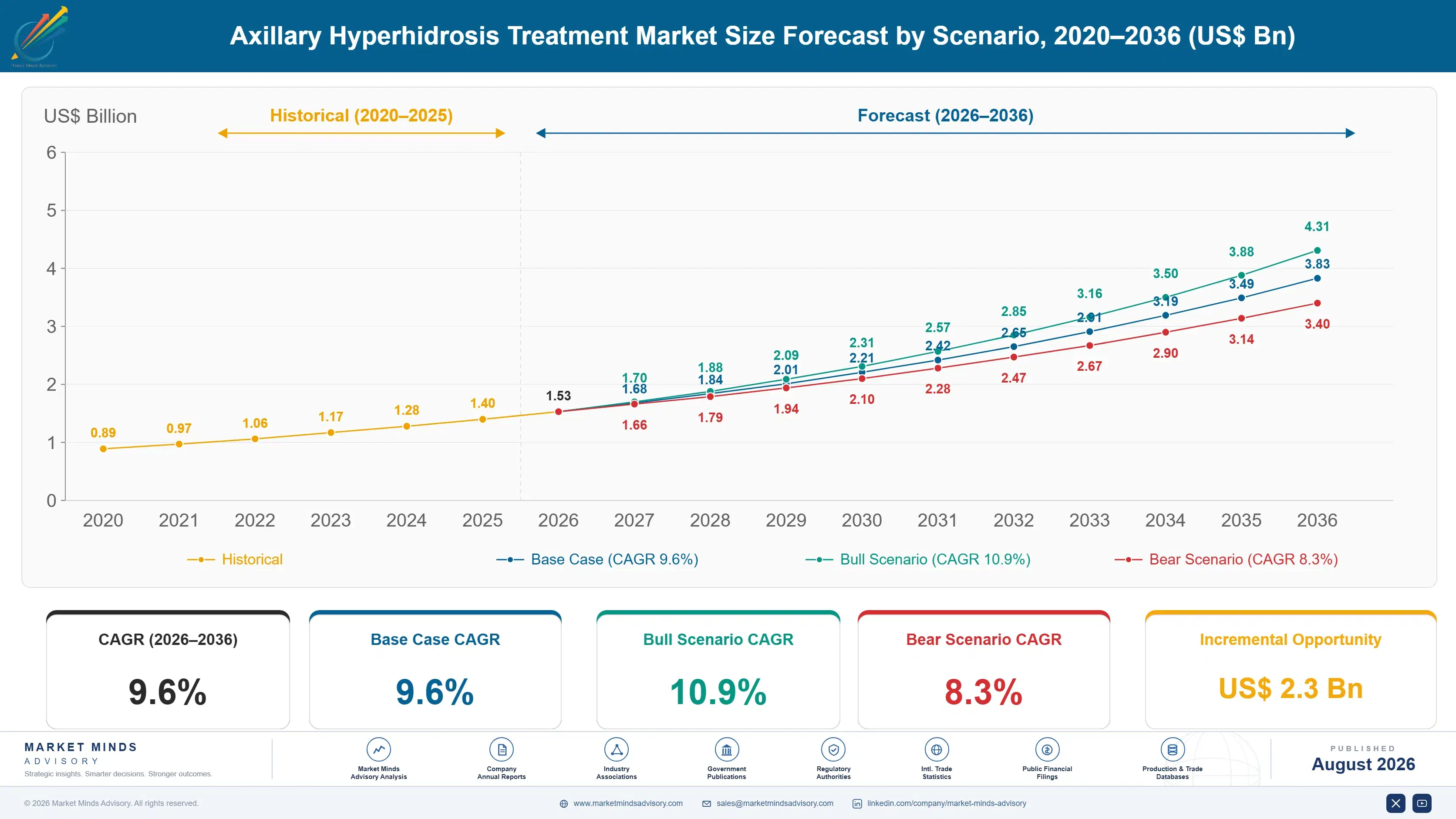
Between 2020 and 2025 the market grew at roughly 8.8% annually, a steady pace reflecting expanding neurotoxin injection access even before microwave thermolysis devices had reached broad clinical adoption across major dermatology practice networks worldwide. Device capital investment during this window remained modest compared with current program scale, leaving growth to track largely established injection demand patterns.
The base case carries the market to 9.6% annual growth through three commercial mechanisms working together. First, energy-based devices keep expanding as patients increasingly prefer a permanent solution over repeated injection cycles. Second, topical anticholinergic treatments keep gaining adoption as a non-invasive alternative for needle-averse patients. Third, China's expanding dermatology clinic access keeps converting rising patient awareness into direct treatment demand nationwide each year. Reimbursement systems across major markets keep broadening coverage for device-based treatment.
The bull case, 10.9%, assumes accelerated device adoption and clinic capital investment pulls forward treatment demand faster than currently modeled across major consumer healthcare markets worldwide. The bear case, 8.3%, assumes device capital cost and reimbursement caution keep neurotoxin injection the dominant treatment modality well beyond the current decade of forecast coverage tracked here. tracked closely in this review.

Where Microwave Devices Meet Neurotoxin Injections

Three forces converge on this market simultaneously. Energy-based devices keep expanding as patients increasingly prefer a permanent solution over repeated injection cycles. Topical anticholinergic treatments keep gaining adoption as a non-invasive alternative for needle-averse patients. And China's expanding dermatology clinic access keeps converting rising patient awareness into direct treatment demand nationwide across its clinic network. across nearly every reimbursement channel tracked in t
MARKET CONCENTRATIONCR5: 52%Top five manufacturers control just over half of revenue
AVERAGE TREATMENT COSTUSD 400 to 3,800 per courseCosts vary sharply by treatment modality and repeat visit frequency
TOP TREATMENT COUNTRYUnited States: 29% of proceduresConcentrated dermatology innovation and cash-pay infrastructure drive volume here
DEVICE ADOPTION RATE24% of specialty clinicsShare of dermatology clinics now offering energy-based device treatment
ACTIVE INGREDIENT COST SHARE33% of COGSNeurotoxin proteins and specialty compounds dominate production cost structure
TREATMENT RENEWAL CYCLE4 months to permanentCycle varies sharply between injection therapy and single-session device treatment
Commercially, this market behaves like a specialty aesthetic and dermatology device business layered onto a cash-pay consumer healthcare economics model. Manufacturers compete on treatment durability data and clinic capital efficiency as much as on price, since dermatologists increasingly demand validated outcome data before specifying a device or injectable into a standard treatment protocol. That evidence depth increasingly separates leading manufacturers from generic competitors across nearly every major market tracked here.
Over the next decade expect continued expansion beyond injection-only correction into device-based and topical formats. China's clinic access will keep anchoring regional volume growth across its expanding dermatology network. And treatment durability documentation, more than raw procedure volume alone, will increasingly determine which manufacturers dermatologists actually specify into standard treatment protocols going forward. across every therapeutic category tracked.
"A patient who never needs another injection changes the entire economics of what a dermatology practice can charge for that first visit."
Director, Dermatology and Aesthetic Devices Practice · MMA Healthcare Practice <

Market Trends

Patients Adopt Permanent Energy-Based Device Treatment

Patients increasingly specify microwave thermolysis and energy-based device treatments that permanently destroy sweat glands in a single session, a requirement that has converted hyperhidrosis correction from a recurring injection routine into a one-time capital-intensive clinic procedure. This shift addresses a genuine treatment burden concern, since neurotoxin injections require repeat clinic visits every few months that many patients find inconvenient and increasingly costly over a treatment lifetime. Several manufacturers have expanded device platforms with published durability and patient satisfaction data, positioning permanent correction as the category's clearest growth driver heading into the next decade of adoption.
Market Impact: Adds 18% share via awareness growth
Topical Treatments Expand Access For Needle-Averse Patients

Dermatologists increasingly prescribe topical anticholinergic treatments for patients who avoid injection-based therapy, converting non-invasive symptom management into a direct specification driver rather than a secondary treatment option reserved for mild cases. This shift addresses a genuine access constraint, since needle aversion and injection cost keep many diagnosed patients from pursuing neurotoxin therapy despite documented symptom severity. Several manufacturers have expanded topical product lines with published efficacy and tolerability data, positioning documented convenience as a durable differentiator across the dermatology treatment industry worldwide. Payer confidence in this approach continues rising across major reimbursement markets tracked.
Market Impact: Anchors 21% of regional treatment v

Market Opportunities and Growth Drivers

Rising Patient Awareness Expands Diagnosed Treatment Demand

Healthcare systems worldwide keep seeing rising patient awareness of hyperhidrosis as a treatable medical condition rather than a private embarrassment, converting diagnosed treatment demand into a durable growth driver independent of any single manufacturer's product cycle. This creates demand that spans nearly every major consumer healthcare market simultaneously, since social media and dermatology practice marketing have both normalized seeking treatment for a condition patients previously managed silently. Manufacturers increasingly design patient education campaigns specifically for younger demographics, converting what was once a rarely discussed condition into a proactive standard-of-care conversation across the broader dermatology system worldwide.
Market Impact: Cuts device adoption by roughly 26%

China's Dermatology Clinic Access Anchors Regional Demand

China's continued investment in dermatology clinic access keeps converting rising patient awareness directly into treatment demand capable of serving both established urban aesthetic clinic networks and increasingly tier-two city populations nationwide each year. Domestic Chinese manufacturers increasingly supply topical treatments and basic devices that previously relied on imported specifications, giving the country meaningful production self-sufficiency and expanding distribution capability across tier-one and tier-two city networks alike. This capacity buildout gives China outsized influence over regional demand growth, since Chinese clinic expansion decisions convert directly into treatment orders at meaningful scale.
Market Impact: Leaves 38% of patients self-funding

Market Restraints and Challenges

Device Capital Cost Limits Clinic Adoption

Energy-based device platforms cost considerably more than a neurotoxin injection starter kit, and smaller dermatology practices often lack the capital budget to absorb this upfront investment without a clear return-on-investment timeline, a limitation that leaves many practices reluctant to add device-based treatment despite documented patient demand. The root cause is financial: device platforms carry meaningful upfront cost that only high-volume practices can recoup quickly. The impact falls hardest on independent practices, since they lack the patient volume larger aesthetic clinic chains use to justify investment. Some manufacturers are responding with leasing and revenue-share financing programs.
Market Impact: Cuts repeat visits by roughly 34%

Reimbursement Variability Limits Access To Insurance Coverage

Insurance reimbursement for hyperhidrosis treatment varies considerably across payers and geographies, and many insurers classify certain treatments as cosmetic rather than medically necessary, a limitation that leaves many diagnosed patients paying out of pocket despite documented clinical severity criteria. The root cause is classificatory: payers apply inconsistent medical necessity standards that do not always align with dermatology society treatment guidelines. The impact falls hardest on patients in regions with stricter cosmetic exclusions, since they must self-fund treatment regardless of severity. Some manufacturers are responding by funding patient assistance and documentation support programs.
Market Impact: Expands treated population by 27%
3 additional market trends, 4 additional growth drivers, and 3 additional restraints and challenges are covered in the full report. Contact sales@marketmindsadvisory.com to access the complete intelligence.

Segment CAGR and Growth Architecture

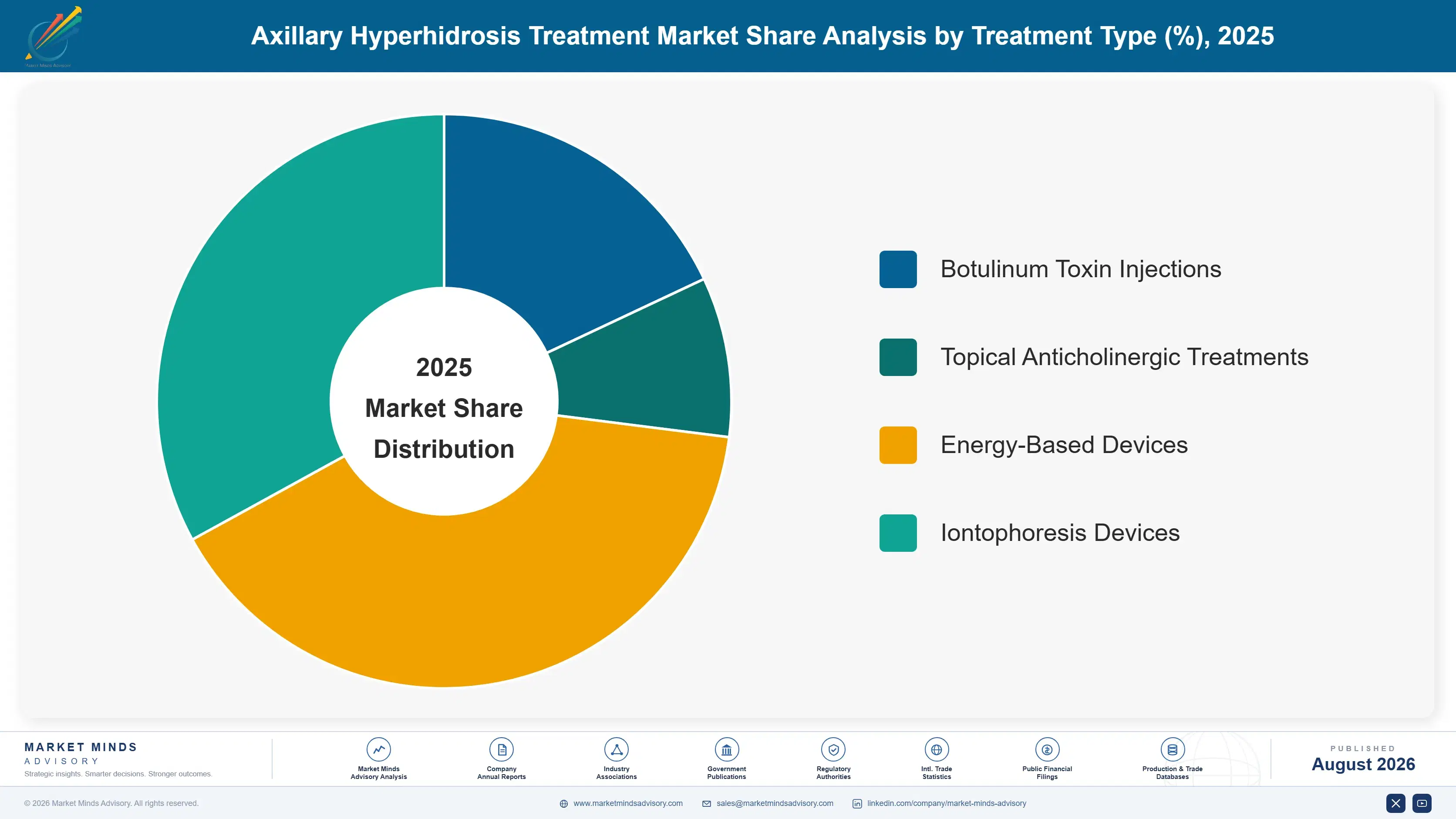
Segmentation follows treatment type, the single classification logic that determines administration method, durability profile, and reimbursement pathway. Injection, topical, device, and surgical formats each carry distinct commercial properties, so commercial position tracks treatment type rather than severity level alone across every manufacturer profiled in this review. across every manufacturer and treatment category profiled here.
axillary-hyperhidrosis-treatment-market-market-share-analysis-1787305237516

Energy-Based Devices

Energy-based devices grow fastest at 15.4%, roughly 1.60 times the overall market rate, as patients increasingly demand a permanent solution that neurotoxin injections cannot deliver without repeated clinic visits every few months over a treatment lifetime. This treatment type delivers microwave or laser energy to permanently destroy sweat glands in a single outpatient session, eliminating the need for ongoing maintenance treatment. Sientra and Candela lead this segment's platform development, while Cutera and Cynosure compete on treatment comfort and session duration. Growing clinic capital investment continues expanding this segment's addressable base considerably beyond its original niche origins across major dermatology practice networks. Practice partnerships continue strengthening this segment's provider confidence worldwide.
CAGR 15.4%

Topical Anticholinergic Treatments

Topical anticholinergic treatments grow second-fastest at 12.6%, about 1.31 times the overall rate, as dermatologists increasingly prescribe non-invasive formulations for needle-averse patients who avoid injection-based therapy entirely. This treatment type delivers anticholinergic medication directly through a topical wipe or cream formulation, blocking the nerve signals that trigger excessive sweating without requiring injection administration. Journey Medical leads this segment's formulation development, while Almirall and Bausch Health compete on tolerability profile and distribution reach. Growing patient preference for non-invasive treatment continues expanding this segment's addressable population considerably beyond its original niche origins across major dermatology practices worldwide. Regulatory guidance continues favoring cost-effective, non-invasive treatment options across most reimbursement systems. Provider partnerships continue strengthening this segment's prescriber confidence.
CAGR 12.6%
Full segment breakdown across 6 segments available in the complete report.

Regional Architecture and Country Demand Map

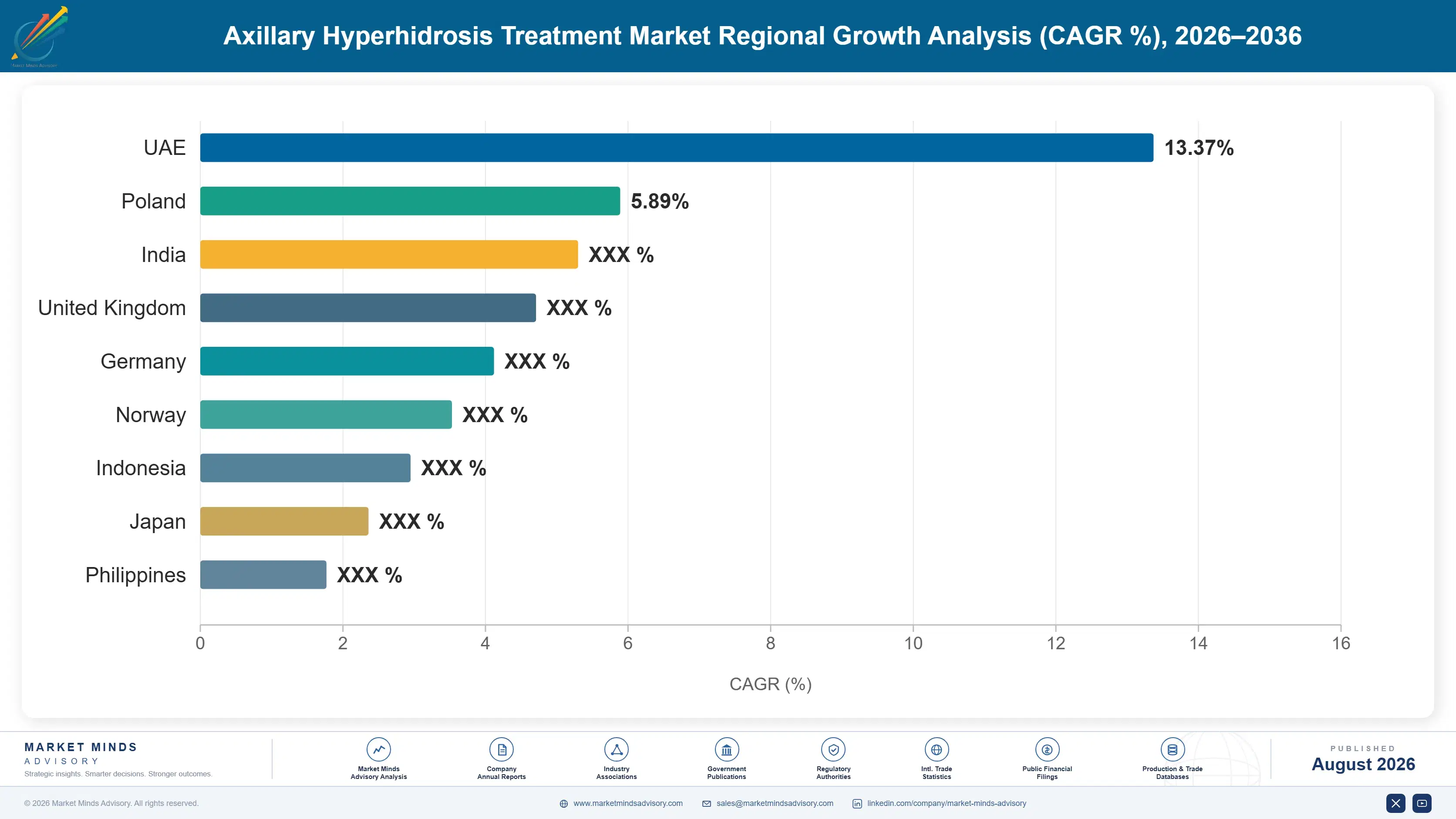
North America leads at 32% of the total, anchored by concentrated dermatology innovation and cash-pay aesthetic treatment infrastructure. East Asia follows on China's rapidly expanding dermatology clinic access, while the remaining five regions complete global distribution. across every treatment category tracked in this review closely.

North America

The United States and Canada anchor North America's 32% share through concentrated dermatology innovation and cash-pay aesthetic treatment infrastructure, a combination that positions this region as the origin market for nearly every recently launched device and topical product tracked in this review. The United States hosts the region's largest dermatology practice and aesthetic clinic infrastructure, with AbbVie and Sientra's American operations serving both dermatology practice and medical spa channels nationwide. Canada's comparable practice structure adds incremental demand beyond American volume specifically. Growth of 10.4% reflects steady device adoption and awareness expansion more than any single regulatory deadline alone. Practice density across this region's clinic channel keeps its premium treatment mix wider than most others tracked here.
Share: 32% | CAGR: 10.4% (2026 to 2036)

Western Europe

Germany, France, and the United Kingdom anchor Western Europe's 23% share through established dermatology systems and growing device adoption operating under some of the world's strictest medical device and pharmaceutical regulatory standards. Ipsen and Galderma's core European operations serve both domestic clinical and export markets across the continent. Southern European markets contribute meaningful injection-based demand beyond the core German and French base. Growth of 8.1%, the softest pace among the seven regions tracked, reflects this underlying market maturity rather than weakening underlying treatment demand overall. Belgium and the Netherlands contribute additional demand across their national health systems too. Italy's dermatology sector also contributes meaningful demand as private aesthetic clinic networks continue to expand.
Share: 23% | CAGR: 8.1% (2026 to 2036)
Regional intelligence for 5 additional markets available in the complete report: East Asia, South Asia and Pacific, Latin America, Middle East and Africa, Eastern Europe. Contact sales@marketmindsadvisory.com.
axillary-hyperhidrosis-treatment-market-country-cagr-analysis-1787305238022

How Manufacturers Can Defend Treatment Margin

Margin increasingly depends on clinic financing support and treatment durability documentation rather than raw unit price alone, as dermatologists demand dependable return-on-investment data alongside clinical evidence. The four levers below target certification, service, and financing revenue that hyperhidrosis manufacturers have left underexploited, converting a commodity device or injectable sale into a longer, more defensible practice relationship over time.

Bundle Practice Marketing Support With Device Sales

Manufacturers increasingly bundle patient acquisition marketing support with device platform sales, capturing service revenue that manufacturers without marketing support leave on the table since smaller dermatology practices often lack in-house expertise to market a new device treatment effectively. This service model captures 9% to 15% incremental revenue beyond commodity device pricing, since buyers increasingly value manufacturers who can accelerate patient volume rather than suppliers who simply ship equipment without ongoing support. Building this capability requires investment in dedicated marketing staff, and the margin differential justifies the added cost. Buyers increasingly favor manufacturers with proven marketing track records over those without.
Market Impact: Generates 9% to 15% recurring marke

Offer Extended Treatment Durability Warranty Coverage

Manufacturers increasingly offer extended treatment durability warranties that guarantee documented sweat reduction beyond the standard treatment protocol, capturing premium pricing that manufacturers without performance guarantees leave on the table since risk-averse practices pay meaningfully more for documented reliability assurance. Buyers pay 10% to 16% more for treatments backed by extended warranties than for equivalent products without guaranteed performance, since warranty-backed protection directly reduces the practice's patient satisfaction liability exposure. This reputation compounds into durable advantage over time. Practices increasingly weigh warranty depth alongside raw product pricing decisions when selecting a supplier.
Market Impact: Commands 10% to 16% higher unit pri

Guarantee Multi-Year Practice Financing Deal Contracts

Manufacturers increasingly offer guaranteed multi-year device financing agreements to strategic dermatology practice customers, capturing specification loyalty that manufacturers without financing programs leave on the table since practices require dependable capital access for equipment planning amid genuine upfront cost constraints. Sientra and Candela both report that financing guarantees directly determine which practice contracts they can even secure, independent of unit pricing alone. Building this capability requires investment exceeding $3 million per program, but manufacturers who commit early lock in relationships before competitors match the depth. Smaller manufacturers without comparable capital reserves struggle to compete for these contracts.
Market Impact: Wins practice contracts each worth

Expand Regional Manufacturing Near Treatment Hubs

Import tariffs and delivery lead time on products manufactured outside major treatment hubs have risen enough that regional manufacturing capacity, closer to clinic procurement clusters, increasingly beats import economics even at somewhat higher local production cost. Manufacturers building manufacturing capacity in China, India, and Mexico, rather than relying entirely on centralized production, cut landed cost by roughly 14% while also shortening lead times that matter increasingly to fast-scaling clinic demand. This shift requires upfront capital investment, but manufacturers who move early capture share from import-dependent competitors. Manufacturers who commit early lock in relationships before rivals match the depth.
Market Impact: Cuts landed treatment costs by roug

Who Controls the Margin Pool

Five manufacturers control just over half of global revenue, a moderately fragmented picture reflecting the neurotoxin formulation scale and device engineering specialization that few competitors combine at meaningful breadth. AbbVie and Journey Medical lead on scale, though AbbVie leads neurotoxin injection breadth while Journey Medical leads topical treatment depth. Revenue, the basis used here, favors manufacturers with the broadest documented clinical durability.
Competitive activity runs across three dimensions. Manufacturers race to expand device platform capability before rivals lock in long-term dermatology practice agreements. Treatment durability and financing support offerings have become a differentiator, as risk-averse practices increasingly prefer manufacturers who can document guaranteed patient outcomes. Chinese domestic manufacturers are winning standard-range topical and injectable specification deals that once belonged primarily to established Western suppliers.

Pressure is building from two directions that could reshuffle rankings within the decade. Chinese and Indian regional manufacturers, still largely absent from the global key player list, are scaling topical and device production to serve domestic rising awareness closer to home. Specialized energy-based device makers, outside the established injection-only franchise, are proving that documented permanent correction can command pricing conventional manufacturers struggle to match, forcing established players toward deeper device investment directly.
axillary-hyperhidrosis-treatment-market-company-positioning-matrix-1787305238543

Competitive Moat and Risk Dimensions

ABBVIE INC.

Moat: Deepest Neurotoxin Formulation Expertise

AbbVie holds particularly deep neurotoxin formulation expertise, built on decades of botulinum toxin research investment that positions it closest to the largest share of injection-based treatment demand. That specialization converts directly into stronger dermatologist relationships and clinical trial support capability across major markets. That specialization compounds across every major regulatory filing.
ABBVIE INC.

Risk: Narrower Energy-Based Device Presence

AbbVie's core strength in neurotoxin injections leaves it less positioned to capture the fastest-growing energy-based device segment compared with competitors who built dedicated device manufacturing capability earlier in the category's development cycle. This gap could limit its addressable volume over the coming decade of growth.
JOURNEY MEDICAL CORPORATION

Moat: Broadest Topical Formulation Portfolio

Journey Medical holds one of the broadest topical anticholinergic formulation portfolios of any manufacturer, spanning multiple tolerability profiles built on decades of accumulated dermatology formulation and clinical relationship investment. That breadth lets it bid on multi-practice distribution contracts that narrower device-only specialists cannot match on documented reliability depth.
JOURNEY MEDICAL CORPORATION

Risk: Narrower Device And Injection Base

Journey Medical's core strength in topical treatment leaves it less positioned to capture the device and injection segments compared with competitors who built dedicated hardware and neurotoxin manufacturing capability earlier. This gap could limit its addressable volume over the coming decade of growth. This gap could pressure long-term revenue diversification meaningfully.

Players Tracked

Prominent Players

AbbVie Inc.
Journey Medical Corporation
Sientra, Inc.
Ipsen S.A.
Galderma Group AG

Other Key Players

Merz Pharma GmbH and Co. KGaA
Candela Corporation
Cutera, Inc.
Cynosure, LLC
Lumenis Ltd.
Fotona d.o.o.
Hidrex GmbH
R.A. Fischer Company, Inc.
A/S Perspirex
Church and Dwight Co., Inc.
Almirall, S.A.
Bausch Health Companies Inc.
Revance Therapeutics, Inc.
Evolus, Inc.
Hugel, Inc.

Recent Developments

FEBRUARY 2025

Sientra Expands Device Manufacturing Capacity In The United States

Sientra expanded microwave thermolysis device production capacity at an existing American facility, aiming to meet growing demand from dermatology practices and medical spas. The expansion added meaningful annual capacity without requiring an entirely new greenfield manufacturing site, ahead of the anticipated demand cycle across major metropolitan markets.
Signal: Signals established device manufacturers a
JUNE 2025

AbbVie Signs Distribution Agreement With A Chinese Dermatology Network

AbbVie signed a multi-year distribution agreement with a major Chinese dermatology healthcare network to provide neurotoxin injection treatment across several aesthetic clinic centers. The agreement was structured as a direct distribution contract, not any joint venture or equity arrangement, ahead of a planned awareness-driven demand ramp across the region.
Signal: Signals established manufacturers are secu
OCTOBER 2025

Journey Medical Acquires A Regional Topical Treatment Specialist

Journey Medical completed the acquisition of a regional topical anticholinergic treatment specialist, adding formulation technology to its existing treatment portfolio. The transaction was a full acquisition, not a licensing or minority equity investment arrangement. The specialist brought formulation technology Journey Medical previously lacked internally. ahead of a planned expansion.
Signal: Signals established manufacturers are cons

What Actually Drives Hyperhidrosis Treatment Cost

Neurotoxin proteins and specialty compounds account for roughly 33% of production cost, sourced from specialty manufacturing facilities concentrated in the United States, Germany, and increasingly South Korea. Device component and quality assurance costs add another 29%, while packaging and distribution costs make up most of the remainder across manufacturer operations. Neurotoxin protein sourcing remains the single largest cost driver.
Neurotoxin protein prices spiked in 2021 and 2022 as broader biopharmaceutical manufacturing supply chain disruption raised the cost of specialty inputs shared with other injectable therapeutics industries competing for the same processing capacity. AbbVie's 2022 annual report cited elevated protein manufacturing costs as a direct pressure on aesthetic and therapeutic segment margins that year, and several manufacturers reported similar pressure, pushing some smaller producers toward temporary production cutbacks until commodity pricing eased into 2023 and 2024.

Smaller regional manufacturers carry the sharpest exposure, since they lack the purchase volume to negotiate long-term protein supply contracts that AbbVie and Ipsen secure directly with biologics producers. Geographic exposure varies too: manufacturers sourcing domestic proteins face lower cost volatility than those dependent on imported specialty inputs, a gap that widens whenever global commodity prices spike against relatively stable domestic pricing.
axillary-hyperhidrosis-treatment-market-cost-volatility-analysis-1787305238738

Lock Multi-Year Protein Supply Agreements

Manufacturers with sufficient purchase volume are negotiating multi-year neurotoxin protein supply agreements directly with biologics producers, trading pricing flexibility for guaranteed allocation during industry-wide commodity shortages. This approach favors the largest manufacturers, since minimum volume commitments required for favorable terms sit beyond what smaller regional producers can commit to. Smaller producers lack this negotiating leverage.

Qualify Alternative Ingredient Sourcing Networks

Some manufacturers now qualify alternative protein sourcing networks that reduce single-supplier dependency across multiple product lines rather than relying entirely on one biologics producer, trading some cost optimization for meaningfully improved supply flexibility during recurring shortages. Larger manufacturers with diverse sourcing relationships pursue this path most successfully across cycles. Larger manufacturers with diverse sourcing relationships pursue this path most successfully.

Build Regional Manufacturing Capacity Near Demand

Opening manufacturing facilities closer to major Asian dermatology markets, as several manufacturers have done in China and South Korea, cuts logistics cost and currency exposure even when core proteins still ship from concentrated global suppliers. This shift requires meaningful capital investment but pays off steadily for regionally integrated manufacturers over time. Regionally integrated manufacturers benefit most as demand expands.

Portfolio Architecture for Margin Defence

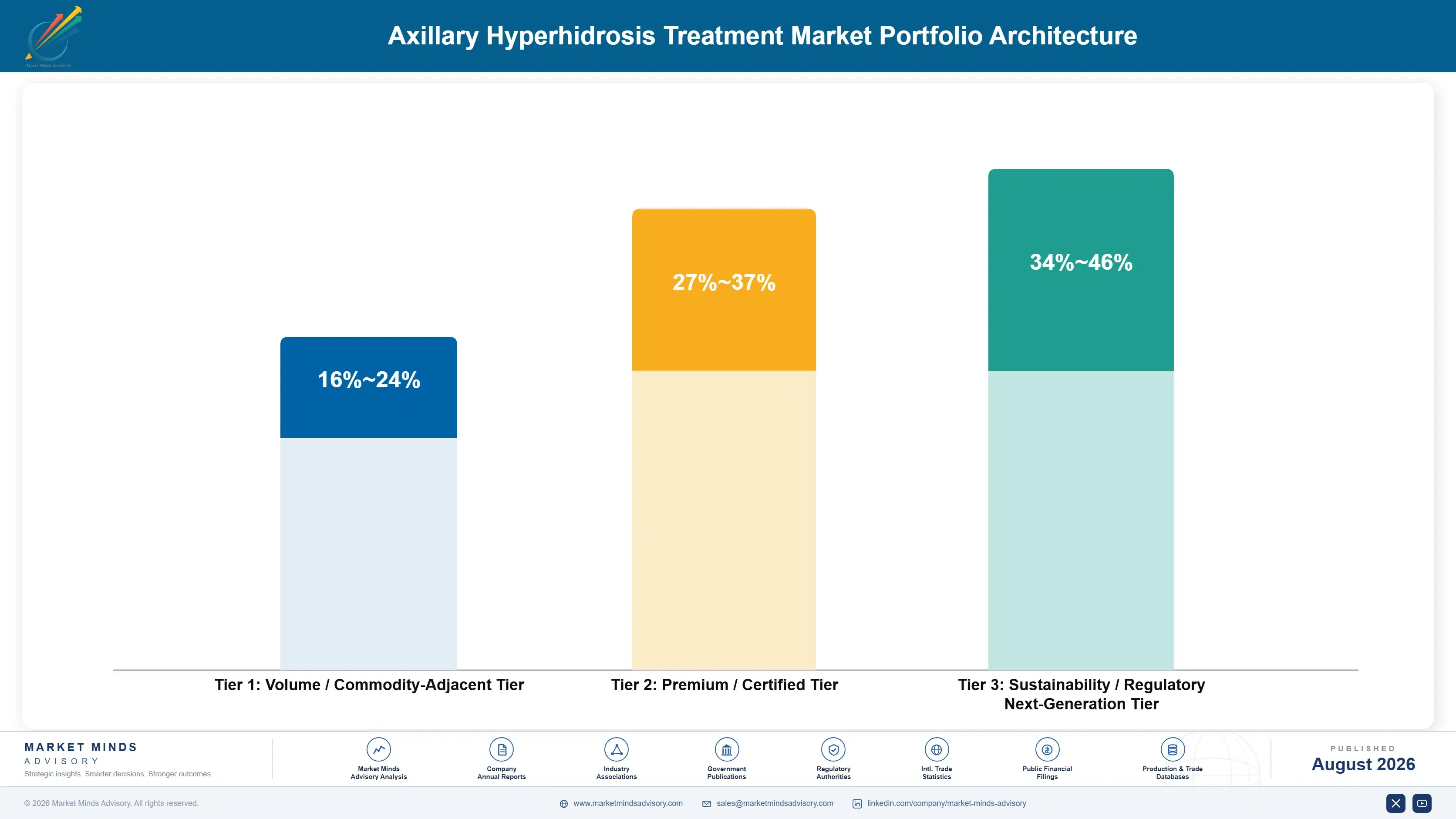
The portfolio splits into three tiers with clear margin separation. Volume-tier products, standard neurotoxin injection kits and generic topical formulations sold largely on price into commodity dermatology channels, compete hard and earn modestly. Premium certified products, covering enhanced topical formulations and extended-duration injectables, earn considerably more because clinical trial depth supports pricing. Next-generation energy-based devices and precision-matched permanent solutions
The tension here is common to specialty dermatology device businesses: volume injection revenue funds the manufacturing scale premium products depend on, yet volume growth alone cannot fund the device development investment next-generation permanent solutions require. Manufacturers leaning too heavily into premium positioning risk losing the manufacturing scale that makes market entry viable in price-sensitive injection channels, while volume players cede premium device specification to diversified rivals.

High-value pools concentrate where treatment durability, clinical documentation depth, and practice financing reliability intersect: energy-based device products serving patients willing to pay for verified, documented permanent correction. That intersection is a minority of revenue globally but expanding quickly, which is why the next-generation tier grows fastest even while representing a modest volume share.

Volume / Commodity-Adjacent Tier

Standard neurotoxin injection kits and generic topical formulations sold largely on price into commodity dermatology channels, competing directly against low-cost regional producers across most price-sensitive markets. Margins here compress steadily each year.
Gross Margin: 16%-24%

Premium / Certified Tier

Enhanced topical formulations and extended-duration injectables meeting documented efficacy specifications, sold to buyers willing to pay for clinical trial depth and proven reliability. This tier increasingly anchors long-term practice relationships and repeat volume.
Gross Margin: 27%-37%

Sustainability / Regulatory / Next-Generation Tier

Energy-based devices and precision-matched permanent solutions representing the treatment innovation frontier, priced at a premium justified by trial depth and expanding practice application scope. Few manufacturers currently compete here, leaving room for early leadership.
Gross Margin: 34%-46%
axillary-hyperhidrosis-treatment-market-portfolio-architecture-1787305239236

How Treatment Demand Actually Commits

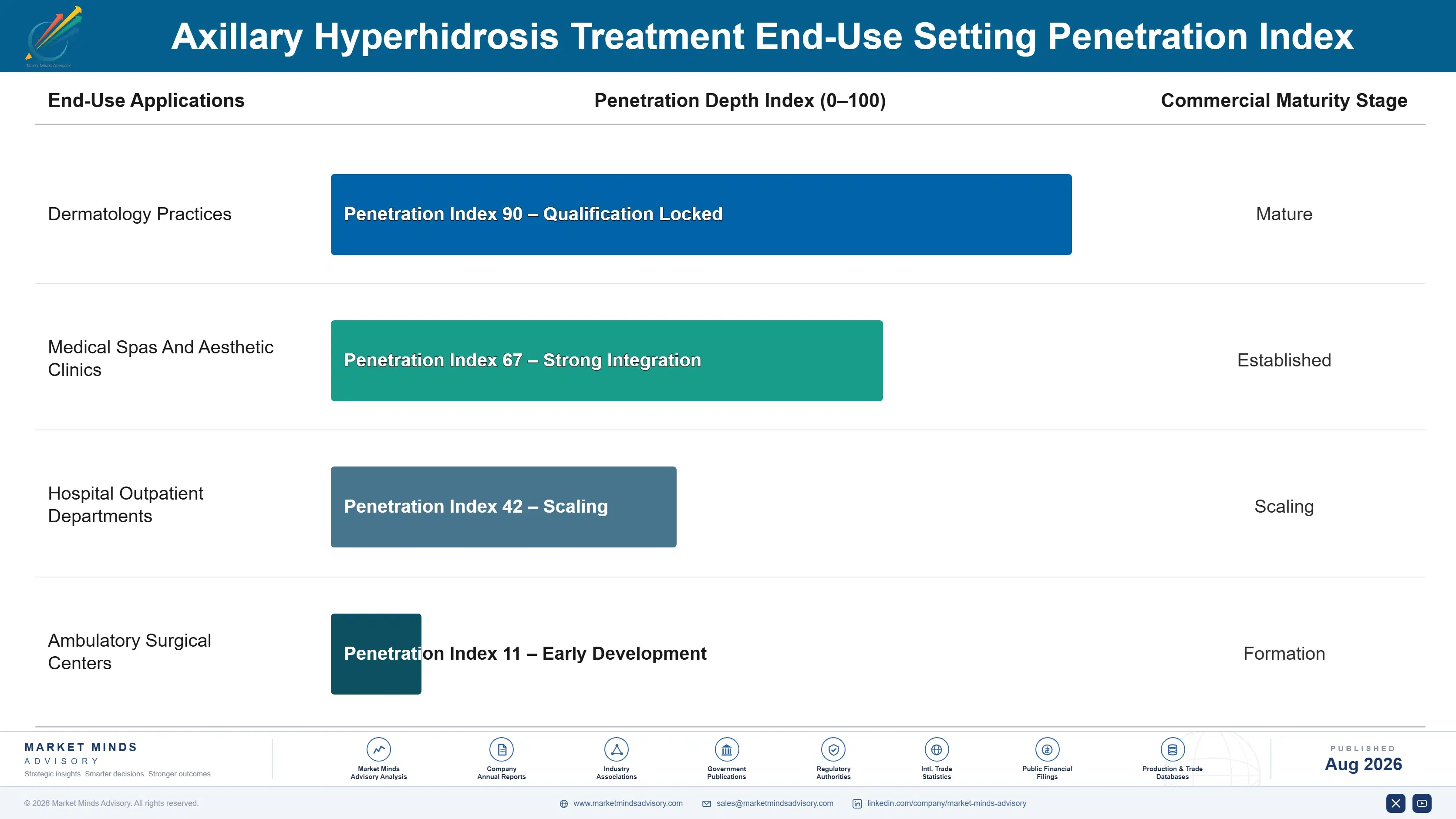
Demand here commits through a practice qualification and patient relationship cycle rather than a point-of-sale purchase decision. A dermatology practice that qualifies a specific device or injectable for its treatment protocol typically commits to that manufacturer for the protocol's entire equipment life, since switching manufacturers mid-protocol requires re-training staff and re-establishing patient trust in the original brand. That long-commitment structure makes this market behave like a p
Adoption depth varies by application category. Aesthetic dermatology and medical spa practices adopt energy-based devices readily, given the patient volume and capital access that make device investment relatively straightforward. Standard dermatology buyers adopt more cost-consciously, weighing treatment benefit against a procedure cost that competes with tighter practice budgets. Needle-averse patients occupy a distinct position, often prioritizing topical convenience over marginal cost differences between comparable treatments.

Younger dermatologists increasingly research treatment durability and device documentation directly rather than relying entirely on manufacturer sales representatives that previous practitioner generations depended on for guidance. That shift is pushing manufacturers toward more transparent published clinical data and digital prescribing tools, even though long-term specification relationships remain the actual purchasing mechanism for most practice and clinic accounts today.
axillary-hyperhidrosis-treatment-market-end-use-penetration-index-1787305239724

Where This Market Rewards Treatment Durability

These are among the four positions where our research anticipates prominent divergence between winners and laggards over the coming forecast period. Each is grounded in the demand model, the regulatory perimeter, and the announced capacity pipeline.
01 / ENERGY-BASED DEVICE STRATEGY

Winners will build permanent formats before rivals

Raw treatment chemistry alone no longer separates leading manufacturers, since most competitors can eventually match a given injection specification within a few product cycles. What actually separates winners is the depth of validated permanent correction formats available to strategic practice accounts, because a technically capable injectable without durability cannot win the specification decisions that increasingly require documented long-term outcomes before prescription begins. Manufacturers building dedicated device capability, rather than treating it as an afterthought, will out-earn technically comparable rivals over the coming decade.
02 / REGIONAL MANUFACTURING FOOTPRINT

Local production capacity will decide Asian market access

Trade cost and delivery lead time, not raw manufacturing cost alone, increasingly determine which manufacturers can compete profitably as China and India scale their own dermatology device manufacturing base rapidly. Manufacturers who build regional manufacturing capacity early will capture access that purely import-dependent competitors cannot match, regardless of how competitive their underlying treatment pricing might otherwise be under normal market conditions. Those relying entirely on distant centralized manufacturing will find themselves increasingly unable to serve the fastest-growing Asian markets within this decade.
03 / SERVICE AND FINANCING REVENUE

Practice financing will matter more than bulk sales

Manufacturers still competing purely on bulk treatment price are leaving durable revenue on the table that practice financing and marketing support services already capture successfully for service-forward competitors across major markets. These recurring revenue streams persist independent of the lumpy device adoption cycles that otherwise define this market's uneven revenue pattern tied to capital investment timing. Companies that build genuine financing and marketing capability early will earn materially more per practice relationship over a decade than those still selling only treatment.
04 / TOPICAL TREATMENT INVESTMENT

Formulation tolerability will matter more than legacy volume

Even where established injection demand keeps growing steadily, long-term margin growth is increasingly shaped by how quickly manufacturers secure tolerability leadership across the fastest-growing topical platforms, a formulation transition individual manufacturers cannot simply accelerate through marketing alone. Manufacturers who invest early in tolerability research and topical-specific engineering will capture positioning ahead of competitors still dependent entirely on legacy injection demand. This constraint will matter more to realized long-term margin than any single near-term pricing decision alone across every category tracked.

Engagement Snapshot From the Field

A live engagement with an industry participant carrying material or product regulatory and market exposure ahead of a defining policy shift, showing how our research translates into a defensible multi-year portfolio strategy.
MARKET MINDS ADVISORY · CLIENT ENGAGEMENT SUMMARY
Axillary Hyperhidrosis Treatment Producer Strategic Portfolio Review and Transition Roadmap 2026·Investment Scenario on Axillary Hyperhidrosis Treatment Exposure Evaluation 2025-26
CLIENT PROFILE
A regional dermatology practice group approached MMA while evaluating whether to expand its energy-based device investment or continue relying primarily on its established neurotoxin injection protocols across its patient base. The group reported annual hyperhidrosis patient volume near 3,900 cases, with roughly 74% treated through standard injection schedules (client-reported, unverified by MMA). The group's leadership sought an outside benchmark before committing capital.
STRATEGIC CHALLENGE
Leadership believed device expansion would meaningfully improve patient retention and lifetime revenue, but nobody had modeled the additional capital investment and financing timeline against the potential clinical advantage, nor assessed which manufacturer would best balance device performance against the group's existing patient relationships. This uncertainty delayed the capital decision by several months.
MMA APPROACH
MMA benchmarked energy-based device offerings across four manufacturers against the group's existing patient base, modeled financing investment and timeline scenarios against comparable prior equipment rollouts, and interviewed procurement staff at three regional practice groups on real-world adoption criteria for device versus injection-only treatment and reviewed comparable published outcome data. Findings were synthesized into a comparative scorecard weighted toward retention and reliability.
KEY FINDINGS
  1. A phased device rollout plan building on the group's existing patient relationships offered the clearest path to adoption, based on comparable competitor rollout timelines (client-reported, unverified by MMA).
  2. Peer group interviews revealed stronger patient retention improvement than the group's own market research had previously indicated. This gap influenced the final capital investment decision materially.
  3. The financing timeline for device adoption ran only modestly longer than the group's standard equipment onboarding cycle, given shared vendor relationship infrastructure.
  4. Two of the four manufacturers evaluated had secured meaningfully stronger patient relationships after launching device programs than injection-only comparable peers. Both manufacturers cited financing depth as a primary differentiator in their pitches.
CLIENT PROFILE
A regional dermatology practice group approached MMA while evaluating whether to expand its energy-based device investment or continue relying primarily on its established neurotoxin injection protocols across its patient base. The group reported annual hyperhidrosis patient volume near 3,900 cases, with roughly 74% treated through standard injection schedules (client-reported, unverified by MMA). The group's leadership sought an outside benchmark before committing capital.
STRATEGIC CHALLENGE
Leadership believed device expansion would meaningfully improve patient retention and lifetime revenue, but nobody had modeled the additional capital investment and financing timeline against the potential clinical advantage, nor assessed which manufacturer would best balance device performance against the group's existing patient relationships. This uncertainty delayed the capital decision by several months.
MMA APPROACH
MMA benchmarked energy-based device offerings across four manufacturers against the group's existing patient base, modeled financing investment and timeline scenarios against comparable prior equipment rollouts, and interviewed procurement staff at three regional practice groups on real-world adoption criteria for device versus injection-only treatment and reviewed comparable published outcome data. Findings were synthesized into a comparative scorecard weighted toward retention and reliability.
KEY FINDINGS
  1. A phased device rollout plan building on the group's existing patient relationships offered the clearest path to adoption, based on comparable competitor rollout timelines (client-reported, unverified by MMA).
  2. Peer group interviews revealed stronger patient retention improvement than the group's own market research had previously indicated. This gap influenced the final capital investment decision materially.
  3. The financing timeline for device adoption ran only modestly longer than the group's standard equipment onboarding cycle, given shared vendor relationship infrastructure.
  4. Two of the four manufacturers evaluated had secured meaningfully stronger patient relationships after launching device programs than injection-only comparable peers. Both manufacturers cited financing depth as a primary differentiator in their pitches.
RECOMMENDED STRATEGY
Phase 1: Phase 1 (0 to 6 months): Finalize the phased device rollout plan and begin manufacturer financing negotiations directly. with three shortlisted vendor candidates. Phase 2: Phase 2 (6 to 15 months): Complete initial device deployment while maintaining the existing injection protocols and patient relationships. across the full patient base. Phase 3: Phase 3 (15 to 24 months): Launch full device availability to eligible patients, monitoring early retention and outcome results. closely across all locations.
OUTCOME
The group proceeded with the phased device rollout plan and began manufacturer financing negotiations on schedule, tracking meaningfully faster than the originally projected timeline, with initial deployment completed ahead of the internal target date. The group reported strong early patient retention improvement ahead of the anticipated rollout expansion (client-reported, unverified by MMA).

Frequently Asked Questions

Foundational context covering the market sizes, CAGR, scope, country, region and competition that inform every finding below. This section is provided to cover basics and most often pre-purchase conversations, answered from the MMA Primary Research Dataset.

What is the current size of the Axillary Hyperhidrosis Treatment Market?

The market stood at USD 1.4 billion in 2025, based on MMA Primary Research Dataset findings. Rising patient awareness remains the largest driver of overall specification volume.

How large will the Axillary Hyperhidrosis Treatment Market be by 2036?

MMA projects the market will reach USD 3.84 billion by 2036 under the base case scenario, representing roughly 2.50 times the 2026 opening value across the eleven-year forecast period.

What is the CAGR for the Axillary Hyperhidrosis Treatment Market 2026 to 2036?

The base case CAGR is 9.6% annually. MMA's bull scenario reaches 10.9% while the bear scenario, reflecting device capital cost caution, runs closer to 8.3% over the period.

Which segment is growing fastest?

Energy-based devices lead at 15.4% CAGR, roughly 1.60 times the overall market rate, as patients demand permanent correction over repeated injection cycles at scale worldwide.

Who are the major companies in the Axillary Hyperhidrosis Treatment Market?

AbbVie, Journey Medical, Sientra, Ipsen, and Galderma lead the market, together controlling an estimated 52% of global revenue on a consistent basis measured across every treatment category.

Which country is growing fastest?

China posts the fastest national growth at 13.4% CAGR, driven by its rapidly expanding dermatology clinic access and rising patient awareness. Domestic manufacturers increasingly compete for regional export orders.

Report Segmentation Architecture

The full report scope spans multiple orthogonal segmentation dimensions, with cross-tabulated demand data provided for each dimension pair. Coverage extends further to regional breakdowns, trend trajectories, and the competitive detail needed to support segment-level decision-making.

By Treatment Type

  • Botulinum Toxin Injections
  • Topical Anticholinergic Treatments
  • Energy-Based Devices
  • Iontophoresis Devices

By End-Use Setting

  • Dermatology Practices
  • Medical Spas And Aesthetic Clinics
  • Hospital Outpatient Departments
  • Ambulatory Surgical Centers

By Commercial Dimension

  • Direct Practice Sales
  • Specialty Distributor Channels
  • Payer And Insurance Partnerships
  • Cash-Pay Aesthetic Procurement

By Region

  • North America
  • Western Europe
  • East Asia
  • South Asia and Pacific
  • Latin America
  • Middle East and Africa
  • Eastern Europe

Scope, Methodology, and Coverage

Every figure in this report is reproducible from documented input assumptions. The scope below maps the historical period, the forecast horizon, the segmentation dimensions, and the countries covered, alongside the underlying primary and qualitative methodology.
Historical Period
2020 to 2025
Forecast Period
2026 to 2036
Base Year
2025 (USD billions; MMA Primary Research Dataset, August 2026)
Market Definition
The axillary hyperhidrosis treatment market covers botulinum toxin injections, topical anticholinergic treatments, energy-based devices, iontophoresis devices, and surgical sympathectomy used specifically to treat excessive underarm sweating. It excludes general-purpose antiperspirant and deodorant products without a specific prescription indication.
Quantitative Units
USD billions (current prices); treatment courses and procedures shipped where applicable
Segmentation Dimensions
By Treatment Type; By End-Use Setting; By Commercial Dimension; By Region
Regions Covered
North America, Western Europe, East Asia, South Asia and Pacific, Latin America, Middle East and Africa, Eastern Europe
Countries Covered
USA, Canada, China, Japan, South Korea, India, Australia, Vietnam, Indonesia, Germany, France, UK, Italy, Spain, Brazil, Mexico, UAE, Saudi Arabia, South Africa, Poland, Czech Republic, Hungary, Romania, Russia, and additional markets relevant to this sector
Key Companies Profiled
AbbVie Inc., Journey Medical Corporation, Sientra, Inc., Ipsen S.A., Galderma Group AG, Merz Pharma GmbH and Co. KGaA, Candela Corporation, Cutera, Inc., Cynosure, LLC, Lumenis Ltd., Fotona d.o.o., Hidrex GmbH, R.A. Fischer Company, Inc., A/S Perspirex, Church and Dwight Co., Inc., Almirall, S.A., Bausch Health Companies Inc., Revance Therapeutics, Inc., Evolus, Inc., Hugel, Inc.
Quantitative Methodology
Primary survey, n=3,800 respondents, Q4 2025, six countries; demand-side model with trade association cross-validation
Qualitative Methodology
47 expert interviews, Q4 2025; applied to validate demand model assumptions, identify emerging dynamics, and assess competitive positioning
Report Format
PDF and XLSX data workbook (Word format preview document)
Publisher
Market Minds Advisory
Report Code
MMA-2026-HLT-215
Published
August 2026
Contact
sales@marketmindsadvisory.com | www.marketmindsadvisory.com

Purchase the full Axillary Hyperhidrosis Treatment Market Report (2026 to 2036).

The full MMA Axillary Hyperhidrosis Treatment report sizes the market across four treatment-type categories, four end-use settings, four commercial channels, and seven regions through 2036. It profiles 20 participants on a consistent revenue basis, scoring the top five on clinical trial depth, device and formulation breadth, and practice financing reliability. Scenario models quantify how energy-based device adoption, topical treatment uptake, and China's clinic access expansion move both demand and realizable pricing. The report also includes delivered-cost modelling by treatment type, a regional reimbursement policy tracker, and a competitive benchmarking tool built for manufacturer strategy, practice procurement, and investor due diligence teams.
Four-category treatment-type segmentation with regional cross-tabulation
Reimbursement policy tracker across twelve major markets
Competitive benchmarking on consistent revenue basis
Delivered-cost modelling by treatment type and region
Scenario models for device and topical treatment demand
China dermatology clinic access analysis by manufacturer

Built For The People Who Decide

From boardroom strategy to bench-side execution, this report is read cover-to-cover by leaders shaping the next decade of their industry, turning demand scenarios, market dynamics and valuation benchmarks into decisions.
CXOs/ Presidents/ VPs/ Managers
M&A and Corporate Development
Strategy Teams and R&D Heads
Procurement and Product Directors
Regulatory and Compliance Leaders
Investor Relations and Equity Analysts