Market Minds Advisory
Avocado Oil Market

Avocado Oil Market: One Fruit, Three Buyers: How Culinary, Cosmetic, And Byproduct Demand Are Repricing Avocado Oil

Avocado oil moves from a niche premium cooking oil into a diversified ingredient category, as Mexican and Peruvian growers, cosmetic formulators, and byproduct-oil extractors all compete for the same fruit that once yielded only guacamole.

Lead Analyst

Lisa Gevelber

Published

September 2026

Make Smarter Decisions with Customized Research Insights

Request a free sample report and evaluate market opportunities, growth trends, and competitive dynamics relevant to your business needs.

2025 MARKET VALUE$1.9BMarket Size 2025
2036 FORECAST VALUE$4.2BBase Case , 2026 to 2036
CAGR 2026 TO 20367.4 %Bull 8.7% / Bear 6.1%
INCREMENTAL OPPORTUNITY$2.1BNet 10- year value creation
EXPANSION MULTIPLE2.04x2036 value over 2026 base
Strategic Levers
M&A Pipeline
Regional Outlook
Country Rankings
Competitive Intelligence
Segmental Deep-dive
Call-Us : 91 93563 13602

Executive Snapshot and Market Trajectory

Avocado oil has moved from a niche premium cooking oil into a genuine multi-use ingredient category, as Mexican growers, cosmetic formulators, and byproduct-oil extractors all now compete for the same fruit that once yielded little beyond guacamole for most of its long commercial history until quite recently.
The market stands at USD 1.9 billion in 2025 and reaches USD 4.17 billion by 2036 at a 7.4% CAGR. Avocado pomace oil grows fastest at 11.2%, about 1.51 times the overall rate, as processors extract oil from guacamole and pulp processing byproduct rather than discarding it. Latin America holds 42% of value on Mexico's overwhelming avocado cultivation dominance, while North America leads cosmetic and culinary consumption without growing the fruit itself.
Concentration sits at a moderate 28%, split between large Mexican and Peruvian avocado agribusinesses and specialty cold-pressed oil brands that rarely compete on the same shelf. Buyers increasingly specify avocado oil by processing grade, extra virgin for salads, refined for high-heat cooking, rather than treating it as a single interchangeable product. Cosmetic formulators pay considerably more per liter than food buyers ever do at any real scale.
Market Definition
The avocado oil market covers oil extracted from avocado fruit pulp or processing byproduct, valued at the point of sale into culinary, personal care, and industrial applications across extra virgin, refined, crude, and pomace-derived grades. It excludes fresh avocado fruit sales, guacamole and other finished avocado food products, and finished cosmetic products beyond the oil ingredient itself.
Base Year Value
$1.9B in 2025 (MMA Primary Research Dataset, August 2026)
Forecast Period
2026 to 2036, eleven discrete annual values
CAGR
7.4% base case. Bull 8.7%. Bear 6.1%.
Fastest Growth Segment
Avocado Pomace Oil: 11.2% CAGR
Fastest Growth Country
Peru: 13.5% CAGR
Fastest Growth Region
South Asia and Pacific: 9.4% CAGR
Largest Region
Latin America: 42% of 2025 global value
Market Leaders
Chosen Foods, Sesajal, Olivado, La Tourangelle, Westfalia Fruit. Source: MMA Analysis based on company annual reports.
Primary Survey
n=3,800 procurement and R&D decision-makers, Q4 2025, six countries
Methodology
Demand-side build-up, cross-validated against public data, 47 expert interviews

Avocado Oil Market Forecast Scenarios

avocado-oil-market-trends-growth-size-forecast-scenario-1787463173240
Avocado oil compounded near 6.5% from 2020 to 2025, a period dominated by rising culinary demand as consumers sought a high smoke-point alternative to olive oil. Mexican processing capacity expanded steadily through the period, while Peruvian and Kenyan growers began building export-oriented oil extraction capacity behind their already-established fresh fruit export industries, and cosmetic buyers began specifying avocado oil more precisely by name.
Three mechanisms carry the base case to 7.4%. First, culinary buyers are substituting avocado oil for olive and canola oil in high-heat cooking applications, a swap requiring no new equipment. Second, cosmetic formulators are specifying avocado oil by name for its documented skin-conditioning properties, a category needing genuine reformulation investment. Third, processors are extracting pomace oil from guacamole and pulp processing byproduct that previously carried disposal cost, converting waste into a new revenue stream.
The bull case at 8.7% assumes cosmetic and pomace-oil demand both scale faster than expected, pulling additional processing investment into Mexico and Peru simultaneously. The bear case at 6.1% assumes culinary demand growth slows as avocado oil's price premium over olive and canola oil limits mainstream adoption, leaving premium and cosmetic channels as the primary growth engine.

Why One Fruit Now Feeds Three Different Buyers

Three forces converge on avocado oil today. Health-conscious cooks want a high smoke-point oil with a cleaner nutritional story than canola or vegetable oil, cosmetic formulators want a naturally derived skin-conditioning ingredient with documented efficacy, and food processors want a genuine use for pulp byproduct that once carried real disposal cost. Suppliers able to serve more than one of these buyers simultaneously capture pricing single-channel competitors cannot match at all.
MARKET CONCENTRATIONCR5: 28%Mexican and Peruvian agribusinesses compete with specialty brands
COSMETIC PRICE PREMIUM3 to 6x culinary gradeSkin-care formulators pay considerably more per liter overall
TOP PRODUCING COUNTRY SHAREMexico: ~55% of global cultivationRaw fruit supply concentrates heavily in one country
EXTRACTION CAPACITY UTILISATION60% to 75%Cold-press and refining lines run below full capacity
FEEDSTOCK SHARE OF COGS50% to 65%Raw fruit cost dominates total production expense heavily
POMACE OIL YIELD SHARE3% to 6% of processed fruitOnly a small fraction of byproduct converts to oil
The commercial character splits sharply by grade. Refined culinary oil competes closely against olive and canola oil on price, with only a modest premium for smoke-point performance in high-heat cooking applications. Cosmetic-grade oil behaves like a specialty ingredient entirely, commanding several multiples of culinary pricing because formulators pay for documented skin-conditioning claims rather than caloric or flavor content that food buyers actually value.
The next decade turns on whether Peru, Kenya, and Colombia build genuine oil extraction capacity behind their already-growing fresh fruit export industries, or remain raw fruit exporters while Mexico and the United States capture the oil processing value entirely. Pomace oil extraction remains the newest and least proven growth channel, though early results look genuinely promising for processors willing to invest.
"Ten years ago this was cooking oil with a marketing story. Now a cosmetic chemist, a chef, and a waste management engineer are all buying the same fruit for three completely different reasons, and none of them are paying the same price."
Director, Specialty Edible Oils and Personal Care Ingredients Practice · MMA Agriculture / Specialty Edible and Cosmetic Oils Practice · August 2026

Market Trends

Cosmetic Formulators Specify Avocado Oil By Documented Claim

Personal care brands have moved beyond listing avocado oil as a generic botanical ingredient toward specifying it by documented skin-conditioning and barrier-repair claims, a shift that has pulled cosmetic-grade demand well ahead of what culinary growth alone would predict. Croda International and other specialty ingredient suppliers now offer cosmetic-grade avocado oil with published clinical or in-vitro efficacy data, letting brand customers cite specific claims on packaging rather than generic botanical language. The shift mirrors what happened earlier in other functional ingredient categories, where documented claims eventually separated premium suppliers from commodity botanical oil sellers entirely.
Market Impact: Retail distribution expanded 40% since 2020
Pomace Oil Extraction Converts Processing Waste Into Revenue

Guacamole and packaged avocado pulp processors generate substantial fruit waste, including skins, pits, and off-grade pulp, that historically carried disposal cost rather than revenue. Extraction technology adapted from olive pomace oil processing now recovers a meaningful additional oil yield from this waste stream, typically 3% to 6% of processed fruit weight, at close to zero incremental feedstock cost. Mission Produce and other large-scale processors have begun piloting dedicated pomace extraction lines alongside their primary fresh fruit and pulp operations, treating what was previously a cost center as a genuine secondary revenue stream worth pursuing at scale.
Market Impact: Commands 3x to 6x culinary pricing

Market Opportunities and Growth Drivers

High Smoke Point Pulls Avocado Oil Into Mainstream Cooking

Avocado oil's smoke point runs meaningfully higher than extra virgin olive oil, making it genuinely useful for high-heat searing and frying applications where olive oil degrades and produces off-flavors. Health-conscious consumers switching away from canola and vegetable oil for perceived nutritional reasons have adopted avocado oil as a direct substitute carrying a healthier positioning than either alternative. Chosen Foods and other branded suppliers have expanded retail distribution significantly across North American grocery chains since 2020, moving avocado oil from a specialty health-food-store item into mainstream supermarket shelf space alongside conventional cooking oils entirely.
Market Impact: Mexico supplies over 50% of fruit

Cosmetic Brands Reformulate Around Skin-Conditioning Claims

Natural and clean-beauty personal care brands increasingly specify avocado oil for its documented fatty acid and vitamin content supporting skin barrier function, a positioning that commands considerably higher pricing than generic carrier oil sales. Croda International and specialty botanical ingredient suppliers have expanded cosmetic-grade avocado oil capacity specifically to serve this demand, differentiating it from culinary-grade material through tighter purity and sensory specification. The reformulation mirrors the broader natural personal care trend already reshaping other ingredient categories, where documented functional claims increasingly separate premium suppliers from commodity botanical oil sellers competing purely on price.
Market Impact: Testing adds 15% to cosmetic-grade cost

Market Restraints and Challenges

Mexican Supply Concentration Creates Genuine Price Volatility Risk

Roughly half of global avocado cultivation concentrates in Mexico, primarily Michoacan state, so any weather event, disease outbreak, or trade disruption there moves global oil pricing considerably more than diversified commodity oil markets experience. The root cause is decades of concentrated agricultural investment, since Michoacan's climate and elevation suit avocado cultivation exceptionally well, and building comparable orchards elsewhere takes seven to ten years to reach production. The impact falls hardest on culinary buyers competing against olive and canola oil on price, since they cannot easily pass through Mexican volatility. Processors are diversifying sourcing toward Peru, Colombia, and Kenya.
Market Impact: Cosmetic-grade demand grows 9% faster annually

Cosmetic Grade Requires Costly Purity Certification

Cosmetic-grade avocado oil must meet considerably tighter purity, peroxide value, and heavy metal specifications than culinary-grade material, requiring analytical testing infrastructure many agricultural processors simply do not have. The root cause is regulatory: personal care ingredient safety standards, particularly in the European Union, impose documentation requirements agricultural commodity processors were never built to satisfy. The impact falls hardest on smaller Latin American producers who grow excellent fruit but lack laboratory infrastructure to certify cosmetic-grade output, ceding that higher-margin business to specialty distributors instead. Some producers are partnering with specialty distributors who handle certification and testing on their behalf.
Market Impact: Recovers 3% to 6% oil yield
3 additional market trends, 4 additional growth drivers, and 2 additional restraints and challenges are covered in the full report. Contact sales@marketmindsadvisory.com to access the complete intelligence.

Segment CAGR and Growth Architecture

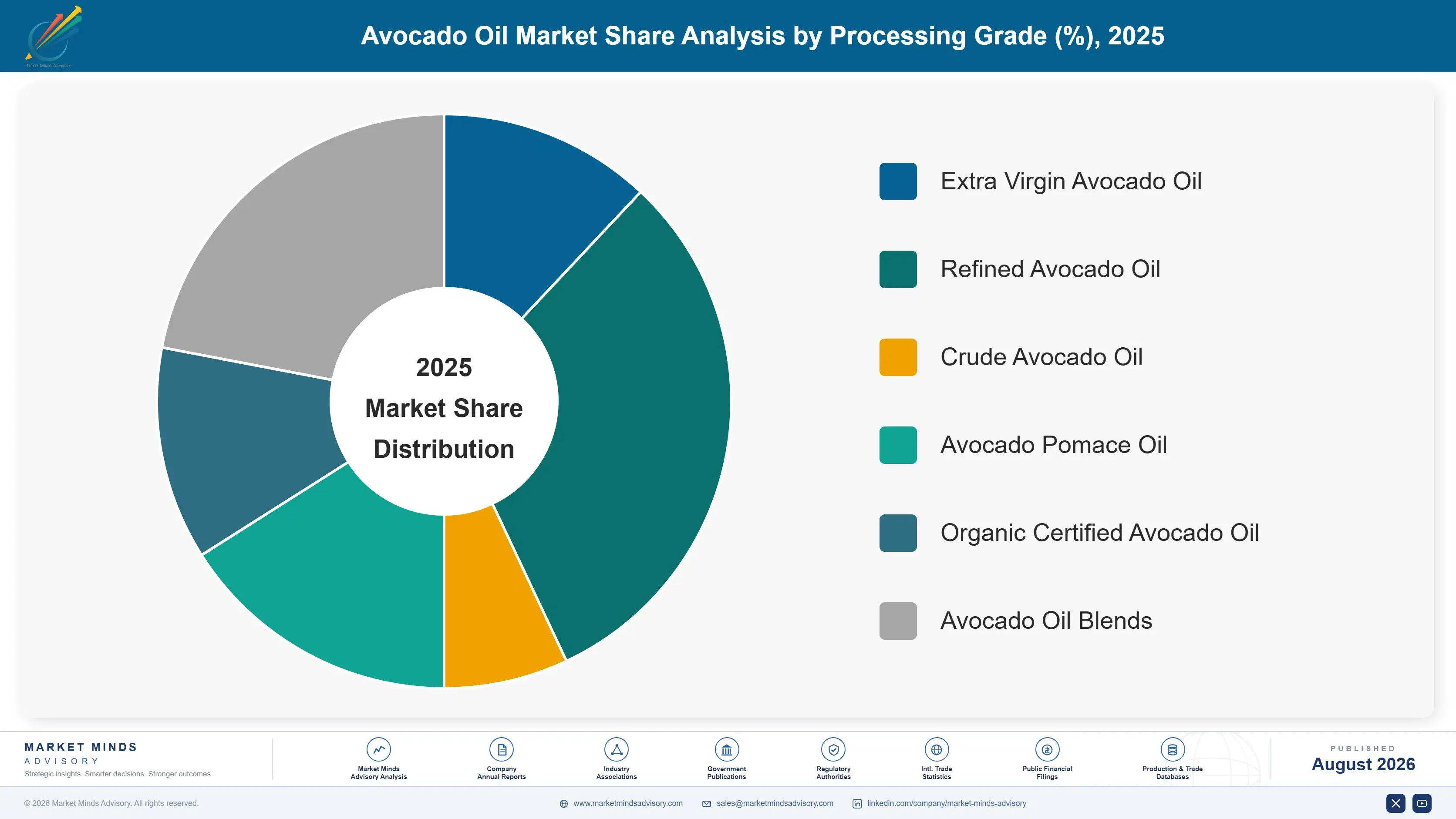
Segmentation follows processing grade, the single classification logic separating how avocado oil is extracted and refined before sale. Extra virgin, refined, crude, pomace-derived, organic certified, and blended oil each carry distinct extraction methods, purity specifications, and buyer types. End-use industry and distribution channel sit separately within the framework rather than folded into this hierarchy.
avocado-oil-market-trends-growth-market-share-analysis-1787463173773

Avocado Pomace Oil

Avocado pomace oil grows fastest at 11.2%, about 1.51 times the overall 7.4% rate, extracted from the skins, pits, and off-grade pulp that guacamole and packaged avocado processors previously discarded as waste. Mission Produce and other large-scale processors have begun piloting dedicated pomace extraction lines adapted from olive pomace oil technology, recovering roughly 3% to 6% of processed fruit weight as additional oil yield at close to zero incremental feedstock cost. The category benefits from a genuine sustainability narrative, since it converts a disposal cost into revenue rather than requiring any additional fruit cultivation. Supply remains tightly tied to guacamole and pulp processing volume, and quality consistency across extraction batches is the harder technical problem processors are still solving.
CAGR 11.2%

Organic Certified Avocado Oil

Organic certified avocado oil grows second-fastest at 9.8%, roughly 1.32 times the overall rate, as clean-label culinary and cosmetic buyers increasingly specify certified organic sourcing over conventional avocado oil carrying no such certification. Mexican and Peruvian growers have expanded certified organic orchard acreage considerably since 2020, responding to premium pricing that can run meaningfully above conventional fruit at the farm gate. Certification costs and yield penalties from foregoing synthetic inputs keep organic oil a premium category rather than a mainstream one, limiting how quickly supply can scale even as demand grows. Olivado and other specialty cold-pressed brands have built their positioning substantially around organic certification, differentiating themselves from large commodity-focused agribusiness competitors selling primarily conventional fruit.
CAGR 9.8%
Full segment breakdown across 6 segments available in the complete report.

Regional Architecture and Country Demand Map

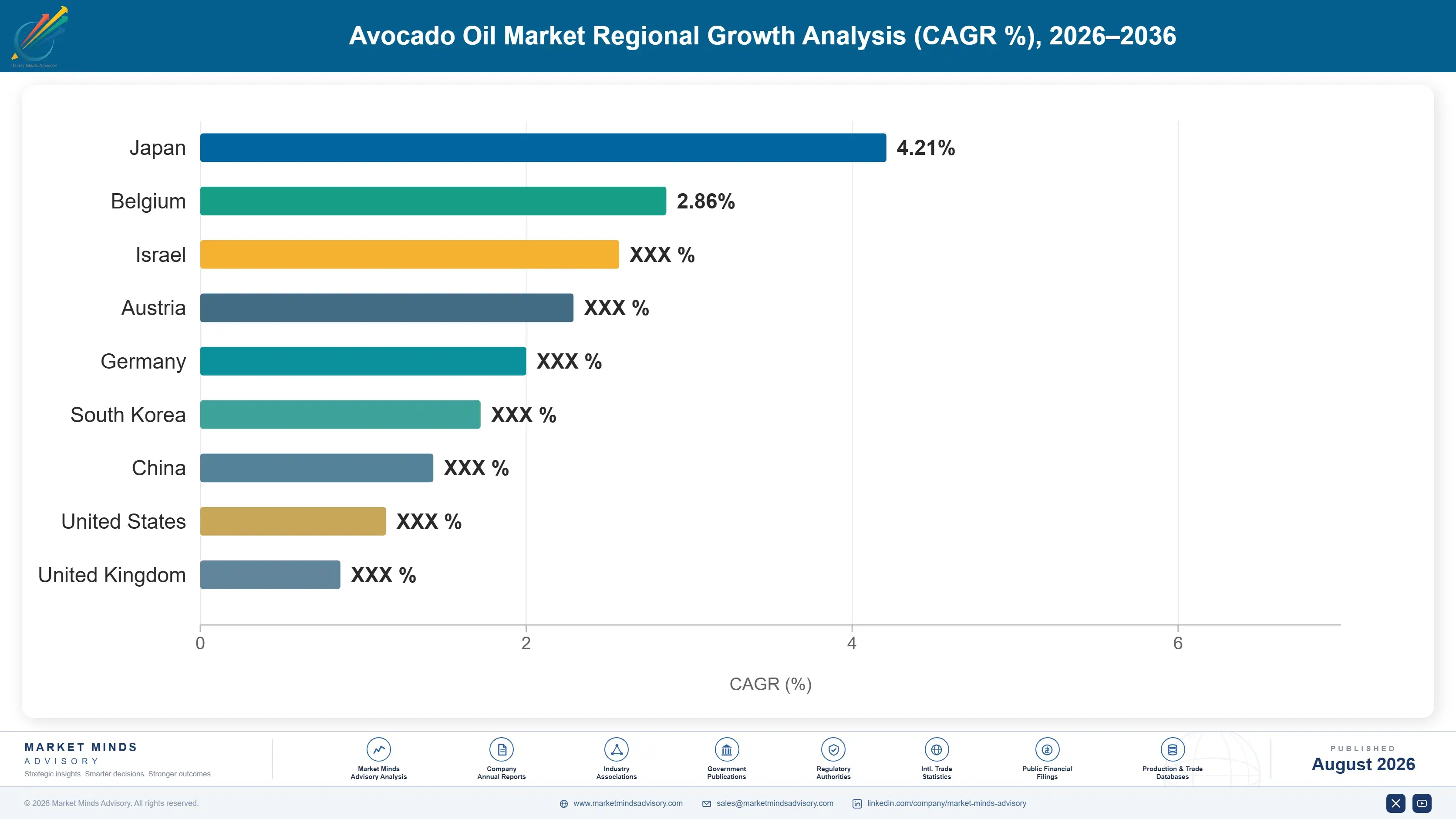
Latin America leads overwhelmingly on Mexico's raw avocado cultivation dominance, while North America captures the bulk of cosmetic and culinary consumption value without growing the fruit domestically. Western Europe, East Asia, and South Asia and Pacific all sit below their usual bands given limited cultivation and culinary tradition.

North America

Cosmetic and culinary consumption without proportional domestic cultivation explains North America's 22% share, at the floor of the 22 to 32% band, since the United States imports the overwhelming majority of its avocado oil feedstock or finished oil from Mexico and Peru rather than growing fruit domestically at comparable commercial scale. Chosen Foods and La Tourangelle both built substantial branded retail distribution across American grocery chains, capturing consumption value even without controlling underlying cultivation directly. Croda International supplies cosmetic-grade material into the region's substantial personal care manufacturing base, a channel considerably less price-sensitive than culinary retail. Growth of 8.0% reflects continued culinary and cosmetic demand expansion running ahead of any domestic supply constraint.
Share: 22% | CAGR: 8.0% (2026 to 2036)

Western Europe

Established olive oil culinary tradition limits avocado oil's culinary penetration across Western Europe, holding the region to 14% of value, below the 18 to 26% band, even though cosmetic demand remains genuinely substantial. Croda International and other European specialty houses supply cosmetic-grade avocado oil into the region's large personal care manufacturing base, a demand channel considerably less price-sensitive than culinary buyers. German and French premium retail have expanded avocado oil shelf space steadily, though it competes directly against a deeply entrenched olive oil culture. The share sits below band because olive oil's cultural and price incumbency, not purchasing power, constrains culinary adoption. Growth of 5.9%, the slowest of the seven, reflects that incumbency.
Share: 14% | CAGR: 5.9% (2026 to 2036)
Regional intelligence for 5 additional markets available in the complete report: East Asia, South Asia and Pacific, Latin America, Middle East and Africa, Eastern Europe. Contact sales@marketmindsadvisory.com.
avocado-oil-market-trends-growth-country-cagr-analysis-1787463174290

Where Avocado Oil Producers Capture More Value

Selling avocado oil as undifferentiated culinary commodity leaves considerable value on the table, since cosmetic formulators, pomace-oil buyers, and organic-certified channels will all pay meaningfully more for the same underlying fruit under the right conditions. The four moves below focus on cosmetic-grade certification, pomace extraction investment, organic acreage conversion, and direct formulator relationships bypassing brokers entirely.

Certify Cosmetic-Grade Purity And Documented Claims

Culinary-grade avocado oil competes on price against olive and canola oil, whereas cosmetic-grade material sold with documented skin-conditioning claims commands 3 to 6 times culinary pricing from personal care formulators who rarely shop on price alone. Producers able to invest in the analytical testing and clinical or in-vitro efficacy data cosmetic buyers require can access this considerably higher-margin channel directly rather than selling undifferentiated bulk oil to a distributor. Croda International and similar specialty ingredient houses built their entire avocado oil business around this certification gap, capturing margin agricultural processors without laboratory infrastructure cannot reach on their own.
Market Impact: Commands a 3x to 6x culinary-grade price premium

Build Dedicated Pomace Oil Extraction Lines

Guacamole and packaged pulp processors generate substantial fruit waste that historically carried disposal cost rather than revenue, and dedicated pomace extraction lines adapted from olive pomace technology recover 3% to 6% of processed fruit weight as additional oil at close to zero incremental feedstock cost. Mission Produce and other large processors piloting this approach are converting an existing cost center into a genuine secondary revenue stream without requiring additional fruit cultivation. The capital investment is modest relative to primary processing infrastructure already in place, though quality consistency across extraction batches remains a real technical problem processors are still solving.
Market Impact: Recovers an extra 3% to 6% oil revenue

Convert Acreage To Certified Organic Production

Certified organic avocado oil commands premium pricing 15% to 25% above conventional material at both the farm gate and finished oil level, as clean-label culinary and cosmetic buyers increasingly specify certification directly rather than accepting conventional sourcing by default. The conversion process takes three to five years and carries genuine yield penalties from foregoing synthetic inputs, which limits how quickly supply can scale even as demand grows steadily. Olivado and similar specialty brands built their market positioning substantially around organic certification, differentiating themselves from large commodity-focused agribusiness competitors selling primarily conventional fruit at lower, less differentiated pricing.
Market Impact: Commands a 15% to 25% organic price premium

Build Direct Relationships With Cosmetic Formulators

Selling through commodity oil trading intermediaries captures a smaller share of delivered value than contracting directly with cosmetic and personal care formulators willing to commit to multi-year supply agreements at negotiated specification and pricing. Westfalia Fruit and similar vertically integrated suppliers have expanded direct formulator relationships, cutting out a distribution layer and capturing the 10% to 18% margin that previously went to specialty ingredient brokers. Direct relationships also give producers demand visibility supporting cosmetic-grade capacity planning, reducing the risk of certifying capacity nobody has committed to purchase. The approach requires sales investment few pure agricultural producers have historically built in-house.
Market Impact: Cuts broker margin by roughly 10% to 18%

Who Controls the Margin Pool

Concentration sits at a moderate 28%, split between large Mexican and Peruvian avocado agribusinesses controlling raw material supply and specialty cold-pressed oil brands that rarely compete for the same customer directly. All participants are assessed on one basis: attributable avocado oil revenue across culinary, cosmetic, and industrial channels.
Competition runs along three lines. First, raw material access, since fruit supply concentration in Mexico gives vertically integrated growers a genuine cost advantage over oil producers dependent on open-market fruit purchasing. Second, cosmetic-grade certification capability, where analytical testing and documented claims separate specialty ingredient suppliers from commodity culinary oil sellers. Third, brand distribution reach, as culinary brands increasingly compete on retail shelf presence rather than oil quality alone.

Pressure is building from two directions. Peruvian and Kenyan growers are moving downstream into oil extraction rather than remaining raw fruit exporters, competing directly with Mexican processors who previously controlled most oil-grade supply. Meanwhile cosmetic ingredient specialists are pushing into pomace-oil sourcing to diversify their raw material base beyond primary fruit purchasing alone. Rankings should favor participants holding both vertically integrated fruit supply and cosmetic-grade certification capability over those dependent on a single channel or sourcing geography.
avocado-oil-market-trends-growth-company-positioning-matrix-1787463174816

Competitive Moat and Risk Dimensions

CHOSEN FOODS

Moat: Vertically integrated Mexican supply

Chosen Foods sources through its parent company Sesajal's vertically integrated Mexican avocado processing operations, giving it cost and supply security advantages competitors dependent on open-market fruit purchasing cannot easily replicate at comparable scale. That integration let it expand branded retail distribution aggressively across North American grocery chains since 2020.
CHOSEN FOODS

Risk: Concentrated single-country sourcing

Chosen Foods' supply chain concentrates heavily in Mexico, leaving it more exposed than geographically diversified competitors to Mexican weather events, disease outbreaks, or trade policy disruption that could constrain fruit availability or raise cost meaningfully across its entire branded product line and broader distribution network.
OLIVADO

Moat: Geographically diversified cold-press sourcing

Olivado operates cold-pressed extraction capacity across Kenya, Peru, and Mexico simultaneously, giving it supply diversification competitors concentrated in a single country cannot match at all, along with organic certification positioning that differentiates it from large commodity-focused agribusiness competitors selling primarily conventional, uncertified fruit at scale.
OLIVADO

Risk: Smaller scale than agribusiness rivals

Olivado operates at meaningfully smaller scale than large vertically integrated Mexican and Peruvian agribusinesses, limiting its ability to compete purely on price in commodity culinary oil channels and making its premium, certification-driven positioning essential to sustaining margin over the long term regardless of overall scale.

Players Tracked

Prominent Players

Chosen Foods
Sesajal
Olivado
La Tourangelle
Westfalia Fruit

Other Key Players

Mission Produce
Calavo Growers
Camposol
Cartama
Fresh Del Monte Produce
West Pak Avocado
Henry Avocado
Eco Farms
Index Fresh
Agricola Cerro Prieto
Croda International
Jedwards International
New Directions Aromatics
NOW Foods
Olam Agri

Recent Developments

FEBRUARY 2024

Mission Produce expands avocado processing capacity in Peru

Mission Produce announced an organic expansion of its avocado processing and packing capacity in Peru, adding output to serve growing export demand across North American and European markets simultaneously. This was an organic capacity expansion funded from existing operations, not an acquisition or joint venture.
Signal: Capacity investment in Peru signals growers diversifying processing scale beyond Mexico ahead of any single-country supply disruption.
SEPTEMBER 2023

Camposol expands avocado oil extraction capacity in Peru

Camposol announced continued investment in dedicated avocado oil extraction capacity at its Peruvian facilities, expanding output to serve culinary and cosmetic-grade demand channels across several major growing export markets. This was an organic capacity expansion within existing operations, not an acquisition or new joint venture.
Signal: A major fresh fruit exporter investing in oil extraction confirms Peru is moving downstream rather than remaining a raw supplier.
MAY 2024

Olivado expands cold-pressed avocado oil capacity in Kenya

Olivado announced expanded cold-press extraction capacity at its Kenyan facility, adding output to serve growing European and North American demand for certified organic avocado oil across both retail and formulator channels. This was an organic capacity expansion funded from existing operations, not an acquisition or joint venture.
Signal: Capacity investment behind organic certification shows specialty brands defending their premium positioning ahead of larger commodity competitors.

Raw Fruit Cost And Harvest Volatility

Raw avocado fruit cost dominates the cost structure, running 50% to 65% of cost of goods sold, sourced overwhelmingly from Mexican, Peruvian, and increasingly Kenyan and Colombian orchards. Extraction and refining energy adds a further 10% to 15%, with cosmetic-grade material carrying additional analytical testing and certification cost on top of the base extraction expense.
Mexican avocado prices spiked sharply during 2022 and 2023 as drought conditions and periodic trade disruption tightened fruit availability from Michoacan, the state supplying the overwhelming majority of Mexican export volume. Fresh Del Monte Produce's 2023 Annual Report documented meaningfully higher fruit procurement cost passing through to processed and oil-grade product lines, compressing margins for processors unable to reprice contracts quickly. Peruvian supply proved comparatively more stable through the period, partially offsetting Mexican volatility for diversified buyers.

Exposure separates producers by sourcing geography and vertical integration rather than by scale alone. Vertically integrated growers controlling their own orchards absorbed the 2022 and 2023 price spikes better than oil processors dependent on open-market fruit purchasing from Mexican intermediaries. Geographically diversified buyers sourcing across Mexico, Peru, and Kenya simultaneously held a meaningful cost advantage over single-country-dependent competitors throughout the volatility.
avocado-oil-market-trends-growth-cost-volatility-analysis-1787463175012

Diversify fruit sourcing across multiple growing countries

Producers dependent entirely on Mexican fruit carried the full weight of the 2022 and 2023 drought-driven price spikes, while competitors sourcing across Mexico, Peru, and Kenya simultaneously absorbed the shock considerably better. Building supply relationships across multiple growing geographies before a disruption occurs, rather than after, is what actually protects margin when the next weather event inevitably arrives.

Contract fruit supply on multi-year fixed-volume agreements

Spot-market fruit purchasing exposed several processors to the sharpest of the 2022 and 2023 price spikes, while competitors holding multi-year supply agreements with growers absorbed the shock more gradually across their contract term. Locking volume and reference pricing with orchard operators ahead of need converts an unpredictable cost line into a plannable one across budget cycles.

Vertically integrate into orchard ownership where feasible

The most durable cost position belongs to processors who own or partner directly with the orchards generating their fruit supply, capturing agricultural margin at its source rather than purchasing fruit from an intermediary at a marked-up price during a shortage. This also secures supply continuity that pure oil processors cannot guarantee for themselves during a regional disruption.

Portfolio Architecture for Margin Defence

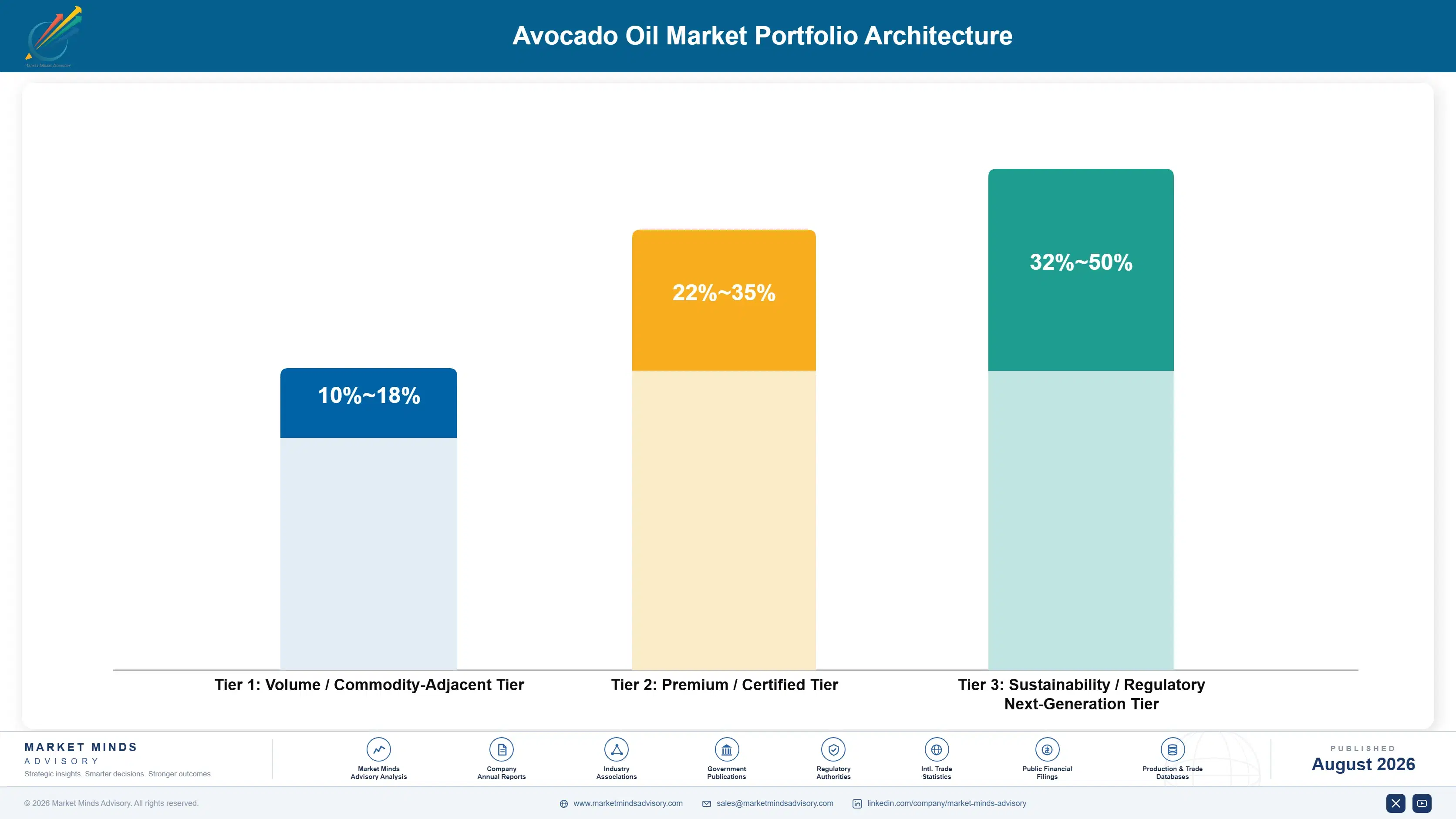
The portfolio splits into three tiers by grade and end-use specification. Crude and bulk refined culinary oil sold into commodity cooking oil channels competes almost entirely on price against olive and canola oil. Branded culinary and organic-certified oil sold at retail earns considerably more, since packaging, certification, and brand positioning carry real value. Cosmetic-grade material sits at the top, priced against specialty personal care ingredient economics rather than food commodity benchmarks.
The tension runs between volume that keeps processing lines running through a concentrated harvest season and margin that rewards certification and brand investment. Bulk commodity sales fund plant utilization but earn thin margins barely covering fruit and extraction cost during a volatile pricing year. Branded and cosmetic-grade volume carries the returns but depends on certification infrastructure and formulator relationships smaller producers often lack. Producers weighting entirely toward bulk commodity channels carry real exposure to fruit price swings.

High-value pools concentrate wherever a buyer needs a documented attribute: cosmetic-grade purity for personal care formulation, organic certification for clean-label retail, or pomace-oil sustainability positioning for waste-conscious buyers. Bulk crude oil sold into undifferentiated commodity channels competes on price alone and generally earns the thinnest margin across the category.

Volume / Commodity-Adjacent Tier

Crude and bulk refined culinary oil sold into commodity cooking oil channels, priced against olive and canola oil on a functional-equivalence basis. Margins stay thin because buyers treat these largely as substitutable commodity inputs.
Gross Margin: 10-18%

Premium / Certified Tier

Branded culinary and organic-certified oil sold through retail, commanding a real premium because consumers pay for packaging, certification, and documented sourcing rather than generic bulk cooking oil alone at scale.
Gross Margin: 22-35%

Sustainability / Regulatory / Next-Generation Tier

Cosmetic-grade material sold into personal care and skin-conditioning formulations, priced against specialty ingredient economics given the purity certification and documented efficacy claims required to earn this premium grade at real commercial volume.
Gross Margin: 32-50%
avocado-oil-market-trends-growth-portfolio-architecture-1787463175508

High-value Sub-segments and Strategic Watch-out

Avocado Pomace Oil

High value and the fastest growth at 11.2%, converting guacamole and pulp processing byproduct into a genuine secondary revenue stream at real commercial scale today. Mission Produce and other large-scale processors are piloting dedicated extraction lines adapted from established olive pomace oil technology and expertise.
Gross Margin: 28-45%

Organic Certified Avocado Oil

High value with strong growth at 9.8%, serving clean-label culinary and cosmetic buyers specifying certified organic sourcing over conventional material at a meaningful price premium today. Olivado and similar specialty brands built their positioning substantially around this certification advantage over commodity competitors selling conventional fruit.
Gross Margin: 25-40%

Crude Avocado Oil

The volume core at 5.4% growth, the slowest of the six segments, supplying refiners and cosmetic processors as an industrial intermediate rather than a finished retail product at any real scale. Growth now tracks broader extraction capacity rather than outpacing it meaningfully across the wider category over time.
Gross Margin: 10-18%

Avocado Oil Blends

The strategic watch-out at 6.2% growth, constrained by consumer and regulatory scrutiny of blended oil labeling accuracy, since blends historically carried meaningfully lower actual avocado oil content than marketing language implied in several documented cases across major retail markets in both North America and Western Europe.
Gross Margin: 12-20%

Why Avocado Oil Ties Compound

A cosmetic formulator or food brand that qualifies a specific avocado oil supplier rarely switches afterward, since doing so means re-running stability, sensory, or efficacy testing and risking supply disruption during a concentrated harvest season. That switching cost behaves like an annuity for incumbent suppliers, converting a single successful qualification into years of recurring ingredient revenue rather than a one-time commodity transaction.
Adoption depth varies considerably by vertical. Cosmetic formulation adopted deepest, since personal care brands build entire product claims around a specific certified ingredient they will not casually replace. Culinary retail follows a steadier, price-competitive adoption pattern tied to olive and canola oil substitution economics rather than any single brand relationship. Industrial and pomace-oil buyers remain earliest-stage, still qualifying multiple suppliers rather than committing to long-term single-source contracts.

Buyer profiles have shifted from commodity oil traders toward brand procurement teams and cosmetic formulators specifying avocado oil for its documented functional and sourcing story as much as its price. Sustainability-focused buyers increasingly value pomace-oil sourcing and organic certification alongside functional performance, a framing that barely existed when avocado oil was sold purely as a premium cooking oil.
avocado-oil-market-trends-growth-end-use-penetration-index-1787463175993

Our Call On Avocado Oil

These are among the four positions where our research anticipates prominent divergence between winners and laggards over the coming forecast period. Each is grounded in the demand model, the regulatory perimeter, and the announced capacity pipeline.
01 / MEXICO CONCENTRATION SETS RISK

Half the world's supply sits in one Mexican state

Roughly half of global avocado cultivation concentrates in Michoacan, Mexico, so any weather event, disease outbreak, or trade policy disruption there moves global pricing considerably more than diversified commodity oil markets ever experience. Peru, Colombia, and Kenya are all expanding cultivation and processing capacity, but building comparable orchards takes seven to ten years to reach full production. Buyers and processors should actively diversify sourcing geography now, since Mexican concentration risk will not meaningfully ease within the current decade regardless of investment elsewhere.
02 / COSMETIC GRADE EARNS PREMIUM

Documented skin claims separate specialty from commodity sellers

Cosmetic-grade avocado oil sold with documented skin-conditioning claims commands three to six times culinary pricing, a premium that rewards analytical testing and certification investment agricultural processors without laboratory infrastructure cannot easily access on their own. Croda International and similar specialty ingredient houses built entire businesses around this certification gap, capturing margin bulk agricultural sellers otherwise leave on the table entirely. Producers should treat cosmetic-grade certification as a primary growth investment rather than a secondary line extension pursued only opportunistically when convenient.
03 / POMACE OIL CONVERTS WASTE

Processing byproduct is becoming a genuine secondary revenue stream

Guacamole and pulp processors generate substantial fruit waste that historically carried disposal cost rather than revenue, and dedicated extraction lines now recover 3% to 6% of processed fruit weight as additional oil at close to zero incremental feedstock cost. Mission Produce and other large processors piloting this approach are converting an existing cost center into genuine margin without requiring any additional cultivation. Processors with substantial guacamole or pulp operations should prioritize pomace extraction investment as a near-term, low-risk margin opportunity.
04 / GEOGRAPHIC DIVERSIFICATION CUTS RISK

Peru and Kenya moving downstream changes the competitive map

Peruvian and Kenyan growers are increasingly building oil extraction capacity behind their already-established fresh fruit export industries, rather than remaining raw fruit exporters ceding processing value entirely to Mexican and American oil producers downstream. That shift is beginning to erode the processing-value concentration Mexico has historically held, though Mexico's raw cultivation dominance will persist regardless of how quickly this trend continues. Buyers seeking geographic diversification should evaluate Peruvian and Kenyan oil-grade supply now, ahead of broader market recognition of this shift.

Engagement Snapshot From the Field

A live engagement with an industry participant carrying material or product regulatory and market exposure ahead of a defining policy shift, showing how our research translates into a defensible multi-year portfolio strategy.
MARKET MINDS ADVISORY · CLIENT ENGAGEMENT SUMMARY
Avocado Oil Producer Strategic Portfolio Review and Transition Roadmap 2026·Investment Scenario on Avocado Oil Exposure Evaluation 2025-26
CLIENT PROFILE
A personal care ingredient formulator supplying cosmetic-grade avocado oil into major skin-care brands engaged MMA after a Mexican drought disrupted its primary fruit supply for several months. The client reported annual revenue near USD 145 million and sourced over 80% of its avocado oil from a single Mexican supplier, with leadership seeking a diversification strategy to prevent future disruption (client-reported, unverified by MMA).
STRATEGIC CHALLENGE
Management could not agree whether to qualify additional Mexican suppliers, which would not solve the underlying geographic concentration risk, or invest in qualifying Peruvian and Kenyan suppliers carrying unfamiliar specification profiles and longer lead times. The board wanted diversification completed before the next harvest season, a timeline several candidate suppliers could not realistically meet.
MMA APPROACH
MMA screened twelve candidate suppliers across Mexico, Peru, and Kenya against the client's cosmetic-grade purity and consistency specifications, modeling lead time, certification status, and geographic correlation with Mexican weather risk for each. We benchmarked landed cost and quality consistency data from each candidate's existing customers and assessed realistic qualification timelines against the client's harvest-season deadline.
KEY FINDINGS
  1. Only three of twelve candidate suppliers could realistically complete qualification testing before the next harvest season, all located in Peru rather than Kenya (client-reported, unverified by MMA).
  2. Kenyan suppliers offered the strongest geographic diversification from Mexican weather risk but carried qualification timelines averaging six months longer than Peruvian alternatives.
  3. Diversifying 30% of volume to Peruvian suppliers would have added roughly 8% to landed cost, a premium leadership judged acceptable given the disruption risk avoided (client-reported, unverified by MMA).
  4. Two Peruvian suppliers already held the cosmetic-grade certification the client required, avoiding a lengthy certification buildout process that less prepared candidates would have faced.
CLIENT PROFILE
A personal care ingredient formulator supplying cosmetic-grade avocado oil into major skin-care brands engaged MMA after a Mexican drought disrupted its primary fruit supply for several months. The client reported annual revenue near USD 145 million and sourced over 80% of its avocado oil from a single Mexican supplier, with leadership seeking a diversification strategy to prevent future disruption (client-reported, unverified by MMA).
STRATEGIC CHALLENGE
Management could not agree whether to qualify additional Mexican suppliers, which would not solve the underlying geographic concentration risk, or invest in qualifying Peruvian and Kenyan suppliers carrying unfamiliar specification profiles and longer lead times. The board wanted diversification completed before the next harvest season, a timeline several candidate suppliers could not realistically meet.
MMA APPROACH
MMA screened twelve candidate suppliers across Mexico, Peru, and Kenya against the client's cosmetic-grade purity and consistency specifications, modeling lead time, certification status, and geographic correlation with Mexican weather risk for each. We benchmarked landed cost and quality consistency data from each candidate's existing customers and assessed realistic qualification timelines against the client's harvest-season deadline.
KEY FINDINGS
  1. Only three of twelve candidate suppliers could realistically complete qualification testing before the next harvest season, all located in Peru rather than Kenya (client-reported, unverified by MMA).
  2. Kenyan suppliers offered the strongest geographic diversification from Mexican weather risk but carried qualification timelines averaging six months longer than Peruvian alternatives.
  3. Diversifying 30% of volume to Peruvian suppliers would have added roughly 8% to landed cost, a premium leadership judged acceptable given the disruption risk avoided (client-reported, unverified by MMA).
  4. Two Peruvian suppliers already held the cosmetic-grade certification the client required, avoiding a lengthy certification buildout process that less prepared candidates would have faced.
RECOMMENDED STRATEGY
Phase 1: Phase 1 (0 to 6 months): Qualify two Peruvian suppliers already holding cosmetic-grade certification and shift 30% of volume toward them. Phase 2: Phase 2 (6 to 14 months): Begin qualification of one Kenyan supplier in parallel, accepting the longer timeline for deeper geographic diversification. Phase 3: Phase 3 (14 to 24 months): Rebalance sourcing toward a three-country mix once Kenyan qualification completes and volume commitments allow.
OUTCOME
The client completed Peruvian supplier qualification ahead of the following harvest season and avoided disruption when Mexican weather conditions again tightened supply. Landed cost rose modestly as modeled, and the client reported the diversification strategy prevented an estimated USD 4 million in potential stockout and expedited-shipping cost during the subsequent season (client-reported, unverified by MMA).

Frequently Asked Questions

Foundational context covering the market sizes, CAGR, scope, country, region and competition that inform every finding below. This section is provided to cover basics and most often pre-purchase conversations, answered from the MMA Primary Research Dataset.

What is the current size of the Avocado Oil Market?

The avocado oil market reached USD 1.9 billion in 2025. Growth is driven by culinary substitution for olive and canola oil, cosmetic formulator demand, and processors extracting oil from pulp processing byproduct.

How large will the Avocado Oil Market be by 2036?

The market is projected to reach USD 4.17 billion by 2036, an increase of USD 2.13 billion over the 2026 base as cosmetic and pomace-oil demand both continue expanding rapidly.

What is the CAGR for the Avocado Oil Market 2026 to 2036?

The market is projected to grow at a 7.4% CAGR between 2026 and 2036, with a bull case of 8.7% and a bear case of 6.1% depending on cosmetic demand growth.

Which segment is growing fastest?

Avocado pomace oil grows fastest at an 11.2% CAGR, about 1.51 times the overall market rate, as processors extract oil from guacamole and pulp processing byproduct that was previously treated purely as waste.

Who are the major companies in the Avocado Oil Market?

Leading suppliers include Chosen Foods, Sesajal, Olivado, La Tourangelle, and Westfalia Fruit, assessed on attributable avocado oil revenue across culinary, cosmetic, and industrial channels worldwide.

Which country is growing fastest?

Peru grows fastest among tracked countries as growers expand oil extraction capacity behind their already-established fresh fruit export industry, moving downstream rather than remaining a raw fruit exporter.

Report Segmentation Architecture

The full report scope spans multiple orthogonal segmentation dimensions, with cross-tabulated demand data provided for each dimension pair. Coverage extends further to regional breakdowns, trend trajectories, and the competitive detail needed to support segment-level decision-making.

By Processing Grade

  • Extra Virgin Avocado Oil
  • Refined Avocado Oil
  • Crude Avocado Oil
  • Avocado Pomace Oil
  • Organic Certified Avocado Oil
  • Avocado Oil Blends

By End-Use Industry

  • Culinary and Food Service
  • Personal Care and Cosmetics
  • Industrial and Technical Applications
  • Pet Food and Animal Nutrition
  • Nutraceutical and Dietary Supplements

By Distribution Channel

  • Retail and Branded Packaged Sales
  • Direct Formulator Supply Agreements
  • Bulk Commodity Trading Channels
  • Food Service and Industrial Contracts

By Region

  • North America
  • Western Europe
  • East Asia
  • South Asia and Pacific
  • Latin America
  • Middle East and Africa
  • Eastern Europe

Scope, Methodology, and Coverage

Every figure in this report is reproducible from documented input assumptions. The scope below maps the historical period, the forecast horizon, the segmentation dimensions, and the countries covered, alongside the underlying primary and qualitative methodology.
Historical Period
2020 to 2025
Forecast Period
2026 to 2036
Base Year
2025 (USD billions; MMA Primary Research Dataset, August 2026)
Market Definition
The avocado oil market comprises oil extracted from avocado fruit pulp or processing byproduct, valued at the point of sale into culinary, personal care, and industrial applications across extra virgin, refined, crude, and pomace-derived grades. It excludes fresh avocado fruit sales, guacamole and other finished avocado food products, and finished cosmetic products beyond the oil ingredient itself.
Quantitative Units
USD billions (current prices); oil volume in metric tonnes where applicable
Segmentation Dimensions
By Processing Grade; By End-Use Industry; By Distribution Channel; By Region
Regions Covered
North America, Western Europe, East Asia, South Asia and Pacific, Latin America, Middle East and Africa, Eastern Europe
Countries Covered
USA, China, Germany, France, UK, Japan, South Korea, India, Australia, Canada, Brazil, Mexico, Indonesia, Vietnam, Thailand, Malaysia, UAE, Saudi Arabia, South Africa, Nigeria, Turkey, Poland, Netherlands, Italy, Spain, Sweden, Switzerland, Argentina, Colombia, Singapore, and additional markets relevant to this sector
Key Companies Profiled
Chosen Foods, Sesajal, Olivado, La Tourangelle, Westfalia Fruit, Mission Produce, Calavo Growers, Camposol, Cartama, Fresh Del Monte Produce, West Pak Avocado, Henry Avocado, Eco Farms, Index Fresh, Agricola Cerro Prieto, Croda International, Jedwards International, New Directions Aromatics, NOW Foods, Olam Agri
Quantitative Methodology
Primary survey, n=3,800 respondents, Q4 2025, six countries; demand-side model with trade association cross-validation
Qualitative Methodology
47 expert interviews, Q4 2025; applied to validate demand model assumptions, identify emerging dynamics, and assess competitive positioning
Report Format
PDF and XLSX data workbook (Word format preview document)
Publisher
Market Minds Advisory
Report Code
MMA-2026-AGR-104
Published
August 2026
Contact
sales@marketmindsadvisory.com | www.marketmindsadvisory.com

Purchase the full Avocado Oil Market Report (2026 to 2036).

The full MMA Avocado Oil report sizes the market across six processing grades, five end-use industries, four distribution channels, and seven regions through 2036. It profiles 20 participants on a consistent basis of attributable avocado oil revenue, scoring each on raw material sourcing diversification, cosmetic-grade certification depth, and brand distribution reach. Scenario models quantify how cosmetic demand growth, pomace-oil extraction economics, and Mexican supply concentration risk move both volume and achievable price. The report also includes a supplier geographic diversification screen, a cosmetic-grade certification gap assessment, and a pomace-oil extraction opportunity model for sourcing, formulation, and product development teams.
Six-grade and four-channel market sizing to 2036
Twenty-participant benchmark on attributable avocado oil revenue
Supplier geographic diversification and concentration risk screen
Cosmetic-grade certification gap assessment across major suppliers
Pomace-oil extraction economics and opportunity model
Mexican supply concentration risk quantification and scenario modeling

Built For The People Who Decide

From boardroom strategy to bench-side execution, this report is read cover-to-cover by leaders shaping the next decade of their industry, turning demand scenarios, market dynamics and valuation benchmarks into decisions.
CXOs/ Presidents/ VPs/ Managers
M&A and Corporate Development
Strategy Teams and R&D Heads
Procurement and Product Directors
Regulatory and Compliance Leaders
Investor Relations and Equity Analysts