Market Minds Advisory
Autonomous Ships Market

Autonomous Ships Market: Remote and Uncrewed Vessel Technology Moves From Pilot to Commercial Deployment

Maritime autonomy is shifting from isolated pilots toward genuine commercial deployment as crew shortages, naval drone warfare lessons, and slowly maturing regulation push shipowners and navies to fund remote vessel programs at real scale.

Lead Analyst

Published

September 2026

Make Smarter Decisions with Customized Research Insights

Request a free sample report and evaluate market opportunities, growth trends, and competitive dynamics relevant to your business needs.

2025 MARKET VALUE$1.8BMarket Size 2025
2036 FORECAST VALUE$8.0BBase Case , 2026 to 2036
CAGR 2026 TO 203614.5 %Bull 15.8% / Bear 13.2%
INCREMENTAL OPPORTUNITY$5.9BNet 10- year value creation
EXPANSION MULTIPLE3.87x2036 value over 2026 base
Strategic Levers
M&A Pipeline
Regional Outlook
Country Rankings
Competitive Intelligence
Segmental Deep-dive
Call-Us : 91 93563 13602

Executive Snapshot and Market Trajectory

Autonomous ship technology is leaving the pilot-project stage as naval procurement and short-sea shipping operators both fund real commercial deployment, with defense budgets moving fastest of any buyer segment following demonstrated combat effectiveness of low-cost uncrewed surface vessels. Regulators are racing to catch up with what it already does reliably.
Naval and defense applications are growing fastest of all six vessel segments as navies rush to field unmanned surface vessels cheaply, while inland and short-sea commercial shipping follows close behind on genuine crew-cost economics. South Korean shipbuilders concentrate an outsized share of newbuild autonomy integration given their dominant global shipbuilding capacity. Fixed-route vessels are proving the easiest near-term application, with deep-sea cargo adoption trailing considerably behind.
Forty-two percent of the market sits with five leading suppliers, led by Kongsberg Maritime's operational track record through its Massterly joint venture. Class societies and flag states are issuing provisional autonomy notations ahead of a finalized International Maritime Organization code, while cybersecurity requirements are becoming a genuine procurement gate rather than an afterthought. Smaller specialized suppliers without shipbuilding or defense-scale procurement relationships increasingly struggle to compete on component cost alone.
Market Definition
This report covers revenue from autonomous navigation systems, remote-control platforms, and fully uncrewed vessel technology sold for commercial and defense maritime applications. It excludes conventional crewed vessel shipbuilding revenue, standard bridge navigation equipment without autonomy functions, and unmanned aerial or ground vehicle systems.
Base Year Value
$1.8B in 2025 (MMA Primary Research Dataset, August 2026)
Forecast Period
2026 to 2036, eleven discrete annual values
CAGR
14.5% base case. Bull 15.8%. Bear 13.2%.
Fastest Growth Segment
Autonomous Naval and Defense Vessels: 19.0% CAGR
Fastest Growth Country
South Korea: 16.5% CAGR
Fastest Growth Region
South Asia and Pacific: 16.5% CAGR
Largest Region
East Asia: 30% of 2025 global value
Market Leaders
Kongsberg Maritime, Wartsila, HD Hyundai, Sea Machines Robotics, L3Harris Technologies. Source: MMA Analysis based on company annual reports and defense procurement disclosures.
Primary Survey
n=3,800 procurement and R&D decision-makers, Q4 2025, six countries
Methodology
Demand-side build-up, cross-validated against public data, 47 expert interviews

Autonomous Ships Market Forecast Scenarios

autonomous-ships-market-size-forecast-scenario-1787982214742
Between 2020 and 2025 the autonomous ships market grew at roughly 13.0 percent annually, driven almost entirely by pilot programs and early naval demonstrator contracts rather than production-scale deployment. Commercial short-sea operators moved cautiously while defense buyers ran parallel demonstration fleets. Insurers and classification societies spent this period building the interim frameworks that now support limited commercial deployment on select routes.
The base case assumes 14.5 percent annual growth through 2036, anchored in three mechanisms: accelerating naval unmanned surface vessel procurement following demonstrated low-cost combat effectiveness, worsening global seafarer shortages pushing commercial short-sea and inland operators toward remote-control crewing models, and gradual International Maritime Organization regulatory clarity removing the liability ambiguity that has slowed insurer and flag-state acceptance. Suppliers with existing defense relationships are best placed to capture the largest share of this combined growth trajectory.
A bull scenario built on faster naval fleet expansion and accelerating regulatory finalization could push growth toward 15.8 percent. A bear scenario tied to a stalled international code and renewed insurer caution after a high-profile autonomous vessel incident could instead pull growth down toward 13.2 percent. Component supply and semiconductor availability remain a secondary swing factor either way.

Autonomy Level Adoption and Procurement Economics

Autonomous shipping sits at an unusual point where the enabling technology is genuinely mature but commercial deployment remains held back by insurance, liability, and regulatory frameworks still catching up to what sensor fusion and remote-control systems can already do reliably today. This gap between capability and deployment is unusual for a technology market, and it is precisely what makes near-term winners so hard to predict confidently.
TOP-5 SUPPLIER CONCENTRATION42%Revenue share held by five largest autonomy suppliers
DEFENSE PROCUREMENT SHARE46%Total revenue originating from naval and defense buyers
RETROFIT VERSUS NEWBUILD SPLIT58% retrofitShare of installations on existing vessels rather than newbuilds
AVERAGE CREW REDUCTION RATE35%Typical onboard staffing cut achieved through remote control
INSURABLE VESSEL SHARE28%Autonomous vessels currently carrying full commercial insurance coverage
SOUTH KOREA SHIPBUILDING SHARE31%Global newbuild tonnage share held by South Korean yards
Defense buyers are moving fastest precisely because military procurement tolerates the liability ambiguity that commercial insurers still will not underwrite, letting navies field unmanned surface vessels years ahead of comparable commercial cargo deployment at meaningful scale. Commercial insurers, by contrast, remain unwilling to underwrite comparable risk absent a finalized international liability framework. That gap alone explains most of the current commercial deployment lag.
Two forces will reshape the next decade. A finalized International Maritime Organization autonomy code will meaningfully build commercial insurer confidence, while naval procurement budgets keep growing regardless of civilian regulatory pace, widening the gap between defense and commercial adoption further before it eventually narrows. Suppliers positioned across both buyer types simultaneously carry a genuine advantage as this gap eventually closes.
"Everyone talks about self-driving cars, but ships got there first in every way that matters: the technology works, insurers are the real bottleneck, and defense budgets are proving that out faster than any commercial pilot program ever could."
Director, Industrial Technology Practice · MMA Technology Practice · August 2026

Market Trends

IMO MASS Code Development Nears a Finalized Framework

The International Maritime Organization has been developing a mandatory Maritime Autonomous Surface Ships code through its Maritime Safety Committee, working toward a target adoption timeline that would establish binding international safety and liability standards for remote-controlled and fully autonomous vessels for the first time. Until this code takes effect, flag states and classification societies including DNV and the American Bureau of Shipping have issued their own interim notations, creating a fragmented patchwork that insurers remain reluctant to underwrite consistently. Shipowners operating internationally currently must navigate different approval requirements depending on which flag state and trading routes their autonomous vessel uses.
Market Impact: Cuts crew needs 35 percent

Naval Drone Warfare Lessons Accelerate Defense Procurement

Demonstrated combat effectiveness of low-cost uncrewed surface vessels in recent naval conflicts has fundamentally reshaped how navies worldwide think about unmanned maritime systems, shifting procurement conversations from experimental demonstrator programs toward genuine fleet-scale acquisition commitments. The United States Navy's hybrid fleet planning explicitly targets a meaningfully larger unmanned surface vessel component within the next decade, and NATO members are separately accelerating their own procurement programs in direct response to observed battlefield performance. This shift is pulling significant engineering talent and capital away from purely commercial autonomous shipping applications toward defense contracts that pay faster and tolerate more technical risk.
Market Impact: Grows defense orders 20 percent yearly

Market Opportunities and Growth Drivers

Worsening Global Seafarer Shortage Pushes Remote Crewing

The global shipping industry faces a well-documented and worsening shortage of qualified seafarers, particularly certified officers, a gap industry bodies expect to widen considerably over the coming decade as experienced crew retire faster than replacements can be trained. Remote-control and reduced-crew autonomous systems let operators run vessels with meaningfully smaller onboard teams supported by shore-based control centers, directly addressing the labor shortage rather than simply cutting cost for its own sake. Short-sea and inland shipping operators, who typically cannot offer the compensation packages that deep-sea carriers use to retain scarce qualified officers, are adopting this technology fastest.
Market Impact: Limits coverage to 28 percent

Naval Fleet Expansion Favors Cheap Unmanned Surface Vessels

Navies worldwide are expanding unmanned surface vessel fleets because they deliver meaningful sensor and strike capability at a small fraction of the cost and multi-year build time of a traditional crewed warship, letting budget-constrained naval forces field considerably larger effective fleets than crewed-only procurement would allow. This economic logic has proven durable enough that even navies with substantial existing crewed fleets are redirecting new procurement budget toward unmanned platforms rather than replacing aging crewed vessels on a like-for-like basis. Defense contractors with maritime autonomy expertise are consequently winning contracts considerably faster than their commercial shipping counterparts.
Market Impact: Adds 9 percent to system cost

Market Restraints and Challenges

Regulatory Fragmentation Delays Commercial Insurance Acceptance

Without a finalized International Maritime Organization code, commercial insurers face genuine legal uncertainty about liability allocation when an autonomous vessel is involved in a collision or environmental incident, since existing maritime law was written assuming a human master bears ultimate responsibility. The root cause is the deliberately slow, consensus-driven pace of international maritime regulation rather than any technical shortcoming in the autonomy systems themselves. Insurers and classification societies are mitigating this gap through interim autonomy notations and vessel-specific risk assessments, but underwriters still charge meaningfully higher premiums for autonomous vessels than for comparable crewed ships.
Market Impact: Affects 28 percent insurable fleet

Cybersecurity Exposure Grows With Vessel Connectivity

Remote-controlled and autonomous vessels depend on continuous satellite and cellular connectivity between the vessel and shore-based control centers, creating a genuinely larger attack surface than a traditional crewed vessel with an isolated bridge network ever presented. The root cause is the fundamental connectivity requirement of remote operation itself, not careless system design, meaning the exposure cannot simply be engineered away without sacrificing the remote-control capability that makes these vessels valuable. Suppliers are mitigating this through segmented onboard networks, encrypted satellite links, and mandatory cybersecurity certification requirements that several major classification societies now require before granting autonomy notations.
Market Impact: Adds 46 percent of total revenue
3 additional market trends, 4 additional growth drivers, and 3 additional restraints and challenges are covered in the full report. Contact sales@marketmindsadvisory.com to access the complete intelligence.

Segment CAGR and Growth Architecture

Segmentation follows vessel application, the dimension shipowners, navies, and classification societies use to evaluate autonomy requirements and risk. Six categories cover the market: cargo and container vessels, ferries and passenger vessels, naval and defense vessels, survey and research vessels, inland and short-sea vessels, and retrofit kits. This mirrors how classification societies themselves structure vessel certification standards.
autonomous-ships-market-market-share-analysis-1787982215281

Autonomous Naval and Defense Vessels

Naval and defense vessels are growing fastest because demonstrated combat effectiveness of low-cost uncrewed surface vessels in recent conflicts has fundamentally reshaped naval procurement priorities worldwide, shifting budgets from experimental demonstrator programs toward genuine fleet-scale acquisition. Unmanned surface vessels deliver meaningful sensor and strike capability at a fraction of the cost and build time of a crewed warship, letting budget-constrained naval forces field considerably larger effective fleets. The United States Navy, Royal Navy, and several NATO members are running parallel procurement programs, creating sustained demand that shipbuilders and defense contractors are racing to capture. This segment also benefits from tolerance for risk and liability ambiguity that commercial insurers will not accept, letting defense programs move faster than commercial deployment.
CAGR 19.0%

Autonomous Inland and Short-Sea Vessels

Inland and short-sea vessels are the second-fastest segment as European and Asian operators respond to worsening seafarer shortages and rising crew costs on routes too short to justify traditional deep-sea crewing economics. Norway's Yara Birkeland project demonstrated that fully autonomous container operation on a fixed short-sea route is technically viable, prompting several European and Japanese operators to launch comparable pilot programs on their own domestic routes. These vessels typically operate fixed, well-charted routes with predictable traffic patterns, a considerably easier autonomy problem than open-ocean deep-sea navigation requiring collision avoidance in unpredictable traffic. Regulatory approval also moves faster for vessels confined to a single flag state's coastal waters than for internationally trading deep-sea vessels.
CAGR 17.0%
Full segment breakdown across 6 segments available in the complete report.

Regional Architecture and Country Demand Map

East Asia leads on dominant shipbuilding capacity concentrated in South Korea, China, and Japan. North America follows closely on defense procurement scale, while South Asia and Pacific posts the fastest regional growth rate as naval modernization programs expand steadily across the wider region and its neighboring waters overall.

East Asia

South Korea's HD Hyundai and Samsung Heavy Industries, alongside Japanese and Chinese yards, build the overwhelming majority of the world's commercial vessel tonnage, giving the region unmatched ability to integrate autonomy systems directly into newbuild construction rather than retrofitting existing fleets afterward. China is separately fielding unmanned surface vessels at meaningful naval scale, treating maritime autonomy as a strategic priority alongside its broader naval expansion program. South Korean shipbuilders specifically have moved fastest among commercial yards to offer factory-integrated autonomy packages, led by HD Hyundai's Avikus subsidiary, which has completed transoceanic autonomous navigation trials on large commercial tankers. Japanese shipping majors are running parallel domestic short-sea autonomy pilots given their own acute seafarer shortage.
Share: 30% | CAGR: 15.5% (2026 to 2036)

North America

United States Navy procurement anchors this region's outsized share, with hybrid fleet planning explicitly targeting a substantially larger unmanned surface vessel component within the next decade following demonstrated low-cost combat effectiveness observed in recent conflicts elsewhere. Defense contractors including L3Harris Technologies and newer entrants like Anduril Industries are winning meaningful naval contracts considerably faster than commercial shipping autonomy suppliers can secure comparable civilian deals. Commercial adoption trails defense procurement significantly here, since US-flagged commercial shipping represents a small share of global tonnage relative to the country's naval spending scale. Canadian Arctic surveillance programs are separately funding autonomous survey vessel development for polar monitoring applications. Commercial retrofit demand stays modest here relative to naval spending.
Share: 26% | CAGR: 15.5% (2026 to 2036)
Regional intelligence for 5 additional markets available in the complete report: Western Europe, South Asia and Pacific, Latin America, Middle East and Africa, Eastern Europe. Contact sales@marketmindsadvisory.com.
autonomous-ships-market-country-cagr-analysis-1787982215858

Where Autonomy Suppliers Can Capture Value

Four levers stand out for suppliers navigating a market split between fast-moving defense budgets and slower commercial adoption. Each trades regulatory uncertainty for either defense contract scale, retrofit volume, or route-specific deployment advantages competitors cannot easily match. Each requires different capabilities, but all four are available to suppliers already operating profitably in this market today.

Prioritize Defense Contracts Over Commercial Pilots

Naval procurement now represents 46 percent of total market revenue and is growing considerably faster than commercial shipping adoption, since defense budgets tolerate the liability ambiguity and technical risk that commercial insurers still will not underwrite. Suppliers that prioritize defense relationships over slower commercial pilot programs can secure considerably larger contract values with shorter sales cycles, since naval procurement decisions move faster once a program is funded than the multi-year commercial insurance and classification approval process typically requires. This does mean accepting defense-specific security clearance and export control requirements that add real complexity relative to purely commercial engineering work.
Market Impact: Captures nearly 46 percent of all total revenue

Build Retrofit Kits for Existing Commercial Fleets

58 percent of current installations are retrofits onto existing vessels rather than newbuild integration, reflecting how much of the world's active commercial fleet predates widespread autonomy adoption and cannot be economically replaced simply to add remote-control capability. Suppliers offering modular retrofit kits that install without extended drydock time can capture this considerably larger addressable base faster than newbuild-only competitors waiting for fleet replacement cycles that take decades to complete naturally. This approach also generates recurring software and monitoring service revenue beyond the initial hardware installation, a more durable revenue stream than one-time newbuild integration contracts alone.
Market Impact: Captures fully 58 percent of the retrofit base

Target Fixed-Route Short-Sea Deployment First Always

Short-sea and inland vessels operating fixed, well-charted routes with predictable traffic represent a considerably easier autonomy problem than open-ocean navigation, letting suppliers achieve commercial deployment and regulatory approval faster than competitors pursuing deep-sea applications directly. This segment is growing 17 percent annually against a 14.5 percent market average, and early movers are building operational track records that meaningfully ease the regulatory approval process for their next deployment. Suppliers that establish credibility here first can use that track record to accelerate entry into more complex deep-sea applications later, rather than attempting the harder problem without an established safety record.
Market Impact: Grows share within the fast 17 percent segment

Invest in Cybersecurity Certification Ahead of Requirements

Major classification societies are increasingly requiring mandatory cybersecurity certification before granting autonomy notations, and suppliers that build this capability ahead of formal requirement finalization can win contracts from shipowners eager to avoid future compliance scrambles when the requirements fully take effect. This adds roughly 9 percent to system cost but removes a genuine adoption barrier for risk-conscious commercial operators who would otherwise delay purchasing decisions until certification standards stabilize completely. Suppliers without this capability increasingly find themselves excluded from procurement shortlists entirely regardless of their core autonomy technology's underlying quality.
Market Impact: Removes a barrier worth 9 percent of cost

Who Controls the Margin Pool

Five suppliers hold roughly forty-two percent of market revenue, a considerably lower concentration than more mature technology-enabled markets since maritime autonomy still splits across shipbuilder-integrated players, defense contractors, and specialized commercial autonomy startups pursuing different customer bases. Kongsberg Maritime leads on operational track record, but no single supplier dominates across both commercial and defense applications simultaneously. No single business model has yet proven definitively superior across both buyer segments.
Current competitive activity centers on three fronts: defense contract competition as navies worldwide accelerate unmanned surface vessel procurement, retrofit kit development aimed at the considerably larger existing commercial fleet rather than newbuild-only integration, and cybersecurity certification investment as classification societies tighten requirements ahead of the finalized international regulatory code. Several suppliers are also investing heavily in software-only monitoring platforms as a lower-cost entry point.

Emerging pressure comes from well-funded defense technology entrants like Anduril Industries bringing venture capital-backed engineering speed to a sector historically dominated by traditional shipbuilders and defense primes. Rankings could shift meaningfully as the commercial segment eventually catches up to defense procurement scale, since suppliers currently over-indexed on defense contracts may find their commercial pipeline underdeveloped once that shift begins in earnest.
autonomous-ships-market-company-positioning-matrix-1787982216379

Competitive Moat and Risk Dimensions

KONGSBERG MARITIME

Moat: Deepest Operational Track Record

Kongsberg's Massterly joint venture with Wilhelmsen operates the Yara Birkeland, giving it genuine commercial autonomous vessel operating experience that competitors still relying on simulation and limited trials cannot match, a credibility advantage that meaningfully eases sales conversations with risk-averse commercial shipowners and insurers alike. This advantage compounds further as more shipowners seek proven operational references before committing.
KONGSBERG MARITIME

Risk: Slow Commercial Scaling Pace

Kongsberg's commercial deployment remains limited to a small number of fixed-route pilot projects years after the Yara Birkeland's initial voyages, suggesting genuine commercial scaling may prove considerably slower than the company's early public timelines suggested, even as defense-focused competitors move faster on parallel naval contracts.
HD HYUNDAI

Moat: Shipbuilding Integration Advantage

HD Hyundai's Avikus subsidiary can integrate autonomy directly into newbuild vessels during construction rather than retrofitting completed ships afterward, a meaningful cost and engineering advantage that pure-play autonomy suppliers lacking shipyard ownership cannot replicate without a manufacturing partnership. This integration advantage grows more valuable as newbuild autonomy demand keeps expanding globally.
HD HYUNDAI

Risk: Dependent on Shipbuilding Cycle

HD Hyundai's autonomy revenue is tightly linked to its broader newbuild order book, meaning a cyclical downturn in global shipbuilding demand would directly compress autonomy integration volume regardless of underlying technology demand, a correlation pure-play autonomy suppliers without shipbuilding exposure do not share. Pure-play suppliers can potentially win share during any prolonged shipbuilding downturn.

Players Tracked

Prominent Players

Kongsberg Maritime
Wartsila
HD Hyundai
Sea Machines Robotics
L3Harris Technologies

Other Key Players

ABB Marine and Ports
Samsung Heavy Industries
Saildrone
Ocean Infinity
Orca AI
Massterly
Wilhelmsen
Elbit Systems
Textron Systems
Zhuhai Yunzhou Intelligence Technology
Fincantieri
Yara International
Buffalo Automation
Anduril Industries
Boeing

Recent Developments

MARCH 2025

Yara Birkeland Achieves Fully Unmanned Commercial Voyage

Kongsberg Maritime and Wilhelmsen's Massterly joint venture announced the Yara Birkeland completed its first fully unmanned commercial voyage without any remote human intervention along its fixed Norwegian coastal route, a milestone years in development since the vessel's initial crewed autonomous trials. The voyage was independently verified by Norwegian maritime authorities.
Signal: Confirms that fixed-route commercial autonomy has moved from demonstration to genuine deployment status across the industry.
SEPTEMBER 2024

HD Hyundai Completes Transoceanic Autonomous Navigation Trial

HD Hyundai's Avikus subsidiary completed a transoceanic autonomous navigation trial aboard a large commercial tanker, demonstrating conditional autonomy capability across open-ocean routes considerably more complex than the fixed short-sea deployments most competitors have focused on to date. The trial involved minimal remote intervention across the entire multi-week voyage.
Signal: Signals that shipbuilder-integrated suppliers are pushing autonomy capability well beyond short-sea applications into deep-sea trade routes.
JUNE 2025

US Navy Awards Unmanned Surface Vessel Contract to Anduril

The United States Navy awarded Anduril Industries a contract to develop and deliver unmanned surface vessels as part of its broader hybrid fleet expansion program, marking a significant procurement win for a venture-backed defense technology entrant over established defense primes. Financial terms of the contract were not disclosed.
Signal: Shows that defense procurement is opening meaningfully to non-traditional suppliers beyond legacy defense contractors entirely now.

Sensor, Compute, and Compliance Cost Pressures

Sensor suites, edge compute hardware, and satellite connectivity together represent the largest cost-to-serve components for autonomy system suppliers, running roughly forty to forty-five percent of total system cost, with cybersecurity certification and classification society approval adding a further nine percent on top. Nearly all high-grade maritime sensor and semiconductor components originate from a concentrated group of specialized suppliers in the United States, Japan, and Taiwan.
Global semiconductor supply tightness during 2023 and 2024 pushed lead times and pricing higher for the specialized radar, LIDAR, and edge-compute chips autonomous vessel systems depend on, a constraint several suppliers described in investor communications as meaningfully delaying planned commercial deployment schedules. Kongsberg's 2024 Annual Report specifically cited component availability as a factor moderating near-term delivery timelines for autonomy retrofit orders. Suppliers with diversified sourcing relationships weathered this period more comfortably than single-vendor competitors.

Smaller specialized autonomy startups face proportionally heavier exposure to this cost pressure because they lack the purchasing volume and supplier relationships that shipbuilding-integrated players like HD Hyundai or diversified defense contractors like L3Harris can secure more easily. Startups without vertical integration or defense-scale procurement relationships are consequently paying meaningfully higher per-unit component costs, compressing margin on retrofit contracts specifically.
autonomous-ships-market-cost-volatility-analysis-1787982216575

Diversify Semiconductor and Sensor Supplier Relationships

Establishing relationships with multiple sensor and chip suppliers rather than concentrating with a single vendor reduces exposure to component shortages and pricing spikes, and lets suppliers shift orders when any single vendor faces capacity constraints during demand surges. Suppliers maintaining at least three active vendor relationships typically weather shortages more comfortably. This flexibility matters most during acute demand surges.

Pursue Joint Development Agreements With Defense Primes

Partnering with established defense contractors for component sourcing and manufacturing scale gives smaller autonomy startups access to purchasing volume and supplier relationships they could not secure independently, while defense primes gain specialized engineering talent they lack internally. Several smaller autonomy startups have pursued exactly this kind of partnership successfully in recent years. Both parties typically benefit from this arrangement.

Standardize Modular Hardware Across Vessel Types

Designing sensor and compute hardware modules that work across multiple vessel applications rather than customizing for each contract separately reduces per-unit engineering cost and lets suppliers achieve meaningful purchasing scale faster across a broader customer base. Suppliers pursuing this approach report meaningfully faster time-to-deployment across new contract types. Standardization also shortens overall engineering and certification timelines meaningfully.

Portfolio Architecture for Margin Defence

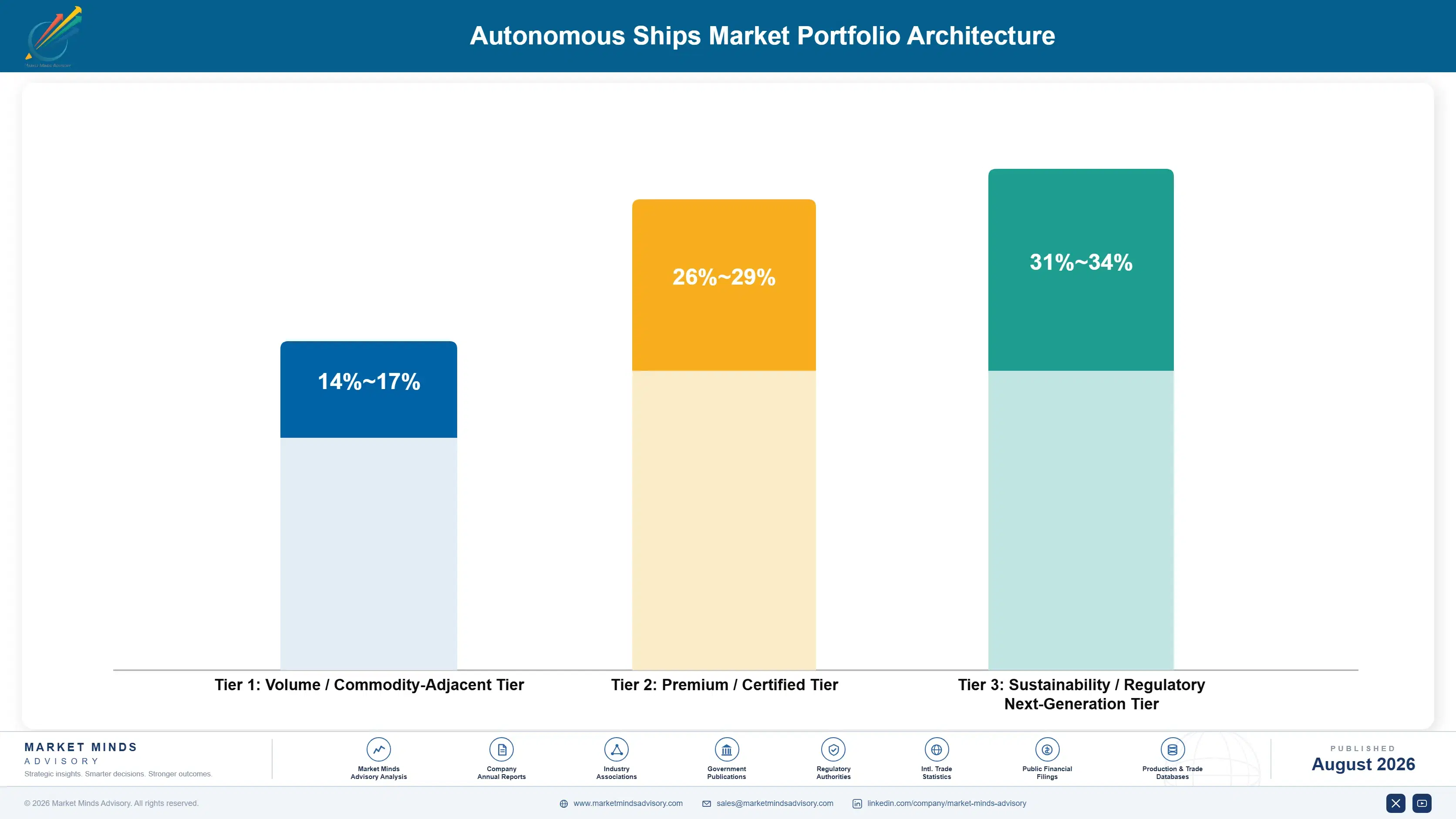
Autonomy suppliers architect their offering across three tiers that trade deployment risk for margin in fairly predictable steps. Basic decision-support and remote-monitoring systems anchor the volume tier at thin margin, conditional autonomy and defense-grade systems occupy a premium middle tier, and fully autonomous certified systems sit at the top as the smallest but fastest-expanding category. No single tier alone determines a supplier's overall profitability across its full product line.
The tension between volume and premium tiers reflects genuine technical difficulty rather than market positioning alone: basic monitoring systems require comparatively simple sensor integration and generate steady but thin-margin revenue, while fully autonomous systems require considerably deeper engineering investment and regulatory navigation that only the most capable suppliers can complete, which is why margin concentrates so heavily at the top of this particular hierarchy. This dynamic mirrors how software companies price entry-level versus enterprise-grade product tiers.

The highest-value pools concentrate in defense-grade unmanned surface vessel systems and fully certified autonomous commercial platforms, both benefiting from genuine technical and regulatory barriers that smaller, less capitalized competitors cannot easily replicate without years of dedicated engineering and certification investment. Suppliers lacking either specialty risk drifting toward the thin-margin volume tier by default.

Volume / Commodity-Adjacent Tier

Basic decision-support and remote-monitoring systems requiring comparatively simple sensor integration, sold widely across commercial fleets seeking incremental safety improvement without pursuing full autonomy certification just yet. Most incumbent fleet operators begin their autonomy adoption somewhere within this entry tier.
Gross Margin: 14-17%

Premium / Certified Tier

Conditional autonomy systems and defense-grade unmanned surface vessel platforms requiring deeper engineering investment and classification society or military certification than basic monitoring systems ever demand. This tier attracts the largest share of dedicated engineering talent across the industry today.
Gross Margin: 26-29%

Sustainability / Regulatory / Next-Generation Tier

Fully autonomous certified commercial systems built on years of regulatory navigation and engineering investment that smaller, less capitalized competitors cannot quickly replicate without substantial dedicated capital. Only a handful of suppliers worldwide currently operate confidently within this top tier.
Gross Margin: 31-34%
autonomous-ships-market-portfolio-architecture-1787982217074

High-value Sub-segments and Strategic Watch-out

Autonomous Naval and Defense Vessels

Fastest-growing and highest-margin pool in the portfolio, driven by accelerating naval procurement worldwide, with margin concentrated among suppliers holding established defense contract relationships and required security clearances. Suppliers here benefit from tolerance for technical risk that commercial buyers will not accept readily. That gap is unlikely to close soon.
Gross Margin: 31-34%

Autonomous Inland and Short-Sea Vessels

High-value segment growing steadily on genuine crew-cost economics, with margin concentrated among suppliers holding proven fixed-route operational track records built through years of pilot deployment experience. Norway's fixed-route pilot programs remain the clearest proof point for this segment's genuine commercial viability. Approval also moves faster along these coastal corridors.
Gross Margin: 26-29%

Autonomy Retrofit Kits for Existing Fleets

Largest volume core segment by installed base, serving the considerably larger existing commercial fleet rather than newbuild vessels, with margin staying thin due to competitive retrofit pricing pressure. Suppliers here compete on installation speed and total cost of ownership. Pricing pressure shows no sign of easing.
Gross Margin: 14-17%

Autonomous Cargo and Container Vessels

Strategic watch-out tied closely to global trade volume and shipbuilding order cycles, where a slowdown in newbuild activity could compress volume for suppliers dependent on shipyard integration partnerships specifically. A prolonged newbuild slowdown could meaningfully compress volume across this segment specifically over the coming years.
Gross Margin: 22-25%

Contract Cycles and Adoption Depth

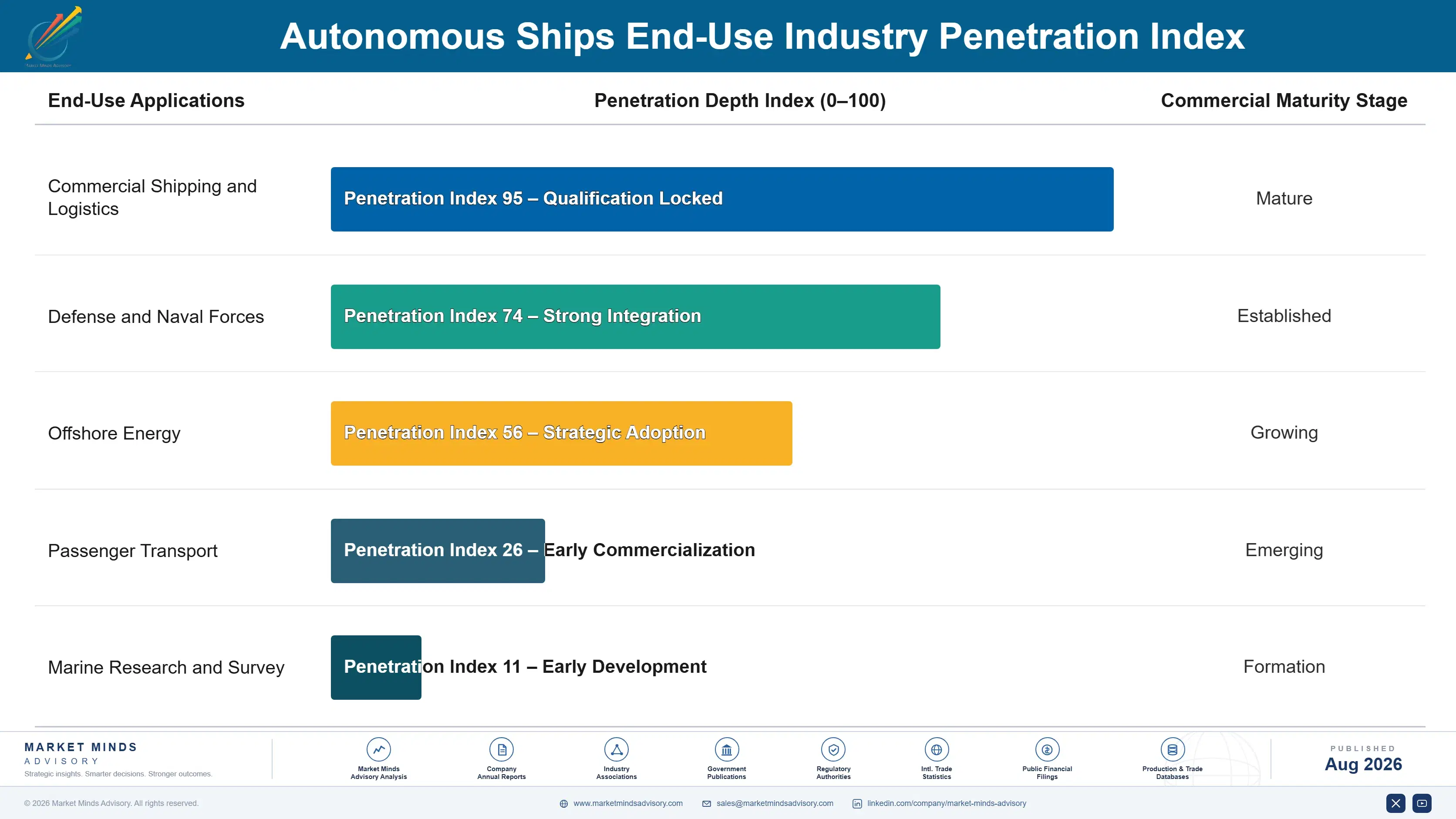
Autonomous ship technology runs on longer, lumpier sales cycles than typical annuity software businesses: naval contracts involve multi-year procurement processes followed by fleet-wide rollout commitments, while commercial retrofit deals generate recurring software and monitoring service revenue once the initial hardware installation is complete. This lumpiness makes revenue forecasting genuinely harder than for comparable software-as-a-service businesses.
Adoption depth varies sharply by vertical. Naval and defense buyers are moving deepest and fastest given demonstrated combat effectiveness and available budget, while commercial deep-sea shipping remains earliest in its adoption curve, with most operators still watching short-sea and inland pilot results before committing their own deep-sea fleets to comparable investment. Suppliers serving both ends of this spectrum need genuinely different sales and engineering organizations entirely. Bridging that gap well is what separates the strongest suppliers from everyone else.

A generational shift is underway among younger maritime engineers and fleet operators who increasingly expect remote-monitoring and autonomy features as standard rather than experimental, in contrast to veteran ship captains and fleet managers who remain considerably more skeptical of ceding operational control to shore-based systems. Suppliers slow to build credibility with this younger cohort risk losing relevance over the coming decade.
autonomous-ships-market-end-use-penetration-index-1787982217563

Where Autonomy Suppliers Should Focus

These are among the four positions where our research anticipates prominent divergence between winners and laggards over the coming forecast period. Each is grounded in the demand model, the regulatory perimeter, and the announced capacity pipeline.
01 / DEFENSE CONTRACT STRATEGY

Prioritize naval procurement relationships over slower commercial pilots

Defense budgets already represent forty-six percent of total market revenue and tolerate the liability ambiguity that commercial insurers still will not underwrite, letting naval programs move considerably faster once funded than the multi-year commercial approval process typically requires. Suppliers that build defense relationships now, while procurement budgets keep expanding in direct response to demonstrated combat effectiveness, position themselves ahead of competitors still waiting for commercial insurance frameworks to mature. Waiting for commercial clarity risks ceding the fastest-growing customer segment to defense-focused rivals permanently.
02 / RETROFIT MARKET EXPANSION

Build modular retrofit kits for the existing global commercial fleet

Fifty-eight percent of current installations are retrofits, reflecting how much of the world's active fleet predates autonomy adoption and cannot be economically replaced simply to add remote-control capability. Suppliers offering retrofit kits that install without extended drydock time capture this considerably larger addressable base faster than newbuild-only competitors waiting for fleet replacement cycles measured in decades. This approach also generates recurring software and monitoring revenue beyond the initial hardware sale, a durable advantage worth pursuing deliberately rather than treating retrofit as a one-time transaction.
03 / ROUTE SELECTION STRATEGY

Establish fixed-route short-sea deployment before attempting deep-sea applications

Fixed, well-charted short-sea routes represent a considerably easier autonomy problem than open-ocean navigation, letting suppliers achieve deployment and regulatory approval faster than competitors pursuing deep-sea applications directly and prematurely. Early movers building operational track records on these routes meaningfully ease the regulatory approval process for subsequent, more complex deployments elsewhere. Suppliers that skip this staged approach entirely, attempting deep-sea deployment before establishing any operational track record at all, risk a costly regulatory setback that could delay their broader commercial roadmap considerably.
04 / CYBERSECURITY INVESTMENT TIMING

Complete cybersecurity certification ahead of formal requirement finalization

Major classification societies are increasingly requiring cybersecurity certification before granting autonomy notations, and suppliers building this capability ahead of formal requirement finalization can win contracts from operators eager to avoid future compliance scrambles entirely. This adds real cost but removes a genuine adoption barrier for risk-conscious commercial buyers who would otherwise delay purchasing decisions until standards stabilize. Suppliers without this capability, treating cybersecurity as an afterthought rather than a core engineering requirement, increasingly find themselves excluded from procurement shortlists regardless of underlying technology quality.

Engagement Snapshot From the Field

A live engagement with an industry participant carrying material or product regulatory and market exposure ahead of a defining policy shift, showing how our research translates into a defensible multi-year portfolio strategy.
MARKET MINDS ADVISORY · CLIENT ENGAGEMENT SUMMARY
Autonomous Ships Producer Strategic Portfolio Review and Transition Roadmap 2026·Investment Scenario on Autonomous Ships Exposure Evaluation 2025-26
CLIENT PROFILE
The client is a mid-sized short-sea shipping operator running a fixed coastal freight route in Northern Europe, with a fleet of eight vessels facing acute officer recruitment difficulty. Annual revenue was approximately 210 million dollars (client-reported, unverified by MMA) at engagement start. The client sought an independent assessment of whether autonomy retrofit investment could meaningfully address its crewing shortage.
STRATEGIC CHALLENGE
The client faced rising officer wage costs and repeated voyage delays from understaffed vessels, but leadership was uncertain whether available autonomy technology was mature enough for its specific route profile or whether insurance and flag-state approval would meaningfully slow deployment beyond the technology timeline itself. The board needed a clear-eyed technical and regulatory feasibility assessment before committing capital.
MMA APPROACH
MMA conducted a route-specific autonomy feasibility assessment benchmarking the client's traffic patterns against comparable deployed short-sea projects, engaged directly with the relevant flag-state maritime authority on approval timelines, and modeled crew-cost savings against retrofit capital cost across a five-year horizon. The engagement combined this technical assessment with structured interviews across the client's operations and safety teams.
KEY FINDINGS
  1. The client's fixed route profile closely matched conditions under which comparable short-sea autonomy projects had already achieved regulatory approval (client-reported, unverified by MMA).
  2. Flag-state approval timelines were considerably shorter than the client's leadership team had originally assumed based on general industry commentary. This finding meaningfully shifted the client's internal investment timeline expectations.
  3. Retrofit capital cost would be recovered within approximately three years given the client's specific officer wage cost structure. This payback period was faster than the client's board had originally expected.
  4. Two of the client's eight vessels required hull modifications too extensive to justify retrofit investment within this timeframe. These two vessels will instead be evaluated for replacement in the coming years.
CLIENT PROFILE
The client is a mid-sized short-sea shipping operator running a fixed coastal freight route in Northern Europe, with a fleet of eight vessels facing acute officer recruitment difficulty. Annual revenue was approximately 210 million dollars (client-reported, unverified by MMA) at engagement start. The client sought an independent assessment of whether autonomy retrofit investment could meaningfully address its crewing shortage.
STRATEGIC CHALLENGE
The client faced rising officer wage costs and repeated voyage delays from understaffed vessels, but leadership was uncertain whether available autonomy technology was mature enough for its specific route profile or whether insurance and flag-state approval would meaningfully slow deployment beyond the technology timeline itself. The board needed a clear-eyed technical and regulatory feasibility assessment before committing capital.
MMA APPROACH
MMA conducted a route-specific autonomy feasibility assessment benchmarking the client's traffic patterns against comparable deployed short-sea projects, engaged directly with the relevant flag-state maritime authority on approval timelines, and modeled crew-cost savings against retrofit capital cost across a five-year horizon. The engagement combined this technical assessment with structured interviews across the client's operations and safety teams.
KEY FINDINGS
  1. The client's fixed route profile closely matched conditions under which comparable short-sea autonomy projects had already achieved regulatory approval (client-reported, unverified by MMA).
  2. Flag-state approval timelines were considerably shorter than the client's leadership team had originally assumed based on general industry commentary. This finding meaningfully shifted the client's internal investment timeline expectations.
  3. Retrofit capital cost would be recovered within approximately three years given the client's specific officer wage cost structure. This payback period was faster than the client's board had originally expected.
  4. Two of the client's eight vessels required hull modifications too extensive to justify retrofit investment within this timeframe. These two vessels will instead be evaluated for replacement in the coming years.
RECOMMENDED STRATEGY
Phase 1: Phase 1 (Months 1 to 3): Engage the flag-state authority formally and begin the classification society approval process while preparing detailed technical documentation. Phase 2: Phase 2 (Months 4 to 10): Retrofit the six technically suitable vessels with remote-control and monitoring systems, completing installation on one vessel at a time. Phase 3: Phase 3 (Months 11 to 18): Establish a shore-based control center and transition crewing models across the retrofitted fleet while monitoring crew feedback throughout.
OUTCOME
Within eighteen months, the client completed retrofit of six vessels and reduced officer staffing requirements by roughly a third across the retrofitted fleet (client-reported, unverified by MMA). The client has since become a reference site for the supplier's subsequent short-sea sales conversations elsewhere in the region.

Frequently Asked Questions

Foundational context covering the market sizes, CAGR, scope, country, region and competition that inform every finding below. This section is provided to cover basics and most often pre-purchase conversations, answered from the MMA Primary Research Dataset.

What is the current size of the Autonomous Ships Market?

The market generated approximately 1.8 billion dollars in revenue in 2025. Growth is fast but from a genuinely small base, reflecting the market's nascent commercial deployment stage.

How large will the Autonomous Ships Market be by 2036?

MMA projects the market will reach approximately 8.0 billion dollars by 2036, representing nearly a fourfold expansion over the forecast decade as growth compounds gradually across both commercial and defense deployment.

What is the CAGR for the Autonomous Ships Market 2026 to 2036?

The base-case compound annual growth rate is 14.5 percent. Bull and bear scenarios range from 13.2 to 15.8 percent depending on regulatory finalization and naval budget trajectories.

Which segment is growing fastest?

Autonomous naval and defense vessels lead at a 19.0 percent CAGR, driven by demonstrated combat effectiveness of low-cost unmanned surface vessels. Inland and short-sea vessels follow at 17.0 percent.

Who are the major companies in the Autonomous Ships Market?

Kongsberg Maritime, Wartsila, HD Hyundai, Sea Machines Robotics, and L3Harris Technologies lead the market, together holding roughly forty-two percent of total revenue with no single company dominating both commercial and defense applications.

Which country is growing fastest?

South Korea leads at a 16.5 percent CAGR, driven by its dominant shipbuilding capacity and factory-integrated autonomy packages. Its shipyards build a substantial share of global newbuild tonnage.

Report Segmentation Architecture

The full report scope spans multiple orthogonal segmentation dimensions, with cross-tabulated demand data provided for each dimension pair. Coverage extends further to regional breakdowns, trend trajectories, and the competitive detail needed to support segment-level decision-making.

By Primary Market Dimension

  • Autonomous Cargo and Container Vessels
  • Autonomous Ferries and Passenger Vessels
  • Autonomous Naval and Defense Vessels
  • Autonomous Survey and Research Vessels
  • Autonomous Inland and Short-Sea Vessels
  • Autonomy Retrofit Kits

By End-Use Industry

  • Commercial Shipping and Logistics
  • Defense and Naval Forces
  • Offshore Energy
  • Passenger Transport
  • Marine Research and Survey

By Commercial Dimension

  • Newbuild Integration
  • Aftermarket Retrofit
  • Government and Defense Contracts
  • Commercial Fleet Operators

By Region

  • North America
  • Western Europe
  • East Asia
  • South Asia and Pacific
  • Latin America
  • Middle East and Africa
  • Eastern Europe

Scope, Methodology, and Coverage

Every figure in this report is reproducible from documented input assumptions. The scope below maps the historical period, the forecast horizon, the segmentation dimensions, and the countries covered, alongside the underlying primary and qualitative methodology.
Historical Period
2020 to 2025
Forecast Period
2026 to 2036
Base Year
2025 (USD billions; MMA Primary Research Dataset, August 2026)
Market Definition
This report defines the Autonomous Ships Market as revenue from autonomous navigation systems, remote-control platforms, and fully uncrewed vessel technology sold for commercial and defense maritime applications. It excludes conventional crewed vessel shipbuilding revenue, standard bridge navigation equipment without autonomy functions, and unmanned aerial or ground vehicle systems.
Quantitative Units
USD billions (current prices); revenue basis
Segmentation Dimensions
By Vessel Application; By Autonomy Level; By End-Use Industry; By Region
Regions Covered
North America, Western Europe, East Asia, South Asia and Pacific, Latin America, Middle East and Africa, Eastern Europe
Countries Covered
South Korea, China, Japan, Norway, United States, United Kingdom, Finland, Germany, France, Netherlands, Singapore, Australia, India, Brazil, UAE, Saudi Arabia, and additional markets relevant to naval procurement and shipbuilding
Key Companies Profiled
Kongsberg Maritime, Wartsila, HD Hyundai, Sea Machines Robotics, L3Harris Technologies, ABB Marine and Ports, Samsung Heavy Industries, Saildrone, Ocean Infinity, Orca AI, Massterly, Wilhelmsen, Elbit Systems, Textron Systems, Zhuhai Yunzhou Intelligence Technology, Fincantieri, Yara International, Buffalo Automation, Anduril Industries, Boeing
Quantitative Methodology
Primary survey, n=3,800 respondents, Q4 2025, six countries; demand-side model with trade association cross-validation
Qualitative Methodology
47 expert interviews, Q4 2025; applied to validate demand model assumptions, identify emerging dynamics, and assess competitive positioning
Report Format
PDF and XLSX data workbook (Word format preview document)
Publisher
Market Minds Advisory
Report Code
MMA-2026-TEC-105
Published
August 2026
Contact
sales@marketmindsadvisory.com | www.marketmindsadvisory.com

Purchase the full Autonomous Ships Market Report (2026 to 2036).

The full report delivers a complete quantitative and qualitative assessment of the global autonomous ships market, spanning ten years of forecast detail across all six vessel application segments. It includes company-level competitive profiling of all twenty tracked suppliers and regulatory analysis of the International Maritime Organization's autonomy code development timeline. Buyers also receive detailed defense procurement analysis and retrofit market sizing not available in the summary version, along with a dedicated cybersecurity certification landscape review. A dedicated appendix walks through the primary survey and expert interview methodology underlying every forecast figure in detail. Regional benchmarking against comparable shipbuilding and defense procurement markets rounds out the deliverable.
Ten-year segment-level revenue forecast detail included
Full twenty-company competitive profiling and benchmarking
IMO regulatory timeline impact analysis included
Defense procurement spending breakdown by country
Retrofit versus newbuild market sizing included
Cybersecurity certification landscape review included fully

Built For The People Who Decide

From boardroom strategy to bench-side execution, this report is read cover-to-cover by leaders shaping the next decade of their industry, turning demand scenarios, market dynamics and valuation benchmarks into decisions.
CXOs/ Presidents/ VPs/ Managers
M&A and Corporate Development
Strategy Teams and R&D Heads
Procurement and Product Directors
Regulatory and Compliance Leaders
Investor Relations and Equity Analysts