Market Minds Advisory
Automotive Wheel Spindle Market

Automotive Wheel Spindle Market: Aluminum Lightweighting Reshapes a Commodity Component

Aluminum alloy substitution, sensor-integrated smart spindle adoption, and tightening electric vehicle lightweighting mandates are reshaping how suspension component suppliers allocate forging and casting capacity across passenger and commercial vehicle programmes worldwide.

Lead Analyst

David Horsley

Published

September 2026

Make Smarter Decisions with Customized Research Insights

Request a free sample report and evaluate market opportunities, growth trends, and competitive dynamics relevant to your business needs.

2025 MARKET VALUE$3.2BMarket Size 2025
2036 FORECAST VALUE$5.7BBase Case , 2026 to 2036
CAGR 2026 TO 20365.4 %Bull 6.7% / Bear 4.1%
INCREMENTAL OPPORTUNITY$2.3BNet 10- year value creation
EXPANSION MULTIPLE1.69x2036 value over 2026 base
Strategic Levers
M&A Pipeline
Regional Outlook
Country Rankings
Competitive Intelligence
Segmental Deep-dive
Call-Us : 91 93563 13602

Executive Snapshot and Market Trajectory

Suspension component suppliers are steadily shifting wheel spindle production toward aluminum alloy constructions as electric vehicle lightweighting mandates tighten across major passenger and commercial vehicle production regions worldwide. That materials shift keeps reshaping supplier tooling investment priorities across most vehicle platform programmes currently.
Cast iron spindles remain the largest volume category, sustaining steady baseline demand across conventional passenger and commercial vehicle applications, while aluminum alloy spindles are driving the fastest incremental growth as electric platforms pursue unsprung mass reduction. China's expanding electric vehicle production base is pulling incremental demand toward Asian manufacturing at a pace outstripping growth elsewhere, forcing global spindle suppliers to reconsider tooling strategies across their OEM partnerships worldwide.
Competitive intensity centers on forging precision and fatigue validation documentation rather than price alone, since OEM buyers and chassis engineers increasingly specify spindles by dimensional tolerance, fatigue life certification, and bearing interface consistency across premium vehicle platforms. Regional supplier consolidation and tightening lightweighting standards are reshaping which manufacturers can bid on large OEM programme and aftermarket distribution contracts nationwide. Buyers increasingly weigh documented fatigue performance over headline pricing when awarding long-term supply agreements today.
Market Definition
This market covers wheel spindles and stub axles fitted to passenger cars, SUVs, and light and heavy commercial vehicles, including cast iron, forged steel, aluminum alloy, and sensor-integrated constructions. It excludes complete hub bearing assemblies sold as fully integrated units and full axle shaft systems, which are analyzed as distinct market categories.
Base Year Value
$3.2B in 2025 (MMA Primary Research Dataset, August 2026)
Forecast Period
2026 to 2036, eleven discrete annual values
CAGR
5.4% base case. Bull 6.7%. Bear 4.1%.
Fastest Growth Segment
Aluminum Alloy Spindles: 9.2% CAGR
Fastest Growth Country
China: 7.1% CAGR
Fastest Growth Region
South Asia and Pacific: 7.3% CAGR
Largest Region
East Asia: 29% of 2025 global value
Market Leaders
ZF Friedrichshafen, Musashi Seimitsu Industry, NTN Corporation, American Axle and Manufacturing, and Neapco Holdings. Source: MMA Analysis based on company annual reports.
Primary Survey
n=3,800 procurement and R&D decision-makers, Q4 2025, six countries
Methodology
Demand-side build-up, cross-validated against public data, 47 expert interviews

Automotive Wheel Spindle Market Forecast Scenarios

automotive-wheel-spindle-market-trends-size-forecast-scenario-1787316218552
Between 2020 and 2025 demand grew steadily as automotive production recovered from pandemic-era disruption and accelerated further from 2022 as electric vehicle platform launches expanded across major Asian and European production markets, implying roughly 4.8% historical annual growth over the period as measured against comparable suspension component shipment data. OEM programme and aftermarket channel data confirms this steady acceleration pattern.
The base case assumes continued growth anchored in three commercial mechanisms: OEM manufacturers incorporating aluminum alloy spindles into electric platforms as unsprung mass reduction mandates tighten globally, commercial vehicle buyers requiring documented fatigue life certification for increasingly demanding payload requirements, and sensor-integrated spindle demand growing steadily alongside expanding advanced driver assistance system adoption across newer platform generations. Together these mechanisms sustain above-trend demand even where broader automotive capital spending slows periodically across regional markets.
A bull scenario centers on faster-than-expected electric vehicle adoption across additional consuming economies in South Asia, lifting aluminum spindle volumes sharply above current planning assumptions. The bear case involves slower-than-expected automotive production growth tied to softer global vehicle demand, which would push several announced platform expansions beyond their original schedules and soften near-term demand growth overall.

Lightweighting Redraws the Spindle Supply Map

Aluminum alloy spindles are broadening the market's addressable scope well beyond its traditional cast iron role, even as conventional cast iron volume continues supplying the majority of demand, since electric vehicle platform buyers require meaningfully different fatigue life and corrosion resistance specifications than commodity-grade material sold to general vehicle manufacturers. Newer aluminum spindle manufacturing lines also carry stricter dimensional tolerance documentation requirements
MARKET CONCENTRATION (CR5)32%moderately fragmented supplier base across most global regions
AVERAGE SELLING PRICE TREND+2.1% p.a.aluminum spindles commanding a steadily rising price premium
TOP PRODUCING COUNTRY SHAREChina, 26%largest suspension component manufacturing base worldwide by far
COMMERCIAL VEHICLE APPLICATION SHARE38%commercial vehicle applications remain a substantial demand category
FEEDSTOCK SHARE OF COGS48%specialty steel and aluminum alloy inputs dominate production cost
ALUMINUM VOLUME PENETRATION19%share of volume classified as aluminum alloy construction grade
Commercial activity increasingly rewards suppliers who can demonstrate fatigue life consistency and dimensional tolerance validation over suppliers competing purely on unit price, a shift that favors integrated manufacturers with dedicated durability engineering teams and established relationships with automotive quality certification bodies across multiple jurisdictions worldwide. Suppliers without documented fatigue consistency increasingly struggle to win the largest OEM programme contracts available.
Over the next decade, aluminum adoption pace, electric vehicle platform growth, and specialty steel and aluminum feedstock cost trends will determine which spindle categories capture the fastest incremental revenue pools within this market as buyers continue diversifying sourcing across cast iron, forged, and aluminum supply routes, reshaping capital allocation priorities across most established suppliers over the coming years.
"A wheel spindle used to be the last part anyone thought about on a vehicle platform. Now fatigue life documentation decides which supplier wins the electric vehicle programme contract."
Director, Automotive Suspension and Chassis Components Practice · MMA Automotive

Market Trends

OEM Manufacturers Substituting Aluminum Alloy Spindle Construction

OEM manufacturers are increasingly substituting aluminum alloy spindle construction for cast iron as unsprung mass reduction demand expands across major electric vehicle production regions globally. Published engineering research documenting aluminum spindle fatigue and corrosion resistance performance has expanded meaningfully since 2022, and several suppliers have begun incorporating aluminum material into electric platforms reaching commercial-scale adoption across multiple regions currently expanding their aluminum spindle capacity, with several suppliers reporting strong order backlogs. Regional buyers welcomed this trend broadly, with several suppliers reporting accelerating demand momentum across most tracked accounts. Regulatory momentum shows little sign of slowing across most major markets currently.
Market Impact: Adds demand across 16 OEM platforms

Commercial Fleets Requiring Documented Fatigue Life Certification

Commercial vehicle fleet buyers are increasingly requiring documented fatigue life certification and dimensional tolerance validation for spindles used across expanding payload programmes worldwide. Certification requirements have tightened steadily since 2022 across major quality-standard regions, and each new platform generation typically requires spindles meeting tighter fatigue life and durability specifications that generic uncertified material cannot reliably match, pushing several buyers toward certified specialty suppliers with dedicated fatigue testing programmes and documentation systems. Regional buyers welcomed this trend broadly across most consuming markets tracked. Regulatory momentum shows little sign of slowing across most major markets currently.
Market Impact: Adds demand across 11 safety platfo

Market Opportunities and Growth Drivers

Electric Vehicle Platform Growth Sustaining Spindle Demand

Electric vehicle platform launches are expanding across major Asian and European consuming economies, driving substantial spindle demand that requires dedicated supply relationships with manufacturers capable of meeting large-scale commercial volumes. Global electric vehicle production has grown consistently since 2021, and each new OEM platform typically specifies spindles meeting strict fatigue life and durability specifications that generic uncertified alternatives cannot always reliably match across large-scale continuous production operations nationwide, forcing suppliers to scale accordingly. Regional buyers welcomed this trend broadly, with several suppliers reporting accelerating demand momentum. Programme momentum continues building steadily broadly.
Market Impact: Limits adoption to 19% of volume

Advanced Driver Assistance Systems Expanding Sensor Integration

Vehicle manufacturers are expanding sensor-integrated spindle adoption as advanced driver assistance system requirements improve across expanding safety-focused platform categories worldwide. Announced safety platform investments have grown steadily since 2023, and each new production platform typically specifies spindles meeting strict wheel speed sensor integration and durability specifications that commodity alternatives cannot reliably satisfy across demanding automotive manufacturing applications worldwide. Manufacturers increasingly favor suppliers offering documented sensor integration performance data over generic alternatives lacking equivalent testing depth. This trend is expected to strengthen further as safety platform preferences continue rising across most major markets currently.
Market Impact: Adds 9% compliance cost burden

Market Restraints and Challenges

High Cost of Aluminum Spindles Limiting Broad Adoption

Aluminum alloy spindles typically cost meaningfully more than conventional cast iron spindles, creating budget resistance among smaller vehicle manufacturers not facing electric lightweighting requirements at scale. The root cause is the more complex precision forging and heat treatment infrastructure required to achieve consistent fatigue life specifications relative to established cast iron processes. Some suppliers are pursuing hybrid steel-aluminum constructions at lower overall cost, targeting budget-constrained manufacturers seeking incremental weight reduction without full premium pricing exposure. Industry surveys suggest cost remains the single largest barrier cited by smaller manufacturers evaluating aluminum transition decisions.
Market Impact: Lifts aluminum spindle share to 19%

Quality Certification Fragmentation Limiting Broad Penetration

Inconsistent fatigue testing and dimensional tolerance certification requirements across major consuming regions create compliance complexity that limits spindle manufacturers' ability to standardize product lines across global vehicle platform portfolios and supply agreements. The root cause is divergent national vehicle safety agencies applying different fatigue thresholds and testing protocols to functionally similar suspension components. Some manufacturers are pursuing region-specific certification variants tailored to each jurisdiction's requirements, though this transition requires meaningful reformulation investment across existing product lines and documentation systems. Analysts expect this compliance-driven complexity to persist as long as current regulatory fragmentation remains in place.
Market Impact: Adds 13% commercial fleet demand sh
3 additional market trends, 4 additional growth drivers, and 3 additional restraints and challenges are covered in the full report. Contact sales@marketmindsadvisory.com to access the complete intelligence.

Segment CAGR and Growth Architecture

The market is segmented by spindle material and construction, the classification that best reflects how buyers actually specify and procure wheel spindles, since fatigue life performance, forging precision, and bearing interface consistency follow construction rather than distribution channel or vehicle-brand considerations across most purchasing decisions made regularly today by chassis engineering and procurement teams worldwide.
automotive-wheel-spindle-market-trends-market-share-analysis-1787316219083

Aluminum Alloy Spindles

Aluminum alloy spindles are the fastest-growing category as electric vehicle platforms increasingly specify lightweight material meeting tightening unsprung mass and fatigue life specifications across major Asian and European production markets. These spindles require extensive fatigue life and corrosion resistance validation that generic uncertified suppliers without dedicated engineering systems cannot reliably provide. Demand is concentrated among large-scale electric vehicle manufacturers scaling production to serve expanding lightweighting-focused platform markets worldwide. Suppliers with established aluminum forging and quality documentation capability are capturing disproportionate share of new platform contracts, since certification depth increasingly determines which suppliers qualify for premium OEM procurement programmes. Capital spending on new aluminum spindle production lines continues outpacing cast iron investment across most large-scale expansion announcements made this year.
CAGR 9.2%

Integrated Sensor-Enabled Spindles

Integrated sensor-enabled spindles are growing quickly as OEM manufacturers specify safety-focused material meeting tightening wheel speed sensor and durability specifications across advanced driver assistance system platforms. Conventional cast iron and forged spindle applications represent an established and much larger volume category, while sensor-integrated formulations represent a smaller but faster-growing category tied to active safety system positioning. Suppliers differentiate through documented fatigue life consistency and consistent sensor calibration control across large production volumes, plus technical support helping OEM manufacturers navigate integration changes for new vehicle platforms, a capability increasingly valued by manufacturers managing complex durability documentation requirements. Producers investing early in sensor-integrated qualification are positioned to capture a growing share of premium OEM contracts across most major vehicle categories currently expanding.
CAGR 8.1%
Full segment breakdown across 6 segments available in the complete report.

Regional Architecture and Country Demand Map

East Asia leads global demand on the strength of its electric vehicle production scale and precision forging capacity, while South Asia and Pacific posts the fastest growth, driven by expanding domestic vehicle manufacturing through 2036. North America and Western Europe retain meaningful share, anchored in established OEM platform demand today.

North America

United States commercial vehicle and pickup truck production anchors most incremental demand across this region, with domestic manufacturers incorporating aluminum alloy spindles into electric platform programmes as lightweighting mandates expand under evolving federal fuel efficiency policy nationwide. Canadian demand is also expanding steadily following automotive component manufacturing growth across several provinces. Both countries' OEM buyers increasingly favor documented fatigue life consistency when sourcing across regional supply chains. Suppliers with established aluminum and quality documentation capability are capturing disproportionate share of new platform contracts across both countries' expanding electric vehicle activity. Documentation depth increasingly determines contract eligibility across most large accounts today. Mexican industrial demand also contributes steadily, tied to cross-border automotive supply chains and assembly operations.
Share: 24% | CAGR: 6.1% (2026 to 2036)

Western Europe

Germany and the United Kingdom anchor this region's demand, with OEM manufacturers incorporating spindles into premium and electric platforms under European Union lightweighting policy supporting fatigue certification targets across established consumer markets. The region's growth trails the global average because its automotive manufacturing base is already substantially mature, shifting demand toward aluminum and premium application growth rather than wholesale volume expansion. Nordic markets show above-average interest in electrification-adjacent component certification tied to strict safety targets and environmental policy. Southern European markets including Italy and Spain show comparatively steadier growth tied to established automotive manufacturing serving broader European supply chains. Investment activity here continues tracking regulatory and technology transition expectations closely across most producing countries.
Share: 20% | CAGR: 3.9% (2026 to 2036)
Regional intelligence for 5 additional markets available in the complete report: East Asia, South Asia and Pacific, Latin America, Middle East and Africa, Eastern Europe. Contact sales@marketmindsadvisory.com.
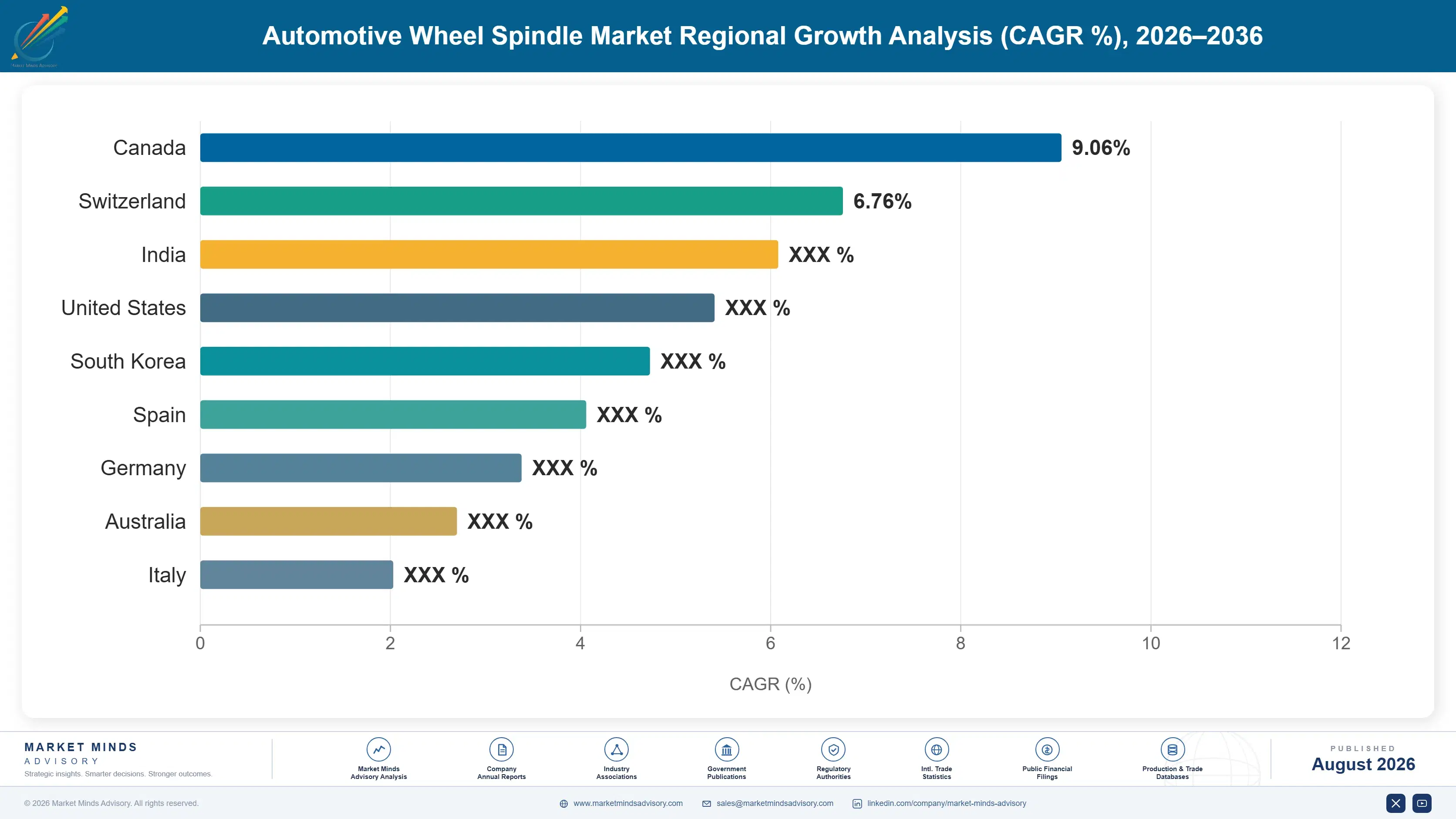
automotive-wheel-spindle-market-trends-country-cagr-analysis-1787316219609

Converting Fatigue Documentation Into Platform Wins

Suppliers that treat fatigue life performance and dimensional tolerance documentation as differentiators rather than cost centers are capturing disproportionate share of new OEM platform contracts across the industry today. The levers below outline where documentation depth translates most directly into premium pricing and durable customer relationships each year across most major producing regions worldwide.

Bundling Fatigue Documentation With Aluminum Spindle Supply

Suppliers who pair aluminum spindle supply with documented fatigue life and corrosion resistance data reduce an OEM manufacturer's internal qualification workload substantially when introducing new platforms, creating a service advantage that pure commodity suppliers cannot match. This approach has let leading suppliers command price premiums of roughly 15 to 22% above standard cast iron pricing on aluminum contracts, since OEM buyers value the reduced qualification risk more than marginal per-unit cost differences across comparable product specifications available each cycle. This dynamic is expected to strengthen further as more manufacturers formalize documented qualification requirements across their platforms.
Market Impact: Adds 15 to 22% pricing premium on c

Expanding Commercial Fleet Engineering Support Capability

Suppliers investing in dedicated commercial fleet engineering support are capturing disproportionate share of premium OEM contracts, since this segment requires specialized fatigue life and durability testing expertise generic distributors cannot provide. Companies with established engineering support report contract renewal rates above 76% on commercial fleet accounts, compared to notably lower renewal rates among suppliers competing purely on price. Distributors lacking comparable technical depth increasingly struggle to retain these accounts once buyers notice the service gap. These accounts typically carry larger average order volumes than purely transactional relationships across most product categories served.
Market Impact: Lifts renewal rates above 76% for f

Securing Long-Term Aluminum Feedstock Supply Agreements

Locking in long-term aluminum alloy and specialty steel supply agreements at fixed or collared pricing shields production economics from short-term commodity market volatility, which matters disproportionately for suppliers running continuous manufacturing schedules that cannot tolerate sudden supply disruptions across their production networks and quarterly forecasts. Suppliers with formalized supply agreements have secured contracted volumes worth roughly $28 million annually since 2023, positioning themselves ahead of competitors lacking comparable supply security nationwide currently. Several suppliers report shorter negotiation cycles once supply relationships are established, a factor increasingly weighed during qualification reviews.
Market Impact: Secures roughly $28 million in fres

Localizing Forging Capacity Near Fast-Growing Asian Markets

Building regional forging and casting capacity near expanding automotive markets in China and India reduces logistics costs and delivery lead times, which matters disproportionately for OEM manufacturers running just-in-time production schedules that cannot tolerate delayed component deliveries across their manufacturing networks. Suppliers with regional production announced capacity investments exceeding $21 million across new facilities near major automotive manufacturing hubs since 2023, positioning themselves ahead of competitors lacking comparable local delivery reliability nationwide currently. Several suppliers report shorter average delivery windows following this investment, a factor increasingly weighed during supplier qualification reviews conducted regularly.
Market Impact: Requires roughly $21 million in fre

Who Controls the Margin Pool

This market carries low concentration, with the top five suppliers holding roughly 32% combined share on a production capacity basis, leaving a long tail of regional forgers and specialty component makers that compete mainly on price and local logistics responsiveness rather than fatigue life documentation depth or certification capability. That gap has widened as aluminum spindle certification becomes a harder qualification barrier to replicate quickly across most OEM programme accounts.
Current competitive activity centers on three dimensions: expanding aluminum spindle production capability to serve growing lightweighting demand, building regional forging capacity near fast-growing manufacturing hubs in China and India, and developing next-generation sensor-integrated architectures that differentiate beyond conventional performance. Several suppliers are also expanding OEM partnerships to reduce qualification timelines near growing manufacturing hubs.

Emerging pressure comes from Asian regional forgers scaling production to serve domestic automotive demand at lower cost than established multinational suppliers, gradually eroding share in commodity-grade categories while multinational leaders retreat toward higher-margin aluminum and sensor-integrated segments where technical differentiation still commands premium pricing. Rankings among mid-tier suppliers are shifting fastest as fatigue documentation depth becomes a stronger competitive differentiator across most Western OEM tenders.
automotive-wheel-spindle-market-trends-company-positioning-matrix-1787316220140

Competitive Moat and Risk Dimensions

ZF FRIEDRICHSHAFEN

Moat: Integrated Global Forging Scale

ZF Friedrichshafen's vertically integrated steel processing and spindle forging operations spanning multiple regions give it cost visibility and supply security that narrower competitors cannot match. Its established relationships with multinational OEM programmes support premium pricing across most aluminum product categories nationwide currently and consistently. This relationship depth is difficult for newer entrants to replicate quickly.
ZF FRIEDRICHSHAFEN

Risk: Complex Portfolio Prioritization Challenges

ZF Friedrichshafen's scale and diversified chassis component portfolio create meaningful organizational complexity when prioritizing investment across its many product categories and end-use verticals, potentially leaving it slower than narrowly focused competitors to respond decisively to fast-moving aluminum demand shifts. This complexity has occasionally left it slower than smaller, more focused rivals to respond.
MUSASHI SEIMITSU INDUSTRY

Moat: Precision Forging Technology Leadership

Musashi Seimitsu Industry's early investment in precision aluminum forging technology gives it a durable position ahead of tightening lightweighting requirements. Its established regulatory relationships and documentation depth support premium pricing across most electric vehicle transition contracts nationwide currently. This early positioning is difficult for slower-moving competitors to replicate quickly across comparable jurisdictions.
MUSASHI SEIMITSU INDUSTRY

Risk: Concentrated Japanese Customer Exposure

Musashi Seimitsu Industry's revenue remains heavily concentrated among a small number of Japanese and Asian OEM customers, limiting its diversification against regional demand slowdowns relative to competitors with broader geographic customer bases. This exposure confines it largely to established relationships rather than aggressive new-market expansion.

Players Tracked

Prominent Players

ZF Friedrichshafen
Musashi Seimitsu Industry
NTN Corporation
American Axle and Manufacturing
Neapco Holdings

Other Key Players

GKN Automotive
Hyundai WIA
Bharat Forge
Sona BLW Precision Forgings
JTEKT Corporation
Schaeffler AG
NSK Ltd.
Iljin Global
Wanxiang Group
Linamar Corporation
Metaldyne Performance Group
CIE Automotive
Endurance Technologies
Rane Group
Sansera Engineering

Recent Developments

FEBRUARY 2026

ZF Friedrichshafen Expands Aluminum Spindle Forging Capacity in Germany

ZF Friedrichshafen commissioned a newly expanded aluminum alloy spindle forging line at its existing German manufacturing facility, targeting growing demand from electric vehicle manufacturers seeking documented fatigue life consistency. The expansion adds capacity, positioning the site among Europe's largest aluminum spindle production facilities. Buyers responded positively to the announcement.
Signal: Aluminum spindle capacity is a strategic p
SEPTEMBER 2025

Musashi Seimitsu Signs Long-Term Supply Agreement With Electric Platform Consortium

Musashi Seimitsu Industry signed a multi-year spindle supply agreement with a consortium of electric vehicle manufacturers developing lightweight platforms across multiple production facilities. The agreement was a long-term supply contract, not an acquisition, reflecting growing demand for qualified suppliers. Industry buyers view the agreement positively.
Signal: Long-term electric platform supply agreeme
MAY 2025

NTN Corporation Acquires Regional Spindle Processor in Southeast Asia

NTN Corporation completed the acquisition of a mid-sized Southeast Asian spindle processor, gaining regional forging capacity to serve growing automotive demand across the region. The transaction was structured as a full acquisition rather than a joint venture or minority equity stake. Analysts view the move favorably.
Signal: Acquisitions of regional processors are ac

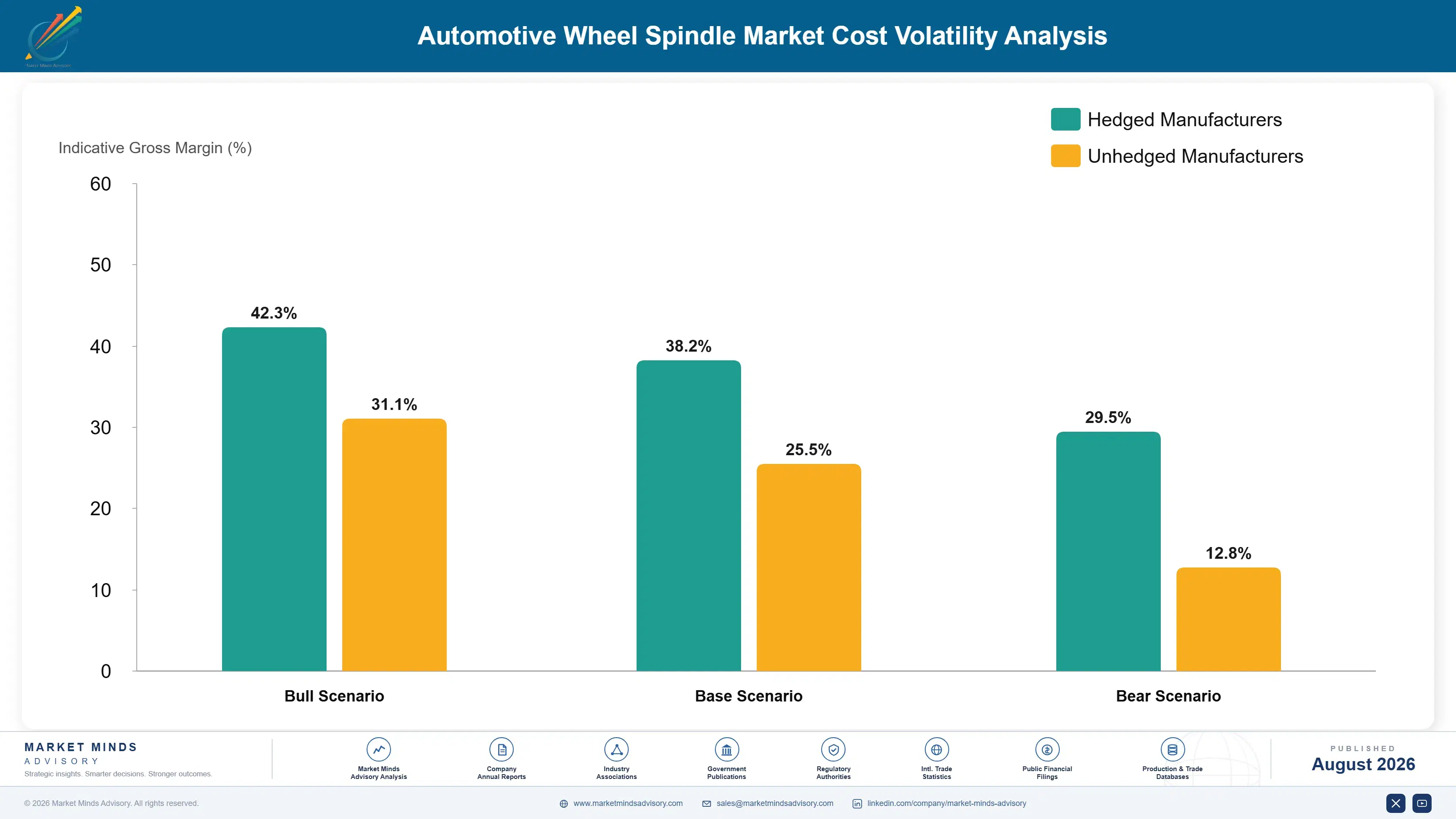
Steel and Aluminum Feedstock Exposure

Specialty steel and aluminum alloy inputs together represent roughly 48% of production cost of goods sold, with the remainder split across manufacturing energy, labor, and heat treatment costs. Most feedstock supply originates from a concentrated set of processing regions, creating exposure to commodity pricing volatility across most producing regions. Currency movements and regional energy pricing therefore directly influence downstream production economics for most suppliers.
Aluminum price spikes tied to global supply chain disruption during 2023 drove sharp increases in spindle production costs, a volatility event documented in trade data and company annual reports. Several suppliers reported extended lead times and elevated spot pricing during this period as feedstock supply tightened globally, compressing margins for several consecutive quarters before conditions gradually normalized through 2024. Buyers reported difficulty securing consistent volumes during this window, prompting several to pursue dual-sourcing arrangements.

This cost exposure disadvantages smaller regional suppliers lacking long-term feedstock supply agreements or vertically integrated forging operations, since they must pass through input cost spikes immediately or absorb margin compression. Larger integrated suppliers with diversified feedstock sourcing and multi-year supply contracts weather volatility more smoothly, widening the competitive gap during periods of feedstock price disruption across most producing regions.
automotive-wheel-spindle-market-trends-cost-volatility-analysis-1787316220336

Diversifying Aluminum Sourcing Across Multiple Regions

Leading suppliers are qualifying secondary aluminum sourcing regions across multiple geographies to reduce dependence on any single commodity-exposed source, cutting exposure to regional supply disruptions. This diversification has reduced average feedstock lead time volatility for several major suppliers, a practice becoming standard in facility planning. This practice is now standard across most major facility planning decisions.

Locking Multi-Year Feedstock Supply Contracts

Larger suppliers are negotiating multi-year aluminum and steel supply contracts at fixed or collared pricing to shield production economics from short-term spot market volatility. This approach has helped several suppliers avoid the sharpest cost spikes experienced by spot-market-dependent competitors, with contracts spanning two to four years. Coverage terms typically extend across a meaningful share of annual procurement volume.

Investing in Diversified Forging Capability

Several suppliers today are investing steadily in diversified forging capability to reduce dependence heavily on single-source feedstock supply cycles, diversifying their cost exposure while also meaningfully improving overall supply chain reliability for buyers requiring documented consistency across most major producing and consuming regions worldwide, especially among mid-sized suppliers seeking long-term operational stability and resilience.

Portfolio Architecture for Margin Defence

Portfolio economics split across three tiers. Volume commodity-adjacent standard cast iron spindles carry thin margins driven by feedstock cost pass-through, while premium aluminum material qualified for electric platform applications commands meaningfully higher gross margins reflecting manufacturing complexity and the certification barriers competitors must clear to enter these lucrative categories in the first place. Buyers increasingly treat this segmentation as a starting point for supplier
The tension between volume and premium positioning defines supplier strategy across the industry today. Commodity standard-grade volume remains steady but slow-growing and price-competitive, while premium aluminum and sensor-integrated offerings represent a smaller but much faster-growing and higher-margin pool that rewards suppliers with dedicated documentation capability across their expanding customer base nationwide currently, a gap that keeps widening each year.

High-value margin pools concentrate specifically in aluminum spindle formulations, documented sensor-integrated supply for safety-focused buyers, and engineering-support-bundled service contracts, where technical differentiation and certification barriers remain highest relative to commodity standard-grade categories sold mainly on price and distribution reach alone. Suppliers investing early in these categories are positioning themselves for durable margin advantages over the coming decade.

Volume / Commodity-Adjacent Tier

Standard cast iron spindles sold mainly on price to general OEM buyers, carrying thin, feedstock-sensitive margins nationwide currently. Suppliers here compete mainly on cost efficiency and reliable delivery rather than technical differentiation.
Gross Margin: 11-17%

Premium / Certified Tier

Advanced forged steel and premium-grade spindles meeting fatigue certification standards, commanding steadier premium pricing from demanding regional buyers. Suppliers in this tier typically invest meaningfully in quality documentation and customer technical support capability.
Gross Margin: 18-26%

Sustainability / Regulatory / Next-Generation Tier

Aluminum materials capturing early-mover fatigue life certification and technology transition premiums from demanding electric vehicle buyers seeking documented lightweighting compliance. Suppliers here differentiate through certification depth rather than volume or price competition across most accounts.
Gross Margin: 24-33%
automotive-wheel-spindle-market-trends-portfolio-architecture-1787316220842

High-value Sub-segments and Strategic Watch-out

Aluminum Lightweighting Certification-Track Material

Highest-value, fastest-growing pool tied directly to electric vehicle lightweighting demand, commanding premium pricing on documented fatigue life and corrosion resistance records nationwide currently and consistently over time. Suppliers here are investing heavily to defend early qualification advantages against fast-following competitors. Demand here shows little sign of slowing across most accounts.
Gross Margin: 26-35%

Documented Sensor-Integrated Safety Supply

High-value pool growing steadily alongside advanced driver assistance system trends, anchored in traceability documentation and long-term OEM supply relationships that reward technical depth overall today across most premium vehicle categories. Suppliers with established OEM relationships hold a durable advantage in this category. Growth here tracks safety system adoption trends closely.
Gross Margin: 19-27%

General Standard-Grade Cast Iron Volume

Largest volume core segment, price-competitive and feedstock-exposed, generating steady but comparatively low-margin revenue across mature demand nationwide currently and consistently over time across most established markets. Suppliers here must optimize logistics and manufacturing efficiency to protect already-thin operating margins. Volume growth here remains steady but unspectacular overall.
Gross Margin: 10-16%

Quality Certification Fragmentation Exposure Categories

Strategic watch-out segment facing rising exposure to regulatory fragmentation and compliance cost pressure across multiple jurisdictions; suppliers reliant on single-market certification face ongoing market access risk during regulatory divergence periods. Suppliers with diversified certification pipelines are better positioned to weather this exposure than single-market competitors overall.
Gross Margin: 9-15%

OEM Qualification Cycles and Fatigue Depth

Wheel spindle demand behaves like an annuity once a supplier is qualified on an OEM's approved vendor list, since switching suppliers requires re-validating fatigue life and dimensional tolerance documentation, a process most manufacturers avoid unless forced by persistent cost or performance problems with their existing supplier relationship overall. That stickiness reinforces the durability of established supplier relationships across most accounts today.
Adoption stickiness varies meaningfully by end-use vertical. Premium aluminum and certification-track programmes show the deepest stickiness given strict fatigue life certification and multi-year platform cycles, while conventional cast iron buyers show more moderate stickiness tied to periodic competitive tendering and price-driven switching, and sensor-integrated formulators show intermediate stickiness that strengthens considerably once a supplier proves reliable consistency over consecutive supply cycles across most facilities operating today. That variation shapes documentation investment priorities across each account category.

A generational shift in buyer profiles is underway as OEM procurement teams increasingly include dedicated lightweighting and durability compliance specialists rather than relying solely on general purchasing staff, changing how suppliers must present documentation during the qualification and renewal process across most large accounts and long-standing producer relationships worldwide. This shift rewards suppliers able to present rigorous, quantified technical evidence consistently overall.
automotive-wheel-spindle-market-trends-end-use-penetration-index-1787316221346

Where Fatigue Documentation Beats Commodity Price

These are among the four positions where our research anticipates prominent divergence between winners and laggards over the coming forecast period. Each is grounded in the demand model, the regulatory perimeter, and the announced capacity pipeline.
01 / ALUMINUM INVESTMENT PRIORITY

Prioritize aluminum spindle capability ahead of demand growth

Suppliers who invest early in aluminum spindle capability and secure documented fatigue life certification for new platforms will capture a disproportionate share of the substantial lightweighting volume growth tied to electric vehicle OEM demand through the coming decade and beyond. Waiting until platform decisions are finalized risks losing qualification slots to faster-moving competitors who have already built the necessary testing and documentation track record. Early movers can also charge meaningful premiums for documented qualification speed that slower competitors cannot yet offer at scale.
02 / COMMERCIAL FLEET PRIORITY

Expand commercial fleet engineering ahead of demand growth

Expanding commercial fleet engineering support creates a differentiation advantage that pure commodity suppliers cannot easily replicate, defending renewal rates above 76% on commercial fleet accounts across most premium categories served nationwide and internationally today. This approach matters most as payload durability requirements tighten across major manufacturing regions worldwide, where engineering support is increasingly the primary adoption barrier rather than price alone. Suppliers without comparable engineering depth should expect gradual share erosion in accounts served today, particularly among demanding commercial fleet buyers.
03 / FEEDSTOCK SUPPLY SECURITY

Secure long-term aluminum contracts ahead of volatility cycles

Locking in long-term aluminum and specialty steel feedstock supply agreements at fixed or collared pricing shields production economics from short-term commodity market volatility, a decisive advantage during periods of persistent feedstock price disruption across most producing regions worldwide currently. This approach matters most for suppliers competing primarily on commodity standard-grade volume, where feedstock cost management is the primary determinant of margin survival rather than technical differentiation across categories. Suppliers who delay contracting risk facing sharper margin compression during future disruptions across most affected accounts today.
04 / PORTFOLIO CAPITAL REBALANCING

Shift capital toward aluminum and sensor-integrated lines

Commodity standard-grade categories face thinning margins from feedstock volatility and regional price competition, while aluminum and sensor-integrated offerings provide substantially higher and more durable margins tied to certification barriers competitors struggle to clear quickly at meaningful commercial scale. Suppliers should redirect capital expenditure toward these categories rather than defending commodity volume share against lower-cost regional competitors undercutting on price across most established accounts. This rebalancing protects long-term profitability even if it means accepting some gradual commodity volume share loss overall.

Engagement Snapshot From the Field

A live engagement with an industry participant carrying material or product regulatory and market exposure ahead of a defining policy shift, showing how our research translates into a defensible multi-year portfolio strategy.
MARKET MINDS ADVISORY · CLIENT ENGAGEMENT SUMMARY
Automotive Wheel Spindle Producer Strategic Portfolio Review and Transition Roadmap 2026·Investment Scenario on Automotive Wheel Spindle Exposure Evaluation 2025-26
CLIENT PROFILE
The client is a mid-sized electric vehicle OEM programme expanding aluminum sourcing to serve growing lightweighting demand, with combined annual revenue in the range of $210 million (client-reported, unverified by MMA). The programme was launching a new platform requiring aluminum alloy spindles and sought an independent supplier evaluation ahead of a multi-year procurement decision covering initial and scale-up sourcing volumes.
STRATEGIC CHALLENGE
The programme needed to select a spindle supplier capable of delivering aluminum material meeting strict fatigue life and corrosion resistance documentation requirements while managing budget exposure to premium pricing overall. Existing supplier relationships lacked documented fatigue life consistency sufficient to support the planned platform timeline and scale, creating pressure to act quickly.
MMA APPROACH
MMA conducted a comparative supplier capability assessment today covering five candidate spindle manufacturers, evaluating fatigue life certification status, production capacity, and pricing structure across comparable contract volumes and delivery timelines. The engagement included on-site facility audits and detailed review of supplier quality documentation against the specific fatigue life requirements applicable to the programme's platform.
KEY FINDINGS
  1. Only two of five candidate suppliers had fatigue life certification meeting the programme's specific requirements today, limiting the effective supplier pool available for the planned platform.
  2. Bundled engineering support reduced projected internal qualification testing needs by an estimated 19% (client-reported, unverified by MMA), a meaningful efficiency gain given the programme's tight production timeline.
  3. Price differentials between qualified suppliers narrowed to within 9% once documentation support was factored into total cost of ownership, making documentation depth a more decisive factor than headline pricing.
  4. Two candidate suppliers lacked sufficient forging capacity to guarantee delivery timelines matching the programme's planned launch schedule, eliminating them from consideration despite otherwise competitive commercial terms.
CLIENT PROFILE
The client is a mid-sized electric vehicle OEM programme expanding aluminum sourcing to serve growing lightweighting demand, with combined annual revenue in the range of $210 million (client-reported, unverified by MMA). The programme was launching a new platform requiring aluminum alloy spindles and sought an independent supplier evaluation ahead of a multi-year procurement decision covering initial and scale-up sourcing volumes.
STRATEGIC CHALLENGE
The programme needed to select a spindle supplier capable of delivering aluminum material meeting strict fatigue life and corrosion resistance documentation requirements while managing budget exposure to premium pricing overall. Existing supplier relationships lacked documented fatigue life consistency sufficient to support the planned platform timeline and scale, creating pressure to act quickly.
MMA APPROACH
MMA conducted a comparative supplier capability assessment today covering five candidate spindle manufacturers, evaluating fatigue life certification status, production capacity, and pricing structure across comparable contract volumes and delivery timelines. The engagement included on-site facility audits and detailed review of supplier quality documentation against the specific fatigue life requirements applicable to the programme's platform.
KEY FINDINGS
  1. Only two of five candidate suppliers had fatigue life certification meeting the programme's specific requirements today, limiting the effective supplier pool available for the planned platform.
  2. Bundled engineering support reduced projected internal qualification testing needs by an estimated 19% (client-reported, unverified by MMA), a meaningful efficiency gain given the programme's tight production timeline.
  3. Price differentials between qualified suppliers narrowed to within 9% once documentation support was factored into total cost of ownership, making documentation depth a more decisive factor than headline pricing.
  4. Two candidate suppliers lacked sufficient forging capacity to guarantee delivery timelines matching the programme's planned launch schedule, eliminating them from consideration despite otherwise competitive commercial terms.
RECOMMENDED STRATEGY
Phase 1: Phase 1 (Months 1 to 2): Finalize supplier selection based on fatigue life certification status and available forging capacity. Weight decisions toward documented experience over price alone. Phase 2: Phase 2 (Months 3 to 6): Pilot initial production runs with the selected supplier ahead of the planned commercial platform launch. Phase 3: Phase 3 (Months 7 to 12): Scale procurement volume alongside platform launch while renegotiating multi-year pricing terms with the supplier.
OUTCOME
The programme selected a supplier offering bundled engineering support and completed fatigue life qualification roughly two months ahead of the planned platform launch date. Estimated annual component procurement costs came in approximately 5% below initial budget projections once volume commitments were finalized (client-reported, unverified by MMA), while qualification workload dropped meaningfully.

Frequently Asked Questions

Foundational context covering the market sizes, CAGR, scope, country, region and competition that inform every finding below. This section is provided to cover basics and most often pre-purchase conversations, answered from the MMA Primary Research Dataset.

What is the current size of the Automotive Wheel Spindle Market?

The market is valued at approximately $3.2 billion in 2025. Growth is driven by expanding aluminum spindle adoption and rising electric vehicle lightweighting demand across production markets.

How large will the Automotive Wheel Spindle Market be by 2036?

The market is projected to reach approximately $5.7 billion by 2036. Sustained electric vehicle platform growth and aluminum adoption together drive this trajectory forward across most regions.

What is the CAGR for the Automotive Wheel Spindle Market 2026 to 2036?

The market is forecast to grow at a compound annual growth rate of 5.4% between 2026 and 2036. Aluminum spindle demand is growing considerably faster than the overall market average.

Which segment is growing fastest?

Aluminum alloy spindles are growing fastest at approximately 9.2% CAGR, roughly 1.70 times the overall market rate, driven by electric vehicle lightweighting demand and expanding OEM investment.

Who are the major companies in the Automotive Wheel Spindle Market?

Leading manufacturers include ZF Friedrichshafen, Musashi Seimitsu Industry, NTN Corporation, American Axle and Manufacturing, and Neapco Holdings, together holding roughly 32% combined market share globally.

Which country is growing fastest?

China is the fastest-growing major market today at approximately 7.1% CAGR, driven by its expanding electric vehicle production base and precision forging investment. India follows closely behind.

Report Segmentation Architecture

The full report scope spans multiple orthogonal segmentation dimensions, with cross-tabulated demand data provided for each dimension pair. Coverage extends further to regional breakdowns, trend trajectories, and the competitive detail needed to support segment-level decision-making.

By Spindle Material and Construction

  • Cast Iron Spindles
  • Forged Steel Spindles
  • Aluminum Alloy Spindles
  • Integrated Sensor-Enabled Spindles
  • Hub-Integrated Bearing Spindles
  • Commercial Vehicle Heavy-Duty Spindles

By End-Use Vehicle Type

  • Passenger Cars
  • SUVs and Crossovers
  • Light Commercial Vehicles
  • Heavy Commercial Vehicles

By Commercial Dimension

  • Direct OEM Programme Contracts
  • Tier 1 Supplier Contracts
  • Bundled Engineering Support Agreements
  • Aftermarket Distributors

By Region

  • North America
  • Western Europe
  • East Asia
  • South Asia and Pacific
  • Latin America
  • Middle East and Africa
  • Eastern Europe

Scope, Methodology, and Coverage

Every figure in this report is reproducible from documented input assumptions. The scope below maps the historical period, the forecast horizon, the segmentation dimensions, and the countries covered, alongside the underlying primary and qualitative methodology.
Historical Period
2020 to 2025
Forecast Period
2026 to 2036
Base Year
2025 (USD billions; MMA Primary Research Dataset, August 2026)
Market Definition
This report covers wheel spindles and stub axles fitted to passenger cars, SUVs, and light and heavy commercial vehicles, including cast iron, forged steel, aluminum alloy, and sensor-integrated constructions. It excludes complete hub bearing assemblies sold as fully integrated units and full axle shaft systems, which are analyzed as distinct market categories.
Quantitative Units
USD billions (current prices); unit shipments where volume data is available
Segmentation Dimensions
By Spindle Material and Construction; By End-Use Vehicle Type; By Commercial Dimension; By Region
Regions Covered
North America, Western Europe, East Asia, South Asia and Pacific, Latin America, Middle East and Africa, Eastern Europe
Countries Covered
USA, Canada, Mexico, Germany, UK, France, Italy, Spain, China, Japan, South Korea, India, Vietnam, Indonesia, Thailand, Australia, Brazil, Argentina, Colombia, UAE, Saudi Arabia, South Africa, Poland, Czech Republic, Hungary, Romania, and additional markets relevant to this sector
Key Companies Profiled
ZF Friedrichshafen, Musashi Seimitsu Industry, NTN Corporation, American Axle and Manufacturing, Neapco Holdings, GKN Automotive, Hyundai WIA, Bharat Forge, Sona BLW Precision Forgings, JTEKT Corporation, Schaeffler AG, NSK Ltd., Iljin Global, Wanxiang Group, Linamar Corporation, Metaldyne Performance Group, CIE Automotive, Endurance Technologies, Rane Group, Sansera Engineering
Quantitative Methodology
Primary survey, n=3,800 respondents, Q4 2025, six countries; demand-side model with trade association cross-validation
Qualitative Methodology
47 expert interviews, Q4 2025; applied to validate demand model assumptions, identify emerging dynamics, and assess competitive positioning
Report Format
PDF and XLSX data workbook (Word format preview document)
Publisher
Market Minds Advisory
Report Code
MMA-2026-AUT-113
Published
August 2026
Contact
sales@marketmindsadvisory.com | www.marketmindsadvisory.com

Purchase the full Automotive Wheel Spindle Market Report (2026 to 2036).

The full report delivers detailed segment-level sizing across all six spindle material and construction categories, country-level regional breakdowns for all seven regions, and in-depth competitive profiles covering twenty companies active in this market today. It includes granular analysis of aluminum spindle adoption timelines, aluminum and steel feedstock cost sensitivity modeling, and supplier qualification pathway guidance for buyers navigating fatigue life and quality certification requirements. The report also profiles emerging sensor-integrated and hub-integrated technologies gaining early commercial traction across leading manufacturers. Buyers also receive access to underlying data tables and a dedicated analyst briefing call.
Country-level sizing across twenty-four markets covered
Aluminum spindle adoption tracker by region and category
Feedstock cost sensitivity modeling and forecasting tools
Twenty-company competitive benchmarking profiles included throughout
Supplier qualification pathway guidance provided throughout
Dedicated analyst briefing call included at no cost

Built For The People Who Decide

From boardroom strategy to bench-side execution, this report is read cover-to-cover by leaders shaping the next decade of their industry, turning demand scenarios, market dynamics and valuation benchmarks into decisions.
CXOs/ Presidents/ VPs/ Managers
M&A and Corporate Development
Strategy Teams and R&D Heads
Procurement and Product Directors
Regulatory and Compliance Leaders
Investor Relations and Equity Analysts