Market Minds Advisory
Automotive Wheel Rims Market

Automotive Wheel Rims Market: Diameter Inflation, Unsprung Mass Economics, and the Trade Defences Around Chinese Aluminium

Every kilogram removed from a wheel is unsprung mass a battery electric vehicle no longer has to accelerate, which has turned a styling component into a range engineering decision across most platforms.

Lead Analyst

David Horsley

Published

September 2026

Make Smarter Decisions with Customized Research Insights

Request a free sample report and evaluate market opportunities, growth trends, and competitive dynamics relevant to your business needs.

2025 MARKET VALUE$49.6BMarket Size 2025
2036 FORECAST VALUE$90.3BBase Case , 2026 to 2036
CAGR 2026 TO 20365.6 %Bull 6.9% / Bear 4.3%
INCREMENTAL OPPORTUNITY$37.9BNet 10- year value creation
EXPANSION MULTIPLE1.72x2036 value over 2026 base
Strategic Levers
M&A Pipeline
Regional Outlook
Country Rankings
Competitive Intelligence
Segmental Deep-dive
Call-Us : 91 93563 13602

Executive Snapshot and Market Trajectory

Wheels used to be sold on appearance and priced on aluminium. Electrification changed that, because unsprung mass costs certified range directly, and average fitted diameter keeps rising toward 18.4 inches. Appearance no longer decides the specification. Process capability, not metal choice, now separates the winners.
Commercial power sits with producers holding process capability rather than casting tonnage. Flow forming, which spins a cast rim to align the grain, delivers most of the weight benefit of forging at a fraction of the cost, and it is taking share rapidly from plain casting. Carbon fibre wheels grow fastest at 16.8%, roughly 3.00 times the market, from a tiny and financially troubled base. East Asia holds 30% of value.
Concentration is moderate at roughly 36% for the top five, with Chinese producers holding the largest single positions and facing anti-dumping measures in both European and American markets as a result. Battery electric vehicles complicate the picture further by weighing considerably more than combustion equivalents, which raises required load ratings and adds material back onto wheels that lightweighting had just removed. Lightweighting and load rating now pull in opposite directions. Certification is the ultimate gate.
Market Definition
This report covers wheel rims supplied for light vehicles, spanning steel wheels, cast aluminium alloy wheels, flow-formed aluminium wheels, forged aluminium wheels, magnesium alloy wheels, and carbon fibre and composite wheels. Value is measured at wheel level across original equipment and aftermarket channels. Tyres, wheel bearings, hub assemblies, wheel covers and trims sold separately, commercial vehicle and off-highway wheels, and tyre pressure monitoring hardware fall outside scope.
Base Year Value
$49.6B in 2025 (MMA Primary Research Dataset, August 2026)
Forecast Period
2026 to 2036, eleven discrete annual values
CAGR
5.6% base case. Bull 6.9%. Bear 4.3%.
Fastest Growth Segment
Carbon Fibre and Composite Wheels: 16.8% CAGR
Fastest Growth Country
India: 8.4% CAGR
Fastest Growth Region
South Asia and Pacific: 7.6% CAGR
Largest Region
East Asia: 30% of 2025 global value
Market Leaders
CITIC Dicastal, Superior Industries, Ronal Group, Maxion Wheels, Enkei. Source: MMA Analysis based on company annual reports.
Primary Survey
n=3,800 procurement and R&D decision-makers, Q4 2025, six countries
Methodology
Demand-side build-up, cross-validated against public data, 47 expert interviews

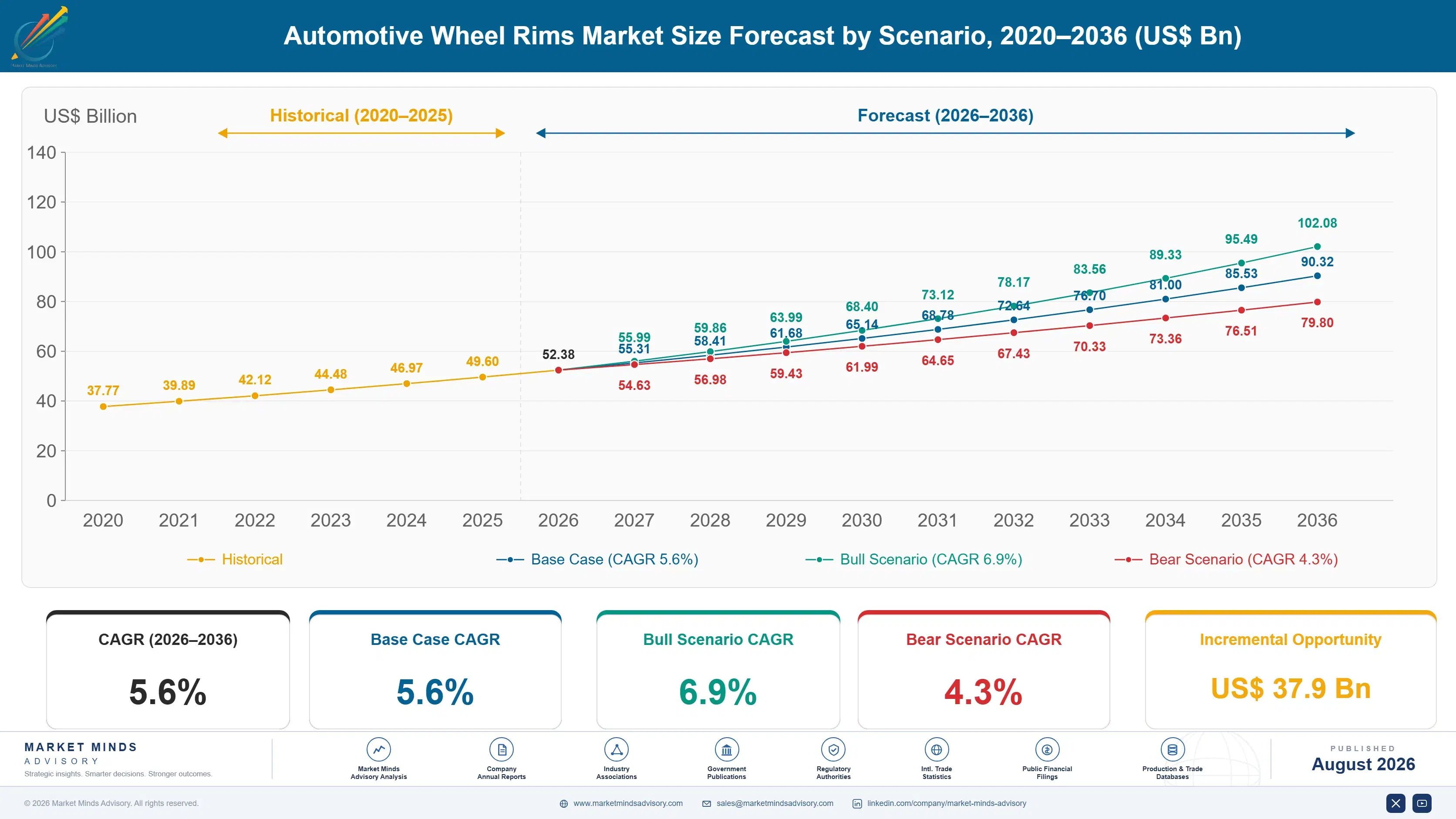
Automotive Wheel Rims Market Forecast Scenarios

automotive-wheel-rims-market-size-forecast-scenario-1787465339320
Between 2020 and 2025 value rose faster than unit volume, and diameter explains most of it. Average fitted wheel size kept climbing across every segment, aluminium penetration reached roughly 78% of light vehicles, and electric platforms introduced aerodynamic designs carrying more tooling content. Aluminium and European smelter energy costs spiked through 2022. The 4.4% historical growth mixes content gains with metal pass-through.
The 5.6% base case rests on three mechanisms. Diameter inflation continues across segments, raising metal content and machining time per wheel without any increase in units produced. Electric vehicle mass keeps pushing load rating requirements upward while range pressure simultaneously demands lower unsprung weight, and resolving that tension needs process capability rather than more aluminium. And flow forming keeps taking share from plain casting because it delivers meaningful weight reduction at a cost premium buyers accept.
The 6.9% bull case assumes aerodynamic wheel designs become standard across electric platforms, adding tooling and closed-face content to a large share of production. The 4.3% bear case reflects vehicle production weakness alongside trade measures fragmenting supply and raising landed costs without any corresponding increase in what manufacturers will pay per wheel. Trade policy decides much of which case actually arrives.

Why Diameter Inflation Funds Everything

Three forces drive this market and styling is now the least important. Diameter comes first, because a larger wheel uses more metal, takes longer to machine, and sells for more without the producer doing anything differently. Mass comes second, since unsprung weight costs range on electric platforms in a way it never mattered on combustion vehicles. Trade policy comes third, shaping sourcing more than cost comparison does.
TOP-FIVE CONCENTRATION36%Share of global wheel supply held collectively by producers
AVERAGE WHEEL DIAMETER18.4 inchesMean fitted diameter across new light vehicle production
ALUMINIUM PENETRATION RATE78%Share of new light vehicles fitted with alloy wheels
ALUMINIUM COST SHARE47%Primary and recycled metal within total production cost
UNSPRUNG MASS SAVING3.2 kgTypical reduction per wheel moving from cast to forged
CAPACITY UTILISATION71%Average loading across casting, machining, and finishing lines
The commercial character has shifted toward process capability. A producer with casting furnaces and machining centres competes on aluminium conversion cost, which Chinese producers win on energy and scale. A producer with flow forming, forging, and aerodynamic design capability competes on weight and drag, which manufacturers pay for because both translate into certified range figures on a window sticker.
The next decade turns on whether the mass and load rating tension resolves. Electric vehicles weigh substantially more than combustion equivalents, which demands higher wheel load ratings and therefore more material, while range pressure demands the opposite. Flow forming and forging address that directly, and carbon fibre does so at a price almost nobody pays. Producers who invested in process rather than tonnage sit on the right side of that argument.
"A carbon fibre wheel saves more unsprung mass than any other single change you can make to a vehicle, and the company that proved it nearly went under doing so. That gap between engineering merit and commercial reality defines this category."
Director, Wheels and Chassis Components Practice · MMA Automotive / Wheels and Chassis Components Practice · August 2026

Market Trends

Flow Forming Takes Share From Plain Casting Rapidly

Flow forming spins a cast wheel rim under pressure to align the aluminium grain structure, delivering much of the strength and weight benefit that forging provides at a fraction of forging cost and cycle time. Growth of 9.4% reflects manufacturers specifying it across mainstream platforms rather than only on performance derivatives, because the weight saving translates directly into certified range on electric vehicles. The process needs dedicated equipment and metallurgical control that plain casting operations do not have, which is exactly why it separates producers competing on conversion cost from those competing on capability.
Market Impact: Reaches 18.4 inches average fitted
Trade Defence Measures Fragment Global Wheel Sourcing

Anti-dumping and countervailing duties on Chinese aluminium wheels in both European and American markets have made landed cost a function of trade policy rather than production efficiency, and manufacturers now weigh origin risk alongside price in sourcing decisions. Chinese producers have responded by establishing capacity in Morocco, Mexico, Thailand, and elsewhere to serve affected markets from outside the measures. That relocation adds cost without adding capability, and it has reshaped the competitive map more than any technical development during the same period. Producers inside protected markets are watching that protection erode steadily.
Market Impact: Cuts 3.2 kilograms per wheel

Market Opportunities and Growth Drivers

Diameter Inflation Raises Content Without Raising Volume

Average fitted wheel diameter has climbed steadily toward 18.4 inches as crossovers displaced saloons and as larger wheels became a visible marker of trim level across every price segment. A larger wheel consumes more aluminium, takes longer to machine, requires more finishing area, and sells for correspondingly more. That escalation delivers revenue growth entirely independent of how many vehicles get built, which matters considerably in a period when global production volumes have been broadly flat. Producers benefit without changing anything about how they manufacture. Revenue rises even where vehicle output does not, which is unusual in this industry.
Market Impact: Raises load ratings 18% typically

Electric Range Pressure Makes Unsprung Mass Commercially Valuable

Weight at the wheel is unsprung and rotating, so reducing it improves both efficiency and ride quality more than removing the same mass from the body would. On battery electric platforms that improvement shows up in certified range, which appears on the specification comparison buyers actually make. Manufacturers therefore fund lighter wheel processes that combustion cost cases would have rejected outright a decade ago. Aerodynamic wheel designs add a second effect, since wheel and wheel arch airflow contributes measurably to overall drag coefficient on modern vehicles. Combustion cost cases rejected exactly the same investment a decade ago.
Market Impact: Moves 47% of production cost

Market Restraints and Challenges

Electric Vehicle Mass Adds Material Back Onto Wheels

Battery electric vehicles weigh considerably more than combustion equivalents of similar size, which raises the load rating a wheel must carry and forces additional material into the rim and spokes exactly where engineers are trying to remove it. The root cause is battery mass, which no wheel design addresses. Producers respond by moving up the process ladder toward flow forming and forging that achieve required strength at lower mass, by optimising spoke geometry through simulation, and by qualifying higher-strength alloys that carry load with less section thickness. The two requirements pull directly against each other on every programme.
Market Impact: Saves 1.8 kilograms per wheel

Aluminium and Smelter Energy Pass Through Slowly

Metal accounts for roughly 47% of wheel production cost, and primary aluminium pricing reflects smelter electricity costs that moved violently through 2021 and 2022 as European capacity curtailed. The root cause is that wheels are among the most metal-intensive automotive components by value. Programme pricing agreed at award runs years against that exposure. Producers respond by negotiating metal indexation, by raising recycled content which prices on different drivers, and by locating casting capacity where electricity costs are permanently lower over the long term. Nothing about wheel design reduces exposure to the metal itself.
Market Impact: Redirects 22% of export volume
3 additional market trends, 2 additional growth drivers, and 4 additional restraints and challenges are covered in the full report. Contact sales@marketmindsadvisory.com to access the complete intelligence.

Segment CAGR and Growth Architecture

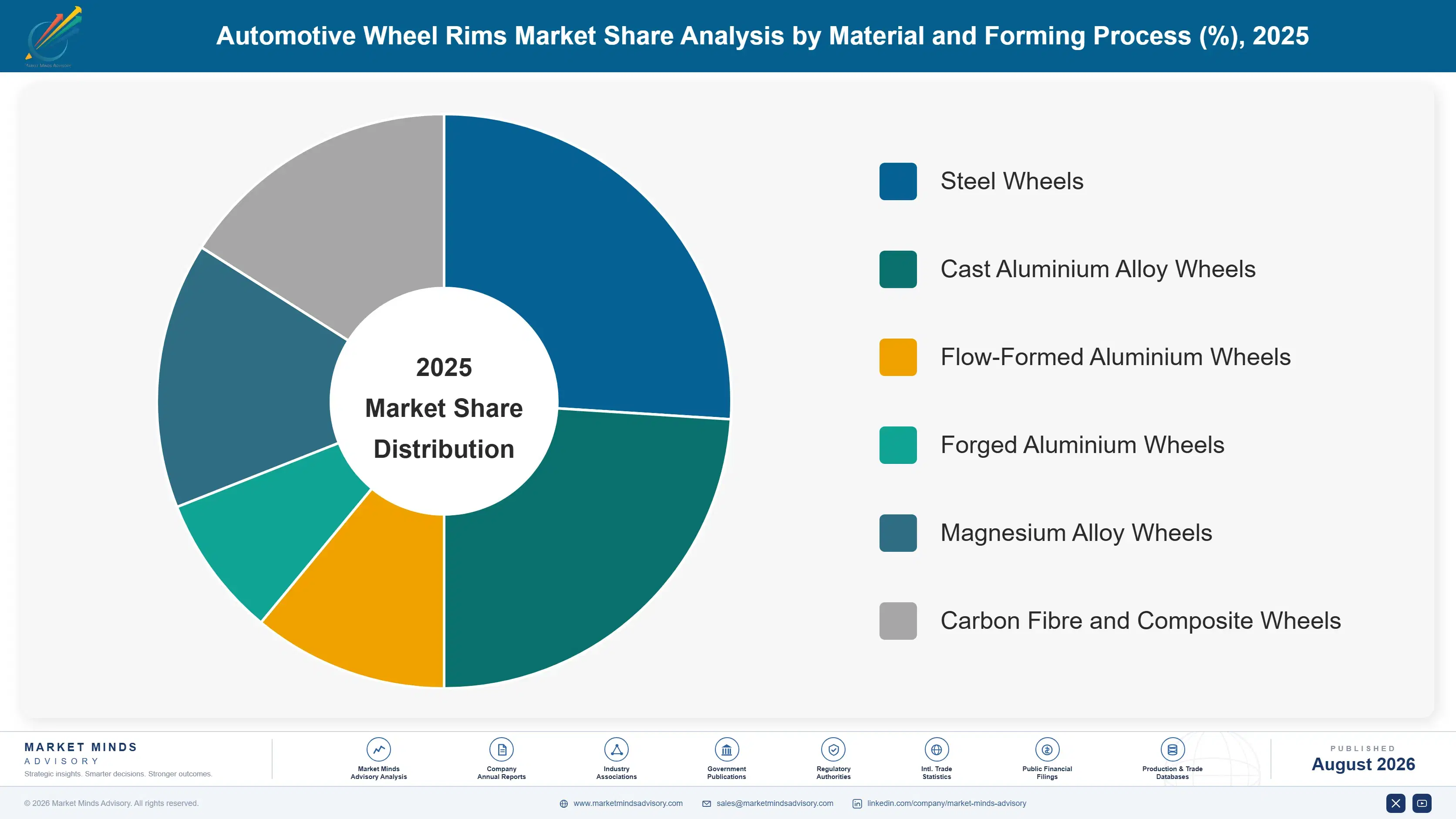
Segmentation follows material and forming process, the single logic that determines weight, strength, cost, and which manufacturers will specify it. Process decides whether a producer competes on aluminium conversion cost or on weight performance, which are entirely different commercial positions. Vehicle segment, wheel diameter, and channel structure appear separately in the framework as commercial dimensions rather than parallel segments.
automotive-wheel-rims-market-market-share-analysis-1787465339886

Carbon Fibre and Composite Wheels

Carbon fibre wheels remove more unsprung mass than any other single vehicle modification, cutting eight to ten kilograms per corner against cast aluminium and delivering measurable gains in acceleration, braking, ride, and range simultaneously. Growth of 16.8%, roughly 3.00 times the market, comes off a base so small that the rate describes fitment on a handful of performance programmes rather than any volume trade. Cost is the entire problem, running perhaps ten times a cast equivalent, and the leading supplier encountered severe financial difficulty despite winning genuine original equipment programmes. The engineering case is unarguable and the commercial case remains unproven at any volume that matters. Nobody has closed that gap yet at any meaningful volume.
CAGR 16.8%

Flow-Formed Aluminium Wheels

Flow forming spins a cast rim under rollers to align grain structure and thin the section, delivering roughly 1.8 kilograms of saving per wheel against plain casting at a cost premium manufacturers accept readily on electric platforms. Growth of 9.4% reflects the process moving from performance derivatives into mainstream specification across Europe, China, and North America. Dedicated forming equipment and metallurgical process control are required, which plain casting operations do not possess and cannot add quickly. That capability gap is precisely what separates producers competing on aluminium conversion cost from those competing on weight, and the second group is growing considerably faster. Subcontracting the forming step to a competitor is the alternative on offer.
CAGR 9.4%
Full segment breakdown across 6 segments available in the complete report.

Regional Architecture and Country Demand Map

East Asia holds the largest share at 30%, driven by Chinese production scale that supplies both domestic assembly and export markets worldwide. North America and Western Europe follow on large-diameter premium fitment, while South Asia and Pacific grows fastest on Indian production expansion. Trade measures reshape sourcing everywhere.

North America

Pickup trucks and large sport utility vehicles carry the biggest wheels fitted anywhere, and average diameter here runs above every other region, which lifts content value per vehicle before any process decision is taken. Anti-dumping and countervailing duties on Chinese aluminium wheels have reshaped sourcing, pushing volume toward Mexican, Thai, and domestic capacity. Superior Industries and Accuride operate substantial regional production alongside Mexican operations serving under regional content rules. The aftermarket is large, brand-driven, and unusually profitable given styling-led purchasing. Regional growth of 4.9% is content-led, since production volumes have shown little movement. Trade measures now shape sourcing decisions more than production cost comparison ever did. Domestic capacity has gained accordingly.
Share: 24% | CAGR: 4.9% (2026 to 2036)

Western Europe

Premium manufacturers specify large-diameter alloy wheels with intricate designs and complex finishes that demand machining and painting capability beyond commodity production. Aerodynamic wheel designs have spread quickly across electric platforms as manufacturers chase drag coefficient improvements that translate into certified range figures. Trade defence measures against Chinese wheels apply here as in North America, shifting sourcing toward Moroccan, Turkish, and Eastern European capacity. Ronal, Borbet, and BBS hold engineering and production positions serving German premium programmes. Growth of 4.0% is the slowest of any region and reflects contracting production volumes offsetting genuine content increases. Energy cost disadvantage persists whatever trade measures happen to be in force at the time. Content increases only partly offset it.
Share: 20% | CAGR: 4.0% (2026 to 2036)
Regional intelligence for 5 additional markets available in the complete report: East Asia, South Asia and Pacific, Latin America, Middle East and Africa, Eastern Europe. Contact sales@marketmindsadvisory.com.
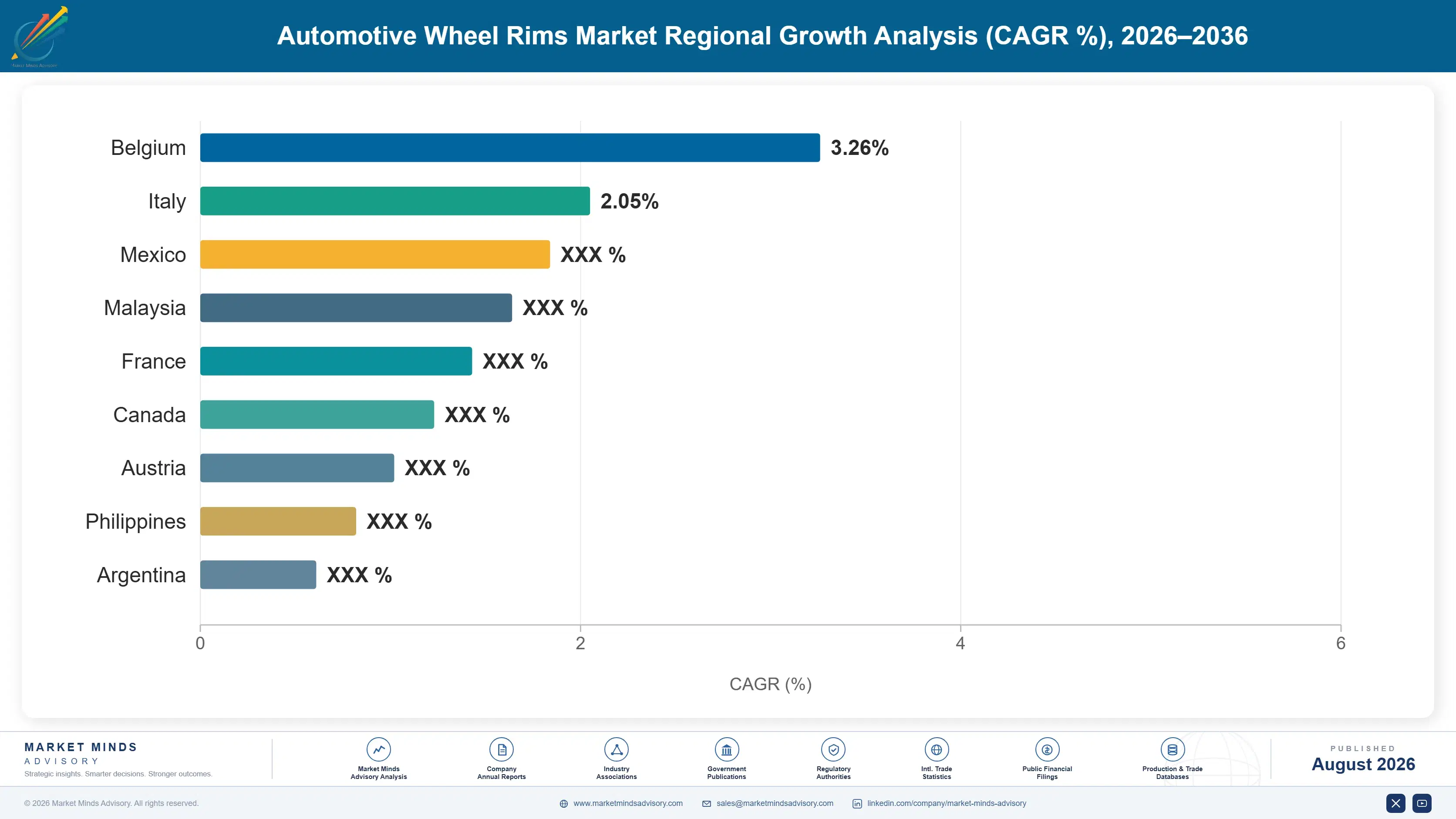
automotive-wheel-rims-market-country-cagr-analysis-1787465340514

Where Wheel Margin Actually Sits Today

Casting aluminium and machining it competes against Chinese energy costs and scale, which is not a contest worth entering. The four moves below sell weight and drag instead of metal: flow forming capability, aerodynamic design ownership, recycled content that answers regulation and cost together, and aftermarket brand positions that price on styling rather than kilograms.

Install Flow Forming Capability Ahead of Programme Demand

Flow forming saves roughly 1.8 kilograms per wheel against plain casting at a cost premium manufacturers accept because the weight translates into certified electric range. Installing dedicated forming equipment and building metallurgical process control costs around $22 million per line and takes eighteen months. Plain casting operations cannot add the capability quickly, which is exactly why the pricing holds. Producers who invested before demand arrived are winning specifications that competitors can only bid by subcontracting the forming step to them. That capability gap is the whole competitive argument in this category.
Market Impact: Saves 1.8 kilograms on each wheel produced overall

Own Aerodynamic Wheel Design Rather Than Machining Someone Else's

Wheel and wheel arch airflow contributes measurably to vehicle drag coefficient, and electric platforms chase every hundredth because it converts into range on the window sticker. Producers offering computational fluid dynamics capability and validated aerodynamic wheel designs participate in the specification conversation rather than quoting against a fixed drawing. That capability costs perhaps $5 million to build and supports pricing 12% to 20% above equivalent styling-only wheels, because the manufacturer is buying a range contribution they can measure. Quoting against a fixed drawing forfeits that conversation entirely. That distinction decides awards.
Market Impact: Supports a 12 to 20% wheel price premium

Raise Recycled Aluminium Content Above Regulatory Minimums

Wheels are among the best recyclate applications in a vehicle, since alloy specification tolerates secondary metal well and the parts are readily recoverable at end of life. Recycled aluminium prices on different drivers than primary and requires roughly 95% less energy to produce, which cuts both cost exposure and embodied carbon simultaneously. European recycled content proposals make this a compliance advantage as well. Producers running high recyclate ratios held cost position through the 2022 smelter curtailments that primary-dependent competitors simply could not match. Specification conservatism is usually the only real obstacle.
Market Impact: Cuts metal energy intensity by roughly 95% overall

Build Aftermarket Brand Position Priced on Styling

Aftermarket wheel buyers purchase appearance and brand rather than weight, paying two to four times original equipment pricing for products where the engineering argument barely features in the decision. Demand follows the vehicle parc and personalisation culture rather than new production, and it is entirely insulated from trade measures and programme awards. Building or acquiring a credible brand position costs perhaps $30 million. Margins run several times original equipment work and the revenue survives every argument in this report. No trade measure or programme award affects it in any way.
Market Impact: Earns 2 to 4x the equipment pricing level

Who Controls the Margin Pool

The top five hold roughly 36% of supply, measured consistently as wheel revenue at producer level. CITIC Dicastal is the largest producer globally and operates from a Chinese base with capacity established in Morocco and elsewhere to serve markets applying trade measures. Superior, Ronal, Maxion, and Enkei hold substantial regional positions built on process capability and proximity to assembly rather than on raw casting scale.
Competition runs along three lines. Process capability is the first and increasingly decisive, separating producers who can offer flow forming and forging from those competing purely on casting conversion cost. Trade position is the second, since anti-dumping measures now determine landed cost more than production efficiency does. The third is aerodynamic and design capability, which lets a producer participate in specification rather than quoting against somebody else's drawing.

Two pressures will reshape positions. Chinese producers relocating capacity into Morocco, Mexico, and Thailand are neutralising trade measures without losing cost advantage, which erodes the protection Western producers gained. Meanwhile electric platform requirements keep rewarding weight and drag capability over tonnage. The exposed position is a casting-led producer in a high-energy-cost region with no flow forming, no aerodynamic design capability, and no aftermarket brand.
automotive-wheel-rims-market-company-positioning-matrix-1787465341132

Competitive Moat and Risk Dimensions

CITIC DICASTAL

Moat: Global Scale and Cost Position

CITIC Dicastal produces more aluminium wheels than any competitor and operates from a cost base built on Chinese energy, scale, and supply chain depth that no Western producer approaches. Capacity established in Morocco and other locations lets it serve markets applying trade measures against Chinese origin. That combination of cost leadership and geographic flexibility is difficult to answer directly.
CITIC DICASTAL

Risk: Trade Measure Exposure

Anti-dumping and countervailing duties in Europe and North America target Chinese origin specifically, and relocating capacity addresses the measures while adding cost and complexity the company would rather avoid. Political scrutiny of Chinese-owned production in sensitive supply chains continues broadening. Each new measure requires another response, and the cumulative burden reduces the cost advantage the business was built upon.
RONAL GROUP

Moat: Premium Design and Process Depth

Ronal combines flow forming, forging, and complex finishing capability with design engineering that serves German premium programmes specifying intricate wheel architectures and demanding surface treatments. That capability set competes on weight and appearance rather than on aluminium conversion cost. Long-standing premium manufacturer relationships give early sight of styling and aerodynamic requirements before specifications are frozen.
RONAL GROUP

Risk: European Energy Cost Base

Casting and finishing are energy-intensive, and European electricity costs after 2022 left regional producers permanently disadvantaged against Chinese, Moroccan, and Turkish capacity. Trade measures offset part of that gap without closing it. As Chinese producers establish capacity inside protected markets, the protection weakens while the underlying cost disadvantage remains entirely unchanged.

Players Tracked

Prominent Players

CITIC Dicastal
Superior Industries
Ronal Group
Maxion Wheels
Enkei

Other Key Players

Borbet
Accuride
Topy Industries
Zhejiang Jinfei Kaida Wheel
Lizhong Group
Wanfeng Auto Holding
Howmet Aerospace
BBS
OZ Group
Carbon Revolution
Dymag Group
Steel Strips Wheels
Minda Kosei Aluminum Wheel
Yokohama Wheel
Alcar Holding

Recent Developments

MARCH 2025

Chinese producers expand capacity outside trade measure jurisdictions

Chinese aluminium wheel producers continued establishing and expanding production capacity in Morocco, Mexico, and Thailand to serve European and North American customers from origins outside anti-dumping and countervailing duty measures. The relocation preserves much of the underlying cost advantage while adding logistics complexity and capital commitment for the producers involved.
Signal: Trade measures are simply redirecting production geography without meaningfully changing who actually holds the cost advantage.
OCTOBER 2024

Flow-formed wheels move from performance into mainstream specification

Vehicle manufacturers extended flow-formed aluminium wheel specification from performance derivatives into mainstream electric platforms, citing weight savings that translate into certified range improvements. The process requires dedicated forming equipment and metallurgical control that plain casting operations cannot add quickly or cheaply in response. Adoption widened through 2025.
Signal: Process capability rather than casting tonnage now separates producers competing on weight from those on price.
JULY 2025

Carbon fibre wheel supply faces continued commercial pressure

Carbon composite wheel supply into original equipment programmes continued facing commercial difficulty despite proven engineering benefits and genuine manufacturer awards, as production cost remained roughly ten times cast aluminium equivalents. Programme volumes stayed confined to performance derivatives where buyers accept the pricing involved. Volumes stayed confined to performance derivatives.
Signal: Engineering merit and commercial viability still remain a very long way apart in composite wheel manufacture.

Aluminium, Smelter Energy, and Finishing

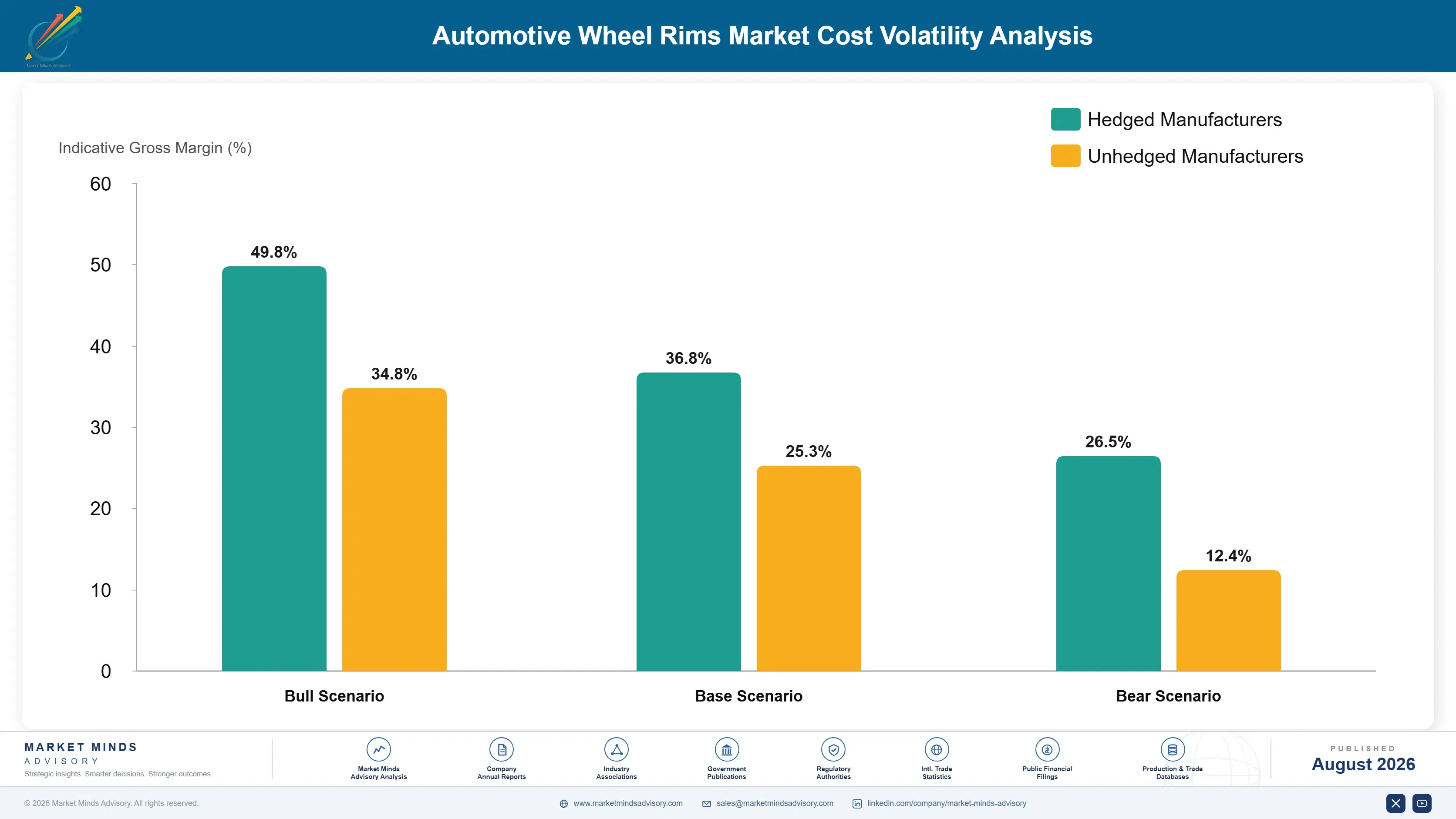
Aluminium accounts for roughly 47% of wheel production cost, split between primary metal priced against exchange benchmarks and secondary recycled material that prices on entirely different drivers. Casting, machining, and heat treatment energy takes a further 16%. Paint, coating, and finishing contribute 12%, and tooling amortisation, labour, and quality inspection absorb the remainder in typical wheel operations.
Primary aluminium pricing reflects smelter electricity costs, and European curtailments through 2021 and 2022 under the energy conditions documented in IEA reporting pushed both metal and regional conversion costs sharply higher. Producers on fixed programme pricing without metal indexation absorbed increases they could not recover. Superior Industries and Ronal both referenced metal and energy cost pressure across their reporting in the period, and several European finishing operations reduced output rather than run negative.

Exposure divides on recycled content and on energy geography rather than on production scale. Producers running high secondary aluminium ratios held cost position through the primary metal spike, since recycled material requires roughly 95% less energy and prices on scrap availability instead. Those dependent on primary metal in high-tariff regions faced a gap no operational improvement closes. Chinese and Gulf producers, on cheaper power, held positions Western plants cannot approach.
automotive-wheel-rims-market-cost-volatility-analysis-1787465341391

Raise secondary aluminium ratios through alloy specification discipline

Wheel alloy specifications tolerate secondary metal well, and recycled aluminium requires roughly 95% less energy to produce while pricing on scrap availability rather than smelter economics. Raising recyclate ratios cuts both cost exposure and embodied carbon simultaneously, and European recycled content proposals make it a compliance advantage too. The obstacle is usually specification conservatism rather than any genuine metallurgical constraint.

Negotiate metal indexation into every programme award

Aluminium is 47% of wheel cost and moves continuously, while programme pricing agreed at award runs several years, which guarantees a mismatch whenever metal markets move against the producer. Manufacturers accept indexation at award far more readily than they grant relief afterwards. Producers who secured it protected margin that competitors on fixed pricing surrendered entirely through 2022.

Site casting capacity against long-term electricity cost position

Casting and heat treatment are energy-intensive and the load is continuous, so plant location relative to cheap reliable power determines competitiveness for decades rather than seasons. Freight on finished wheels is meaningful but far smaller than the energy differential between regions. European producers learned this expensively after 2022, and several are now weighing relocation seriously.

Portfolio Architecture for Margin Defence

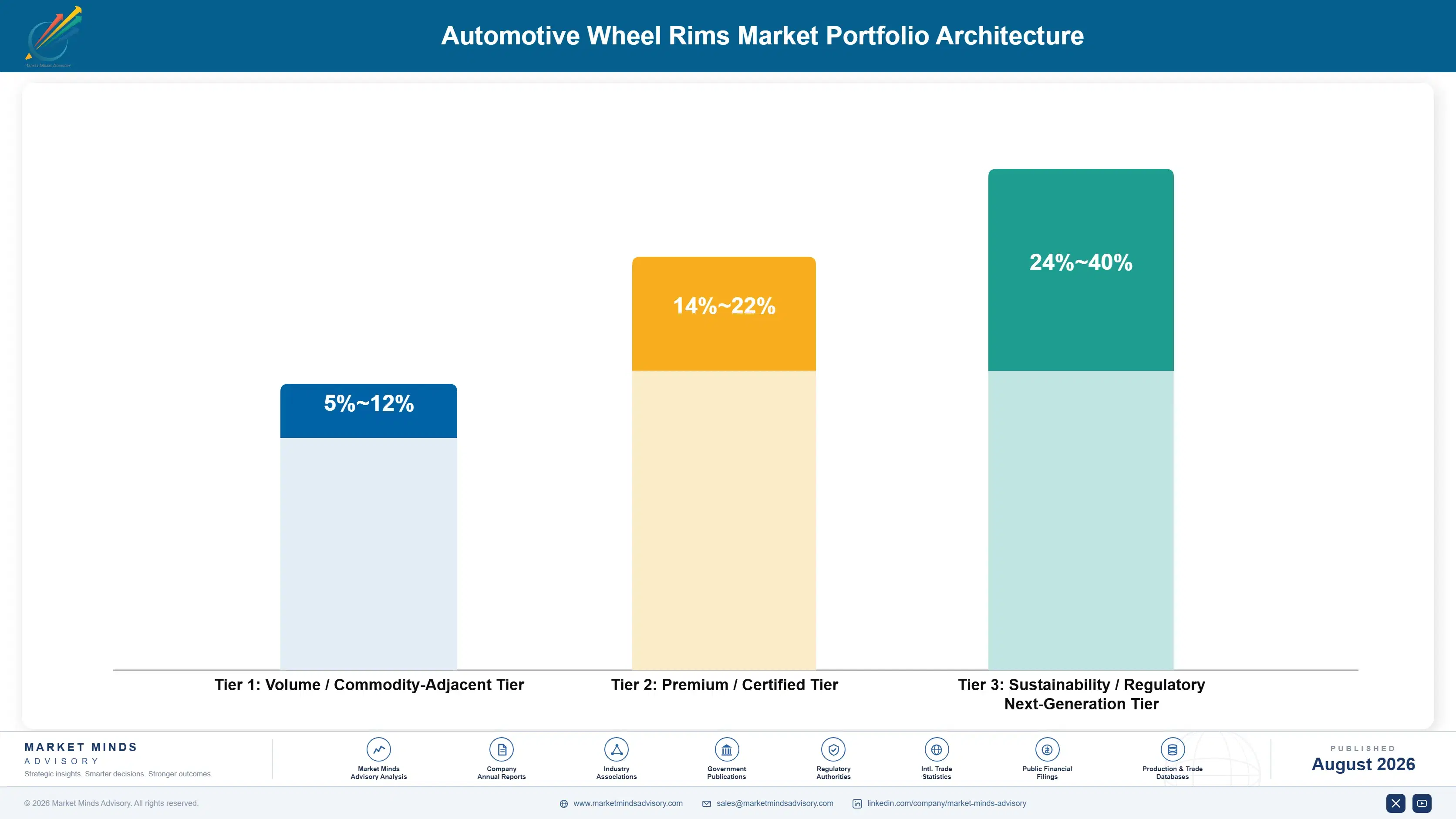
Three tiers separate on what the producer sells beyond metal. Steel wheels and plain cast aluminium supplied against manufacturer drawings earn 5% to 12%, competing on conversion cost against producers with permanently cheaper energy. Flow-formed and forged wheels with weight performance earn 14% to 22%, since manufacturers pay for range contribution. Aerodynamic designed wheels and aftermarket brand products earn most, and for entirely different reasons.
The tension is that casting volume keeps the furnaces running while conversion economics keep deteriorating. Plain cast wheels hold utilisation near 71%, which the capital in melting, casting, and machining genuinely requires, yet the tier competes directly against Chinese and Moroccan energy costs that no European or American operational improvement closes. Producers who invested in flow forming rather than more casting capacity found the weight argument gave them somewhere defensible to stand.

High-value pools sit where the manufacturer buys a measurable vehicle attribute or the consumer buys appearance. Weight reduction converts into certified range, aerodynamic design converts into drag coefficient, and aftermarket brand converts into willingness to pay several times what the metal costs, none of which a conversion-cost comparison touches.

Volume / Commodity-Adjacent Tier

Steel wheels and plain cast aluminium supplied against manufacturer drawings on conversion cost. Competes directly against producers with cheaper electricity and scale. The wide range reflects large differences in energy cost, recyclate ratio, and casting scale between regions.
Gross Margin: 5%-12%

Premium / Certified Tier

Flow-formed and forged aluminium wheels sold on validated weight reduction and load rating performance for electric and premium platforms. Range width separates flow-formed volume production from fully forged low-volume wheels within the same tier.
Gross Margin: 14%-22%

Sustainability / Regulatory / Next-Generation Tier

Aerodynamically designed wheels with drag validation, high recycled content products meeting emerging requirements, and branded aftermarket ranges. Design capability and brand equity, rather than conversion economics, sustain the margin structure across this tier.
Gross Margin: 24%-40%
automotive-wheel-rims-market-portfolio-architecture-1787465342113

High-value Sub-segments and Strategic Watch-out

Branded Aftermarket Wheel Ranges

Highest margin in the category, selling appearance and brand at two to four times original equipment pricing where engineering barely features in the buying decision. Demand follows the parc and personalisation culture rather than new production entirely. Trade measures and programme awards are irrelevant here.
Gross Margin: 30%-40%

Aerodynamic Designed Wheels

High value with strong growth, since wheel and arch airflow measurably affects drag and therefore certified electric range. Design capability lets a producer join the specification conversation rather than quoting against a fixed drawing. Drag figures go into homologation, which protects the position. Design capability is the entry.
Gross Margin: 22%-32%

Flow-Formed Aluminium Production

The growth core at 9.4%, saving 1.8 kilograms per wheel at a premium manufacturers accept readily on electric platforms. Dedicated equipment and metallurgical control are the barrier that plain casting operations cannot cross quickly. Manufacturers pay for range they can actually certify. Equipment is the real barrier.
Gross Margin: 16%-24%

Plain Cast Aluminium Supply

The strategic watch-out. Competes on conversion cost against Chinese, Moroccan, and Turkish energy positions that no Western operational improvement closes. It holds utilisation and should be priced for exactly that, nothing more. Expect nothing beyond utilisation from it. Price it as pure ballast, nothing else.
Gross Margin: 6%-13%

Why Wheel Programmes Follow Styling

Wheel revenue is programme revenue with an unusual rhythm, because wheel designs change on styling cycles rather than engineering ones. A producer awarded a wheel programme supplies that design for its production life, typically four to seven years, which is shorter than most chassis components because facelifts routinely bring new wheel designs even when nothing mechanical changes. Tooling is design-specific and relatively inexpensive, which means switching is easier here than in almost any other chassis category.
Stickiness therefore depends on capability rather than tooling investment. Producers holding flow forming or forging capability are protected because the customer cannot easily source the same weight performance elsewhere. Aerodynamically validated designs are protected because the drag figure is written into the vehicle's homologation. Plain cast wheels against manufacturer drawings are the least sticky of all, retendered at every facelift on conversion cost with genuinely no attachment to the incumbent producer.

Buyer profiles have shifted markedly. Aerodynamics and vehicle efficiency engineers now sit in wheel supplier selection alongside styling and purchasing, and questions about mass and drag contribution arrive before any discussion of finish quality. Finish quality has become a qualification hurdle rather than a differentiator in those conversations.
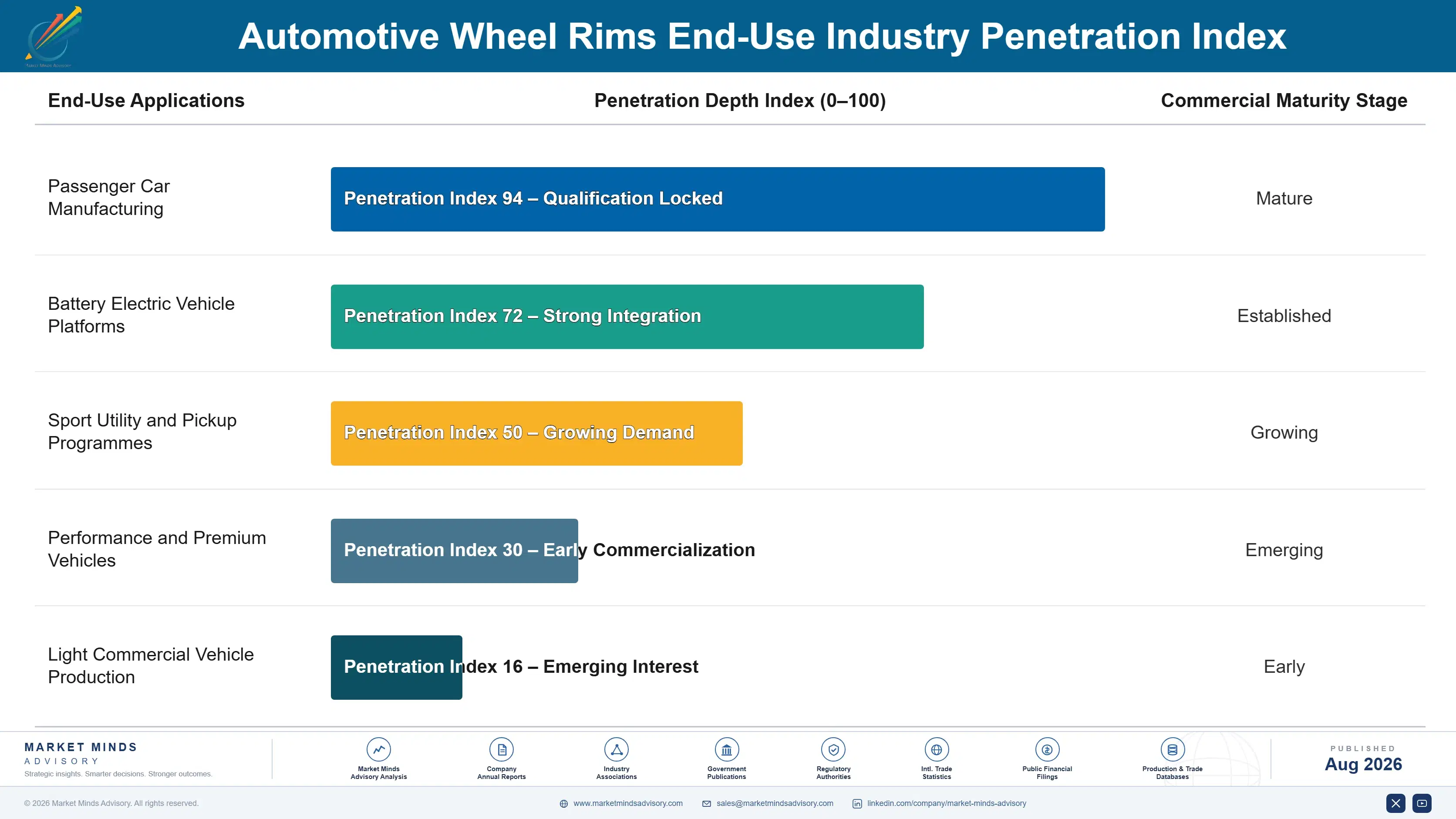
automotive-wheel-rims-market-end-use-penetration-index-1787465342809

Where Wheel Capital Should Go

These are among the four positions where our research anticipates prominent divergence between winners and laggards over the coming forecast period. Each is grounded in the demand model, the regulatory perimeter, and the announced capacity pipeline.
01 / FLOW FORMING INVESTMENT

Buy the process, because casting cost is a losing argument

Flow forming saves roughly 1.8 kilograms per wheel against plain casting at a premium manufacturers accept readily, because unsprung weight converts into certified electric range that appears on the specification comparison buyers make. Dedicated forming equipment and metallurgical process control cost around $22 million per line across eighteen months, and plain casting operations cannot add the capability quickly. Producers who invested before the demand arrived now win specifications that competitors can only bid by subcontracting the forming step to them directly.
02 / AERODYNAMIC DESIGN OWNERSHIP

Join the specification conversation instead of quoting a drawing

Wheel and wheel arch airflow contributes measurably to drag coefficient, and electric platforms chase every hundredth because it converts directly into certified range on the window sticker. Producers offering computational fluid dynamics capability and validated aerodynamic designs participate in specification development rather than bidding against a fixed drawing somebody else produced. That capability costs perhaps $5 million to build and supports pricing 12% to 20% above equivalent styling-only wheels, because the manufacturer is buying a measurable and certifiable range contribution.
03 / RECYCLED METAL POSITIONING

Raise secondary aluminium ratios for cost and compliance together

Wheels tolerate secondary aluminium well, and recycled metal requires roughly 95% less energy to produce while pricing on scrap availability rather than smelter electricity economics, which is a genuinely different exposure. European recycled content proposals turn the same decision into a compliance advantage alongside the cost one. Producers running high recyclate ratios held position through the 2022 primary metal spike that primary-dependent competitors simply could not match, and specification conservatism is usually the only genuine obstacle standing in the way.
04 / AFTERMARKET BRAND BUILDING

Sell appearance to consumers who never mention kilograms

Aftermarket wheel buyers purchase brand and appearance at two to four times original equipment pricing, in a transaction where the engineering argument barely features and trade measures, programme awards, and manufacturer cost engineering are all irrelevant. Demand here follows the vehicle parc and personalisation culture rather than new production volumes. Building or acquiring a credible brand position costs perhaps around $30 million, delivers margins several times original equipment work, and survives every single competitive argument set out in this report.

Engagement Snapshot From the Field

A live engagement with an industry participant carrying material or product regulatory and market exposure ahead of a defining policy shift, showing how our research translates into a defensible multi-year portfolio strategy.
MARKET MINDS ADVISORY · CLIENT ENGAGEMENT SUMMARY
Automotive Wheel Rims Producer Strategic Portfolio Review and Transition Roadmap 2026·Investment Scenario on Automotive Wheel Rims Exposure Evaluation 2025-26
CLIENT PROFILE
A European aluminium wheel producer operating two casting and machining plants supplying German, French, and Czech vehicle programmes, with annual revenue near EUR 420 million (client-reported, unverified by MMA). Plain cast wheels supplied roughly 79% of volume, no flow forming or forging capability existed, recyclate content sat below 30%, and aftermarket sales were made unbranded through distributors.
STRATEGIC CHALLENGE
European electricity costs had left the client permanently disadvantaged against Moroccan and Turkish capacity, and two programmes had been lost on price within eighteen months. A third customer had specified flow-formed wheels the client could not produce. Group margin had fallen to 4.1%, casting utilisation was at 64%, and the board was weighing plant closure against process investment.
MMA APPROACH
MMA rebuilt profitability by product type and programme using actual delivered metal and energy costs. Flow forming investment was costed against continued plain casting under three energy price scenarios. Recyclate ratio increase was assessed against alloy specifications in force across the client's programmes, and aftermarket branding options were evaluated, with findings tested through 47 expert interviews during Q4 2025.
KEY FINDINGS
  1. No achievable casting scale closed the delivered cost gap against Moroccan and Turkish capacity, because the difference was electricity tariff rather than plant efficiency or labour.
  2. Flow-formed wheels on comparable programmes were realising prices 24% above the client's plain cast equivalents, and three customers had flow-formed requirements the client could not bid.
  3. Alloy specifications across the client's programmes permitted recyclate ratios above 60%, against the client's actual 29%, with no metallurgical obstacle identified anywhere.
  4. Unbranded aftermarket wheels realised roughly 40% of the price the same castings achieved carrying an established styling brand in the same distribution channels.
CLIENT PROFILE
A European aluminium wheel producer operating two casting and machining plants supplying German, French, and Czech vehicle programmes, with annual revenue near EUR 420 million (client-reported, unverified by MMA). Plain cast wheels supplied roughly 79% of volume, no flow forming or forging capability existed, recyclate content sat below 30%, and aftermarket sales were made unbranded through distributors.
STRATEGIC CHALLENGE
European electricity costs had left the client permanently disadvantaged against Moroccan and Turkish capacity, and two programmes had been lost on price within eighteen months. A third customer had specified flow-formed wheels the client could not produce. Group margin had fallen to 4.1%, casting utilisation was at 64%, and the board was weighing plant closure against process investment.
MMA APPROACH
MMA rebuilt profitability by product type and programme using actual delivered metal and energy costs. Flow forming investment was costed against continued plain casting under three energy price scenarios. Recyclate ratio increase was assessed against alloy specifications in force across the client's programmes, and aftermarket branding options were evaluated, with findings tested through 47 expert interviews during Q4 2025.
KEY FINDINGS
  1. No achievable casting scale closed the delivered cost gap against Moroccan and Turkish capacity, because the difference was electricity tariff rather than plant efficiency or labour.
  2. Flow-formed wheels on comparable programmes were realising prices 24% above the client's plain cast equivalents, and three customers had flow-formed requirements the client could not bid.
  3. Alloy specifications across the client's programmes permitted recyclate ratios above 60%, against the client's actual 29%, with no metallurgical obstacle identified anywhere.
  4. Unbranded aftermarket wheels realised roughly 40% of the price the same castings achieved carrying an established styling brand in the same distribution channels.
RECOMMENDED STRATEGY
Phase 1: Phase 1 (months one to six): raise recyclate ratios toward specification limits and decline plain cast quotations without metal and energy indexation. Phase 2: Phase 2 (months seven to twenty-four): install one flow forming line at the higher-utilisation plant and qualify with the three customers already requiring it. Phase 3: Phase 3 (months twenty-five to thirty-six): build aerodynamic design capability and establish a branded aftermarket range through the existing distribution network.
OUTCOME
The producer raised recyclate content to 58% and reported group margin improving from 4.1% to 9.7% within sixteen months (client-reported, unverified by MMA). The flow forming line was commissioned and qualified with two customers. No plant closure was required and aftermarket branding is in development.

Frequently Asked Questions

Foundational context covering the market sizes, CAGR, scope, country, region and competition that inform every finding below. This section is provided to cover basics and most often pre-purchase conversations, answered from the MMA Primary Research Dataset.

What is the current size of the Automotive Wheel Rims Market?

The market was valued at USD 49.6 billion in 2025, rising to an estimated USD 52.38 billion in 2026. East Asia holds the largest regional share at 30% of global value.

How large will the Automotive Wheel Rims Market be by 2036?

MMA forecasts USD 90.32 billion by 2036 under the base case, an expansion multiple of 1.72 times the 2026 level. Incremental value creation reaches USD 37.94 billion across the period.

What is the CAGR for the Automotive Wheel Rims Market 2026 to 2036?

The base case CAGR is 5.6%, with a bull case of 6.9% and a bear case of 4.3%. Historical growth between 2020 and 2025 ran at 4.4%, mixing content gains with metal pricing.

Which segment is growing fastest?

Carbon fibre and composite wheels, at 16.8%, roughly 3.00 times the overall market rate. The rate describes fitment on a handful of performance programmes rather than volume trade.

Who are the major companies in the Automotive Wheel Rims Market?

CITIC Dicastal, Superior Industries, Ronal Group, Maxion Wheels, and Enkei lead, holding roughly 36% of supply between them. Indian and Turkish producers are gaining export share.

Which country is growing fastest?

India, at 8.4%, driven by vehicle production expansion alongside alloy wheel penetration rising from a base where steel wheels remained common far longer than elsewhere.

Report Segmentation Architecture

The full report scope spans multiple orthogonal segmentation dimensions, with cross-tabulated demand data provided for each dimension pair. Coverage extends further to regional breakdowns, trend trajectories, and the competitive detail needed to support segment-level decision-making.

By Material and Forming Process

  • Steel Wheels
  • Cast Aluminium Alloy Wheels
  • Flow-Formed Aluminium Wheels
  • Forged Aluminium Wheels
  • Magnesium Alloy Wheels
  • Carbon Fibre and Composite Wheels

By End-Use Industry

  • Passenger Car Manufacturing
  • Battery Electric Vehicle Platforms
  • Sport Utility and Pickup Programmes
  • Performance and Premium Vehicles
  • Light Commercial Vehicle Production

By Commercial Dimension

  • Original Equipment Programme Supply
  • Branded Aftermarket Ranges
  • Independent Distribution Channel
  • Contract Casting and Machining

By Region

  • North America
  • Western Europe
  • East Asia
  • South Asia and Pacific
  • Latin America
  • Middle East and Africa
  • Eastern Europe

Scope, Methodology, and Coverage

Every figure in this report is reproducible from documented input assumptions. The scope below maps the historical period, the forecast horizon, the segmentation dimensions, and the countries covered, alongside the underlying primary and qualitative methodology.
Historical Period
2020 to 2025
Forecast Period
2026 to 2036
Base Year
2025 (USD billions; MMA Primary Research Dataset, August 2026)
Market Definition
The market comprises wheel rims supplied for light vehicles, covering steel wheels, cast aluminium alloy wheels, flow-formed aluminium wheels, forged aluminium wheels, magnesium alloy wheels, and carbon fibre and composite wheels. Value is measured at wheel level across original equipment programme supply and aftermarket channels. Tyres, wheel bearings, hub assemblies, wheel covers and trims sold separately, commercial vehicle and off-highway wheels, and tyre pressure monitoring hardware fall outside scope.
Quantitative Units
USD billions (current prices); wheel units shipped annually; USD per wheel average selling price
Segmentation Dimensions
By Material and Forming Process; By End-Use Industry; By Commercial Dimension; By Region
Regions Covered
North America, Western Europe, East Asia, South Asia and Pacific, Latin America, Middle East and Africa, Eastern Europe
Countries Covered
USA, China, Germany, France, UK, Japan, South Korea, India, Australia, Canada, Brazil, Mexico, Indonesia, Vietnam, Thailand, Malaysia, UAE, Saudi Arabia, South Africa, Nigeria, Turkey, Poland, Netherlands, Italy, Spain, Sweden, Switzerland, Argentina, Colombia, Singapore, and additional markets relevant to this sector
Key Companies Profiled
CITIC Dicastal, Superior Industries, Ronal Group, Maxion Wheels, Enkei, Borbet, Accuride, Topy Industries, Zhejiang Jinfei Kaida Wheel, Lizhong Group, Wanfeng Auto Holding, Howmet Aerospace, BBS, OZ Group, Carbon Revolution, Dymag Group, Steel Strips Wheels, Minda Kosei Aluminum Wheel, Yokohama Wheel, Alcar Holding
Quantitative Methodology
Primary survey, n=3,800 respondents, Q4 2025, six countries; demand-side model with trade association cross-validation
Qualitative Methodology
47 expert interviews, Q4 2025; applied to validate demand model assumptions, identify emerging dynamics, and assess competitive positioning
Report Format
PDF and XLSX data workbook (Word format preview document)
Publisher
Market Minds Advisory
Report Code
MMA-2026-AUT-119
Published
August 2026
Contact
sales@marketmindsadvisory.com | www.marketmindsadvisory.com

Purchase the full Automotive Wheel Rims Market Report (2026 to 2036).

The full report sizes wheel demand across six material and process categories and seven regions with 2026 to 2036 forecasts under base, bull, and bear cases. It models diameter inflation and mass requirements against electric vehicle load ratings, showing where weight and range arguments justify process investment. Competitive profiles cover twenty producers assessed consistently on wheel revenue, process capability, and trade position. Cost analysis traces primary and secondary aluminium exposure by energy geography and recyclate ratio. Commercial guidance addresses flow forming investment, aerodynamic design capability, recycled metal positioning, and aftermarket brand building.
Six material and process categories sized separately
Diameter inflation modelled against content value per wheel
Twenty producer profiles on consistent wheel revenue basis
Trade measures mapped by origin and destination market
Recyclate ratio economics compared against primary metal exposure
Aftermarket brand pricing benchmarked against equipment supply levels

Built For The People Who Decide

From boardroom strategy to bench-side execution, this report is read cover-to-cover by leaders shaping the next decade of their industry, turning demand scenarios, market dynamics and valuation benchmarks into decisions.
CXOs/ Presidents/ VPs/ Managers
M&A and Corporate Development
Strategy Teams and R&D Heads
Procurement and Product Directors
Regulatory and Compliance Leaders
Investor Relations and Equity Analysts