Market Minds Advisory
Automotive Wheel Hub Bearing Aftermarket

Automotive Wheel Hub Bearing Aftermarket: Sensor Integration Redraws Replacement Economics

Automotive wheel hub bearing aftermarket suppliers are scaling sensor-integrated Generation 3 and Generation 4 replacement units as aging vehicle fleets and advanced driver assistance calibration requirements reshape replacement part specifications across independent repair channels worldwide.

Lead Analyst

David Horsley

Published

September 2026

Make Smarter Decisions with Customized Research Insights

Request a free sample report and evaluate market opportunities, growth trends, and competitive dynamics relevant to your business needs.

2025 MARKET VALUE$5.8BMarket Size 2025
2036 FORECAST VALUE$10.8BBase Case , 2026 to 2036
CAGR 2026 TO 20365.8 %Bull 7.0% / Bear 4.6%
INCREMENTAL OPPORTUNITY$4.7BNet 10- year value creation
EXPANSION MULTIPLE1.76x2036 value over 2026 base
Strategic Levers
M&A Pipeline
Regional Outlook
Country Rankings
Competitive Intelligence
Segmental Deep-dive
Call-Us : 91 93563 13602

Executive Snapshot and Market Trajectory

Automotive wheel hub bearing aftermarket demand is shifting toward sensor-integrated Generation 3 and Generation 4 replacement units as aging vehicle fleets and advanced driver assistance systems increasingly require precision-calibrated bearing replacements across independent and dealership repair channels globally today and well beyond.
EV-specific hub bearing units and Generation 4 integrated assemblies are the fastest-expanding categories as electric vehicle torque loads and electronic parking brake integration require more sophisticated replacement components than legacy ball bearing designs. East Asia holds the largest share of global replacement volume, anchored by China's expansive and rapidly aging vehicle parc, while North America sustains strong demand through its large, mature vehicle fleet and established do-it-for-me repair channel nationwide.
Competition splits between large diversified bearing manufacturers with original equipment relationships extending into aftermarket sales and numerous smaller regional remanufacturers competing mainly on price for legacy Generation 1 and Generation 2 designs sold through independent parts channels across most retail markets. Rising sensor integration complexity is pushing repair shops toward calibrated original-specification replacement units, while counterfeit and low-quality substitutes remain a persistent quality risk across every price tier, distribution channel, and consuming region worldwide.
Market Definition
The Automotive Wheel Hub Bearing Aftermarket comprises replacement bearing units for wheel hub assemblies, spanning legacy ball bearing, flanged, sensor-integrated, and tapered roller designs sold through independent repair, dealership, and distribution channels. It excludes original equipment bearing supply and unrelated wheel or suspension components.
Base Year Value
$5.8B in 2025 (MMA Primary Research Dataset, August 2026)
Forecast Period
2026 to 2036, eleven discrete annual values
CAGR
5.8% base case. Bull 7.0%. Bear 4.6%.
Fastest Growth Segment
EV-Specific Hub Bearing Units: 11.5% CAGR
Fastest Growth Country
China: 7.0% CAGR
Fastest Growth Region
South Asia and Pacific: 7.8% CAGR
Largest Region
East Asia: 28% of 2025 global value
Market Leaders
SKF, Schaeffler Group, NSK, NTN Corporation, and Timken lead by global shipment volume and sensor calibration technology depth. Source: MMA Analysis based on company annual reports.
Primary Survey
n=3,800 procurement and R&D decision-makers, Q4 2025, six countries
Methodology
Demand-side build-up, cross-validated against public data, 47 expert interviews

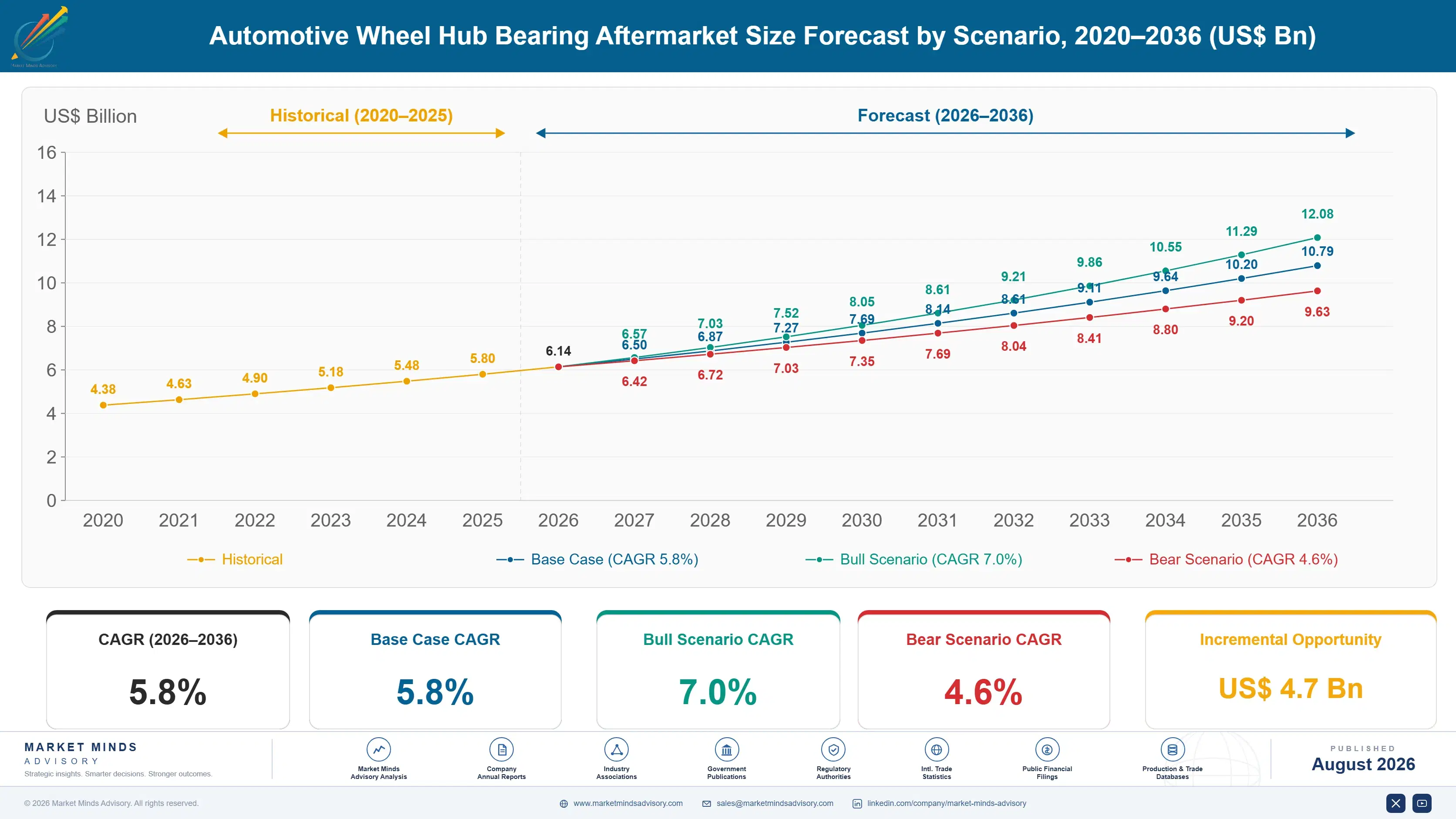
Automotive Wheel Hub Bearing Aftermarket Market Forecast Scenarios

automotive-wheel-hub-bearing-aftermarket-trends-size-forecast-scenario-1787464857032
Between 2020 and 2025, wheel hub bearing aftermarket volumes grew at an estimated 5.1% compound rate as vehicle parc aging continued steadily across major markets despite pandemic-related repair deferrals during 2020 and 2021 specifically. Sensor-integrated Generation 3 designs gained early aftermarket penetration through this period, while legacy ball bearing units still dominated total unit volume.
The base case assumes continued expansion as three mechanisms compound: global vehicle parc aging pushing more vehicles past the typical eight to ten year bearing replacement threshold, electric vehicle adoption requiring higher-load specialized bearing units suited to instant torque delivery, and advanced driver assistance systems demanding precisely calibrated Generation 4 replacement units rather than generic substitutes. Suppliers are expanding sensor-integrated production capacity to meet anticipated demand across multiple vehicle generations and repair channels simultaneously.
The bull case turns on vehicle parc aging accelerating faster than expected as post-2015 vehicle sales booms cross the replacement threshold sooner, pulling volumes sharply higher across mainstream repair channels nationwide. The bear case centers on extended original equipment bearing durability improvements delaying replacement cycles, which would constrain aftermarket volume growth across the entire industry overall.

Calibration Economics and the Sensor Transition

Automotive wheel hub bearing aftermarket sits at the intersection of two converging forces: enduring baseline replacement demand tied to routine vehicle wear across a mature global vehicle parc and an accelerating technology shift toward sensor-integrated Generation 3 and Generation 4 units required by advanced driver assistance and electronic parking brake systems. Suppliers that once treated wheel bearings as a simple mechanical commodity now invest heavily in sensor calibration technology and electronics integration, betting that original-specification precision will command durable premiums over generic substitutes.
MARKET CONCENTRATIONCR5 42%Leading five suppliers hold under half of total supply
AVERAGE SELLING PRICE$32 per unitSensor-integrated units command meaningfully higher unit pricing overall
TOP PRODUCING COUNTRY SHAREChina 30%China's aging vehicle parc anchors global replacement volume demand
CAPACITY UTILIZATION74%Remanufacturing facilities run near full rates amid rising demand
INPUT COST SHARE42%Steel and electronics inputs dominate total component production expense
REPLACEMENT CYCLE LENGTH8-10 yearsBearings typically require replacement every eight to ten years
Commercially, the market still behaves partly like a mature component category: legacy Generation 1 and Generation 2 units trade on delivered cost and reliability, with margins tied closely to steel input costs and manufacturing automation efficiency. Sensor-integrated Generation 3 and Generation 4 units command distinctly different economics, priced on calibration precision and electronic compatibility rather than raw material cost, giving suppliers who master these technologies a differentiated margin position across dealership and premium repair channels.
Looking ahead, the decade defining forces are technological and demographic: how quickly the global vehicle parc ages past its replacement threshold will determine baseline volume, while sensor integration complexity determines which suppliers capture the richest Generation 4 and electric vehicle replacement contracts.
"A wheel bearing used to be a part you replaced. Now it's a sensor package you calibrate, and the shops that treat it like the old part are the ones getting comebacks."
Director, Automotive Aftermarket Components Practice · MMA Automotive Aftermarket Components Practice · August 2026

Market Trends

Sensor-Integrated Generation 4 Units Displace Legacy Designs

Independent repair shops and dealerships across North America, Europe, and Asia are qualifying Generation 4 hub bearing units with integrated electronic parking brake and torque sensors to replace legacy Generation 2 designs, responding to rising vehicle content complexity and advanced driver assistance calibration requirements across the entire industry. Several leading bearing manufacturers have disclosed Generation 4 production line expansion during 2024 and 2025, targeting both original equipment and aftermarket replacement channels specifically. This shift is compressing the addressable market available to suppliers offering only legacy mechanical designs, pushing makers toward deeper investment in sensor calibration and electronics integration capability.
Market Impact: Vehicle parc aging adds roughly 6%
Electric Vehicle Fleet Growth Creates New Bearing Specifications

Electric vehicle makers require hub bearing units engineered for instant torque delivery and regenerative braking loads distinct from conventional internal combustion vehicle specifications, creating a growing aftermarket replacement category as the earliest mass-market electric vehicles begin crossing typical replacement thresholds across major markets. Several aftermarket suppliers have disclosed electric vehicle specific bearing unit launches during 2024 and 2025, targeting the growing installed base of electric vehicles now entering their first major service cycle. This shift is compressing development timelines for suppliers without electric vehicle specific engineering capability, rewarding makers who can deliver validated high-load bearing units.
Market Impact: ADAS-equipped vehicles need 30% precision units

Market Opportunities and Growth Drivers

Aging Vehicle Parc Sustains Baseline Replacement Demand

The global vehicle parc continues aging steadily as consumers hold onto vehicles longer amid elevated new vehicle prices, pushing an ever-larger share of the fleet past the typical eight to ten year wheel bearing replacement threshold across major markets worldwide. Every incremental year of fleet aging generates additional replacement demand independent of new vehicle sales trends, since wheel bearings wear from cumulative mileage and road condition exposure rather than vehicle age alone. This directly sustains addressable demand for aftermarket bearing units regardless of new vehicle production cycles, benefiting both legacy and sensor-integrated component suppliers across the industry.
Market Impact: Counterfeit units cause 12% of failures

Advanced Driver Assistance Systems Require Precision Replacements

Advanced driver assistance systems increasingly rely on wheel speed sensor data integrated directly into hub bearing units, making replacement precision a safety-relevant requirement rather than a simple mechanical fit consideration across vehicles equipped with these systems today. Every incremental vehicle sold with lane keeping, stability control, or automated emergency braking now requires a precisely calibrated Generation 3 or Generation 4 replacement unit rather than a generic substitute lacking proper sensor calibration. This expands addressable demand for original-specification aftermarket bearing units well beyond what basic mechanical replacement demand alone would suggest.
Market Impact: Extended warranties delay replacement 18 months

Market Restraints and Challenges

Counterfeit Bearings Undermine Quality And Brand Trust

Counterfeit and substandard wheel hub bearing units continue circulating through informal distribution channels in several developing markets, a problem rooted in the difficulty of visually distinguishing genuine precision-manufactured bearings from inferior copies without laboratory-grade metallurgical testing equipment that most repair shops lack. This quality gap creates real safety risk and undermines consumer trust in the broader aftermarket parts channel, since a single high-profile failure can damage confidence in legitimate suppliers as well as counterfeit ones. Industry associations are investing in authentication technology and distributor certification programs to narrow this trust gap over time considerably.
Market Impact: Gen 4 unit demand grows 25%

Extended Original Equipment Warranties Delay Replacement Cycles

Original equipment automakers are extending factory bearing warranties and improving base durability specifications, a trend rooted in competitive pressure to reduce warranty claim costs and differentiate on long-term reliability marketing claims across the entire industry today. This extension delays the point at which vehicles enter the aftermarket replacement cycle, compressing near-term volume growth for aftermarket suppliers who had previously modeled replacement timing against older, shorter-lived bearing designs. Suppliers are responding by emphasizing sensor-integrated and electric vehicle specific replacement categories where extended warranties matter less, since demand there is only just emerging.
Market Impact: EV bearing demand grows roughly 20%
3 additional market trends, 4 additional growth drivers, and 2 additional restraints and challenges are covered in the full report. Contact sales@marketmindsadvisory.com to access the complete intelligence.

Segment CAGR and Growth Architecture

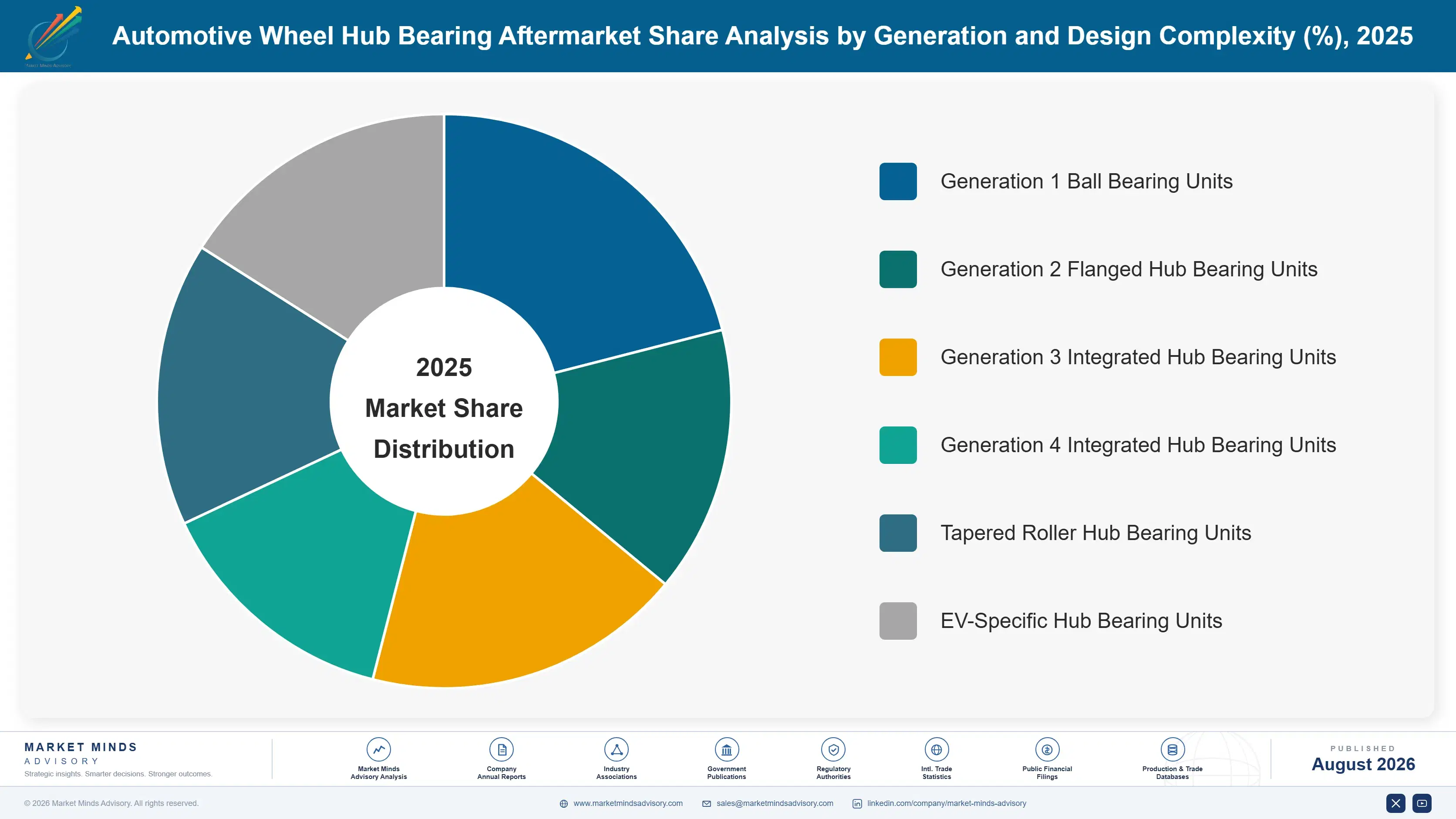
Automotive Wheel Hub Bearing Aftermarket segments by generation and design complexity rather than vehicle category, since the specific bearing generation determines replacement cost, sensor calibration requirements, and installation complexity across independent and dealership repair channels sold worldwide today. Six categories span legacy ball bearing designs through emerging electric vehicle specific units across the entire industry.
automotive-wheel-hub-bearing-aftermarket-trends-market-share-analysis-1787464857620

EV-Specific Hub Bearing Units

EV-specific hub bearing units are engineered for the higher instantaneous torque loads and regenerative braking forces characteristic of electric powertrains, a design distinct from conventional internal combustion vehicle bearings tuned for gradual torque delivery across the industry today and quite well beyond still indeed consistently. This is the fastest-growing category, expanding at an estimated 11.5 percent annually as the earliest mass-market electric vehicles begin crossing typical replacement thresholds and require specialized aftermarket replacement units rather than generic substitutes across every price tier. Suppliers with proprietary electric vehicle bearing engineering and validated high-load durability testing are capturing outsized share of this category's growth, while legacy bearing makers without electric vehicle specific capability struggle to compete for these emerging replacement contracts nationwide.
CAGR 11.5%

Generation 4 Integrated Hub Bearing Units

Generation 4 integrated hub bearing units combine the wheel bearing, ABS sensor, and electronic parking brake actuator into a single calibrated assembly, addressing rising vehicle content complexity and advanced driver assistance system requirements across newer vehicle platforms sold worldwide today and quite well beyond still indeed consistently across the industry. This is the second-fastest category, expanding at an estimated 10.0 percent annually as vehicles equipped with electronic parking brakes and advanced driver assistance systems begin entering their first major replacement cycle across major markets. Suppliers with proprietary sensor calibration and electronics integration capability are winning these replacement contracts fastest, since repair shops increasingly require original-specification precision rather than generic mechanical substitutes lacking proper calibration nationwide and well beyond.
CAGR 10.0%
Full segment breakdown across 6 segments available in the complete report.

Regional Architecture and Country Demand Map

Automotive wheel hub bearing aftermarket demand spans all major regions, with East Asia leading given China's expansive and rapidly aging vehicle parc, North America sustaining strong replacement demand through its large mature fleet, and South Asia and Pacific expanding fastest as regional vehicle parc scales upward worldwide today.

North America

US repair shops and dealerships process substantial replacement volume given the country's large, mature vehicle parc averaging over twelve years of age, sustaining steady baseline demand across the region's extensive do-it-for-me repair channel network nationwide and well beyond it entirely and quite consistently indeed still today. The region's replacement demand also includes substantial Generation 4 unit adoption tied to newer vehicle platforms equipped with electronic parking brakes and advanced driver assistance systems entering their first service cycle nationwide and well beyond. Canada's repair channels follow similar patterns on a smaller scale given shared vehicle platform commonality with the United States. Demand concentrates in trucks, SUVs, and sedans crossing the typical replacement threshold nationwide.
Share: 26% | CAGR: 6.5% (2026 to 2036)

Western Europe

Germany anchors European wheel hub bearing aftermarket demand given its large vehicle parc and well-established independent repair channel infrastructure, both increasingly transitioning toward Generation 3 and Generation 4 unit replacement as sensor-equipped vehicles age into their first service cycle nationwide and well beyond entirely. France and the United Kingdom follow closely, where independent repair chains have expanded original-specification sensor-integrated replacement adoption faster than the broader category overall this cycle across most markets nationwide and beyond. The European Union's vehicle inspection regime sustains steady baseline replacement demand across most vehicle age brackets. Growth trails East Asia given the region's comparatively mature, slower-expanding vehicle parc relative to rapidly scaling Chinese registration volume.
Share: 20% | CAGR: 4.3% (2026 to 2036)
Regional intelligence for 5 additional markets available in the complete report: East Asia, South Asia and Pacific, Latin America, Middle East and Africa, Eastern Europe. Contact sales@marketmindsadvisory.com.
automotive-wheel-hub-bearing-aftermarket-trends-country-cagr-analysis-1787464858170

Where Bearing Aftermarket Margins Concentrate

Margin expansion in wheel hub bearing aftermarket flows through four distinct commercial levers: sensor-integrated unit premiums over legacy mechanical designs, original-specification calibration attachment, electric vehicle specific bearing engineering, and distributor certification programs that command durable trust premiums over uncertified competitors across every major consuming market across the entire wider world today still quite consistently.

Sensor-Integrated Units Command Premium Over Legacy

Generation 3 and Generation 4 sensor-integrated bearing units command a price premium of roughly 1.6 to 2.1 times legacy Generation 1 and Generation 2 designs, reflecting both specialized calibration technology cost and the safety-critical precision premium repair shops pay for to avoid advanced driver assistance system malfunction claims. Suppliers who develop differentiated sensor calibration technology capture pricing power that legacy bearing makers competing purely on steel cost cannot access. This premium has proven durable because calibration expertise is difficult to replicate quickly, giving early movers a multi-year head start over competitors still building comparable technical capability from scratch.
Market Impact: Sensor units price 1.6 to 2.1 times legacy

Distributor Certification Builds Trust And Pricing Power

Bearing manufacturers offering rigorous distributor certification and authentication technology capture additional value from repair shops seeking verified genuine parts amid persistent counterfeit circulation, a certification distinct from simple brand labeling made without any independent verification whatsoever across the distribution channel. This certification capability requires sustained investment in authentication technology and distributor auditing infrastructure that smaller regional remanufacturers typically cannot commit to building independently. Suppliers with established certification programs are capturing an additional premium of roughly 18 percent beyond uncertified competitors, often embedding themselves more deeply into a distributor's quality assurance process.
Market Impact: Certified suppliers command roughly an 18 percent premium

Electric Vehicle Bearing Engineering Opens New Volume

Bearing manufacturers investing in electric vehicle specific engineering capability now are positioning to capture the fastest-growing replacement category as the earliest mass-market electric vehicles begin crossing typical replacement thresholds, with disclosed electric vehicle bearing development programs often spanning 2 to 4 years before commercial launch. Suppliers who establish this capability early secure preferential positioning with electric vehicle specialist repair chains before competitors complete comparable engineering validation. This lever favors suppliers with dedicated high-load bearing engineering teams and requires sustained investment that smaller regional remanufacturers often cannot commit at comparable scale.
Market Impact: EV bearing programs often span 2 to 4 years

Original Equipment Relationships Extend Aftermarket Reach

Bearing manufacturers with existing original equipment supply relationships capture meaningfully more aftermarket replacement volume than pure aftermarket specialists, since repair shops and vehicle owners increasingly seek original-specification parts from the same manufacturer that supplied the vehicle when new, a trust dynamic worth roughly 25 percent additional replacement share. This original equipment relationship requires sustained investment in automaker qualification programs that smaller regional remanufacturers typically cannot access independently. Suppliers with established dual-channel positioning are capturing additional premium pricing beyond pure aftermarket competitors, often embedding themselves more deeply into a vehicle brand's authorized parts network.
Market Impact: OE relationships add roughly 25 percent replacement share

Who Controls the Margin Pool

Automotive Wheel Hub Bearing Aftermarket concentration sits at a CR5 of 42 percent, evaluated on global unit shipment volume, with SKF and Schaeffler Group holding the largest positions built on diversified original equipment and aftermarket portfolios spanning multiple vehicle platforms. The gap between these established leaders and numerous smaller regional remanufacturers remains wide on sensor calibration and electronics integration capability, though narrower on delivered cost position for legacy Generation 1 and Generation 2 categories.
Current competitive activity concentrates in three areas: sensor calibration technology investment to meet rising Generation 3 and Generation 4 replacement demand, electric vehicle specific bearing engineering to capture the emerging high-load replacement category, and distributor certification program expansion to combat persistent counterfeit circulation across independent parts channels.

Rankings are most likely to shift as sensor-integrated units become standard replacement practice across mainstream vehicle segments, a dynamic that could let manufacturers with the strongest calibration technology pull meaningfully ahead of conventional mechanical bearing specialists. Smaller remanufacturers without dedicated sensor capability face the greatest pressure, and several are pursuing licensing or supply partnership arrangements with larger manufacturers rather than building calibration technology internally, a defensive posture that could reshape the competitive leaderboard within the next five years.
automotive-wheel-hub-bearing-aftermarket-trends-company-positioning-matrix-1787464858706

Competitive Moat and Risk Dimensions

SKF

Moat: Broad Bearing Technology Portfolio

SKF operates the industry's broadest bearing technology portfolio spanning legacy mechanical designs, sensor-integrated Generation 3 and Generation 4 units, and electric vehicle specific engineering, supported by dedicated automaker and distributor account teams serving customers globally. This breadth lets SKF offer integrated replacement solutions across every vehicle generation that narrower regional remanufacturers cannot match at comparable technical depth.
SKF

Risk: Diluted Segment Priority

SKF's broad bearing portfolio means wheel hub units represent one of several strategic priorities relative to competitors more narrowly focused on aftermarket replacement specifically, potentially slowing dedicated investment pace in any single vehicle segment. Intensifying competition from aftermarket specialists could erode SKF's share in price-sensitive legacy replacement categories if its broader investment pace fails to keep up.
SCHAEFFLER GROUP

Moat: Original Equipment Quality Credibility

Schaeffler Group's decades of original equipment supply relationships and deep automaker qualification give it distinctive credibility with repair shops seeking proven, original-specification bearing technology. This established reputation and specialized sensor calibration technology give the company a durable position in the premium replacement segment specifically across multiple regions.
SCHAEFFLER GROUP

Risk: Weaker Commodity Price Position

Schaeffler Group's specialized focus on original equipment quality standards leaves it comparatively less price-competitive in commodity legacy replacement categories relative to lower-cost regional remanufacturers, potentially limiting its exposure to price-sensitive repair channels. Sustained counterfeit competition in developing markets could pressure its aftermarket positioning over time.

Players Tracked

Prominent Players

SKF
Schaeffler Group
NSK Ltd.
NTN Corporation
The Timken Company

Other Key Players

JTEKT Corporation
ILJIN Bearing Co., Ltd.
GMB Corporation
C.T.R. Co., Ltd.
Federal-Mogul Motorparts (Moog)
Dana Incorporated
Wanxiang Group
NACHI-FUJIKOSHI Corp.
Delphi Technologies
Centric Parts
Beck/Arnley
WJB Corporation
Raybestos (First Brands Group)
Meyle AG
FEBI Bilstein

Recent Developments

FEBRUARY 2025

SKF Expands Sensor-Integrated Bearing Production Capacity

SKF announced an expansion of its sensor-integrated Generation 4 bearing production capacity to increase calibrated unit output, responding to sustained demand from repair shops seeking original-specification replacement units for vehicles equipped with electronic parking brakes. The expansion adds meaningful annual production volume at an existing European facility.
Signal: Signals established bearing manufacturers are prioritizing sensor calibration capacity ahead of accelerating aftermarket replacement demand growth.
SEPTEMBER 2024

Schaeffler Group Launches Electric Vehicle Specific Bearing Unit

Schaeffler Group launched a new electric vehicle specific hub bearing unit engineered for higher torque loads and regenerative braking forces, targeting the growing installed base of electric vehicles entering their first major service cycle. The launch includes documented durability testing data benchmarked against conventional internal combustion vehicle bearings.
Signal: Signals established manufacturers are prioritizing electric vehicle bearing development as a distinct competitive battleground across the industry.
APRIL 2025

NTN Corporation Opens Distributor Certification Program

NTN Corporation opened a new distributor certification and authentication program to combat counterfeit bearing circulation across independent parts channels, reducing quality risk for regional repair shops significantly across multiple markets and distribution regions worldwide. The program includes dedicated testing infrastructure supporting genuine parts verification requirements.
Signal: Signals manufacturers are investing in authentication capability to protect brand trust against counterfeit competition across the industry.

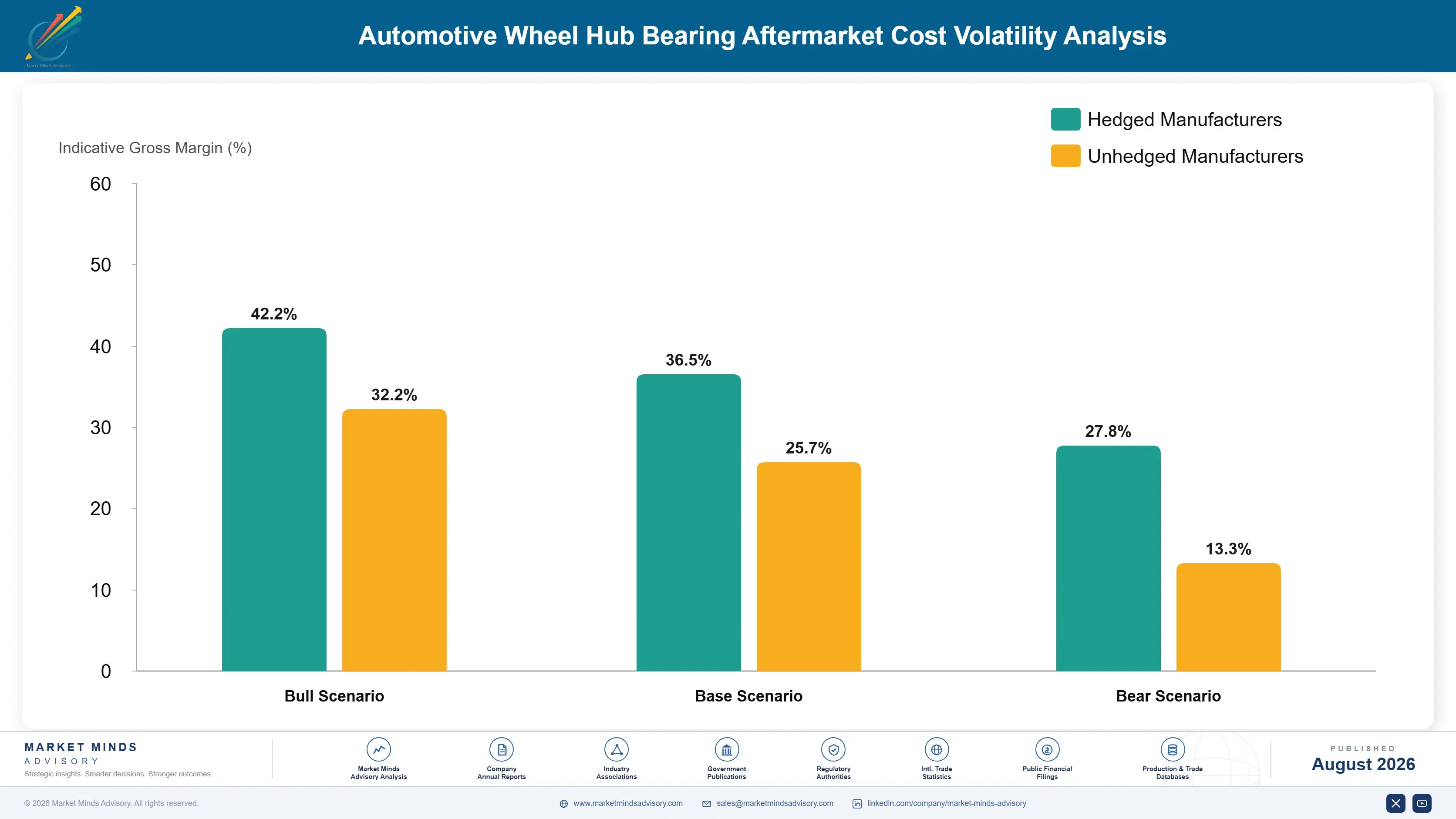
Steel And Electronics Input Cost Exposure

Steel and chrome alloy inputs account for an estimated 40 to 45 percent of cost of goods sold for standard legacy bearing units, while sensor components and control electronics represent a growing input category for premium Generation 3 and Generation 4 grades sold worldwide today. Steel feedstock originates mainly from China, Japan, and South Korea milling operations.
Steel prices spiked more than 18 percent during 2024 following trade tariff adjustments and supply disruptions affecting major East Asian mills, according to World Trade Organization data cited by industry associations, pushing bearing production costs up substantially and squeezing margins for manufacturers who could not pass costs through mid-contract. Several suppliers disclosed steel-linked cost inflation as a pressure on segment margins in recent annual reporting periods, prompting wider adoption of indexed pricing clauses.

Manufacturers without diversified steel sourcing relationships face a persistent cost disadvantage during price spikes, since bearing production cannot easily substitute alternative materials on short notice without triggering separate qualification and validation requirements from automaker and distributor customers. Exposure concentrates most heavily among smaller regional remanufacturers who lack the balance sheet to hold buffer inventory that larger diversified competitors maintain across multiple sourcing geographies and material technology platforms simultaneously.
automotive-wheel-hub-bearing-aftermarket-trends-cost-volatility-analysis-1787464858904

Diversify Steel Sourcing Across Supplier Geographies

Bearing manufacturers are qualifying additional steel sourcing regions across multiple milling geographies including Japan, South Korea, and domestic recycling streams, reducing single-region dependence across the bearing feedstock supply base considerably and consistently. This diversification adds logistics complexity but meaningfully lowers the probability that a single regional supply disruption disrupts total production volume across a manufacturer's portfolio.

Expand Domestic Recycled Steel Reclamation Capacity

Capital allocation is shifting toward recycled steel reclamation from returned core bearings precisely because reclaimed feedstock trades on more stable, controllable supply cycles with far more availability than virgin steel tied to mill production cycles. Manufacturers pursuing this path reduce long-run exposure to steel price volatility, even though reclamation systems still carry higher processing cost than mature milling.

Negotiate Indexed Cost Pass-Through Clauses In Contracts

Bearing manufacturers are increasingly building indexed cost pass-through mechanisms into multi-year distributor and automaker supply agreements, tying pricing to published steel cost benchmarks rather than fixed unit prices negotiated years in advance. This protects margins during volatility events but requires distributor buyers accustomed to fixed pricing to accept periodic adjustment clauses, a negotiation favoring suppliers with strong bargaining position.

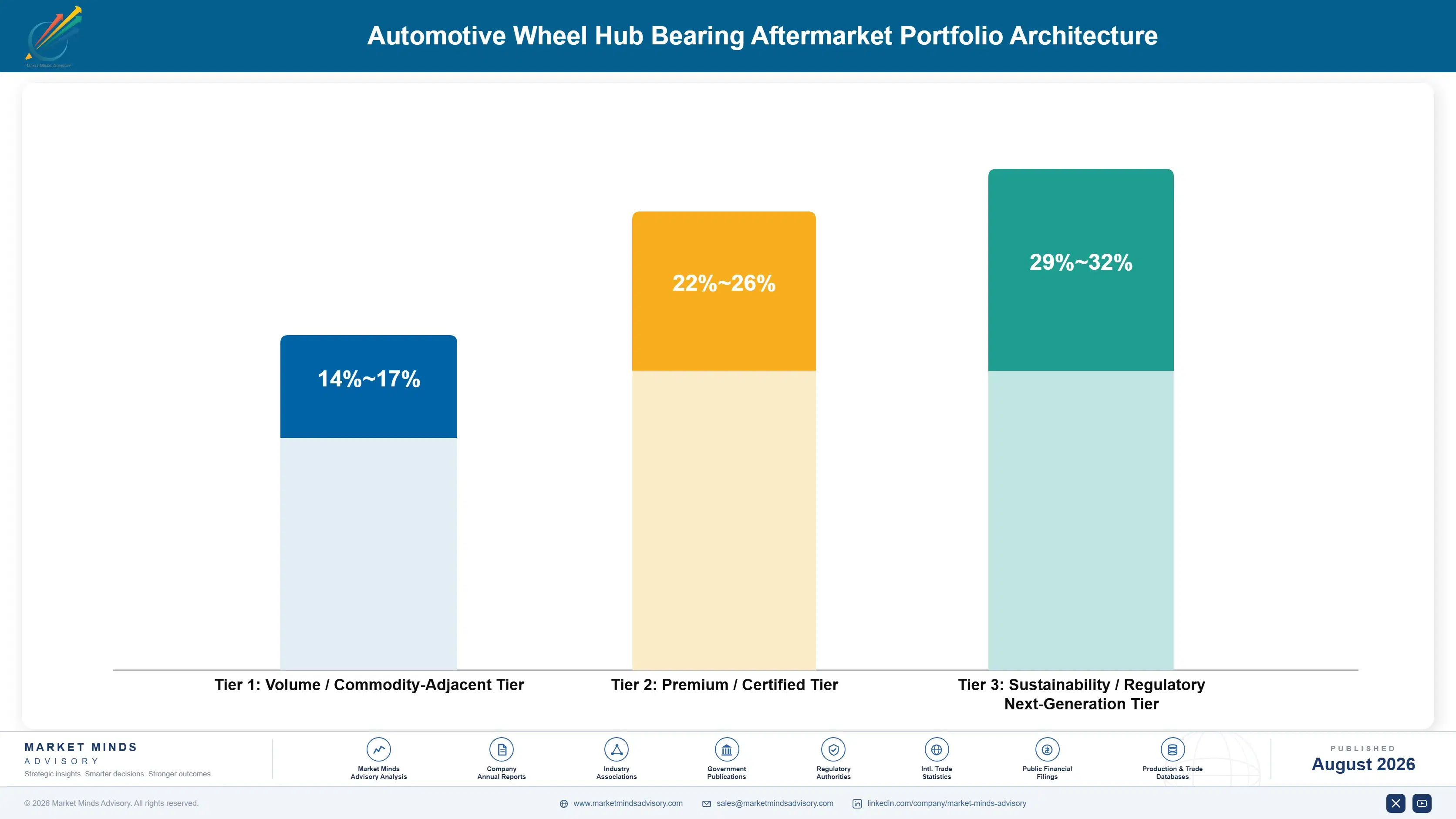
Portfolio Architecture for Margin Defence

Automotive Wheel Hub Bearing Aftermarket splits into three commercial tiers with different margin economics: a volume tier built on legacy Generation 1 and Generation 2 units sold into mainstream replacement channels, a premium tier built on Generation 3 sensor-integrated units commanding differentiated positioning, and a next-generation tier built on Generation 4 and electric vehicle specific units still scaling toward full commercial economics. Gross margins range from roughly 14 percent to over 32 percent for differentiated systems sold under certified distribution agreements.
Volume-tier producers compete primarily on price and reliable delivery into commodity legacy bearing formulations, where sensor calibration matters less than consistent supply at lowest deliverable cost. Premium-tier producers instead compete on calibration sophistication and electronics integration capability for repair shops unwilling to compromise on safety-critical positioning, accepting materially higher research costs in exchange for pricing power volume-tier competitors cannot access.

High-value margin pools concentrate in Generation 4 and electric vehicle specific contracts sold under certified distribution agreements to premium repair chains and dealerships, where buyers pay for both calibration precision and technical partnership simultaneously. Standard legacy bearing units remain the volume backbone of the market, but its margin ceiling is capped by an increasingly competitive set of regional remanufacturers.

Volume / Commodity-Adjacent Tier

Legacy Generation 1 and Generation 2 mechanical bearing units sold into mainstream replacement channels at competitive pricing, prioritizing reliable volume delivery over technology sophistication, serving mid-tier repair chains and price-sensitive vehicle segments across mature aftermarket categories.
Gross Margin: 14-17%

Premium / Certified Tier

Generation 3 sensor-integrated bearing units with documented calibration precision and ABS compatibility sold to premium repair chains and dealerships requiring verified original-specification standards, commanding higher unit prices than legacy equivalents under multi-year distribution contracts.
Gross Margin: 22-26%

Sustainability / Regulatory / Next-Generation Tier

Generation 4 integrated units and electric vehicle specific bearings marketed on calibration precision and high-load durability, targeting premium repair chains and electric vehicle specialists pursuing product differentiation, commanding the highest margins as sensor technology continues improving cost competitiveness.
Gross Margin: 29-32%
automotive-wheel-hub-bearing-aftermarket-trends-portfolio-architecture-1787464859427

High-value Sub-segments and Strategic Watch-out

EV-Specific And Generation 4 Bearing Units

Electric vehicle specific bearing units and Generation 4 integrated assemblies are both the highest-margin and fastest-growing segment as the earliest mass-market electric vehicles begin crossing typical replacement thresholds, attracting the bulk of all new global research investment from leading bearing manufacturers worldwide during this current strong cycle.
Gross Margin: 29-32%

Generation 3 Sensor-Integrated Units

Generation 3 sensor-integrated units for conventional advanced driver assistance applications continue generating strong margins even as growth moderates relative to Generation 4 co-development, supported by established repair channel relationships that newer entrants still need many long years to replicate credibly with major distributors globally today.
Gross Margin: 22-26%

Legacy Generation 1 And 2 Core Volume

Legacy Generation 1 and Generation 2 mechanical units sold at competitive volume pricing into mainstream replacement channels remain the market's core revenue base even as margins compress under rising competition from lower-cost regional remanufacturers entering the segment at a very meaningful scale across many quite different geographies worldwide.
Gross Margin: 14-17%

Steel Feedstock Supply Risk

Steel feedstock supply tied to milling output and trade tariff cycles in major producing countries represents the segment producers and investors should watch most closely, since a sustained multi-year steel price spike could strand bearing production capacity and force very costly reformulation across the entire global industry at once today.
Gross Margin: 9-12%

Why Replacement Demand Recurs Predictably

Once a vehicle crosses its typical mileage and age threshold, wheel hub bearing replacement becomes a recurring maintenance event tied to cumulative wear rather than a discretionary purchase decision, giving the aftermarket a durable annuity-like demand base that persists regardless of new vehicle sales cycles. This wear-driven pattern gives suppliers reliable, repeat revenue across the installed vehicle parc, rewarding distribution reach and channel relationships over aggressive price competition alone.
Adoption of sensor-integrated Generation 3 and Generation 4 units runs deepest in newer vehicles equipped with advanced driver assistance and electronic parking brake systems, where calibration precision is a defining safety requirement that repair shops cannot substitute with generic units without risking system malfunction, and shallowest in older vehicles retaining legacy mechanical designs. Mid-life vehicle segments sit between these extremes, adopting sensor-integrated replacement selectively as original equipment sensor content phases in across model years.

A younger cohort of repair shop technicians, now trained on sensor-equipped vehicle platforms, treats original-specification calibrated replacement as a baseline requirement rather than a cost consideration their predecessors debated case by case. This generational shift is compressing the qualification timeline for new sensor-integrated bearing formulations at repair chains that previously relied on generic mechanical substitutes.
automotive-wheel-hub-bearing-aftermarket-trends-end-use-penetration-index-1787464859937

Where To Place Bearing Aftermarket Bets

These are among the four positions where our research anticipates prominent divergence between winners and laggards over the coming forecast period. Each is grounded in the demand model, the regulatory perimeter, and the announced capacity pipeline.
01 / SENSOR CALIBRATION TECHNOLOGY INVESTMENT

Back Sensor Calibration Technology Before Rivals Do

Sensor-integrated Generation 3 and Generation 4 units are growing faster than legacy designs as advanced driver assistance systems demand calibration precision that generic mechanical substitutes increasingly cannot deliver safely. Manufacturers that invest in sensor calibration technology now will lock in preferential access to premium repair chain and dealership contracts before conventional competitors complete their own capability build-out. Waiting for the replacement wave to fully arrive before investing risks ceding the most defensible long-term position to competitors who moved earlier and already control the strongest calibration technology portfolios.
02 / ELECTRIC VEHICLE BEARING ENGINEERING

Invest In Electric Vehicle Bearing Engineering Now

Electric vehicle specific bearing engineering offers manufacturers a durable, multi-year growth position as the earliest mass-market electric vehicles begin crossing their first replacement cycle, a category legacy internal combustion bearing specialists are not naturally positioned to serve well. Manufacturers that invest in dedicated high-load engineering capability now capture preferential access to this emerging category before competitors recognize the shift and respond with their own dedicated investment programs. This capability requires sustained engineering investment but offers durable, multi-year returns once firmly established.
03 / STEEL SUPPLY DIVERSIFICATION

Diversify Steel Sourcing Before Next Disruption

Steel feedstock supply remains tied to milling and trade tariff cycles that have already produced sharp cost spikes in recent years, and further disruption at major East Asian mills remains a credible risk given concentrated global production geography. Manufacturers that diversify steel sourcing across Japan, South Korea, and domestic recycling streams now protect margin during the next inevitable disruption rather than scrambling for alternative supply after prices have already moved sharply higher. This diversification is a comparatively low-cost hedge relative to the downside it protects against.
04 / DISTRIBUTOR CERTIFICATION CAPABILITY

Build Distributor Certification Infrastructure Now

Distributor certification and authentication technology have become a genuine competitive differentiator for manufacturers serving repair shops who increasingly demand verified genuine parts amid persistent counterfeit circulation across independent distribution channels worldwide today. Manufacturers that build rigorous certification infrastructure now capture preferential access to premium contracts that uncertified competitors increasingly cannot fulfill under tightening distributor quality requirements and expectations. Early movers in this specific capability will likely retain preferred-supplier status well beyond the current certification wave and into the next one.

Engagement Snapshot From the Field

A live engagement with an industry participant carrying material or product regulatory and market exposure ahead of a defining policy shift, showing how our research translates into a defensible multi-year portfolio strategy.
MARKET MINDS ADVISORY · CLIENT ENGAGEMENT SUMMARY
Automotive Wheel Hub Bearing Aftermarket Producer Strategic Portfolio Review and Transition Roadmap 2026·Investment Scenario on Automotive Wheel Hub Bearing Aftermarket Exposure Evaluation 2025-26
CLIENT PROFILE
The client is a multinational auto parts distributor generating approximately 4.8 billion dollars (client-reported, unverified by MMA) in annual replacement parts revenue across North America and Western Europe. The company had committed publicly to expanding sensor-integrated bearing unit coverage across its private label catalog within a fifteen-month product transition timeline tied to quality positioning commitments.
STRATEGIC CHALLENGE
The clients existing private label bearing catalog relied heavily on legacy mechanical designs lacking calibration precision, risking competitive disadvantage against rivals already marketing original-specification sensor-integrated replacement units across the industry. Management needed an independent assessment of bearing manufacturers to determine which could realistically deliver comparable calibration accuracy within the required timeline.
MMA APPROACH
MMA conducted primary interviews with sourcing and quality leadership across five bearing manufacturers, benchmarking sensor calibration technology readiness, distributor certification capability, and prior large-scale private label supply experience against the client's transition timeline. The analysis included calibration accuracy and durability testing review and stress-tested each candidate's production scale-up timeline against the client's catalog rollout schedule.
KEY FINDINGS
  1. Two of five evaluated manufacturers had prior commercial experience supplying sensor-integrated units to comparably sized private label distributors within a nine-month transition window.
  2. Calibration accuracy testing showed one candidate's replacement units matching original equipment sensor tolerance within 97 percent across standard advanced driver assistance benchmarks.
  3. Production transition timelines across candidates ranged from seven to fourteen months, with the fastest candidate requiring meaningfully less lead time before full supply readiness.
  4. Pricing structures varied significantly across candidates, with delivered unit cost ranging from 1.2 to 1.6 times the client's existing legacy bearing cost depending on calibration scope.
CLIENT PROFILE
The client is a multinational auto parts distributor generating approximately 4.8 billion dollars (client-reported, unverified by MMA) in annual replacement parts revenue across North America and Western Europe. The company had committed publicly to expanding sensor-integrated bearing unit coverage across its private label catalog within a fifteen-month product transition timeline tied to quality positioning commitments.
STRATEGIC CHALLENGE
The clients existing private label bearing catalog relied heavily on legacy mechanical designs lacking calibration precision, risking competitive disadvantage against rivals already marketing original-specification sensor-integrated replacement units across the industry. Management needed an independent assessment of bearing manufacturers to determine which could realistically deliver comparable calibration accuracy within the required timeline.
MMA APPROACH
MMA conducted primary interviews with sourcing and quality leadership across five bearing manufacturers, benchmarking sensor calibration technology readiness, distributor certification capability, and prior large-scale private label supply experience against the client's transition timeline. The analysis included calibration accuracy and durability testing review and stress-tested each candidate's production scale-up timeline against the client's catalog rollout schedule.
KEY FINDINGS
  1. Two of five evaluated manufacturers had prior commercial experience supplying sensor-integrated units to comparably sized private label distributors within a nine-month transition window.
  2. Calibration accuracy testing showed one candidate's replacement units matching original equipment sensor tolerance within 97 percent across standard advanced driver assistance benchmarks.
  3. Production transition timelines across candidates ranged from seven to fourteen months, with the fastest candidate requiring meaningfully less lead time before full supply readiness.
  4. Pricing structures varied significantly across candidates, with delivered unit cost ranging from 1.2 to 1.6 times the client's existing legacy bearing cost depending on calibration scope.
RECOMMENDED STRATEGY
Phase 1: Phase 1 (0 to 3 months): Complete calibration accuracy and durability testing across shortlisted manufacturers and select a partner based on fit. Phase 2: Phase 2 (3 to 11 months): Transition catalog supply across all sensor-integrated bearing categories, running validation testing across multiple configurations and vehicle platforms throughout. Phase 3: Phase 3 (11 to 15 months): Complete full catalog rollout with documented original-specification calibration claims, finalizing long-term supply pricing and distribution terms.
OUTCOME
Within fourteen months, the client completed its sensor-integrated bearing transition across its private label catalog, achieving 96 percent (client-reported, unverified by MMA) calibration accuracy versus original equipment benchmarks. The rollout was completed ahead of schedule, with bearing units now sourced under a long-term certified supply agreement.

Frequently Asked Questions

Foundational context covering the market sizes, CAGR, scope, country, region and competition that inform every finding below. This section is provided to cover basics and most often pre-purchase conversations, answered from the MMA Primary Research Dataset.

What is the current size of the Automotive Wheel Hub Bearing Aftermarket?

The Automotive Wheel Hub Bearing Aftermarket was valued at approximately 5.8 billion dollars in 2025. Growth is driven by aging vehicle parc and sensor-integrated replacement adoption in advanced driver assistance equipped vehicles.

How large will the Automotive Wheel Hub Bearing Aftermarket be by 2036?

The market is projected to reach approximately 10.78 billion dollars by 2036, up from 6.14 billion dollars in 2026. That represents roughly a 1.76 times expansion over the ten-year forecast window.

What is the CAGR for the Automotive Wheel Hub Bearing Aftermarket 2026 to 2036?

The market is forecast to expand at a compound annual growth rate of 5.8 percent between 2026 and 2036. Bull and bear scenarios range from 7.0 percent to 4.6 percent depending on parc aging pace.

Which segment is growing fastest?

EV-specific hub bearing units are the fastest-growing segment, expanding at an estimated 11.5 percent annually, roughly 2.0 times the overall market rate. Generation 4 integrated units follow at 10.0 percent.

Who are the major companies in the Automotive Wheel Hub Bearing Aftermarket?

SKF, Schaeffler Group, NSK, NTN Corporation, and Timken lead the market by global shipment volume. Combined, the top five suppliers hold a CR5 of approximately 42 percent.

Which country is growing fastest?

China is the fastest-growing single country, expanding rapidly as vehicles from its 2010s sales boom cross typical replacement thresholds. India follows closely given similar vehicle parc aging dynamics.

Report Segmentation Architecture

The full report scope spans multiple orthogonal segmentation dimensions, with cross-tabulated demand data provided for each dimension pair. Coverage extends further to regional breakdowns, trend trajectories, and the competitive detail needed to support segment-level decision-making.

By Generation and Design Complexity

  • Generation 1 Ball Bearing Units
  • Generation 2 Flanged Hub Bearing Units
  • Generation 3 Integrated Hub Bearing Units
  • Generation 4 Integrated Hub Bearing Units
  • Tapered Roller Hub Bearing Units
  • EV-Specific Hub Bearing Units

By Vehicle Segment

  • Passenger Cars
  • Light Trucks and SUVs
  • Commercial Vehicles
  • Electric Vehicles

By Commercial Dimension

  • Independent Repair Channel Distribution
  • Dealership Service Channel
  • Do-It-Yourself Retail
  • Export Trade

By Region

  • North America
  • Western Europe
  • East Asia
  • South Asia and Pacific
  • Latin America
  • Middle East and Africa
  • Eastern Europe

Scope, Methodology, and Coverage

Every figure in this report is reproducible from documented input assumptions. The scope below maps the historical period, the forecast horizon, the segmentation dimensions, and the countries covered, alongside the underlying primary and qualitative methodology.
Historical Period
2020 to 2025
Forecast Period
2026 to 2036
Base Year
2025 (USD billions; MMA Primary Research Dataset, August 2026)
Market Definition
The Automotive Wheel Hub Bearing Aftermarket comprises replacement bearing units for wheel hub assemblies, spanning legacy ball bearing, flanged, sensor-integrated, and tapered roller designs sold through independent repair, dealership, and distribution channels. It excludes original equipment bearing supply and unrelated wheel or suspension components.
Quantitative Units
USD billions (current prices); unit shipment volume where disclosed
Segmentation Dimensions
Generation and Design Complexity; Vehicle Segment; Commercial Dimension; By Region
Regions Covered
North America, Western Europe, East Asia, South Asia and Pacific, Latin America, Middle East and Africa, Eastern Europe
Countries Covered
USA, China, Germany, France, UK, Japan, South Korea, India, Australia, Canada, Brazil, Mexico, Indonesia, Vietnam, Thailand, Malaysia, UAE, Saudi Arabia, South Africa, Nigeria, Turkey, Poland, Netherlands, Italy, Spain, Sweden, Switzerland, Argentina, Colombia, Singapore, and additional markets relevant to this sector
Key Companies Profiled
SKF, Schaeffler Group, NSK Ltd., NTN Corporation, The Timken Company, JTEKT Corporation, ILJIN Bearing Co., Ltd., GMB Corporation, C.T.R. Co., Ltd., Federal-Mogul Motorparts (Moog), Dana Incorporated, Wanxiang Group, NACHI-FUJIKOSHI Corp., Delphi Technologies, Centric Parts, Beck/Arnley, WJB Corporation, Raybestos (First Brands Group), Meyle AG, FEBI Bilstein
Quantitative Methodology
Primary survey, n=3,800 respondents, Q4 2025, six countries; demand-side model with trade association cross-validation
Qualitative Methodology
47 expert interviews, Q4 2025; applied to validate demand model assumptions, identify emerging dynamics, and assess competitive positioning
Report Format
PDF and XLSX data workbook (Word format preview document)
Publisher
Market Minds Advisory
Report Code
MMA-2026-AUT-305
Published
August 2026
Contact
sales@marketmindsadvisory.com | www.marketmindsadvisory.com

Purchase the full Automotive Wheel Hub Bearing Aftermarket Report (2026 to 2036).

The full Automotive Wheel Hub Bearing Aftermarket report delivers a complete generation segmentation model spanning Generation 1 through Generation 4 designs plus tapered roller and electric vehicle specific units. It includes detailed regional replacement demand data across all seven world regions. The report profiles twenty producers, including detailed capacity, technology positioning, and moat and risk assessment for the top five, supported by primary interviews with sourcing and quality leadership. It also includes ten-year forecast scenarios under base, bull, and bear cases, steel cost exposure analysis by region and player type, and a strategic verdict framework for sourcing and product development decisions.
Ten-Year Base, Bull, and Bear Forecasts
Generation Segmentation Across Six Bearing Categories
Full Seven-Region Replacement Demand Data Breakdown
Twenty-Company Competitive Profiles With Moat Analysis
Steel Cost Exposure and Mitigation Playbook
Primary Interview Data From Quality Leadership Teams

Built For The People Who Decide

From boardroom strategy to bench-side execution, this report is read cover-to-cover by leaders shaping the next decade of their industry, turning demand scenarios, market dynamics and valuation benchmarks into decisions.
CXOs/ Presidents/ VPs/ Managers
M&A and Corporate Development
Strategy Teams and R&D Heads
Procurement and Product Directors
Regulatory and Compliance Leaders
Investor Relations and Equity Analysts