Market Minds Advisory
Automotive Variable Oil Pump Market

Automotive Variable Oil Pump Market: Electric Decoupling, Continuous Control and the Parasitic Loss Argument

Fully electric pumps are decoupling lubrication from crankshaft speed as hybrids demand pressure with the engine stopped, while continuously variable vane control replaces the two-stage designs that satisfied regulators a decade ago.

Lead Analyst

David Horsley

Published

September 2026

Make Smarter Decisions with Customized Research Insights

Request a free sample report and evaluate market opportunities, growth trends, and competitive dynamics relevant to your business needs.

2025 MARKET VALUE$4.1BMarket Size 2025
2036 FORECAST VALUE$7.5BBase Case , 2026 to 2036
CAGR 2026 TO 20365.6 %Bull 6.8% / Bear 4.4%
INCREMENTAL OPPORTUNITY$3.1BNet 10- year value creation
EXPANSION MULTIPLE1.72x2036 value over 2026 base
Strategic Levers
M&A Pipeline
Regional Outlook
Country Rankings
Competitive Intelligence
Segmental Deep-dive
Call-Us : 91 93563 13602

Executive Snapshot and Market Trajectory

A mechanical oil pump is driven by the crankshaft, which means it delivers most pressure exactly when the engine needs it least, at high speed. Every engineering advance in this component for twenty years has been an attempt to break that relationship, and electric drive finally breaks it completely.
Fully electric oil pumps grow at 8.4%, a full 1.50 times the market rate, because a motor-driven pump maintains lubrication and hydraulic pressure with the engine completely stopped, which hybrid stop-start operation absolutely requires. East Asia holds 33% of global value, above the standard regional band, because China builds roughly 30 million vehicles annually and Japan hosts the deepest engine auxiliary engineering base found anywhere in the industry.
Concentration runs at 52% for the top five, which is unusually high for an engine auxiliary component, and it reflects just how much control electronics now sit inside the part. A variable pump is no longer simply a casting and a rotor. It carries solenoids, position sensors and a calibration map tied directly into engine management strategy, and suppliers lacking that capability now find themselves quoting on castings alone against competitors selling complete systems.
Market Definition
This report covers engine lubrication oil pumps with variable displacement or electronically controlled flow, spanning two-stage and continuously variable vane pumps, variable displacement pendulum slider pumps, variable flow internal gear pumps and fully electric motor-driven oil pumps across passenger vehicles, light and heavy commercial vehicles and hybrid powertrains. Fixed displacement pumps, transmission fluid pumps, coolant pumps, fuel pumps and complete engine assemblies are excluded from the sizing.
Base Year Value
$4.1B in 2025 (MMA Primary Research Dataset, August 2026)
Forecast Period
2026 to 2036, eleven discrete annual values
CAGR
5.6% base case. Bull 6.8%. Bear 4.4%.
Fastest Growth Segment
Fully Electric Oil Pump: 8.4% CAGR
Fastest Growth Country
India: 8.0% CAGR
Fastest Growth Region
South Asia and Pacific: 7.8% CAGR
Largest Region
East Asia: 33% of 2025 global value
Market Leaders
Aisin Corporation, Hitachi Astemo, Rheinmetall, SHW AG and Magna International lead on variable pump shipment volume. Source: MMA Analysis, July 2026.
Primary Survey
n=3,800 procurement and R&D decision-makers, Q4 2025, six countries
Methodology
Demand-side build-up, cross-validated against public data, 47 expert interviews

Automotive Variable Oil Pump Market Forecast Scenarios

automotive-variable-oil-pump-market-trends-size-forecast-scenario-1787315771105
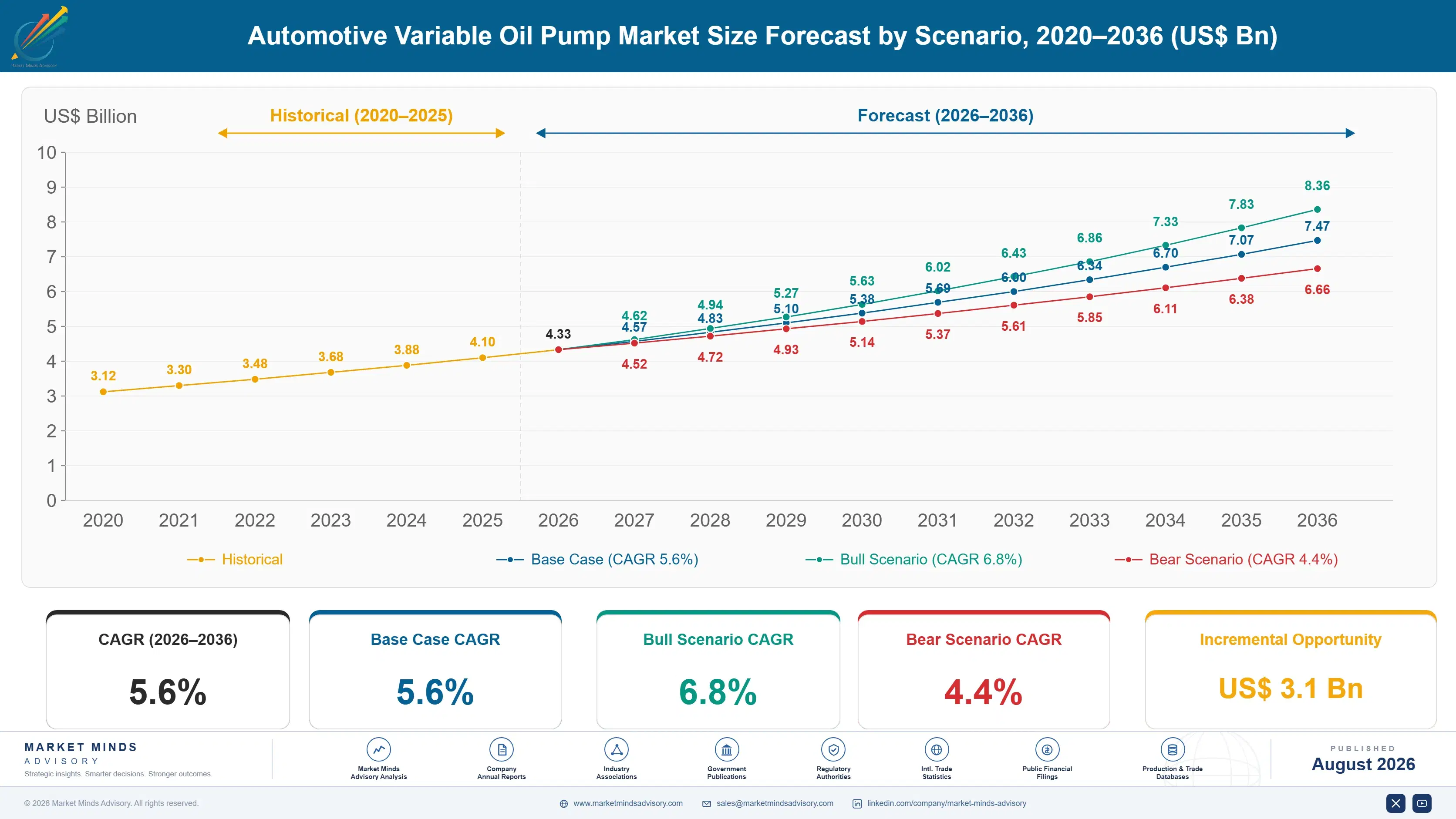
Between 2020 and 2025 the market compounded at 4.4%, and attach rate rather than engine volume explains almost all of it. Engine production fell hard through 2020 and has not recovered to earlier peaks in Europe or Japan. What lifted value instead was penetration: variable displacement moved from a premium feature to near-standard fitment across most new engine families, and average realised price rose with it.
The base case at 5.6% rests on three mechanisms. Electric pump adoption accelerates as hybrid share rises, and an electric unit carries motor and control electronics that realise several times mechanical pump pricing. Continuously variable vane designs continue displacing two-stage systems as emissions rules tighten past what stepped control can deliver. Emerging market fuel efficiency rules, particularly across India and Southeast Asia, pull variable adoption up from a low base.
The bull case at 6.8% turns on hybrid share rising faster than battery electric across the major markets, which would drive electric pump fitment well beyond current assumptions. The bear case at 4.4% is a sharper battery transition removing engines faster than hybrids replace them, combined with attach rates that are already high enough in Europe and North America to leave little penetration headroom.

What Drives Variable Oil Pump Value

The problem this component solves is elegantly simple to state. A crankshaft-driven pump scales its output with engine speed, but an engine needs the most oil pressure at low speed under load and the least at high speed cruising. A fixed pump therefore wastes energy across most of the operating map.
TOP FIVE CONCENTRATION52%Share held by the five largest oil pump suppliers
AVERAGE PUMP PRICE$38Typical realised price for a variable displacement unit
VARIABLE ATTACH RATE64%Share of new engines fitted with variable flow pumps
PARASITIC LOSS SAVING1.8%Fuel consumption benefit against a fixed displacement pump
ALUMINIUM COST SHARE34% of COGSDie cast housing content as portion of unit cost
PROGRAMME LENGTH9 yearsTypical production run before an engine family changes
Variable displacement fixes part of that. A vane pump with a movable control ring adjusts its swept volume against a pressure signal, delivering only what the engine needs, and the fuel saving against a fixed pump runs near 1.8% across a regulatory drive cycle. That is enough to matter when a manufacturer is counting grams of carbon dioxide, which is why attach rates climbed from niche to roughly 64% of new engines within a decade.
Electric drive goes further and changes the commercial character of the part. A motor-driven pump is decoupled from the crankshaft entirely, so it delivers pressure on demand regardless of engine speed and continues running when the engine stops, which hybrid operation requires rather than merely prefers. It also carries a motor, a controller and calibration work tied to engine management, and it sells for several times what a mechanical variable unit does.
"The suppliers who will still be here in 2040 are the ones treating this as a fluid control electronics business rather than a machining business. A die casting plant is not a defensible asset when the value has migrated into the solenoid and the calibration map."
Practice Director, Automotive Components, Market Minds Advisory · MMA Automotive

Market Trends

Electric Pumps Decouple Lubrication From Crankshaft Speed Entirely

Motor-driven oil pumps break the fixed relationship between engine speed and oil delivery that has governed lubrication design since the beginning. The immediate commercial driver is hybrid operation: an engine that shuts down at every traffic light still needs hydraulic pressure for restart and for transmission actuation, and a crankshaft-driven pump delivers nothing when the crankshaft is stationary. Electric units also permit pressure strategies tuned to oil temperature and load rather than to speed alone. They carry motor and control electronics content that realises roughly 3.4 times mechanical pump pricing.
Market Impact: Delivers 1.8% fuel benefit
Continuously Variable Control Displaces Two-Stage Vane Systems

Two-stage pumps switch between high and low pressure settings against a solenoid signal, which satisfied the first generation of efficiency requirements. Continuously variable designs modulate the control ring across the full operating range instead, capturing efficiency across intermediate conditions that stepped control simply cannot address. The gain is roughly 0.4 percentage points of additional fuel benefit, which sounds trivial until a manufacturer is short of its fleet target. Calibration complexity is the barrier, since continuous control demands integration with engine management that stepped systems avoid entirely, and few suppliers hold that capability.
Market Impact: Adds 3.4 times content per vehicle

Market Opportunities and Growth Drivers

Fleet Emissions Targets Make Parasitic Loss Reduction Mandatory

Fleet carbon dioxide limits across Europe, corporate average fuel economy rules in North America and tightening norms in China and India all require manufacturers to find efficiency wherever it exists. Auxiliary drive losses are among the cheapest places to look, and a variable oil pump delivers around 1.8% against a fixed unit for a modest cost increase. That arithmetic is why attach rates climbed to roughly 64% within a decade. The regulation is the demand mechanism rather than consumer preference, which makes the volume considerably more predictable than most automotive content.
Market Impact: Removes 18% of addressable engines

Hybrid Powertrain Growth Requires Pressure Without Engine Rotation

Hybrid share is now rising faster than battery electric across North America, Japan and increasingly Europe too, and every hybrid architecture shuts the engine down repeatedly during normal operation. That creates a requirement no crankshaft-driven pump can satisfy, because pressure has to remain available for restart, for transmission actuation and for bearing protection while the engine is stationary. Manufacturers are therefore specifying electric pumps as a functional necessity rather than an efficiency option, and content per vehicle rises accordingly on precisely the platforms that are growing fastest across every major market.
Market Impact: Leaves 20% headroom remaining

Market Restraints and Challenges

Battery Electric Platforms Remove Engine Lubrication Entirely

A battery electric vehicle has no engine and therefore no engine oil pump, which removes the addressable unit rather than substituting something cheaper. The root cause is powertrain architecture, and no supplier response changes it. Commercially the effect concentrates in Western Europe and China, the markets with the highest attach rates and best realised pricing. Participants are responding by moving into electric vehicle thermal and transmission fluid pumps where the motor and control capability transfers directly, and by holding hybrid pump positions that extend engine fitment considerably further out than pure battery forecasts assumed.
Market Impact: Realises 3.4 times mechanical prici

High Attach Rates Leave Limited Penetration Headroom Remaining

Variable displacement already reaches roughly 64% of new engines globally, and above 80% across Western Europe and North America. The root cause of the slowdown is simply arithmetic: growth that came from converting fixed pumps to variable ones is largely finished in the markets that pay best. Commercially this shifts the growth burden onto mix and onto emerging markets with far lower realised pricing. Participants are responding by pushing electric and continuously variable architectures that carry higher content, and by targeting Indian and Southeast Asian programmes where penetration remains genuinely low.
Market Impact: Adds 0.4 points fuel benefit
3 additional market trends, 4 additional growth drivers, and 2 additional restraints and challenges are covered in the full report. Contact sales@marketmindsadvisory.com to access the complete intelligence.

Segment CAGR and Growth Architecture

Segmentation follows pump control architecture, because how flow is regulated determines the efficiency actually achieved, the electronics content carried, the calibration work required, the supplier capability needed and the realised price per unit. Engine family, vehicle class, customer type and sales channel all sit downstream of that single architectural decision taken during engine development.
automotive-variable-oil-pump-market-trends-market-share-analysis-1787315771650

Fully Electric Oil Pump

The fastest segment at 8.4%, a full 1.50 times the market rate, covering pumps driven by an integrated electric motor rather than by the crankshaft, with flow commanded by the engine control unit instead of following engine speed. Hybrid operation is what created the segment. An engine shutting down at every traffic light still needs hydraulic pressure for restart, transmission actuation and bearing protection, and a crankshaft-driven pump delivers precisely nothing while the crankshaft is stationary. Electric units also allow pressure strategies tuned to oil temperature and load. They carry motor and controller content realising roughly 3.4 times mechanical pump pricing, which is why suppliers without power electronics capability cannot credibly compete for these programmes.
CAGR 8.4%

Two-Stage Variable Displacement Vane Pump

Growing at 6.7% on vane pumps that switch between two discrete pressure settings through a solenoid controlled by the engine management system, rather than modulating continuously. Cost is what sustains the segment. Two-stage control captures most of the available fuel benefit at meaningfully lower calibration complexity than continuously variable designs, which matters enormously on high volume engine programmes where every dollar of unit cost multiplies across millions of units. Emerging market adoption is where the growth actually sits, since Indian and Southeast Asian programmes are converting from fixed displacement now and two-stage is the natural first step. What limits the segment is that tightening emissions rules eventually demand more than stepped control delivers.
CAGR 6.7%
Full segment breakdown across 5 segments available in the complete report.

Regional Architecture and Country Demand Map

East Asia holds 33% of global value on Chinese engine output and the deepest auxiliary engineering base in the industry. North America follows on regulation-driven attach rates and high duty large-displacement engines, while growth runs fastest across South Asia and Pacific on conversion from fixed displacement designs.

East Asia

Note: East Asia holds 33% against a 22 to 30% band because China builds roughly 30 million vehicles annually and Japan hosts the deepest engine auxiliary engineering base in the industry. Aisin and Hitachi Astemo both design variable displacement pumps that Western manufacturers specify on their own programmes, and Mikuni and TBK hold substantial supporting positions. Chinese producers supply domestic engine plants at delivered costs no importer approaches. What distinguishes the region is that hybrid volume is rising alongside battery electric, and hybrids need electric oil pumps for stop-start operation, so the transition is adding content in one architecture while removing it in another. Both movements are running simultaneously at full speed.
Share: 33% | CAGR: 6.8% (2026 to 2036)

North America

Fuel economy regulation rather than engine volume drives this region. Corporate average fuel economy standards forced variable displacement adoption across nearly every new engine family during the past decade, and attach rates here now run close to the global ceiling. Large-displacement engines in full-size pickups and body-on-frame utilities carry higher pump duty than any other segment, which lifts realised value per unit well above the world average. Those platforms are also electrifying more slowly than anything else in the world, so the addressable base is holding up considerably better than European engine production. Aftermarket demand is small because oil pumps rarely fail. Failure is uncommon and replacement volume correspondingly small.
Share: 23% | CAGR: 5.1% (2026 to 2036)
Regional intelligence for 5 additional markets available in the complete report: Western Europe, South Asia and Pacific, Latin America, Middle East and Africa, Eastern Europe. Contact sales@marketmindsadvisory.com.
automotive-variable-oil-pump-market-trends-country-cagr-analysis-1787315772188

Where Oil Pump Margin Is Won

Four positions separate suppliers capturing fluid control value from those machining housings at component rates: owning motor and control electronics internally, holding calibration capability that ties the pump to engine management, converting pump expertise into electric vehicle thermal applications, and winning emerging market engine programmes while variable displacement penetration there is still genuinely low.

Own Motor And Control Electronics Inside The Pump

A fully electric oil pump realises roughly 3.4 times mechanical pricing, but suppliers buying motors and controllers from third parties and assembling around them capture only a fraction of that uplift. Holding motor design, driver electronics and control software internally retains 11 to 15 points more gross margin on identical programmes. The capability takes years to build from a machining base, which is precisely why several pump specialists have acquired it rather than developing it, and why the ones who did neither are now quoting castings against competitors selling complete systems.
Market Impact: Retains 15 additional points of gro

Hold Calibration Capability Tied To Engine Management

Continuously variable pumps only deliver their full efficiency advantage when the control strategy has been calibrated against real engine behaviour across temperature, load and oil condition. Suppliers providing that calibration work alongside the hardware become part of the powertrain development team rather than just another component vendor bidding on a specification, and they hold 14% to 20% higher programme win rates as a result. The work costs engineers and test cell time rather than capital equipment, which makes it considerably faster to build than any manufacturing capability could ever be.
Market Impact: Lifts programme win rate by up to 2

Convert Pump Expertise Into Electric Thermal Applications

Battery electric vehicles have no engine oil pump, but they carry coolant pumps, battery thermal circulation pumps and transmission fluid pumps where motor, impeller and control capability transfers almost directly. Suppliers making that move recover 40% to 55% of the fluid handling content per vehicle they lose when the engine disappears, which is a far better conversion rate than most other engine component categories can manage at all. The engineering overlap here is genuine rather than aspirational, and the buying customers are the same powertrain teams already sitting in the room.
Market Impact: Recovers 55% of the lost fluid hand

Win Emerging Market Programmes Before Penetration Rises

Variable displacement already reaches above 80% of new engines across Western Europe and North America, which leaves almost no conversion headroom at all in those markets, while Indian and Southeast Asian penetration remains far lower, and tightening domestic efficiency norms are pulling it upward right now. Suppliers winning those programmes during the conversion window hold their positions for nine year engine runs at volumes that will keep on growing. Realised pricing runs 30% to 40% below Western levels, so the commercial case rests on volume and programme duration rather than on unit economics.
Market Impact: Secures positions across full 9 yea

Who Controls the Margin Pool

Concentration sits at 52% for the top five measured on variable pump shipment volume, the basis used throughout this section, and it is high for an engine auxiliary component. Aisin and Hitachi Astemo lead on breadth across Japanese and Western engine programmes, while Rheinmetall and SHW hold the strongest European positions and Magna competes across both regions. The gap to the next tier is wide, because control electronics and calibration capability separate the groups rather than manufacturi
Competitive activity runs on three fronts. Electric pump capability is the first and the most consequential, since it decides who can quote hybrid programmes at all. Calibration depth is the second, and it determines whether a supplier joins powertrain development or bids afterwards against a fixed specification. The third is electric vehicle thermal pump development, where motor and impeller expertise transfers and the customers are already familiar.

Pressure comes from two directions at once. Chinese suppliers compete hard on mechanical pumps at delivered costs Western plants cannot approach. Separately, thermal management specialists entering from the coolant side hold motor and control capability that traditional pump machinists lack entirely. Rankings will shift on who holds credible electric pump positions when hybrid volumes peak.
automotive-variable-oil-pump-market-trends-company-positioning-matrix-1787315772722

Competitive Moat and Risk Dimensions

AISIN CORPORATION

Moat: Integrated powertrain system position

Supplying transmissions, pumps and thermal components across the same powertrain puts oil pump specification inside a broader system conversation rather than out at a component procurement desk. That position carries calibration knowledge no standalone pump supplier can match, and it spreads engineering cost across volumes that make competitive quoting difficult for specialists.
AISIN CORPORATION

Risk: Heavy combustion portfolio exposure

A very large share of group content disappears entirely on battery electric platforms, and the thermal applications available do not replace it at comparable value per vehicle. Managing that run-off while funding electrification development forces capital allocation choices that smaller, more focused competitors can sidestep by simply picking one side.
RHEINMETALL

Moat: European variable pump engineering depth

Decades of vane pump development means European manufacturers specify these designs during engine definition rather than tendering afterwards, and continuously variable control reached production here before elsewhere. The defence business alongside it provides balance sheet stability that lets the automotive division fund long development cycles without quarterly pressure.
RHEINMETALL

Risk: European engine volume decline

The strongest positions sit in exactly the region where engine production has fallen furthest and will keep falling, and high attach rates there leave no penetration headroom to offset unit decline. Growth therefore depends on winning programmes outside Europe against entrenched Japanese and increasingly capable Chinese competitors.

Players Tracked

Prominent Players

Aisin Corporation
Hitachi Astemo
Rheinmetall
SHW AG
Magna International

Other Key Players

Mikuni Corporation
TBK Co.
Yamada Manufacturing
Nidec
Schaeffler
JTEKT
Denso
BorgWarner
Melling Engine Parts
Concentric AB
Hanon Systems
Stackpole International
Weifu High-Technology Group
Sogefi
Hyundai Mobis

Recent Developments

JANUARY 2025

Electric oil pump production launched for plug-in hybrid programme

A supplier began series production of a fully electric oil pump for a European plug-in hybrid platform, delivering hydraulic pressure for restart and transmission actuation while the engine is stopped, which is a duty that no crankshaft-driven pump is capable of performing at all under any circumstances.
Signal: Hybrid architectures now make electric pum
JUNE 2025

Continuously variable vane pump replaces two-stage on engine revision

A European manufacturer specified continuously variable pressure control on a revised engine family, replacing the two-stage vane pump that had been fitted previously, in order to capture efficiency gains across the intermediate operating conditions that stepped pressure control had been leaving entirely unaddressed on the previous version.
Signal: Stepped pressure control is reaching its l
OCTOBER 2025

Pump specialist enters battery thermal circulation applications

An established engine oil pump manufacturer began supplying battery thermal circulation pumps to a European electric vehicle programme during the year, which converts the motor, impeller and control capability originally developed for engine lubrication work into an application that survives the powertrain transition entirely intact.
Signal: Thermal management pumps are now the most

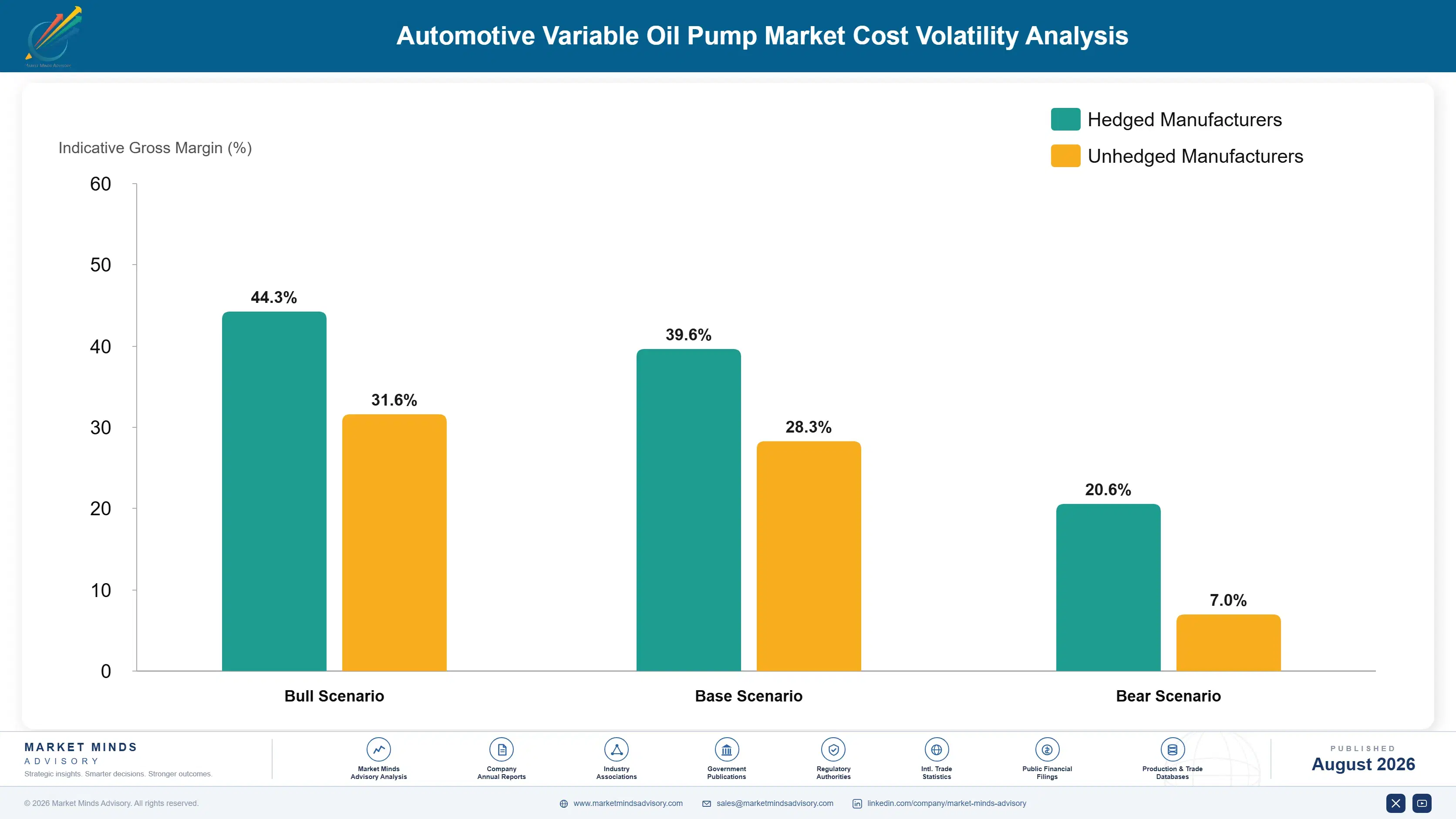
What Moves Pump Input Cost

Aluminium die cast housings account for roughly 34% of manufactured cost, sourced regionally because freight on castings is unforgiving. Sintered rotors, vanes and control rings add around 16%, and precision machining plus assembly labour a further 19%. On electric units the structure shifts sharply: motor magnets, copper windings and driver electronics together reach 31% or more, which introduces supply dynamics that mechanical pump suppliers had never previously managed.
European aluminium smelter curtailments through 2022 and the energy pricing behind them lifted casting costs materially, and suppliers on fixed programme pricing absorbed the increase for the remainder of those contracts. Rare earth magnet pricing followed a separate path during 2024 and 2025 as Chinese export controls tightened. Rheinmetall Annual Report 2025 identifies energy and raw material cost as continuing pressure across automotive operations rather than a resolved issue.

The disadvantage mechanism is programme pricing tenure combined with architecture. Engine contracts run nine years with limited adjustment, so fixed terms mean absorbing input swings for the duration. Exposure also splits by product: mechanical pump suppliers carry aluminium and energy risk, electric pump suppliers carry magnet, copper and semiconductor risk, and those inputs rarely move in the same direction at the same time.
automotive-variable-oil-pump-market-trends-cost-volatility-analysis-1787315772918

Index nine year programme pricing to published benchmarks

Engine contracts written against published aluminium, copper, magnet and energy indices move volatility onto a formula both parties can verify rather than leaving it with whoever signed first. Manufacturers resist because it complicates their own planning. Across nine years, though, absorbing input moves nobody forecast at signature routinely eliminates programme margin entirely, which makes the negotiation worth having properly.

Qualify motor designs reducing rare earth magnet dependence

Brushless designs using ferrite magnets or reluctance architectures avoid rare earth exposure entirely, at some cost in power density and package size. On an oil pump, where packaging constraints are less severe than in a traction motor, that trade is genuinely acceptable. Suppliers holding both options quote whichever the programme economics favour rather than being locked to one supply position.

Balance mechanical and electric exposure across the portfolio

Mechanical pumps carry aluminium and energy risk while electric units carry magnet, copper and semiconductor risk, and those inputs rarely move together in the same direction. A portfolio spanning both architectures dampens volatility at group level without any hedging activity. The benefit sits alongside the commercial case for architecture breadth, which makes the investment considerably easier to justify internally.

Portfolio Architecture for Margin Defence

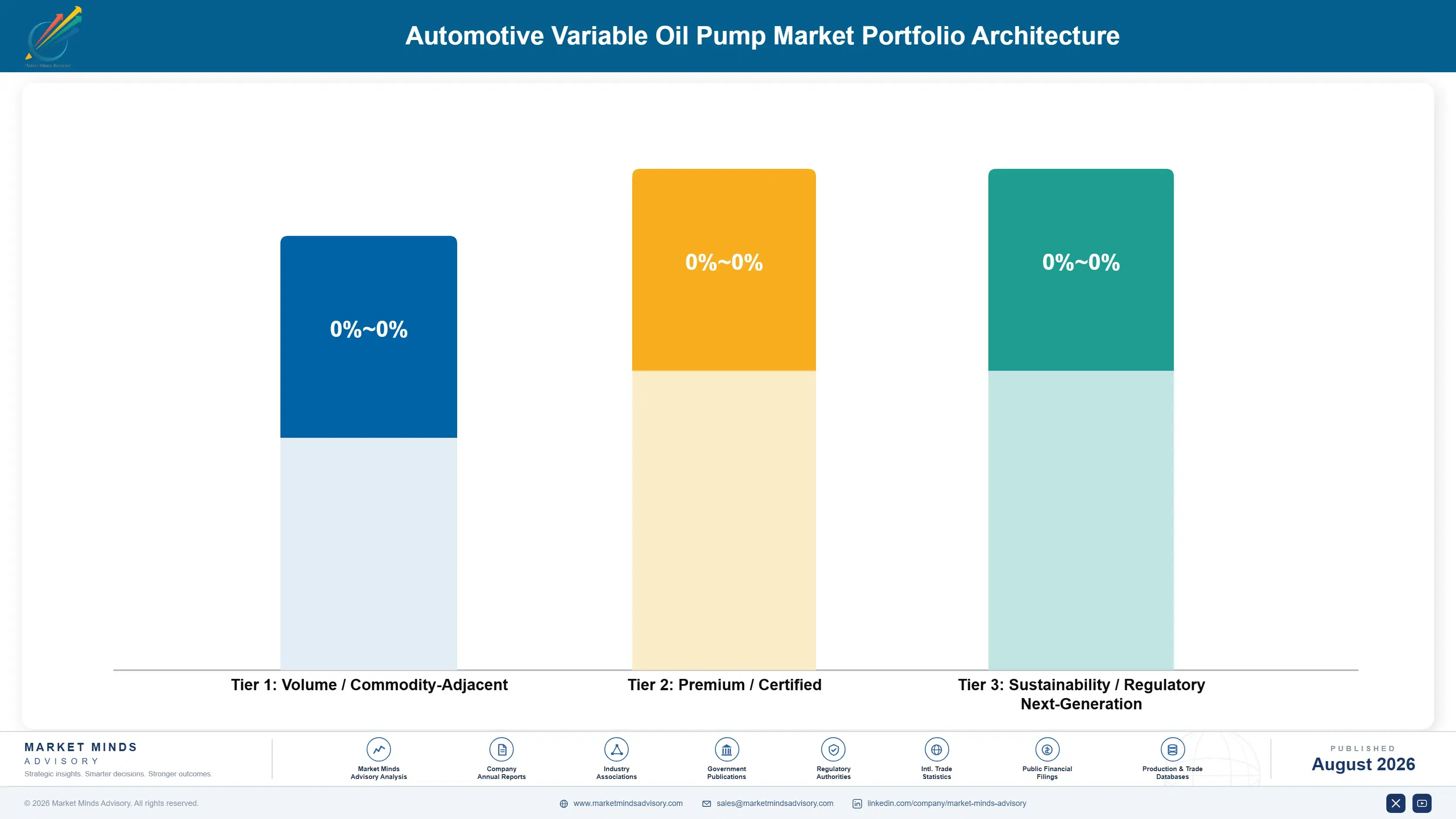
Portfolio economics divide on electronics content rather than on customer or vehicle class. Mechanical variable pumps quoted into competitive engine tenders earn gross margins in the mid teens, because manufacturers negotiate nine-year programmes hard at signature, several suppliers quote comparable specification, and the machining and casting involved is well within reach of any capable component manufacturer anywhere. Volume secures the relationship rather than the margin.
The premium tier is continuously variable control supplied together with calibration scope. Suppliers providing the control strategy alongside the hardware become part of powertrain development rather than a component vendor, which changes both the pricing conversation and the renewal odds considerably, and margins there run in the mid twenties to low thirties. Renewal odds improve considerably alongside the pricing.

Above both sits fully electric pump supply for suppliers holding motor and control electronics internally. Those assembling around purchased motors capture a fraction of what integration creates. Full capability suppliers reach the high thirties on units realising roughly 3.4 times mechanical pricing, and battery thermal circulation applications sit alongside at similar margins with the considerable advantage of surviving the powertrain transition entirely intact rather than declining with it.

Volume / Commodity-Adjacent

Mechanical variable displacement pumps quoted into competitive engine tenders. Nine-year pricing negotiated hard at signature, comparable specification from several suppliers, and casting and machining capability that is widely held across the industry.
Gross Margin: 13 to 19%

Premium / Certified

Continuously variable pumps supplied with calibration scope tied to engine management. The range is wide because calibration involvement varies considerably between programmes, and because some manufacturers retain that work internally.
Gross Margin: 24 to 32%

Sustainability / Regulatory / Next-Generation

Fully electric oil pumps and battery thermal circulation units for suppliers owning motor and control electronics. Those assembling around purchased motors sit far lower, which is what widens this range considerably.
Gross Margin: 33 to 41%
automotive-variable-oil-pump-market-trends-portfolio-architecture-1787315773421

High-value Sub-segments and Strategic Watch-out

Electric Pumps For Hybrid Powertrains

High value and high growth sitting together. Hybrid stop-start operation makes electric pressure delivery a functional requirement rather than an efficiency choice, content on these units realises several times mechanical pump pricing, and suppliers without genuine power electronics capability cannot credibly quote these programmes at all any more.
Gross Margin: 35 to 42%

Battery Thermal Circulation Pump Applications

High value running on genuinely moderate growth. Motor, impeller and control capability transfers almost directly across from engine lubrication work, the buying customers are the same powertrain teams already in the room, and the application survives the powertrain transition entirely rather than declining alongside internal combustion engines.
Gross Margin: 32 to 39%

Mechanical Variable Pump Volume Supply

The volume core that keeps casting and machining capacity properly loaded between spells of higher-value work. Margins stay modest because nine-year pricing gets negotiated hard and the capability is widely held, but the scope secures exactly the powertrain relationships that carry electric pump business later on.
Gross Margin: 13 to 19%

Two-Stage Vane Pump Programmes

The strategic watch-out sitting squarely in this portfolio. Two-stage control still wins emerging market conversion programmes purely on cost, but tightening emissions rules will eventually demand genuinely continuous modulation instead, and any tooling committed to it now serves a technology that carries a clearly defined commercial horizon.
Gross Margin: 17 to 24%

How Pump Demand Repeats

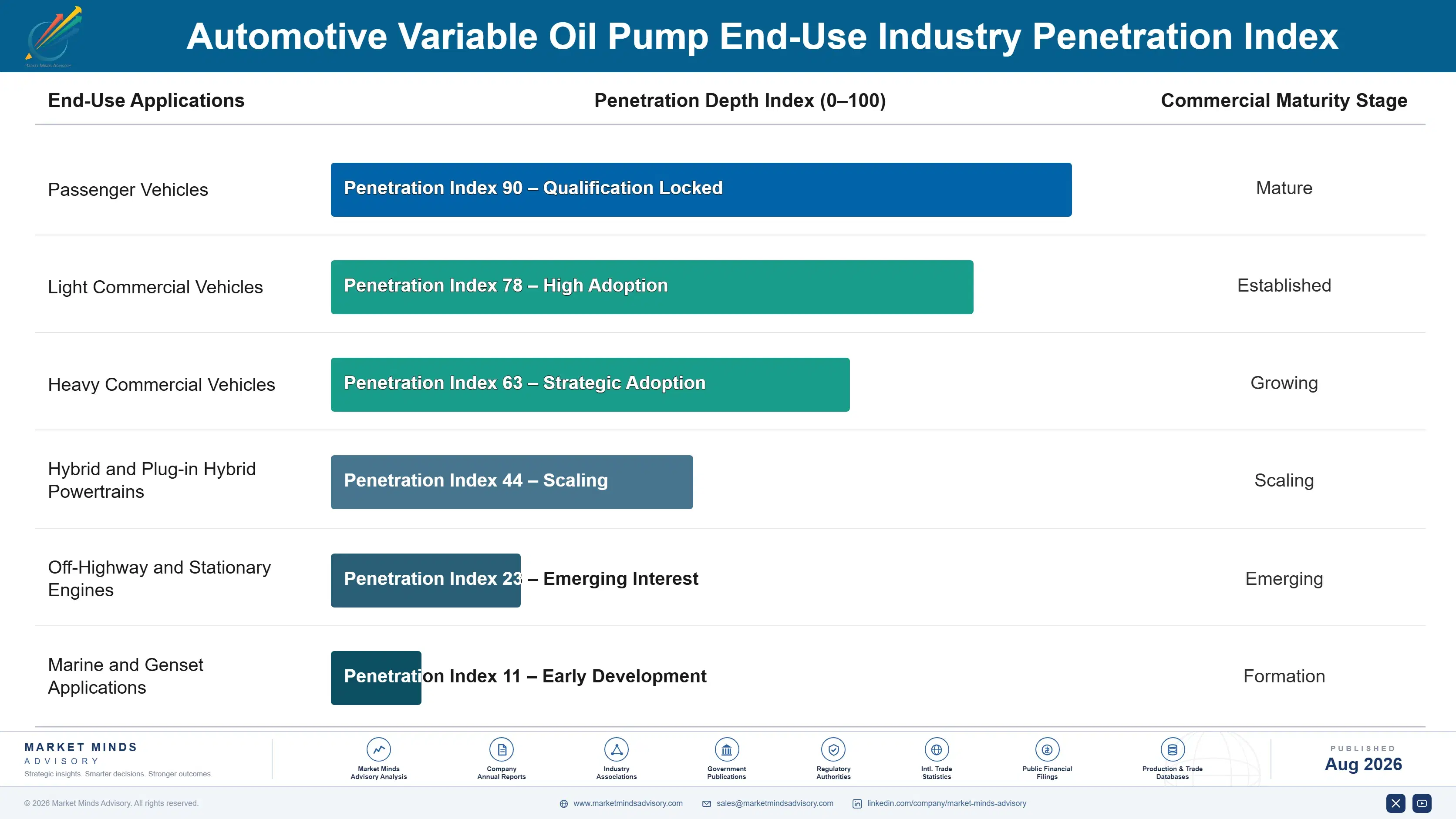
The repeat business is the engine programme rather than any individual order. A pump specified during engine development ships for roughly nine years of production against release schedules that arrive regardless of what else is happening, and the specification is almost never revisited mid-programme because requalifying a lubrication component means rerunning durability testing nobody wants to fund. Winning the specification is therefore worth many multiples of the development contract precedin
Stickiness varies considerably by end-use. Heavy commercial positions are deepest, since durability requirements are severe and operators judge suppliers across a fifteen year service life. Passenger engine positions are locked for the programme but fully contestable at each engine revision, and revisions are becoming more frequent as manufacturers chase efficiency. Hybrid programmes are stickiest of all, because electric pump calibration ties into powertrain control in ways that make swapping suppliers genuinely difficult. Aftermarket demand barely exists, since pumps rarely fail.

The buyer profile has shifted generationally. Specification once sat with lubrication engineers weighing flow, pressure and durability alone. Today it sits with powertrain control teams evaluating calibration integration, electrical load and thermal strategy together, which favours suppliers who arrive with software engineers rather than only with sample castings.
automotive-variable-oil-pump-market-trends-end-use-penetration-index-1787315773911

Where To Compete And Why

These are among the four positions where our research anticipates prominent divergence between winners and laggards over the coming forecast period. Each is grounded in the demand model, the regulatory perimeter, and the announced capacity pipeline.
01 / MOTOR ELECTRONICS OWNERSHIP

Electric pumps only pay if you own the motor

A fully electric oil pump realises roughly 3.4 times mechanical pricing, but suppliers buying motors and controllers from third parties capture only a fraction of that uplift while carrying the warranty exposure anyway. Holding motor design, driver electronics and control software internally retains 11 to 15 points more gross margin on identical programmes. The capability takes years to build from a machining base, which is why several pump specialists acquired it and why those who did neither are quoting castings against competitors selling systems.
02 / CALIBRATION SCOPE CAPTURE

Sell the control strategy with the hardware

Continuously variable pumps deliver their efficiency advantage only when the control strategy is calibrated against real engine behaviour across temperature, load and oil condition. Suppliers providing that work alongside the hardware join the powertrain development team rather than bidding afterwards as component vendors, and they hold 14% to 20% higher programme win rates. The investment required is engineers and test cell time rather than capital equipment, which makes it far faster to build than any manufacturing capability could ever be.
03 / THERMAL APPLICATION CONVERSION

Fluid control survives the engine disappearing

Battery electric vehicles carry no engine oil pump but do carry coolant, battery thermal and transmission fluid pumps where motor, impeller and control capability transfers almost directly across. Suppliers making that move recover 40% to 55% of the fluid handling content per vehicle lost when the engine goes, which comfortably beats what most engine component categories are able to manage. The engineering overlap is genuine rather than aspirational, and the buying customers are the same powertrain teams already in the room.
04 / EMERGING PROGRAMME TIMING

Penetration headroom exists only outside the West

Variable displacement already reaches above 80% of new engines across Western Europe and North America, which leaves essentially no conversion growth in the markets that pay best. Indian and Southeast Asian penetration remains far lower and tightening efficiency norms are pulling it upward right now. Suppliers winning programmes during that conversion hold nine year positions at volumes which are still growing, though realised pricing runs 30% to 40% below Western levels and the case rests on duration rather than unit economics.

Engagement Snapshot From the Field

A live engagement with an industry participant carrying material or product regulatory and market exposure ahead of a defining policy shift, showing how our research translates into a defensible multi-year portfolio strategy.
MARKET MINDS ADVISORY · CLIENT ENGAGEMENT SUMMARY
Automotive Variable Oil Pump Producer Strategic Portfolio Review and Transition Roadmap 2026·Investment Scenario on Automotive Variable Oil Pump Exposure Evaluation 2025-26
CLIENT PROFILE
A European manufacturer of engine lubrication and fluid components operating three plants, with annual revenue near $290 million (client-reported, unverified by MMA), roughly 76% of it from mechanical variable displacement oil pumps supplied to European engine programmes. The business held strong vane pump engineering and long manufacturer relationships but no motor or power electronics capability at all, and it had been excluded from every hybrid programme it attempted to quote.
STRATEGIC CHALLENGE
European engine production was declining, attach rates on the client's core product had reached the ceiling, and the electric pump programmes replacing them required capability the business did not hold. Management needed to decide between acquiring a motor and electronics business, partnering with an electronics supplier on a revenue share, or repositioning entirely toward battery thermal circulation pumps for electric vehicle platforms.
MMA APPROACH
MMA modelled pump architecture demand across 52 European and Asian engine programmes through 2038, mapped hybrid and battery electric platform schedules against the client's qualification positions, and assessed acquisition, partnership and repositioning economics for each route. Twenty-three expert interviews with powertrain engineers, thermal system leads and procurement directors tested where specification decisions were genuinely made.
KEY FINDINGS
  1. Every hybrid programme in the study specified electric pumps with integrated motor control, and the client had been screened out before commercial discussion on all eleven it had attempted to quote.
  2. Partnership structures returned roughly 40% of the margin that in-house electronics capability would deliver, because the electronics partner captured the software and calibration value that manufacturers actually paid for.
  3. Battery thermal circulation pumps used impeller, motor and control capability overlapping the client's engineering by around 60%, making repositioning far more feasible than management had assumed it was.
  4. Mechanical variable pump revenue would decline by roughly 45% before 2036 on European programme schedules alone, considerably faster than the client's internal planning had allowed for.
CLIENT PROFILE
A European manufacturer of engine lubrication and fluid components operating three plants, with annual revenue near $290 million (client-reported, unverified by MMA), roughly 76% of it from mechanical variable displacement oil pumps supplied to European engine programmes. The business held strong vane pump engineering and long manufacturer relationships but no motor or power electronics capability at all, and it had been excluded from every hybrid programme it attempted to quote.
STRATEGIC CHALLENGE
European engine production was declining, attach rates on the client's core product had reached the ceiling, and the electric pump programmes replacing them required capability the business did not hold. Management needed to decide between acquiring a motor and electronics business, partnering with an electronics supplier on a revenue share, or repositioning entirely toward battery thermal circulation pumps for electric vehicle platforms.
MMA APPROACH
MMA modelled pump architecture demand across 52 European and Asian engine programmes through 2038, mapped hybrid and battery electric platform schedules against the client's qualification positions, and assessed acquisition, partnership and repositioning economics for each route. Twenty-three expert interviews with powertrain engineers, thermal system leads and procurement directors tested where specification decisions were genuinely made.
KEY FINDINGS
  1. Every hybrid programme in the study specified electric pumps with integrated motor control, and the client had been screened out before commercial discussion on all eleven it had attempted to quote.
  2. Partnership structures returned roughly 40% of the margin that in-house electronics capability would deliver, because the electronics partner captured the software and calibration value that manufacturers actually paid for.
  3. Battery thermal circulation pumps used impeller, motor and control capability overlapping the client's engineering by around 60%, making repositioning far more feasible than management had assumed it was.
  4. Mechanical variable pump revenue would decline by roughly 45% before 2036 on European programme schedules alone, considerably faster than the client's internal planning had allowed for.
RECOMMENDED STRATEGY
Phase 1: Phase one: acquire a small motor and driver electronics business rather than partnering, capturing the software value manufacturers price into hybrid pump programmes. Phase 2: Phase two: qualify battery thermal circulation pumps with two existing powertrain customers, using the acquired electronics capability across both applications. Phase 3: Phase three: manage mechanical pump volume for cash rather than growth, and match capacity to the declining European engine schedule deliberately.
OUTCOME
The client completed the electronics acquisition in ten months and reported first-year electric pump and thermal revenue of $34 million against a $23 million plan (client-reported, unverified by MMA). Two hybrid programmes were won that the business had previously been screened out of, and blended gross margin improved by roughly six points.

Frequently Asked Questions

Foundational context covering the market sizes, CAGR, scope, country, region and competition that inform every finding below. This section is provided to cover basics and most often pre-purchase conversations, answered from the MMA Primary Research Dataset.

What is the current size of the Automotive Variable Oil Pump Market?

The global automotive variable oil pump market was valued at $4.10 billion in 2025, reaching an estimated $4.33 billion in 2026. That covers variable displacement and electronically controlled engine lubrication pumps across all vehicle classes.

How large will the Automotive Variable Oil Pump Market be by 2036?

MMA forecasts the market reaching $7.47 billion by 2036, an increase of $3.14 billion over the 2026 base. That represents an expansion multiple of 1.72 times across the forecast period.

What is the CAGR for the Automotive Variable Oil Pump Market 2026 to 2036?

The base case compound annual growth rate is 5.6%, with a bull case of 6.8% and a bear case of 4.4%. Historical growth between 2020 and 2025 ran at 4.4% annually.

Which segment is growing fastest?

Fully electric oil pumps grow at 8.4%, a full 1.50 times the market rate, because hybrid stop-start operation requires pressure with the engine stationary. Two-stage variable vane pumps follow at 6.7% on emerging market conversion.

Who are the major companies in the Automotive Variable Oil Pump Market?

Aisin Corporation, Hitachi Astemo, Rheinmetall, SHW AG and Magna International lead on variable pump shipment volume. Together they account for roughly 52% of global shipments across all architectures.

Which country is growing fastest?

India grows fastest at 8.0% annually, driven by expanding engine production and tightening fuel efficiency norms pulling variable displacement adoption up from a low base. Indonesia and Vietnam follow on similar logic.

Report Segmentation Architecture

The full report scope spans multiple orthogonal segmentation dimensions, with cross-tabulated demand data provided for each dimension pair. Coverage extends further to regional breakdowns, trend trajectories, and the competitive detail needed to support segment-level decision-making.

By Pump Control Architecture

  • Fully Electric Oil Pump
  • Two-Stage Variable Displacement Vane Pump
  • Continuously Variable Vane Pump
  • Variable Displacement Pendulum Slider Pump
  • Variable Flow Internal Gear Pump

By End-Use Industry

  • Passenger Vehicles
  • Light Commercial Vehicles
  • Heavy Commercial Vehicles
  • Hybrid and Plug-in Hybrid Powertrains
  • Off-Highway and Stationary Engines
  • Marine and Genset Applications

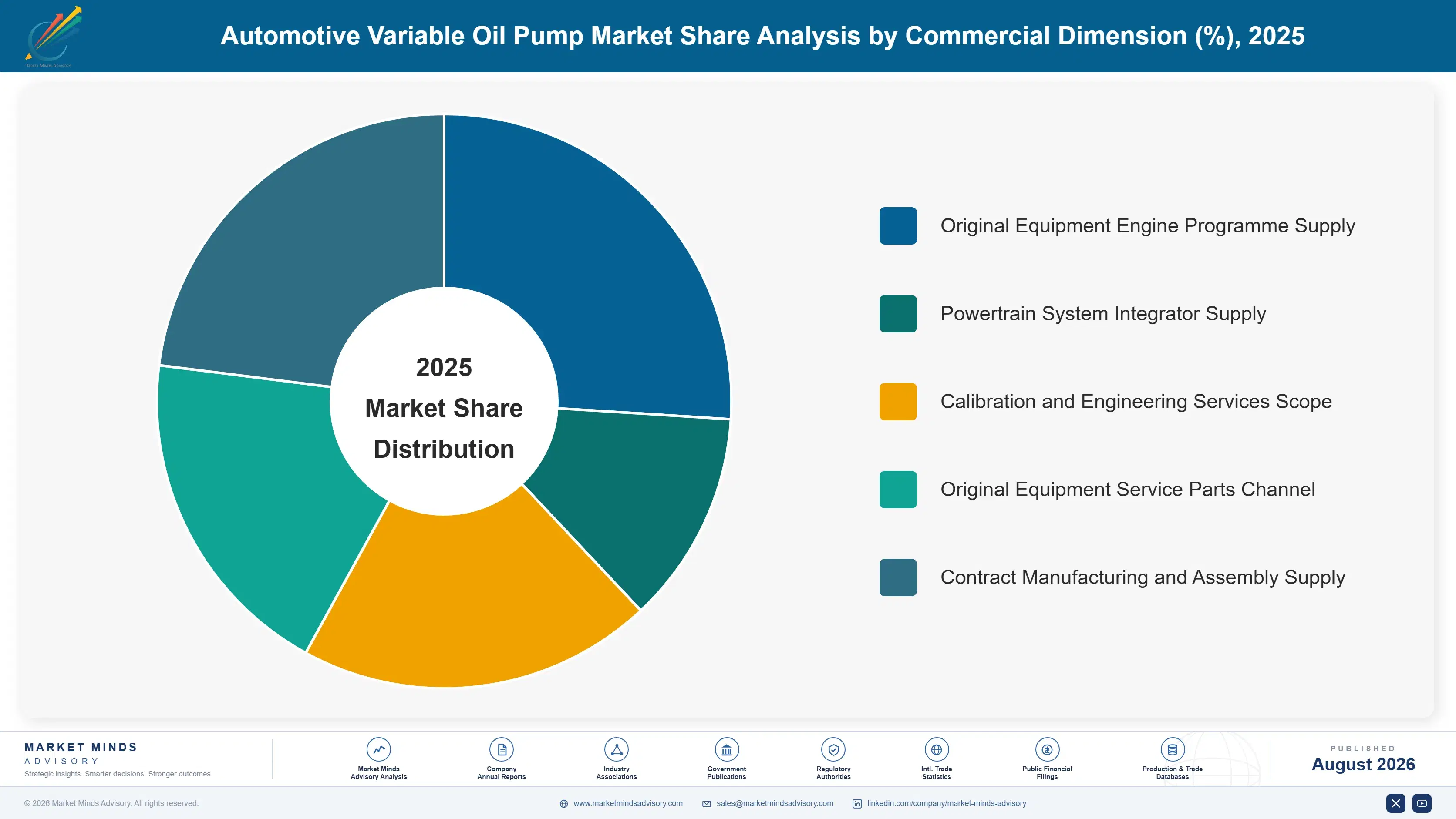
By Commercial Dimension

  • Original Equipment Engine Programme Supply
  • Powertrain System Integrator Supply
  • Calibration and Engineering Services Scope
  • Original Equipment Service Parts Channel
  • Contract Manufacturing and Assembly Supply

By Region

  • North America
  • Western Europe
  • East Asia
  • South Asia and Pacific
  • Latin America
  • Middle East and Africa
  • Eastern Europe

Scope, Methodology, and Coverage

Every figure in this report is reproducible from documented input assumptions. The scope below maps the historical period, the forecast horizon, the segmentation dimensions, and the countries covered, alongside the underlying primary and qualitative methodology.
Historical Period
2020 to 2025
Forecast Period
2026 to 2036
Base Year
2025 (USD billions; MMA Primary Research Dataset, August 2026)
Market Definition
This report covers engine lubrication oil pumps with variable displacement or electronically controlled flow, spanning two-stage and continuously variable vane pumps, variable displacement pendulum slider pumps, variable flow internal gear pumps and fully electric motor-driven oil pumps, across passenger vehicles, light and heavy commercial vehicles, hybrid powertrains and off-highway engines. Fixed displacement oil pumps, transmission fluid pumps, coolant and water pumps, fuel pumps, vacuum pumps and complete engine assemblies are excluded from the sizing.
Quantitative Units
USD billions at manufacturer realised value; pump shipments in millions of units; average realised price in USD per unit.
Segmentation Dimensions
By pump control architecture; by end-use industry; by commercial dimension; by region.
Regions Covered
North America, Western Europe, East Asia, South Asia and Pacific, Latin America, Middle East and Africa, Eastern Europe
Countries Covered
United States, Canada, Mexico, United Kingdom, Germany, France, Italy, Spain, Sweden, Japan, South Korea, China, India, Thailand, Indonesia, Brazil, South Africa, Turkey, Poland, Czech Republic.
Key Companies Profiled
Aisin Corporation, Hitachi Astemo, Rheinmetall, SHW AG, Magna International, Mikuni Corporation, TBK Co., Yamada Manufacturing, Nidec, Schaeffler, JTEKT, Denso, Concentric AB, Stackpole International and others.
Quantitative Methodology
Primary survey, n=3,800 respondents, Q4 2025, six countries; demand-side model with trade association cross-validation
Qualitative Methodology
47 expert interviews, Q4 2025; applied to validate demand model assumptions, identify emerging dynamics, and assess competitive positioning
Report Format
PDF and XLSX data workbook (Word format preview document)
Publisher
Market Minds Advisory
Report Code
MMA-2026-AUT-907
Published
August 2026
Contact
sales@marketmindsadvisory.com | www.marketmindsadvisory.com

Purchase the full Automotive Variable Oil Pump Market Report (2026 to 2036).

The full report sizes the automotive variable oil pump market across five control architectures, six end-use industries and seven regions, with unit shipment and realised pricing detail behind every value estimate. It profiles twenty global suppliers on electronics capability, calibration scope and thermal application conversion progress. Regional chapters cover engine production outlook, attach rate headroom and efficiency regulation by market. Electrification analysis quantifies hybrid pump content growth against battery electric engine loss. Cost analysis tracks aluminium, magnet and semiconductor exposure across mechanical and electric pump architectures.
Unit shipment and pricing detail by control architecture
Attach rate headroom analysis by regional market
Electric pump adoption forecasts through 2036
Hybrid content growth against engine loss modelling
Competitive position assessments across twenty global suppliers
Thermal application conversion potential by supplier

Built For The People Who Decide

From boardroom strategy to bench-side execution, this report is read cover-to-cover by leaders shaping the next decade of their industry, turning demand scenarios, market dynamics and valuation benchmarks into decisions.
CXOs/ Presidents/ VPs/ Managers
M&A and Corporate Development
Strategy Teams and R&D Heads
Procurement and Product Directors
Regulatory and Compliance Leaders
Investor Relations and Equity Analysts