Market Minds Advisory
Automotive Valve Stem Seal Market

Automotive Valve Stem Seal Market: Oil Consumption Control, Heat Resistance Positioning, and Hybrid Engine Manufacturing Scale

Freudenberg and Federal-Mogul are defending premium FKM seal margin against low-cost NBR imports, while China's dominant hybrid engine production scale reshapes which suppliers automakers select for next-generation oil consumption control programs nationwide.

Lead Analyst

David Horsley

Published

September 2026

Make Smarter Decisions with Customized Research Insights

Request a free sample report and evaluate market opportunities, growth trends, and competitive dynamics relevant to your business needs.

2025 MARKET VALUE$1.8BMarket Size 2025
2036 FORECAST VALUE$2.7BBase Case , 2026 to 2036
CAGR 2026 TO 20363.8 %Bull 5.0% / Bear 2.6%
INCREMENTAL OPPORTUNITY$0.8BNet 10- year value creation
EXPANSION MULTIPLE1.45x2036 value over 2026 base
Strategic Levers
M&A Pipeline
Regional Outlook
Country Rankings
Competitive Intelligence
Segmental Deep-dive
Call-Us : 91 93563 13602

Executive Snapshot and Market Trajectory

Valve stem seal demand holds steady as engine manufacturers require documented oil consumption control and heat resistance that few other engine components can genuinely match at comparable delivered cost and consistent supply reliability across most active regulated engine program cycles nationwide today and further still overall.
FKM and PTFE seals are the fastest-growing categories as manufacturers pursue documented heat resistance positioning without abandoning established NBR reliability, while East Asia commands the largest regional share given its dominant hybrid and ICE engine production scale and continued capacity investment across major supplier corridors nationwide overall today and increasingly well beyond current output levels reached across this entire cycle overall now indeed truly and further still even more into the coming decade.
A moderately fragmented group of specialty seal manufacturers dominate certified engine builder supply through long-standing relationships built over decades of continuous elastomer and molding infrastructure investment across multiple countries worldwide today, while regional manufacturers compete aggressively on price for standard NBR orders across less differentiated categories nationwide today. Heat resistance consistency increasingly separates established manufacturers from smaller regional competitors lacking dedicated compounding infrastructure of their own.
Market Definition
The valve stem seal market comprises NBR, FKM, PTFE, silicone, and ACM seals installed in passenger, commercial, and off-highway engines. It excludes standalone piston rings and non-automotive industrial sealing products sold as separate components.
Base Year Value
$1.8B in 2025 (MMA Primary Research Dataset, August 2026)
Forecast Period
2026 to 2036, eleven discrete annual values
CAGR
3.8% base case. Bull 5.0%. Bear 2.6%.
Fastest Growth Segment
FKM Seals: 6.9% CAGR
Fastest Growth Country
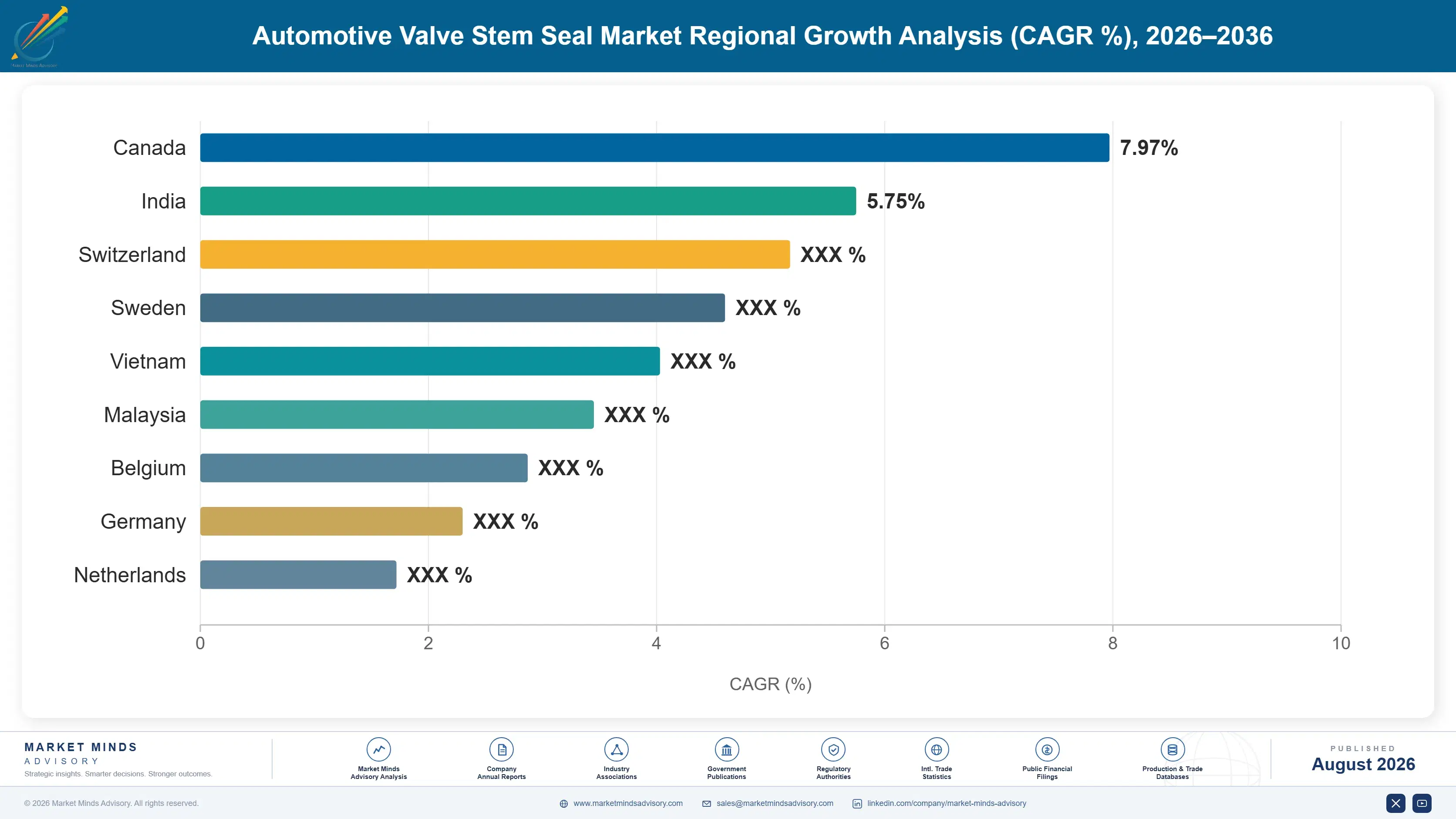
India: 5.6% CAGR
Fastest Growth Region
South Asia and Pacific: 5.6% CAGR
Largest Region
East Asia: 30% of 2025 global value
Market Leaders
Freudenberg, Federal-Mogul, Dana, NOK, Trelleborg. Source: MMA Analysis based on company annual reports.
Primary Survey
n=3,800 procurement and R&D decision-makers, Q4 2025, six countries
Methodology
Demand-side build-up, cross-validated against public data, 47 expert interviews

Automotive Valve Stem Seal Market Forecast Scenarios

automotive-valve-stem-seal-market-trends-size-forecast-scenario-1787315616151
Valve stem seal demand grew steadily through 2020 to 2025 as engine production infrastructure broadened across most major automotive manufacturing regions worldwide throughout the entire period overall. FKM seal adoption accelerated from 2023 onward as manufacturers tightened heat resistance targets. The market grew at a historical rate of roughly 3.2% annually across this five year period overall.
The base case rests on three mechanisms: expanding global hybrid and ICE engine production activity sustaining baseline demand for standard NBR and silicone seal supply across engine builder and fleet manufacturing channels worldwide, accelerating FKM seal adoption displacing conventional untreated formats among manufacturers seeking documented heat resistance positioning and reduced warranty liability, and tightening emissions and durability standards across major economies adding new qualified-supplier procurement volume across expanding molding networks and their associated compounding operations.
The bull case rests on faster than expected FKM seal substitution for conventional NBR formats following the pattern several large manufacturers have already established through documented engine data. The bear case centers on generic NBR price competition and manufacturer capital spending discipline compressing margin across standard categories that comprise much unit volume industry wide today and going forward.

Where Oil Control Meets Heat Resistance Demand

Valve stem seals occupy a specific position in automotive powertrain supply chains, since oil consumption control and heat resistance certification requirements dictate exactly which seal tier a given engine manufacturer genuinely requires regardless of application type or production scale constraints affecting the wider automotive powertrain industry today. Standard NBR and silicone formats dominate certified volume, but FKM formats are steadily gaining share wherever documented heat resistance
TOP FIVE MANUFACTURER CONCENTRATION36%Combined share held by the top five manufacturers
AVERAGE SEAL SET PRICE$4.20Average price charged per each complete engine set
LEADING COUNTRY OUTPUT SHARE23%Share of global output produced within domestic borders
MOLDING LINE CAPACITY UTILIZATION74%Molding and compounding lines running at active capacity
CROSS-BORDER TRADE INTENSITY33%Share of total unit volume crossing international borders
ELASTOMER COGS SHARE32%Base elastomer cost as a share of total delivery
Demand concentrates wherever hybrid and ICE engine manufacturing density is strongest across the world today. East Asia generates the largest procurement volume given its dominant hybrid and ICE engine production scale, while North America sustains substantial demand tied to its expanding aftermarket and rebuild sector across major distribution markets nationwide and increasingly well beyond current levels today and further still going forward.
Over the next decade, heat resistance consistency will matter more than raw seal volume alone, since manufacturers increasingly evaluate suppliers on documented durability and wear resistance records rather than simple unit cost or brand origin alone. Suppliers able to demonstrate strong quality reliability and secure long-term engine builder supply contracts are positioned to capture disproportionate share as FKM demand continues expanding across most regions worldwide going forward and beyond.
"Everyone in this category still talks about seal diameter on the spec sheet when the real conversation manufacturers are having is about oil consumption failing a durability test after ten thousand hours. Suppliers betting on heat resistance data over marketing claims are the ones winning long-term engine builder contracts renewed this cycle."
Director, Powertrain Elastomer Practice · MMA Automotive Practice ·

Market Trends

FKM Seal Adoption Accelerates Ahead of NBR Supply

Growing manufacturer demand for precisely documented, durability-conscious seal formulations, increasingly codified through formal heat resistance certification protocols at major engine builders, is pushing engineering teams to replace conventional NBR seals with FKM formats as a routine specification requirement rather than an occasional upgrade. This shift is converting what was once a specialized niche into an increasingly mainstream platform category at leading manufacturers pursuing documented heat resistance positioning and expanded consumer accessibility. Manufacturers still selling exclusively conventional NBR seals risk losing engine builder contracts to competitors already offering validated FKM alternatives at comparable delivered cost nationwide.
Market Impact: Adds 140 new builder contracts year
PTFE Seal Growth Reshapes Low-Friction Standards

Growing consumer and fleet pressure on documented friction reduction positioning and rapid production tracking, increasingly requiring documented wear data at major engine builders, is converting seal selection from a purely cost-driven decision into one increasingly anchored in friction and durability requirements across most major platform categories nationwide. This shift is prompting manufacturers to expand their PTFE seal portfolio beyond conventional NBR formats rather than relying exclusively on standard supply carrying limited friction range. Manufacturers with comprehensive PTFE capability are capturing disproportionate share of this increasingly quality-driven procurement demand nationwide and increasingly well beyond current levels.
Market Impact: Adds 16 new rebuild programs yearly

Market Opportunities and Growth Drivers

Rising Hybrid Engine Production Volume Sustains Baseline Demand

Growing global hybrid and ICE engine production volume, driven by expanding commercial fleet and passenger vehicle diversification activity across both developed and developing economies, sustains recurring baseline demand for standard NBR and silicone seal supply regardless of any single FKM trend reshaping the broader automotive powertrain landscape worldwide. Each additional engine assembled represents a discrete, recurring procurement event, since valve stem seals are a consumable powertrain input that manufacturers replenish on a recurring platform refresh cycle rather than a one time capital purchase. Manufacturers with established engine builder relationships are capturing disproportionate share of this steady demand pool.
Market Impact: Limits small manufacturer margin to

Expanding Aftermarket Rebuild Programs Drives New Demand

Expanding aftermarket rebuild and engine overhaul diversification programs, particularly across fleet operators extending vehicle service life, is driving substantial new-contract demand for precision valve stem seal formulations as operators commission expanded rebuild programs requiring full durability validation before commercial deployment begins. Each new rebuild program commissioned represents a significant, ongoing procurement relationship spanning the program's full multi year operating lifetime, since seal consumption scales directly with engine count and restocking frequency once operations begin. Manufacturers with established regional distribution and technical support presence are capturing disproportionate share of this expanding demand pool.
Market Impact: Limits supply consistency growth to

Market Restraints and Challenges

Generic NBR Price Competition Limits Small Manufacturer Margin

A growing number of small and independent seal manufacturers struggle to defend margin against generic NBR price competition, particularly where existing engine builder contracts remain short term and fully price-exposed across most routine tender cases nationwide. The root cause is that standard NBR seals have become largely commoditized despite generally rising demand for durability graded material across seal categories that smaller manufacturers have not yet fully differentiated into their pricing decisions. This directly limits margin among manufacturers concentrated in cost sensitive categories facing tight engine builder budgets. Manufacturers are responding by pursuing FKM differentiation across multiple product lines.
Market Impact: Lifts FKM adoption to 19%

Fluoropolymer Feedstock Volatility Limits Supply Consistency

Certified valve stem seal production depends on consistent fluoropolymer and elastomer feedstock availability, and tightening supply in several major producing regions creates genuine molding constraints among manufacturers unable to secure updated supplier contracts. The root cause is that dedicated compounding capacity has not scaled at the same pace as growing FKM demand, leaving manufacturers competing for a fixed fluoropolymer supply pool across multiple powertrain component markets nationwide. This limits supply consistency among smaller regional manufacturers lacking dedicated feedstock relationships. Manufacturers are responding by investing directly in fluoropolymer supply partnerships that shift this constraint away from single-source dependency.
Market Impact: Expands PTFE segment share 8%
3 additional market trends, 4 additional growth drivers, and 3 additional restraints and challenges are covered in the full report. Contact sales@marketmindsadvisory.com to access the complete intelligence.

Segment CAGR and Growth Architecture

MMA segments the valve stem seal market by material composition, the classification that most directly determines heat resistance, friction performance, and delivered price across NBR, FKM, PTFE, silicone, and ACM seal categories, rather than an engine-type-based split used far more commonly seen elsewhere across the wider global automotive powertrain industry today and further beyond.
automotive-valve-stem-seal-market-trends-market-share-analysis-1787315616689

FKM Seals

FKM Seals are growing fastest, at roughly 6.9% annually, as manufacturers seek documented heat resistance positioning without abandoning the reliability of established NBR manufacturing protocols across most fleet and consumer categories nationwide today and going even further forward across most active regulated distribution markets overall. Adoption concentrates among large manufacturers handling documented durability programs, where engineering teams increasingly specify FKM seals as a preferred heat resistance requirement rather than a fallback consideration during platform renewal. Pricing runs meaningfully higher than conventional NBR supply, reflecting the specialized compounding and testing work the category genuinely requires. Manufacturers with validated FKM portfolios are positioned to capture disproportionate share of new engine builder contracts nationwide.
CAGR 6.9%

PTFE Seals

PTFE Seals are growing at roughly 5.8% annually, driven by tightening friction reduction standardization and rapid production tracking requirements that increasingly requires documented wear data for complex, high-turnover categories across most heavily regulated fleet markets worldwide today and going even further still forward across most active premium consumer distribution regions nationwide and beyond. Demand concentrates among manufacturers managing complex multi-format platform programs, where friction inconsistency carries genuine quality and brand risk that conventional NBR formats cannot adequately address at comparable friction or reliability. This segment commands meaningful price premiums over standard formats, sustained by the rigorous molding and testing infrastructure the category requires across every engine sold into premium consumer markets nationwide.
CAGR 5.8%
Full segment breakdown across 5 segments available in the complete report.

Regional Architecture and Country Demand Map

East Asia holds the largest overall regional share given its dominant hybrid and ICE engine production scale and continued capacity investment, while South Asia and Pacific grows fastest as regional engine production expands rapidly today. Eastern Europe sustains a smaller share tied to slower engine modernization overall.

East Asia

East Asia's demand is anchored by China, Japan, and South Korea, where a dominant hybrid and ICE engine production base sustains steady procurement of certified valve stem seals across thousands of active manufacturers and engine builders nationwide and well beyond its own domestic borders and export channels today and going even much further forward still into the distant future ahead and further still well beyond current levels reached across this entire cycle overall today overall now truly indeed truly further still. China's engine expansion, led by domestic seal suppliers, is accelerating faster than in most regions worldwide today. Japan's mature molding sector contributes steady secondary demand concentrated in premium categories nationwide. South Korea's dense manufacturing base adds meaningful demand nationwide.
Share: 30% | CAGR: 4.7% (2026 to 2036)

North America

North America contributes substantial demand anchored by the United States, where a mature powertrain and fleet manufacturing sector sustains steady procurement of certified valve stem seals across hundreds of active manufacturers and distributors nationwide and increasingly well beyond its own domestic borders today and going even much further forward still into the very distant future ahead and further still well beyond current levels reached across this entire cycle overall today overall now truly indeed truly. Regulatory emissions compliance across the country is accelerating demand for validated FKM formats nationwide today. Canada's growing powertrain sector contributes steady secondary demand concentrated in similar categories nationwide. Mexico's expanding assembly base adds incremental demand nationwide.
Share: 23% | CAGR: 4.5% (2026 to 2036)
Regional intelligence for 5 additional markets available in the complete report: Western Europe, South Asia and Pacific, Latin America, Middle East and Africa, Eastern Europe. Contact sales@marketmindsadvisory.com.
automotive-valve-stem-seal-market-trends-country-cagr-analysis-1787315617192

Moving Beyond the Commodity NBR Sale

Base NBR seal pricing faces steady downward pressure from low-cost regional manufacturers competing aggressively on standard engine builder tenders nationwide and increasingly beyond. Manufacturers that build FKM heat resistance depth, secure PTFE friction certification breadth, and expand regional molding capacity capture considerably better lifetime value than those competing purely on unit price across every major powertrain component market today.

Building Advanced FKM Heat Resistant Seal Capability

Manufacturers investing in advanced FKM heat resistant seal capability capture disproportionate share of a demand pool commanding pricing 27 to 39% above conventional NBR supply, where documented heat resistance positioning directly determines whether a manufacturer can win new engine builder contracts now specifying FKM sourcing as a preferred procurement requirement across major fleet and consumer manufacturers nationwide today. This compounding development typically requires seven to eleven months of validation and testing, but manufacturers that complete it successfully capture durable, multi year engine builder contracts that persist across a customer's full engine cycle and well beyond initial adoption.
Market Impact: Commands pricing 27 to 39% above NB

Expanding PTFE Friction Certification Breadth Across Portfolio

Manufacturers offering comprehensive PTFE and low-friction options across their full product portfolio capture meaningful recurring revenue worth an estimated 16 to 24% above conventional NBR only competitors, converting a fragmented, application-specific sourcing relationship into a captive full-portfolio engine builder contract tied to a customer's entire engine protocol across its full multi year procurement cycle nationwide today. This portfolio breadth, difficult for narrowly focused manufacturers to replicate without dedicated molding infrastructure of their own, creates durable customer dependency that extends the commercial relationship well beyond a single order into years of recurring full-portfolio supply.
Market Impact: Adds 16 to 24% above standalone pri

Expanding South Asian Molding Capacity Broadly

Manufacturers building dedicated molding capacity in India and South Asia are capturing disproportionate share of the region's rapidly expanding diesel engine demand pool worth an estimated 4 million dollars, positioning closer to fast growing regional commercial fleet volume rather than serving the market purely through remote molding carrying longer response times and considerably higher coordination costs today. This regional capacity investment requires meaningful capital commitment but positions manufacturers to capture recurring, multi year engine builder supply relationships as regional molding infrastructure scales alongside expanding fleet investment across many states and provinces region wide.
Market Impact: Captures a growing $4M regional dem

Securing Long-Term Engine Builder Supply Contracts Now

Manufacturers securing long-term engine builder supply contracts are capturing disproportionate share of a demand pool worth an estimated 7 million dollars tied to steady powertrain procurement volume across East Asia and North America, a segment offering predictable, multi year procurement volume that spot tender batches rarely provide at comparable scale or consistency. This supply agreement relationship requires meaningful quality and reliability investment but positions manufacturers to capture recurring, contract anchored procurement across a multi year agreement cycle, a relationship considerably more durable than typical spot tender transactions negotiated purely on price.
Market Impact: Captures a growing $7M engine build

Who Controls the Margin Pool

The valve stem seal market remains moderately fragmented, with a CR5 near 36%, since standard NBR production scales easily while FKM and PTFE categories demand dedicated compounding infrastructure fewer manufacturers have built. Freudenberg and Federal-Mogul lead on combined capacity and engine builder relationship breadth, while Dana and NOK hold meaningful specialty share. The gap between top and mid-sized challengers is widening as certification investment compounds.
Competitive activity centers on FKM seal expansion, PTFE certification breadth, and regional molding expansion, particularly across South Asia where manufacturers are commissioning capacity to serve growing local diesel engine demand. Manufacturers are also investing in fluoropolymer supply partnerships to protect margin against feedstock volatility, while mid-tier competitors pursue plant consolidation to defend cost position against larger rivals. Pricing discipline on standard NBR categories remains a persistent theme this year.

Emerging pressure is building from regional manufacturers scaling aggressively on price in standard categories, eroding incumbent share in commodity segments over coming years. Rankings are most likely to shift where a mid-tier challenger commits capital to FKM compounding infrastructure ahead of incumbents, capturing durability driven engine builder contracts before established leaders complete comparable build-outs. Consolidation among smaller regional manufacturers remains a plausible path.
automotive-valve-stem-seal-market-trends-company-positioning-matrix-1787315617715

Competitive Moat and Risk Dimensions

FREUDENBERG GROUP

Moat: Integrated Compounding Scale

Freudenberg's extensive integrated compounding and testing footprint across Western Europe and East Asia lets it serve large multi-site engine builder contracts with consistent lead times that smaller regional manufacturers cannot reliably match. This integration also provides elastomer sourcing cost advantages during periods of price volatility, sustaining margin discipline across cyclical demand swings that pressure less diversified competitors more severely.
FREUDENBERG GROUP

Risk: Slower FKM Pivot

Freudenberg's scale advantage concentrates disproportionately in conventional NBR categories, leaving it comparatively exposed as engine builder demand shifts toward FKM and PTFE formats where dedicated compounding investment matters more than raw molding capacity. Smaller, more focused competitors are capturing early FKM contracts while the company completes its own infrastructure build-out across multiple regional plants.
FEDERAL-MOGUL LLC

Moat: European Engine Builder Leadership

Federal-Mogul holds an early lead in validated FKM seal systems across major European and East Asian engine builder networks, built through years of dedicated compounding investment and certification testing that newer entrants would need considerable time to replicate. This positions the company favorably as heat resistance linked procurement requirements expand across major fleet accounts throughout the region and beyond.
FEDERAL-MOGUL LLC

Risk: Feedstock Cost Exposure

Federal-Mogul's FKM systems depend heavily on premium fluoropolymer and elastomer inputs that carry meaningfully higher feedstock cost exposure than standard NBR material, leaving margin more sensitive to commodity price volatility than competitors relying on lower-cost standard streams. This exposure has intensified as several major fluoropolymer producing regions face tightening supply constraints this year.

Players Tracked

Prominent Players

Freudenberg Group
Federal-Mogul LLC
Dana Incorporated
NOK Corporation
Trelleborg AB

Other Key Players

Corteco GmbH
Cooper Standard Holdings Inc
Eagle Industry Co Ltd
SKF Group
Ishikawa Gasket Co Ltd
Nishikawa Rubber Co Ltd
Parker Hannifin Corporation
ElringKlinger AG
Hutchinson SA
Toyoda Gosei Co Ltd
Sumitomo Riko Company Limited
Mahle GmbH
Victor Reinz
Fel-Pro Inc
Reinz-Dichtungs GmbH

Recent Developments

JANUARY 2026

Freudenberg Acquires South Asian Molding Producer

Freudenberg acquired a regional molding producer in South Asia to expand certified manufacturing capacity positioned closer to India's growing diesel engine demand across its major expanding urban corridors today and beyond. The acquisition adds dedicated production lines and an established distributor network across the surrounding region.
Signal: Signals accelerating consolidation as majo
SEPTEMBER 2025

Federal-Mogul Signs East Asian Engine Builder Agreement

Federal-Mogul entered a supply agreement with a major East Asian engine builder to provide certified FKM seal systems across the builder's multi-country platform program today. The multi year agreement covers several hundred thousand annual units and includes dedicated technical support for compounding validation and quality monitoring.
Signal: Signals growing engine builder preference
MAY 2025

Dana and NOK Form Manufacturing Joint Venture

Dana and NOK completed a joint venture combining North American and Asian manufacturing capacity and creating a larger integrated producer of certified FKM and PTFE formats. The combined entity gains expanded fluoropolymer sourcing scale and a broader engine builder relationship base across both regions overall.
Signal: Signals consolidation intensifying among e

Fluoropolymer Volatility and Cost Exposure

Fluoropolymer, elastomer, and compounding inputs together represent an estimated 28 to 36% of total production cost for a typical valve stem seal, with fluoropolymer sourced predominantly from producers concentrated in the United States, Japan, and Germany, and base elastomers sourced from suppliers located across China and South Korea today and increasingly well beyond current levels.
Global fluoropolymer prices rose sharply through 2024 as several major chemical producers faced extended capacity constraints, tightening available supply during a period of otherwise steady manufacturer demand recovery, according to EPA industrial market reporting. Compounding buyers absorbed cost increases exceeding 11% within a single two-quarter window, and several regional manufacturers passed a portion of that increase directly through to engine builders via renegotiated tender pricing, according to Freudenberg's most recent annual report disclosures.

Smaller manufacturers lacking long-term fluoropolymer supply contracts absorb volatility more directly than integrated majors, since spot market purchasing exposes them to price swings that larger competitors hedge through owned sourcing and compounding capacity. This exposure varies by geography too: manufacturers in feedstock-scarce regions of South Asia and Latin America face consistently higher landed costs than those near abundant North American or East Asian fluoropolymer infrastructure.
automotive-valve-stem-seal-market-trends-cost-volatility-analysis-1787315617909

Diversifying Fluoropolymer Sourcing Across Regional Producers

Manufacturers are qualifying multiple fluoropolymer and elastomer suppliers across separate geographic regions rather than depending on a single producer relationship, reducing exposure to any one region's capacity constraints or supply shortfalls entirely. This diversification typically adds modest logistics complexity but meaningfully improves supply continuity during volatile pricing periods across most major producing markets nationwide.

Expanding Long-Term Fixed-Price Fluoropolymer Agreements

Larger manufacturers are negotiating multi year fixed-price or collared pricing agreements directly with fluoropolymer producers and cooperatives, insulating a meaningful share of production cost from near-term spot market swings. This approach requires committed volume guarantees but has protected margin for manufacturers that secured agreements ahead of the sharp 2024 price surge across most affected regions.

Investing in Owned Compounding Processing Capacity

Several major manufacturers are investing directly in owned fluoropolymer sourcing and compounding infrastructure, reducing reliance on third-party suppliers and capturing conversion margin that would otherwise accrue to intermediaries elsewhere entirely. This vertical investment requires meaningful upfront capital but has proven durable protection against feedstock cost swings for manufacturers with sufficient production scale nationwide today.

Portfolio Architecture for Margin Defence

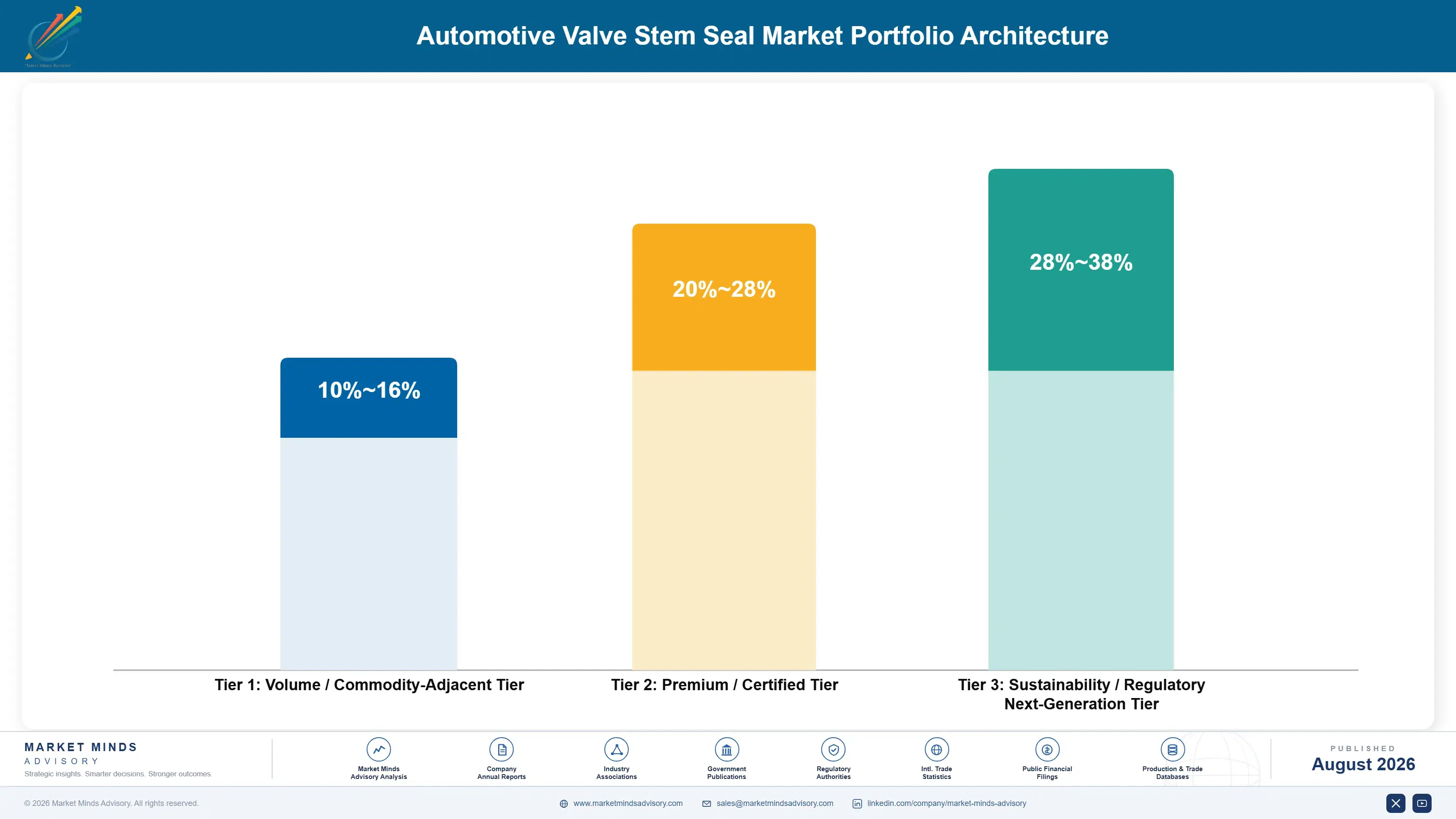
The valve stem seal portfolio splits across three tiers with meaningfully different margin economics: volume commodity-adjacent NBR and ACM formats carrying gross margin near 10 to 16%, premium certified silicone and PTFE formats near 20 to 28%, and FKM seal systems commanding the highest gross margin of the three tiers at 28 to 38% across nearly every producing region worldwide today and increasingly well beyond.
Manufacturers competing purely in the volume tier face persistent price compression from regional manufacturers scaling aggressively on cost alone, while those with FKM capability capture considerably fatter margin pools that keep expanding as engine builder heat resistance mandates broaden across major fleet and consumer accounts nationwide and increasingly well beyond their traditional domestic markets and established multi year distribution networks.

The clearest strategic tension sits between chasing volume share in commodity NBR categories and committing capital toward the compounding infrastructure premium tiers genuinely require, a tradeoff nearly every major manufacturer in this market is actively navigating this year as FKM demand accelerates and engine builder heat resistance requirements tighten steadily across most regulated end-use categories and adjacent commercial segments nationwide and beyond.

Volume / Commodity-Adjacent Tier

Standard NBR and ACM formats serving routine fleet and dealer needs, priced primarily on elastomer cost and molding scale rather than differentiated engineering or certified durability performance features and warranty coverage today.
Gross Margin: 10%-16%

Premium / Certified Tier

Certified silicone and PTFE formats engineered for durability and process consistency, commanding meaningful premiums through validated production performance and testing documentation that engine builders now require for most regulated categories.
Gross Margin: 20%-28%

Sustainability / Regulatory / Next-Generation Tier

FKM seal systems designed for documented heat resistance and emissions compliance, engineered for extended wear outcomes and validated compounding data that increasingly anchor long-term engine builder procurement decisions across most major regulated accounts.
Gross Margin: 28%-38%
automotive-valve-stem-seal-market-trends-portfolio-architecture-1787315618409

High-value Sub-segments and Strategic Watch-out

FKM Fleet and Consumer Systems

FKM seal systems serving major fleet and consumer manufacturers represent the highest value, fastest growing pool in this market, combining premium pricing with expanding heat resistance linked procurement mandates across large multinational engine builder accounts spanning multiple continents and steadily growing wider still across most regulated platform categories.
Gross Margin: 32%-38%

Certified Silicone and PTFE Formats

Certified silicone and PTFE formats serving regulated fleet categories offer strong value with moderate growth, sustained by steady replacement demand and durability certification requirements that limit competitive entry from smaller, less differentiated regional manufacturers lacking dedicated compounding infrastructure and testing capability of their own to fully match.
Gross Margin: 22%-28%

Standard NBR and ACM Formats

Standard NBR and ACM formats remain the volume core of the market, delivering steady but comparatively thin margin on routine engine builder shipments across most established distribution channels nationwide today, sustained mainly by recurring restocking cycles rather than any meaningful pricing power or genuine differentiation.
Gross Margin: 10%-14%

PTFE and Low-Friction Formats

PTFE and low-friction premium formats warrant strategic monitoring as adoption in premium fleet and industrial categories could accelerate quickly if major manufacturers standardize around the format industry wide, a shift that would meaningfully reshape competitive positioning among mid-tier manufacturers currently underexposed to this fast growing category overall.
Gross Margin: 16%-22%

Why Seal Demand Compounds

Valve stem seals function closer to an annuity purchase than a one time capital good, since every engine assembled represents a discrete restocking event tied to a manufacturer's ongoing production cycle rather than a single upfront decision. This recurring consumption pattern means manufacturers with entrenched engine builder relationships capture predictable, multi year procurement volume that compounds steadily as underlying hybrid engine and durability activity expands across fleet and consu
Adoption stickiness and depth vary meaningfully by end-use vertical. Major powertrain manufacturers and diesel engine builders, operating under strict durability and certification protocols, rarely switch molding suppliers once a qualified relationship is established, since requalification carries genuine cost and brand risk. General retail and aftermarket buyers switch more readily, treating standard formulations as a comparatively interchangeable commodity input priced mainly on cost rather than validated supplier continuity.

A generational shift is underway in buyer profiles too. Younger procurement teams entering fleet and engine builder purchasing roles increasingly weight documented heat resistance outcomes and wear resistance proficiency alongside price and reliability, a departure from purchasing habits common a decade ago. This shift is accelerating FKM seal adoption faster than pure economics alone would predict, particularly across large multinational fleet chains.
automotive-valve-stem-seal-market-trends-end-use-penetration-index-1787315618896

Where Manufacturers Should Focus Now

These are among the four positions where our research anticipates prominent divergence between winners and laggards over the coming forecast period. Each is grounded in the demand model, the regulatory perimeter, and the announced capacity pipeline.
01 / FKM SYSTEMS INVESTMENT

Build validated FKM heat resistant seal capability ahead of mandates

Durability linked procurement is shifting from a preference to a specification requirement across fleet and consumer engine builders, and manufacturers without validated FKM systems risk exclusion from future contract renewals entirely across most major regulated categories. Building this capability takes seven to eleven months of engineering and testing work, so manufacturers that start now will have validated portfolios in place before mandates tighten further across major engine builder accounts nationwide. Waiting until demand is fully proven means competing for contracts against rivals who already hold certification and established trust.
02 / REGIONAL CAPACITY POSITIONING

Expand South Asian molding footprint ahead of demand

India's diesel engine and commercial fleet infrastructure is expanding faster than any other major regional market, yet most established manufacturers still serve this demand through remote molding carrying longer lead times and considerably higher landed costs than local rivals. Manufacturers that commit to dedicated regional capacity now will capture disproportionate share of this demand pool before local competitors scale production to match rising volume across the wider region. This window will likely narrow within the next several years as domestic capacity investment accelerates across most neighboring markets too.
03 / FEEDSTOCK SUPPLY SECURITY

Lock in long-term fluoropolymer contracts before the next volatility cycle

Fluoropolymer price swings tied to producer capacity constraints have already cost smaller manufacturers meaningful margin in recent cycles, and this pattern shows no sign of abating given tightening global fluoropolymer capacity across most producing regions. Manufacturers relying on spot market purchasing remain fully exposed every time a major producing region faces an unplanned supply disruption of its own making. Securing multi year fixed-price agreements now protects margin through the next volatility cycle rather than reacting only after prices have already moved sharply higher.
04 / CERTIFICATION PORTFOLIO BREADTH

Expand FKM and PTFE certification across the line

Engine builders managing complex, multi-site fleet programs increasingly consolidate purchasing with manufacturers offering full certified portfolio breadth rather than maintaining separate relationships for each seal format they individually require across their operations. Manufacturers with narrow certification coverage lose these consolidated contracts to rivals capable of serving a customer's entire powertrain protocol from a single qualified source and relationship. Building this breadth requires sustained compounding investment, but it converts fragmented orders into durable, full-portfolio engine builder relationships spanning multiple years and renewal cycles.

Engagement Snapshot From the Field

A live engagement with an industry participant carrying material or product regulatory and market exposure ahead of a defining policy shift, showing how our research translates into a defensible multi-year portfolio strategy.
MARKET MINDS ADVISORY · CLIENT ENGAGEMENT SUMMARY
Automotive Valve Stem Seal Producer Strategic Portfolio Review and Transition Roadmap 2026·Investment Scenario on Automotive Valve Stem Seal Exposure Evaluation 2025-26
CLIENT PROFILE
The client is a regional engine rebuilder managing multiple powertrain overhaul programs across southern Germany, supplying commercial fleet operators with rebuilt diesel and gasoline engine platforms. The organization purchases several hundred thousand valve stem seals annually across NBR, FKM, and silicone formats, managing procurement through a single centralized purchasing function that had historically prioritized unit cost over documented durability performance.
STRATEGIC CHALLENGE
The client faced rising warranty cost complaints tied to inconsistent oil consumption control across seasonal rebuild batches, while its centralized procurement structure meant purchasing decisions were made almost entirely on price without systematic evaluation of durability impact across supplier options. Leadership needed an independent assessment of FKM conversion feasibility and supplier consolidation opportunity before committing capital to a sourcing strategy overhaul across its rebuild lines.
MMA APPROACH
MMA conducted structured interviews with powertrain engineering and procurement leaders across all facilities alongside a detailed cost and wear performance audit of the rebuilder's top twelve seal suppliers, benchmarking pricing, heat resistance data, and certification coverage against the broader competitive landscape. The engagement combined primary supplier interviews with MMA's proprietary powertrain component cost model to quantify FKM conversion payback under several plausible adoption scenarios.
KEY FINDINGS
  1. Converting from standard NBR to FKM formats across the top four highest-volume rebuild lines could reduce oil consumption complaints by an estimated 19 to 27% within one year.
  2. Consolidating from twelve regional suppliers to five qualified partners could reduce blended unit cost by roughly 6 to 10% through volume purchasing and standardized specification terms.
  3. Two of the rebuilder's existing suppliers already held FKM certification the rebuilder was not systematically using, representing immediate cost avoidance without new supplier qualification work.
  4. Facility-level procurement teams lacked shared visibility into supplier wear data, causing repeated renegotiation of terms already secured by sister facilities operating under the same corporate umbrella.
CLIENT PROFILE
The client is a regional engine rebuilder managing multiple powertrain overhaul programs across southern Germany, supplying commercial fleet operators with rebuilt diesel and gasoline engine platforms. The organization purchases several hundred thousand valve stem seals annually across NBR, FKM, and silicone formats, managing procurement through a single centralized purchasing function that had historically prioritized unit cost over documented durability performance.
STRATEGIC CHALLENGE
The client faced rising warranty cost complaints tied to inconsistent oil consumption control across seasonal rebuild batches, while its centralized procurement structure meant purchasing decisions were made almost entirely on price without systematic evaluation of durability impact across supplier options. Leadership needed an independent assessment of FKM conversion feasibility and supplier consolidation opportunity before committing capital to a sourcing strategy overhaul across its rebuild lines.
MMA APPROACH
MMA conducted structured interviews with powertrain engineering and procurement leaders across all facilities alongside a detailed cost and wear performance audit of the rebuilder's top twelve seal suppliers, benchmarking pricing, heat resistance data, and certification coverage against the broader competitive landscape. The engagement combined primary supplier interviews with MMA's proprietary powertrain component cost model to quantify FKM conversion payback under several plausible adoption scenarios.
KEY FINDINGS
  1. Converting from standard NBR to FKM formats across the top four highest-volume rebuild lines could reduce oil consumption complaints by an estimated 19 to 27% within one year.
  2. Consolidating from twelve regional suppliers to five qualified partners could reduce blended unit cost by roughly 6 to 10% through volume purchasing and standardized specification terms.
  3. Two of the rebuilder's existing suppliers already held FKM certification the rebuilder was not systematically using, representing immediate cost avoidance without new supplier qualification work.
  4. Facility-level procurement teams lacked shared visibility into supplier wear data, causing repeated renegotiation of terms already secured by sister facilities operating under the same corporate umbrella.
RECOMMENDED STRATEGY
Phase 1: Phase 1 (FKM Conversion): Converts the top four highest-volume rebuild lines from standard NBR to FKM formats within two quarters, prioritizing suppliers with existing heat resistance certification. Phase 2: Phase 2 (Supplier Consolidation): Consolidates the supplier base from twelve regional suppliers to five qualified partners across all facilities, standardizing specification terms and pricing structures. Phase 3: Phase 3 (Data Centralization): Centralizes wear and supplier performance data visibility across all facilities, establishing shared scorecards to prevent redundant renegotiation of secured terms.
OUTCOME
Within the first two quarters of implementation, the client reported oil consumption complaint reductions of approximately 23% (client-reported, unverified by MMA) across converted rebuild lines, alongside measurably faster procurement cycle times once shared scorecards replaced fragmented facility-level negotiation. The supplier consolidation program is proceeding into its second phase across additional facilities.

Frequently Asked Questions

Foundational context covering the market sizes, CAGR, scope, country, region and competition that inform every finding below. This section is provided to cover basics and most often pre-purchase conversations, answered from the MMA Primary Research Dataset.

What is the current size of the Automotive Valve Stem Seal Market?

The valve stem seal market reached an estimated 1.8 billion dollars in 2025, according to MMA Primary Research Dataset, July 2026. This reflects steady demand growth across NBR, FKM, and silicone applications worldwide.

How large will the Automotive Valve Stem Seal Market be by 2036?

MMA projects the market will reach approximately 2.72 billion dollars by 2036, nearly 1.45 times its 2026 value. Growth is driven by expanding hybrid engine production and rising FKM adoption.

What is the CAGR for the Automotive Valve Stem Seal Market 2026 to 2036?

The market is projected to grow at a compound annual rate of 3.8% between 2026 and 2036. Bull and bear scenarios range from 2.6% to 5.0% depending on FKM adoption pace.

Which segment is growing fastest?

FKM seals are growing fastest at roughly 6.9% annually, about 1.82 times the overall market rate. Demand is driven by manufacturer heat resistance requirements across major fleet and consumer accounts.

Who are the major companies in the Automotive Valve Stem Seal Market?

Leading manufacturers include Freudenberg, Federal-Mogul, Dana, NOK, and Trelleborg, together holding an estimated 36% combined production capacity share. Competition remains moderately fragmented across regional markets.

Which country is growing fastest?

India leads regional growth at roughly 5.6% annually, driven by rapidly expanding organized diesel engine and commercial fleet infrastructure. Domestic molding capacity is scaling to serve this demand and reduce import dependency.

Report Segmentation Architecture

The full report scope spans multiple orthogonal segmentation dimensions, with cross-tabulated demand data provided for each dimension pair. Coverage extends further to regional breakdowns, trend trajectories, and the competitive detail needed to support segment-level decision-making.

By Material Composition

  • NBR Seals
  • FKM Seals
  • PTFE Seals
  • Silicone Seals
  • ACM Seals

By End-Use Industry

  • Passenger Vehicles
  • Light Commercial Vehicles
  • Heavy Commercial Vehicles
  • Off-Highway Equipment
  • Marine and Industrial Engines

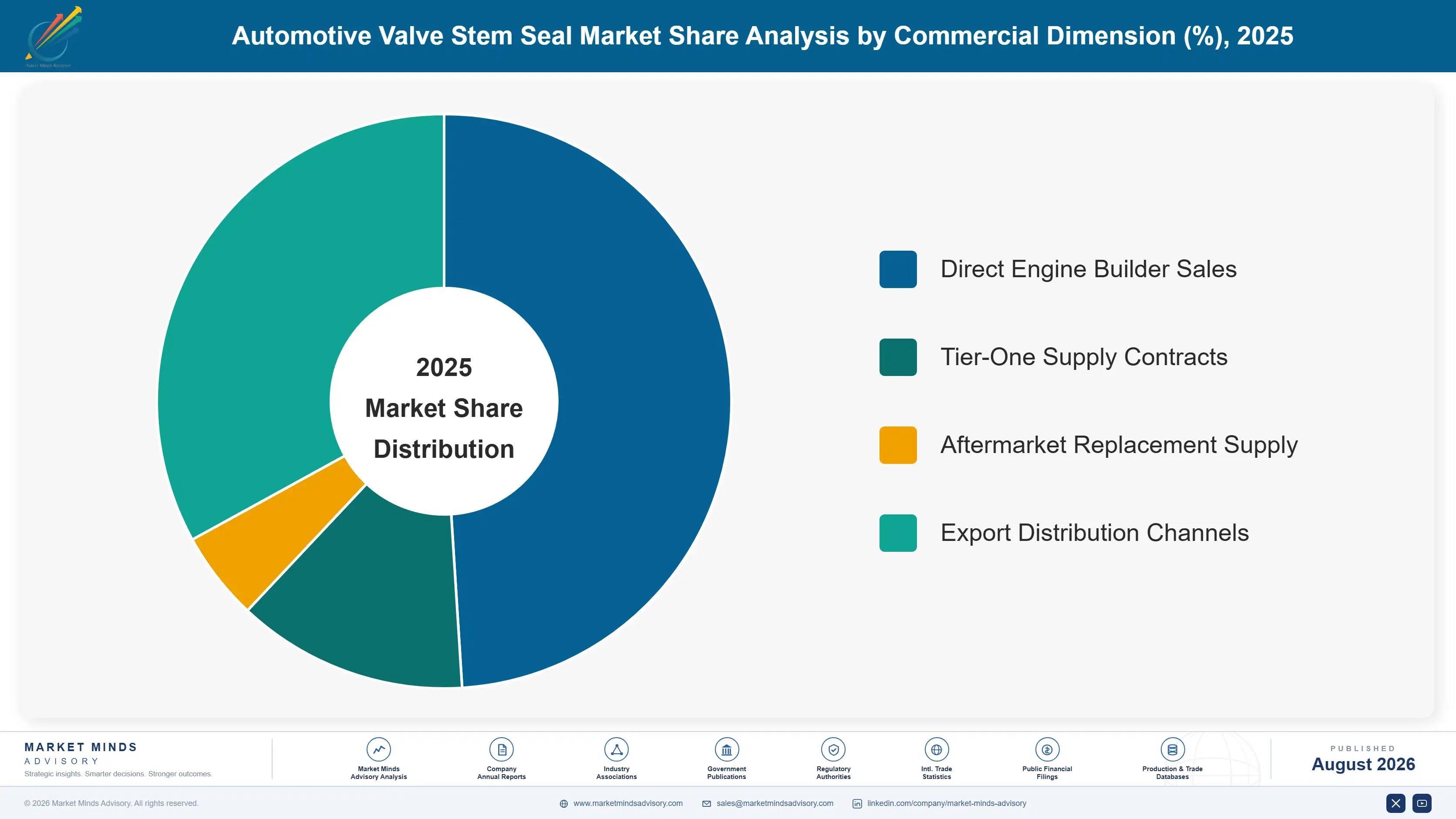
By Commercial Dimension

  • Direct Engine Builder Sales
  • Tier-One Supply Contracts
  • Aftermarket Replacement Supply
  • Export Distribution Channels

By Region

  • North America
  • Western Europe
  • East Asia
  • South Asia and Pacific
  • Latin America
  • Middle East and Africa
  • Eastern Europe

Scope, Methodology, and Coverage

Every figure in this report is reproducible from documented input assumptions. The scope below maps the historical period, the forecast horizon, the segmentation dimensions, and the countries covered, alongside the underlying primary and qualitative methodology.
Historical Period
2020 to 2025
Forecast Period
2026 to 2036
Base Year
2025 (USD billions; MMA Primary Research Dataset, August 2026)
Market Definition
The valve stem seal market comprises NBR, FKM, PTFE, silicone, and ACM seals installed in passenger, commercial, and off-highway engines. It excludes standalone piston rings and non-automotive industrial sealing products sold as separate components.
Quantitative Units
USD billions (current prices); million units of product volume where applicable
Segmentation Dimensions
By Material Composition; By End-Use Industry; By Commercial Dimension; By Region
Regions Covered
North America, Western Europe, East Asia, South Asia and Pacific, Latin America, Middle East and Africa, Eastern Europe
Countries Covered
China, Japan, South Korea, USA, Canada, Mexico, Germany, France, UK, Italy, India, Australia, Indonesia, Vietnam, Thailand, Brazil, Argentina, Chile, UAE, Saudi Arabia, Israel, Egypt, South Africa, Nigeria, Turkey, Poland, Russia, Czech Republic, Spain, Sweden, and additional markets relevant to this sector
Key Companies Profiled
Freudenberg Group, Federal-Mogul LLC, Dana Incorporated, NOK Corporation, Trelleborg AB, Corteco GmbH, Cooper Standard Holdings Inc, Eagle Industry Co Ltd, SKF Group, Ishikawa Gasket Co Ltd, Nishikawa Rubber Co Ltd, Parker Hannifin Corporation, ElringKlinger AG, Hutchinson SA, Toyoda Gosei Co Ltd, Sumitomo Riko Company Limited, Mahle GmbH, Victor Reinz, Fel-Pro Inc, Reinz-Dichtungs GmbH
Quantitative Methodology
Primary survey, n=3,800 respondents, Q4 2025, six countries; demand-side model with trade association cross-validation
Qualitative Methodology
47 expert interviews, Q4 2025; applied to validate demand model assumptions, identify emerging dynamics, and assess competitive positioning
Report Format
PDF and XLSX data workbook (Word format preview document)
Publisher
Market Minds Advisory
Report Code
MMA-2026-AUT-114
Published
August 2026
Contact
sales@marketmindsadvisory.com | www.marketmindsadvisory.com

Purchase the full Automotive Valve Stem Seal Market Report (2026 to 2036).

This report provides a comprehensive analysis of the global valve stem seal market, covering market sizing, segmentation by material composition, and regional demand dynamics across all seven world regions. It examines competitive positioning among leading manufacturers and the shift toward FKM systems driven by engine builder heat resistance requirements. Fluoropolymer cost exposure and mitigation strategies receive dedicated treatment, alongside forecast scenarios through 2036 and portfolio margin analysis by product tier. The report closes with an anonymized client case study illustrating sourcing strategy conversion and measured commercial outcomes.
Segmentation by material composition and durability profile
All seven regional markets sized and forecast
Competitive benchmarking of top twenty manufacturers
Fluoropolymer cost exposure and mitigation analysis
Portfolio margin economics across three product tiers
Anonymized client case study and strategic recommendations

Built For The People Who Decide

From boardroom strategy to bench-side execution, this report is read cover-to-cover by leaders shaping the next decade of their industry, turning demand scenarios, market dynamics and valuation benchmarks into decisions.
CXOs/ Presidents/ VPs/ Managers
M&A and Corporate Development
Strategy Teams and R&D Heads
Procurement and Product Directors
Regulatory and Compliance Leaders
Investor Relations and Equity Analysts