Market Minds Advisory
Automotive Timing Chain and Belt Market

Automotive Timing Chain and Belt Market: Wet Belt Retreat, Hybrid Persistence and a Long Aftermarket Tail

Belt-in-oil drives grew fast and then collided with warranty reality, hybrids are extending internal combustion further than anyone planned, and the ageing global parc keeps replacement kit demand alive well past new fitment decline.

Lead Analyst

David Horsley

Published

September 2026

Make Smarter Decisions with Customized Research Insights

Request a free sample report and evaluate market opportunities, growth trends, and competitive dynamics relevant to your business needs.

2025 MARKET VALUE$9.2BMarket Size 2025
2036 FORECAST VALUE$13.6BBase Case , 2026 to 2036
CAGR 2026 TO 20363.6 %Bull 4.8% / Bear 2.4%
INCREMENTAL OPPORTUNITY$4.0BNet 10- year value creation
EXPANSION MULTIPLE1.42x2036 value over 2026 base
Strategic Levers
M&A Pipeline
Regional Outlook
Country Rankings
Competitive Intelligence
Segmental Deep-dive
Call-Us : 91 93563 13602

Executive Snapshot and Market Trajectory

Every forecast written five years ago had this market dying quietly as batteries replaced engines. That has not happened. Hybrid architectures still need a timing drive, plug-in hybrids need a fully engineered one, and manufacturers keep extending internal combustion programmes that were scheduled to end years ago.
Belt-in-oil drives grow at 5.4%, a full 1.50 times the market rate, because running the belt inside the oil bath cuts parasitic friction losses measurably and helps small turbocharged engines meet fleet carbon dioxide targets. East Asia holds 34% of global value, above the standard regional band, because China builds roughly 30 million vehicles annually and Japan hosts the deepest timing drive engineering base found anywhere in this industry, by a wide margin.
Concentration sits at 46% for the top five, and the interesting part is where the money is moving. New engine fitment volume is falling across Europe and broadly flat in North America. Replacement kits are not falling at all: the global parc keeps ageing steadily, belts have to be changed on schedule, and the aftermarket now carries a growing share of everything genuinely worth having in this category.
Market Definition
This report covers engine timing drive systems for on-highway vehicles, spanning timing chains, timing belts, belt-in-oil drives and the tensioners, guides and sprockets supplied as part of a complete drive set, across passenger vehicles, light and heavy commercial vehicles and motorcycles. Accessory belt drives, balance shaft drives sold separately, oil pump drives, camshafts and complete engine assemblies are excluded from the sizing.
Base Year Value
$9.2B in 2025 (MMA Primary Research Dataset, August 2026)
Forecast Period
2026 to 2036, eleven discrete annual values
CAGR
3.6% base case. Bull 4.8%. Bear 2.4%.
Fastest Growth Segment
Belt-in-Oil Timing Belt: 5.4% CAGR
Fastest Growth Country
India: 6.0% CAGR
Fastest Growth Region
South Asia and Pacific: 5.8% CAGR
Largest Region
East Asia: 34% of 2025 global value
Market Leaders
BorgWarner, Tsubakimoto Chain, Schaeffler, Gates Industrial and Continental lead on timing drive set shipment volume. Source: MMA Analysis, July 2026.
Primary Survey
n=3,800 procurement and R&D decision-makers, Q4 2025, six countries
Methodology
Demand-side build-up, cross-validated against public data, 47 expert interviews

Automotive Timing Chain and Belt Market Forecast Scenarios

automotive-timing-chain-belt-market-trends-size-forecast-scenario-1787315748059
Between 2020 and 2025 the market compounded at 2.6%, which understates how eventful the period was. New fitment volume fell as European engine production contracted and battery electric share climbed. What held the total up was content and aftermarket: belt-in-oil systems arrived at higher prices than the dry belts they replaced, and an ageing global parc pushed replacement kit demand steadily upward throughout.
The base case at 3.6% rests on three mechanisms. Hybrid architectures keep internal combustion in the fleet far longer than pure battery forecasts assumed, and every hybrid still carries a timing drive. Aftermarket replacement grows on a parc that keeps expanding and ageing, and belt intervals arrive whether or not anybody is buying new cars. Emerging market engine production, particularly India and Southeast Asia, adds genuine unit growth rather than offsetting decline elsewhere.
The bull case at 4.8% turns on hybrid share rising faster than battery electric across the major markets, which would extend timing drive fitment well into the 2040s. The bear case at 2.4% is a sharper battery transition combined with belt-in-oil retreat: manufacturers reverting to chain on warranty grounds lose the price uplift that wet belts brought, and the mix reverts toward lower-value product.

What Actually Sustains Timing Drive Value

A timing drive keeps the camshaft turning in fixed relationship to the crankshaft. Get it wrong by a few degrees and the engine runs badly. Get it wrong by more and the valves meet the pistons. That failure consequence is why this component gets engineered far more carefully than its unit price suggests.
TOP FIVE CONCENTRATION46%Share held by the five largest timing drive suppliers
AVERAGE SET PRICE$46Typical realised price for a complete timing drive
AFTERMARKET VOLUME SHARE37%Portion of volume destined for replacement and repair
STEEL COST SHARE39% of COGSWire, plate and steel content as portion of cost
BELT SERVICE INTERVAL90,000 milesTypical distance before a dry belt requires replacement
PROGRAMME LENGTH9 yearsTypical production run before an engine family changes
The commercial history of the past decade runs through one decision. Chasing fleet carbon dioxide targets, European manufacturers moved small turbocharged engines to belt-in-oil drives, where a specially compounded belt runs submerged in engine oil and cuts friction losses against a chain. The physics worked. What followed was less comfortable: belt degradation in oil produced debris that blocked oil pickups, and the resulting warranty exposure has pushed several manufacturers back toward chain on subsequent programme revisions.
Meanwhile the aftermarket keeps growing regardless. Roughly 37% of volume already goes to replacement, and that share rises every year as the global parc ages and new fitment softens. A belt kit is a scheduled maintenance item with a defined interval, which makes the revenue considerably more predictable than engine production, and considerably better margin as well.
"The wet belt story is the most instructive thing in this market. An engineering solution that genuinely worked on the dynamometer created a warranty problem large enough to reverse a decade of specification direction, and the suppliers who never stopped making chains are quietly winning that argument back."
Practice Director, Automotive Components, Market Minds Advisory · MMA Automotive

Market Trends

Belt-In-Oil Adoption Meets Warranty Reality Across Programmes

Wet belt drives spread rapidly through small turbocharged engines because running the belt in oil cuts friction losses and helps meet fleet carbon dioxide limits. The engineering worked on test. What followed in service was belt material degradation producing debris that restricted oil pickup screens, and the warranty exposure has been substantial enough that several manufacturers reverted to chain on subsequent revisions. The technology is not finished, since improved compounds and revised service intervals address much of the problem, but specification momentum has very clearly slowed across European engine programmes over the past two years.
Market Impact: Serves 290 million vehicle parc
Hybrid Architectures Extend Internal Combustion Fitment Substantially

Hybrid share is rising faster than battery electric across North America, Japan and increasingly Europe, and every hybrid carries an engine and therefore a timing drive. Plug-in hybrids carry fully engineered drives designed for frequent stop-start cycling, which is a considerably more demanding duty cycle than continuous running. The commercial consequence is that timing drive fitment extends well past the dates pure battery forecasts assumed, and suppliers who wrote the business down are now finding programmes extended rather than cancelled. Engine families scheduled to end are being revised and extended instead.
Market Impact: Adds 3 million annual engines

Market Opportunities and Growth Drivers

Ageing Global Parc Drives Scheduled Replacement Kit Demand

Aftermarket already takes 37% of volume, and the mechanism behind it is a maintenance schedule rather than any purchasing decision. A dry timing belt has a defined replacement interval near 90,000 miles, and skipping it destroys the engine, which makes the work close to non-discretionary for anyone intending to keep the vehicle. North America alone runs above 290 million vehicles at an average age near thirteen years. Replacement demand of that character is considerably less cyclical than new engine production, and it carries far better margin per set as well.
Market Impact: Removes 18% of addressable units

Emerging Market Engine Output Adds Genuine Unit Growth

India, Southeast Asia and Latin America are still adding engine production capacity rather than merely replacing it, which distinguishes them sharply from Europe and Japan, where engine output has been contracting for a decade. Indian motorcycle and three-wheeler production alone consumes chain volume on a scale that Western markets have no equivalent for, and internal combustion remains firmly dominant across nearly every price segment there. Local content requirements pull component manufacturing in behind assembly, which is steadily reshaping where new timing drive capacity gets built and who ends up supplying it.
Market Impact: Costs 25% price uplift

Market Restraints and Challenges

Battery Electric Vehicles Eliminate The Component Entirely

A battery electric vehicle has no camshaft, no crankshaft and therefore no timing drive at all. This is not a substitution threat where a cheaper alternative takes share; it removes the addressable unit completely. The root cause is powertrain architecture rather than any competitive weakness. Commercially the effect is concentrated in exactly the markets with the highest content per engine, meaning Western Europe and China. Participants are responding by moving into electric vehicle chain and belt applications such as reduction drives and thermal system pumps, and by building aftermarket depth ahead of the fitment decline.
Market Impact: Reverses 30% of adoption

Wet Belt Warranty Exposure Reverses Specification Momentum

Belt-in-oil drives were the growth story of the past decade and are now the reputational problem. The root cause is material: belt compounds degrade in hot engine oil over time, and the resulting debris restricts oil pickup screens on some engine families, producing failures well inside expected service life. Commercially this costs suppliers the entire price uplift that wet belts carried over conventional dry ones. Participants are responding with revised compounds, shortened published service intervals, redesigned pickup screening and, where customers insist on it, straightforward reversion to chain drives on programme revisions.
Market Impact: Extends fitment 8 years longer
4 additional market trends, 2 additional growth drivers, and 3 additional restraints and challenges are covered in the full report. Contact sales@marketmindsadvisory.com to access the complete intelligence.

Segment CAGR and Growth Architecture

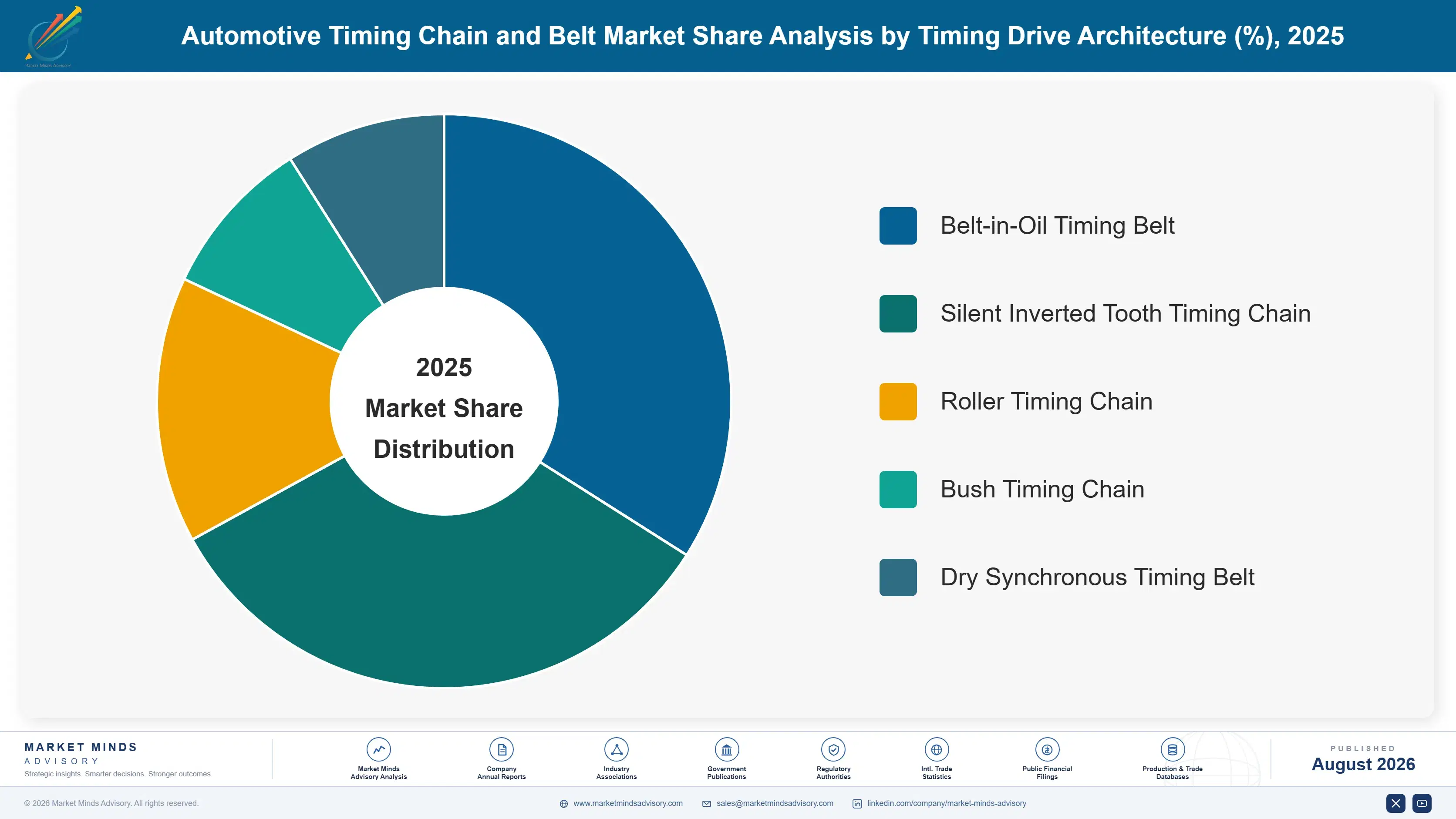
Segmentation follows timing drive architecture, because the choice between chain and belt, and between running dry or in oil, determines friction losses, service interval, noise behaviour, realised price and the engineering capability a supplier needs. Engine family, vehicle class, customer type and sales channel all sit downstream of that single architectural decision taken during engine development.
automotive-timing-chain-belt-market-trends-market-share-analysis-1787315748664

Belt-in-Oil Timing Belt

The fastest segment at 5.4%, a full 1.50 times the market rate, covering drives where a specially compounded toothed belt runs submerged in engine oil rather than dry behind a cover. Friction is the whole engineering argument. A wet belt cuts parasitic losses measurably against a chain, which matters directly when a manufacturer is chasing fleet carbon dioxide limits on a small turbocharged engine. The problem has been material durability: belt compounds degrade in hot oil over time and the resulting debris restricts oil pickup screens, producing failures inside expected service life. Revised compounds and shortened service intervals address much of it, but specification momentum across European programmes has clearly slowed.
CAGR 5.4%

Silent Inverted Tooth Timing Chain

Growing at 4.4% on inverted tooth chains, where flat link plates engage the sprocket teeth directly rather than through rollers, which is what makes the drive markedly quieter than conventional roller construction. Noise behaviour drives adoption. Cabin refinement expectations have risen steadily and engine downsizing removed much of the masking noise that larger engines provided, so timing drive whine became audible in ways it never used to be. The segment also benefits directly from wet belt reversion, since manufacturers moving away from belt-in-oil generally specify silent chain rather than roller. Manufacturing capability is the barrier, because link plate forming and pitch consistency both demand tooling that very few suppliers actually hold.
CAGR 4.4%
Full segment breakdown across 5 segments available in the complete report.

Regional Architecture and Country Demand Map

East Asia holds 34% of global value on Chinese engine output and the deepest timing drive engineering base in the industry. North America follows on large-displacement chain drives and an enormous aftermarket, while growth runs fastest across South Asia and Pacific on engine and motorcycle output together.

East Asia

Note: East Asia holds 34% against a 22 to 30% band because China builds roughly 30 million vehicles annually and Japan hosts the deepest timing drive engineering base anywhere. Tsubakimoto and Daido Kogyo both design chain systems that Western manufacturers specify on their own programmes, and Bando and Mitsuboshi hold comparable positions in belts. Chinese chain producers around Hangzhou and Zhejiang supply domestic engine plants and export aggressively into aftermarket channels. What makes the region unusual is that battery electric share is the world's highest while internal combustion output remains enormous, so timing drive demand and its eventual replacement are happening simultaneously in the same market. Both trajectories are running at full speed.
Share: 34% | CAGR: 4.8% (2026 to 2036)

North America

Displacement is what makes this region different. Large-capacity engines in full-size pickups and body-on-frame utilities almost universally use chain drives rather than belts, and those platforms are electrifying more slowly than any other segment in the world. The installed parc runs above 290 million vehicles at an average age near thirteen years, which sustains a replacement chain and belt kit business considerably larger than new engine production alone would generate. Belt-in-oil adoption here has been complicated by well-publicised warranty problems on downsized turbocharged engines, and several manufacturers have reverted to chain on subsequent programme revisions. Chain drives dominate here to a degree found in no other region, and the replacement kit business behind them is correspondingly large.
Share: 22% | CAGR: 3.1% (2026 to 2036)
Regional intelligence for 5 additional markets available in the complete report: Western Europe, South Asia and Pacific, Latin America, Middle East and Africa, Eastern Europe. Contact sales@marketmindsadvisory.com.
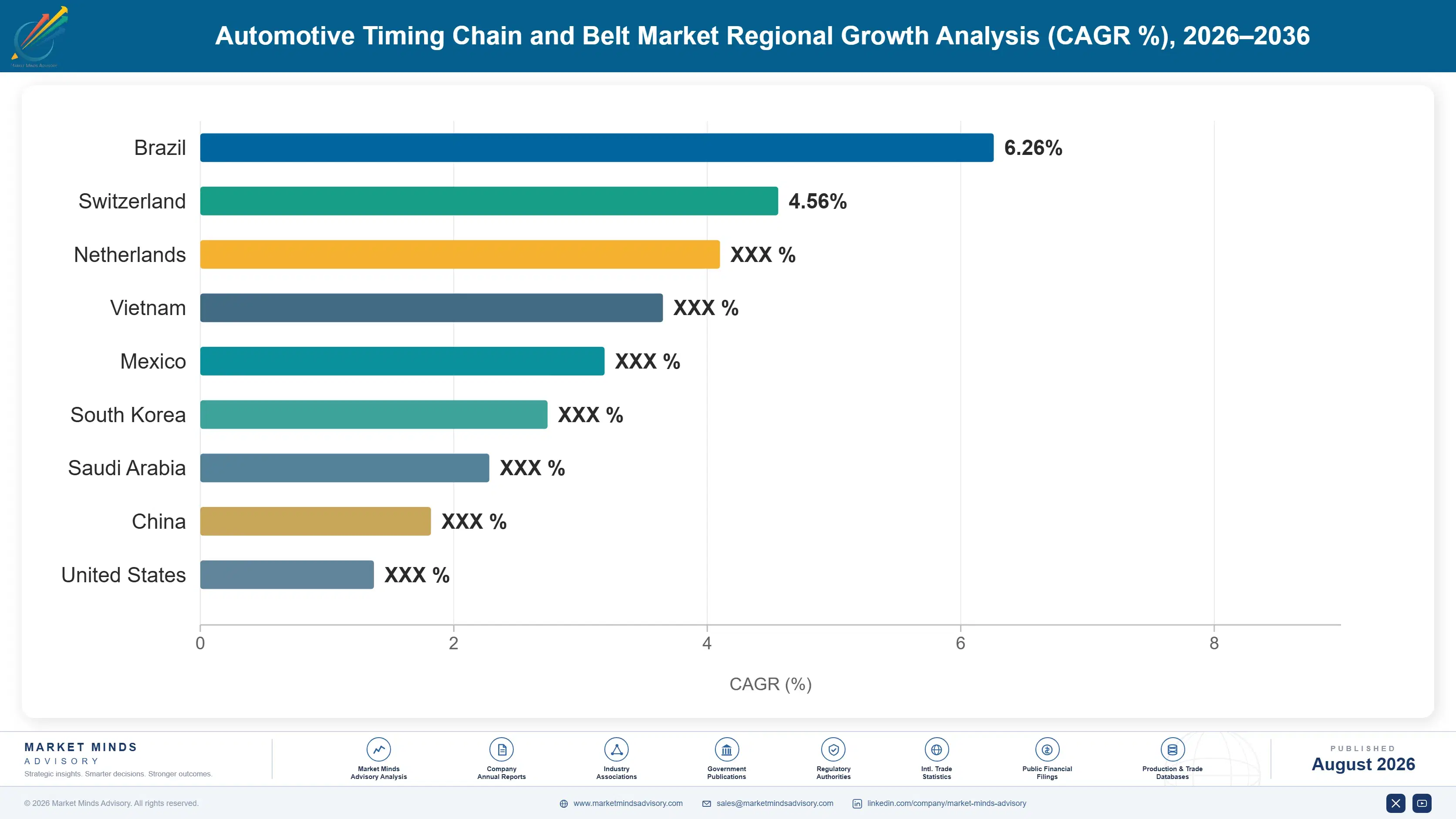
automotive-timing-chain-belt-market-trends-country-cagr-analysis-1787315749224

Where Timing Drive Margin Is Won

Four positions separate suppliers holding value in a declining fitment market from those watching engine programmes end: building aftermarket kit depth ahead of the decline, winning complete drive set scope rather than single components, holding both chain and belt capability through the specification reversal, and converting existing chain manufacturing expertise into electric vehicle drive applications.

Build Aftermarket Kit Depth Before Fitment Declines

Aftermarket already takes 37% of volume and earns 18 to 24 points more gross margin than original equipment supply, because a workshop buying a timing kit is solving a scheduled maintenance problem rather than negotiating a multi-year contract. Suppliers building catalogue coverage and distribution reach now capture the long tail from engine families still being built today, revenue that arrives for fifteen years after the last unit leaves the plant. Those waiting until fitment declines to act will find the distributor shelf space has already been taken by somebody else.
Market Impact: Adds 24 margin points across all ki

Win Complete Drive Set Scope Not Single Components

A timing drive is a chain or a belt plus its tensioners, guides, sprockets and very often a water pump, and suppliers quoting the complete set realise 2.6 times the revenue per engine of those supplying the chain alone. Set scope also removes the interface risk that engine engineers most dislike, since a single supplier then owns the whole system behaviour rather than several arguing about whose part caused the noise. Winning set scope requires validation capability across every one of those components, which is exactly where component specialists consistently fall short.
Market Impact: Realises 2.6 times the revenue per

Hold Chain And Belt Capability Through The Reversal

Belt-in-oil specification momentum has slowed considerably and several manufacturers have already reverted to chain, which strands any supplier holding only one architecture. Those able to quote either technology follow the customer wherever the engineering argument eventually lands, and they hold 12% to 18% higher programme win rates as a direct result of that flexibility. The capability costs duplicated validation work and tooling investment, which is precisely why most suppliers chose a side early, and precisely why the few who did not are now taking programmes from competitors unable to follow the customer.
Market Impact: Lifts programme win rate by up to 1

Convert Chain Expertise Into Electric Drive Applications

Battery electric vehicles have no timing drive, but they do use chains and belts in reduction drives, thermal management pumps and accessory systems, and the precision manufacturing capability behind them transfers across directly. Suppliers making that move capture between 15% and 22% of the content per electric vehicle that they lost when the engine disappeared from the platform. It is not a full replacement, and pretending otherwise simply misleads investors, but it converts an asset base otherwise scheduled for write-down into something with a genuine future rather than a run-off.
Market Impact: Recovers 22% of the lost per vehicl

Who Controls the Margin Pool

Concentration sits at 46% for the top five measured on drive set shipment volume, the basis used throughout this section. BorgWarner and Tsubakimoto lead on chain systems across passenger and commercial engine programmes globally, while Gates and Continental hold the strongest belt positions and Schaeffler competes across both architectures. The gap to the next tier is moderate, and it narrows in the aftermarket where catalogue coverage matters more than original equipment relationships.
Competitive activity runs on three fronts. Architecture breadth is the first, since the wet belt reversal has stranded suppliers holding only one technology. Aftermarket catalogue depth is the second, and it is where several participants are investing hardest as fitment volume softens. The third is electric vehicle application development, where chain and belt precision manufacturing transfers into reduction drives and thermal system components.

Pressure arrives from two directions. Chinese chain manufacturers compete aggressively on delivered cost in aftermarket channels where brand matters less than availability. Separately, engine programme cancellations remove positions that suppliers expected to run for years. Rankings will shift on who built aftermarket depth before fitment declined, which is a decision most participants are taking right now.
automotive-timing-chain-belt-market-trends-company-positioning-matrix-1787315749806

Competitive Moat and Risk Dimensions

BORGWARNER

Moat: Complete drive system scope

Supplying chains, tensioners, guides, sprockets and variable cam timing as an integrated system puts the whole drive behaviour inside one company, which removes the interface arguments engine engineers dislike most. That system scope realises far more revenue per engine than component supply and makes the position considerably harder to displace at programme renewal.
BORGWARNER

Risk: Combustion portfolio run-off

A large share of the business is tied to internal combustion content that disappears entirely on battery electric platforms, and the electric applications available do not replace it at comparable value. Managing that decline while funding electrification investment forces difficult capital allocation decisions that lighter competitors do not face on the same scale.
TSUBAKIMOTO CHAIN

Moat: Chain engineering depth and specification

Decades of chain design work means Japanese and Western manufacturers specify Tsubakimoto systems directly during engine development rather than tendering afterwards, and that engineering relationship carries programmes for their full production life. The industrial chain business alongside it spreads manufacturing cost across volumes no automotive-only supplier can match.
TSUBAKIMOTO CHAIN

Risk: Narrow architecture exposure

Deep chain specialisation offers limited protection where a customer specifies belt drives instead, and it leaves the business unable to follow a manufacturer that switches architecture mid-programme. Building comparable belt capability from a chain base means duplicated validation, tooling and compound expertise that would take years to establish credibly.

Players Tracked

Prominent Players

BorgWarner
Tsubakimoto Chain
Schaeffler
Gates Industrial
Continental

Other Key Players

Daido Kogyo
iwis Group
Dayco
Hutchinson
Mubea
SKF
Bando Chemical Industries
Mitsuboshi Belting
Optibelt
Hangzhou Donghua Chain Group
Renold
KMC Chain Industrial
Zhejiang Zhongxin Chain Transmission
NTN Corporation
Aisin Corporation

Recent Developments

FEBRUARY 2025

Revised wet belt compound released after warranty programme

A belt manufacturer released a reformulated belt-in-oil compound with improved resistance to hot oil degradation, following extensive warranty activity on European engine families where belt material debris had restricted oil pickup screens and caused engine failures well inside expected service life on vehicles still under warranty.
Signal: Material chemistry rather than drive geome
MAY 2025

Silent chain capacity expanded as manufacturers revert from belts

A chain supplier commissioned additional silent inverted tooth chain manufacturing capacity in Central Europe, responding directly to several manufacturers specifying chain on engine programme revisions after belt-in-oil warranty exposure, and to cabin refinement requirements that conventional roller chain construction no longer satisfies on downsized engines.
Signal: Wet belt reversion is translating directly
SEPTEMBER 2025

Aftermarket catalogue coverage extended across legacy engine families

A major supplier extended its replacement kit catalogue coverage across several hundred additional engine applications during the year, including a number of families no longer in production at all, which targets the long revenue tail continuing for well over a decade after original fitment on those families ended entirely.
Signal: Catalogue depth is quickly becoming the pr

What Moves Timing Drive Cost

Steel wire, plate and sintered content account for roughly 39% of manufactured cost on chain drives, sourced regionally because freight economics on steel are unforgiving. Belt drives carry a different structure: hydrogenated nitrile and comparable elastomer compounds run around 24% of cost, with glass and aramid tensile cord adding a further 14%. Precision machining and heat treatment labour account for roughly 17% of delivered cost across both architectures.
Steel prices moved sharply through 2021 and 2022 on demand recovery and energy costs, and again during 2025 as tariff measures reshaped regional trade flows. Elastomer and aramid pricing followed a separate path driven by petrochemical feedstock and specialty fibre capacity. Continental Annual Report 2025 identifies raw material and energy cost as continuing pressure on component margins, and the pass-through lag on multi-year engine programmes remains the difficult part.

The disadvantage mechanism is programme pricing tenure. Engine contracts routinely run nine years with limited price adjustment, so suppliers who negotiated fixed terms absorb input swings for the full duration while those with indexed contracts recover within a quarter. Exposure varies by architecture too: chain suppliers carry steel risk, belt suppliers carry petrochemical and aramid risk, and the two rarely move together.
automotive-timing-chain-belt-market-trends-cost-volatility-analysis-1787315750002

Index long engine programme pricing to published benchmarks

Nine-year engine contracts written against published steel, elastomer and energy indices move volatility onto a formula rather than leaving it with whoever signed first. Manufacturers resist this because it complicates their own cost planning. On programmes running most of a decade, though, the alternative is absorbing input moves nobody could have forecast at signature, which routinely eliminates programme margin entirely.

Balance chain and belt exposure across the portfolio

Chain drives carry steel risk and belt drives carry petrochemical and aramid risk, and those inputs rarely move together in the same direction. A portfolio spanning both architectures dampens input volatility at group level without any hedging activity at all. The benefit sits alongside the commercial argument for architecture breadth, which makes the investment easier to justify internally.

Qualify secondary wire and cord suppliers early

Single-source wire or tensile cord positions leave a supplier exposed when a mill allocates or a specialty fibre plant goes down without warning. Qualifying alternatives costs validation time and duplicated testing, and it must happen before a disruption rather than during one. Suppliers who did this ahead of the 2025 trade measures shipped to schedule while single-sourced competitors renegotiated dates.

Portfolio Architecture for Margin Defence

Portfolio economics here divide on channel far more than on product. Original equipment component supply, meaning a chain or belt quoted alone into a competitive engine tender, earns gross margins in the low teens, because manufacturers negotiate nine-year programmes hard at signature, several credible suppliers quote identical specification against each other, and there is very little scope for recovery afterwards.
The premium tier is complete drive set scope. Supplying the chain or belt together with tensioners, guides, sprockets and often the water pump realises 2.6 times the revenue per engine and removes the interface risk engine engineers dislike, which holds margins in the mid twenties. Set scope also survives programme renewal far better than individual component positions ever do.

Above both sits the aftermarket, which is where this market's economics genuinely improve. A workshop buying a replacement kit is solving a scheduled maintenance problem against a defined interval, not negotiating a supply contract, and pricing reflects that. Margins reach the high thirties, the revenue continues for well over a decade after fitment ends, and catalogue coverage rather than engineering capability is what determines who captures it.

Volume / Commodity-Adjacent

Individual chains or belts quoted into competitive engine tenders. Nine-year programme pricing negotiated hard at signature, several suppliers quoting identical specification, and limited scope for recovery once terms are fixed.
Gross Margin: 11 to 16%

Premium / Certified

Complete drive set scope including tensioners, guides, sprockets and water pump. The range reflects how much of the system a supplier actually holds, which varies considerably between programmes and manufacturers.
Gross Margin: 22 to 28%

Sustainability / Regulatory / Next-Generation

Branded aftermarket replacement kits and electric vehicle drive applications. The wide range reflects the gap between branded workshop kits and value-line product competing directly against Chinese imports on delivered price.
Gross Margin: 34 to 42%
automotive-timing-chain-belt-market-trends-portfolio-architecture-1787315750517

High-value Sub-segments and Strategic Watch-out

Branded Aftermarket Replacement Kits

High value and high growth together. Belt intervals arrive on schedule regardless of vehicle sales, the parc keeps ageing, workshops pay for brand confidence on a component whose failure destroys the engine, and the revenue continues for well over a decade after original fitment has ended.
Gross Margin: 36 to 43%

Complete Drive Set Original Equipment Scope

High value running on genuinely moderate growth. Set scope realises well over twice the revenue per engine that component supply does, and it survives programme renewal considerably better, because one supplier owning the whole system behaviour is what engine engineers actually want to be buying.
Gross Margin: 22 to 28%

Volume Chain And Belt Component Supply

The volume core that keeps chain forming and belt vulcanising capacity loaded between spells of higher-value work. Margins sit near the floor here because nine-year programme pricing gets negotiated very hard, but the scope secures exactly the manufacturer relationships that later carry complete drive set business.
Gross Margin: 11 to 16%

Belt-in-Oil Drive Programmes

The strategic watch-out sitting in this portfolio. Wet belts carried a genuine price premium and grew faster than anything else in this market, but warranty exposure has reversed specification momentum and manufacturers reverting to chain now strand whatever tooling and validation was committed to them.
Gross Margin: 18 to 26%

How Timing Drive Demand Repeats

This market has an unusually long tail and most participants underweight it. An engine family fitted with a particular drive generates original equipment revenue for roughly nine years of production, then replacement kit revenue for fifteen years or more after that, at considerably better margin. The fitment decision made once determines two decades of demand, which is why losing a programme costs far more than the contract value suggests.
Stickiness varies sharply by channel rather than by end-use. Original equipment positions are locked for the programme but fully contestable at each engine revision, and the wet belt reversal has shown how quickly architecture changes reopen them. Independent workshop demand is stickier than it looks, because installers develop preferences for kits that fit correctly first time. Value-line and online channels are the least sticky, buying purely on delivered price and availability.

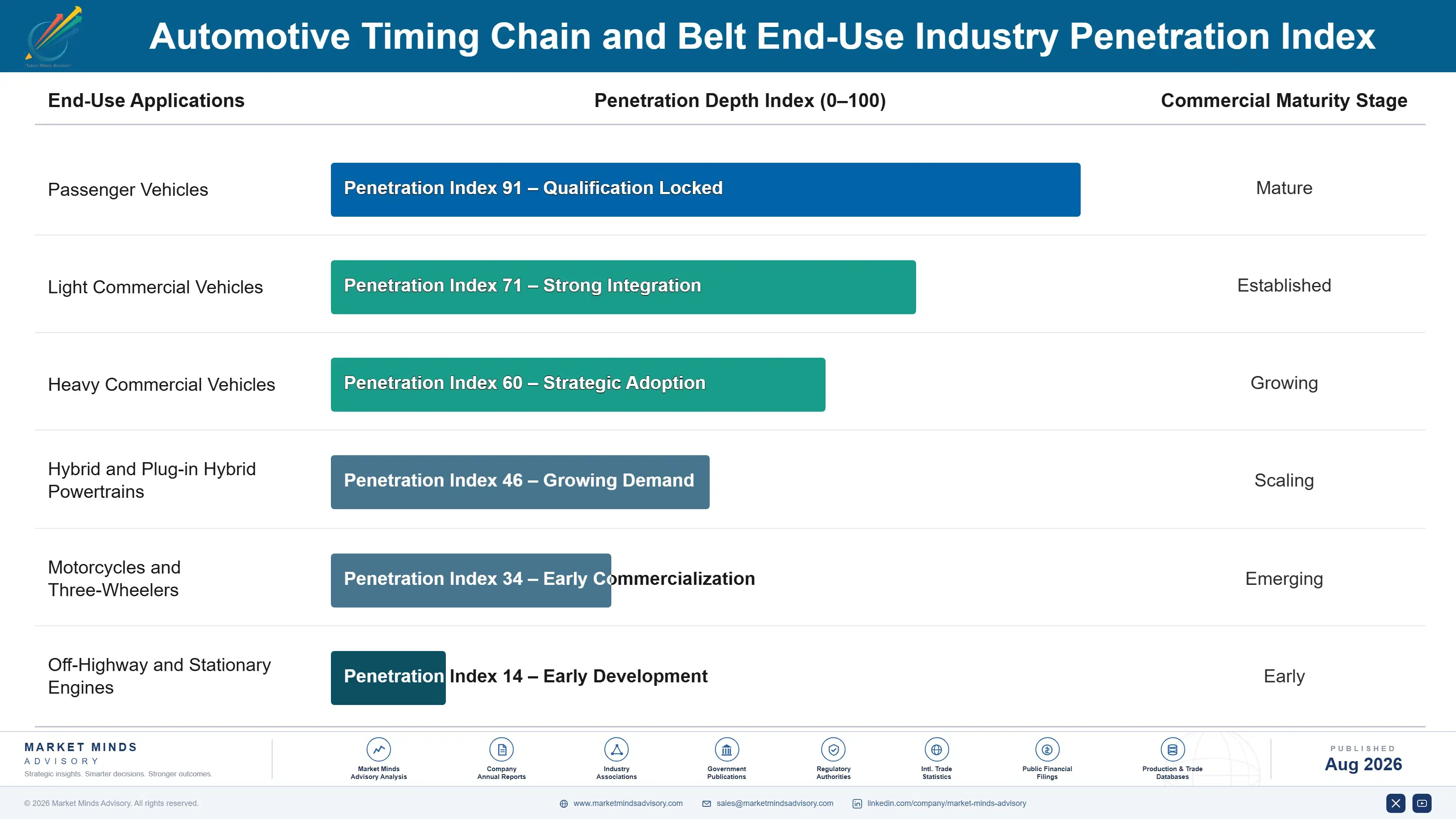
The buyer profile has shifted generationally. Specification once sat with engine designers weighing friction, noise and durability in isolation. Today it sits with powertrain teams balancing fleet carbon targets, warranty exposure and hybrid duty cycles together, and wet belt experience has made warranty risk the dominant consideration in a way it simply was not a decade ago.
automotive-timing-chain-belt-market-trends-end-use-penetration-index-1787315751035

Where To Compete And Why

These are among the four positions where our research anticipates prominent divergence between winners and laggards over the coming forecast period. Each is grounded in the demand model, the regulatory perimeter, and the announced capacity pipeline.
01 / AFTERMARKET CATALOGUE DEPTH

The tail is longer than the fitment

Aftermarket already takes 37% of volume and earns 18 to 24 points more gross margin than original equipment supply, because a workshop buying a kit is solving a maintenance problem rather than negotiating a contract. Every engine family in production today generates replacement demand for fifteen years after the last unit is built. Suppliers building catalogue coverage and distribution reach now capture that tail, while those waiting for fitment to decline before acting will find that the distributor shelf space has already gone.
02 / COMPLETE SET SCOPE

Sell the system not the chain

A timing drive is a chain or belt plus tensioners, guides, sprockets and often a water pump, and suppliers quoting complete sets realise 2.6 times the revenue per engine that those supplying individual components alone manage. Set scope also removes the interface risk engine engineers dislike most, since one supplier owns whole system behaviour rather than several arguing about the noise. Winning that scope requires validation capability across every single component, which is precisely where component specialists keep losing the argument.
03 / ARCHITECTURE BREADTH RETENTION

Follow the customer whichever way they turn

Belt-in-oil momentum has slowed and several manufacturers have reverted to chain, which strands suppliers holding only one architecture with tooling and validation committed to programmes that no longer exist. Those able to quote either technology follow the engineering argument wherever it lands and hold 12% to 18% higher programme win rates. The capability costs duplicated validation and tooling investment, which is exactly why most suppliers picked a side, and why the few who did not are taking their programmes now.
04 / ELECTRIC APPLICATION CONVERSION

Chains still exist without an engine

Battery electric vehicles have no timing drive, but they use chains and belts in reduction drives, thermal management pumps and accessory systems where precision manufacturing capability transfers directly across. Suppliers making that move recover between 15% and 22% of the content per vehicle that they lost when the engine disappeared from the platform. It is not a full replacement and claiming otherwise simply misleads investors, but it converts an asset base scheduled for write-down into something carrying an actual future.

Engagement Snapshot From the Field

A live engagement with an industry participant carrying material or product regulatory and market exposure ahead of a defining policy shift, showing how our research translates into a defensible multi-year portfolio strategy.
MARKET MINDS ADVISORY · CLIENT ENGAGEMENT SUMMARY
Automotive Timing Chain and Belt Producer Strategic Portfolio Review and Transition Roadmap 2026·Investment Scenario on Automotive Timing Chain and Belt Exposure Evaluation 2025-26
CLIENT PROFILE
A European manufacturer of timing chains and drive components operating four plants, with annual revenue near $470 million (client-reported, unverified by MMA), roughly 82% of it from original equipment supply into European engine programmes. The business held strong chain positions and long manufacturer relationships but had almost no aftermarket presence, and three of its largest engine programmes were scheduled to end within six years.
STRATEGIC CHALLENGE
Original equipment volume was declining as European engine production contracted and battery electric share rose, and the programmes replacing them were smaller. Management needed to decide whether to build aftermarket catalogue and distribution from nothing, invest in belt-in-oil capability to compete for the programmes still specifying it, or pursue electric vehicle chain applications that carried far lower content per unit.
MMA APPROACH
MMA modelled fitment and replacement demand across 68 European engine families through 2040, mapped aftermarket catalogue coverage and distribution reach against competitor positions by application, and assessed the capital and timeline requirements for each option. Twenty-two expert interviews with powertrain engineers, aftermarket distributors and independent workshop chains tested where replacement purchasing decisions were actually made.
KEY FINDINGS
  1. Replacement demand from engine families the client already supplied would exceed its declining original equipment revenue by 2032, and that tail was entirely unaddressed because the business had never built catalogue coverage.
  2. Belt-in-oil investment would have targeted programmes where specification momentum had already reversed, with four of the seven candidate families studied having reverted to chain during the engagement itself.
  3. Independent workshops selected kits on fitment accuracy and completeness rather than on price or brand heritage, which favoured a supplier with genuine original equipment engineering behind the catalogue.
  4. Electric vehicle chain applications carried roughly a fifth of the content per vehicle of a timing drive, making them a partial offset rather than the replacement business management had been describing to its board.
CLIENT PROFILE
A European manufacturer of timing chains and drive components operating four plants, with annual revenue near $470 million (client-reported, unverified by MMA), roughly 82% of it from original equipment supply into European engine programmes. The business held strong chain positions and long manufacturer relationships but had almost no aftermarket presence, and three of its largest engine programmes were scheduled to end within six years.
STRATEGIC CHALLENGE
Original equipment volume was declining as European engine production contracted and battery electric share rose, and the programmes replacing them were smaller. Management needed to decide whether to build aftermarket catalogue and distribution from nothing, invest in belt-in-oil capability to compete for the programmes still specifying it, or pursue electric vehicle chain applications that carried far lower content per unit.
MMA APPROACH
MMA modelled fitment and replacement demand across 68 European engine families through 2040, mapped aftermarket catalogue coverage and distribution reach against competitor positions by application, and assessed the capital and timeline requirements for each option. Twenty-two expert interviews with powertrain engineers, aftermarket distributors and independent workshop chains tested where replacement purchasing decisions were actually made.
KEY FINDINGS
  1. Replacement demand from engine families the client already supplied would exceed its declining original equipment revenue by 2032, and that tail was entirely unaddressed because the business had never built catalogue coverage.
  2. Belt-in-oil investment would have targeted programmes where specification momentum had already reversed, with four of the seven candidate families studied having reverted to chain during the engagement itself.
  3. Independent workshops selected kits on fitment accuracy and completeness rather than on price or brand heritage, which favoured a supplier with genuine original equipment engineering behind the catalogue.
  4. Electric vehicle chain applications carried roughly a fifth of the content per vehicle of a timing drive, making them a partial offset rather than the replacement business management had been describing to its board.
RECOMMENDED STRATEGY
Phase 1: Phase one: build replacement kit catalogue coverage across every engine family the business has ever supplied, starting with the highest parc volumes. Phase 2: Phase two: establish distribution agreements with independent workshop chains and parts distributors across the client's core European markets and beyond. Phase 3: Phase three: pursue electric vehicle chain applications as a capacity utilisation measure rather than as a growth substitute, and communicate it that way.
OUTCOME
The client launched catalogue coverage across 340 applications within fourteen months and reported first-year aftermarket revenue of $29 million against a $20 million plan (client-reported, unverified by MMA). Blended gross margin improved by roughly three points, the belt-in-oil investment was cancelled, and two of the three expiring engine programmes have since been extended on hybrid derivatives.

Frequently Asked Questions

Foundational context covering the market sizes, CAGR, scope, country, region and competition that inform every finding below. This section is provided to cover basics and most often pre-purchase conversations, answered from the MMA Primary Research Dataset.

What is the current size of the Automotive Timing Chain and Belt Market?

The global automotive timing chain and belt market was valued at $9.20 billion in 2025, reaching an estimated $9.53 billion in 2026. That covers complete timing drive systems across original equipment and aftermarket channels.

How large will the Automotive Timing Chain and Belt Market be by 2036?

MMA forecasts the market reaching $13.57 billion by 2036, an increase of $4.04 billion over the 2026 base. That represents an expansion multiple of 1.42 times across the forecast period.

What is the CAGR for the Automotive Timing Chain and Belt Market 2026 to 2036?

The base case compound annual growth rate is 3.6%, with a bull case of 4.8% and a bear case of 2.4%. Historical growth between 2020 and 2025 ran at 2.6% annually.

Which segment is growing fastest?

Belt-in-oil timing belts grow at 5.4%, a full 1.50 times the market rate, on friction reduction in small turbocharged engines. Silent inverted tooth chains follow at 4.4% on noise requirements and wet belt reversion.

Who are the major companies in the Automotive Timing Chain and Belt Market?

BorgWarner, Tsubakimoto Chain, Schaeffler, Gates Industrial and Continental lead on drive set shipment volume. Together they account for roughly 46% of global shipments across both architectures.

Which country is growing fastest?

India grows fastest at 6.0% annually, driven by expanding engine production, enormous motorcycle and three-wheeler chain volume and internal combustion dominance across most price segments. Indonesia and Vietnam follow.

Report Segmentation Architecture

The full report scope spans multiple orthogonal segmentation dimensions, with cross-tabulated demand data provided for each dimension pair. Coverage extends further to regional breakdowns, trend trajectories, and the competitive detail needed to support segment-level decision-making.

By Timing Drive Architecture

  • Belt-in-Oil Timing Belt
  • Silent Inverted Tooth Timing Chain
  • Roller Timing Chain
  • Bush Timing Chain
  • Dry Synchronous Timing Belt

By End-Use Industry

  • Passenger Vehicles
  • Light Commercial Vehicles
  • Heavy Commercial Vehicles
  • Hybrid and Plug-in Hybrid Powertrains
  • Motorcycles and Three-Wheelers
  • Off-Highway and Stationary Engines

By Commercial Dimension

  • Original Equipment Engine Programme Supply
  • Complete Drive Set System Supply
  • Branded Aftermarket Kit Distribution
  • Value Line and Private Label Supply
  • Original Equipment Service Parts Channel

By Region

  • North America
  • Western Europe
  • East Asia
  • South Asia and Pacific
  • Latin America
  • Middle East and Africa
  • Eastern Europe

Scope, Methodology, and Coverage

Every figure in this report is reproducible from documented input assumptions. The scope below maps the historical period, the forecast horizon, the segmentation dimensions, and the countries covered, alongside the underlying primary and qualitative methodology.
Historical Period
2020 to 2025
Forecast Period
2026 to 2036
Base Year
2025 (USD billions; MMA Primary Research Dataset, August 2026)
Market Definition
This report covers engine timing drive systems for on-highway vehicles and motorcycles, spanning timing chains, dry timing belts, belt-in-oil drives and the tensioners, guides and sprockets supplied as part of a complete drive set, across passenger vehicles, light and heavy commercial vehicles, hybrid powertrains and two and three-wheelers. Accessory and serpentine belt drives, separately sold balance shaft drives, oil pump drives, camshafts, variable valve timing phasers sold standalone and complete engine assemblies are excluded from the sizing.
Quantitative Units
USD billions at manufacturer realised value; drive set shipments in millions of units; average realised price in USD per set.
Segmentation Dimensions
By timing drive architecture; by end-use industry; by commercial dimension; by region.
Regions Covered
North America, Western Europe, East Asia, South Asia and Pacific, Latin America, Middle East and Africa, Eastern Europe
Countries Covered
United States, Canada, Mexico, United Kingdom, Germany, France, Italy, Spain, Japan, South Korea, China, India, Thailand, Indonesia, Australia, Brazil, South Africa, Turkey, Poland, Czech Republic.
Key Companies Profiled
BorgWarner, Tsubakimoto Chain, Schaeffler, Gates Industrial, Continental, Daido Kogyo, iwis Group, Dayco, Hutchinson, Mubea, SKF, Bando Chemical Industries, Mitsuboshi Belting, Renold and others.
Quantitative Methodology
Primary survey, n=3,800 respondents, Q4 2025, six countries; demand-side model with trade association cross-validation
Qualitative Methodology
47 expert interviews, Q4 2025; applied to validate demand model assumptions, identify emerging dynamics, and assess competitive positioning
Report Format
PDF and XLSX data workbook (Word format preview document)
Publisher
Market Minds Advisory
Report Code
MMA-2026-AUT-900
Published
August 2026
Contact
sales@marketmindsadvisory.com | www.marketmindsadvisory.com

Purchase the full Automotive Timing Chain and Belt Market Report (2026 to 2036).

The full report sizes the automotive timing chain and belt market across five drive architectures, six end-use industries and seven regions, with unit shipment and realised pricing detail behind every value estimate. It profiles twenty global suppliers on architecture breadth, drive set scope and aftermarket catalogue coverage. Regional chapters cover engine production outlook, hybrid share trajectory and belt-in-oil specification reversal by manufacturer. Aftermarket analysis quantifies the replacement tail from engine families currently in production. Cost analysis tracks steel, elastomer and aramid exposure across both drive architectures.
Unit shipment and pricing detail by drive architecture
Belt-in-oil specification reversal tracking by manufacturer
Aftermarket replacement tail forecasts through 2040
Hybrid powertrain fitment persistence modelling by market
Competitive position assessments across twenty global suppliers
Steel and elastomer cost exposure by architecture

Built For The People Who Decide

From boardroom strategy to bench-side execution, this report is read cover-to-cover by leaders shaping the next decade of their industry, turning demand scenarios, market dynamics and valuation benchmarks into decisions.
CXOs/ Presidents/ VPs/ Managers
M&A and Corporate Development
Strategy Teams and R&D Heads
Procurement and Product Directors
Regulatory and Compliance Leaders
Investor Relations and Equity Analysts