Market Minds Advisory
Automotive TCU Market

Automotive TCU Market: 5G Migration Demand and the V2X Connectivity Buildout

Automotive TCU manufacturers now face a rapid 5G migration mandate colliding with legacy 3G and 4G network sunset deadlines, an emerging V2X connectivity buildout requiring spectrum certification, and semiconductor supply constraints affecting cellular modem availability.

Lead Analyst

David Horsley

Published

September 2026

Make Smarter Decisions with Customized Research Insights

Request a free sample report and evaluate market opportunities, growth trends, and competitive dynamics relevant to your business needs.

2025 MARKET VALUE$7.5BMarket Size 2025
2036 FORECAST VALUE$22.5BBase Case , 2026 to 2036
CAGR 2026 TO 203610.5 %Bull 11.8% / Bear 9.2%
INCREMENTAL OPPORTUNITY$14.2BNet 10- year value creation
EXPANSION MULTIPLE2.71x2036 value over 2026 base
Strategic Levers
M&A Pipeline
Regional Outlook
Country Rankings
Competitive Intelligence
Segmental Deep-dive
Call-Us : 91 93563 13602

Executive Snapshot and Market Trajectory

Automakers are specifying 5G telematics control units faster than cellular modem supply chains can reliably scale, creating a widening qualification backlog as legacy network sunset deadlines force urgent replacement of 3G and aging 4G connectivity hardware across active vehicle fleets. Suppliers unprepared for this pace risk losing programs.
5G and V2X-enabled telematics control units are pulling category growth well ahead of conventional 4G LTE and eCall-only designs, as automakers race to support over-the-air software updates and connected safety features requiring higher bandwidth and lower latency than legacy connectivity hardware provides. East Asia commands the largest and fastest-growing volume base, anchored in China's connected vehicle mandate, while North America and Western Europe drive premium V2X and satellite connectivity adoption among established automakers.
Competitive structure remains moderately concentrated among established automotive electronics and telecom module suppliers, with the top five holding a meaningful combined share on a revenue basis. Cellular modem semiconductor supply constraints and spectrum certification complexity are compounding program risk, pushing suppliers toward direct chipset foundry partnerships and dedicated V2X testing infrastructure rather than relying on conventional 4G module production capability alone across their existing supplier networks.
Market Definition
The automotive TCU market covers telematics control units providing cellular connectivity, GPS positioning, eCall emergency notification, over-the-air update capability, and vehicle-to-everything communication in passenger and commercial vehicles. It excludes standalone infotainment head units without integrated cellular connectivity and excludes aftermarket telematics devices not factory-installed by automakers or authorized dealers.
Base Year Value
$7.5B in 2025 (MMA Primary Research Dataset, August 2026)
Forecast Period
2026 to 2036, eleven discrete annual values
CAGR
10.5% base case. Bull 11.8%. Bear 9.2%.
Fastest Growth Segment
5G Telematics Control Units: 15.5% CAGR
Fastest Growth Country
China: 12.5% CAGR
Fastest Growth Region
South Asia and Pacific: 12.6% CAGR
Largest Region
East Asia: 34% of 2025 global value
Market Leaders
Continental AG, Harman International, LG Electronics, Denso Corporation, and Robert Bosch. Source: MMA Analysis based on company annual reports.
Primary Survey
n=3,800 procurement and R&D decision-makers, Q4 2025, six countries
Methodology
Demand-side build-up, cross-validated against public data, 47 expert interviews

Automotive TCU Market Forecast Scenarios

automotive-tcu-market-size-forecast-scenario-1787465766438
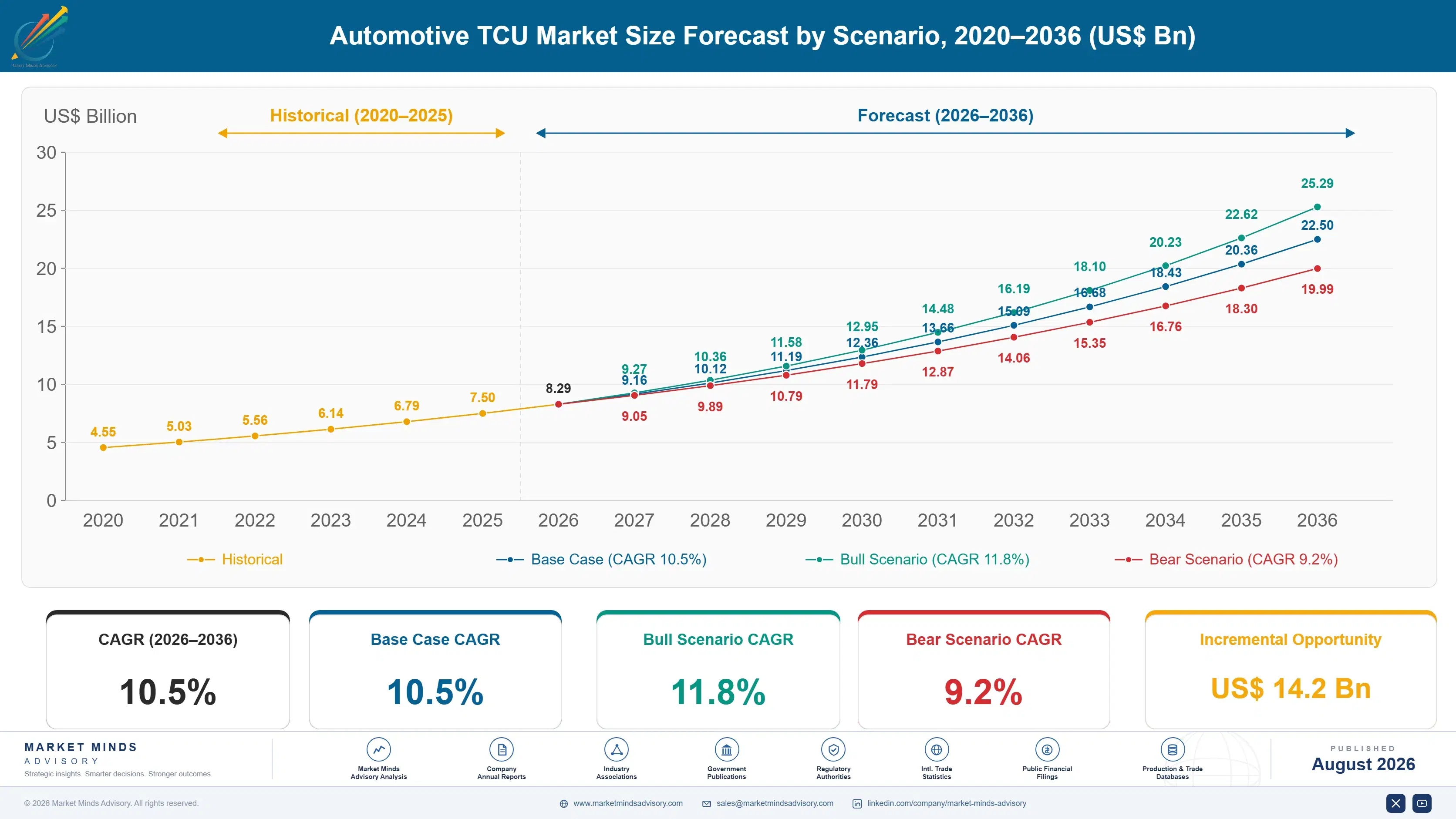
Between 2020 and 2025 the market grew at a historical pace of roughly 9.0 percent annually, as connected vehicle feature adoption expanded steadily while 5G migration and V2X certification requirements began accelerating meaningfully only in the final two years of the period as network carriers announced legacy 3G and aging 4G sunset timelines across major markets.
The base case assumes growth near 10.5 percent annually through 2036, anchored in three commercial mechanisms: mandatory 5G migration driven by carrier network sunset deadlines forcing replacement of legacy connectivity hardware across active vehicle fleets, expanding over-the-air software update capability requiring higher-bandwidth connectivity than legacy modules provide, and emerging vehicle-to-everything communication adoption supporting connected safety and traffic management applications across a widening range of vehicle programs and price segments worldwide.
A bull scenario builds on faster V2X spectrum standardization accelerating connected safety feature adoption across a broader range of vehicle segments and geographies than currently anticipated, while a bear scenario centers on cellular modem semiconductor supply constraints slowing planned 5G migration timelines and compressing supplier margins across the industry well into the next decade regardless of demand strength. Both scenarios remain plausible.

Network Migration Racing Semiconductor Supply

Three forces are converging on the category at once: carrier network sunset deadlines are forcing urgent replacement of legacy 3G and aging 4G connectivity hardware, automakers are expanding over-the-air software update capability requiring higher-bandwidth connectivity than legacy modules provide, and suppliers are racing to scale 5G and V2X-capable cellular modem production fast enough to meet accelerating automaker demand across multiple simultaneous vehicle programs.
MARKET CONCENTRATIONCR5 46%top five suppliers hold a substantial combined share
5G MIGRATION PENETRATION31%share of new vehicles shipping with next-generation cellular connectivity hardware
LEADING PRODUCING COUNTRYChinalargest single national manufacturing and deployment base overall
OVER-THE-AIR UPDATE COVERAGE54%share of connected vehicles supporting full software update capability
CELLULAR MODEM LEAD TIME24-36 weekstypical wait time for automotive-grade cellular modem components
SEMICONDUCTOR COST SHARE41% of COGScellular modem and processor chips as portion of total cost
Commercially the category increasingly behaves like a network infrastructure business layered on top of traditional automotive electronics manufacturing, since a supplier's ability to win new vehicle programs now depends as much on carrier certification relationships and spectrum compliance credentials as on hardware performance specifications alone, a shift that is rewarding suppliers with broader telecom industry relationships over specialists in proprietary hardware alone.
Over the next decade, suppliers most likely to capture disproportionate value are those investing in 5G and V2X certification capability ahead of automaker platform decisions and carrier sunset deadlines, since securing this certification after competitors have already established it takes considerably longer than building the capability in from the start. Suppliers delaying this investment risk permanent exclusion from next-generation program bidding.
"A TCU that can't talk to the network isn't a connectivity module, it's a paperweight. The suppliers surviving the 3G sunset are the ones who started the 5G transition years before carriers announced a hard deadline."
Director, Automotive Electronics and Telematics Practice · MMA Automotive Electronics / Telematics Connectivity Systems Practice · August 2026

Market Trends

Carrier Network Sunset Deadlines Forcing Urgent Hardware Replacement

Major cellular network carriers across North America, Europe, and parts of Asia have announced or completed 3G network shutdowns, with aging 4G network sunset timelines increasingly under discussion as carriers reallocate spectrum toward 5G infrastructure investment. This forces automakers and fleet operators to urgently replace legacy telematics hardware in active vehicles that would otherwise lose connectivity entirely, creating a compressed replacement cycle that differs from typical planned technology upgrade timelines. Several suppliers have launched dedicated retrofit and replacement TCU programs within the past two years, signaling the sunset transition has moved beyond new vehicle programs into active fleet remediation.
Market Impact: Lifts update-capable TCU demand by 13%
Vehicle-to-Everything Communication Standards Gain Broader Traction

Automakers and regulators are increasingly supporting vehicle-to-everything communication standards enabling direct communication between vehicles, infrastructure, and pedestrians for connected safety and traffic management applications, moving beyond early pilot deployments into broader commercial vehicle program planning across multiple regions simultaneously. This technology requires specialized spectrum certification and low-latency processing capability that differs substantially from conventional cellular connectivity requirements, concentrating early adoption among suppliers with dedicated V2X engineering capability. Government safety agencies in several major markets are actively drafting mandates that would extend this requirement across a considerably broader share of new vehicle programs.
Market Impact: Adds 8% to regulatory-driven TCU demand

Market Opportunities and Growth Drivers

Over-the-Air Software Update Capability Expansion Accelerates

Automakers are increasingly expanding over-the-air software update capability across vehicle systems beyond infotainment alone, extending to safety-critical systems and even battery management software for electric vehicles, requiring TCU hardware with sufficient bandwidth and processing capability to support these larger and more frequent software update packages across the vehicle's full operating lifetime rather than only its first ownership cycle. This expansion is directly driving demand for higher-specification TCU hardware capable of handling update volumes that legacy connectivity modules were never designed to support at the frequency automakers now require from their supplier base each product cycle.
Market Impact: Caps 5G production scaling at 12%

Connected Safety Feature Regulatory Requirements Expand Steadily

Government mandates requiring automatic emergency notification and connected safety features across new vehicle sales in several major markets are directly expanding the addressable TCU market, as these regulatory requirements apply across virtually all new vehicle price segments rather than remaining concentrated in premium models alone. This regulatory driver provides demand visibility that differs from purely consumer-preference-driven adoption, giving suppliers considerably more predictable long-term volume planning than categories dependent entirely on discretionary feature adoption decisions made independently by individual automakers each product year across their respective global vehicle lineups and regional markets.
Market Impact: Raises multi-region certification costs by 15%

Market Restraints and Challenges

Cellular Modem Semiconductor Supply Constraints Persist

Automotive-grade 5G cellular modem semiconductor supply has not fully scaled to meet accelerating automaker demand, a constraint rooted in automotive-grade modem manufacturing representing a smaller and more specialized share of overall semiconductor foundry capacity relative to consumer smartphone applications that foundries often prioritize given larger volume commitments. The commercial impact is that suppliers cannot always scale 5G TCU production as quickly as automaker order volumes would otherwise support, occasionally forcing automakers to delay vehicle launches or specify 4G connectivity as an interim fix. Several suppliers are qualifying redundant chipset sources as a mitigation path to reduce this constraint over time.
Market Impact: Lifts replacement demand by 17%

Multi-Region Spectrum Certification Complexity Extends Timelines

Divergent cellular spectrum allocations and certification requirements across major consuming regions require suppliers serving global automaker customers to maintain multiple regional hardware variants rather than a single universal TCU design, a complexity rooted in the absence of fully harmonized international spectrum allocation standards for automotive connectivity applications. The commercial impact is meaningfully higher research and certification cost for suppliers serving multiple regional markets simultaneously relative to suppliers focused on a single regulatory jurisdiction. Several suppliers are pursuing modular hardware platforms as a mitigation path to share core components across regional variants.
Market Impact: Adds 12% to V2X-enabled TCU demand
3 additional market trends, 4 additional growth drivers, and 3 additional restraints and challenges are covered in the full report. Contact sales@marketmindsadvisory.com to access the complete intelligence.

Segment CAGR and Growth Architecture

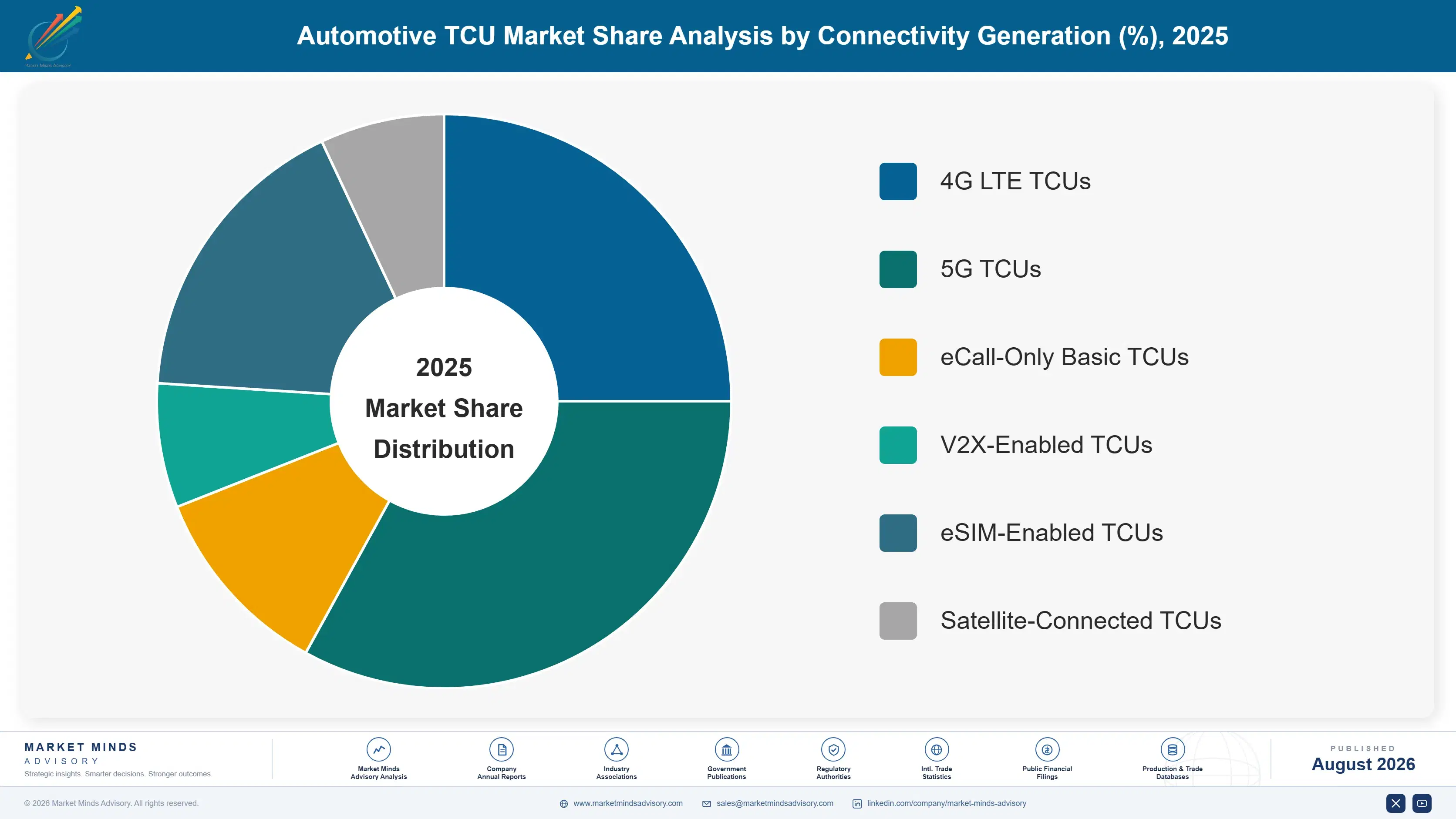
Segmentation follows connectivity generation, since 4G LTE, 5G, eCall-only, V2X-enabled, eSIM-enabled, and satellite-connected TCU designs each carry distinct spectrum certification, processing requirements, and carrier relationships despite serving overlapping vehicle connectivity applications across passenger and commercial vehicle programs worldwide today, spanning both mainstream mass-market platforms and premium flagship electric vehicle programs across every major region.
automotive-tcu-market-market-share-analysis-1787465767042

5G Telematics Control Units

5G TCUs are growing fastest as automakers race to support over-the-air software updates and connected safety features requiring higher bandwidth and lower latency than legacy 4G connectivity provides, while also positioning ahead of anticipated aging 4G network sunset timelines that could eventually mirror the 3G shutdown pattern already affecting the category. This segment requires automotive-grade 5G cellular modem components that remain supply constrained relative to accelerating automaker demand, concentrating production among suppliers with established semiconductor foundry relationships. Suppliers with early 5G qualification are securing multi-year program awards from automakers eager to lock in supply ahead of anticipated continued demand growth across their global vehicle platforms and regional export programs alike.
CAGR 15.5%

V2X-Enabled Telematics Control Units

V2X-enabled TCUs are the second fastest growing segment, supporting direct communication between vehicles, infrastructure, and pedestrians for connected safety and traffic management applications that extend beyond traditional cellular network connectivity alone. This segment requires specialized spectrum certification and low-latency processing capability that differs substantially from conventional cellular TCU requirements, limiting production to suppliers with dedicated V2X engineering and testing infrastructure built specifically for this narrow purpose. Government safety mandates in several major markets are increasingly supporting V2X adoption, providing demand visibility that is accelerating supplier investment in this specialized capability ahead of broader mainstream vehicle adoption across additional price segments and geographies. Even automakers historically slow to adopt new technology now cite V2X readiness in formal supplier scorecards.
CAGR 14.0%
Full segment breakdown across 6 segments available in the complete report.

Regional Architecture and Country Demand Map

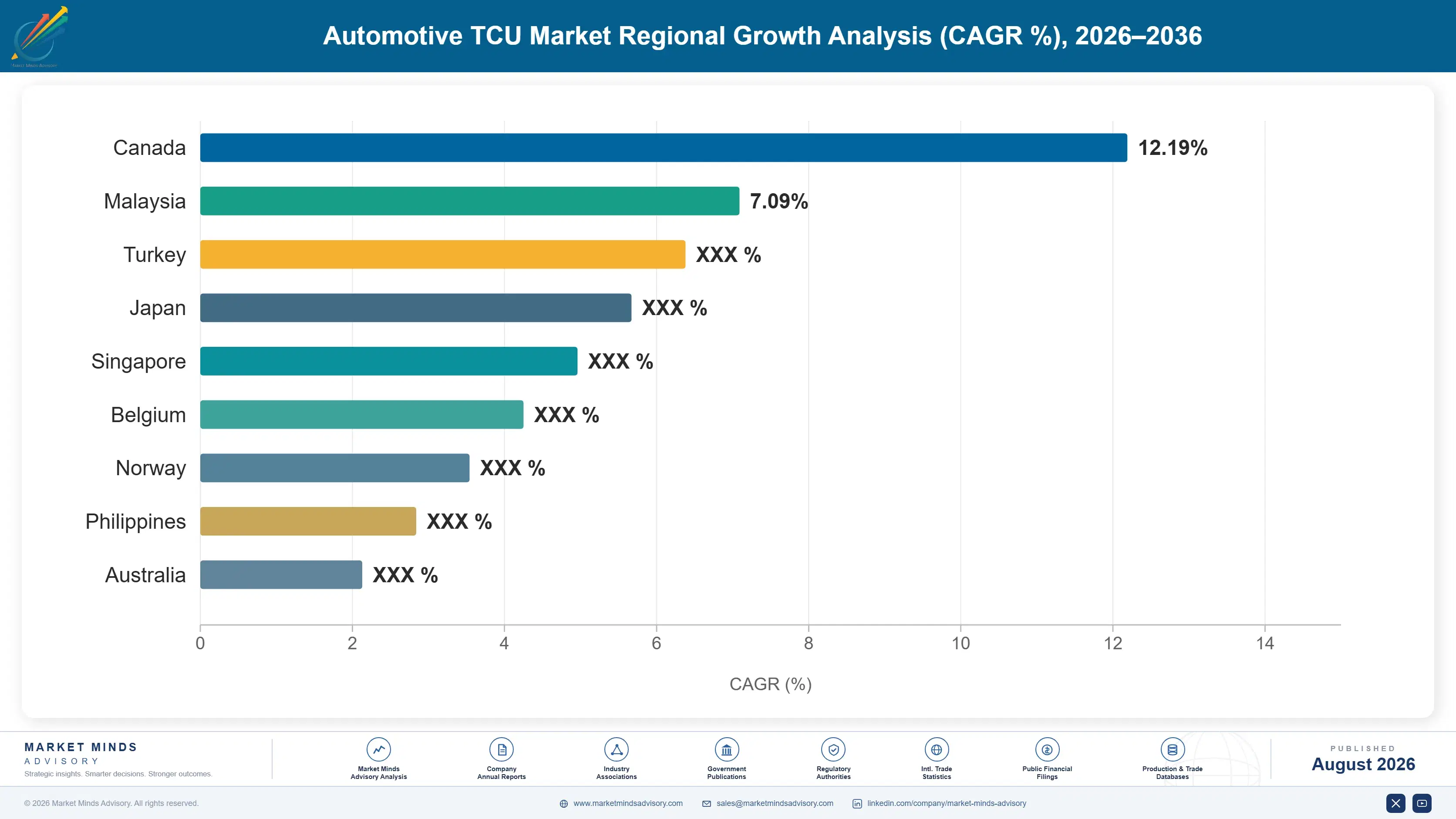
East Asia dominates global manufacturing and deployment volume through China's connected vehicle mandate and domestic 5G infrastructure leadership, while North America and Western Europe anchor premium V2X and satellite connectivity adoption among established automakers, and South Asia and Pacific posts the fastest regional growth rate overall.

North America

United States automakers anchor regional demand, with connected vehicle mandates and carrier 3G sunset deadlines already completed driving urgent legacy hardware replacement across active vehicle fleets nationwide and across most fleet operator programs. Premium V2X and satellite connectivity adoption remains concentrated among flagship electric vehicle and luxury vehicle programs, while mainstream manufacturers increasingly specify 5G connectivity as a cost-efficient path to regulatory compliance and over-the-air update capability. Canada follows similar adoption patterns at smaller scale, relying primarily on the same North American supplier base serving both markets under shared regulatory frameworks. Fleet telematics operators are additionally driving replacement demand as commercial logistics providers upgrade aging connectivity hardware ahead of scheduled carrier deadlines nationwide.
Share: 24% | CAGR: 10.9% (2026 to 2036)

Western Europe

Germany, France, and the United Kingdom anchor regional demand, supported by European Union eCall regulatory mandates requiring automatic emergency notification across all new vehicle sales, a requirement that has made TCU adoption effectively universal across the region's new vehicle market regardless of price segment. Aging 4G network sunset discussions across several member states are beginning to shape supplier 5G migration planning similarly to the completed 3G transition seen elsewhere on the continent. Germany's concentrated premium automotive manufacturing base gives the country outsized influence on regional connectivity technology standards. Nordic markets, though individually small, post some of the highest per-vehicle connectivity specification rates in the region given strong consumer safety preference.
Share: 22% | CAGR: 9.0% (2026 to 2036)
Regional intelligence for 5 additional markets available in the complete report: East Asia, South Asia and Pacific, Latin America, Middle East and Africa, Eastern Europe. Contact sales@marketmindsadvisory.com.
automotive-tcu-market-country-cagr-analysis-1787465767557

Network Migration and Certification Leadership Levers

Suppliers are pulling four commercial levers at once: 5G and V2X certification investment, cellular modem supply diversification, carrier partnership development, and modular regional platform design, each addressing a distinct margin opportunity created by the category's ongoing network migration and shifting spectrum certification requirements across major consuming regions worldwide today and over the coming decade.

5G and V2X Certification Capability Investment Program

Investing in dedicated 5G and V2X spectrum certification capability positions suppliers to capture the premium pricing and program access these technologies increasingly require across major automaker platform decisions. This investment requires substantial capital and specialized engineering talent but positions early movers to capture disproportionate share as legacy connectivity market access continues narrowing ahead of anticipated further network sunset timelines across additional regions. Suppliers with established certification capability report new program qualification rates roughly 25 percent higher than legacy-technology-focused competitors still relying on older 4G-only hardware platforms. Automakers now weight certification track record heavily during supplier scorecard reviews each program cycle.
Market Impact: Lifts new program qualification rate by roughly 25 percent

Cellular Modem Supply Diversification Qualification Program

Qualifying automotive-grade cellular modem components from multiple foundry sources rather than relying on a single chip supplier allows suppliers to maintain production continuity during the periodic supply disruptions that have repeatedly affected the automotive semiconductor category in recent years. This qualification requires meaningful upfront engineering investment across each additional chip source but has demonstrably protected production schedules for suppliers with diversified sourcing, reducing overall supply disruption exposure by roughly 20 percent during recent disruption events relative to single sourced competitors across the industry. Automakers increasingly require documented multi-source qualification plans before awarding new long-term supply contracts.
Market Impact: Cuts overall supply disruption exposure by roughly 21 percent

Direct Carrier Partnership Development for Faster Certification

Establishing direct partnerships with major cellular carriers accelerates network certification and spectrum compliance relative to suppliers navigating carrier certification processes independently for each new market and technology generation. This approach requires sustained relationship investment across multiple carrier partners but has enabled suppliers pursuing this strategy to bring new connectivity generations to market meaningfully faster, cutting typical certification timelines by roughly 29 percent relative to competitors building carrier relationships from scratch for each new regional deployment program. Suppliers lacking these relationships increasingly find themselves excluded from early-stage program bidding entirely as carriers prioritize established partners with proven track records.
Market Impact: Cuts overall certification timeline by roughly 29 percent

Modular Regional Platform Design for Multi-Market Efficiency

Developing modular TCU platforms that share core components across different regional spectrum and certification requirements reduces the research and development cost burden of maintaining fully separate hardware designs for each regional market. This approach requires meaningful upfront platform engineering investment but has demonstrably reduced per-market development cost for suppliers serving multiple regulatory jurisdictions simultaneously, an efficiency gain estimated at roughly 20 percent relative to fully bespoke regional designs still favored by smaller and less diversified competitors across the supplier landscape. This platform approach also shortens time to market for automakers launching vehicle programs across several regions simultaneously each year.
Market Impact: Cuts overall multi-market development cost by roughly 20 percent

Who Controls the Margin Pool

Concentration remains moderate, with the top five suppliers holding a combined 46 percent share on a revenue basis, reflecting a market where established automotive electronics and telecom module companies compete alongside a growing number of specialized 5G and V2X technology developers entering from adjacent telecommunications and semiconductor backgrounds. The gap between the leading supplier and the sixth-ranked challenger remains wide, reflecting durable program relationships built over multiple vehicle generations.
Current competitive activity centers on three dimensions: 5G and V2X certification investment to capture regulatory and network-driven premium demand, cellular modem supply diversification to protect production continuity, and direct carrier partnership development to accelerate certification timelines ahead of competitors still relying on independent regional certification processes for each new program launch. Program wins increasingly hinge on demonstrated certification track record.

Emerging pressure comes from specialized 5G and V2X technology developers entering the category from adjacent telecommunications backgrounds, and from Chinese suppliers expanding export capacity aggressively with competitive pricing, threatening to redistribute share away from established Western suppliers reliant primarily on legacy 4G hardware manufacturing scale over the coming decade. Rankings among the second tier of suppliers look considerably less settled than the top five.
automotive-tcu-market-company-positioning-matrix-1787465768083

Competitive Moat and Risk Dimensions

CONTINENTAL AG

Moat: Integrated Vehicle Electronics Systems Depth

Continental's integrated position spanning broader vehicle electronics and connectivity systems beyond TCU hardware alone gives it system-level integration expertise that standalone module suppliers cannot easily replicate, supporting deeper automaker program relationships across multiple vehicle systems and manufacturing regions simultaneously each year. Few competitors can match this breadth of integrated program relationships.
CONTINENTAL AG

Risk: Broad Electronics Cycle Exposure

Continental's diversified electronics portfolio exposure means broader automotive electronics cycle downturns can simultaneously pressure multiple business lines at once, a concentration risk that more narrowly focused TCU specialists facing more resilient regulatory-driven demand do not share to nearly the same degree across their program portfolios.
HARMAN INTERNATIONAL

Moat: Established Consumer Electronics Integration

Harman's consumer electronics heritage, combined with Samsung's semiconductor manufacturing scale as its parent company, gives it component sourcing and integration advantages that standalone automotive electronics specialists cannot easily match across comparable program scale and geographic reach worldwide. Few standalone specialists can access comparable semiconductor supply terms or component pricing at similar production volume scale.
HARMAN INTERNATIONAL

Risk: Parent Company Strategic Exposure

Harman's position within the broader Samsung corporate structure means strategic priority shifts at the parent company level could affect resource allocation to automotive-specific programs, a governance risk that independent automotive electronics specialists with dedicated ownership structures do not face to the same degree across their operations.

Players Tracked

Prominent Players

Continental AG
Harman International
LG Electronics
Denso Corporation
Robert Bosch

Other Key Players

Valeo
Marelli Holdings
Visteon Corporation
Aptiv PLC
ZTE Corporation
Quectel Wireless Solutions
Telit Cinterion
u-blox Holding
Thales Group
Sierra Wireless
Panasonic Automotive
Toyota Tsusho
LG Uplus
China Mobile IoT
Verizon Connect

Recent Developments

MARCH 2026

Continental Expands 5G TCU Production Capacity

Continental AG commissioned expanded 5G telematics control unit production capacity at its European manufacturing facility, aimed at meeting rising automaker demand for connectivity hardware as carrier network sunset deadlines continue accelerating replacement demand across multiple vehicle segments and price points across the broader regional market.
Signal: Signals continued 5G capacity investment ahead of accelerating network sunset replacement demand nationwide across the broader supplier landscape
OCTOBER 2025

Harman Signs Direct Carrier Certification Partnership

Harman International signed a direct certification partnership agreement with a major cellular carrier, accelerating network compliance for its automaker customers seeking to launch 5G-capable vehicles without navigating separate carrier certification processes independently. Industry observers view the agreement as an early signal of consolidating carrier relationships across the supplier landscape.
Signal: Confirms direct carrier partnerships accelerating as a standard deployment strategy industry wide going forward across the industry
JUNE 2025

Denso Launches Modular Regional TCU Platform

Denso Corporation launched a new modular telematics control unit platform designed to share core components across multiple regional spectrum and certification requirements, reducing development cost for automakers serving markets with divergent network migration timelines and regulatory requirements across different regions worldwide this decade. Analysts expect further modular platform announcements.
Signal: Demonstrates modular platform investment scaling as a multi-market compliance strategy industry wide going forward across the supplier base

Cellular Modem Semiconductor Exposure

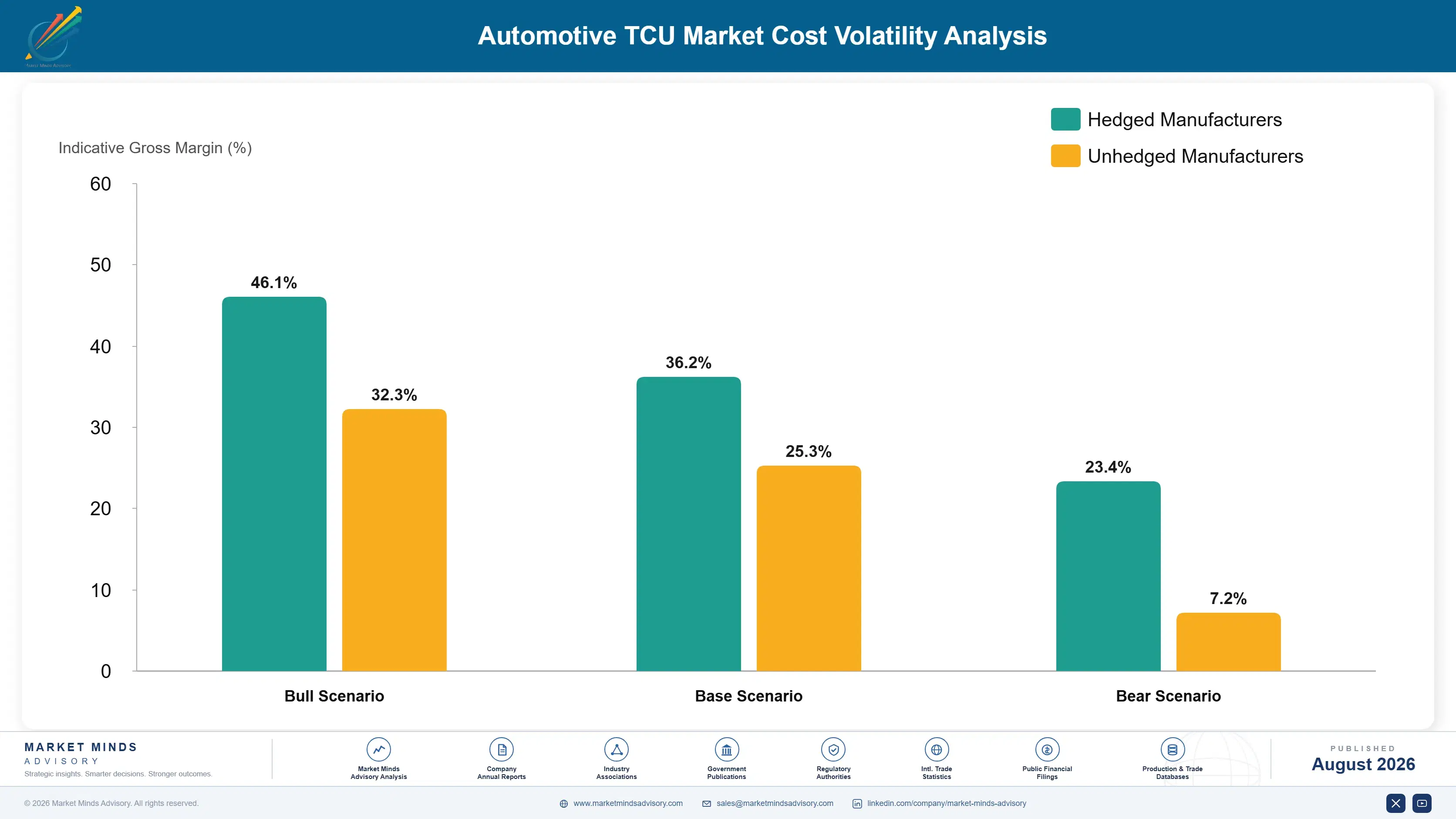
Automotive-grade cellular modem semiconductors and application processor chips together represent roughly 41 percent of cost of goods sold for TCU production, sourced primarily from Taiwanese and South Korean semiconductor foundries, with additional components sourced from Japanese and European specialty chip manufacturers serving automotive-grade certification requirements across major global supplier programs each year. This concentration leaves the category exposed to regional export policy shifts affecting semiconductor trade flows.
Automotive semiconductor lead times spiked sharply in 2021 and 2022 following broader global chip supply disruption, a volatility event documented in Semiconductor Industry Association market reporting, delaying several planned 5G TCU program launches and forcing automakers to temporarily specify 4G connectivity as an interim solution while supply stabilized across the broader industry over the following two years. Several automakers have since diversified their supplier base to reduce comparable exposure going forward across future product cycles.

Exposure varies considerably by player type: large suppliers with direct semiconductor foundry relationships and diversified sourcing have absorbed volatility more easily than smaller suppliers reliant on distributor-based chip purchasing, a disadvantage accelerating consolidation of smaller TCU suppliers into larger automotive electronics operations across most consuming regions worldwide. Smaller suppliers increasingly seek merger partners to gain comparable scale.
automotive-tcu-market-cost-volatility-analysis-1787465768279

Direct Semiconductor Foundry Supply Agreements

Larger suppliers are securing direct multi-year supply agreements with semiconductor foundries, protecting production continuity during volatility events, though this approach requires accurate long-term demand forecasting that smaller suppliers with less established program pipelines often find difficult to commit to with confidence. Larger suppliers with strong balance sheets absorb this forecasting risk more comfortably than smaller competitors.

Multi-Source Chipset Qualification Across Foundries

Qualifying automotive-grade cellular modem chips from multiple foundry sources reduces exposure to any single supplier's capacity constraints or geopolitical disruption, though it requires significant engineering validation investment across each additional source that smaller suppliers often cannot justify given typical program volume and available capital. Suppliers pursuing this path typically qualify two or three alternate sources per critical component category.

Interim 4G Specification for Supply Flexibility

Offering automakers the option to specify 4G connectivity as an interim solution during periods of acute 5G modem supply constraint reduces exposure to any single component's supply limitations, though this approach delays automakers' transition to full 5G capability relative to original program timelines. Most automakers view this as a temporary bridge rather than a permanent choice.

Portfolio Architecture for Margin Defence

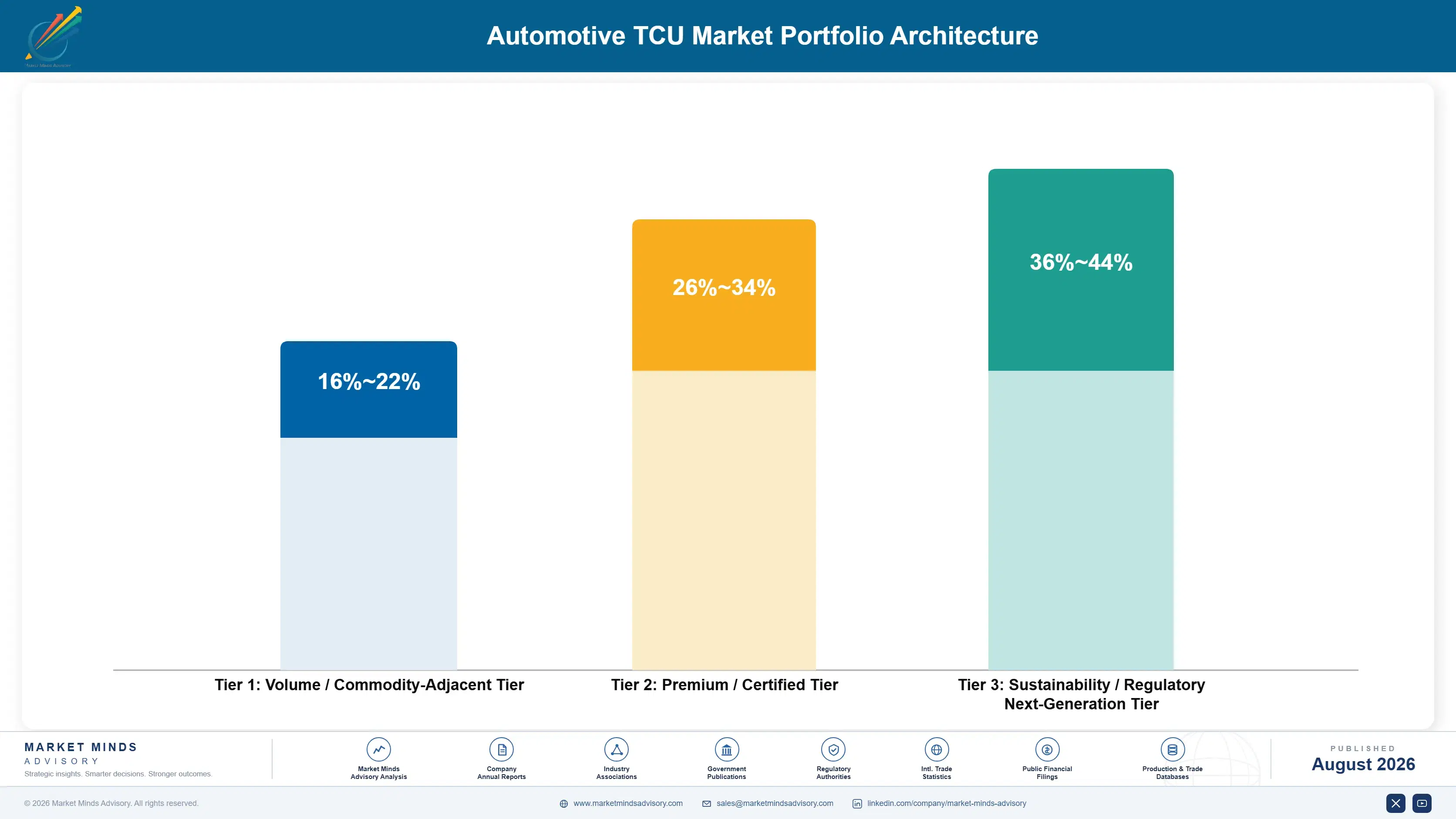
Portfolio economics split across three tiers: commodity 4G LTE and eCall-only TCUs competing largely on price and manufacturing scale, mid-tier 5G and eSIM-enabled systems commanding meaningful premium pricing tied to certification depth, and premium V2X and satellite connectivity platforms capturing the highest margin as customers pay for both specialized capability and ongoing certification support across their global vehicle programs. Suppliers stuck between tiers without a clear positioning strategy struggle to defend either cost leadership or premium pricing consistently.
The tension between volume and premium positioning is sharpest as regulatory mandates increasingly require baseline connectivity capability regardless of vehicle price point, compressing the traditional segmentation between basic connectivity for economy vehicles and premium connectivity for luxury models, pushing suppliers to defend margin through certification and carrier relationship differentiation rather than hardware exclusivity alone across their product lines.

High value margin pools concentrate in V2X and satellite connectivity platforms sold with ongoing certification and carrier relationship support, where spectrum compliance depth and carrier partnership relationships limit competition to suppliers with established telecom industry capability and sustained engineering investment across multiple technology generations and regional certification regimes. Suppliers without this capability rarely gain meaningful access to this tier regardless of manufacturing scale.

Volume / Commodity-Adjacent Tier

Commodity 4G LTE and eCall-only TCUs competing primarily on price and manufacturing scale across mainstream vehicle segments, where automakers select suppliers largely based on unit cost and delivery reliability rather than advanced feature differentiation.
Gross Margin: 16-22%

Premium / Certified Tier

5G and eSIM-enabled telematics systems commanding premium pricing tied to network certification depth and carrier relationship credentials, appealing to automakers seeking differentiated connectivity performance without the full cost of flagship platforms.
Gross Margin: 26-34%

Sustainability / Regulatory / Next-Generation Tier

V2X-enabled and satellite connectivity platforms serving premium and safety-focused vehicle programs requiring the deepest certification, commanding the strongest margins given limited supplier capability and sustained automaker willingness to pay for it.
Gross Margin: 36-44%
automotive-tcu-market-portfolio-architecture-1787465768784

High-value Sub-segments and Strategic Watch-out

V2X-Enabled Connectivity Platforms

Scaling as government safety mandates expand, this segment commands the highest margins but remains constrained by specialized spectrum certification capability concentrated among a small number of suppliers, limiting how quickly new entrants can meaningfully compete for share across major consuming markets over the next several years.
Gross Margin: 38-44%

5G Cellular Connectivity Modules

Carrier network sunset deadlines increasingly mandate this technology, supporting durable volume growth for suppliers with established semiconductor foundry relationships over legacy-focused competitors still building out comparable production capacity and certification depth across their own regional supplier networks, program pipelines, and long-standing customer relationships worldwide today.
Gross Margin: 28-34%

Conventional 4G LTE Connectivity Modules

The largest volume segment by unit count, competing primarily on price across mainstream vehicle platforms, and gradually losing regulatory market access as network sunset timelines continue advancing across an expanding share of major consuming regions worldwide over the coming several years and future product cycles ahead.
Gross Margin: 16-20%

Legacy 3G-Compatible Connectivity Hardware

Facing accelerating displacement as carrier sunset deadlines exclude this technology from an expanding share of markets, this segment requires urgent replacement investment or faces continued volume decline across nearly every major consuming region worldwide over the next several years and upcoming program cycles overall industry wide.
Gross Margin: 10-14%

Network Certification Cycle Economics

Demand in this category increasingly resembles a recurring network certification relationship rather than a one-time hardware purchase, since carrier network generation transitions periodically force replacement demand independent of normal vehicle replacement cycles, creating a form of annuity demand for suppliers embedded early in an automaker's connectivity technology roadmap. This dynamic rewards suppliers embedded early in an automaker's technology roadmap over late entrants competing purely on price.
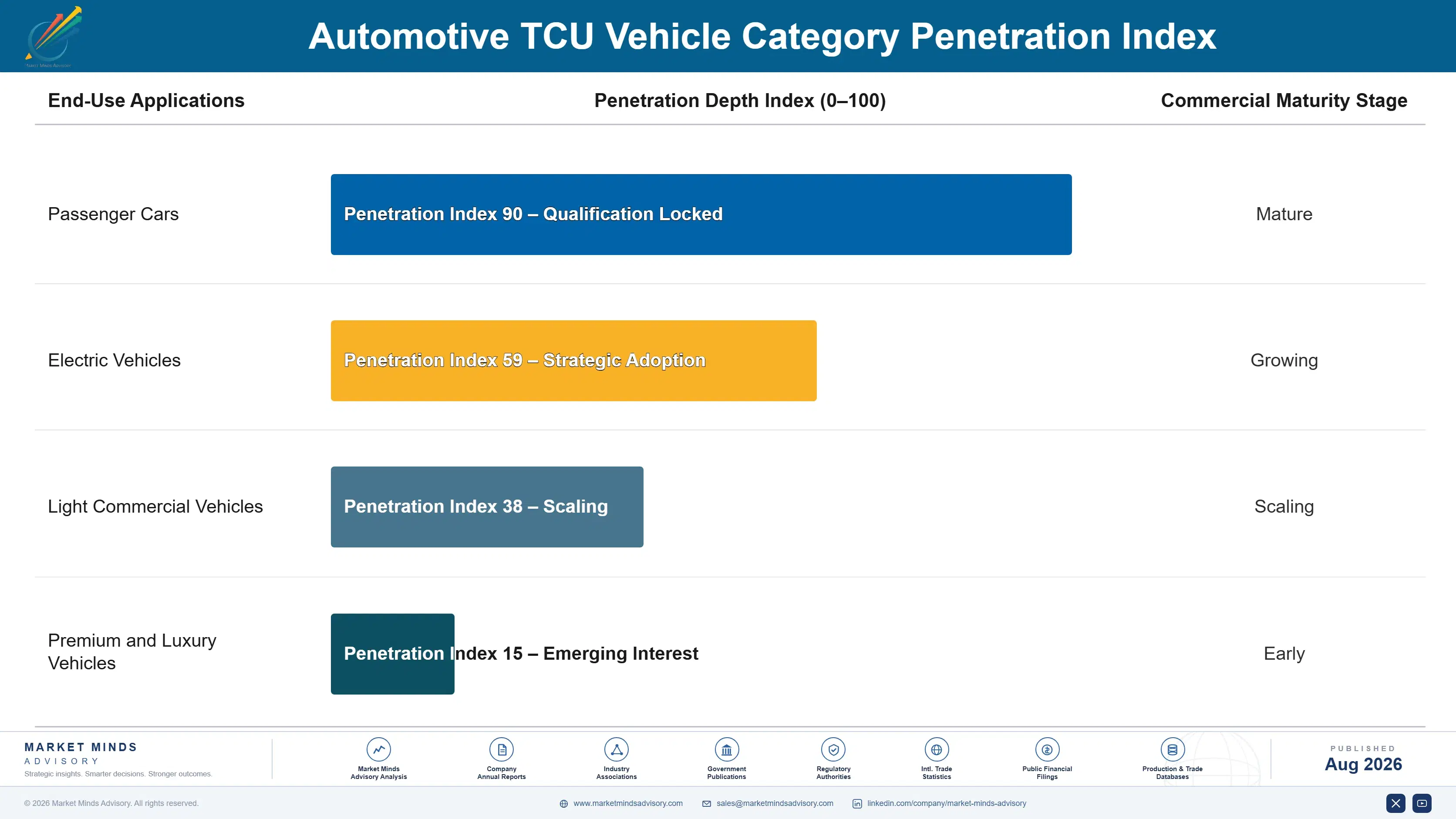
Adoption depth varies considerably by end use vertical: premium and technology-forward automakers show the deepest and most consistent adoption of V2X and satellite connectivity technology, mainstream mass-market vehicle programs show moderate but accelerating adoption tied to regulatory compliance deadlines, and budget-segment vehicle programs remain the shallowest adopters, still specifying baseline eCall-only connectivity to control cost. Fleet operators occupy a middle position, adopting connectivity upgrades on planned replacement cycles rather than immediate mandate-driven timelines.

Younger vehicle program engineers and connectivity specification managers entering procurement roles increasingly expect 5G and V2X capability as a baseline design expectation rather than a premium differentiator, a generational shift that is gradually normalizing advanced connectivity specification across a broader range of vehicle segments and price points. Procurement teams increasingly treat certification depth as a baseline qualification criterion.
automotive-tcu-market-end-use-penetration-index-1787465769279

Where TCU Supplier Capital Should Concentrate

These are among the four positions where our research anticipates prominent divergence between winners and laggards over the coming forecast period. Each is grounded in the demand model, the regulatory perimeter, and the announced capacity pipeline.
01 / 5G CERTIFICATION INVESTMENT

Build 5G capability before legacy market access narrows further

Carrier network sunset deadlines are converting 5G capability from a premium differentiator into a baseline connectivity requirement faster than many suppliers currently plan for within their development timelines and capital budgets. Suppliers with established 5G certification already report meaningfully higher new program qualification rates than legacy-technology-focused competitors still relying on older 4G-only hardware platforms across their portfolios. This advantage compounds as more carriers announce comparable sunset timelines, widening considerably as legacy connectivity market access continues narrowing across additional consuming regions worldwide.
02 / SEMICONDUCTOR SUPPLY SECURITY

Diversify cellular modem sourcing before the next disruption cycle

Automotive semiconductor supply has already demonstrated its disruption potential multiple times this decade, and suppliers without diversified sourcing remain persistently exposed to the next shortage regardless of current market conditions or existing program backlogs. Suppliers with diversified sourcing already report winning new program awards at meaningfully higher rates than single-source competitors still dependent on a narrow supplier base. Building this resilience now, well before the next disruption, costs considerably less than attempting to build it reactively during an active crisis.
03 / CARRIER PARTNERSHIP TIMING

Secure direct carrier partnerships before competitors lock in certification relationships

Network certification increasingly depends on direct carrier relationships that take considerably longer to establish than the underlying hardware development itself, a timeline mismatch that catches unprepared suppliers off guard each product cycle across their program pipelines. Suppliers with established carrier partnerships already report meaningfully faster certification timelines than competitors building relationships independently for each new regional deployment program. Suppliers delaying this investment risk losing certification speed advantages permanently to competitors with stronger, more established carrier network relationships already firmly in place.
04 / MODULAR PLATFORM DEVELOPMENT

Build modular regional platforms before certification complexity increases further

Divergent spectrum certification requirements across major consuming regions are increasing development complexity faster than suppliers relying on fully bespoke regional designs can efficiently manage within typical program budgets and engineering headcount constraints across their supplier organizations. Suppliers pursuing modular platform development already report meaningfully lower per-market development costs than competitors maintaining separate designs for each region across their supply base. This advantage compounds further as more regions adopt distinct spectrum certification timelines and requirements over the coming several years ahead.

Engagement Snapshot From the Field

A live engagement with an industry participant carrying material or product regulatory and market exposure ahead of a defining policy shift, showing how our research translates into a defensible multi-year portfolio strategy.
MARKET MINDS ADVISORY · CLIENT ENGAGEMENT SUMMARY
Automotive TCU Producer Strategic Portfolio Review and Transition Roadmap 2026·Investment Scenario on Automotive TCU Exposure Evaluation 2025-26
CLIENT PROFILE
The client is a mid-sized North American telematics supplier generating approximately 210 million dollars in annual revenue (client-reported, unverified by MMA), historically supplying 4G LTE TCUs to two regional automakers without 5G or V2X certification capability of its own, and facing intensifying pressure from better-capitalized global competitors expanding aggressively into its core customer accounts. Debt covenants limited its available capital.
STRATEGIC CHALLENGE
Facing declining new program awards as automakers increasingly required 5G connectivity ahead of anticipated network sunset timelines, the client needed to evaluate whether to build internal 5G certification capability or acquire it externally, without sufficient capital to pursue both approaches simultaneously within its available investment timeline and existing debt covenants.
MMA APPROACH
MMA conducted a build-versus-acquire feasibility assessment for 5G certification capability, incorporating automaker buyer interviews, capital cost modeling, and competitive benchmarking against established 5G-certified suppliers, then developed a phased eighteen month capability development roadmap sequenced to the client's available capital, existing engineering headcount, and near-term program pipeline. Interviews focused specifically on certification track record as a purchasing criterion.
KEY FINDINGS
  1. Acquiring a small 5G certification engineering firm offered a faster path to market than building capability internally given the client's limited existing spectrum expertise.
  2. Two automaker customers expressed preliminary interest in renewed program awards contingent on demonstrated 5G certification within eighteen months of engagement start and completion.
  3. Existing manufacturing infrastructure could be adapted for 5G production with moderate capital investment rather than requiring entirely new dedicated facilities or additional real estate.
  4. Carrier certification relationships required significant additional investment beyond the acquisition itself to meet current automaker expectations for deployment speed and reliability. overall
CLIENT PROFILE
The client is a mid-sized North American telematics supplier generating approximately 210 million dollars in annual revenue (client-reported, unverified by MMA), historically supplying 4G LTE TCUs to two regional automakers without 5G or V2X certification capability of its own, and facing intensifying pressure from better-capitalized global competitors expanding aggressively into its core customer accounts. Debt covenants limited its available capital.
STRATEGIC CHALLENGE
Facing declining new program awards as automakers increasingly required 5G connectivity ahead of anticipated network sunset timelines, the client needed to evaluate whether to build internal 5G certification capability or acquire it externally, without sufficient capital to pursue both approaches simultaneously within its available investment timeline and existing debt covenants.
MMA APPROACH
MMA conducted a build-versus-acquire feasibility assessment for 5G certification capability, incorporating automaker buyer interviews, capital cost modeling, and competitive benchmarking against established 5G-certified suppliers, then developed a phased eighteen month capability development roadmap sequenced to the client's available capital, existing engineering headcount, and near-term program pipeline. Interviews focused specifically on certification track record as a purchasing criterion.
KEY FINDINGS
  1. Acquiring a small 5G certification engineering firm offered a faster path to market than building capability internally given the client's limited existing spectrum expertise.
  2. Two automaker customers expressed preliminary interest in renewed program awards contingent on demonstrated 5G certification within eighteen months of engagement start and completion.
  3. Existing manufacturing infrastructure could be adapted for 5G production with moderate capital investment rather than requiring entirely new dedicated facilities or additional real estate.
  4. Carrier certification relationships required significant additional investment beyond the acquisition itself to meet current automaker expectations for deployment speed and reliability. overall
RECOMMENDED STRATEGY
Phase 1: Phase 1 (Months 1 to 8): Complete acquisition of certification engineering firm and secure initial carrier relationships across target regions. Phase 2: Phase 2 (Months 9 to 18): Develop and qualify initial 5G platform with target automaker customers ahead of scheduled program reviews. Phase 3: Phase 3 (Months 19 to 24): Secure program awards and begin scaled 5G TCU production deployment across qualified manufacturing sites.
OUTCOME
Within twenty-four months of implementation, the client reported securing two new 5G program awards representing roughly 24 percent of projected future revenue and establishing durable certification capability beyond its historical 4G-only connectivity business, positioning it for renewed competitiveness against larger rivals (client-reported, unverified by MMA).

Frequently Asked Questions

Foundational context covering the market sizes, CAGR, scope, country, region and competition that inform every finding below. This section is provided to cover basics and most often pre-purchase conversations, answered from the MMA Primary Research Dataset.

What is the current size of the Automotive TCU Market?

The Automotive TCU Market is valued at approximately 7.5 billion dollars in 2025, spanning 4G, 5G, V2X, and satellite connectivity hardware categories used across global vehicle programs.

How large will the Automotive TCU Market be by 2036?

The market is projected to reach roughly 22.5 billion dollars by 2036, driven by mandatory 5G migration, expanding V2X connectivity adoption, and steady over-the-air update feature growth.

What is the CAGR for the Automotive TCU Market 2026 to 2036?

The market is expected to grow at a compound annual growth rate of approximately 10.5 percent between 2026 and 2036, among the faster rates in automotive electronics.

Which segment is growing fastest?

5G telematics control units are the fastest growing segment, expanding at roughly 1.5 times the overall market rate as carrier network sunset deadlines force urgent legacy hardware replacement.

Who are the major companies in the Automotive TCU Market?

Leading companies include Continental AG, Harman International, LG Electronics, Denso Corporation, and Robert Bosch, each investing heavily in 5G and V2X certification capability across their global program pipelines.

Which country is growing fastest?

China is the fastest growing single country, as its connected vehicle mandate and domestic 5G infrastructure leadership drive rapid TCU adoption nationwide across both domestic and export vehicle programs.

Report Segmentation Architecture

The full report scope spans multiple orthogonal segmentation dimensions, with cross-tabulated demand data provided for each dimension pair. Coverage extends further to regional breakdowns, trend trajectories, and the competitive detail needed to support segment-level decision-making.

By Connectivity Generation

  • 4G LTE TCUs
  • 5G TCUs
  • eCall-Only Basic TCUs
  • V2X-Enabled TCUs
  • eSIM-Enabled TCUs
  • Satellite-Connected TCUs

By Vehicle Category

  • Passenger Cars
  • Electric Vehicles
  • Light Commercial Vehicles
  • Premium and Luxury Vehicles

By Commercial Dimension

  • Original Equipment Manufacturer Direct Supply
  • Tier-One Integration Contract
  • Aftermarket Retrofit Systems
  • Fleet Telematics Service Contract

By Region

  • North America
  • Western Europe
  • East Asia
  • South Asia and Pacific
  • Latin America
  • Middle East and Africa
  • Eastern Europe

Scope, Methodology, and Coverage

Every figure in this report is reproducible from documented input assumptions. The scope below maps the historical period, the forecast horizon, the segmentation dimensions, and the countries covered, alongside the underlying primary and qualitative methodology.
Historical Period
2020 to 2025
Forecast Period
2026 to 2036
Base Year
2025 (USD billions; MMA Primary Research Dataset, August 2026)
Market Definition
The automotive TCU market covers telematics control units providing cellular connectivity, GPS positioning, eCall emergency notification, over-the-air update capability, and vehicle-to-everything communication in passenger and commercial vehicles. It excludes standalone infotainment head units without integrated cellular connectivity and excludes aftermarket telematics devices not factory-installed by automakers or authorized dealers.
Quantitative Units
USD billions (current prices); unit shipments for select volume metrics
Segmentation Dimensions
By Connectivity Generation; By Vehicle Category; By Commercial Dimension; By Region
Regions Covered
North America, Western Europe, East Asia, South Asia and Pacific, Latin America, Middle East and Africa, Eastern Europe
Countries Covered
USA, China, Germany, France, UK, Japan, South Korea, India, Australia, Canada, Brazil, Mexico, Indonesia, Vietnam, Thailand, Malaysia, UAE, Saudi Arabia, South Africa, Nigeria, Turkey, Poland, Netherlands, Italy, Spain, Sweden, Switzerland, Argentina, Colombia, Singapore, and additional markets relevant to this sector
Key Companies Profiled
Continental AG, Harman International, LG Electronics, Denso Corporation, Robert Bosch, Valeo, Marelli Holdings, Visteon Corporation, Aptiv PLC, ZTE Corporation, Quectel Wireless Solutions, Telit Cinterion, u-blox Holding, Thales Group, Sierra Wireless, Panasonic Automotive, Toyota Tsusho, LG Uplus, China Mobile IoT, Verizon Connect
Quantitative Methodology
Primary survey, n=3,800 respondents, Q4 2025, six countries; demand-side model with trade association cross-validation
Qualitative Methodology
47 expert interviews, Q4 2025; applied to validate demand model assumptions, identify emerging dynamics, and assess competitive positioning
Report Format
PDF and XLSX data workbook (Word format preview document)
Publisher
Market Minds Advisory
Report Code
MMA-2026-AUT-306
Published
August 2026
Contact
sales@marketmindsadvisory.com | www.marketmindsadvisory.com

Purchase the full Automotive TCU Market Report (2026 to 2036).

The full report delivers a complete quantitative and qualitative assessment of the automotive TCU market, including detailed segment level forecasts through 2036, regional analyses across all seven covered geographies, and profiles of twenty leading suppliers. It incorporates primary survey data from 3,800 respondents and 47 expert interviews conducted in the fourth quarter of 2025. Buyers receive editable data tables, a customizable Excel forecast model, and access to MMA analysts for follow up questions during a defined post purchase support window. The report also includes detailed semiconductor cost sensitivity analysis calibrated to current foundry lead time benchmarks.
Detailed segment-level market forecasts through 2036
All seven regional market analyses included
Twenty profiled leading automotive telematics suppliers included
Editable Excel based forecast data model
Primary survey and expert interview data
Extended post-purchase analyst support access window included

Built For The People Who Decide

From boardroom strategy to bench-side execution, this report is read cover-to-cover by leaders shaping the next decade of their industry, turning demand scenarios, market dynamics and valuation benchmarks into decisions.
CXOs/ Presidents/ VPs/ Managers
M&A and Corporate Development
Strategy Teams and R&D Heads
Procurement and Product Directors
Regulatory and Compliance Leaders
Investor Relations and Equity Analysts