Market Minds Advisory
Automotive Software Market

Automotive Software Market: Automotive Software Market. ADAS, Software-Defined Vehicle Platforms, and Connected Services, 2026 to 2036

Software now determines vehicle differentiation more than hardware does, forcing legacy automakers to compress multi-year release cycles into over-the-air update schedules while competing against technology entrants building vehicles around centralized computing architectures from the outset.

Lead Analyst

Published

September 2026

Make Smarter Decisions with Customized Research Insights

Request a free sample report and evaluate market opportunities, growth trends, and competitive dynamics relevant to your business needs.

2025 MARKET VALUE$42.0BMarket Size 2025
2036 FORECAST VALUE$132.4BBase Case , 2026 to 2036
CAGR 2026 TO 203611.0 %Bull 12.3% / Bear 9.7%
INCREMENTAL OPPORTUNITY$85.8BNet 10- year value creation
EXPANSION MULTIPLE2.84x2036 value over 2026 base
Strategic Levers
M&A Pipeline
Regional Outlook
Country Rankings
Competitive Intelligence
Segmental Deep-dive
Call-Us : 91 93563 13602

Executive Snapshot and Market Trajectory.

Automakers are racing to consolidate dozens of separate electronic control units into centralized, software-defined vehicle architectures, since the old distributed model makes over-the-air updates slow, costly, and often impossible for anything beyond basic infotainment, a constraint that increasingly defines competitive positioning across nearly every major vehicle segment sold globally today.
Revenue models are shifting from one-time hardware sales toward recurring software subscriptions for advanced driver assistance features, connected navigation, and in-cabin personalization, with China's domestic electric vehicle makers moving fastest of all because they built centralized computing platforms into new model lines from the outset rather than retrofitting legacy architectures inherited from many prior vehicle generations sold previously, concentrating early software-defined vehicle revenue disproportionately in East Asia for the time being at present.
Competitive intensity is rising as technology companies supply operating systems and cloud platforms to automakers reluctant to build everything internally, while regulatory scrutiny over autonomous driving liability and cybersecurity certification requirements introduced across major markets since 2024 forces every player toward far more rigorous validation than the industry historically required, lengthening development cycles even as update cycles compress elsewhere across most segments.
Market Definition
The Automotive Software Market covers embedded and cloud-connected software running in passenger and commercial vehicles, including operating systems, middleware, ADAS and autonomous driving stacks, infotainment and connected services, over-the-air update platforms, and automotive cybersecurity software. It excludes vehicle hardware, semiconductors, and dealership-facing enterprise software unrelated to the vehicle itself.
Base Year Value
$42.0B in 2025 (MMA Primary Research Dataset, September 2026)
Forecast Period
2026 to 2036, eleven discrete annual values
CAGR
11.0% base case. Bull 12.3%. Bear 9.7%.
Fastest Growth Segment
Over-the-Air Update and Software-Defined Vehicle Platforms: 15.5% CAGR
Fastest Growth Country
China: 16.5% CAGR
Fastest Growth Region
South Asia and Pacific: 13.0% CAGR
Largest Region
East Asia: 30% of 2025 global value
Market Leaders
QNX (BlackBerry), Aptiv, Continental, Bosch, and NVIDIA lead by automotive software platform revenue. Source: MMA Primary Research Dataset, July 2026.
Primary Survey
n=3,800 procurement and R&D decision-makers, Q4 2025, six countries
Methodology
Demand-side build-up, cross-validated against public data, 47 expert interviews

Automotive Software Market Forecast Scenarios

automotive-software-market-size-forecast-scenario-1789987987122
Between 2020 and 2025, automotive software spending grew steadily as automakers digitized infotainment and added basic driver assistance features, though most vehicles still relied on distributed control unit architectures rather than centralized computing, limiting how quickly manufacturers could roll out meaningful over-the-air functionality improvements to owners already on the road without a costly dealership service visit.
The base case assumes continued migration toward centralized software-defined architectures across new vehicle platforms, sustained growth in recurring software subscription revenue as consumers accept paying for advanced driver assistance and connectivity features, and expanding regulatory mandates for cybersecurity certification that push automakers toward more sophisticated software validation processes. Together these three mechanisms sustain double-digit growth through 2036, with East Asian manufacturers leading platform-level architecture transitions that legacy Western and Japanese automakers are still working through.
A bull scenario assumes faster-than-expected consumer acceptance of paid software subscriptions alongside accelerating autonomous driving feature rollout across mainstream vehicle segments, pulling forward platform revenue meaningfully ahead of current projections. A bear scenario assumes consumer backlash against subscription-based feature paywalls, echoing widely publicized industry controversies over previously free features, delaying monetization plans across multiple major automakers simultaneously.

Where Centralized Architecture Now Sets Software Value

Automotive software has moved from a cost center bundled into vehicle pricing to a standalone revenue category with its own margin structure, forcing automakers to decide whether they build software capability internally or buy it from technology suppliers instead. The decision increasingly separates winners from laggards in new vehicle launches across nearly every major market segment.
MARKET CONCENTRATION (CR5)25%Top five platform providers hold roughly a quarter of revenue
AVERAGE SOFTWARE CONTENT$1,850Software bill of materials embedded in a typical new vehicle
EAST ASIA PRODUCTION SHARE42%Vehicles manufactured in this region carrying software-defined architectures
RECURRING SUBSCRIPTION ATTACH RATE18%New vehicle owners who purchase at least one paid subscription
SOFTWARE SHARE OF COGS14%Portion of total vehicle cost attributable to software development
AVERAGE OTA UPDATE CYCLE6 weeksTypical interval between major over-the-air software update releases
East Asian manufacturers, particularly Chinese domestic electric vehicle makers, have pulled ahead in software-defined architecture adoption because they designed centralized computing into new platforms from inception rather than retrofitting decades-old electrical architectures inherited from earlier vehicle generations. This head start shows up directly in over-the-air update frequency and feature rollout speed compared to legacy Western and Japanese competitors still migrating older platforms toward newer designs.
Recurring subscription revenue remains a small share of total software spending today, but attach rates are climbing as automakers bundle advanced driver assistance and connectivity features behind paid tiers rather than including them as standard equipment. Consumer resistance to paying for previously free functionality has slowed this transition in some markets, forcing automakers to rethink carefully which features actually justify a subscription versus a straightforward one-time purchase.
"Every automaker now claims to be a software company, but very few have actually rebuilt their organization to ship code the way one does. The gap between that claim and reality is where the real competitive sorting is happening."
Director, Connected Vehicle and Software Platforms Practice · MMA Automotive Practice · September 2026

Market Trends

Centralized Compute Platforms Replace Distributed Control Units

Automakers are consolidating dozens of separate electronic control units into a handful of centralized, high-performance computing domains, mirroring the architecture technology entrants adopted from the outset rather than retrofitted onto legacy platforms. This shift reduces wiring harness weight and cost substantially while enabling over-the-air updates across nearly every vehicle subsystem rather than infotainment alone. Legacy automakers face a multi-generation transition since existing platforms cannot simply be retrofitted, while newer entrants and Chinese domestic manufacturers building centralized architecture into every new model line are capturing update-speed advantages competitors cannot easily match within a single product cycle.
Market Impact: Attach rates reached 18% in 2025

Cybersecurity Certification Mandates Expand Across Major Markets

Regulatory bodies in the European Union, United States, and China have introduced formal automotive cybersecurity certification requirements since 2024, compelling automakers to build far more rigorous software validation processes than the industry historically maintained. Compliance costs have risen meaningfully for manufacturers without existing dedicated cybersecurity engineering teams, favoring larger automakers and established Tier 1 suppliers able to absorb certification overhead across multiple vehicle programs simultaneously. Smaller manufacturers increasingly outsource this function entirely to specialized automotive cybersecurity software vendors rather than build internal capability from scratch, reshaping supplier relationships across the industry.
Market Impact: Update cycles run 3 times faster

Market Opportunities and Growth Drivers

Consumers Increasingly Accept Paid Feature Subscriptions

Recurring software subscriptions for advanced driver assistance, connected navigation, and in-cabin personalization have grown from a novelty into a meaningful revenue line as automakers refine which features genuinely justify ongoing payment versus standard inclusion. Attach rates remain modest overall but are climbing steadily in markets where automakers bundle subscriptions with financing offers rather than selling them as standalone add-ons after purchase. This shift gives automakers a recurring revenue stream that partially offsets declining new vehicle margins, a financial incentive strong enough to sustain continued investment in subscription infrastructure despite periodic consumer backlash over specific paywalled features.
Market Impact: Migration takes 5 to 7 years

Chinese EV Makers Set the Software-Defined Pace

Chinese domestic electric vehicle manufacturers designed centralized computing architecture into new model lines from inception, avoiding the costly retrofit process legacy automakers now face when migrating decades-old distributed electrical systems toward software-defined designs across multiple vehicle platforms. This head start translates directly into faster over-the-air update cycles and quicker rollout of new driver assistance features, pressuring global competitors to accelerate their own architecture transitions or risk losing ground in export markets where Chinese manufacturers increasingly compete on software capability rather than price alone, a shift traditional automakers did not originally anticipate.
Market Impact: Reversals hit at least 3 brands

Market Restraints and Challenges

Legacy Electrical Architectures Slow Platform Migration

Most established automakers still operate vehicle platforms built on distributed electrical architectures accumulated over decades, and the root cause is straightforward: redesigning a platform's core electrical architecture requires a multi-year development cycle that cannot simply be accelerated by adding software engineers. The commercial impact shows up as slower over-the-air update rollout and a persistent competitive gap against manufacturers that designed centralized computing in from the start. Some automakers are mitigating this by introducing a hybrid domain-controller architecture as an interim step, capturing partial over-the-air benefits before a full platform redesign arrives in later model generations.
Market Impact: Cuts wiring harness cost by 20%

Consumer Backlash Slows Subscription Feature Monetization

Automakers attempting to charge recurring fees for features once included standard, such as heated seats or specific driver assistance functions, have faced sharp public criticism and, in several documented cases, reversed pricing decisions entirely. The root cause is a mismatch between software industry subscription norms and decades of consumer expectation that a purchased vehicle includes its hardware-enabled features outright. This has slowed monetization plans across the industry, and automakers are mitigating the friction by restricting subscriptions to genuinely new capabilities delivered after purchase rather than features already physically present in the vehicle at the time of sale.
Market Impact: Certification adds 8 to 12 months
3 additional market trends, 4 additional growth drivers, and 3 additional restraints and challenges are covered in the full report. Contact sales@marketmindsadvisory.com to access the complete intelligence.

Segment CAGR and Growth Architecture

Automotive software divides into five categories distinguished by function and where they sit in the vehicle's compute stack, from foundational operating systems through consumer-facing applications. ADAS and autonomous driving stacks, infotainment and connected services, vehicle operating systems and middleware, over-the-air and software-defined vehicle platforms, and automotive cybersecurity software each carry distinct development cycles and commercial models.
automotive-software-market-market-share-analysis-1789987987707

Over-the-Air Update and Software-Defined Vehicle Platforms

Over-the-air update and software-defined vehicle platforms have become the fastest-growing category because they underpin every other software category's ability to reach vehicles already sold, turning a one-time hardware sale into an ongoing software relationship with the owner over the full vehicle lifecycle. Automakers building centralized computing architecture from the ground up can push meaningful feature updates within weeks, while those retrofitting legacy platforms remain limited to smaller patches addressing security or minor bugs. Chinese domestic electric vehicle manufacturers lead adoption by a wide margin, having designed their newest platforms around this capability from inception rather than adding it later, and Western and Japanese automakers are now investing heavily to close the resulting update-speed gap.
CAGR 15.5%

ADAS and Autonomous Driving Software

ADAS and autonomous driving software combines perception, planning, and control functions that increasingly determine a vehicle's safety rating and marketing positioning, and demand has accelerated as regulators in multiple major markets tighten mandatory driver assistance requirements for new vehicles sold from 2026 onward across most vehicle classes and body styles. Development cost for this category runs meaningfully higher than any other segment given the validation rigor safety-critical software requires, favoring larger automakers and specialized suppliers with dedicated testing infrastructure. Consumer willingness to pay for higher levels of autonomous capability beyond mandatory baseline features remains uneven across markets, creating pricing experimentation across nearly every major manufacturer currently active in this category.
CAGR 14.0%
Full segment breakdown across 5 segments available in the complete report.

Regional Architecture and Country Demand Map

East Asia leads global automotive software revenue, reflecting the region's concentration of vehicle manufacturing and its domestic electric vehicle makers' head start on software-defined architecture. North America follows closely, anchored by established automakers and technology suppliers, while South Asia and Pacific posts the fastest regional growth rate.

North America

North America holds the second-largest regional share, anchored by established automakers investing heavily in software-defined architecture transitions alongside technology companies supplying operating systems and cloud platforms to automakers reluctant to build everything internally themselves across their existing vehicle lineups today. Regulatory scrutiny over autonomous driving software liability has intensified meaningfully across multiple states, pushing automakers toward more rigorous validation processes before wider deployment of new autonomous features to consumers everywhere. Consumer acceptance of paid software subscriptions has grown steadily but unevenly, with several publicized pricing missteps slowing broader adoption relative to what automakers had originally projected when subscription programs first launched across the region's largest vehicle markets several years ago.
Share: 28% | CAGR: 11.0% (2026 to 2036)

Western Europe

Western Europe's automotive software revenue reflects a large installed base of premium automakers with sophisticated driver assistance and connectivity offerings, though the region's growth rate trails East Asia and North America as legacy platform migration proceeds more gradually across established manufacturers with deep engineering organizations. Stringent European Union cybersecurity and data privacy regulation has shaped software development priorities considerably, requiring automakers to build compliance directly into platform architecture rather than treating it as an afterthought late in development. Premium German automakers in particular continue investing heavily in proprietary software platforms rather than relying primarily on external suppliers, a strategic choice that has slowed time to market relative to more externally sourced competitors.
Share: 18% | CAGR: 9.5% (2026 to 2036)
Regional intelligence for 5 additional markets available in the complete report: East Asia, South Asia and Pacific, Latin America, Middle East and Africa, Eastern Europe. Contact sales@marketmindsadvisory.com.
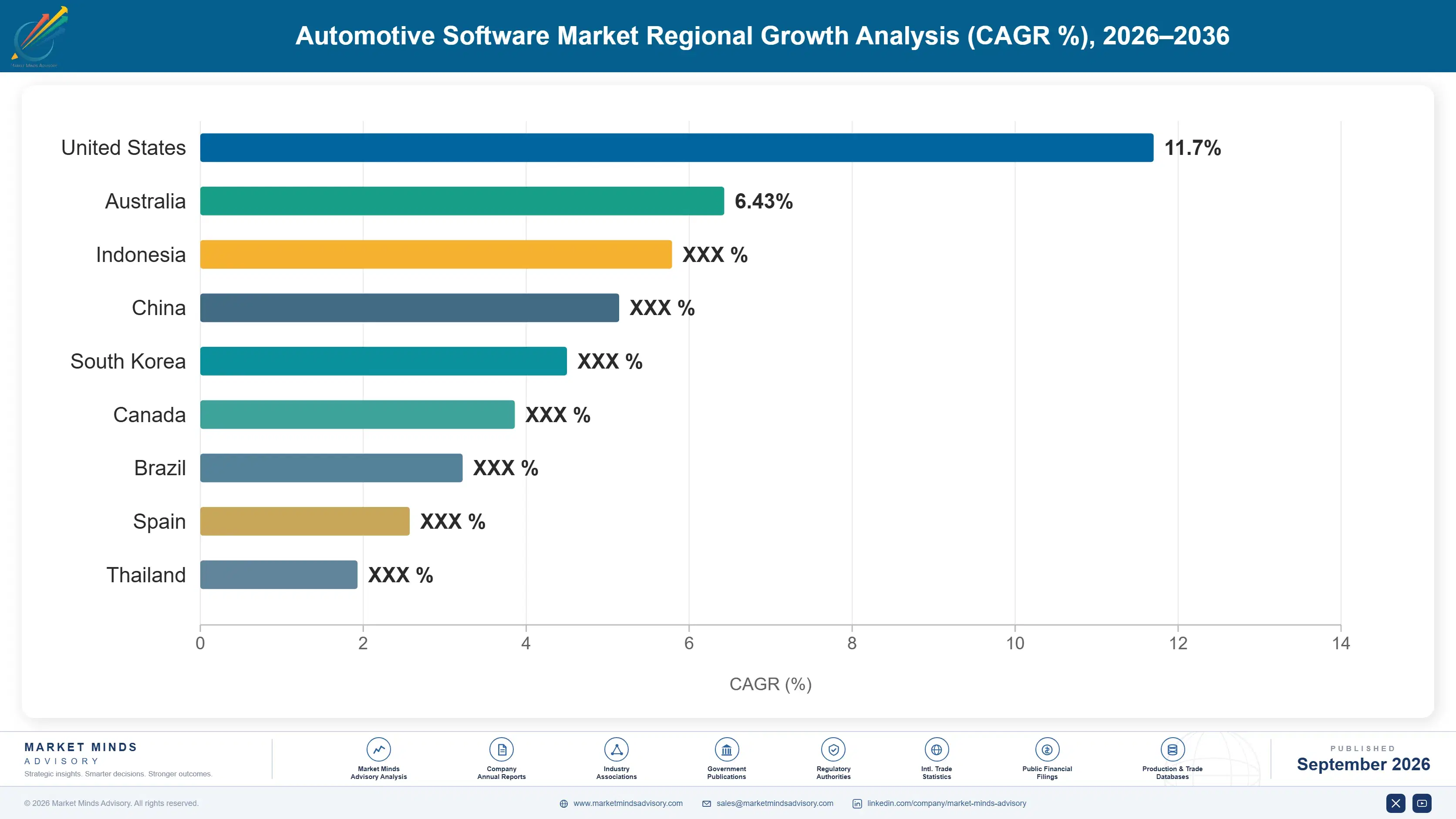
automotive-software-market-country-cagr-analysis-1789987988217

Where Automotive Software Vendors Find Margin

Automotive software suppliers and automakers alike are testing new commercial structures to capture more value from software content that once shipped bundled into vehicle price with no separate revenue attached at all previously. The levers below reflect where the industry is actively investing to build recurring, higher-margin revenue streams beyond the initial vehicle sale.

Bundling Advanced Driver Assistance Into Subscription Tiers

Automakers are restructuring advanced driver assistance features into tiered subscription packages rather than one-time hardware-activated options, generating recurring revenue that continues well past the initial vehicle sale and often through subsequent ownership changes over the vehicle's full lifespan. Early adopters report subscription revenue reaching 15 to 20 percent of total software revenue within three years of launching tiered pricing, though attach rates vary considerably depending on how automakers price entry-level tiers relative to competing free alternatives. This approach works best when automakers clearly differentiate paid tiers from features consumers already expect as standard equipment.
Market Impact: Generates roughly 15 to 20 percent of revenue

Licensing Centralized Computing Platforms to Smaller Automakers

Automakers and specialized suppliers that built centralized, software-defined computing platforms are increasingly licensing that architecture to smaller manufacturers lacking the scale to justify independent platform development, capturing licensing revenue worth 8 to 15 percent on top of any component sales already generated from that same relationship. This mirrors a strategy long used in consumer electronics, where platform owners monetize their architecture investment across a broader customer base than their own product line alone could support. Smaller automakers benefit from faster time to market without the multi-year internal development timeline building an equivalent platform from scratch would require.
Market Impact: Platform licensing fees run 8 to 15 percent

Selling Over-the-Air Update Infrastructure as a Service

Suppliers building over-the-air update infrastructure are increasingly selling it as a standalone service to automakers rather than bundling it into a broader software platform contract, letting automakers retain more control over their own application layer while outsourcing the complex update delivery mechanics. This model appeals particularly to automakers midway through a software-defined architecture transition who need update infrastructure sooner than their own internal development timeline allows. Suppliers report renewal rates on these service contracts running above 85 percent, considerably higher than comparable one-time licensing arrangements, reflecting the switching cost automakers face once infrastructure is deeply integrated.
Market Impact: Service contracts renew at a rate over 85 percent

Charging Data Licensing Fees for Fleet Telemetry

Automakers with large connected vehicle fleets are increasingly licensing anonymized telemetry data to insurers, mapping companies, and infrastructure planners, turning a byproduct of existing connectivity into a standalone revenue stream requiring minimal incremental investment beyond data infrastructure already built for other purposes. Insurers in particular pay a premium of 3 to 5 percent for usage-based driving data that improves underwriting accuracy relative to traditional demographic pricing models. Automakers are approaching this cautiously given consumer privacy concerns, generally requiring explicit opt-in consent and limiting data sharing to anonymized, aggregated formats rather than individually identifiable driving records tied to specific vehicle owners.
Market Impact: Telemetry licensing adds 3 to 5% to margin

Who Controls the Margin Pool

Automotive software platform revenue concentrates modestly at the top, with the five leading providers holding roughly 25 percent combined share while dozens of Tier 1 suppliers and technology companies compete for the remainder. QNX and NVIDIA lead by this measure, drawing on decades of embedded systems and computing platform experience traditional automotive suppliers are still building internally. Continental and Bosch trail the technology-native leaders somewhat in pure software revenue, though both hold advantages in integrated hardware-software bundles pure software vendors cannot easily replicate.
Current competitive activity centers on platform consolidation, as automakers reduce the number of software suppliers per vehicle program to simplify integration and validation. Several major automakers have announced multi-year platform partnerships with a single primary software supplier rather than sourcing components from many vendors as before. Cybersecurity certification compliance has become a genuine differentiator, with suppliers investing heavily in dedicated engineering teams.

Emerging pressure comes from Chinese domestic suppliers building software platforms tailored to Chinese automakers' aggressive over-the-air update cadence, a capability Western suppliers are still working to match. Rankings among established suppliers are likely to shift as automakers increasingly favor suppliers who can demonstrate proven software-defined vehicle deployments over those still transitioning legacy hardware-centric product lines.
automotive-software-market-company-positioning-matrix-1789987988743

Competitive Moat and Risk Dimensions

QNX (BLACKBERRY)

Moat: Deep Embedded Systems Heritage

QNX draws on decades of certified embedded operating system experience across safety-critical industries beyond automotive, giving it a compliance and reliability track record that newer software-defined vehicle entrants cannot easily replicate. This heritage makes QNX a default choice for safety-critical functions where certification history matters more than modern feature velocity, particularly among automakers prioritizing regulatory approval speed.
QNX (BLACKBERRY)

Risk: Perceived as Legacy Platform

QNX's association with traditional embedded systems architecture makes it a less obvious default for automakers building entirely new software-defined vehicle platforms from scratch, who increasingly consider more modern, cloud-native alternatives from technology entrants. This risks ceding the newest, highest-growth platform contracts to competitors perceived as better suited to over-the-air-first vehicle architecture design.
NVIDIA

Moat: Computing Hardware and Software Bundle

NVIDIA pairs its automotive-grade computing hardware directly with a full software development platform, letting automakers adopt both simultaneously rather than integrating separately sourced components from multiple vendors. This bundled approach shortens development timelines meaningfully for automakers building centralized computing architecture, a genuine advantage competitors offering software or hardware alone struggle to match on integration speed.
NVIDIA

Risk: Premium Pricing Limits Reach

NVIDIA's premium computing hardware pricing limits its addressable market among cost-sensitive automakers building lower-priced vehicle segments, ceding this volume tier to lower-cost alternatives from competing chip suppliers willing to accept thinner margins. As automakers increasingly seek to differentiate pricing across vehicle tiers, NVIDIA's premium positioning may constrain its penetration outside flagship and premium vehicle segments specifically.

Players Tracked

Prominent Players

QNX (BlackBerry)
Aptiv
Continental
Bosch
NVIDIA

Other Key Players

Harman International
Denso
Elektrobit
Wind River
Vector Informatik
Green Hills Software
Luxoft
Visteon
ZF Friedrichshafen
Valeo
Autotalks
Renesas Electronics
Mobileye
Xilinx (AMD)
Sonatus

Recent Developments

FEBRUARY 2026

NVIDIA Expands Computing Platform Partnerships

NVIDIA expanded its automotive computing platform partnership roster, adding two additional global automakers committed to building next-generation vehicle lines on its centralized computing architecture. The expanded partnerships extend NVIDIA's software development platform across a broader range of vehicle segments than its previous premium-only automaker relationships covered.
Signal: Signals computing platform consolidation is accelerating well beyond premium vehicle segments into mainstream production programs industry-wide overall
SEPTEMBER 2025

QNX Adds Cybersecurity Certification Support

QNX announced expanded cybersecurity certification support for its embedded automotive operating system, responding directly to newly mandatory certification requirements introduced across the European Union and China during 2024. The update lets automakers using QNX meet compliance deadlines without engaging a separate specialized cybersecurity software vendor.
Signal: Signals embedded platform vendors are increasingly absorbing cybersecurity compliance work automakers previously outsourced separately to dedicated specialists
MAY 2025

Chinese EV Maker Launches Weekly-Update Platform

A major Chinese domestic electric vehicle manufacturer launched a new model generation built entirely on a centralized computing architecture, supporting weekly over-the-air update cycles considerably faster than most competing global automakers currently offer their customers. The launch reinforced China's lead in software-defined vehicle deployment speed.
Signal: Signals the update-speed gap between Chinese and global legacy automakers continues widening rather than narrowing further

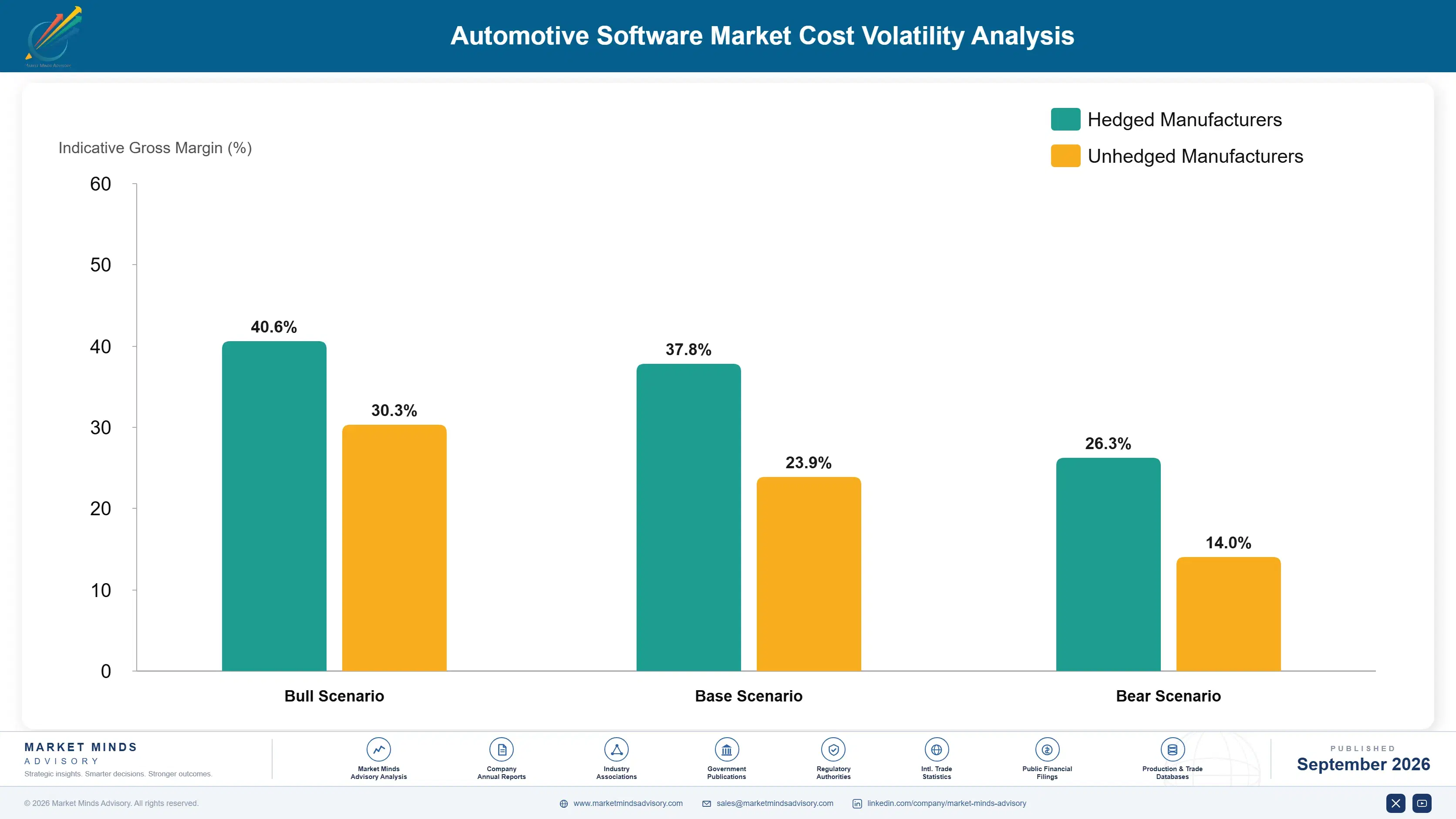
What Drives Automotive Software Development Cost

Software engineering labor represents the dominant input cost for automotive software, typically running 55 to 65 percent of total development cost, sourced from a combination of in-house engineering teams and outsourced development firms concentrated in North America, Western Europe, and increasingly India. Computing hardware licensing and third-party middleware fees round out the remaining major cost categories.
Software engineering compensation rose sharply during 2022 and 2023 as automakers competed directly against established technology companies for the same pool of experienced embedded and cloud software engineers, a dynamic documented in multiple automaker annual reports discussing rising research and development expense during that period. Automakers without existing strong technology employer branding found themselves losing candidates to better-known technology companies offering comparable or higher compensation for similar work.

Automakers without in-house software engineering scale face a genuine competitive disadvantage, since outsourced development typically costs more per engineer-hour and creates coordination overhead across time zones and vendor boundaries that in-house teams avoid entirely. This disadvantage falls hardest on smaller, regional automakers lacking the vehicle volume to justify large permanent engineering organizations, pushing many toward platform licensing arrangements with larger suppliers instead of building comparable capability internally from scratch.
automotive-software-market-cost-volatility-analysis-1789987988939

Building Regional Engineering Hubs in Lower-Cost Markets

Automakers are establishing dedicated software engineering hubs in India and Eastern Europe, capturing meaningfully lower labor cost than comparable North American or Western European teams while maintaining reasonable time zone overlap with headquarters engineering organizations throughout the development cycle. This approach requires sustained investment in local hiring and retention infrastructure to work well over time.

Standardizing Middleware Across Vehicle Platforms

Automakers are consolidating middleware choices across multiple vehicle platforms rather than maintaining separate software stacks per model line, reducing duplicate engineering effort and licensing fees considerably across the broader vehicle portfolio and its various trim levels. This standardization also shortens the validation cycle for new vehicle programs, since previously certified middleware components carry over directly.

Partnering With Technology Companies on Talent Pipelines

Several automakers have formed direct partnerships with universities and technology companies to build dedicated automotive software talent pipelines, addressing the engineering talent shortage at its source rather than competing purely on compensation after graduation from these partner institutions. This approach takes longer to show measurable results but produces more loyal engineering talent over time.

Portfolio Architecture for Margin Defence

Automotive software splits into three margin tiers reflecting fundamentally different development economics and pricing power across the industry today. Standardized infotainment and basic connectivity software runs on volume economics with thinner per-unit margins, while ADAS and cybersecurity software command materially higher margins given their safety-critical validation requirements and specialized engineering talent needs.
Tension between volume and premium tiers shows up most clearly in how suppliers allocate senior engineering talent, since safety-critical ADAS validation requires far more specialized expertise than standard infotainment feature development does across most vehicle programs. Suppliers increasingly staff commodity infotainment work with junior engineers and reusable code libraries, reserving senior talent for premium ADAS and centralized platform architecture work that commands considerably stronger margins overall.

High-value margin pools concentrate specifically in ADAS software, cybersecurity software, and centralized software-defined vehicle platform licensing, all of which combine strong pricing power with meaningful barriers to entry from certification and validation requirements across the broader industry landscape today. Infotainment software represents the largest volume pool but the thinnest margins, having become commoditized as consumers increasingly expect smartphone-equivalent interfaces as standard rather than a differentiated purchase decision.

Volume / Commodity-Adjacent

Standardized infotainment interfaces and basic connectivity software sold at low incremental cost per vehicle across mass-market model lines to maximize unit volume and total addressable reach across every price segment.
Gross Margin: 22-30%

Premium / Certified

Advanced driver assistance software and premium connected services sold as differentiated features commanding stronger per-vehicle pricing power than commodity infotainment alternatives available broadly across the market today and going forward.
Gross Margin: 38-48%

Sustainability / Regulatory / Next-Generation

Cybersecurity software and centralized software-defined vehicle platform licensing addressing emerging regulatory certification requirements and the industry's broader architecture transition currently underway across most regions worldwide right now and well beyond that horizon.
Gross Margin: 42-52%
automotive-software-market-portfolio-architecture-1789987989444

High-value Sub-segments and Strategic Watch-out

ADAS and Autonomous Driving Software

ADAS and autonomous driving software combines the strongest growth with the highest margins, driven by tightening mandatory driver assistance regulation and automakers' willingness to pay a premium for suppliers with proven safety-critical validation track records and established regulatory approval relationships built over many years of work.
Gross Margin: 45-55%

Over-the-Air Update and Software-Defined Vehicle Platforms

Over-the-air update and software-defined vehicle platforms post strong margins and the fastest growth of any category, though execution risk remains meaningful for automakers still migrating legacy distributed architectures toward the centralized computing model this segment fundamentally depends on for full functionality across every vehicle system.
Gross Margin: 40-50%

Infotainment and Connected Services Software

Infotainment and connected services software remains the volume core of the market, shipping in nearly every new vehicle at accessible per-unit pricing, and suppliers rely on this segment for stable baseline revenue even as its margin contribution continues to compress steadily under commoditization pressure over time.
Gross Margin: 22-28%

Vehicle Operating Systems and Middleware

Vehicle operating systems and middleware warrant close monitoring as automakers increasingly consolidate around fewer platform choices, threatening to displace smaller specialized suppliers from mid-tier programs that once provided steady, dependable revenue without requiring the very largest strategic platform commitments from suppliers competing hard for share.
Gross Margin: 32-40%

Why Software Revenue Compounds Post-Sale

Automotive software increasingly behaves like an annuity business once a vehicle ships with recurring subscription features enabled, since the software relationship continues for years after the initial hardware sale rather than ending at delivery. Automakers structure over-the-air update infrastructure specifically to sustain this ongoing relationship, treating each update as an opportunity to introduce new paid features rather than simply patching bugs.
Adoption stickiness varies considerably by end-use vertical: premium and luxury vehicle buyers adopt paid software subscriptions at meaningfully higher rates than mass-market buyers, who show greater resistance to paying for features once bundled at no additional cost. Commercial fleet operators represent a distinct pattern entirely, valuing predictive maintenance and telemetry software for measurable operating cost reduction rather than convenience or personalization features.

Buyer profiles are shifting generationally as procurement decisions increasingly involve software and data specialists rather than purely mechanical engineering leadership, pushing automakers to demonstrate software roadmap credibility alongside traditional vehicle engineering credentials during supplier selection. This generational shift favors suppliers who can speak credibly to both software architecture and traditional automotive engineering requirements simultaneously, a combination fewer established suppliers possess than the industry's changing buyer expectations now demand.
automotive-software-market-end-use-penetration-index-1789987989935

Priorities for Automotive Software Suppliers

These are among the four positions where our research anticipates prominent divergence between winners and laggards over the coming forecast period. Each is grounded in the demand model, the regulatory perimeter, and the announced capacity pipeline.
01 / CENTRALIZED ARCHITECTURE INVESTMENT

Build Toward Centralized Computing Before Rivals Force It

Automakers still operating distributed electrical architectures face a widening competitive gap against manufacturers that designed centralized computing platforms from inception, particularly Chinese domestic electric vehicle makers now setting the pace on over-the-air update speed. Suppliers who help automakers accelerate this transition, rather than simply patch legacy architectures, are positioned to capture the highest-margin platform contracts of the coming decade. Waiting for rivals to force this transition through competitive pressure leaves suppliers negotiating from a position of catch-up rather than leadership.
02 / SUBSCRIPTION PRICING DISCIPLINE

Reserve Paid Tiers for Genuinely New Capabilities

Consumer backlash against subscription fees for previously free features has already forced several automakers to reverse pricing decisions publicly, damaging brand trust in the process across multiple major markets simultaneously in recent years. Suppliers and automakers who restrict paid tiers to genuinely new capabilities delivered after purchase, rather than features already physically present in the vehicle, avoid this reputational risk entirely. This discipline requires resisting the short-term revenue temptation of monetizing existing hardware capability that consumers already reasonably expect as standard equipment.
03 / CYBERSECURITY CERTIFICATION READINESS

Build Compliance Capability Before Mandates Take Effect

Cybersecurity certification requirements introduced across the European Union, United States, and China since 2024 have already meaningfully raised compliance cost for automakers and suppliers lacking dedicated engineering capability in this one specific area. Suppliers who built this capability early are now positioned to sell certification support as a standalone service to automakers still catching up, turning a compliance burden into a genuine revenue opportunity. Those who wait until mandates take effect will likely pay a premium for outsourced expertise instead.
04 / PLATFORM PARTNERSHIP STRATEGY

Choose Fewer, Deeper Platform Relationships Over Many Vendors

Automakers are consolidating the number of software suppliers per vehicle program to simplify integration and validation, favoring deeper relationships with fewer platform partners rather than sourcing individual components from many vendors as before this shift began. Suppliers positioned as a primary platform partner capture disproportionate share of a vehicle program's total software spend compared to component-level vendors competing for smaller pieces of the same contract. Suppliers unable to offer platform-level breadth risk being displaced entirely from the largest, most strategic vehicle programs.

Engagement Snapshot From the Field

A live engagement with an industry participant carrying material or product regulatory and market exposure ahead of a defining policy shift, showing how our research translates into a defensible multi-year portfolio strategy.
MARKET MINDS ADVISORY · CLIENT ENGAGEMENT SUMMARY
Automotive Software Producer Strategic Portfolio Review and Transition Roadmap 2026·Investment Scenario on Automotive Software Exposure Evaluation 2025-26
CLIENT PROFILE
The client is a mid-tier global automaker producing roughly 1.8 million vehicles annually across North America and Europe, facing mounting pressure from both premium competitors and Chinese domestic electric vehicle makers with meaningfully faster over-the-air update cycles across their newest model lines. The firm's existing vehicle platforms relied on distributed electrical architectures accumulated across three prior model generations.
STRATEGIC CHALLENGE
The automaker needed to decide whether to build a centralized software-defined vehicle platform internally, license one from an external supplier, or pursue a hybrid approach, all within a compressed eighteen-month window ahead of its next major model launch cycle. Internal engineering leadership was sharply divided on the right path forward.
MMA APPROACH
MMA evaluated four platform licensing options against the automaker's internal development roadmap, modeling total cost of ownership, time to market, and long-term architectural flexibility for each path under consideration. The analysis recommended a hybrid approach: licensing a proven centralized computing platform for the next model generation while building internal capability in parallel for future independence.
KEY FINDINGS
  1. Licensing an external platform reduced projected time to market by roughly fourteen months compared to the automaker's original internal-only development timeline for this program.
  2. Total platform cost over a five-year horizon ran lower than fully internal development despite ongoing licensing fees, given the avoided upfront engineering investment.
  3. Internal engineering teams retained ownership of the application layer, preserving differentiation while outsourcing the underlying computing platform infrastructure entirely to the external supplier.
  4. The hybrid approach let the automaker begin shipping over-the-air updates within the current model generation rather than waiting for a full future platform redesign.
CLIENT PROFILE
The client is a mid-tier global automaker producing roughly 1.8 million vehicles annually across North America and Europe, facing mounting pressure from both premium competitors and Chinese domestic electric vehicle makers with meaningfully faster over-the-air update cycles across their newest model lines. The firm's existing vehicle platforms relied on distributed electrical architectures accumulated across three prior model generations.
STRATEGIC CHALLENGE
The automaker needed to decide whether to build a centralized software-defined vehicle platform internally, license one from an external supplier, or pursue a hybrid approach, all within a compressed eighteen-month window ahead of its next major model launch cycle. Internal engineering leadership was sharply divided on the right path forward.
MMA APPROACH
MMA evaluated four platform licensing options against the automaker's internal development roadmap, modeling total cost of ownership, time to market, and long-term architectural flexibility for each path under consideration. The analysis recommended a hybrid approach: licensing a proven centralized computing platform for the next model generation while building internal capability in parallel for future independence.
KEY FINDINGS
  1. Licensing an external platform reduced projected time to market by roughly fourteen months compared to the automaker's original internal-only development timeline for this program.
  2. Total platform cost over a five-year horizon ran lower than fully internal development despite ongoing licensing fees, given the avoided upfront engineering investment.
  3. Internal engineering teams retained ownership of the application layer, preserving differentiation while outsourcing the underlying computing platform infrastructure entirely to the external supplier.
  4. The hybrid approach let the automaker begin shipping over-the-air updates within the current model generation rather than waiting for a full future platform redesign.
RECOMMENDED STRATEGY
Phase 1: Phase one: license a proven centralized computing platform from an external supplier for the next model generation launch cycle ahead. Phase 2: Phase two: build internal software engineering capability in parallel, focused specifically on the application layer and update infrastructure needs going forward. Phase 3: Phase three: evaluate a fully internal platform for the following model generation once internal capability reaches sufficient scale and maturity.
OUTCOME
The hybrid platform strategy let the automaker launch its next model generation with over-the-air update capability roughly on schedule with premium competitors, a meaningful improvement from its prior multi-year lag (client-reported, unverified by MMA). Internal engineering capability built during this period is expected to reduce licensing dependence in the following model generation.

Frequently Asked Questions

Foundational context covering the market sizes, CAGR, scope, country, region and competition that inform every finding below. This section is provided to cover basics and most often pre-purchase conversations, answered from the MMA Primary Research Dataset.

What is the current size of the Automotive Software Market?

The Automotive Software Market was valued at $42.0 billion in 2025. This figure covers ADAS and autonomous driving stacks, infotainment, vehicle operating systems, over-the-air platforms, and automotive cybersecurity software.

How large will the Automotive Software Market be by 2036?

MMA projects the market will reach $132.37 billion by 2036, up from $46.62 billion in 2026. This represents a 2.84-times expansion over the forecast decade.

What is the CAGR for the Automotive Software Market 2026 to 2036?

The market is projected to grow at an 11.0% compound annual growth rate between 2026 and 2036. This compares to a historical CAGR of roughly 10.0% between 2020 and 2025.

Which segment is growing fastest?

Over-the-air update and software-defined vehicle platforms lead all segments at a 15.5% CAGR, roughly 1.41 times the overall market rate. ADAS and autonomous driving software follows closely at 14.0%.

Who are the major companies in the Automotive Software Market?

QNX, Aptiv, Continental, Bosch, and NVIDIA lead by automotive software platform revenue. Harman, Denso, and Elektrobit hold strong positions across infotainment and middleware segments respectively.

Which country is growing fastest?

China is the fastest-growing major market at a 16.5% CAGR, driven by domestic electric vehicle makers building centralized computing architecture into new platforms from inception. This head start compounds each model cycle.

Report Segmentation Architecture

The full report scope spans multiple orthogonal segmentation dimensions, with cross-tabulated demand data provided for each dimension pair. Coverage extends further to regional breakdowns, trend trajectories, and the competitive detail needed to support segment-level decision-making.

By Primary Market Dimension

  • ADAS and Autonomous Driving Software
  • Infotainment and Connected Services Software
  • Vehicle Operating Systems and Middleware
  • Over-the-Air Update and Software-Defined Vehicle Platforms
  • Automotive Cybersecurity Software

By End-Use Industry

  • Passenger Vehicles
  • Commercial Vehicles
  • Electric Vehicles
  • Autonomous and Robotaxi Fleets

By Commercial Dimension

  • OEM-Embedded Licensing
  • Recurring Subscription Revenue
  • Platform-as-a-Service Licensing

By Region

  • North America
  • Western Europe
  • East Asia
  • South Asia and Pacific
  • Latin America
  • Middle East and Africa
  • Eastern Europe

Scope, Methodology, and Coverage

Every figure in this report is reproducible from documented input assumptions. The scope below maps the historical period, the forecast horizon, the segmentation dimensions, and the countries covered, alongside the underlying primary and qualitative methodology.
Historical Period
2020 to 2025
Forecast Period
2026 to 2036
Base Year
2025 (USD billions; MMA Primary Research Dataset, September 2026)
Market Definition
The Automotive Software Market covers embedded and cloud-connected software running in passenger and commercial vehicles, including operating systems, middleware, ADAS and autonomous driving stacks, infotainment and connected services, over-the-air update platforms, and automotive cybersecurity software. It excludes vehicle hardware, semiconductors, and dealership-facing enterprise software unrelated to the vehicle itself.
Quantitative Units
USD Billion, Software Content Per Vehicle, CAGR %
Segmentation Dimensions
Software Category, End-Use Industry, Commercial Dimension, Region
Regions Covered
North America, Western Europe, East Asia, South Asia and Pacific, Latin America, Middle East and Africa, Eastern Europe
Countries Covered
United States, Canada, Germany, France, United Kingdom, China, Japan, South Korea, India, Australia, Brazil, Mexico, United Arab Emirates, South Africa, Poland
Key Companies Profiled
QNX (BlackBerry), Aptiv, Continental, Bosch, NVIDIA, Harman International, Denso, Elektrobit, Wind River, Vector Informatik, Green Hills Software, Luxoft, Visteon, ZF Friedrichshafen, Valeo, Autotalks, Renesas Electronics, Mobileye, Xilinx (AMD), Sonatus
Quantitative Methodology
Primary survey, n=3,800 respondents, Q4 2025, six countries; demand-side model with trade association cross-validation
Qualitative Methodology
47 expert interviews, Q4 2025; applied to validate demand model assumptions, identify emerging dynamics, and assess competitive positioning
Report Format
PDF and XLSX data workbook (Word format preview document)
Publisher
Market Minds Advisory
Report Code
MMA-2026-AUT-631
Published
September 2026
Contact
sales@marketmindsadvisory.com | www.marketmindsadvisory.com

Purchase the full Automotive Software Market Report (2026 to 2036).

This report examines the Automotive Software Market across five software categories and seven demand regions. It analyzes the competitive dynamics reshaping how automakers and suppliers price and deliver vehicle software to consumers worldwide today. The analysis quantifies market size, growth, and segment-level trends through 2036, drawing on primary survey data covering three thousand eight hundred respondents and forty-seven expert interviews conducted in the fourth quarter of 2025. It also covers competitive positioning and input cost pressure. Revenue strategies available to suppliers navigating the industry's software-defined vehicle transition round out the report.
Ten-Year Market Sizing and Forecast Model
Five-Segment MECE Software Category Classification Taxonomy
Seven-Region Demand Breakdown and Growth Analysis
Competitive Benchmarking of Twenty Named Suppliers
Revenue Lever and Margin Economics Analysis
Anonymized Client Engagement Case Study Review

Built For The People Who Decide

From boardroom strategy to bench-side execution, this report is read cover-to-cover by leaders shaping the next decade of their industry, turning demand scenarios, market dynamics and valuation benchmarks into decisions.
CXOs/ Presidents/ VPs/ Managers
M&A and Corporate Development
Strategy Teams and R&D Heads
Procurement and Product Directors
Regulatory and Compliance Leaders
Investor Relations and Equity Analysts