Market Minds Advisory
Automotive Rocker Arm Market

Automotive Rocker Arm Market: Fuel Economy Regulation Reshapes a Mature Valvetrain Component

Fuel economy regulations now reward cylinder deactivation technology that only precision-engineered rocker arms can deliver, turning a simple mechanical lever into a compliance-critical component even as electric vehicle adoption slowly narrows its long-term addressable base.

Lead Analyst

David Horsley

Published

September 2026

Make Smarter Decisions with Customized Research Insights

Request a free sample report and evaluate market opportunities, growth trends, and competitive dynamics relevant to your business needs.

2025 MARKET VALUE$2.1BMarket Size 2025
2036 FORECAST VALUE$3.1BBase Case , 2026 to 2036
CAGR 2026 TO 20363.6 %Bull 4.9% / Bear 2.3%
INCREMENTAL OPPORTUNITY$0.9BNet 10- year value creation
EXPANSION MULTIPLE1.42x2036 value over 2026 base
Strategic Levers
M&A Pipeline
Regional Outlook
Country Rankings
Competitive Intelligence
Segmental Deep-dive
Call-Us : 91 93563 13602

Executive Snapshot and Market Trajectory

Fuel economy regulation, not raw valvetrain durability, now determines which rocker arm suppliers win new engine programs, as cylinder deactivation mandates turn a simple mechanical lever into a precision-engineered component few smaller manufacturers can genuinely support at meaningful scale or speed today across every market.
Cylinder deactivation and variable valve actuation rocker arms grow fastest of all as automakers chase fuel economy targets on large-displacement North American truck and SUV engines, while roller rocker arms keep displacing older stamped steel designs across developing markets modernizing engine platforms at genuine scale. North America accounts for a disproportionate share of value, reflecting the region's concentrated large-displacement truck and SUV engine production that relies heavily on cylinder deactivation technology specifically and consistently.
A handful of established suppliers with deep OEM engineering integration and precision manufacturing depth capture most design-in value, while a long tail of regional forging specialists compete on replacement volume alone across every developing market this report tracks in careful detail. Long-term electric vehicle substitution, not near-term demand softness, is the more durable force shaping how suppliers allocate capital across this maturing category and its many downstream applications.
Market Definition
The automotive rocker arm market covers valvetrain components that transfer camshaft motion to open and close intake and exhaust valves in combustion and hybrid engines. It excludes camshafts themselves, valve springs, and rocker arm components for non-automotive combustion applications.
Base Year Value
$2.1B in 2025 (MMA Primary Research Dataset, August 2026)
Forecast Period
2026 to 2036, eleven discrete annual values
CAGR
3.6% base case. Bull 4.9%. Bear 2.3%.
Fastest Growth Segment
Cylinder Deactivation and Variable Valve Actuation Rocker Arms: 8.9% CAGR
Fastest Growth Country
India: 6.4% CAGR
Fastest Growth Region
South Asia and Pacific: 5.8% CAGR
Largest Region
North America: 33% of 2025 global value
Market Leaders
Eaton Corporation, Schaeffler AG, Rhythm Autotech, Sundram Fasteners, Melling Engine Parts. Source: MMA Analysis based on company annual reports.
Primary Survey
n=3,800 procurement and R&D decision-makers, Q4 2025, six countries
Methodology
Demand-side build-up, cross-validated against public data, 47 expert interviews

Automotive Rocker Arm Market Forecast Scenarios

automotive-rocker-arm-market-size-forecast-scenario-1787465904366
Demand grew slowly but steadily from 2020 to 2025 as combustion engine production held broadly stable across most developing markets even while mature markets began shifting meaningfully toward electric platforms, with cylinder deactivation adoption on North American truck engines providing a genuine bright spot throughout the entire historical window this report tracks in careful detail.
The base case assumes modest continued expansion driven by three mechanisms: rising cylinder deactivation adoption as automakers chase fuel economy targets on large-displacement North American engines specifically, growing roller rocker arm adoption as developing markets replace older stamped steel designs with friction-reducing architecture across every relevant program, and steady replacement demand from the enormous existing global combustion vehicle fleet that will remain on the road for decades to come regardless of new sales trends.
The bull case centers on faster-than-expected cylinder deactivation adoption spreading beyond trucks and SUVs into mainstream passenger vehicle engine programs across every major market tracked. The bear case rests on accelerated electric vehicle substitution in mature markets compressing new-engine rocker arm demand faster than replacement volume and developing-market growth can offset, squeezing supplier revenue meaningfully across the category.

Fuel Economy Compliance Reshapes a Mature Legacy Category

Three forces converge on this market today. Fuel economy regulations increasingly reward cylinder deactivation technology that only precision-engineered rocker arms can reliably deliver, pulling demand toward higher-value designs regardless of underlying engine production volume. Developing markets keep replacing older stamped steel rocker arms with roller architecture as engine platforms modernize. Electric vehicle substitution in mature markets creates a genuine long-term ceiling that shapes how suppliers allocate capital today.
MARKET CONCENTRATIONCR5 52%top five suppliers hold a moderate combined share
AVERAGE SELLING PRICEUSD 9/unitcylinder deactivation rockers command a meaningful price premium
TOP PRODUCING COUNTRYChina 22%concentrated stamped and cast component manufacturing base overall
CAPACITY UTILIZATION68%mature forging lines run below full nameplate capacity
FEEDSTOCK COST SHARE31% of COGSforged steel billet and precision machining input dependency
TRADE INTENSITY44% cross-borderfinished rockers shipped globally across OEM assembly networks
The commercial character sits closer to a mature, precision-manufacturing component business than a high-growth technology category, since most volume now comes from sustaining an enormous existing combustion vehicle fleet rather than winning entirely new engine programs each cycle. That dynamic rewards suppliers with efficient forging scale and established OEM engineering relationships over those chasing narrow technology differentiation alone without comparable reach.
The next decade turns on how far cylinder deactivation technology spreads beyond large-displacement trucks into mainstream passenger vehicle engines, and on whether developing-market combustion growth and replacement volume can offset accelerating mature-market electrification for long enough to sustain supplier profitability. Both outcomes shape how aggressively suppliers reinvest in this maturing category versus redirecting capital elsewhere entirely.
"This part used to be pure mechanics. Now half the engineering budget goes into making sure a cylinder can shut off and restart without the driver ever noticing, and that's what separates the suppliers who win from the ones who don't."
Director, Powertrain Components Practice · MMA Automotive / Powertrain Components Practice · August 2026

Market Trends

Cylinder Deactivation Mandates Drive Premium Rocker Adoption

Fuel economy regulations increasingly reward automakers that deactivate individual engine cylinders under light load, a capability only precision-engineered rocker arms with integrated collapsing mechanisms can reliably deliver across every operating condition an engine faces. Roughly 45% of new large-displacement North American truck and SUV engine programs launched globally now specify cylinder deactivation rocker arms as standard equipment rather than an optional feature. Suppliers that achieve certified durability compliance status gain a captive demand pool competitors lacking comparable precision manufacturing depth cannot easily contest, since automakers face genuine warranty exposure if deactivation mechanisms fail during extended service life.
Market Impact: Grew roughly 19% over two years

Roller Architecture Displaces Legacy Stamped Steel Designs

Roller rocker arms reduce friction losses considerably compared with stamped steel designs, delivering measurable fuel economy gains that developing markets modernizing their domestic engine platforms increasingly specify over older, cheaper alternatives as manufacturing costs continue falling steadily. India alone transitioned roughly 38% of new passenger vehicle engine production to roller rocker arm architecture over the past four years, a shift that barely existed at meaningful scale a decade ago. This transition represents one of the largest remaining unit volume opportunities in the entire rocker arm category, since developing-market engine production volumes continue expanding while mature markets plateau.
Market Impact: Replaces every 100,000 to 150,000 miles

Market Opportunities and Growth Drivers

North American Truck Engines Adopt Cylinder Deactivation

North American truck and SUV engine programs continue specifying cylinder deactivation technology to meet tightening fuel economy standards, and every additional engine program adopting this technology represents incremental premium rocker arm demand tied directly to platform architecture rather than optional equipment choice. Cylinder deactivation adoption on large-displacement North American engines grew by roughly 19% over the past two years according to manufacturer disclosures, with premium truck and SUV platforms leading this expansion consistently. This single technology segment now represents one of the largest and most reliable sources of incremental rocker arm demand tracked anywhere in this global report.
Market Impact: Eliminates demand across 100% of EVs

Aftermarket Replacement Demand Provides Reliable Volume Floor

Rocker arms wear gradually with mileage accumulation and valvetrain stress, creating predictable replacement demand from the enormous existing global combustion vehicle fleet that will remain on the road for many years regardless of new vehicle sales trends or electrification timelines. The average rocker arm requires inspection or replacement every 100,000 to 150,000 miles across most vehicle platforms, generating steady recurring revenue independent of new vehicle production cycles entirely. This replacement volume provides suppliers a meaningfully more stable revenue base than categories tied exclusively to new engine program wins, cushioning the category against near-term production volatility.
Market Impact: Affects 35% of legacy unit volume

Market Restraints and Challenges

Electric Vehicle Substitution Sets a Long-Term Ceiling

Electric vehicle adoption in mature markets is steadily eliminating the very engine platforms that generate rocker arm demand, creating a genuine long-term ceiling on new-engine volume that no amount of cylinder deactivation premiumization can fully offset. The root cause is that battery-electric vehicles have no valvetrain and therefore no rocker arm requirement whatsoever, making this substitution complete and permanent rather than partial or reversible. The commercial impact falls hardest on suppliers whose portfolios concentrate narrowly on mature-market new-engine programs rather than replacement volume or developing markets. Producers are responding by redirecting capital toward developing-market growth and replacement-focused distribution instead.
Market Impact: Covers 45% of new truck engines

Legacy Architecture Faces Intense Price Competition

A large population of regional forging and stamping manufacturers compete for legacy stamped steel rocker arm volume largely on price, since these older designs carry minimal differentiation and few switching costs for cost-sensitive buyers. The root cause is that patent protection on legacy stamped steel designs has long since expired, leaving manufacturing scale as the only meaningful barrier smaller producers must overcome with modest capital investment. The impact shows up as compressed margins across roughly 35% of unit volume still using older stamped architecture. Leading suppliers are responding by concentrating investment in cylinder deactivation categories where technology barriers remain durable.
Market Impact: Converted 38% of new Indian engines
4 additional market trends, 3 additional growth drivers, and 3 additional restraints and challenges are covered in the full report. Contact sales@marketmindsadvisory.com to access the complete intelligence.

Segment CAGR and Growth Architecture

The market segments by rocker arm architecture and technology type, the dimension that determines both manufacturing complexity and pricing power most directly across every program, rather than by vehicle body style, which cuts evenly across every architecture category regardless of the specific platform or price tier involved in each program this report tracks closely.
automotive-rocker-arm-market-market-share-analysis-1787465904952

Cylinder Deactivation and Variable Valve Actuation Rocker Arms

Cylinder deactivation and variable valve actuation rocker arms represent the fastest-growing segment, expanding well above the overall market rate as fuel economy regulations increasingly reward automakers that deactivate individual cylinders under light load conditions across large-displacement engine platforms. Pricing runs meaningfully above legacy architecture, reflecting genuine mechanical complexity and certified durability testing that smaller regional manufacturers cannot easily replicate without substantial engineering investment and validation infrastructure. Adoption has expanded rapidly across North American truck and SUV engine programs launched over the past several years, a category that barely existed at meaningful commercial scale a decade ago across the industry. Eaton Corporation and Schaeffler AG both supply this segment at meaningfully growing volume worldwide.
CAGR 8.9%

Roller Rocker Arms

Roller rocker arms form the second-fastest-growing segment, driven by developing markets modernizing domestic engine platforms and displacing older stamped steel architecture that carries genuine friction losses and considerably less favorable fuel economy characteristics across every operating cycle an engine undergoes throughout its service life. India's massive passenger vehicle production base has driven much of this segment's recent expansion, converting a meaningful share of new engine output to this architecture within just the past several years of accelerating adoption nationwide across every major manufacturer. This segment's underlying unit volume, tied directly to developing-market vehicle production, gives it considerably more durable growth than mature-market categories facing steady electric vehicle substitution pressure and shrinking fleets.
CAGR 6.2%
Full segment breakdown across 6 segments available in the complete report.

Regional Architecture and Country Demand Map

North America leads on concentrated large-displacement truck and SUV engine production relying heavily on cylinder deactivation technology, while every other region sits within its typical band given how globally distributed rocker arm manufacturing genuinely remains across every major market and vehicle segment this report tracks.

North America

Concentrated large-displacement truck and SUV engine production, combined with cylinder deactivation technology adoption unmatched anywhere else, pushes North America to 33% of value, just above its typical 22 to 32% band for this specific category. Eaton Corporation and Melling Engine Parts both maintain substantial North American engineering and manufacturing operations serving OEM customers directly across major production hubs. Canadian demand contributes a smaller additional base tied to integrated cross-border automotive supply chains built over many decades. The share sits above its usual band because North American truck and SUV engine architecture specifically favors cylinder deactivation at a scale unmatched elsewhere. Growth of 4.2% reflects continued technology adoption across expanding platform lineups.
Share: 33% | CAGR: 4.2% (2026 to 2036)

Western Europe

Smaller-displacement turbocharged engine architecture common across European vehicle programs relies considerably less on cylinder deactivation technology than large North American engines, keeping Western Europe within its 18 to 26% band at 18% of value, near the floor of that typical range for this category specifically. Schaeffler AG and MAHLE GmbH both maintain substantial regional manufacturing capacity serving both OEM and aftermarket demand across the continent and its many distinct national markets. German and French replacement demand contributes meaningful volume tied to the region's still-substantial existing combustion vehicle fleet still on the road today. Growth of 2.0%, the slowest of the seven regions, reflects the bloc's aggressive push toward electrification within the coming decade ahead.
Share: 18% | CAGR: 2.0% (2026 to 2036)
Regional intelligence for 5 additional markets available in the complete report: East Asia, South Asia and Pacific, Latin America, Middle East and Africa, Eastern Europe. Contact sales@marketmindsadvisory.com.
automotive-rocker-arm-market-country-cagr-analysis-1787465905482

Where Rocker Arm Suppliers Can Still Expand Margin

Margin expansion in this market concentrates around cylinder deactivation technology, developing-market unit volume, and aftermarket distribution reach rather than mature-market new-engine growth alone, since electrification steadily and permanently shrinks the addressable base for entirely new combustion engine programs suppliers might otherwise pursue for growth across every relevant vehicle category, price tier, and geography served.

Expand Cylinder Deactivation Manufacturing Capacity Now

Fuel economy regulations increasingly reward cylinder deactivation technology that only precision-engineered rocker arms with certified durability can reliably deliver, and suppliers with proven manufacturing capability capture disproportionate share of this premium segment's continued expansion across every relevant truck and SUV engine program and price tier. Automakers face genuine warranty exposure if deactivation mechanisms fail, making certified suppliers considerably harder to displace once qualified and validated across multiple platforms and markets. Producers investing in dedicated cylinder deactivation manufacturing can capture 20% to 30% pricing premiums over legacy architecture across comparable output specifications and configurations.
Market Impact: Commands a 20% to 30% pricing premium overall

Capture India's Roller Architecture Conversion Volume

India's transition from stamped steel to roller rocker arm architecture across its enormous passenger vehicle production base represents one of the largest remaining unit volume opportunities in this entire category, and suppliers with established local manufacturing presence capture disproportionate share of this ongoing conversion across every price tier. Local production avoids the import duties and logistics costs that erode margin on components shipped from established Japanese or Western facilities across considerable distances. Suppliers with early Indian manufacturing investment can expect 13% to 19% faster revenue growth than those relying solely on export.
Market Impact: Delivers 13% to 19% faster revenue growth overall

Build Aftermarket Replacement Distribution Depth Now

Replacement demand from the enormous existing global combustion vehicle fleet provides considerably more stable, recurring revenue than new-engine program wins alone, and suppliers with deep independent repair shop and retail distribution relationships capture disproportionate share of this durable revenue base regardless of new vehicle sales trends or broader economic cycles. This channel depth typically requires years of relationship building that newer entrants cannot easily replicate quickly or cheaply at any real scale. Suppliers with established aftermarket distribution can capture 15% to 22% incremental margin relative to OEM-only supply relationships alone.
Market Impact: Adds 15% to 22% incremental margin overall today

Redirect Capital Toward Developing Market Capacity Now

Developing markets across South Asia, Southeast Asia, and Africa represent the fastest-growing source of incremental combustion engine production, and suppliers reallocating capital away from mature-market new-engine programs toward developing-market manufacturing capacity position themselves ahead of where genuine unit volume growth is actually occurring right now across the industry. This reallocation reduces exposure to the accelerating mature-market electrification trend steadily shrinking traditional new-engine demand across every relevant program and geography. Suppliers making this shift early can expect 11% to 17% better long-term revenue durability than those remaining concentrated in mature markets.
Market Impact: Improves revenue durability by 11% to 17% overall

Who Controls the Margin Pool

Concentration sits at a moderate 52%, evaluated on OEM and aftermarket revenue combined, with Eaton Corporation holding a commanding lead through its proprietary cylinder deactivation technology while Schaeffler AG follows closely on precision manufacturing depth and broad OEM relationships across every major automotive market tracked.
Current competitive activity centers on three dimensions: expanding cylinder deactivation manufacturing capability to capture fuel economy-driven demand across every relevant truck and SUV engine program, building developing-market manufacturing presence ahead of continued combustion engine production growth in South Asia specifically, and deepening aftermarket distribution networks that provide durable replacement revenue regardless of new-engine cycles. Suppliers lacking precision manufacturing depth increasingly struggle to compete outside commoditized legacy architecture entirely.

Emerging pressure comes from regional Indian and Southeast Asian forging manufacturers building manufacturing capability to serve fast-growing domestic passenger vehicle production without depending entirely on established Japanese and Western suppliers for every component sourced. Rankings could shift meaningfully if mature-market electrification accelerates faster than expected, since that single trend would reshuffle which suppliers hold the strongest remaining growth drivers across this maturing but still substantial global category and its many regional sub-segments.
automotive-rocker-arm-market-company-positioning-matrix-1787465905999

Competitive Moat and Risk Dimensions

EATON CORPORATION

Moat: Proprietary Deactivation Technology

Eaton's proprietary cylinder deactivation rocker arm technology, licensed to major North American truck and SUV engine programs, combined with deep OEM engineering integration, gives it genuine pricing power that narrower specialists cannot easily replicate at comparable scale, speed, or global reach today across every relevant market.
EATON CORPORATION

Risk: North American Platform Concentration

Eaton's revenue still carries meaningful concentration in North American large-displacement engine platforms facing long-term downsizing and electrification pressure, requiring continuous portfolio reallocation toward developing-market volume and technology-adjacent components that smaller, more focused competitors can pursue with considerably less legacy drag weighing them down each year.
SCHAEFFLER AG

Moat: Precision Manufacturing Depth

Schaeffler's precision roller finger-follower manufacturing expertise, built on decades of valvetrain engineering across multiple architectures, combined with broad European and Asian OEM relationships, lets it command premium pricing that newer, less established competitors simply cannot easily match at comparable volume, scale, or global reach today.
SCHAEFFLER AG

Risk: European Phase-Out Exposure

Schaeffler's revenue relies more heavily on European combustion engine phase-out timing than diversified peers with stronger North American positions, leaving it more exposed to any acceleration in regional electric vehicle adoption that shrinks core demand for its established valvetrain component portfolio over time considerably and permanently.

Players Tracked

Prominent Players

Eaton Corporation
Schaeffler AG
Rhythm Autotech
Sundram Fasteners
Melling Engine Parts

Other Key Players

Bharat Forge
Delphi Technologies
Thyssenkrupp AG
Musashi Seimitsu Industry
Riken Corporation
Yamada Manufacturing
Otics Corporation
F.C.C. Co
Crower Cams & Equipment
COMP Cams
T&N Group
Metaldyne Performance Group
Kibbe Precision Machining
MAHLE GmbH
Federal-Mogul Motorparts

Recent Developments

MARCH 2025

Eaton Expands Cylinder Deactivation Capacity

Eaton Corporation expanded cylinder deactivation rocker arm manufacturing capacity at a North American production facility to meet rising demand from truck and SUV engine programs across multiple automaker platforms. This was an organic capacity expansion funded through existing operations, not an acquisition or joint venture of any kind.
Signal: Signals continued investment in cylinder deactivation manufacturing capacity ahead of expanding fuel economy compliance demand worldwide.
AUGUST 2024

Schaeffler Signs Chinese OEM Supply Deal

Schaeffler AG entered a supply agreement with a major Chinese automaker to provide roller finger-follower rocker arms for a new engine platform launching within the next two years. This was a supply agreement, not an acquisition, joint venture, or merger between the two companies involved in the transaction.
Signal: Signals established European suppliers winning meaningful design-in status with fast-growing Chinese domestic automakers directly and competitively.
JANUARY 2025

Rhythm Autotech Acquires Indian Forging Firm

Rhythm Autotech acquired a smaller Indian precision forging company to expand its rocker arm and valvetrain component manufacturing capacity ahead of continued domestic engine production growth across the country. This was a full acquisition, not a joint venture or minority equity stake, giving Rhythm Autotech direct control.
Signal: Signals Indian domestic suppliers consolidating precision manufacturing capability ahead of continued combustion engine production growth nationwide.

Steel Billet and Precision Machining Cost Exposure

Forged steel billet and precision machining together represent roughly 31% of cost of goods sold for finished rocker arms, sourced primarily from steel producers in South Korea and China and precision machining capacity concentrated in Japan, Germany, and India, each carrying distinct exposure and genuine supply risk that suppliers must actively manage across every relevant sourcing region and contract relationship maintained.
Steel billet pricing spiked considerably during 2021 and 2022 as global supply chains faced disruption and demand from multiple industrial sectors competed directly for constrained steel mill capacity, according to IEA industrial commodity reporting covering that period specifically in careful detail. Manufacturers dependent on spot market steel purchasing faced meaningful cost pass-through pressure during that stretch, with some unable to fully recover margin through pricing for several quarters afterward.

Suppliers with long-term steel supply contracts, primarily the larger vertically integrated manufacturers, weather commodity volatility considerably better than smaller competitors purchasing on the spot market each quarter without comparable protection. Smaller suppliers lacking negotiating leverage with mills face the sharpest margin compression during volatility episodes, reinforcing the competitive gap between scaled suppliers and smaller regional specialists across the broader rocker arm supply chain and its many participants.
automotive-rocker-arm-market-cost-volatility-analysis-1787465906197

Long-Term Steel Billet Supply Contracts

Larger suppliers increasingly lock in multi-year steel billet supply agreements with fixed or collared pricing, reducing exposure to the kind of spot market volatility that hit smaller manufacturers hardest during 2021 and 2022 specifically, protecting margin more reliably through future commodity cycles ahead and reducing quarterly earnings surprises considerably for shareholders and management teams alike.

Direct Steel Mill Partnership Investment

Several vertically integrated manufacturers have invested in direct steel mill partnerships and long-term offtake agreements, securing priority billet access that previously flowed only to larger industrial buyers with far greater purchasing volume and negotiating leverage across the entire global commodity market overall, meaningfully improving supply security during future shortage episodes and sustained price cycles.

Alternative Precision Machining Sourcing Diversification

Some manufacturers today are actively qualifying alternative precision machining sourcing beyond traditional Japanese and German suppliers, diversifying supply geography considerably and reducing single-region sourcing concentration risk quite meaningfully across the entire broader global rocker arm manufacturing base this report covers in careful, thorough detail throughout every chapter, regional breakdown, and individual profile it includes.

Portfolio Architecture for Margin Defence

The portfolio splits into three tiers by architecture sophistication and manufacturing precision. Legacy stamped steel rocker arms compete largely on price against decades-old designs with minimal differentiation between competing suppliers. Standard roller rocker arms earn considerably more, since developing-market OEM relationships and manufacturing scale create genuine switching costs. Cylinder deactivation rocker arms sit at the top, priced against certified durability depth rather than bulk component benchmarks alone.
The tension runs between volume that keeps legacy forging lines running and margin that rewards genuine precision manufacturing investment over time and across product cycles. Stamped steel coil sales fund plant utilization but face intensifying price competition as more regional manufacturers enter basic supply channels. Cylinder deactivation and roller volume carries considerably better returns but depends on certification depth smaller producers often cannot fund.

High-value pools concentrate wherever fuel economy regulation requires certified deactivation durability or developing markets need modern roller architecture that legacy stamped designs cannot deliver at comparable efficiency or cost. Legacy rockers sold into undifferentiated replacement channels compete on price alone and earn the thinnest margin across the entire rocker arm category this report tracks in careful detail.

Volume / Commodity-Adjacent Tier

Legacy stamped steel rocker arms sold into basic replacement channels, priced against decades-old designs with minimal formulation differentiation across competing suppliers nationwide and internationally, leaving margins genuinely thin overall today.
Gross Margin: 10-18%

Premium / Certified Tier

Standard roller rocker arms specified across mainstream developing-market vehicle programs, commanding real premium pricing because OEM relationships and manufacturing scale create genuine multi-year switching costs that persist across every product cycle.
Gross Margin: 20-30%

Sustainability / Regulatory / Next-Generation Tier

Cylinder deactivation rocker arms engineered for fuel economy compliance programs, priced against certified durability and proven track record built over years of dedicated validation work, extensive testing, and continuous refinement.
Gross Margin: 28-42%
automotive-rocker-arm-market-portfolio-architecture-1787465906698

High-value Sub-segments and Strategic Watch-out

Cylinder Deactivation and Variable Valve Actuation Rocker Arms

High value and the fastest growth at roughly 8.9%, converting fuel economy mandates into durable pricing power across every certified truck and SUV engine program worldwide. Eaton Corporation and Schaeffler AG both lead commercial development of this technology at meaningful global manufacturing scale today, with investment continuing steadily.
Gross Margin: 28-42%

Roller Rocker Arms

High value with strong growth at roughly 6.2%, selling directly against developing-market engine platform modernization rather than discretionary feature appeal across the category and its many applications served today, though concentrated demand exposure to India specifically carries genuine execution risk that suppliers must actively manage.
Gross Margin: 20-30%

Finger-Follower Rocker Arms

The volume core at roughly 3.8% growth, built on decades of established finger-follower relationships and broad grower familiarity across every major automaker this report tracks worldwide, with growth now tracking category expansion closely rather than meaningfully outpacing it each and every single year without fail.
Gross Margin: 14-22%

Stamped Steel Rocker Arms

The strategic watch-out at roughly negative 0.8% growth, the only declining segment tracked in this report, constrained by intensifying price competition from roller architecture and automakers increasingly abandoning stamped steel designs across nearly every single new engine program launched worldwide today and every year going forward.
Gross Margin: 8-16%

Replacement Annuity Meets Compliance Lock-In

Rocker arm purchasing behaves closer to an annuity than a discretionary component decision once a supplier wins design-in status on an engine platform, since automakers rarely re-source valvetrain systems mid-cycle given the extensive re-validation testing a switch would require across every relevant durability and reliability standard the platform must meet throughout its entire production life and beyond.
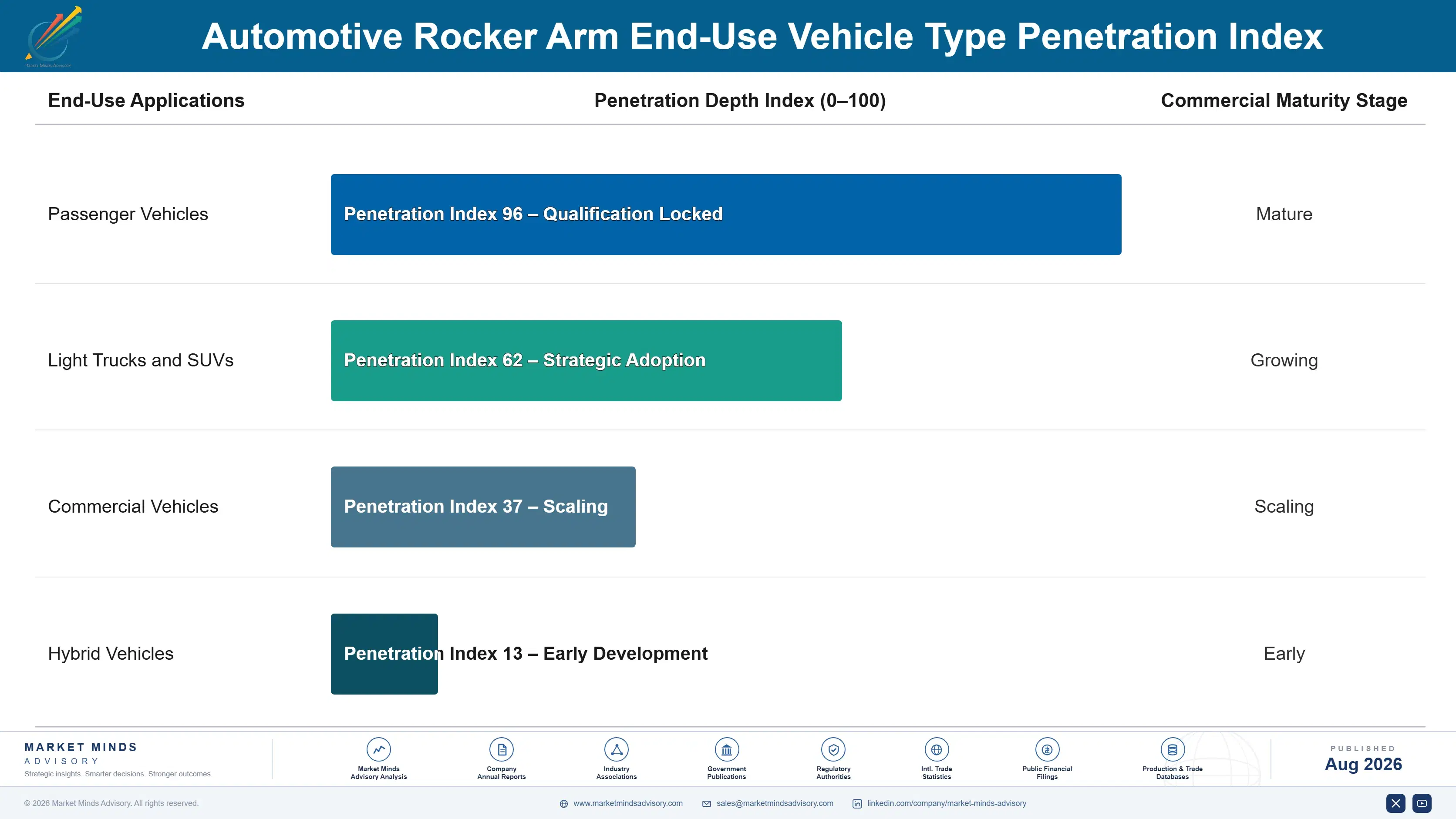
Adoption depth varies meaningfully by end-use vertical across the category and its many downstream applications served worldwide today. Large-displacement North American truck and SUV programs show the deepest, most locked-in purchasing patterns given direct cylinder deactivation requirements tied to platform architecture itself, while mature-market passenger vehicle programs retain considerably more discretionary supplier choice absent comparable platform-level dependency across their respective model lines and generations.

A generational shift is underway as fuel economy compliance teams, working with different priorities than traditional mechanical engineering groups, increasingly evaluate rocker arm suppliers primarily on certified durability depth and precision manufacturing capability rather than component pricing alone as the deciding factor. This shift favors suppliers who can demonstrate genuine systems-level engineering depth over those relying on legacy mechanical relationships built over many decades of accumulated history and trust.
automotive-rocker-arm-market-end-use-penetration-index-1787465907193

Precision Depth Beats Legacy Volume

These are among the four positions where our research anticipates prominent divergence between winners and laggards over the coming forecast period. Each is grounded in the demand model, the regulatory perimeter, and the announced capacity pipeline.
01 / COMPLIANCE INVESTMENT PRIORITY

Chase cylinder deactivation certification over legacy architecture volume

Suppliers that achieve certified cylinder deactivation durability status now secure genuinely durable pricing power that no amount of price competition from legacy stamped steel architecture can meaningfully erode once certification is complete and validated across programs and markets. This status takes years and considerable engineering investment to earn through joint testing with automakers across multiple truck and SUV platforms. Producers still competing primarily on legacy stamped steel volume are fighting for margin that keeps shrinking as roller architecture displaces older designs each and every year.
02 / MARKET DIVERSIFICATION STRATEGY

Build developing-market depth beyond mature-market programs

Concentrating growth strategy around mature-market new-engine programs alone leaves suppliers exposed to a permanently shrinking addressable base, since electric vehicle substitution eliminates valvetrain requirements entirely rather than merely slowing their growth rate over time and across cycles. Suppliers building developing-market manufacturing capacity and aftermarket distribution depth protect revenue from the accelerating mature-market electrification trend already reshaping the category and its supplier base. Those who fail to diversify risk losing relevance as the market's center of gravity continues shifting decisively toward developing regions worldwide.
03 / GEOGRAPHIC EXPANSION FOCUS

Establish Indian manufacturing presence before rivals do

India's transition from stamped steel to roller rocker arm architecture across its enormous passenger vehicle production base represents one of the largest remaining unit volume opportunities in this entire market, and suppliers establishing early local manufacturing now stand to capture outsized share of a market still forming its competitive structure. Local presence meaningfully improves win rates given genuine automaker preference for domestic supply chain resilience following recent years of well-publicized global disruption. Those waiting for the segment to mature further will find established relationships considerably harder to displace once formed.
04 / FEEDSTOCK RISK MITIGATION

Lock in steel supply before the next volatility episode

Steel billet and precision machining pricing has already spiked once this decade during 2021 and 2022, and vertically integrated sourcing now represents a genuine durable advantage for suppliers who invested in it early ahead of their rivals. Long-term mill contracts protect margin during future volatility episodes that undersupplied competitors purchasing on the open market cannot avoid without comparable capital and planning. Suppliers without long-term supply agreements remain exposed to the same margin compression that hit smaller manufacturers hardest during the last shortage, and securing feedstock now protects the returns.

Engagement Snapshot From the Field

A live engagement with an industry participant carrying material or product regulatory and market exposure ahead of a defining policy shift, showing how our research translates into a defensible multi-year portfolio strategy.
MARKET MINDS ADVISORY · CLIENT ENGAGEMENT SUMMARY
Automotive Rocker Arm Producer Strategic Portfolio Review and Transition Roadmap 2026·Investment Scenario on Automotive Rocker Arm Exposure Evaluation 2025-26
CLIENT PROFILE
The client is a mid-sized regional valvetrain component distributor operating across the American Midwest, generating approximately 78 million dollars (client-reported, unverified by MMA) in annual revenue primarily from legacy rocker arm and camshaft replacement sales to independent repair shops and regional retail chains across a broad multi-state distribution territory, customer base, and established dealer network.
STRATEGIC CHALLENGE
The client faced eroding margins on its legacy stamped steel rocker arm portfolio as national distributors undercut pricing aggressively across its territory, while lacking visibility into which cylinder deactivation manufacturing partnerships might create genuine growth opportunities worth pursuing within a reasonable competitive timeframe against far larger, better-capitalized rivals expanding nationwide.
MMA APPROACH
MMA conducted a competitive landscape audit and emerging technology opportunity analysis, evaluating exclusive distribution partnerships with cylinder deactivation rocker arm manufacturers as an alternative to competing directly against national distributors on price for the same commoditized legacy product lines across the client's existing territory, customer base, and long-established regional relationships built nationwide.
KEY FINDINGS
  1. Legacy stamped steel rocker arm volume carried gross margins roughly 15 percentage points below cylinder deactivation product lines across comparable order volumes served.
  2. Securing an exclusive cylinder deactivation distribution partnership required roughly 32% less upfront capital than building comparable manufacturing capability independently over a similar timeline.
  3. Independent repair shop relationships, not big-box retail channels, drove over 64% of the client's existing volume across its entire multi-state distribution territory today.
  4. Competing national distributors had already secured exclusive partnerships with three of the five largest cylinder deactivation manufacturers the client currently lacked access to.
CLIENT PROFILE
The client is a mid-sized regional valvetrain component distributor operating across the American Midwest, generating approximately 78 million dollars (client-reported, unverified by MMA) in annual revenue primarily from legacy rocker arm and camshaft replacement sales to independent repair shops and regional retail chains across a broad multi-state distribution territory, customer base, and established dealer network.
STRATEGIC CHALLENGE
The client faced eroding margins on its legacy stamped steel rocker arm portfolio as national distributors undercut pricing aggressively across its territory, while lacking visibility into which cylinder deactivation manufacturing partnerships might create genuine growth opportunities worth pursuing within a reasonable competitive timeframe against far larger, better-capitalized rivals expanding nationwide.
MMA APPROACH
MMA conducted a competitive landscape audit and emerging technology opportunity analysis, evaluating exclusive distribution partnerships with cylinder deactivation rocker arm manufacturers as an alternative to competing directly against national distributors on price for the same commoditized legacy product lines across the client's existing territory, customer base, and long-established regional relationships built nationwide.
KEY FINDINGS
  1. Legacy stamped steel rocker arm volume carried gross margins roughly 15 percentage points below cylinder deactivation product lines across comparable order volumes served.
  2. Securing an exclusive cylinder deactivation distribution partnership required roughly 32% less upfront capital than building comparable manufacturing capability independently over a similar timeline.
  3. Independent repair shop relationships, not big-box retail channels, drove over 64% of the client's existing volume across its entire multi-state distribution territory today.
  4. Competing national distributors had already secured exclusive partnerships with three of the five largest cylinder deactivation manufacturers the client currently lacked access to.
RECOMMENDED STRATEGY
Phase 1: Phase 1 (Months 1-4): Secure an exclusive regional distribution partnership with a growth-oriented cylinder deactivation manufacturer seeking market entry support. Phase 2: Phase 2 (Months 5-10): Deepen independent repair shop relationships to defend the distribution channel driving most of the client's existing sales volume. Phase 3: Phase 3 (Months 11-16): Expand into two adjacent states where cylinder deactivation demand remains underserved by existing national distribution networks currently operating there.
OUTCOME
Within sixteen months of implementation, the client reported (client-reported, unverified by MMA) a 19% increase in blended average selling price and roughly 9 million dollars in incremental annual revenue from the new exclusive partnership sold through existing repair shop relationships across its full multi-state territory.

Frequently Asked Questions

Foundational context covering the market sizes, CAGR, scope, country, region and competition that inform every finding below. This section is provided to cover basics and most often pre-purchase conversations, answered from the MMA Primary Research Dataset.

What is the current size of the Automotive Rocker Arm Market?

The market reached USD 2.1 billion in base year 2025, with cylinder deactivation electronics and developing-market unit volume driving a growing share of that value.

How large will the Automotive Rocker Arm Market be by 2036?

MMA projects the market will reach USD 3.10 billion by 2036 under the base case scenario, representing 1.42 times its 2026 value of USD 2.18 billion.

What is the CAGR for the Automotive Rocker Arm Market 2026 to 2036?

The base case CAGR is 3.6%, with a bull case of 4.9% and a bear case of 2.3%. Electric vehicle adoption pace meaningfully influences which scenario ultimately materializes.

Which segment is growing fastest?

Cylinder deactivation and variable valve actuation rocker arms lead at an 8.9% CAGR, about 2.47 times the overall market rate. Roller rocker arms follow at 6.2% growth.

Who are the major companies in the Automotive Rocker Arm Market?

Eaton Corporation, Schaeffler AG, Rhythm Autotech, Sundram Fasteners, and Melling Engine Parts lead the competitive field. Combined they hold a moderate 52% concentration on a combined revenue basis.

Which country is growing fastest?

India leads at a 6.4% CAGR, driven by rapidly expanding passenger and commercial vehicle combustion production with minimal electric vehicle substitution at any real scale.

Report Segmentation Architecture

The full report scope spans multiple orthogonal segmentation dimensions, with cross-tabulated demand data provided for each dimension pair. Coverage extends further to regional breakdowns, trend trajectories, and the competitive detail needed to support segment-level decision-making.

By Rocker Arm Architecture

  • Roller Rocker Arms
  • Finger-Follower Rocker Arms
  • Shaft-Mounted Rocker Arms
  • Stamped Steel Rocker Arms
  • Cylinder Deactivation and VVA Rocker Arms
  • Forged and Cast Rocker Arms

By End-Use Vehicle Type

  • Passenger Vehicles
  • Light Trucks and SUVs
  • Commercial Vehicles
  • Hybrid Vehicles

By Commercial Dimension

  • OEM Design-In Supply
  • Aftermarket Replacement
  • Export Finished Product
  • Private Label Supply

By Region

  • North America
  • Western Europe
  • East Asia
  • South Asia and Pacific
  • Latin America
  • Middle East and Africa
  • Eastern Europe

Scope, Methodology, and Coverage

Every figure in this report is reproducible from documented input assumptions. The scope below maps the historical period, the forecast horizon, the segmentation dimensions, and the countries covered, alongside the underlying primary and qualitative methodology.
Historical Period
2020 to 2025
Forecast Period
2026 to 2036
Base Year
2025 (USD billions; MMA Primary Research Dataset, August 2026)
Market Definition
This report covers rocker arms that transfer camshaft motion to open and close intake and exhaust valves across combustion and hybrid vehicle engines, including passenger vehicles, trucks, and commercial vehicles. It excludes camshafts, valve springs, and rocker arm components designed for non-automotive combustion applications such as marine or industrial engines.
Quantitative Units
USD billions (current prices); volume in million units where applicable
Segmentation Dimensions
By Rocker Arm Architecture; By End-Use Vehicle Type; By Commercial Dimension; By Region
Regions Covered
North America, Western Europe, East Asia, South Asia and Pacific, Latin America, Middle East and Africa, Eastern Europe
Countries Covered
USA, China, Germany, France, UK, Japan, South Korea, India, Australia, Canada, Brazil, Mexico, Indonesia, Vietnam, Thailand, Malaysia, UAE, Saudi Arabia, South Africa, Nigeria, Turkey, Poland, Netherlands, Italy, Spain, Sweden, Switzerland, Argentina, Colombia, Singapore, and additional markets relevant to this sector
Key Companies Profiled
Eaton Corporation, Schaeffler AG, Rhythm Autotech, Sundram Fasteners, Melling Engine Parts, Bharat Forge, Delphi Technologies, Thyssenkrupp AG, Musashi Seimitsu Industry, Riken Corporation, Yamada Manufacturing, Otics Corporation, F.C.C. Co, Crower Cams & Equipment, COMP Cams, T&N Group, Metaldyne Performance Group, Kibbe Precision Machining, MAHLE GmbH, Federal-Mogul Motorparts
Quantitative Methodology
Primary survey, n=3,800 respondents, Q4 2025, six countries; demand-side model with trade association cross-validation
Qualitative Methodology
47 expert interviews, Q4 2025; applied to validate demand model assumptions, identify emerging dynamics, and assess competitive positioning
Report Format
PDF and XLSX data workbook (Word format preview document)
Publisher
Market Minds Advisory
Report Code
MMA-2026-AUT-114
Published
August 2026
Contact
sales@marketmindsadvisory.com | www.marketmindsadvisory.com

Purchase the full Automotive Rocker Arm Market Report (2026 to 2036).

The full report delivers a comprehensive assessment of the automotive rocker arm market, covering architecture-level segmentation, regional demand drivers, and competitive positioning across all twenty profiled companies operating in this space today and going forward. It includes detailed tracking of fuel economy regulation and its implications for supplier certification decisions across every relevant engine program worldwide. Buyers receive quantified feedstock cost exposure analysis and margin benchmarking across all three portfolio tiers covered in depth throughout. The report supports both precision manufacturing investment planning and developing-market expansion decisions across the industry.
Architecture-level segment sizing model through 2036
Twenty-company competitive benchmark and profile set
Cylinder deactivation compliance and certification tracker
Regional manufacturing capacity and demand assessment
Feedstock cost exposure and volatility model
India roller conversion opportunity screening tool

Built For The People Who Decide

From boardroom strategy to bench-side execution, this report is read cover-to-cover by leaders shaping the next decade of their industry, turning demand scenarios, market dynamics and valuation benchmarks into decisions.
CXOs/ Presidents/ VPs/ Managers
M&A and Corporate Development
Strategy Teams and R&D Heads
Procurement and Product Directors
Regulatory and Compliance Leaders
Investor Relations and Equity Analysts