Market Minds Advisory
Automotive Performance Tuning and Engine Remapping Market

Automotive Performance Tuning and Engine Remapping Market: Hardware Gives Way to Software

Engine remapping is splitting between chip tuning facing tightening emissions enforcement and an EV performance software category delivering battery and motor output through firmware, forcing tuning companies to rebuild their playbook around code over hardware.

Lead Analyst

David Horsley

Published

September 2026

Make Smarter Decisions with Customized Research Insights

Request a free sample report and evaluate market opportunities, growth trends, and competitive dynamics relevant to your business needs.

2025 MARKET VALUE$3.4BMarket Size 2025
2036 FORECAST VALUE$7.0BBase Case , 2026 to 2036
CAGR 2026 TO 20366.8 %Bull 8.0% / Bear 5.6%
INCREMENTAL OPPORTUNITY$3.4BNet 10- year value creation
EXPANSION MULTIPLE1.93x2036 value over 2026 base
Strategic Levers
M&A Pipeline
Regional Outlook
Country Rankings
Competitive Intelligence
Segmental Deep-dive
Call-Us : 91 93563 13602

Executive Snapshot and Market Trajectory

Performance tuning used to mean swapping a chip or flashing a static file onto an engine control unit. Modern remapping means writing and licensing software that upgrades power, torque, or battery output remotely, and that shift from hardware to software is rewriting who can compete and how they get paid.
North America holds the largest regional share, sustained by a diesel and gasoline truck tuning culture and a large base of dyno shops serving enthusiast and fleet customers alike. Western Europe follows, anchored by the professional ECU remapping industry that commercialized flash tuning for performance and diesel vehicles decades ago. EV performance software upgrades are growing fastest as electric vehicle owners discover that power gains can be purchased as a subscription over installed hardware.
Competition remains fragmented, with the top five companies holding a quarter of global revenue across thousands of tuning shops and software vendors. COBB Tuning and APR lead on brand recognition and engineering depth, while regional dyno shops compete on installation service and reputation rather than proprietary software. Regulatory scrutiny over emissions-defeat tuning is becoming the dividing line, since companies selling illegal emissions-bypass calibrations face legal exposure performance-only tuners do not.
Market Definition
The automotive performance tuning and engine remapping market covers ECU software remapping, piggyback and standalone tuning hardware, dyno-based calibration services, and EV performance software upgrades that modify a vehicle's power, torque, or efficiency output beyond factory settings. It excludes emissions-defeat devices sold for illegal use, and excludes mechanical performance parts such as exhausts, intakes, or suspension components sold independently of tuning software or calibration.
Base Year Value
$3.4B in 2025 (MMA Primary Research Dataset, August 2026)
Forecast Period
2026 to 2036, eleven discrete annual values
CAGR
6.8% base case. Bull 8.0%. Bear 5.6%.
Fastest Growth Segment
EV Performance Software Upgrades: 13.8% CAGR
Fastest Growth Country
United States: 8.6% CAGR
Fastest Growth Region
South Asia and Pacific: 8.8% CAGR
Largest Region
North America: 25% of 2025 global value
Market Leaders
COBB Tuning, APR LLC, HP Tuners, Edge Products, and Racechip lead global supply. Source: MMA Analysis based on company annual reports.
Primary Survey
n=3,800 procurement and R&D decision-makers, Q4 2025, six countries
Methodology
Demand-side build-up, cross-validated against public data, 47 expert interviews

Automotive Performance Tuning and Engine Remapping Market Forecast Scenarios

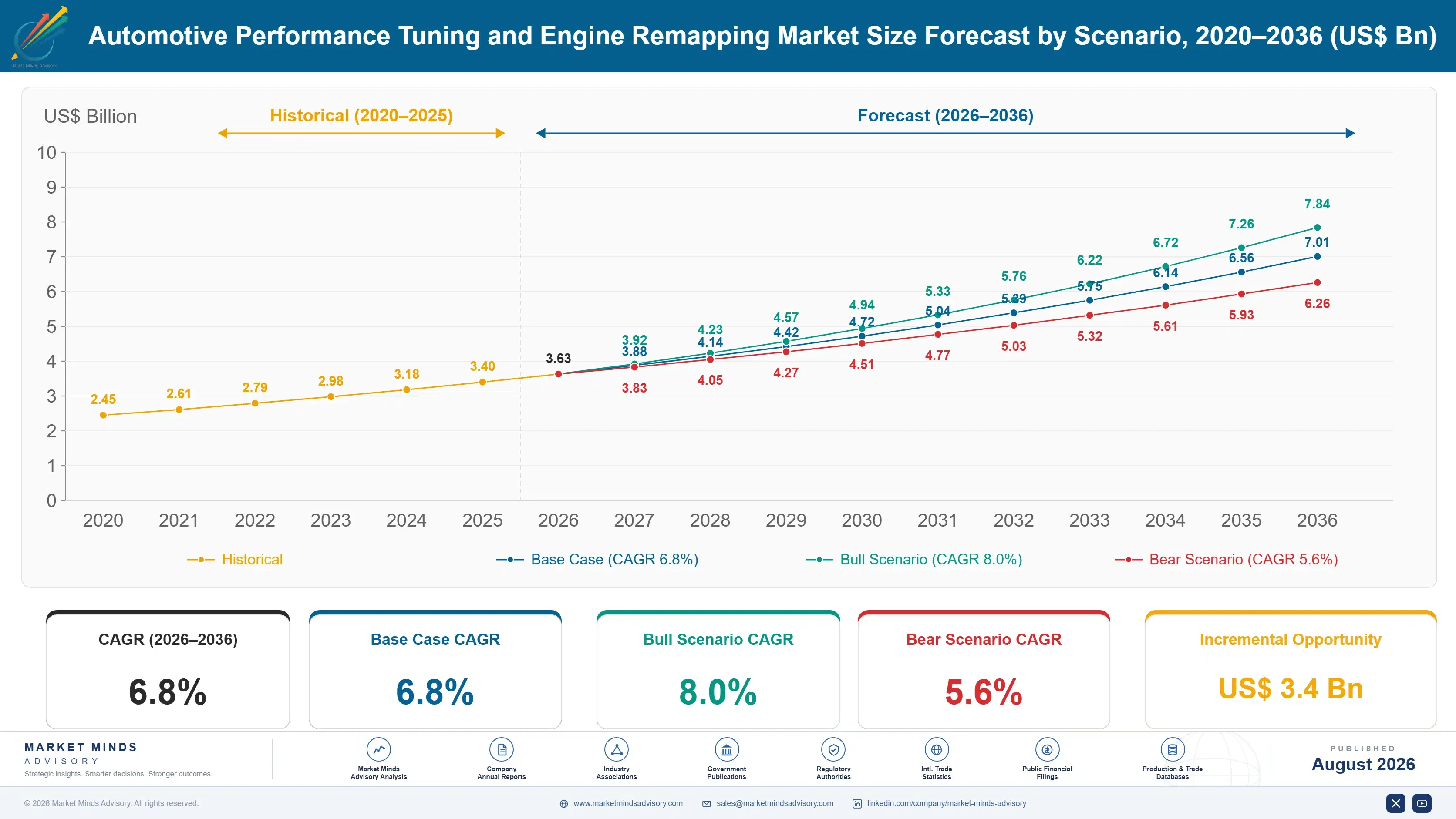
automotive-performance-tuning-engine-remapping-mar-size-forecast-scenario-1787465462481
Between 2020 and 2025, automotive performance tuning demand grew at an estimated 6.0% annually as diesel and gasoline truck tuning demand remained resilient in North America and European ECU remapping shops expanded software-based calibration services beyond traditional chip-swap hardware. COBB Tuning and Racechip expanded software capacity through the period to serve demand for remote calibration updates.
MMA's base case projects 6.8% annual growth to 2036 on three mechanisms: diesel and gasoline truck tuning demand sustained by a large installed vehicle base in North America and emerging markets, subscription-based software remapping that lets tuning companies capture recurring revenue rather than one-time hardware sales, and rapid emergence of EV performance software upgrades as electric vehicle adoption expands the addressable market beyond internal combustion engines entirely. Fleet efficiency tuning operators are adding a fourth, smaller growth channel through fuel economy optimization services.
A bull catalyst comes from manufacturers formally licensing third-party performance software upgrades rather than treating all tuning as unauthorized modification, which could expand the EV tuning category within a few years. The bear risk is regulatory: tightening emissions enforcement against illegal defeat-device tuning could sweep in legitimate performance-only calibration providers if regulators cannot easily distinguish between the two categories.

Hardware Tuning Gives Way to Software Licensing

Performance tuning sells on a simple promise: more power, more torque, or better efficiency than the factory calibration delivers, at a price the vehicle owner considers worth paying. That promise used to require physical hardware installation. Increasingly it requires nothing more than a software license and a data connection, and that shift is rewriting the category's entire cost structure and competitive dynamics simultaneously. That distinction increasingly separates category winners from companies still competing on hardware alone.
MARKET CONCENTRATION28%Top five companies hold barely a quarter of total
AVERAGE SELLING PRICE$620/calibrationEV performance upgrades command the steepest available price premium
TOP PRODUCING COUNTRYUnited StatesLargest truck tuning culture drives overall category revenue volume
CAPACITY UTILIZATION68%Software development teams scale with new vehicle platform releases
FEEDSTOCK COST SHARE22% of COGSSoftware development and calibration engineering dominate total cost structure
TRADE INTENSITY31% exportedRoughly a third of finished software licenses cross borders
Commercially, the category increasingly behaves like a software licensing business layered onto vehicle-specific calibration engineering expertise. Development costs track engineering talent and vehicle platform complexity rather than any physical commodity input, while pricing increasingly tracks proven power gains, safety validation, and subscription convenience rather than the cost of a physical tuning box. Companies that master software-first delivery are capturing share from hardware-dependent competitors.
Over the next decade, expect software licensing and subscription models to matter more than one-time hardware sales, particularly as EV performance upgrades scale and manufacturers experiment with formally sanctioned tuning partnerships. Companies investing in software-first calibration platforms are positioned to capture recurring revenue that hardware-only competitors increasingly cannot access even when their underlying pricing looks competitive on paper.
"Ten years ago this business was selling a plastic box you plugged into the OBD port. Now the best companies are selling a subscription that upgrades horsepower with an over-the-air update, and that's a completely different business model."
Director, Automotive Aftermarket and Performance Technology Practice · MMA Automotive Aftermarket and Performance Technology Practice · August 2026

Market Trends

EV Manufacturers Begin Licensing Third-Party Software

A small but growing number of electric vehicle manufacturers are beginning to license third-party performance software upgrades officially, rather than treating all aftermarket tuning as unauthorized modification that voids warranty coverage entirely. COBB Tuning and several specialty EV tuning companies have expanded software development capacity over the past two years specifically to serve this newly accessible, manufacturer-sanctioned segment. At least a handful of electric vehicle manufacturers have established official tuning partnership programs since 2023, and tuning companies report these partnerships are opening a legitimate commercial channel that unauthorized aftermarket modification never provided.
Market Impact: Sustains demand across 5%+ annual growth

Subscription Remapping Replaces One-Time Hardware Sales

Tuning companies are increasingly shifting toward subscription-based software remapping models that generate recurring revenue, replacing the traditional one-time hardware sale model that dominated the category for decades. Racechip and several specialty software providers have expanded subscription platform development specifically to capture this recurring revenue opportunity across their existing customer base. At least a dozen major tuning companies have launched subscription-based calibration update services since 2024, and industry contacts report these subscription models are generating meaningfully higher customer lifetime value than comparable one-time hardware transactions, a shift that is reshaping how the entire industry values customer relationships over time.
Market Impact: Expands addressable market 20%+

Market Opportunities and Growth Drivers

Diesel Truck Tuning Culture Sustains Baseline Demand

A deeply established diesel and gasoline truck tuning culture, particularly in North America, continues sustaining baseline demand for performance calibration regardless of broader automotive market cycles or emerging electric vehicle competition. Edge Products and Banks Power have both reported steady order volume tied specifically to diesel pickup truck tuning demand across enthusiast and light commercial fleet customers over the past several years. Industry analysts report this diesel truck tuning culture provides a stable volume floor for the category that is unlikely to disappear quickly even as electric vehicle adoption accelerates elsewhere in the automotive market.
Market Impact: Risks penalties exceeding $10M for violators

Electric Vehicle Adoption Expands Addressable Market

Rapid electric vehicle adoption is expanding the addressable performance tuning market well beyond its traditional internal combustion engine base, as software-based power and torque upgrades become technically feasible in ways that physical chip tuning never was for conventional engines. Electric vehicle owners report strong interest in performance software upgrades specifically because the modification requires no physical installation and carries meaningfully lower mechanical risk than traditional engine tuning. Tuning companies report electric vehicle-specific inquiries have grown considerably faster than conventional internal combustion inquiries over the past several years, reflecting this expanding addressable market opportunity.
Market Impact: Deters 30%+ of interested mainstream buyers

Market Restraints and Challenges

Emissions Regulation Scrutiny Threatens Legitimate Tuners

Regulatory scrutiny over illegal emissions-defeat device tuning is intensifying across major automotive markets, and the root cause is that some companies have sold calibrations disabling emissions control systems entirely, creating risk that extends to legitimate performance-only tuning companies operating within legal boundaries. Regulatory investigations have resulted in significant penalties against companies found selling illegal calibrations in several major markets over the past several years. This attention risks sweeping in legitimate providers if enforcement cannot distinguish illegal emissions-bypass calibrations from legal power gains. Legitimate companies are mitigating this by investing in compliant calibration validation and clear marketing distinction from emissions-defeat products.
Market Impact: Adds 5+ manufacturer-sanctioned tuning partnerships

Warranty Voiding Risk Discourages Mainstream Adoption

Vehicle manufacturers routinely void powertrain warranty coverage when they detect aftermarket performance tuning modifications, and the root cause is that unauthorized calibration changes can genuinely affect engine and transmission durability in ways manufacturers are unwilling to warranty without their own validation testing. Consumer surveys report warranty voiding risk as among the most cited reasons mainstream owners avoid tuning, even those interested in the power gains offered. This concentrates adoption among enthusiast owners willing to accept the tradeoff over the population. Companies are mitigating this by offering their own warranty protection programs covering tuning-related failures independently of manufacturer coverage here.
Market Impact: Adds 12+ new subscription service launches
3 additional market trends, 3 additional growth drivers, and 3 additional restraints and challenges are covered in the full report. Contact sales@marketmindsadvisory.com to access the complete intelligence.

Segment CAGR and Growth Architecture

Automotive performance tuning is segmented by product and delivery method, the classification that determines technical approach, revenue model, and target vehicle platform: ECU remapping software, piggyback tuning boxes, performance chip hardware, dyno-based calibration services, diesel-specific tuning systems, and EV performance software upgrades each serve distinct vehicle platforms, avoiding the overlap a brand-based split would create.
automotive-performance-tuning-engine-remapping-mar-market-share-analysis-1787465463102

EV Performance Software Upgrades

EV performance software upgrades, which increase battery output, motor torque, or acceleration performance entirely through software rather than physical modification, are the fastest-growing segment as electric vehicle adoption expands the category's addressable market substantially. COBB Tuning and several specialty EV tuning companies both dominate this segment through established reverse-engineering and calibration validation expertise that smaller regional tuners struggle to replicate for increasingly complex electric vehicle software architectures. Electric vehicle owners increasingly specify these upgrades by documented performance gain and manufacturer compatibility rather than accepting generic tuning claims, reflecting growing sophistication among performance-focused electric vehicle buyers. Development costs remain meaningfully higher than conventional chip tuning, but subscription and one-time licensing pricing more than compensates companies with genuine EV software engineering capability.
CAGR 13.8%

Diesel Performance Tuning Systems

Diesel performance tuning systems, engineered specifically for the higher-torque, higher-compression characteristics of diesel pickup truck and commercial vehicle engines, are scaling steadily as diesel truck ownership and towing-focused vehicle use continue growing across North America and other established diesel markets. Edge Products and Banks Power both maintain significant diesel-specific tuning engineering capability, benefiting from decades of specialized diesel calibration expertise most general-purpose tuning companies have not developed. Diesel truck owners increasingly specify tuning systems by documented torque and towing capacity improvement rather than accepting generic gasoline-oriented tuning products, reflecting the technical differences between diesel and gasoline engine tuning requirements. Pricing commands a meaningful premium over conventional gasoline tuning systems, reflecting specialized engineering and smaller production volumes.
CAGR 7.2%
Full segment breakdown across 6 segments available in the complete report.

Regional Architecture and Country Demand Map

North America leads global automotive performance tuning demand, sustained by a deep diesel and gasoline truck tuning culture, while Western Europe follows closely on the strength of its professional ECU remapping industry that first commercialized flash tuning for performance and diesel vehicles across both established and emerging tuning markets.

North America

The United States hosts the world's largest diesel and gasoline truck tuning culture, anchored by companies including Edge Products and Banks Power that serve enthusiast and light commercial fleet customers across a large installed pickup truck base. COBB Tuning and HP Tuners both maintain extensive domestic software development and dyno tuning shop networks supporting both gasoline performance and diesel truck customers simultaneously. Canadian tuning demand closely mirrors US patterns, importing much of its software and hardware from US-based providers given the integrated North American automotive aftermarket. Electric vehicle performance software demand is emerging fastest here, given the region's substantial electric vehicle adoption and enthusiast culture willing to experiment with new tuning categories.
Share: 25% | CAGR: 7.6% (2026 to 2036)

Western Europe

Germany anchors Western European demand through its established professional ECU remapping industry, home to companies including Racechip and DTE Systems that pioneered commercial flash tuning for performance and diesel vehicles decades ago. The United Kingdom maintains a significant tuning market, with REVO Technik and TDI Tuning serving both domestic and export customers across gasoline and diesel platforms. France and Italy contribute meaningful demand tied to established performance car culture and motorsport-adjacent enthusiast communities. Growth here trails North America and Asia because the region's tuning market is already mature and growing more slowly than faster-expanding emerging markets elsewhere. Scandinavian markets maintain steady demand tied to established performance car culture and motorsport heritage.
Share: 25% | CAGR: 5.3% (2026 to 2036)
Regional intelligence for 5 additional markets available in the complete report: East Asia, South Asia and Pacific, Latin America, Middle East and Africa, Eastern Europe. Contact sales@marketmindsadvisory.com.
automotive-performance-tuning-engine-remapping-mar-country-cagr-analysis-1787465463737

Where Tuning Companies Can Capture Margin

Margin capture in performance tuning increasingly depends on software licensing and subscription models rather than one-time hardware sales. Companies that can deliver EV performance upgrades, secure manufacturer-sanctioned tuning partnerships, and build recurring subscription revenue are commanding meaningfully better economics than those competing purely on the price of a physical tuning box. That shift rewards software-first companies over pure hardware sellers.

EV Performance Software Upgrade Development Program

Companies that develop EV performance software upgrade capability are capturing premium pricing from electric vehicle owners seeking documented power and acceleration gains without physical modification. COBB Tuning's EV upgrade line, expanded in 2024, reportedly commands pricing 3 to 5 times higher per vehicle than comparable conventional gasoline tuning packages. Companies without dedicated EV software reverse-engineering capability are increasingly partnering with specialized technology providers to offer comparable products, adding cost but preserving access to the fastest-growing segment of the category across most vehicle platform categories across most regional and dealer markets today.
Market Impact: Commands a 3 to 5 times price premium

Building Manufacturer-Sanctioned Tuning Partnership Access Programs

Companies that secure official manufacturer-sanctioned tuning partnerships are capturing legitimate commercial access and customer trust that unauthorized aftermarket modification cannot provide. Manufacturer-sanctioned tuning programs reportedly generate 40 to 60 percent higher customer conversion rates than comparable unauthorized aftermarket offerings, reflecting reduced warranty concern and perceived legitimacy. Building these partnerships requires sustained relationship development and technical validation investment over multiple years, a barrier that has kept this advantage concentrated among a small number of established tuning companies Companies increasingly treat these partnerships as essential for long-term market access across most premium accounts.
Market Impact: Lifts conversion rates by 40 to 60 percent

Building Subscription Recurring Revenue Platform Development

Companies that shift from one-time hardware sales to subscription-based software licensing are capturing meaningfully higher customer lifetime value than comparable one-time transaction models. Subscription-based tuning platforms reportedly generate customer lifetime value 2 to 3 times higher than one-time hardware sales over a comparable multi-year ownership period. This transition requires investment in cloud software infrastructure and over-the-air update capability, a barrier that has kept this advantage concentrated among companies with established software engineering resources Customers increasingly expect ongoing calibration updates as part of the subscription value proposition across most premium accounts today.
Market Impact: Lifts customer lifetime value 2 to 3 times

Bundled Warranty Protection and Dyno Validation

Bundling warranty protection coverage and dyno-validated performance documentation alongside the physical tuning sale helps address the warranty voiding concern that discourages mainstream vehicle owners from pursuing performance tuning modifications. Companies offering this bundled service report meaningfully higher conversion rates among previously hesitant mainstream customers compared with standard tuning-only sales. This service layer also raises effective per-unit pricing by an estimated 10 to 15 percent, since customers otherwise face independent warranty protection costs if sourced separately from third-party providers across most regional dealer and distributor networks across most regional markets today.
Market Impact: Raises effective pricing by 10 to 15 percent

Who Controls the Margin Pool

Five companies hold barely a quarter of global automotive tuning revenue, reflecting a market considerably more fragmented than most automotive aftermarket categories given the large number of independent tuning shops and regional software vendors. The gap between brand-recognized software companies and local dyno shops is wide on scale and technology depth, even though both compete under the same broad performance tuning category label That fragmentation keeps competitive intensity elevated across both software and service segments.
Current competitive activity centers on three fronts: EV performance software development to capture the fastest-growing segment, manufacturer-sanctioned partnership development to legitimize aftermarket access, and subscription model transition to build recurring revenue. COBB Tuning and Racechip have both announced software development investment in the past two years specifically targeting these higher-margin, technically differentiated segments.

Emerging pressure is coming from vehicle manufacturers themselves, which increasingly offer their own factory-authorized performance upgrade software directly to consumers, threatening to disintermediate independent aftermarket tuning companies entirely in some vehicle segments. Rankings could shift meaningfully over the next several years if manufacturers expand factory-authorized software upgrade programs faster than independent tuning companies can secure comparable sanctioned partnership access.
automotive-performance-tuning-engine-remapping-mar-company-positioning-matrix-1787465464338

Competitive Moat and Risk Dimensions

COBB TUNING

Moat: Broadest Multi-Platform Software Portfolio

COBB Tuning maintains the broadest multi-platform tuning software portfolio in the industry, supporting a wide range of vehicle makes and models rather than specializing narrowly in a single manufacturer's platform. That breadth gives COBB Tuning customer reach and cross-platform engineering expertise that narrowly focused competitors cannot easily replicate.
COBB TUNING

Risk: Platform-Specific Technical Complexity

COBB Tuning's broad multi-platform strategy requires maintaining engineering expertise across many distinct vehicle software architectures simultaneously, creating meaningful technical complexity and development cost that narrowly focused single-platform competitors do not face. As vehicle software architectures continue diverging across manufacturers, this complexity could strain COBB Tuning's ability to maintain comparable quality across its full platform portfolio.
APR LLC

Moat: Deep Volkswagen Group Platform Specialization

APR LLC has built deep, specialized engineering expertise specifically for Volkswagen Group vehicle platforms, rather than spreading development resources across many unrelated manufacturers. That specialized focus lets APR command premium engineering credibility and customer trust within its specific platform niche that generalist competitors cannot always match.
APR LLC

Risk: Limited Diversification Beyond Core Platform

APR LLC's concentrated focus on Volkswagen Group platforms limits its exposure to broader automotive market trends and leaves the company more dependent on a single manufacturer's vehicle architecture and market performance than diversified multi-platform competitors. Any significant shift in Volkswagen Group vehicle architecture or market position could disproportionately affect APR relative to broader competitors.

Players Tracked

Prominent Players

COBB Tuning
APR LLC
HP Tuners
Edge Products
Racechip

Other Key Players

Banks Power
Bully Dog Technologies
Superchips Inc
Diablosport
Mcchip-DKR
Wagner Tuning
REVO Technik
Unitronic
TDI Tuning
DTE Systems
Dinan Engineering
EcuTek
Alientech
Syvecs
Bootmod3

Recent Developments

APRIL 2024

COBB Tuning Launches EV Performance Upgrade Line

COBB Tuning launched a dedicated EV performance software upgrade product line in April 2024, targeting growing electric vehicle owner interest in documented power and acceleration gains achievable entirely through software modification, responding directly to customer requests for tuning options beyond traditional internal combustion platforms across all regions.
Signal: Signals established tuning companies are investing in EV-specific software capability rather than treating electric vehicles as outside their addressable market.
SEPTEMBER 2023

Racechip Expands Subscription-Based Calibration Platform

Racechip expanded its subscription-based calibration update platform in September 2023, shifting customer relationships from one-time hardware purchases toward recurring software licensing revenue, marking significant investment beyond the company's traditional piggyback tuning box hardware business Company leadership called the shift a fundamental change in how the business generates revenue.
Signal: Signals established tuning companies are prioritizing recurring software revenue over traditional one-time hardware transaction models across the broader tuning industry.
JANUARY 2025

Regulators Escalate Emissions-Defeat Tuning Enforcement

Regulatory authorities in several major automotive markets escalated enforcement actions against companies selling illegal emissions-defeat tuning calibrations in January 2025, resulting in significant penalties and increased scrutiny of the broader performance tuning industry's compliance practices Industry observers called it a wake-up call for the entire aftermarket sector.
Signal: Signals regulatory attention is intensifying industry-wide, creating pressure for legitimate tuners to clearly differentiate from emissions-defeat products.

Software Engineering and Calibration Cost Exposure

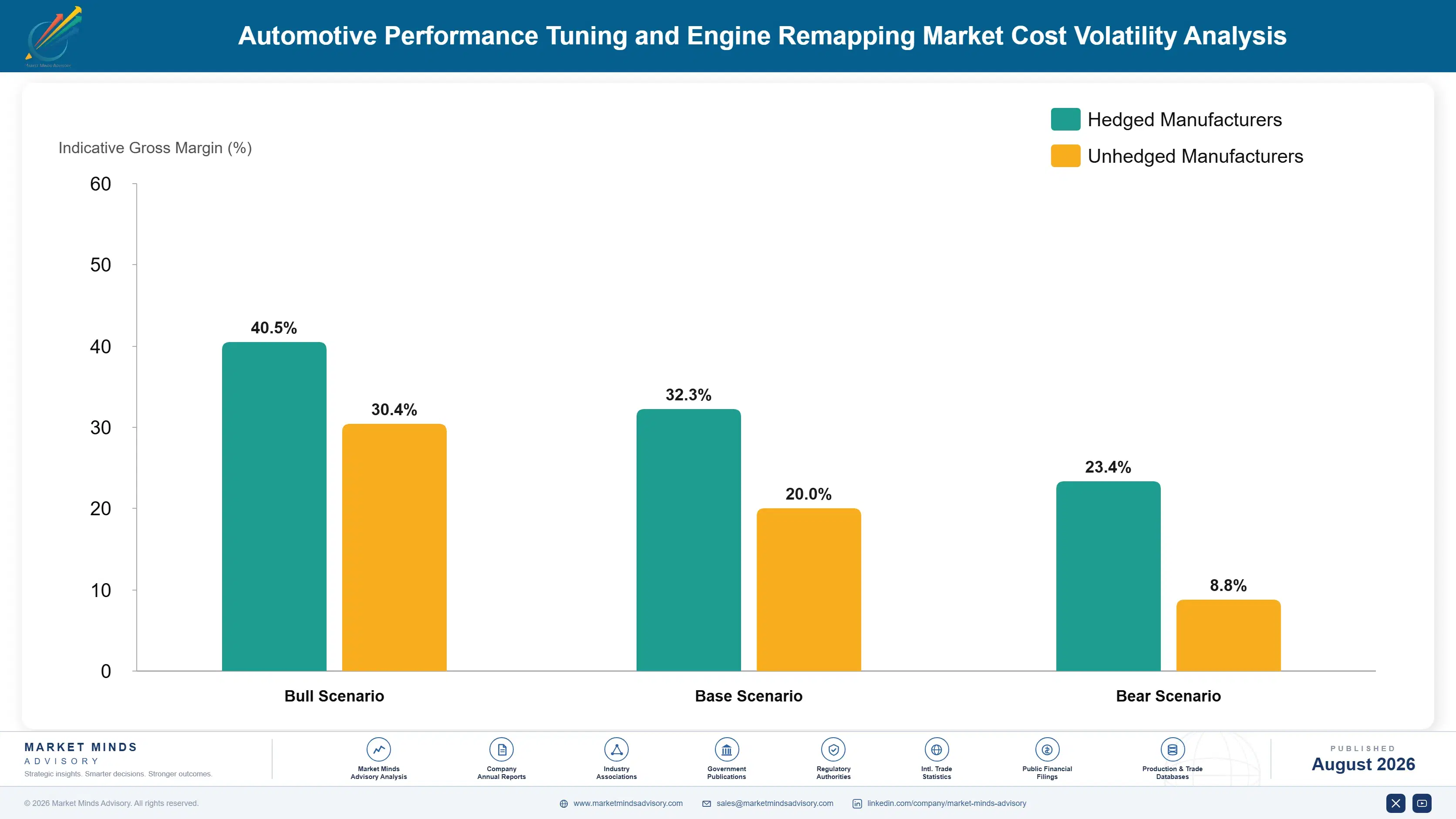
Software development and calibration engineering talent together account for roughly twenty-two percent of total operating cost across the industry, reflecting the fundamentally knowledge-intensive nature of modern tuning software development regardless of the specific vehicle platform tier. Engineering talent costs track broader software engineering labor markets, while dyno testing and validation infrastructure costs track specialized automotive testing equipment markets that behave independently from software labor cycles.
Software engineering talent costs rose meaningfully during 2022 and 2023 as broader technology industry demand for skilled software engineers increased competition for talent, according to industry trade reporting and company disclosures, increasing development costs across the performance tuning software industry. Companies without established engineering teams faced the steepest cost increases, since recruiting specialized automotive calibration engineers requires competing directly with better-resourced technology companies for the same talent pool.

Smaller tuning companies relying on limited in-house engineering capability carry meaningfully more cost exposure than larger, more established companies like COBB Tuning or Racechip that maintain substantial internal software development teams. Companies pursuing EV performance software face a distinct cost exposure profile tied to complex electric vehicle software architecture reverse-engineering rather than conventional internal combustion calibration work, introducing additional development complexity and cost beyond standard tuning economics.
automotive-performance-tuning-engine-remapping-mar-cost-volatility-analysis-1787465464574

Build In-House Software Engineering Capability

Larger tuning companies are investing in in-house software engineering teams rather than relying on external contractors, reducing per-project development cost and improving long-term platform support capability. This approach requires significant upfront investment in talent recruitment but has measurably improved development efficiency for companies that built this capability before recent talent market tightening across most established teams.

Partner With Specialized EV Technology Providers

Companies without dedicated electric vehicle software reverse-engineering capability are partnering with specialized technology providers to access EV tuning capability without building internal expertise from scratch. This approach requires revenue sharing but has kept development costs more manageable for companies entering the EV tuning segment for the first time. Companies report this approach also reduces long-term development risk considerably.

Diversify Toward Higher-Margin Subscription Revenue

Companies are shifting revenue mix toward higher-margin subscription-based software licensing, reducing sensitivity to one-time hardware sales cost pressure that affects lower-margin conventional tuning box economics most directly. This approach requires software infrastructure investment but has improved overall margin resilience for companies that pursued it before recent market shifts. Companies report these investments also improve long-term margin predictability.

Portfolio Architecture for Margin Defence

Automotive tuning companies operate a three-tier portfolio spanning commodity piggyback tuning boxes and basic chip hardware sold largely on cost per unit into price-sensitive enthusiast markets, engineered ECU remapping software and diesel-specific systems commanding premium pricing from demanding truck and performance accounts, and EV performance upgrades and subscription platforms positioned for the highest-margin technology-forward accounts. Gross margins vary sharply across these tiers, from thin single digits on commodity hardware to well above forty percent on EV software and subscription platforms.
The volume versus premium tension is intensifying as more companies chase EV and subscription margins, but commodity hardware and standard remapping still represent meaningful shipped volume and remain important for covering fixed development costs across the industry's large enthusiast customer base. Companies that abandon commodity volume too quickly in pursuit of premium accounts risk losing brand relevance built over years of enthusiast community engagement.

High-value margin pools concentrate specifically in EV performance upgrades sold to technology-forward electric vehicle owners, and in subscription-based software platforms generating recurring revenue from existing customer relationships. Commodity hardware and standard tuning boxes remain the volume anchor but carry the thinnest margins, squeezed further by regional competitors competing on price.

Volume / Commodity-Adjacent Tier

Commodity piggyback tuning boxes and basic chip hardware sold primarily on cost per unit into price-sensitive enthusiast markets, where price competition among global and regional providers is intense and software differentiation is limited.
Gross Margin: 8-15%

Premium / Certified Tier

Engineered ECU remapping software and diesel-specific tuning systems sold into demanding truck and performance enthusiast accounts, commanding premium pricing through documented power gains and platform-specific validation Pricing reflects documented performance testing investment rather than raw hardware cost alone.
Gross Margin: 22-32%

Sustainability / Regulatory / Next-Generation Tier

EV performance software upgrades and subscription-based platforms positioned for technology-forward accounts paying the category's highest prices for software-delivered, recurring-revenue performance features Capital and software engineering requirements keep this tier concentrated among a handful of companies.
Gross Margin: 40-55%
automotive-performance-tuning-engine-remapping-mar-portfolio-architecture-1787465465105

High-value Sub-segments and Strategic Watch-out

EV Performance Software Upgrades

EV performance software upgrades are capturing the highest margins in the category as electric vehicle owners seek documented power and acceleration gains achievable entirely through software, and established tuning companies are accelerating engineering investment to capture this rapidly expanding addressable market ahead of competitors today.
Gross Margin: 40-55%

Subscription-Based Calibration Platforms

Subscription-based software calibration platforms are gaining share as companies shift from one-time hardware sales toward recurring revenue models, though building the necessary cloud software infrastructure remains concentrated among a smaller number of established technology-capable companies. Adoption should broaden as more companies build comparable cloud software infrastructure.
Gross Margin: 30-42%

Commodity Piggyback Tuning Hardware

Standard piggyback tuning boxes and chip hardware sold into mainstream enthusiast markets remain the category's volume core, anchored by established brand relationships but facing intense price competition from regional providers. Most incumbents defend this tier through brand loyalty rather than active software differentiation broadly today.
Gross Margin: 8-15%

Emissions-Defeat Adjacent Products

Tuning products marketed with ambiguous emissions compliance claims face rising regulatory scrutiny and legal risk following recent enforcement actions, making this a segment legitimate companies should actively distance themselves from. Several companies still selling ambiguous products have already faced legal scrutiny recently broadly very soon indeed.
Gross Margin: 5-12%

Tuning's Platform and Community Lock-In

Automotive performance tuning behaves like a community-driven annuity business once a customer commits to a specific platform relationship network, because switching tuning providers often means losing access to established community support, proven calibration files, and accumulated enthusiast reputation built around a specific brand relationship. That inertia gives incumbent companies multi-year customer relationships once established, particularly within tight-knit enthusiast communities that share brand loyalty across social media and local meetup culture. That lock-in can persist for years once a customer builds a proven calibration history and community reputation around one brand.
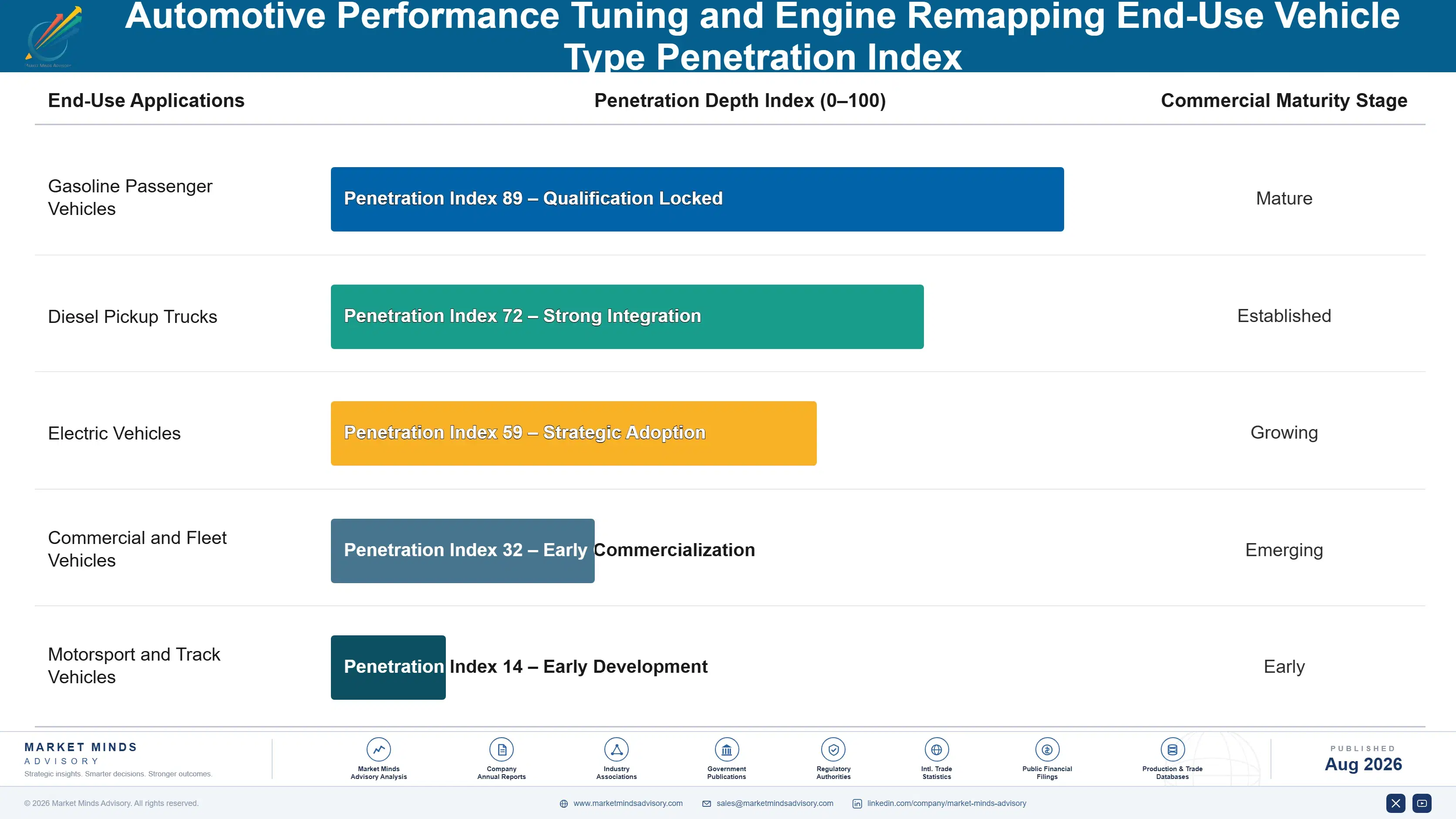
Adoption depth varies sharply by end-use vertical. Enthusiast gasoline and diesel truck owners adopt new tuning products relatively quickly when documented performance gains and community reputation support the investment, while mainstream vehicle owners move far more slowly, requiring extensive warranty protection assurance before committing to any aftermarket modification at all.

Generational buyer shifts are visible mainly in the electric vehicle owner segment, where younger, technology-comfortable buyers readily adopt software-based performance upgrades specifically because the modification carries no mechanical risk, while legacy internal combustion enthusiasts remain anchored to established hardware-based tuning brands with decades-long community trust and proven track records.
automotive-performance-tuning-engine-remapping-mar-end-use-penetration-index-1787465465645

Where Tuning Value Concentrates

These are among the four positions where our research anticipates prominent divergence between winners and laggards over the coming forecast period. Each is grounded in the demand model, the regulatory perimeter, and the announced capacity pipeline.
01 / EV SOFTWARE DEVELOPMENT PRIORITY

Invest in EV performance software ahead of category maturation

Electric vehicle adoption is expanding the addressable tuning market substantially beyond its traditional internal combustion base, and companies with established EV software reverse-engineering capability are capturing this new demand fastest. COBB Tuning has already demonstrated meaningful commercial traction with its EV upgrade product line, confirming genuine consumer demand exists for software-based electric vehicle performance modification. MMA recommends companies without EV software development capability invest in it now, before the category matures and premium pricing compresses toward conventional tuning levels, since catching up later will prove considerably more expensive.
02 / MANUFACTURER PARTNERSHIP DEVELOPMENT

Pursue manufacturer-sanctioned partnerships ahead of disintermediation

Vehicle manufacturers are increasingly offering their own factory-authorized performance upgrade software directly to consumers, threatening to disintermediate independent aftermarket tuning companies that cannot secure comparable sanctioned partnership access. Companies that have already established manufacturer relationships are better positioned to remain relevant as manufacturers formalize official tuning channels. MMA recommends companies without manufacturer partnership relationships pursue development now, before manufacturers fully establish factory-authorized channels that bypass independent aftermarket providers entirely, since manufacturers increasingly treat official channels as the primary path to market access.
03 / SUBSCRIPTION MODEL TRANSITION

Transition to subscription revenue ahead of margin compression

Subscription-based software licensing generates meaningfully higher customer lifetime value than one-time hardware sales, and companies that have already transitioned are capturing this margin advantage over competitors still dependent on traditional hardware transaction models. Racechip's subscription platform expansion has already demonstrated commercial viability at meaningful customer scale. MMA recommends companies without subscription revenue capability invest in the required software infrastructure now, before competitors capture the recurring-revenue customer relationships first, since customers increasingly expect ongoing software support as part of any tuning purchase decision.
04 / REGULATORY COMPLIANCE DIFFERENTIATION

Differentiate compliance positioning ahead of enforcement escalation

Regulatory enforcement against illegal emissions-defeat tuning is intensifying across major automotive markets, creating reputational risk for legitimate performance-only tuning companies that get associated with emissions-defeat products in public perception. Companies that clearly differentiate compliant performance-only tuning from emissions-bypass products are protecting their brand and legal standing more effectively than companies that remain ambiguous. MMA recommends companies without clear compliance differentiation invest in it now, before regulatory enforcement escalates further and sweeps in companies that failed to establish clear boundaries, since regulatory scrutiny rewards early, clear compliance positioning.

Engagement Snapshot From the Field

A live engagement with an industry participant carrying material or product regulatory and market exposure ahead of a defining policy shift, showing how our research translates into a defensible multi-year portfolio strategy.
MARKET MINDS ADVISORY · CLIENT ENGAGEMENT SUMMARY
Automotive Performance Tuning and Engine Remapping Producer Strategic Portfolio Review and Transition Roadmap 2026·Investment Scenario on Automotive Performance Tuning and Engine Remapping Exposure Evaluation 2025-26
CLIENT PROFILE
The client is a mid-sized North American diesel truck tuning company generating an estimated forty-five million dollars in annual revenue (client-reported, unverified by MMA), with a customer base concentrated among diesel pickup truck enthusiasts and light commercial fleet operators. The client wanted to expand into EV performance software tuning but lacked internal electric vehicle software engineering expertise to develop the capability independently.
STRATEGIC CHALLENGE
Several competitors had already launched EV performance software products, creating competitive pressure for the client to enter the category quickly or risk losing relevance as customer interest shifted toward electric vehicles. The client needed to evaluate whether to build internal EV software capability or partner with an established technology provider within a compressed development timeline.
MMA APPROACH
MMA conducted a structured evaluation of build-versus-partner options for EV software development, benchmarking internal talent acquisition costs, partnership licensing terms, and time-to-market against the client's competitive timeline pressure. The engagement included direct technical assessments of three potential technology partners to validate their EV reverse-engineering capability before recommending a path forward.
KEY FINDINGS
  1. Building internal EV software engineering capability would have required a development timeline considerably longer than the client's competitive window allowed given current market dynamics.
  2. Partnering with the recommended technology provider added an ongoing revenue-sharing cost but enabled the client to launch EV tuning products within a fraction of the internal build timeline.
  3. Two of the three evaluated technology partners could not demonstrate sufficient reverse-engineering depth across the client's target electric vehicle platforms during the evaluation period.
  4. The client's successful EV product launch attracted a meaningfully younger customer demographic than its traditional diesel truck tuning base (client-reported, unverified by MMA).
CLIENT PROFILE
The client is a mid-sized North American diesel truck tuning company generating an estimated forty-five million dollars in annual revenue (client-reported, unverified by MMA), with a customer base concentrated among diesel pickup truck enthusiasts and light commercial fleet operators. The client wanted to expand into EV performance software tuning but lacked internal electric vehicle software engineering expertise to develop the capability independently.
STRATEGIC CHALLENGE
Several competitors had already launched EV performance software products, creating competitive pressure for the client to enter the category quickly or risk losing relevance as customer interest shifted toward electric vehicles. The client needed to evaluate whether to build internal EV software capability or partner with an established technology provider within a compressed development timeline.
MMA APPROACH
MMA conducted a structured evaluation of build-versus-partner options for EV software development, benchmarking internal talent acquisition costs, partnership licensing terms, and time-to-market against the client's competitive timeline pressure. The engagement included direct technical assessments of three potential technology partners to validate their EV reverse-engineering capability before recommending a path forward.
KEY FINDINGS
  1. Building internal EV software engineering capability would have required a development timeline considerably longer than the client's competitive window allowed given current market dynamics.
  2. Partnering with the recommended technology provider added an ongoing revenue-sharing cost but enabled the client to launch EV tuning products within a fraction of the internal build timeline.
  3. Two of the three evaluated technology partners could not demonstrate sufficient reverse-engineering depth across the client's target electric vehicle platforms during the evaluation period.
  4. The client's successful EV product launch attracted a meaningfully younger customer demographic than its traditional diesel truck tuning base (client-reported, unverified by MMA).
RECOMMENDED STRATEGY
Phase 1: Phase 1 (Weeks 1 to 3): Benchmark three EV software technology partners against reverse-engineering depth and licensing terms ahead of the deadline. Phase 2: Phase 2 (Weeks 4 to 6): Validate partner technical capability against the client's target electric vehicle platform requirements before finalizing selection. Phase 3: Phase 3 (Weeks 7 to 10): Finalize partnership agreement, launch initial EV tuning products, and monitor customer adoption across the full product line.
OUTCOME
The client successfully launched EV performance software tuning products within the competitive timeline, attracting a meaningfully younger customer base alongside its traditional diesel truck tuning customers (client-reported, unverified by MMA). The partnership also positioned the client favorably for continued EV platform expansion as electric vehicle adoption accelerates.

Frequently Asked Questions

Foundational context covering the market sizes, CAGR, scope, country, region and competition that inform every finding below. This section is provided to cover basics and most often pre-purchase conversations, answered from the MMA Primary Research Dataset.

What is the current size of the Automotive Performance Tuning and Engine Remapping Market?

The global automotive performance tuning and engine remapping market is valued at approximately $3.40 billion in 2025. Growth is driven by diesel truck tuning demand alongside emerging EV performance software upgrades.

How large will the Automotive Performance Tuning and Engine Remapping Market be by 2036?

MMA projects the market will reach approximately $7.01 billion by 2036, roughly 1.9 times its 2026 base value. EV performance software upgrades will account for a growing share of that expansion.

What is the CAGR for the Automotive Performance Tuning and Engine Remapping Market 2026 to 2036?

The market is expected to grow at a compound annual growth rate of 6.8% between 2026 and 2036. Bull and bear scenarios range from 5.6% to 8.0% depending on regulatory and EV adoption conditions.

Which segment is growing fastest?

EV performance software upgrades are the fastest-growing segment, expanding at roughly 13.8% annually, about 2.0 times the overall market rate. Electric vehicle adoption is the primary driver.

Who are the major companies in the Automotive Performance Tuning and Engine Remapping Market?

COBB Tuning, APR LLC, HP Tuners, Edge Products, and Racechip lead global supply. The top five companies together hold barely a quarter of global revenue.

Which country is growing fastest?

The United States is growing fastest, driven by its expanding diesel truck tuning culture and rapidly emerging EV performance software adoption. Enthusiast community growth is reinforcing this trend.

Report Segmentation Architecture

The full report scope spans multiple orthogonal segmentation dimensions, with cross-tabulated demand data provided for each dimension pair. Coverage extends further to regional breakdowns, trend trajectories, and the competitive detail needed to support segment-level decision-making.

By Product and Delivery Method

  • ECU Remapping Software
  • Piggyback Tuning Boxes
  • Performance Chip Hardware
  • Dyno Calibration Services
  • Diesel Performance Tuning Systems
  • EV Performance Software Upgrades

By End-Use Vehicle Type

  • Gasoline Passenger Vehicles
  • Diesel Pickup Trucks
  • Electric Vehicles
  • Commercial and Fleet Vehicles
  • Motorsport and Track Vehicles

By Commercial Dimension

  • Manufacturer-Sanctioned Supply
  • Independent Aftermarket Supply
  • Subscription Software Supply
  • Direct-to-Consumer Hardware Supply

By Region

  • North America
  • Western Europe
  • East Asia
  • South Asia and Pacific
  • Latin America
  • Middle East and Africa
  • Eastern Europe

Scope, Methodology, and Coverage

Every figure in this report is reproducible from documented input assumptions. The scope below maps the historical period, the forecast horizon, the segmentation dimensions, and the countries covered, alongside the underlying primary and qualitative methodology.
Historical Period
2020 to 2025
Forecast Period
2026 to 2036
Base Year
2025 (USD billions; MMA Primary Research Dataset, August 2026)
Market Definition
The automotive performance tuning and engine remapping market covers ECU software remapping, piggyback and standalone tuning hardware, dyno-based calibration services, and EV performance software upgrades that modify a vehicle's power, torque, or efficiency output beyond factory settings. It excludes emissions-defeat devices sold for illegal use, and excludes mechanical performance parts such as exhausts, intakes, or suspension components sold independently of tuning software or calibration.
Quantitative Units
USD billions (current prices); million units of software licenses and hardware where applicable
Segmentation Dimensions
By Product and Delivery Method; By End-Use Vehicle Type; By Commercial Dimension; By Region
Regions Covered
North America, Western Europe, East Asia, South Asia and Pacific, Latin America, Middle East and Africa, Eastern Europe
Countries Covered
USA, China, Germany, France, UK, Japan, South Korea, India, Australia, Canada, Brazil, Mexico, Indonesia, Vietnam, Thailand, Malaysia, UAE, Saudi Arabia, South Africa, Nigeria, Turkey, Poland, Netherlands, Italy, Spain, Sweden, Switzerland, Argentina, Colombia, Singapore, and additional markets relevant to this sector
Key Companies Profiled
COBB Tuning, APR LLC, HP Tuners, Edge Products, Racechip, Banks Power, Bully Dog Technologies, Superchips Inc, Diablosport, Mcchip-DKR, Wagner Tuning, REVO Technik, Unitronic, TDI Tuning, DTE Systems, Dinan Engineering, EcuTek, Alientech, Syvecs, Bootmod3
Quantitative Methodology
Primary survey, n=3,800 respondents, Q4 2025, six countries; demand-side model with trade association cross-validation
Qualitative Methodology
47 expert interviews, Q4 2025; applied to validate demand model assumptions, identify emerging dynamics, and assess competitive positioning
Report Format
PDF and XLSX data workbook (Word format preview document)
Publisher
Market Minds Advisory
Report Code
MMA-2026-AUT-303
Published
August 2026
Contact
sales@marketmindsadvisory.com | www.marketmindsadvisory.com

Purchase the full Automotive Performance Tuning and Engine Remapping Market Report (2026 to 2036).

This report delivers a complete assessment of the global automotive performance tuning and engine remapping market across all major product categories, end-use vehicle types, and geographic regions through 2036. It includes competitive profiling of twenty companies, segmentation distinguishing ECU remapping software, tuning boxes, chip hardware, dyno services, diesel systems, and EV performance upgrades, and regional demand modeling across all seven MMA-covered geographies. Buyers will find quantified forecasts for market size, segment growth, and regional CAGR alongside analysis of EV tuning emergence, regulatory enforcement, and software engineering cost exposure. A dedicated revenue lever framework identifies four specific commercial actions companies can take to capture margin as the category shifts toward software.
Twenty-company competitive profiling with moat and risk analysis
Seven-region demand model with justified share and CAGR bands
Product-method segmentation across six MECE categories
Quantified revenue lever framework for margin capture strategies
Software engineering and calibration cost exposure analysis
Anonymized case study on EV tuning capability expansion

Built For The People Who Decide

From boardroom strategy to bench-side execution, this report is read cover-to-cover by leaders shaping the next decade of their industry, turning demand scenarios, market dynamics and valuation benchmarks into decisions.
CXOs/ Presidents/ VPs/ Managers
M&A and Corporate Development
Strategy Teams and R&D Heads
Procurement and Product Directors
Regulatory and Compliance Leaders
Investor Relations and Equity Analysts