Market Minds Advisory
Automotive Manufacturing Equipment Market

Automotive Manufacturing Equipment Market: Battery Assembly Retooling and Robotic Line Conversion Through 2036

Automakers are retooling assembly plants for battery pack production faster than they retired combustion engine lines, forcing equipment suppliers to redesign entire production systems around a fundamentally different manufacturing process.

Lead Analyst

David Horsley

Published

September 2026

Make Smarter Decisions with Customized Research Insights

Request a free sample report and evaluate market opportunities, growth trends, and competitive dynamics relevant to your business needs.

2025 MARKET VALUE$32.0BMarket Size 2025
2036 FORECAST VALUE$70.9BBase Case , 2026 to 2036
CAGR 2026 TO 20367.5 %Bull 8.7% / Bear 6.3%
INCREMENTAL OPPORTUNITY$36.5BNet 10- year value creation
EXPANSION MULTIPLE2.06x2036 value over 2026 base
Strategic Levers
M&A Pipeline
Regional Outlook
Country Rankings
Competitive Intelligence
Segmental Deep-dive
Call-Us : 91 93563 13602

Executive Snapshot and Market Trajectory

Automakers converting plants from combustion to electric vehicle production face a genuine manufacturing puzzle, since battery pack assembly requires precision handling and cell welding equipment that bears little resemblance to the engine and transmission lines it is replacing, and demands wholesale retooling investment rather than incremental line adjustments.
ABB Ltd and FANUC Corporation are expanding robotic welding and assembly system capacity to serve automakers converting body shops for lighter, differently structured electric vehicle platforms, a redesign that touches nearly every station on the line rather than a single isolated process. Battery pack assembly equipment is capturing disproportionate investment as automakers race to bring cell-to-pack manufacturing in-house rather than depending entirely on external battery suppliers, reinforcing how plant decisions are consolidating.
KUKA AG and Dürr AG are adapting paint shop and final assembly equipment for electric vehicle platforms that require different underbody sealing and thermal management integration than combustion vehicles ever needed. Suppliers without battery assembly expertise increasingly depend on partnerships or acquisitions to compete for the highest-growth segment of new plant investment currently underway across the industry, particularly as new plant investment concentrates around electric vehicle programs specifically.
Market Definition
The automotive manufacturing equipment market covers robotic welding and assembly systems, metal stamping presses and tooling, paint shop and coating equipment, battery pack assembly equipment, final assembly line conveyor systems, and quality inspection and testing equipment sold to automakers and their tier-one manufacturing partners. It excludes hand tools and maintenance consumables used within these production lines.
Base Year Value
$32.0B in 2025 (MMA Primary Research Dataset, August 2026)
Forecast Period
2026 to 2036, eleven discrete annual values
CAGR
7.5% base case. Bull 8.7%. Bear 6.3%.
Fastest Growth Segment
Battery Pack Assembly Equipment: 13.0% CAGR
Fastest Growth Country
China: 11.5% CAGR
Fastest Growth Region
South Asia and Pacific: 9.5% CAGR
Largest Region
East Asia: 30% of 2025 global value
Market Leaders
ABB Ltd, FANUC Corporation, KUKA AG, Comau, Dürr AG. Source: MMA Analysis based on company annual reports.
Primary Survey
n=3,800 procurement and R&D decision-makers, Q4 2025, six countries
Methodology
Demand-side build-up, cross-validated against public data, 47 expert interviews

Automotive Manufacturing Equipment Market Forecast Scenarios

automotive-manufacturing-equipment-market-size-forecast-scenario-1787464451101
Between 2020 and 2025 the market grew at roughly 6.5 percent a year, with pandemic-era capital expenditure delays briefly slowing equipment orders before electric vehicle plant conversion announcements accelerated demand through the back half of the period as automakers committed to major manufacturing footprint changes, and equipment orders climbed steadily as more automakers finalized their electric vehicle manufacturing footprint plans.
The base case assumes 7.5 percent annual growth to 2036, built on three mechanisms: electric vehicle plant conversions requiring wholesale replacement of body shop and assembly line equipment, battery pack assembly bringing an entirely new manufacturing process in-house at automaker facilities, and robotic automation adoption expanding beyond welding into quality inspection and material handling tasks previously performed manually. Together these three mechanisms sustain growth above simple vehicle production volume trends.
A bull case near 8.7 percent depends on additional automakers accelerating electric vehicle plant conversion timelines faster than currently announced. The bear case near 6.3 percent assumes automakers delay major capital expenditure decisions given uncertain electric vehicle demand trajectories in several key markets, and automakers postpone finalizing plant conversion decisions until demand signals become clearer.

Plant Conversion Reshapes Capital Equipment Demand

Manufacturing equipment sits downstream of automaker capital expenditure cycles above almost everything else, since a single plant conversion decision can generate equipment orders worth hundreds of millions of dollars concentrated into a narrow multi-year installation window, and that concentration risk has shaped supplier sales strategy across the entire industry for decades, across every major regional market today, and that concentration risk has shaped supplier sales cycles across every major region.
PRODUCER CONCENTRATIONCR5 45%top five suppliers hold roughly half of global shipments
AVERAGE SELLING PRICE$1.8M/systemblended price across all major equipment categories sold today
EAST ASIA PRODUCTION SHARE34%share of global equipment production originating from this region
ROBOTICS PENETRATION62%share of assembly stations now automated across new plants today
TRADE INTENSITY40%share of shipments crossing a border before reaching assembly plants
ELECTRONICS COST SHARE36% of COGSsensor and control electronics cost burden within equipment production
Commercially, the market splits between mature stamping and conveyor equipment priced close to commodity levels and a faster-growing robotics and battery assembly tier commanding better margins as automakers convert plants for electric vehicle production. Margins concentrate in battery assembly and robotics integration expertise, where systems engineering matters more than simple hardware manufacturing scale, as automakers increasingly weigh documented systems integration track records before committing to a supplier relationship.
Over the next decade, battery assembly systems engineering and robotics integration capability will matter more to competitive position than legacy stamping press manufacturing scale, since that mechanical technology itself is now widely accessible across multiple regional suppliers, particularly as automakers weigh integration expertise alongside simple equipment cost, ahead too indeed, particularly as plant teams finalize their roadmaps ahead.
"A stamping press is a stamping press anywhere in the world. Battery assembly integration is where the real engineering fight is happening right now, and most suppliers are still catching up."
Director, Construction and Industrial Equipment Practice · MMA Construction and Industrial Equipment Practice · August 2026

Market Trends

Electric Vehicle Plant Conversions Drive Equipment Replacement

Automakers are converting existing combustion vehicle plants to electric vehicle production at an accelerating pace, and each conversion requires wholesale replacement of body shop, paint shop, and final assembly equipment rather than incremental upgrades to existing lines. ABB Ltd and FANUC Corporation have both expanded robotic system production capacity specifically to serve this conversion wave rather than relying on discretionary equipment replacement cycles alone. This conversion trend is spreading from flagship electric vehicle plants into broader manufacturing footprints as automakers commit to firmer electrification timelines, reflecting how quickly plant conversion decisions are reshaping supplier investment priorities industry-wide.
Market Impact: Global vehicle output grows 3-4% annually
Battery Pack Assembly Insourcing Accelerates Equipment Orders

Automakers are increasingly bringing battery pack assembly in-house rather than depending entirely on external battery suppliers, and that insourcing trend requires specialized cell welding, module assembly, and pack integration equipment that most automaker plants never previously needed to stock. Comau and Dürr AG have both expanded battery assembly equipment production capacity specifically to serve this insourcing wave. This trend is spreading from flagship battery plants into broader manufacturing networks as automakers scale vertical integration strategies, reinforcing how quickly vertical integration strategies are reshaping equipment procurement across the supply base, too.
Market Impact: Robotics adoption expanded 15% beyond welding

Market Opportunities and Growth Drivers

Global Vehicle Production Growth Sustains Equipment Demand

Global vehicle production has grown steadily as demand recovers and expands across most major markets, and every new or expanded assembly plant requires proportional equipment investment regardless of which specific manufacturing technology is growing fastest at any given time. This volume relationship gives equipment suppliers a demand floor tied directly to broader vehicle production growth rather than depending on any single automaker's individual capital expenditure decisions within the competitive manufacturing landscape shaping the industry across every major producing region worldwide, sustaining predictable order volume for suppliers year after year too.
Market Impact: Conversion costs run 25-30% higher

Robotic Automation Adoption Expands Beyond Welding Tasks

Robotic automation has expanded beyond traditional welding applications into material handling, quality inspection, and even final assembly tasks that automakers previously performed manually, and that expansion has broadened the addressable market for robotics suppliers well beyond their historical body shop stronghold. FANUC Corporation and KUKA AG have both driven this expansion through continuous robotics capability development, making automation increasingly competitive against manual labor on pure economics, a trend expected to continue as automation economics keep improving further, even as manual labor costs continue rising across most major manufacturing regions too.
Market Impact: Flexible tooling adds 18% cost

Market Restraints and Challenges

High Capital Costs Delay Smaller Automaker Conversions

Electric vehicle plant conversion requires substantial capital investment that smaller and regional automakers struggle to fund at the same pace as larger global manufacturers, and the underlying cause is that battery assembly and robotics integration equipment carries a meaningfully higher price tag than the combustion equipment it replaces. The commercial impact delays equipment orders among smaller automakers even as larger competitors move ahead with conversion timelines. Suppliers are mitigating this through leasing and phased installation programs tailored to smaller manufacturer budgets, particularly across regional automakers lacking the balance sheet strength of global manufacturers.
Market Impact: Robotics penetration reached 62% of stations

Battery Technology Uncertainty Slows Equipment Standardization

Battery cell chemistry and pack architecture continue evolving rapidly, and the underlying cause is that automakers and battery suppliers have not converged on a single shared design standard the way combustion engine manufacturing eventually did. The commercial impact forces equipment suppliers to build flexible, reconfigurable assembly systems rather than optimized single-purpose lines, raising engineering cost. Suppliers are mitigating this through modular equipment designs that can be reconfigured as battery specifications evolve, particularly for smaller suppliers lacking the engineering resources to support constant redesign cycles, and this burden persists despite years of modular design effort across the supply base.
Market Impact: Battery assembly orders rose 30%
3 additional market trends, 4 additional growth drivers, and 3 additional restraints and challenges are covered in the full report. Contact sales@marketmindsadvisory.com to access the complete intelligence.

Segment CAGR and Growth Architecture

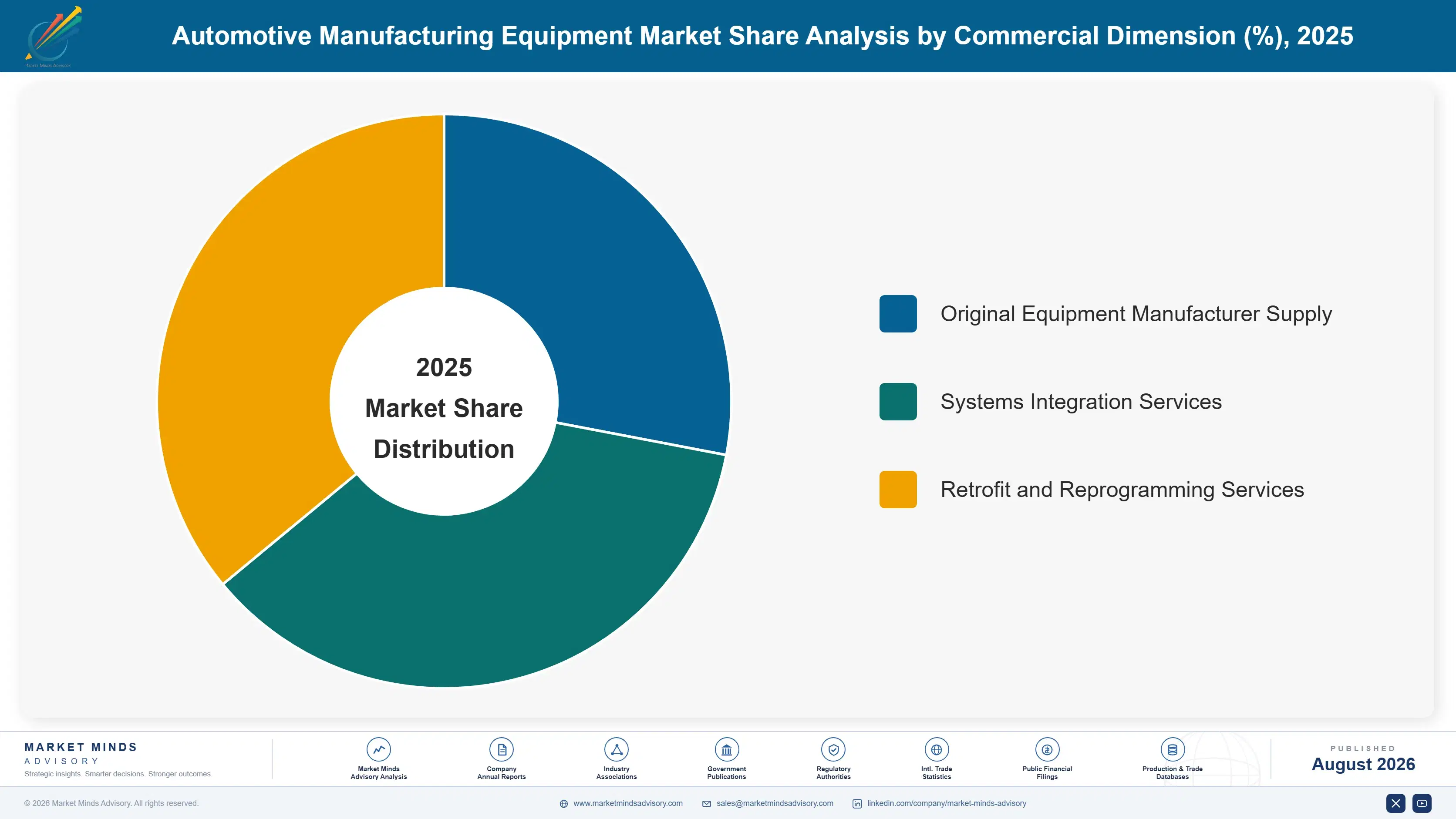
The market splits into six categories by equipment function, from robotic assembly through quality inspection. Battery pack assembly equipment is growing fastest as automakers insource cell-to-pack manufacturing, while robotic welding and assembly systems follow closely given electric vehicle body shop conversions sweeping the industry, as automakers accelerate their vertical integration strategies across every major manufacturing region.
automotive-manufacturing-equipment-market-market-share-analysis-1787464451654

Battery Pack Assembly Equipment

Battery pack assembly equipment is growing faster than any other category because automakers increasingly bring cell-to-pack manufacturing in-house rather than depending entirely on external battery suppliers, and that insourcing trend requires specialized cell welding, module assembly, and pack integration equipment most automaker plants never previously stocked. Comau and Dürr AG have both expanded battery assembly equipment production capacity specifically to serve this insourcing wave rather than relying on discretionary plant upgrade decisions. ABB Ltd has pursued a similar strategy, and the category's technical complexity, spanning precision cell handling and thermal management integration, gives established suppliers a meaningful engineering advantage over new entrants lacking comparable systems integration experience, particularly as battery specifications keep evolving across the supply base.
CAGR 13.0%

Robotic Welding and Assembly Systems

Robotic welding and assembly systems remain the largest single category by revenue and are growing quickly as electric vehicle body shop conversions touch nearly every station on the line rather than a single isolated process. FANUC Corporation and KUKA AG compete most directly in this category, where lighter, differently structured electric vehicle platforms demand reprogrammed welding sequences and often entirely new tooling fixtures. This universal requirement across nearly every plant conversion gives robotic systems a demand floor that shields the category from the volatility affecting more specialized battery assembly equipment categories, Yaskawa Electric has similarly expanded welding robot production to serve this growing conversion demand, regardless of broader macroeconomic swings across the industry.
CAGR 9.5%
Full segment breakdown across 7 segments available in the complete report.

Regional Architecture and Country Demand Map

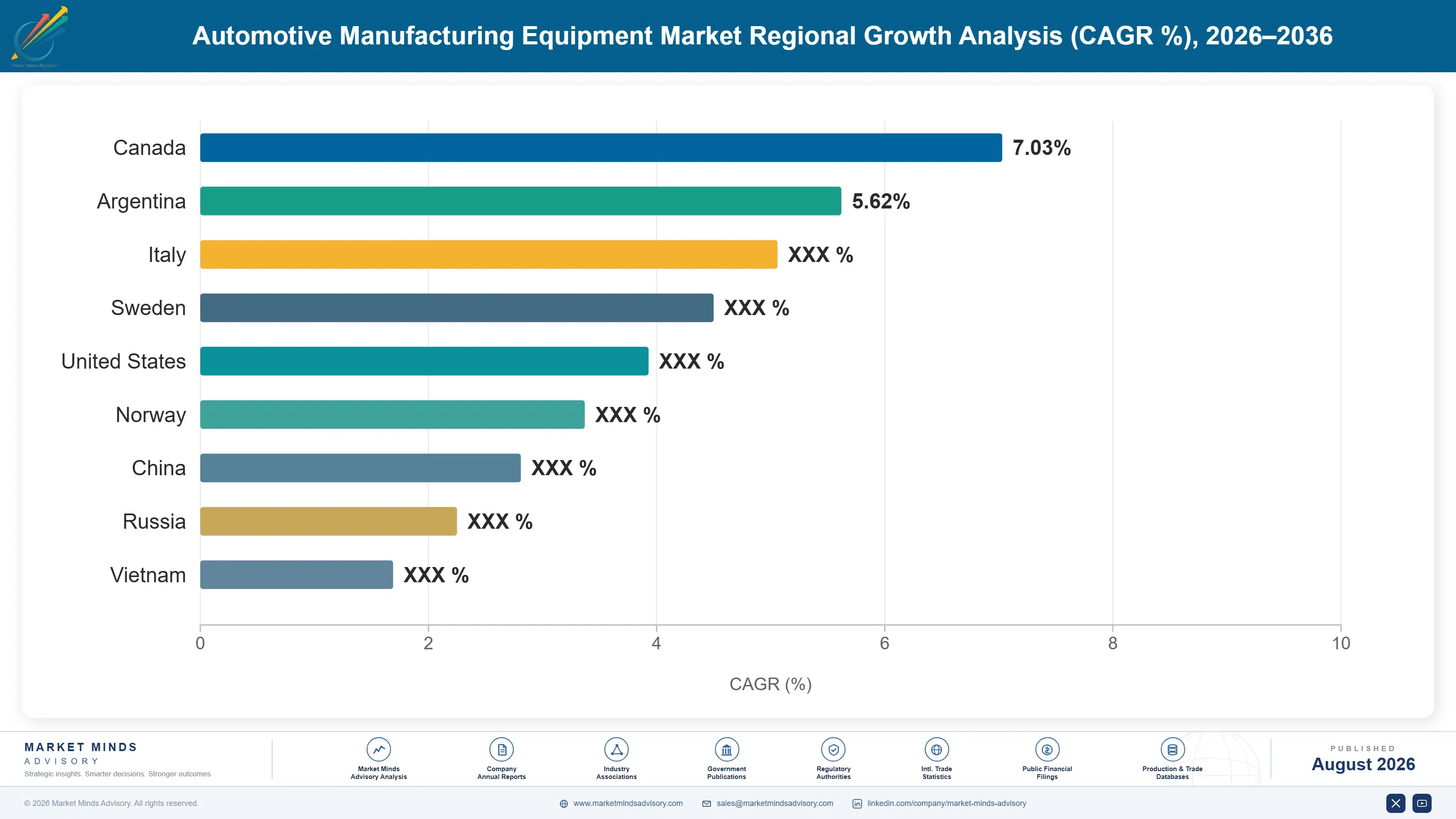
East Asia leads global manufacturing equipment demand, anchored by China's vehicle production scale and a deep robotics supply chain across Japan and South Korea. South Asia and Pacific posts the fastest growth as new assembly plants come online across the region, supported by new battery plant and assembly capacity announcements.

North America

US automakers are converting several major assembly plants to electric vehicle production, generating substantial equipment orders tied directly to announced conversion timelines rather than simple replacement cycles that characterize mature combustion manufacturing. Rockwell Automation maintains significant domestic engineering and integration capacity serving both established and emerging electric vehicle programs. Canada's smaller manufacturing base follows similar demand patterns tied to cross-border supply chain integration. Battery plant announcements from several automakers are accelerating equipment orders across the region's supplier base, and supporting stable long-term supplier revenue across the continent's expanding manufacturing footprint, and reinforcing established supplier relationships built over years of continuous platform development, across every major manufacturing hub, and their tier-one partners.
Share: 22% | CAGR: 7.8% (2026 to 2036)

Western Europe

Germany hosts substantial equipment engineering capacity serving both domestic automakers and export markets, with KUKA AG and Dürr AG both headquartered in the country and anchoring significant regional research investment. The region's automakers are further along in electric vehicle platform adoption than many global peers, accelerating equipment conversion work within domestic supply chains. Growth here trails faster-growing Asian markets because vehicle production volume itself has grown more slowly, even as technical sophistication remains genuinely high across the region's established supplier base, and reinforcing the region's engineering leadership position as global electrification accelerates further, and helping domestic suppliers maintain technical relevance as global electrification accelerates further, and beyond current platform generations.
Share: 22% | CAGR: 6.2% (2026 to 2036)
Regional intelligence for 5 additional markets available in the complete report: East Asia, South Asia and Pacific, Latin America, Middle East and Africa, Eastern Europe. Contact sales@marketmindsadvisory.com.
automotive-manufacturing-equipment-market-country-cagr-analysis-1787464452172

Capturing Value as Plants Convert

Suppliers capture the largest margin gains not from selling more stamping presses but from shifting what they sell: battery assembly systems integration, robotics reprogramming services, and financing that helps smaller automakers afford conversion. Each lever depends on capability incumbents already have, and it favors suppliers who move on it early across every regional program.

Expand Battery Assembly Systems Integration Capacity

Suppliers with mature battery assembly systems integration can capture a price premium of roughly 22 to 28 percent over standard stamping and conveyor equipment, capturing value from automakers racing to insource cell-to-pack manufacturing across multiple plant programs. Comau and Dürr AG have both prioritized this expansion with existing customers rather than competing purely for new original equipment contracts, since incumbent suppliers already hold the plant relationship and integration history needed to win the upgrade without a fully competitive tender process, and this advantage is widening as more automakers finalize their vertical integration roadmaps.
Market Impact: Battery integration helps add a 22-28% price premium

Offer Robotics Reprogramming and Retrofit Services

Suppliers that offer robotics reprogramming and retrofit services for existing installations capture recurring revenue worth an estimated 12 to 16 percent of original equipment value per conversion project, generating income that pure new equipment sales alone cannot match. ABB Ltd has expanded this retrofit service offering specifically to serve automakers seeking to reuse existing robotic hardware for electric vehicle platforms rather than replacing entire systems outright, and this offering is growing as more plants seek to extend the service life of existing capital equipment across every major platform today indeed.
Market Impact: Retrofit services help add a 12-16% recurring revenue

Provide Financing for Smaller Automaker Conversions

Financing programs that spread conversion equipment cost across its service life help budget-constrained regional automakers justify the purchase against comparable delayed-conversion alternatives, expanding the addressable customer base beyond automakers able to absorb the full capital outlay immediately. Suppliers offering in-house financing capture roughly 10 to 15 percent higher win rates against competitors requiring upfront cash purchase, since many regional automakers operate under tighter capital budgets than global manufacturers typically face, and this gap is widening as more automakers formalize their conversion budgets over time across every major manufacturing region too.
Market Impact: Financing helps improve win rates by 10-15 percent

Who Controls the Margin Pool

Concentration sits moderate at a CR5 near 45 percent, reflecting an industry where systems integration expertise creates genuine barriers against new entrants. ABB Ltd holds the clearest leadership position given its broad robotics range and deep original equipment relationships across multiple automakers. The gap between ABB Ltd and challengers like FANUC Corporation is narrower in commodity welding robot categories than in specialized battery assembly systems integration.
Current competitive activity centers on battery assembly equipment capacity and robotics retrofit services, as suppliers race to serve automakers converting plants while extending the service life of existing capital equipment. Comau and Dürr AG have both expanded battery assembly capability, while Rockwell Automation continues developing integration software to differentiate from pure hardware competitors, particularly in battery cell handling engineering.

Emerging pressure comes from Chinese equipment makers like Siasun Robot and Automation scaling technical capability rapidly within their large domestic electric vehicle manufacturing market, a trajectory that could eventually support competition beyond basic robotics into precision battery assembly integration. Rankings could shift meaningfully over the next decade if domestic suppliers close the remaining engineering gap that currently protects established multinational suppliers.
automotive-manufacturing-equipment-market-company-positioning-matrix-1787464452705

Competitive Moat and Risk Dimensions

ABB LTD

Moat: Broad Robotics Platform Range

ABB Ltd's broad robotics range spanning welding, material handling, and increasingly battery assembly lets automakers standardize on one supplier across multiple plant functions rather than managing several vendor relationships with different programming environments and service requirements, and reinforcing its position as the preferred choice for multi-function global plant programs.
ABB LTD

Risk: Battery Integration Depth Gap

ABB Ltd's battery assembly integration depth still trails specialists like Comau in certain cell handling applications, requiring continued engineering investment to defend its position as automakers increasingly weigh specialized battery expertise alongside general robotics capability, particularly as battery specialists accelerate their engineering advantage faster than currently projected.
FANUC CORPORATION

Moat: Manufacturing Scale and Reliability

FANUC Corporation's manufacturing scale and decades of reliability data give it a track record that automakers weigh heavily when selecting suppliers for high-volume production lines where downtime carries substantial financial consequences across every shift, as more automakers formalize reliability requirements into their supplier scorecards for high-volume lines.
FANUC CORPORATION

Risk: Narrower Battery Assembly Presence

FANUC Corporation's narrower presence in dedicated battery assembly equipment compared with specialists like Comau means it captures less of the fastest-growing segment of new plant investment currently reshaping automaker capital expenditure decisions, as those specialists extend integrated battery relationships across multiple plant generations ahead overall.

Players Tracked

Prominent Players

ABB Ltd
FANUC Corporation
KUKA AG
Comau
Dürr AG

Other Key Players

Kawasaki Heavy Industries
Yaskawa Electric
Schuler Group
AIDA Engineering
Siasun Robot and Automation
Hirata Corporation
Nachi-Fujikoshi
Bosch Rexroth
Rockwell Automation
Siemens
Mitsubishi Electric
Fives Group
Manz AG
Wuxi Lead Intelligent Equipment
Jonas and Redmann

Recent Developments

APRIL 2025

ABB Ltd announced an expansion of its battery assembly systems integration capacity at its European production facility, adding capacity specifically to serve automakers scaling battery pack insourcing ahead of continued production volume growth across several major markets,, reinforcing its regional leadership position and beyond ahead.
Signal: Signals supplier confidence that battery insourcing demand will sustain long-term capacity utilization broadly across the industry
SEPTEMBER 2025

Comau entered a supply agreement with a major automaker to provide battery pack assembly equipment across several manufacturing facilities over a multi-year period, reinforcing its position in a category increasingly valued for vertical integration strategy support, and extending its reach into a category increasingly valued across the broader automaker landscape.
Signal: Confirms automakers increasingly commit to multi-year battery assembly equipment contracts across the industr overall too here.
JANUARY 2026

KUKA AG launched an integrated robotics retrofit program combining reprogramming software and hardware upgrade kits into a single package, aimed at helping automakers reuse existing welding robots for electric vehicle platform conversions, and reinforcing its position as a leader in retrofit and software integration technology.
Signal: Signals a broader competitive shift toward retrofit and reuse capability rather than full replacement entirel overall.

Steel Structure and Control Electronics Exposure

Structural steel for stamping presses and conveyor systems and control electronics for robotics together represent roughly 36 percent of cost of goods sold for equipment manufacturers, sourced from a mix of steel mills and specialty electronics suppliers whose own pricing cycles directly influence equipment contract pricing across the broader supply chain, particularly during periods of tight global steel and electronics capacity utilization.
Steel prices rose meaningfully during a 2021 supply disruption tied to pandemic-era manufacturing and shipping bottlenecks, according to industry commodity pricing reports, and that shortage passed through to stamping and conveyor equipment contract pricing within roughly two to three quarters as manufacturers renegotiated terms with automaker customers already committed to plant conversion schedules. Manufacturers without long-term steel supply agreements absorbed the sharpest cost increases during that period across the industry.

Smaller regional equipment manufacturers without diversified steel and electronics sourcing absorb price volatility directly in margin, while larger diversified manufacturers with broader procurement relationships smooth pricing for their automaker customers instead. That gap in resilience increasingly determines which manufacturers can offer multi-year fixed-price contracts that large automakers now require for major plant programs, given the scale of their plant program footprint.
automotive-manufacturing-equipment-market-cost-volatility-analysis-1787464452903

Long-Term Steel Supply Agreements

Manufacturers are securing structural steel through multi-year contracts with mills rather than relying on spot-market purchases, smoothing cost volatility during years when supply disruptions or competing industrial demand push steel prices higher than budgeted across the industry each production cycle, helping preserve stable margins even when broader industrial demand elsewhere tightens overall steel capacity.

Diversified Control Electronics Sourcing

Manufacturers are securing control electronics components through multiple suppliers rather than relying on a single source, smoothing cost volatility during regional supply disruptions that periodically affect specific electronics manufacturing facilities and their surrounding markets globally each cycle, and helping manufacturers maintain delivery schedules even when a single supplier faces unexpected capacity constraints indeed too.

Modular Equipment Design Enabling Component Flexibility

Some manufacturers are designing modular equipment compatible with components from multiple electronics suppliers, reducing dependence on any single vendor while preserving the flexibility to switch sourcing quickly whenever pricing or availability conditions shift meaningfully, an approach increasingly valued by manufacturers seeking to avoid dependence on any single external vendor each cycle too now too.

Portfolio Architecture for Margin Defence

The market splits across three tiers: commodity stamping and conveyor equipment sold on thin margins against automaker volume contracts, robotic welding and assembly systems sold with integration support at a premium, and an emerging tier of battery assembly systems commanding the highest margins as automakers insource cell-to-pack manufacturing, reflecting how quickly the underlying manufacturing technology mix within the industry keeps shifting.
Volume sits overwhelmingly in the commodity stamping and conveyor tier, where bulk contracts with automakers generate revenue scale but comparatively thin margins given intense price competition among established and regional manufacturers. Premium tension is sharpest in battery assembly systems, where systems engineering and integration expertise earn meaningfully better margins than commoditized mechanical equipment, pulling supplier investment toward capacity serving both tiers.

High-value margin pools concentrate in battery assembly systems and robotics retrofit services sold to automakers converting plants for electric vehicle production, a category still smaller in absolute volume than commodity equipment but growing faster and attracting disproportionate research investment from leading suppliers each year, a pattern likely to continue strengthening as more automakers finalize their own vertical integration roadmaps, a pattern reinforced further.

Volume / Commodity-Adjacent Tier

Standardized stamping presses and conveyor systems sold on multi-year volume contracts to automakers, competing primarily on manufacturing cost and delivery reliability across regions, reflecting the intense price sensitivity these budget-constrained buyers bring to every large-volume procurement decision.
Gross Margin: 8%-14%

Premium / Certified Tier

Robotic welding and assembly systems sold with systems integration and engineering support, commanding a premium over standardized equipment equivalents across most original equipment contracts, as plant conversion activity continues expanding steadily across an expanding set of manufacturing regions.
Gross Margin: 20%-28%

Sustainability / Regulatory / Next-Generation Tier

Battery pack assembly systems tied to electric vehicle vertical integration strategies, sold into the industry's highest-margin engineering arrangements currently available across major plant programs, as more automakers seek unified vertical integration capability over separately sourced mechanical components.
Gross Margin: 28%-36%
automotive-manufacturing-equipment-market-portfolio-architecture-1787464453416

High-value Sub-segments and Strategic Watch-out

Battery Pack Assembly Systems

Battery pack assembly systems command the category's highest margins and are growing fastest as automakers increasingly insource cell-to-pack manufacturing over relying on external suppliers each plant program currently underway, and suppliers with established integration capability are capturing the bulk of this expanding demand and beyond.

Robotics Retrofit and Reprogramming Services

Robotics retrofit and reprogramming services are growing steadily as automakers seek to extend the service life of existing capital equipment rather than replacing entire systems outright during platform conversions, a combination increasingly viewed as a competitive necessity rather than an optional differentiator and beyond too.

Standardized Stamping and Conveyor Equipment

The largest volume pool by far, standardized equipment generates scale revenue for top suppliers but offers little margin expansion room given intense multi-region price competition among established manufacturers, leaving manufacturers to compete mainly on delivery reliability and established regional service networks and beyond too now.

Domestic Chinese Robotics Manufacturers

Domestic Chinese robotics manufacturers scaling technical capability could challenge multinational suppliers on cost within their home market over the next decade, a shift worth monitoring closely going forward, particularly if domestic engineering capability matures faster than currently anticipated by most industry observers and beyond too.

Plant Cycles and Integration Loyalty

Original equipment demand behaves like an annuity once an automaker qualifies a specific supplier's systems integration approach against its own plant specifications, since switching suppliers again requires repeating extensive commissioning and validation testing that most automakers avoid unless supply is disrupted, giving incumbent suppliers durable multi-year volume once they win the initial plant contract and pass the first renewal cycle.
Adoption depth varies by segment: large global automakers show the deepest supplier stickiness given the scale of commissioning and validation testing required across multiple plant programs, while smaller regional automakers switch suppliers more readily since their production volumes are smaller and requalification costs correspondingly lower relative to total capital spend involved in each plant conversion, particularly where plant specifications rotate more frequently across shorter regional product cycles.

A generational shift among younger plant engineers toward treating equipment data and predictive maintenance capability as a core operational asset rather than a simple mechanical maintenance item is pulling supplier selection earlier into plant planning decisions, giving software-capable suppliers a seat at the table that legacy hardware-only vendors historically never had, reshaping how plant teams weigh technical capability against simple equipment price.
automotive-manufacturing-equipment-market-end-use-penetration-index-1787464453915

Positioning as Plants Convert

These are among the four positions where our research anticipates prominent divergence between winners and laggards over the coming forecast period. Each is grounded in the demand model, the regulatory perimeter, and the announced capacity pipeline.
01 / BATTERY INTEGRATION INVESTMENT

Expand battery assembly integration ahead of insourcing waves

Battery assembly integration already commands a 22 to 28 percent premium, and suppliers without proven cell handling experience cannot access the plant contracts Comau and Dürr AG increasingly dominate as automakers insource cell-to-pack manufacturing. Building this capability now, even at substantial engineering investment, positions a supplier to capture the highest-margin category before more automakers finalize their vertical integration roadmaps. Suppliers who wait risk permanent exclusion from contracts requiring years of integration history to win across every regional market too indeed.
02 / ROBOTICS RETROFIT SERVICES

Build retrofit services to extend equipment service life

Retrofit services add an estimated 12 to 16 percent recurring revenue per conversion project, and ABB Ltd already demonstrates this advantage through reprogramming offerings that automakers increasingly value across their existing installed base. Suppliers without comparable retrofit capability miss revenue from automakers seeking to extend equipment life rather than replace it outright. Building this capability now secures long-term plant relationships before competitors close the remaining service gap further across the broader manufacturing base across every plant program indeed overall too.
03 / REGIONAL AUTOMAKER FINANCING

Offer financing to reach budget-constrained regional automakers

Financing programs that spread conversion cost across its service life improve win rates by an estimated 10 to 15 percent against competitors requiring full upfront cash purchase, since many regional automakers operate under tighter capital budgets than global manufacturers. This gap is widening as electrification pressure spreads without correspondingly larger regional budgets. Suppliers building financing capability now will reach a broader customer base as conversion pressure spreads beyond well-funded global automakers and pricing conditions across the industry broadly indeed here.
04 / CHINESE MARKET LOCALIZATION

Localize manufacturing in China before domestic suppliers mature

China's manufacturing equipment market is growing at roughly 11.5 percent annually, and domestic robotics makers like Siasun Robot and Automation are scaling capacity rapidly to serve this expanding electric vehicle production base. Suppliers who build local manufacturing capacity now can secure long-term supply relationships before domestic champions capture the bulk of new demand growth entirely. Early localization secures market position before this fast-growing market matures and consolidates further around domestic leaders over time across every regional market indeed here too.

Engagement Snapshot From the Field

A live engagement with an industry participant carrying material or product regulatory and market exposure ahead of a defining policy shift, showing how our research translates into a defensible multi-year portfolio strategy.
MARKET MINDS ADVISORY · CLIENT ENGAGEMENT SUMMARY
Automotive Manufacturing Equipment Producer Strategic Portfolio Review and Transition Roadmap 2026·Investment Scenario on Automotive Manufacturing Equipment Exposure Evaluation 2025-26
CLIENT PROFILE
A regional automaker converting a legacy combustion assembly plant to electric vehicle production engaged MMA to guide an equipment supplier selection strategy after its existing stamping and welding suppliers could not meet the new platform's battery assembly requirements. The automaker's annual manufacturing equipment procurement spend exceeded 180 million dollars (client-reported, unverified by MMA), making supplier selection a material decision for its senior operations leadership.
STRATEGIC CHALLENGE
The automaker's existing equipment suppliers lacked battery pack assembly integration expertise, threatening the plant conversion timeline as validation testing for a new supplier relationship typically requires many months that the compressed schedule could not easily absorb, threatening a meaningful share of the automaker's planned production launch window across every production shift.
MMA APPROACH
MMA benchmarked battery assembly equipment suppliers against integration depth and plant commissioning track records, modeled the schedule risk of switching suppliers, and structured a phased qualification plan sequenced around the automaker's plant conversion deadline, drawing on comparable conversions completed at similarly sized regional automakers elsewhere across the automaker's broader supplier base.
KEY FINDINGS
  1. Switching to a supplier with proven battery assembly experience compressed the commissioning timeline meaningfully, freeing engineering resources for other priority plant development work.
  2. The new supplier's retrofit capability let the automaker reuse a portion of its existing robotic equipment, reducing total capital spend meaningfully across the conversion project.
  3. A phased qualification approach across two production lines avoided the delay a full plant switch would have created, keeping production schedules on track throughout the transition period.
  4. Supplier engineering support during commissioning proved as valuable to the automaker's team as the technical capability itself, giving engineering leadership confidence to expand the relationship further.
CLIENT PROFILE
A regional automaker converting a legacy combustion assembly plant to electric vehicle production engaged MMA to guide an equipment supplier selection strategy after its existing stamping and welding suppliers could not meet the new platform's battery assembly requirements. The automaker's annual manufacturing equipment procurement spend exceeded 180 million dollars (client-reported, unverified by MMA), making supplier selection a material decision for its senior operations leadership.
STRATEGIC CHALLENGE
The automaker's existing equipment suppliers lacked battery pack assembly integration expertise, threatening the plant conversion timeline as validation testing for a new supplier relationship typically requires many months that the compressed schedule could not easily absorb, threatening a meaningful share of the automaker's planned production launch window across every production shift.
MMA APPROACH
MMA benchmarked battery assembly equipment suppliers against integration depth and plant commissioning track records, modeled the schedule risk of switching suppliers, and structured a phased qualification plan sequenced around the automaker's plant conversion deadline, drawing on comparable conversions completed at similarly sized regional automakers elsewhere across the automaker's broader supplier base.
KEY FINDINGS
  1. Switching to a supplier with proven battery assembly experience compressed the commissioning timeline meaningfully, freeing engineering resources for other priority plant development work.
  2. The new supplier's retrofit capability let the automaker reuse a portion of its existing robotic equipment, reducing total capital spend meaningfully across the conversion project.
  3. A phased qualification approach across two production lines avoided the delay a full plant switch would have created, keeping production schedules on track throughout the transition period.
  4. Supplier engineering support during commissioning proved as valuable to the automaker's team as the technical capability itself, giving engineering leadership confidence to expand the relationship further.
RECOMMENDED STRATEGY
Phase 1: Phase 1 (Months 1-4): Qualify the new supplier on the lead production line first, the line facing the nearest production launch deadline. Phase 2: Phase 2 (Months 5-9): Extend qualification across the remaining production line, validating performance before completing the full plant transition across every production shift. Phase 3: Phase 3 (Months 10-13): Complete commissioning and finalize long-term supply agreement terms, closing out the qualification on schedule and within budget.
OUTCOME
The automaker completed its phased supplier qualification within the recommended thirteen-month window and launched its converted plant on schedule (client-reported, unverified by MMA), while retrofit reuse of existing equipment reduced total conversion capital spend meaningfully, strengthening its position ahead of the next platform generation program.

Frequently Asked Questions

Foundational context covering the market sizes, CAGR, scope, country, region and competition that inform every finding below. This section is provided to cover basics and most often pre-purchase conversations, answered from the MMA Primary Research Dataset.

What is the current size of the Automotive Manufacturing Equipment Market?

The global automotive manufacturing equipment market was valued at approximately $32.0 billion in 2025. Battery assembly equipment already accounts for a meaningful and growing share of new plant investment.

How large will the Automotive Manufacturing Equipment Market be by 2036?

MMA projects the market will reach approximately $70.9 billion by 2036, roughly 2.06 times its 2026 value. Battery assembly equipment adoption drives much of this growth.

What is the CAGR for the Automotive Manufacturing Equipment Market 2026 to 2036?

The market is projected to grow at a 7.5 percent compound annual rate between 2026 and 2036. Bull and bear scenarios range from 6.3 to 8.7 percent.

Which segment is growing fastest?

Battery pack assembly equipment is the fastest-growing segment at a 13.0 percent CAGR, well above the overall market rate. Cell-to-pack insourcing drives this expansion across the industry today.

Who are the major companies in the Automotive Manufacturing Equipment Market?

Leading suppliers include ABB Ltd, FANUC Corporation, KUKA AG, Comau, and Dürr AG. Together they hold a CR5 near 45 percent of global shipments of global shipment volume.

Which country is growing fastest?

China posts the fastest national growth at roughly 11.5 percent, driven by aggressive electric vehicle plant conversion and battery plant construction. Domestic manufacturing capacity is expanding to meet this rising demand.

Report Segmentation Architecture

The full report scope spans multiple orthogonal segmentation dimensions, with cross-tabulated demand data provided for each dimension pair. Coverage extends further to regional breakdowns, trend trajectories, and the competitive detail needed to support segment-level decision-making.

By Equipment Type

  • Robotic Welding and Assembly Systems
  • Metal Stamping Presses and Tooling
  • Paint Shop and Coating Equipment
  • Battery Pack Assembly Equipment
  • Final Assembly Line Conveyor Systems
  • Quality Inspection and Testing Equipment

By End-Use Application

  • Body Shop Manufacturing
  • Powertrain and Battery Manufacturing
  • Final Vehicle Assembly
  • Quality Control and Testing

By Commercial Dimension

  • Original Equipment Manufacturer Supply
  • Systems Integration Services
  • Retrofit and Reprogramming Services

By Region

  • North America
  • Western Europe
  • East Asia
  • South Asia and Pacific
  • Latin America
  • Middle East and Africa
  • Eastern Europe

Scope, Methodology, and Coverage

Every figure in this report is reproducible from documented input assumptions. The scope below maps the historical period, the forecast horizon, the segmentation dimensions, and the countries covered, alongside the underlying primary and qualitative methodology.
Historical Period
2020 to 2025
Forecast Period
2026 to 2036
Base Year
2025 (USD billions; MMA Primary Research Dataset, August 2026)
Market Definition
The automotive manufacturing equipment market covers robotic welding and assembly systems, metal stamping presses and tooling, paint shop and coating equipment, battery pack assembly equipment, final assembly line conveyor systems, and quality inspection and testing equipment sold to automakers and their tier-one manufacturing partners. It excludes hand tools and maintenance consumables used within these production lines.
Quantitative Units
USD billions (current prices); unit volume for equipment category detail
Segmentation Dimensions
By Equipment Type; By End-Use Application; By Commercial Dimension; By Region
Regions Covered
North America, Western Europe, East Asia, South Asia and Pacific, Latin America, Middle East and Africa, Eastern Europe
Countries Covered
China, Japan, South Korea, Germany, USA, India, France, UK, Italy, Sweden, Canada, Mexico, Brazil, Argentina, Colombia, UAE, Saudi Arabia, South Africa, Poland, Czech Republic, Hungary, Slovakia, Turkey, Indonesia, Thailand, Vietnam, Australia, Spain, Netherlands, and additional markets relevant to this sector
Key Companies Profiled
ABB Ltd, FANUC Corporation, KUKA AG, Comau, Dürr AG, Kawasaki Heavy Industries, Yaskawa Electric, Schuler Group, AIDA Engineering, Siasun Robot and Automation, Hirata Corporation, Nachi-Fujikoshi, Bosch Rexroth, Rockwell Automation, Siemens, Mitsubishi Electric, Fives Group, Manz AG, Wuxi Lead Intelligent Equipment, Jonas and Redmann
Quantitative Methodology
Primary survey, n=3,800 respondents, Q4 2025, six countries; demand-side model with trade association cross-validation
Qualitative Methodology
47 expert interviews, Q4 2025; applied to validate demand model assumptions, identify emerging dynamics, and assess competitive positioning
Report Format
PDF and XLSX data workbook (Word format preview document)
Publisher
Market Minds Advisory
Report Code
MMA-2026-CON-102
Published
August 2026
Contact
sales@marketmindsadvisory.com | www.marketmindsadvisory.com

Purchase the full Automotive Manufacturing Equipment Market Report (2026 to 2036).

The full Automotive Manufacturing Equipment Market report delivers a comprehensive 2026 to 2036 forecast across six equipment categories, seven regions, and twenty profiled companies active in this sector. It includes detailed segmentation by end-use application, steel and electronics cost modeling, and competitive benchmarking measured against a single consistent shipment volume basis throughout. Analysts document the electrification and battery insourcing trends reshaping supplier positioning across the industry. Buyers receive full access to the underlying data tables, regional breakouts, and a customizable Excel model built for scenario planning.
2026-2036 volume and value forecasts by segment
Six-category equipment type breakdown and detailed analysis
Seven-region market sizing and share detail
Twenty-company competitive profiles and full benchmarking
Steel and electronics cost sensitivity modeling
Editable Excel forecast workbook with scenario toggles

Built For The People Who Decide

From boardroom strategy to bench-side execution, this report is read cover-to-cover by leaders shaping the next decade of their industry, turning demand scenarios, market dynamics and valuation benchmarks into decisions.
CXOs/ Presidents/ VPs/ Managers
M&A and Corporate Development
Strategy Teams and R&D Heads
Procurement and Product Directors
Regulatory and Compliance Leaders
Investor Relations and Equity Analysts