

Market Minds Advisory
Automotive Human-Machine Interface (HMI) Market

Automotive Human-Machine Interface (HMI) Market: Automotive Human-Machine Interface Market. EV Cockpit Digitization Forces a Display Upgrade Cycle

Electric vehicle cockpits are replacing physical switchgear with software-defined digital surfaces, forcing interior electronics suppliers still selling discrete button clusters toward integrated display and voice control platforms tied directly to over-the-air update pipelines.

Lead Analyst

Published

September 2026

Make Smarter Decisions with Customized Research Insights

Request a free sample report and evaluate market opportunities, growth trends, and competitive dynamics relevant to your business needs.

2025 MARKET VALUE$15.6BMarket Size 2025
2036 FORECAST VALUE$48.2BBase Case , 2026 to 2036
CAGR 2026 TO 203610.8 %Bull 12.1% / Bear 9.5%
INCREMENTAL OPPORTUNITY$30.9BNet 10- year value creation
EXPANSION MULTIPLE2.79x2036 value over 2026 base
Strategic Levers
M&A Pipeline
Regional Outlook
Country Rankings
Competitive Intelligence
Segmental Deep-dive
Call-Us : 91 93563 13602

Executive Snapshot and Market Trajectory.

A car buyer today judges a dashboard the way they once judged a smartphone, and that shift alone has turned interior electronics from a cost-engineering afterthought into a genuine brand differentiator that automakers now compete on directly and quite aggressively across every price segment, trim level, and vehicle class.
Electric vehicle cockpit redesigns, rising voice and gesture control adoption, and expanding over-the-air software update capability together drive most demand, each pushing suppliers toward integrated digital cockpit platforms rather than discrete mechanical switchgear across the entire industry today and tomorrow. East Asia's massive vehicle production base and China's aggressive EV cockpit digitization push give the region an outsized role in global demand that exceeds its share of overall automotive production value alone.
Five vendors hold under half of global revenue, a fragmented landscape reflecting how differently automakers approach cockpit design depending on whether they prioritize a single large curved display, multiple discrete screens, or a hybrid physical-digital layout across the entire vehicle lineup. Rising AI integration is pushing automakers toward conversational voice assistants and predictive interfaces, a shift that favors suppliers with strong software and semiconductor partnerships.
Market Definition
The automotive HMI market covers digital instrument clusters, infotainment touchscreens, heads-up displays, voice recognition systems, and haptic control interfaces integrated into vehicle cockpits. It excludes the underlying telematics connectivity hardware and advanced driver assistance sensor systems that operate independently of the driver-facing interface itself.
Base Year Value
$15.6B in 2025 (MMA Primary Research Dataset, September 2026)
Forecast Period
2026 to 2036, eleven discrete annual values
CAGR
10.8% base case. Bull 12.1%. Bear 9.5%.
Fastest Growth Segment
AI-Powered Voice and Gesture Recognition Systems: 17.6% CAGR
Fastest Growth Country
China: 14.9% CAGR
Fastest Growth Region
South Asia and Pacific: 12.6% CAGR
Largest Region
East Asia: 30% of 2025 global value
Market Leaders
Continental, Visteon, Harman (Samsung), Panasonic Automotive, and Denso lead the market. Source: MMA Primary Research Dataset, July 2026.
Primary Survey
n=3,800 procurement and R&D decision-makers, Q4 2025, six countries
Methodology
Demand-side build-up, cross-validated against public data, 47 expert interviews

Automotive Human-Machine Interface (HMI) Market Forecast Scenarios

automotive-human-machine-interface-hmi-technologie-size-forecast-scenario-1790005376127
Between 2020 and 2025 the market grew at roughly 9.9% a year as pandemic-era semiconductor shortages delayed cockpit electronics shipments before a strong rebound in electric vehicle production and digital cockpit adoption pulled demand forward through the back half of the period across most major automotive manufacturing regions worldwide, particularly across China and North America and Europe.
The base case assumes 10.8% annual growth through 2036, built on three mechanisms: accelerating electric vehicle cockpit redesigns that replace mechanical switchgear with integrated digital display and voice control systems across nearly every new model launched, rising consumer expectation for smartphone-like interface quality that pushes automakers toward continuous software-defined cockpit updates, and expanding AI integration that makes conversational voice assistants and predictive interfaces commercially viable across a broader range of vehicle price points.
A bull case near 12.1% follows if AI-powered voice and gesture recognition adoption accelerates faster than currently announced automaker product roadmaps suggest across major manufacturers worldwide and well beyond. The principal bear risk, a slowdown in electric vehicle production growth that delays cockpit digitization investment across the entire industry, would instead pull growth toward 9.5%.

Automotive HMI Market Overview

Automotive HMI sits at the point where a vehicle's technology story either becomes a genuine showroom selling point or stays an invisible engineering detail buried in a spec sheet. Buyers no longer choose cockpit suppliers purely on component cost. They increasingly demand frictionless multi-display integration, natural voice interaction, and over-the-air update capability that keeps the cockpit feeling current years after purchase.
MARKET CONCENTRATIONCR5 42%Top five vendors hold under half of global revenue
AVERAGE SELLING PRICE$180-2,400 per vehiclePrice spans basic instrument clusters to full cockpit platforms
LEADING PRODUCING COUNTRYChina, 33% shareChinese automakers concentrate rapid digital cockpit innovation and adoption
VOICE CONTROL ADOPTION RATE46% of new vehiclesAutomakers increasingly integrate conversational assistants into standard trim levels
SOFTWARE UPDATE CAPABILITY38% of vehicles OTA-readyGrowing share of cockpits now support continuous remote feature updates
INPUT COST SHARE39%Display panels and semiconductor processors dominate total unit cost
China hosts a disproportionate share of rapid digital cockpit innovation, reflecting the country's aggressive electric vehicle competition and consumer expectation for smartphone-grade interface quality at launch across nearly every price segment. East Asia more broadly is the largest single demand pool by volume, driven by the region's massive vehicle production base and a domestic automaker cohort competing directly on cockpit technology differentiation.
Voice control adoption is accelerating faster than the overall market, since conversational assistants increasingly replace touchscreen menu navigation for common driver tasks performed while the vehicle is in motion and hands must stay on the wheel. Software update capability continues expanding across new vehicle platforms, a shift that lets automakers generate recurring feature revenue long after the original vehicle sale is complete.
"Nobody test drives the engine anymore. They test drive the dashboard, and if it feels like a phone from three years ago, the sale is already lost before the car leaves the lot."
Director, Automotive Electronics Practice · MMA Automotive Practice · September 2026

Market Trends

AI-powered conversational voice assistants replace menu-based navigation

Automakers are rapidly replacing hierarchical touchscreen menu systems with large language model-powered conversational voice assistants capable of understanding natural, context-dependent requests rather than requiring drivers to memorize specific command phrases well in advance of use. This shift lets drivers control climate, navigation, and entertainment functions through conversational speech while keeping their eyes on the road, addressing genuine safety concerns around touchscreen-based interaction while driving at speed. Vendors partnering directly with leading AI model providers increasingly win specification battles against suppliers offering older, rule-based voice recognition systems limited to fixed command vocabularies.
Market Impact: 18 million EVs produced annually

Software-defined cockpits enable continuous over-the-air feature updates

Vehicle cockpits increasingly run on software-defined architecture that lets automakers deploy new features, interface improvements, and bug fixes remotely after a vehicle has already been sold, rather than locking cockpit functionality permanently at the point of manufacture entirely and forever. This capability transforms the cockpit from a fixed hardware asset into an evolving software platform that can generate ongoing revenue through paid feature activations and subscription services offered after purchase. Automakers increasingly view over-the-air update capability as a competitive requirement rather than an optional premium feature reserved for flagship models alone.
Market Impact: 70% of buyers cite interface quality

Market Opportunities and Growth Drivers

Electric vehicle cockpit redesigns generate first-time HMI demand

Electric vehicle manufacturers are redesigning cockpits from a clean architectural slate rather than adapting legacy internal combustion vehicle interiors, generating an opportunity to integrate digital displays and voice control from the earliest design stages rather than retrofitting existing platforms after the fact. This clean-slate approach lets EV manufacturers differentiate on interior technology in ways that internal combustion competitors constrained by existing platform architecture struggle to match quickly. Chinese EV manufacturers in particular have made cockpit technology a central competitive battleground, pushing traditional automakers to accelerate their own digital cockpit roadmaps considerably.
Market Impact: 22% longer glance time for touchscreens

Consumer smartphone expectations drive interface quality benchmarking

Vehicle buyers increasingly evaluate cockpit interface quality against the smartphones they use every single day, expecting responsive touch performance, intuitive navigation, and regular feature updates that legacy automotive interface design cycles historically could not deliver at comparable pace or speed across the entire industry. This benchmarking pressure is forcing automakers to adopt consumer electronics development practices, including more frequent software release cycles and user experience testing methodologies borrowed directly from smartphone manufacturers. Automakers failing to meet these elevated expectations increasingly face negative reviews specifically citing outdated or unresponsive cockpit technology.
Market Impact: 6 month average feature delay

Market Restraints and Challenges

Touchscreen-only interfaces face safety and usability criticism

Regulators, safety advocates, and increasingly automakers themselves have raised concerns that removing physical buttons entirely in favor of touchscreen-only controls increases driver distraction, since touch interaction requires more sustained visual attention than reaching for a familiar physical switch by feel alone during driving. The root cause is that early digital cockpit designs prioritized aesthetic minimalism and cost reduction over ergonomic research into actual driver distraction patterns during real-world use. Several automakers have reintroduced physical controls for frequently used functions specifically in response to consumer complaints and independent safety testing results.
Market Impact: 46% of new vehicles now voice-enabled

Semiconductor supply constraints limit advanced cockpit feature availability

Advanced cockpit features requiring high-performance processors for AI voice assistants and multi-display rendering depend on semiconductor supply chains that experienced significant disruption in recent years, forcing some automakers to delay planned feature rollouts or ship vehicles with reduced cockpit capability than originally intended for that particular model year. The underlying cause is that automotive-grade semiconductors require lengthy qualification processes that limit how quickly manufacturers can shift between chip suppliers during a genuine shortage. Several automakers are now qualifying multiple semiconductor suppliers simultaneously specifically to reduce single-supplier dependency risk going forward.
Market Impact: 38% of vehicles now OTA-capable
4 additional market trends, 3 additional growth drivers, and 3 additional restraints and challenges are covered in the full report. Contact sales@marketmindsadvisory.com to access the complete intelligence.

Segment CAGR and Growth Architecture

Automotive HMI segments cleanly by interaction modality, the dimension that determines both development cost and driver interaction experience for a given cockpit design and vehicle platform. This framework separates AI-powered voice and gesture recognition systems, digital instrument clusters, infotainment touchscreens, heads-up displays, and haptic feedback controls, avoiding overlap between interaction technology and cockpit hardware placement.
Section default visual

AI-Powered Voice and Gesture Recognition Systems

AI-powered voice and gesture recognition systems are pulling ahead of every other configuration as large language model integration makes conversational interaction genuinely practical for everyday driving tasks rather than a novelty feature limited to fixed command phrases and rigid vocabularies. These systems let drivers control cockpit functions without diverting visual attention from the road, addressing safety concerns that touchscreen-only interfaces have increasingly attracted from regulators and consumer advocates alike across major markets. Automakers increasingly favor this configuration because it delivers both a genuine safety improvement and a differentiated brand experience that competitors using older, rule-based voice systems cannot easily replicate. Vendors slow to build mature voice integration risk exclusion from major automaker procurement programmes entirely.
CAGR 17.6%

Digital Instrument Clusters

Digital instrument clusters remain the largest single configuration by installed base worldwide today, continuing to serve as the primary display replacing traditional analog gauges across nearly every new vehicle segment regardless of price point or trim level offered. Their appeal lies in configurable information density and lower long-term cost compared with fully custom cockpit architectures, a genuine advantage for automakers standardizing displays across multiple vehicle platforms and trim levels simultaneously across their entire lineup. Mainstream automakers continue generating steady replacement and expansion demand for this established, cost-effective configuration. Manufacturers continue expanding compatibility across a broader range of vehicle segments and price points, further strengthening this configuration's already dominant installed base position across the industry.
CAGR 8.9%
Full segment breakdown across 7 segments available in the complete report.

Regional Architecture and Country Demand Map

East Asia leads on the strength of China's massive vehicle production base and aggressive EV cockpit digitization push across most domestic automakers nationwide today, while North America and Western Europe follow closely behind on premium vehicle segments and their long established automotive electronics supplier bases.

East Asia

China's domestic electric vehicle manufacturers, including several companies founded within the past decade, have made cockpit technology a central competitive battleground, pushing display size, voice assistant sophistication, and update frequency well beyond what traditional automakers historically offered. Japanese and South Korean automakers favor a more measured integration of digital cockpit technology, balancing innovation against established brand reliability expectations among their core customer base. Rising domestic semiconductor and display manufacturing capacity across the region continues reducing China's historical dependence on imported cockpit components. Domestic regulatory frameworks increasingly favor locally developed software platforms over foreign alternatives, reshaping competitive dynamics across the region's largest national automotive markets. This trend is expected to continue expanding steadily each year.
Share: 30% | CAGR: 11.5% (2026 to 2036)

North America

The United States hosts a concentrated cluster of automotive electronics suppliers and technology companies competing to supply cockpit software and semiconductor platforms to both domestic and international automakers. American electric vehicle manufacturers have positioned cockpit technology as a primary brand differentiator, pushing traditional Detroit automakers to accelerate their own digital cockpit investment considerably. Canadian automotive supplier operations add meaningful incremental volume behind the much larger American market, growing at a broadly comparable pace overall. Federal support for domestic semiconductor and battery manufacturing continues indirectly strengthening the broader automotive electronics supply chain across the country. Vendor investment in this region continues rising steadily each year across most product categories tracked. This pace is expected to hold.
Share: 26% | CAGR: 10.9% (2026 to 2036)
Regional intelligence for 5 additional markets available in the complete report: Western Europe, South Asia and Pacific, Latin America, Middle East and Africa, Eastern Europe. Contact sales@marketmindsadvisory.com.
automotive-human-machine-interface-hmi-technologie-market-share-analysis-1790005376668

Where Margin Concentrates in Automotive HMI

Suppliers capture the widest margins where a cockpit becomes a recurring software revenue relationship rather than a one-time hardware sale, and where AI integration commands a premium over legacy rule-based systems regardless of upfront component cost involved. Four levers stand out as the clearest paths to expanding gross margin over the coming decade ahead.

Sell paid feature activations through over-the-air software updates

Suppliers that build cockpit hardware capable of activating additional features after the vehicle sale through paid over-the-air software updates capture recurring revenue well beyond the original component sale, transforming a one-time hardware transaction into a multi-year commercial relationship with the automaker and end customer alike. Several leading suppliers have expanded this capability specifically to help automakers monetize features like enhanced navigation or premium voice assistant tiers after purchase. Automakers adopting this model report blended margin improvements of roughly 15 percentage points compared with pure hardware sales. This approach also creates deeper customer engagement with the vehicle brand.
Market Impact: 15 percentage point blended margin uplift from software

Win exclusive integration status on major AI model platforms

Securing preferred-integration status with a leading AI foundation model provider locks in a technology advantage that automakers increasingly specify explicitly during supplier selection, effectively excluding competitors without comparable AI partnerships from premium cockpit contracts entirely. Automakers increasingly standardize voice assistant technology across their entire vehicle lineup once a supplier proves reliable conversational performance in real-world driving conditions. Suppliers that invest early in these partnerships typically hold their position for years, worth an estimated 21% revenue premium over competitors without comparable AI integration. This qualification advantage compounds further as additional vehicle programmes reference prior successful integrations.
Market Impact: 21% revenue premium earned on AI-integrated contracts directly

Sell haptic and multi-sensory feedback as a premium content tier

Suppliers offering advanced haptic feedback and multi-sensory interaction capability, priced as a premium tier above standard touchscreen interfaces, capture margin from automakers seeking to differentiate flagship trim levels with a genuinely distinctive tactile experience for their customers. This model rewards suppliers that invest early in specialized actuator and feedback engineering rather than offering generic, one-size-fits-all touchscreen interfaces across every trim level equally. Suppliers operating dedicated premium haptic tiers report gross margins on this revenue stream near 56%, meaningfully above blended average cockpit hardware margins overall. Customers value the tactile distinction that differentiates a flagship trim from base configurations.
Market Impact: 56% gross margin achieved on premium haptic content

License usage analytics and driver behavior data to insurers

Insurance companies increasingly pay cockpit suppliers and automakers for aggregated, anonymized driver interaction and behavior data used to refine usage-based insurance pricing models across their entire policyholder base and risk pool. This creates a software-like revenue stream layered on top of the original hardware sale, carrying margins that substantially exceed those available on component manufacturing alone. Early adopters of this model report that data licensing revenue, while still a modest share of total sales, carries gross margins above 68% and grows independently of new vehicle production volume. Insurers increasingly view this data as essential input for future underwriting model development.
Market Impact: 68% gross margin achieved on driver behavior data licensing

Who Controls the Margin Pool

Five vendors, measured by revenue, hold under half of global automotive HMI market sales, leaving the remainder split among specialist voice AI providers, regional cockpit integrators, and Chinese domestic suppliers competing on rapid innovation cycles. Continental and Visteon lead this group given their broad automaker relationships spanning multiple vehicle platforms, and the gap to the third-ranked player is wide enough that challengers compete mainly for the remaining specialist and regional segments.
Current competitive activity centres on AI voice assistant integration and over-the-air software capability, with suppliers racing to partner with leading AI model providers while building software-defined cockpit architectures that support continuous feature updates. Several producers have added haptic feedback and multi-sensory interaction to previously touchscreen-only offerings, letting a single sales relationship cover a broader share of an automaker's interior technology needs.

Emerging pressure is coming from Chinese domestic suppliers entering global cockpit contracts at prices below traditional Tier 1 supplier levels, testing whether established vendors can defend their software integration and AI partnership advantage against faster-moving, lower-cost alternatives. Rankings are most likely to shift among smaller automakers price-sensitive enough to accept Chinese suppliers over established Tier 1 relationships that larger premium automakers still value for proven reliability.
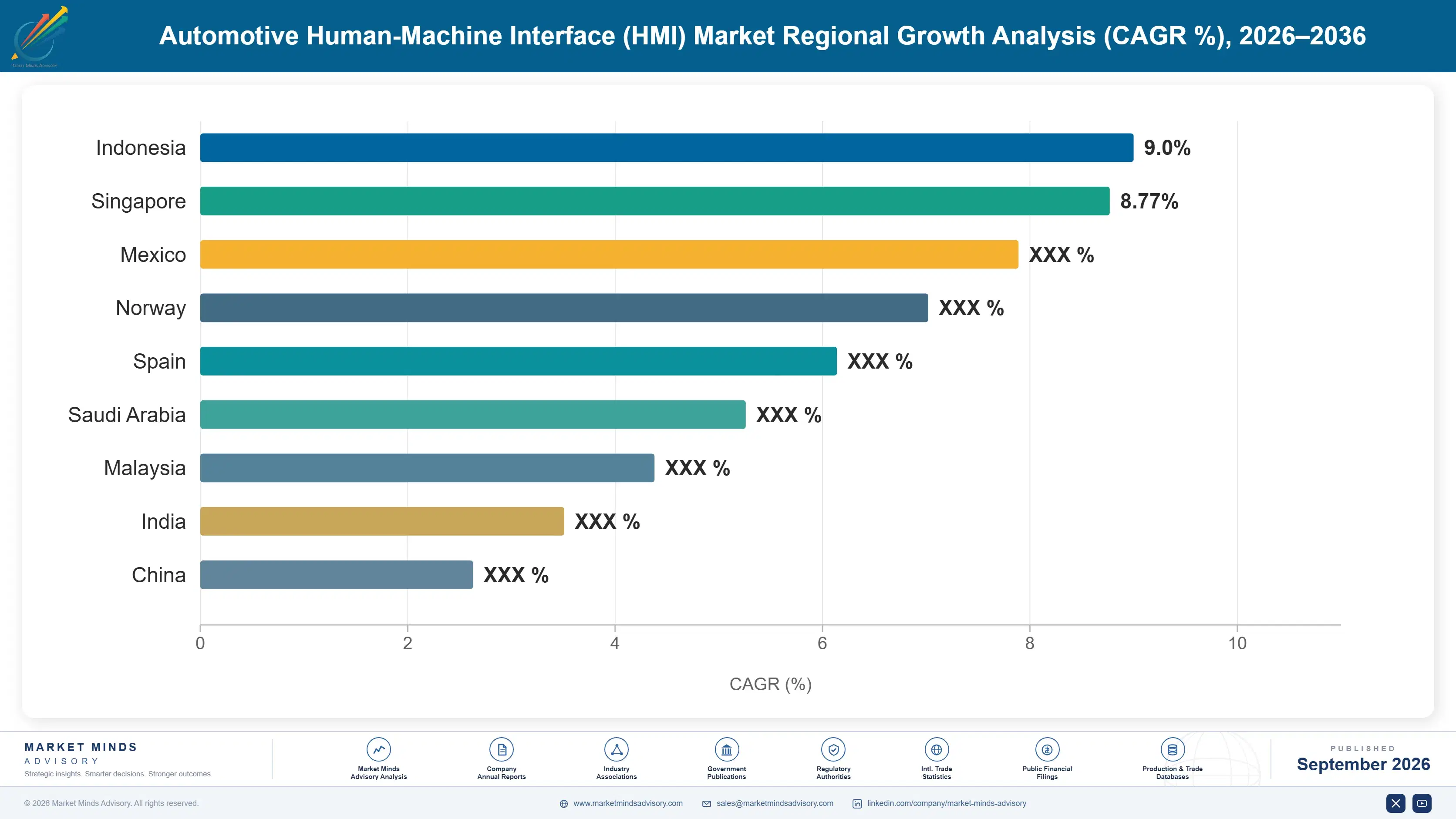
automotive-human-machine-interface-hmi-technologie-country-cagr-analysis-1790005377194

Competitive Moat and Risk Dimensions

CONTINENTAL

Moat: Deep automaker platform integration

Continental has supplied cockpit electronics to global automakers for decades, building integration expertise across dozens of vehicle platforms that newer entrants cannot replicate quickly. This depth lets Continental win specification battles on proven reliability and existing supplier qualification status even where challengers offer newer, unproven interface technology.
CONTINENTAL

Risk: Slower AI partnership development

Continental's core strength lies in hardware integration and functional safety engineering rather than advanced AI model partnerships, leaving room for specialist voice technology providers to win specification battles specifically on conversational AI sophistication that Continental has been comparatively slower to match across its product line.
VISTEON

Moat: Broad digital cockpit product portfolio

Visteon offers one of the widest ranges of digital cockpit configurations spanning instrument clusters, infotainment, and integrated cockpit domain controllers, letting automakers consolidate purchasing with a single supplier across multiple vehicle platforms and trim levels simultaneously and cost-effectively across their entire global product lineup and portfolio.
VISTEON

Risk: Pricing pressure from Chinese suppliers

Visteon faces persistent pricing pressure from Chinese domestic suppliers entering global cockpit contracts at substantially lower cost, forcing Visteon to continually justify its premium pricing through demonstrable integration and reliability advantages that lower-cost alternatives cannot easily match across most vehicle segments and price points offered today.

Players Tracked

Prominent Players

Continental
Visteon
Harman (Samsung)
Panasonic Automotive
Denso

Other Key Players

Bosch
Aptiv
LG Electronics
Desay SV Automotive
Hyundai Mobis
Nvidia
Alpine Electronics
Pioneer Corporation
Marelli
Valeo
Yazaki Corporation
Sony Semiconductor Solutions
Cerence
Faurecia (Forvia)
Neusoft Reach

Recent Developments

APRIL 2026

Continental acquired a conversational AI startup specializing in automotive-grade large language model deployment, adding capability Continental's existing platform previously lacked entirely for natural voice interaction and rich conversational understanding capability. The acquisition brings existing customer relationships across several European automakers directly into Continental's distribution network.
Signal: Legacy Tier 1 suppliers are increasingly buying conversational AI capability rather than building it internally from scratch.
NOVEMBER 2025

Visteon and a major semiconductor manufacturer signed a joint development agreement to build cockpit domain controllers optimized specifically for AI workload processing, rather than adapting general-purpose automotive chips for that demanding application. The agreement targets automakers seeking dedicated AI processing capability within their cockpit architecture.
Signal: Purpose-built AI silicon partnerships are becoming essential for competing effectively in premium automotive cockpit segments worldwide.

Display and Processor Cost Exposure

Display panels and semiconductor processors together account for roughly 39% of unit cost of goods sold, sourced primarily from display fabricators concentrated in South Korea, China, and Taiwan, with automotive-grade application processors sourced from semiconductor manufacturers concentrated in Taiwan and the United States. Voice processing and connectivity chipsets, sourced more broadly across East Asia, add a further meaningful cost layer.
Automotive semiconductor supply constraints during 2021 through 2023, documented in multiple manufacturer annual reports and the US Census Bureau's manufacturing survey data, forced several cockpit suppliers to redesign electronics around alternative chip architectures with different performance characteristics and lower availability risk across the industry. Suppliers unable to secure priority allocation from major chipmakers lost specification slots on time-sensitive vehicle launch programmes during this prolonged period of scarcity.

Smaller suppliers carry disproportionately more of this exposure because they lack the volume commitments and direct semiconductor manufacturer relationships that larger competitors use to secure priority allocation during shortages. Suppliers dependent on distributor channels rather than direct chip sourcing relationships face longer lead times and higher per-unit component costs, a persistent disadvantage that compounds during periods of genuine supply constraint across the industry.
automotive-human-machine-interface-hmi-technologie-company-positioning-matrix-1790005377388

Qualify processors across multiple semiconductor suppliers

Suppliers increasingly qualify cockpit processors and display drivers from multiple semiconductor manufacturers rather than relying on a single sourcing relationship, reducing the chance that one supplier disruption halts production entirely across an entire vehicle programme and model year. Continental and Visteon have both expanded qualified supplier lists for this exact reason over recent years.

Hold strategic display inventory ahead of launch cycles

Some suppliers now hold larger safety stock of critical display panels ahead of known vehicle launch cycles, accepting higher working capital cost in exchange for reduced exposure to sudden allocation shortages during periods of scarcity and market uncertainty. This approach requires accurate forecasting of automaker production timelines well in advance of actual manufacturing need.

Portfolio Architecture for Margin Defence

Suppliers organize product portfolios across three margin tiers that mirror how automakers actually specify cockpit content, ranging from basic digital instrument clusters bundled into entry trim levels to fully integrated, AI-powered cockpit platforms specified for flagship electric vehicle models regardless of cost. Volume tier products carry the thinnest margins but the highest unit sales, while certified premium platforms command significantly higher prices from automakers that prioritize conversational AI and software-defined flexibility over sticker price.
The tension between volume and premium tiers shows up most clearly in entry-level vehicle purchasing behavior, where cost constraints keep basic instrument clusters selling steadily even as flagship models push toward fully immersive alternatives. High-value margin pools concentrate disproportionately in premium and electric vehicle accounts, where brand differentiation requirements and software subscription potential justify premium pricing that entry-level vehicle buyers would resist paying.

Next-generation product lines integrating AI voice assistants with haptic and multi-sensory feedback are still a small share of total revenue but carry the highest margins in the entire portfolio, reflecting genuine technical differentiation rather than brand premium alone. Suppliers investing here are positioning for a future where static, touchscreen-only interfaces become effectively obsolete for premium and electric vehicle applications.

Basic digital instrument clusters and simple touchscreens bundled into entry trim levels sold primarily on price to cost-sensitive automakers and budget vehicle segments with modest feature requirements and limited customization needs.
Gross Margin

Multi-display cockpit platforms with AI voice assistant integration specified by mainstream and premium automakers that must demonstrate competitive interface quality across their entire vehicle lineup consistently and reliably each year.
Gross Margin

Fully software-defined, AI-integrated cockpit platforms positioned for a vehicle development environment that increasingly treats continuous feature updates and conversational AI as standard rather than optional across every single vehicle segment.
Gross Margin
automotive-human-machine-interface-hmi-technologie-cost-volatility-analysis-1790005377896

High-value Sub-segments and Strategic Watch-out

AI-Powered Voice and Gesture Recognition Systems

High-value and high-growth simultaneously, this segment benefits from both large language model integration and rising safety scrutiny of touchscreen-only interfaces, commanding growing revenue while adding volume faster than any other configuration in the market today. Manufacturers are prioritizing this configuration in future product roadmaps. Pricing remains firm despite competition.

Digital Instrument Clusters

High-value with moderate but steady growth, these clusters carry solid margins tied to near-universal adoption, expanding gradually as remaining analog gauge vehicles convert to digital displays across most price segments and vehicle classes. These clusters remain the entry point for most first-time digital cockpit buyers.

Infotainment Touchscreens

The volume core of the market, generating the largest unit sales base even as growth slows relative to voice and gesture alternatives, remaining essential for media, navigation, and connectivity functions across nearly every vehicle sold today. Rental and shared vehicle fleets are helping sustain volume in this category.

Heads-Up Displays

A strategic watch-out segment where growth depends heavily on windshield glass technology costs and automaker willingness to specify the feature beyond flagship trim levels, creating demand that is real but uneven across vehicle segments and price points. Vendor investment decisions here carry outsized influence on segment trajectory.

Recurring Cockpit Software Economics

Automotive HMI generates something close to annuity economics once a supplier establishes a software-defined cockpit platform relationship with an automaker, because every vehicle built on that platform continues requiring feature updates and support regardless of broader vehicle sales cycles. Software revenue expansion follows fleet size and update frequency rather than discretionary upgrade decisions, giving suppliers offering subscription models unusually predictable long-term revenue visibility across their installed vehicle base.
Adoption depth varies sharply by end-use vertical. Premium and electric vehicle manufacturers exhibit the deepest stickiness, having standardized cockpit architecture around specific validated platforms tied directly to safety certification documentation that discourages switching suppliers mid-platform-cycle. Budget vehicle segments show comparatively looser loyalty, frequently choosing suppliers based on component cost and availability rather than any fixed long-term platform commitment.

A generational shift in buyer profile is underway as younger automotive product managers, more comfortable evaluating AI conversational quality and software update cadence than raw hardware specifications, increasingly influence purchasing decisions once made almost entirely by mechanical and electrical engineering staff. This shift favors suppliers who can present a compelling software and AI integration story alongside traditional hardware reliability claims that dominated buying conversations for decades.
Section default visual

MMA Verdict on Automotive HMI

These are among the four positions where our research anticipates prominent divergence between winners and laggards over the coming forecast period. Each is grounded in the demand model, the regulatory perimeter, and the announced capacity pipeline.
01 / AI VOICE PARTNERSHIP STRATEGY

Secure conversational AI partnerships before it becomes commoditized

Suppliers still offering rule-based voice recognition risk losing enterprise contracts to competitors partnering directly with leading AI foundation model providers on genuinely conversational interaction that drivers actually prefer and increasingly expect. Winning this technology advantage early generates a durable specification advantage before conversational AI becomes an expected baseline feature that buyers assume rather than reward with premium pricing over time. The window to differentiate on AI voice sophistication before it becomes fully commoditized is closing within the next several years.
02 / SOFTWARE MONETIZATION STRATEGY

Convert hardware sales into ongoing feature subscription relationships

Suppliers selling cockpit hardware as one-time transactions leave substantial recurring revenue on the table that competitors bundling paid feature activations directly with over-the-air software capture instead across their entire vehicle fleet and installed customer base. Converting a hardware relationship into a subscription relationship generates meaningfully higher lifetime revenue per vehicle than defending the original component sale indefinitely against price competition from newer entrants. This shift also strengthens automaker retention by embedding the supplier relationship into an ongoing software update obligation.
03 / GEOGRAPHIC EXPANSION PRIORITY

Prioritize India and Southeast Asia digital cockpit demand

North American and Western European premium vehicle demand already carries deep cockpit technology penetration among established suppliers with strong existing automaker relationships built over many decades of continuous engagement across the entire region and beyond. India's rapidly expanding automotive market and growing domestic electric vehicle sector offer considerably more room for genuine share gain than defending position in already saturated mature markets elsewhere. Suppliers building local engineering and service capability early will capture this growth before competitors arrive in meaningful force.
04 / DATA MONETIZATION STRATEGY

Treat driver interaction data as a licensable product line

Aggregated driver interaction and behavior data carries genuine value to insurance companies and usage-based pricing providers that extends well beyond the original cockpit hardware sale it was generated from at the point of manufacture. Suppliers currently give this data away implicitly as a software byproduct rather than pricing it as a separate, high-margin product line worth real recurring revenue over time. Charging for data access, even modestly at first, converts an underused data asset into a durable, recurring revenue stream.

Engagement Snapshot From the Field

A live engagement with an industry participant carrying material or product regulatory and market exposure ahead of a defining policy shift, showing how our research translates into a defensible multi-year portfolio strategy.
MARKET MINDS ADVISORY · CLIENT ENGAGEMENT SUMMARY
Automotive Human-Machine Interface (HMI) Producer Strategic Portfolio Review and Transition Roadmap 2026·Investment Scenario on Automotive Human-Machine Interface (HMI) Exposure Evaluation 2025-26
CLIENT PROFILE
The client is a mid-size global automaker preparing to launch its first dedicated electric vehicle platform, facing pressure to match cockpit technology expectations set by newer EV-focused competitors. The automaker's existing cockpit architecture, inherited from internal combustion vehicle platforms, lacked the software-defined flexibility and AI voice capability that buyers increasingly expected from a new electric vehicle launch.
STRATEGIC CHALLENGE
The automaker needed to select and integrate a cockpit platform capable of supporting AI voice assistance and over-the-air updates within a compressed vehicle development timeline, all while ensuring the new architecture would remain extensible across future vehicle platforms rather than requiring another complete redesign within just a few short years.
MMA APPROACH
MMA conducted a comparative technical assessment of leading cockpit platform suppliers against the automaker's specific AI integration, software update, and platform extensibility requirements across its entire planned vehicle lineup and future roadmap. The engagement included a supplier selection framework weighted toward long-term platform flexibility rather than lowest initial component cost alone.
KEY FINDINGS
  1. The selected cockpit platform reduced planned redesign cycles for future vehicle platforms by roughly 40%, based on client-reported engineering roadmap data shared during the engagement.
  2. AI voice assistant integration met customer satisfaction benchmarks set by competitor EV launches, according to client-reported customer clinic feedback collected during vehicle testing.
  3. Over-the-air update capability enabled post-launch feature additions without requiring dealer service visits at all, per client-reported technical validation data from the engagement review.
  4. The automaker completed its EV platform launch within its original development timeline despite the cockpit architecture change, according to client-reported programme milestone tracking.
CLIENT PROFILE
The client is a mid-size global automaker preparing to launch its first dedicated electric vehicle platform, facing pressure to match cockpit technology expectations set by newer EV-focused competitors. The automaker's existing cockpit architecture, inherited from internal combustion vehicle platforms, lacked the software-defined flexibility and AI voice capability that buyers increasingly expected from a new electric vehicle launch.
STRATEGIC CHALLENGE
The automaker needed to select and integrate a cockpit platform capable of supporting AI voice assistance and over-the-air updates within a compressed vehicle development timeline, all while ensuring the new architecture would remain extensible across future vehicle platforms rather than requiring another complete redesign within just a few short years.
MMA APPROACH
MMA conducted a comparative technical assessment of leading cockpit platform suppliers against the automaker's specific AI integration, software update, and platform extensibility requirements across its entire planned vehicle lineup and future roadmap. The engagement included a supplier selection framework weighted toward long-term platform flexibility rather than lowest initial component cost alone.
KEY FINDINGS
  1. The selected cockpit platform reduced planned redesign cycles for future vehicle platforms by roughly 40%, based on client-reported engineering roadmap data shared during the engagement.
  2. AI voice assistant integration met customer satisfaction benchmarks set by competitor EV launches, according to client-reported customer clinic feedback collected during vehicle testing.
  3. Over-the-air update capability enabled post-launch feature additions without requiring dealer service visits at all, per client-reported technical validation data from the engagement review.
  4. The automaker completed its EV platform launch within its original development timeline despite the cockpit architecture change, according to client-reported programme milestone tracking.
RECOMMENDED STRATEGY
Phase 1: Phase one: select a cockpit platform architecture that prioritizes long-term extensibility over the lowest initial component cost entirely and permanently. Phase 2: Phase two: integrate AI voice assistant capability early in the development cycle to allow adequate testing and thorough refinement time. Phase 3: Phase three: validate over-the-air update infrastructure thoroughly before launch to ensure reliable post-sale feature deployment nationwide and even further internationally.
OUTCOME
The automaker completed its cockpit platform modernization within its original development timeline and reported measurable improvements in customer satisfaction, update capability, and future platform flexibility, all figures client-reported and unverified by MMA. The engagement also established a supplier selection framework applicable to future vehicle platform development programmes.

Frequently Asked Questions

Foundational context covering the market sizes, CAGR, scope, country, region and competition that inform every finding below. This section is provided to cover basics and most often pre-purchase conversations, answered from the MMA Primary Research Dataset.

What is the current size of the Automotive Human-Machine Interface (HMI) Market?

The global automotive HMI market was valued at $15.6 billion in 2025. This figure covers digital instrument clusters, infotainment touchscreens, and voice recognition systems integrated into vehicle cockpits.

How large will the Automotive Human-Machine Interface (HMI) Market be by 2036?

The market is projected to reach $48.19 billion by 2036, up from a 2026 base of $17.28 billion. That represents roughly a 2.79 times expansion over the forecast period.

What is the CAGR for the Automotive Human-Machine Interface (HMI) Market 2026 to 2036?

The market is expected to grow at a 10.8% compound annual growth rate over this period. Growth is driven primarily by electric vehicle cockpit redesigns and AI voice assistant integration.

Which segment is growing fastest?

AI-powered voice and gesture recognition systems are the fastest-growing segment, expanding at roughly 17.6% annually through 2036. That is about 1.63 times the overall market growth rate.

Who are the major companies in the Automotive Human-Machine Interface (HMI) Market?

Continental, Visteon, Harman, Panasonic Automotive, and Denso lead the market by unit and revenue volume. Together these five vendors hold roughly 42% of global market revenue.

Which country is growing fastest?

China is the fastest-growing national market tracked in this report, expanding at roughly 14.9% annually. Growth is tied to aggressive electric vehicle cockpit digitization among domestic automakers.

Report Segmentation Architecture

The full report scope spans multiple orthogonal segmentation dimensions, with cross-tabulated demand data provided for each dimension pair. Coverage extends further to regional breakdowns, trend trajectories, and the competitive detail needed to support segment-level decision-making.

        By Region

        • North America
        • Western Europe
        • East Asia
        • South Asia and Pacific
        • Latin America
        • Middle East and Africa
        • Eastern Europe

        Scope, Methodology, and Coverage

        Every figure in this report is reproducible from documented input assumptions. The scope below maps the historical period, the forecast horizon, the segmentation dimensions, and the countries covered, alongside the underlying primary and qualitative methodology.
        Historical Period
        2020 to 2025
        Forecast Period
        2026 to 2036
        Base Year
        2025 (USD billions; MMA Primary Research Dataset, September 2026)
        Market Definition
        The automotive HMI market covers digital instrument clusters, infotainment touchscreens, heads-up displays, voice recognition systems, and haptic control interfaces integrated into vehicle cockpits. It excludes the underlying telematics connectivity hardware, advanced driver assistance sensor systems, and general vehicle infotainment content licensing that operates independently of the driver-facing interface itself.
        Quantitative Units
        USD billions
        Segmentation Dimensions
        Regions Covered
        North America, Western Europe, East Asia, South Asia and Pacific, Latin America, Middle East and Africa, Eastern Europe
        Countries Covered
        Key Companies Profiled
        Continental, Visteon, Harman (Samsung), Panasonic Automotive, Denso, Bosch, Aptiv, LG Electronics, Desay SV Automotive, Hyundai Mobis, Nvidia, Alpine Electronics, Pioneer Corporation, Marelli, Valeo, Yazaki Corporation, Sony Semiconductor Solutions, Cerence, Faurecia (Forvia), Neusoft Reach
        Quantitative Methodology
        Primary survey, n=3,800 respondents, Q4 2025, six countries; demand-side model with trade association cross-validation
        Qualitative Methodology
        47 expert interviews, Q4 2025; applied to validate demand model assumptions, identify emerging dynamics, and assess competitive positioning
        Report Format
        PDF and XLSX data workbook (Word format preview document)
        Publisher
        Market Minds Advisory
        Report Code
        MMA-2026-AUT-367
        Published
        September 2026
        Contact
        sales@marketmindsadvisory.com | www.marketmindsadvisory.com

        Purchase the full Automotive Human-Machine Interface (HMI) Market Report (2026 to 2036).

        This report provides a comprehensive analysis of the global automotive HMI market, covering market sizing, segmentation, competitive dynamics, and regional demand patterns through 2036. It examines the shift toward AI-powered voice interaction and software-defined cockpit architecture driven by electric vehicle redesigns and rising consumer interface expectations worldwide. The analysis includes detailed profiles of leading cockpit suppliers, input cost exposure, and revenue diversification strategies available to vendors operating in this space. Readers gain a structured view of where margin concentrates across product tiers and which regional markets offer the strongest growth opportunity over the coming decade.
        Full 2026 to 2036 forecast across all major segments
        Detailed competitive profiles of five leading suppliers
        Regional demand analysis across all seven global regions
        Input cost exposure and mitigation strategy assessment
        Revenue lever analysis for margin expansion opportunities
        Anonymized client case study on cockpit platform modernization

        Built For The People Who Decide

        From boardroom strategy to bench-side execution, this report is read cover-to-cover by leaders shaping the next decade of their industry, turning demand scenarios, market dynamics and valuation benchmarks into decisions.
        CXOs/ Presidents/ VPs/ Managers
        M&A and Corporate Development
        Strategy Teams and R&D Heads
        Procurement and Product Directors
        Regulatory and Compliance Leaders
        Investor Relations and Equity Analysts