Market Minds Advisory
Automotive Radar Market

Automotive Radar Market: Sensor Fusion, Imaging Radar, and Autonomous Perception Architecture

Radar suppliers are racing from single-purpose long-range sensors toward four-dimensional imaging arrays resolving height and velocity simultaneously, as regulators mandate driver assistance and automakers chase genuine highway autonomy across new vehicle platforms worldwide.

Lead Analyst

David Horsley

Published

September 2026

Make Smarter Decisions with Customized Research Insights

Request a free sample report and evaluate market opportunities, growth trends, and competitive dynamics relevant to your business needs.

2025 MARKET VALUE$15.2BMarket Size 2025
2036 FORECAST VALUE$48.9BBase Case , 2026 to 2036
CAGR 2026 TO 203611.2 %Bull 12.4% / Bear 10.0%
INCREMENTAL OPPORTUNITY$32.0BNet 10- year value creation
EXPANSION MULTIPLE2.89x2036 value over 2026 base
Strategic Levers
M&A Pipeline
Regional Outlook
Country Rankings
Competitive Intelligence
Segmental Deep-dive
Call-Us : 91 93563 13602

Executive Snapshot and Market Trajectory

Automotive radar is shifting from a single-purpose collision-warning sensor to the backbone of highway autonomy, as four-dimensional imaging architectures resolve height, range, and velocity together well enough to challenge lidar on cost and reliability across nearly every new vehicle platform launched this year.
Regulatory driver-assistance mandates across the European Union and several US states are forcing radar onto nearly every new vehicle trim, not just premium nameplates, while China's domestic automakers push level-two-plus autonomy into mainstream price segments faster than any other market. Corner and long-range radar together account for the bulk of unit volume, but imaging radar is capturing a widening share of total content value as automakers upgrade sensor suites for genuine highway autonomy programs.
Five global suppliers hold well over half of shipment volume on a consistent basis, a concentration level unusual for automotive components, reflecting the steep radio-frequency engineering and safety certification barriers that keep smaller challengers largely confined to niche or regional programs today. Semiconductor partnerships between Tier 1 suppliers and chipset makers are increasingly deciding which companies can even compete for next-generation imaging radar platform awards across the industry.
Market Definition
The automotive radar market covers the design, manufacture, and supply of radar sensor modules and associated signal-processing hardware used for driver assistance and autonomous perception in passenger and light commercial vehicles. It excludes lidar, camera, and ultrasonic sensors, and the software-only perception algorithms that process radar output downstream.
Base Year Value
$15.2B in 2025 (MMA Primary Research Dataset, August 2026)
Forecast Period
2026 to 2036, eleven discrete annual values
CAGR
11.2% base case. Bull 12.4%. Bear 10.0%.
Fastest Growth Segment
4D Imaging Radar Systems: 18.0% CAGR
Fastest Growth Country
China: 13.5% CAGR
Fastest Growth Region
South Asia and Pacific: 13.2% CAGR
Largest Region
East Asia: 43% of 2025 global value
Market Leaders
Robert Bosch GmbH, Continental AG, Aptiv PLC, Denso Corporation, Valeo SA. Source: MMA Analysis based on company annual reports.
Primary Survey
n=3,800 procurement and R&D decision-makers, Q4 2025, six countries
Methodology
Demand-side build-up, cross-validated against public data, 47 expert interviews

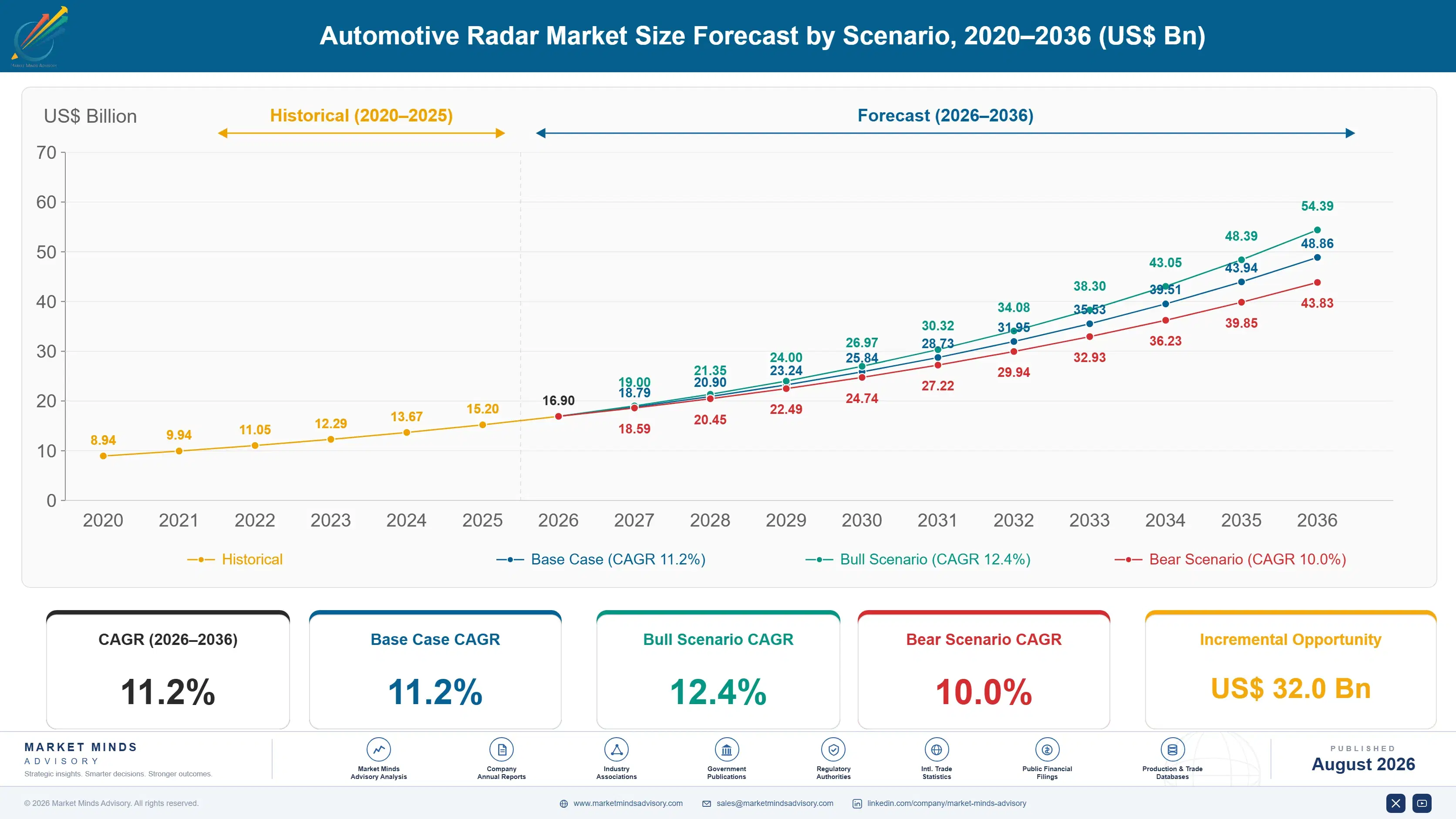
Automotive Radar Market Forecast Scenarios

automotive-hd-imaging-radar-market-trends-size-forecast-scenario-1787465135843
Between 2020 and 2025 radar demand climbed steadily as adaptive cruise control and automatic emergency braking moved from optional luxury features to expected safety equipment across nearly every vehicle segment, though semiconductor shortages repeatedly delayed shipment timelines and forced automakers to ration sensor allocation across trim levels during the tightest supply years of the entire period.
The base case assumes three commercial mechanisms drive growth well beyond unit volume expansion: regulatory driver-assistance mandates spreading across new geographies, a steady mix shift from single long-range sensors toward multi-radar corner and imaging configurations per vehicle, and China's accelerating level-two-plus autonomy rollout across mainstream price segments well ahead of other regional markets. Together these forces lift average radar content value per vehicle considerably faster than global light-vehicle production itself grows each year.
The bull case rests on faster-than-expected imaging radar cost declines that let automakers specify it broadly rather than reserving it for flagship autonomy trims alone. The bear case centers on lidar cost curves falling faster than radar's, eroding radar's role in premium sensor suites even as it remains essential for basic driver-assistance compliance across mainstream vehicle segments.

Sensor Fusion Economics and Semiconductor Dependency

Radar economics increasingly hinge on semiconductor content rather than mechanical assembly, as suppliers compete on radio-frequency chipset performance, signal-processing sophistication, and the software algorithms that turn raw returns into usable object detection for downstream vehicle control systems. This shift is pulling traditional mechanical component suppliers into direct competition with semiconductor firms that previously sold only the underlying chipsets rather than finished sensor modules altogether.
TOP PRODUCER SHAREGermany, 26%Share of global radar module production concentrated domestically
MARKET CONCENTRATIONCR5 58%Combined share held by the five largest global suppliers
AVERAGE SELLING PRICE$35-95 per unitTypical price spread across corner and imaging radar tiers
RADAR SENSORS PER VEHICLE4-7 unitsTypical sensor count on a driver-assistance equipped vehicle
SEMICONDUCTOR COST SHARE48% of COGSChipset and packaging share of total production cost
CAPACITY UTILIZATION81%Average utilization rate across major global production facilities
The commercial character of the market splits sharply between corner and blind-spot radar, which now competes largely on unit cost and proven reliability, and imaging radar, where automakers negotiate multi-year co-development contracts tied to specific autonomy feature roadmaps and safety certification timelines. Suppliers serving both tiers increasingly run separate engineering and pricing organizations to avoid letting commodity pressure bleed into higher-margin imaging programs.
Over the next decade, regulatory mandates, semiconductor packaging cost curves, and China's fast-moving domestic autonomy programs will decide which suppliers hold their current platform positions and which lose ground to chipset-native challengers entering the market from the semiconductor side. The pace of platform resourcing decisions is accelerating each successive model year across nearly every major automaker program worldwide.
"Radar used to be the sensor nobody argued about. Now it is the sensor deciding whether a car can see a pedestrian at night better than a camera can, and that changes who gets to set the price."
Director, Automotive Sensing and ADAS Practice · MMA Automotive Sensing and ADAS Components Practice · August 2026

Market Trends

4D Imaging Radar Reaching Series Production Scale

Fourth-generation imaging radar platforms that resolve elevation alongside range, azimuth, and velocity have moved from demonstration programs into genuine series production on several premium and mid-market electric vehicle platforms, closing much of the perception gap that previously favored lidar for highway autonomy applications. Suppliers with established radio-frequency chipset partnerships are winning the earliest imaging radar platform awards, while competitors still reliant on legacy single-chip architectures face a costly redesign to stay competitive. The technology's cost curve is falling faster than many suppliers originally forecast, pulling adoption timelines forward across several major automaker programs.
Market Impact: Adds radar to 15M vehicles
Radar, Camera, and Lidar Fusion Architecture Standardization Push

Automakers are increasingly standardizing sensor fusion architectures that combine radar, camera, and lidar inputs through a shared processing stack rather than treating each sensor's output separately, raising the bar for radar suppliers to deliver software-compatible, well-documented data interfaces alongside raw hardware performance. This shift favors suppliers with genuine systems integration capability over pure component manufacturers, and it is reshaping how automakers evaluate competing radar bids during platform sourcing decisions. Several European and Japanese automakers have already published common fusion interface specifications that new radar suppliers must meet before qualifying for platform consideration at all.
Market Impact: Adds 5.1 points to China growth

Market Opportunities and Growth Drivers

EU General Safety Regulation Driver-Assistance Mandate

The European Union's General Safety Regulation now requires automatic emergency braking, intelligent speed assistance, and lane-keeping support as standard equipment on all new vehicle type approvals, forcing radar onto every trim level rather than reserving it for premium options packages as automakers previously chose. Suppliers already qualified on the relevant safety certification standards are capturing disproportionate share of this mandated volume increase, while newer entrants face a multi-year certification timeline before winning meaningful platform business. Several US states are moving toward comparable requirements, extending this regulatory tailwind well beyond the European market alone across the coming several years.
Market Impact: Degrades detection range 8-12%

China's Level-Two-Plus Autonomy Price Democratization Wave

China's domestic new-energy-vehicle makers are specifying level-two-plus driver assistance, requiring four to six radar sensors per vehicle, on models priced well below where such content historically appeared in Western and Japanese vehicle lineups, compressing the technology democratization timeline by several years. Domestic radar suppliers with established relationships to fast-scaling Chinese automakers are capturing disproportionate volume growth as these programs multiply across new model launches each year. The pace of specification upgrades is forcing global suppliers to match domestic Chinese cost structures or cede meaningful share entirely across the whole region.
Market Impact: Concentrates 65% supply in 3 firms

Market Restraints and Challenges

Spectrum Congestion at 77-81 GHz Frequency Band

As vehicle radar density climbs toward five to seven sensors per car, mutual interference between radars from different vehicles sharing the same road is becoming a measurable performance problem, particularly in dense urban traffic where dozens of equipped vehicles operate within close range simultaneously. The root cause lies in the limited usable spectrum allocated to automotive radar worldwide, which was never designed to support today's sensor density. Suppliers are mitigating the problem through frequency-hopping waveforms and interference-cancellation algorithms, though these solutions add processing cost and are not yet universally standardized across the industry.
Market Impact: Adds $18-25 per unit

Semiconductor Radar Chipset Supply Concentration Risk

A small number of specialized radio-frequency chipset makers supply the monolithic microwave integrated circuits that underpin nearly every modern radar module, leaving the broader supply chain exposed to disruption at just one or two upstream chokepoints. The root cause is the extreme fabrication complexity of automotive-grade radar chipsets, which few foundries can produce at the required yield and reliability. Larger Tier 1 suppliers are mitigating exposure through dual-sourcing agreements and, in some cases, direct equity investment in chipset makers, while smaller suppliers remain largely dependent on whichever chipset partner will still take their orders.
Market Impact: Raises bid qualification bar for 40%
4 additional market trends, 3 additional growth drivers, and 3 additional restraints and challenges are covered in the full report. Contact sales@marketmindsadvisory.com to access the complete intelligence.

Segment CAGR and Growth Architecture

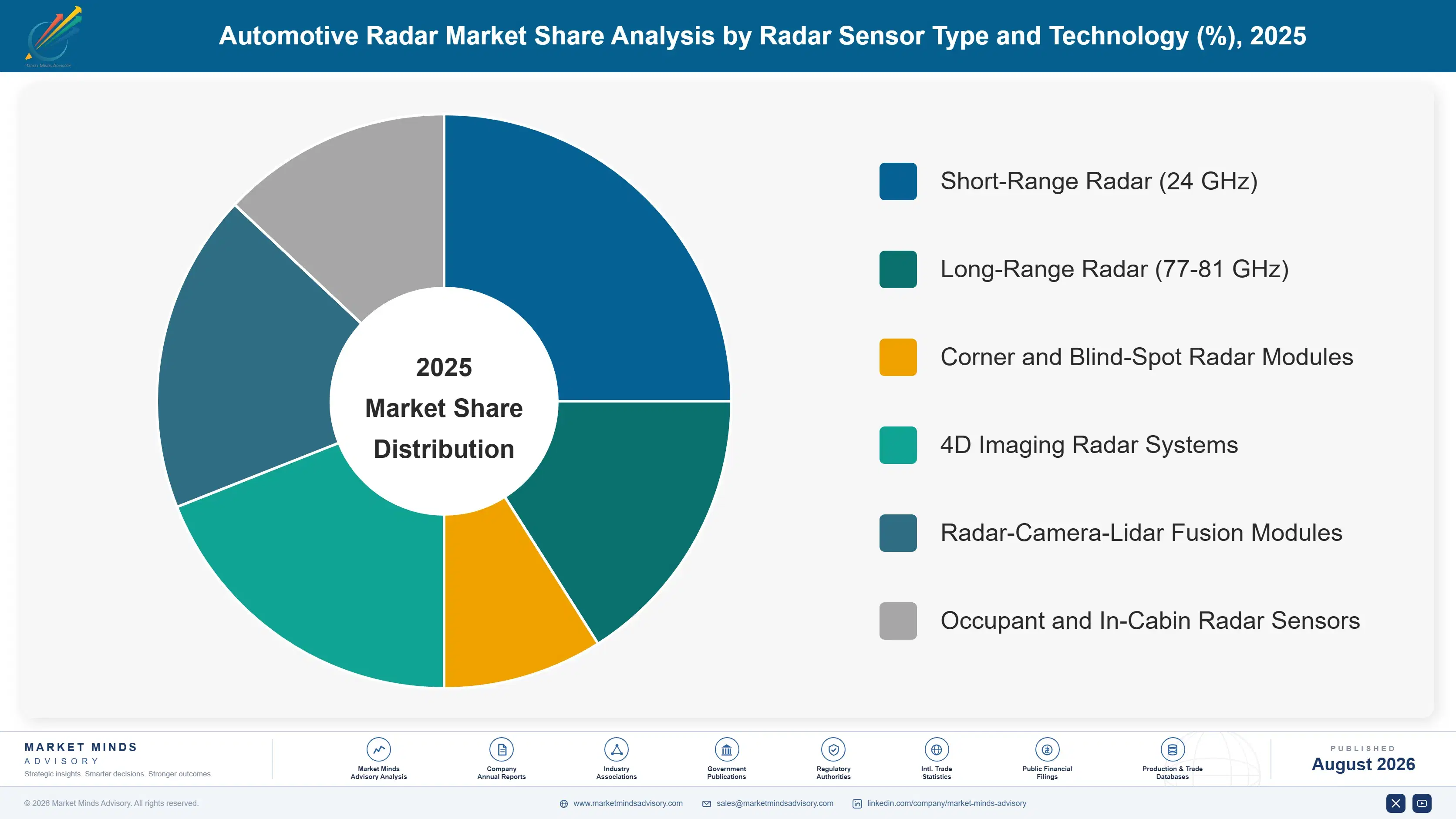
Segmentation follows radar sensor type and technology generation, the dimension automakers specify against when awarding platform sourcing contracts, rather than by vehicle class or distribution channel, both of which sit outside this defined market scope and belong instead to adjacent commercial and channel-level analysis kept entirely separate from this specific market research report and its stated boundaries.
automotive-hd-imaging-radar-market-trends-market-share-analysis-1787465136378

4D Imaging Radar Systems

Four-dimensional imaging radar resolves elevation alongside range, azimuth, and velocity, producing a point-cloud output dense enough to challenge lidar for highway autonomy perception while remaining considerably cheaper to manufacture at scale. Automakers are specifying this architecture earliest on premium electric vehicle flagships and China's fastest-scaling new-energy-vehicle platforms, where genuine highway autonomy features differentiate otherwise similar powertrains. Suppliers need advanced radio-frequency chipset partnerships and sophisticated signal-processing software, a combination only a handful of global players currently hold at meaningful scale. Tooling and software costs run considerably higher than legacy long-range radar, but content value climbs enough to justify the investment, pulling qualification budgets away from simpler single-purpose radar programs across nearly every major automaker's roadmap.
CAGR 18.0%

Occupant and In-Cabin Radar Sensors

Occupant and in-cabin radar sensors monitor passenger presence, seat occupancy, and vital signs such as breathing rate without cameras, addressing both child-presence-detection safety mandates and rising interest in wellness monitoring features across premium vehicle segments. Regulatory requirements in the United States and European Union mandating rear-seat occupant detection are pulling this segment into mainstream specification well ahead of the broader imaging radar transition. Suppliers with millimeter-wave expertise adapted from exterior radar are moving fastest into this space, though the segment demands entirely different packaging, range calibration, and privacy-handling software than exterior-facing sensors require. Content value per vehicle remains modest today but is climbing quickly as more markets adopt comparable occupant detection mandates.
CAGR 16.0%
Full segment breakdown across 6 segments available in the complete report.

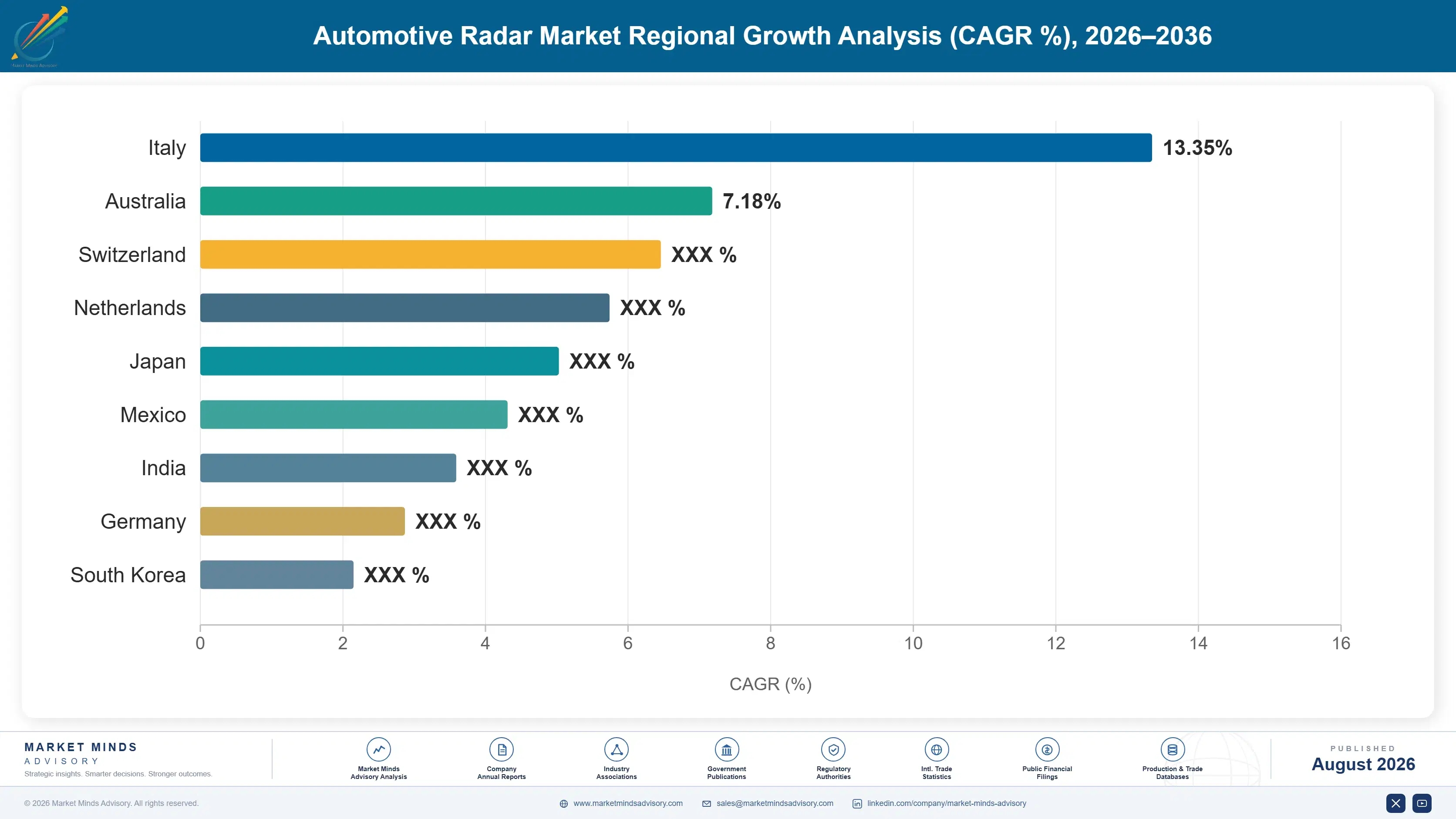
Regional Architecture and Country Demand Map

East Asia's dominant vehicle production base and China's aggressive level-two-plus autonomy rollout anchor global radar demand, while North America and Western Europe carry the deepest regulatory driver-assistance mandates and the richest imaging radar content value per vehicle across their established platform sourcing programs and supplier networks.

North America

US and Canadian light-vehicle programs carry among the richest radar content value per vehicle globally, driven by NHTSA's phased automatic emergency braking mandate and consumer demand for highway-autonomy-capable trims across full-size trucks and SUVs, the region's dominant body styles. Established Tier 1 suppliers hold the bulk of regional platform sourcing, with imaging radar adoption concentrated among premium electric vehicle nameplates first. Semiconductor supply chain reshoring incentives are drawing some radar chipset packaging investment toward US-based facilities, though final module assembly remains largely offshore. Insurance industry safety ratings increasingly reward vehicles with multi-radar sensor suites, reinforcing automaker specification decisions across nearly every new model year. Canadian assembly plants mirror US radar specification requirements given shared platform architectures.
Share: 22% | CAGR: 9.9% (2026 to 2036)

Western Europe

Germany, France, and the wider European Union anchor regional demand through the General Safety Regulation's mandatory driver-assistance requirements, which apply to every new vehicle type approval regardless of price segment, pulling radar into vehicles that previously carried none at all. Premium German automakers lead imaging radar adoption on flagship electric platforms, supporting above-average content value per vehicle despite comparatively modest unit volume growth across the region overall. Regional radar suppliers benefit from proximity to leading radio-frequency chipset developers headquartered nearby, shortening qualification cycles considerably. Growth trails East Asia as vehicle production itself expands only modestly across most Western European markets this decade. France and Italy contribute meaningful volume through mid-market platforms adopting mandated radar content at a steady pace.
Share: 18% | CAGR: 9.7% (2026 to 2036)
Regional intelligence for 5 additional markets available in the complete report: East Asia, South Asia and Pacific, Latin America, Middle East and Africa, Eastern Europe. Contact sales@marketmindsadvisory.com.
automotive-hd-imaging-radar-market-trends-country-cagr-analysis-1787465136907

Where Radar Suppliers Can Defend Margin

Suppliers facing commodity pricing pressure on long-range and corner radar have four realistic paths to defend and expand margin without waiting for automakers to specify imaging content unprompted across every new vehicle program they currently serve, plan to enter soon, or still hope eventually to win across the coming several years ahead of them.

Building Imaging Radar Chipset Co-Development Deals

Suppliers that build direct radio-frequency chipset co-development partnerships rather than buying off-the-shelf components can bid for imaging radar contracts earlier and at better margin than competitors dependent on shared, publicly available chipset roadmaps. Co-development relationships of this kind typically raise average unit content value by $18-25 compared with a standard long-range radar design lacking imaging resolution. The partnership requires meaningful upfront investment and shared intellectual property arrangements, but suppliers who move early are securing qualification slots on flagship autonomy platforms years before competitors relying on commodity chipsets can catch up to them.
Market Impact: Adds $18-25 per unit and earlier bid wins

Investing in Occupant Radar Regulatory Compliance

Building qualified occupant and in-cabin radar production capacity ahead of child-presence and rear-seat occupant detection mandates positions suppliers to win early qualification slots on North American and European platforms before compliance becomes mandatory across every new model launched. Early movers are already capturing $4-7 in additional unit content value on premium platforms specifying in-cabin radar, a qualification that laggard suppliers cannot easily match without dedicated packaging and software investment. Suppliers delaying this shift risk losing established interior sensing positions entirely once mandates take full legal effect across major markets. today.
Market Impact: Secures early occupant-radar wins across 12+ platforms today

Building Dual-Sourced Chipset Supply Resilience Programs

Establishing qualified relationships with two or more radio-frequency chipset suppliers, rather than depending on a single semiconductor partner, protects delivery reliability during periods of tight capacity and gives suppliers negotiating leverage on pricing across successive contract renewal cycles each year. This resilience typically costs $2-4 more per unit in qualification and testing overhead but materially reduces the risk of losing entire platform programs to a supply disruption at a single upstream chokepoint. Suppliers without this redundancy are increasingly screened out of automaker sourcing shortlists during formal risk assessment reviews. Suppliers view this as essential now.
Market Impact: Cuts single-source supply exposure by roughly 50% overall

Direct China Autonomy Platform Sourcing Access

Establishing direct supplier relationships with China's fastest-scaling level-two-plus autonomy programs, rather than relying solely on legacy joint-venture automaker relationships, gives suppliers access to the fastest unit volume and technology democratization growth in the global market today, expanding at roughly 12% annually. Domestic Chinese suppliers already hold strong incumbency here, so global suppliers need genuinely competitive local cost structures rather than exporting Western pricing assumptions into a materially different competitive environment. Suppliers succeeding at this are capturing outsized share of the fastest-growing demand pool worldwide today. Momentum here is compounding quickly.
Market Impact: Captures share of a 12% China growth pool

Who Controls the Margin Pool

The five largest global radar suppliers hold well over half of shipment volume on a revenue basis, a concentration unusually high for automotive components, reflecting steep radio-frequency engineering and safety certification barriers that keep smaller challengers largely out of core platform bidding. The gap between the leading suppliers and mid-tier challengers remains wide, though semiconductor-native entrants are beginning to close it on imaging radar specifically.
Current competitive activity centers on three dimensions: radio-frequency chipset co-development partnerships that determine imaging radar readiness, occupant and in-cabin radar capability building ahead of regulatory mandates, and direct sourcing relationships with China's fastest-scaling autonomy programs rather than legacy joint-venture channels. Suppliers investing across all three simultaneously are pulling ahead of narrowly focused competitors still betting on a single dimension.

Emerging pressure is coming from semiconductor-native challengers entering directly from the chipset side rather than the traditional mechanical component side, threatening established suppliers' historical hold on imaging radar platform sourcing. Rankings are most likely to shift among mid-tier suppliers lacking either advanced chipset partnerships or occupant-radar capability, both of which are becoming baseline requirements rather than differentiators on next-generation platform sourcing decisions across the industry.
automotive-hd-imaging-radar-market-trends-company-positioning-matrix-1787465137435

Competitive Moat and Risk Dimensions

ROBERT BOSCH GMBH

Moat: Full-Stack Radar Engineering Scale

Bosch's combination of in-house chipset design, module manufacturing, and perception software gives it end-to-end control over radar performance that most competitors must assemble through external partnerships. Its manufacturing footprint spans every major production region, letting it serve global platform programs from a single qualified relationship.
ROBERT BOSCH GMBH

Risk: Legacy Architecture Transition Cost

Bosch's massive installed base of long-range and corner radar designs creates real switching cost as automakers migrate toward imaging radar, requiring Bosch to manage two parallel product generations simultaneously across most active programs. Smaller, imaging-radar-native competitors face no such legacy burden and can move faster.
CONTINENTAL AG

Moat: Established Automaker Co-Development Relationships

Continental's decades of platform co-development relationships across nearly every major global automaker give it design-in access from the earliest vehicle architecture stage, a position new entrants cannot easily replicate. Its recent radar production milestones, including large series orders, reinforce automaker confidence in long-term supply continuity.
CONTINENTAL AG

Risk: Corporate Restructuring Distraction Risk

Continental's ongoing corporate restructuring and spin-off activity introduces execution uncertainty at exactly the moment when imaging radar platform decisions are being made, risking management attention diverted from technology investment toward organizational transition matters instead of competitive product development priorities across every division and region. Investors remain watchful.

Players Tracked

Prominent Players

Robert Bosch GmbH
Continental AG
Aptiv PLC
Denso Corporation
Valeo SA

Other Key Players

ZF Friedrichshafen AG
Hyundai Mobis Co. Ltd.
NXP Semiconductors N.V.
Infineon Technologies AG
Texas Instruments Incorporated
HELLA GmbH & Co. KGaA
Panasonic Automotive Systems Co. Ltd.
Magna International Inc.
Arbe Robotics Ltd.
Uhnder Inc.
Vayyar Imaging Ltd.
Smartmicro GmbH
Renesas Electronics Corporation
Bitsensing Inc.
HL Mando Corporation

Recent Developments

FEBRUARY 2026

Continental Ramps Sixth-Generation Radar Platform

Continental AG announced full commercial ramp-up of its sixth-generation radar sensor platform featuring integrated edge artificial intelligence signal processing, enabling target classification at extended range of roughly 250 meters while reducing module power consumption by about 20% across multiple automaker platform programs launched this year.
Signal: Confirms established suppliers are embedding processing intelligence directly into radar hardware rather than relying on separate software layers.
OCTOBER 2025

HELLA and NXP Partner on Imaging Radar Chipset

HELLA GmbH and NXP Semiconductors announced a partnership to develop and industrialize a high-resolution imaging radar sensor using NXP's third-generation radar chipset with up to thirty-two channels, targeting series production launch on several European premium platform programs within the coming several years and beyond that.
Signal: Shows chipset makers and Tier 1 suppliers increasingly co-developing rather than buying finished components off a catalog.
MAY 2026

Arbe Robotics Wins Chinese Automaker Platform Award

Arbe Robotics secured a platform sourcing award from a fast-scaling Chinese new-energy-vehicle maker for its four-dimensional imaging radar chipset, marking one of the first meaningful wins for a semiconductor-native challenger against established Tier 1 incumbents across the region's competitive sourcing landscape this particular calendar year.
Signal: Indicates semiconductor-native entrants can win platform business directly, bypassing traditional Tier 1 sourcing channels entirely now.

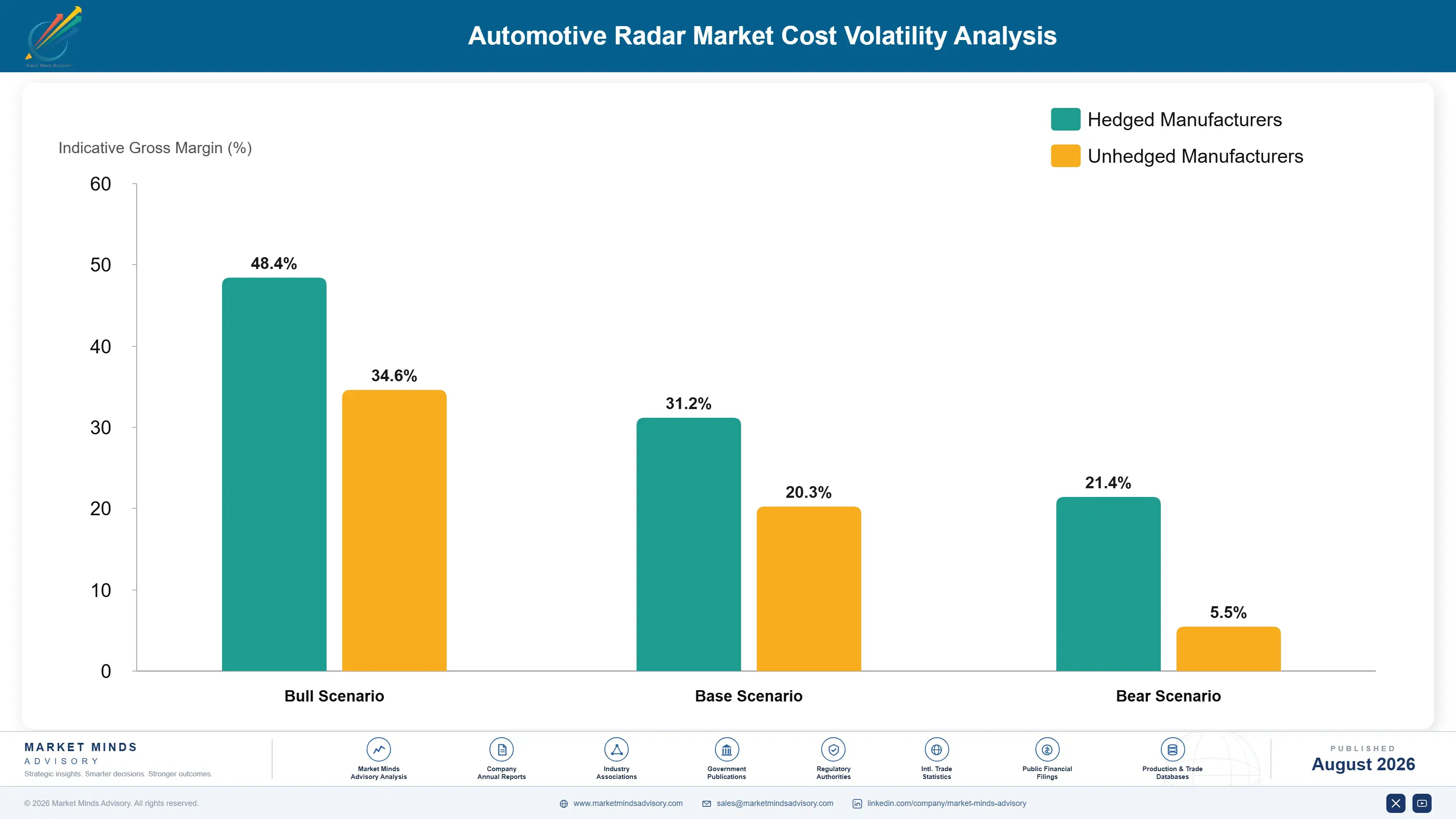
Semiconductor Chipset Dependency and Cost Exposure

Radio-frequency semiconductor chipsets and printed circuit board assembly together account for roughly forty-eight percent of radar module production cost, with chipset fabrication concentrated among a small number of specialized foundries across Taiwan, Germany, and the United States capable of the required automotive-grade yield and reliability standards that few alternative producers can currently match at comparable scale.
Global automotive-grade semiconductor capacity tightened sharply during the 2021 to 2022 chip shortage tracked widely across the industry, forcing several radar suppliers to ration module shipments and prioritize premium platform programs over volume commodity contracts, a rationing pattern several suppliers say reshaped how they now negotiate capacity reservations years in advance of actual production need rather than ordering closer to the delivery date as before.

Larger suppliers with direct foundry capacity reservation agreements and, in some cases, equity stakes in chipset makers absorb shortages far better than smaller regional module assemblers dependent on spot-market chipset purchases, a gap in supply chain sophistication that is slowly reshaping which suppliers can even compete for imaging radar platform awards across the industry's most demanding autonomy programs today. Regional variation in exposure is widening as a result.
automotive-hd-imaging-radar-market-trends-cost-volatility-analysis-1787465137631

Direct Foundry Capacity Reservation Agreements

Negotiating multi-year capacity reservation agreements directly with automotive-grade chipset foundries lets larger suppliers guarantee priority allocation during periods of tight semiconductor supply, a structure smaller regional assemblers struggle to replicate without comparable purchasing volume and long-standing foundry relationships built over multiple product generations. Suppliers view these agreements as a competitive necessity now. Bosch and Continental lead this practice.

Equity Investment in Chipset Suppliers

Taking direct equity stakes in specialized radio-frequency chipset makers gives larger Tier 1 suppliers priority access to next-generation chipset roadmaps and manufacturing capacity, reducing exposure to spot-market pricing swings during periods of constrained global semiconductor availability and strengthening long-term co-development alignment on future imaging radar generations. Several major suppliers have pursued this path recently.

Dual-Foundry Qualification Programs

Qualifying radar chipset designs across two separate foundries, even at meaningfully higher upfront engineering cost, reduces the risk of a single fabrication disruption halting an entire platform program, a resilience investment increasingly expected by automaker procurement teams during formal sourcing reviews and annual supplier risk assessments. Costs are considered worthwhile given the risk avoided.

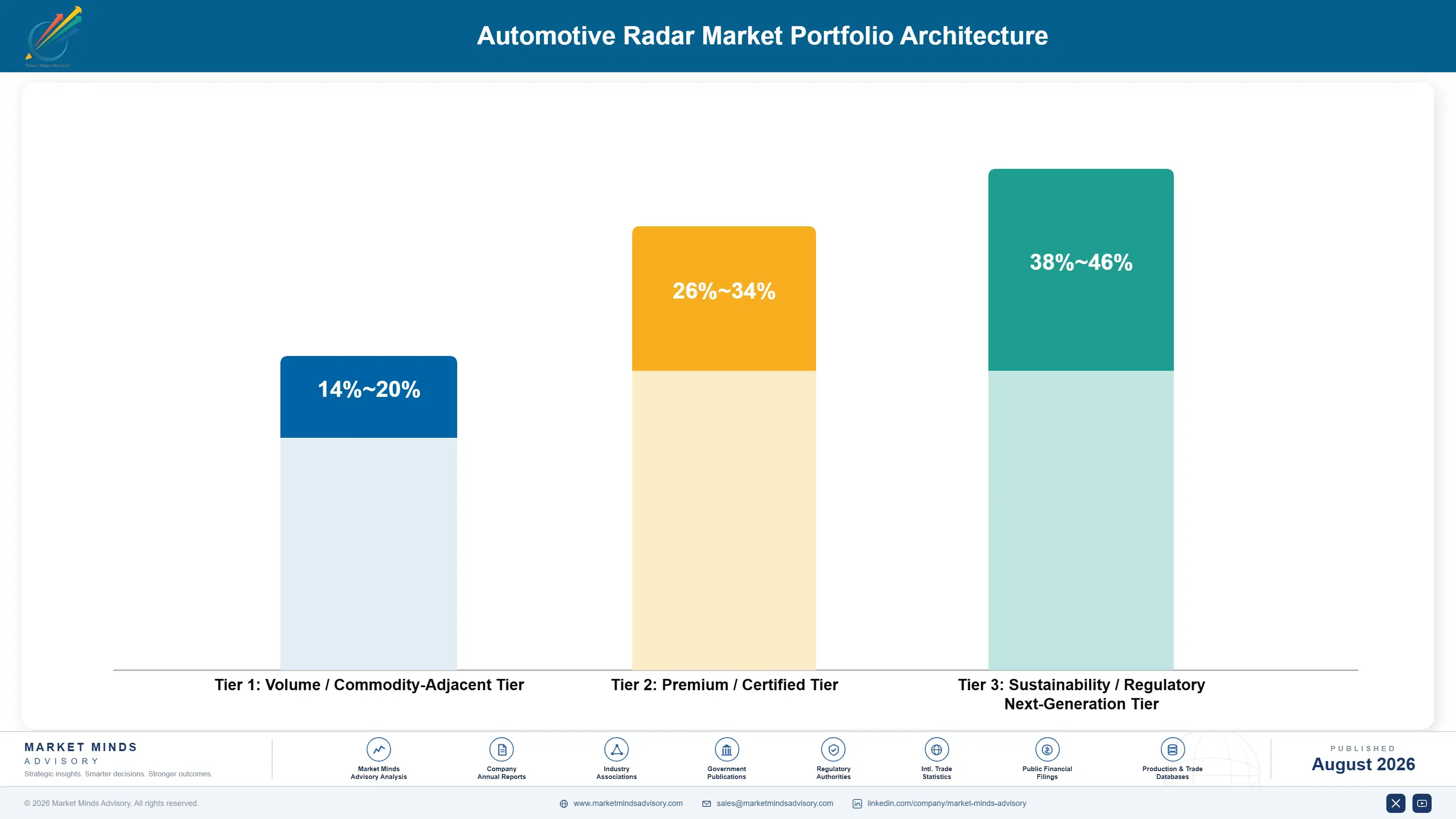
Portfolio Architecture for Margin Defence

Radar suppliers organize their portfolios across three tiers separated primarily by resolution capability and semiconductor sophistication rather than by vehicle class alone, with gross margin climbing sharply from commodity long-range programs toward imaging radar designs commanding genuine technology differentiation. The gap between the lowest and highest tier has widened considerably as electronics content becomes a genuine qualification requirement across the industry's most demanding autonomy programs.
The volume-versus-premium tension is intensifying as automakers simultaneously demand cost reduction on entry-level driver-assistance packages while accelerating imaging radar specification on flagship autonomy models, forcing suppliers to run fundamentally different manufacturing and engineering organizations under a single corporate roof. Suppliers that fail to separate these two operating models organizationally often see margin erosion bleed from the volume tier into programs that should command premium pricing.

High-value margin pools concentrate overwhelmingly in imaging radar and occupant-sensing programs, both of which command qualification barriers that commodity module assemblers cannot easily cross without meaningful capital investment and multi-year chipset partnership development. Suppliers building both capabilities simultaneously are positioning themselves to capture a disproportionate share of industry margin over the coming decade. This concentration is expected to deepen further as autonomy programs scale.

Volume / Commodity-Adjacent Tier

Standard long-range and corner radar sold primarily on unit cost and proven reliability across mainstream mass-market vehicle trims meeting baseline safety requirements without imaging or occupant-sensing functionality included. Margins remain thin here.
Gross Margin: 14-20%

Premium / Certified Tier

Multi-radar corner and blind-spot suites with enhanced processing, commanding higher pricing on premium and mid-market platform programs specifying broader safety feature sets and expanded coverage zones around the vehicle. Volume.
Gross Margin: 26-34%

Sustainability / Regulatory / Next-Generation Tier

Four-dimensional imaging radar and occupant-sensing systems meeting the newest autonomy and safety regulatory requirements, commanding the steepest qualification barriers and richest margin pools across the entire supplier portfolio. Demand keeps rising.
Gross Margin: 38-46%
automotive-hd-imaging-radar-market-trends-portfolio-architecture-1787465138127

High-value Sub-segments and Strategic Watch-out

4D Imaging Radar Systems

Highest-value, fastest-growing segment as autonomy roadmaps and premium electric vehicle platforms specify imaging resolution as standard equipment across an expanding share of new model launches worldwide each year, pulling qualification budgets away from simpler designs entirely. Suppliers ignoring this shift risk losing relevance. Investment keeps accelerating.
Gross Margin: 40-46%

Occupant and In-Cabin Radar Sensors

High-value, moderate-growth segment expanding steadily as occupant detection mandates approach, offering suppliers a durable margin premium tied to certification rather than volume scale alone across qualifying platforms and multiple vehicle segments each successive year. Momentum is building quickly across major markets. Regulators keep tightening timelines further.
Gross Margin: 32-38%

Standard Long-Range and Corner Radar

The volume core of the market, carrying thin but stable margin across the largest share of global vehicle production, remaining essential to supplier fixed-cost absorption even as growth concentrates elsewhere in imaging and occupant-sensing segments nationwide each year. Suppliers rely on it for baseline profitability.
Gross Margin: 14-20%

Semiconductor-Native Challenger Entry

Strategic watch-out segment where chipset-native entrants bypass traditional Tier 1 channels entirely to win platform business directly, threatening established suppliers' historical hold on imaging radar sourcing across multiple regional markets over the coming years. Established suppliers are responding cautiously so far. Watch this space closely.
Gross Margin: 20-30%

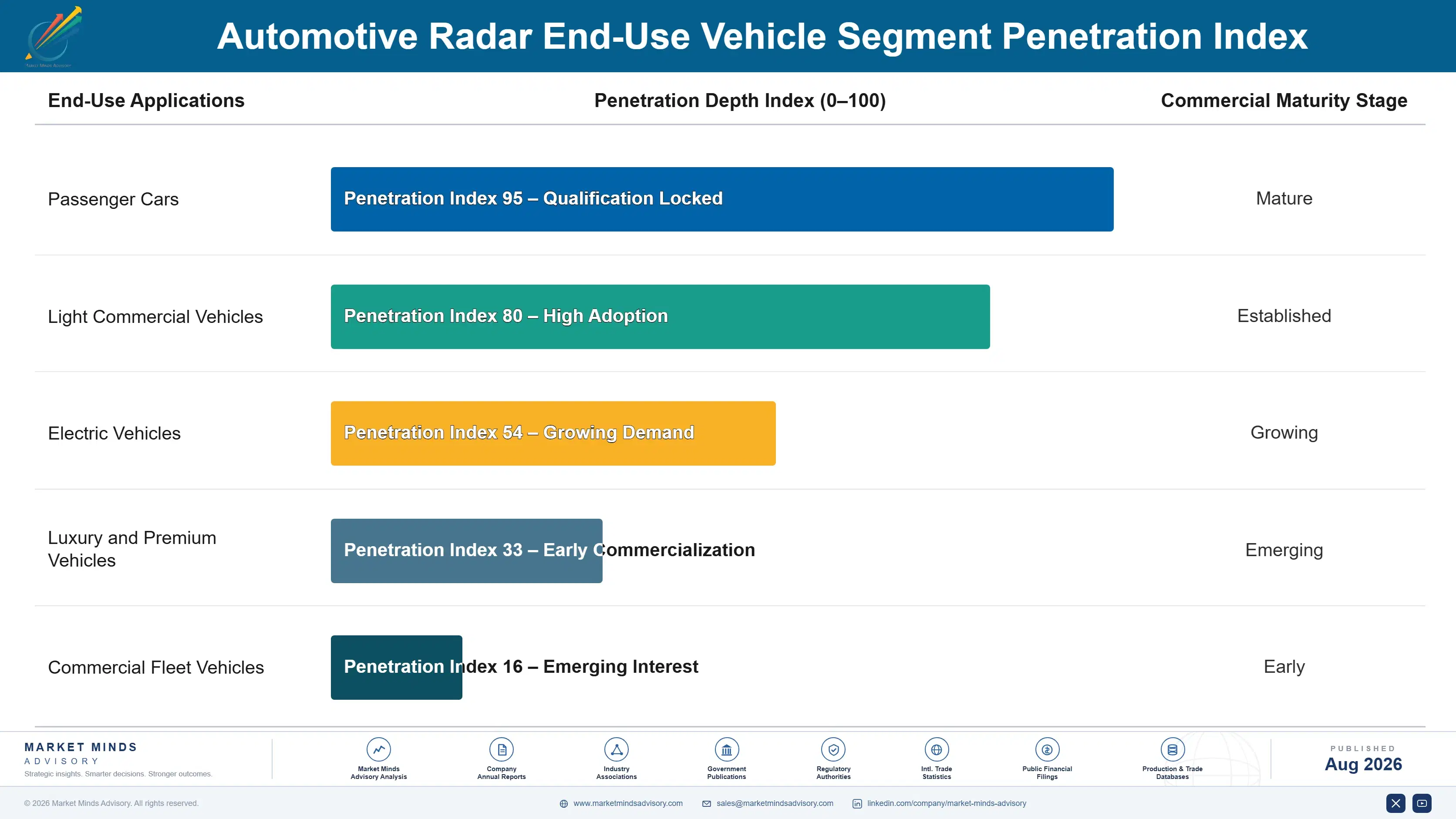
Platform Cycles and Sensing Depth

Radar demand behaves like an annuity anchored to vehicle platform sourcing cycles rather than one-off transactions: once a supplier wins design-in on a given nameplate's sensor suite, it typically holds that position for the full multi-year production run, giving qualified suppliers predictable revenue visibility across several years of platform life. Winning that initial design slot is disproportionately valuable relative to its upfront bidding cost.
Adoption depth varies sharply by end-use vertical. Luxury and premium electric vehicle platforms specify the deepest sensor suites, including imaging radar and occupant sensing, while entry-level and commercial vehicle segments still specify a single long-range unit for basic compliance, creating a widening content-value gap between the top and bottom of the vehicle price spectrum across every region. Mid-market platforms sit in between, adopting imaging content selectively rather than across every trim level offered.

A generational shift in buyer profile is underway as China's younger new-energy-vehicle buyers treat autonomy features as a primary purchase driver rather than a secondary safety option, pulling automaker specification decisions toward richer radar content years earlier in the platform lifecycle than in prior vehicle generations. Western markets are following a similar trajectory, though at a noticeably slower pace so far.
automotive-hd-imaging-radar-market-trends-end-use-penetration-index-1787465138616

Where Radar Suppliers Should Invest Next

These are among the four positions where our research anticipates prominent divergence between winners and laggards over the coming forecast period. Each is grounded in the demand model, the regulatory perimeter, and the announced capacity pipeline.
01 / IMAGING RADAR CHIPSET ACCESS

Build direct radio-frequency chipset co-development partnerships now

Suppliers lacking direct chipset co-development relationships are ceding the fastest-growing, highest-margin segment of the market to better-equipped competitors and semiconductor-native challengers across nearly every major autonomy program. Co-development partnerships lock in earlier platform access and raise unit content value meaningfully above commodity long-range designs, giving early movers a durable revenue advantage over slower-moving rivals still reliant on shared, publicly available chipset roadmaps. Waiting for automakers to specify imaging content unprompted means missing qualification windows on the flagship platforms defining the next product generation entirely.
02 / OCCUPANT SENSING COMPLIANCE

Secure occupant-radar qualification ahead of North American and European mandates

Regulatory deadlines for rear-seat occupant detection are approaching faster than many mid-tier suppliers have prepared for, and qualification slots on premium platforms are already filling among early movers with established in-cabin radar capacity built well ahead of the formal compliance schedule. Suppliers that wait until compliance becomes mandatory will find themselves requalifying under time pressure while competitors already hold the relevant platform positions locked in for years to come. Early investment here protects both margin and existing customer relationships across the entire platform portfolio.
03 / CHINA AUTONOMY SOURCING ACCESS

Establish direct relationships with China's fastest autonomy programs

China's domestic level-two-plus autonomy segment is democratizing radar content years faster than any other market, and suppliers relying solely on legacy joint-venture channels are missing the fastest volume growth available globally today across nearly every vehicle price tier and body style. Direct qualification requires genuinely competitive local cost structures rather than exported Western pricing assumptions built for a fundamentally different competitive environment entirely. Suppliers that succeed here capture a disproportionate share of the industry's best growth opportunity over the coming decade.
04 / SUPPLY CHAIN RESILIENCE INVESTMENT

Diversify chipset sourcing before the next semiconductor disruption hits

Concentrated dependence on a small number of specialized radio-frequency foundries leaves suppliers exposed to the kind of disruption that already forced shipment rationing once this decade, and suppliers without dual-foundry qualification or capacity reservation agreements risk losing entire platform programs during the next tightening cycle across the industry. Building this resilience costs real money upfront, but automaker procurement teams are increasingly screening suppliers on exactly this criterion during formal sourcing reviews. Suppliers ignoring it risk exclusion from future shortlists entirely.

Engagement Snapshot From the Field

A live engagement with an industry participant carrying material or product regulatory and market exposure ahead of a defining policy shift, showing how our research translates into a defensible multi-year portfolio strategy.
MARKET MINDS ADVISORY · CLIENT ENGAGEMENT SUMMARY
Automotive Radar Producer Strategic Portfolio Review and Transition Roadmap 2026·Investment Scenario on Automotive Radar Exposure Evaluation 2025-26
CLIENT PROFILE
The client is a global Tier 1 automotive radar supplier with module production facilities across three continents, serving both established long-range and corner radar programs and newly emerging imaging radar platforms for a broad roster of international automaker customers across multiple vehicle segments and autonomy tiers, with annual radar revenue in the low hundreds of millions (client-reported, unverified by MMA).
STRATEGIC CHALLENGE
The client was losing qualification bids on next-generation imaging radar platforms to competitors with direct chipset co-development partnerships it had not yet established, while simultaneously facing margin pressure on its commodity long-range product lines from lower-cost regional module assemblers undercutting aggressively on price across multiple long-standing accounts and regions simultaneously.
MMA APPROACH
MMA conducted a platform-by-platform competitive benchmarking exercise across the client's active and prospective automaker relationships, combined with primary interviews among procurement decision-makers, to identify which specific capability gaps were costing qualification bids and quantify the revenue opportunity available from closing them within a realistic multi-year investment and hiring plan ahead.
KEY FINDINGS
  1. Roughly fifty-five percent of lost bids over the prior two years traced directly to missing chipset co-development capability rather than price competitiveness alone.
  2. Automaker procurement teams ranked occupant-radar certification as a rising qualification criterion, moving from optional to expected within roughly eighteen months across major markets.
  3. Semiconductor-native challengers had won several platform awards directly, bypassing the client's traditional Tier 1 sourcing relationships entirely across two key regional markets.
  4. Value-focused electric vehicle programs represented a growing share of new sourcing volume the client had been systematically excluded from due to its premium-only architecture.
CLIENT PROFILE
The client is a global Tier 1 automotive radar supplier with module production facilities across three continents, serving both established long-range and corner radar programs and newly emerging imaging radar platforms for a broad roster of international automaker customers across multiple vehicle segments and autonomy tiers, with annual radar revenue in the low hundreds of millions (client-reported, unverified by MMA).
STRATEGIC CHALLENGE
The client was losing qualification bids on next-generation imaging radar platforms to competitors with direct chipset co-development partnerships it had not yet established, while simultaneously facing margin pressure on its commodity long-range product lines from lower-cost regional module assemblers undercutting aggressively on price across multiple long-standing accounts and regions simultaneously.
MMA APPROACH
MMA conducted a platform-by-platform competitive benchmarking exercise across the client's active and prospective automaker relationships, combined with primary interviews among procurement decision-makers, to identify which specific capability gaps were costing qualification bids and quantify the revenue opportunity available from closing them within a realistic multi-year investment and hiring plan ahead.
KEY FINDINGS
  1. Roughly fifty-five percent of lost bids over the prior two years traced directly to missing chipset co-development capability rather than price competitiveness alone.
  2. Automaker procurement teams ranked occupant-radar certification as a rising qualification criterion, moving from optional to expected within roughly eighteen months across major markets.
  3. Semiconductor-native challengers had won several platform awards directly, bypassing the client's traditional Tier 1 sourcing relationships entirely across two key regional markets.
  4. Value-focused electric vehicle programs represented a growing share of new sourcing volume the client had been systematically excluded from due to its premium-only architecture.
RECOMMENDED STRATEGY
Phase 1: Phase 1 (Months 1-6): Establish a direct chipset co-development partnership and pilot an imaging radar module on one qualifying platform program. Phase 2: Phase 2 (Months 6-14): Build occupant-radar certification capability ahead of North American and European regulatory deadlines across two priority sites. Phase 3: Phase 3 (Months 14-24): Launch a dual-foundry qualification program to protect chipset supply continuity while defending existing premium platform relationships.
OUTCOME
Within eighteen months of implementation, the client reported winning qualification on two additional imaging radar platform programs, alongside a measurable improvement in bid win rate on chipset-partnership-scored sourcing evaluations across its North American and European customer base and several new prospects (client-reported, unverified by MMA).

Frequently Asked Questions

Foundational context covering the market sizes, CAGR, scope, country, region and competition that inform every finding below. This section is provided to cover basics and most often pre-purchase conversations, answered from the MMA Primary Research Dataset.

What is the current size of the Automotive Radar Market?

The global automotive radar market is valued at approximately $15.2 billion in 2025. Growth is concentrated in imaging radar content and China's rapidly premiumizing autonomy segment.

How large will the Automotive Radar Market be by 2036?

The market is projected to reach approximately $48.9 billion by 2036 under the base case scenario. This reflects roughly 2.89 times expansion from 2026 levels.

What is the CAGR for the Automotive Radar Market 2026 to 2036?

The base case CAGR is 11.2% over the forecast period. Bull and bear scenarios range from 12.4% down to 10.0% depending on imaging radar cost curves.

Which segment is growing fastest?

4D Imaging Radar Systems is the fastest-growing segment at an 18.0% CAGR, roughly 1.61 times the overall market rate. Occupant and In-Cabin Radar Sensors follows closely at 16.0%.

Who are the major companies in the Automotive Radar Market?

Leading suppliers include Robert Bosch GmbH, Continental AG, Aptiv PLC, Denso Corporation, and Valeo SA. Together they hold well over half of global shipment volume.

Which country is growing fastest?

China leads global growth at a 13.5% CAGR, driven by rapid level-two-plus autonomy adoption across its domestic new-energy-vehicle segment. Domestic suppliers are scaling imaging radar capability alongside this surge.

Report Segmentation Architecture

The full report scope spans multiple orthogonal segmentation dimensions, with cross-tabulated demand data provided for each dimension pair. Coverage extends further to regional breakdowns, trend trajectories, and the competitive detail needed to support segment-level decision-making.

By Radar Sensor Type and Technology

  • Short-Range Radar (24 GHz)
  • Long-Range Radar (77-81 GHz)
  • Corner and Blind-Spot Radar Modules
  • 4D Imaging Radar Systems
  • Radar-Camera-Lidar Fusion Modules
  • Occupant and In-Cabin Radar Sensors

By End-Use Vehicle Segment

  • Passenger Cars
  • Light Commercial Vehicles
  • Electric Vehicles
  • Luxury and Premium Vehicles
  • Commercial Fleet Vehicles

By Commercial Sourcing Dimension

  • Original Equipment Manufacturer Direct Contracts
  • Tier 1 Co-Development Programs
  • Aftermarket Replacement Supply
  • Chipset-Native Direct Sourcing

By Region

  • North America
  • Western Europe
  • East Asia
  • South Asia and Pacific
  • Latin America
  • Middle East and Africa
  • Eastern Europe

Scope, Methodology, and Coverage

Every figure in this report is reproducible from documented input assumptions. The scope below maps the historical period, the forecast horizon, the segmentation dimensions, and the countries covered, alongside the underlying primary and qualitative methodology.
Historical Period
2020 to 2025
Forecast Period
2026 to 2036
Base Year
2025 (USD billions; MMA Primary Research Dataset, August 2026)
Market Definition
The automotive radar market covers the design, manufacture, and supply of radar sensor modules and associated signal-processing hardware used for driver assistance and autonomous perception in passenger and light commercial vehicles. It excludes lidar, camera, and ultrasonic sensors, and the software-only perception algorithms that process radar output downstream.
Quantitative Units
USD billions (current prices); shipment volume in million units where applicable
Segmentation Dimensions
By Radar Sensor Type and Technology; By End-Use Vehicle Segment; By Commercial Sourcing Dimension; By Region
Regions Covered
North America, Western Europe, East Asia, South Asia and Pacific, Latin America, Middle East and Africa, Eastern Europe
Countries Covered
USA, China, Germany, France, UK, Japan, South Korea, India, Australia, Canada, Brazil, Mexico, Indonesia, Vietnam, Thailand, Malaysia, UAE, Saudi Arabia, South Africa, Nigeria, Turkey, Poland, Netherlands, Italy, Spain, Sweden, Switzerland, Argentina, Colombia, Singapore, and additional markets relevant to this sector
Key Companies Profiled
Robert Bosch GmbH, Continental AG, Aptiv PLC, Denso Corporation, Valeo SA, ZF Friedrichshafen AG, Hyundai Mobis Co. Ltd., NXP Semiconductors N.V., Infineon Technologies AG, Texas Instruments Incorporated, HELLA GmbH & Co. KGaA, Panasonic Automotive Systems Co. Ltd., Magna International Inc., Arbe Robotics Ltd., Uhnder Inc., Vayyar Imaging Ltd., Smartmicro GmbH, Renesas Electronics Corporation, Bitsensing Inc., HL Mando Corporation
Quantitative Methodology
Primary survey, n=3,800 respondents, Q4 2025, six countries; demand-side model with trade association cross-validation
Qualitative Methodology
47 expert interviews, Q4 2025; applied to validate demand model assumptions, identify emerging dynamics, and assess competitive positioning
Report Format
PDF and XLSX data workbook (Word format preview document)
Publisher
Market Minds Advisory
Report Code
MMA-2026-AUT-113
Published
August 2026
Contact
sales@marketmindsadvisory.com | www.marketmindsadvisory.com

Purchase the full Automotive Radar Market Report (2026 to 2036).

The full report delivers a comprehensive analysis of the global automotive radar market, including detailed segmentation by sensor type and technology generation, regional demand forecasts across all seven MMA-tracked geographies, and competitive benchmarking of the twenty leading suppliers profiled. It includes primary survey data from three thousand eight hundred respondents and forty-seven expert interviews conducted in the fourth quarter of 2025. Buyers receive supplier chipset partnership maps, input cost sensitivity models, and platform sourcing cycle analysis. The full ten-year forecast spans 2026 through 2036 across every major regional market.
Ten-year quantitative forecast model spanning 2026-2036
Seven-region demand breakdown with growth drivers
Twenty-company competitive benchmarking profiles included in full
Primary survey and expert interview data
Semiconductor cost sensitivity and volatility analysis
Platform sourcing cycle and qualification mapping

Built For The People Who Decide

From boardroom strategy to bench-side execution, this report is read cover-to-cover by leaders shaping the next decade of their industry, turning demand scenarios, market dynamics and valuation benchmarks into decisions.
CXOs/ Presidents/ VPs/ Managers
M&A and Corporate Development
Strategy Teams and R&D Heads
Procurement and Product Directors
Regulatory and Compliance Leaders
Investor Relations and Equity Analysts