Market Minds Advisory
Automotive Exhaust Headers Market

Automotive Exhaust Headers Market: The Integrated Cylinder Head Problem, Nickel Exposure, and an Aftermarket That Refuses to Die

Engine designers have been casting the exhaust manifold straight into the cylinder head for a decade, which removes the component entirely, and roughly two in five new petrol engines now do exactly that.

Lead Analyst

David Horsley

Published

September 2026

Make Smarter Decisions with Customized Research Insights

Request a free sample report and evaluate market opportunities, growth trends, and competitive dynamics relevant to your business needs.

2025 MARKET VALUE$4.9BMarket Size 2025
2036 FORECAST VALUE$7.1BBase Case , 2026 to 2036
CAGR 2026 TO 20363.4 %Bull 4.6% / Bear 2.2%
INCREMENTAL OPPORTUNITY$2.0BNet 10- year value creation
EXPANSION MULTIPLE1.40x2036 value over 2026 base
Strategic Levers
M&A Pipeline
Regional Outlook
Country Rankings
Competitive Intelligence
Segmental Deep-dive
Call-Us : 91 93563 13602

Executive Snapshot and Market Trajectory

The most serious threat to this component is not electrification, it is a casting decision. Engine designers on downsized turbocharged platforms cast the exhaust manifold directly into the cylinder head, which deletes the separate part entirely, and roughly 38% of new petrol engines already do it.
Commercial power sits with suppliers who moved toward thermal management rather than defending casting volume. Emissions rules keep tightening cold-start requirements, which rewards manifolds that get catalysts to light-off temperature quickly, and that favours thin-wall fabricated, air-gap insulated, and water-cooled architectures over heavy cast iron. Water-cooled integrated manifolds grow fastest at 8.2%, roughly 2.41 times the market. East Asia holds 30% of value. Casting volume is no longer the business.
Concentration is low at roughly 33% for the top five, because foundry and fabrication capability is widely distributed and regional suppliers serve local programmes competently. The commercially interesting corner is the performance aftermarket, where brand rather than engineering drives purchase, margins run several times original equipment levels, and enthusiasts keep buying headers for engines that manufacturers stopped making years ago. Brand rather than metallurgy carries that business, which most suppliers find genuinely uncomfortable to accept.
Market Definition
This report covers exhaust manifolds and headers supplied to light and commercial vehicles, spanning cast iron manifolds, cast high-alloy steel manifolds, fabricated tubular manifolds, turbine housing integrated manifolds, water-cooled integrated manifolds, and double-wall air-gap insulated manifolds. Value is measured at component level across original equipment and aftermarket channels. Catalytic converters, downpipes, mufflers, complete exhaust systems, turbochargers sold separately, and cylinder heads with cast-in manifolds fall outside scope.
Base Year Value
$4.9B in 2025 (MMA Primary Research Dataset, August 2026)
Forecast Period
2026 to 2036, eleven discrete annual values
CAGR
3.4% base case. Bull 4.6%. Bear 2.2%.
Fastest Growth Segment
Water-Cooled Integrated Manifolds: 8.2% CAGR
Fastest Growth Country
India: 6.2% CAGR
Fastest Growth Region
South Asia and Pacific: 5.5% CAGR
Largest Region
East Asia: 30% of 2025 global value
Market Leaders
Tenneco, Forvia, Eberspaecher, Benteler Automotive, Katcon. Source: MMA Analysis based on company annual reports.
Primary Survey
n=3,800 procurement and R&D decision-makers, Q4 2025, six countries
Methodology
Demand-side build-up, cross-validated against public data, 47 expert interviews

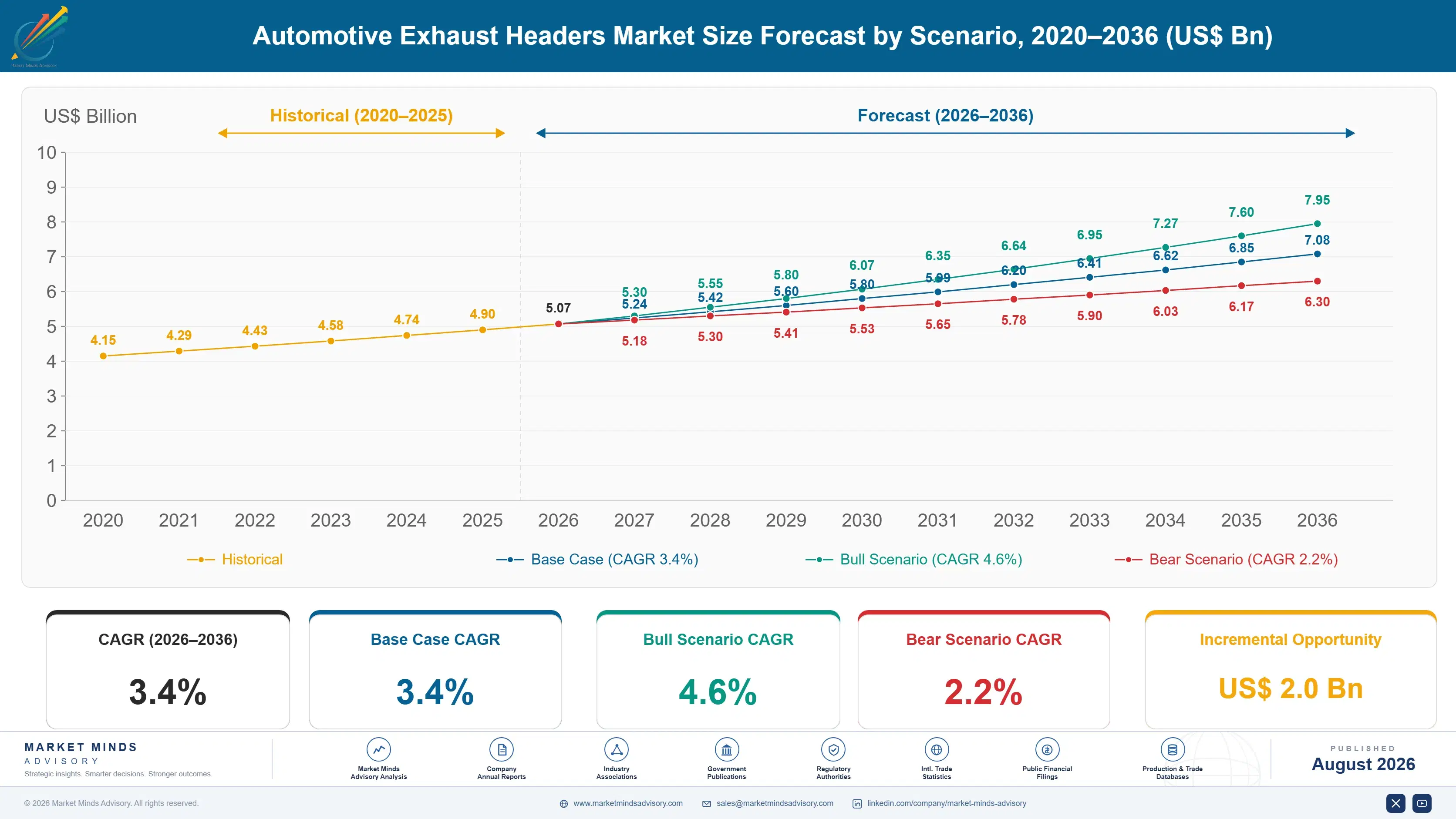
Automotive Exhaust Headers Market Forecast Scenarios

automotive-exhaust-headers-market-size-forecast-scenario-1787465275844
The 2020 to 2025 period was a slow squeeze from two directions at once. Integrated cylinder head designs kept spreading across downsized turbocharged platforms, deleting the manifold from an expanding share of engines, while battery electric penetration removed exhaust systems entirely. Nickel and foundry energy costs rose sharply through 2021 and 2022. The 2.7% historical growth came from commercial volume and aftermarket resilience rather than light vehicle programmes.
The 3.4% base case rests on three mechanisms. Emissions regulation keeps tightening cold-start requirements across Euro 7, China 6b, and American standards, which favours thermally efficient manifold architectures over heavy castings and lifts value per unit. Commercial vehicle and off-highway engines keep using conventional manifolds because duty cycles and durability requirements suit cast solutions. And hybrid platforms retain exhaust systems while adding thermal cycling severity that raises material specification and price.
The 4.6% bull case assumes hybrid adoption holds through the decade while Euro 7 style cold-start rules spread to further jurisdictions, lifting specification across the installed application base. The 2.2% bear case reflects integrated cylinder head adoption accelerating alongside faster battery electric penetration, shrinking the served application base faster than specification gains can offset it.

Why the Cylinder Head Ate the Manifold

Three forces govern this component and only one is the obvious one. Engine architecture comes first, because casting the manifold into the cylinder head deletes the part completely and no supplier response recovers it. Emissions regulation comes second, rewarding designs that reach catalyst light-off quickly and penalising thermal mass. Material cost comes third, and nickel alone moves 22% of production cost for high-temperature grades without warning.
TOP-FIVE CONCENTRATION33%Share of global exhaust manifold supply held collectively
AVERAGE UNIT PRICE$78Blended price across cast, fabricated, and integrated types
INTEGRATED HEAD PENETRATION38%Share of new petrol engines casting the manifold internally
PEAK GAS TEMPERATURE1,050 CMaximum exhaust temperature modern turbocharged petrol engines reach
NICKEL CONTENT SHARE22%Alloying element cost within high-temperature manifold production today
AFTERMARKET REVENUE SHARE17%Supplier revenue from performance and replacement channels combined
The commercial character has narrowed considerably. Foundries with cast iron capability face a shrinking application base while fabrication and thermal management specialists follow the specification upward. Commercial vehicle and off-highway engines remain reliably conventional, which gives suppliers serving them a steadier base than light vehicle work provides. Behind everything sits the performance aftermarket, where a header sells on brand and sound.
The next decade depends on how far integrated heads spread. The design suits downsized turbocharged petrol engines and transfers poorly to diesel and commercial applications where thermal loads and packaging argue against it. If adoption stays confined to that segment, conventional manifolds hold a defensible position. If engine designers extend it further, the served base contracts faster than any specification improvement can offset.
"The exhaust manifold was not disrupted by an electric motor. It was disrupted by a foundry engineer who realised the cylinder head could do the job, and nobody in this industry saw that coming from inside the engine."
Director, Powertrain and Emissions Systems Practice · MMA Automotive / Powertrain and Emissions Systems Practice · August 2026

Market Trends

Cold-Start Rules Reward Thermal Efficiency Over Casting Mass

Euro 7, China 6b, and tightening American standards all place more weight on emissions during the first seconds after ignition, before the catalyst reaches operating temperature, and a heavy cast iron manifold absorbs exactly the heat the catalyst needs. Thin-wall fabricated manifolds, double-wall air-gap insulated designs, and water-cooled architectures all move that heat downstream faster. Engine calibration teams increasingly specify manifold thermal behaviour rather than treating it as plumbing. Suppliers who can demonstrate light-off time improvement on a specific engine win specifications that casting cost alone would never secure. Casting cost arguments no longer reach that conversation.
Market Impact: Sustains 34% of unit volume
Turbine Housing Integration Moves Content to Turbo Suppliers

Casting the turbine housing and exhaust manifold as a single component eliminates a joint, reduces thermal mass, and improves turbocharger response, which is why it has become standard on many downsized petrol platforms. The commercial consequence is that the combined part is frequently awarded to the turbocharger supplier rather than to the manifold specialist, moving content across a supply chain boundary. Manifold suppliers respond by partnering with turbo manufacturers, by developing their own turbine housing casting capability, or by concentrating on applications where the integration does not apply. Neither response is comfortable, and doing nothing is worse.
Market Impact: Earns 4x original equipment pricing

Market Opportunities and Growth Drivers

Commercial and Off-Highway Engines Retain Conventional Manifolds

Heavy truck, bus, agricultural, and construction engines use exhaust manifolds that suit continuous high-load duty cycles, extended service life, and rebuild practice, and none of those requirements favours casting the manifold into a cylinder head that must then be replaced entirely if the exhaust ports crack. Diesel applications also run lower exhaust temperatures than turbocharged petrol engines, which reduces the thermal argument for integration. That segment therefore sustains conventional manifold demand well beyond the light vehicle timeline, and it consumes higher-alloy material at better prices. Rebuild practice alone makes integration commercially unattractive for these engines.
Market Impact: Removes 38% of petrol applications

Performance Aftermarket Sells on Brand Rather Than Engineering

Enthusiast buyers purchase tubular headers for sound, appearance, and perceived output, and they pay several multiples of original equipment pricing for products carrying the right brand. Demand follows the enthusiast vehicle parc rather than new production, so headers keep selling for engines manufacturers discontinued a decade ago. Akrapovic, Borla, and MagnaFlow have built positions on brand equity that engineering specification alone would never sustain. Margins here run considerably above any original equipment programme, and the demand is remarkably insensitive to what happens in the new vehicle market. New vehicle production barely affects this demand at all.
Market Impact: Moves 22% of production cost

Market Restraints and Challenges

Integrated Cylinder Heads Delete the Component Completely

Casting exhaust runners directly into the cylinder head improves warm-up, reduces weight and part count, and eliminates a gasket joint, and roughly 38% of new petrol engines now use the approach. The root cause is engine architecture rather than any commercial failure by manifold suppliers, and no product response recovers a component the engine does not have. Responses include following content into turbine housing integration, concentrating on commercial vehicle and diesel applications where the design transfers poorly, and building aftermarket positions that survive whatever happens to original equipment. The threat came from inside the engine rather than outside it.
Market Impact: Cuts light-off time 22% typically

Nickel Exposure Passes Through Slowly on Fixed Programmes

High-temperature manifolds require austenitic stainless or nickel-bearing ductile iron grades to survive exhaust gas temperatures reaching 1,050 degrees Celsius, and nickel alone accounts for roughly 22% of production cost on those grades. The root cause is metallurgical: nothing cheaper survives the temperature. Vehicle programmes run five to seven years on pricing agreed at award, and many contain no alloy surcharge mechanism at all. Suppliers respond by negotiating alloy indexation, by qualifying lower-nickel grades where temperatures permit, and by hedging where exchange liquidity allows it. Nothing cheaper survives those temperatures, which is the whole problem.
Market Impact: Transfers 6.4% growth to turbo suppliers
3 additional market trends, 2 additional growth drivers, and 4 additional restraints and challenges are covered in the full report. Contact sales@marketmindsadvisory.com to access the complete intelligence.

Segment CAGR and Growth Architecture

Segmentation follows manifold construction, the single engineering logic that determines material, thermal behaviour, manufacturing route, and value per unit. Construction decides whether a supplier competes on foundry cost or on thermal management capability, which are entirely different businesses. Vehicle category, engine type, and channel structure appear separately in the framework as commercial dimensions rather than parallel segments.
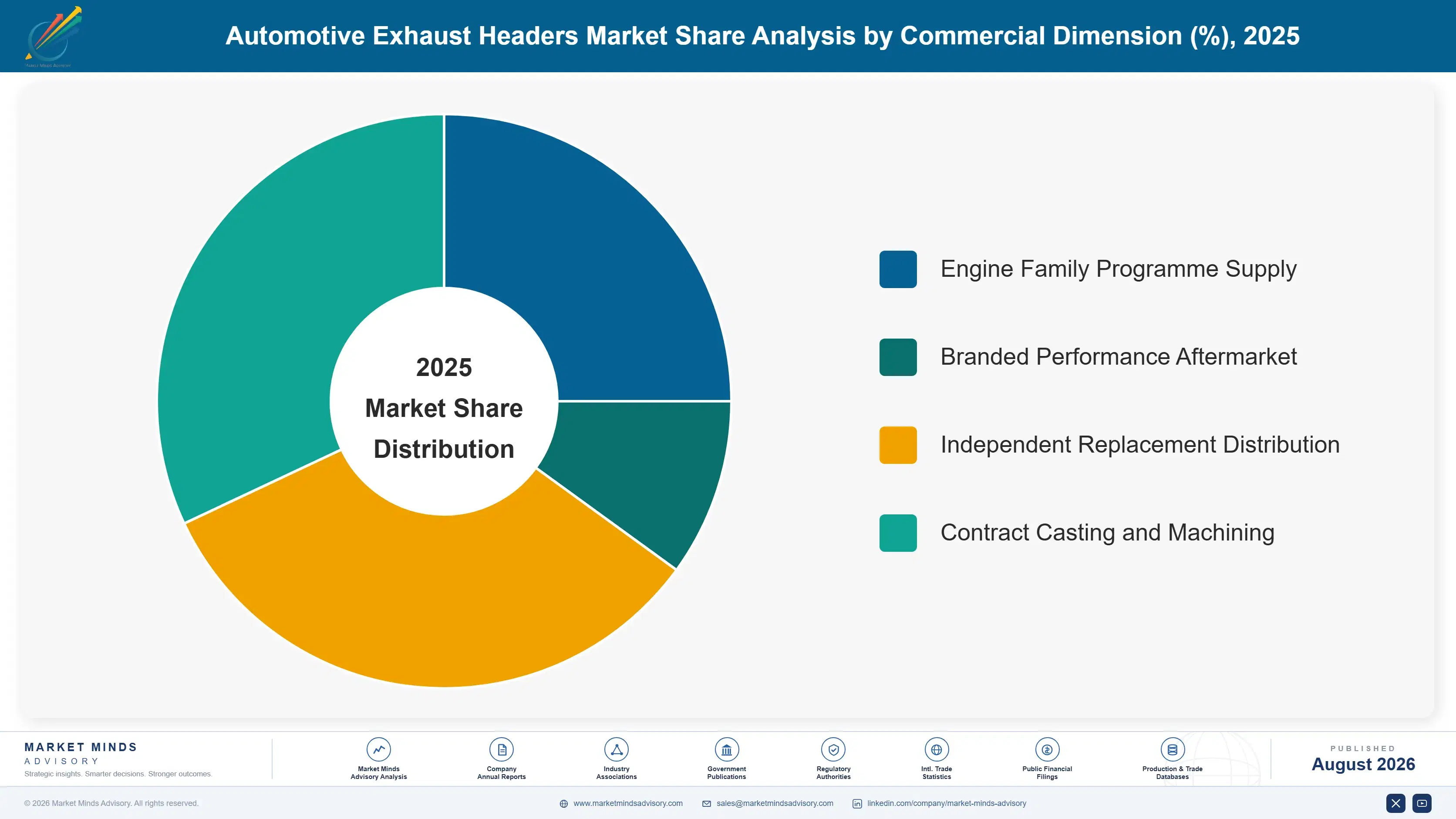
automotive-exhaust-headers-market-market-share-analysis-1787465276712

Water-Cooled Integrated Manifolds

Water-cooled manifolds route engine coolant through jackets around the exhaust runners, controlling component temperature, protecting downstream turbochargers, and helping catalyst thermal management under high load. Growth of 8.2%, roughly 2.41 times the market, follows tightening cold-start emissions requirements and the thermal demands of downsized high-output engines and hybrid duty cycles. The engineering is considerably harder than a plain casting, involving coolant circuit integration, thermal fatigue analysis, and sealing across a large temperature gradient. That difficulty is precisely what protects pricing, and it favours suppliers with thermal management capability over foundries competing on cost per kilogram of iron poured. Foundries competing on cost per kilogram cannot participate in this segment at all.
CAGR 8.2%

Turbine Housing Integrated Manifolds

Combining the turbine housing and exhaust manifold into one casting removes a flanged joint, cuts thermal mass, and improves turbocharger response, which has made it standard practice on many downsized petrol platforms across Europe and Asia. Growth of 6.4% follows turbocharger penetration rather than any independent manifold trend. The commercial complication is decisive: the combined component is frequently awarded to the turbocharger supplier rather than the manifold specialist, which moves content across a supply chain boundary that manifold companies did not previously have to defend. Partnering with turbo manufacturers or building turbine housing casting capability are the only two realistic responses available. Doing neither means watching the content leave the category entirely.
CAGR 6.4%
Full segment breakdown across 6 segments available in the complete report.

Regional Architecture and Country Demand Map

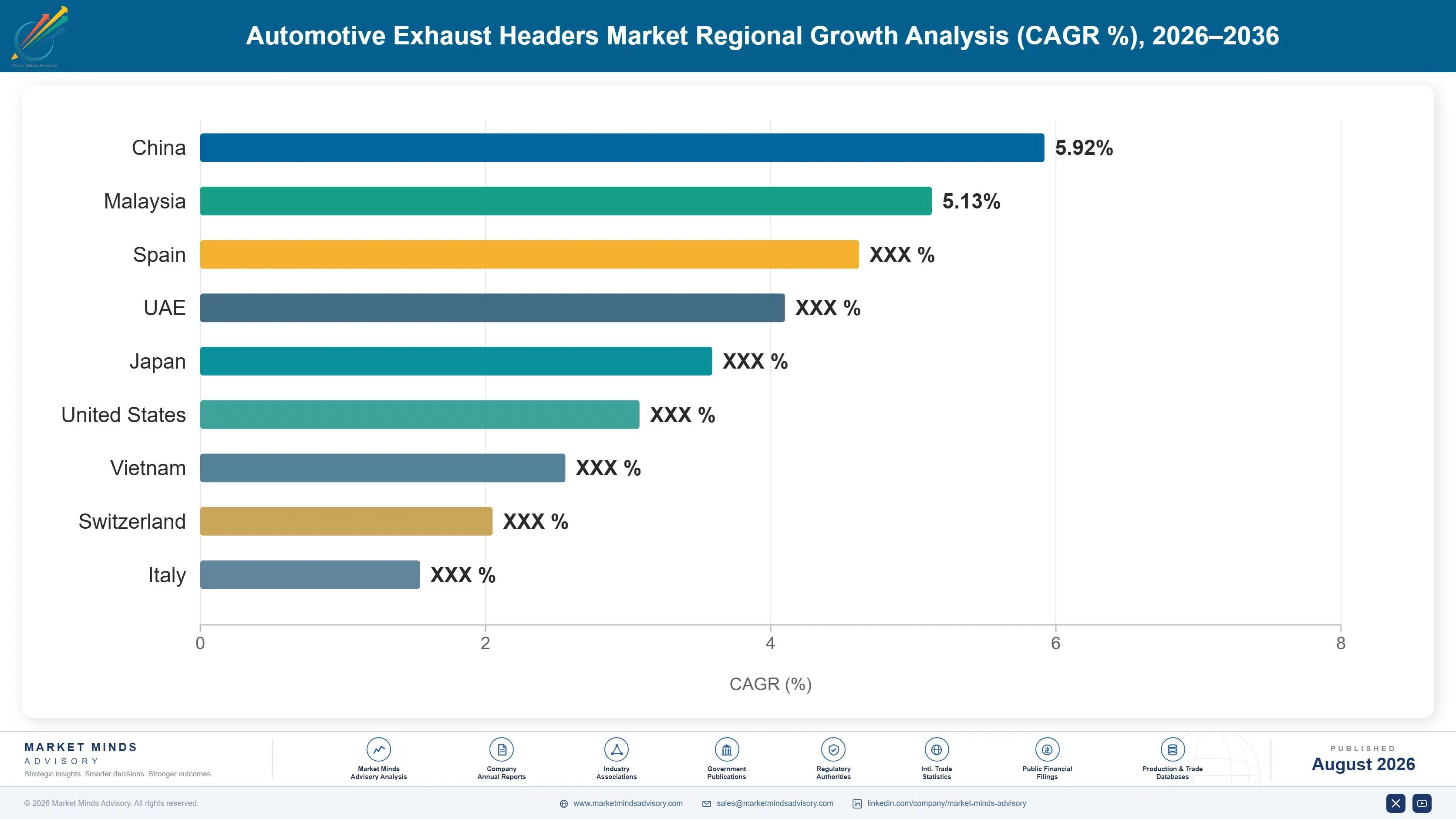
East Asia holds the largest share at 30%, driven by Chinese vehicle production scale and Japanese and Korean manufacturing capability. North America follows on truck and performance aftermarket demand, while South Asia and Pacific grows fastest on Indian production expansion. Latin America retains substantial combustion production.

North America

Pickup trucks and body-on-frame sport utility vehicles keep large displacement engines and conventional manifolds relevant here far longer than in Europe, and Class 8 truck production sustains heavy cast manifold demand at high alloy content. The performance aftermarket is also larger and more brand-driven than anywhere else, with Borla, MagnaFlow, and specialist fabricators serving an enthusiast parc that keeps buying headers for engines discontinued years ago. Integrated cylinder head adoption on downsized petrol platforms progresses steadily but affects a smaller share of the regional mix. Regional growth of 2.6% blends declining light vehicle applications with resilient truck and aftermarket demand. Aftermarket brand equity matters more here than anywhere else in the world.
Share: 24% | CAGR: 2.6% (2026 to 2036)

Western Europe

Integrated cylinder head designs originated largely here and spread fastest across German and French downsized turbocharged petrol platforms, which is why this region shows the sharpest contraction in separate manifold demand anywhere. Euro 7 cold-start requirements push remaining applications toward thin-wall fabricated and air-gap insulated architectures at higher specification and price. Diesel passenger car decline removed a substantial application base that had used heavy cast manifolds. Eberspaecher, Forvia, and Boysen retain significant regional engineering and production capability. Growth of 1.8% is the slowest of any region and reflects architecture change rather than any weakness in vehicle production itself. Architecture change rather than production weakness explains the contraction here. Diesel decline removed further volume.
Share: 19% | CAGR: 1.8% (2026 to 2036)
Regional intelligence for 5 additional markets available in the complete report: East Asia, South Asia and Pacific, Latin America, Middle East and Africa, Eastern Europe. Contact sales@marketmindsadvisory.com.
automotive-exhaust-headers-market-country-cagr-analysis-1787465277611

Where Exhaust Manifold Margin Actually Sits

Competing on cost per kilogram of iron poured is a business with a visible end date and a shrinking application base. The four moves below follow value where architecture has not deleted it: thermal management capability, turbine housing partnership, commercial vehicle and off-highway concentration, and performance brands that sell on sound rather than specification.

Build Thermal Management Capability Rather Than Foundry Scale

Cold-start emissions rules reward manifolds that move heat downstream quickly, and calibration teams increasingly specify light-off behaviour rather than treating the manifold as plumbing. Developing thermal simulation, air-gap insulation, and water-cooling design capability costs around $7 million and shifts the conversation from cost per kilogram to a performance attribute the customer can measure. Suppliers demonstrating a 22% light-off improvement on a specific engine win specifications that no casting price advantage would secure, and the position holds across the programme life. The position then holds across the whole programme life rather than one tender.
Market Impact: Cuts catalyst light-off time by roughly 22% overall

Partner With Turbocharger Suppliers on Integrated Housings

Turbine housing integration frequently moves the combined component to the turbocharger supplier, transferring content across a supply chain boundary manifold specialists cannot defend alone. Structured partnerships that supply the manifold portion of an integrated casting, or joint bids with a turbo manufacturer, retain roughly 40% to 55% of unit value that would otherwise be lost entirely. Building independent turbine housing capability costs considerably more at around $24 million and competes against established suppliers with existing programme positions and relationships. Losing the content entirely is the alternative on offer here. Doing nothing forfeits it.
Market Impact: Retains 40 to 55% of the unit value

Concentrate on Commercial Vehicle and Off-Highway Applications

Heavy truck, agricultural, and construction engines use conventional manifolds because continuous high-load duty cycles, rebuild practice, and lower exhaust temperatures all argue against casting exhaust runners into a cylinder head. That segment sustains 34% of unit volume with better alloy content and pricing than light vehicle work, and integrated head architecture transfers poorly to it. Existing foundry and machining capability applies directly, requiring application engineering rather than new plant. Margins run 6 to 11 points above light vehicle programmes. Application engineering rather than new plant is what entry actually requires.
Market Impact: Adds 6 to 11 points of gross margin

Build or Buy Performance Aftermarket Brand Position

Enthusiast buyers pay roughly four times original equipment pricing for headers carrying the right brand, and demand follows the enthusiast vehicle parc rather than new production, so products keep selling for engines discontinued a decade ago. Building brand position organically takes years; acquiring an established name costs perhaps $40 million for a credible position. Either route delivers margins several times original equipment work and revenue that is almost entirely insulated from architectural change in new vehicle programmes. Revenue here is insulated from every architectural argument in this report. Nothing else here behaves that way.
Market Impact: Earns roughly 4x the original equipment pricing level

Who Controls the Margin Pool

The top five hold roughly 33% of supply, measured consistently as exhaust manifold revenue at supplier level. Tenneco, Forvia, Eberspaecher, Benteler, and Katcon combine foundry, fabrication, and emissions system capability across regions, while Japanese and Korean suppliers including Yutaka Giken and Sejong hold strong domestic programme positions. Concentration is low because foundry capability is widely distributed and regional suppliers serve local programmes competently.
Competition runs along three lines. Thermal management capability is the first and increasingly decides who is specified, as calibration teams treat manifold behaviour as an emissions variable. Turbine housing position is the second, determining whether integrated content stays with the manifold supplier or moves to the turbocharger manufacturer. The third is segment mix, where commercial vehicle, off-highway, and aftermarket exposure determines how much architecture change actually matters.

Two pressures will reshape positions. Integrated cylinder heads keep deleting light vehicle applications outright, which no supplier response addresses. Meanwhile Chinese and Indian foundries continue taking conventional casting volume on delivered cost. The exposed position is a foundry-led supplier with light vehicle petrol concentration, no thermal management capability, no turbine housing partnership, and no aftermarket brand to fall back on.
automotive-exhaust-headers-market-company-positioning-matrix-1787465278448

Competitive Moat and Risk Dimensions

TENNECO

Moat: Emissions System Integration Breadth

Tenneco supplies manifolds alongside catalytic converters, downpipes, and complete exhaust systems, which means manifold content is frequently awarded inside a broader emissions package where thermal behaviour across the whole system is controlled by one supplier. That reduces integration risk for calibration teams considerably. The aftermarket business alongside it captures replacement value that original equipment specialists surrender to distribution.
TENNECO

Risk: Light Vehicle Architecture Exposure

A substantial part of the business depends on light vehicle exhaust content that integrated cylinder heads delete and battery electric platforms remove entirely. Commercial vehicle and aftermarket positions offset part of that, though neither grows fast enough to replace the light vehicle base outright. The exposure compounds wherever both architectural changes advance in the same market simultaneously.
EBERSPAECHER

Moat: Thermal Management Engineering Depth

Eberspaecher combines exhaust technology with vehicle thermal management capability developed across heating and climate systems, which maps directly onto what cold-start emissions rules now demand from a manifold. That lets it bid on light-off performance rather than on casting cost. German manufacturer relationships give early visibility of calibration requirements before manifold specifications are frozen.
EBERSPAECHER

Risk: European Programme Concentration

The strongest positions sit with European manufacturers whose production volumes are contracting and who adopted integrated cylinder heads earliest and most widely of any region. Growth in conventional manifold demand concentrates in Asia and in commercial vehicles, where established local suppliers hold cost advantages. Building equivalent Asian position means competing on price against foundries with far lower cost bases.

Players Tracked

Prominent Players

Tenneco
Forvia
Eberspaecher
Benteler Automotive
Katcon

Other Key Players

Boysen
Yutaka Giken
Sango Co.
Futaba Industrial
Sejong Industrial
Marelli
Bosal
Wescast Industries
Georg Fischer
Tuopu Group
Sharda Motor Industries
Jetex Exhausts
Borla Performance Industries
MagnaFlow
Akrapovic

Recent Developments

MARCH 2025

Manufacturers extend integrated cylinder head adoption across petrol platforms

Vehicle manufacturers continued extending integrated exhaust manifold cylinder head designs across additional downsized turbocharged petrol platforms, citing warm-up performance, weight reduction, and part count benefits. The approach deletes the separate manifold entirely from affected engines, removing content that no supplier product response can recover afterwards.
Signal: Engine architecture rather than electrification clearly remains the largest single threat to this whole component category.
SEPTEMBER 2024

Cold-start emissions requirements tighten across major jurisdictions

Regulatory implementation across European, Chinese, and American standards continued raising weight on emissions measured during the first seconds after ignition, before catalysts reach operating temperature. Manifold thermal behaviour has consequently moved from a plumbing consideration into a calibration variable that engine teams now specify explicitly during development.
Signal: Thermal performance is becoming a specification attribute rather than an incidental property of the casting itself.
JUNE 2025

Performance exhaust brands expand across enthusiast vehicle parc

Specialist performance exhaust manufacturers extended header ranges covering older enthusiast vehicles alongside current platforms, responding to demand that follows the existing parc rather than new production. Pricing continues running at several multiples of original equipment levels on products sold largely on brand, sound, and appearance.
Signal: Aftermarket demand is almost entirely insulated from the architectural changes now reshaping original equipment supply everywhere.

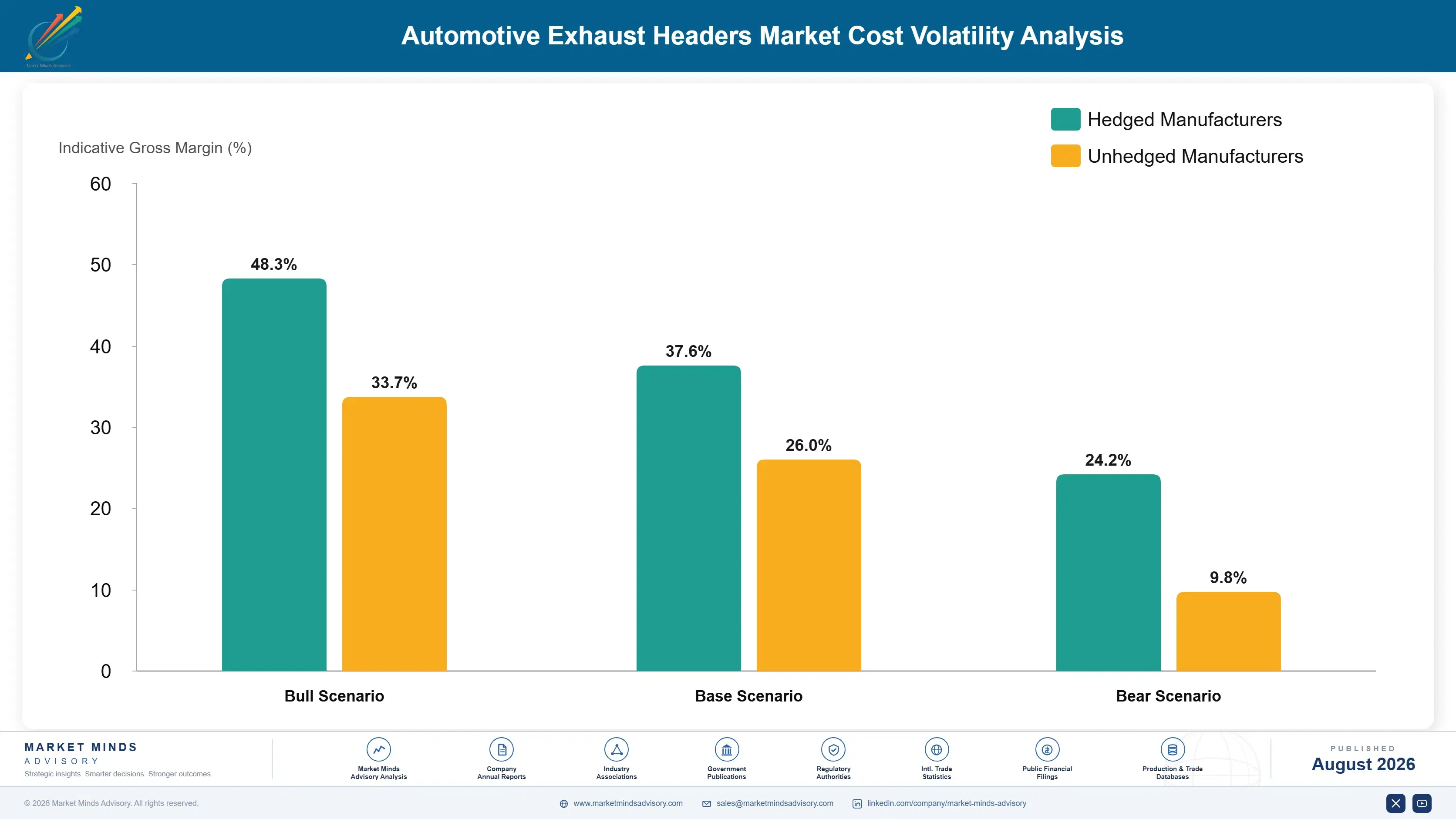
Nickel, Foundry Energy, and Alloy Scrap

Alloying elements dominate high-temperature manifold cost, with nickel alone accounting for roughly 22% and chromium a further 9%, purchased against exchange and producer pricing. Foundry and fabrication energy takes 18%, since melting, pouring, and heat treatment all carry heavy thermal loads. Machining, welding consumables, coatings, and quality inspection absorb the remaining cost across most manifold production operations.
Nickel prices moved violently through 2022, including an exchange trading suspension, and remained elevated across 2023 while European foundry energy costs rose steeply according to IEA reporting. Suppliers on programme pricing without alloy surcharge mechanisms absorbed increases they could not recover, and several European foundries reduced output rather than pour at negative margin. Tenneco and Forvia both referenced raw material and energy cost pressure across their 2022 and 2023 reporting periods without full recovery.

Exposure divides on contract structure and on alloy specification rather than on foundry scale. Suppliers holding alloy surcharge clauses passed nickel movements through within a quarter. Those on fixed pricing absorbed the full swing across contracts running years longer. Producers using higher scrap ratios held better positions than those relying on primary alloy. Indian and Chinese foundries, on cheaper energy and closer to alloy supply, held unmatched positions.
automotive-exhaust-headers-market-cost-volatility-analysis-1787465278760

Negotiate alloy surcharge mechanisms into every programme award

Nickel and chromium move continuously while programme pricing is fixed for five to seven years, and the 2022 nickel episode demonstrated exactly what that mismatch costs a foundry. Manufacturers accept surcharge mechanisms at award far more readily than they grant relief afterwards. Suppliers holding them passed movements through within a quarter while competitors on fixed pricing simply absorbed them.

Qualify lower-nickel grades wherever exhaust temperature permits

Not every application runs at 1,050 degrees, and specifying a high-nickel austenitic grade across a whole product range because the hottest application needs it wastes alloy on parts that never see those temperatures. Application-specific material selection requires thermal measurement work but removes cost permanently. Several suppliers discovered substantial savings simply by measuring what their manifolds actually experienced.

Raise scrap ratios in the melt charge through segregation discipline

Alloy scrap returns from machining and rejected castings carry the expensive elements already paid for, and foundries that segregate rigorously by grade can charge far higher scrap ratios than those mixing streams. The discipline is operational rather than capital-intensive. Producers running high scrap ratios held cost positions through the nickel spike that primary-dependent competitors could not match.

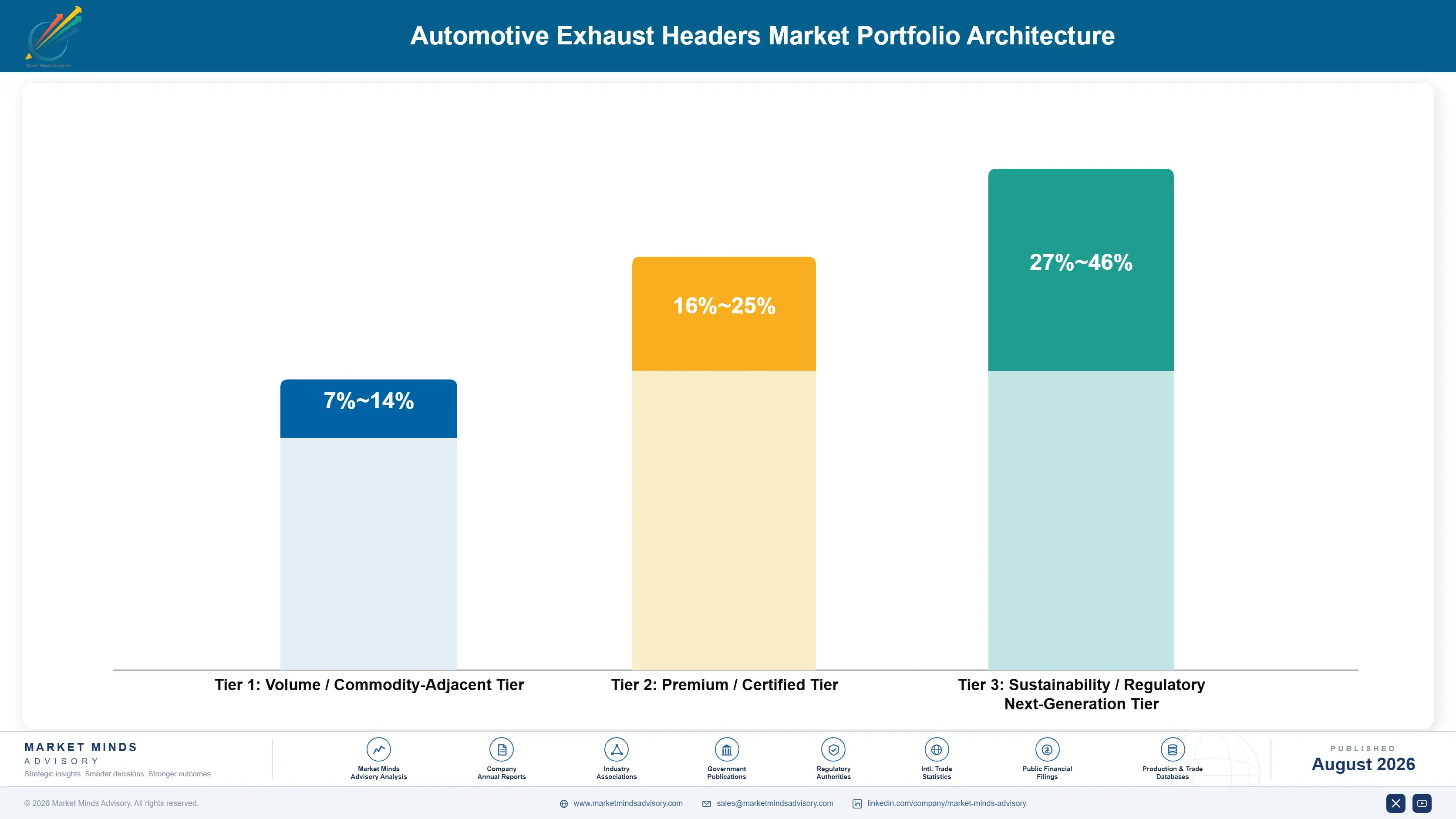
Portfolio Architecture for Margin Defence

Three tiers separate on whether the supplier sells a casting or a thermal solution. Conventional cast iron manifolds supplied against manufacturer designs earn 7% to 14%, competing on foundry cost against Chinese, Indian, and Eastern European positions. High-alloy and fabricated manifolds with demonstrated thermal performance earn 16% to 25%, since calibration teams buy light-off behaviour. Water-cooled, integrated, and performance aftermarket products earn most, and for very different reasons.
The tension is that the shrinking tier keeps the foundries pouring. Conventional castings hold utilisation, which matters given the capital in melting and moulding capacity, yet the application base contracts with every integrated cylinder head programme launched. Suppliers who defended that volume rather than funding thermal capability now find themselves quoting iron against foundries with materially lower costs, which is a competition they cannot win on any timescale that matters.

High-value pools sit where the customer buys something other than a part. Light-off performance, integrated thermal management, and enthusiast brand equity all involve attributes a purchasing team cannot commoditise on a weight basis, which is exactly why they resist the cost per kilogram comparison that plain castings invite immediately.

Volume / Commodity-Adjacent Tier

Conventional cast iron manifolds supplied against manufacturer-owned designs into light vehicle programmes on quotation. Competes on foundry cost and location alone. The wide range reflects large differences in energy cost, scrap ratio, and labour between producing regions.
Gross Margin: 7%-14%

Premium / Certified Tier

High-alloy cast and fabricated tubular manifolds supplied with thermal validation, durability testing, and demonstrated light-off performance data. Range width separates standard fabricated designs from air-gap insulated architectures carrying full calibration support within this tier.
Gross Margin: 16%-25%

Sustainability / Regulatory / Next-Generation Tier

Water-cooled integrated manifolds, turbine housing assemblies with supplier-owned design, and branded performance aftermarket headers. Thermal engineering capability and brand equity, rather than foundry economics, sustain the margin structure throughout this tier.
Gross Margin: 27%-46%
automotive-exhaust-headers-market-portfolio-architecture-1787465279606

High-value Sub-segments and Strategic Watch-out

Performance Aftermarket Headers

Highest margin in the market, selling on brand, sound, and appearance at roughly four times original equipment pricing. Demand follows the enthusiast parc rather than new production, so products keep selling for engines discontinued a decade ago entirely. Architecture change never touches it. Brand equity is the barrier.
Gross Margin: 36%-46%

Water-Cooled and Insulated Manifolds

High value with 8.2% growth, driven by cold-start emissions rules that treat manifold thermal behaviour as a calibration variable. Coolant integration and thermal fatigue analysis are genuinely difficult, which is exactly what protects the pricing here. Foundry cost advantage is irrelevant in this segment. Difficulty protects pricing.
Gross Margin: 28%-38%

Commercial and Off-Highway Cast Manifolds

The reliable core at 34% of unit volume, protected because integrated cylinder head architecture transfers poorly to continuous high-load duty cycles and rebuild practice. Alloy content and pricing both run better than light vehicle work does. Integration transfers poorly to these duty cycles. Alloy content runs higher.
Gross Margin: 18%-26%

Light Vehicle Cast Iron Manifolds

The strategic watch-out. Integrated cylinder heads delete the application entirely on an expanding share of petrol engines, and Chinese and Indian foundries take what remains on cost. Harvest the volume rather than reinvesting behind it. The application base shrinks every year. Cost competition is unwinnable.
Gross Margin: 6%-13%

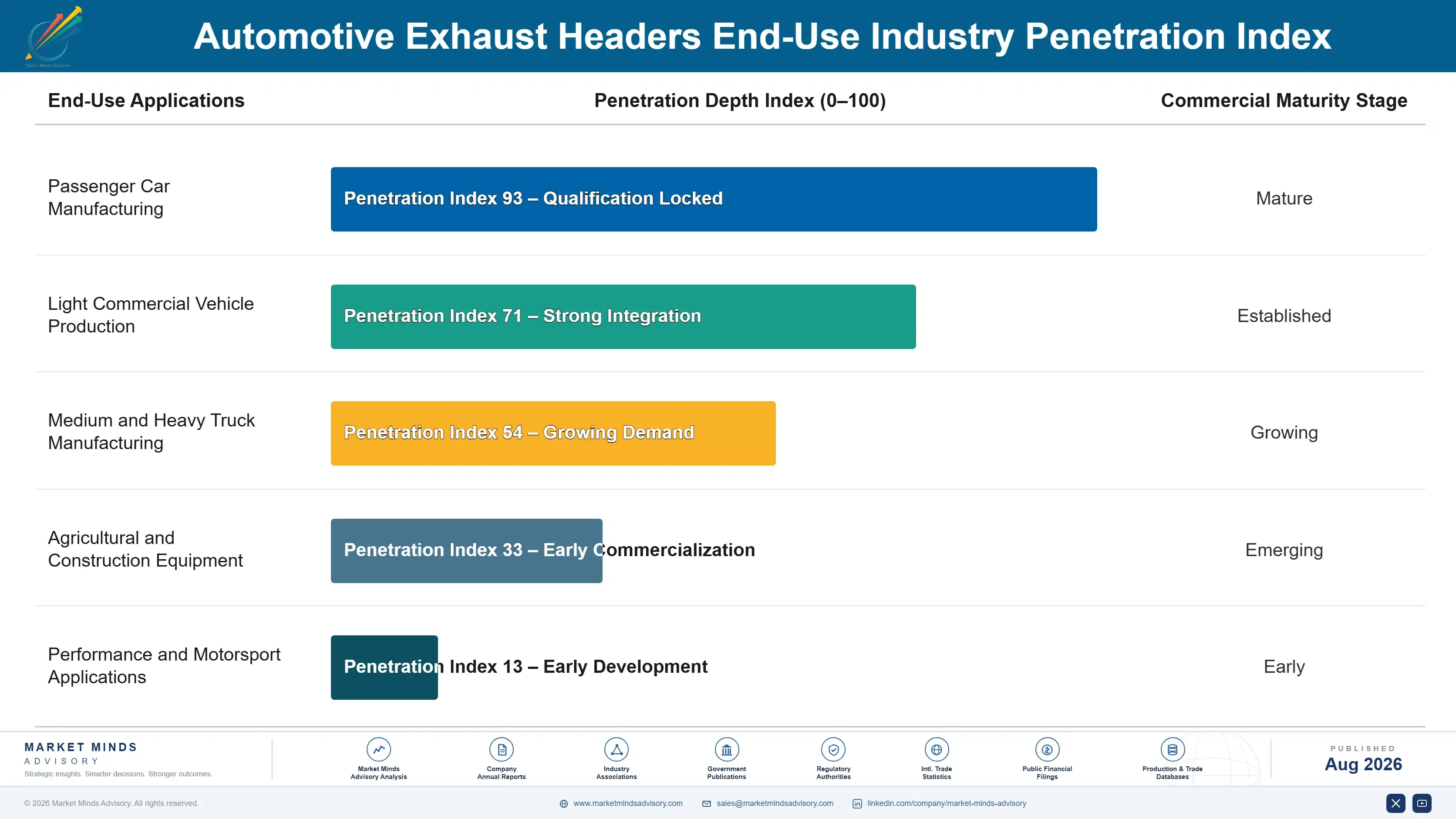
Why Engine Families Fix Suppliers

Manifold revenue is engine family revenue, which behaves as a long and unusually predictable annuity. A supplier awarded at engine development supplies that family for its full production life, often eight to twelve years across multiple vehicle applications, because tooling, thermal validation, and calibration all assume the specific component. Engine families also outlive vehicle programmes, appearing across several models and facelifts, so a single award reaches far more volume than a vehicle programme award typically does.
Stickiness varies with how deeply thermal behaviour is embedded. Manifolds whose light-off characteristics are written into emissions calibration are effectively unmovable, since substituting one means recalibrating and recertifying the engine. Commercial vehicle manifolds come next, protected by rebuild practice and service parts obligations lasting decades. Light vehicle cast iron supply against manufacturer designs is the least sticky, retendered at engine refresh on quotation with no attachment to the incumbent at all.

Buyer profiles have shifted noticeably. Emissions calibration engineers now sit in manifold supplier selection alongside purchasing and manufacturing, and questions about thermal mass and light-off timing arrive well before any discussion of casting cost. Casting cost has become a qualification hurdle rather than a differentiator in those rooms.
automotive-exhaust-headers-market-end-use-penetration-index-1787465280426

Where Exhaust Manifold Capital Belongs

These are among the four positions where our research anticipates prominent divergence between winners and laggards over the coming forecast period. Each is grounded in the demand model, the regulatory perimeter, and the announced capacity pipeline.
01 / THERMAL CAPABILITY INVESTMENT

Sell light-off performance, because nobody buys iron by the kilogram

Cold-start emissions rules across Euro 7, China 6b, and American standards all reward manifolds that move heat downstream quickly, and calibration teams now specify thermal behaviour rather than treating the component as plumbing between the engine and the catalyst. Building thermal simulation, air-gap insulation, and water-cooling design capability costs around $7 million and changes the whole conversation entirely. Suppliers demonstrating a 22% light-off improvement on a specific engine win specifications that no casting price advantage would ever secure for them.
02 / TURBINE HOUSING PARTNERSHIP

Partner with turbo suppliers before the content leaves entirely

Casting turbine housing and manifold as one component has become standard on many downsized petrol platforms, and the combined part is frequently awarded to the turbocharger supplier rather than the manifold specialist, moving content across a supply chain boundary that cannot be defended alone. Structured partnerships or joint bids retain roughly 40% to 55% of unit value that would otherwise be lost outright. Building independent turbine housing capability costs around $24 million and competes against suppliers holding established programme positions.
03 / COMMERCIAL SEGMENT CONCENTRATION

Redirect capacity toward engines integration cannot reach

Heavy truck, agricultural, and construction engines all keep conventional manifolds because continuous high-load duty cycles, rebuild practice, and lower diesel exhaust temperatures all argue against casting exhaust runners permanently into a cylinder head. That segment sustains roughly 34% of unit volume at better alloy content and better pricing, with margins running some 6 to 11 points above light vehicle programmes. Existing foundry and machining capability transfers directly, requiring only application engineering and customer qualification rather than any new plant investment.
04 / AFTERMARKET BRAND POSITION

Own an enthusiast brand, because it ignores architecture entirely

Performance buyers routinely pay roughly four times original equipment pricing for headers carrying the right name, and demand follows the enthusiast vehicle parc rather than new production, so products keep selling steadily for engines that manufacturers discontinued a decade ago. Building brand equity organically takes years, while acquiring a credible established name costs perhaps $40 million. Either route delivers margins several times original equipment work, and revenue that is almost entirely insulated from the architectural changes reshaping new vehicle programmes.

Engagement Snapshot From the Field

A live engagement with an industry participant carrying material or product regulatory and market exposure ahead of a defining policy shift, showing how our research translates into a defensible multi-year portfolio strategy.
MARKET MINDS ADVISORY · CLIENT ENGAGEMENT SUMMARY
Automotive Exhaust Headers Producer Strategic Portfolio Review and Transition Roadmap 2026·Investment Scenario on Automotive Exhaust Headers Exposure Evaluation 2025-26
CLIENT PROFILE
A European exhaust component supplier operating two foundries and one fabrication plant producing manifolds for German and French engine programmes, with annual revenue near EUR 185 million (client-reported, unverified by MMA). Conventional cast iron manifolds for light vehicle petrol engines supplied roughly 68% of revenue, no water-cooled or air-gap capability existed, and aftermarket sales were made unbranded to distributors.
STRATEGIC CHALLENGE
Two engine families had moved to integrated cylinder head architecture at successive refreshes, deleting the client's content entirely, and a third was expected to follow. Nickel cost increases absorbed under programmes without surcharge clauses had cut group margin to 4.9%, foundry utilisation had fallen to 58%, and the board was weighing closure of one foundry against capability investment.
MMA APPROACH
MMA rebuilt profitability by product line and engine family, projecting application attrition from integrated head adoption across the client's customer base. Thermal management capability build was costed against turbine housing partnership options. Commercial vehicle and off-highway entry was assessed using existing foundry capability, and aftermarket branding options were evaluated, with findings tested through 47 expert interviews during Q4 2025.
KEY FINDINGS
  1. Integrated cylinder head adoption across the client's customer engine families would delete an estimated 41% of current light vehicle manifold volume within seven years.
  2. Commercial vehicle and agricultural manifold work generated 23% contribution margin against 6% for light vehicle cast iron, using substantially the same foundry and machining capability.
  3. Nickel cost increases absorbed across four programmes without surcharge clauses had cost an estimated EUR 11 million over three years with no recovery mechanism available.
  4. Unbranded aftermarket sales to distributors realised roughly a third of the price the same castings achieved carrying an established performance brand name.
CLIENT PROFILE
A European exhaust component supplier operating two foundries and one fabrication plant producing manifolds for German and French engine programmes, with annual revenue near EUR 185 million (client-reported, unverified by MMA). Conventional cast iron manifolds for light vehicle petrol engines supplied roughly 68% of revenue, no water-cooled or air-gap capability existed, and aftermarket sales were made unbranded to distributors.
STRATEGIC CHALLENGE
Two engine families had moved to integrated cylinder head architecture at successive refreshes, deleting the client's content entirely, and a third was expected to follow. Nickel cost increases absorbed under programmes without surcharge clauses had cut group margin to 4.9%, foundry utilisation had fallen to 58%, and the board was weighing closure of one foundry against capability investment.
MMA APPROACH
MMA rebuilt profitability by product line and engine family, projecting application attrition from integrated head adoption across the client's customer base. Thermal management capability build was costed against turbine housing partnership options. Commercial vehicle and off-highway entry was assessed using existing foundry capability, and aftermarket branding options were evaluated, with findings tested through 47 expert interviews during Q4 2025.
KEY FINDINGS
  1. Integrated cylinder head adoption across the client's customer engine families would delete an estimated 41% of current light vehicle manifold volume within seven years.
  2. Commercial vehicle and agricultural manifold work generated 23% contribution margin against 6% for light vehicle cast iron, using substantially the same foundry and machining capability.
  3. Nickel cost increases absorbed across four programmes without surcharge clauses had cost an estimated EUR 11 million over three years with no recovery mechanism available.
  4. Unbranded aftermarket sales to distributors realised roughly a third of the price the same castings achieved carrying an established performance brand name.
RECOMMENDED STRATEGY
Phase 1: Phase 1 (months one to six): decline further light vehicle quotations without alloy surcharge clauses and begin commercial vehicle customer qualification. Phase 2: Phase 2 (months seven to twenty): build thermal management and water-cooled manifold capability, and open turbine housing partnership discussions with two suppliers. Phase 3: Phase 3 (months twenty-one to thirty-four): shift foundry mix toward commercial and off-highway work as light vehicle engine families reach end of life.
OUTCOME
The supplier qualified with two commercial vehicle customers and reported group margin improving from 4.9% to 10.6% within seventeen months (client-reported, unverified by MMA). No foundry closure was required. Water-cooled manifold development reached prototype stage and one turbine housing partnership is under negotiation. Both remain on schedule.

Frequently Asked Questions

Foundational context covering the market sizes, CAGR, scope, country, region and competition that inform every finding below. This section is provided to cover basics and most often pre-purchase conversations, answered from the MMA Primary Research Dataset.

What is the current size of the Automotive Exhaust Headers Market?

The market was valued at USD 4.90 billion in 2025, rising to an estimated USD 5.07 billion in 2026. East Asia holds the largest regional share at 30% of global value.

How large will the Automotive Exhaust Headers Market be by 2036?

MMA forecasts USD 7.08 billion by 2036 under the base case, an expansion multiple of 1.40 times the 2026 level. Incremental value creation across the period reaches USD 2.01 billion.

What is the CAGR for the Automotive Exhaust Headers Market 2026 to 2036?

The base case CAGR is 3.4%, with a bull case of 4.6% and a bear case of 2.2%. Historical growth between 2020 and 2025 ran at 2.7%, carried by commercial vehicles and aftermarket.

Which segment is growing fastest?

Water-cooled integrated manifolds, at 8.2%, roughly 2.41 times the overall market rate. Cold-start emissions rules and downsized engine thermal demands drive that growth directly across every major jurisdiction.

Who are the major companies in the Automotive Exhaust Headers Market?

Tenneco, Forvia, Eberspaecher, Benteler Automotive, and Katcon lead, holding roughly 33% of supply between them. Japanese, Korean, Chinese, and Indian suppliers hold strong regional positions.

Which country is growing fastest?

India, at 6.2%, driven by vehicle production expansion across passenger, commercial, and agricultural applications where conventional manifold architectures remain standard throughout most of the domestic fleet.

Report Segmentation Architecture

The full report scope spans multiple orthogonal segmentation dimensions, with cross-tabulated demand data provided for each dimension pair. Coverage extends further to regional breakdowns, trend trajectories, and the competitive detail needed to support segment-level decision-making.

By Manifold Construction

  • Cast Iron Manifolds
  • Cast High-Alloy Steel Manifolds
  • Fabricated Tubular Manifolds
  • Turbine Housing Integrated Manifolds
  • Water-Cooled Integrated Manifolds
  • Double-Wall Air-Gap Insulated Manifolds

By End-Use Industry

  • Passenger Car Manufacturing
  • Light Commercial Vehicle Production
  • Medium and Heavy Truck Manufacturing
  • Agricultural and Construction Equipment
  • Performance and Motorsport Applications

By Commercial Dimension

  • Engine Family Programme Supply
  • Branded Performance Aftermarket
  • Independent Replacement Distribution
  • Contract Casting and Machining

By Region

  • North America
  • Western Europe
  • East Asia
  • South Asia and Pacific
  • Latin America
  • Middle East and Africa
  • Eastern Europe

Scope, Methodology, and Coverage

Every figure in this report is reproducible from documented input assumptions. The scope below maps the historical period, the forecast horizon, the segmentation dimensions, and the countries covered, alongside the underlying primary and qualitative methodology.
Historical Period
2020 to 2025
Forecast Period
2026 to 2036
Base Year
2025 (USD billions; MMA Primary Research Dataset, August 2026)
Market Definition
The market comprises exhaust manifolds and headers supplied to light and commercial vehicles, covering cast iron manifolds, cast high-alloy steel manifolds, fabricated tubular manifolds, turbine housing integrated manifolds, water-cooled integrated manifolds, and double-wall air-gap insulated manifolds. Value is measured at component level across original equipment programme supply, branded performance, and replacement channels. Catalytic converters, downpipes, mufflers, complete exhaust systems, turbochargers sold separately, and cylinder heads with cast-in exhaust runners fall outside scope.
Quantitative Units
USD billions (current prices); units shipped annually; USD per unit average selling price
Segmentation Dimensions
By Manifold Construction; By End-Use Industry; By Commercial Dimension; By Region
Regions Covered
North America, Western Europe, East Asia, South Asia and Pacific, Latin America, Middle East and Africa, Eastern Europe
Countries Covered
USA, China, Germany, France, UK, Japan, South Korea, India, Australia, Canada, Brazil, Mexico, Indonesia, Vietnam, Thailand, Malaysia, UAE, Saudi Arabia, South Africa, Nigeria, Turkey, Poland, Netherlands, Italy, Spain, Sweden, Switzerland, Argentina, Colombia, Singapore, and additional markets relevant to this sector
Key Companies Profiled
Tenneco, Forvia, Eberspaecher, Benteler Automotive, Katcon, Boysen, Yutaka Giken, Sango Co., Futaba Industrial, Sejong Industrial, Marelli, Bosal, Wescast Industries, Georg Fischer, Tuopu Group, Sharda Motor Industries, Jetex Exhausts, Borla Performance Industries, MagnaFlow, Akrapovic
Quantitative Methodology
Primary survey, n=3,800 respondents, Q4 2025, six countries; demand-side model with trade association cross-validation
Qualitative Methodology
47 expert interviews, Q4 2025; applied to validate demand model assumptions, identify emerging dynamics, and assess competitive positioning
Report Format
PDF and XLSX data workbook (Word format preview document)
Publisher
Market Minds Advisory
Report Code
MMA-2026-AUT-158
Published
August 2026
Contact
sales@marketmindsadvisory.com | www.marketmindsadvisory.com

Purchase the full Automotive Exhaust Headers Market Report (2026 to 2036).

The full report sizes exhaust manifold demand across six construction types and seven regions with 2026 to 2036 forecasts under base, bull, and bear cases. It projects application attrition from integrated cylinder head adoption engine family by engine family, which volume forecasts built on vehicle production entirely miss. Competitive profiles cover twenty suppliers assessed consistently on manifold revenue, thermal capability, and segment mix. Cost analysis traces nickel, chromium, and foundry energy exposure by contract structure. Commercial guidance addresses thermal capability building, turbine housing partnership, commercial segment concentration, and aftermarket brand positioning.
Six construction types sized and forecast separately
Integrated cylinder head attrition projected by engine family
Twenty supplier profiles on consistent component revenue basis
Cold-start regulation mapped against manifold specification requirements
Nickel and alloy exposure modelled by contract structure
Performance aftermarket pricing benchmarked against original equipment levels

Built For The People Who Decide

From boardroom strategy to bench-side execution, this report is read cover-to-cover by leaders shaping the next decade of their industry, turning demand scenarios, market dynamics and valuation benchmarks into decisions.
CXOs/ Presidents/ VPs/ Managers
M&A and Corporate Development
Strategy Teams and R&D Heads
Procurement and Product Directors
Regulatory and Compliance Leaders
Investor Relations and Equity Analysts