Market Minds Advisory
Automotive Engineering Services Market

Automotive Engineering Services Market: Software Talent Redraws the Outsourcing Map

Automotive engineering services providers are scaling software and electronics engineering capability as software-defined vehicle architecture, electric powertrain development, and ADAS validation demand push automakers to outsource specialized development work at unprecedented scale worldwide.

Lead Analyst

David Horsley

Published

September 2026

Make Smarter Decisions with Customized Research Insights

Request a free sample report and evaluate market opportunities, growth trends, and competitive dynamics relevant to your business needs.

2025 MARKET VALUE$48.0BMarket Size 2025
2036 FORECAST VALUE$121.4BBase Case , 2026 to 2036
CAGR 2026 TO 20368.8 %Bull 10.0% / Bear 7.5%
INCREMENTAL OPPORTUNITY$69.2BNet 10- year value creation
EXPANSION MULTIPLE2.32x2036 value over 2026 base
Strategic Levers
M&A Pipeline
Regional Outlook
Country Rankings
Competitive Intelligence
Segmental Deep-dive
Call-Us : 91 93563 13602

Executive Snapshot and Market Trajectory

Automotive engineering services demand is shifting from traditional body and chassis design toward software and electronics engineering as vehicles become increasingly defined by code rather than mechanical hardware alone. Electric vehicle powertrain and battery engineering services are scaling rapidly alongside this software transition across major automaker programs.
Testing, validation, and traditional mechanical engineering services anchor volume demand, but software and electronics engineering is the fastest-expanding segment as automakers outsource increasingly complex software-defined vehicle and ADAS development work to specialized engineering partners. Western Europe hosts the largest share of global engineering capacity, driven by Germany's deeply established automotive R&D base, while East Asia scales fastest as Chinese automakers build domestic engineering capability to support rapid electric vehicle platform launches.
Competition splits between large diversified engineering services groups with integrated software, powertrain, and testing capability and numerous smaller regional specialists competing mainly on price for traditional mechanical engineering work. Automaker demand for software and electronics engineering talent is intensifying competition for scarce specialized engineers, while consolidation activity among mid-sized engineering firms is accelerating as automakers increasingly prefer fewer, larger strategic engineering partners over many small specialized vendors.
Market Definition
The Automotive Engineering Services Market comprises outsourced engineering, design, and testing services for vehicle development, including software and electronics, powertrain, body and chassis, and validation disciplines, sold to automakers and Tier 1 suppliers. It excludes in-house automaker engineering headcount and non-automotive engineering services.
Base Year Value
$48.0B in 2025 (MMA Primary Research Dataset, August 2026)
Forecast Period
2026 to 2036, eleven discrete annual values
CAGR
8.8% base case. Bull 10.0%. Bear 7.5%.
Fastest Growth Segment
Software and Electronics Engineering: 13.5% CAGR
Fastest Growth Country
China: 11.5% CAGR
Fastest Growth Region
South Asia and Pacific: 10.8% CAGR
Largest Region
East Asia: 28% of 2025 global value
Market Leaders
AVL, Ricardo, Bertrandt, EDAG, and Segula Technologies lead by global engineering services revenue and software practice depth. Source: MMA Analysis based on company annual reports.
Primary Survey
n=3,800 procurement and R&D decision-makers, Q4 2025, six countries
Methodology
Demand-side build-up, cross-validated against public data, 47 expert interviews

Automotive Engineering Services Market Forecast Scenarios

automotive-engineering-services-market-size-forecast-scenario-1787464797894
Between 2020 and 2025, automotive engineering services volumes grew at an estimated 7.6% compound rate as electric vehicle platform development accelerated across major automakers and software-defined vehicle architecture gained mainstream adoption. Software and electronics engineering demand grew fastest through this period, while traditional body and chassis engineering demand grew more slowly amid platform consolidation across automaker portfolios.
The base case assumes continued expansion as three mechanisms compound: automakers accelerating software-defined vehicle development requiring specialized electronics and software engineering talent beyond internal capacity, electric vehicle platform proliferation requiring dedicated powertrain and battery engineering support, and testing and validation complexity increasing as ADAS and autonomous driving features expand across vehicle lineups. Engineering services providers are expected to expand software and electronics practice capacity substantially, while consolidation continues concentrating market share among larger, full-service engineering groups.
The bull case turns on software-defined vehicle development accelerating faster than expected across the industry, pulling software and electronics engineering services volumes sharply higher as automakers expand outsourced development scope. The bear case centers on automaker internalization risk: large automakers building substantial in-house software engineering capability could reduce outsourced engineering demand for the specific capabilities engineering services providers currently supply at scale.

Software Talent Economics and the Outsourcing Race

Automotive engineering services sit at the intersection of two converging forces: enduring demand for traditional mechanical development expertise and an accelerating software-defined vehicle mandate requiring specialized electronics and software engineering talent automakers cannot fully build internally. Providers that once treated engineering services as a mature cost-reduction outsourcing category are now investing heavily in software and electronics practice capacity to serve automaker demand, betting that specialized talent scarcity will sustain durable premium positioning within the next decade.
MARKET CONCENTRATIONCR5 34%Leading five providers hold roughly a third of supply
AVERAGE BILL RATE$95 per hourSoftware engineering hours command substantial price above traditional work
TOP PRODUCING COUNTRY SHAREGermany 20%Concentrated automotive research anchors regional engineering capacity dominance
CAPACITY UTILIZATION84%Engineering centers run near full utilization amid rising demand
FEEDSTOCK SHARE OF COGS61%Specialized engineer compensation costs dominate total service delivery expense
EXPORT TRADE INTENSITY52%Meaningful cross border project volume links providers to distant automakers
Commercially, the market still behaves partly like a mature professional services category: traditional mechanical and testing engineering work trades on delivered cost and established automaker relationships, with margins tied to headcount utilization and project scope. Software and electronics engineering command a distinctly different economics, priced on specialized talent scarcity and platform-critical expertise rather than commodity engineering hours, giving providers who master these capabilities a genuinely differentiated margin position across automaker development programs.
Looking ahead, the decade defining forces are technological and competitive: how quickly automakers build sufficient internal software engineering capacity will determine the pace of outsourcing demand, while consolidation among engineering services providers determines which firms capture the resulting concentration of automaker strategic partnerships across major vehicle development programs worldwide.
"Automakers used to outsource engineering to save money. Now they outsource it because they simply cannot hire software engineers fast enough, and that changes who has the leverage in every contract negotiation."
Director, Automotive Engineering and Technical Services Practice · MMA Automotive Engineering and Technical Services Practice · August 2026

Market Trends

Software-Defined Vehicles Reshape Engineering Services Demand

Major automakers across Europe, North America, and China are restructuring vehicle development organizations around software-defined vehicle architecture, requiring engineering services providers to build dedicated software and electronics practices spanning vehicle operating systems, over-the-air update infrastructure, and centralized computing platforms. Several leading engineering services firms have disclosed significant software practice expansion during 2024 and 2025, hiring specialized software engineers at a pace outstripping traditional mechanical engineering hiring. This shift is compressing the addressable market available to providers offering only traditional mechanical engineering services, pushing firms toward deeper investment in software talent acquisition and platform partnership capability.
Market Impact: Outsourced engineering demand grows roughly 10%
EV Powertrain Engineering Demand Expands Rapidly

Electric vehicle powertrain and battery engineering demand is expanding rapidly as automakers launch new electric vehicle platforms across multiple market segments simultaneously, requiring specialized battery pack design, thermal management integration, and powertrain calibration expertise that many automakers do not maintain sufficient internal capacity to cover across every program. Engineering services providers with dedicated battery and powertrain practices are capturing outsized project volume as automakers accelerate electric vehicle launch timelines industry-wide. This shift is compressing development timelines for new engineering practice areas, rewarding providers who can deliver proven battery engineering expertise rather than generalist mechanical engineering support.
Market Impact: Software engineering demand grows 15%+ yearly

Market Opportunities and Growth Drivers

Complex Vehicle Programs Strain Internal Engineering Capacity

Automakers across every major region are launching increasingly complex vehicle programs spanning electric, hybrid, and software-defined architectures simultaneously, straining internal engineering capacity and driving sustained outsourcing demand to specialized engineering services providers who can flex capacity across multiple concurrent programs. Every incremental vehicle program launched requires substantial engineering hours across mechanical, electronics, and software domains, and automakers increasingly treat engineering services partnerships as a strategic capacity management tool rather than a discretionary cost-reduction measure. This directly expands addressable demand for engineering services beyond what vehicle production volume alone would suggest, benefiting providers across both traditional and specialized practice areas simultaneously.
Market Impact: Compensation costs rise roughly 15%+

Software Complexity Expands Engineering Services Demand

Rising vehicle software complexity, driven by advanced driver assistance systems, infotainment platforms, and over-the-air update infrastructure, is expanding the addressable market for specialized software engineering services considerably beyond what automakers can economically staff with permanent internal headcount given the specialized and rapidly evolving skill sets required across every program. Every incremental software feature requires dedicated development, testing, and validation work that automakers increasingly route to engineering services partners with proven software delivery track records. This expands addressable demand for software engineering services well beyond what overall vehicle production growth alone would suggest.
Market Impact: Internal hiring could displace 20% demand

Market Restraints and Challenges

Specialized Talent Scarcity Constrains Provider Growth

Specialized software and electronics engineering talent remains in persistently short supply relative to automaker and engineering services provider demand, driving intense competition for qualified engineers and pushing compensation costs upward across the industry regardless of firm size or market position. This scarcity is rooted in the relatively recent emergence of software-defined vehicle architecture as a mainstream automotive engineering discipline, meaning the talent pipeline has not yet scaled to match demand growth. Engineering services providers unable to secure sufficient specialized talent risk losing project bids to competitors with stronger recruitment and retention capability, constraining growth even where demand exists.
Market Impact: Software practice hiring grows roughly 30%

Automaker Internalization Threatens Long-Term Outsourcing Demand

Large automakers are increasingly building substantial internal software and electronics engineering capability rather than relying entirely on external engineering services partners, a strategic shift rooted in automakers' desire to control software-defined vehicle architecture as a core competitive differentiator rather than treating it as an outsourceable commodity function. This internalization trend risks reducing addressable outsourcing demand for the specific software capabilities that engineering services providers have invested heavily in building over recent years. Providers are responding by positioning as strategic co-development partners rather than simple staffing augmentation vendors to preserve relevance.
Market Impact: Battery engineering projects grow 2x faster
3 additional market trends, 4 additional growth drivers, and 2 additional restraints and challenges are covered in the full report. Contact sales@marketmindsadvisory.com to access the complete intelligence.

Segment CAGR and Growth Architecture

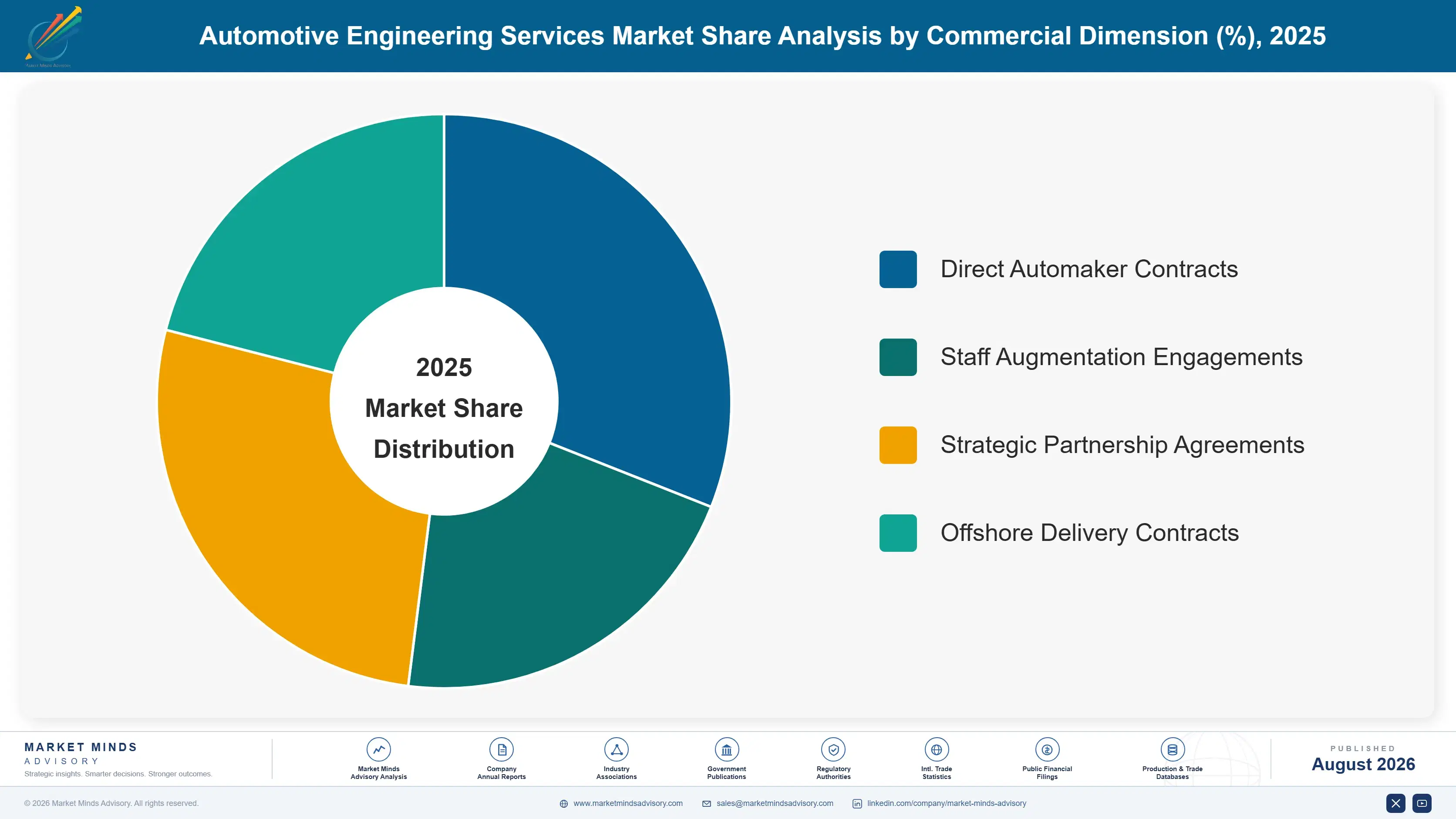
Automotive Engineering Services Market segments by service discipline rather than vehicle category, since the specific engineering domain determines talent requirements, margin structure, and growth trajectory across automaker development programs. Six disciplines span traditional mechanical work and emerging software-defined vehicle capabilities, each carrying distinct margin profiles and demand growth across providers and automaker customers worldwide.
automotive-engineering-services-market-market-share-analysis-1787464798431

Software and Electronics Engineering

Software and electronics engineering services span vehicle operating system development, ADAS algorithm design, infotainment platform integration, and over-the-air update infrastructure, representing the engineering discipline most fundamentally reshaped by the software-defined vehicle transition sweeping the entire automotive industry today and beyond. This is the fastest-growing discipline, expanding at an estimated 13.5 percent annually as automakers outsource increasingly complex software development work that internal teams cannot fully staff given persistent specialized talent scarcity across the industry. Providers with established software engineering practices and proven platform delivery track records are capturing outsized share of this discipline's growth, while traditional mechanical engineering firms without software capability struggle to compete for the highest-value automaker contracts nationwide.
CAGR 13.5%

Powertrain and EV/Battery Engineering

Powertrain and electric vehicle battery engineering services cover battery pack design, thermal management integration, powertrain calibration, and electric drive system development, representing specialized expertise that many automakers do not maintain sufficient internal capacity to cover across every simultaneous vehicle program nationwide and quite well beyond it. This is the second-fastest discipline, expanding at an estimated 11.8 percent annually as automakers accelerate electric vehicle platform launches across multiple market segments and price points worldwide. Providers with dedicated battery and powertrain engineering practices are winning premium project contracts fastest, since automakers increasingly prefer proven electrification expertise over generalist mechanical engineering support for these safety-critical, technically demanding development programs across the industry today.
CAGR 11.8%
Full segment breakdown across 6 segments available in the complete report.

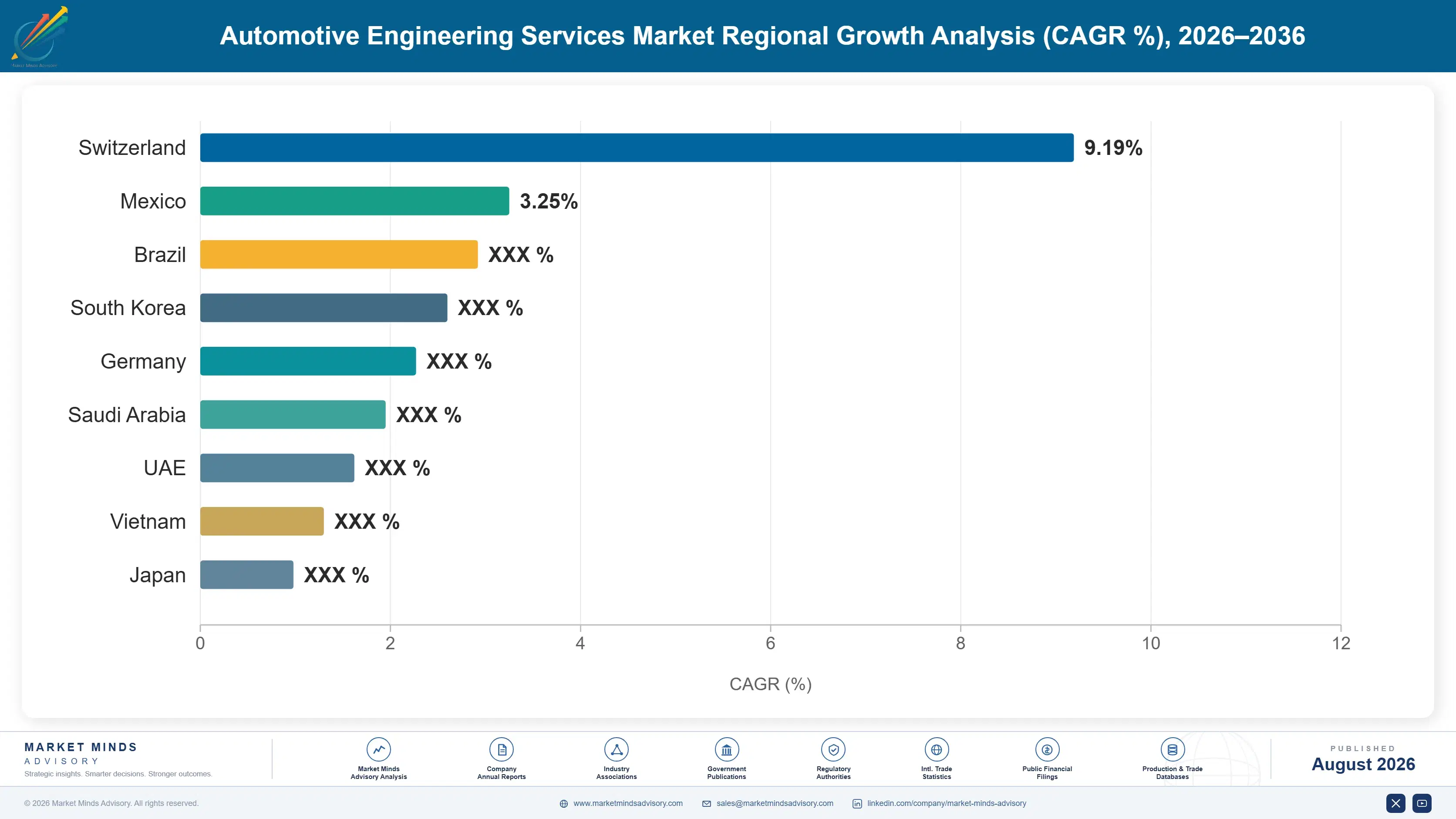
Regional Architecture and Country Demand Map

Automotive engineering services demand spans all major regions, with Western Europe leading given Germany's deeply established automotive R&D base, East Asia scaling fastest as Chinese automakers build domestic engineering capability rapidly, and North America anchoring quite substantial traditional and software engineering demand nationwide and beyond.

North America

US automakers increasingly outsource software and electronics engineering work to specialized providers as internal teams struggle to scale fast enough to meet software-defined vehicle development timelines across the country's large automotive manufacturing base and well beyond it entirely and quite consistently indeed. The region's engineering services demand also includes substantial traditional testing and validation work tied to the country's dense network of automotive proving grounds and certification facilities nationwide and beyond. Canada's automotive engineering sector follows similar outsourcing patterns on a smaller scale given shared supply chain integration with the United States. Demand concentrates in software, electronics, and battery engineering categories where specialized talent commands the highest project rates nationwide.
Share: 24% | CAGR: 7.9% (2026 to 2036)

Western Europe

Germany anchors European automotive engineering services demand given its position as home to numerous major automakers and a dense concentration of specialized engineering firms built over decades of automotive research and development activity nationwide and quite well beyond. The United Kingdom and France follow closely, where established engineering services providers have expanded software and electronics practices faster than the broader traditional engineering category overall this cycle across most markets nationwide. The European Union's vehicle safety and emissions certification requirements sustain substantial testing and validation engineering demand across the region's automotive supply chain. Growth trails East Asia given the region's already-mature, slower-expanding automotive production base relative to rapidly scaling Chinese operations.
Share: 26% | CAGR: 7.2% (2026 to 2036)
Regional intelligence for 5 additional markets available in the complete report: East Asia, South Asia and Pacific, Latin America, Middle East and Africa, Eastern Europe. Contact sales@marketmindsadvisory.com.
automotive-engineering-services-market-country-cagr-analysis-1787464798941

Where Engineering Services Margins Concentrate

Margin expansion in automotive engineering services flows through four distinct commercial levers: software and electronics engineering premiums over traditional mechanical work, strategic partnership contracts that secure multi-year automaker relationships, specialized talent retention capability, and offshore delivery centers that reduce cost while maintaining quality across global engineering programs across the entire industry worldwide today still.

Software Engineering Premium Over Mechanical Work

Software and electronics engineering hours command a price premium of roughly 1.6 to 2.4 times traditional mechanical engineering rates, reflecting both specialized talent scarcity and the platform-critical nature of software-defined vehicle development work automakers depend on for competitive positioning. Providers who develop differentiated software engineering practices capture pricing power that generalist mechanical engineering firms competing purely on headcount cost cannot access. This premium has proven durable because specialized software talent takes years to develop and recruit at scale, giving early practice builders a multi-year head start over competitors still building comparable capability from scratch.
Market Impact: Software engineers price 1.6 to 2.4 times mechanical

Strategic Partnership Contracts Secure Multi-Year Revenue

Automakers increasingly fund exclusive, strategic engineering partnership contracts rather than purchasing standardized engineering hours from a competitive bid pool, with disclosed partnerships often spanning 3 to 5 years and covering entire vehicle platform development programs across several regions simultaneously and consistently. Providers that secure these partnerships gain both revenue visibility and deeper platform integration difficult for competitors to displace once a program has launched into production. This lever favors providers with dedicated automaker account teams and requires sustained relationship investment that smaller regional engineering firms often cannot commit at comparable scale.
Market Impact: Partnership contracts often span 3 to 5 years

Specialized Talent Retention Secures Delivery Reliability

Engineering services providers that invest in specialized talent retention programs, including dedicated software and electronics career development tracks, secure a durable staffing advantage over competitors facing higher turnover in a persistently talent-constrained labor market across the entire industry. This retention capability directly determines project delivery reliability, since losing a specialized engineer mid-project can delay automaker programs by 6 months or more and damage client relationships built over years of sustained investment. Providers with strong retention track records are winning larger, longer-duration contracts as automakers increasingly prioritize staffing stability over marginal cost savings from lower-retention competitors.
Market Impact: Talent turnover can delay projects by 6 months

Offshore Delivery Centers Cut Engineering Cost

Providers operating offshore delivery centers in India and other cost-competitive engineering talent markets capture cost advantages of roughly 30 percent while maintaining quality standards comparable to onshore delivery, allowing them to price competitively against pure onshore competitors without sacrificing margin across the entire industry today. This lever requires sustained investment in offshore quality management and communication infrastructure that smaller regional providers without established offshore operations typically cannot replicate quickly at comparable scale. Providers with mature offshore delivery capability are winning larger, cost-sensitive engineering contracts that pure onshore competitors struggle to match on price.
Market Impact: Offshore delivery centers cut costs by 30 percent

Who Controls the Margin Pool

Automotive Engineering Services Market concentration sits at a CR5 of 34 percent, evaluated on global engineering services revenue, with AVL and Ricardo holding the largest positions built on diversified engineering practice portfolios spanning powertrain, software, and testing capability across multiple automaker relationships. The gap between these established leaders and numerous smaller regional specialists remains wide on software and electronics engineering capability, though narrower on delivered cost position for traditional mechanical engineering work.
Current competitive activity concentrates in three areas: software and electronics practice investment to meet automaker software-defined vehicle development demand, strategic partnership contract development with major automakers seeking fewer, larger engineering relationships, and offshore delivery capacity expansion to remain cost-competitive against lower-cost regional specialists.

Rankings are most likely to shift as software-defined vehicle development becomes standard practice across the industry, a dynamic that could let providers with the strongest software and electronics engineering capability pull meaningfully ahead of traditional mechanical engineering specialists. Smaller providers without dedicated software practice capability face the greatest pressure, and several are pursuing merger or acquisition arrangements with larger providers rather than building software capability internally, a defensive posture that could reshape the competitive leaderboard within the next five years.
automotive-engineering-services-market-company-positioning-matrix-1787464799458

Competitive Moat and Risk Dimensions

AVL LIST GMBH

Moat: Broad Multi-Discipline Practice

AVL operates one of the broadest automotive engineering practices globally, spanning powertrain, software, testing, and vehicle integration capability supported by dedicated technical centers serving nearly every major automaker. This breadth lets AVL offer integrated engineering solutions across multiple disciplines that narrower competitors focused on single practice areas cannot match at comparable technical depth and program scale.
AVL LIST GMBH

Risk: Diluted Software Practice Focus

AVL's broad practice portfolio requires sustained investment across many engineering disciplines simultaneously, potentially diluting focus relative to specialist software providers targeting the fastest-growing software-defined vehicle segment specifically. Intensifying competition from software-focused specialists could erode AVL's share in premium software engineering contracts if its broader investment pace fails to keep up.
RICARDO PLC

Moat: Established Powertrain Heritage

Ricardo's century-long automotive engineering heritage and established relationships across nearly every major automaker give it distinctive credibility for complex powertrain and driveline engineering programs requiring deep technical trust. This established reputation and long-standing customer relationships give Ricardo a durable position in premium, technically demanding engineering programs specifically.
RICARDO PLC

Risk: Limited Software Engineering Depth

Ricardo's traditional mechanical engineering heritage leaves it comparatively less established in software and electronics engineering relative to newer specialist competitors, potentially limiting its share of the fastest-growing segment of the category. Sustained competition from software-focused specialists could pressure Ricardo's growth rate in this specific high-growth discipline over time.

Players Tracked

Prominent Players

AVL List GmbH
Ricardo plc
Bertrandt AG
EDAG Engineering Group AG
Segula Technologies

Other Key Players

Altran (Capgemini Engineering)
FEV Group GmbH
IAV GmbH
ALTEN Group
AKKA Technologies (Akkodis)
Bosch Engineering GmbH
Continental Engineering Services
IDIADA Automotive Technology
Horiba MIRA
Roush Enterprises
L&T Technology Services
Tata Technologies
KPIT Technologies
HCL Technologies (ER&D)
Wipro Engineering

Recent Developments

FEBRUARY 2025

AVL Expands Software-Defined Vehicle Engineering Center In Germany

AVL announced an expansion of its software-defined vehicle engineering center in Germany, adding dedicated capacity for vehicle operating system and centralized computing platform development across the region. The expansion responds to sustained demand from automakers restructuring vehicle development organizations around software-defined architecture across multiple concurrent programs.
Signal: Signals established engineering services providers are prioritizing software practice capacity ahead of continued automaker demand growth.
SEPTEMBER 2024

Ricardo Launches Dedicated EV Battery Engineering Practice

Ricardo launched a dedicated electric vehicle battery engineering practice combining battery pack design, thermal management, and powertrain calibration expertise under a single organizational structure across the company. The launch responds to accelerating automaker demand for specialized electrification engineering support across multiple simultaneous vehicle platform programs.
Signal: Signals established providers are prioritizing dedicated battery engineering capability as a distinct electrification practice area industry-wide.
APRIL 2025

Tata Technologies Opens New Automotive Engineering Center In India

Tata Technologies opened a new automotive engineering center in India to expand regional engineering capacity serving automakers across multiple global regions from cost-competitive operations nationwide and well beyond. The facility adds substantial technical headcount supporting software, powertrain, and testing engineering practice areas across the organization.
Signal: Signals established providers are expanding offshore engineering capacity to serve rising global automaker demand cost-effectively today.

Specialized Engineering Talent Compensation Costs

Specialized engineering talent compensation accounts for an estimated 58 to 65 percent of cost of goods sold across automotive engineering services delivery, with software and electronics engineers commanding meaningfully higher compensation than traditional mechanical engineering roles across most delivery markets worldwide still today indeed. Talent supply is concentrated in Germany, India, and the United States.
Software and electronics engineer compensation rose sharply during 2022 and remained elevated through 2023 following intense competition for scarce talent across the automotive and broader technology sectors, according to industry compensation surveys cited by engineering services associations, squeezing margins for providers who could not pass costs through mid-contract. Several providers disclosed talent-linked cost inflation as a specific pressure on segment margins in recent annual reporting periods, prompting wider adoption of indexed pricing clauses.

Providers without diversified talent sourcing across multiple geographies face a persistent cost disadvantage during compensation inflation cycles, since specialized software and electronics engineering roles cannot easily substitute lower-cost generalist talent without compromising project delivery quality. Exposure concentrates most heavily among smaller regional providers who lack the balance sheet to offer competitive compensation packages that larger diversified competitors maintain across multiple talent markets and delivery centers.
automotive-engineering-services-market-cost-volatility-analysis-1787464799652

Diversify Talent Sourcing Across Multiple Regions

Providers are qualifying additional talent sourcing regions across India, Eastern Europe, and Southeast Asia, reducing single-market dependence across the specialized engineering talent supply base considerably and quite fully consistently. This diversification adds management complexity but meaningfully lowers the probability that a single regional compensation spike disrupts total delivery capacity across a provider's entire portfolio.

Build Internal Talent Development Programs Ahead Of Demand

Capital allocation is shifting toward internal talent development and training programs precisely because building specialized software and electronics capability internally provides more predictable long-run cost than relying entirely on open-market recruitment amid persistent scarcity across the industry. Providers pursuing this path reduce long-run exposure to compensation volatility, even though internal training requires sustained upfront investment.

Negotiate Indexed Cost Pass-Through Clauses In Contracts

Providers are increasingly building indexed cost pass-through mechanisms into multi-year automaker supply agreements, tying pricing to published compensation cost benchmarks rather than fixed unit prices negotiated years in advance. This protects margins during volatility events but requires automaker buyers accustomed to fixed pricing to accept periodic adjustment clauses, a negotiation that favors providers with strong bargaining position.

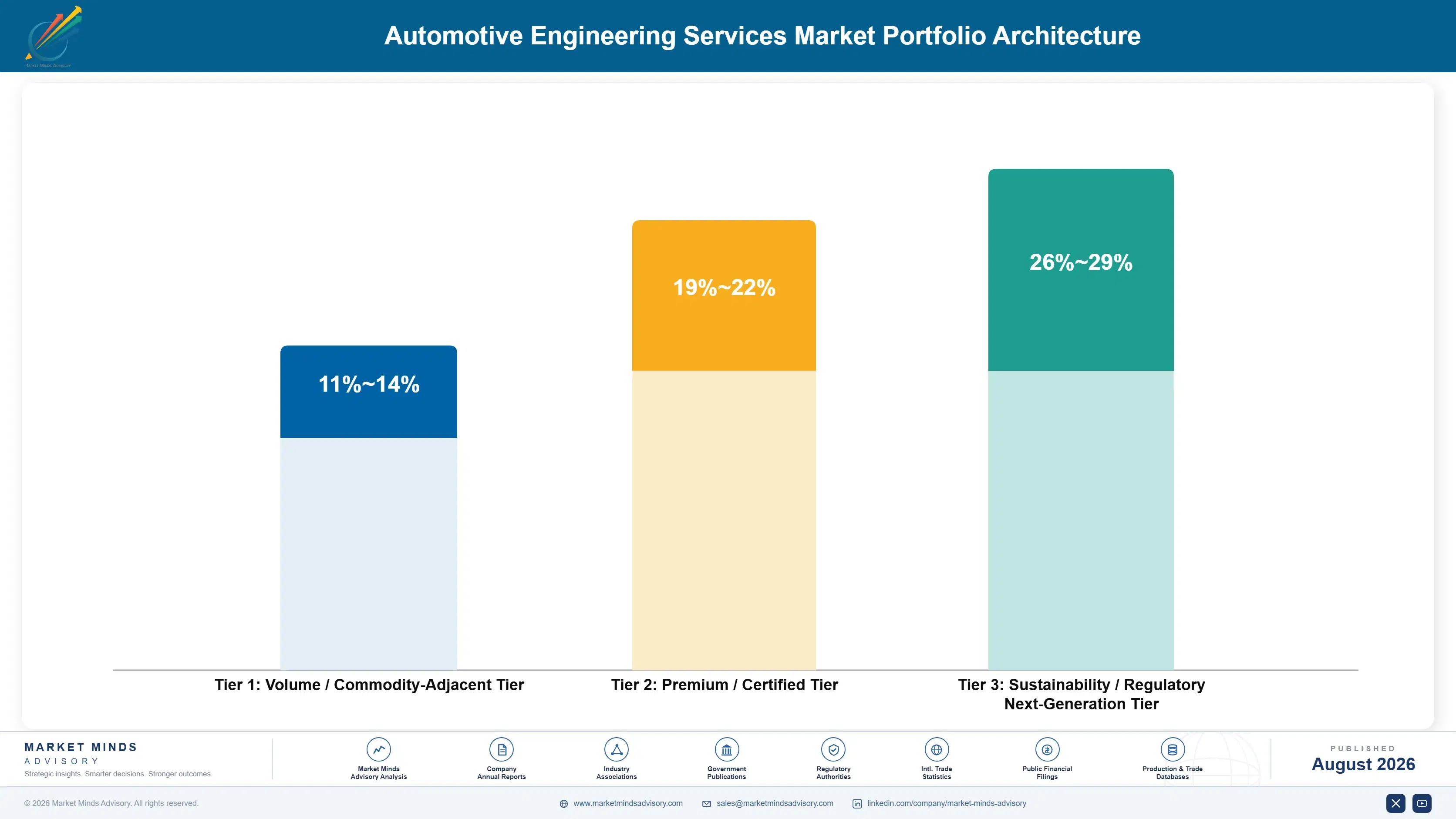
Portfolio Architecture for Margin Defence

Automotive Engineering Services Market splits into three commercial tiers with different margin economics: a volume tier built on traditional mechanical and testing engineering sold into mainstream automaker development programs, a premium tier built on powertrain and electrification engineering commanding specialized talent premiums, and a next-generation tier built on software and electronics engineering still scaling toward full commercial economics. Gross margins range from roughly 12 percent at the volume end to over 28 percent for differentiated software services.
Volume-tier providers compete primarily on price and reliable delivery into commodity mechanical and testing engineering work, where specialized capability matters less than consistent staffing at the lowest deliverable cost. Premium-tier providers instead compete on software and electronics engineering depth for automakers unwilling to compromise on software-defined vehicle capability, accepting materially higher talent costs in exchange for pricing power volume-tier competitors cannot access.

High-value margin pools concentrate in software and electronics engineering contracts sold under exclusive multi-year agreements to automakers pursuing software-defined vehicle strategies, where buyers pay for both specialized talent and platform integration partnership simultaneously. Traditional mechanical engineering remains the volume backbone of the market, but its margin ceiling is capped by an increasingly competitive set of regional providers entering the segment.

Volume / Commodity-Adjacent Tier

Traditional mechanical and testing engineering services sold into mainstream automaker development programs at competitive pricing, prioritizing reliable staffing delivery over specialized technical differentiation, serving conventional body, chassis, and validation work across mature vehicle development categories.
Gross Margin: 11-14%

Premium / Certified Tier

Powertrain and electrification engineering services with documented specialized talent and technical delivery credentials sold to automakers requiring verified electric vehicle development expertise, commanding higher project rates than traditional mechanical engineering equivalents under multi-year program contracts.
Gross Margin: 19-22%

Sustainability / Regulatory / Next-Generation Tier

Software and electronics engineering marketed on software-defined vehicle development depth and platform integration expertise, targeting automakers pursuing competitive differentiation through vehicle software capability, commanding the highest margins as specialized talent scarcity continues supporting premium pricing power.
Gross Margin: 26-29%
automotive-engineering-services-market-portfolio-architecture-1787464800156

High-value Sub-segments and Strategic Watch-out

Software And Electronics Engineering

Software and electronics engineering is both the highest-margin and fastest-growing segment as automakers fund exclusive partnership contracts to secure specialized talent for software-defined vehicle development, attracting the bulk of all new investment from leading global engineering services providers worldwide during this very current strong cycle.
Gross Margin: 26-29%

Powertrain And Electrification Engineering

Powertrain and electrification engineering for premium electric vehicle programs continues generating strong margins even as growth moderates relative to software engineering, supported by established customer relationships and technical capability that newer entrants still need many years to replicate credibly with major automakers globally today still.
Gross Margin: 19-22%

Traditional Mechanical Engineering Core Volume

Traditional mechanical and testing engineering sold at competitive volume pricing into mainstream automaker development programs remains the market's core revenue base even as margins compress under rising competition from lower-cost regional providers entering the segment at a very meaningful scale across many different geographies worldwide.
Gross Margin: 11-14%

Specialized Talent Supply Concentration Risk

Specialized talent supply concentrated among a limited pool of software and electronics engineers represents the segment providers and investors should watch most closely, since a sustained multi-year talent shortage could constrain delivery capacity broadly and slow automaker software-defined vehicle development timelines across the entire industry.
Gross Margin: 7-10%

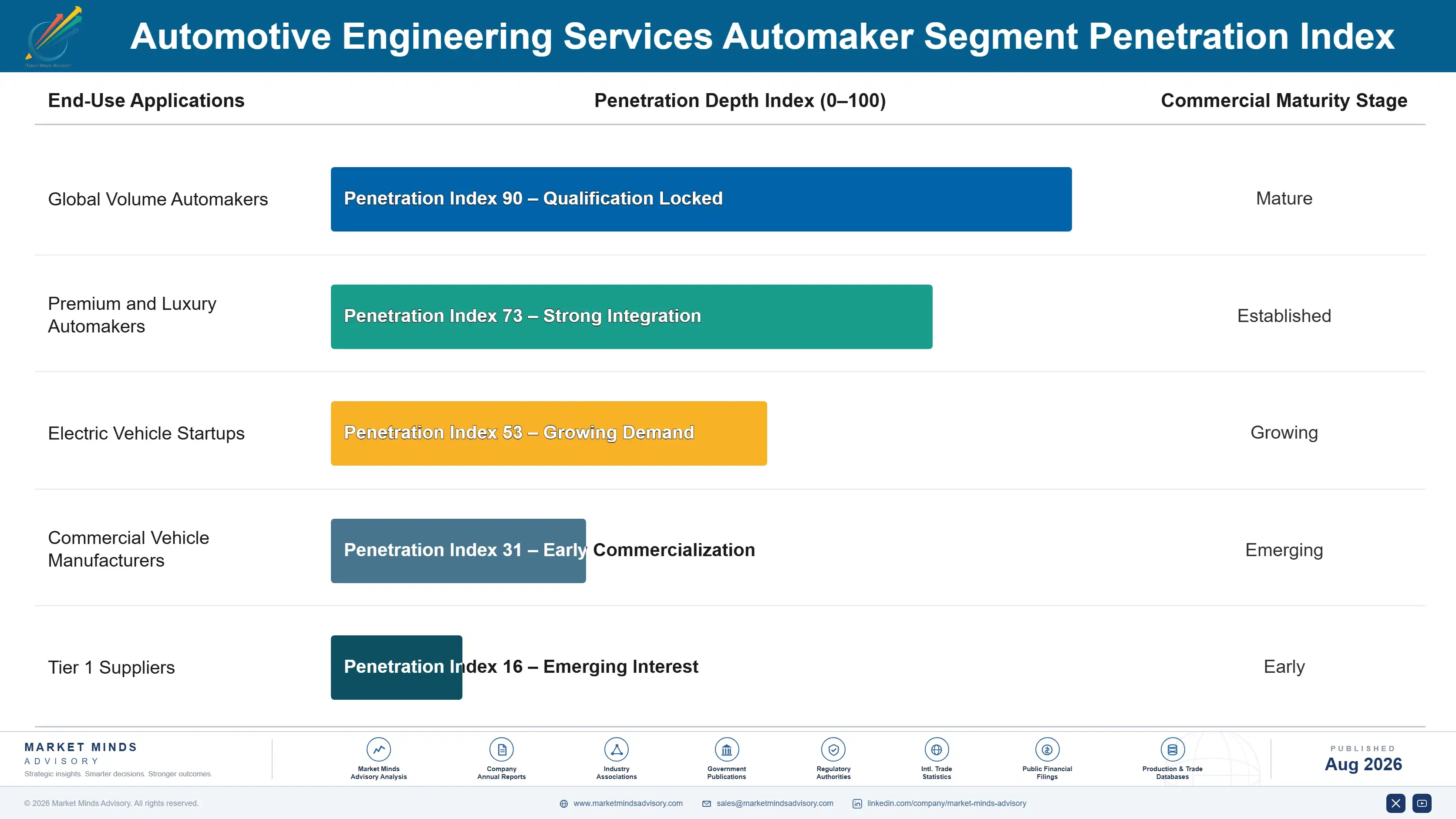
Why Engineering Services Contracts Renew Reliably

Once an automaker qualifies an engineering services provider against its capability and cost benchmarks for a specific vehicle program, the relationship tends to persist across the full program lifecycle rather than being re-tendered annually, since re-qualification carries real cost and delivery risk for the buyer. This qualification stickiness gives incumbent providers reliable, repeat revenue once a program contract is won, a dynamic that rewards established relationships more than aggressive price competition alone.
Adoption runs deepest in software-defined vehicle and electrification programs, where specialized engineering capability is a defining determinant of program success that automakers cannot easily substitute without risking development delays, and shallowest in traditional mechanical engineering work, where automakers retain more staffing flexibility. Testing and validation work sits between these extremes, adopting specialized providers selectively across complex programs while retaining simpler staffing arrangements for routine work within the same portfolio.

A younger cohort of program managers at automakers, now negotiating engineering services contracts, treats software and electronics capability as a baseline program requirement rather than a differentiator their predecessors debated case by case. This generational shift is compressing the qualification timeline for new engineering practice relationships at automakers that previously relied on traditional mechanical engineering providers exclusively.
automotive-engineering-services-market-end-use-penetration-index-1787464800668

Where To Place Services Bets

These are among the four positions where our research anticipates prominent divergence between winners and laggards over the coming forecast period. Each is grounded in the demand model, the regulatory perimeter, and the announced capacity pipeline.
01 / SOFTWARE ENGINEERING INVESTMENT

Back Software Engineering Practices Before Rivals Do

Software and electronics engineering is growing faster than any other discipline as automakers demand specialized talent that internal teams cannot fully staff given persistent scarcity across the industry. Providers that invest in software practice capacity and talent recruitment now will lock in preferential access to premium automaker contracts before generalist mechanical engineering competitors complete their own capability build-out. Waiting for the software talent market to ease before investing risks ceding the most defensible long-term position to competitors who moved earlier and already control the strongest software engineering practices.
02 / STRATEGIC PARTNERSHIP DEVELOPMENT

Secure Strategic Automaker Partnerships Now

Strategic partnership contracts secured with major automakers offer providers durable, multi-year revenue positions difficult for competitors to displace once a program relationship has been established, since automakers increasingly prefer fewer, larger engineering partners over many small specialized vendors. Providers that invest in dedicated automaker account teams now capture preferential access to these partnership contracts before competitors recognize the shift toward relationship consolidation and respond with their own dedicated investment. This capability requires sustained relationship investment but offers durable, multi-year returns once secured.
03 / TALENT RETENTION CAPABILITY

Build Talent Retention Capability Ahead Of Rivals

Specialized talent retention has become a genuine competitive differentiator as persistent software and electronics engineering scarcity makes staffing stability a critical factor in automaker provider selection decisions across the entire industry today. Providers that invest in talent development and retention programs now build delivery reliability that price-focused competitors facing higher turnover cannot match, particularly for complex, multi-year software-defined vehicle programs requiring continuity. Building this capability takes years, making it a strategic priority best pursued well ahead of the next talent cycle.
04 / OFFSHORE DELIVERY EXPANSION

Expand Offshore Delivery Capacity Now

Offshore delivery capability offers providers a durable cost advantage that becomes more valuable precisely when compensation inflation squeezes industry-wide engineering margins across onshore delivery markets facing persistent talent scarcity and rising competition. Providers without established offshore operations remain exposed to onshore compensation cost pressure that integrated competitors with mature offshore capability can largely avoid while maintaining comparable delivery quality standards throughout. Building this capability takes years, making it a strategic priority best pursued well before the next compensation cycle arrives.

Engagement Snapshot From the Field

A live engagement with an industry participant carrying material or product regulatory and market exposure ahead of a defining policy shift, showing how our research translates into a defensible multi-year portfolio strategy.
MARKET MINDS ADVISORY · CLIENT ENGAGEMENT SUMMARY
Automotive Engineering Services Producer Strategic Portfolio Review and Transition Roadmap 2026·Investment Scenario on Automotive Engineering Services Exposure Evaluation 2025-26
CLIENT PROFILE
The client is a multinational automaker generating approximately 42 billion dollars (client-reported, unverified by MMA) in annual vehicle revenue across North America and Western Europe. The company had committed publicly to accelerating its software-defined vehicle development timeline within an eighteen-month program to compete more effectively with digitally native electric vehicle entrants gaining significant market share.
STRATEGIC CHALLENGE
The client's internal software engineering headcount could not scale fast enough to meet the accelerated development timeline, and existing engineering services relationships lacked sufficient specialized software-defined vehicle expertise. Management needed an independent assessment of engineering services providers to determine which could realistically deliver the required specialized talent within the compressed timeline.
MMA APPROACH
MMA conducted primary interviews with delivery and quality leadership across five engineering services providers, benchmarking software and electronics practice depth, documented software-defined vehicle project experience, and prior large-scale automaker program delivery against the client's timeline requirements. The analysis included staffing capacity assessment and stress-tested each candidate's talent scale-up timeline against the client's program deadline.
KEY FINDINGS
  1. Two of five evaluated providers had prior commercial experience delivering comparable software-defined vehicle engineering programs for similarly sized automakers within a twelve-month timeline.
  2. Staffing capacity assessment showed meaningful talent availability variance across candidates, ranging from immediate deployment of dedicated teams to twelve-month recruitment and onboarding requirements.
  3. Program delivery timelines across candidates ranged from ten to twenty months, with the fastest candidate requiring meaningfully less lead time before full team deployment.
  4. Pricing structures varied significantly across candidates, with delivered engineering rates ranging from 1.4 to 2.1 times the client's existing internal engineering cost depending on specialization required.
CLIENT PROFILE
The client is a multinational automaker generating approximately 42 billion dollars (client-reported, unverified by MMA) in annual vehicle revenue across North America and Western Europe. The company had committed publicly to accelerating its software-defined vehicle development timeline within an eighteen-month program to compete more effectively with digitally native electric vehicle entrants gaining significant market share.
STRATEGIC CHALLENGE
The client's internal software engineering headcount could not scale fast enough to meet the accelerated development timeline, and existing engineering services relationships lacked sufficient specialized software-defined vehicle expertise. Management needed an independent assessment of engineering services providers to determine which could realistically deliver the required specialized talent within the compressed timeline.
MMA APPROACH
MMA conducted primary interviews with delivery and quality leadership across five engineering services providers, benchmarking software and electronics practice depth, documented software-defined vehicle project experience, and prior large-scale automaker program delivery against the client's timeline requirements. The analysis included staffing capacity assessment and stress-tested each candidate's talent scale-up timeline against the client's program deadline.
KEY FINDINGS
  1. Two of five evaluated providers had prior commercial experience delivering comparable software-defined vehicle engineering programs for similarly sized automakers within a twelve-month timeline.
  2. Staffing capacity assessment showed meaningful talent availability variance across candidates, ranging from immediate deployment of dedicated teams to twelve-month recruitment and onboarding requirements.
  3. Program delivery timelines across candidates ranged from ten to twenty months, with the fastest candidate requiring meaningfully less lead time before full team deployment.
  4. Pricing structures varied significantly across candidates, with delivered engineering rates ranging from 1.4 to 2.1 times the client's existing internal engineering cost depending on specialization required.
RECOMMENDED STRATEGY
Phase 1: Phase 1 (0 to 3 months): Complete provider capability assessment across shortlisted candidates and select a partner based on talent availability and timeline fit. Phase 2: Phase 2 (3 to 14 months): Deploy dedicated software engineering teams across the program, running integration and validation testing throughout the development cycle. Phase 3: Phase 3 (14 to 18 months): Complete software-defined vehicle development milestones ahead of launch, finalizing long-term engineering partnership terms and pricing.
OUTCOME
Within sixteen months, the client completed its accelerated software-defined vehicle development program, achieving a 22 percent (client-reported, unverified by MMA) reduction in development timeline versus its original internal-only development plan. The program was completed ahead of schedule, with the engineering partnership now formalized under a long-term strategic agreement.

Frequently Asked Questions

Foundational context covering the market sizes, CAGR, scope, country, region and competition that inform every finding below. This section is provided to cover basics and most often pre-purchase conversations, answered from the MMA Primary Research Dataset.

What is the current size of the Automotive Engineering Services Market?

The Automotive Engineering Services Market was valued at approximately 48.0 billion dollars in 2025. Growth is driven by software-defined vehicle development and rising electric vehicle powertrain engineering demand.

How large will the Automotive Engineering Services Market be by 2036?

The market is projected to reach approximately 121.4 billion dollars by 2036, up from 52.2 billion dollars in 2026. That represents roughly a 2.32 times expansion over the ten-year forecast window.

What is the CAGR for the Automotive Engineering Services Market 2026 to 2036?

The market is forecast to expand at a compound annual growth rate of 8.8 percent between 2026 and 2036. Bull and bear scenarios range from 10.0 percent to 7.5 percent depending on software outsourcing pace.

Which segment is growing fastest?

Software and electronics engineering is the fastest-growing segment, expanding at an estimated 13.5 percent annually, roughly 1.5 times the overall market rate. Powertrain and EV battery engineering follows at 11.8 percent.

Who are the major companies in the Automotive Engineering Services Market?

AVL, Ricardo, Bertrandt, EDAG, and Segula Technologies lead the market by global engineering services revenue. Combined, the top five providers hold a CR5 of approximately 34 percent.

Which country is growing fastest?

China is the fastest-growing single country, expanding at an estimated 11.5 percent annually as domestic automakers scale engineering capability to support rapid electric vehicle launches. Germany remains the largest engineering talent hub.

Report Segmentation Architecture

The full report scope spans multiple orthogonal segmentation dimensions, with cross-tabulated demand data provided for each dimension pair. Coverage extends further to regional breakdowns, trend trajectories, and the competitive detail needed to support segment-level decision-making.

By Engineering Discipline

  • Software and Electronics Engineering
  • Powertrain and EV/Battery Engineering
  • Body and Chassis Engineering
  • Testing, Validation, and Homologation
  • Prototyping and Vehicle Build Services
  • Design and Styling Services

By Automaker Segment

  • Global Volume Automakers
  • Premium and Luxury Automakers
  • Electric Vehicle Startups
  • Commercial Vehicle Manufacturers
  • Tier 1 Suppliers

By Commercial Dimension

  • Direct Automaker Contracts
  • Staff Augmentation Engagements
  • Strategic Partnership Agreements
  • Offshore Delivery Contracts

By Region

  • North America
  • Western Europe
  • East Asia
  • South Asia and Pacific
  • Latin America
  • Middle East and Africa
  • Eastern Europe

Scope, Methodology, and Coverage

Every figure in this report is reproducible from documented input assumptions. The scope below maps the historical period, the forecast horizon, the segmentation dimensions, and the countries covered, alongside the underlying primary and qualitative methodology.
Historical Period
2020 to 2025
Forecast Period
2026 to 2036
Base Year
2025 (USD billions; MMA Primary Research Dataset, August 2026)
Market Definition
The Automotive Engineering Services Market comprises outsourced engineering, design, and testing services for vehicle development, including software and electronics, powertrain, body and chassis, and validation disciplines, sold to automakers and Tier 1 suppliers. It excludes in-house automaker engineering headcount and non-automotive engineering services.
Quantitative Units
USD billions (current prices); engineering headcount and project volume where disclosed
Segmentation Dimensions
Engineering Discipline; Automaker Segment; Commercial Dimension; By Region
Regions Covered
North America, Western Europe, East Asia, South Asia and Pacific, Latin America, Middle East and Africa, Eastern Europe
Countries Covered
USA, China, Germany, France, UK, Japan, South Korea, India, Australia, Canada, Brazil, Mexico, Indonesia, Vietnam, Thailand, Malaysia, UAE, Saudi Arabia, South Africa, Nigeria, Turkey, Poland, Netherlands, Italy, Spain, Sweden, Switzerland, Argentina, Colombia, Singapore, and additional markets relevant to this sector
Key Companies Profiled
AVL List GmbH, Ricardo plc, Bertrandt AG, EDAG Engineering Group AG, Segula Technologies, Altran (Capgemini Engineering), FEV Group GmbH, IAV GmbH, ALTEN Group, AKKA Technologies (Akkodis), Bosch Engineering GmbH, Continental Engineering Services, IDIADA Automotive Technology, Horiba MIRA, Roush Enterprises, L&T Technology Services, Tata Technologies, KPIT Technologies, HCL Technologies (ER&D), Wipro Engineering
Quantitative Methodology
Primary survey, n=3,800 respondents, Q4 2025, six countries; demand-side model with trade association cross-validation
Qualitative Methodology
47 expert interviews, Q4 2025; applied to validate demand model assumptions, identify emerging dynamics, and assess competitive positioning
Report Format
PDF and XLSX data workbook (Word format preview document)
Publisher
Market Minds Advisory
Report Code
MMA-2026-AUT-302
Published
August 2026
Contact
sales@marketmindsadvisory.com | www.marketmindsadvisory.com

Purchase the full Automotive Engineering Services Market Report (2026 to 2036).

The full Automotive Engineering Services Market report delivers a complete discipline segmentation model spanning software and electronics, powertrain and battery, body and chassis, testing and validation, prototyping, and design engineering services. It includes detailed regional demand and talent cost data across all seven world regions. The report profiles twenty providers, including detailed capacity, practice positioning, and moat and risk assessment for the top five, supported by primary interviews with delivery and procurement leadership. It also includes ten-year forecast scenarios under base, bull, and bear cases, talent cost exposure analysis by region and provider type, and a strategic verdict framework for practice development decisions.
Ten-Year Base, Bull, and Bear Forecasts
Discipline Segmentation Across Six Practice Categories
Full Seven-Region Demand and Talent Cost Breakdown
Twenty-Company Competitive Profiles With Moat Analysis
Talent Cost Exposure and Mitigation Playbook
Primary Interview Data From Delivery Leadership Teams

Built For The People Who Decide

From boardroom strategy to bench-side execution, this report is read cover-to-cover by leaders shaping the next decade of their industry, turning demand scenarios, market dynamics and valuation benchmarks into decisions.
CXOs/ Presidents/ VPs/ Managers
M&A and Corporate Development
Strategy Teams and R&D Heads
Procurement and Product Directors
Regulatory and Compliance Leaders
Investor Relations and Equity Analysts