Market Minds Advisory
Automotive Die-Casting Lubricants Market

Automotive Die-Casting Lubricants Market: Formulating for the Gigacasting Era

Aluminum gigacasting adoption is forcing lubricant formulators to engineer release agents for structural parts far larger than engine blocks, while tightening VOC regulation pushes die casters away from solvent-based products faster than reformulation budgets allow.

Lead Analyst

Bilal Shaikh

Published

September 2026

Make Smarter Decisions with Customized Research Insights

Request a free sample report and evaluate market opportunities, growth trends, and competitive dynamics relevant to your business needs.

2025 MARKET VALUE$1.4BMarket Size 2025
2036 FORECAST VALUE$2.6BBase Case , 2026 to 2036
CAGR 2026 TO 20366.2 %Bull 7.5% / Bear 4.9%
INCREMENTAL OPPORTUNITY$1.2BNet 10- year value creation
EXPANSION MULTIPLE1.82x2036 value over 2026 base
Strategic Levers
M&A Pipeline
Regional Outlook
Country Rankings
Competitive Intelligence
Segmental Deep-dive
Call-Us : 91 93563 13602

Executive Snapshot and Market Trajectory

Die-casting lubricant formulators are navigating two simultaneous shifts at once: aluminum gigacasting is scaling die sizes and clamping forces well beyond anything conventional automotive castings required, and environmental regulation is forcing a parallel move away from solvent-based release agents that die casters relied on for decades.
Specialty additives and concentrates are growing fastest at roughly 1.42 times the market average as gigacasting formulations demand performance beyond what standard release agents deliver, while water-based products follow closely on VOC regulation compliance. East Asia holds the largest share of global spending because China combines the world's largest aluminum die-casting capacity with rapidly expanding electric vehicle structural casting adoption, and its formulators increasingly export proven gigacasting-grade lubricants rather than importing Western formulations.
Five suppliers, Chem-Trend, Quaker Houghton, Fuchs, Chemtool, and Foseco, hold under half of global revenue in a market fragmented enough for regional formulators to compete on technical service. VOC emissions limits in the European Union and increasingly strict California regulations are reshaping which lubricant chemistries die casters specify, favoring suppliers with proven water-based gigacasting formulations over legacy solvent-based products that face tightening restrictions in major manufacturing regions.
Market Definition
The automotive die-casting lubricants market covers water-based and solvent-based die release agents, plunger lubricants, semi-solid and paste lubricants, powder and dry film lubricants, and specialty additives and concentrates used in high-pressure aluminum, magnesium, and zinc die casting for automotive components. It excludes general metalworking fluids, forging lubricants, and sand casting release agents.
Base Year Value
$1.4B in 2025 (MMA Primary Research Dataset, August 2026)
Forecast Period
2026 to 2036, eleven discrete annual values
CAGR
6.2% base case. Bull 7.5%. Bear 4.9%.
Fastest Growth Segment
Specialty Additives and Concentrates: 8.8% CAGR
Fastest Growth Country
China: 9.5% CAGR
Fastest Growth Region
South Asia and Pacific: 8.2% CAGR
Largest Region
East Asia: 29% of 2025 global value
Market Leaders
Chem-Trend, Quaker Houghton, Fuchs, Chemtool, Foseco. Source: MMA Analysis based on company annual reports.
Primary Survey
n=3,800 procurement and R&D decision-makers, Q4 2025, six countries
Methodology
Demand-side build-up, cross-validated against public data, 47 expert interviews

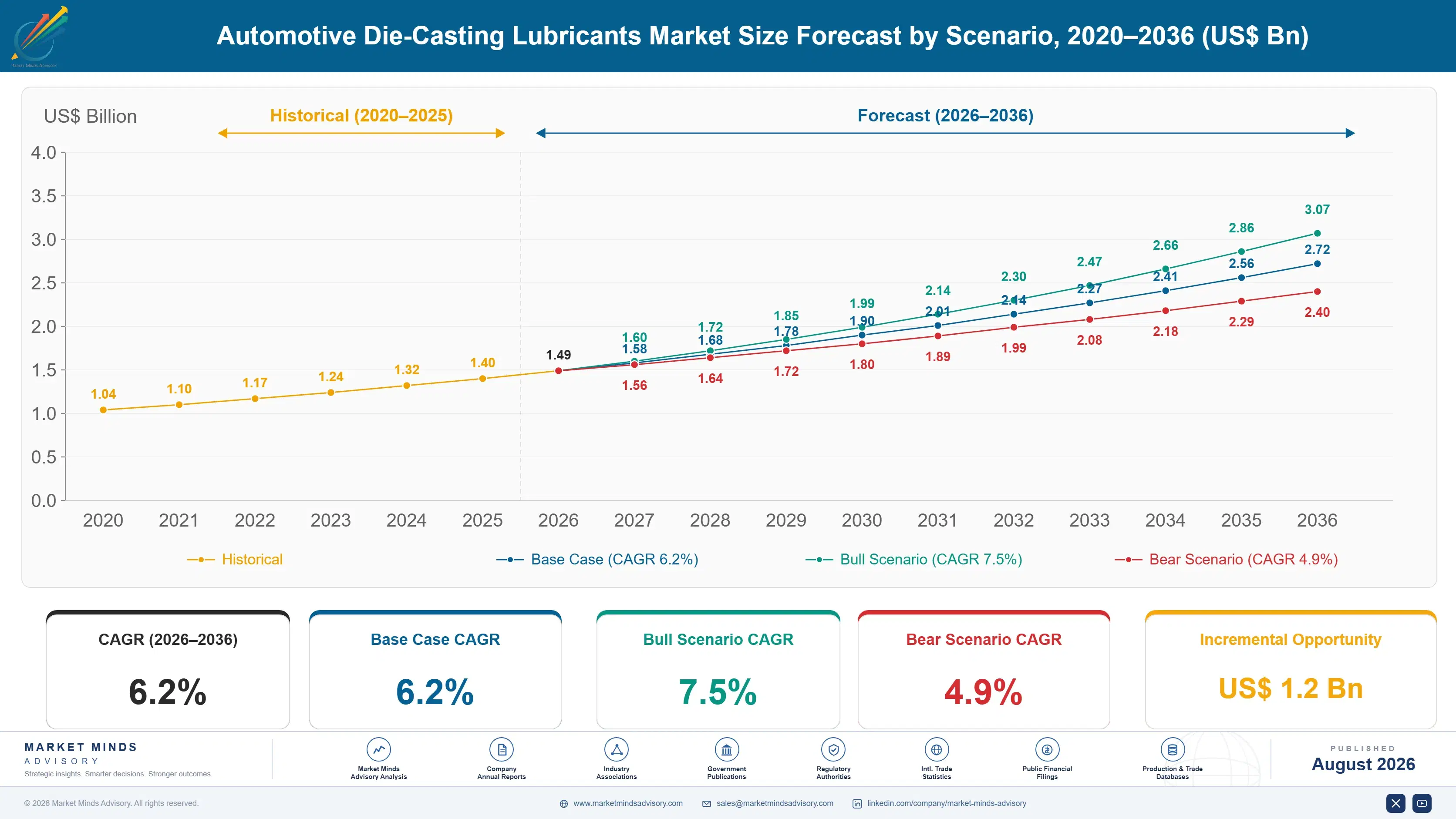
Automotive Die-Casting Lubricants Market Forecast Scenarios

automotive-die-casting-lubricants-market-size-forecast-scenario-1787300947241
The market grew steadily through the early 2020s as aluminum die casting volume tracked broader automotive production, then accelerated from 2023 as gigacasting adoption for electric vehicle structural components began requiring specialized formulations. European Union VOC regulation tightened further during this period, accelerating the shift toward water-based chemistry. The result was a 5.2 percent historical CAGR, weighted toward formulation upgrades rather than raw casting volume growth.
The base case rests on three mechanisms. First, gigacasting adoption for electric vehicle structural components requires specialized formulations that command meaningfully higher prices than conventional release agents. Second, VOC regulation in the European Union and California is forcing a permanent shift from solvent-based to water-based chemistry, lifting formulation complexity and cost. Third, aluminum content per vehicle keeps rising as automakers substitute aluminum for steel to offset battery weight, expanding the addressable casting volume lubricants must serve.
The bull case turns on accelerating gigacasting adoption if automakers beyond Tesla and BYD commit to large structural aluminum castings this decade, pulling specialty lubricant demand above forecasts. The bear case centers on an automotive production slowdown that delays new casting capacity investment, extending the working life of existing formulations and pushing die casters toward cheaper, lower-performance alternatives.

Gigacasting Redraws the Formulation Requirements

Automotive die-casting lubricants sit at the intersection of two forces: gigacasting technology that demands formulation performance conventional release agents were never engineered to deliver, and environmental regulation that is forcing a parallel retreat from solvent-based chemistry regardless of performance considerations. Both forces push formulators toward higher-value water-based and specialty concentrate products, rather than toward the cheaper conventional formulations that dominated t
CR5 CONCENTRATION42%Fragmented market leaves considerable room for regional formulators
AVERAGE SELLING PRICE$4.20 per liter concentrateGigacasting formulations command steep premium over standard agents
TOP PRODUCING COUNTRY SHARE26%China leads global aluminum die-casting lubricant manufacturing output
WATER-BASED PENETRATION58% of new formulation ordersRegulatory pressure keeps pushing die casters toward water chemistry
TRADE INTENSITY27% of output exportedCross-border lubricant shipments rise with new casting capacity
INPUT COST SHARE48% of COGSSpecialty surfactants and release polymers dominate formulation costs
Commercially, the market behaves like a technical service relationship more than a commodity chemical purchase. Chem-Trend and Quaker Houghton both increasingly embed application engineers directly with die caster customers to optimize formulation and dosing for specific casting geometries, since a poorly matched lubricant can cause costly casting defects. Smaller regional formulators compete mainly on price and delivery speed for conventional, lower-complexity casting applications that make up the bulk of total volume.
Over the next decade, gigacasting-grade specialty formulations will keep growing faster than conventional die-casting lubricants, and suppliers without proven water-based, high-performance chemistry will increasingly lose specification battles to those that have already qualified with major automotive OEMs and their casting suppliers across multiple structural component programs and regions worldwide.
"A gigacasting die failure isn't a scrapped part, it's a scrapped vehicle underbody. That single fact is why formulators who can prove reliability at scale are writing their own pricing terms right now."
Director, Automotive Materials and Process Chemicals Practice · MMA Chemicals an

Market Trends

Gigacasting Demands Entirely New Lubricant Formulations

Gigacasting presses now producing single aluminum castings the size of a vehicle underbody require lubricant formulations engineered for larger die surfaces, longer cycle times, and higher clamping forces than conventional engine block or transmission housing casting ever demanded. Tesla pioneered large-scale gigacasting adoption, and Chinese automakers including BYD and NIO have since followed with their own casting programs, each requiring formulators to requalify chemistry for die geometries far beyond historical norms. Chem-Trend and Fuchs have both developed dedicated gigacasting product lines to serve this application, reporting order volumes growing considerably faster than their conventional business.
Market Impact: Adds 18 percent aluminum casting volume
VOC Regulation Accelerates Water-Based Chemistry Shift

European Union industrial emissions regulation and California's stringent air quality rules are both tightening volatile organic compound limits on manufacturing, forcing die casters to specify water-based release agents over solvent-based products that historically offered superior release performance in demanding applications. Formulators have spent years closing the performance gap, and recent generation water-based products now match solvent-based release performance in most conventional applications, removing the technical justification many die casters previously cited for continuing solvent-based use. Quaker Houghton reports water-based orders growing meaningfully faster than solvent-based orders across every region with active enforcement.
Market Impact: Gigacasting formulations command 35 percent premium

Market Opportunities and Growth Drivers

Rising Aluminum Content Per Vehicle Expands Casting Volume

Automakers are substituting aluminum for steel across a growing share of vehicle structures to offset the weight electric vehicle battery packs add, expanding the aluminum die-casting volume that lubricant formulators must serve well beyond what internal combustion engine production alone ever required. Each new aluminum component requires its own die-casting lubricant qualification, and formulators that have already validated chemistry for a given automaker's specific alloy and casting process capture repeat business across that automaker's expanding aluminum portfolio. This dynamic is lifting lubricant volume per vehicle even in years when production stays flat.
Market Impact: Surfactant costs rose 25 percent

Gigacasting Investment Commands Premium Formulation Pricing

Automakers investing in gigacasting presses are willing to pay meaningfully more for lubricant formulations proven to work reliably at the scale and cycle times these machines require, since a formulation failure on a single-piece casting is far costlier than a defect on a smaller component that represents a fraction of the vehicle's value. Formulators that have successfully qualified gigacasting-grade chemistry capture premium pricing and lock in long-term supply relationships that are difficult for competitors to displace once a lubricant is validated into production. Fuchs and Chem-Trend both report gigacasting-qualified lines carry substantially higher margins than conventional sales.
Market Impact: Delays formulation adoption 18 months

Market Restraints and Challenges

Specialty Surfactant Costs Squeeze Formulator Margins

Specialty surfactants and release polymers used in water-based die-casting lubricant formulations account for a large share of production cost, and pricing tracks petrochemical feedstock markets that formulators do not control directly. When feedstock prices spiked during 2022's energy crisis, formulators absorbed much of the increase to remain price-competitive against conventional solvent-based alternatives, compressing margins across water-based product lines specifically. Mid-tier formulators without long-term surfactant supply contracts felt this hardest, while Chem-Trend and Quaker Houghton leaned on scale purchasing agreements and began qualifying alternative surfactant chemistries to reduce future feedstock exposure.
Market Impact: Lifts gigacasting formulation orders 30 percent

Casting Defect Liability Slows New Formulation Adoption

Die casters remain cautious about switching formulations given the real risk that a poorly matched chemistry can cause porosity or surface defects that scrap an expensive casting, particularly on gigacasting parts where a single defect represents substantial material loss. The root cause is that lubricant performance depends on precise interaction with specific alloy compositions and die temperatures, so switching requires trial validation before a die caster commits to full production. Formulators are addressing this by offering extended trial periods and on-site support during transitions, reducing the risk that keeps some casters on legacy chemistry longer than performance alone would justify.
Market Impact: Lifts water-based penetration 22 percent
3 additional market trends, 3 additional growth drivers, and 3 additional restraints and challenges are covered in the full report. Contact sales@marketmindsadvisory.com to access the complete intelligence.

Segment CAGR and Growth Architecture

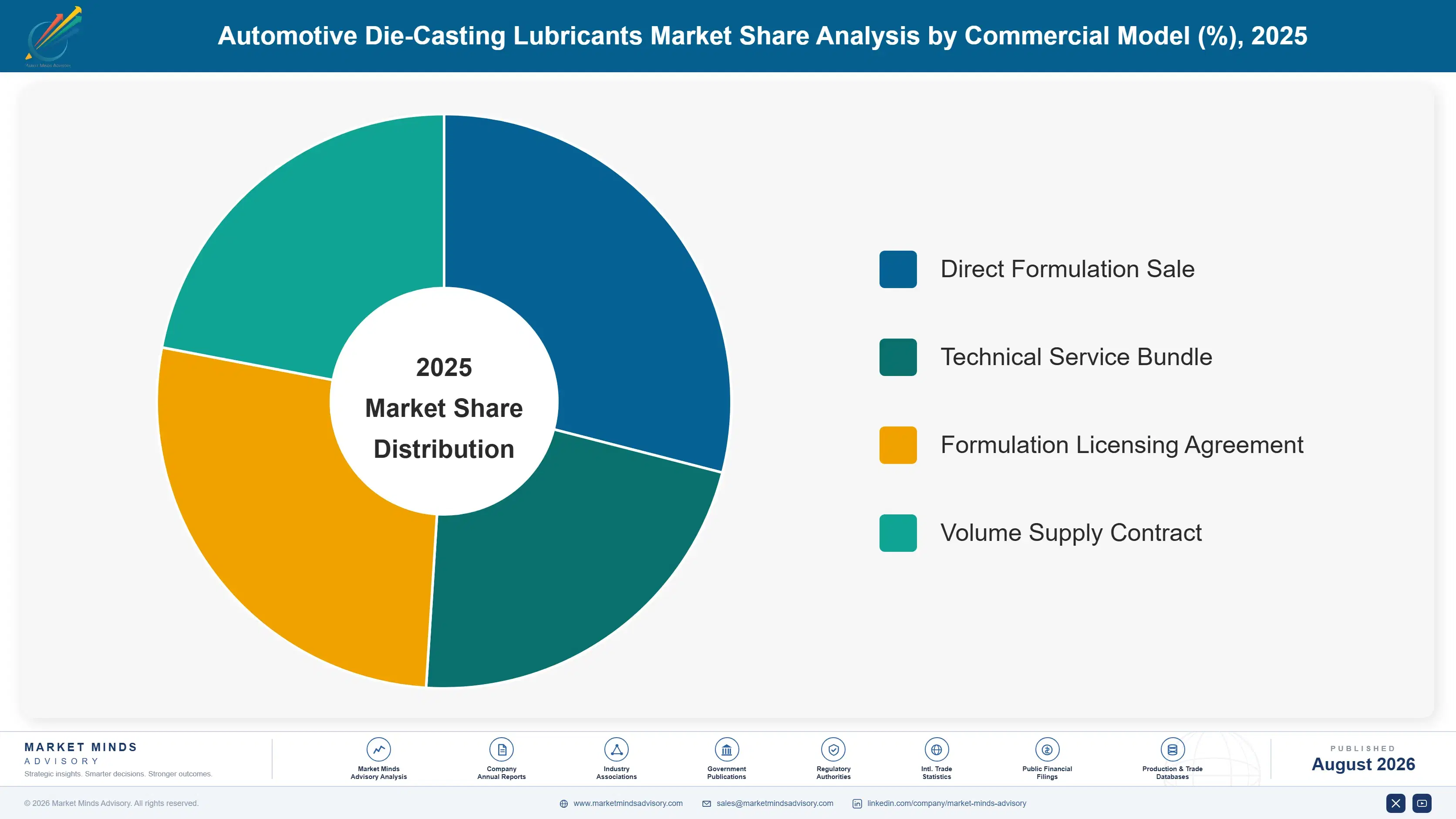
Segmentation follows lubricant chemistry type rather than end-use component or alloy, since a single die-casting operation typically uses multiple lubricant categories across its production process. Six categories span the chemistry range from primary die release agents through plunger and specialty additives, reflecting how die casters budget and specify each chemistry as a distinct procurement line.
automotive-die-casting-lubricants-market-market-share-analysis-1787300947774

Specialty Additives and Concentrates

Specialty additives and concentrates are growing fastest as gigacasting and other demanding applications require performance-enhancing formulations beyond what standard release agents and plunger lubricants alone can deliver. These concentrated additive packages let die casters fine-tune release performance, thermal stability, and surface finish for specific alloy and casting geometry combinations, commanding meaningfully higher prices than standard formulations given their technical complexity. Chem-Trend and Fuchs both lead gigacasting-qualified additive development, while smaller specialty chemical formulators compete on niche applications like magnesium die casting, which requires distinct chemistry given magnesium's different reactivity characteristics compared with aluminum. Qualification cycles for specialty additives run considerably longer than for standard release agents, creating durable technical relationships once a formulation is validated into a production process.
CAGR 8.8%

Water-Based Die Release Agents

Water-based die release agents are growing quickly as VOC regulation in the European Union and California forces die casters away from solvent-based chemistry regardless of historical performance preferences. Quaker Houghton and Foseco both lead water-based product development, having invested years closing the performance gap that once made solvent-based products the default choice for the most demanding applications. Regional formulators in China and India are qualifying competing water-based chemistry specifically to serve domestic automotive manufacturers facing increasingly strict emissions regulation of their own. This category increasingly represents the default specification for new die-casting lines, since new facility permits in most major manufacturing regions now require water-based or otherwise low-VOC chemistry from the outset rather than allowing solvent-based installation.
CAGR 8.0%
Full segment breakdown across 6 segments available in the complete report.

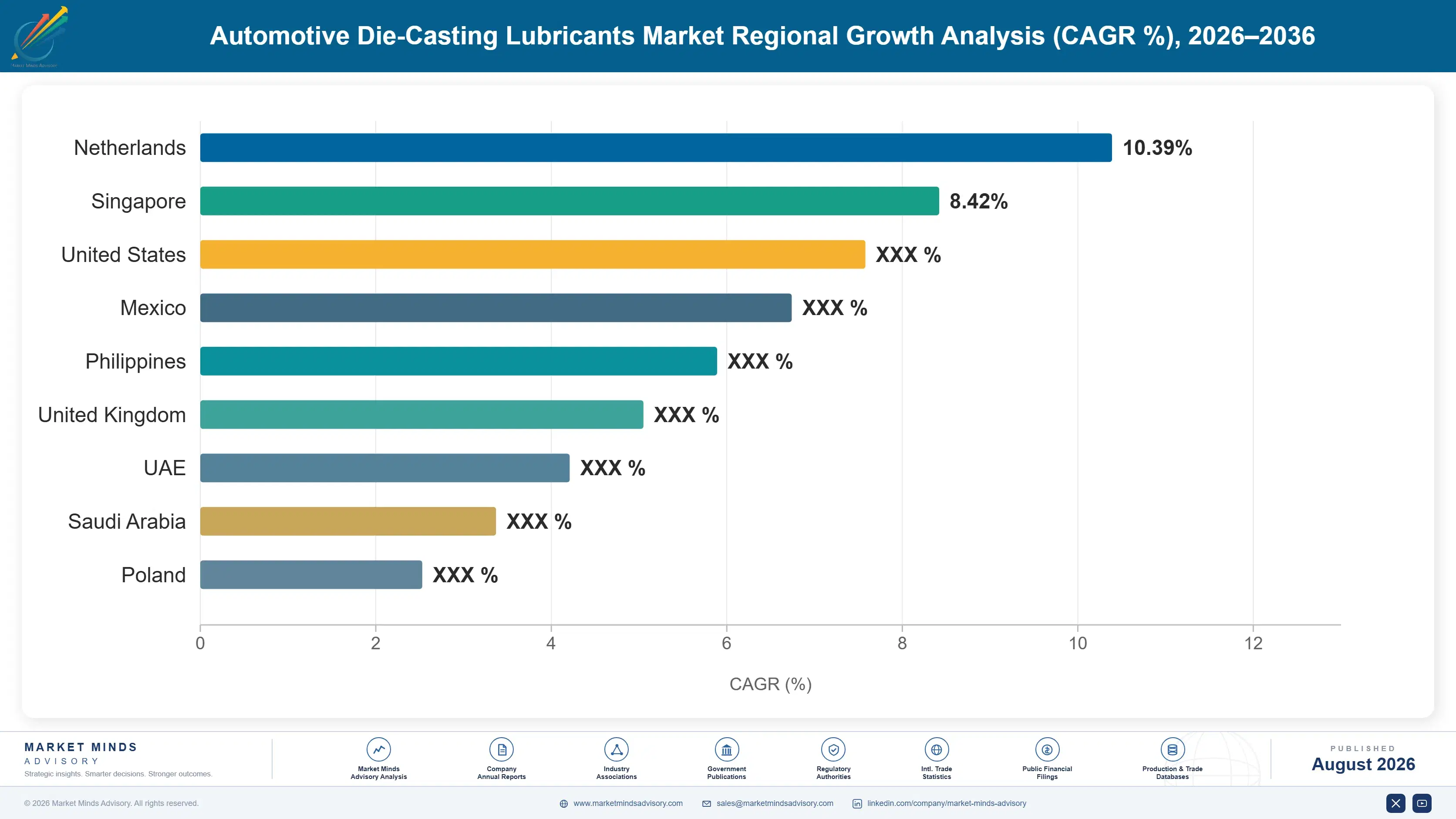
Regional Architecture and Country Demand Map

Demand concentrates where automotive manufacturing volume and gigacasting investment are significant. East Asia leads on China's die-casting scale and electric vehicle casting adoption, North America and Western Europe sustain steady demand, while South Asia and Pacific gains share fastest on expanding production and export capacity.

East Asia

China's aluminum die-casting capacity exceeds that of any other country, anchored by both conventional automotive component production and the world's most aggressive electric vehicle gigacasting adoption led by domestic automakers including BYD and NIO. Domestic formulators have scaled rapidly to serve this demand, increasingly qualifying gigacasting-grade chemistry that rivals imported Western formulations in performance while offering faster technical response given proximity to customer facilities. South Korea's automotive manufacturing base, led by Hyundai and Kia's expanding electric vehicle production, adds a second significant demand layer within the region. Japan's more mature automotive sector sustains steady replacement demand, while Taiwan's growing role in automotive component manufacturing contributes a smaller but genuine incremental layer of regional demand.
Share: 29% | CAGR: 7.2% (2026 to 2036)

North America

United States automotive manufacturers are investing in domestic gigacasting capacity specifically to support electric vehicle structural component production, with Tesla's pioneering adoption increasingly followed by traditional automakers evaluating similar large-format casting investment. Chem-Trend and Quaker Houghton, both with significant United States manufacturing and technical service presence, are well positioned to capture this domestic gigacasting-driven demand growth. Mexico's automotive manufacturing sector, benefiting from nearshoring investment as automakers diversify production away from more distant supply chains, is adding a genuinely significant layer of regional demand tied to both conventional and increasingly electric vehicle component production. Canada's smaller automotive manufacturing base contributes steady but slower-growing conventional demand, and several suppliers maintain dedicated technical service teams there.
Share: 24% | CAGR: 6.5% (2026 to 2036)
Regional intelligence for 5 additional markets available in the complete report: Western Europe, South Asia and Pacific, Latin America, Middle East and Africa, Eastern Europe. Contact sales@marketmindsadvisory.com.
automotive-die-casting-lubricants-market-country-cagr-analysis-1787300948279

Where Formulators Can Grow Margin

Volume growth alone will not sustain margins in a market where conventional die-casting lubricants remain intensely price-competitive across mature automotive applications. The more durable path runs through gigacasting formulation qualification, technical service bundling, and water-based chemistry licensing, each of which carries pricing power that standard release agent sales increasingly lack in a maturing conventional segment.

Qualifying Premium Gigacasting Formulation Product Lines

Gigacasting presses require lubricant formulations validated at a scale and cycle time few conventional applications ever demanded, a qualification process that can take a year or more but creates durable supply relationships once completed given the cost of requalifying an alternative on high-volume production. Formulators that invest in this qualification capture premium pricing and long-term contracts worth considerably more per program, since automakers pay for validated reliability rather than shopping on price for critical applications. Chem-Trend's gigacasting-qualified line has captured an estimated 20 percent larger share of new large-format casting programs since expanding its qualification capability.
Market Impact: Gigacasting contracts command roughly a 35 percent premium

Bundling Technical Service With Formulation Sales

Bundling on-site application engineering and dosing optimization support with lubricant formulation sales turns a commodity chemical purchase into a technical service relationship that die casters value for reducing costly casting defects and production downtime. Quaker Houghton and Chem-Trend both report technical service-bundled accounts show an estimated 22 percent higher customer retention than accounts buying purely on price, since die casters value having a single accountable partner for both chemistry and application optimization rather than troubleshooting formulation issues independently. This model also creates switching costs, since a die caster's process has effectively been optimized around a specific formulator's chemistry over time.
Market Impact: Bundled service lifts customer retention by 22 percent

Licensing Water-Based Chemistry to Regional Formulators

Formulators that have proven water-based chemistry meeting the strictest VOC standards can license that intellectual property to regional formulators serving markets where direct manufacturing does not make economic sense, capturing royalty revenue without new capital investment in every market. This model lets technology leaders like Quaker Houghton monetize development investment across a broader footprint than they could build organically, while licensees gain access to proven, validated chemistry rather than developing competing formulations from scratch. Early licensing deals in Southeast Asia and Latin America are generating royalty revenue that scales with licensee volume, worth roughly 12 percent of revenue.
Market Impact: Licensing captures roughly 12 percent of royalty revenue

Building Advanced Alloy-Specific Formulation Product Portfolios

Automakers increasingly specify unique aluminum alloy compositions optimized for specific structural or powertrain applications, and formulators that build dedicated alloy-specific lubricant portfolios rather than offering a single general-purpose formulation can command premium pricing for the additional validation work involved. This approach particularly appeals to automakers pursuing weight reduction through advanced alloy chemistry, since generic lubricant formulations often underperform on newer, more reactive alloy compositions that require tailored release chemistry. Fuchs has expanded its alloy-specific formulation portfolio significantly since 2023, capturing an estimated 15 percent larger share of new advanced alloy casting programs than formulators offering only general-purpose products.
Market Impact: Wins roughly 15 percent more advanced alloy programs

Who Controls the Margin Pool

Five suppliers, Chem-Trend, Quaker Houghton, Fuchs, Chemtool, and Foseco, hold under half of global revenue in a market fragmented enough for regional formulators to compete on technical service, and the gap between the global leaders and a tail of regional players is narrower than in more concentrated automotive supply categories. Chem-Trend and Quaker Houghton both run the broadest technical service networks with proven gigacasting qualification.
Current competitive activity centers on three fronts. Suppliers are racing to qualify gigacasting-grade formulations across every major automaker's casting program, since that qualification is becoming a specification requirement rather than a differentiator. They are building technical service bundling and licensing programs to capture recurring revenue, and expanding alloy-specific portfolios to meet weight reduction goals. Regional Asian formulators are qualifying competing chemistry to displace Western suppliers in price-sensitive segments.

Emerging pressure comes from two directions. Regional Chinese formulators are exporting increasingly credible conventional and water-based lubricants into Southeast Asian and African markets at prices Western suppliers struggle to match. Specialized gigacasting formulation start-ups are also entering by partnering directly with automakers on custom chemistry development, threatening to capture premium specification business before established formulators fully commercialize their own next-generation gigacasting product lines.
automotive-die-casting-lubricants-market-company-positioning-matrix-1787300948803

Competitive Moat and Risk Dimensions

CHEM-TREND

Moat: Broadest Gigacasting Qualification Portfolio

Chem-Trend operates the broadest portfolio of gigacasting-qualified lubricant formulations validated across multiple automaker large-format casting programs, letting it serve customers as a proven technology partner rather than an unvalidated new entrant. That breadth of field-proven gigacasting experience is difficult for smaller specialized competitors to replicate without years of parallel qualification investment across programs.
CHEM-TREND

Risk: Regional Formulators Undercutting on Price

Regional Asian formulators are qualifying competing conventional and water-based chemistry at substantially lower price points, and as their technical capability narrows the gap with Chem-Trend's offering in standard applications, premium pricing in price-sensitive emerging markets faces growing pressure from suppliers willing to compete primarily on cost.
QUAKER HOUGHTON

Moat: Deep Water-Based Chemistry Leadership

Quaker Houghton's early and sustained investment in water-based die-casting chemistry gives it the most field-proven track record in the industry, built through years of formulation refinement that closed the performance gap with solvent-based products other formulators are only now beginning to match at comparable scale.
QUAKER HOUGHTON

Risk: Conventional Product Line Growth Slowing

Quaker Houghton's legacy exposure to conventional, non-gigacasting die-casting applications remains larger than some peers, and as growth in that segment slows relative to gigacasting-driven demand, that legacy exposure drags on overall segment growth even as its water-based and specialty product lines outperform the broader conventional category.

Key Players

Chem-Trend
Quaker Houghton
Fuchs
Chemtool
Foseco

Others

Zeller+Gmelin
Henkel
Klueber Lubrication
Petrofer
Rocol
Dow
CONDAT
Wesco Lubricants
Ashland
Metalube
Blaser Swisslube
Bruggemann Chemical
DuBois Chemicals
Nihon Parkerizing
Zircotec

Recent Developments

MARCH 2025

Chem-Trend Launches Gigacasting Formulation Line for Structural Components

Chem-Trend launched a new lubricant formulation line specifically engineered for gigacasting structural components, targeting automakers expanding large-format aluminum casting capacity for electric vehicle production. The launch followed extensive field validation with several undisclosed automaker customers across gigacasting programs in North America and Asia over eighteen months.
Signal: Signals major formulators extending proven technology into the fastest-growing segment of the die-casting lubricant market industry-wide.
AUGUST 2024

Quaker Houghton Acquires Regional Water-Based Formulation Specialist

Quaker Houghton acquired a privately held regional water-based die-casting lubricant specialist to strengthen its position serving automotive manufacturers transitioning away from solvent-based chemistry. The acquisition adds proprietary water-based formulation technology to Quaker Houghton's existing product portfolio, deepening its regulatory compliance positioning meaningfully across several key accounts.
Signal: Signals consolidation in water-based chemistry as suppliers bring specialized formulation capability in-house rather than partnering externally.
JANUARY 2025

Fuchs Expands Chinese Manufacturing Capacity for Water-Based Lubricants

Fuchs opened an expanded water-based die-casting lubricant manufacturing facility in China dedicated to serving domestic automotive manufacturers under tightening emissions regulation. The facility increases Fuchs's Chinese production capacity and supports faster technical response to local automaker specification requirements across multiple growing provinces and export markets.
Signal: Signals Western suppliers investing directly in Chinese manufacturing to defend share against domestic formulators gaining ground.

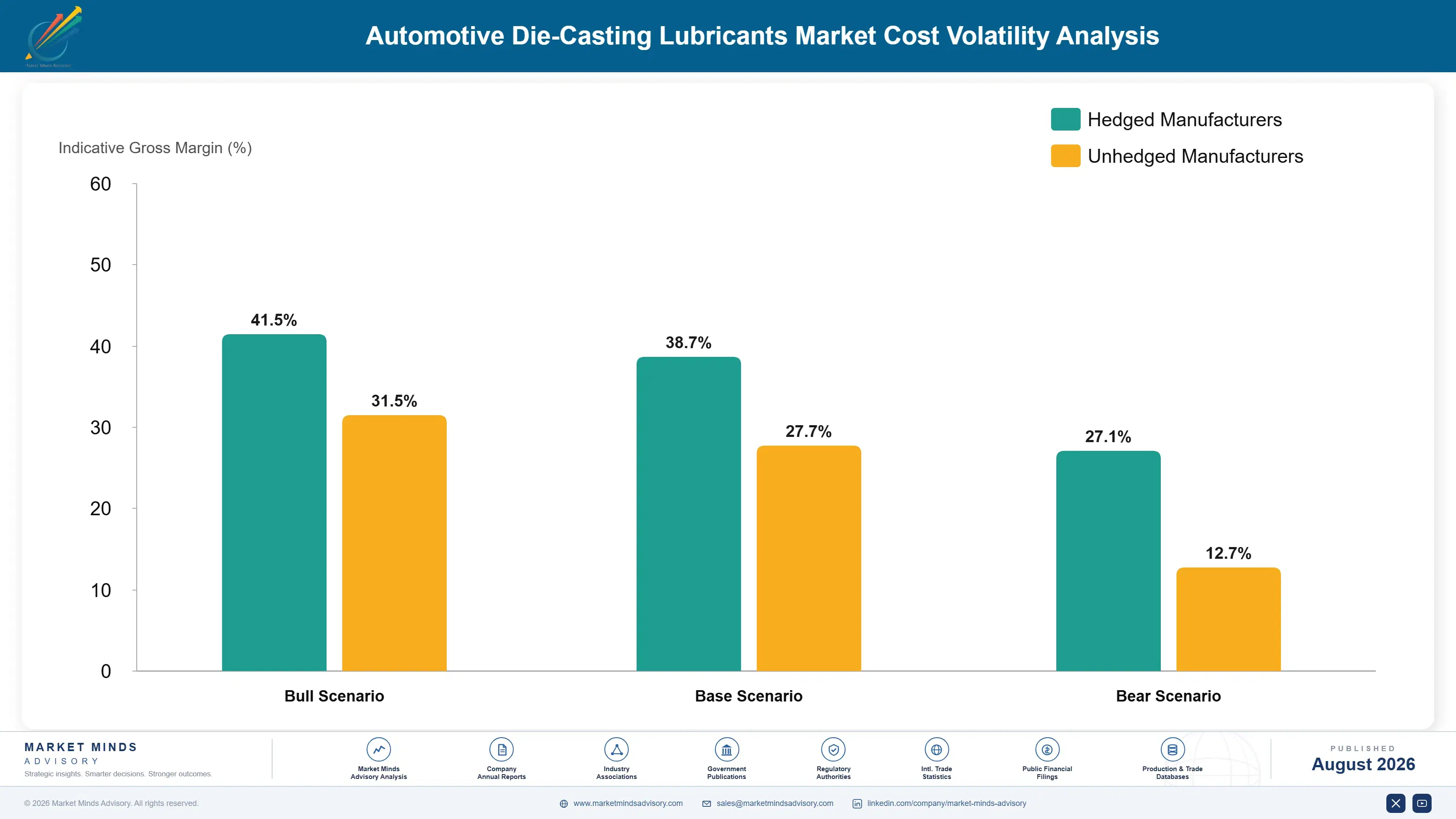
Specialty Surfactant Cost Exposure

Specialty surfactants and release polymers account for roughly 48 percent of die-casting lubricant cost of goods sold, with pricing tracking petrochemical feedstock markets that formulators do not control directly. Feedstock sourcing is concentrated among a handful of global specialty chemical producers, giving formulators limited negotiating leverage during periods of tight feedstock supply across most major manufacturing regions worldwide.
Feedstock prices spiked sharply during 2022's energy crisis, with specialty surfactant prices rising more than 25 percent within a single year as natural gas costs surged across Europe, according to IEA petrochemical price tracking. Quaker Houghton's 2022 annual report cited raw material cost inflation as a meaningful drag on segment margins, and several mid-tier formulators passed a portion of the increase through to customers via surcharges rather than absorbing it fully during the spike.

The disadvantage falls hardest on formulators without long-term surfactant supply contracts or geographic sourcing diversity. Chem-Trend and Quaker Houghton, with scale to negotiate multi-year feedstock agreements, absorb volatility more smoothly than regional formulators buying on the spot market. That gap widens further for European formulators specifically, who face both feedstock exposure and higher regional natural gas costs than United States or Asian competitors.
automotive-die-casting-lubricants-market-cost-volatility-analysis-1787300948998

Qualifying Alternative Surfactant Chemistries

Several formulators are qualifying alternative surfactant chemistries less dependent on petrochemical feedstocks specifically vulnerable to natural gas price swings, reducing exposure to the volatility that compressed margins during 2022. Chem-Trend and Fuchs both report growing investment in alternative chemistry qualification since the spike, though virgin petrochemical surfactants still dominate total volume across the industry today.

Hedging Feedstock Purchases Through Forward Contracts

Several formulators have moved to twelve-month forward purchase agreements for key surfactant feedstocks, locking in pricing ahead of production runs rather than buying on the spot market. This reduces margin volatility quarter to quarter, though it also means formulators occasionally pay above prevailing spot prices when feedstock costs fall unexpectedly during the contract term.

Diversifying Feedstock Sourcing Geographically

Leading formulators are qualifying feedstock suppliers across the United States, Middle East, and Asia rather than relying primarily on European sources exposed to natural gas price swings. This diversification reduces regional supply disruption risk and gives formulators more negotiating leverage during periods of tight feedstock availability in any single geography, a posture growing more common.

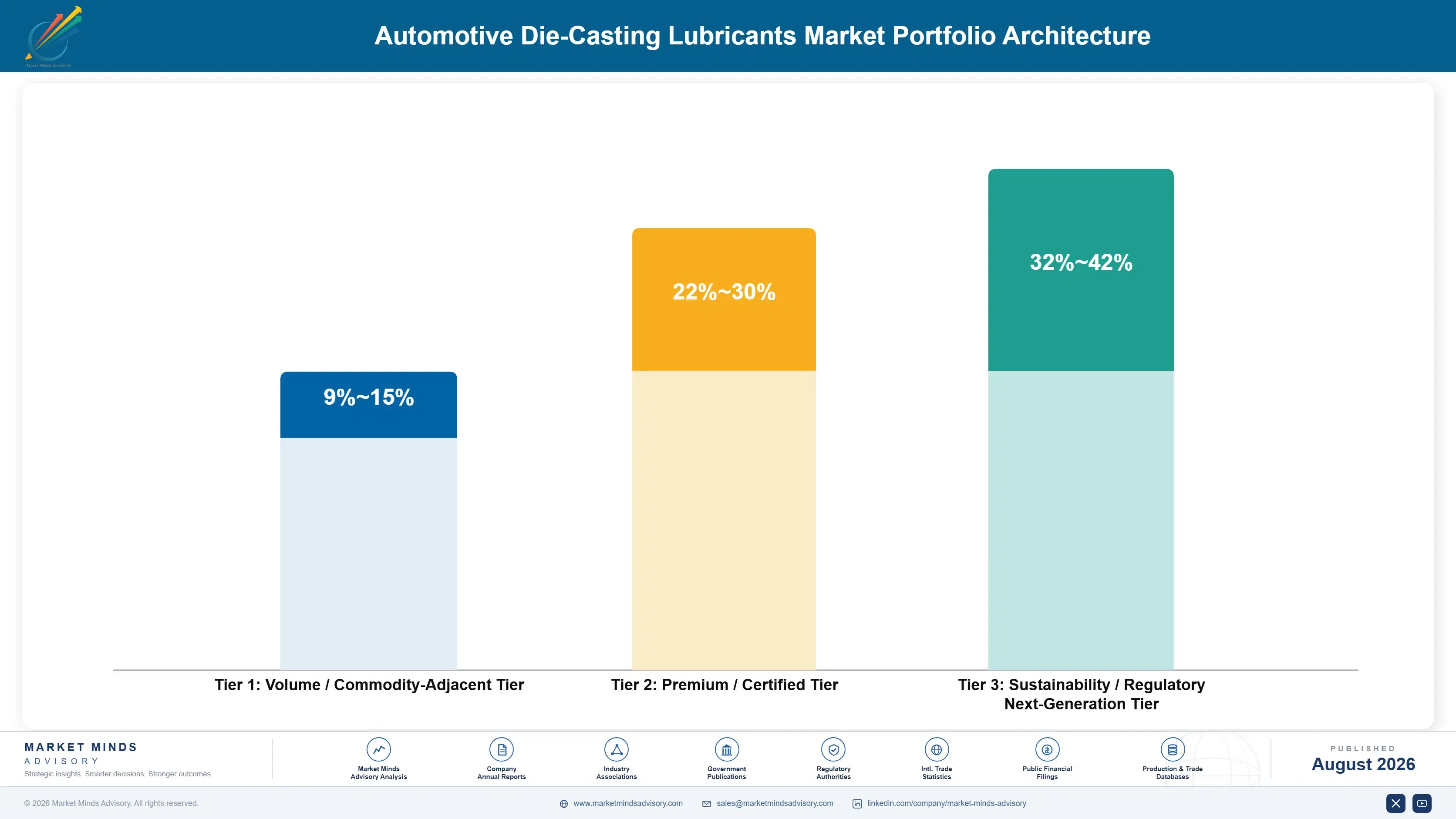
Portfolio Architecture for Margin Defence

The portfolio splits into three tiers. Commodity solvent-based release agents and standard plunger lubricants sit at the volume base with thin margins, competing mainly on price and delivery reliability. Premium water-based formulations and alloy-specific chemistry occupy the middle tier, commanding stronger margins through regulatory compliance and technical qualification. Gigacasting-grade specialty formulations and technical service contracts sit at the top, where margins run richest and comp
The tension between volume and premium runs through how formulators allocate investment. Conventional manufacturing requires steady throughput to cover fixed costs, pulling formulators toward volume even as that segment's growth slows, while gigacasting and specialty chemistry demand sustained investment that only pays off once qualification is complete. Formulators that lean too far toward either extreme risk losing either the cash generation volume provides or the margin growth premium chemistry delivers.

High-value margin pools concentrate in gigacasting-grade formulations and technical service contracts, where qualification barriers keep competition thin and automakers pay premium prices for validated reliability on high-value structural castings. That concentration is likely to deepen as gigacasting adoption continues expanding beyond its current early-mover base of automakers.

Volume / Commodity-Adjacent Tier

Commodity solvent-based release agents and standard plunger lubricants sold primarily on price and delivery reliability to a broad base of conventional automotive die-casting applications worldwide, where switching suppliers costs little beyond requalification paperwork.
Gross Margin: 9%-15%

Premium / Certified Tier

Water-based release agents and alloy-specific formulations sold with technical support to automakers navigating VOC compliance and advanced alloy weight reduction programs, priced to reflect the formulation expertise and testing involved.
Gross Margin: 22%-30%

Sustainability / Regulatory / Next-Generation Tier

Gigacasting-grade specialty formulations and technical service contracts built for automakers requiring validated performance on large-format structural castings, where qualification barriers keep the competitive field narrow and pricing power strongest today.
Gross Margin: 32%-42%
automotive-die-casting-lubricants-market-portfolio-architecture-1787300949494

High-value Sub-segments and Strategic Watch-out

Gigacasting Formulation Qualification

Automakers expanding large-format aluminum structural casting capacity are forcing formulators to specify validated gigacasting chemistry with limited existing supplier competition. Qualification barriers keep the field narrow, and volume is expanding faster than almost any other category tracked in this report worldwide today across every region.
Gross Margin: 32%-42%

Technical Service and Formulation Licensing

Recurring service and licensing revenue attached to proprietary chemistry grows steadily as automakers standardize on proven formulations. Growth is moderate compared with gigacasting hardware demand but margins are among the richest in the portfolio once expertise is built, and renewal rates run consistently high year after year.
Gross Margin: 30%-38%

Commodity Solvent-Based Release Agents

The largest revenue base by volume, sold into conventional die-casting applications worldwide on price and delivery reliability. Growth tracks automotive production closely and margins stay thin, but the segment funds gigacasting technology development, making it strategically indispensable despite its low relative margins industry-wide today and every year.
Gross Margin: 9%-15%

Regional Asian Chemistry Exports

Regional Asian formulators are exporting increasingly credible conventional and water-based lubricants at prices well below Western equivalents, initially into Southeast Asia and Africa. If technical gaps close further, this segment could pressure premium pricing industry-wide within the decade ahead across every commodity category tracked here.
Gross Margin: 14%-22%

Recurring Qualification Revenue Inside Every Program

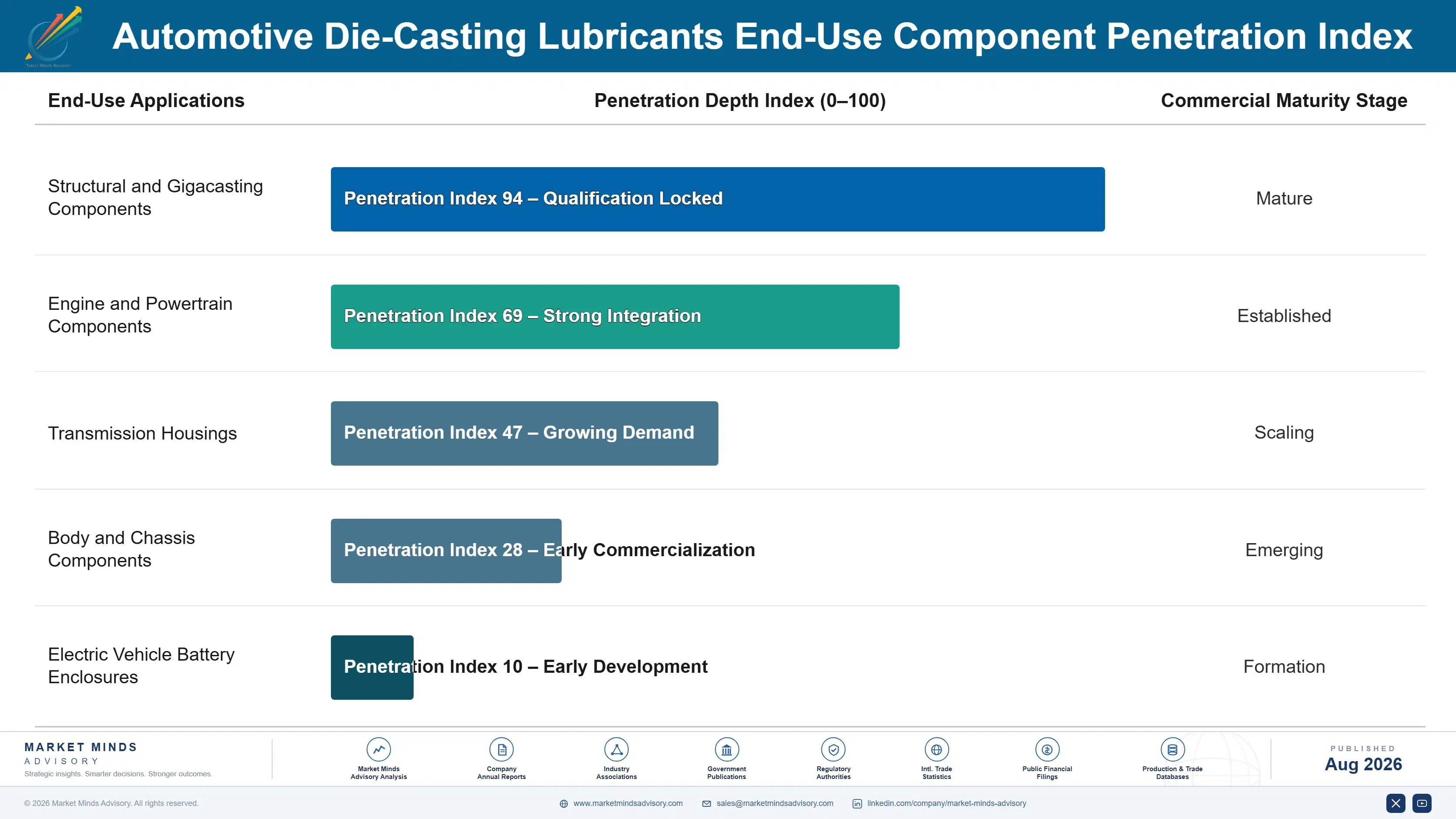
Automotive die-casting lubricants generate revenue closer to an annuity than a one-time sale once technical service relationships and multi-year supply contracts are included, since every operating casting line consumes another cycle of lubricant purchases regardless of near-term automotive production volatility. That repeat-purchase dynamic gives formulators more predictable revenue than headline automotive production volatility alone would suggest, provided their formulation stays specified in
Adoption depth varies sharply by customer type. Automakers and their tier-one casting suppliers sign multi-year qualification agreements that lock in preferred formulators across their casting network, creating high switching costs once a chemistry is validated into a process. Smaller regional die casters behave differently, rebidding lubricant supply more frequently on standardized contracts and staying price-sensitive, which keeps competition sharper but limits how much recurring revenue any formulator can count on.

A generational shift in buyer profiles is underway as process engineers who trained on gigacasting and water-based chemistry replace an older generation more familiar exclusively with conventional solvent-based formulations. That shift favors formulators with strong next-generation chemistry and technical documentation over those competing purely on price, and it is reshaping which suppliers get invited to participate in new casting program technology selection.
automotive-die-casting-lubricants-market-end-use-penetration-index-1787300949983

Where MMA Sees the Opportunity

These are among the four positions where our research anticipates prominent divergence between winners and laggards over the coming forecast period. Each is grounded in the demand model, the regulatory perimeter, and the announced capacity pipeline.
01 / GIGACASTING QUALIFICATION PRIORITY

Prioritize gigacasting formulation qualification ahead of expanding adoption

Gigacasting adoption is creating lubricant demand growing considerably faster than conventional die-casting applications, and automakers increasingly exclude formulators without validated gigacasting chemistry from consideration for new large-format casting programs. Formulators that have not yet invested in gigacasting qualification risk missing the fastest-growing and most defensible segment of this market for years to come. MMA recommends prioritizing gigacasting formulation investment over incremental improvements to conventional release agent lines facing persistent price pressure across mature applications with limited growth potential remaining industry-wide.
02 / TECHNICAL SERVICE EXPANSION

Build technical service bundling to deepen automaker relationships

Technical service bundling that embeds application engineers with die caster customers creates genuine switching costs that pure commodity chemical sales relationships simply cannot generate on their own. Formulators without service capability are increasingly excluded from co-development relationships as Chem-Trend and Quaker Houghton both expand bundled service offerings across their largest accounts. MMA recommends building or acquiring technical service capability rather than continuing to compete purely on formulation price and delivery speed alone in an increasingly service-driven, relationship-based market overall today.
03 / WATER-BASED CHEMISTRY INVESTMENT

Accelerate water-based chemistry investment ahead of regulatory expansion

VOC regulation is turning water-based chemistry into a hard specification requirement rather than a differentiator, and formulators without proven water-based formulations are increasingly excluded from new facility permits that now require low-VOC chemistry from the outset in most major manufacturing regions. That pressure will likely intensify as more jurisdictions beyond the European Union and California adopt similar emissions standards. MMA recommends accelerating water-based chemistry investment now, before regulatory deadlines compress qualification timelines further across every major manufacturing region worldwide this decade.
04 / REGIONAL EXPORT DEFENSE

Defend Western technology lead against rising Asian chemistry exports

Regional Asian formulators are exporting increasingly credible conventional and water-based lubricants into Southeast Asia and Africa at prices Western suppliers struggle to match, benefiting from domestic manufacturing scale and proximity to expanding automotive production. If that price and technology gap continues narrowing, Western formulators risk losing share in price-sensitive emerging markets faster than premium gigacasting and technical service growth can offset. MMA recommends accelerating technology differentiation rather than competing on price alone against lower-cost regional alternatives that cannot yet match premium formulation performance.

Engagement Snapshot From the Field

A live engagement with an industry participant carrying material or product regulatory and market exposure ahead of a defining policy shift, showing how our research translates into a defensible multi-year portfolio strategy.
MARKET MINDS ADVISORY · CLIENT ENGAGEMENT SUMMARY
Automotive Die-Casting Lubricants Producer Strategic Portfolio Review and Transition Roadmap 2026·Investment Scenario on Automotive Die-Casting Lubricants Exposure Evaluation 2025-26
CLIENT PROFILE
The client is a global automotive tier-one supplier operating four aluminum die-casting facilities supplying structural components to multiple electric vehicle manufacturers, reporting approximately 120 million dollars in annual lubricant and process chemistry procurement spend (client-reported, unverified by MMA). The company faced pressure from several automaker customers to qualify gigacasting-grade lubricant formulations ahead of new large-format casting program launches.
STRATEGIC CHALLENGE
Leadership needed to determine whether to qualify a single gigacasting formulation supplier across all four facilities or maintain separate regional supplier relationships, and whether the qualification timeline could realistically meet automaker program launch deadlines given the extensive validation testing required and the client's constrained capital budget for supplier transition work.
MMA APPROACH
MMA benchmarked gigacasting formulation qualification timelines and technical performance across comparable tier-one suppliers already running large-format casting programs, modeling total risk and cost under single-supplier versus multi-supplier scenarios. The engagement combined primary interviews with three formulator technical teams and secondary analysis of comparable qualification timelines to inform the client's sourcing strategy.
KEY FINDINGS
  1. Single-supplier qualification across all four facilities reduced total validation testing cost by approximately 30 percent compared with separate regional supplier relationships (client-reported, unverified by MMA).
  2. Gigacasting-grade formulations carried a 28 percent price premium over the client's existing conventional lubricant costs, though defect rates fell meaningfully during pilot production runs (client-reported, unverified by MMA).
  3. Qualification testing required approximately nine months from initial trials to full production approval, longer than the client's most urgent program launch timeline initially allowed.
  4. Peer tier-one suppliers that consolidated gigacasting formulation suppliers reported stronger technical support responsiveness than those managing multiple regional supplier relationships simultaneously across separate facilities.
CLIENT PROFILE
The client is a global automotive tier-one supplier operating four aluminum die-casting facilities supplying structural components to multiple electric vehicle manufacturers, reporting approximately 120 million dollars in annual lubricant and process chemistry procurement spend (client-reported, unverified by MMA). The company faced pressure from several automaker customers to qualify gigacasting-grade lubricant formulations ahead of new large-format casting program launches.
STRATEGIC CHALLENGE
Leadership needed to determine whether to qualify a single gigacasting formulation supplier across all four facilities or maintain separate regional supplier relationships, and whether the qualification timeline could realistically meet automaker program launch deadlines given the extensive validation testing required and the client's constrained capital budget for supplier transition work.
MMA APPROACH
MMA benchmarked gigacasting formulation qualification timelines and technical performance across comparable tier-one suppliers already running large-format casting programs, modeling total risk and cost under single-supplier versus multi-supplier scenarios. The engagement combined primary interviews with three formulator technical teams and secondary analysis of comparable qualification timelines to inform the client's sourcing strategy.
KEY FINDINGS
  1. Single-supplier qualification across all four facilities reduced total validation testing cost by approximately 30 percent compared with separate regional supplier relationships (client-reported, unverified by MMA).
  2. Gigacasting-grade formulations carried a 28 percent price premium over the client's existing conventional lubricant costs, though defect rates fell meaningfully during pilot production runs (client-reported, unverified by MMA).
  3. Qualification testing required approximately nine months from initial trials to full production approval, longer than the client's most urgent program launch timeline initially allowed.
  4. Peer tier-one suppliers that consolidated gigacasting formulation suppliers reported stronger technical support responsiveness than those managing multiple regional supplier relationships simultaneously across separate facilities.
RECOMMENDED STRATEGY
Phase 1: Phase 1 (Months 1 to 4): Begin gigacasting formulation qualification testing at the client's most urgent facility ahead of its program launch deadline. Phase 2: Phase 2 (Months 5 to 9): Complete qualification and negotiate a single-supplier agreement covering all four facilities based on pilot performance. Phase 3: Phase 3 (Months 10 to 15): Standardize the qualified formulation across all remaining facilities, retiring legacy regional supplier relationships entirely.
OUTCOME
Within nine months, the client successfully qualified a single gigacasting formulation supplier across its most urgent facility, meeting the automaker program launch deadline while reducing defect rates meaningfully compared with its prior conventional lubricant chemistry (client-reported, unverified by MMA). The company has since standardized the same supplier relationship across its remaining three facilities.

Frequently Asked Questions

Foundational context covering the market sizes, CAGR, scope, country, region and competition that inform every finding below. This section is provided to cover basics and most often pre-purchase conversations, answered from the MMA Primary Research Dataset.

What is the current size of the Automotive Die-Casting Lubricants Market?

The global automotive die-casting lubricants market was valued at approximately 1.35 billion dollars in 2025. Growth is driven primarily by gigacasting adoption and VOC regulation compliance.

How large will the Automotive Die-Casting Lubricants Market be by 2036?

MMA forecasts the market reaching approximately 2.6 billion dollars by 2036, roughly 1.82 times its 2026 value. Gigacasting-grade formulations account for much of that growth.

What is the CAGR for the Automotive Die-Casting Lubricants Market 2026 to 2036?

The market is projected to grow at a 6.2 percent compound annual rate over the forecast period. Bull and bear scenarios range from 4.9 to 7.5 percent depending on gigacasting adoption pace.

Which segment is growing fastest?

Specialty additives and concentrates are the fastest-growing segment, expanding at roughly 1.42 times the overall market rate. Gigacasting formulation demand across expanding electric vehicle programs is the primary driver.

Who are the major companies in the Automotive Die-Casting Lubricants Market?

Chem-Trend, Quaker Houghton, Fuchs, Chemtool, and Foseco lead the market on a revenue basis. Together they hold under half of global revenue in a fragmented field.

Which country is growing fastest?

China is the fastest-growing country, driven by rapid electric vehicle gigacasting adoption and expanding aluminum die-casting capacity. Domestic formulators are scaling quickly to serve rising demand.

Report Segmentation Architecture

The full report scope spans multiple orthogonal segmentation dimensions, with cross-tabulated demand data provided for each dimension pair. Coverage extends further to regional breakdowns, trend trajectories, and the competitive detail needed to support segment-level decision-making.

By Chemistry Type

  • Water-Based Die Release Agents
  • Solvent-Based Die Release Agents
  • Plunger Lubricants
  • Semi-Solid and Paste Lubricants
  • Powder and Dry Film Lubricants
  • Specialty Additives and Concentrates

By End-Use Component

  • Structural and Gigacasting Components
  • Engine and Powertrain Components
  • Transmission Housings
  • Body and Chassis Components
  • Electric Vehicle Battery Enclosures

By Commercial Model

  • Direct Formulation Sale
  • Technical Service Bundle
  • Formulation Licensing Agreement
  • Volume Supply Contract

By Region

  • North America
  • Western Europe
  • East Asia
  • South Asia and Pacific
  • Latin America
  • Middle East and Africa
  • Eastern Europe

Scope, Methodology, and Coverage

Every figure in this report is reproducible from documented input assumptions. The scope below maps the historical period, the forecast horizon, the segmentation dimensions, and the countries covered, alongside the underlying primary and qualitative methodology.
Historical Period
2020 to 2025
Forecast Period
2026 to 2036
Base Year
2025 (USD billions; MMA Primary Research Dataset, August 2026)
Market Definition
The automotive die-casting lubricants market covers water-based and solvent-based die release agents, plunger lubricants, semi-solid and paste lubricants, powder and dry film lubricants, and specialty additives and concentrates used in high-pressure aluminum, magnesium, and zinc die casting for automotive components. It excludes general metalworking fluids, forging lubricants, and sand casting release agents.
Quantitative Units
USD billions (current prices); volume shipments in metric tons where applicable
Segmentation Dimensions
By Chemistry Type; By End-Use Component; By Commercial Model; By Region
Regions Covered
North America, Western Europe, East Asia, South Asia and Pacific, Latin America, Middle East and Africa, Eastern Europe
Countries Covered
USA, China, Germany, France, UK, Japan, South Korea, India, Australia, Canada, Brazil, Mexico, Indonesia, Vietnam, Thailand, Malaysia, UAE, Saudi Arabia, South Africa, Nigeria, Turkey, Poland, Netherlands, Italy, Spain, Sweden, Switzerland, Argentina, Colombia, Singapore, and additional markets relevant to this sector
Key Companies Profiled
Chem-Trend, Quaker Houghton, Fuchs, Chemtool, Foseco, Zeller+Gmelin, Henkel, Klueber Lubrication, Petrofer, Rocol, Dow, CONDAT, Wesco Lubricants, Ashland, Metalube, Blaser Swisslube, Bruggemann Chemical, DuBois Chemicals, Nihon Parkerizing, Zircotec
Quantitative Methodology
Primary survey, n=3,800 respondents, Q4 2025, six countries; demand-side model with trade association cross-validation
Qualitative Methodology
47 expert interviews, Q4 2025; applied to validate demand model assumptions, identify emerging dynamics, and assess competitive positioning
Report Format
PDF and XLSX data workbook (Word format preview document)
Publisher
Market Minds Advisory
Report Code
MMA-2026-CHM-101
Published
August 2026
Contact
sales@marketmindsadvisory.com | www.marketmindsadvisory.com

Purchase the full Automotive Die-Casting Lubricants Market Report (2026 to 2036).

The full report provides detailed sizing and ten-year forecasts for each of the six chemistry categories tracked in this analysis, alongside country-level detail across thirty markets. It includes a complete competitive benchmarking of the top twenty formulators on a revenue basis, with moat and risk analysis for the two market leaders. The report also contains a dedicated surfactant feedstock cost and supply chain risk assessment, plus scenario modeling across bull, base, and bear cases through 2036. Buyers receive access to the underlying primary survey and expert interview datasets referenced throughout the analysis.
Ten-year forecasts across all six chemistry categories
Competitive benchmarking of twenty profiled formulators
Specialty surfactant and feedstock supply chain analysis
Bull, base, and bear scenario modeling through 2036
Country-level sizing across thirty tracked national markets
Access to underlying primary survey and interview data

Built For The People Who Decide

From boardroom strategy to bench-side execution, this report is read cover-to-cover by leaders shaping the next decade of their industry, turning demand scenarios, market dynamics and valuation benchmarks into decisions.
CXOs/ Presidents/ VPs/ Managers
M&A and Corporate Development
Strategy Teams and R&D Heads
Procurement and Product Directors
Regulatory and Compliance Leaders
Investor Relations and Equity Analysts