

Market Minds Advisory
Automotive DC-DC Converter Market

Automotive DC-DC Converter Market: 800-Volt Architecture Shift and Bidirectional Power Through 2036

The shift to 800-volt electric vehicle architectures is forcing converter suppliers to redesign power electronics faster than battery pack voltage standards themselves are converging across automakers racing to cut charging time.

Lead Analyst

David Horsley

Published

September 2026

Make Smarter Decisions with Customized Research Insights

Request a free sample report and evaluate market opportunities, growth trends, and competitive dynamics relevant to your business needs.

2025 MARKET VALUE$3.2BMarket Size 2025
2036 FORECAST VALUE$8.7BBase Case , 2026 to 2036
CAGR 2026 TO 20369.5 %Bull 10.8% / Bear 8.2%
INCREMENTAL OPPORTUNITY$5.2BNet 10- year value creation
EXPANSION MULTIPLE2.48x2036 value over 2026 base
Strategic Levers
M&A Pipeline
Regional Outlook
Country Rankings
Competitive Intelligence
Segmental Deep-dive
Call-Us : 91 93563 13602

Executive Snapshot and Market Trajectory

Every electric vehicle needs a DC-DC converter to step high-voltage battery power down to the twelve or forty-eight volt systems running lights, infotainment, and safety electronics, and the industry's shift toward eight-hundred-volt architectures is forcing a wholesale redesign of that conversion stage, reshaping investment priorities broadly.
Vitesco Technologies and Infineon Technologies are racing to qualify converters rated for eight-hundred-volt battery packs as automakers chase faster charging times, a transition that makes converters designed for four-hundred-volt architectures obsolete for new platform wins. Bidirectional converters, which can push power both directions between the high and low voltage buses, are capturing disproportionate investment as vehicle-to-grid and vehicle-to-load features move from concept to standard equipment, reinforcing how quickly voltage standards are consolidating.
Delta Electronics and BorgWarner are expanding silicon carbide semiconductor integration to shrink converter size and cut thermal losses, since packaging space inside increasingly crowded electric vehicle platforms has become a genuine constraint on design freedom. Suppliers without in-house power semiconductor expertise increasingly depend on partnerships with chipmakers like Infineon Technologies to remain competitive on efficiency specifications, particularly as automakers push for smaller and lighter power electronics packages,.
Market Definition
The automotive DC-DC converter market covers isolated high-voltage to low-voltage converters, bidirectional DC-DC converters, non-isolated buck converters, forty-eight volt mild hybrid converters, onboard charger integrated converters, and auxiliary power module converters sold to automakers and tier-one suppliers. It excludes onboard chargers sold as standalone units outside an integrated converter module.
Base Year Value
$3.2B in 2025 (MMA Primary Research Dataset, August 2026)
Forecast Period
2026 to 2036, eleven discrete annual values
CAGR
9.5% base case. Bull 10.8%. Bear 8.2%.
Fastest Growth Segment
Bidirectional DC-DC Converters: 13.5% CAGR
Fastest Growth Country
China: 12.0% CAGR
Fastest Growth Region
South Asia and Pacific: 11.5% CAGR
Largest Region
East Asia: 30% of 2025 global value
Market Leaders
Vitesco Technologies, Infineon Technologies, Delta Electronics, BorgWarner, Eaton. Source: MMA Analysis based on company annual reports.
Primary Survey
n=3,800 procurement and R&D decision-makers, Q4 2025, six countries
Methodology
Demand-side build-up, cross-validated against public data, 47 expert interviews

Automotive DC-DC Converter Market Forecast Scenarios

automotive-dc-dc-converter-market-trends-size-forecast-scenario-1787464408113
Between 2020 and 2025 the market grew at roughly 8.5 percent a year, with early electric vehicle platforms establishing baseline converter demand before the eight-hundred-volt architecture transition began accelerating orders through the back half of the period as automakers committed to faster-charging platform designs, and early silicon carbide adoption began improving efficiency across several new platform launches.
The base case assumes 9.5 percent annual growth to 2036, built on three mechanisms: electric vehicle production scaling that lifts converter volume regardless of architecture choice, the eight-hundred-volt transition forcing platform-by-platform converter redesign and replacement cycles, and bidirectional functionality becoming standard equipment as vehicle-to-grid features spread beyond premium models. Together these three mechanisms sustain growth above what simple vehicle production trends alone would suggest, beyond the industry's traditional pace, and beyond simple platform replacement cycles.
A bull case near 10.8 percent depends on vehicle-to-grid mandates or incentives spreading faster than currently planned across major markets, pulling bidirectional converter demand higher. The bear case near 8.2 percent assumes electric vehicle adoption growth slows enough that converter volume tracks closer to simple platform replacement cycles, and automakers defer eight-hundred-volt platform transitions where budgets stay constrained.

Voltage Architecture Shift Redraws Converter Design

Converter manufacturing sits downstream of power semiconductor supply above almost everything else, since the silicon carbide and insulated gate bipolar transistor components inside determine efficiency, size, and cost more than any other design choice a supplier makes, and that dependency has shaped supplier strategy across the entire industry for years, across every major regional market today, and that dependency has shaped supplier strategy across the entire industry for years now.
PRODUCER CONCENTRATIONCR5 48%top five suppliers hold roughly half of global shipments
AVERAGE SELLING PRICE$85/unitblended price across all converter categories sold today
CHINA PRODUCTION SHARE32%share of global converter production originating from this country
800V PLATFORM PENETRATION24%share of new electric vehicles built on this architecture today
TRADE INTENSITY46%share of shipments crossing a border before reaching assembly plants
SEMICONDUCTOR COST SHARE42% of COGSpower semiconductor cost burden within converter production expense
Commercially, the market splits between mature four-hundred-volt converter designs priced close to commodity levels and a faster-growing eight-hundred-volt and bidirectional tier commanding better margins as automakers chase faster charging and vehicle-to-grid capability. Margins concentrate in silicon carbide integration expertise, where efficiency gains matter more than simple manufacturing scale, as automakers increasingly weigh documented efficiency data before committing to a supplier relationship, as buyers increasingly weigh documented efficiency data before committing to any long-term relationship.
Over the next decade, silicon carbide integration and bidirectional power flow engineering will matter more to competitive position than legacy four-hundred-volt converter manufacturing scale, since basic buck converter technology itself is now widely accessible across multiple regional suppliers, particularly as automakers weigh efficiency credentials alongside simple unit cost, over time,.
"Everyone assumed converters were a commodity box until eight-hundred volts arrived. Now half the suppliers who won four-hundred-volt contracts are scrambling to prove they can do this again."
Director, Automotive Practice · MMA Automotive Practice · August 2026

Market Trends

800-Volt Architecture Adoption Forces Converter Redesign

Automakers are shifting toward eight-hundred-volt battery architectures to cut charging time meaningfully, and that shift forces a wholesale redesign of the DC-DC converter stage since components qualified for four-hundred-volt systems cannot simply be reused. Vitesco Technologies and Infineon Technologies have both expanded eight-hundred-volt converter development capacity specifically to capture new platform wins rather than defending legacy four-hundred-volt business. This transition is spreading from premium electric vehicle platforms into mainstream segments as component costs decline across the broader supply base, reflecting how quickly voltage architecture decisions are reshaping supplier investment priorities industry-wide.
Market Impact: EV output grew 25% in 2025

Vehicle-to-Grid Features Drive Rising Bidirectional Demand

Automakers are increasingly offering vehicle-to-grid and vehicle-to-load features that let an electric vehicle's battery power a home or external device, and delivering that capability requires a bidirectional converter capable of pushing power both directions rather than the one-way designs that dominated earlier electric vehicle generations. Delta Electronics and BorgWarner have both expanded bidirectional converter production capacity specifically to serve automakers adding this feature as standard equipment across a broadening range of vehicle segments and price points, reinforcing how quickly feature expectations are reshaping converter design requirements across the supply base.
Market Impact: SiC costs fell 20% in 3yrs

Market Opportunities and Growth Drivers

Electric Vehicle Production Growth Sustains Converter Volume

Global electric vehicle production has scaled rapidly as automakers commit to electrification roadmaps across multiple regions, and every electric vehicle produced requires at least one DC-DC converter regardless of architecture choice or price segment. This volume relationship gives converter suppliers a demand floor tied directly to broader electric vehicle production growth rather than depending on any single automaker's individual platform decisions within the competitive manufacturing landscape shaping the industry across every major producing region worldwide, sustaining predictable order volume for suppliers year after year, across both established manufacturing hubs and newer regional assembly plants alike.
Market Impact: Chip shortages delayed launches 6 months

Silicon Carbide Cost Decline Expands Addressable Market

Silicon carbide semiconductor costs have fallen as manufacturing scale expands across the broader power electronics industry, and that cost trajectory has expanded the addressable market for silicon carbide converters well beyond early premium adopters into mainstream vehicle platforms. Infineon Technologies and STMicroelectronics have both driven this cost curve through continuous manufacturing scale expansion, making silicon carbide converters increasingly competitive against legacy silicon designs on pure economics, a trend expected to continue as manufacturing scale keeps expanding further, even as legacy silicon designs gradually lose relevance across the broader industry too.
Market Impact: Dual-architecture adds 15% to R&D

Market Restraints and Challenges

Semiconductor Supply Constraints Limit Production Scaling

Power semiconductor supply, particularly silicon carbide components, remains constrained relative to rapidly growing automotive demand, and the underlying cause is that fabrication capacity expansion for these specialized chips requires years of lead time and substantial capital investment that has not kept pace with electric vehicle adoption. The commercial impact has forced some converter suppliers to delay platform launches or substitute less efficient designs. Suppliers are mitigating this through long-term supply agreements directly with semiconductor manufacturers, particularly across suppliers lacking the scale to negotiate priority allocation with chipmakers, over time too.
Market Impact: 800V platforms reached 24% of sales

Architecture Fragmentation Raises Design Complexity Costs

Automakers are running four-hundred-volt and eight-hundred-volt architectures simultaneously across their platform lineups, and the underlying cause is that transitioning an entire lineup to a single voltage standard requires years of platform redesign that automakers cannot complete all at once. The commercial impact forces converter suppliers to maintain parallel product lines rather than consolidating engineering resources behind a single architecture. Suppliers are mitigating this through modular converter platforms that share components across voltage variants, particularly for smaller suppliers lacking the engineering capacity to support both architectures simultaneously, and this burden persists despite years of modular design effort across the supply base.
Market Impact: Bidirectional demand rose 35% in 2yrs
3 additional market trends, 4 additional growth drivers, and 3 additional restraints and challenges are covered in the full report. Contact sales@marketmindsadvisory.com to access the complete intelligence.

Segment CAGR and Growth Architecture

The market splits into six categories by converter architecture, from isolated high-voltage conversion through auxiliary power modules. Bidirectional converters are growing fastest as vehicle-to-grid features spread, while isolated high-voltage to low-voltage converters follow closely given the eight-hundred-volt transition sweeping new platforms, as automakers standardize their platform architectures around this new voltage class, further still.
automotive-dc-dc-converter-market-trends-market-share-analysis-1787464408668

Bidirectional DC-DC Converters

Bidirectional converters are growing faster than any other category because automakers increasingly offer vehicle-to-grid and vehicle-to-load features that let an electric vehicle's battery power a home or external device, and delivering that capability requires power flow in both directions rather than the one-way designs that dominated earlier electric vehicle generations. Delta Electronics and BorgWarner have both expanded bidirectional converter production capacity specifically to serve automakers adding this feature as standard equipment, and the category's technical complexity, spanning both power electronics and control software, gives established suppliers a meaningful engineering advantage over new entrants lacking comparable systems integration experience, Eaton has similarly expanded control software development to support this growing feature category.
CAGR 13.5%

Isolated High-Voltage to Low-Voltage Converters

Isolated high-voltage to low-voltage converters remain the largest single category by volume and are growing quickly as the eight-hundred-volt architecture transition forces automakers to redesign this conversion stage across nearly every new electric vehicle platform launched. Vitesco Technologies and Infineon Technologies compete most directly in this category, where galvanic isolation requirements and safety certification standards demand more rigorous engineering than simpler non-isolated designs require. This universal requirement across nearly every electric vehicle platform gives isolated converters a demand floor that shields the category from the volatility affecting more niche converter types, sustaining stable order volume for established suppliers year after year across every major manufacturing region, regardless of broader macroeconomic swings.
CAGR 11.5%
Full segment breakdown across 7 segments available in the complete report.

Regional Architecture and Country Demand Map

East Asia leads global converter demand, anchored by China's electric vehicle production scale and a deep power electronics supply chain. South Asia and Pacific posts the fastest growth as electric vehicle adoption accelerates from a low base across the region's expanding manufacturing base across the region's expanding base.

North America

US automakers are scaling electric vehicle production across multiple new assembly plants, generating steady converter demand tied directly to platform launch schedules rather than simple replacement cycles that characterize combustion vehicle components. BorgWarner maintains significant domestic engineering and manufacturing capacity serving both established and emerging electric vehicle programs. Canada's smaller vehicle production base follows similar demand patterns tied to cross-border supply chain integration. Eight-hundred-volt platform announcements from several major automakers are accelerating converter redesign work across the region's supplier base, and supporting stable long-term supplier revenue across the continent's expanding manufacturing footprint, and reinforcing established supplier relationships built over years of continuous platform development, across every major manufacturing hub, and their tier-one partners.
Share: 22% | CAGR: 10.0% (2026 to 2036)

Western Europe

Germany hosts substantial power electronics engineering capacity serving both domestic automakers and export markets, with Vitesco Technologies and Infineon Technologies both headquartered in the country and anchoring significant regional research investment. The region's automakers are further along in eight-hundred-volt platform adoption than many global peers, accelerating converter redesign work within domestic supply chains. Growth here trails faster-growing Asian markets because vehicle production volume itself has grown more slowly, even as technical sophistication remains genuinely high across the supplier base, and reinforcing the region's engineering leadership position as global electrification accelerates further, and helping domestic suppliers maintain technical relevance as global electrification accelerates further, and beyond current platform generations, and export markets alike.
Share: 21% | CAGR: 8.2% (2026 to 2036)
Regional intelligence for 5 additional markets available in the complete report: East Asia, South Asia and Pacific, Latin America, Middle East and Africa, Eastern Europe. Contact sales@marketmindsadvisory.com.
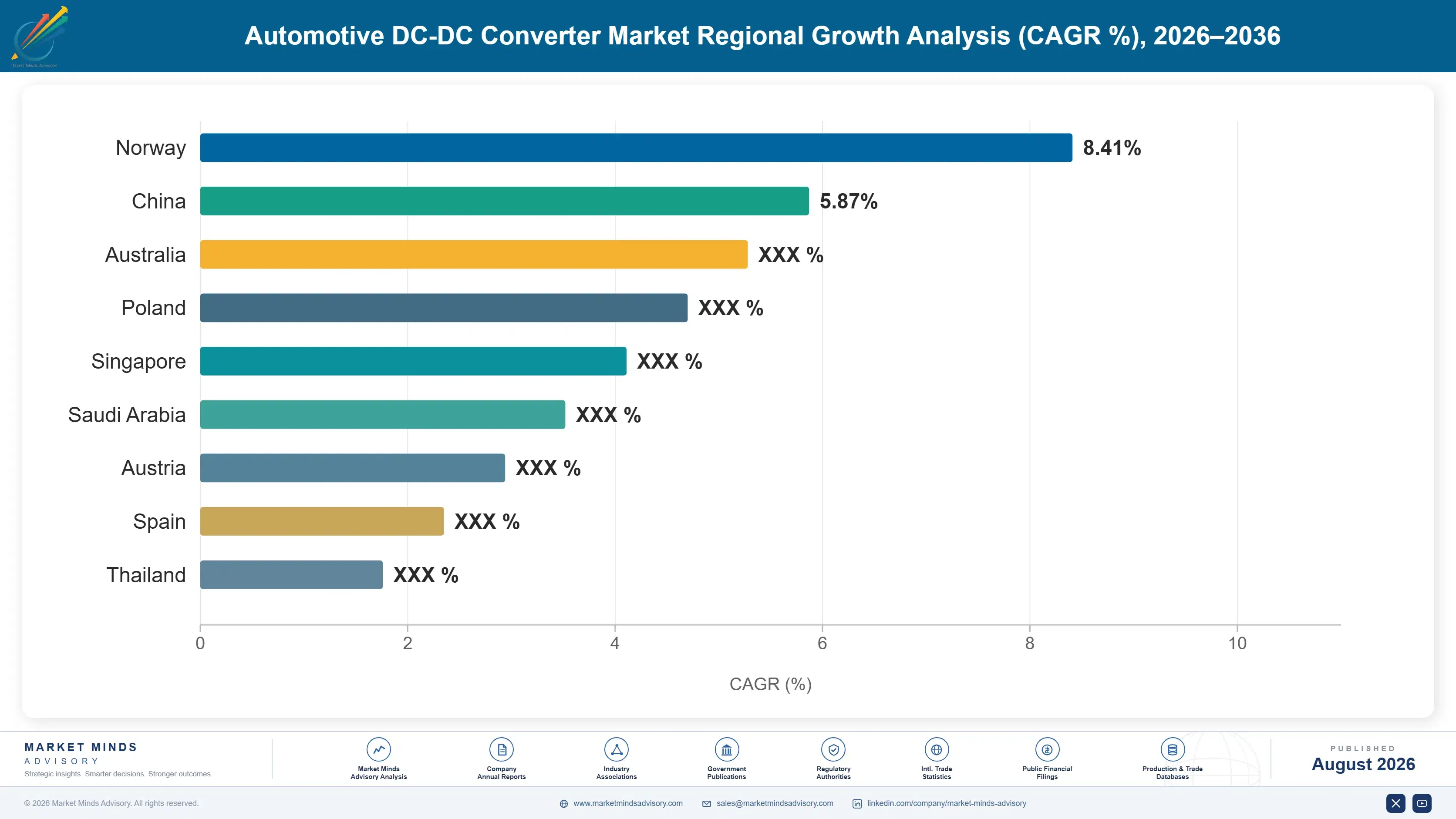
automotive-dc-dc-converter-market-trends-country-cagr-analysis-1787464409200

Capturing Value as Voltage Standards Shift

Suppliers capture the largest margin gains not from selling more units but from shifting what they sell: eight-hundred-volt converters, bidirectional power capability, and silicon carbide integration that command better pricing than legacy designs. Each lever depends on capability incumbents already have and challengers must still build, and it favors suppliers who move on it early.

Expand 800-Volt Converter Engineering Capacity Further

Suppliers with mature eight-hundred-volt converter engineering can capture a price premium of roughly 20 to 26 percent over four-hundred-volt equivalents, capturing value from automakers racing to differentiate on charging speed across multiple platform generations. Vitesco Technologies and Infineon Technologies have both prioritized this expansion with existing customers rather than competing purely for new original equipment contracts, since incumbent suppliers already hold the platform relationship and testing history needed to win the upgrade without a fully competitive tender process, and this advantage is widening as more automakers finalize their eight-hundred-volt platform roadmaps.
Market Impact: 800V converters help add a 20-26% price premium

Bundle Bidirectional Capability Into Standard Platforms

Suppliers that bundle bidirectional power flow into standard converter offerings capture a higher share of total system value than selling one-way converters alone, generating margin roughly 15 to 20 percent above unidirectional equivalents. Delta Electronics has expanded this bundling strategy specifically to serve automakers seeking vehicle-to-grid features without engaging a separate specialized supplier, since integrated bidirectional converters reduce total vehicle system complexity that separately sourced components would otherwise require, and this gap is widening as more automakers formalize simplified system architecture requirements across every major platform generation and beyond today.
Market Impact: Bidirectional bundling helps add a 15-20% margin uplift

Deepen Silicon Carbide Supplier Partnerships Further

Suppliers that secure preferential silicon carbide semiconductor allocation through deep partnerships avoid the supply constraints that periodically delay competitor platform launches by an estimated 4 to 6 months during tight allocation periods, giving them a meaningful reliability advantage in automaker sourcing decisions. BorgWarner has pursued this strategy through direct long-term agreements with semiconductor manufacturers, while several smaller suppliers are now pursuing comparable partnerships to defend delivery reliability, across every major regional market currently served by the supply chain and beyond into future platform generations and following too indeed overall as well.
Market Impact: Secure allocation helps avoid a 4-6 month delay

Who Controls the Margin Pool

Concentration sits moderate at a CR5 near 48 percent, reflecting an industry where power semiconductor integration expertise creates genuine barriers against new entrants. Vitesco Technologies holds the clearest leadership position given its deep original equipment relationships and eight-hundred-volt engineering depth. The gap between Vitesco Technologies and challengers like Infineon Technologies is narrower in commodity buck converter categories than in specialized bidirectional and high-voltage isolation designs, particularly in eight-hundred-volt engineering.
Current competitive activity centers on eight-hundred-volt converter capacity and bidirectional power flow engineering, as suppliers race to serve automakers transitioning platform architectures while meeting rising vehicle-to-grid feature expectations. Delta Electronics and BorgWarner have both expanded silicon carbide integration capability, while Eaton continues developing control software to differentiate its bidirectional converter offerings from pure hardware competitors.

Emerging pressure comes from Chinese semiconductor and converter makers scaling technical capability rapidly within their large domestic electric vehicle market, a trajectory that could eventually support competition beyond basic converters into precision silicon carbide integration. Rankings could shift meaningfully over the next decade if domestic suppliers close the remaining engineering gap that currently protects established multinational suppliers, reshaping the industry's cost structure meaningfully over time.
automotive-dc-dc-converter-market-trends-company-positioning-matrix-1787464409732

Competitive Moat and Risk Dimensions

VITESCO TECHNOLOGIES

Moat: Deep OEM Platform Relationships

Vitesco Technologies' decades of original equipment relationships give it visibility into upcoming platform requirements years before competitors, letting it position eight-hundred-volt converter development ahead of automaker announcements rather than reacting to published specifications after the fact, and reinforcing its position as the preferred choice for multi-platform global vehicle programs.
VITESCO TECHNOLOGIES

Risk: Legacy Platform Revenue Exposure

Vitesco Technologies' meaningful four-hundred-volt converter business exposes it to declining legacy platform orders as automakers transition to eight-hundred-volt architectures, requiring continued redesign investment to defend its original equipment position across each new platform generation, particularly as automakers accelerate their eight-hundred-volt transition faster than currently projected.
INFINEON TECHNOLOGIES

Moat: Power Semiconductor Manufacturing Depth

Infineon Technologies' own silicon carbide semiconductor manufacturing gives it supply reliability and cost advantages that converter suppliers dependent on external chip sourcing cannot easily match, particularly during periods of tight industry-wide semiconductor allocation, as more automakers formalize supply reliability requirements into their supplier scorecards conditions.
INFINEON TECHNOLOGIES

Risk: Limited System Integration Scope

Infineon Technologies' focus on semiconductor components rather than full converter systems means it captures less of the total system value that integrated suppliers like Vitesco Technologies and Delta Electronics can access through complete module sales to automakers, as those competitors extend integrated module relationships across multiple vehicle generations.

Players Tracked

Prominent Players

Vitesco Technologies
Infineon Technologies
Delta Electronics
BorgWarner
Eaton

Other Key Players

Continental AG
Robert Bosch
Denso Corporation
Hitachi Astemo
Valeo
ZF Friedrichshafen
Toyota Industries
Mitsubishi Electric
Fuji Electric
STMicroelectronics
Texas Instruments
ON Semiconductor
Marelli
LG Magna e-Powertrain
Hyundai Mobis

Recent Developments

APRIL 2025

Vitesco Technologies announced an expansion of its eight-hundred-volt converter manufacturing capacity at its German production facility, adding capacity specifically to serve automakers scaling electric vehicle platforms ahead of continued production volume growth across several major markets, and reinforcing its position as a preferred supplier for premium electric vehicle programs.
Signal: Signals supplier confidence that eight-hundred-volt demand will sustain long-term capacity utilization broadly across the industr overall.
AUGUST 2025

Delta Electronics entered a supply agreement with a major automaker to provide bidirectional converters across several electric vehicle platforms over a multi-year period, reinforcing its position in a category increasingly valued for vehicle-to-grid feature support, and extending its reach into a category increasingly valued across the broader supplier landscape.
Signal: Confirms automakers increasingly commit to multi-year bidirectional supply contracts over spot purchasing across the industr too.
FEBRUARY 2026

Eaton launched an integrated converter module combining bidirectional power flow and control software into a single package, aimed at simplifying automaker integration work and reducing total vehicle system complexity across electric vehicle platforms, and reinforcing its position as a leader in software and controls integration technology.
Signal: Signals a broader competitive shift toward integrated software capability rather than hardware components alone toda too.

Power Semiconductor and Magnetics Exposure

Silicon carbide and insulated gate bipolar transistor semiconductors together represent roughly 42 percent of cost of goods sold for converter manufacturers, sourced from a concentrated group of specialty semiconductor fabricators whose own pricing cycles directly influence converter contract pricing across the broader automotive supply chain each production year, particularly during periods of tight global semiconductor capacity utilization.
Silicon carbide wafer prices rose meaningfully during a 2022 supply disruption as electric vehicle manufacturing demand surged globally, according to industry semiconductor pricing reports, and that cost pressure passed through to converter contract pricing within roughly two to three quarters as manufacturers renegotiated terms with automaker customers already committed to platform production schedules. Manufacturers without long-term semiconductor supply agreements absorbed the sharpest cost increases during that period across the industry.

Smaller converter manufacturers without diversified semiconductor sourcing or long-term supply contracts absorb price volatility directly in margin, while larger manufacturers with broader procurement relationships and greater purchasing scale can smooth pricing for their automaker customers instead. That resilience gap increasingly determines which manufacturers can offer multi-year fixed-price contracts that large automakers now require, given the scale of their platform footprint.
automotive-dc-dc-converter-market-trends-cost-volatility-analysis-1787464409937

Long-Term Semiconductor Supply Agreements

Manufacturers are securing silicon carbide and insulated gate bipolar transistor supply through multi-year contracts with fabricators rather than relying on spot-market purchases, smoothing cost volatility during periods when electric vehicle demand elsewhere in the economy pushes chip prices higher than budgeted across a given production cycle, helping preserve stable margins even when broader industrial demand elsewhere tightens overall capacity.

Diversified Semiconductor Sourcing Relationships

Manufacturers are securing power semiconductor components through multiple fabricators rather than relying on a single source, smoothing cost volatility during regional supply disruptions that periodically affect specific semiconductor manufacturing facilities and their surrounding markets globally, and helping manufacturers maintain delivery schedules even when a single supplier faces unexpected capacity constraints each cycle too indeed.

Modular Converter Design Enabling Component Flexibility

Some manufacturers are designing modular converters compatible with components from multiple semiconductor suppliers, reducing dependence on any single fabricator while preserving the flexibility to switch sourcing quickly whenever pricing or availability conditions shift meaningfully in the market, an approach increasingly valued by manufacturers seeking to avoid dependence on any single external fabricator today too.

Portfolio Architecture for Margin Defence

The market splits across three tiers: commodity four-hundred-volt buck converters sold on thin margins against original equipment volume contracts, eight-hundred-volt isolated converters sold with certification and engineering support at a premium, and an emerging tier of bidirectional integrated modules commanding the highest margins as automakers seek vehicle-to-grid capability, reflecting how quickly the underlying voltage architecture mix within the industry keeps shifting, reflecting how quickly the underlying voltage mix keeps shifting.
Volume sits overwhelmingly in the four-hundred-volt buck converter tier, where bulk contracts with automakers generate revenue scale but comparatively thin margins given intense price competition among established and regional component suppliers. Premium tension is sharpest in eight-hundred-volt and bidirectional systems, where certification and engineering capability earn meaningfully better margins than commoditized designs, pulling supplier investment toward capacity serving both tiers, as more automakers finalize their platform architecture decisions.

High-value margin pools concentrate in bidirectional converters and eight-hundred-volt modules sold to automakers pursuing vehicle-to-grid and fast-charging differentiation, a category still smaller in absolute volume than commodity converters but growing faster and attracting disproportionate research investment from the leading suppliers each year, a pattern likely to continue strengthening as more automakers finalize their own eight-hundred-volt platform roadmaps,.

Volume / Commodity-Adjacent Tier

Standardized four-hundred-volt buck converters sold on multi-year volume contracts to automakers, competing primarily on manufacturing cost and delivery reliability across regions, reflecting the intense price sensitivity these budget-constrained buyers bring to every large-volume procurement decision.
Gross Margin: 10%-16%

Premium / Certified Tier

Eight-hundred-volt isolated converters sold with certification and engineering support, commanding a premium over standardized converter equivalents across most original equipment contracts, as eight-hundred-volt platform commitments continue expanding steadily across an expanding set of manufacturing regions.
Gross Margin: 22%-30%

Sustainability / Regulatory / Next-Generation Tier

Bidirectional integrated modules tied to vehicle-to-grid and vehicle-to-load capability, sold into the industry's highest-margin bundled software and hardware arrangements available today, as more automakers seek unified electronics architecture over separately sourced mechanical components.
Gross Margin: 30%-38%
automotive-dc-dc-converter-market-trends-portfolio-architecture-1787464410448

High-value Sub-segments and Strategic Watch-out

Bidirectional Integrated Converter Modules

Bidirectional integrated converter modules command the category's highest margins and are growing fastest as automakers increasingly demand vehicle-to-grid capability over standalone one-way components each platform cycle currently, and suppliers with established software capability are capturing the bulk of this expanding demand and beyond today now.

800-Volt Isolated Converters

Eight-hundred-volt isolated converters sold into original equipment contracts command steady premium pricing on engineering value, growing reliably as fast-charging platform commitments continue expanding across additional regional markets worldwide, a combination increasingly viewed as a competitive necessity rather than an optional differentiator and beyond now too.

Standardized 400-Volt Buck Converters

The largest volume pool by far, standardized converters generate scale revenue for top suppliers but offer little margin expansion room given intense multi-region price competition among established component manufacturers, leaving manufacturers to compete mainly on delivery reliability and established regional service networks and beyond consistently.

Domestic Chinese Semiconductor Suppliers

Domestic Chinese semiconductor and converter suppliers scaling technical capability could challenge multinational suppliers on cost within their home market over the next decade, a shift worth monitoring closely, particularly if domestic engineering capability matures faster than currently anticipated by most industry observers and beyond too.

Platform Cycles and Engineering Loyalty

Original equipment demand behaves like an annuity once an automaker qualifies a specific supplier's converter against its own vehicle platform testing requirements, since switching suppliers again requires repeating extensive validation testing that most automakers avoid unless supply is disrupted, giving incumbent suppliers durable multi-year volume once they win the initial platform contract and pass the first renewal cycle, across every major regional manufacturing footprint.
Adoption depth varies by segment: large global automakers show the deepest supplier stickiness given the scale of platform validation testing required across multiple export markets, while smaller regional automakers switch suppliers more readily since their production volumes are smaller and requalification costs correspondingly lower relative to total component spend involved in each vehicle program, particularly where vehicle platforms rotate more frequently across shorter regional product cycles.

A generational shift among younger vehicle electrical engineers toward treating converter efficiency data as a core platform design input rather than a simple power management component is pulling supplier selection earlier into platform development decisions, giving technically differentiated suppliers a seat at the table that legacy hardware-only vendors historically never had, reshaping how platform teams weigh technical capability against simple component price.
automotive-dc-dc-converter-market-trends-end-use-penetration-index-1787464410959

Positioning as Voltage Standards Shift

These are among the four positions where our research anticipates prominent divergence between winners and laggards over the coming forecast period. Each is grounded in the demand model, the regulatory perimeter, and the announced capacity pipeline.
01 / 800-VOLT ENGINEERING INVESTMENT

Expand 800-volt converter capacity ahead of platform transitions

Eight-hundred-volt converters already command a 20 to 26 percent premium, and suppliers without proven testing history cannot access the platform contracts Vitesco Technologies and Infineon Technologies increasingly dominate as automakers chase faster charging. Building this capability now, even at substantial engineering investment, positions a supplier to capture the highest-margin category before more automakers finalize their platform roadmaps. Suppliers who wait risk permanent exclusion from contracts requiring years of testing history to win, and open bidding to a wider field of competitors across every regional market.
02 / BIDIRECTIONAL CAPABILITY BUILDOUT

Bundle bidirectional power flow to capture vehicle-to-grid demand

Bidirectional bundling adds an estimated 15 to 20 percent margin uplift over one-way converters, and Delta Electronics already demonstrates this advantage through simplified system architecture that automakers increasingly value across their platforms. Suppliers without comparable bidirectional integration capability struggle to compete on total system value alone. Building this capability now secures long-term platform relationships spanning both new contracts and existing customer relationships, before competitors close the remaining technology gap further across every major vehicle segment and beyond overall as well.
03 / SEMICONDUCTOR PARTNERSHIP DEPTH

Deepen semiconductor partnerships to secure allocation priority

Secure semiconductor allocation avoids the 4 to 6 month delays that periodically strike competitors during tight industry-wide chip shortages, and BorgWarner already demonstrates this advantage through direct long-term agreements with semiconductor manufacturers. Suppliers without comparable partnerships face genuine platform launch risk during allocation crunches, particularly as electric vehicle production keeps scaling faster than semiconductor capacity across every major producing region. Building these relationships now secures delivery reliability before the next supply disruption arrives unexpectedly across every major regional market too.
04 / CHINESE MARKET LOCALIZATION

Localize manufacturing in China before domestic suppliers mature

China's converter market is growing at roughly 12.0 percent annually, and domestic semiconductor and converter makers are scaling capacity rapidly to serve this expanding electric vehicle production base. Suppliers who build local manufacturing capacity now can secure long-term supply relationships before domestic champions capture the bulk of new demand growth entirely. Early localization secures market position before this fast-growing market matures and consolidates further around a small number of dominant domestic suppliers over time over the next several years too.

Engagement Snapshot From the Field

A live engagement with an industry participant carrying material or product regulatory and market exposure ahead of a defining policy shift, showing how our research translates into a defensible multi-year portfolio strategy.
MARKET MINDS ADVISORY · CLIENT ENGAGEMENT SUMMARY
Automotive DC-DC Converter Producer Strategic Portfolio Review and Transition Roadmap 2026·Investment Scenario on Automotive DC-DC Converter Exposure Evaluation 2025-26
CLIENT PROFILE
A regional automaker transitioning its electric vehicle lineup to an eight-hundred-volt architecture engaged MMA to guide a converter supplier selection strategy after its existing four-hundred-volt supplier could not meet the new platform's technical requirements. The automaker's annual converter procurement spend exceeded 45 million dollars (client-reported, unverified by MMA), making supplier selection a material decision for its senior platform engineering leadership.
STRATEGIC CHALLENGE
The automaker's existing converter supplier lacked eight-hundred-volt engineering depth and silicon carbide integration experience, threatening the platform launch timeline as validation testing for a new supplier relationship typically requires many months that the compressed schedule could not easily absorb, threatening a meaningful share of the automaker's planned platform launch window.
MMA APPROACH
MMA benchmarked eight-hundred-volt converter suppliers against silicon carbide integration depth and semiconductor allocation reliability, modeled the validation timeline risk of switching suppliers, and structured a phased qualification plan sequenced around the automaker's platform launch deadline, drawing on comparable transitions completed at similarly sized regional automakers elsewhere across the automaker's broader supplier base.
KEY FINDINGS
  1. Switching to a supplier with proven eight-hundred-volt experience compressed the validation timeline meaningfully, freeing engineering resources for other priority platform development work.
  2. The new supplier's semiconductor allocation agreements reduced delivery risk compared with the automaker's prior arrangement, validating the switching decision earlier than the original engagement timeline anticipated.
  3. A phased qualification approach across two vehicle trims avoided the delay a full platform switch would have created, keeping the launch schedule on track throughout the transition period.
  4. Supplier engineering support during validation proved as valuable to the automaker's team as the technical capability itself, giving engineering leadership confidence to expand the relationship further.
CLIENT PROFILE
A regional automaker transitioning its electric vehicle lineup to an eight-hundred-volt architecture engaged MMA to guide a converter supplier selection strategy after its existing four-hundred-volt supplier could not meet the new platform's technical requirements. The automaker's annual converter procurement spend exceeded 45 million dollars (client-reported, unverified by MMA), making supplier selection a material decision for its senior platform engineering leadership.
STRATEGIC CHALLENGE
The automaker's existing converter supplier lacked eight-hundred-volt engineering depth and silicon carbide integration experience, threatening the platform launch timeline as validation testing for a new supplier relationship typically requires many months that the compressed schedule could not easily absorb, threatening a meaningful share of the automaker's planned platform launch window.
MMA APPROACH
MMA benchmarked eight-hundred-volt converter suppliers against silicon carbide integration depth and semiconductor allocation reliability, modeled the validation timeline risk of switching suppliers, and structured a phased qualification plan sequenced around the automaker's platform launch deadline, drawing on comparable transitions completed at similarly sized regional automakers elsewhere across the automaker's broader supplier base.
KEY FINDINGS
  1. Switching to a supplier with proven eight-hundred-volt experience compressed the validation timeline meaningfully, freeing engineering resources for other priority platform development work.
  2. The new supplier's semiconductor allocation agreements reduced delivery risk compared with the automaker's prior arrangement, validating the switching decision earlier than the original engagement timeline anticipated.
  3. A phased qualification approach across two vehicle trims avoided the delay a full platform switch would have created, keeping the launch schedule on track throughout the transition period.
  4. Supplier engineering support during validation proved as valuable to the automaker's team as the technical capability itself, giving engineering leadership confidence to expand the relationship further.
RECOMMENDED STRATEGY
Phase 1: Phase 1 (Months 1-3): Qualify the new supplier on the lead vehicle trim first, the trim facing the nearest platform launch deadline. Phase 2: Phase 2 (Months 4-7): Extend qualification across the remaining platform trim variants, validating performance before expanding the relationship further across every trim variant. Phase 3: Phase 3 (Months 8-10): Complete validation and finalize long-term supply agreement terms, closing out the qualification on schedule and within budget.
OUTCOME
The automaker completed its phased supplier qualification within the recommended ten-month window and launched its eight-hundred-volt platform on schedule (client-reported, unverified by MMA), while the new supplier's semiconductor allocation agreements strengthened delivery reliability significantly, strengthening its position ahead of the next platform generation review across its expanding platform lineup.

Frequently Asked Questions

Foundational context covering the market sizes, CAGR, scope, country, region and competition that inform every finding below. This section is provided to cover basics and most often pre-purchase conversations, answered from the MMA Primary Research Dataset.

What is the current size of the Automotive DC-DC Converter Market?

The global automotive DC-DC converter market was valued at approximately $3.2 billion in 2025. Eight-hundred-volt converters already account for a meaningful and growing share of new platform demand.

How large will the Automotive DC-DC Converter Market be by 2036?

MMA projects the market will reach approximately $8.67 billion by 2036, roughly 2.48 times its 2026 value. Bidirectional converter adoption drives much of this growth.

What is the CAGR for the Automotive DC-DC Converter Market 2026 to 2036?

The market is projected to grow at a 9.5 percent compound annual rate between 2026 and 2036. Bull and bear scenarios range from 8.2 to 10.8 percent.

Which segment is growing fastest?

Bidirectional DC-DC converters are the fastest-growing segment at a 13.5 percent CAGR, well above the overall market rate. Vehicle-to-grid feature adoption drives this expansion across the industry today.

Who are the major companies in the Automotive DC-DC Converter Market?

Leading suppliers include Vitesco Technologies, Infineon Technologies, Delta Electronics, BorgWarner, and Eaton. Together they hold a CR5 near 48 percent of global shipments of global shipment volume today.

Which country is growing fastest?

China posts the fastest national growth at roughly 12.0 percent, driven by aggressive eight-hundred-volt platform adoption and rapid electric vehicle production scaling. Domestic manufacturing capacity is expanding to meet this rising demand.

Report Segmentation Architecture

The full report scope spans multiple orthogonal segmentation dimensions, with cross-tabulated demand data provided for each dimension pair. Coverage extends further to regional breakdowns, trend trajectories, and the competitive detail needed to support segment-level decision-making.

By Converter Architecture

  • Isolated High-Voltage to Low-Voltage Converters
  • Bidirectional DC-DC Converters
  • Non-Isolated Buck Converters
  • 48V Mild Hybrid Converters
  • Onboard Charger Integrated Converters
  • Auxiliary Power Module Converters

By Vehicle Category

  • Battery Electric Vehicles
  • Plug-In Hybrid Vehicles
  • Mild Hybrid Vehicles
  • Fuel Cell Electric Vehicles

By Commercial Dimension

  • Original Equipment Manufacturer Supply
  • Tier-One Integration Contracts
  • Aftermarket Replacement Supply

By Region

  • North America
  • Western Europe
  • East Asia
  • South Asia and Pacific
  • Latin America
  • Middle East and Africa
  • Eastern Europe

Scope, Methodology, and Coverage

Every figure in this report is reproducible from documented input assumptions. The scope below maps the historical period, the forecast horizon, the segmentation dimensions, and the countries covered, alongside the underlying primary and qualitative methodology.
Historical Period
2020 to 2025
Forecast Period
2026 to 2036
Base Year
2025 (USD billions; MMA Primary Research Dataset, August 2026)
Market Definition
The automotive DC-DC converter market covers isolated high-voltage to low-voltage converters, bidirectional DC-DC converters, non-isolated buck converters, forty-eight volt mild hybrid converters, onboard charger integrated converters, and auxiliary power module converters sold to automakers and tier-one suppliers. It excludes onboard chargers sold as standalone units outside an integrated converter module.
Quantitative Units
USD billions (current prices); unit volume for vehicle production detail
Segmentation Dimensions
By Converter Architecture; By Vehicle Category; By Commercial Dimension; By Region
Regions Covered
North America, Western Europe, East Asia, South Asia and Pacific, Latin America, Middle East and Africa, Eastern Europe
Countries Covered
China, Germany, USA, Japan, South Korea, India, France, UK, Taiwan, Canada, Mexico, Brazil, Argentina, Colombia, UAE, Saudi Arabia, South Africa, Poland, Czech Republic, Hungary, Slovakia, Turkey, Indonesia, Thailand, Vietnam, Australia, Spain, Netherlands, Sweden, and additional markets relevant to this sector
Key Companies Profiled
Vitesco Technologies, Infineon Technologies, Delta Electronics, BorgWarner, Eaton, Continental AG, Robert Bosch, Denso Corporation, Hitachi Astemo, Valeo, ZF Friedrichshafen, Toyota Industries, Mitsubishi Electric, Fuji Electric, STMicroelectronics, Texas Instruments, ON Semiconductor, Marelli, LG Magna e-Powertrain, Hyundai Mobis
Quantitative Methodology
Primary survey, n=3,800 respondents, Q4 2025, six countries; demand-side model with trade association cross-validation
Qualitative Methodology
47 expert interviews, Q4 2025; applied to validate demand model assumptions, identify emerging dynamics, and assess competitive positioning
Report Format
PDF and XLSX data workbook (Word format preview document)
Publisher
Market Minds Advisory
Report Code
MMA-2026-AUT-104
Published
August 2026
Contact
sales@marketmindsadvisory.com | www.marketmindsadvisory.com

Purchase the full Automotive DC-DC Converter Market Report (2026 to 2036).

The full Automotive DC-DC Converter Market report delivers a comprehensive 2026 to 2036 forecast across six converter architecture categories, seven regions, and twenty profiled companies active in this sector. It includes detailed segmentation by vehicle category, semiconductor and magnetics cost modeling, and competitive benchmarking measured against a single consistent shipment volume basis throughout. Analysts document the voltage architecture and bidirectional feature trends reshaping supplier positioning across the industry. Buyers receive full access to the underlying data tables, regional breakouts, and a customizable Excel model built for scenario planning.
2026-2036 volume and value forecasts by segment
Six-category converter architecture breakdown and detailed analysis
Seven-region market sizing and share detail
Twenty-company competitive profiles and full benchmarking
Semiconductor and magnetics cost sensitivity modeling
Editable Excel forecast workbook with scenario toggles

Built For The People Who Decide

From boardroom strategy to bench-side execution, this report is read cover-to-cover by leaders shaping the next decade of their industry, turning demand scenarios, market dynamics and valuation benchmarks into decisions.
CXOs/ Presidents/ VPs/ Managers
M&A and Corporate Development
Strategy Teams and R&D Heads
Procurement and Product Directors
Regulatory and Compliance Leaders
Investor Relations and Equity Analysts