Market Minds Advisory
Automotive Crash Sensor Market

Automotive Crash Sensor Market: Radar and Vision Sensors Outgrow the Airbag They Were Built For

Chinese and Indian safety regulation is pulling crash sensor demand toward radar and camera-based pre-crash systems faster than Tier 1 suppliers can shift production away from legacy accelerometer-only architectures currently in use.

Lead Analyst

David Horsley

Published

September 2026

Make Smarter Decisions with Customized Research Insights

Request a free sample report and evaluate market opportunities, growth trends, and competitive dynamics relevant to your business needs.

2025 MARKET VALUE$4.2BMarket Size 2025
2036 FORECAST VALUE$10.4BBase Case , 2026 to 2036
CAGR 2026 TO 20368.6 %Bull 9.9% / Bear 7.3%
INCREMENTAL OPPORTUNITY$5.8BNet 10- year value creation
EXPANSION MULTIPLE2.28x2036 value over 2026 base
Strategic Levers
M&A Pipeline
Regional Outlook
Country Rankings
Competitive Intelligence
Segmental Deep-dive
Call-Us : 91 93563 13602

Executive Snapshot and Market Trajectory

Automotive crash sensors reached USD 4.2 billion in 2025, a mature passive-safety component category now reshaping itself around radar and camera-based pre-crash detection rather than the accelerometer technology the category was originally built around several decades ago in a very different global automotive industry landscape entirely.
Radar-based pre-crash sensors grow fastest at 13.5%, about 1.57 times the overall 8.6% rate, as automatic emergency braking mandates push sensor fusion architectures into vehicle trims that previously carried only basic impact accelerometers across the board and nothing else at all. East Asia carries the largest regional share on China's enormous vehicle production base, while India posts the quickest national growth as Bharat NCAP tightens occupant protection requirements nationwide across the country.
Competition sits at a high CR5 of 62%, concentrated among a small number of Tier 1 safety suppliers with decades of automotive qualification history that newer semiconductor entrants find difficult to replicate quickly at meaningful scale across the wider industry. Sensor fusion integration and Chinese domestic supplier consolidation are the two forces deciding which companies capture the category's next decade of platform design wins across every region.
Market Definition
The automotive crash sensor market covers accelerometer, pressure, gyroscopic, radar, and camera-based sensors that detect impact or imminent collision to trigger airbags, pretensioners, and automatic braking systems. It excludes broader advanced driver assistance system components not directly tied to crash detection or restraint deployment, such as adaptive cruise control radar sold as a standalone comfort feature.
Base Year Value
$4.2B in 2025 (MMA Primary Research Dataset, August 2026)
Forecast Period
2026 to 2036, eleven discrete annual values
CAGR
8.6% base case. Bull 9.9%. Bear 7.3%.
Fastest Growth Segment
Radar-Based Pre-Crash Sensors: 13.5% CAGR
Fastest Growth Country
India: 11.2% CAGR
Fastest Growth Region
South Asia and Pacific: 10.6% CAGR
Largest Region
East Asia: 30% of 2025 global value
Market Leaders
Robert Bosch GmbH, Continental AG, ZF Friedrichshafen AG, Autoliv Inc, DENSO Corporation. Source: MMA Analysis based on company annual reports.
Primary Survey
n=3,800 procurement and R&D decision-makers, Q4 2025, six countries
Methodology
Demand-side build-up, cross-validated against public data, 47 expert interviews

Automotive Crash Sensor Market Forecast Scenarios

automotive-crash-sensor-market-trends-size-forecast-scenario-1787464934868
Between 2020 and 2025 the market grew near 7.6% annually as global vehicle production recovered from pandemic-era disruption while safety content per vehicle kept rising steadily across most major markets. Radar and camera sensor integration accelerated late in the period as automatic emergency braking moved from a premium option toward a near-standard fitment across mainstream trim levels.
The base case carries the market to 8.6% through 2036 on three mechanisms. First, tightening crash test and automatic emergency braking regulation across China, India, and Europe keeps pushing sensor fusion architectures into vehicle segments that previously carried only basic accelerometers. Second, rising electric vehicle production keeps adding new crash sensor requirements specific to battery protection that internal combustion platforms did not require. Third, Chinese domestic vehicle production keeps expanding, adding volume even as pricing faces sustained downward pressure from local competition.
The bull case reaches 9.9% if additional major markets finalize mandatory automatic emergency braking requirements faster than currently scheduled, accelerating sensor fusion adoption across entry-level vehicle segments. The bear case falls to 7.3% if global vehicle production growth slows meaningfully, a pattern already visible during periods of elevated interest rates that have periodically depressed new vehicle sales across several major markets.

A Legacy Safety Component Rebuilt Around Sensor Fusion

Crash sensors spent decades as a quiet, largely unchanging component, a single accelerometer wired to trigger an airbag on impact when a collision was detected. That framing has genuinely broken down as automatic emergency braking regulation and sensor fusion architecture pull radar and camera technology into a category that used to be purely mechanical detection built around one simple electrical trigger.
MARKET CONCENTRATIONCR5: 62%Concentrated among a few established automotive safety component suppliers
AVERAGE SELLING PRICEUSD 4 to 65 per unitReflects wide gap between basic and fusion-grade sensors
TOP PRODUCING REGION SHAREEast Asia: 30%Anchored by China's enormous and still-expanding vehicle production base
CAPACITY UTILISATION76% to 86%Reflects a mature category with steady incremental growth
SEMICONDUCTOR SHARE OF COGS35% to 45%MEMS and radar chip pricing drives sensor cost structure
REPLACEMENT CYCLE LENGTH5 to 7 yearsTime between major vehicle platform sensor redesign cycles
Commercially, the category increasingly rewards sensor fusion integration capability over single-sensor manufacturing scale alone. A supplier capable of delivering an integrated radar, camera, and accelerometer package with validated fusion software can command meaningfully higher per-vehicle content than one selling standalone impact sensors, since automakers increasingly specify complete safety architecture rather than individual components sourced separately from multiple vendors across a platform.
Over the next decade, the pace of automatic emergency braking regulation across China, India, and remaining unregulated markets will decide how quickly sensor fusion architecture becomes standard equipment across entry-level vehicle segments worldwide and across every price point. Suppliers with proven fusion platforms already validated across multiple automaker programs are positioned to capture that expansion first regardless of how quickly individual national regulatory timelines finalize.
"Nobody thinks about the sensor that decides whether an airbag fires in eighty milliseconds, until the day it matters. The technology is now good enough that the interesting question is not whether it works but whether a startup semiconductor firm can ever get an automaker to trust it."
Director, Automotive Safety Systems Practice · MMA Automotive Safety Systems Practice · August 2026

Market Trends

Sensor Fusion Architecture Replaces Standalone Accelerometers

Automakers are increasingly specifying integrated radar, camera, and accelerometer sensor fusion packages rather than sourcing standalone impact sensors from separate suppliers, driven by automatic emergency braking regulation that requires pre-crash detection alongside traditional post-impact restraint triggering. This shift follows years of software validation work proving that fused sensor data reduces false airbag deployment and improves automatic braking accuracy compared to single-sensor systems operating independently. Bosch and Continental have both restructured their safety electronics divisions specifically around fusion platform sales rather than discrete component sales, reflecting how thoroughly this architecture shift has reshaped supplier commercial strategy.
Market Impact: Affects mandates across 3 major markets
Chinese Domestic Suppliers Scale Radar Sensor Production

Chinese domestic automotive electronics suppliers have expanded radar sensor manufacturing capacity substantially to serve the country's rapidly growing automatic emergency braking fitment rates, driven by both regulatory pressure and the competitive dynamics of China's crowded domestic electric vehicle market. This capacity expansion is beginning to pressure established international Tier 1 suppliers on pricing for standard radar modules, even as those same international suppliers retain an advantage in higher-value fusion software and validation services. Domestic Chinese suppliers are increasingly winning platform contracts from local automakers specifically on cost grounds for less differentiated sensor hardware.
Market Impact: Adds 2 to 4 sensors

Market Opportunities and Growth Drivers

Automatic Emergency Braking Mandates Expand Sensor Fitment

Regulatory bodies across the European Union, China, and increasingly India have finalized or proposed automatic emergency braking requirements for new vehicles, following the established precedent set by United States voluntary industry commitments covering the vast majority of new vehicle production. This regulatory expansion forces radar or camera-based pre-crash sensor fitment into vehicle segments and price points that previously relied entirely on post-impact accelerometer detection alone. Automakers serving multiple regulatory jurisdictions increasingly standardize on fusion-capable sensor architecture across their full model range rather than maintaining separate designs for regulated and unregulated markets, simplifying platform engineering even where not strictly required.
Market Impact: Extends lead times 6 months

Electric Vehicle Production Adds Battery-Specific Sensor Requirements

Electric vehicle platforms require crash sensor configurations tailored to battery pack protection and high-voltage system disconnection that internal combustion vehicles never needed, creating incremental sensor content specific to electrified platforms beyond standard occupant protection requirements entirely and quite consistently. This demand is scaling directly alongside global electric vehicle production growth, giving crash sensor suppliers a genuine volume tailwind independent of traditional vehicle safety regulation timelines. Suppliers with established battery protection sensor designs validated across multiple electric vehicle platforms are capturing this incremental content ahead of competitors still developing comparable technology.
Market Impact: Adds 18 to 30 months delay

Market Restraints and Challenges

Semiconductor Supply Volatility Disrupts Sensor Production Planning

Crash sensor manufacturing depends on specialized MEMS and radar chip supply that has faced repeated allocation constraints during recent semiconductor supply disruptions, forcing Tier 1 suppliers to manage extended lead times and periodic production stoppages at automaker assembly plants. The root cause is the concentrated nature of automotive-grade semiconductor fabrication capacity, dominated by a small number of specialized foundries that automotive customers must compete for against consumer electronics demand carrying comparable or higher margins. This restricts suppliers' ability to respond quickly to sudden demand increases from expanding braking mandates. Larger suppliers are securing dedicated capacity agreements directly with foundries.
Market Impact: Lifts content by USD 40

Fusion Software Validation Raises Development Cost and Timeline

Sensor fusion architecture requires extensive software validation across diverse crash scenarios and driving conditions before automakers will certify a system for production, a testing burden considerably more complex and costly than the mechanical validation legacy accelerometer-only systems required. The root cause is the genuine safety-critical nature of fusion algorithms that must reliably distinguish true collision risk from false positives across a wide range of real-world driving scenarios. This restricts fusion platform development primarily to well-capitalized suppliers with established validation infrastructure, excluding smaller entrants regardless of their underlying sensor hardware quality.
Market Impact: Adds 15 new domestic radar suppliers
3 additional market trends, 3 additional growth drivers, and 4 additional restraints and challenges are covered in the full report. Contact sales@marketmindsadvisory.com to access the complete intelligence.

Segment CAGR and Growth Architecture

Segmentation follows sensor technology, a single detection dimension shared across every crash sensor sold into global vehicle safety systems and platforms across the world today. Each technology carries distinct integration, cost, and validation requirements, so commercial position tracks the underlying detection method itself rather than the specific vehicle segment, brand, or geography it ultimately serves.
automotive-crash-sensor-market-trends-market-share-analysis-1787464935409

Radar-Based Pre-Crash Sensors

Radar-based pre-crash sensors grow fastest at 13.5%, about 1.57 times the overall 8.6% rate, as automatic emergency braking regulation pushes pre-crash detection into vehicle segments that previously relied entirely on post-impact accelerometer triggering alone. Growth concentrates most heavily in China, India, and Europe, where regulatory timelines are compressing fastest and forcing automakers to standardize radar fitment across broader portions of their model ranges than originally planned. Established Tier 1 suppliers with validated fusion software are capturing this segment's growth disproportionately, since automakers remain genuinely cautious about certifying safety-critical radar algorithms from unproven suppliers regardless of hardware cost advantages. Chinese domestic suppliers are narrowing this validation gap steadily, particularly for less differentiated standard radar modules sold into domestic vehicle platforms.
CAGR 13.5%

Camera-Based Pre-Crash Vision Sensors

Camera-based pre-crash vision sensors grow at 11.8% as automakers increasingly pair radar with vision-based detection to improve pedestrian and cyclist recognition accuracy beyond what radar alone reliably achieves in complex urban driving environments across most major automotive markets worldwide today. This segment benefits from cost declines in automotive-grade image sensors that have made camera-based detection considerably more affordable than it was even five years ago, expanding its addressable vehicle segment range meaningfully across most price points. Growth trails the radar segment specifically because camera-based detection typically supplements rather than replaces radar in most current fusion architectures, limiting camera sensors to a secondary rather than primary role in most current-generation safety systems sold today.
CAGR 11.8%
Full segment breakdown across 6 segments available in the complete report.

Regional Architecture and Country Demand Map

East Asia leads on China's enormous vehicle production base, followed by North America and Western Europe, both growing at a steady and quite consistent pace overall. South Asia and Pacific posts the fastest regional growth as Indian safety regulation tightens nationwide across the entire country.

North America

The United States anchors regional demand through a large vehicle production base and voluntary automatic emergency braking commitments covering the substantial majority of new vehicle sales, a framework that has already pushed sensor fusion architecture into most mainstream vehicle segments nationwide today and consistently. Canada and Mexico contribute meaningful assembly volume tied to integrated North American vehicle production supply chains serving the broader regional market. Growth here tracks close to the global average as the region's sensor fusion transition, an early mover globally, has already captured much of its near-term addressable expansion opportunity. Suppliers with established American manufacturing footprints continue to benefit from proximity to major assembly plants across the region.
Share: 24% | CAGR: 8.5% (2026 to 2036)

Western Europe

Germany, France, and the United Kingdom drive regional demand through sophisticated vehicle production sectors operating under some of the strictest crash test and pedestrian protection regulation globally, pushing sensor fusion adoption ahead of most other mature markets worldwide today and quite consistently. Growth trails East Asia and South Asia as the region's safety regulation framework, while comprehensive, has already driven most major automakers to standardize fusion architecture across their European model ranges over the past several years. Southern European markets add modest additional demand tied to smaller domestic vehicle assembly operations. Scandinavian markets contribute a smaller but steadily growing segment oriented toward premium safety technology adoption ahead of regulatory requirements.
Share: 18% | CAGR: 7.0% (2026 to 2036)
Regional intelligence for 5 additional markets available in the complete report: East Asia, South Asia and Pacific, Latin America, Middle East and Africa, Eastern Europe. Contact sales@marketmindsadvisory.com.
automotive-crash-sensor-market-trends-country-cagr-analysis-1787464935919

Capturing Margin as Sensors Fuse Together

Sensor fusion integration, not standalone hardware scale, is the clearest margin opportunity this category has seen in years, rewarding suppliers who can deliver validated software alongside sensor hardware across every platform and price segment worldwide today. The four moves below target where participants across the value chain can build durable and lasting competitive advantage.

Build Proprietary Sensor Fusion Software Platforms

Automakers increasingly specify complete fusion packages rather than sourcing individual sensors separately, making proprietary validated fusion software a genuine competitive moat rather than a hardware afterthought for suppliers competing on platform design wins across the industry. Suppliers with proven fusion platforms are capturing pricing 25% to 40% above standalone sensor sales, converting a software development cost into durable recurring platform revenue across multiple vehicle programs. This investment requires sustained engineering commitment but compounds across successive automaker programs that reuse validated fusion architecture rather than restarting certification from scratch each time.
Market Impact: Lifts platform pricing by 25% to 40% overall

Secure Dedicated Automotive-Grade Semiconductor Capacity Now

Semiconductor supply volatility has extended chip lead times by 6 to 12 months during recent disruptions, and suppliers securing dedicated automotive-grade capacity agreements directly with foundries are protecting production continuity that competitors relying only on spot allocation cannot easily match consistently across the wider industry today. This capacity security increasingly functions as a genuine sales advantage with automakers seeking supply resilience following past disruption, converting a procurement function into a customer-facing differentiator. Larger suppliers with meaningful purchasing scale are best positioned to negotiate these dedicated agreements ahead of smaller competitors.
Market Impact: Cuts production disruption risk by roughly 30% annually

Expand Battery Protection Sensor Content for EV Platforms

Electric vehicle platforms require 2 to 4 incremental crash sensors specific to battery protection and high-voltage disconnection beyond standard occupant protection content, creating genuine incremental revenue per vehicle that internal combustion platforms never generated at all previously or ever since. Suppliers with validated battery protection sensor designs are capturing this content ahead of competitors still developing comparable technology, positioning them favorably as global electric vehicle production continues scaling regardless of broader safety regulation timelines. This represents a volume opportunity largely independent of the regulatory cycles driving traditional crash sensor demand.
Market Impact: Adds USD 15 to 25 in EV-specific content

Pursue Joint Venture Partnerships With Chinese Domestic Suppliers

Chinese domestic suppliers are scaling radar sensor production and winning platform contracts from local automakers on cost grounds, and established international Tier 1 suppliers pursuing joint venture partnerships rather than direct competition are preserving access to China's enormous vehicle production volume worth billions of dollars annually. This approach combines international suppliers' fusion software validation depth with domestic partners' cost-competitive manufacturing scale and existing automaker relationships, addressing both the market access and cost competitiveness challenges simultaneously. Suppliers without a credible Chinese joint venture strategy risk losing meaningful platform volume to purely domestic competitors over time.
Market Impact: Preserves access to 30% of global platform volume

Who Controls the Margin Pool

Concentration sits at a high CR5 of 62%, reflecting a category where established Tier 1 safety suppliers with decades of automotive qualification history dominate platform wins that newer entrants find difficult to displace. The gap between Bosch, the broadest sensor portfolio holder, and specialized suppliers is meaningful given the capital and validation investment required to compete at scale. All participants are assessed on one basis: revenue attributable to crash sensor product lines.
Current competitive activity runs along three lines. Sensor fusion software validation increasingly differentiates suppliers competing for complete platform wins from those confined to standalone hardware sales only. Dedicated semiconductor capacity security is emerging as a genuine advantage following recent supply disruptions. Chinese domestic supplier consolidation is reshaping the competitive base for standard hardware, pressuring international suppliers on price.

Emerging pressure comes from Chinese domestic automotive electronics companies building fusion software capability close to the world's largest vehicle production base, challenging the advantage international Tier 1 suppliers held through decades of validation experience. Rankings over the next five years will likely shift toward whichever companies combine proven fusion software with secured semiconductor supply and credible China market access, since that addresses the category's core challenges simultaneously.
automotive-crash-sensor-market-trends-company-positioning-matrix-1787464936448

Competitive Moat and Risk Dimensions

ROBERT BOSCH GMBH

Moat: Broadest MEMS sensor portfolio

Bosch's position as the world's largest MEMS sensor manufacturer gives it vertical integration and manufacturing scale advantages that specialized competitors simply cannot easily replicate at all today, supporting cost leadership across both standalone accelerometer sales and integrated fusion platform packages sold to automakers worldwide today.
ROBERT BOSCH GMBH

Risk: Diversified conglomerate focus dilution

Bosch's automotive safety division competes internally for capital and engineering resources against the company's much broader industrial and consumer product portfolio, potentially slowing its overall response to fast-moving sensor fusion opportunities relative to more narrowly focused and specialized competitors over the coming several years ahead.
CONTINENTAL AG

Moat: Deep integrated safety systems expertise

Continental's combined expertise across both passive safety sensors and active driver assistance systems gives it fusion architecture credibility that suppliers specializing in only one narrow domain cannot easily match at all, supporting its position on complete safety platform design wins with major global automakers worldwide today.
CONTINENTAL AG

Risk: Chinese domestic price competition exposure

Continental faces mounting price pressure from Chinese domestic suppliers on standard radar and camera hardware sold into China's competitive domestic vehicle market, and sustained share loss on hardware volume could genuinely erode the scale advantages supporting its broader fusion software development investment over the coming years.

Players Tracked

Prominent Players

Robert Bosch GmbH
Continental AG
ZF Friedrichshafen AG
Autoliv Inc
DENSO Corporation

Other Key Players

Sensata Technologies
Infineon Technologies
STMicroelectronics
NXP Semiconductors
Hitachi Astemo
Aptiv PLC
Joyson Safety Systems
Hyundai Mobis
Melexis
TE Connectivity
BorgWarner
Panasonic Automotive
Analog Devices
Murata Manufacturing
Elmos Semiconductor

Recent Developments

FEBRUARY 2025

Bosch Expands MEMS Sensor Fabrication Capacity in Germany

Bosch commissioned additional MEMS sensor fabrication capacity at its existing Reutlingen facility to meet growing demand for fusion-grade accelerometers across European and export vehicle platforms. The expansion was funded from Bosch's own capital budget as an organic capacity addition. Full production ramp is expected within twelve months.
Signal: Confirms fusion-grade sensor demand now justifies dedicated new fabrication capacity investment, not simply routine expansion overall.
JUNE 2025

Continental and a Chinese Automotive Electronics Firm Form Joint Venture

Continental entered a joint venture with a Chinese automotive electronics manufacturer to produce radar sensors specifically for the domestic Chinese vehicle market. The venture combines Continental's fusion software technology with the partner's local manufacturing scale and automaker relationships. Initial production is targeted for early 2026.
Signal: Signals that joint ventures, not direct competition alone, are now the clearly preferred strategy for accessing China.
OCTOBER 2025

Sensata Technologies Acquires Automotive Radar Software Startup

Sensata Technologies acquired a smaller automotive radar signal processing software startup to expand its sensor fusion capability beyond its existing hardware manufacturing operations. The acquired company brought proprietary algorithm technology that Sensata previously lacked internally. Integration is expected to complete within nine months of close.
Signal: Confirms hardware-focused suppliers now see fusion software as a genuine and direct acquisition target going forward.

MEMS and Radar Chip Feedstock Exposure

MEMS accelerometer chips and radar semiconductor components together account for 35% to 45% of cost of goods sold across crash sensor manufacturers, sourced primarily from specialized automotive-grade semiconductor foundries concentrated in Taiwan, Germany, and the United States. This concentration leaves the category exposed to foundry capacity allocation decisions during periods of broader semiconductor demand competing with consumer electronics manufacturers.
The 2021 to 2022 global semiconductor shortage, documented in automotive industry production reports, forced several automakers to idle assembly lines specifically due to crash sensor and broader electronics component shortages, pushing sensor input costs and lead times up sharply within a single year. Suppliers with diversified foundry relationships across multiple chip sources absorbed that disruption more smoothly than those dependent on a single supplier contract. Conditions gradually normalized over the following two years as foundry capacity expanded.

Exposure varies by supplier scale and foundry relationship depth. Larger Tier 1 suppliers with long-term automotive-grade capacity agreements absorb allocation constraints more smoothly than smaller specialized sensor manufacturers buying primarily through distributors, who face sharper disruption during tight supply periods. Geography matters too: suppliers with direct Taiwanese foundry relationships face different exposure than those dependent on European or American automotive-grade fabrication capacity specifically.
automotive-crash-sensor-market-trends-cost-volatility-analysis-1787464936651

Diversify Automotive-Grade Foundry Relationships

Manufacturers qualifying MEMS and radar chip supply from multiple foundries across different geographic regions simultaneously reduce dependence on any single facility's capacity allocation decisions in a given calendar period each year. This adds supplier qualification complexity but meaningfully smooths aggregate input cost and lead time volatility across a full multi-year sourcing horizon and planning cycle.

Secure Long-Term Dedicated Capacity Agreements

Larger suppliers are negotiating dedicated automotive-grade capacity agreements directly with foundries, locking allocation priority ahead of the broader semiconductor market's cyclical demand swings across multiple product categories and applications each passing year. This requires meaningful upfront commitment but delivers substantially more predictable chip supply during future disruption periods and multi-year planning cycles going forward.

Invest in Sensor Designs Using Alternative Chip Architectures

Some suppliers are developing sensor designs capable of using a wider range of chip architectures and process nodes, reducing dependence on any single specialized semiconductor design and its associated allocation risk across the broader industry today. This requires genuine engineering investment but expands sourcing flexibility meaningfully over time and across multiple future product generations.

Portfolio Architecture for Margin Defence

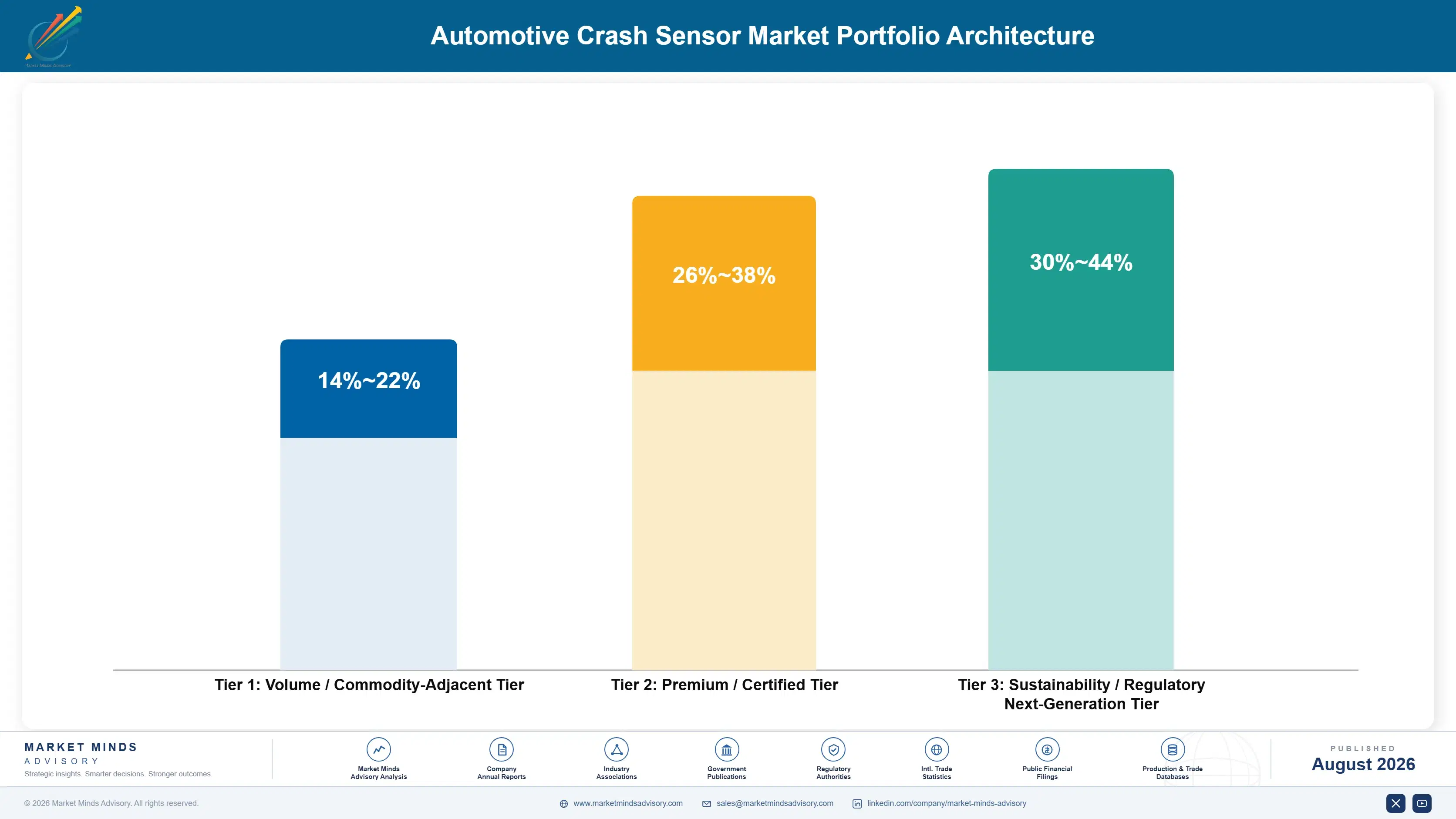
The portfolio splits into three tiers with meaningful margin separation tied to sensor fusion sophistication rather than raw hardware cost alone. Standalone accelerometer and pressure sensors compete mainly on price and delivery reliability, while integrated fusion platforms command durable premiums tied to validated software and complete safety architecture design responsibility.
The tension between hardware volume and fusion software premium is sharpening as automatic emergency braking regulation expands fusion architecture demand faster than standalone sensor demand grows, pulling supplier investment toward the higher-margin segment even though standalone sensors remain the larger unit volume base globally today, particularly in less regulated markets. Suppliers that maintain a foothold in both segments preserve optionality, while those chasing only fusion platform contracts risk losing the stable cash flow that standalone hardware sales still reliably provide.

High-value margin pools concentrate specifically in validated fusion software platforms and battery protection sensors for electric vehicles, both requiring genuine engineering investment that hardware-only suppliers must build or acquire rather than simply extend from existing manufacturing capability. Standalone accelerometer and pressure sensors, by contrast, remain a large but slower-growing volume base offering thinner, more commoditized margins for most participants going forward.

Volume / Commodity-Adjacent Tier

Standalone accelerometer and pressure sensors sold primarily on price and delivery reliability into vehicle segments without fusion architecture requirements yet, particularly across cost-sensitive emerging market segments worldwide today and consistently.
Gross Margin: 14-22%

Premium / Certified Tier

Validated radar and camera sensors integrated into automaker-certified fusion platforms commanding durable premiums tied to software validation depth and a proven, multi-year track record established with global regulators and buyers.
Gross Margin: 26-38%

Sustainability / Regulatory / Next-Generation Tier

Battery protection sensors and next-generation multi-sensor fusion architectures representing the newest and most technically demanding corner of the entire product portfolio built specifically for electric vehicle platforms sold globally today.
Gross Margin: 30-44%
automotive-crash-sensor-market-trends-portfolio-architecture-1787464937154

High-value Sub-segments and Strategic Watch-out

Validated Fusion Software Platforms

High value and high growth, driven by automatic emergency braking mandates expanding fusion architecture across broader vehicle segments worldwide and every price point today. Suppliers with proven software are capturing this segment's fastest-growing platform design wins globally right now, across nearly every major market and region.
Gross Margin: 30-44%

Electric Vehicle Battery Protection Sensors

High value with strong growth, tied directly to global electric vehicle production scaling independent of broader safety regulation cycles worldwide and across most segments today and consistently. Validated sensor designs increasingly decide which supplier wins long-term EV platform contracts across most major automakers and regions worldwide.
Gross Margin: 28-40%

Standard Accelerometer and Pressure Sensors

The volume core, serving vehicle segments across most global markets regardless of fusion architecture adoption pace or regulatory timeline currently in place today and consistently. Steady growth tracks vehicle production volume rather than any specific technology trend emerging currently across the wider category and industry.
Gross Margin: 14-22%

Unvalidated Chinese Domestic Radar Hardware

The strategic watch-out, facing accelerating price competition as domestic suppliers scale production for cost-sensitive vehicle segments worldwide and across every single price tier today and quite consistently over time. Remaining international supplier volume concentrates in accounts still requiring proven validation history and long-established track records overall.
Gross Margin: 10-18%

Platform Design Cycles Meet Regulatory Timelines

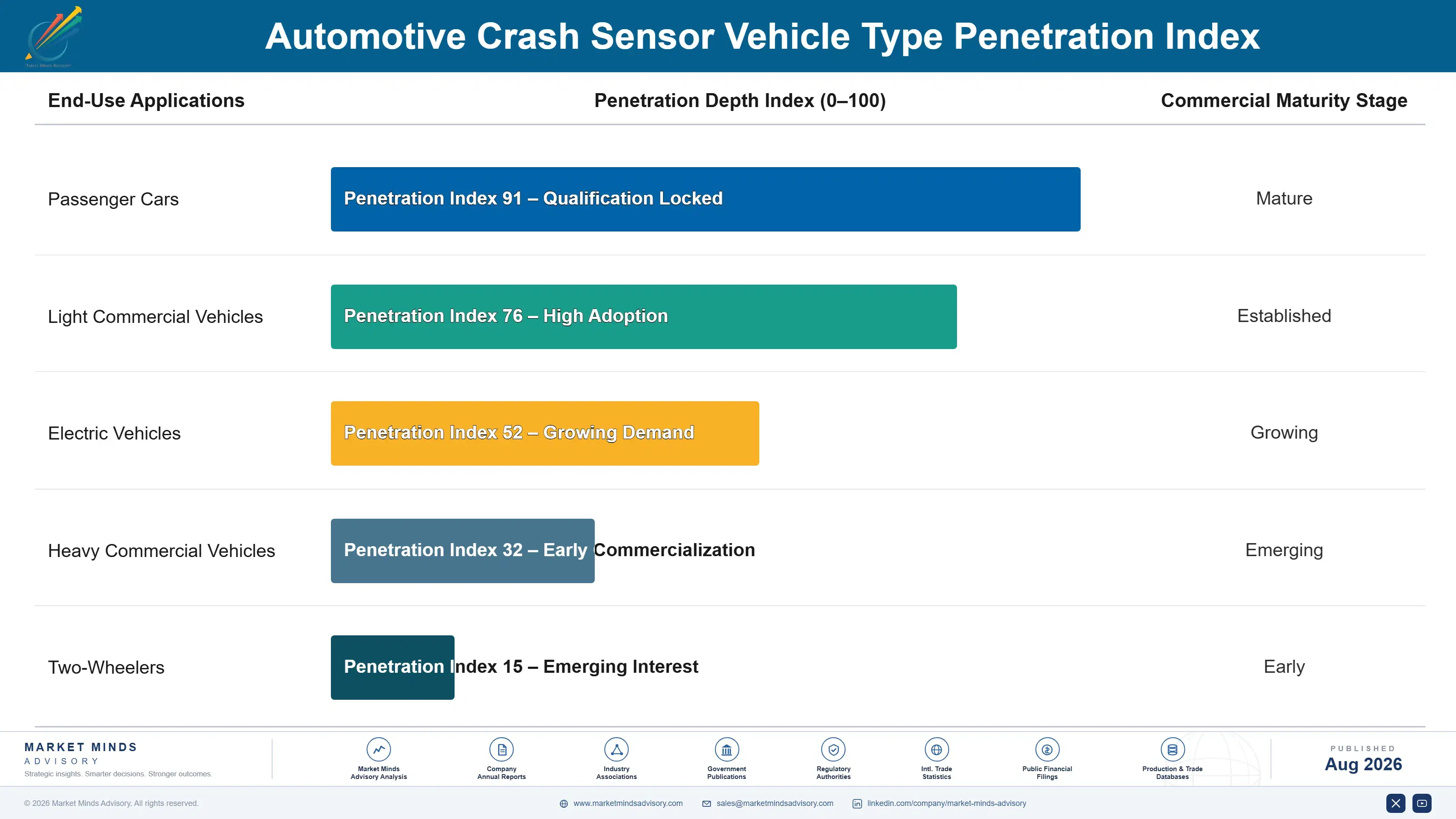
Demand compounds through vehicle platform design cycles rather than simple repeat commodity purchasing patterns. Once an automaker validates a sensor supplier's hardware and software against a platform's crash testing requirements, switching suppliers means repeating certification that typically runs 18 to 30 months, creating genuine lock-in once a contract is secured. That lock-in makes won contracts closer to an annuity than a spot sale, since automakers rarely revisit a certified supplier absent a quality issue.
Adoption depth varies sharply by vehicle segment and automaker scale. Premium and luxury automakers show the deepest fusion lock-in, having validated complete sensor suites years before regulation required broader adoption. Mainstream volume automakers show more price-driven switching behavior as they extend fusion architecture into lower trims under regulatory pressure, remaining open to competitive bidding. Commercial vehicle manufacturers sit between the two, with loyalty varying by fleet safety requirements.

Generational buyer shifts are reshaping who makes these platform sourcing decisions. Younger vehicle safety engineers increasingly prioritize validated software architecture and performance metrics over established supplier relationships that shaped earlier generations of automotive engineers. This shift favors suppliers investing in transparent validation data over those relying primarily on legacy relationship depth built over decades.
automotive-crash-sensor-market-trends-end-use-penetration-index-1787464937649

Where Crash Sensor Suppliers Should Focus

These are among the four positions where our research anticipates prominent divergence between winners and laggards over the coming forecast period. Each is grounded in the demand model, the regulatory perimeter, and the announced capacity pipeline.
01 / FUSION SOFTWARE INVESTMENT

Build Proprietary Platforms Before Regulation Forces the Shift

Automatic emergency braking regulation continues expanding across major markets, and suppliers without validated fusion software are losing platform design wins to competitors that invested in this capability years ahead of the current regulatory wave. This gap will only widen as automakers standardize fusion architecture across broader portions of their model ranges to simplify global platform engineering across regulated and unregulated markets alike. Suppliers relying only on standalone hardware sales should treat fusion software investment as an urgent strategic priority rather than a discretionary expansion.
02 / SEMICONDUCTOR SUPPLY SECURITY

Lock Dedicated Chip Capacity Before the Next Disruption

Past semiconductor shortages extended chip lead times by 6 to 12 months and forced automakers to idle assembly lines, and suppliers without dedicated automotive-grade capacity agreements absorbed that disruption directly against already thin hardware margins across the industry today. Larger suppliers are already securing dedicated foundry relationships, leaving smaller unhedged competitors increasingly exposed during the next inevitable supply tightening cycle. Securing capacity now, ahead of the next disruption, protects production continuity that automakers increasingly expect as a baseline supplier qualification requirement.
03 / CHINA MARKET ACCESS STRATEGY

Pursue Joint Ventures Rather Than Direct Price Competition

Chinese domestic suppliers are scaling radar production and winning platform contracts on cost grounds within the world's largest vehicle production market, and international suppliers competing purely on hardware price against domestic competitors face a genuinely difficult position given local cost advantages. Joint venture partnerships combining international fusion software depth with domestic manufacturing scale address both the cost competitiveness and market access challenges simultaneously. Suppliers without a credible China joint venture strategy risk losing meaningful platform volume permanently to purely domestic competitors.
04 / ELECTRIC VEHICLE CONTENT EXPANSION

Develop Battery Protection Sensors Ahead of EV Scale-Up

Electric vehicle platforms require incremental battery protection and high-voltage disconnection sensors that internal combustion platforms never needed, representing genuine additional revenue per vehicle largely independent of traditional safety regulation cycles worldwide today. Suppliers with validated battery protection designs are capturing this content ahead of competitors still developing comparable technology as global electric vehicle production continues scaling regardless of how quickly remaining safety mandates finalize. This positions early movers to own a growing content category before broader industry investment catches up.

Engagement Snapshot From the Field

A live engagement with an industry participant carrying material or product regulatory and market exposure ahead of a defining policy shift, showing how our research translates into a defensible multi-year portfolio strategy.
MARKET MINDS ADVISORY · CLIENT ENGAGEMENT SUMMARY
Automotive Crash Sensor Producer Strategic Portfolio Review and Transition Roadmap 2026·Investment Scenario on Automotive Crash Sensor Exposure Evaluation 2025-26
CLIENT PROFILE
A mid-sized Indian automaker approached MMA while planning a crash sensor platform upgrade across its compact vehicle range ahead of tightening Bharat NCAP occupant protection requirements nationwide. The client reported annual vehicle production near 250,000 units and had previously sourced basic accelerometer sensors from a single domestic supplier without fusion capability (client-reported, unverified by MMA).
STRATEGIC CHALLENGE
Management needed to identify a sensor fusion supplier capable of meeting new regulatory crash test requirements within a compressed regulatory compliance timeline while keeping incremental per-vehicle cost within the client's competitive compact vehicle pricing constraints. The client's engineering team had limited prior experience validating fusion architecture at this production scale.
MMA APPROACH
MMA benchmarked fusion platform pricing and validation timelines across four candidate suppliers under the client's specific compliance deadline and cost targets. We modeled total platform integration cost including certification testing and assessed each supplier's semiconductor supply security given recent industry disruption history. We also evaluated each candidate's experience validating comparable fusion architecture for other Indian and Southeast Asian automaker programs.
KEY FINDINGS
  1. Two of the four candidate suppliers had already validated comparable fusion architecture for other regional automakers, meaningfully reducing expected certification timeline risk (client-reported, unverified by MMA).
  2. The client's incumbent domestic supplier could not deliver validated fusion software within the regulatory compliance deadline without a costly rushed development program.
  3. Per-vehicle sensor cost increased meaningfully under the recommended fusion platform but remained within the client's stated competitive pricing tolerance for the segment.
  4. Semiconductor supply commitments varied significantly among candidates, with only two suppliers offering dedicated automotive-grade capacity agreements protecting future delivery timelines fully and reliably.
CLIENT PROFILE
A mid-sized Indian automaker approached MMA while planning a crash sensor platform upgrade across its compact vehicle range ahead of tightening Bharat NCAP occupant protection requirements nationwide. The client reported annual vehicle production near 250,000 units and had previously sourced basic accelerometer sensors from a single domestic supplier without fusion capability (client-reported, unverified by MMA).
STRATEGIC CHALLENGE
Management needed to identify a sensor fusion supplier capable of meeting new regulatory crash test requirements within a compressed regulatory compliance timeline while keeping incremental per-vehicle cost within the client's competitive compact vehicle pricing constraints. The client's engineering team had limited prior experience validating fusion architecture at this production scale.
MMA APPROACH
MMA benchmarked fusion platform pricing and validation timelines across four candidate suppliers under the client's specific compliance deadline and cost targets. We modeled total platform integration cost including certification testing and assessed each supplier's semiconductor supply security given recent industry disruption history. We also evaluated each candidate's experience validating comparable fusion architecture for other Indian and Southeast Asian automaker programs.
KEY FINDINGS
  1. Two of the four candidate suppliers had already validated comparable fusion architecture for other regional automakers, meaningfully reducing expected certification timeline risk (client-reported, unverified by MMA).
  2. The client's incumbent domestic supplier could not deliver validated fusion software within the regulatory compliance deadline without a costly rushed development program.
  3. Per-vehicle sensor cost increased meaningfully under the recommended fusion platform but remained within the client's stated competitive pricing tolerance for the segment.
  4. Semiconductor supply commitments varied significantly among candidates, with only two suppliers offering dedicated automotive-grade capacity agreements protecting future delivery timelines fully and reliably.
RECOMMENDED STRATEGY
Phase 1: Phase 1 (0 to 3 months): Select the validated fusion platform supplier and finalize integration and testing terms fully and promptly. Phase 2: Phase 2 (3 to 9 months): Complete full platform certification testing thoroughly against Bharat NCAP crash test requirements and standards. Phase 3: Phase 3 (9 to 12 months): Launch the updated compact vehicle range with fully certified fusion sensor architecture in place.
OUTCOME
The client completed platform certification within the twelve-month timeline, meeting the regulatory deadline without production disruption. The certified fusion architecture also qualified the client's compact vehicle range for a higher safety rating than its previous generation achieved, supporting a reported sales uplift in safety-conscious urban markets (client-reported, unverified by MMA).

Frequently Asked Questions

Foundational context covering the market sizes, CAGR, scope, country, region and competition that inform every finding below. This section is provided to cover basics and most often pre-purchase conversations, answered from the MMA Primary Research Dataset.

What is the current size of the Automotive Crash Sensor Market?

The market stood at approximately USD 4.2 billion in 2025, according to MMA's primary research dataset. This reflects global demand across accelerometer, radar, and camera-based crash detection technologies.

How large will the Automotive Crash Sensor Market be by 2036?

MMA projects the market will reach approximately USD 10.41 billion by 2036 under the base case scenario. This represents roughly 2.28 times the 2026 market entry value.

What is the CAGR for the Automotive Crash Sensor Market 2026 to 2036?

The base case CAGR is 8.6%, with a bull case of 9.9% and a bear case of 7.3%. The range reflects uncertainty around the pace of global safety regulation.

Which segment is growing fastest?

Radar-based pre-crash sensors grow fastest at 13.5%, about 1.57 times the overall market rate. Automatic emergency braking mandates are the primary driver of this growth.

Who are the major companies in the Automotive Crash Sensor Market?

Leading companies include Robert Bosch GmbH, Continental AG, ZF Friedrichshafen AG, Autoliv Inc, and DENSO Corporation. These five companies together hold an estimated 62% of the market on a revenue basis.

Which country is growing fastest?

India posts the fastest national growth at 11.2% CAGR, driven by tightening Bharat NCAP occupant protection requirements. This outpaces the broader South Asia and Pacific regional average.

Report Segmentation Architecture

The full report scope spans multiple orthogonal segmentation dimensions, with cross-tabulated demand data provided for each dimension pair. Coverage extends further to regional breakdowns, trend trajectories, and the competitive detail needed to support segment-level decision-making.

By Sensor Technology

  • Frontal Impact Accelerometers
  • Side Impact Pressure Sensors
  • Rollover and Yaw Rate Sensors
  • Radar-Based Pre-Crash Sensors
  • Camera-Based Pre-Crash Vision Sensors
  • Seat Belt Pretensioner Sensors

By Vehicle Type

  • Passenger Cars
  • Light Commercial Vehicles
  • Electric Vehicles
  • Heavy Commercial Vehicles
  • Two-Wheelers

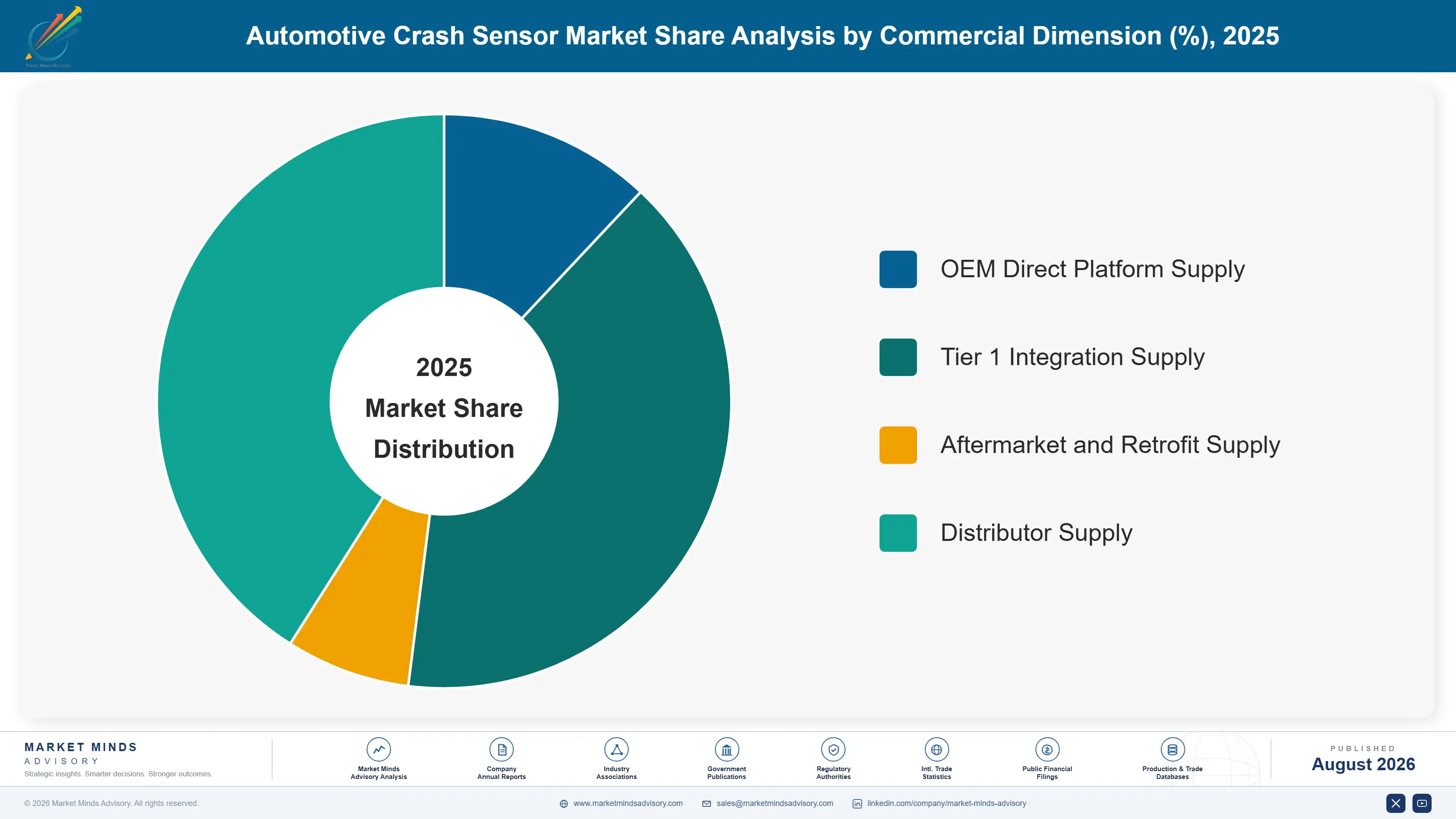
By Commercial Dimension

  • OEM Direct Platform Supply
  • Tier 1 Integration Supply
  • Aftermarket and Retrofit Supply
  • Distributor Supply

By Region

  • North America
  • Western Europe
  • East Asia
  • South Asia and Pacific
  • Latin America
  • Middle East and Africa
  • Eastern Europe

Scope, Methodology, and Coverage

Every figure in this report is reproducible from documented input assumptions. The scope below maps the historical period, the forecast horizon, the segmentation dimensions, and the countries covered, alongside the underlying primary and qualitative methodology.
Historical Period
2020 to 2025
Forecast Period
2026 to 2036
Base Year
2025 (USD billions; MMA Primary Research Dataset, August 2026)
Market Definition
The automotive crash sensor market comprises accelerometer, pressure, gyroscopic, radar, and camera-based sensors that detect impact or imminent collision to trigger airbags, pretensioners, and automatic braking systems. It excludes broader advanced driver assistance system components not directly tied to crash detection or restraint deployment, such as adaptive cruise control radar sold as a standalone comfort feature.
Quantitative Units
USD billions (current prices); unit shipment volume where applicable
Segmentation Dimensions
By Sensor Technology; By Vehicle Type; By Commercial Dimension; By Region
Regions Covered
North America, Western Europe, East Asia, South Asia and Pacific, Latin America, Middle East and Africa, Eastern Europe
Countries Covered
USA, China, Germany, France, UK, Japan, South Korea, India, Australia, Canada, Brazil, Mexico, Indonesia, Vietnam, Thailand, Malaysia, UAE, Saudi Arabia, South Africa, Nigeria, Turkey, Poland, Netherlands, Italy, Spain, Sweden, Switzerland, Argentina, Colombia, Singapore, and additional markets relevant to this sector
Key Companies Profiled
Robert Bosch GmbH, Continental AG, ZF Friedrichshafen AG, Autoliv Inc, DENSO Corporation, Sensata Technologies, Infineon Technologies, STMicroelectronics, NXP Semiconductors, Hitachi Astemo, Aptiv PLC, Joyson Safety Systems, Hyundai Mobis, Melexis, TE Connectivity, BorgWarner, Panasonic Automotive, Analog Devices, Murata Manufacturing, Elmos Semiconductor
Quantitative Methodology
Primary survey, n=3,800 respondents, Q4 2025, six countries; demand-side model with trade association cross-validation
Qualitative Methodology
47 expert interviews, Q4 2025; applied to validate demand model assumptions, identify emerging dynamics, and assess competitive positioning
Report Format
PDF and XLSX data workbook (Word format preview document)
Publisher
Market Minds Advisory
Report Code
MMA-2026-AUT-101
Published
August 2026
Contact
sales@marketmindsadvisory.com | www.marketmindsadvisory.com

Purchase the full Automotive Crash Sensor Market Report (2026 to 2036).

The full MMA Automotive Crash Sensor report sizes the market across six sensor technologies, five vehicle types, and seven regions through 2036. It profiles 20 participants on a consistent revenue basis, scoring each on fusion software validation, semiconductor supply security, and China market access strategy. Scenario models quantify how automatic emergency braking regulation and electric vehicle production growth move demand and pricing across hardware and fusion segments. The report also includes delivered semiconductor cost modeling, a regulatory timeline tracker, and a China domestic supplier competitive screen built for procurement, engineering, and category strategy teams.
Six-technology segmentation with detailed growth forecasts
MEMS and radar chip supply risk assessment
Automatic emergency braking regulation tracking tool
Fusion versus standalone sensor margin model
Regional vehicle production capacity mapping tool
Twenty-company competitive benchmarking scorecard and assessment

Built For The People Who Decide

From boardroom strategy to bench-side execution, this report is read cover-to-cover by leaders shaping the next decade of their industry, turning demand scenarios, market dynamics and valuation benchmarks into decisions.
CXOs/ Presidents/ VPs/ Managers
M&A and Corporate Development
Strategy Teams and R&D Heads
Procurement and Product Directors
Regulatory and Compliance Leaders
Investor Relations and Equity Analysts