Market Minds Advisory
Automotive Composites Market

Automotive Composites Market: Lightweighting Materials, Structural Applications, and Supplier Strategy Through 2036

Automakers are chasing weight reduction to offset battery mass in electric platforms, pulling carbon fiber and thermoplastic composites into load-bearing roles once reserved for steel, even as cost gaps and recycling mandates reshape supplier selection.

Lead Analyst

David Horsley

Published

September 2026

Make Smarter Decisions with Customized Research Insights

Request a free sample report and evaluate market opportunities, growth trends, and competitive dynamics relevant to your business needs.

2025 MARKET VALUE$38.5BMarket Size 2025
2036 FORECAST VALUE$101.4BBase Case , 2026 to 2036
CAGR 2026 TO 20369.2 %Bull 10.4% / Bear 8.0%
INCREMENTAL OPPORTUNITY$59.3BNet 10- year value creation
EXPANSION MULTIPLE2.41x2036 value over 2026 base
Strategic Levers
M&A Pipeline
Regional Outlook
Country Rankings
Competitive Intelligence
Segmental Deep-dive
Call-Us : 91 93563 13602

Executive Snapshot and Market Trajectory

Electric vehicle platforms have turned composite substitution from a premium option into an engineering requirement, since every kilogram removed from the body buys back range lost to battery weight. That calculus now dictates material specification years before a vehicle reaches production. Engineering teams now treat that tradeoff as fixed.
Carbon fiber reinforced polymer parts are absorbing the fastest growth, expanding at over twelve percent annually as EV load-bearing applications multiply beyond hoods and spoilers into battery enclosures and crash structures. East Asia now anchors both production capacity and demand, with Chinese and Japanese vehicle programs specifying composite content earlier in the design cycle than European or American counterparts, compressing the qualification timeline suppliers once relied on.
Supplier consolidation is accelerating as automakers push toward fewer, deeper partnerships covering resin formulation through part molding, squeezing smaller fabricators without integrated capacity across the value chain. End-of-life recycling regulation in the European Union is forcing a shift toward thermoplastic and bio-based resin systems that can be reprocessed, a technology transition that carbon fiber suppliers built on thermoset chemistry are now racing to match before mandates tighten further across the bloc's 2030 circularity targets.
Market Definition
The automotive composites market covers glass fiber, carbon fiber, and natural fiber reinforced polymer components engineered for passenger and commercial vehicle body, structural, and interior applications. It excludes tires, adhesives sold independent of molded parts, and aerospace-grade composites not adapted for automotive production volumes.
Base Year Value
$38.5B in 2025 (MMA Primary Research Dataset, August 2026)
Forecast Period
2026 to 2036, eleven discrete annual values
CAGR
9.2% base case. Bull 10.4%. Bear 8.0%.
Fastest Growth Segment
Carbon Fiber Reinforced Polymer Composites: 12.5% CAGR
Fastest Growth Country
China: 11.8% CAGR
Fastest Growth Region
South Asia and Pacific: 11.2% CAGR
Largest Region
East Asia: 29% of 2025 global value
Market Leaders
Toray Industries, SGL Carbon, Teijin, Owens Corning, and Solvay lead by disclosed composite material shipment volume. Source: MMA Analysis based on company annual reports.
Primary Survey
n=3,800 procurement and R&D decision-makers, Q4 2025, six countries
Methodology
Demand-side build-up, cross-validated against public data, 47 expert interviews

Automotive Composites Market Forecast Scenarios

automotive-composites-market-trends-size-forecast-scenario-1787314663240
Between 2020 and 2025 automotive composites adoption grew steadily rather than explosively, held back by resin cost and slow qualification cycles even as the first dedicated EV platforms proved the weight-saving case in production volume, setting a foundation the current decade is now building on at a materially faster pace, a trend visible in both fiber consumption volumes and disclosed supplier order backlogs.
The base case assumes low double-digit growth in electric vehicle output, continued tightening of EU and Chinese fuel economy and emissions frameworks that reward mass reduction, and falling carbon fiber production cost as capacity scales in Asia and the Middle East. Together these three mechanisms pull composite content into mainstream trim levels rather than confining it to halo models, widening the addressable vehicle base each year through the forecast window.
The bull case rests on a breakthrough in low-cost carbon fiber precursor chemistry cutting per-kilogram cost toward aluminum parity within a few years. The bear case is a prolonged EV demand slowdown that leaves automakers reverting to high-strength steel and aluminum for cost reasons, stalling composite penetration in mid-market vehicle segments for an extended stretch.

Weight Economics and the Shift to Structural Composites

Vehicle mass has become a design constraint rather than a marketing point since battery packs added hundreds of kilograms that engineering teams must claw back elsewhere in the vehicle architecture. Composite substitution offers the largest single weight reduction lever available without redesigning the powertrain, which is why material specification decisions now happen at the concept phase rather than late in development. Few other single design decisions carry comparable leverage over a vehic
MARKET CONCENTRATIONCR5 42%top five suppliers hold moderate but rising combined share
AVERAGE SELLING PRICE$18.40/kg CFRP partcarbon fiber parts command steep premium versus steel
LEADING PRODUCTION COUNTRYChina, 27% shareoutput concentrated near battery and EV assembly hubs
CAPACITY UTILISATION76%carbon fiber precursor production lines running near ceiling
RESIN COST SHARE38% of COGSepoxy and thermoplastic resin dominates finished part cost
TRADE INTENSITY44% cross-borderfiber precursor and finished part shipments span multiple regions
The market's commercial character splits between high-volume glass fiber parts sold on cost parity with steel and a smaller, higher-margin carbon fiber segment sold on performance and range extension. Fabricators serving the two tiers operate almost as separate businesses with different customers, tooling investments, sales cycles, and qualification requirements that rarely overlap in practice. That split shows up in negotiated payment terms.
The next decade will be shaped by recycling regulation, precursor cost curves, and the maturation of high-pressure resin transfer molding that cuts cycle times toward the speed mainstream assembly lines require. Suppliers that solve cycle time without sacrificing fiber performance win the largest and longest-running platform programs. Suppliers optimizing only for strength risk losing ground on manufacturability.
"Composite suppliers keep pitching weight savings, but the automakers that actually scale volume are the ones that solved cycle time first. Performance without manufacturability just stays a concept car material."
Director, Automotive Materials Practice · MMA Automotive Materials and Component

Market Trends

Structural Battery Enclosures Adopting Composite Housings

Battery enclosure design is shifting from stamped steel trays toward sheet molding compound and glass fiber composite housings that cut assembly mass by up to 40 percent while meeting thermal runaway containment standards under UN R100 and GB 38031. Six major EV platforms launched since 2024 specify composite battery trays as standard, up from a single reference design in 2021. Suppliers report enclosure programs now represent the fastest-growing single application category within the broader composites portfolio, ahead of body panels and interior trim combined, and expect the gap to widen further through 2028.
Market Impact: Improves range 6 to 8 percent
Recycled Carbon Fiber Reaching Automotive-Grade Qualification

Pyrolysis-based recycled carbon fiber has cleared automotive tensile strength qualification at three major suppliers since 2023, opening a second-life feedstock stream that costs roughly 60 percent less than virgin fiber. Automakers under EU end-of-life vehicle directive pressure are specifying minimum recycled content in non-safety-critical trim and underbody panels, with several targeting 25 percent recycled fiber content by 2028. This shifts the competitive question from who owns virgin fiber capacity to who controls reclamation infrastructure and sorting technology at meaningful commercial scale across multiple regions. Fabricators moving early into reclamation are positioning to supply automakers broadly.
Market Impact: Requires 15 percent mass substituti

Market Opportunities and Growth Drivers

EV Range Anxiety Pushing Mass Reduction Mandates

Every 10 percent reduction in vehicle mass improves electric range by roughly 6 to 8 percent according to powertrain engineering studies cited across multiple OEM technical disclosures, making composite substitution a direct lever on the range figure that dominates EV purchase decisions. Automakers targeting 400-mile range flagship models are specifying carbon fiber content in roof, hood, and floor structures that previously used steel or aluminum. This driver compounds as battery chemistry improvements slow and mass reduction becomes the remaining lever engineers can pull within a fixed development budget and timeline.
Market Impact: Leaves cycle time near 4 min

China's New Energy Vehicle Mandate Scaling Composite Demand

China's new energy vehicle credit system, tightened for the 2026 model year, requires domestic automakers to hit fleet-average consumption targets that are difficult to meet without material substitution across at least 15 percent of body-in-white mass. Domestic carbon fiber capacity has tripled since 2021 to meet this demand, led by Jilin and Jiangsu province production clusters that now supply both domestic and export markets. The mandate created a captive demand base that gave Chinese fiber producers scale advantages competitors in Europe and the United States are still building toward, at the pace already evident in provincial output data.
Market Impact: Raises premiums 8 to 15 pct

Market Restraints and Challenges

Cycle Time Gap Versus Stamped Steel Limits Mass-Market Use

Compression molding for carbon fiber parts still runs at roughly 3 to 5 minutes per part against under 10 seconds for stamped steel, a gap rooted in resin cure chemistry that has not closed proportionally to cost reduction achieved elsewhere in the process. The commercial impact falls hardest on mid-volume vehicle programs producing 50,000 to 150,000 units annually, where tooling economics favor steel even when composite parts would perform better. Suppliers are pursuing high-pressure resin transfer molding and snap-cure epoxy systems to compress cure time toward a target under 90 seconds, with several pilot lines running below 2 minutes.
Market Impact: Adds 40 percent enclosure mass redu

Repairability Gaps Raising Insurance and Ownership Cost

Carbon fiber body panels lack the standardized dent-and-paint repair infrastructure that exists for steel, so a collision that would cost a few hundred dollars to fix on a steel panel often requires full panel replacement on a composite one, a root cause tied to resin matrix damage that body shops cannot assess visually. Insurers have responded by raising premium tiers on composite-intensive vehicles by 8 to 15 percent in several markets, which feeds back into consumer purchase resistance. Suppliers and insurers are piloting ultrasonic damage assessment tools intended to bring repair cost estimation closer to steel-panel norms by 2028.
Market Impact: Cuts recycled fiber cost 60 percent
3 additional market trends, 3 additional growth drivers, and 4 additional restraints and challenges are covered in the full report. Contact sales@marketmindsadvisory.com to access the complete intelligence.

Segment CAGR and Growth Architecture

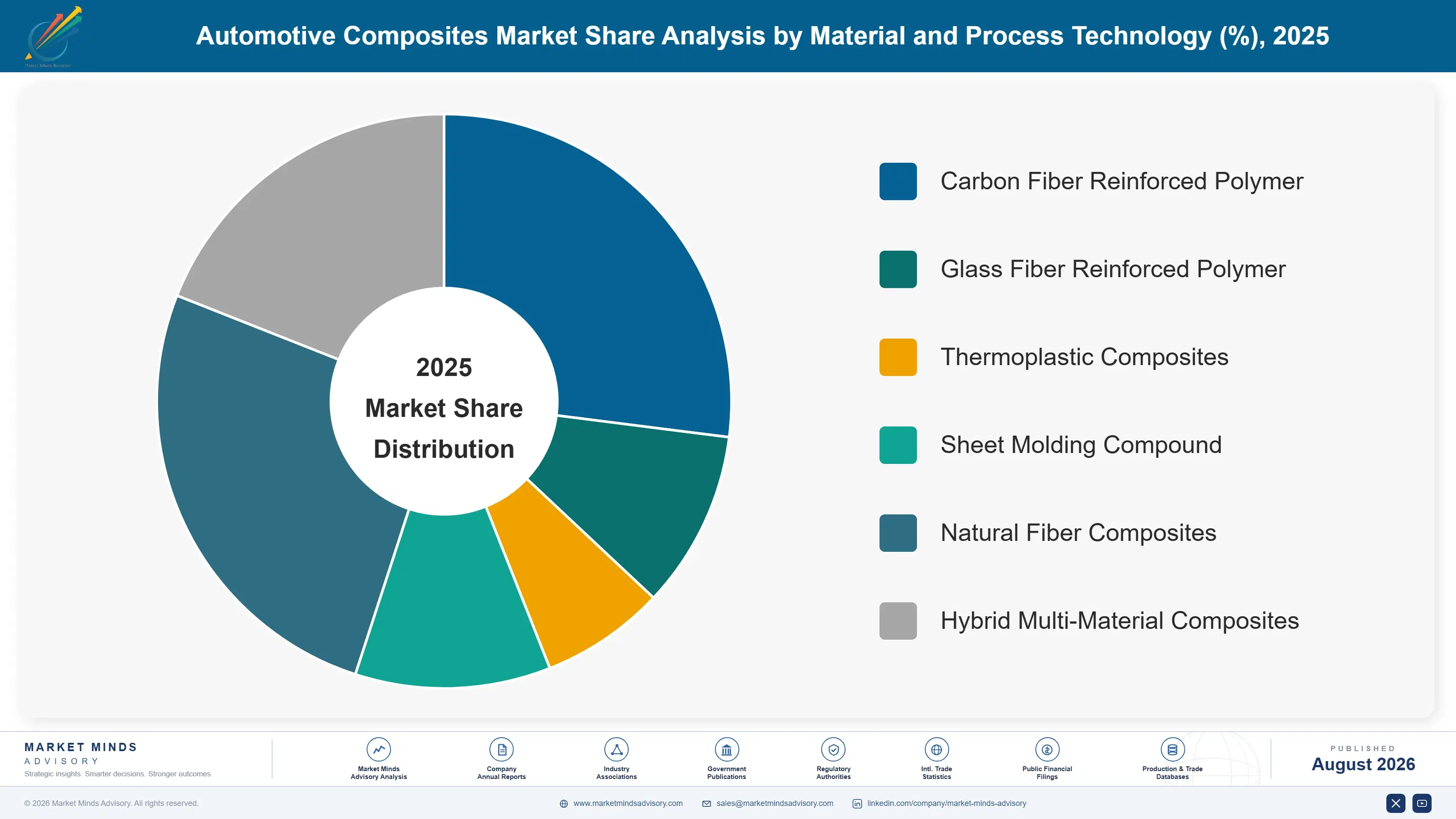
Segmentation follows material and process technology rather than end-use application, since material choice is the decision automakers lock in earliest and revisit least often across a program's life, and it determines cost structure, cycle time, and which vehicle programs a fabricator can realistically supply at meaningful production volume across the full range of vehicle categories.
automotive-composites-market-trends-market-share-analysis-1787314663810

Carbon Fiber Reinforced Polymer (CFRP)

CFRP is the highest-performance and highest-cost segment, used where mass reduction directly justifies premium pricing: EV battery enclosures, roof panels, crash structures, and performance vehicle body shells. Growth is running well ahead of the broader market as precursor capacity expands in China and the Middle East and as recycled fiber qualification opens a lower-cost feedstock tier. Automakers increasingly specify CFRP in structural rather than cosmetic applications, a shift that raises both the technical bar for suppliers and the value captured per part. Tooling investment remains the binding constraint on how quickly new entrants can scale, keeping the supplier base concentrated even as demand broadens across more vehicle platforms and price tiers than five years ago existed in this market.
CAGR 12.5%

Thermoplastic Composites

Thermoplastic composites are gaining share because they can be reheated and reshaped, which solves the end-of-life recyclability problem that thermoset resins cannot, and because injection molding cycle times run closer to conventional plastic processing than to carbon fiber compression molding. Automakers under EU circularity pressure are specifying thermoplastic composite underbody shields, battery trays, and interior structural brackets in place of thermoset alternatives. The segment benefits from a broader supplier base already equipped for high-volume plastic processing, lowering the capital barrier relative to carbon fiber. Growth is concentrated in Europe and China, where recycling mandates and EV production volumes intersect most directly, though adoption is spreading into North American programs as suppliers qualify equivalent material systems for local platforms.
CAGR 11.0%
Full segment breakdown across 6 segments available in the complete report.

Regional Architecture and Country Demand Map

East Asia leads on the combined strength of vehicle production volume and fiber manufacturing capacity, with North America and Western Europe following on premium and performance vehicle demand and tightening emissions frameworks respectively, reflecting where assembly scale and materials science investment now concentrate most heavily.

North America

The United States carries the bulk of regional demand, driven by domestic EV programs at legacy automakers and pure-play manufacturers that specify carbon fiber content in flagship trims to hit range targets ahead of competitors. Federal fuel economy standards under CAFE continue to reward mass reduction even as EV incentive policy shifts, keeping composite specification attractive across both electric and hybrid programs. Mexico's growing role as a vehicle assembly hub is pulling composite part fabrication south of the US border to stay close to final assembly lines. Canada contributes a smaller but stable share concentrated in commercial vehicle and specialty applications. Tooling investment by suppliers is increasingly sited near assembly clusters in the US South and Mexico's Bajio region.
Share: 24% | CAGR: 8.7% (2026 to 2036)

Western Europe

Germany anchors regional demand through its premium vehicle manufacturers, which have used carbon fiber in performance trims for over a decade and are now extending composite specification into mainstream EV platforms to meet stringent EU fleet emissions targets. France and Italy contribute meaningful volume through both automotive supply and adjacent motorsport and luxury vehicle composite expertise that transfers into production programs. The region's growth trails the global average because its automakers are simultaneously the most exposed to end-of-life recycling regulation, which is forcing a costly transition from thermoset to thermoplastic resin systems even as unit volumes stay comparatively flat. Regulatory pressure here is as much a growth constraint as a demand driver.
Share: 20% | CAGR: 7.7% (2026 to 2036)
Regional intelligence for 5 additional markets available in the complete report: East Asia, South Asia and Pacific, Latin America, Middle East and Africa, Eastern Europe. Contact sales@marketmindsadvisory.com.
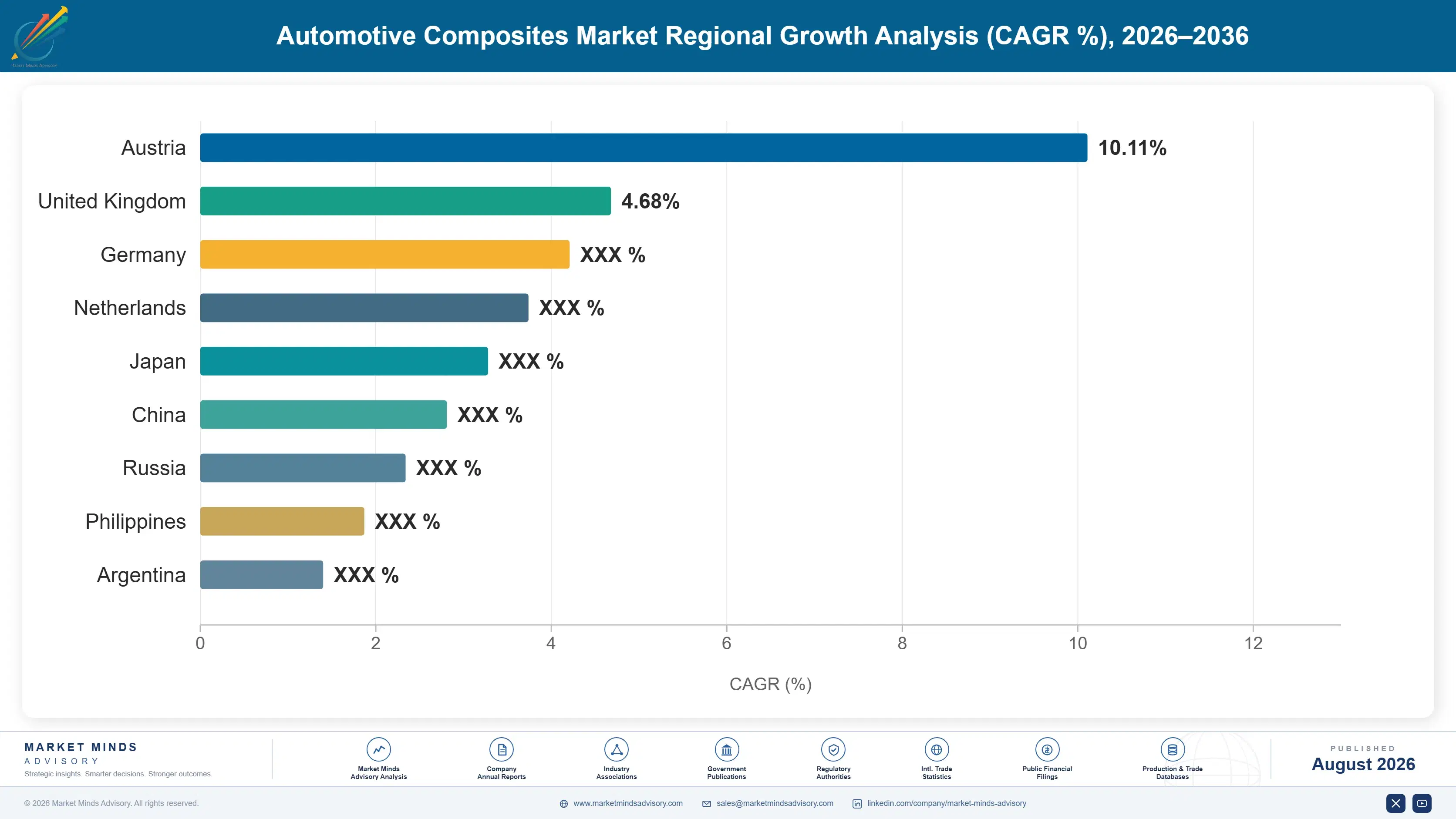
automotive-composites-market-trends-country-cagr-analysis-1787314664350

Where Composite Suppliers Can Expand Margin

Four commercial levers separate suppliers capturing premium value from those competing purely on part price, spanning application mix, feedstock control, process technology, and geographic positioning relative to assembly hubs and customer footprints. Each lever reflects a different point in the value chain where suppliers can capture more margin than commodity part pricing alone would ever allow them to realize.

Shift Toward Structural Rather Than Cosmetic Applications

Suppliers that move from cosmetic trim parts into load-bearing structural applications capture materially higher per-kilogram pricing, since structural qualification requires crash certification testing that raises the barrier for competitors and justifies premium contracts over multi-year terms. Battery enclosures and crash structures carry pricing 2 to 3 times cosmetic trim on a per-kilogram basis, reflecting both material performance requirements and the engineering validation cost baked into structural programs. Fabricators that invested early in crash testing capability are now winning multi-year structural supply agreements that cosmetic-only competitors cannot bid on, locking in revenue visibility that spot-market trim contracts never provided them.
Market Impact: Captures 2 to 3 times trim-part pri

Control Recycled Fiber Reclamation Infrastructure Assets

Suppliers building pyrolysis and solvolysis reclamation capacity are securing a feedstock cost advantage of roughly 60 percent versus virgin fiber while positioning themselves as the compliant supplier of choice under tightening EU and Chinese recycled content mandates taking effect this decade. Owning reclamation infrastructure also creates a second revenue stream from processing end-of-life material for competitors who lack their own facilities, effectively monetizing waste streams the industry previously treated as pure cost. Early movers in this space are securing long-term reclamation feedstock agreements with automaker take-back programs, a contract structure that barely existed five years ago and is becoming meaningful.
Market Impact: Cuts feedstock cost by roughly 60 p

Localize Fabrication Near Major Assembly Clusters

Composite parts are bulky and costly to ship relative to their value, so suppliers locating fabrication within 200 to 300 kilometers of final assembly plants capture freight and just-in-time delivery premiums that distant competitors cannot match, alongside reduced working capital tied up in transit inventory and warehousing. This proximity advantage is becoming more valuable as automakers compress supplier lead time requirements to match faster EV platform development cycles across every major region. Suppliers that co-locate with assembly clusters in Mexico's Bajio region, Poland, and China's Jiangsu province are winning preferred supplier status that translates into multi-year volume commitments.
Market Impact: Captures freight premium of 5 to 8

Offer Collision Repair Certification Training Services

Suppliers and material system providers that build out collision repair training and certification programs for body shops are creating a services revenue stream while addressing the repairability restraint that currently suppresses composite adoption in mass-market vehicle segments. Certification programs typically charge body shops per technician trained and per facility certified, a model that scales with the growing installed base of composite-intensive vehicles on the road each year. This lever also strengthens automaker relationships, cutting insurance-related warranty claims by roughly 10 percent at certified shops. Automakers increasingly favor suppliers who can demonstrate a functioning repair network at launch.
Market Impact: Adds fees per shop, cuts claims 10

Who Controls the Margin Pool

CR5 sits at 42 percent, reflecting a market still fragmented enough for regional specialists to compete alongside global materials companies, though the gap between the top five and the next tier of challengers has widened as structural application requirements raise the qualification bar smaller fabricators struggle to clear consistently across programs. That gap is most visible in how quickly each tier can win new structural program bids.
Current competitive activity centers on precursor capacity expansion in Asia and the Middle East, recycled fiber qualification programs racing to meet 2028 content targets, and vertical integration moves where fiber producers acquire downstream part fabricators to capture more of the value chain rather than selling commodity fiber tow at thin margin.

Emerging pressure comes from Chinese fiber producers whose domestic scale advantage is starting to translate into export competitiveness against Japanese and European incumbents that have held precursor technology leadership for decades. Recycled fiber specialists without legacy virgin fiber assets are also gaining ground, since automakers now value reclamation capability on its own commercial merits rather than treating it as a niche sustainability add-on to the core business. Neither dynamic looks likely to reverse soon.
automotive-composites-market-trends-company-positioning-matrix-1787314664875

Competitive Moat and Risk Dimensions

TORAY INDUSTRIES

Moat: Precursor technology depth

Toray holds one of the industry's deepest carbon fiber precursor patent portfolios, built over four decades of research investment, giving it a fiber performance edge that is difficult for newer entrants to replicate quickly regardless of the capital they have available to deploy. Its position spans both precursor chemistry and downstream part qualification expertise.
TORAY INDUSTRIES

Risk: Chinese capacity undercutting price

Rapidly scaling Chinese domestic precursor capacity is compressing the price premium Toray has historically commanded in export markets, forcing a shift toward higher-value structural applications where technology leadership still matters more than raw unit cost alone. This pressure is most visible in cosmetic and mid-tier applications, where Chinese suppliers now compete on price alone.
SGL CARBON SE

Moat: Automotive-dedicated production lines

SGL Carbon operates production lines purpose-built for automotive volume rather than aerospace-grade specifications, giving it a cost and cycle time advantage when bidding on high-volume structural component programs against aerospace-first competitors that carry higher fixed cost structures. That focus lets it price competitively on programs aerospace-oriented rivals economically cannot match.
SGL CARBON SE

Risk: European energy cost exposure

Carbon fiber production is energy-intensive, and SGL's largely European manufacturing base carries higher energy cost exposure than Asian competitors, a disadvantage that widened noticeably during recent European energy price volatility and has not fully reversed since. Diversifying production geography would help, but existing plant investments limit how quickly that shift can happen.

Players Tracked

Prominent Players

Toray Industries
SGL Carbon SE
Teijin Limited
Owens Corning
Solvay SA

Other Key Players

Hexcel Corporation
Mitsubishi Chemical Group
Continental Structural Plastics
Plasan Carbon Composites
Toho Tenax
Zoltek Companies
Gurit Holding AG
Johns Manville
PPG Industries
Magna International
Faurecia SE
BASF SE
Huntsman Corporation
Jushi Group
Koninklijke Ten Cate

Recent Developments

MARCH 2025

Toray Expands Carbon Fiber Precursor Line in South Korea

Toray commissioned an expanded polyacrylonitrile precursor production line at its Gumi facility in South Korea, adding capacity dedicated to automotive-grade fiber tow to serve growing regional EV battery enclosure demand. The expansion followed two years of construction work and represents Toray's largest single automotive-focused capacity addition in the region.
Signal: Signals precursor capacity is shifting tow
SEPTEMBER 2025

SGL Carbon and a European Automaker Sign Multi-Year Supply Agreement

SGL Carbon signed a multi-year supply agreement with a major European automaker covering carbon fiber reinforced roof and structural components for an upcoming EV platform, locking in volume commitments through 2029. The agreement was structured as a supply contract rather than a joint venture or equity arrangement between the parties.
Signal: Confirms automakers are locking in multi-y
JANUARY 2026

Teijin Acquires a Recycled Carbon Fiber Reclamation Specialist

Teijin acquired a mid-sized European recycled carbon fiber reclamation company, adding pyrolysis processing capacity and securing feedstock supply ahead of tightening EU recycled content requirements taking effect later this decade. The acquisition was Teijin's first dedicated move into reclamation infrastructure ownership rather than fiber purchasing agreements with third parties.
Signal: Shows established fiber producers moving t

Resin and Precursor Cost Exposure

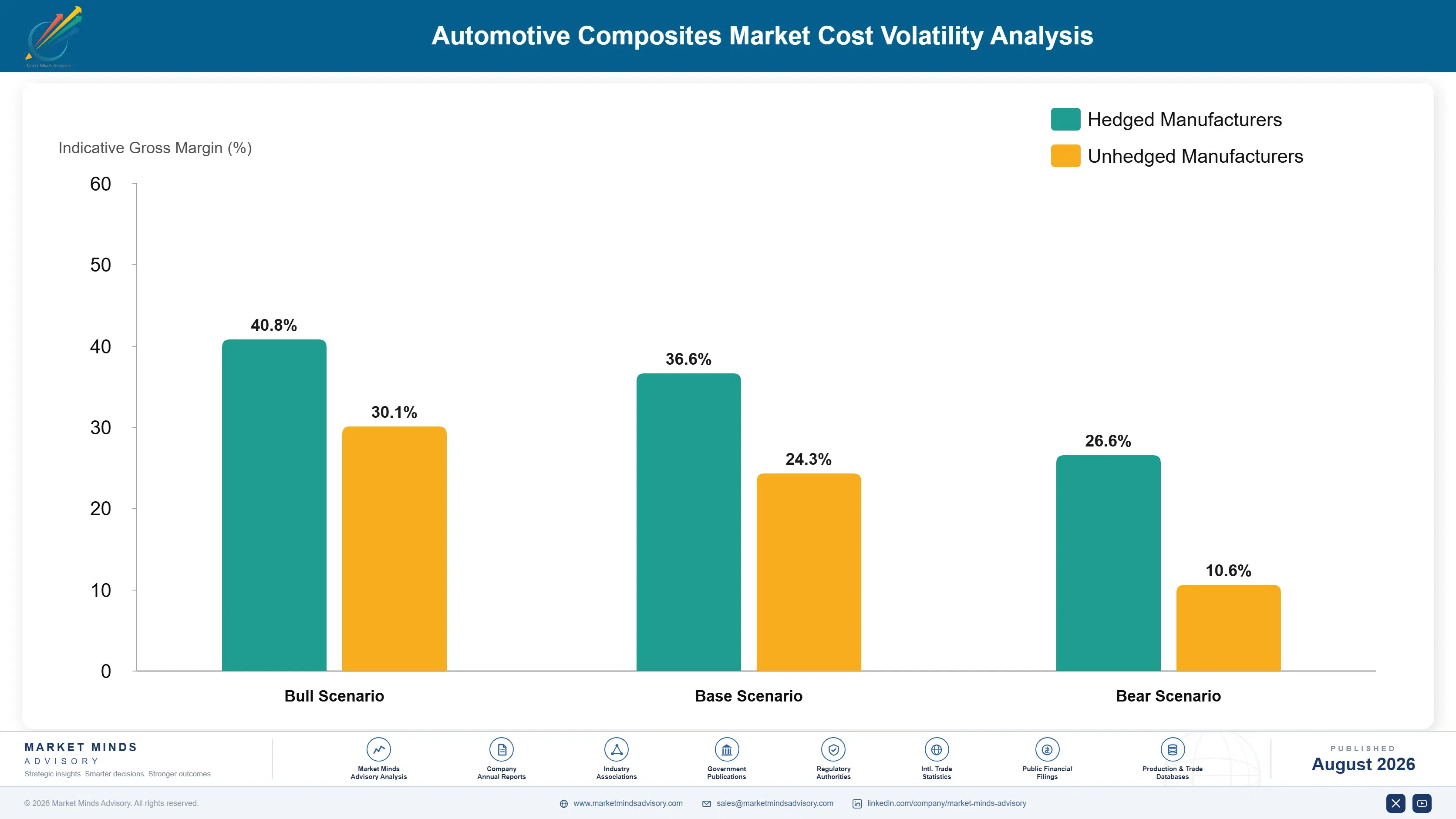
Resin systems, primarily epoxy and thermoplastic polymers, account for roughly 38 percent of finished composite part cost, with carbon fiber precursor material adding a further 30 percent for CFRP-grade parts. Precursor feedstock traces back to polyacrylonitrile derived from acrylonitrile, a petrochemical commodity whose price tracks natural gas and crude oil markets, giving the supply chain exposure to swings outside any single supplier's control.
European energy price volatility following supply disruptions in 2022 pushed acrylonitrile production costs up sharply according to IEA energy market reporting, squeezing margins at European precursor producers relative to Asian and Middle Eastern competitors with access to lower-cost natural gas feedstock supplies. Several European fiber producers reported temporary production curtailments during the worst of the price spike, a disruption still referenced in supplier risk disclosures and annual reports.

The competitive disadvantage falls hardest on European and North American fabricators without long-term feedstock supply agreements, since spot-market resin purchasing leaves them exposed to price swings that vertically integrated Asian and Middle Eastern producers can partially absorb through captive petrochemical feedstock access. Smaller regional fabricators without hedging programs or long-term contracts carry the highest earnings volatility from this exposure, a gap that is pushing consolidation toward larger, better-hedged suppliers.
automotive-composites-market-trends-cost-volatility-analysis-1787314665069

Long-Term Feedstock Supply Agreements

Larger fabricators are locking in multi-year acrylonitrile and resin supply contracts with fixed or collared pricing to reduce exposure to spot market volatility, trading some cost upside for predictability that smaller competitors without negotiating leverage cannot access on comparable terms. This approach has become more common since 2023 as volatility increased and smaller players found spot markets increasingly unreliable.

Regional Precursor Sourcing Diversification

Suppliers are qualifying precursor material from multiple regional sources rather than depending on a single geography, reducing the risk that any one region's energy price spike or supply disruption stalls production across the entire fabrication network for extended periods. This diversification requires additional supplier qualification work upfront but pays back quickly once any single region experiences disruption.

Recycled Feedstock Blending Programs

Blending reclaimed carbon fiber into new parts where structural requirements allow reduces virgin precursor dependence and provides a cost buffer against precursor price spikes, while simultaneously addressing recycled content regulatory requirements taking effect later this decade across major markets. Suppliers running pilot blending lines report no measurable performance loss in non-safety-critical applications so far.

Portfolio Architecture for Margin Defence

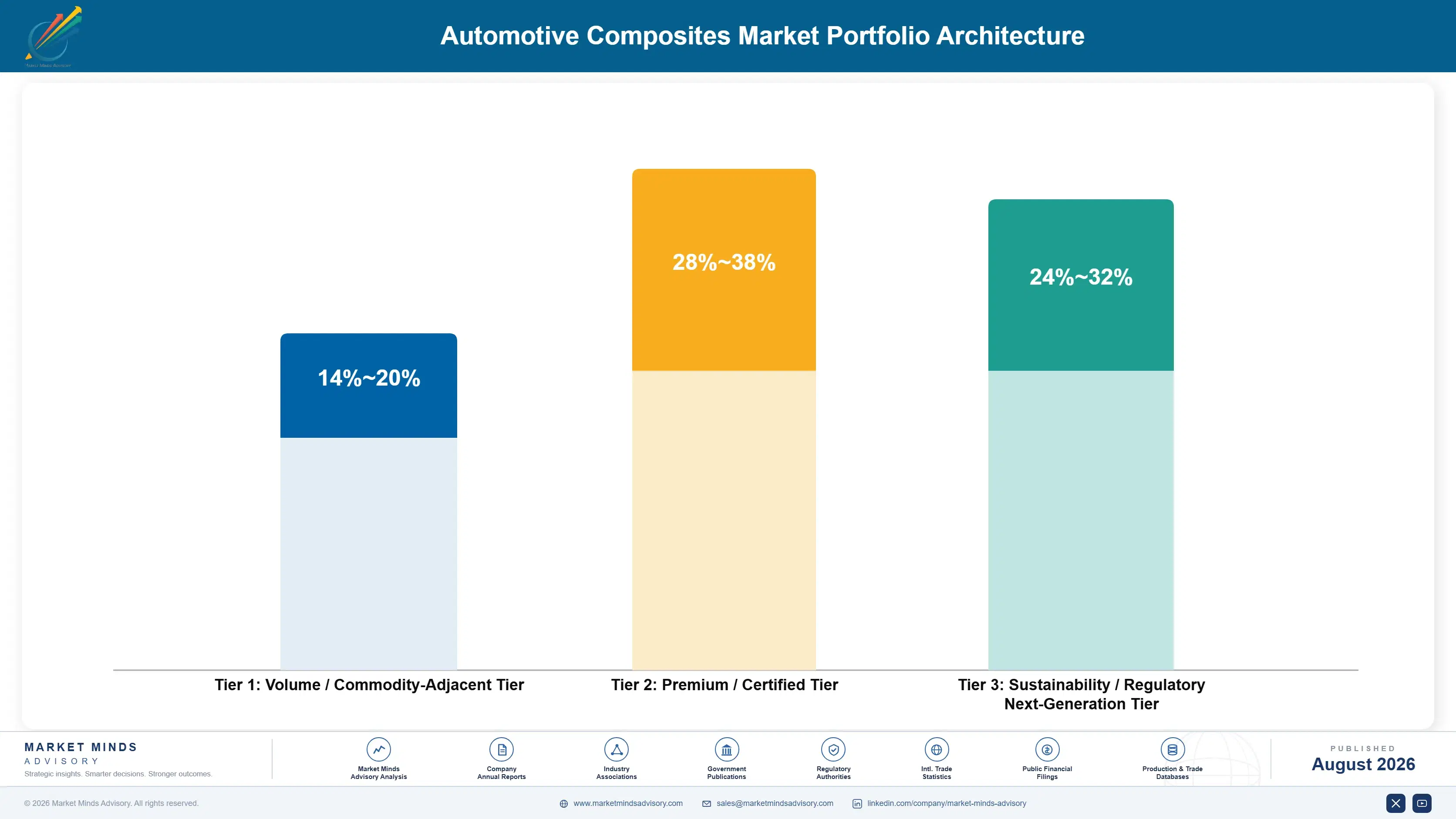
The portfolio splits into three tiers running on distinct economics: a volume tier built on glass fiber and sheet molding compound parts sold near cost parity with steel, a premium tier of carbon fiber structural and cosmetic components carrying substantially higher margin, and an emerging sustainability tier built on recycled and bio-based feedstock that commands a compliance premium rather than a pure performance premium alone. Each tier draws a genuinely different customer base.
The tension between volume and premium is not simply about margin, since automakers buying volume-tier parts are extremely price-sensitive and will resource to steel at the first sign of cost creep, while premium-tier buyers are paying for a specific performance outcome and tolerate less price sensitivity as long as the weight-saving math holds up against realistic alternatives available to them. Suppliers serving both tiers manage them as separate commercial operations entirely.

High-value margin pools concentrate in structural CFRP applications and in recycled fiber processing, both of which combine technical differentiation with regulatory tailwinds that volume-tier commodity parts simply do not have, giving suppliers positioned in either pool meaningfully more pricing power than the broader market average would suggest.

Volume / Commodity-Adjacent Tier

Glass fiber and sheet molding compound parts for body panels, interior trim, and underbody shields, priced to compete directly against stamped steel and injection-molded plastic alternatives on cost. This tier represents the highest unit volume in the market by a wide margin.
Gross Margin: 14-20%

Premium / Certified Tier

Carbon fiber structural and performance components meeting crash certification standards, sold into EV flagship trims and performance vehicle programs at a substantial margin premium over volume parts. Suppliers here compete primarily on engineering credibility rather than price.
Gross Margin: 28-38%

Sustainability / Regulatory / Next-Generation Tier

Recycled and bio-based fiber composite parts meeting EU and Chinese recycled content mandates, commanding a compliance premium as automakers race to meet 2028 content targets set by regulators. This tier is growing fastest as mandates tighten across major markets.
Gross Margin: 24-32%
automotive-composites-market-trends-portfolio-architecture-1787314665561

High-value Sub-segments and Strategic Watch-out

EV Structural Battery Enclosures

Combines the fastest application growth rate in the market with premium structural pricing, making it the single most valuable pool for suppliers with crash certification capability and thermal containment expertise built up since 2023 and refined continuously. Few competitors currently hold both capabilities at scale.
Gross Margin: 30-38%

Recycled Carbon Fiber Reclamation

Growing steadily as regulatory content mandates take effect across major markets, offering suppliers a second revenue stream from processing end-of-life material while securing a structural cost advantage over virgin fiber competitors lacking reclamation capacity of their own. This segment rewards early infrastructure investment over fast follower entry.
Gross Margin: 26-34%

Glass Fiber Body Panels

The steady volume core of the market, growing in line with overall vehicle production and offering predictable but thinner margin than either the structural or recycled tiers discussed above in this section. It remains the segment most exposed to direct steel and aluminum substitution pressure over time.
Gross Margin: 14-20%

Thermoset Cosmetic Trim Parts

A strategic watch-out segment facing margin compression as EU recycling mandates penalize non-recyclable thermoset resin systems, pushing volume toward thermoplastic alternatives suppliers must qualify quickly or risk losing meaningful share. Suppliers slow to requalify their resin systems risk losing entire program contracts within a single renewal cycle.
Gross Margin: 10-16%

From Program Wins to Platform Lock-In

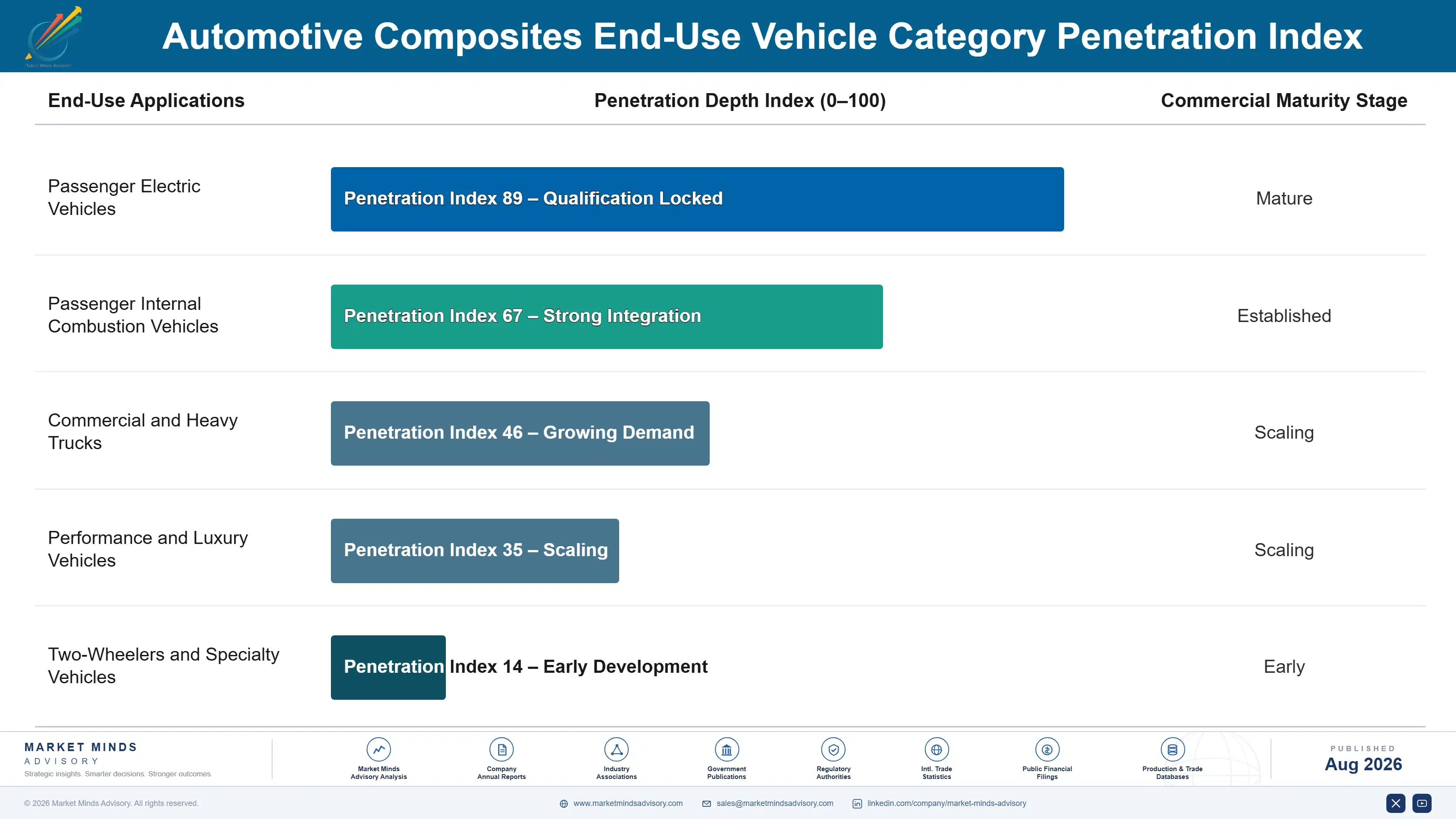
Composite supply contracts function closer to annuities than transactional sales once a supplier wins qualification on a vehicle platform, since requalifying an alternative material system mid-program is expensive and risky enough that automakers rarely switch suppliers within a platform's five to seven year production run and lifecycle. That inertia is precisely why early platform wins matter so much more than they would in a commodity part category.
Adoption depth varies sharply by end-use vertical: EV flagship and performance vehicle programs have pushed composite content deep into structural applications, while mainstream mid-market passenger vehicles still limit composite use to cosmetic trim and a handful of underbody components where the business case is unambiguous. Commercial vehicle and heavy truck programs lag furthest behind, held back by duty cycle durability requirements composites have not yet fully proven against steel in the field.

A generational shift is underway in buyer profiles as procurement decisions move from purchasing teams focused purely on part cost toward integrated engineering and sustainability teams that weigh lifecycle emissions and recyclability alongside price, a change that favors suppliers who can document material provenance and end-of-life pathways clearly and consistently.
automotive-composites-market-trends-end-use-penetration-index-1787314666055

Structural Applications Decide the Decade

These are among the four positions where our research anticipates prominent divergence between winners and laggards over the coming forecast period. Each is grounded in the demand model, the regulatory perimeter, and the announced capacity pipeline.
01 / APPLICATION PORTFOLIO FOCUS

Prioritize structural qualification over cosmetic volume

Structural applications carry two to three times the pricing of cosmetic trim and require crash certification that smaller competitors cannot easily replicate, creating a durable barrier around suppliers who invest early in this capability. Cosmetic-only fabricators face margin compression as automakers commoditize trim sourcing across multiple qualified vendors competing on price alone. Suppliers should direct capital toward crash testing capability and structural design engineering rather than expanding cosmetic part capacity that offers limited long-term pricing power in a market moving toward structural specification.
02 / FEEDSTOCK SOURCING STRATEGY

Build recycled fiber reclamation capacity now

Recycled content mandates in the EU and China are moving from voluntary target to enforced requirement within this decade, and suppliers without reclamation infrastructure will be forced to purchase reclaimed feedstock from competitors at a margin disadvantage. Early movers are already securing automaker take-back agreements that create durable feedstock pipelines unavailable to later entrants in this space. Building or acquiring reclamation capacity now, while assets remain reasonably priced, positions suppliers ahead of a regulatory deadline that will tighten sourcing options considerably in coming years.
03 / GEOGRAPHIC POSITIONING STRATEGY

Localize fabrication near East Asian assembly clusters

East Asia combines the fastest regional growth with the deepest concentration of EV assembly volume, giving suppliers with fabrication capacity near Chinese, Japanese, and South Korean assembly hubs a freight and lead-time advantage over more distant competitors. This is a materially different call than five years ago when European premium demand justified a Western-weighted supplier footprint. Suppliers still concentrated in legacy European or North American locations should evaluate East Asian capacity additions as a near-term priority rather than a longer-term option to revisit later.
04 / COST RISK MANAGEMENT

Secure multi-year precursor supply agreements

Resin and precursor costs, tied closely to petrochemical and energy markets, remain the largest source of margin volatility across the industry, and suppliers without long-term supply agreements are structurally disadvantaged relative to vertically integrated competitors with captive feedstock. The 2022 to 2024 European energy price spike demonstrated how quickly this exposure can compress margins for unhedged fabricators operating on thin working capital. Suppliers should prioritize locking in multi-year feedstock agreements and diversifying precursor sourcing geography before the next energy price disruption arrives unexpectedly.

Engagement Snapshot From the Field

A live engagement with an industry participant carrying material or product regulatory and market exposure ahead of a defining policy shift, showing how our research translates into a defensible multi-year portfolio strategy.
MARKET MINDS ADVISORY · CLIENT ENGAGEMENT SUMMARY
Automotive Composites Producer Strategic Portfolio Review and Transition Roadmap 2026·Investment Scenario on Automotive Composites Exposure Evaluation 2025-26
CLIENT PROFILE
The client was a Tier-1 automotive supplier with roughly $2.4 billion in annual revenue (client-reported, unverified by MMA), supplying body and structural components to three major EV platforms across North America and Europe, seeking to expand its carbon fiber structural component offering ahead of a wave of new platform launches scheduled through 2027. The client had not previously bid on any full structural component program.
STRATEGIC CHALLENGE
The client's cosmetic trim business faced margin compression as automakers commoditized sourcing across qualified vendors, while a competitor had begun winning structural component contracts the client lacked crash certification capability to bid on, threatening its position on several upcoming platform awards. Internal estimates suggested the client would lose meaningful share within two platform cycles absent a capability change.
MMA APPROACH
MMA conducted a competitive capability assessment against structural component leaders, modeled the crash certification investment case against projected structural contract volume, and benchmarked feedstock sourcing strategy against vertically integrated Asian competitors to identify the client's most defensible market entry point. The engagement also included interviews with three automaker procurement leads to validate demand assumptions before finalizing the recommendation.
KEY FINDINGS
  1. Structural component contracts carried 2.6 times the margin of the client's existing cosmetic trim portfolio, based on comparable disclosed program pricing across peers.
  2. Crash certification investment payback fell within three platform-years given the client's existing customer relationships and production footprint in the region. once contract volume materialized.
  3. The client's Mexico fabrication footprint gave it a freight and lead-time advantage over two competitors bidding from more distant locations. according to logistics cost modeling.
  4. Recycled fiber blending could offset roughly 20 percent of virgin feedstock cost without compromising structural certification requirements set by regulators. based on pilot line trial results.
CLIENT PROFILE
The client was a Tier-1 automotive supplier with roughly $2.4 billion in annual revenue (client-reported, unverified by MMA), supplying body and structural components to three major EV platforms across North America and Europe, seeking to expand its carbon fiber structural component offering ahead of a wave of new platform launches scheduled through 2027. The client had not previously bid on any full structural component program.
STRATEGIC CHALLENGE
The client's cosmetic trim business faced margin compression as automakers commoditized sourcing across qualified vendors, while a competitor had begun winning structural component contracts the client lacked crash certification capability to bid on, threatening its position on several upcoming platform awards. Internal estimates suggested the client would lose meaningful share within two platform cycles absent a capability change.
MMA APPROACH
MMA conducted a competitive capability assessment against structural component leaders, modeled the crash certification investment case against projected structural contract volume, and benchmarked feedstock sourcing strategy against vertically integrated Asian competitors to identify the client's most defensible market entry point. The engagement also included interviews with three automaker procurement leads to validate demand assumptions before finalizing the recommendation.
KEY FINDINGS
  1. Structural component contracts carried 2.6 times the margin of the client's existing cosmetic trim portfolio, based on comparable disclosed program pricing across peers.
  2. Crash certification investment payback fell within three platform-years given the client's existing customer relationships and production footprint in the region. once contract volume materialized.
  3. The client's Mexico fabrication footprint gave it a freight and lead-time advantage over two competitors bidding from more distant locations. according to logistics cost modeling.
  4. Recycled fiber blending could offset roughly 20 percent of virgin feedstock cost without compromising structural certification requirements set by regulators. based on pilot line trial results.
RECOMMENDED STRATEGY
Phase 1: Phase 1 (0-6 months): Complete crash certification testing for battery enclosure and roof structure applications. ahead of the first platform bid deadline. Phase 2: Phase 2 (6-18 months): Bid structural components on two upcoming EV platform awards using new certified capability. to secure initial contract volume. Phase 3: Phase 3 (18-36 months): Build recycled fiber blending capacity to secure cost advantage on renewed contracts. and strengthen the client's regulatory compliance position.
OUTCOME
The client won structural component contracts on one of two platform bids within fourteen months of certification completion, adding an estimated $180 million in annual contracted revenue (client-reported, unverified by MMA) at materially higher margin than its legacy cosmetic trim business generated previously. MMA's client relationship continued into a second engagement on recycled fiber sourcing strategy.

Frequently Asked Questions

Foundational context covering the market sizes, CAGR, scope, country, region and competition that inform every finding below. This section is provided to cover basics and most often pre-purchase conversations, answered from the MMA Primary Research Dataset.

What is the current size of the Automotive Composites Market?

The global automotive composites market is valued at approximately $38.5 billion in 2025, spanning carbon fiber, glass fiber, and natural fiber reinforced polymer components across passenger and commercial vehicles.

How large will the Automotive Composites Market be by 2036?

The market is projected to reach approximately $101.4 billion by 2036, driven primarily by structural application growth in electric vehicle platforms and tightening recycling regulation across major markets.

What is the CAGR for the Automotive Composites Market 2026 to 2036?

The market is projected to grow at a compound annual rate of 9.2 percent between 2026 and 2036, with carbon fiber reinforced polymer growing fastest within that total figure.

Which segment is growing fastest?

Carbon fiber reinforced polymer composites are growing fastest at 12.5 percent annually, roughly 1.36 times the overall market rate, driven by EV structural applications and enclosures.

Who are the major companies in the Automotive Composites Market?

Toray Industries, SGL Carbon, Teijin, Owens Corning, and Solvay lead the market by disclosed composite shipment volume, alongside fifteen other significant global and regional fabricators.

Which country is growing fastest?

China is growing fastest among major markets at 11.8 percent annually, supported by new energy vehicle mandates and rapidly expanding domestic carbon fiber precursor capacity nationwide.

Report Segmentation Architecture

The full report scope spans multiple orthogonal segmentation dimensions, with cross-tabulated demand data provided for each dimension pair. Coverage extends further to regional breakdowns, trend trajectories, and the competitive detail needed to support segment-level decision-making.

By Material and Process Technology

  • Carbon Fiber Reinforced Polymer
  • Glass Fiber Reinforced Polymer
  • Thermoplastic Composites
  • Sheet Molding Compound
  • Natural Fiber Composites
  • Hybrid Multi-Material Composites

By End-Use Vehicle Category

  • Passenger Electric Vehicles
  • Passenger Internal Combustion Vehicles
  • Commercial and Heavy Trucks
  • Performance and Luxury Vehicles
  • Two-Wheelers and Specialty Vehicles

By Application

  • Body Panels and Exterior
  • Structural and Crash Components
  • Battery Enclosures
  • Interior Trim

By Region

  • North America
  • Western Europe
  • East Asia
  • South Asia and Pacific
  • Latin America
  • Middle East and Africa
  • Eastern Europe

Scope, Methodology, and Coverage

Every figure in this report is reproducible from documented input assumptions. The scope below maps the historical period, the forecast horizon, the segmentation dimensions, and the countries covered, alongside the underlying primary and qualitative methodology.
Historical Period
2020 to 2025
Forecast Period
2026 to 2036
Base Year
2025 (USD billions; MMA Primary Research Dataset, August 2026)
Market Definition
This report covers glass fiber, carbon fiber, and natural fiber reinforced polymer composite components engineered and sold for passenger and commercial vehicle applications, including body, structural, battery enclosure, and interior parts. It excludes standalone tire materials, adhesives sold independent of molded parts, and aerospace-grade composites not adapted for automotive production volumes.
Quantitative Units
USD billions (current prices); metric kilotonnes of fiber consumption where applicable
Segmentation Dimensions
By Material and Process Technology; By End-Use Vehicle Category; By Application; By Region
Regions Covered
North America, Western Europe, East Asia, South Asia and Pacific, Latin America, Middle East and Africa, Eastern Europe
Countries Covered
USA, China, Germany, France, UK, Japan, South Korea, India, Australia, Canada, Brazil, Mexico, Indonesia, Vietnam, Thailand, Malaysia, UAE, Saudi Arabia, South Africa, Nigeria, Turkey, Poland, Netherlands, Italy, Spain, Sweden, Switzerland, Argentina, Colombia, Singapore, and additional markets relevant to this sector
Key Companies Profiled
Toray Industries, SGL Carbon SE, Teijin Limited, Owens Corning, Solvay SA, Hexcel Corporation, Mitsubishi Chemical Group, Continental Structural Plastics, Plasan Carbon Composites, Toho Tenax, Zoltek Companies, Gurit Holding AG, Johns Manville, PPG Industries, Magna International, Faurecia SE, BASF SE, Huntsman Corporation, Jushi Group, Koninklijke Ten Cate
Quantitative Methodology
Primary survey, n=3,800 respondents, Q4 2025, six countries; demand-side model with trade association cross-validation
Qualitative Methodology
47 expert interviews, Q4 2025; applied to validate demand model assumptions, identify emerging dynamics, and assess competitive positioning
Report Format
PDF and XLSX data workbook (Word format preview document)
Publisher
Market Minds Advisory
Report Code
MMA-2026-AUT-101
Published
August 2026
Contact
sales@marketmindsadvisory.com | www.marketmindsadvisory.com

Purchase the full Automotive Composites Market Report (2026 to 2036).

The full Automotive Composites Market report delivers a complete quantitative and qualitative assessment across all six material segments, seven regions, and twenty profiled companies operating in this space. It includes detailed sizing and forecast models through 2036, competitive benchmarking on shipment volume, and a full regulatory tracker covering EU, Chinese, and North American recycling and emissions frameworks affecting suppliers. Buyers receive segment-level and country-level data tables supporting the full analysis presented throughout this report. The report is designed to support both procurement strategy and supplier investment decisions across the value chain.
Segment-level sizing across six material technologies
Country-level forecast data for thirty markets
Competitive benchmarking on shipment volume basis
Regulatory tracker for EU and Chinese recycling mandates
Structural application adoption curves by vehicle platform
Twenty-company competitive profile database, updated each quarter

Built For The People Who Decide

From boardroom strategy to bench-side execution, this report is read cover-to-cover by leaders shaping the next decade of their industry, turning demand scenarios, market dynamics and valuation benchmarks into decisions.
CXOs/ Presidents/ VPs/ Managers
M&A and Corporate Development
Strategy Teams and R&D Heads
Procurement and Product Directors
Regulatory and Compliance Leaders
Investor Relations and Equity Analysts