Market Minds Advisory
Automotive Clutch Slave Cylinder Market

Automotive Clutch Slave Cylinder Market: Manual Decline, Hybrid Disconnect Clutches, and the Replacement Parc That Keeps Paying

Battery electric vehicles have no clutch at all, yet hybrid disconnect architectures and dual-clutch gearboxes need more actuation content than the manual systems they replaced, which almost nobody in the industry expected.

Lead Analyst

David Horsley

Published

September 2026

Make Smarter Decisions with Customized Research Insights

Request a free sample report and evaluate market opportunities, growth trends, and competitive dynamics relevant to your business needs.

2025 MARKET VALUE$2.1BMarket Size 2025
2036 FORECAST VALUE$3.1BBase Case , 2026 to 2036
CAGR 2026 TO 20363.6 %Bull 4.8% / Bear 2.4%
INCREMENTAL OPPORTUNITY$0.9BNet 10- year value creation
EXPANSION MULTIPLE1.42x2036 value over 2026 base
Strategic Levers
M&A Pipeline
Regional Outlook
Country Rankings
Competitive Intelligence
Segmental Deep-dive
Call-Us : 91 93563 13602

Executive Snapshot and Market Trajectory

Everybody assumed electrification would kill this component. It has instead transformed it, because hybrid powertrains use disconnect clutches to separate the combustion engine from the driveline, and those clutches need actuation content worth several times a conventional slave cylinder. The component changed rather than disappeared.
Commercial power sits with suppliers who followed clutch actuation into electromechanical territory rather than defending hydraulic volume. Manual transmission share of global light vehicle output has fallen to roughly 27%, yet dual-clutch gearboxes, automated manuals, and hybrid disconnect systems all require actuation that is more sophisticated and better paid. Electromechanical actuators grow fastest at 11.4%, roughly 3.17 times the market. East Asia holds 30% of value.
Concentration is high at roughly 58% for the top five, because clutch actuation sits inside transmission programmes where Schaeffler, ZF, Valeo, and Aisin hold long-standing positions. The quieter commercial fact is the aftermarket: slave cylinders are seal-based wear items, replacement tracks the vehicle parc rather than new production, and roughly 31% of supplier revenue arrives from parts fitted to vehicles built years ago. That replacement stream is what keeps this category funded through the transition.
Market Definition
This report covers clutch actuation components supplied to light and commercial vehicles, spanning external slave cylinders, concentric slave cylinders, electro-hydraulic clutch actuators, electromechanical clutch actuators, clutch servo and booster units, and master-slave integrated modules. Value is measured at component level across original equipment and replacement channels. Clutch discs, pressure plates, release bearings sold separately, complete transmissions, and brake hydraulic components fall outside scope.
Base Year Value
$2.1B in 2025 (MMA Primary Research Dataset, August 2026)
Forecast Period
2026 to 2036, eleven discrete annual values
CAGR
3.6% base case. Bull 4.8%. Bear 2.4%.
Fastest Growth Segment
Electromechanical Clutch Actuators: 11.4% CAGR
Fastest Growth Country
India: 6.4% CAGR
Fastest Growth Region
South Asia and Pacific: 5.7% CAGR
Largest Region
East Asia: 30% of 2025 global value
Market Leaders
Schaeffler, ZF Friedrichshafen, Valeo, Aisin Corporation, Exedy. Source: MMA Analysis based on company annual reports.
Primary Survey
n=3,800 procurement and R&D decision-makers, Q4 2025, six countries
Methodology
Demand-side build-up, cross-validated against public data, 47 expert interviews

Automotive Clutch Slave Cylinder Market Forecast Scenarios

automotive-clutch-slave-cylinder-market-size-forecast-scenario-1787465255071
The 2020 to 2025 period looked worse on paper than it turned out commercially. Manual share kept falling across Western Europe and had already collapsed in North America, and battery electric platforms removed the clutch entirely. Hybrid disconnect systems and dual-clutch gearboxes then added content per vehicle that partly offset the volume loss. The 2.9% historical growth reflects that offset rather than any recovery in manual demand.
The 3.6% base case rests on three mechanisms. Hybrid architectures keep spreading as manufacturers hedge between combustion and battery electric, and every parallel hybrid disconnect clutch needs an actuator considerably more valuable than a hydraulic slave cylinder. Automated manual transmissions keep growing across India and Southeast Asia where cost sensitivity rules out full automatics. And the replacement aftermarket keeps growing with the global vehicle parc regardless of what new production does.
The 4.8% bull case assumes hybrid adoption accelerates as battery electric growth moderates in several major markets, extending combustion driveline content well into the next decade. The 2.4% bear case reflects faster battery electric penetration combined with continued manual decline, leaving actuation content growth unable to offset the shrinking installed application base. Hybrid persistence rather than manual survival decides which case arrives.

Why Hybrids Saved This Component

Three forces shape this market and manual transmission decline is only the obvious one. Transmission architecture comes first, because dual-clutch and automated manual gearboxes both need actuation and both pay more than a manual pedal system did. Hybrid disconnect clutches come second, adding an application that did not exist a decade ago. The vehicle parc comes third, generating replacement demand that ignores new production.
TOP-FIVE CONCENTRATION58%Share of global clutch actuation supply held collectively
AVERAGE UNIT PRICE$34Blended price across hydraulic and electronic actuator types
MANUAL TRANSMISSION SHARE27%Portion of global light vehicle output using manual gearboxes
AFTERMARKET REVENUE SHARE31%Supplier revenue derived from replacement rather than original equipment
CONCENTRIC DESIGN PENETRATION62%Share of hydraulic actuation using bearing-integrated concentric architectures
CAPACITY UTILISATION68%Average loading across machining and assembly production lines
The commercial character has quietly inverted. Suppliers who read manual decline as category decline reduced investment and lost position on exactly the electro-hydraulic and electromechanical programmes that carry the growth. Those who followed actuation into transmission control found content per vehicle rising while volumes fell, a better trade than it sounds. The aftermarket sits underneath both, funded by a parc that keeps expanding whatever happens to new vehicle mix.
The next decade turns on hybrid persistence rather than on manual survival. If parallel hybrid architectures remain the industry hedge through the 2030s, disconnect clutch actuation supports content growth that offsets manual erosion comfortably. If battery electric adoption accelerates sharply, the application base shrinks faster than content can compensate. Nobody currently plans confidently either way, which is itself informative.
"Half this industry wrote the clutch off when the first electric platforms appeared. The other half noticed that a hybrid needs a clutch to disconnect an engine, and quietly took the actuation content while everyone else was mourning."
Director, Powertrain Components Practice · MMA Automotive / Powertrain Components Practice · August 2026

Market Trends

Hybrid Disconnect Clutches Create an Entirely New Application

Parallel hybrid architectures place an electric motor between engine and transmission and require a clutch to disconnect the combustion engine during electric-only operation, which is an application that simply did not exist before hybridisation. Those clutches actuate frequently, respond faster than a driver-operated system, and are controlled by the powertrain controller rather than by a pedal. Actuation content is therefore worth several times a conventional slave cylinder, and it is specified by transmission engineers rather than by chassis teams. Suppliers who followed clutch actuation into that territory captured content that pure hydraulic specialists never saw coming.
Market Impact: Carries 5x manual system content
Automated Manual Transmissions Spread Across Cost-Sensitive Markets

Automated manual gearboxes bolt an actuator onto a conventional manual transmission, delivering two-pedal convenience at a fraction of the cost of a torque converter automatic or dual-clutch unit, which suits Indian, Southeast Asian, and Latin American price points precisely. Maruti Suzuki, Tata, and several Chinese manufacturers have deployed them across high-volume models. Each installation requires electro-hydraulic or electromechanical clutch actuation where a pedal and cable previously sufficed. The segment grows on affordability rather than on any performance argument, which makes it unusually resilient to consumer sentiment shifts. Consumer sentiment barely affects a purchase decided on affordability.
Market Impact: Supplies 31% of supplier revenue

Market Opportunities and Growth Drivers

Dual-Clutch Gearboxes Multiply Actuation Content Per Vehicle

Dual-clutch transmissions operate two clutches alternately, each requiring precise, fast, and independently controlled actuation, which means a single vehicle carries actuation hardware worth several multiples of a manual slave cylinder. Chinese, German, and Korean manufacturers have adopted these gearboxes widely across passenger platforms, and wet-clutch variants add hydraulic control complexity beyond the actuation itself. Content per vehicle rises regardless of whether total vehicle volumes do. That arithmetic is why suppliers positioned in transmission control have grown while those supplying manual pedal systems have watched their served market contract. Vehicle volume growth is irrelevant to that arithmetic entirely.
Market Impact: Removes 100% of the application

Global Vehicle Parc Sustains Replacement Demand Independently

Slave cylinders are seal-based hydraulic components that wear, and replacement demand follows the installed vehicle population rather than current production mix, which insulates roughly 31% of supplier revenue from every argument about transmission trends. The global parc keeps expanding as vehicle life extends and emerging market ownership rises. Concentric designs complicate this usefully, since replacing one requires transmission removal and workshops therefore replace the clutch assembly at the same time. Aftermarket margins run well above original equipment, and the demand persists for fifteen years after a programme ends. No argument about transmission trends touches this revenue at all.
Market Impact: Multiplies repair cost 12x component

Market Restraints and Challenges

Battery Electric Platforms Remove the Application Entirely

A single-speed battery electric driveline has no clutch, no actuation, and no replacement demand, which removes the component completely rather than merely reducing its content. The root cause is architectural rather than commercial, and no supplier response recovers a part that the vehicle does not need. Wherever battery electric penetration rises, the served application base contracts by exactly that amount. Suppliers respond by following actuation into hybrid disconnect and transmission control applications, by expanding commercial vehicle and off-highway positions, and by defending aftermarket revenue from the existing parc as long as possible.
Market Impact: Adds 4x conventional actuator content

Concentric Design Failures Carry Disproportionate Warranty Exposure

A concentric slave cylinder sits inside the bellhousing around the input shaft, and replacing a failed one requires removing the transmission, so a component costing tens of dollars generates a repair bill in the hundreds. The root cause is packaging: integrating the actuator with the release bearing saves space and linkage complexity at the cost of accessibility. Manufacturers price that risk into supplier agreements accordingly. Responses include extended seal material validation, improved contamination protection, and design life targets that exceed the transmission overhaul interval rather than merely matching the warranty period.
Market Impact: Converts 2.8 million units annually
3 additional market trends, 2 additional growth drivers, and 4 additional restraints and challenges are covered in the full report. Contact sales@marketmindsadvisory.com to access the complete intelligence.

Segment CAGR and Growth Architecture

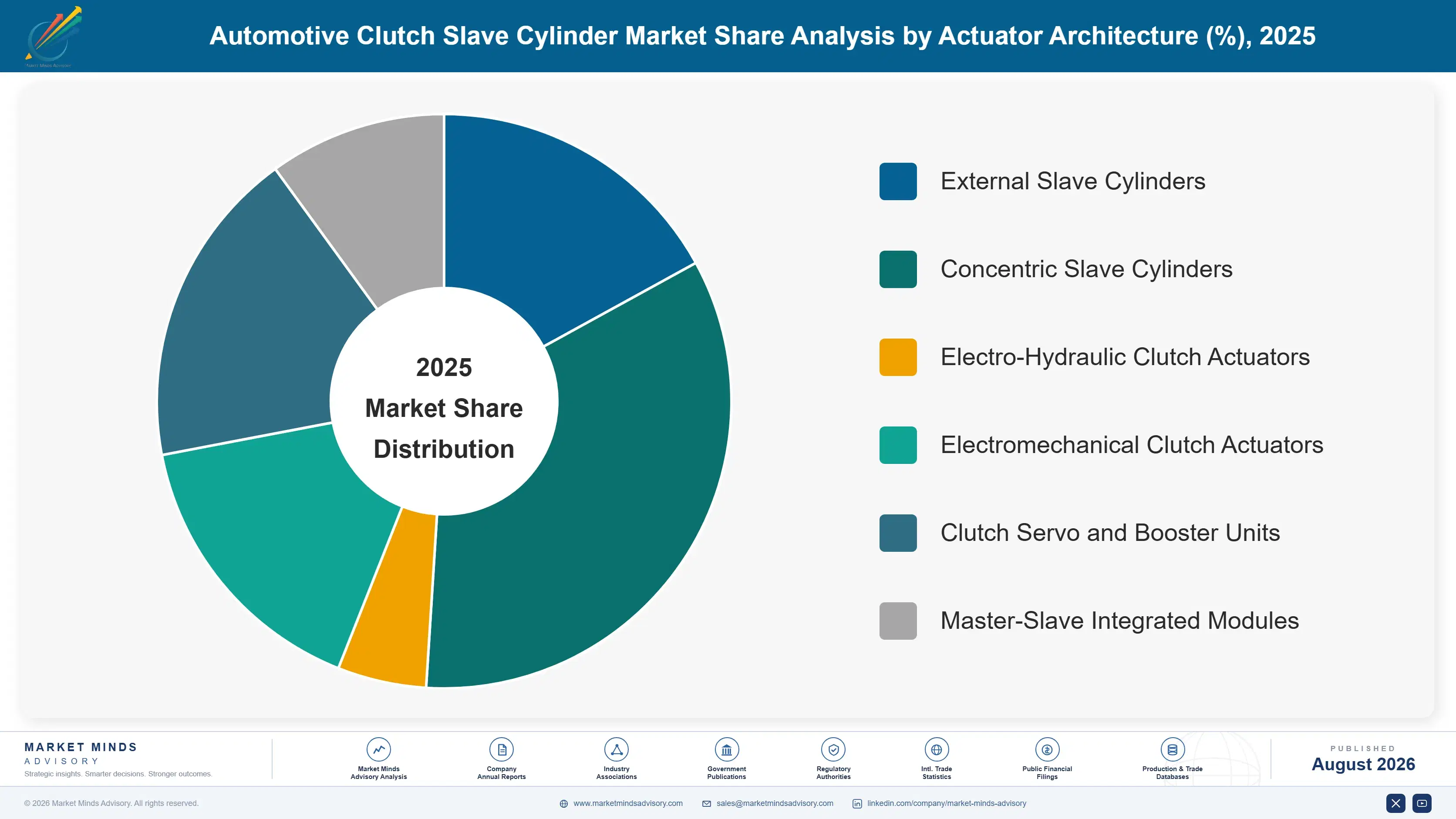
Segmentation follows actuator architecture, the single engineering logic that determines control method, packaging, content value, and which engineering function specifies it. Architecture decides whether a supplier competes on hydraulic sealing or on motor control and software integration. Vehicle category, transmission type, and channel structure appear separately in the framework as commercial dimensions rather than parallel segments.
automotive-clutch-slave-cylinder-market-market-share-analysis-1787465255697

Electromechanical Clutch Actuators

Electromechanical actuators use an electric motor, gearset, and position sensing to move the clutch directly, eliminating hydraulic fluid, seals, and the leakage failure mode entirely. Growth of 11.4%, roughly 3.17 times the market, comes from hybrid disconnect clutches and dry dual-clutch applications where the powertrain controller commands engagement precisely and frequently. Content value runs several multiples of a hydraulic slave cylinder because the motor, electronics, and control software carry most of it. The competitive consequence is decisive: this is a mechatronic product specified by transmission control engineers, and hydraulic specialists without motor and software capability find themselves supplying components into somebody else's actuator. Waiting to build that capability is not a strategy.
CAGR 11.4%

Electro-Hydraulic Clutch Actuators

Electro-hydraulic units combine a pump, accumulator, valve block, and electronic control to actuate clutches under transmission controller command rather than driver input, serving dual-clutch gearboxes and automated manual transmissions across a wide price range. Growth of 8.6% follows dual-clutch adoption in China and Europe alongside automated manual deployment in cost-sensitive markets. The architecture suits wet-clutch applications particularly well, since the hydraulic circuit already exists for cooling and lubrication. Suppliers here compete on control precision, response time, and energy consumption rather than on sealing alone, which favours companies holding both hydraulic and electronic capability within one engineering organisation. Both disciplines inside one engineering organisation is the qualifying requirement here. Few suppliers hold both.
CAGR 8.6%
Full segment breakdown across 6 segments available in the complete report.

Regional Architecture and Country Demand Map

East Asia holds the largest share at 30%, driven by Chinese vehicle production scale and widespread dual-clutch adoption. North America and Western Europe follow on aftermarket demand from large vehicle parcs, while South Asia and Pacific grows fastest on automated manual expansion. Latin America retains real manual production.

North America

Manual transmission take rate in American light vehicles has fallen to around one percent, which means original equipment demand here is almost entirely hybrid disconnect and commercial vehicle actuation rather than conventional clutch systems. The aftermarket tells a different story: a vehicle parc approaching three hundred million units includes millions of older manuals and commercial vehicles requiring replacement hydraulics for years to come. Class 8 truck automated manual adoption adds clutch servo and actuator content at higher value. Mexican assembly builds manual-equipped vehicles for export markets that still want them. Regional growth of 2.6% rests on aftermarket resilience rather than any new production trend. Original equipment demand here is now almost entirely hybrid and commercial.
Share: 22% | CAGR: 2.6% (2026 to 2036)

Western Europe

Manual transmission share here has fallen from roughly half of new registrations a decade ago toward a quarter, and the decline continues as automatics and hybrids take share across every segment. Dual-clutch gearboxes remain widely specified by German manufacturers, sustaining electro-hydraulic actuation demand at good value. Hybrid disconnect clutches have become standard content on parallel hybrid platforms across the region. Schaeffler, ZF, and Valeo all hold substantial regional engineering and production capability. The aftermarket remains large given the age profile of the European parc. Growth of 2.0% is the slowest of any region and reflects manual erosion outpacing content gains. Content gains have not yet offset the pace of manual erosion.
Share: 21% | CAGR: 2.0% (2026 to 2036)
Regional intelligence for 5 additional markets available in the complete report: East Asia, South Asia and Pacific, Latin America, Middle East and Africa, Eastern Europe. Contact sales@marketmindsadvisory.com.
automotive-clutch-slave-cylinder-market-country-cagr-analysis-1787465256218

Where Clutch Actuator Margin Actually Sits

Defending hydraulic slave cylinder volume against a shrinking manual parc is a managed decline dressed as a strategy. The four moves below follow the content instead: hybrid disconnect actuation, aftermarket capture from a parc that keeps growing, automated manual positions in cost-sensitive markets, and design life that removes the warranty exposure buyers price in.

Follow Actuation Into Hybrid Disconnect Applications

Parallel hybrid architectures need a clutch to disconnect the combustion engine, and the actuator commanding it carries roughly four times the content of a conventional slave cylinder because motor, electronics, and control software dominate the value. Building that capability costs around $9 million in mechatronic engineering and validation. Suppliers who made the move captured content specified by transmission control engineers rather than by chassis teams, which is a different customer relationship entirely. Those who read manual decline as category decline are now supplying components into somebody else's actuator. The customer relationship changes as much as the content does.
Market Impact: Captures roughly 4x the conventional actuator content value

Build Direct Aftermarket Distribution Rather Than Selling Through Traders

Replacement demand follows the vehicle parc rather than production mix, already supplying 31% of supplier revenue at margins well above original equipment, and most of that value currently passes through independent distributors who capture a large share. Building branded aftermarket distribution and workshop programmes costs perhaps $6 million annually and recovers 12 to 18 margin points on the same physical part. Concentric designs help, since replacement requires transmission removal and workshops fit a complete kit rather than a single component. Workshops fit a complete kit rather than a single component.
Market Impact: Recovers 12 to 18 points of gross margin

Position in Automated Manual Programmes Across Emerging Markets

Automated manual gearboxes deliver two-pedal driving at roughly a third the cost of a torque converter automatic, which suits Indian, Southeast Asian, and Latin American price points where full automatics remain unaffordable. Each installation converts a cable and pedal into an actuated system worth around 3 times the previous content. Winning position requires local engineering presence and cost engineering discipline rather than advanced technology. Volumes are large and growing, and the manufacturers deploying these systems value supply reliability and price above sophistication considerably. Reliability and price matter far more than sophistication here.
Market Impact: Adds 3x the content on each converted vehicle

Engineer Design Life Beyond the Transmission Overhaul Interval

A concentric slave cylinder failure requires transmission removal, turning a component worth tens of dollars into a repair bill in the hundreds, and manufacturers price that exposure into supplier agreements aggressively. Designing seal materials, contamination protection, and stroke life to exceed the transmission overhaul interval rather than merely the warranty period removes the risk the customer is pricing. Validation costs perhaps $1.8 million per design family and supports pricing 9% to 15% above competitors quoting to warranty life alone. Manufacturers price that exposure aggressively into every supplier agreement. Warranty exposure is what buyers are actually pricing.
Market Impact: Supports a 9 to 15% unit price premium

Who Controls the Margin Pool

The top five hold roughly 58% of supply, measured consistently as clutch actuation component revenue at supplier level. Schaeffler, ZF, Valeo, Aisin, and Exedy hold positions inside transmission programmes built over decades, and those relationships determine which suppliers are invited to quote on new actuation content. Indian and Chinese suppliers hold substantial regional volume in conventional hydraulics and increasingly in automated manual actuation.
Competition runs along three lines. Mechatronic capability is the first and increasingly decisive, since hybrid disconnect and electromechanical actuation are specified by transmission control engineers rather than by hydraulic specialists. Aftermarket channel position is the second, determining whether replacement value reaches the manufacturer or the distributor. The third is cost engineering for automated manual programmes, where emerging market manufacturers value price and reliability over sophistication.

Two pressures will reshape positions. Battery electric penetration removes applications outright wherever it advances, which no supplier response addresses. Meanwhile hybrid and dual-clutch content keeps favouring mechatronic suppliers over hydraulic ones. The exposed position is a hydraulic specialist with light vehicle concentration in a developed market, no electromechanical capability, and aftermarket revenue captured by independent distribution rather than by the manufacturer itself.
automotive-clutch-slave-cylinder-market-company-positioning-matrix-1787465256742

Competitive Moat and Risk Dimensions

SCHAEFFLER

Moat: Transmission Systems Integration Depth

Schaeffler supplies clutches, release systems, actuators, and increasingly complete hybrid modules to the same transmission programmes, which means actuation content is awarded inside a broader package where interfaces are already controlled. That reduces integration risk for the customer considerably. Decades of transmission engineering relationships also give early visibility of architecture decisions before actuation requirements are frozen.
SCHAEFFLER

Risk: Combustion Driveline Exposure

A substantial part of the business depends on transmission and clutch content that battery electric platforms remove entirely, and no product response recovers an application the vehicle does not need. Hybrid content offsets part of that, but only while hybrids remain the industry hedge. If battery electric adoption accelerates faster than expected, the offset weakens considerably and quickly.
VALEO

Moat: Hydraulic and Electronic Combination

Valeo combines clutch hydraulics acquired through earlier consolidation with electronics and actuator capability from adjacent vehicle systems, letting it bid electro-hydraulic and electromechanical actuation where pure hydraulic specialists must partner. Aftermarket distribution reach across independent workshop channels is also unusually strong, which captures replacement value that competitors surrender to distributors.
VALEO

Risk: Programme Concentration in Europe

The strongest positions sit with European manufacturers whose production volumes are contracting and whose manual transmission share is falling fastest of any major region. Growth in automated manual and dual-clutch content concentrates in Asia, where domestic suppliers hold cost advantages and established relationships. Building equivalent Asian position requires competing on price against local competitors with far lower cost bases.

Players Tracked

Prominent Players

Schaeffler
ZF Friedrichshafen
Valeo
Aisin Corporation
Exedy

Other Key Players

BorgWarner
Continental
Hitachi Astemo
Nabtesco
Knorr-Bremse
Kongsberg Automotive
Setco Automotive
Rane Group
Clutch Auto Limited
Ningbo Hongxie Machinery
Zhejiang Tieliu Clutch
Eaton
Raicam Group
Hyundai Mobis
Dongfeng Electronic Technology

Recent Developments

MARCH 2025

Suppliers extend hybrid disconnect clutch actuator capability

Several powertrain component suppliers extended electromechanical clutch actuator capability aimed at parallel hybrid disconnect applications, responding to manufacturers hedging between combustion and battery electric architectures. The units are specified by transmission control engineering rather than chassis teams, which has shifted commercial relationships toward suppliers holding motor and software capability.
Signal: Hybrid hedging by manufacturers is sustaining clutch actuation content that battery electric platforms would otherwise remove.
OCTOBER 2024

Indian manufacturers expand automated manual transmission deployment

Indian vehicle manufacturers extended automated manual transmission availability across additional high-volume models, delivering two-pedal convenience at price points that torque converter automatics cannot reach in the domestic market. Each installation converts a cable and pedal arrangement into an actuated system requiring electro-hydraulic or electromechanical clutch control.
Signal: Affordability rather than performance is now driving actuation content growth across the fastest expanding regional market.
JULY 2025

Aftermarket distributors consolidate clutch hydraulic parts supply

Independent aftermarket distributors continued consolidating clutch hydraulic component supply across European and North American workshop channels, strengthening their position between manufacturers and installers. Component suppliers without branded distribution reported continued margin capture by the channel on replacement parts they had originally engineered and produced. Consolidation continued into 2025.
Signal: Replacement value keeps accruing to distribution rather than to the suppliers who actually make the components.

Aluminium, Elastomers, and Machining Energy

Aluminium castings and forgings account for roughly 29% of production cost, purchased against exchange pricing from casters across Europe, Asia, and North America. Elastomer seals and hydraulic components contribute 17%, priced against synthetic rubber and specialty polymer feedstocks. Machining and assembly energy takes 12%, and on electronic actuator variants motors and control hardware absorb considerably more than the hydraulic elements they replace.
Aluminium prices moved sharply through 2021 and 2022 on energy-driven European smelter curtailments documented in IEA reporting, and elastomer feedstock costs rose alongside petrochemical inflation across the same window. Suppliers on fixed programme pricing absorbed increases they could not recover, while those holding indexation clauses passed movements through with a quarter of lag. Schaeffler and Valeo both referenced input cost pressure across their 2022 and 2023 reporting periods without full recovery.

Exposure divides on contract structure and on product mix rather than on manufacturing scale. Hydraulic components carry heavy aluminium and elastomer content that moves with commodity markets. Electronic actuators shift cost toward motors, magnets, and semiconductors with different volatility, including rare earth exposure hydraulics never had. Indian and Chinese producers, on lower energy and labour costs closer to casting supply, held positions Western plants could not approach.
automotive-clutch-slave-cylinder-market-cost-volatility-analysis-1787465256938

Secure aluminium indexation in programme pricing at award stage

Vehicle programmes run five to seven years against aluminium that moves continuously, and requesting relief mid-programme puts a supplier in the weakest possible position. Manufacturers accept indexation at award considerably more readily than they grant relief afterwards. Suppliers who secured it through the 2021 and 2022 movement protected margin that competitors on fixed pricing simply surrendered.

Qualify multiple elastomer compounds before a supply interruption

Seal performance determines slave cylinder life, and requalifying a compound after a design is validated takes months of durability testing nobody wants to repeat under pressure. Qualifying two or three compounds during development preserves sourcing flexibility permanently at modest cost. Suppliers who left this until a specialty polymer shortage arrived discovered the constraint at exactly the wrong moment.

Balance hydraulic and electronic mix against differing cost volatility

Hydraulic products carry aluminium and elastomer exposure while electronic actuators carry motor, magnet, and semiconductor exposure, and those cost bases move on entirely unrelated drivers. Holding both in the portfolio reduces overall input volatility rather than concentrating it, which is a genuine argument for the transition beyond content value alone. Portfolio balance is a hedge, not just a growth story.

Portfolio Architecture for Margin Defence

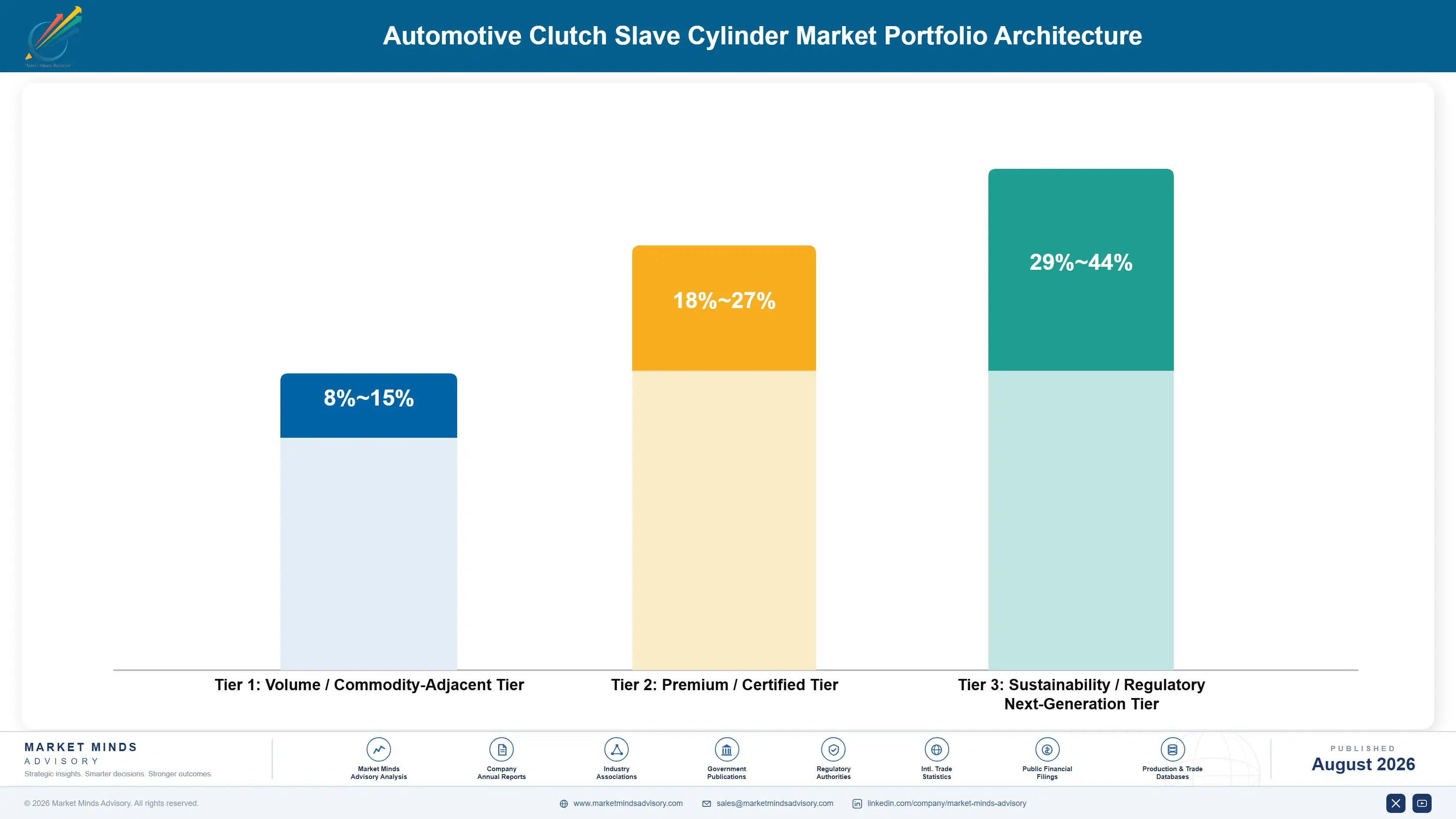
Three tiers separate on who specifies the part and what capability it demands. Conventional external and concentric slave cylinders supplied against manufacturer designs earn 8% to 15%, competing on quotation against Indian, Chinese, and Eastern European cost positions. Electro-hydraulic actuators with supplier-owned control earn 18% to 27%, since transmission integration transfers with the award. Electromechanical and hybrid disconnect actuators earn most, and the gap keeps widening.
The tension is that the declining tier still fills the machining lines. Conventional hydraulics keep utilisation near 68%, which matters given the capital in machining and assembly, yet they earn least and their served application base shrinks with every battery electric platform launched. Suppliers who defended that volume rather than funding mechatronic capability now find themselves quoting components into actuators designed by competitors, which is a considerably worse position than lower utilisation would have been.

High-value pools sit where the customer buys control rather than a part. Hybrid disconnect actuation, electromechanical units, and branded aftermarket supply all involve capability or channel position that a manufacturer or distributor cannot easily replicate, which is exactly why they resist the quotation comparison that conventional hydraulics invite.

Volume / Commodity-Adjacent Tier

External and concentric slave cylinders supplied against manufacturer-owned designs on quotation into light vehicle programmes. Competes on machining cost and location. The wide range reflects large differences in plant labour cost, casting proximity, and volume between suppliers.
Gross Margin: 8%-15%

Premium / Certified Tier

Electro-hydraulic actuators and clutch servo units where the supplier owns control hardware, validation, and transmission integration responsibility. Range width separates single-application units from platform families carrying broader validation within the same tier.
Gross Margin: 18%-27%

Sustainability / Regulatory / Next-Generation Tier

Electromechanical actuators, hybrid disconnect systems with owned control software, and branded aftermarket supply. Mechatronic capability and channel position, rather than manufacturing economics, sustain the margin structure throughout this tier. Channel ownership compounds that advantage.
Gross Margin: 29%-44%
automotive-clutch-slave-cylinder-market-portfolio-architecture-1787465257442

High-value Sub-segments and Strategic Watch-out

Hybrid Disconnect Clutch Actuation

Highest value in the market, carrying roughly four times conventional slave cylinder content because motor, electronics, and software dominate. Specified by transmission control engineers rather than chassis teams. Hydraulic specialists without mechatronic capability cannot bid these programmes at all. Building the capability now is the decision that matters.
Gross Margin: 34%-44%

Branded Aftermarket Replacement Supply

High value and unusually durable, following the vehicle parc rather than production mix and persisting fifteen years past programme end. Recovers 12 to 18 margin points against selling through independent distribution. Concentric designs encourage complete kit replacement. Distributors currently own most of this relationship. Branded supply changes that.
Gross Margin: 28%-38%

Concentric Slave Cylinder Original Equipment

The volume core at 62% of hydraulic actuation, keeping machining lines loaded and funding the mechatronic transition. Warranty exposure is real because replacement needs transmission removal. Price it for utilisation rather than as a growth position. Utilisation is the honest reason to keep it. Growth belongs elsewhere.
Gross Margin: 10%-17%

External Slave Cylinder Supply

The strategic watch-out. Legacy architecture growing at 1.4%, displaced by concentric designs in original equipment and sustained mainly by an ageing parc. Chinese and Indian cost positions dominate what remains. Harvest rather than reinvest here. Parc ageing is the only thing sustaining it. Harvest, do not reinvest.
Gross Margin: 7%-14%

Why Replacement Demand Outlasts Programmes

Clutch actuation revenue is unusual in carrying two annuities of very different lengths. Programme supply runs for the vehicle production life, typically six to nine years, and is difficult to displace because tooling, validation, and bellhousing packaging all assume the specific component. Replacement demand then runs for fifteen to twenty years beyond the last production unit, following the vehicle parc rather than any manufacturing decision, and it generates margins well above the original equipment that created it.
Stickiness varies enormously between the two. Original equipment programme positions are effectively fixed once tooling is committed, since substituting a component packaged inside a bellhousing is impractical mid-programme. Aftermarket supply through manufacturer-branded channels is durable where workshop relationships exist. Aftermarket supply through independent distributors is not sticky at all, since the distributor owns the workshop relationship and will substitute whichever component brand offers better terms next season.

Buyer profiles have shifted with the mechatronic transition. Transmission control engineers now specify actuation alongside chassis and powertrain teams, and questions about response time and software interface arrive before any discussion of sealing performance. Sealing performance has become a qualification hurdle rather than a differentiator in those conversations.
automotive-clutch-slave-cylinder-market-end-use-penetration-index-1787465257933

Where Clutch Actuation Capital Belongs

These are among the four positions where our research anticipates prominent divergence between winners and laggards over the coming forecast period. Each is grounded in the demand model, the regulatory perimeter, and the announced capacity pipeline.
01 / HYBRID ACTUATION CAPABILITY

Follow the clutch into hybrid disconnect, or supply someone else's actuator

Parallel hybrid architectures need a clutch to disconnect the combustion engine during electric operation, and the actuator commanding it carries roughly four times conventional slave cylinder content because motor, electronics, and control software dominate the value entirely. Building that capability costs around $9 million in mechatronic engineering and validation work, which is modest against the alternative outcome entirely. Suppliers who read manual decline as category decline reduced investment and now supply low-value components into actuators their competitors designed and own.
02 / AFTERMARKET CHANNEL OWNERSHIP

Stop handing replacement margin to independent distribution

Replacement demand follows the vehicle parc rather than production mix, already supplying 31% of supplier revenue at margins well above original equipment and persisting for fifteen years beyond the programme end. Most of that value currently passes through distributors who own the workshop relationship and capture the difference. Building branded distribution and workshop programmes costs perhaps $6 million annually and recovers 12 to 18 margin points on exactly the same physical component that the supplier already engineers and manufactures itself.
03 / EMERGING MARKET AUTOMATION

Win automated manual programmes on cost engineering, not sophistication

Automated manual gearboxes deliver two-pedal driving at roughly a third the cost of a torque converter automatic, which is why Indian, Southeast Asian, and Latin American manufacturers keep deploying them across high-volume models where full automatics remain unaffordable. Each installation converts a cable and pedal into an actuated system worth around three times the previous content. Winning requires local engineering presence and cost discipline rather than advanced technology, and these manufacturers value supply reliability and delivered price far above technical sophistication.
04 / DESIGN LIFE ENGINEERING

Exceed the overhaul interval, because failure costs twelve times the part

A concentric slave cylinder failure requires transmission removal, turning a component worth tens of dollars into a repair bill in the hundreds, and manufacturers price that exposure into supplier agreements considerably more aggressively than the component value alone would suggest. Designing seal materials, contamination protection, and stroke life to exceed the transmission overhaul interval rather than merely the warranty period removes the risk the customer is pricing in. Validation costs roughly $1.8 million per design family and supports pricing 9% to 15% above competitors.

Engagement Snapshot From the Field

A live engagement with an industry participant carrying material or product regulatory and market exposure ahead of a defining policy shift, showing how our research translates into a defensible multi-year portfolio strategy.
MARKET MINDS ADVISORY · CLIENT ENGAGEMENT SUMMARY
Automotive Clutch Slave Cylinder Producer Strategic Portfolio Review and Transition Roadmap 2026·Investment Scenario on Automotive Clutch Slave Cylinder Exposure Evaluation 2025-26
CLIENT PROFILE
A European tier one supplier producing clutch hydraulics across three plants for German, French, and Eastern European vehicle programmes, with annual revenue near EUR 240 million (client-reported, unverified by MMA). Conventional slave cylinders supplied roughly 74% of revenue, no electromechanical actuator capability existed, and aftermarket product was sold almost entirely through independent distributors under their own brands.
STRATEGIC CHALLENGE
Manual transmission share across the client's core European customers had fallen sharply, two programmes had ended without replacement, and the group had been excluded from a hybrid disconnect actuator bid for lack of motor and software capability. Group margin had fallen to 6.2%, machining utilisation was at 61%, and the board was weighing plant closure against capability investment it had not costed.
MMA APPROACH
MMA rebuilt profitability by product line and by channel, separating original equipment contribution from aftermarket value captured versus value surrendered to distribution. Mechatronic capability build was costed against partnership and acquisition routes. Automated manual programme opportunities in India and Southeast Asia were sized against the client's cost position, with findings tested through 47 expert interviews during Q4 2025.
KEY FINDINGS
  1. Aftermarket volume sold through independent distributors generated 14 margin points less than comparable branded supply, on components the client had engineered and manufactured itself.
  2. Hybrid disconnect actuator content on the client's existing customer platforms was worth an estimated four times the conventional slave cylinders those programmes were replacing.
  3. Building electromechanical capability internally would cost around EUR 8.4 million, against EUR 61 million to acquire a comparable position through a small mechatronic acquisition.
  4. Two of three plants held machining capability suitable for automated manual actuator production with modest tooling investment and no additional building capacity required.
CLIENT PROFILE
A European tier one supplier producing clutch hydraulics across three plants for German, French, and Eastern European vehicle programmes, with annual revenue near EUR 240 million (client-reported, unverified by MMA). Conventional slave cylinders supplied roughly 74% of revenue, no electromechanical actuator capability existed, and aftermarket product was sold almost entirely through independent distributors under their own brands.
STRATEGIC CHALLENGE
Manual transmission share across the client's core European customers had fallen sharply, two programmes had ended without replacement, and the group had been excluded from a hybrid disconnect actuator bid for lack of motor and software capability. Group margin had fallen to 6.2%, machining utilisation was at 61%, and the board was weighing plant closure against capability investment it had not costed.
MMA APPROACH
MMA rebuilt profitability by product line and by channel, separating original equipment contribution from aftermarket value captured versus value surrendered to distribution. Mechatronic capability build was costed against partnership and acquisition routes. Automated manual programme opportunities in India and Southeast Asia were sized against the client's cost position, with findings tested through 47 expert interviews during Q4 2025.
KEY FINDINGS
  1. Aftermarket volume sold through independent distributors generated 14 margin points less than comparable branded supply, on components the client had engineered and manufactured itself.
  2. Hybrid disconnect actuator content on the client's existing customer platforms was worth an estimated four times the conventional slave cylinders those programmes were replacing.
  3. Building electromechanical capability internally would cost around EUR 8.4 million, against EUR 61 million to acquire a comparable position through a small mechatronic acquisition.
  4. Two of three plants held machining capability suitable for automated manual actuator production with modest tooling investment and no additional building capacity required.
RECOMMENDED STRATEGY
Phase 1: Phase 1 (months one to seven): launch branded aftermarket distribution in two markets and decline further quotations without raw material indexation clauses. Phase 2: Phase 2 (months eight to twenty-two): build electromechanical actuator capability internally and bid hybrid disconnect content on two existing customer platforms. Phase 3: Phase 3 (months twenty-three to thirty-six): pursue automated manual programmes in India and Southeast Asia using converted capacity at two plants.
OUTCOME
The supplier launched branded aftermarket supply in two markets and reported group margin improving from 6.2% to 12.8% within eighteen months (client-reported, unverified by MMA). Electromechanical capability reached prototype validation. One hybrid disconnect bid was submitted and no plant closure proved necessary. Both remain on plan.

Frequently Asked Questions

Foundational context covering the market sizes, CAGR, scope, country, region and competition that inform every finding below. This section is provided to cover basics and most often pre-purchase conversations, answered from the MMA Primary Research Dataset.

What is the current size of the Automotive Clutch Slave Cylinder Market?

The market was valued at USD 2.10 billion in 2025, rising to an estimated USD 2.18 billion in 2026. East Asia holds the largest regional share at 30% of global value.

How large will the Automotive Clutch Slave Cylinder Market be by 2036?

MMA forecasts USD 3.10 billion by 2036 under the base case, an expansion multiple of 1.42 times the 2026 level. Incremental value creation across the period reaches USD 0.92 billion.

What is the CAGR for the Automotive Clutch Slave Cylinder Market 2026 to 2036?

The base case CAGR is 3.6%, with a bull case of 4.8% and a bear case of 2.4%. Historical growth between 2020 and 2025 ran at 2.9% as content gains offset manual decline.

Which segment is growing fastest?

Electromechanical clutch actuators, at 11.4%, roughly 3.17 times the overall market rate. Growth comes from hybrid disconnect clutches and dry dual-clutch applications rather than conventional manual systems.

Who are the major companies in the Automotive Clutch Slave Cylinder Market?

Schaeffler, ZF Friedrichshafen, Valeo, Aisin Corporation, and Exedy lead, holding roughly 58% of supply between them. Indian and Chinese suppliers hold substantial regional volume in conventional hydraulics.

Which country is growing fastest?

India, at 6.4%, driven by automated manual transmission deployment across high-volume models where torque converter automatics remain unaffordable for most domestic buyers across the market.

Report Segmentation Architecture

The full report scope spans multiple orthogonal segmentation dimensions, with cross-tabulated demand data provided for each dimension pair. Coverage extends further to regional breakdowns, trend trajectories, and the competitive detail needed to support segment-level decision-making.

By Actuator Architecture

  • External Slave Cylinders
  • Concentric Slave Cylinders
  • Electro-Hydraulic Clutch Actuators
  • Electromechanical Clutch Actuators
  • Clutch Servo and Booster Units
  • Master-Slave Integrated Modules

By End-Use Industry

  • Passenger Car Manufacturing
  • Light Commercial Vehicle Production
  • Medium and Heavy Truck Manufacturing
  • Hybrid Powertrain Platforms
  • Agricultural and Off-Highway Equipment

By Commercial Dimension

  • Original Equipment Programme Supply
  • Manufacturer Branded Aftermarket
  • Independent Distribution Channel
  • Contract Machining and Sub-Assembly

By Region

  • North America
  • Western Europe
  • East Asia
  • South Asia and Pacific
  • Latin America
  • Middle East and Africa
  • Eastern Europe

Scope, Methodology, and Coverage

Every figure in this report is reproducible from documented input assumptions. The scope below maps the historical period, the forecast horizon, the segmentation dimensions, and the countries covered, alongside the underlying primary and qualitative methodology.
Historical Period
2020 to 2025
Forecast Period
2026 to 2036
Base Year
2025 (USD billions; MMA Primary Research Dataset, August 2026)
Market Definition
The market comprises clutch actuation components supplied to light and commercial vehicles, covering external slave cylinders, concentric slave cylinders, electro-hydraulic clutch actuators, electromechanical clutch actuators, clutch servo and booster units, and master-slave integrated modules. Value is measured at component level across original equipment programme supply and replacement channels. Clutch discs, pressure plates, flywheels, release bearings sold separately, complete transmission assemblies, and brake hydraulic components fall outside scope.
Quantitative Units
USD billions (current prices); units shipped annually; USD per unit average selling price
Segmentation Dimensions
By Actuator Architecture; By End-Use Industry; By Commercial Dimension; By Region
Regions Covered
North America, Western Europe, East Asia, South Asia and Pacific, Latin America, Middle East and Africa, Eastern Europe
Countries Covered
USA, China, Germany, France, UK, Japan, South Korea, India, Australia, Canada, Brazil, Mexico, Indonesia, Vietnam, Thailand, Malaysia, UAE, Saudi Arabia, South Africa, Nigeria, Turkey, Poland, Netherlands, Italy, Spain, Sweden, Switzerland, Argentina, Colombia, Singapore, and additional markets relevant to this sector
Key Companies Profiled
Schaeffler, ZF Friedrichshafen, Valeo, Aisin Corporation, Exedy, BorgWarner, Continental, Hitachi Astemo, Nabtesco, Knorr-Bremse, Kongsberg Automotive, Setco Automotive, Rane Group, Clutch Auto Limited, Ningbo Hongxie Machinery, Zhejiang Tieliu Clutch, Eaton, Raicam Group, Hyundai Mobis, Dongfeng Electronic Technology
Quantitative Methodology
Primary survey, n=3,800 respondents, Q4 2025, six countries; demand-side model with trade association cross-validation
Qualitative Methodology
47 expert interviews, Q4 2025; applied to validate demand model assumptions, identify emerging dynamics, and assess competitive positioning
Report Format
PDF and XLSX data workbook (Word format preview document)
Publisher
Market Minds Advisory
Report Code
MMA-2026-AUT-146
Published
August 2026
Contact
sales@marketmindsadvisory.com | www.marketmindsadvisory.com

Purchase the full Automotive Clutch Slave Cylinder Market Report (2026 to 2036).

The full report sizes clutch actuation demand across six architectures and seven regions with 2026 to 2036 forecasts under base, bull, and bear cases. It models application base erosion from battery electric penetration against content growth from hybrid disconnect and dual-clutch systems, netting the two by market. Competitive profiles cover twenty suppliers assessed consistently on actuation component revenue, mechatronic capability, and aftermarket channel position. Parc modelling quantifies replacement demand independently of new production mix. Commercial guidance addresses hybrid capability building, aftermarket ownership, emerging market automation, and design life engineering.
Six actuator architectures sized and forecast separately
Application erosion netted against content growth by market
Twenty supplier profiles on consistent component revenue basis
Vehicle parc modelled to project replacement demand independently
Automated manual deployment tracked across emerging market programmes
Warranty exposure quantified by actuator packaging architecture

Built For The People Who Decide

From boardroom strategy to bench-side execution, this report is read cover-to-cover by leaders shaping the next decade of their industry, turning demand scenarios, market dynamics and valuation benchmarks into decisions.
CXOs/ Presidents/ VPs/ Managers
M&A and Corporate Development
Strategy Teams and R&D Heads
Procurement and Product Directors
Regulatory and Compliance Leaders
Investor Relations and Equity Analysts