Market Minds Advisory
Automotive Brake Shims Market

Automotive Brake Shims Market: NVH Performance Standards and Electric Vehicle Transition Economics

Rising noise, vibration, and harshness performance standards are pushing automakers toward multi-layer steel brake shims even as electric vehicle regenerative braking gradually reduces friction cycles that shim demand depends on.

Lead Analyst

David Horsley

Published

September 2026

Make Smarter Decisions with Customized Research Insights

Request a free sample report and evaluate market opportunities, growth trends, and competitive dynamics relevant to your business needs.

2025 MARKET VALUE$1.4BMarket Size 2025
2036 FORECAST VALUE$2.2BBase Case , 2026 to 2036
CAGR 2026 TO 20364.4 %Bull 5.6% / Bear 3.2%
INCREMENTAL OPPORTUNITY$0.8BNet 10- year value creation
EXPANSION MULTIPLE1.54x2036 value over 2026 base
Strategic Levers
M&A Pipeline
Regional Outlook
Country Rankings
Competitive Intelligence
Segmental Deep-dive
Call-Us : 91 93563 13602

Executive Snapshot and Market Trajectory

Rising noise, vibration, and harshness performance standards are pushing automakers toward multi-layer steel brake shims, even as electric vehicle regenerative braking gradually reduces the total friction braking cycles that shim replacement demand has always depended on for aftermarket volume. Buyers increasingly weigh long-term component durability alongside near-term noise performance requirements.
Multi-layer steel shims now drive the fastest growth as automakers specify superior noise dampening for quieter electric and hybrid vehicle cabins, while standard single-layer steel shims still represent the largest single segment by volume given decades of established original equipment specification. East Asia anchors both component manufacturing scale and vehicle production, tied closely to China's massive automotive assembly base. Aftermarket replacement demand adds a further stable revenue pool tied to vehicle fleet age.
Akebono and Brembo dominate through established original equipment relationships and engineering scale that smaller regional component makers cannot easily match. Electric vehicle adoption reducing friction brake cycle frequency and tightening cabin noise standards favoring premium shim materials are the two forces most likely to reshape demand allocation across the next decade specifically. Regional Chinese manufacturers are also expanding standard production capacity rapidly to compete on price.
Market Definition
The automotive brake shims market covers commercial production and sale of anti-noise and anti-vibration shim components installed between brake pads and calipers across passenger vehicles, light trucks, and commercial vehicles. It excludes brake pads, calipers, rotors, and other braking system components sold separately from the shim itself, as well as finished vehicles that merely incorporate shims as one component.
Base Year Value
$1.4B in 2025 (MMA Primary Research Dataset, August 2026)
Forecast Period
2026 to 2036, eleven discrete annual values
CAGR
4.4% base case. Bull 5.6%. Bear 3.2%.
Fastest Growth Segment
Multi-Layer Steel Shims: 6.8% CAGR
Fastest Growth Country
India: 6.8% CAGR
Fastest Growth Region
South Asia and Pacific: 6.4% CAGR
Largest Region
East Asia: 34% of 2025 global value
Market Leaders
Akebono Brake Industry, Brembo S.p.A., ZF Friedrichshafen, Aisin Corporation, Tenneco. Source: MMA Analysis based on company annual reports.
Primary Survey
n=3,800 procurement and R&D decision-makers, Q4 2025, six countries
Methodology
Demand-side build-up, cross-validated against public data, 47 expert interviews

Automotive Brake Shims Market Forecast Scenarios

automotive-brake-shims-market-trends-size-forecast-scenario-1787463783262
Between 2020 and 2025 the market grew steadily as global vehicle production recovered from pandemic-era disruption and noise performance standards tightened gradually across major markets, giving the category a fairly consistent growth trajectory relative to more cyclical automotive component peers over the historical period specifically. Manufacturers serving both segments benefited from relatively stable long-term contract structures during this window.
The base case through 2036 rests on three mechanisms: continued original equipment specification of multi-layer steel shims as automakers pursue quieter cabin experiences across electric and hybrid vehicle platforms, sustained aftermarket replacement demand tied to the ageing global vehicle fleet requiring periodic brake service, and gradual electric vehicle adoption offsetting some friction brake cycle reduction through continued original equipment volume growth in new vehicle production. None of these mechanisms depends on a single event, supporting the base case broadly.
The bull case turns on noise performance standards tightening faster than currently expected across additional vehicle categories, pulling premium shim demand well above current base case assumptions. The bear risk is electric vehicle adoption accelerating faster than anticipated, reducing friction braking cycle frequency enough to meaningfully compress the aftermarket replacement volume that underpins much of the category's stable revenue base.

NVH Performance Economics and Electric Vehicle Transition Dynamics

Two forces are shaping brake shims at once: rising noise performance standards pushing automakers toward multi-layer steel formulations, and electric vehicle adoption gradually reducing the friction braking cycles that aftermarket replacement volume depends on. Each pulls manufacturer investment priorities in a somewhat different direction, splitting what was once a fairly uniform component category into distinct performance tiers with genuinely separate pricing. Manufacturers slow to recognize this split risk losing relevance in both segments.
MARKET CONCENTRATIONCR5 40%reflects a fairly fragmented global production base overall
AVERAGE SELLING PRICE$3.20/unitmulti-layer steel shims command a meaningful premium generally
TOP PRODUCING COUNTRY SHAREChina 28%reflects concentrated component manufacturing and vehicle production there
CAPACITY UTILIZATION74%production lines running comfortably below their practical processing ceiling
FEEDSTOCK COGS SHARE41%steel and specialty rubber coating inputs dominate production cost
TRADE INTENSITY46%share of global production moving across national export borders
Commercially, shim supply behaves like a specialty automotive component relationship rather than a pure commodity trade. Automakers qualify shim suppliers against noise dampening and durability specifications years before vehicle platform launch, and premium multi-layer steel pricing has held even through periods when standard steel shims faced margin pressure from raw material cost swings. Buyers treat validated noise performance as a reliability signal.
The next decade will be shaped by how fast electric vehicle adoption continues reducing friction brake cycle frequency, whether noise performance standards tighten further across additional vehicle categories and regions, and how quickly component makers can scale multi-layer steel production to meet rising original equipment specification demand from premium and electric vehicle platforms. How fast adoption continues will also matter.
"Brake squeal used to be an acceptable trade-off. In an electric vehicle with no engine noise to mask it, a cheap shim becomes a warranty complaint within the first service interval."
Director, Automotive Components Practice · MMA Automotive Components & Braking Systems Practice · August 2026

Market Trends

Electric Vehicles Raise the Bar for Cabin Noise Standards

Electric and hybrid vehicle platforms lack the engine noise that traditionally masked brake squeal in conventional vehicles, pushing automakers to specify multi-layer steel shims engineered for superior noise dampening performance across nearly every new electric vehicle program. Akebono and Brembo have both expanded dedicated multi-layer steel production capacity over recent years specifically targeting this demand. Several major automakers have publicly disclosed noise performance requirements for electric vehicle braking systems that standard single-layer shims cannot reliably meet, giving premium shim makers a durable specification advantage. Several other automakers are expected to specify comparable requirements soon, expanding this demand base.
Market Impact: Adds 95 million dollars aftermarket demand
Regenerative Braking Gradually Reduces Friction Cycle Frequency

Electric vehicle regenerative braking systems handle a growing share of total deceleration events, gradually reducing how often friction brake components including pads and shims actually engage compared with conventional vehicles relying entirely on friction braking. Several automakers have documented meaningfully extended brake component service intervals on electric vehicle platforms relative to comparable conventional models. This trend is reshaping aftermarket replacement demand patterns gradually as electric vehicle fleet penetration continues increasing across major markets. Several suppliers report adjusting production forecasts to reflect this gradually shifting demand pattern across their broader customer base.
Market Impact: Adds 78 million dollars regulation-driven demand

Market Opportunities and Growth Drivers

Ageing Global Vehicle Fleet Sustains Aftermarket Demand

The average age of vehicles on the road continues to rise across North America and Western Europe, extending the population of vehicles requiring periodic brake service and shim replacement well beyond original equipment warranty periods. Several automotive aftermarket trade associations have documented continued growth in average vehicle age across major markets, directly expanding the addressable replacement shim demand base that aftermarket suppliers depend on for stable recurring revenue. Independent aftermarket surveys confirm this trend is accelerating steadily across nearly every major vehicle market tracked, reinforcing long-term category stability. This trend shows no sign of reversing given continued vehicle longevity gains.
Market Impact: Limits long-term volume growth to 2

Tightening Noise Regulations Expand Premium Shim Specification

Vehicle noise emission regulations across the European Union and increasingly other major markets have tightened cabin and exterior noise limits considerably, pushing automakers toward premium multi-layer shim formulations that meet these standards more reliably than standard single-layer alternatives. Regulatory bodies have continued strengthening noise standards over the past several years, giving premium shim makers a genuine regulatory tailwind that is largely insulated from near-term commodity price swings affecting standard component pricing. Several automakers now reference these tightening standards directly when specifying shim requirements for new vehicle programs entering production. This regulatory momentum should continue across additional categories.
Market Impact: Limits premium adoption to 36 percent

Market Restraints and Challenges

Electric Vehicle Transition Threatens Long-Term Volume Growth

Sustained electric vehicle adoption growth threatens to gradually compress total friction brake cycle frequency across the global vehicle fleet, reducing the aftermarket replacement volume that has historically provided shim makers with stable recurring revenue independent of new vehicle production cycles. The root cause is that regenerative braking fundamentally reduces mechanical wear on friction components in a way that no shim formulation improvement can offset. Manufacturers are mitigating this through premium multi-layer product development that captures more value per unit even as total unit volume growth moderates over time. Some manufacturers now diversify toward original equipment contracts to offset this risk.
Market Impact: Lifts multi-layer pricing by 16 percent

Price-Sensitive Segments Resist Premium Shim Adoption

Cost-conscious automakers and aftermarket buyers in price-sensitive vehicle segments continue to specify standard single-layer steel shims wherever noise performance requirements permit it, since the cost gap between standard and premium multi-layer formulations outweighs the noise dampening benefit that has not yet reached those price tiers with the same intensity as premium and electric vehicle segments. Manufacturers are mitigating this through tiered product lines that offer incremental noise performance improvements at accessible price points. Several manufacturers report this tiered approach has already improved conversion among price-sensitive automaker accounts considerably. This helps retain price-sensitive customers who would otherwise switch to Chinese alternatives.
Market Impact: Cuts replacement frequency by 9 percent
3 additional market trends, 3 additional growth drivers, and 4 additional restraints and challenges are covered in the full report. Contact sales@marketmindsadvisory.com to access the complete intelligence.

Segment CAGR and Growth Architecture

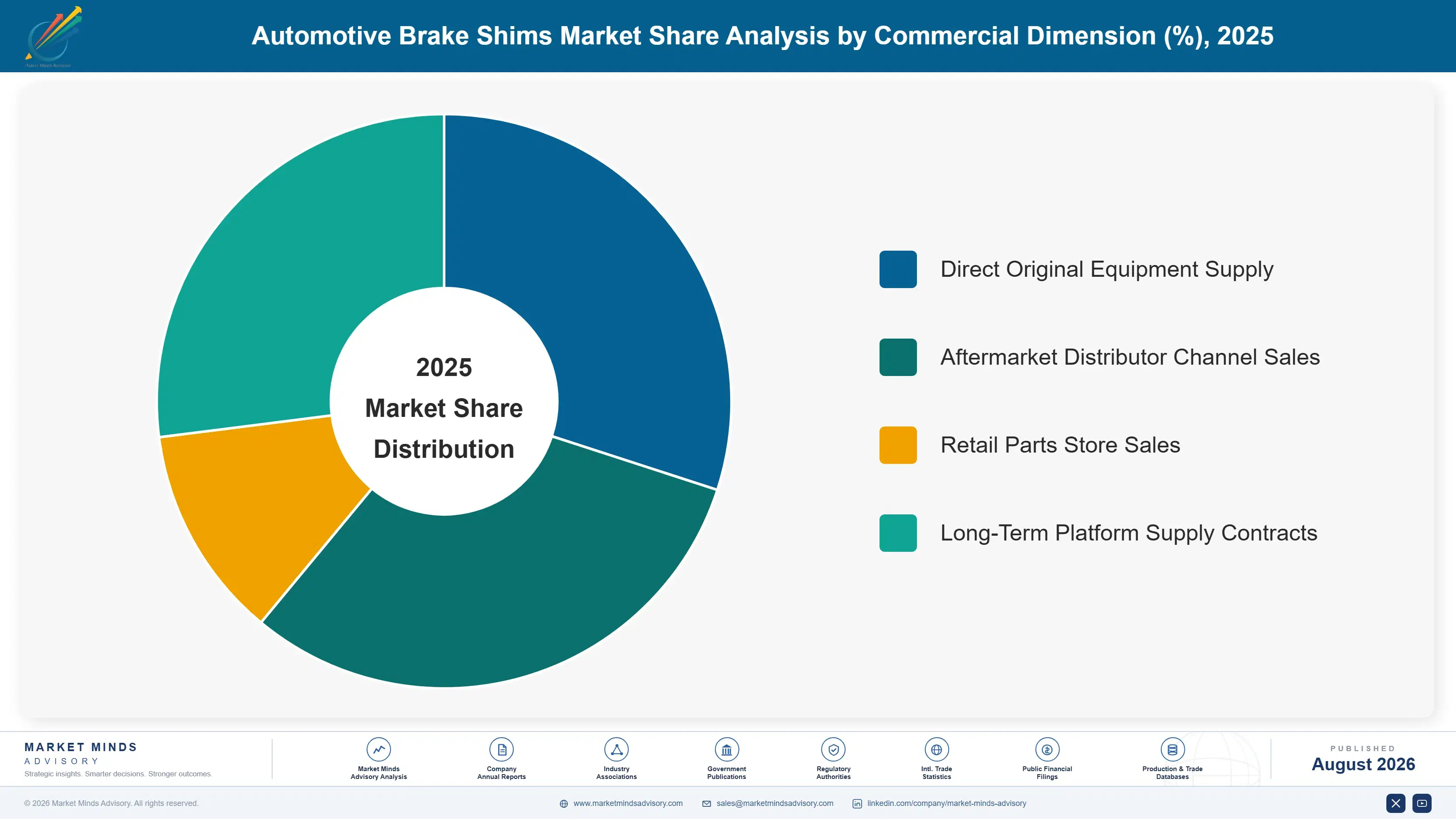
Automotive brake shims are segmented here by material construction rather than by distribution channel or vehicle category, since rubber-coated steel, multi-layer steel, non-asbestos organic, titanium alloy, and polymer composite formulations each face distinct performance and cost characteristics that shape demand independent of the underlying vehicle platform. today across the industry and vendors consistently over time
automotive-brake-shims-market-trends-market-share-analysis-1787463783823

Multi-Layer Steel Shims

This segment is growing fastest as automakers specify superior noise dampening performance for quieter electric and hybrid vehicle cabins that lack engine noise to mask brake squeal the way conventional vehicles historically have. Akebono and Brembo have both prioritized dedicated multi-layer steel production capability specifically targeting this demand, given its scale and direct connection to nearly every new electric vehicle platform launch. Contract cycles here run longer than in most segments, since automakers value validated noise performance enough to commit to dedicated supplier relationships across multi-year platform lifecycles. Pricing reflects the specialized engineering these shims require, with automakers increasingly willing to pay a premium for validated noise dampening that protects brand reputation for quiet, refined vehicle cabin experiences.
CAGR 6.8%

Composite Polymer Shims

Lightweight composite polymer shims are growing steadily as automakers pursuing vehicle weight reduction, particularly for electric vehicle range optimization, increasingly specify these formulations over heavier steel alternatives wherever noise performance requirements permit the substitution. ZF Friedrichshafen and Aisin dominate this segment, benefiting from established polymer engineering expertise that smaller regional component makers lack entirely. This segment faces less price sensitivity than standard steel shims, since weight reduction carries genuine value for electric vehicle range performance that automakers actively pursue. Margins here remain comfortably above standard steel shims given the specialized polymer formulation development these products require. Analysts expect demand here to keep expanding as electric vehicle range optimization remains a persistent automaker priority.
CAGR 5.8%
Full segment breakdown across 6 segments available in the complete report.

Regional Architecture and Country Demand Map

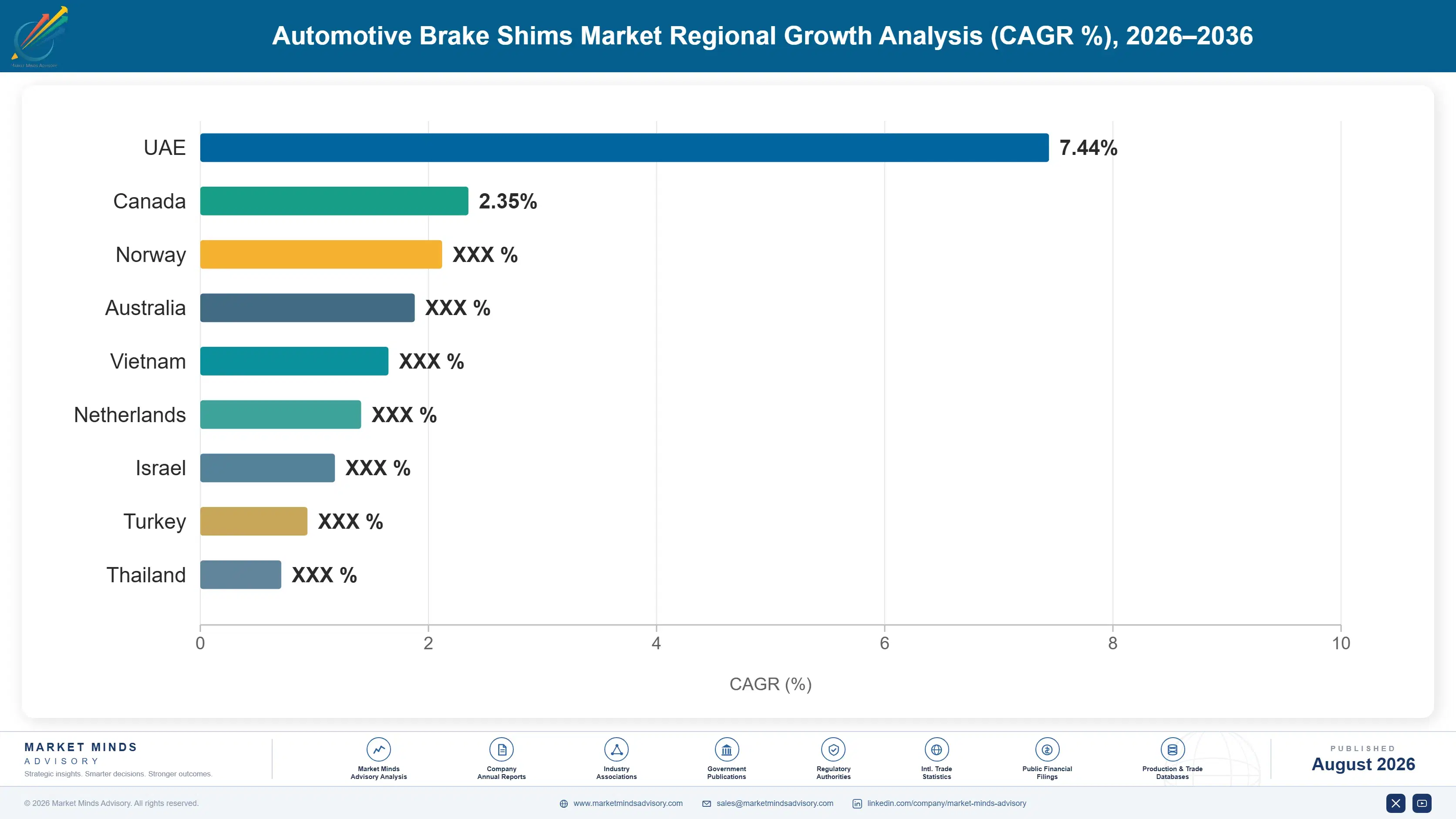
East Asia represents by far the largest share of global automotive brake shim demand given its dominant vehicle production base, while South Asia and Pacific posts the fastest regional growth on expanding domestic vehicle manufacturing capacity nationally. across the entire region consistently overall today nationally

North America

Established original equipment relationships with major US and Canadian automakers anchor a substantial share of regional demand, with automakers increasingly specifying multi-layer steel shims for electric and hybrid vehicle platforms entering production. Aftermarket replacement demand remains substantial tied to the region's ageing vehicle fleet requiring periodic brake service beyond original warranty periods. Mexico contributes further demand tied to its own growing automotive assembly sector serving North American export markets. The region hosts meaningful component manufacturing capacity through Akebono and Tenneco's production networks. Growing electric vehicle production adds further specialty demand for noise-optimized shim formulations across the region. Automakers here increasingly benchmark shim performance against global noise standards set in Europe.
Share: 24% | CAGR: 4.9% (2026 to 2036)

Western Europe

Germany, France, and the United Kingdom account for the bulk of regional demand, concentrated among established automakers facing some of the strictest vehicle noise emission regulations globally under European Union standards. Multi-layer steel shim specification has advanced further here than in most other regions, reflecting both regulatory pressure and premium vehicle segment concentration. Electric vehicle adoption has progressed further across the region too, gradually tempering long-term aftermarket replacement volume growth relative to markets earlier in their electrification transition currently. Regional manufacturers increasingly compete with Asian imports on price across most standard categories today. Nordic countries add smaller but growing demand tied to established automotive component manufacturing sectors. Regional automakers view noise performance as a competitive differentiator against Asian imports.
Share: 20% | CAGR: 2.9% (2026 to 2036)
Regional intelligence for 5 additional markets available in the complete report: East Asia, South Asia and Pacific, Latin America, Middle East and Africa, Eastern Europe. Contact sales@marketmindsadvisory.com.
automotive-brake-shims-market-trends-country-cagr-analysis-1787463784347

Where Brake Shim Manufacturers Can Capture Margin

Manufacturers can lift margin capture by shifting mix toward multi-layer steel and composite formulations serving electric vehicle platforms, expanding aftermarket distribution reach, and building long-term original equipment supply agreements ahead of continued electric vehicle adoption pressure. Building long-term original equipment supply agreements further strengthens customer retention during periods of rapid demand growth. over time

Multi-Layer Steel Production Capacity Expansion Strategy

Manufacturers who expand dedicated multi-layer steel production capacity capture meaningfully better margins from automakers, since original equipment buyers pay a premium of 16 to 22 percent for validated noise dampening performance suited to electric and hybrid vehicle platforms. Akebono and Brembo, which made this investment earliest, now command pricing consistently above manufacturers still weighted toward standard single-layer production. The capital investment required is significant, but the payback period has compressed as electric vehicle platform launches continue expanding across additional automakers. Manufacturers lacking this capability risk exclusion from the category's fastest-growing part entirely.
Market Impact: Lifts multi-layer segment margin by 16 to 22 points

Aftermarket Distribution Network Expansion Growth Strategy

Manufacturers who expand direct aftermarket distribution relationships capture replacement demand from independent repair shops and parts retailers that competitors relying purely on original equipment relationships are slower to reach, while also capturing higher margins than typical original equipment supply contracts provide. Several manufacturers have gained an estimated 10 to 14 percentage points of aftermarket share over the past several years through this approach. Building credible distributor relationships takes 1 to 2 years before this lever converts fully into meaningful new revenue. Manufacturers building this capability early are locking in distributor relationships before competitors catch up meaningfully.
Market Impact: Adds 10 to 14 percentage points of aftermarket share

Composite Polymer Formulation Development Investment Strategy

Manufacturers who develop lightweight composite polymer formulations specifically validated for electric vehicle range optimization capture volume from automakers pursuing vehicle weight reduction that competitors lacking equivalent polymer engineering expertise cannot credibly serve. Several manufacturers report winning 12 to 16 percent more electric vehicle platform accounts after completing this development. Building credible performance validation takes 2 to 3 years before this lever converts fully into meaningful new revenue across additional vehicle programs. Manufacturers building this validation early are locking in electric vehicle platform relationships before rivals close the gap. Early validation work has already opened conversations with several additional automakers.
Market Impact: Adds 12 to 16 percent electric vehicle platform accounts

Long-Term Original Equipment Contract Investment Programs

Locking multi-year supply agreements with large automakers trades some spot-market upside for guaranteed volume and dramatically reduced customer acquisition cost, an arrangement automakers increasingly prefer too since it insulates them from component supply disruption during peak production ramp-up phases. Manufacturers with such agreements report considerably lower customer churn than those selling primarily on annual renewal terms, supporting more confident capacity planning 3 to 5 years ahead of anticipated vehicle platform demand. Sustained investment here builds durable brand trust that transactional selling cannot match easily. This approach captures accounts competitors focused purely on spot pricing would otherwise never secure.
Market Impact: Cuts customer churn by roughly 15 percentage points

Who Controls the Margin Pool

The market sits at moderate concentration, with the top five manufacturers controlling forty percent of global capacity on a production basis. Akebono and Brembo lead by a meaningful margin over the next tier of challengers, both benefiting from established original equipment relationships and engineering scale that smaller regional component makers cannot easily replicate on cost or technical performance grounds. Regional challengers largely compete on price alone.
Current competitive activity centers on three fronts: shifting production mix toward multi-layer steel and composite formulations serving electric vehicle platforms, expanding aftermarket distribution reach to capture higher-margin replacement demand, and building long-term original equipment supply agreements ahead of continued electric vehicle adoption pressure. Chinese manufacturers are also expanding domestic capacity rapidly to compete on price. These fronts increasingly determine which manufacturers retain their most valuable customer accounts.

Emerging pressure comes from Chinese manufacturers who have scaled standard steel shim production considerably faster than Western and Japanese incumbents anticipated, and from specialty polymer developers targeting niche electric vehicle weight reduction applications directly. Rankings could shift meaningfully if Chinese producers close the multi-layer steel technology gap with the two established leaders before Akebono and Brembo complete their own next generation of composite formulation development.
automotive-brake-shims-market-trends-company-positioning-matrix-1787463784893

Competitive Moat and Risk Dimensions

AKEBONO BRAKE INDUSTRY

Moat: Established original equipment scale

Akebono operates integrated shim engineering and production capability across multiple major automaker relationships, letting it serve original equipment and aftermarket customers from a single commercial relationship that smaller regional manufacturers lacking equivalent breadth cannot easily replicate quickly. This breadth advantage becomes especially valuable when automakers consolidate component sourcing across platforms.
AKEBONO BRAKE INDUSTRY

Risk: Exposure to electric vehicle transition

Akebono's revenue depends heavily on continued friction brake cycle frequency, leaving it more exposed than diversified competitors to accelerating electric vehicle adoption that gradually reduces the aftermarket replacement volume its business has historically relied upon. This exposure is already visible in the company's aftermarket revenue trajectory relative to diversified rivals.
BREMBO S.P.A.

Moat: Premium brand and engineering reputation

Brembo's premium brand reputation and engineering expertise gives it privileged access to premium and performance vehicle platforms where noise dampening and braking performance command genuine price premiums that mass-market competitors lacking equivalent brand equity cannot easily capture. This brand advantage becomes especially valuable as premium automakers seek suppliers matching their own positioning.
BREMBO S.P.A.

Risk: Complexity managing a broad portfolio

Brembo's broad braking systems portfolio spanning shims, pads, and calipers requires managing engineering priorities across many more product lines than a focused shim specialist, a complexity that can slow response time to this specific fast-growing segment relative to more focused rivals. This complexity is already visible in slower feature releases relative to focused specialist rivals.

Players Tracked

Prominent Players

Akebono Brake Industry
Brembo S.p.A.
ZF Friedrichshafen
Aisin Corporation
Tenneco

Other Key Players

Nisshinbo Holdings
Continental AG
Robert Bosch
Hitachi Astemo
Nucap Industries
Raybestos
Standard Motor Products
Centric Parts
MAT Holdings
Fras-le S.A.
Sangsin Brake
EBC Brakes
TMD Friction
Bendix Commercial Vehicle Systems
ADVICS Co.

Recent Developments

APRIL 2025

Akebono expands multi-layer steel production capacity

Akebono commissioned an expansion of multi-layer steel shim production capacity at one of its facilities, aimed at meeting growing demand from automakers launching electric and hybrid vehicle platforms requiring superior noise dampening. The expansion followed years of order growth tied to new vehicle program specifications.
Signal: Signals incumbents investing ahead of confirmed long-term electric vehicle demand growth across every major electric vehicle platform launch industry-wide
SEPTEMBER 2024

ZF Friedrichshafen launches composite polymer shim line

ZF Friedrichshafen introduced a new lightweight composite polymer shim product line targeting automakers pursuing electric vehicle weight reduction and range optimization. The launch followed growing customer demand for validated lightweight components suited to electric vehicle platform requirements. Several automakers have already begun evaluating the new line for upcoming vehicle programs.
Signal: Confirms weight reduction becoming a key shim purchasing criterion as weight reduction becomes an increasingly important purchasing criterion
JANUARY 2026

Chinese manufacturer commissions new shim production facility

A leading Chinese automotive component manufacturer brought online a new brake shim production facility, materially increasing domestic capacity to serve both local automakers and export customers across South Asia and Latin America seeking lower-cost alternatives. The facility adds meaningful competitive pricing pressure globally. Regional buyers welcomed the lower-cost sourcing option.
Signal: Signals Chinese producers closing the capacity gap with incumbents rapidly even as Western incumbents maintain their premium segment lead

Steel and Rubber Coating Cost Exposure

Steel substrate and specialty rubber coating materials together account for roughly forty-one percent of production cost of goods sold for most brake shim manufacturers. Stamping and coating process energy costs add a further meaningful input, particularly for producers operating energy-intensive continuous production processes at scale. Testing and validation costs add a further meaningful input for manufacturers pursuing new automaker platform certifications.
Steel prices spiked sharply in 2022 following broader industrial metal market volatility documented in the London Metal Exchange's annual reporting, pushing shim production costs up by an estimated fourteen percent within a single year before gradually easing through 2023 and 2024. Several mid-tier manufacturers reported margin compression during this period severe enough to delay planned capacity expansions. Producers with unhedged spot-market purchasing bore the brunt of this spike more severely than integrated rivals.

Cost exposure varies considerably by manufacturer scale and vertical integration. Large integrated producers like Akebono, which source steel through broader automotive component operations, absorb volatility more easily than standalone shim specialists reliant on spot market purchasing. Geographically, Chinese producers benefit from generally lower steel costs, while European producers face higher energy costs that compress margins further during feedstock price spikes.
automotive-brake-shims-market-trends-cost-volatility-analysis-1787463785107

Long-Term Steel Supply Agreements

Several manufacturers have moved to multi-year steel purchase agreements with upstream suppliers, trading some pricing flexibility for protection against the kind of sharp spikes documented during the 2022 industrial metal volatility, reducing quarter-to-quarter cost unpredictability meaningfully for finance teams. Several buyers now cite this pricing stability as a factor when evaluating long-term supplier relationships directly.

Backward Integration Into Steel Processing

The largest manufacturers are integrating backward into steel processing and rubber compound production, capturing margin previously paid to third-party suppliers while also gaining direct visibility into feedstock cost trends ahead of broader market-wide price movements affecting smaller competitors. This integration has already reduced sourcing bottlenecks for several mid-tier manufacturers considerably in recent periods. Adoption continues steadily.

Energy Efficiency Investment in Stamping Facilities

Manufacturers are investing in more efficient stamping and coating process technology that reduces total energy consumption per unit, a hedge against both energy price volatility and rising industrial electricity costs in key manufacturing regions facing tightening emissions rules. Facilities completing this upgrade report measurably lower per-unit energy costs within the first year of operation.

Portfolio Architecture for Margin Defence

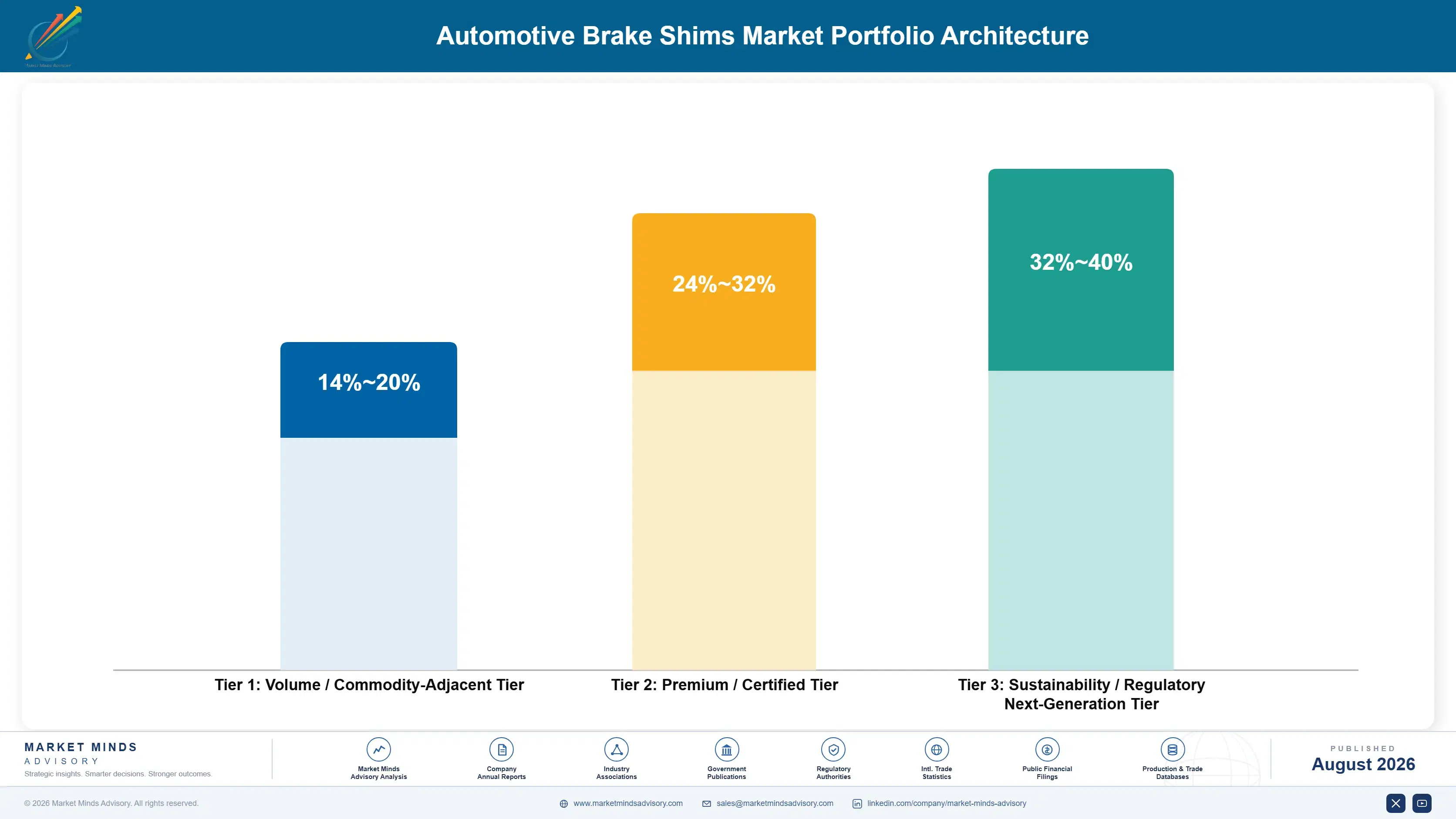
The portfolio splits into three tiers with distinct margin economics. Volume commodity-adjacent standard single-layer steel shims compete largely on price against Chinese production, premium multi-layer steel and non-asbestos organic formulations command a durable pricing advantage tied to validated noise performance, and a smaller next-generation tier built on composite polymer formulations sits above both on a per-unit margin basis. This means margin depends more on mix shift than on growing total volume.
The volume versus premium tension is real: standard single-layer shims still represent meaningful global unit volume across cost-sensitive vehicle segments, but nearly all incremental margin growth is concentrated in multi-layer steel and composite formulations, creating pressure on manufacturers to shift capacity mix even where standard demand remains a stable base business. Manufacturers who delay this mix shift risk ceding profitable relationships to competitors already positioned in the premium tier.

High-value margin pools concentrate in multi-layer steel and composite polymer formulations, both of which reward manufacturers able to demonstrate validated noise dampening and weight performance consistently across demanding automaker qualification cycles rather than simply offering the lowest per-unit price available. Manufacturers demonstrating this consistency across multiple qualification cycles increasingly command a durable pricing advantage over rivals.

Volume / Commodity-Adjacent Tier

Standard single-layer steel shims sold into cost-sensitive vehicle segments where price competition against Chinese production dominates purchasing decisions broadly across the category. Little differentiation exists among manufacturers competing for this cost-sensitive business today.
Gross Margin: 14-20%

Premium / Certified Tier

Multi-layer steel and non-asbestos organic shims sold to automakers requiring validated noise dampening performance across premium and mainstream vehicle platforms. Buyers here validate noise performance thoroughly before committing to a chosen supplier.
Gross Margin: 24-32%

Sustainability / Regulatory / Next-Generation Tier

Composite polymer and titanium alloy formulations serving electric vehicle platforms with the most demanding validated weight and noise performance requirements. Growth here outpaces both other tiers as electric vehicle platforms expand.
Gross Margin: 32-40%
automotive-brake-shims-market-trends-portfolio-architecture-1787463785639

High-value Sub-segments and Strategic Watch-out

Multi-Layer Steel for Electric Vehicle Platforms

This segment combines the fastest volume growth with the strongest margins in the category, driven by electric vehicle cabin noise requirements and rewarding manufacturers with dedicated multi-layer capability already in place today. Few competitors currently match this combination of growth and pricing power. This edge should persist for years.
Gross Margin: 32-40%

Composite Polymer Weight Reduction Formulations

Automakers increasingly demand validated weight reduction here, supporting strong margins in the category, though volume remains smaller than standard steel categories overall currently across the broader market. Manufacturers here compete primarily on validated weight performance rather than price. This edge should persist for several more years.
Gross Margin: 32-40%

Standard Single-Layer Aftermarket Shims

This remains a large volume base in the category, with pricing under continuous pressure from Chinese competitors, leaving margins thinner than the premium multi-layer and composite tiers by a wide margin overall. Little differentiation exists among suppliers competing here today. Volume here should remain steady but unremarkable going forward.
Gross Margin: 14-20%

Electric Vehicle Adoption Risk Exposure

A strategic watch-out segment where accelerating electric vehicle adoption could compress aftermarket replacement volume that the category has historically depended on for stable recurring revenue significantly over time. Diversified manufacturers are watching this risk closely across their broader portfolios. Timing here remains genuinely difficult to predict with confidence.
Gross Margin: 16-24%

Platform Cycles and Replacement Demand Dynamics

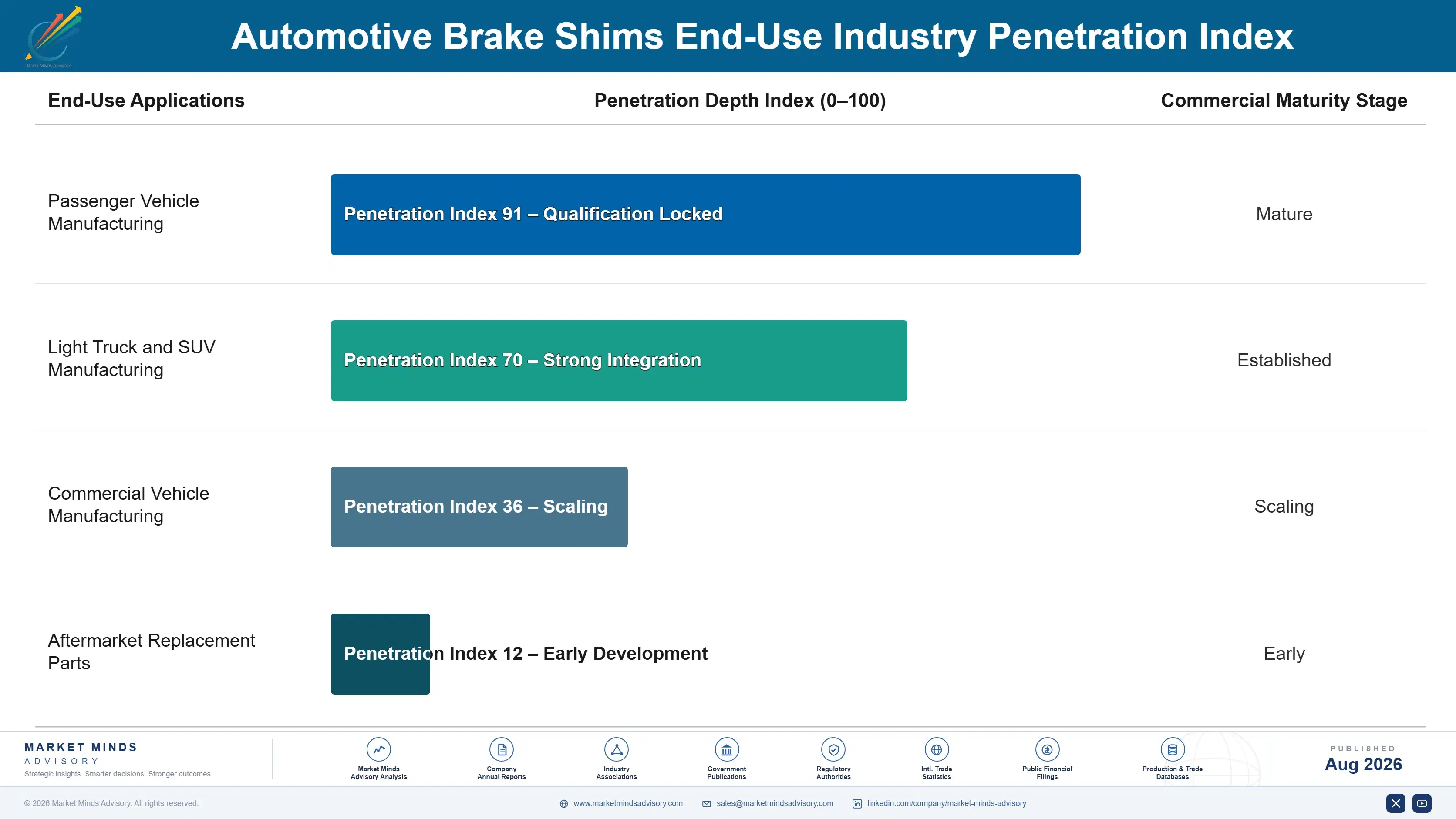
Brake shim demand behaves less like a discretionary purchase and more like a recurring platform commitment once an automaker integrates a specific shim specification into a vehicle program, since switching suppliers requires re-validating noise and durability performance across an entire vehicle platform rather than simply comparing price sheets each quarter. Buyers rarely reverse a supplier decision once a specification is validated across a platform.
Adoption depth varies considerably by end-use vertical. Automakers commit deepest, often single-sourcing a qualified shim supplier across an entire vehicle platform lifecycle for years given the engineering validation risk of switching suppliers mid-production. Aftermarket distributors commit almost as deeply once a replacement product is validated, since customer trust depends on consistent fit and performance. Smaller independent repair shops show shallower commitment and switch suppliers more readily if pricing gaps widen between cycles.

A generational shift in buyer profile is underway too. Younger vehicle engineers increasingly treat validated noise performance data as a default specification requirement rather than a negotiable cost line, a mindset shift that is locking in premium demand durability even independent of near-term electric vehicle adoption swings. This shift persists even in categories where near-term electric vehicle adoption swings remain genuinely uncertain.
automotive-brake-shims-market-trends-end-use-penetration-index-1787463786145

Where Brake Shim Value Concentrates Next

These are among the four positions where our research anticipates prominent divergence between winners and laggards over the coming forecast period. Each is grounded in the demand model, the regulatory perimeter, and the announced capacity pipeline.
01 / MULTI-LAYER STEEL STRATEGY

Prioritize multi-layer capacity over standard steel expansion

Multi-layer steel demand is compounding well above the category average, and manufacturers who have already invested in this capability report meaningfully better margins than those still weighted toward standard single-layer production. Manufacturers still expanding standard capacity are chasing a shrinking margin pool relative to multi-layer alternatives gaining share. The economics of this capability investment now clear payback thresholds that looked marginal only a few years ago, making it the clearest capital allocation priority for manufacturers with flexibility to reallocate production capacity toward multi-layer steel.
02 / AFTERMARKET DISTRIBUTION POSITIONING

Expand distribution reach before rivals capture this margin pool

Aftermarket replacement demand carries meaningfully better margins than typical original equipment supply contracts, and manufacturers who have already expanded direct distribution relationships report capturing considerably more of this higher-margin volume than competitors relying purely on original equipment channels. Manufacturers without expanded distribution risk losing this fast-growing segment entirely as distributors finalize preferred supplier relationships over the coming several years across the industry. This window will not stay open indefinitely once ambitious rivals build equivalent distribution reach first across every major market.
03 / ELECTRIC VEHICLE RISK MANAGEMENT

Diversify into composite formulations before volume erosion accelerates

Electric vehicle adoption threatens to gradually compress aftermarket replacement volume that the category has historically depended on for stable recurring revenue independent of new vehicle production. Manufacturers who diversify into composite polymer and multi-layer premium formulations reduce this concentration risk meaningfully, capturing value per unit even as total friction brake cycle frequency moderates over time. Manufacturers who wait until volume erosion fully materializes will have far less capacity to reposition than those diversifying proactively today across every major product line.
04 / REGIONAL GROWTH SEQUENCING

Prioritize South Asia and Pacific expansion ahead of slower regions

South Asia and Pacific is growing faster than every other region tracked in this report, on the strength of India's rapidly expanding domestic vehicle manufacturing sector and growing automotive export capacity across major hubs. Manufacturers sequencing capacity expansion should weight this region ahead of slower-growing Eastern Europe or Middle East and Africa markets, where vehicle production and aftermarket investment pressure remain comparatively muted for now. Early positioning here compounds advantage as regional automakers finalize long-term supplier relationships over the next several years.

Engagement Snapshot From the Field

A live engagement with an industry participant carrying material or product regulatory and market exposure ahead of a defining policy shift, showing how our research translates into a defensible multi-year portfolio strategy.
MARKET MINDS ADVISORY · CLIENT ENGAGEMENT SUMMARY
Automotive Brake Shims Producer Strategic Portfolio Review and Transition Roadmap 2026·Investment Scenario on Automotive Brake Shims Exposure Evaluation 2025-26
CLIENT PROFILE
The client, a mid-tier brake shim manufacturer headquartered in Western Europe with reported annual revenue of approximately 145 million dollars (client-reported, unverified by MMA), operates production facilities supplying standard single-layer steel shims primarily into regional aftermarket channels, with limited presence in higher-margin multi-layer and composite segments relative to established leaders. with a customer base built over more than a decade of regional operation.
STRATEGIC CHALLENGE
The client faced sustained margin compression from Chinese import competition on its core standard shim business, while lacking the multi-layer production capability and electric vehicle platform relationships needed to compete for higher-margin original equipment contracts, leaving it uncertain whether to compete on cost or pivot toward premium segments entirely. a decision that would shape its competitive position for years.
MMA APPROACH
MMA conducted a comparative margin analysis across formulation types using primary survey data and expert interviews with automaker and aftermarket distributor buyers, benchmarked the client's cost structure against integrated competitors, and modeled portfolio shift scenarios weighted by projected demand growth across each segment through 2036, drawing on this report's underlying dataset.
KEY FINDINGS
  1. Multi-layer steel conversion offered a projected sixteen to twenty-two point margin improvement over the client's existing standard product line within three years.
  2. Regional automakers launching electric vehicle platforms were actively seeking additional qualified multi-layer suppliers, an opportunity the client had not yet pursued. ahead of upcoming platform production timelines.
  3. The client's existing production capacity was reasonably well suited to multi-layer manufacturing with moderate process modifications rather than entirely new facility investment.
  4. Competing regional manufacturers had not yet made equivalent portfolio shifts, giving the client a meaningful first-mover window in its home market region.
CLIENT PROFILE
The client, a mid-tier brake shim manufacturer headquartered in Western Europe with reported annual revenue of approximately 145 million dollars (client-reported, unverified by MMA), operates production facilities supplying standard single-layer steel shims primarily into regional aftermarket channels, with limited presence in higher-margin multi-layer and composite segments relative to established leaders. with a customer base built over more than a decade of regional operation.
STRATEGIC CHALLENGE
The client faced sustained margin compression from Chinese import competition on its core standard shim business, while lacking the multi-layer production capability and electric vehicle platform relationships needed to compete for higher-margin original equipment contracts, leaving it uncertain whether to compete on cost or pivot toward premium segments entirely. a decision that would shape its competitive position for years.
MMA APPROACH
MMA conducted a comparative margin analysis across formulation types using primary survey data and expert interviews with automaker and aftermarket distributor buyers, benchmarked the client's cost structure against integrated competitors, and modeled portfolio shift scenarios weighted by projected demand growth across each segment through 2036, drawing on this report's underlying dataset.
KEY FINDINGS
  1. Multi-layer steel conversion offered a projected sixteen to twenty-two point margin improvement over the client's existing standard product line within three years.
  2. Regional automakers launching electric vehicle platforms were actively seeking additional qualified multi-layer suppliers, an opportunity the client had not yet pursued. ahead of upcoming platform production timelines.
  3. The client's existing production capacity was reasonably well suited to multi-layer manufacturing with moderate process modifications rather than entirely new facility investment.
  4. Competing regional manufacturers had not yet made equivalent portfolio shifts, giving the client a meaningful first-mover window in its home market region.
RECOMMENDED STRATEGY
Phase 1: Phase 1 (0-6 months): Commission process modifications to enable multi-layer steel production alongside existing standard capacity. with priority given to its largest existing customer relationships. Phase 2: Phase 2 (6-18 months): Pursue qualification trials with regional automakers launching electric vehicle platforms directly. while validating performance data across multiple production batches. Phase 3: Phase 3 (18-36 months): Scale multi-layer production based on qualification success and expand aftermarket distribution reach. while monitoring customer conversion rates closely throughout the rollout.
OUTCOME
Within eighteen months of implementing the phased strategy, the client reported securing several new multi-layer supply contracts and a reported blended gross margin improvement of roughly eight percentage points across its product portfolio (client-reported, unverified by MMA), partially offsetting continued standard shim volume pressure. Customer retention across its remaining standard lines also improved noticeably during the transition.

Frequently Asked Questions

Foundational context covering the market sizes, CAGR, scope, country, region and competition that inform every finding below. This section is provided to cover basics and most often pre-purchase conversations, answered from the MMA Primary Research Dataset.

What is the current size of the Automotive Brake Shims Market?

The global automotive brake shims market was valued at approximately 1.4 billion dollars in 2025. Growth is concentrated in multi-layer steel and composite formulations rather than legacy standard shim demand.

How large will the Automotive Brake Shims Market be by 2036?

The market is projected to reach approximately 2.25 billion dollars by 2036. This represents roughly a 1.54 times expansion from 2026 levels over the forecast period.

What is the CAGR for the Automotive Brake Shims Market 2026 to 2036?

The market is forecast to grow at a compound annual growth rate of 4.4 percent between 2026 and 2036. Bull and bear scenarios range from 3.2 to 5.6 percent depending on electric vehicle adoption conditions.

Which segment is growing fastest?

Multi-layer steel shims are the fastest-growing segment, expanding at approximately 6.8 percent annually. This is roughly 1.55 times the overall market growth rate, driven by electric vehicle noise performance requirements.

Who are the major companies in the Automotive Brake Shims Market?

Leading manufacturers include Akebono Brake Industry, Brembo S.p.A., ZF Friedrichshafen, Aisin Corporation, and Tenneco. These five companies control roughly forty percent of global production capacity.

Which country is growing fastest?

India is the fastest-growing national market, expanding at approximately 6.8 percent annually. Growth is driven by rapidly expanding domestic vehicle manufacturing and growing automotive export capacity.

Report Segmentation Architecture

The full report scope spans multiple orthogonal segmentation dimensions, with cross-tabulated demand data provided for each dimension pair. Coverage extends further to regional breakdowns, trend trajectories, and the competitive detail needed to support segment-level decision-making.

By Material Construction

  • Rubber-Coated Steel Shims
  • Multi-Layer Steel Shims
  • Non-Asbestos Organic Shims
  • Titanium and Advanced Alloy Shims
  • Composite Polymer Shims
  • Standard Single-Layer Steel Shims

By End-Use Industry

  • Passenger Vehicle Manufacturing
  • Light Truck and SUV Manufacturing
  • Commercial Vehicle Manufacturing
  • Aftermarket Replacement Parts

By Commercial Dimension

  • Direct Original Equipment Supply
  • Aftermarket Distributor Channel Sales
  • Retail Parts Store Sales
  • Long-Term Platform Supply Contracts

By Region

  • North America
  • Western Europe
  • East Asia
  • South Asia and Pacific
  • Latin America
  • Middle East and Africa
  • Eastern Europe

Scope, Methodology, and Coverage

Every figure in this report is reproducible from documented input assumptions. The scope below maps the historical period, the forecast horizon, the segmentation dimensions, and the countries covered, alongside the underlying primary and qualitative methodology.
Historical Period
2020 to 2025
Forecast Period
2026 to 2036
Base Year
2025 (USD billions; MMA Primary Research Dataset, August 2026)
Market Definition
The automotive brake shims market covers commercial production and sale of anti-noise and anti-vibration shim components installed between brake pads and calipers across passenger vehicles, light trucks, and commercial vehicles. It excludes brake pads, calipers, rotors, and other braking system components sold separately from the shim itself, as well as finished vehicles that merely incorporate shims as one component.
Quantitative Units
USD billions (current prices); million units of shim production volume where applicable
Segmentation Dimensions
By Material Construction; By End-Use Industry; By Commercial Dimension; By Region
Regions Covered
North America, Western Europe, East Asia, South Asia and Pacific, Latin America, Middle East and Africa, Eastern Europe
Countries Covered
USA, China, Germany, France, UK, Japan, South Korea, India, Australia, Canada, Brazil, Mexico, Indonesia, Vietnam, Thailand, Malaysia, UAE, Saudi Arabia, South Africa, Nigeria, Turkey, Poland, Netherlands, Italy, Spain, Sweden, Switzerland, Argentina, Colombia, Singapore, and additional markets relevant to this sector
Key Companies Profiled
Akebono Brake Industry, Brembo S.p.A., ZF Friedrichshafen, Aisin Corporation, Tenneco, Nisshinbo Holdings, Continental AG, Robert Bosch, Hitachi Astemo, Nucap Industries, Raybestos, Standard Motor Products, Centric Parts, MAT Holdings, Fras-le S.A., Sangsin Brake, EBC Brakes, TMD Friction, Bendix Commercial Vehicle Systems, ADVICS Co.
Quantitative Methodology
Primary survey, n=3,800 respondents, Q4 2025, six countries; demand-side model with trade association cross-validation
Qualitative Methodology
47 expert interviews, Q4 2025; applied to validate demand model assumptions, identify emerging dynamics, and assess competitive positioning
Report Format
PDF and XLSX data workbook (Word format preview document)
Publisher
Market Minds Advisory
Report Code
MMA-2026-AUT-102
Published
August 2026
Contact
sales@marketmindsadvisory.com | www.marketmindsadvisory.com

Purchase the full Automotive Brake Shims Market Report (2026 to 2036).

This report delivers a complete commercial assessment of the global automotive brake shims market across material constructions, competitive dynamics, and seven world regions. It includes detailed segmentation analysis, competitive benchmarking of twenty profiled companies, and quantified feedstock cost and electric vehicle transition risk assessments across every major producing geography. Analysts combine primary survey data from 3,800 respondents with 47 expert interviews conducted in the fourth quarter of 2025 to validate demand forecasts running through 2036. The report is designed to support portfolio strategy, capacity planning, and customer segment prioritization decisions for shim manufacturers.
Ten-year quantitative market forecast across all segments
Detailed material-level segmentation analysis and pricing
Seven-region demand breakdown with share and CAGR data
Twenty-company competitive profiles with moat and risk analysis
Feedstock cost risk assessment with manufacturer mitigation strategies
Electric vehicle transition and aftermarket opportunity analysis

Built For The People Who Decide

From boardroom strategy to bench-side execution, this report is read cover-to-cover by leaders shaping the next decade of their industry, turning demand scenarios, market dynamics and valuation benchmarks into decisions.
CXOs/ Presidents/ VPs/ Managers
M&A and Corporate Development
Strategy Teams and R&D Heads
Procurement and Product Directors
Regulatory and Compliance Leaders
Investor Relations and Equity Analysts