Market Minds Advisory
Automotive Bearing and Clutch Market

Automotive Bearing and Clutch Market: Electric Motor Bearing Growth Against Clutch Decline Through 2036

Electric motor and drivetrain bearing demand is offsetting a sustained decline in friction clutch volume as vehicle electrification reshapes which components suppliers need to manufacture at scale across every major producing region worldwide today.

Lead Analyst

David Horsley

Published

September 2026

Make Smarter Decisions with Customized Research Insights

Request a free sample report and evaluate market opportunities, growth trends, and competitive dynamics relevant to your business needs.

2025 MARKET VALUE$27.0BMarket Size 2025
2036 FORECAST VALUE$47.1BBase Case , 2026 to 2036
CAGR 2026 TO 20365.2 %Bull 6.3% / Bear 4.0%
INCREMENTAL OPPORTUNITY$18.8BNet 10- year value creation
EXPANSION MULTIPLE1.66x2036 value over 2026 base
Strategic Levers
M&A Pipeline
Regional Outlook
Country Rankings
Competitive Intelligence
Segmental Deep-dive
Call-Us : 91 93563 13602

Executive Snapshot and Market Trajectory

Vehicle electrification is quietly reshuffling this market's growth engines, lifting demand for electric motor and drivetrain bearings even as friction clutch volume shrinks with every vehicle platform that drops its manual and torque converter transmission options entirely, reshaping how suppliers allocate research and manufacturing investment across their product lines.
Bearing suppliers including Schaeffler AG and SKF are redirecting engineering investment toward electric motor bearing designs that tolerate higher rotational speeds and different lubrication regimes than conventional engine bearings required, capturing new revenue as automakers scale electric vehicle production. Wheel hub bearing units remain the largest single category by volume, growing steadily alongside overall vehicle production regardless of powertrain type, reshaping supplier investment priorities across the entire industry.
Clutch suppliers like Valeo and Aisin Corporation face a genuinely difficult transition, since electric vehicles eliminate the friction clutch entirely, pushing these suppliers to diversify into dual-clutch transmission components for hybrid vehicles or electric motor adjacent parts to preserve relevance. Japanese suppliers dominate original equipment relationships across both categories, reflecting decades of automotive supply chain concentration in the region, particularly for suppliers competing purely on legacy mechanical component manufacturing scale overall today.
Market Definition
The automotive bearing and clutch market covers wheel hub bearing units, engine and transmission bearings, electric motor and drivetrain bearings, friction clutch assemblies, dual-clutch and automated clutch systems, and clutch release and actuation components sold to automakers and tier-one suppliers. It excludes industrial bearings sold outside automotive applications.
Base Year Value
$27.0B in 2025 (MMA Primary Research Dataset, August 2026)
Forecast Period
2026 to 2036, eleven discrete annual values
CAGR
5.2% base case. Bull 6.3%. Bear 4.0%.
Fastest Growth Segment
Electric Motor and Drivetrain Bearings: 9.0% CAGR
Fastest Growth Country
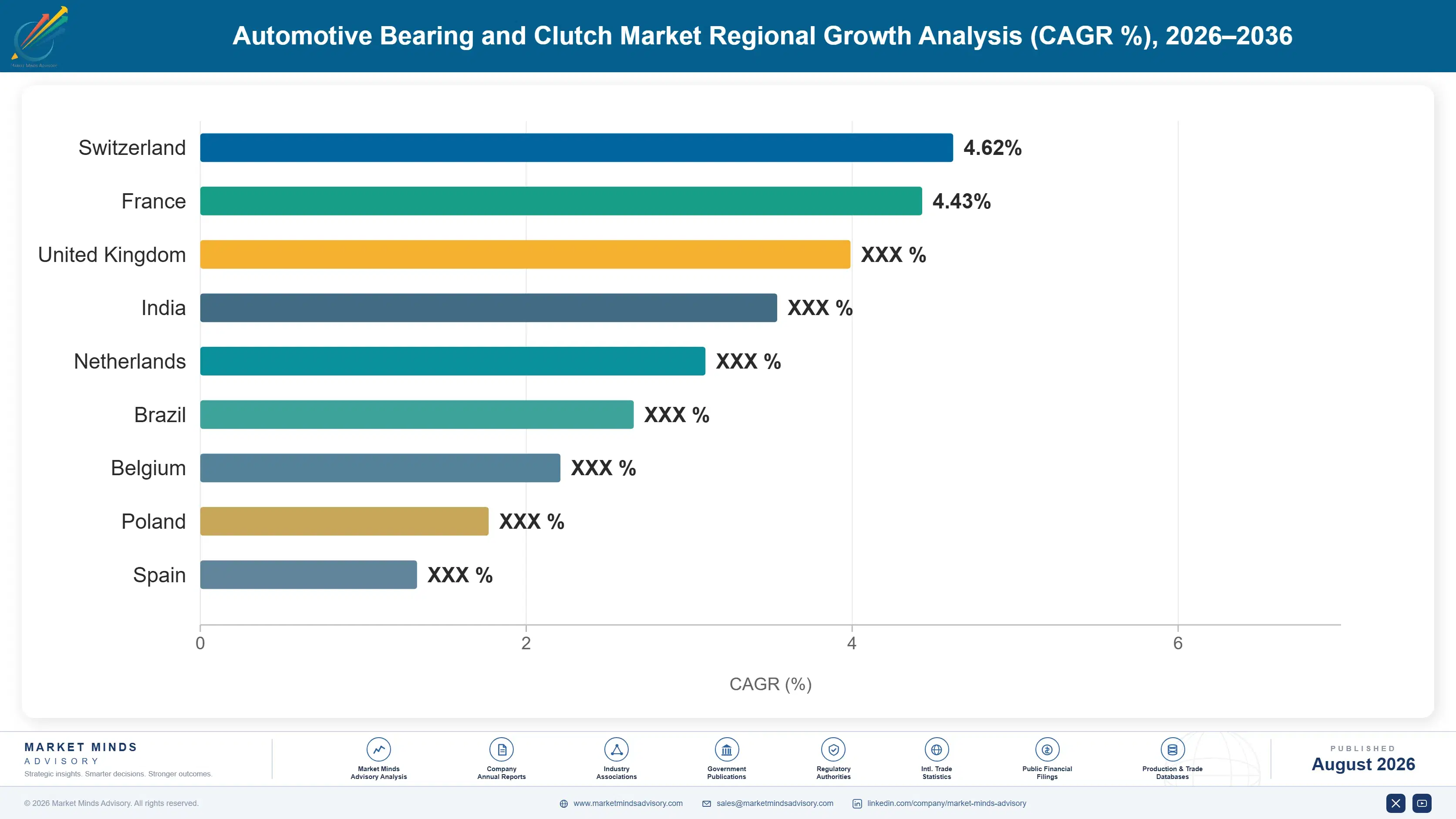
India: 8.5% CAGR
Fastest Growth Region
South Asia and Pacific: 7.2% CAGR
Largest Region
East Asia: 29% of 2025 global value
Market Leaders
Schaeffler AG, SKF, NSK Ltd, Valeo, Aisin Corporation. Source: MMA Analysis based on company annual reports.
Primary Survey
n=3,800 procurement and R&D decision-makers, Q4 2025, six countries
Methodology
Demand-side build-up, cross-validated against public data, 47 expert interviews

Automotive Bearing and Clutch Market Forecast Scenarios

automotive-bearing-clutch-market-trends-size-forecast-scenario-1787463638849
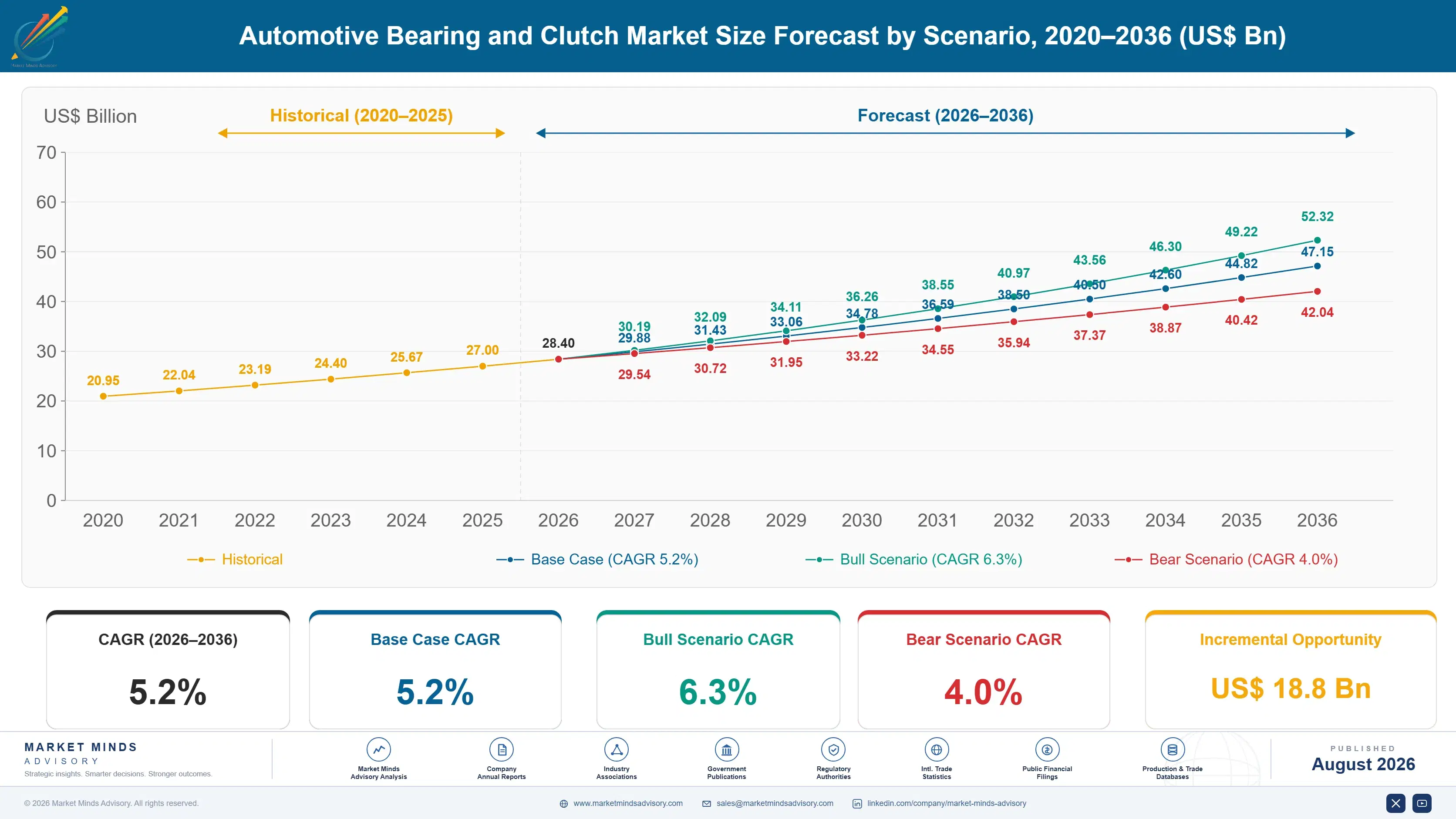
Between 2020 and 2025 the market grew at roughly 4.5 percent a year, with pandemic-era vehicle production disruptions briefly slowing component shipments before a recovery in global vehicle output and early electric vehicle scaling restored steadier growth through the back half of the period, and early electric vehicle bearing programs began scaling meaningfully across several major manufacturing regions.
The base case assumes 5.2 percent annual growth to 2036, built on three mechanisms: electric vehicle adoption driving new motor and drivetrain bearing demand that partially offsets friction clutch decline, steady global vehicle production growth sustaining wheel hub bearing volume regardless of powertrain type, and automaker localization of component sourcing in fast-growing markets like India and Southeast Asia. Together these three mechanisms sustain growth above what simple vehicle production trends alone would suggest.
A bull case near 6.3 percent depends on electric vehicle adoption accelerating faster than currently planned, pulling motor bearing demand higher than base case assumptions. The bear case near 4.0 percent assumes clutch decline outpaces bearing growth as electrification accelerates faster than suppliers can diversify their product portfolios, and automakers accelerate transmission platform simplification faster than currently anticipated.

Electrification Splits Bearing Growth From Clutch Decline

Bearings and clutches share a manufacturing lineage in precision metalworking, but electrification is pulling the two categories in opposite directions since electric motors still need bearings at every rotating joint while battery electric vehicles eliminate the friction clutch outright, and that divergence has already reshaped how suppliers allocate long-term capital investment, across every major regional market today, and this dynamic has held steady across decades of industry consolidation.
PRODUCER CONCENTRATIONCR5 42%top five suppliers hold roughly two-fifths of global shipments
AVERAGE SELLING PRICE$18/unitblended price across all bearing and clutch component categories
JAPAN PRODUCTION SHARE28%share of global component production originating from this country
ELECTRIC VEHICLE BEARING CONTENT$45/vehicleaverage bearing spend per electric vehicle produced worldwide today
TRADE INTENSITY41%share of shipments crossing a border before reaching assembly plants
STEEL COST SHARE34% of COGSsteel input cost burden within bearing and clutch production expense
Commercially, the market splits between mature wheel hub and engine bearing supply priced close to commodity levels and a faster-growing electric motor bearing tier commanding better margins as automakers scale electric vehicle production. Clutch suppliers face the opposite dynamic, competing for a shrinking pool of transmission platforms as automakers phase out manual and torque converter options, as buyers increasingly weigh documented testing history before committing.
Over the next decade, electric motor bearing engineering capability will matter more to competitive position than legacy clutch manufacturing scale, since basic bearing production technology itself is now widely accessible across multiple regional suppliers competing primarily on price, particularly as automakers weigh certification history alongside raw unit cost carefully, over the coming decade, particularly as automakers finalize their electric platform roadmaps further.
"Every electric motor still needs bearings, sometimes more of them than a combustion engine did. The clutch business is the one everyone's trying to diversify away from before it shrinks further."
Director, Automotive Practice · MMA Automotive Practice · August 2026

Market Trends

Electric Motor Bearing Redesign Accelerates Across Suppliers

Electric motors spin at meaningfully higher rotational speeds than combustion engines, requiring bearing designs engineered for different lubrication regimes and thermal conditions than conventional automotive bearings historically required. Schaeffler AG and SKF have both expanded electric motor bearing research and manufacturing capacity specifically to serve automakers scaling electric vehicle production, rather than simply adapting existing combustion engine bearing designs. This redesign effort is spreading across the broader supplier base as electric vehicle production volume continues climbing each year worldwide, reflecting how quickly electric vehicle scaling is reshaping bearing research investment priorities industry-wide.
Market Impact: Global vehicle output grows 3-4% annually
Clutch Suppliers Diversify Into Hybrid Transmission Parts

Friction clutch suppliers facing declining battery electric vehicle demand are diversifying into dual-clutch transmission components for hybrid vehicles, which still require clutch technology even as pure electric platforms eliminate it entirely. Valeo and Aisin Corporation have both expanded dual-clutch and hybrid transmission component capacity specifically to preserve relevance as automakers extend hybrid platform production timelines. This diversification is spreading across the broader clutch supplier base as pure combustion platforms decline faster than expected in several major markets, reinforcing how quickly hybrid platform extension is reshaping clutch supplier portfolio strategy, overall.
Market Impact: EV output grew 25% in 2025

Market Opportunities and Growth Drivers

Global Vehicle Production Growth Sustains Bearing Volume

Global vehicle production has grown steadily as demand recovers and expands across most major markets, and every vehicle produced, regardless of powertrain type, requires wheel hub and drivetrain bearings at multiple points throughout its structure. This volume relationship gives bearing suppliers a demand floor tied directly to broader vehicle production growth rather than depending on any single automaker's individual platform decisions within the competitive manufacturing landscape shaping the industry across every major producing region, across both established manufacturing hubs and newer regional assembly plants alike, sustaining predictable order volume for suppliers year after year.
Market Impact: Clutch volume declined 12% since 2022

Electric Vehicle Adoption Expands Motor Bearing Demand

Electric vehicle production has scaled rapidly as automakers commit to electrification roadmaps across multiple regions, and each electric vehicle typically requires more specialized bearings per motor than an equivalent combustion engine required historically. NSK Ltd and NTN Corporation have both expanded electric motor bearing production capacity specifically to serve this growing demand, capturing revenue that partially offsets declining friction clutch volume across their broader product portfolios, a trend expected to continue as electric vehicle production keeps expanding further, even as combustion-specific component demand gradually contracts across the broader industry today.
Market Impact: Steel spikes cut margins by 25%

Market Restraints and Challenges

Friction Clutch Decline Pressures Legacy Suppliers

Friction clutch volume is declining as battery electric vehicles eliminate the component entirely, and the underlying cause is that electric motors deliver power directly to wheels without the multi-speed transmission and clutch mechanism combustion engines required. The commercial impact is forcing legacy clutch suppliers to either diversify into hybrid transmission components or exit the category as combustion platform production declines. Suppliers are mitigating this through acquisitions of electric motor component manufacturers to diversify their revenue base, particularly across suppliers lacking the capital to fund a meaningful diversification strategy, over time.
Market Impact: EV bearing content hits $45/vehicle

Steel Price Volatility Compresses Bearing Margins

Bearing manufacturing margins remain exposed to steel price volatility, and the underlying cause is that precision bearing steel requires specialized alloy composition that trades at a premium over standard commodity steel grades used elsewhere in manufacturing. The commercial impact has periodically compressed margins for suppliers without long-term steel supply agreements during periods of high commodity prices. Manufacturers are mitigating this through multi-year contracts with specialty steel mills to smooth pricing volatility, particularly across smaller manufacturers lacking the purchasing scale to negotiate favorable long-term terms, and this exposure persists despite years of engineering cost-reduction effort across the supply base.
Market Impact: Hybrid clutch demand rose 18%
3 additional market trends, 4 additional growth drivers, and 3 additional restraints and challenges are covered in the full report. Contact sales@marketmindsadvisory.com to access the complete intelligence.

Segment CAGR and Growth Architecture

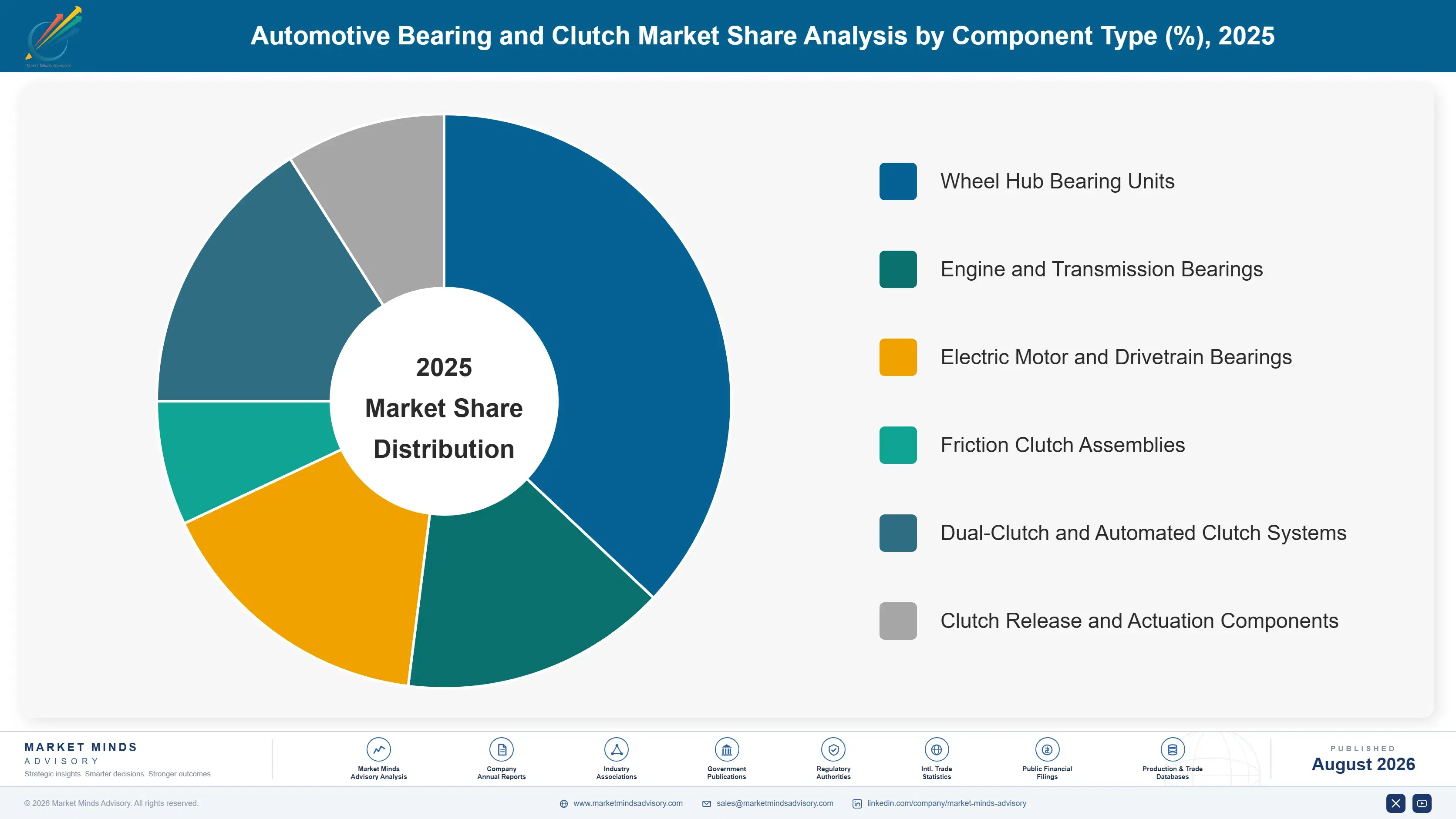
The market splits into six categories spanning bearings and clutches, from wheel hub units through clutch release components. Electric motor and drivetrain bearings are growing fastest as electric vehicle production scales, while wheel hub units follow closely given their presence across every vehicle regardless of powertrain type, as internal combustion platforms decline further each year across most major markets.
automotive-bearing-clutch-market-trends-market-share-analysis-1787463639403

Electric Motor and Drivetrain Bearings

Electric motor and drivetrain bearings are growing faster than any other category because every electric vehicle produced requires specialized bearings engineered for the higher rotational speeds and different thermal conditions that electric motors generate compared with combustion engines. Schaeffler AG and SKF have both expanded electric motor bearing research and manufacturing capacity specifically to serve automakers scaling electric vehicle production, since adapting existing combustion engine bearing designs proved insufficient for these demanding operating conditions. NSK Ltd has pursued a similar strategy, and the category's technical complexity gives established bearing suppliers a meaningful engineering advantage over new entrants lacking decades of precision manufacturing experience, particularly as automakers scrutinize supplier reliability records before committing to multi-year platform contracts.
CAGR 9.0%

Wheel Hub Bearing Units

Wheel hub bearing units remain the largest single category by volume and continue growing steadily because every vehicle produced, regardless of powertrain type, requires these units at each wheel position throughout its structure. NTN Corporation and The Timken Company compete most directly in this category, where integrated hub assemblies combining bearing and sensor functions increasingly differentiate suppliers from basic component manufacturers. This universal applicability across combustion, hybrid, and electric platforms gives wheel hub bearings a demand floor that shields the category from the volatility affecting clutch suppliers more directly as electrification accelerates across the broader industry, sustaining stable order volume for established suppliers year after year across every major manufacturing region.
CAGR 7.0%
Full segment breakdown across 7 segments available in the complete report.

Regional Architecture and Country Demand Map

East Asia leads global bearing and clutch demand, anchored by Japanese supplier headquarters concentration and China's vehicle production scale. South Asia and Pacific posts the fastest growth as India's expanding vehicle production and component localization efforts accelerate regional demand Western Europe and North America follow as major production bases.

North America

US automakers maintain steady bearing and clutch demand tied to established vehicle production volume, with electric vehicle assembly plants increasingly driving motor bearing orders as several automakers scale battery electric platforms. The Timken Company maintains significant domestic manufacturing capacity serving both original equipment and aftermarket replacement channels across the region. Canada's smaller vehicle production base follows similar demand patterns, contributing proportionally modest additional volume. Mexico's growing role as a manufacturing hub for North American brands is expanding component demand tied to nearshoring-driven vehicle production increases, across both established original equipment channels and the growing aftermarket replacement segment nationwide, supporting stable long-term supplier revenue across the continent, and reinforcing established supplier relationships built over decades of continuous platform development.
Share: 23% | CAGR: 5.7% (2026 to 2036)

Western Europe

Germany hosts substantial bearing and clutch manufacturing capacity serving both domestic automakers and export markets, with Schaeffler AG anchoring significant regional engineering and production presence. The region's automakers are further along in electric vehicle platform transitions than many global peers, accelerating the shift from clutch to motor bearing demand within domestic supply chains. Growth here trails faster-growing Asian markets because vehicle production volume itself has grown more slowly, and clutch decline weighs more heavily given the region's historically strong manual transmission market share, suppliers headquartered here continue exporting engineering expertise to newer manufacturing operations across other regions, reinforcing the region's engineering leadership position over time, and helping domestic suppliers maintain technical relevance as global electrification accelerates.
Share: 21% | CAGR: 3.9% (2026 to 2036)
Regional intelligence for 5 additional markets available in the complete report: East Asia, South Asia and Pacific, Latin America, Middle East and Africa, Eastern Europe. Contact sales@marketmindsadvisory.com.
automotive-bearing-clutch-market-trends-country-cagr-analysis-1787463639931

Capturing Value as Electrification Reshuffles Demand

Suppliers capture the largest margin gains not from selling more units but from shifting what they sell: electric motor bearings, integrated hub sensor assemblies, and hybrid transmission components that preserve relevance as combustion platforms decline. Each lever depends on capability incumbents already have and challengers must still build, and it favors suppliers who move on it early.

Expand Electric Motor Bearing Engineering Capacity

Suppliers with mature electric motor bearing engineering can capture a price premium of roughly 18 to 24 percent over standard combustion engine bearings, capturing value from automakers racing to scale electric vehicle production across multiple regions. Schaeffler AG and SKF have both prioritized this expansion with existing customers rather than competing purely for new original equipment contracts, since incumbent suppliers already hold the platform relationship and testing history needed to win the upgrade without a fully competitive tender process in most cases, and this advantage is widening as more automakers finalize their electric vehicle platform roadmaps.
Market Impact: Electric motor bearings help add an 18-24% premium

Integrate Sensors Into Wheel Hub Bearing Units

Suppliers that bundle wheel speed and load sensors directly into wheel hub bearing units capture a higher share of total system value than selling bearings and sensors separately, generating margin roughly 12 to 16 percent above unbundled component sales. NTN Corporation has expanded this integration strategy specifically to serve automakers seeking simplified assembly and fewer supplier relationships, since integrated units reduce total vehicle wiring complexity that separately sourced components would otherwise require, and this gap is widening as more automakers formalize simplified assembly requirements across their platforms across every major platform.
Market Impact: Integrated hub sensors add a 12-16% margin uplift

Diversify Into Hybrid Dual-Clutch Transmission Parts

Clutch suppliers that diversify into dual-clutch transmission components for hybrid vehicles preserve revenue that would otherwise disappear entirely as battery electric platforms eliminate the friction clutch, capturing an estimated 10 to 15 percent of revenue that would be lost without this pivot. Valeo and Aisin Corporation have both pursued this diversification aggressively, using their transmission engineering expertise to bundle hybrid-specific components that pure electric motor suppliers cannot easily replicate, and this pivot is proving increasingly valuable as hybrid platform production timelines extend further across every major hybrid platform and beyond.
Market Impact: Hybrid diversification helps preserve 10-15% of total revenue

Who Controls the Margin Pool

Concentration sits moderate at a CR5 near 42 percent, reflecting an industry that spans two distinct product categories with somewhat different competitive dynamics. Schaeffler AG holds the clearest leadership position given its broad range across both bearings and related components, though the gap between Schaeffler AG and challengers like SKF and NSK Ltd is narrower in commodity bearing categories than in specialized electric motor bearing engineering, particularly in electric motor bearing engineering.
Current competitive activity centers on electric motor bearing capacity expansion and hybrid transmission component diversification, as suppliers race to capture growth in one category while defending relevance in the other. Valeo and Aisin Corporation have both expanded hybrid dual-clutch capacity, while NTN Corporation continues integrating sensor technology into wheel hub bearing units to differentiate from basic component competitors.

Emerging pressure comes from Chinese component makers like C&U Group scaling technical capability rapidly within their large domestic electric vehicle market, a trajectory that could eventually support competition beyond basic bearings into precision electric motor components. Rankings could shift meaningfully over the next decade if domestic suppliers close the remaining engineering gap that currently protects established multinational suppliers.
automotive-bearing-clutch-market-trends-company-positioning-matrix-1787463640464

Competitive Moat and Risk Dimensions

SCHAEFFLER AG

Moat: Broad Cross-Category Portfolio

Schaeffler AG's presence across both bearing and clutch categories lets it serve automakers with a single supplier relationship spanning multiple platform generations, reducing the qualification burden automakers face when managing separate suppliers for each component category across their vehicle lineups, and reinforcing its position as the preferred choice for multi-category platform contracts.
SCHAEFFLER AG

Risk: Exposure to Clutch Decline

Schaeffler AG's meaningful clutch business exposes it more directly to friction clutch decline than pure bearing specialists, requiring continued diversification investment to offset revenue that electric vehicle adoption will eventually eliminate across its existing customer base, particularly as electric vehicle adoption accelerates faster than currently projected.
SKF

Moat: Electric Motor Bearing Depth

SKF has invested early in electric motor bearing research and testing capability, positioning it favorably with automakers scaling electric vehicle production who increasingly require proven high-speed bearing performance data rather than adapted combustion engine designs, as more automakers formalize high-speed bearing reliability requirements into their supplier scorecards.
SKF

Risk: Limited Clutch Presence

SKF's more limited presence in clutch and transmission components means it captures less of the hybrid transition revenue that diversified competitors like Schaeffler AG and Valeo can access through their broader existing product portfolios across multiple categories, as those competitors extend hybrid platform relationships across multiple vehicle generations.

Players Tracked

Prominent Players

Schaeffler AG
SKF
NSK Ltd
Valeo
Aisin Corporation

Other Key Players

NTN Corporation
The Timken Company
JTEKT Corporation
Exedy Corporation
ZF Friedrichshafen
Minebea Mitsumi
Iljin Bearing
C&U Group
Wanxiang Group
Sona BLW Precision Forgings
Rane Group
GKN Automotive
Setco Automotive
Federal-Mogul
Sansera Engineering

Recent Developments

MARCH 2025

Schaeffler AG announced an expansion of its electric motor bearing manufacturing capacity at its German production facility, adding capacity specifically to serve automakers scaling electric vehicle platforms ahead of continued production volume growth across several major markets, and reinforcing its position as a preferred supplier for premium electric vehicle programs.
Signal: Signals supplier confidence that electric vehicle demand will sustain long-term capacity utilization broadly across the industry
SEPTEMBER 2025

Valeo entered a supply agreement with a major automaker to provide dual-clutch transmission components across several hybrid vehicle platforms over a multi-year period, reinforcing its diversification strategy as pure combustion platform production declines, and demonstrating continued automaker commitment to hybrid platforms despite broader electrification trends.
Signal: Confirms automakers continue extending hybrid platform commitments even as electric vehicle adoption accelerates rapidly toda overall.
JANUARY 2026

NTN Corporation launched an integrated wheel hub bearing unit combining wheel speed sensors and load monitoring into a single assembly, aimed at simplifying automaker integration work and reducing total vehicle wiring complexity across platforms, and reinforcing its position as a leader in sensor integration technology development.
Signal: Signals a broader competitive shift toward integrated sensor capability rather than basic mechanical components alon overall.

Steel Alloy and Friction Material Exposure

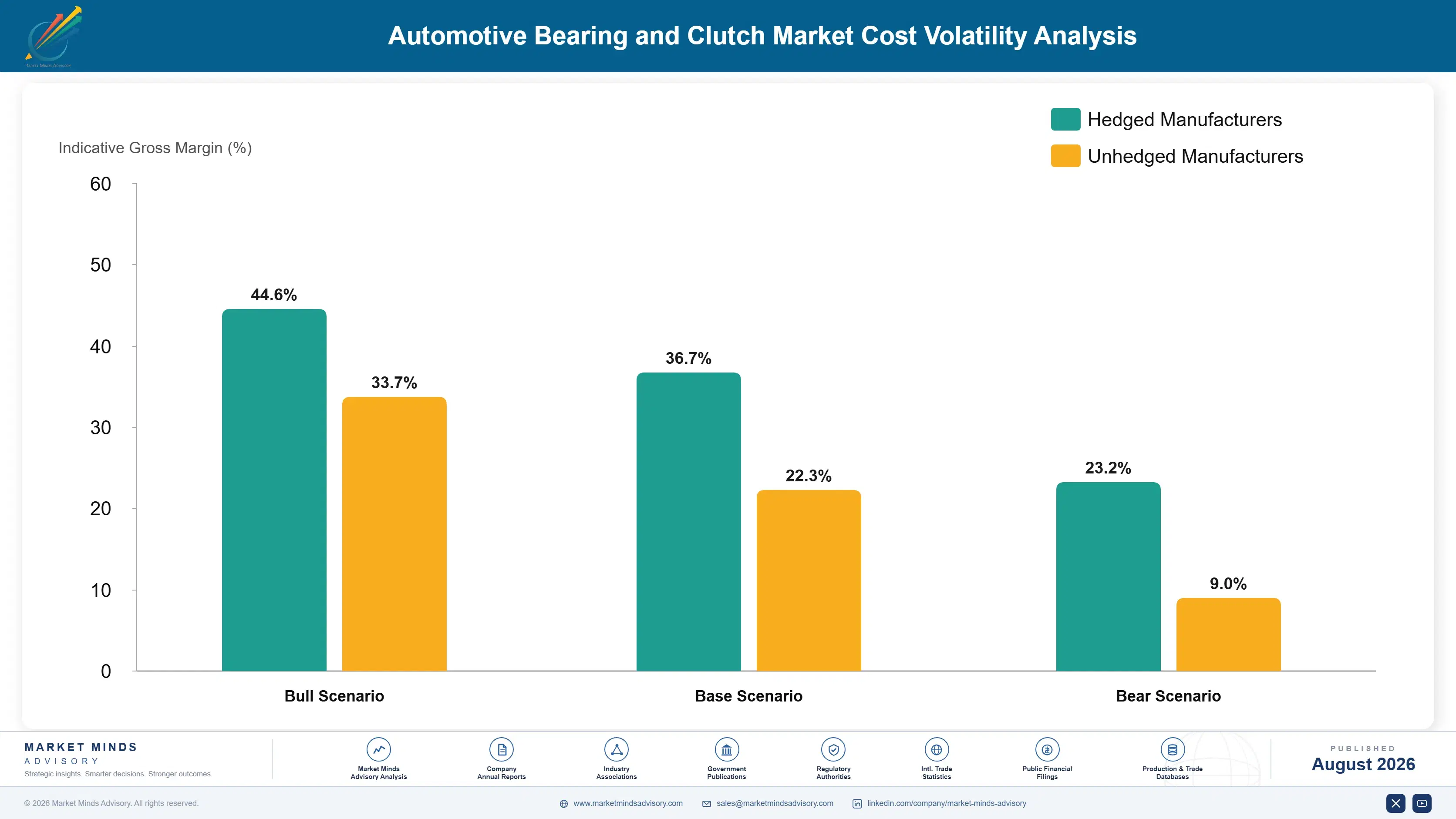
Precision bearing steel and friction clutch materials together represent roughly 34 percent of cost of goods sold for component manufacturers, sourced from a concentrated group of specialty steel mills and friction material producers whose own pricing cycles directly influence contract pricing across the broader automotive supply chain each production year, particularly during periods of tight global steel capacity utilization.
Specialty steel prices rose meaningfully during a 2021 supply disruption tied to pandemic-era manufacturing and shipping bottlenecks, according to industry commodity pricing reports, and that shortage passed through to bearing and clutch contract pricing within roughly two to three quarters as manufacturers renegotiated terms with automaker customers already committed to vehicle production schedules. Manufacturers without long-term steel supply agreements absorbed the sharpest cost increases during that period across the broader industry.

Smaller regional component manufacturers without diversified steel sourcing or long-term supply contracts absorb price volatility directly in margin, while larger diversified manufacturers with broader procurement relationships smooth pricing for their downstream automaker customers instead. That gap in resilience increasingly determines which manufacturers can offer multi-year fixed-price contracts that large automakers now require, given the scale of their platform footprint.
automotive-bearing-clutch-market-trends-cost-volatility-analysis-1787463640660

Long-Term Specialty Steel Supply Agreements

Manufacturers are securing precision bearing steel through multi-year contracts with specialty mills rather than relying on spot-market purchases, smoothing cost volatility during years when supply disruptions or competing industrial demand push steel prices higher than budgeted across the industry each production cycle, helping preserve stable margins even when broader industrial steel demand elsewhere tightens overall capacity.

Diversified Friction Material Sourcing Relationships

Manufacturers are securing friction material components through multiple suppliers rather than relying on a single source, smoothing cost volatility during regional supply disruptions that periodically affect specific friction material manufacturing facilities and their surrounding markets globally, and helping manufacturers maintain delivery schedules even when a single supplier faces unexpected capacity constraints each cycle too.

Vertical Integration Into Steel Processing

Some larger manufacturers are integrating vertically into steel processing operations, reducing exposure to third-party mill pricing while gaining tighter control over quality specifications that bearing precision and durability ultimately depend on across every major product line, an approach increasingly valued by manufacturers seeking to avoid dependence on any single external mill worldwide today too.

Portfolio Architecture for Margin Defence

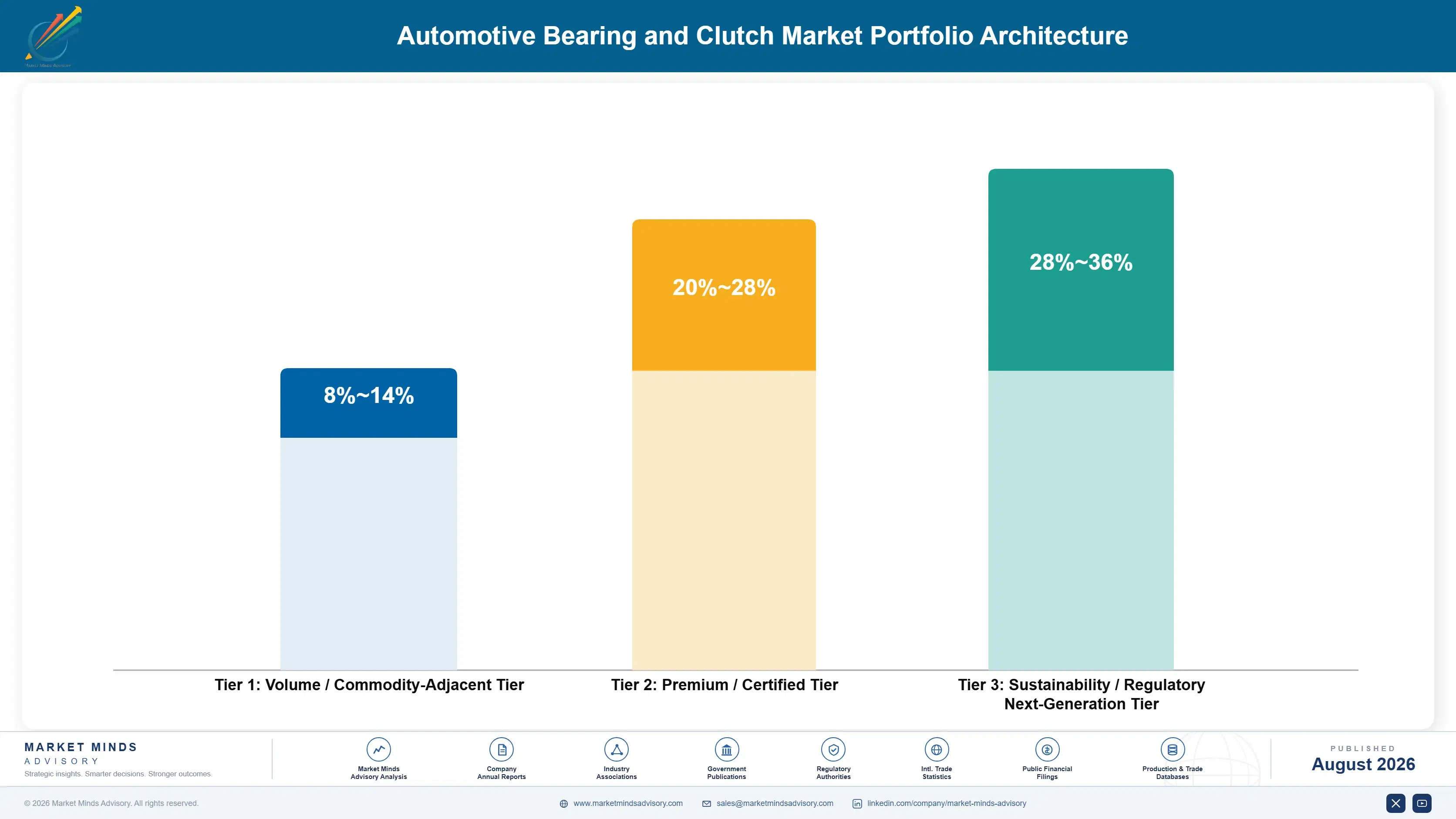
The market splits across three tiers: commodity wheel hub and engine bearings sold on thin margins against original equipment volume contracts, electric motor bearings and hybrid clutch components sold with engineering support at a premium, and an emerging tier of integrated sensor-bearing assemblies commanding the highest margins as automakers seek bundled electronics capability, reflecting how quickly the underlying technology mix within the industry keeps shifting toward electronics.
Volume sits overwhelmingly in the commodity bearing tier, where bulk contracts with automakers generate revenue scale but comparatively thin margins given intense price competition among established and regional component suppliers. Premium tension is sharpest in electric motor bearings, where engineering capability and testing history earn meaningfully better margins than commoditized combustion bearings, pulling supplier investment toward capacity serving both tiers.

High-value margin pools concentrate in electric motor bearings and integrated sensor assemblies sold to automakers scaling electric vehicle production, a category still smaller in absolute volume than commodity bearings but growing faster and attracting disproportionate research investment from the leading suppliers each year, a pattern likely to continue strengthening as more automakers finalize their own electric platform roadmaps.

Volume / Commodity-Adjacent Tier

Standardized wheel hub and engine bearings sold on multi-year volume contracts to automakers, competing primarily on manufacturing cost and delivery reliability across regions, reflecting the intense price sensitivity these budget-constrained buyers bring to every large-volume procurement decision.
Gross Margin: 8%-14%

Premium / Certified Tier

Electric motor bearings and hybrid transmission components sold with engineering and testing support, commanding a premium over standardized bearing equivalents across most contracts, as electric vehicle production continues expanding steadily across an expanding set of manufacturing regions.
Gross Margin: 20%-28%

Sustainability / Regulatory / Next-Generation Tier

Integrated sensor-bearing assemblies tied to advanced vehicle monitoring systems, sold into the industry's highest-margin bundled electronics arrangements currently available, as more automakers seek unified electronics architecture over separately sourced mechanical components.
Gross Margin: 28%-36%
automotive-bearing-clutch-market-trends-portfolio-architecture-1787463641160

High-value Sub-segments and Strategic Watch-out

Integrated Sensor-Bearing Assemblies

Integrated sensor-bearing assemblies command the category's highest margins and are growing fastest as automakers increasingly demand bundled electronics capability over standalone mechanical components each platform cycle today, and suppliers with established electronics capability are capturing the bulk of this expanding demand and beyond too now.

Electric Motor and Drivetrain Bearings

Electric motor and drivetrain bearings sold into original equipment contracts command steady premium pricing on engineering value, growing reliably as electric vehicle production continues expanding across additional regional markets worldwide, a combination increasingly viewed as a competitive necessity rather than an optional differentiator and beyond.

Standardized Wheel Hub and Engine Bearings

The largest volume pool by far, standardized bearings generate scale revenue for top suppliers but offer little margin expansion room given intense multi-region price competition among established component manufacturers, leaving manufacturers to compete mainly on delivery reliability and established regional service networks and beyond too.

Domestic Chinese Component Suppliers

Domestic Chinese suppliers scaling technical capability could challenge multinational suppliers on cost within their home market over the next decade, a shift worth monitoring closely going forward for the industry, particularly if domestic engineering capability matures faster than currently anticipated by most industry observers too.

Platform Cycles and Supplier Loyalty

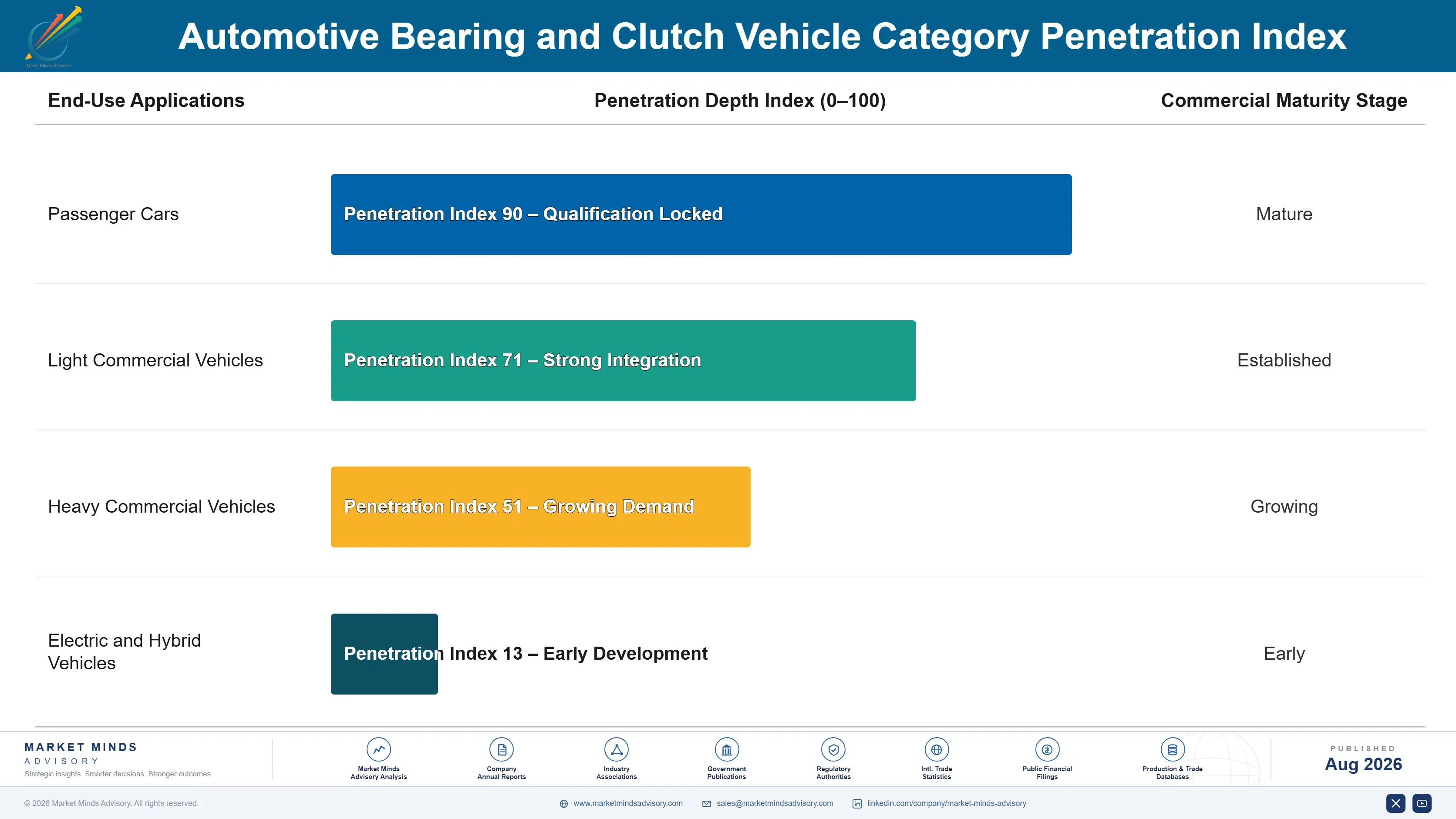
Original equipment demand behaves like an annuity once an automaker qualifies a specific supplier's bearing or clutch component against its own platform specifications, since switching suppliers again requires repeating extensive vehicle-level qualification testing that most automakers avoid unless supply is disrupted, giving incumbent suppliers durable multi-year volume once they win the initial platform contract and pass the first renewal cycle.
Adoption depth varies by segment: large automakers show the deepest supplier stickiness given the scale of platform qualification testing required, while smaller specialty vehicle builders switch suppliers more readily since their production volumes are smaller and requalification costs correspondingly lower relative to total component spend involved in each build across the broader industry, particularly where component specifications rotate more frequently across shorter product design cycles.

A generational shift among younger vehicle engineers toward treating electric motor bearing performance data as a core platform design input rather than a simple mechanical maintenance item is pulling supplier selection earlier into platform development decisions, giving technically differentiated suppliers a seat at the table that legacy component-only vendors historically never had, reshaping how platform teams weigh technical capability against simple component price.
automotive-bearing-clutch-market-trends-end-use-penetration-index-1787463641669

Positioning as Electrification Splits Demand

These are among the four positions where our research anticipates prominent divergence between winners and laggards over the coming forecast period. Each is grounded in the demand model, the regulatory perimeter, and the announced capacity pipeline.
01 / ELECTRIC MOTOR BEARING INVESTMENT

Expand electric motor bearing capacity ahead of platform scaling

Electric motor bearings already command an 18 to 24 percent premium, and suppliers without high-speed testing history cannot access the platform contracts Schaeffler AG and SKF increasingly dominate with automakers scaling electric vehicle production. Building this capability now, even at substantial engineering investment, positions a supplier to capture the highest-margin category before more automakers finalize their electric platform roadmaps. Suppliers who wait risk permanent exclusion from contracts requiring years of testing history to win and open bidding to a wider field of competitors.
02 / HUB SENSOR INTEGRATION

Integrate sensors into hub bearings to capture bundled margin

Integrated sensor-bearing assemblies add an estimated 12 to 16 percent margin uplift over unbundled component sales, and NTN Corporation already demonstrates this advantage through simplified assembly that automakers increasingly value across their platforms. Suppliers without comparable sensor integration capability struggle to compete on total system value alone. Building this capability now secures long-term platform relationships before competitors close the remaining technology gap further spanning both new platform contracts and existing customer relationships across every major regional segment and pricing conditions across the industry.
03 / HYBRID TRANSMISSION DIVERSIFICATION

Diversify into hybrid components before combustion platforms disappear

Hybrid diversification preserves an estimated 10 to 15 percent of revenue that would otherwise disappear as battery electric platforms eliminate the friction clutch entirely, and Valeo and Aisin Corporation already demonstrate this advantage through their transmission engineering expertise. Suppliers without a hybrid diversification strategy face a shrinking addressable market with no offsetting growth avenue. Building this capability now secures revenue continuity before combustion platform production declines further across every region where combustion platforms keep contracting and clutch demand keeps contracting further.
04 / INDIAN MARKET LOCALIZATION

Localize manufacturing in India before domestic suppliers mature

India's bearing and clutch market is growing at roughly 8.5 percent annually, and domestic manufacturers Sona BLW Precision Forgings and Rane Group are scaling capacity rapidly to serve this expanding vehicle production base. Suppliers who build local manufacturing capacity now can secure long-term supply relationships before domestic champions capture the bulk of new demand growth entirely. Early localization secures market position before this fast-growing market matures and consolidates further around domestic leaders around a small number of dominant domestic suppliers.

Engagement Snapshot From the Field

A live engagement with an industry participant carrying material or product regulatory and market exposure ahead of a defining policy shift, showing how our research translates into a defensible multi-year portfolio strategy.
MARKET MINDS ADVISORY · CLIENT ENGAGEMENT SUMMARY
Automotive Bearing and Clutch Producer Strategic Portfolio Review and Transition Roadmap 2026·Investment Scenario on Automotive Bearing and Clutch Exposure Evaluation 2025-26
CLIENT PROFILE
A regional automaker expanding electric vehicle production across multiple platforms engaged MMA to guide a bearing and clutch supplier consolidation strategy after managing separate vendor relationships for combustion and electric platform components became increasingly inefficient. The automaker's annual bearing and clutch procurement spend exceeded 70 million dollars (client-reported, unverified by MMA), making supplier selection a material decision for its senior platform engineering leadership.
STRATEGIC CHALLENGE
The automaker managed separate suppliers for combustion engine bearings, clutch components, and emerging electric motor bearings, creating coordination overhead and inconsistent quality standards across its expanding platform lineup as electric vehicle production scaled rapidly across multiple facilities, threatening a meaningful share of the automaker's quality assurance timeline commitments across every vehicle program.
MMA APPROACH
MMA benchmarked cross-category suppliers against electric motor bearing engineering depth and existing combustion platform relationships, modeled the coordination savings of consolidating vendors, and structured a phased consolidation plan prioritizing the platforms facing the nearest electric vehicle launch timelines, drawing on comparable consolidation programs completed at similarly sized regional automakers elsewhere.
KEY FINDINGS
  1. Consolidating to a cross-category supplier reduced coordination overhead meaningfully within the first two platform launches, freeing engineering resources for other priority platform development work.
  2. The consolidated supplier's electric motor bearing testing data exceeded what separate vendors previously provided, validating the consolidation decision earlier than the original engagement timeline anticipated.
  3. A phased consolidation across three platforms avoided the supply disruption a full switch would have created, keeping production schedules on track throughout the transition period.
  4. Supplier engineering support during the transition proved as valuable to the automaker's team as the cost savings, giving engineering leadership confidence to expand the relationship further.
CLIENT PROFILE
A regional automaker expanding electric vehicle production across multiple platforms engaged MMA to guide a bearing and clutch supplier consolidation strategy after managing separate vendor relationships for combustion and electric platform components became increasingly inefficient. The automaker's annual bearing and clutch procurement spend exceeded 70 million dollars (client-reported, unverified by MMA), making supplier selection a material decision for its senior platform engineering leadership.
STRATEGIC CHALLENGE
The automaker managed separate suppliers for combustion engine bearings, clutch components, and emerging electric motor bearings, creating coordination overhead and inconsistent quality standards across its expanding platform lineup as electric vehicle production scaled rapidly across multiple facilities, threatening a meaningful share of the automaker's quality assurance timeline commitments across every vehicle program.
MMA APPROACH
MMA benchmarked cross-category suppliers against electric motor bearing engineering depth and existing combustion platform relationships, modeled the coordination savings of consolidating vendors, and structured a phased consolidation plan prioritizing the platforms facing the nearest electric vehicle launch timelines, drawing on comparable consolidation programs completed at similarly sized regional automakers elsewhere.
KEY FINDINGS
  1. Consolidating to a cross-category supplier reduced coordination overhead meaningfully within the first two platform launches, freeing engineering resources for other priority platform development work.
  2. The consolidated supplier's electric motor bearing testing data exceeded what separate vendors previously provided, validating the consolidation decision earlier than the original engagement timeline anticipated.
  3. A phased consolidation across three platforms avoided the supply disruption a full switch would have created, keeping production schedules on track throughout the transition period.
  4. Supplier engineering support during the transition proved as valuable to the automaker's team as the cost savings, giving engineering leadership confidence to expand the relationship further.
RECOMMENDED STRATEGY
Phase 1: Phase 1 (Months 1-4): Consolidate suppliers for the highest-priority electric vehicle platform first, the platform facing the nearest electric vehicle launch deadline. Phase 2: Phase 2 (Months 5-10): Extend the consolidated relationship across two additional platforms, validating coordination savings before expanding the relationship further. Phase 3: Phase 3 (Months 11-15): Complete consolidation and finalize joint quality documentation together, closing out the consolidation on schedule and within budget.
OUTCOME
The automaker completed its phased supplier consolidation within the recommended fifteen-month window and reported meaningfully reduced coordination overhead across its platform lineup (client-reported, unverified by MMA), while consolidated testing data strengthened its electric vehicle launch confidence significantly, strengthening its position ahead of the next platform generation review.

Frequently Asked Questions

Foundational context covering the market sizes, CAGR, scope, country, region and competition that inform every finding below. This section is provided to cover basics and most often pre-purchase conversations, answered from the MMA Primary Research Dataset.

What is the current size of the Automotive Bearing and Clutch Market?

The global automotive bearing and clutch market was valued at approximately $27.0 billion in 2025. Electric motor bearing demand already accounts for a meaningful and growing share of total supply.

How large will the Automotive Bearing and Clutch Market be by 2036?

MMA projects the market will reach approximately $47.15 billion by 2036, roughly 1.66 times its 2026 value. Electric motor bearing adoption drives much of this growth.

What is the CAGR for the Automotive Bearing and Clutch Market 2026 to 2036?

The market is projected to grow at a 5.2 percent compound annual rate between 2026 and 2036. Bull and bear scenarios range from 4.0 to 6.3 percent.

Which segment is growing fastest?

Electric motor and drivetrain bearings are the fastest-growing segment at a 9.0 percent CAGR, well above the overall market rate. Electric vehicle production scaling drives this expansion.

Who are the major companies in the Automotive Bearing and Clutch Market?

Leading suppliers include Schaeffler AG, SKF, NSK Ltd, Valeo, and Aisin Corporation. Together they hold a CR5 near 42 percent of global shipments of global shipment volume today.

Which country is growing fastest?

India posts the fastest national growth at roughly 8.5 percent, driven by rapid vehicle production expansion and component localization policy. Domestic manufacturing capacity is expanding to meet this rising demand.

Report Segmentation Architecture

The full report scope spans multiple orthogonal segmentation dimensions, with cross-tabulated demand data provided for each dimension pair. Coverage extends further to regional breakdowns, trend trajectories, and the competitive detail needed to support segment-level decision-making.

By Component Type

  • Wheel Hub Bearing Units
  • Engine and Transmission Bearings
  • Electric Motor and Drivetrain Bearings
  • Friction Clutch Assemblies
  • Dual-Clutch and Automated Clutch Systems
  • Clutch Release and Actuation Components

By Vehicle Category

  • Passenger Cars
  • Light Commercial Vehicles
  • Heavy Commercial Vehicles
  • Electric and Hybrid Vehicles

By Commercial Dimension

  • Original Equipment Manufacturer Supply
  • Aftermarket Replacement Distribution
  • Tier-One Integration Contracts

By Region

  • North America
  • Western Europe
  • East Asia
  • South Asia and Pacific
  • Latin America
  • Middle East and Africa
  • Eastern Europe

Scope, Methodology, and Coverage

Every figure in this report is reproducible from documented input assumptions. The scope below maps the historical period, the forecast horizon, the segmentation dimensions, and the countries covered, alongside the underlying primary and qualitative methodology.
Historical Period
2020 to 2025
Forecast Period
2026 to 2036
Base Year
2025 (USD billions; MMA Primary Research Dataset, August 2026)
Market Definition
The automotive bearing and clutch market covers wheel hub bearing units, engine and transmission bearings, electric motor and drivetrain bearings, friction clutch assemblies, dual-clutch and automated clutch systems, and clutch release and actuation components sold to automakers and tier-one suppliers. It excludes industrial bearings sold outside automotive applications.
Quantitative Units
USD billions (current prices); unit volume for vehicle production detail
Segmentation Dimensions
By Component Type; By Vehicle Category; By Commercial Dimension; By Region
Regions Covered
North America, Western Europe, East Asia, South Asia and Pacific, Latin America, Middle East and Africa, Eastern Europe
Countries Covered
Japan, China, South Korea, Germany, USA, India, France, UK, Italy, Sweden, Canada, Mexico, Brazil, Argentina, Colombia, UAE, Saudi Arabia, South Africa, Poland, Czech Republic, Hungary, Slovakia, Turkey, Indonesia, Thailand, Vietnam, Australia, Spain, Netherlands, and additional markets relevant to this sector
Key Companies Profiled
Schaeffler AG, SKF, NSK Ltd, Valeo, Aisin Corporation, NTN Corporation, The Timken Company, JTEKT Corporation, Exedy Corporation, ZF Friedrichshafen, Minebea Mitsumi, Iljin Bearing, C&U Group, Wanxiang Group, Sona BLW Precision Forgings, Rane Group, GKN Automotive, Setco Automotive, Federal-Mogul, Sansera Engineering
Quantitative Methodology
Primary survey, n=3,800 respondents, Q4 2025, six countries; demand-side model with trade association cross-validation
Qualitative Methodology
47 expert interviews, Q4 2025; applied to validate demand model assumptions, identify emerging dynamics, and assess competitive positioning
Report Format
PDF and XLSX data workbook (Word format preview document)
Publisher
Market Minds Advisory
Report Code
MMA-2026-AUT-103
Published
August 2026
Contact
sales@marketmindsadvisory.com | www.marketmindsadvisory.com

Purchase the full Automotive Bearing and Clutch Market Report (2026 to 2036).

The full Automotive Bearing and Clutch Market report delivers a comprehensive 2026 to 2036 forecast across six component categories, seven regions, and twenty profiled companies active in this sector. It includes detailed segmentation by vehicle category, steel and friction material cost modeling, and competitive benchmarking measured against a single consistent shipment volume basis throughout. Analysts document the electrification and diversification trends reshaping supplier positioning across the industry. Buyers receive full access to the underlying data tables, regional breakouts, and a customizable Excel model built for scenario planning.
2026-2036 volume and value forecasts by segment
Six-category component type breakdown and detailed analysis
Seven-region market sizing and share detail
Twenty-company competitive profiles and full benchmarking
Steel and friction material cost sensitivity modeling
Editable Excel forecast workbook with scenario toggles

Built For The People Who Decide

From boardroom strategy to bench-side execution, this report is read cover-to-cover by leaders shaping the next decade of their industry, turning demand scenarios, market dynamics and valuation benchmarks into decisions.
CXOs/ Presidents/ VPs/ Managers
M&A and Corporate Development
Strategy Teams and R&D Heads
Procurement and Product Directors
Regulatory and Compliance Leaders
Investor Relations and Equity Analysts