Market Minds Advisory
Automotive Backing Plate Market

Automotive Backing Plate Market: Mechanical Retention, Corrosion Specification and the Slow Death of Adhesive Bonding

Adhesive bonding is losing ground to mechanical retention as copper-free friction changes the interface, while electric vehicles corrode brake hardware faster than they wear it and coating specification becomes the commercial argument.

Lead Analyst

David Horsley

Published

September 2026

Make Smarter Decisions with Customized Research Insights

Request a free sample report and evaluate market opportunities, growth trends, and competitive dynamics relevant to your business needs.

2025 MARKET VALUE$1.5BMarket Size 2025
2036 FORECAST VALUE$2.5BBase Case , 2026 to 2036
CAGR 2026 TO 20364.8 %Bull 6.0% / Bear 3.6%
INCREMENTAL OPPORTUNITY$0.9BNet 10- year value creation
EXPANSION MULTIPLE1.60x2036 value over 2026 base
Strategic Levers
M&A Pipeline
Regional Outlook
Country Rankings
Competitive Intelligence
Segmental Deep-dive
Call-Us : 91 93563 13602

Executive Snapshot and Market Trajectory

The backing plate stopped being a piece of stamped steel about a decade ago. Copper-free friction formulations changed the chemistry at the bonding interface, and adhesive alone no longer holds the way it did, which has pushed the whole industry toward plates that grip the friction material mechanically.
Mechanical interlock retention plates grow at 7.2%, a full 1.50 times the market rate, because hooked and barbed surfaces hold friction material through thermal cycling that defeats adhesive, and they eliminate the delamination warranty claims that made brake engineers nervous. East Asia holds 38% of global value, above the standard regional band, because China builds roughly 30 million vehicles annually and hosts the largest concentration of brake stamping capacity on the planet.
Concentration is very low at 29% for the top five, and that reflects what this product actually is: a stamping with a coating and a surface treatment, made by hundreds of plants. Differentiation exists at the technology end of this business and almost nowhere else. Everything that is not mechanically retained or specially coated competes on delivered cost per thousand pieces, and nothing else at all.
Market Definition
This report covers stamped steel backing plates for disc brake friction pads across passenger vehicles, light commercial vehicles, heavy commercial vehicles and two-wheelers, valued at the backing plate component level for both original equipment and aftermarket pad production. Friction material, shims sold separately, drum brake backing plate assemblies, calipers, rotors and complete finished pad assemblies are excluded from the sizing.
Base Year Value
$1.5B in 2025 (MMA Primary Research Dataset, August 2026)
Forecast Period
2026 to 2036, eleven discrete annual values
CAGR
4.8% base case. Bull 6.0%. Bear 3.6%.
Fastest Growth Segment
Mechanical Interlock Retention Backing Plate: 7.2% CAGR
Fastest Growth Country
India: 7.4% CAGR
Fastest Growth Region
South Asia and Pacific: 7.0% CAGR
Largest Region
East Asia: 38% of 2025 global value
Market Leaders
Nucap Industries, Tenneco, Nisshinbo Holdings, Akebono Brake Industry and Sangsin Brake lead on plate shipment volume. Source: MMA Analysis, July 2026.
Primary Survey
n=3,800 procurement and R&D decision-makers, Q4 2025, six countries
Methodology
Demand-side build-up, cross-validated against public data, 47 expert interviews

Automotive Backing Plate Market Forecast Scenarios

automotive-backing-plate-market-trends-size-forecast-scenario-1787313488813
Between 2020 and 2025 the market compounded at 3.8%, and unit volume explains almost none of that. Vehicle production fell through 2020 and 2021 and has still not recovered to earlier peaks in Europe. What lifted value instead was content: mechanical retention and advanced coatings both spread through the fleet, and a retained coated plate carries several times the price of a flat stamped one.
The base case at 4.8% rests on three mechanisms. Retention technology continues displacing adhesive bonding as copper-free friction formulations spread through every major market. Corrosion specification rises steadily, driven by Euro 7 brake wear rules, road salting practice and the particular problem electric vehicles create when brakes sit unused for weeks. Aftermarket volume grows on a global parc that keeps expanding and ageing, which matters more here than new vehicle assembly ever has.
The bull case at 6.0% turns on Euro 7 brake particulate rules forcing friction reformulation faster than planned, which would accelerate retention adoption across the European fleet. The bear case at 3.6% is regenerative braking biting harder than modelled: electric vehicles recover most deceleration energy electrically, pad wear falls sharply, and replacement intervals stretch well beyond what internal combustion fleets established.

What Actually Determines Backing Plate Value

A backing plate is a piece of steel roughly five millimetres thick that holds friction material against a rotor. Described that way it sounds like the least interesting component in a braking system, and for forty years that was broadly true. Two things changed it, both of them recent.
TOP FIVE CONCENTRATION29%Share held by the five largest backing plate suppliers
AVERAGE PLATE PRICE$1.85Typical realised price for a passenger vehicle plate
AFTERMARKET VOLUME SHARE58%Portion of plate volume destined for replacement pad production
STEEL COST SHARE46% of COGSCold rolled coil as portion of manufactured plate cost
PLATES PER VEHICLE8 platesBacking plates fitted across a typical passenger car
PAD REPLACEMENT INTERVAL45,000 milesTypical distance between friction pad replacement on passenger vehicles
The first was copper. Legislation in California and Washington forced friction manufacturers to remove copper from pad formulations, and the replacement chemistries behave differently at the bonding interface. Adhesive that held reliably for decades started producing delamination claims under thermal cycling, and brake engineers responded by specifying plates that hold the friction material mechanically, through hooks, barbs or interlocking geometry stamped into the surface. That is a genuinely different product at a genuinely different price.
The second was corrosion, and electric vehicles made it acute. A vehicle recovering most of its deceleration energy through the motor barely uses its friction brakes, so pads and plates sit unused through weeks of wet weather and corrode rather than wear. Zinc-nickel plating and advanced electrocoat finishes have moved from premium specification toward standard fitment on electrified platforms as a direct consequence.
"There is a real irony here. Electric vehicles were supposed to destroy this market by eliminating brake wear, and what they actually did was make the corrosion problem so visible that everybody upgraded their coating specification. Value per plate went up while volume growth went down."
Practice Director, Automotive Components, Market Minds Advisory · MMA Automotive

Market Trends

Mechanical Retention Displaces Adhesive Bonding Across New Platforms

Hooked, barbed and interlocking plate surfaces are replacing pure adhesive bonding on new brake platforms, and copper-free friction chemistry is the reason. The replacement formulations behave differently at the bonding interface, and adhesive that performed for decades began producing delamination claims under hard thermal cycling. A mechanically retained plate holds friction material through shear forces that defeat any adhesive bond, and it removes an entire warranty failure mode from the system. Retention plates cost roughly 2.4 times a flat stamped equivalent, and original equipment engineers increasingly accept that on liability grounds alone.
Market Impact: Serves 290 million vehicle parc

Electric Powertrains Shift Failure Mode From Wear To Corrosion

Regenerative braking recovers most deceleration energy electrically, so friction brakes on electric vehicles do far less work and pads last considerably longer. What replaces wear as the governing failure mode is corrosion: hardware sitting unused through weeks of wet weather rusts rather than abrades, and seized or corroded pads cause noise, drag and eventually replacement anyway. Zinc-nickel plating and advanced electrocoat have moved toward standard specification on electrified platforms, adding roughly 30% to plate cost and partially offsetting the aftermarket volume loss that regenerative braking otherwise creates across the fleet.
Market Impact: Covers 100% of European fleet

Market Opportunities and Growth Drivers

Global Vehicle Parc Growth Sustains Aftermarket Replacement Volume

Aftermarket already takes 58% of plate volume, and the global fleet keeps growing and ageing. North America alone operates above 290 million vehicles at an average age near thirteen years, and the pattern holds across most major markets. Replacement demand is far less cyclical than original equipment supply, because a worn pad has to be changed whatever the wider economy happens to be doing. The commercial consequence is that plate manufacturers with aftermarket channel positions carry considerably steadier volume than those dependent on vehicle assembly schedules, and they price accordingly.
Market Impact: Extends intervals 3 times longer

Brake Particulate Regulation Forces Friction And Interface Redesign

Euro 7 covers brake wear particulate emissions directly for the first time, setting limits that apply regardless of powertrain and forcing friction manufacturers to reformulate across their European ranges. Reformulated material behaves differently against the plate, which pushes interface design toward mechanical retention rather than adhesive dependence. Similar rules are now under active consideration in several other major markets. The commercial effect runs through the whole chain: every reformulation triggers requalification of the plate interface, and suppliers already holding retention technology are considerably better placed to win that requalification work when it arrives.
Market Impact: Holds margins near 12%

Market Restraints and Challenges

Regenerative Braking Extends Pad Replacement Intervals Substantially

Electric vehicles recover most deceleration energy through the motor, so friction pads on a battery electric car can last two to three times as long as on a comparable internal combustion vehicle. The root cause is straightforward physics rather than any material improvement. Commercially this attacks the aftermarket volume that supplies most of this market's units, and the effect compounds as electrified share of the parc rises. Participants are responding by pushing coated plate specification that raises value per unit, and by positioning corrosion rather than wear as the replacement trigger.
Market Impact: Costs 2.4 times flat plate

Commodity Stamping Economics Compress Pricing At The Volume End

A flat stamped plate is a die, a press and a coil of cold rolled steel, and hundreds of plants can make one. The root cause is genuinely low technical barrier: tooling costs are modest, the process is well understood, and Chinese and Indian stampers hold cost positions that Western plants cannot match on delivered price. Commercially this holds margins in the low teens across most of the volume base. Participants are responding by moving mix toward retention and coated product, by bundling shim assembly, and by competing on qualification rather than price.
Market Impact: Adds 30% to plate cost
4 additional market trends, 2 additional growth drivers, and 3 additional restraints and challenges are covered in the full report. Contact sales@marketmindsadvisory.com to access the complete intelligence.

Segment CAGR and Growth Architecture

Segmentation follows plate construction and retention technology, because how the plate holds friction material determines its price, its qualification path, the failure modes it eliminates and the customers who will pay for it. Vehicle class, coating choice, customer type and channel all sit downstream of that single design decision, and every one of them is priced against it.
automotive-backing-plate-market-trends-market-share-analysis-1787313489347

Mechanical Interlock Retention Backing Plate

The fastest segment at 7.2%, a full 1.50 times the market rate, covering plates with hooks, barbs or interlocking geometry stamped into the friction-side surface so the pad material is held mechanically rather than by adhesive alone. Copper-free friction chemistry created this segment. The replacement formulations behave differently at the bonding interface and adhesive that held reliably for forty years began producing delamination claims under hard thermal cycling. Mechanical retention removes that failure mode completely. Plates cost roughly 2.4 times a flat stamped equivalent, and original equipment brake engineers accept the premium on warranty liability grounds rather than performance grounds. Tooling and press capability are the barriers, and both take real capital to establish properly.
CAGR 7.2%

Advanced Coated Backing Plate

Growing at 6.1% on plates finished with zinc-nickel plating, advanced electrocoat or comparable corrosion systems rather than the basic phosphate and paint that served for decades. Electric vehicles created the urgency. Regenerative braking means friction hardware sits unused through weeks of wet weather, so it corrodes rather than wears, and a seized or rust-bonded pad causes noise, drag and eventually replacement despite having barely worn at all. European road salting and Euro 7 particulate rules both push in the same direction. Coating adds roughly 30% to plate cost and requires plating line capability or a reliable finishing partner, which is exactly what most of the low-cost volume stampers currently lack.
CAGR 6.1%
Full segment breakdown across 5 segments available in the complete report.

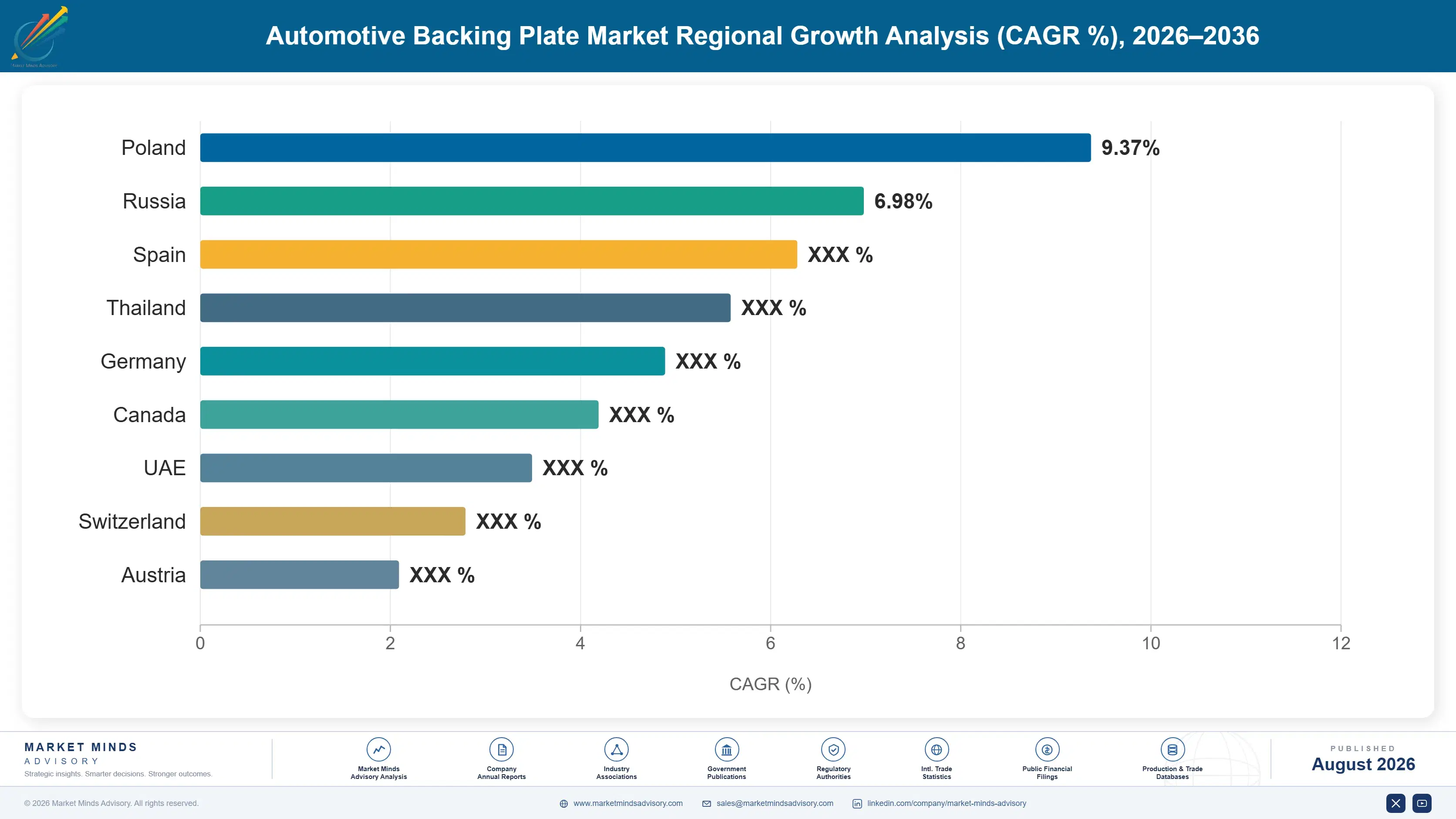
Regional Architecture and Country Demand Map

East Asia holds 38% of global value on Chinese vehicle output and the world's largest concentration of brake stamping capacity. North America follows on aftermarket depth rather than assembly volume, and growth runs fastest across South Asia and Pacific on domestic production and fleet expansion together.

East Asia

Note: East Asia holds 38% against a 22 to 30% band because China alone builds roughly 30 million vehicles a year and hosts the largest concentration of brake stamping capacity anywhere. Shandong and Hebei carry clusters of plants supplying backing plates to domestic friction manufacturers and exporting heavily into the North American and European aftermarket. Japanese suppliers occupy the opposite end, with Akebono and Nisshinbo holding original equipment positions built on noise and vibration performance rather than delivered cost. South Korean production feeds Hyundai and Kia platforms globally. The region's electric vehicle share is also the world's highest, which is pulling coated plate demand forward faster than anywhere else. Export volumes remain very large.
Share: 38% | CAGR: 6.0% (2026 to 2036)

North America

Replacement demand rather than vehicle assembly defines this region. The installed parc runs above 290 million vehicles at an average age near thirteen years, which generates aftermarket pad volume that new vehicle production cannot approach. Mechanical retention has advanced further here than anywhere, driven partly by warranty claims over pad delamination and partly by aftermarket brands using retention technology as a differentiator on the shelf. Copper reduction legislation in California and Washington reshaped friction formulation across the whole continent, and the interface changes that followed pushed manufacturers toward retention designs that do not depend on adhesive chemistry holding under new operating conditions. Installers now ask for retention technology by name.
Share: 22% | CAGR: 4.2% (2026 to 2036)
Regional intelligence for 5 additional markets available in the complete report: Western Europe, South Asia and Pacific, Latin America, Middle East and Africa, Eastern Europe. Contact sales@marketmindsadvisory.com.
automotive-backing-plate-market-trends-country-cagr-analysis-1787313489862

Where Plate Margin Is Actually Made

Four positions separate suppliers earning genuine component margins from those running stamping presses at commodity rates: owning retention tooling technology, holding plating and coating capability in house, winning aftermarket brand specification rather than chasing anonymous volume tenders, and getting into friction manufacturer development programmes early, well before the plate interface itself has been defined.

Own Retention Geometry Tooling And Process Technology

Mechanical retention plates realise roughly 2.4 times flat stamped pricing and carry 14 to 18 points more gross margin, because the tooling, press capability and process control required are genuinely difficult to replicate. Suppliers holding proprietary retention geometry also hold the patents around it, which keeps low-cost stampers out of the segment entirely rather than merely behind on price. The investment required is die development and press capacity rather than anything exotic, but it takes several years to complete and most volume producers have simply chosen not to make it.
Market Impact: Adds up to 18 points of gross margi

Bring Plating And Coating Capability Fully In House

Advanced coating adds roughly 30% to plate value, and suppliers outsourcing that finishing step surrender most of the margin along with any control over lead time and quality. In-house zinc-nickel plating or electrocoat capacity captures 9 to 13 points of additional margin per coated plate and removes a scheduling dependency that costs delivery performance. Environmental permitting rather than capital is the genuine barrier here, which is exactly why the capability concentrates in fewer plants than demand justifies, and why the suppliers holding it price accordingly across every coated programme they quote.
Market Impact: Captures 13 extra margin points per

Win Aftermarket Brand Specification Rather Than Tenders

Aftermarket takes 58% of plate volume, and brands increasingly market retention technology directly to installers as a differentiator on the shelf rather than buying plates anonymously on price per thousand pieces. Suppliers whose technology carries a recognised name into that positioning hold 20% to 28% higher realised pricing than competitors quoting anonymous stamped product into the same channel. The work involved is brand partnership and technical marketing rather than any manufacturing, which makes it considerably cheaper to execute than any capital programme and far faster to show up in reported results.
Market Impact: Holds 28% higher realised pricing a

Enter Friction Development Programmes Before Interface Definition

Every friction reformulation, and Euro 7 is forcing many, requires the plate interface to be requalified alongside it. Suppliers embedded in friction manufacturer development work shape that interface toward geometries they already produce, which converts a reformulation into a locked position rather than an open tender. Programmes won this way typically run 6 to 9 years without any competitive review at all, which is rare in automotive components. Those arriving after the interface has been defined quote against a specification written around somebody else's tooling, and they rarely win on anything except price.
Market Impact: Locks positions across 9 year vehic

Who Controls the Margin Pool

Concentration sits at 29% for the top five measured on plate shipment volume, the basis used throughout this section, and that is low even by automotive component standards. Nucap Industries leads on retention technology rather than on tonnage, while Tenneco, Nisshinbo, Akebono and Sangsin hold positions built through integrated friction manufacturing. The gap between the leading group and the next tier is narrow in volume terms and wide in technology terms, which is an unusual combination.
Competitive activity runs on three fronts. Retention geometry is the first and carries the patents, which makes it the only genuinely defensible position in the category. Coating capability is the second, limited more by environmental permitting than by capital. The third is aftermarket brand positioning, where retention technology is now marketed to installers directly rather than sold anonymously into pad assembly.

Pressure comes almost entirely from Chinese and Indian stampers competing at delivered costs that Western plants cannot approach on flat product. That pressure is contained at the technology end and severe everywhere else. Rankings will shift as Euro 7 reformulation forces interface requalification across European ranges, which reopens positions that had been settled for years.
automotive-backing-plate-market-trends-company-positioning-matrix-1787313490381

Competitive Moat and Risk Dimensions

NUCAP INDUSTRIES

Moat: Patented retention geometry position

Proprietary hooked retention technology protected by patents keeps low-cost stampers out of the fastest-growing segment entirely rather than merely behind on price. The position is reinforced by aftermarket brand recognition, since installers now ask for the technology by name, which is close to unheard of for a component buried inside a brake pad.
NUCAP INDUSTRIES

Risk: Narrow product and patent dependence

The business rests heavily on one technology family, and patent expiry or a workaround geometry developed by a large integrated supplier would erode the position quickly. Limited presence in coating and finishing also means the corrosion-driven part of the market's growth accrues largely to competitors with plating capability in house.
TENNECO

Moat: Integrated friction and plate manufacturing

Making both friction material and backing plates puts interface design inside one company, which shortens development cycles and removes the qualification friction that separate suppliers face at every reformulation. The scale of the aftermarket brand portfolio also gives the plate business a captive channel that independent stampers must compete for on price.
TENNECO

Risk: Debt load constrains technology investment

Balance sheet obligations limit how aggressively the business can fund retention tooling development and plating capacity simultaneously, and both are needed to hold position as the mix shifts. Competitors backed by patient capital or by cheap domestic manufacturing can outspend on either front, forcing sequencing where the market rewards moving on both.

Players Tracked

Prominent Players

Nucap Industries
Tenneco
Nisshinbo Holdings
Akebono Brake Industry
Sangsin Brake

Other Key Players

ZF Friedrichshafen
Robert Bosch
Brembo
Hitachi Astemo
Continental
ITT Inc.
Shandong Gold Phoenix Group
MAT Holdings
Rane Brake Lining
Sundaram Brake Linings
Fras-le
Miba
Winhere Auto-Part Manufacturing
Hyundai Mobis
Longji Machinery

Recent Developments

FEBRUARY 2025

Zinc-nickel plating line commissioned at European stamping plant

A supplier commissioned dedicated zinc-nickel plating capacity alongside its existing stamping operations in Central Europe, bringing corrosion finishing in house rather than outsourcing it and and targeting electrified platforms where brake hardware corrodes long before the friction material on it has meaningfully worn at all.
Signal: Coating capability is being internalised b
MAY 2025

Retention technology licensed to Asian friction manufacturer

A retention geometry patent holder licensed its hooked plate technology to a large Asian friction manufacturer for domestic production, which converts a defensible patent position into recurring royalty revenue in a market where direct export competition on delivered cost had proved commercially unworkable for several years running.
Signal: Licensing rather than exporting is becomin
SEPTEMBER 2025

Euro 7 reformulation triggers interface requalification across ranges

A major European friction manufacturer began requalifying backing plate interfaces right across its passenger vehicle range following brake particulate reformulation work carried out during the year, which reopens plate specifications that had been settled for several years and invites alternative retention geometries back into competitive evaluation.
Signal: Regulatory reformulation is now reopening

What Drives Backing Plate Input Cost

Cold rolled steel coil is roughly 46% of manufactured plate cost, the single dominant input by a wide margin. Most of it is commodity grade sourced regionally, since freight on steel destroys any advantage from distant purchasing. Plating and coating chemistry adds around 11% on finished product, zinc and nickel salts being the material components. Press operation, tooling amortisation and energy account for a further 19% of delivered cost.
Steel coil pricing moved sharply through 2021 and 2022 on demand recovery and energy costs, and again during 2025 as tariff measures reshaped regional trade flows. Stampers on annually negotiated contracts absorbed increases they could not pass through to friction manufacturers holding fixed piece prices. Brembo Annual Report 2025 identifies raw material and energy cost as continuing pressure on braking component margins across the group's operations.

The disadvantage mechanism is pass-through terms rather than purchasing scale. Suppliers whose contracts index to published steel benchmarks recover input moves within a quarter; those on fixed piece pricing absorb the full swing and watch margin disappear on a product already earning low teens. Exposure varies geographically too: Chinese stampers buy domestically produced coil at prices no importer matches after freight and duty.
automotive-backing-plate-market-trends-cost-volatility-analysis-1787313490577

Index piece pricing to published steel coil benchmarks

Contracts written against published coil indices rather than fixed annual piece prices move volatility onto a formula both parties can verify, which shortens negotiation considerably and removes the argument that follows every unexpected move. On a product earning low teens gross margin, the difference between recovering an input move and absorbing it is the difference between profit and loss.

Shift mix toward retention and coated product

Retention and coated plates carry enough additional value that a given steel price move represents a much smaller share of realised price, which dilutes commodity exposure without any hedging activity at all. The mix shift takes tooling investment and plating capability to execute, but it addresses input volatility and margin compression together rather than treating them as separate problems.

Optimise blank nesting and reclaim stamping scrap

Die layout determines how much of every coil becomes product rather than skeleton, and improved nesting recovers several percentage points of material yield on high volume part numbers. Reclaimed scrap sold back into the steel supply chain recovers further value. Neither measure is glamorous, but where coil is 46% of cost they move gross margin more than most commercial initiatives.

Portfolio Architecture for Margin Defence

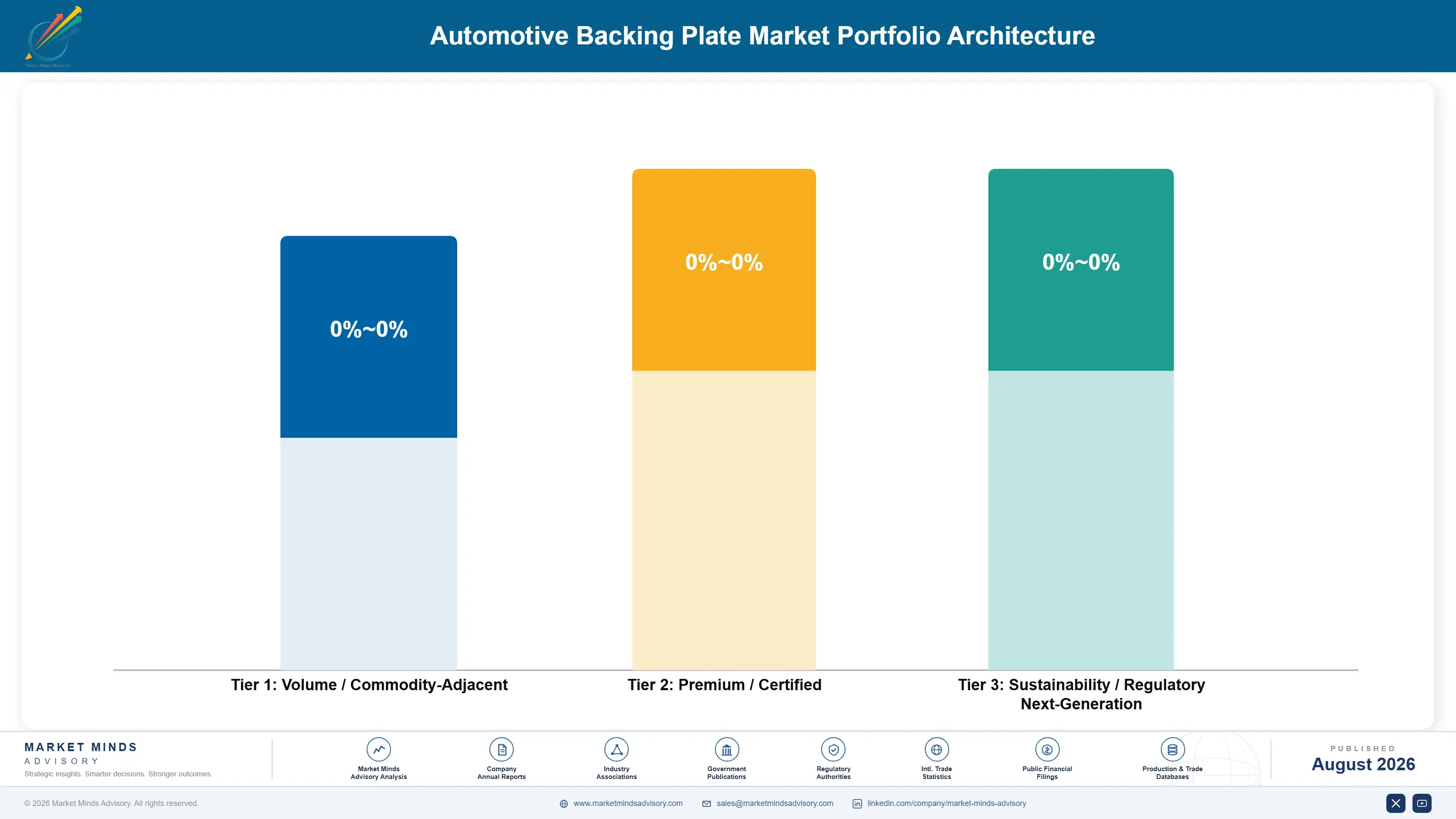
Portfolio economics here divide almost entirely on technology content rather than on customer or channel. Flat stamped uncoated plates sold into volume pad production earn gross margins in the low teens, because the process is a die, a press and a coil of steel, hundreds of plants can run it, and delivered cost per thousand pieces is the only variable anybody negotiates on.
The premium tier is coated product. Zinc-nickel plating and advanced electrocoat add roughly 30% to realised value, and the environmental permitting behind a plating line limits how many suppliers can offer it, which holds margins in the mid twenties to low thirties. Electrified platforms are pulling this demand forward considerably faster than anybody forecast five years ago.

Above both sits mechanical retention, which is where the genuine defensibility lives. Patented hooked and interlocking geometries keep low-cost stampers out of the segment rather than merely behind on price, tooling and press capability take years to establish, and original equipment engineers pay the premium on warranty liability grounds. Margins reach the high thirties, and positions once won typically run for the platform's entire production life without competitive review.

Volume / Commodity-Adjacent

Flat stamped uncoated plates sold into volume pad production. Low technical barrier means hundreds of plants can quote, delivered cost per thousand pieces is the only negotiated variable, and margin sits near the floor throughout the cycle.
Gross Margin: 10 to 15%

Premium / Certified

Zinc-nickel plated and advanced electrocoat finished plates. The range is wide because coating specification varies considerably between temperate and salted-road markets, and because in-house plating economics differ sharply from outsourced finishing.
Gross Margin: 24 to 32%

Sustainability / Regulatory / Next-Generation

Patented mechanical retention geometries, including combined retention and coating specifications. The range reflects the gap between licensed technology and directly owned patent positions, which carry very different margin profiles entirely.
Gross Margin: 33 to 41%
automotive-backing-plate-market-trends-portfolio-architecture-1787313491072

High-value Sub-segments and Strategic Watch-out

Retention Plates For Electrified Platforms

High value and high growth together. Retention geometry and corrosion coating stack onto one plate, electrified platforms genuinely need both of them, and the patent positions behind retention keep low-cost stampers out of the segment altogether rather than simply leaving them behind on delivered price.
Gross Margin: 35 to 42%

Aftermarket Branded Retention Product

High value running on moderate growth. Brands now market retention technology to installers directly as a visible shelf differentiator rather than buying plates anonymously by the thousand pieces, which holds realised pricing well above whatever original equipment tendering ever delivers on a physically identical part.
Gross Margin: 30 to 37%

Volume Flat Stamped Plate Production

The volume core that keeps presses loaded and tooling properly amortised between the higher-value production runs. Margins sit near the floor here because the technical barrier is genuinely very low, but the scale involved secures coil purchasing terms that smaller specialist suppliers simply cannot obtain.
Gross Margin: 10 to 15%

Heavy Commercial Vehicle Plate Supply

The strategic watch-out sitting inside this portfolio. Volumes are steady here and specifications genuinely demanding, but fleet operators buy strictly on total cost per kilometre and squeeze component pricing hard, while electrification is arriving considerably more slowly in this segment than anywhere else in the market.
Gross Margin: 17 to 24%

How Plate Demand Repeats

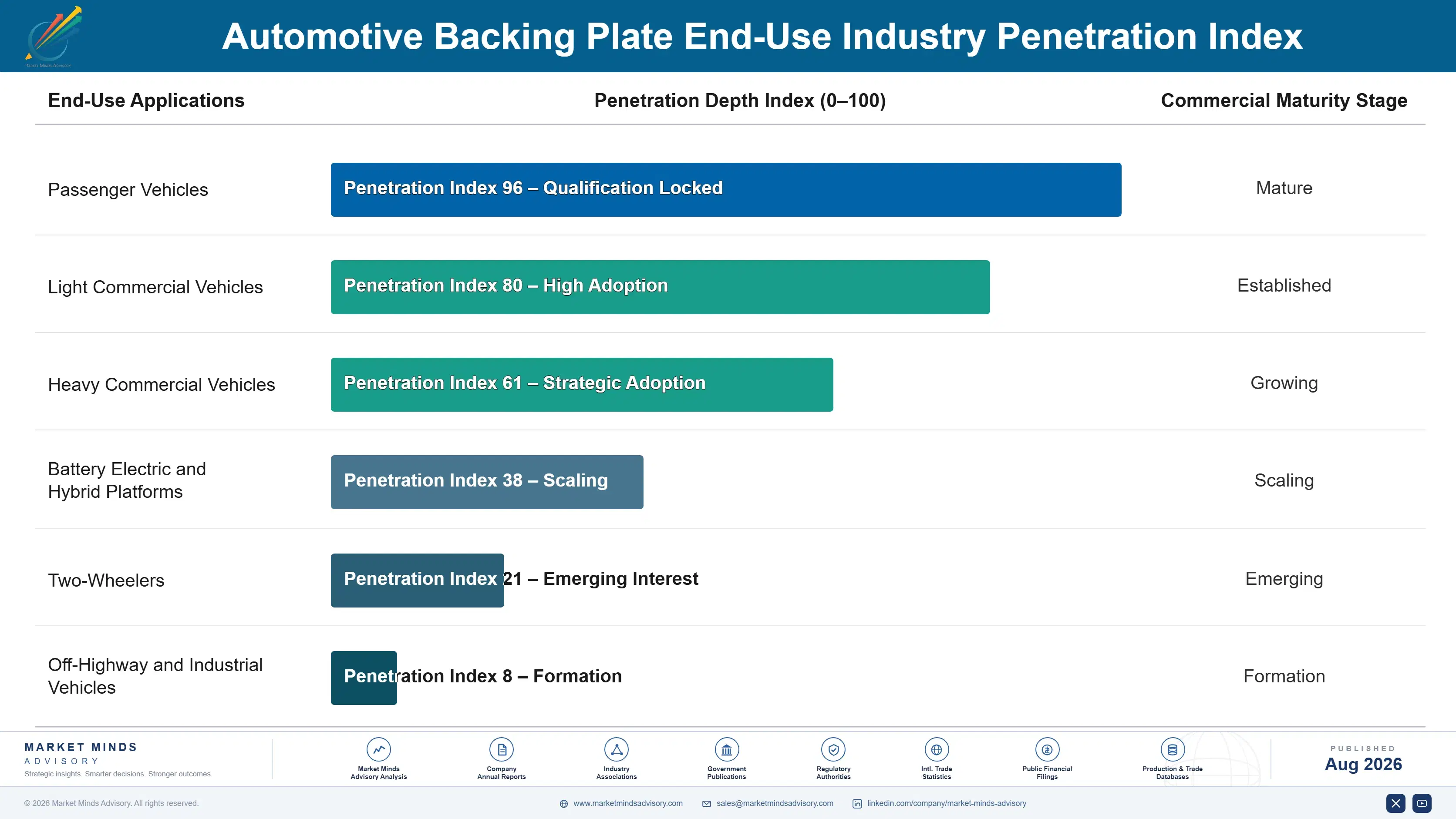
The repeat business in this category is the replacement cycle rather than vehicle assembly. Aftermarket takes 58% of plate volume, and every vehicle on the road eventually needs pads regardless of what new car sales are doing that year. That makes the demand pattern far steadier than original equipment supply, and it explains why suppliers with aftermarket channel positions ride production downturns considerably better than those without.
Stickiness varies sharply by end-use. Original equipment positions are the stickiest, since a qualified plate interface runs for the platform's production life and requalification only happens when friction chemistry changes. Aftermarket brand relationships sit close behind where retention technology carries a recognised name, because installers now ask for it. Independent and private label channels are the least sticky by a wide margin, buying on delivered cost per thousand and switching suppliers without hesitation.

The buyer profile has shifted generationally. Plate specification once sat with friction manufacturer process engineers focused on bond strength. Today it sits increasingly with platform brake engineers evaluating warranty exposure, particulate compliance and corrosion performance together, which favours suppliers who can argue system outcomes rather than piece price.
automotive-backing-plate-market-trends-end-use-penetration-index-1787313491562

Where To Compete And Why

These are among the four positions where our research anticipates prominent divergence between winners and laggards over the coming forecast period. Each is grounded in the demand model, the regulatory perimeter, and the announced capacity pipeline.
01 / RETENTION TECHNOLOGY OWNERSHIP

Patents are the only real barrier in this market

Mechanical retention plates realise roughly 2.4 times flat stamped pricing and carry 14 to 18 points more gross margin, because the tooling, press capability and patents behind them keep low-cost stampers out of the segment entirely. Everything else in this category is a die, a press and a coil of steel that hundreds of plants can run competitively. Suppliers without a defensible retention position are competing on delivered cost per thousand pieces, which is a race nobody in a high-cost country wins.
02 / IN-HOUSE COATING CAPABILITY

Plating capacity is scarcer than the demand

Advanced corrosion coating adds roughly 30% to finished plate value, and suppliers outsourcing that finishing step hand most of the margin away along with any control over lead time and quality. In-house zinc-nickel plating or electrocoat capacity captures between 9 and 13 additional margin points on every single coated plate shipped. Environmental permitting is the real barrier rather than capital, which is precisely why the capability concentrates in fewer plants than demand justifies, and why the suppliers holding it price accordingly.
03 / FRICTION PROGRAMME ACCESS

Shape the interface before it gets defined

Every friction reformulation requires the plate interface to be requalified alongside it, and Euro 7 is forcing a great many reformulations across European ranges right now. Suppliers embedded in friction manufacturer development work steer that interface toward geometries they already tool, which converts what began as a reformulation into a locked commercial position running 6 to 9 years. Those arriving afterwards quote against a specification already written around somebody else's tooling, and they end up winning on nothing except price.
04 / AFTERMARKET BRAND POSITIONING

Sell the technology to installers not buyers

Aftermarket already takes 58% of total plate volume, and brands increasingly market retention technology directly to installers as a visible shelf differentiator rather than buying anonymous stamped product by the thousand pieces. Suppliers whose technology carries a recognised name into that channel hold 20% to 28% higher realised pricing on a physically identical part. The work involved here is brand partnership and technical marketing rather than any manufacturing at all, which makes it the cheapest margin improvement available anywhere in this whole business.

Engagement Snapshot From the Field

A live engagement with an industry participant carrying material or product regulatory and market exposure ahead of a defining policy shift, showing how our research translates into a defensible multi-year portfolio strategy.
MARKET MINDS ADVISORY · CLIENT ENGAGEMENT SUMMARY
Automotive Backing Plate Producer Strategic Portfolio Review and Transition Roadmap 2026·Investment Scenario on Automotive Backing Plate Exposure Evaluation 2025-26
CLIENT PROFILE
A European manufacturer of stamped brake components operating three plants, with annual revenue near $145 million (client-reported, unverified by MMA), roughly 71% of it from flat uncoated backing plates sold to friction manufacturers across Europe. The business held solid volume positions and long customer relationships but almost no technology differentiation, and it had lost three tenders in two years to Chinese stampers quoting well below its own cost base.
STRATEGIC CHALLENGE
Gross margin had fallen into single digits on flat product as steel costs rose faster than piece prices could be renegotiated. Management needed to decide between licensing retention geometry from a technology holder, investing in a zinc-nickel plating line under increasingly demanding environmental permitting, or exiting volume stamping entirely and consolidating around specialist work.
MMA APPROACH
MMA modelled plate mix and realised pricing across 22 European friction manufacturers, mapped upcoming Euro 7 reformulation schedules against plate requalification windows, and assessed licensing terms, plating economics and permitting timelines for each option. Twenty-one expert interviews with friction engineers, brake platform leads and aftermarket brand managers tested where specifications would actually be decided.
KEY FINDINGS
  1. Euro 7 reformulation would reopen backing plate interfaces across 14 of the 22 friction manufacturers studied within three years, creating a specification window considerably wider than management had assumed existed.
  2. Licensed retention geometry delivered 16 points of additional gross margin at royalty rates the client could comfortably absorb, and it reached market roughly two years faster than developing an alternative geometry internally.
  3. Plating line permitting in the client's primary jurisdiction would take 28 to 34 months before commissioning, which placed the capacity well outside the Euro 7 requalification window entirely.
  4. Aftermarket brand managers valued named retention technology far more highly than original equipment buyers did, indicating the licensed route should be positioned toward the replacement channel first.
CLIENT PROFILE
A European manufacturer of stamped brake components operating three plants, with annual revenue near $145 million (client-reported, unverified by MMA), roughly 71% of it from flat uncoated backing plates sold to friction manufacturers across Europe. The business held solid volume positions and long customer relationships but almost no technology differentiation, and it had lost three tenders in two years to Chinese stampers quoting well below its own cost base.
STRATEGIC CHALLENGE
Gross margin had fallen into single digits on flat product as steel costs rose faster than piece prices could be renegotiated. Management needed to decide between licensing retention geometry from a technology holder, investing in a zinc-nickel plating line under increasingly demanding environmental permitting, or exiting volume stamping entirely and consolidating around specialist work.
MMA APPROACH
MMA modelled plate mix and realised pricing across 22 European friction manufacturers, mapped upcoming Euro 7 reformulation schedules against plate requalification windows, and assessed licensing terms, plating economics and permitting timelines for each option. Twenty-one expert interviews with friction engineers, brake platform leads and aftermarket brand managers tested where specifications would actually be decided.
KEY FINDINGS
  1. Euro 7 reformulation would reopen backing plate interfaces across 14 of the 22 friction manufacturers studied within three years, creating a specification window considerably wider than management had assumed existed.
  2. Licensed retention geometry delivered 16 points of additional gross margin at royalty rates the client could comfortably absorb, and it reached market roughly two years faster than developing an alternative geometry internally.
  3. Plating line permitting in the client's primary jurisdiction would take 28 to 34 months before commissioning, which placed the capacity well outside the Euro 7 requalification window entirely.
  4. Aftermarket brand managers valued named retention technology far more highly than original equipment buyers did, indicating the licensed route should be positioned toward the replacement channel first.
RECOMMENDED STRATEGY
Phase 1: Phase one: license retention geometry and begin tooling immediately, targeting the friction manufacturers whose Euro 7 requalification windows open first. Phase 2: Phase two: position licensed retention product through aftermarket brand partners, where named technology commands materially better realised pricing than original equipment tenders. Phase 3: Phase three: begin plating permitting in parallel, accepting the long timeline, and outsource coating in the interim rather than delaying the retention programme.
OUTCOME
The client licensed retention geometry within four months and reported first-year retention plate revenue of $18 million against a $12 million plan (client-reported, unverified by MMA). Blended gross margin improved by roughly five points, three of the reopened Euro 7 specifications were won, and plating permitting is now underway with commissioning expected during 2028.

Frequently Asked Questions

Foundational context covering the market sizes, CAGR, scope, country, region and competition that inform every finding below. This section is provided to cover basics and most often pre-purchase conversations, answered from the MMA Primary Research Dataset.

What is the current size of the Automotive Backing Plate Market?

The global automotive backing plate market was valued at $1.50 billion in 2025, reaching an estimated $1.57 billion in 2026. That covers stamped steel disc brake pad backing plates across passenger, commercial and two-wheeler applications.

How large will the Automotive Backing Plate Market be by 2036?

MMA forecasts the market reaching $2.51 billion by 2036, an increase of $0.94 billion over the 2026 base. That represents an expansion multiple of 1.60 times across the forecast period.

What is the CAGR for the Automotive Backing Plate Market 2026 to 2036?

The base case compound annual growth rate is 4.8%, with a bull case of 6.0% and a bear case of 3.6%. Historical growth between 2020 and 2025 ran at 3.8% annually.

Which segment is growing fastest?

Mechanical interlock retention backing plates grow at 7.2%, a full 1.50 times the market rate, as copper-free friction chemistry undermines adhesive bonding. Advanced coated plates follow at 6.1% on corrosion requirements.

Who are the major companies in the Automotive Backing Plate Market?

Nucap Industries, Tenneco, Nisshinbo Holdings, Akebono Brake Industry and Sangsin Brake lead on plate shipment volume. Together they account for roughly 29% of global volume, which is unusually fragmented.

Which country is growing fastest?

India grows fastest at 7.4% annually, driven by domestic vehicle production expansion, a young and growing parc and competitive export stamping capability. China follows on electrified platform volume and coating demand.

Report Segmentation Architecture

The full report scope spans multiple orthogonal segmentation dimensions, with cross-tabulated demand data provided for each dimension pair. Coverage extends further to regional breakdowns, trend trajectories, and the competitive detail needed to support segment-level decision-making.

By Plate Construction and Retention Technology

  • Mechanical Interlock Retention Backing Plate
  • Advanced Coated Backing Plate
  • Shim-Integrated Damped Backing Plate
  • Perforated and Slotted Retention Plate
  • Adhesive-Bonded Flat Stamped Plate

By End-Use Industry

  • Passenger Vehicles
  • Light Commercial Vehicles
  • Heavy Commercial Vehicles
  • Battery Electric and Hybrid Platforms
  • Two-Wheelers
  • Off-Highway and Industrial Vehicles

By Commercial Dimension

  • Original Equipment Friction Manufacturer Supply
  • Aftermarket Branded Pad Production
  • Private Label and Value Line Supply
  • Technology Licensing and Royalty Arrangements
  • Export and Contract Stamping Supply

By Region

  • North America
  • Western Europe
  • East Asia
  • South Asia and Pacific
  • Latin America
  • Middle East and Africa
  • Eastern Europe

Scope, Methodology, and Coverage

Every figure in this report is reproducible from documented input assumptions. The scope below maps the historical period, the forecast horizon, the segmentation dimensions, and the countries covered, alongside the underlying primary and qualitative methodology.
Historical Period
2020 to 2025
Forecast Period
2026 to 2036
Base Year
2025 (USD billions; MMA Primary Research Dataset, August 2026)
Market Definition
This report covers stamped steel backing plates for disc brake friction pads across passenger vehicles, light and heavy commercial vehicles, two-wheelers and off-highway applications, valued at backing plate component level across original equipment and aftermarket pad production. Friction material, separately sold shims, drum brake backing plate assemblies, calipers, rotors, brake hardware kits and complete finished pad assemblies are excluded from the sizing. Technology licensing royalty revenue is tracked as commentary but excluded from market value.
Quantitative Units
USD billions at manufacturer realised value; plate shipments in billions of units; average realised price in USD per plate.
Segmentation Dimensions
By plate construction and retention technology; by end-use industry; by commercial dimension; by region.
Regions Covered
North America, Western Europe, East Asia, South Asia and Pacific, Latin America, Middle East and Africa, Eastern Europe
Countries Covered
United States, Canada, Mexico, United Kingdom, Germany, France, Italy, Spain, Sweden, Japan, South Korea, China, India, Thailand, Australia, Brazil, South Africa, Saudi Arabia, Poland, Czech Republic.
Key Companies Profiled
Nucap Industries, Tenneco, Nisshinbo Holdings, Akebono Brake Industry, Sangsin Brake, ZF Friedrichshafen, Robert Bosch, Brembo, Hitachi Astemo, Continental, ITT Inc., Shandong Gold Phoenix Group, Rane Brake Lining, Fras-le and others.
Quantitative Methodology
Primary survey, n=3,800 respondents, Q4 2025, six countries; demand-side model with trade association cross-validation
Qualitative Methodology
47 expert interviews, Q4 2025; applied to validate demand model assumptions, identify emerging dynamics, and assess competitive positioning
Report Format
PDF and XLSX data workbook (Word format preview document)
Publisher
Market Minds Advisory
Report Code
MMA-2026-AUT-886
Published
August 2026
Contact
sales@marketmindsadvisory.com | www.marketmindsadvisory.com

Purchase the full Automotive Backing Plate Market Report (2026 to 2036).

The full report sizes the automotive backing plate market across five construction and retention segments, six end-use industries and seven regions, with unit shipment and realised pricing detail behind every value estimate. It profiles twenty manufacturers on retention technology position, coating capability and channel reach. Regional chapters cover copper reduction legislation, Euro 7 brake particulate rules and corrosion specification practice by market. Electrification analysis quantifies how regenerative braking affects replacement intervals against rising coating content. Cost analysis tracks steel coil exposure and pass-through terms across the supply base.
Unit shipment and pricing detail by construction type
Retention technology patent position mapping across suppliers
Coating specification adoption forecasts through 2036
Electrification impact on replacement interval modelling
Competitive position assessments across twenty global suppliers
Steel coil cost exposure and pass-through term analysis

Built For The People Who Decide

From boardroom strategy to bench-side execution, this report is read cover-to-cover by leaders shaping the next decade of their industry, turning demand scenarios, market dynamics and valuation benchmarks into decisions.
CXOs/ Presidents/ VPs/ Managers
M&A and Corporate Development
Strategy Teams and R&D Heads
Procurement and Product Directors
Regulatory and Compliance Leaders
Investor Relations and Equity Analysts