Market Minds Advisory
Automotive Appearance Chemical Market

Automotive Appearance Chemical Market: Professional Coating Migration, Solvent Regulation and the Retail Shelf Decline

Fewer people wash their own cars every year, and the value is moving to professional installers applying five-year coatings that no supermarket shelf in the world has ever stocked at all.

Lead Analyst

Bilal Shaikh

Published

September 2026

Make Smarter Decisions with Customized Research Insights

Request a free sample report and evaluate market opportunities, growth trends, and competitive dynamics relevant to your business needs.

2025 MARKET VALUE$12.8BMarket Size 2025
2036 FORECAST VALUE$21.9BBase Case , 2026 to 2036
CAGR 2026 TO 20365.0 %Bull 6.2% / Bear 3.8%
INCREMENTAL OPPORTUNITY$8.4BNet 10- year value creation
EXPANSION MULTIPLE1.63x2036 value over 2026 base
Strategic Levers
M&A Pipeline
Regional Outlook
Country Rankings
Competitive Intelligence
Segmental Deep-dive
Call-Us : 91 93563 13602

Executive Snapshot and Market Trajectory

Value in car care is migrating from the retail shelf to the professional installer, and the brands owning the shelf mostly do not own the bay. Professional application already accounts for 27% of category value, and the coating systems driving that growth were never retail products in the first place.
Ceramic and graphene coating systems compound at 7.5%, exactly 1.50 times the market rate, because a five-year protection claim applied by a trained installer is a fundamentally different purchase from a tin of wax. East Asia holds 30% of value, the largest position, combining vehicle parc growth with a professional detailing culture considerably deeper than anything in the West. Average retail price sits near USD 14.
Five suppliers ship 39% of product units, which is fragmented because formulation is accessible and brand-building in this category has always been possible from a garage. Solvent content ceilings near 5% constrain reformulation everywhere. Conventional washing consumes 62 litres per vehicle, which is what rinseless chemistry exists to attack. Certified installer networks rather than retail listings now decide who captures the growth, and shelf brands have almost none of them.
Market Definition
Covers chemical products applied to vehicle exteriors and interiors for appearance, cleaning and protection, spanning ceramic and graphene coating systems, waterless and rinseless wash chemistry, wax and sealant polishes, wheel, tyre and trim dressings, interior cleaning and protection products, and glass cleaning and water repellent treatments. Sizing captures product revenue at realised selling price across retail, professional and installed channels. Excludes automotive paint and refinish coatings, undercoating and rust prevention, engine and driveline lubricants, windscreen washer fluid concentrate, paint protection film and vinyl wrap, and car wash equipment or tunnel machinery.
Base Year Value
$12.8B in 2025 (MMA Primary Research Dataset, August 2026)
Forecast Period
2026 to 2036, eleven discrete annual values
CAGR
5.0% base case. Bull 6.2%. Bear 3.8%.
Fastest Growth Segment
Ceramic and Graphene Coating Systems: 7.5% CAGR
Fastest Growth Country
India: 7.6% CAGR
Fastest Growth Region
South Asia and Pacific: 7.1% CAGR
Largest Region
East Asia: 30% of 2025 global value
Market Leaders
3M, Turtle Wax, Energizer Holdings, SONAX, Illinois Tool Works. Source: MMA Analysis based on company annual reports.
Primary Survey
n=3,800 procurement and R&D decision-makers, Q4 2025, six countries
Methodology
Demand-side build-up, cross-validated against public data, 47 expert interviews

Automotive Appearance Chemical Market Forecast Scenarios

automotive-appearance-chemical-market-size-forecast-scenario-1787309780183
Growth of 4.0% across 2020 to 2025 combined a brief retail surge with a lasting channel shift. Lockdowns produced an unusual spike in home car care during 2020 and 2021 as people cleaned vehicles they were not driving, and it reversed sharply. Underneath it, professional detailing and ceramic coating installation grew steadily throughout, taking value from retail rather than adding to it. Solvent regulation tightened across several major markets.
The base case of 5.0% rests on three mechanisms. Ceramic and graphene coatings keep converting owners who would previously have waxed their own cars or done nothing at all, at prices per vehicle that no retail product approaches. Professional detailing capacity keeps expanding as an occupation with genuine training pathways. And Asian vehicle parc growth adds owners in markets where professional application is the default rather than the premium option.
The bull case of 6.2% assumes coating durability claims hold up well enough in independent testing to sustain premium pricing as competition intensifies, which would keep the fastest segment growing at current rates. The bear case of 3.8% reflects two pressures: continued retail decline as fewer owners maintain vehicles themselves, and solvent regulation forcing reformulation costs that consumer pricing cannot absorb.

The Shelf Is Losing To The Bay

The commercial centre of this category has moved and most of the shelf brands have not moved with it. Fewer owners wash and wax their own vehicles each year, driven by urban living, leasing, apartment parking and simple time pressure, and professional application now accounts for 27% of category value. That professional business is served by a different set of brands entirely, through distributor and installer networks, at prices per vehicle no retail product could command.
TOP FIVE CONCENTRATION39%Product units shipped by the leading global suppliers
AVERAGE RETAIL PRICEUSD 14Realised consumer price for one appearance product unit
PROFESSIONAL APPLICATION SHARE27%Category value applied by detailers rather than vehicle owners
COATING DURABILITY CLAIM5 yearsManufacturer stated protection life for premium coating systems
WATER USE PER WASH62 litresConsumption for one conventional wash against rinseless methods
VOLATILE COMPOUND LIMIT5%Regulatory ceiling on solvent content in consumer products
Ceramic and graphene coatings are the reason. A trained installer preparing paint properly and applying a coating with a five-year durability claim performs a service costing hundreds of dollars, of which the chemical is a modest fraction. The owner buys the outcome and the installer buys the chemistry, which puts the supplier two steps from the person paying. Brands that grew on supermarket distribution find that a genuinely difficult market to enter, whatever their formulation capability.
Two forces shape the next decade. Solvent content ceilings near 5% keep forcing reformulation across every product line, which costs money and occasionally costs performance. And rinseless chemistry attacks the 62 litres a conventional wash consumes, which matters in water-constrained markets and increasingly in regulated commercial washing.
"The tin of wax on a supermarket shelf is a declining business and everybody in it knows. What replaced it is a trained installer charging six hundred dollars to coat a car, and the chemistry inside that job costs about forty. The shelf brands keep launching consumer ceramic sprays because entering the professional channel means selling to people who ask hard questions."
Director, Automotive Care Chemistry Practice · MMA Chemicals and Materials / Aut

Market Trends

Professional coating installation replaces owner-applied protection

Owners who once waxed their own cars now increasingly pay a detailer to apply a ceramic or graphene coating with a multi-year durability claim, and professional application has reached 27% of category value. The chemical is a modest fraction of a service costing hundreds of dollars per vehicle, which changes the pricing conversation completely. That segment compounds at 7.5% against 5.0% for the market. Distribution runs through installer networks and training programmes rather than retail buyers, which is a capability shelf brands have consistently struggled to build. Joint warranty arrangements then make certified installers reluctant to change brand at all.
Market Impact: Holds 30% of global category value
Rinseless chemistry attacks water consumption per wash

A conventional hose wash consumes roughly 62 litres per vehicle, which matters commercially in water-constrained markets, in apartment settings without hose access, and increasingly under commercial washing regulation. Rinseless and waterless chemistry removes that requirement using encapsulating polymers that lift soil without free-flowing water. The segment grows at 6.4%. Adoption is strongest among mobile detailing operators who cannot rely on site water at all, and among consumers whose parking arrangements simply do not permit conventional washing anywhere. Formulation quality matters unusually here, since lifting grit without free rinse risks scratching paint directly.
Market Impact: Certifies installers across 40 mark

Market Opportunities and Growth Drivers

Asian vehicle parc growth arrives with professional default

Vehicle ownership across China, India and Southeast Asia keeps rising quickly, and in most of those markets professional washing and detailing is the normal arrangement rather than a premium alternative to doing it yourself. Labour cost makes that economically obvious. East Asia holds 30% of category value at 6.0% growth and South Asia and Pacific grows at 7.1%. That means new owners enter the category through professional channels directly, which shapes brand building very differently from Western market development. Retail shelf presence matters far less in those markets than installer relationships do.
Market Impact: Caps solvent content at 5% limits

Detailing becomes an occupation with training pathways

Professional detailing has developed accredited training, certification programmes and installer networks over the past decade, which turned an informal trade into a channel suppliers can build through deliberately. Coating manufacturers now certify installers and warrant the finished application jointly, which creates genuine switching friction. Certified installers rarely change coating brand, because their own warranty position depends on it. That gives suppliers who invested in training programmes early a channel position competitors cannot buy quickly at any price. Certification also transfers the performance guarantee argument from the supplier to the installer applying it.
Market Impact: Leaves 73% of value at retail

Market Restraints and Challenges

Solvent content regulation forces continuous reformulation cost

Volatile organic compound ceilings near 5% apply to consumer automotive products across California, several European jurisdictions and increasingly elsewhere, and the root cause of the burden is that solvents deliver the cleaning and levelling performance customers judge products on. Every tightening therefore requires reformulation and retesting. Participants respond by moving toward water-based and silicone-based chemistry, by developing single formulations meeting the strictest applicable limit globally, and by accepting modest performance compromises they then have to explain. Enthusiast users notice reformulation immediately and discuss it publicly, which suppliers consistently seem to underestimate.
Market Impact: Takes 27% of category value profess

Retail decline removes the channel most brands were built on

Fewer vehicle owners maintain appearance themselves each year, and the root cause is lifestyle rather than product: urban living, leasing, apartment parking without hose access and time pressure all reduce home car care independently of anything suppliers do. Shelf space contracts accordingly. Participants respond by entering professional and installer channels that demand different capabilities entirely, by acquiring detailing brands rather than extending consumer ones, and by pursuing car wash chain supply contracts where volume has actually moved. None of those channels reward the consumer marketing capability that built these brands originally.
Market Impact: Removes 62 litres per vehicle wash
3 additional market trends, 4 additional growth drivers, and 2 additional restraints and challenges are covered in the full report. Contact sales@marketmindsadvisory.com to access the complete intelligence.

Segment CAGR and Growth Architecture

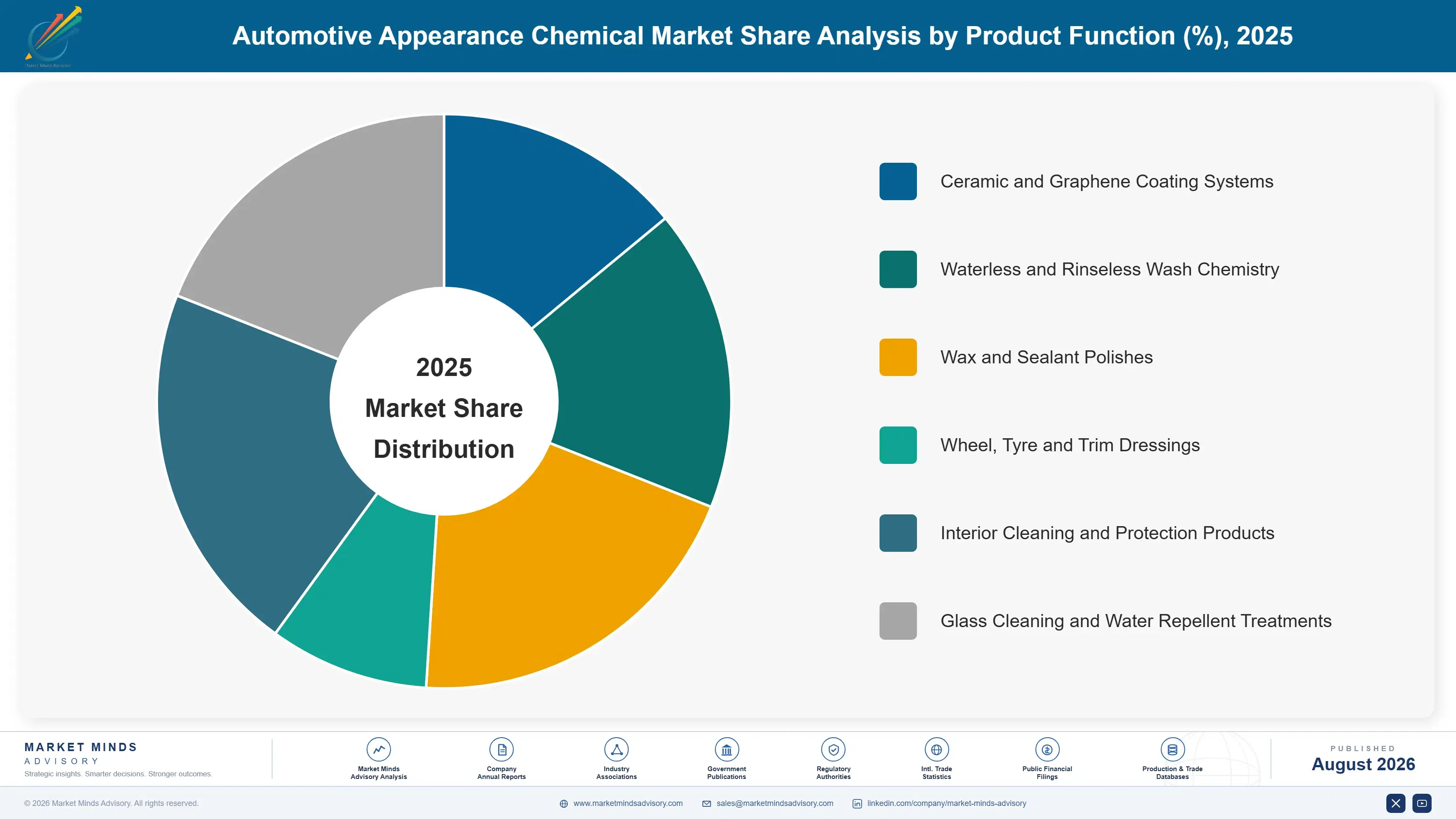
Segmentation follows the product function, because function determines the application channel, the durability claim and the price a product commands. Vehicle type, application setting and geography all matter commercially but cut across every function, so they belong in later discussion. Six functions cover current automotive appearance chemistry practice worldwide, and their channels differ sharply.
automotive-appearance-chemical-market-market-share-analysis-1787309780716

Ceramic and Graphene Coating Systems

Ceramic and graphene coatings compound at 7.5%, exactly 1.50 times the market rate, and they changed who the customer is. A trained installer preparing paint and applying a coating with a five-year durability claim performs a service costing hundreds of dollars, and the chemical is a modest fraction of that. Three commercial features follow. Distribution runs through certified installer networks rather than retail buyers, which shelf brands find genuinely hard to enter. Joint warranty arrangements create real switching friction once an installer is certified. And consumer spray versions sold at retail earn a fraction of the professional price and dilute the durability claim considerably. Installers notice that dilution and treat the brand accordingly, which is a genuine commercial cost.
CAGR 7.5%

Waterless and Rinseless Wash Chemistry

Rinseless and waterless chemistry grows at 6.4%, second fastest, and demand comes from constraint rather than preference. A conventional wash consumes roughly 62 litres, which is impossible for apartment dwellers without hose access, expensive in water-restricted regions and increasingly regulated for commercial operators. Encapsulating polymers lift soil without free-flowing water instead. Mobile detailing operators adopted it first because they cannot rely on site water anywhere. The formulation challenge is genuine, since lifting grit without free rinse risks scratching paint, and cheap versions in this segment cause visible damage. Buyers in this segment are unusually careful about brand for exactly that reason, which rewards suppliers who invested in the chemistry properly.
CAGR 6.4%
Full segment breakdown across 6 segments available in the complete report.

Regional Architecture and Country Demand Map

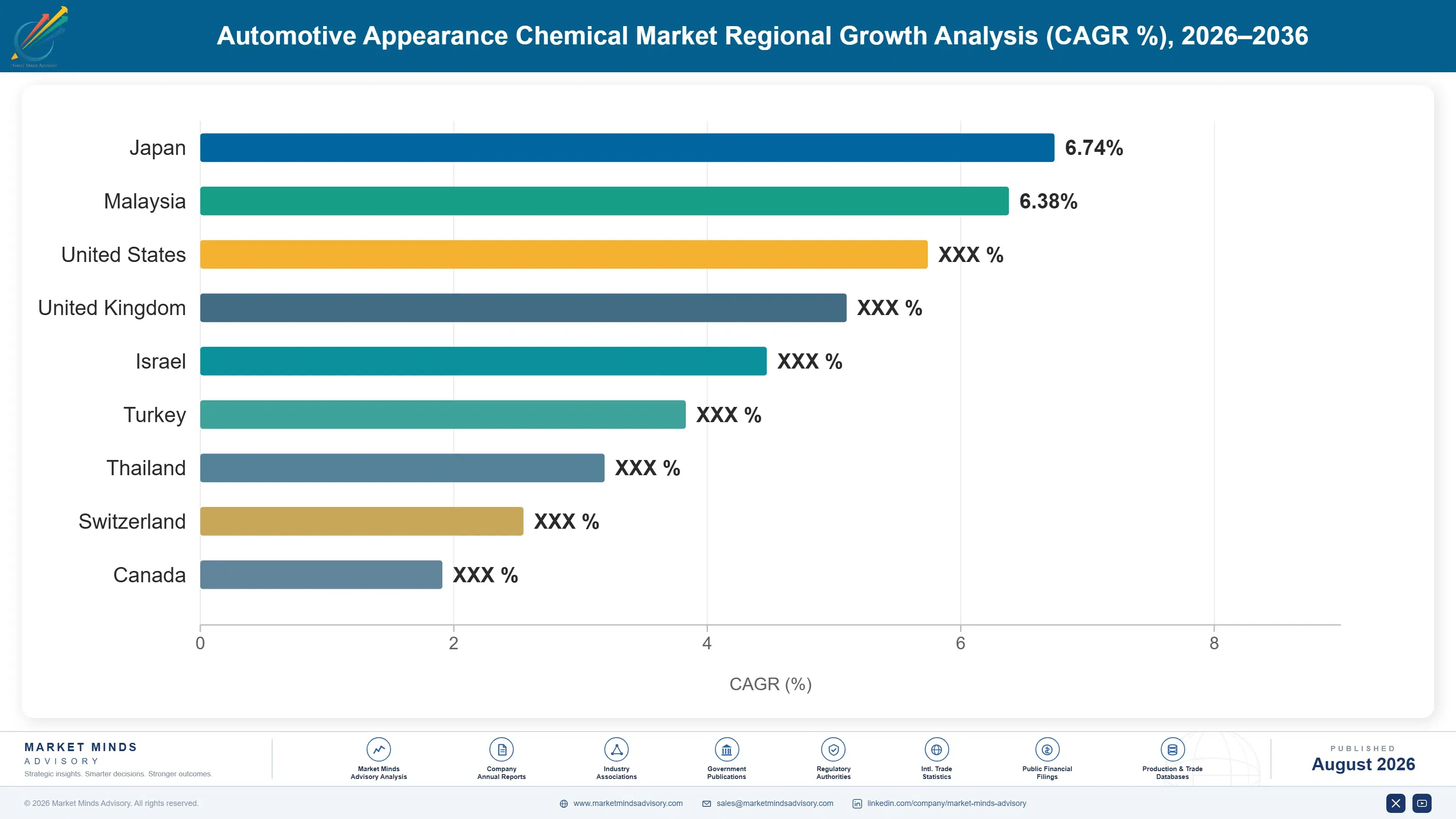
East Asia leads at 30% of value, combining rapid vehicle parc growth with a professional detailing culture far deeper than anything in the West. North America follows at 26% on retail scale. South Asia and Pacific grows fastest, led by India at 7.6%, on rising ownership entering through service channels.

North America

Twenty-six percent of global value sits in North America, growing at 4.2%, and retail scale still explains most of it even as that channel declines. Big-box and automotive parts retail carry enormous shelf assortments, and the established consumer brands built their positions there over decades. Professional detailing has grown substantially, with certification programmes and installer networks now well developed across major metropolitan areas. Californian volatile organic compound limits set the effective national formulation standard for most suppliers. Car wash chain consolidation has created large contract volumes that behave nothing like retail. Specialist detailing brands hold professional credibility here that the established shelf brands have never managed to acquire, whatever their formulation quality.
Share: 26% | CAGR: 4.2% (2026 to 2036)

Western Europe

Growth of 3.5% is the slowest of any region, and 21% of value reflects mature vehicle ownership with declining home car care. German consumers maintain vehicles more actively than most and support SONAX, Koch-Chemie and Autoglym positions accordingly. Urban parking restrictions across the region have pushed washing toward commercial sites and mobile operators. Solvent regulation is stringent and varies by jurisdiction, which forces suppliers toward single compliant formulations. Professional ceramic coating installation has grown quickly in Germany, the Netherlands and Britain through independent detailing businesses rather than dealer networks. Retail decline has been sharper here than in North America, and shelf assortments have contracted accordingly across most large-format grocery and automotive retail.
Share: 21% | CAGR: 3.5% (2026 to 2036)
Regional intelligence for 5 additional markets available in the complete report: East Asia, South Asia and Pacific, Latin America, Middle East and Africa, Eastern Europe. Contact sales@marketmindsadvisory.com.
automotive-appearance-chemical-market-country-cagr-analysis-1787309781232

Four Ways To Follow The Value

Retail shelf demand is declining while professional application takes 27% of value and rising, and the two channels want different products sold in different ways by different people. The levers that matter build installer channel capability, defend formulation against regulation and follow water constraint where it bites. Each carries returns tested against disclosed supplier economics and primary interview evidence.

Build certified installer networks rather than retail listings

Professional application already takes 27% of category value and the coating systems driving it were never retail products, sold instead through distributor and installer networks with training and joint warranty arrangements attached. Suppliers building certified networks report realised price per vehicle roughly 6 times retail equivalents on comparable chemistry. It requires training infrastructure, technical support and warranty administration that consumer brand organisations have no experience running, which is why so many keep launching retail sprays instead. Joint warranty arrangements then hold the installer once the certification process is finally complete.
Market Impact: Earns roughly 6 times retail price

Formulate once to the strictest applicable solvent limit

Volatile organic compound ceilings near 5% now apply across California, several European jurisdictions and a widening set of markets, and maintaining separate compliant and non-compliant formulations doubles testing, inventory and label complexity for no commercial benefit. Suppliers formulating once to the strictest limit report reformulation and compliance cost roughly 35% below those maintaining regional variants. It sacrifices some performance in unregulated markets, which sales organisations there resist strongly and consistently lose the argument about. Regulation has only ever tightened, which makes a single strictest formulation the eventual destination in any case.
Market Impact: Cuts compliance cost by roughly 35%

Pursue car wash chain contracts as consolidation proceeds

Car wash chain consolidation has created contract volumes behaving nothing like retail, with chemistry supplied in bulk against site count and throughput rather than shelf listings. Suppliers holding chain contracts report volume per account roughly 40 times retail store equivalents at considerably lower gross margin. It demands bulk handling, dosing equipment support and site service capability, and it is the one channel where retail decline has translated directly into somebody else's growth. Consolidation is continuing, which means the number of accounts worth pursuing keeps falling while each one grows considerably larger.
Market Impact: Delivers roughly 40 times a retail

Target water-constrained markets with rinseless chemistry

A conventional wash consumes roughly 62 litres and that is simply unavailable to apartment dwellers, mobile operators and owners in water-restricted regions. Suppliers positioning rinseless chemistry against that constraint rather than as a convenience report conversion roughly 45% above general marketing approaches. Formulation quality genuinely matters here, since lifting grit without free rinse risks scratching paint, and cheap entrants causing visible damage have made buyers in this segment unusually careful about brand. Mobile detailing operators cannot rely on site water at all, which makes them the natural first adopters everywhere.
Market Impact: Lifts conversion by roughly 45% abo

Who Controls the Margin Pool

Five suppliers ship 39% of product units, the basis on which MMA assesses every participant here, and that fragmentation reflects how accessible formulation and brand building have always been in this category. 3M leads across professional and retail channels together through its abrasive and finishing heritage. Turtle Wax holds the strongest global consumer brand position and has moved deliberately into professional channels.
Competitive activity runs along three lines. Certified installer network building is the primary contest, because that channel holds the growth and the pricing. Formulation compliance against tightening solvent limits is a continuous engineering cost everybody carries. And car wash chain contracts are being pursued as consolidation creates account volumes no retail listing matches.

Pressure arrives from two directions. Specialist detailing brands including Gtechniq, CarPro and Koch-Chemie built professional credibility that consumer brands cannot buy, and installers trust them specifically because they never appeared in a supermarket. Meanwhile Chinese and regional formulators supply volume-tier chemistry at prices international brands cannot approach. Rankings shift toward participants holding certified installer networks and compliant global formulations, because those two decide access to the only channels genuinely growing.
automotive-appearance-chemical-market-company-positioning-matrix-1787309781751

Competitive Moat and Risk Dimensions

3M

Moat: Professional heritage and channel breadth

The company reaches professional body shops, detailers and dealer service operations through abrasives, films and finishing products alongside appearance chemistry, which means chemistry travels inside a relationship covering many product categories. Technical credibility with professional users is genuine and long established. Formulation and regulatory capability across many jurisdictions also lets it maintain compliant global products more cheaply than specialists manage.
3M

Risk: Consumer brand attachment weakness

Specialist detailing brands hold professional credibility precisely because they never sold through supermarkets, and installers treat that distinction seriously when choosing what to apply under their own warranty. The company's breadth cuts both ways here. Its consumer positions also face the retail decline affecting every shelf brand, without the enthusiast following specialists have built deliberately.
TURTLE WAX

Moat: Global consumer brand recognition

The company holds the most widely recognised consumer car care brand across an unusually large number of markets, which secures retail shelf position and distributor attention almost automatically. That recognition transfers into emerging markets where category development is only beginning. Deliberate movement into professional channels through acquisition has built installer presence that pure consumer brands lack.
TURTLE WAX

Risk: Retail channel decline exposure

The company's core strength sits in a retail channel losing value every year as fewer owners maintain vehicles themselves, and brand recognition does not transfer easily into installer bays where technical credibility governs. Professional entry through acquisition helps and takes time. Specialist brands with enthusiast followings continue to define what serious detailers actually choose to use.

Players Tracked

Prominent Players

3M
Turtle Wax
Energizer Holdings
SONAX
Illinois Tool Works

Other Key Players

Autoglym
Koch-Chemie
Gtechniq
CarPro
Chemical Guys
Mothers Polishes
Simoniz
Liqui Moly
Wurth
Nippon Paint
Soft99
Ceramic Pro
System X Ceramic
Bilt Hamber
ValetPRO

Recent Developments

MARCH 2025

3M expanded its professional ceramic coating and certification range

The company added professional coating systems with extended durability claims and an accompanying installer certification programme, targeting detailing businesses rather than any retail shelf placement at all. It was an organic product development programme rather than an acquisition, joint venture or partnership arrangement of any kind whatsoever.
Signal: Launching coatings with certification atta
SEPTEMBER 2025

Turtle Wax acquired a professional detailing chemistry brand

The acquisition brings installer channel relationships and professional credibility that a consumer brand cannot construct organically, addressing exactly the channel where category value has been migrating for a decade now. Terms were not disclosed. It was an outright acquisition rather than a licensing or distribution arrangement.
Signal: Buying professional credibility concedes t
JANUARY 2026

SONAX agreed multi-year chemistry supply with a car wash chain

The agreement covers bulk chemistry supply, dosing equipment and site technical support across a consolidated European car wash chain, at volumes no retail listing would generate anywhere. Terms were not disclosed. It was a supply agreement rather than any acquisition, joint venture or equity investment.
Signal: Chain contracts are exactly where the reta

Solvents, Silicones And Packaging

Cost structure here tracks petrochemicals closely. Solvents, glycol ethers and carrier fluids are roughly 27% of formulated cost and price against refinery streams directly. Silicone polymers, silica precursors and functional additives add 23%, with coating chemistries weighted far more heavily toward that line. Packaging including bottles, sprayers and closures contributes 21%, and surfactants a further 12%.
The 2021 and 2022 period hit every line at once. American Chemistry Council data recorded sharply higher chemical industry input costs across the window, IEA data recorded industrial energy prices well above prior averages, and container freight rates from Asian packaging suppliers multiplied several times over. US Census Bureau import data recorded higher landed values for automotive chemical categories. Several participants disclosed elevated raw material and freight costs in reports for those years.

Exposure varies by channel and by formulation type, and the mechanism is retail price rigidity against variable petrochemical and freight cost. Suppliers selling through large-format retail could not raise prices without losing listings, so they absorbed it or shrank pack sizes. Professional and chain channels repriced at contract renewal comfortably. Coating-weighted portfolios were less solvent-exposed and more affected by silica precursor pricing, which moved considerably less violently throughout.
automotive-appearance-chemical-market-cost-volatility-analysis-1787309781947

Reformulate toward water-based and silicone-carried chemistry

Solvents are 27% of formulated cost and price directly against refinery streams, which retail pricing cannot follow upward at all. Water-based and silicone-carried systems reduce exposure and satisfy tightening volatile compound limits, which makes that investment do two jobs. Performance compromises are real in cleaning and levelling, and explaining them to enthusiast users takes more effort than the reformulation.

Contract packaging and freight on annual committed terms

Packaging is 21% of formulated cost and freight from Asian bottle and sprayer suppliers multiplied several times across 2021 and 2022 with no ability to reprice retail listings. Annual contracted rates cost more in calm periods and remove that exposure when rates move sharply. Regional packaging sourcing shortens the exposure further and costs more per unit.

Shift channel mix toward contracts that permit repricing

Professional installer and car wash chain contracts renew annually or biennially and accept input cost pass-through in a way retail listings simply never do. Shifting mix toward those channels protects margin through commodity volatility as well as capturing where category value is moving anyway. Building the capability takes years, which is why suppliers most exposed to retail responded least.

Portfolio Architecture for Margin Defence

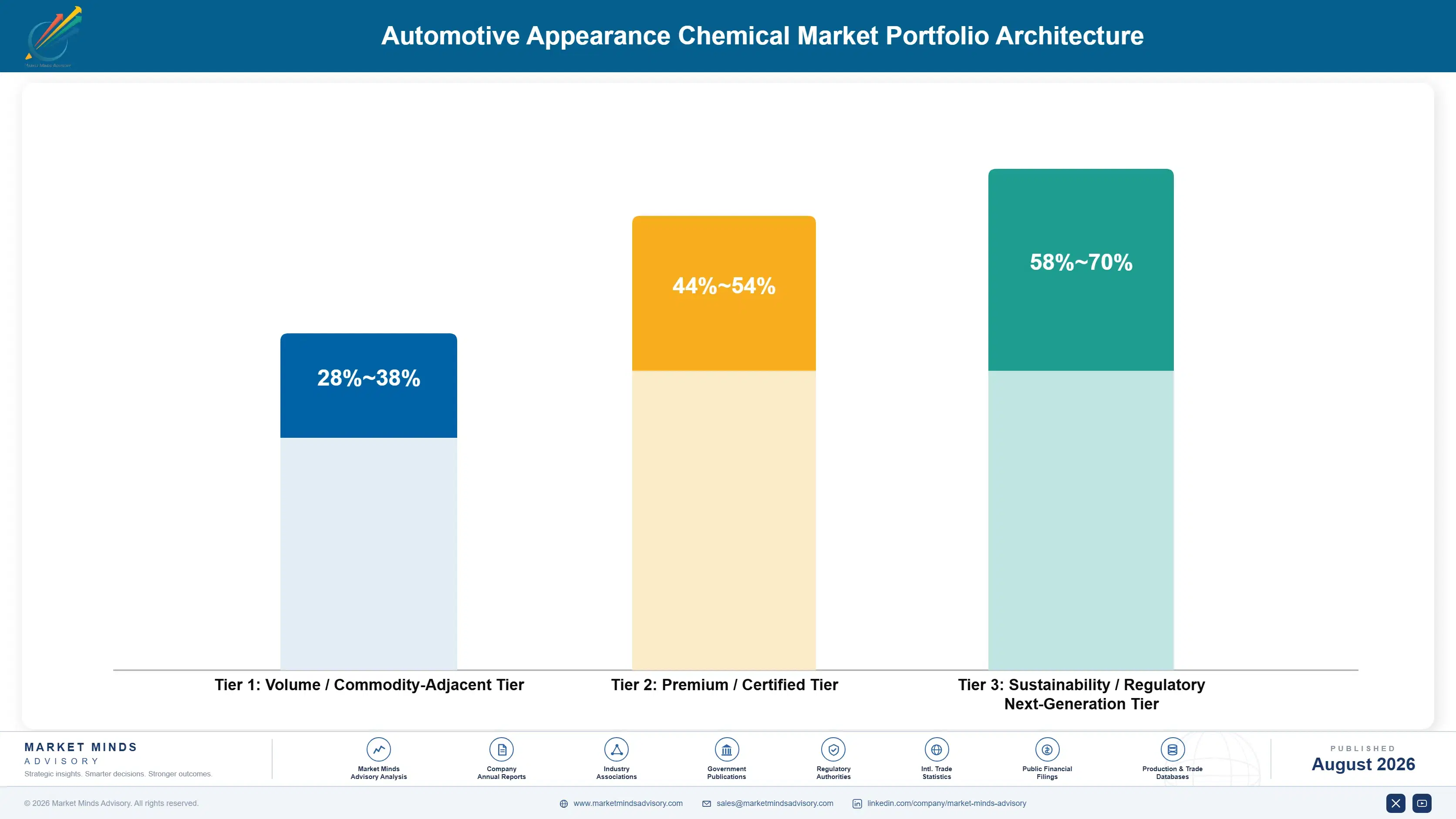
Portfolio economics separate almost entirely on channel rather than on chemistry. Wax, polish and dressing products sold through large-format retail earn gross margin in the low thirties, competing on shelf price against private label. Interior and glass products sit similarly. Professional coating systems earn considerably more, because the chemical is a modest fraction of a service costing hundreds of dollars and installers buy performance rather than price. Car wash chain bulk chemistry earns
The volume and premium tension is unusually clean, because the channels barely overlap. Retail requires shelf presence, packaging design and consumer marketing. Professional requires technical support, training infrastructure and warranty administration. Chain contracts require bulk handling and site service. Suppliers attempting all three carry three organisations, and those performing best accepted that rather than running appearance chemistry as one business.

High-value pools concentrate in three places: professional coating systems sold through certified installers, enthusiast-grade retail products where brand following supports premium pricing, and climate-driven protection markets where the function is genuine rather than cosmetic. None is large against total retail unit volume. Each is defended by installer relationships, brand following or regional presence rather than formulation, which competent chemists replicate readily.

Volume / Commodity-Adjacent Tier

Wax, polish, dressing, glass and interior products sold through large-format retail and grocery channels, plus car wash chain bulk chemistry. Private label and regional formulators set pricing across essentially every market worldwide.
Gross Margin: 28-38%

Premium / Certified Tier

Enthusiast-grade retail products and specialist detailing chemistry sold through automotive and online specialist channels. Brand following and demonstrable performance defend pricing. The ten-point range reflects enthusiast against mainstream retail economics.
Gross Margin: 44-54%

Sustainability / Regulatory / Next-Generation Tier

Professional ceramic and graphene coating systems sold through certified installers, plus compliant low-solvent and rinseless formulations. Installer certification and warranty arrangements defend pricing entirely. The twelve-point range reflects certified against open professional supply.
Gross Margin: 58-70%
automotive-appearance-chemical-market-portfolio-architecture-1787309782440

High-value Sub-segments and Strategic Watch-out

Certified installer coating systems

Where the chemical is a modest fraction of a service costing hundreds of dollars and warranty arrangements create genuine switching friction. Consumer brands find this channel very hard to enter. Installer trust rather than formulation decides it. Consumer spray versions dilute the claim and installers notice.
Gross Margin: 60-70%

Enthusiast-grade retail brands

Where a following built on demonstrable performance supports pricing mainstream retail never achieves, sold through specialist and online channels instead. Supermarket heritage actively harms credibility here. Community reputation is the whole asset. Enthusiast communities discuss any reformulation publicly and almost immediately after it first appears.
Gross Margin: 46-54%

Mainstream retail shelf volume

The largest unit position and the one declining every year as fewer owners maintain vehicles themselves, priced against private label throughout. Pack shrinkage has absorbed input cost repeatedly. Nothing available reverses the underlying behaviour shift. Private label keeps taking shelf space from branded product every single year.
Gross Margin: 28-38%

Climate-driven protection markets

Gulf, Australian and equatorial markets where sun and dust make protection functional rather than cosmetic, which supports coating penetration well above global averages. Regional presence defends it. Water scarcity drives rinseless adoption alongside. Function rather than cosmetics is what genuinely sustains the pricing throughout here.
Gross Margin: 52-64%

How Car Care Demand Repeats

Demand here repeats on habit at retail and on service intervals professionally, and the two behave nothing alike. A consumer buying wax replaces it when the bottle empties, which may be years, and brand loyalty in that cycle is weak because the purchase is infrequent and low involvement. A professional installer consumes chemistry continuously against vehicle throughput and reorders monthly, which makes that relationship an annuity attached to certification rather than preference. Car wash chain
Adoption depth varies sharply by ownership context. Enthusiast owners adopt premium and specialist chemistry deeply and research it obsessively. Mainstream owners buy occasionally on price and shelf prominence. Urban and apartment dwellers increasingly buy no chemistry at all and pay for professional washing instead. New vehicle purchasers in Asian and Gulf markets frequently buy coating as an accessory at the point of sale, which Western markets have barely developed despite the obvious logic.

Buyer profiles have shifted from owner to installer decisively across the growing part of the category. An owner once chose a wax from a shelf. Now an owner chooses a detailer, and the detailer chooses the chemistry under their own warranty.
automotive-appearance-chemical-market-end-use-penetration-index-1787309782929

What We Would Do Here

These are among the four positions where our research anticipates prominent divergence between winners and laggards over the coming forecast period. Each is grounded in the demand model, the regulatory perimeter, and the announced capacity pipeline.
01 / INSTALLER CHANNEL BUILDING

Certify installers instead of chasing shelf listings

Professional application already takes 27% of category value and the coating systems driving that growth were never retail products in the first place, sold instead through distributor and installer networks with training and joint warranty attached. Suppliers building certified networks report realised price per vehicle roughly 6 times retail equivalents on comparable chemistry. It demands training infrastructure, technical support and warranty administration that consumer brand organisations have never run, which is exactly why so many keep launching retail sprays instead.
02 / GLOBAL FORMULATION COMPLIANCE

Formulate once to the strictest limit worldwide

Volatile organic compound ceilings near 5% now apply across California, several European jurisdictions and a steadily widening set of other markets, and maintaining separate compliant and non-compliant formulations doubles testing, inventory and labelling complexity for no commercial benefit at all. Suppliers formulating once to the strictest applicable limit report reformulation and compliance cost roughly 35% below those maintaining regional variants. It sacrifices some performance in unregulated markets, which local sales organisations resist strongly and then consistently lose the argument about.
03 / CHAIN CONTRACT PURSUIT

Follow the wash volume into consolidated chain contracts

Car wash chain consolidation has created contract volumes that behave nothing like retail, with chemistry supplied in bulk against site count and throughput rather than against any shelf listing at all. Suppliers holding chain contracts report volume per account roughly 40 times retail store equivalents, at considerably lower gross margin per litre. It demands bulk handling, dosing equipment support and site service capability, and it is the one channel where retail decline translated directly into somebody else's clearly measurable growth.
04 / WATER CONSTRAINT POSITIONING

Sell rinseless against water access, not convenience

A conventional wash consumes roughly 62 litres of water, which is simply unavailable to apartment dwellers, mobile detailing operators and owners across water-restricted regions everywhere. Suppliers positioning rinseless chemistry against that hard constraint rather than as a general convenience report conversion roughly 45% above broad marketing approaches. Formulation quality genuinely matters here, since lifting grit without a free rinse risks scratching paint, and cheap entrants causing visible damage made buyers across this segment unusually careful about which brand they trust.

Engagement Snapshot From the Field

A live engagement with an industry participant carrying material or product regulatory and market exposure ahead of a defining policy shift, showing how our research translates into a defensible multi-year portfolio strategy.
MARKET MINDS ADVISORY · CLIENT ENGAGEMENT SUMMARY
Automotive Appearance Chemical Producer Strategic Portfolio Review and Transition Roadmap 2026·Investment Scenario on Automotive Appearance Chemical Exposure Evaluation 2025-26
CLIENT PROFILE
A global consumer car care manufacturer with appearance chemical revenue near USD 420 million annually (client-reported, unverified by MMA), heavily weighted toward large-format retail across North America and Europe, a consumer ceramic spray range launched two years earlier, and no certified installer programme of any kind. Roughly 86% of revenue came from retail channels that had declined in each of the previous four years.
STRATEGIC CHALLENGE
Retail volumes had fallen for four consecutive years while category value grew, and management proposed extending the consumer ceramic spray range to capture coating demand. The board doubted that a supermarket product could address a market where owners pay installers hundreds of dollars, but nobody had quantified how large the professional channel had actually become.
MMA APPROACH
MMA sized professional application value across six markets by surveying detailing businesses on chemistry spend, vehicle throughput and brand selection, then compared realised price per vehicle against retail equivalents. Forty-seven expert interviews with detailers, distributors, car wash chain operators and retail category buyers established how brand selection actually happened in each channel. The client's portfolio was scored against both.
KEY FINDINGS
  1. Professional application accounted for 27% of category value and realised roughly six times the price per vehicle of retail chemistry, on formulations that were not fundamentally more expensive to produce.
  2. Detailers interviewed consistently rejected brands with supermarket heritage for warranty-backed coating work, and the client's consumer ceramic range had reached essentially no professional installers at all.
  3. Car wash chain contracts in two markets delivered account volumes roughly forty times a retail store equivalent, and the client had never pursued a single one of them.
  4. Maintaining separate compliant and non-compliant solvent formulations across regions cost the client materially more each year than a single strictest-limit global formulation would have done.
CLIENT PROFILE
A global consumer car care manufacturer with appearance chemical revenue near USD 420 million annually (client-reported, unverified by MMA), heavily weighted toward large-format retail across North America and Europe, a consumer ceramic spray range launched two years earlier, and no certified installer programme of any kind. Roughly 86% of revenue came from retail channels that had declined in each of the previous four years.
STRATEGIC CHALLENGE
Retail volumes had fallen for four consecutive years while category value grew, and management proposed extending the consumer ceramic spray range to capture coating demand. The board doubted that a supermarket product could address a market where owners pay installers hundreds of dollars, but nobody had quantified how large the professional channel had actually become.
MMA APPROACH
MMA sized professional application value across six markets by surveying detailing businesses on chemistry spend, vehicle throughput and brand selection, then compared realised price per vehicle against retail equivalents. Forty-seven expert interviews with detailers, distributors, car wash chain operators and retail category buyers established how brand selection actually happened in each channel. The client's portfolio was scored against both.
KEY FINDINGS
  1. Professional application accounted for 27% of category value and realised roughly six times the price per vehicle of retail chemistry, on formulations that were not fundamentally more expensive to produce.
  2. Detailers interviewed consistently rejected brands with supermarket heritage for warranty-backed coating work, and the client's consumer ceramic range had reached essentially no professional installers at all.
  3. Car wash chain contracts in two markets delivered account volumes roughly forty times a retail store equivalent, and the client had never pursued a single one of them.
  4. Maintaining separate compliant and non-compliant solvent formulations across regions cost the client materially more each year than a single strictest-limit global formulation would have done.
RECOMMENDED STRATEGY
Phase 1: Phase 1 (0 to 9 months): Stop extending the consumer ceramic range, and consolidate onto a single strictest-limit solvent formulation across all regions. Phase 2: Phase 2 (9 to 24 months): Acquire or license a professional detailing brand with existing installer credibility rather than attempting to build one. Phase 3: Phase 3 (24 to 42 months): Pursue car wash chain contracts in two priority markets, and build installer certification and warranty administration capability.
OUTCOME
The consumer ceramic extension was halted before further launch spend. Formulation consolidation was completed within four quarters and reduced compliance cost as modelled (client-reported, unverified by MMA). A professional detailing brand was acquired rather than built, and installer reach began growing from a very low base. One car wash chain contract was won.

Frequently Asked Questions

Foundational context covering the market sizes, CAGR, scope, country, region and competition that inform every finding below. This section is provided to cover basics and most often pre-purchase conversations, answered from the MMA Primary Research Dataset.

What is the current size of the Automotive Appearance Chemical Market?

MMA sizes the global automotive appearance chemical market at USD 12.8 billion in 2025, rising to USD 13.44 billion in 2026. That covers product revenue at realised selling price across retail, professional and installed channels.

How large will the Automotive Appearance Chemical Market be by 2036?

MMA forecasts USD 21.89 billion by 2036, an expansion multiple of 1.63 times the 2026 base. That represents roughly USD 8.45 billion of incremental revenue across the forecast period.

What is the CAGR for the Automotive Appearance Chemical Market 2026 to 2036?

The base case compounds at 5.0% annually, with a bull case of 6.2% and a bear case of 3.8%. Whether coating durability claims hold up in independent testing decides which case materialises.

Which segment is growing fastest?

Ceramic and graphene coating systems compound at 7.5%, exactly 1.50 times the market rate. A five-year claim applied by a trained installer is a different purchase from a tin of wax.

Who are the major companies in the Automotive Appearance Chemical Market?

3M, Turtle Wax, Energizer Holdings, SONAX and Illinois Tool Works together ship 39% of units. Fifteen further participants including Koch-Chemie, Gtechniq and Soft99 are profiled in full.

Which country is growing fastest?

India compounds at 7.6%, ahead of every other national market MMA tracks here. Rising vehicle ownership entering the category through professional service channels drives that growth.

Report Segmentation Architecture

The full report scope spans multiple orthogonal segmentation dimensions, with cross-tabulated demand data provided for each dimension pair. Coverage extends further to regional breakdowns, trend trajectories, and the competitive detail needed to support segment-level decision-making.

By Product Function

  • Ceramic and Graphene Coating Systems
  • Waterless and Rinseless Wash Chemistry
  • Wax and Sealant Polishes
  • Wheel, Tyre and Trim Dressings
  • Interior Cleaning and Protection Products
  • Glass Cleaning and Water Repellent Treatments

By Vehicle and Owner Type

  • Private Passenger Vehicle Owners
  • Enthusiast and Collector Vehicles
  • Commercial Fleet and Rental Vehicles
  • New Vehicle Delivery Preparation
  • Ride-Hailing and Taxi Operators

By Application Channel

  • Large-Format and Grocery Retail
  • Automotive Specialist and Online Retail
  • Certified Professional Installer Networks
  • Car Wash Chains and Commercial Sites

By Region

  • North America
  • Western Europe
  • East Asia
  • South Asia and Pacific
  • Latin America
  • Middle East and Africa
  • Eastern Europe

Scope, Methodology, and Coverage

Every figure in this report is reproducible from documented input assumptions. The scope below maps the historical period, the forecast horizon, the segmentation dimensions, and the countries covered, alongside the underlying primary and qualitative methodology.
Historical Period
2020 to 2025
Forecast Period
2026 to 2036
Base Year
2025 (USD billions; MMA Primary Research Dataset, August 2026)
Market Definition
The market comprises chemical products applied to vehicle exteriors and interiors for appearance, cleaning and protection, spanning ceramic and graphene coating systems, waterless and rinseless wash chemistry, wax and sealant polishes, wheel, tyre and trim dressings, interior cleaning and protection products, and glass cleaning and water repellent treatments. Sizing captures product revenue at realised selling price across retail, professional and installed channels. Automotive paint and refinish coatings, undercoating and rust prevention, engine and driveline lubricants, windscreen washer fluid concentrate, paint protection film and vinyl wrap, and car wash equipment or tunnel machinery are outside scope.
Quantitative Units
USD billions (current prices); million product units shipped annually; USD per unit at realised selling price
Segmentation Dimensions
By Product Function; By Vehicle and Owner Type; By Application Channel; By Region
Regions Covered
North America, Western Europe, East Asia, South Asia and Pacific, Latin America, Middle East and Africa, Eastern Europe
Countries Covered
China, USA, Japan, Germany, UK, France, Italy, Spain, Netherlands, Poland, Czech Republic, South Korea, Taiwan, India, Australia, Canada, Brazil, Mexico, Argentina, Colombia, Indonesia, Thailand, Vietnam, Malaysia, UAE, Saudi Arabia, Qatar, Turkey, South Africa, Nigeria, and additional markets relevant to this sector
Key Companies Profiled
3M, Turtle Wax, Energizer Holdings, SONAX, Illinois Tool Works, Autoglym, Koch-Chemie, Gtechniq, CarPro, Chemical Guys, Mothers Polishes, Simoniz, Liqui Moly, Wurth, Nippon Paint, Soft99, Ceramic Pro, System X Ceramic, Bilt Hamber, ValetPRO.
Quantitative Methodology
Primary survey, n=3,800 respondents, Q4 2025, six countries; demand-side model with trade association cross-validation
Qualitative Methodology
47 expert interviews, Q4 2025; applied to validate demand model assumptions, identify emerging dynamics, and assess competitive positioning
Report Format
PDF and XLSX data workbook (Word format preview document)
Publisher
Market Minds Advisory
Report Code
MMA-2026-CHM-312
Published
August 2026
Contact
sales@marketmindsadvisory.com | www.marketmindsadvisory.com

Purchase the full Automotive Appearance Chemical Market Report (2026 to 2036).

The full report sizes the automotive appearance chemical market across six product functions, five vehicle and owner types, four application channels and seven regions, with annual forecasts to 2036 in revenue and units shipped. It sizes professional application value by surveying detailing businesses on chemistry spend and vehicle throughput, then compares realised price per vehicle against retail equivalents directly. That analysis is what quantifies how much value has already left the retail shelf. Twenty participants are assessed on a consistent units shipped basis, with certified installer network reach and solvent compliance position mapped separately. Car wash chain contract exposure is quantified market by market.
Six product functions sized and forecast annually
Professional application value sized through detailer surveying
Twenty participants on consistent units shipped basis
Certified installer network reach mapped supplier by supplier
Solvent compliance position compared across every participant
Car wash chain contract exposure quantified market by market

Built For The People Who Decide

From boardroom strategy to bench-side execution, this report is read cover-to-cover by leaders shaping the next decade of their industry, turning demand scenarios, market dynamics and valuation benchmarks into decisions.
CXOs/ Presidents/ VPs/ Managers
M&A and Corporate Development
Strategy Teams and R&D Heads
Procurement and Product Directors
Regulatory and Compliance Leaders
Investor Relations and Equity Analysts