Market Minds Advisory
Automatic Weigh Price Labeling Machine Market

Automatic Weigh Price Labeling Machine Market: Variable Weight Packaging and Retail Automation Convergence

Rising variable weight packaging for meat, produce, and prepared foods is pushing retailers and processors toward multihead combination labelers, while wireless networked label printers and shrinking staffed deli counters reshape which format buyers specify next.

Lead Analyst

David Horsley

Published

September 2026

Make Smarter Decisions with Customized Research Insights

Request a free sample report and evaluate market opportunities, growth trends, and competitive dynamics relevant to your business needs.

2025 MARKET VALUE$0.9BMarket Size 2025
2036 FORECAST VALUE$1.8BBase Case , 2026 to 2036
CAGR 2026 TO 20366.5 %Bull 7.7% / Bear 5.3%
INCREMENTAL OPPORTUNITY$0.8BNet 10- year value creation
EXPANSION MULTIPLE1.88x2036 value over 2026 base
Strategic Levers
M&A Pipeline
Regional Outlook
Country Rankings
Competitive Intelligence
Segmental Deep-dive
Call-Us : 91 93563 13602

Executive Snapshot and Market Trajectory

Weigh price labeling has shifted from a back-of-store convenience to a packaging line decision made at the plant design stage. Processors now specify labeling throughput and label accuracy alongside slicing and packaging speed, and retailers increasingly buy machines that connect to loss prevention and inventory systems rather than standalone scales.
Multihead combination weighing labelers are growing at roughly 1.4x the market average as processors expand variable weight multi-component packs for meal kits and prepared foods beyond what single-head units can handle efficiently. East Asia has extended its lead in both installed base and forecast growth, anchored by China's expanding organized retail footprint and Japan's dense supermarket network, while labor shortages at staffed deli counters push North American and European retailers toward pre-packed, machine-labeled formats.
Competitive intensity concentrates among five established scale and labeling manufacturers that increasingly bundle hardware with cloud-connected pricing databases and compliance software, leaving smaller regional machine builders to compete on service responsiveness and price. Label accuracy and network connectivity, not raw weighing speed alone, increasingly determine which suppliers win multi-site retail chain contracts. New enforcement into e-commerce grocery fulfillment is raising the compliance bar, rewarding vendors with defensible audit trails.
Market Definition
The automatic weigh price labeling machine market covers equipment that weighs a product, calculates its price, and prints and applies a compliant label in a single automated cycle, spanning countertop in-store units, in-line conveyorized systems, and multihead combination weighing labelers. It serves meat, deli, produce, bakery, and prepared food packaging across retail and food processing settings. Manual scales without integrated labeling and standalone label printers sold apart from a weighing mechanism are excluded.
Base Year Value
$0.9B in 2025 (MMA Primary Research Dataset, August 2026)
Forecast Period
2026 to 2036, eleven discrete annual values
CAGR
6.5% base case. Bull 7.7%. Bear 5.3%.
Fastest Growth Segment
Multihead Combination Weighing Labelers: 9.0% CAGR
Fastest Growth Country
India: 9.8% CAGR
Fastest Growth Region
South Asia and Pacific: 8.7% CAGR
Largest Region
East Asia: 28% of 2025 global value
Market Leaders
Ishida Co Ltd, METTLER TOLEDO, Bizerba SE and Co KG, Yamato Scale, CAS Corporation. Source: MMA Analysis based on company annual reports.
Primary Survey
n=3,800 procurement and R&D decision-makers, Q4 2025, six countries
Methodology
Demand-side build-up, cross-validated against public data, 47 expert interviews

Automatic Weigh Price Labeling Machine Market Forecast Scenarios

automatic-weigh-price-labeling-machine-market-size-forecast-scenario-1787302228355
Between 2020 and 2025 the market grew at an estimated 5.5% historical CAGR, held back by pandemic-era store closures before recovering as organized retail expansion in Asia and rising prepared food demand in mature markets lifted machine orders. Deli staffing shortages emerging from 2022 onward accelerated retailer interest in pre-packed, machine-labeled formats sooner than most equipment roadmaps had assumed.
The base case assumes 6.5% CAGR through 2036, anchored in three mechanisms: expanding variable weight multi-component packaging for meal kits and prepared foods requiring multihead combination systems, organized retail and supermarket footprint growth across South and East Asia adding first-time installations, and aging single-head machine fleets across mature markets reaching replacement age simultaneously. Wireless networked label printer retrofits add a reinforcing tailwind as retailers upgrade connectivity without replacing entire weighing mechanisms outright.
A bull scenario, near 7.7% CAGR, assumes faster organized retail penetration in India and Southeast Asia and accelerated deli automation pull deployment forward. The bear case, near 5.3%, assumes retail capital spending slows and store operators extend aging machine fleets by two to three years rather than replacing them on the standard equipment cycle, deferring capital spending until conditions improve.

Retail Automation Pressure Meets Variable Weight Packaging Growth

Three forces are converging on this market at once: variable weight packaging growth for meal kits and prepared foods, a generational replacement wave among single-head machines installed during the 2010s retail modernization cycle, and the migration of pricing and inventory data into networked retail software. Retailers that once bought labelers as isolated counter equipment now specify them as connected nodes feeding loss prevention and inventory systems.
MARKET CONCENTRATION46%Combined revenue share held by top five manufacturers
MULTIHEAD SYSTEM ASP$62,000Blended selling price for a standard combination unit
REPLACEMENT CYCLE8-10 yrsTypical service life before mandated machine replacement occurs
WIRELESS CONNECTIVITY RATE31%Share of new machines shipped with networked label printing
TOP PRODUCTION COUNTRYJapanLeading country for finished weighing machine manufacturing volume
LABEL ACCURACY RATE99.6%Share of printed labels passing weight and price verification
Commercially, the market behaves less like a pure equipment category and more like a packaging line design decision bundled with software and service. Hardware margins are steady but thinning at the entry tier as regional manufacturers compete on price, so established vendors increasingly recover margin through pricing database subscriptions, calibration service contracts, and networked printer upgrade programmes sold alongside the physical machine.
Over the next decade, expect continued share gains for multihead combination systems as variable weight packaging spreads beyond meat into bakery and prepared foods, consolidation among regional machine builders unable to fund cloud connectivity development, and rising scrutiny of label accuracy as regulators expand weights and measures enforcement into e-commerce grocery fulfillment centers across multiple jurisdictions simultaneously, a trend few vendors have fully priced into their roadmaps.
"Buyers used to compare machines on heads-per-minute. Now the first question is whether the pricing database syncs with the point of sale system without a technician driving out to the store."
Director, Food Packaging and Retail Equipment Practice · MMA Food Packaging and

Market Trends

Multihead Systems Displace Single-Head Units in Variable Weight Packs

Food processors and retailers are increasingly adopting multihead combination weighing labelers to handle variable weight multi-component packs, such as meal kits and mixed produce trays, that single-head machines process too slowly to remain cost competitive at scale. Each multihead system can combine dozens of small weight measurements into a single target weight far faster than sequential weighing, reducing giveaway and improving throughput. Processors expanding prepared food and meal kit production report multihead adoption is now a default specification for new lines, and the trend is spreading into bakery and produce.
Market Impact: Adds 1,800 new packaging lines year

Wireless Networked Label Printing Becomes Retail Standard

Retailers are increasingly retrofitting existing weighing machines with wireless networked label printer modules that sync pricing data directly with point of sale and inventory systems, eliminating the manual price list updates that previously required a technician visit to each store location. This connectivity reduces pricing errors during promotional periods and enables centralized price changes across an entire retail chain within minutes rather than days. Retail chains completing wireless retrofits report meaningful reductions in pricing discrepancy complaints at checkout, and the upgrade path is proving attractive because it avoids the capital cost of replacing the underlying weighing mechanism entirely.
Market Impact: Covers 4,200 additional retail loca

Market Opportunities and Growth Drivers

Prepared Food and Meal Kit Packaging Growth Expands Demand

Rising consumer demand for prepared foods and meal kits across grocery retail is expanding the addressable base for variable weight labeling equipment beyond traditional meat and deli counters into bakery, produce, and ready meal packaging lines. Each new prepared food packaging line typically requires one or more multihead combination systems to handle the multi-component weighing these products demand, a volume and complexity that single-head machines cannot match economically. Retailers expanding private label prepared food programmes report labeling equipment procurement now happens alongside packaging line design, rather than being retrofitted after launch, giving early-specifying suppliers an advantage.
Market Impact: Delays entry 9 to 14 months

Deli Staffing Shortages Push Retailers Toward Pre-Packed Formats

Persistent staffing shortages at staffed deli and meat counters are pushing grocery retailers to shift volume toward pre-packed, machine-weighed and labeled formats that require fewer counter staff hours per unit sold. Retailers report struggling to maintain full staffing at service counters across multiple shifts, making automated pre-pack lines an increasingly attractive alternative even at chains that historically differentiated on full-service counter experience. This shift is pulling forward equipment orders that might otherwise have waited for the next standard replacement cycle, since retailers view the labor savings as justifying earlier capital deployment than originally budgeted.
Market Impact: Erodes 7% of entry tier margin

Market Restraints and Challenges

Weights and Measures Certification Slows New Market Entry

Every weigh price labeling machine must pass national weights and measures certification before commercial deployment, and the root cause is that regulators treat pricing accuracy as a consumer protection matter carrying legal liability for both manufacturer and retailer if a machine misweighs product. The commercial impact falls hardest on smaller regional manufacturers attempting to enter new export markets, since certification testing and documentation can take many months per country and must be repeated for each significant hardware or software revision. Established manufacturers are mitigating this by maintaining pre-certified product lines across their largest export markets.
Market Impact: Adds 9.0% CAGR to multihead segment

Price Competition From Regional Manufacturers Compresses Entry Tier Margins

Lower cost regional manufacturers, particularly across China and Southeast Asia, are undercutting established brands on single-head and basic in-line machines by a meaningful margin, and the root cause is a combination of lower labor cost and simpler product designs that skip advanced connectivity features many buyers do not yet require. The commercial impact falls hardest on entry tier hardware sales for established vendors, since price sensitive retailers and smaller processors increasingly substitute regional machines for basic weighing and labeling tasks. Established vendors are mitigating this by shifting entry tier focus toward service network density rather than matching import pricing directly.
Market Impact: Lifts connectivity rate to 31%
3 additional market trends, 3 additional growth drivers, and 2 additional restraints and challenges are covered in the full report. Contact sales@marketmindsadvisory.com to access the complete intelligence.

Segment CAGR and Growth Architecture

Segmentation follows machine architecture, the single dimension buyers specify against when designing a packaging line or retail counter. Countertop, in-line, multihead combination, checkweigher-integrated, and wireless networked printer modules each serve a distinct weighing and labeling task across retail and processing settings, keeping upstream mechanical design and downstream connectivity software separate across every product family.
automatic-weigh-price-labeling-machine-market-market-share-analysis-1787302228887

Multihead Combination Weighing Labelers

Multihead combination systems weigh dozens of small product portions simultaneously and combine them algorithmically to hit a target pack weight far faster and more accurately than sequential single-head weighing can achieve. Adoption is concentrated among processors packaging meal kits, mixed produce trays, and multi-component prepared foods where variable weight combinations are the norm rather than the exception. Growth outpaces the broader market by roughly 1.4x as prepared food and meal kit packaging expands beyond the largest processors into mid-sized regional operators seeking the same throughput and accuracy advantages. Suppliers with proven multihead reliability at high mix, high changeover packaging lines are capturing outsized share, since qualifying a new supplier requires validation testing most processors are reluctant to repeat without reason.
CAGR 9.0%

Wireless Networked Label Printer Modules

Wireless networked label printer modules connect a weighing machine directly to a retailer's point of sale and inventory management systems, enabling centralized price updates and reducing the manual price list maintenance that previously required in-store technician visits. Adoption is concentrated among multi-site retail chains seeking centralized pricing control and reduced pricing discrepancy risk during promotional periods. Growth is fastest among retailers retrofitting existing weighing mechanisms rather than purchasing entirely new machines, since the connectivity upgrade path avoids the larger capital outlay a full machine replacement would require. Suppliers offering retrofit compatible modules across multiple legacy machine generations are capturing disproportionate share, since retailers strongly prefer upgrading in place over replacing functioning weighing hardware solely to add connectivity.
CAGR 8.2%
Full segment breakdown across 5 segments available in the complete report.

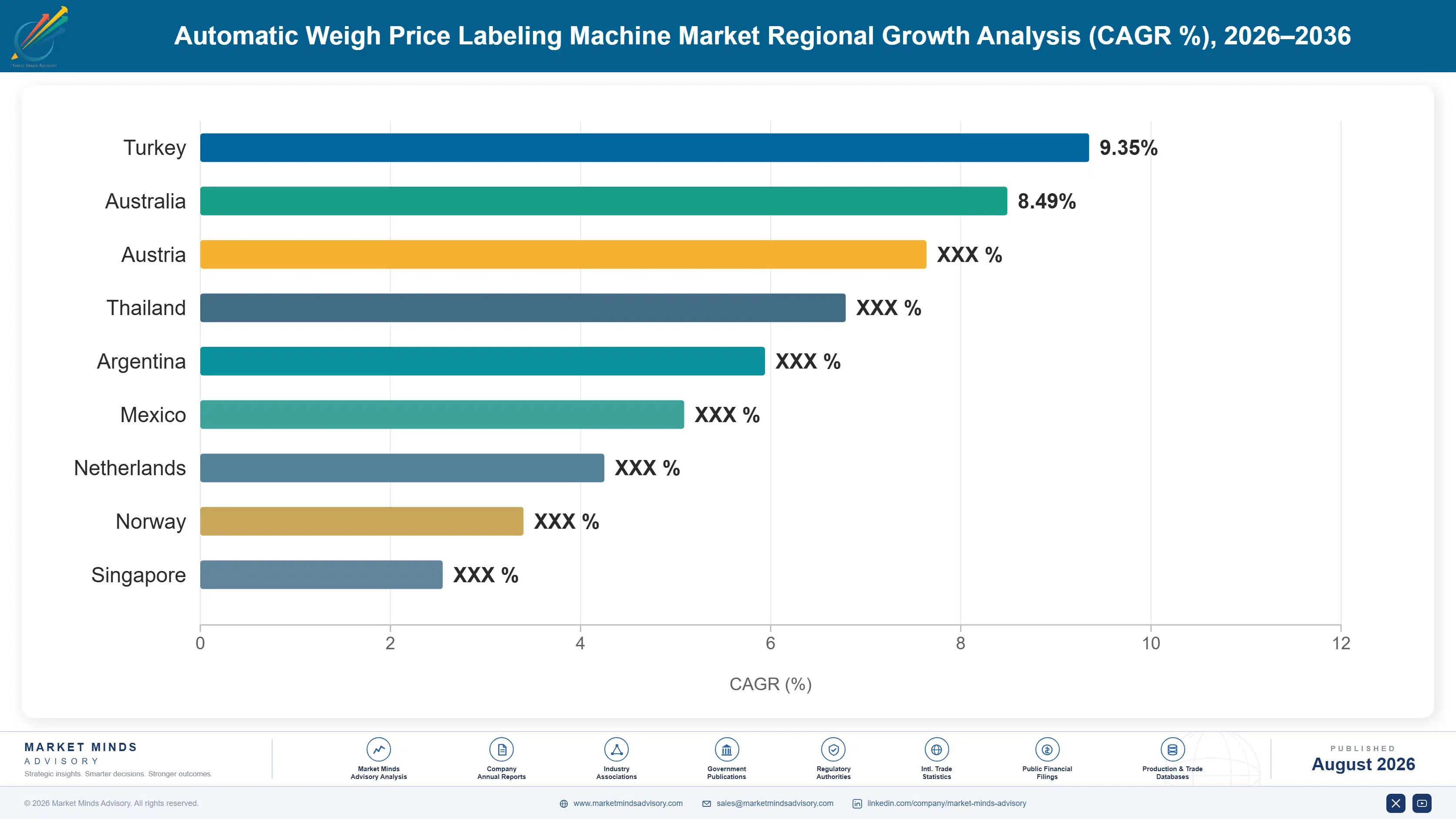
Regional Architecture and Country Demand Map

East Asia leads on both production and installed base as China's organized retail expansion and Japan's dense, mature supermarket network drive sustained machine orders, while North America and Western Europe accelerate replacement demand as deli staffing shortages push retailers toward pre-packed formats industry wide this cycle.

North America

United States grocery chains are accelerating pre-pack format adoption as staffed deli counter labor shortages persist across multiple regions, pushing retailers to invest in multihead and wireless networked labeling equipment faster than their standard replacement schedule would otherwise dictate. Canadian retailers follow a similar pattern, though at a smaller absolute scale tied to the country's more concentrated grocery chain structure. Meal kit and prepared food packaging expansion among both grocery private label programmes and dedicated meal kit companies is adding new multihead system demand across distribution center packaging operations. Growth trails East Asia because the region's installed base is already comparatively mature, meaning much of current demand reflects replacement and connectivity retrofit rather than first-time installation.
Share: 25% | CAGR: 7.2% (2026 to 2036)

Western Europe

German and French retailers, operating within some of the world's strictest weights and measures enforcement regimes, sustain steady replacement demand as aging single-head machines reach mandatory recertification age and operators opt to replace rather than recertify older units. Bizerba's home market advantage in Germany supports strong domestic penetration of premium connected labeling systems among leading grocery chains. United Kingdom retailers continue expanding prepared food and meal kit packaging lines, adding incremental multihead system demand tied to private label expansion. Regional growth trails the global rate as the market's already high penetration of connected labeling systems limits the incremental upside connectivity retrofits alone can provide relative to markets still building out basic infrastructure.
Share: 23% | CAGR: 5.0% (2026 to 2036)
Regional intelligence for 5 additional markets available in the complete report: East Asia, South Asia and Pacific, Latin America, Middle East and Africa, Eastern Europe. Contact sales@marketmindsadvisory.com.
automatic-weigh-price-labeling-machine-market-country-cagr-analysis-1787302229445

Monetizing Connectivity and Pricing Database Services

Suppliers are shifting commercial models toward pricing database subscriptions, calibration service contracts, and connectivity retrofit programmes rather than one time hardware sales, since retailer demand for centralized price control now rivals raw weighing performance as a purchase criterion. This mirrors a broader shift across retail equipment toward relationship-based commercial structures rather than transactional pricing.

Selling Cloud Pricing Database Subscription Services

Suppliers are increasingly selling cloud-hosted pricing database subscriptions that let retail chains push price changes to every connected machine across a store network within minutes rather than dispatching technicians to update individual units. This converts what was historically a one time software configuration into recurring annual revenue tied directly to the size of a retailer's connected machine fleet. Suppliers report subscription attach rates above 45% among multi-site retail chains completing wireless connectivity retrofits, reflecting how centralized pricing control has become a core purchase driver rather than a secondary convenience feature retailers can easily forgo.
Market Impact: Lifts recurring revenue share to ro

Scheduled Calibration and Certification Compliance Contracts

Suppliers are increasingly bundling scheduled calibration visits and weights and measures certification renewal into multi-year service contracts, converting a previously ad hoc maintenance task into predictable recurring revenue while reducing compliance risk for retail and processing customers. Contracts typically include priority response commitments for machines flagged as out of tolerance, a service level that meaningfully reduces the risk of regulatory penalties for retailers operating dozens or hundreds of connected locations. Suppliers report calibration contract attach rates rising fastest among large retail chains, with roughly 38% of new fleet contracts now including scheduled calibration bundled in.
Market Impact: Adds $340 per unit in annual servic

Multihead Retrofit and Throughput Upgrade Packages

Suppliers are increasingly offering retrofit packages that add multihead combination capability or throughput upgrades to existing packaging lines without requiring a full line replacement, giving processors a lower cost path to variable weight packaging capability. This retrofit path typically costs meaningfully less than a full multihead system replacement while still delivering most of the throughput and accuracy improvement, making it attractive to mid-sized processors with constrained capital budgets. Suppliers report retrofit attach rates rising fastest among processors expanding into prepared foods for the first time, with retrofit orders now representing roughly 22% of multihead-related revenue.
Market Impact: Cuts upgrade capital cost by roughl

Label Accuracy Audit and Compliance Reporting Services

As weights and measures regulators expand enforcement into e-commerce grocery fulfillment, suppliers are monetizing automated label accuracy auditing and compliance reporting as a premium software tier layered on top of connected machine fleets. Retailers preparing for a regulatory inspection pay a meaningful premium for one click compliance reports that assemble calibration history, weighing accuracy logs, and label print records automatically across every connected location. This add on carries low marginal delivery cost once the underlying connectivity platform exists, making it a high margin layer suppliers are prioritizing across 2026 and 2027 product roadmaps.
Market Impact: Adds 5 to 7 points of software gros

Who Controls the Margin Pool

The top five manufacturers hold roughly 46% combined share, a moderate concentration reflecting both the technical specialization required for multihead and connected systems and continued price competition from regional manufacturers at the entry tier. The gap between the leading connected-platform vendors and smaller regional machine builders is widening as retail chains specify connectivity and compliance software as core requirements.
Current competitive activity centers on three fronts: multihead throughput and accuracy improvements for variable weight packaging, wireless connectivity retrofit compatibility across legacy machine generations, and pricing database software depth for multi-site retail chain management. Several regional manufacturers are pursuing partnerships with retail software platforms rather than building connectivity in house, a faster but margin diluting route to feature parity with established vendors' platforms.

Emerging pressure comes from Chinese and Southeast Asian manufacturers moving up the value chain from basic single-head machines into connected multihead systems sold initially to domestic retailers but increasingly targeting export markets as certification credentials accumulate. Rankings among the top five could shift over the next several years if any leader fails to close its connectivity and software gap, since retail chains increasingly evaluate platform completeness ahead of individual weighing accuracy specifications during vendor selection.
automatic-weigh-price-labeling-machine-market-company-positioning-matrix-1787302229957

Competitive Moat and Risk Dimensions

ISHIDA CO LTD

Moat: Multihead engineering leadership

Ishida's multi-decade leadership in multihead combination weighing technology, backed by an extensive patent portfolio and deep food processing application expertise, gives it strong incumbency among processors handling the most complex variable weight packaging requirements. That engineering lead compounds with every new packaging line Ishida wins.
ISHIDA CO LTD

Risk: Limited entry tier reach

Ishida's positioning toward premium, high-throughput systems leaves it less competitive on price among smaller regional retailers and processors, ceding entry tier share to lower cost Chinese and Southeast Asian manufacturers competing primarily on hardware cost. That price gap is unlikely to close within the next several years.
METTLER TOLEDO

Moat: Global service network depth

METTLER TOLEDO's extensive global service and calibration network gives it strong incumbency among multi-national retail chains requiring consistent compliance support across many countries, a capability smaller regional competitors struggle to match at comparable scale. That service depth compounds with every new country METTLER TOLEDO adds.
METTLER TOLEDO

Risk: Slower connectivity feature rollout

METTLER TOLEDO's broad, diversified equipment portfolio spanning many industries beyond retail weighing has at times slowed its pace of retail-specific connectivity feature development relative to more focused competitors, occasionally costing it accounts to nimbler specialists. That responsiveness gap has narrowed only slowly over recent years.

Players Tracked

Prominent Players

Ishida Co Ltd
METTLER TOLEDO
Bizerba SE and Co KG
Yamato Scale
CAS Corporation

Other Key Players

Avery Weigh-Tronix
Illinois Tool Works
Loma Systems
Espera-Werke GmbH
Marel
TE.SI Srl
Anritsu Corporation
GSE Scale Systems
Cardinal Scale Manufacturing
Ravas Europe
Fuji Seal International
Multivac Group
Provisur Technologies
Alfa International
Sartorius AG

Recent Developments

OCTOBER 2025

Ishida Launches Cloud-Connected Multihead Platform for Prepared Foods

Ishida introduced a cloud-connected multihead combination platform targeted at prepared food and meal kit packaging lines, integrating throughput monitoring and predictive maintenance alerts directly into its existing weighing software suite. The launch targets processors expanding multi-component packaging lines seeking reduced unplanned downtime and centralized fleet visibility across facilities.
Signal: Confirms software differentiation, not wei
JANUARY 2026

Bizerba Signs Multi-Year Supply Agreement With European Retail Chain

Bizerba signed a multi-year weighing and labeling equipment supply and calibration service agreement with a major European grocery retail chain, covering machine replacement and connectivity retrofit across several hundred store locations. The agreement is a supply arrangement rather than a joint venture or acquisition, extending Bizerba's regional service footprint.
Signal: Highlights service contract bundling as th
APRIL 2026

CAS Corporation Acquires Southeast Asian Labeling Software Startup

CAS Corporation completed the acquisition of a privately held Southeast Asian retail pricing software startup, adding cloud connectivity and pricing database technology to its hardware portfolio. The deal strengthens CAS Corporation's ability to compete against established connected platform vendors across expanding Southeast Asian retail markets.
Signal: Signals regional manufacturers are acceler

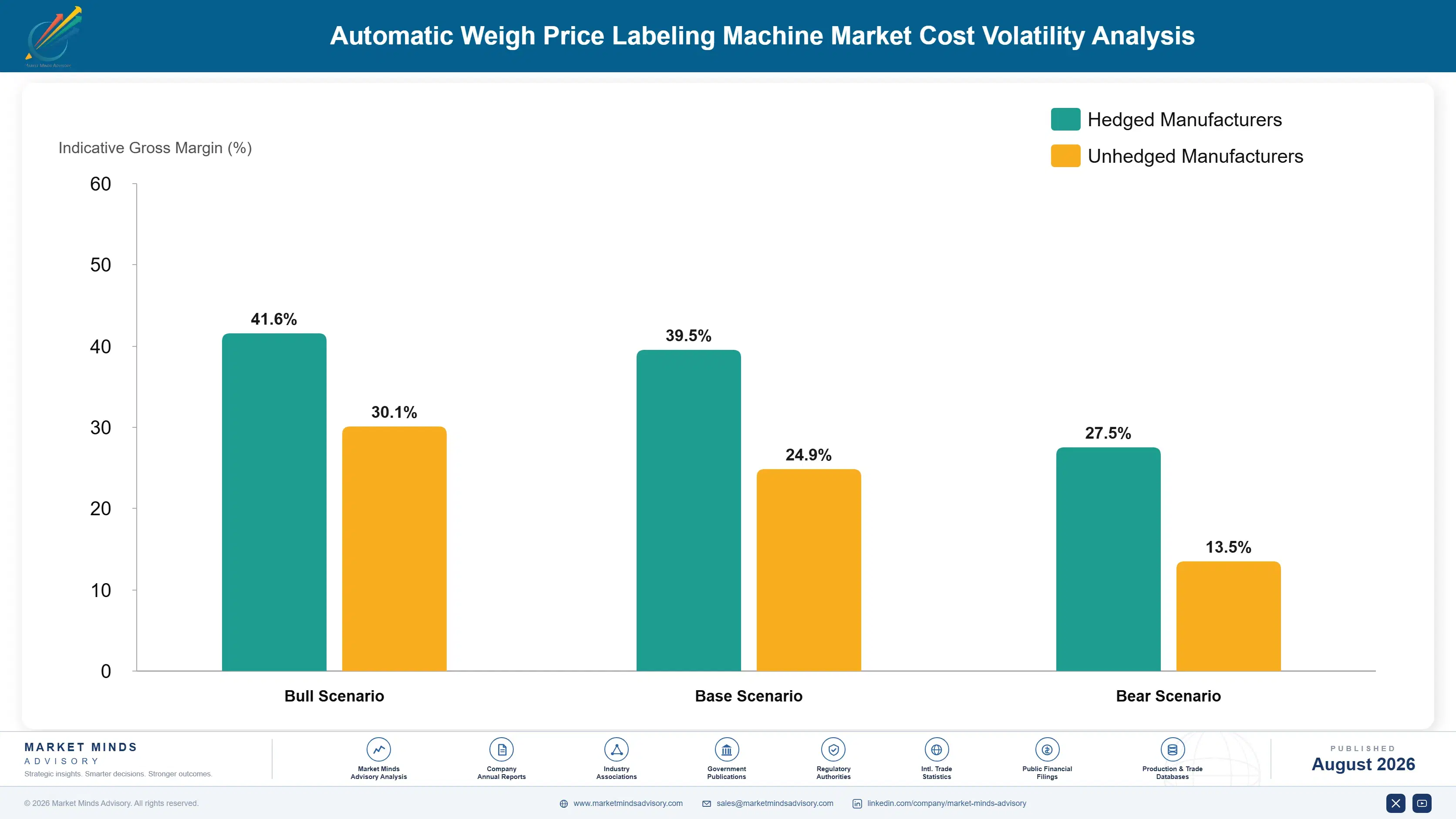
Load Cell and Thermal Printhead Component Exposure

Precision load cell sensors, thermal printheads, and electronic control assemblies together represent an estimated 40 to 50% of machine cost of goods sold. Load cell sensor supply is concentrated among a small number of specialty manufacturers primarily based in Japan, Germany, and China, creating a narrower supply base than the broader industrial electronics component market overall.
Semiconductor component shortages during 2021 and 2022 delayed control board production broadly across industrial equipment categories, and several manufacturers disclosed in annual reports that thermal printhead lead times stretched beyond eighteen weeks during the shortage, forcing temporary reliance on higher cost secondary market components to maintain production schedules for contracted retail chain rollouts already underway across multiple regions simultaneously, a constraint most manufacturers had not planned budgets around in advance.

Smaller regional manufacturers carry disproportionate exposure to these input swings since they lack the purchasing scale to negotiate multi-year fixed pricing directly with load cell and printhead component manufacturers that the top five suppliers secure. This gap widens further for manufacturers reliant on single source thermal printhead suppliers, leaving them more vulnerable to margin compression during component shortages than diversified competitors able to shift specifications across multiple qualified suppliers.
automatic-weigh-price-labeling-machine-market-cost-volatility-analysis-1787302230154

Multi-Sourcing Thermal Printhead Components

Leading manufacturers now qualify at least two thermal printhead suppliers per product line, avoiding the single source exposure that stretched lead times to eighteen weeks during the 2021 to 2022 shortage and protecting delivery commitments on multi-year retail chain rollout contracts already signed with major grocery customers across several regions and continents worldwide today.

Long-Term Load Cell Supply Contracts

Top five manufacturers increasingly lock multi-year pricing with specialty load cell producers, smoothing sensor input costs and insulating margin from the spot price volatility smaller regional manufacturers remain exposed to directly, a practice that has become standard procurement policy since the shortage first disrupted deliveries across the category and its adjacent supply chains broadly.

Modular Control Board Designs Across Product Lines

Standardizing control board architecture across single-head, in-line, and multihead product families lets manufacturers shift production toward whichever component sourcing path has the most favorable pricing in a given quarter without redesigning entire product lines from scratch or requalifying finished machines already qualified for sale in major export markets worldwide today across every regional territory served.

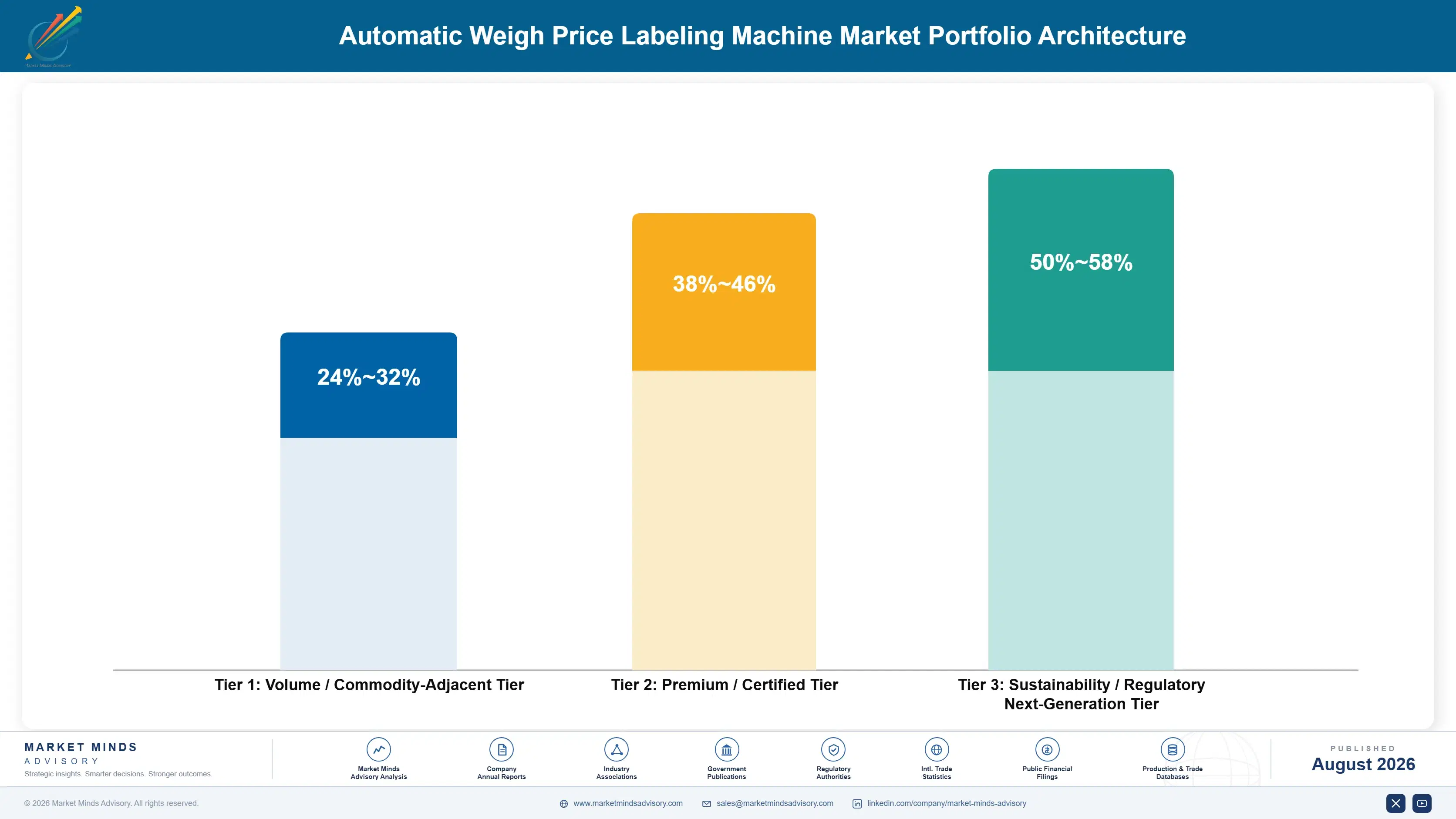
Portfolio Architecture for Margin Defence

Portfolio architecture splits across three tiers: entry priced single-head and basic in-line machines competing largely on cost, certified multihead and checkweigher-integrated systems carrying application engineering value that commands a durable price premium, and next generation connected platforms bundled with pricing database and compliance software subscriptions. Gross margins widen meaningfully moving up this ladder as hardware commoditization pressure concentrates hardest at the entry ti
The volume versus premium tension is sharpest in single-head machines, where regional import competition has compressed prices fastest, pushing established vendors to defend share through calibration service bundling rather than matching import pricing directly on hardware alone. Multihead and connected systems retain pricing power because application engineering complexity and certification requirements carry meaningful requalification cost and time for buyers switching suppliers mid contract.

High value margin pools concentrate in connected platforms paired with pricing database and compliance subscriptions, where recurring revenue and high switching costs together support gross margins well above the portfolio average. Vendors are consequently prioritizing capital and engineering investment toward this tier even though it remains a minority of total unit volume shipped across the broader portfolio today, betting the mix shifts decisively within the decade.

Volume / Commodity-Adjacent Tier

Basic single-head and entry in-line machines competing primarily on unit price against regional imports, with limited service attach and thin per unit margins across most accounts served today across every channel.
Gross Margin: 24-32%

Premium / Certified Tier

Multihead combination and checkweigher-integrated systems serving complex variable weight packaging applications, where certification and application engineering support durable pricing across long-term customer relationships and multi-year renewal contracts negotiated well in advance.
Gross Margin: 38-46%

Sustainability / Regulatory / Next-Generation Tier

Connected platforms bundled with pricing database, calibration, and compliance reporting software, sold on recurring service and centralized control value rather than hardware alone today across every deployment and account currently active.
Gross Margin: 50-58%
automatic-weigh-price-labeling-machine-market-portfolio-architecture-1787302230660

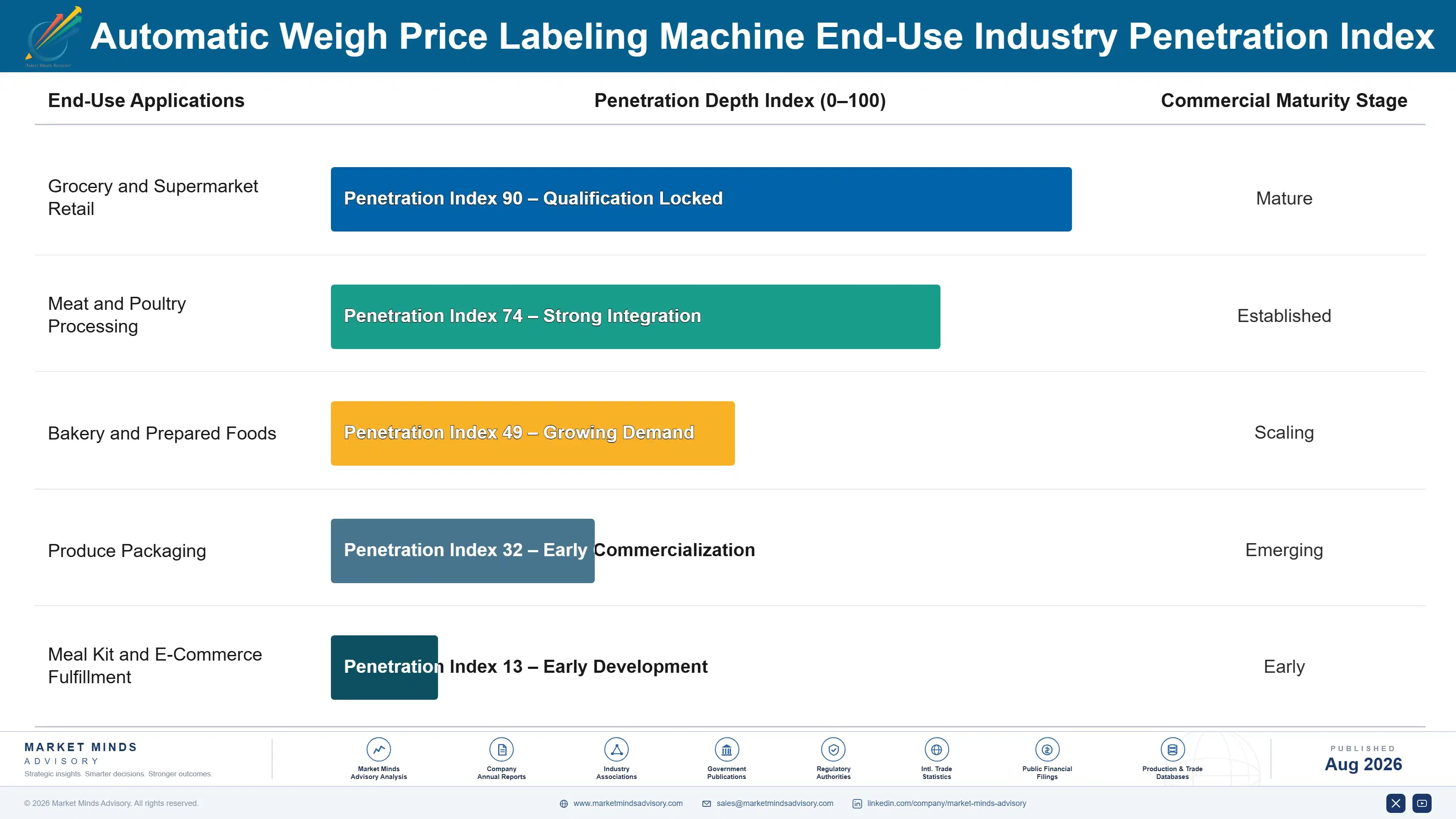
Connectivity Contracts Anchor Recurring Revenue

Machine economics function increasingly like an annuity once a connected fleet is installed, since pricing database subscriptions, calibration contracts, and periodic printhead replacement generate recurring revenue for years after the initial hardware sale closes. This recurring layer now represents a growing share of total category revenue and is the primary reason suppliers compete aggressively on initial fleet placement even at thin entry tier hardware margins.
Adoption depth varies sharply by end use vertical. Established grocery retail chains run near saturated connected labeling coverage and generate mostly replacement and connectivity retrofit demand, while meal kit and prepared food processors are still building out first time multihead coverage, generating a different mix of new installation revenue layered on top of the maturing replacement base across traditional retail verticals.

Buyer profiles are shifting generationally as retail technology administrators, often younger and more comfortable with cloud pricing dashboards than traditional store operations staff, increasingly influence vendor selection alongside category managers. This is accelerating demand for platforms with strong software usability even among buyers who historically evaluated weighing machines purely on mechanical accuracy and throughput specifications, a shift some legacy-focused suppliers are struggling to answer quickly.
automatic-weigh-price-labeling-machine-market-end-use-penetration-index-1787302231158

Where the Category Is Headed

These are among the four positions where our research anticipates prominent divergence between winners and laggards over the coming forecast period. Each is grounded in the demand model, the regulatory perimeter, and the announced capacity pipeline.
01 / CONNECTIVITY PLATFORM INVESTMENT

Prioritize pricing database software over raw weighing speed claims

Weighing accuracy has become table stakes across certified manufacturers, no longer a meaningful differentiator in vendor selection for multi-site retail chains. Buyers now evaluate connectivity depth and pricing database reliability ahead of marginal throughput gains that once justified a premium on their own, particularly across large multi-site retail chain accounts. Vendors that continue competing primarily on heads-per-minute specifications risk losing share to platform focused rivals bundling hardware, calibration service, and compliance software into a single recurring revenue relationship that is far harder to unwind.
02 / SERVICE MONETIZATION STRATEGY

Shift commercial models toward subscription and calibration revenue

Hardware margins will keep compressing as regional imports gain share at the entry tier of the category. Suppliers that convert pricing database access, calibration scheduling, and compliance reporting into contracted recurring revenue will outperform peers still pricing primarily around one time hardware sales alone. This shift also raises customer switching costs meaningfully, since replacing a connected fleet requires displacing an entrenched, multi-year pricing and compliance relationship rather than simply rebuying comparable hardware from a rival vendor with no established service history.
03 / REGIONAL GROWTH PRIORITIZATION

Weight investment toward South and East Asia over mature markets

South Asia and East Asia are compounding faster than North America and Western Europe on both share and CAGR, driven by organized retail expansion, new supermarket openings, and first time equipment installation. Vendors weighting sales and service investment toward these regions ahead of competitors will capture a disproportionate share of first time installation revenue. Mature markets, running mostly on replacement cycles, simply cannot replicate that category of demand at comparable scale or growth rate over the coming decade of the forecast.
04 / SUPPLY CHAIN RESILIENCE PLANNING

Diversify printhead and load cell sourcing before the next cycle

The 2021 to 2022 component shortage demonstrated that single sourced thermal printheads and concentrated load cell sensor supply chains can stretch lead times past eighteen weeks during disruption. Vendors that have not since diversified qualified suppliers remain exposed to the next shortage cycle in a market where retail chain rollout schedules carry contractual penalties for delayed delivery. That exposure raises the commercial cost of any repeat disruption meaningfully for suppliers caught unprepared without a diversified sourcing base already in place.

Engagement Snapshot From the Field

A live engagement with an industry participant carrying material or product regulatory and market exposure ahead of a defining policy shift, showing how our research translates into a defensible multi-year portfolio strategy.
MARKET MINDS ADVISORY · CLIENT ENGAGEMENT SUMMARY
Automatic Weigh Price Labeling Machine Producer Strategic Portfolio Review and Transition Roadmap 2026·Investment Scenario on Automatic Weigh Price Labeling Machine Exposure Evaluation 2025-26
CLIENT PROFILE
The client operates a multinational grocery retail chain with several hundred stores across North America and Western Europe, generating revenue in the low double digit billions (client-reported, unverified by MMA). Its weighing and labeling fleet spanned two decades of legacy single-head machines from multiple vendors, managed through manual price list updates with no centralized pricing visibility for corporate merchandising leadership.
STRATEGIC CHALLENGE
Following repeated pricing discrepancy complaints traced to delayed manual price list updates across store locations, corporate leadership sought a unified connected pricing platform across all stores within eighteen months, while minimizing disruption to daily deli and produce counter operations during the phased rollout across every regional division and store format.
MMA APPROACH
MMA benchmarked five candidate suppliers against connectivity retrofit compatibility, pricing database reliability, and total cost of ownership over a ten year horizon, then modeled rollout sequencing to minimize simultaneous store-level disruption across the client's highest volume locations during the phased connectivity installation programme under review across the full store portfolio.
KEY FINDINGS
  1. Three of five suppliers evaluated could not demonstrate retrofit compatibility with the client's existing legacy weighing hardware fleet at scale reliably enough.
  2. Wireless retrofit reduced projected installation labor cost by 38% versus full machine replacement across comparable store locations reviewed (client-reported, unverified by MMA).
  3. Centralizing pricing database access was projected to cut corporate pricing error resolution time by roughly half across all stores combined together nationwide.
  4. Stores with the oldest machine generations carried the highest near term pricing discrepancy risk, reprioritizing the client's original planned rollout sequence considerably.
CLIENT PROFILE
The client operates a multinational grocery retail chain with several hundred stores across North America and Western Europe, generating revenue in the low double digit billions (client-reported, unverified by MMA). Its weighing and labeling fleet spanned two decades of legacy single-head machines from multiple vendors, managed through manual price list updates with no centralized pricing visibility for corporate merchandising leadership.
STRATEGIC CHALLENGE
Following repeated pricing discrepancy complaints traced to delayed manual price list updates across store locations, corporate leadership sought a unified connected pricing platform across all stores within eighteen months, while minimizing disruption to daily deli and produce counter operations during the phased rollout across every regional division and store format.
MMA APPROACH
MMA benchmarked five candidate suppliers against connectivity retrofit compatibility, pricing database reliability, and total cost of ownership over a ten year horizon, then modeled rollout sequencing to minimize simultaneous store-level disruption across the client's highest volume locations during the phased connectivity installation programme under review across the full store portfolio.
KEY FINDINGS
  1. Three of five suppliers evaluated could not demonstrate retrofit compatibility with the client's existing legacy weighing hardware fleet at scale reliably enough.
  2. Wireless retrofit reduced projected installation labor cost by 38% versus full machine replacement across comparable store locations reviewed (client-reported, unverified by MMA).
  3. Centralizing pricing database access was projected to cut corporate pricing error resolution time by roughly half across all stores combined together nationwide.
  4. Stores with the oldest machine generations carried the highest near term pricing discrepancy risk, reprioritizing the client's original planned rollout sequence considerably.
RECOMMENDED STRATEGY
Phase 1: Phase 1 (Months 1-6): Pilot connectivity retrofit at the ten highest complaint volume stores identified through careful prior data review. Phase 2: Phase 2 (Months 7-14): Scale the validated retrofit programme across remaining North American and European stores in strict priority order. Phase 3: Phase 3 (Months 15-18): Integrate all stores into a single corporate pricing dashboard with fully automated compliance reporting features enabled.
OUTCOME
The client completed connectivity retrofit across all priority stores within the eighteen month window and reported a meaningful reduction in pricing discrepancy complaints during subsequent customer service reviews (client-reported, unverified by MMA). Corporate merchandising leadership gained real time pricing visibility previously unavailable under the prior manual update system.

Frequently Asked Questions

Foundational context covering the market sizes, CAGR, scope, country, region and competition that inform every finding below. This section is provided to cover basics and most often pre-purchase conversations, answered from the MMA Primary Research Dataset.

What is the current size of the Automatic Weigh Price Labeling Machine Market?

The global automatic weigh price labeling machine market reached an estimated $0.9 billion in 2025. Growth is driven by variable weight packaging expansion and retail connectivity retrofit demand.

How large will the Automatic Weigh Price Labeling Machine Market be by 2036?

The market is projected to reach approximately $1.8 billion by 2036, roughly 1.88 times its 2026 value. Multihead combination systems and connectivity retrofits drive most of the added value.

What is the CAGR for the Automatic Weigh Price Labeling Machine Market 2026 to 2036?

The base case CAGR is 6.5% through 2036. Bull and bear scenarios range from roughly 5.3% to 7.7%, depending on organized retail expansion pace and deli staffing trends.

Which segment is growing fastest?

Multihead combination weighing labelers lead at a 9.0% CAGR, about 1.4x the overall market rate. Growth is concentrated in meal kit and prepared food packaging expansion across processors.

Who are the major companies in the Automatic Weigh Price Labeling Machine Market?

Ishida Co Ltd, METTLER TOLEDO, Bizerba SE and Co KG, Yamato Scale, and CAS Corporation lead the category. Combined, the top five suppliers hold roughly 46% of global revenue.

Which country is growing fastest?

India leads country level growth at an estimated 9.8% CAGR. Rapid organized retail expansion is driving first time installation across previously unserved supermarket and hypermarket locations.

Report Segmentation Architecture

The full report scope spans multiple orthogonal segmentation dimensions, with cross-tabulated demand data provided for each dimension pair. Coverage extends further to regional breakdowns, trend trajectories, and the competitive detail needed to support segment-level decision-making.

By Product and Machine Architecture

  • Countertop Single-Head Units
  • In-Line Conveyorized Systems
  • Multihead Combination Weighing Labelers
  • Checkweigher-Integrated Labeling Systems
  • Wireless Networked Label Printer Modules

By End-Use Industry

  • Grocery and Supermarket Retail
  • Meat and Poultry Processing
  • Bakery and Prepared Foods
  • Produce Packaging
  • Meal Kit and E-Commerce Fulfillment

By Commercial Dimension

  • Direct Retail Chain Sales
  • Distributor Channel Sales
  • Connectivity Retrofit Programmes
  • Calibration and Compliance Service Contracts

By Region

  • North America
  • Western Europe
  • East Asia
  • South Asia and Pacific
  • Latin America
  • Middle East and Africa
  • Eastern Europe

Scope, Methodology, and Coverage

Every figure in this report is reproducible from documented input assumptions. The scope below maps the historical period, the forecast horizon, the segmentation dimensions, and the countries covered, alongside the underlying primary and qualitative methodology.
Historical Period
2020 to 2025
Forecast Period
2026 to 2036
Base Year
2025 (USD billions; MMA Primary Research Dataset, August 2026)
Market Definition
The automatic weigh price labeling machine market covers equipment that weighs a product, calculates its price, and prints and applies a compliant label in a single automated cycle, spanning countertop in-store units, in-line conveyorized systems, and multihead combination weighing labelers. It serves meat, deli, produce, bakery, and prepared food packaging across retail and food processing settings.
Quantitative Units
USD billions (current prices); unit shipment volume where disclosed
Segmentation Dimensions
By Product and Machine Architecture; By End-Use Industry; By Commercial Dimension; By Region
Regions Covered
North America, Western Europe, East Asia, South Asia and Pacific, Latin America, Middle East and Africa, Eastern Europe
Countries Covered
USA, China, Germany, France, UK, Japan, South Korea, India, Australia, Canada, Brazil, Mexico, Indonesia, Vietnam, Thailand, Malaysia, UAE, Saudi Arabia, South Africa, Nigeria, Turkey, Poland, Netherlands, Italy, Spain, Sweden, Switzerland, Argentina, Colombia, Singapore, and additional markets relevant to this sector
Key Companies Profiled
Ishida Co Ltd, METTLER TOLEDO, Bizerba SE and Co KG, Yamato Scale, CAS Corporation, Avery Weigh-Tronix, Illinois Tool Works, Loma Systems, Espera-Werke GmbH, Marel, TE.SI Srl, Anritsu Corporation, GSE Scale Systems, Cardinal Scale Manufacturing, Ravas Europe, Fuji Seal International, Multivac Group, Provisur Technologies, Alfa International, Sartorius AG
Quantitative Methodology
Primary survey, n=3,800 respondents, Q4 2025, six countries; demand-side model with trade association cross-validation
Qualitative Methodology
47 expert interviews, Q4 2025; applied to validate demand model assumptions, identify emerging dynamics, and assess competitive positioning
Report Format
PDF and XLSX data workbook (Word format preview document)
Publisher
Market Minds Advisory
Report Code
MMA-2026-PAC-105
Published
August 2026
Contact
sales@marketmindsadvisory.com | www.marketmindsadvisory.com

Purchase the full Automatic Weigh Price Labeling Machine Market Report (2026 to 2036).

The full report delivers a complete quantitative and qualitative assessment of the global automatic weigh price labeling machine market through 2036. It includes detailed segmentation by machine architecture, end use industry, and commercial channel, alongside country level sizing across thirty markets covering every major retail demand center. Competitive profiles cover twenty companies with capability, pricing, and service network benchmarking assessed on a consistent revenue basis. Buyers also receive access to the underlying primary survey and expert interview datasets referenced throughout the analysis, along with editable data tables.
Segment level CAGR and sizing tables
Regional and country level market breakdowns
Twenty company competitive profiles and benchmarks
Detailed connectivity platform capability benchmarking matrix
Input cost and supply chain risk analysis
Primary survey and expert interview datasets

Built For The People Who Decide

From boardroom strategy to bench-side execution, this report is read cover-to-cover by leaders shaping the next decade of their industry, turning demand scenarios, market dynamics and valuation benchmarks into decisions.
CXOs/ Presidents/ VPs/ Managers
M&A and Corporate Development
Strategy Teams and R&D Heads
Procurement and Product Directors
Regulatory and Compliance Leaders
Investor Relations and Equity Analysts