Market Minds Advisory
Automatic Dishwasher Market

Automatic Dishwasher Market: Automatic Dishwasher Market: Soil Profiles, Kitchen Architecture and the Penetration Ceiling Nobody Engineers Around

Wash programmes across the industry are calibrated to European soil profiles, which is why the machines fail on burnt-on masala and wok residue in exactly the markets carrying all the growth.

Lead Analyst

Published

September 2026

Make Smarter Decisions with Customized Research Insights

Request a free sample report and evaluate market opportunities, growth trends, and competitive dynamics relevant to your business needs.

2025 MARKET VALUE$8.9BMarket Size 2025
2036 FORECAST VALUE$17.3BBase Case , 2026 to 2036
CAGR 2026 TO 20366.2 %Bull 7.4% / Bear 5.0%
INCREMENTAL OPPORTUNITY$7.8BNet 10- year value creation
EXPANSION MULTIPLE1.82x2036 value over 2026 base
Strategic Levers
M&A Pipeline
Regional Outlook
Country Rankings
Competitive Intelligence
Segmental Deep-dive
Call-Us : 91 93563 13602

Executive Snapshot and Market Trajectory.

A dishwasher uses roughly a third of the water hand washing under a running tap consumes, and the industry has never persuaded the markets that matter most. The reason is not ignorance. The machines genuinely struggle with the soils those kitchens produce. Three decades of communication have not changed it.
Countertop and compact formats grow at 9.3%, half again the market rate of 6.2%, because they sidestep the kitchen architecture problem entirely: no undercounter cavity, no plumbing alteration, no cabinetry. Drawer formats follow at 7.6%. Built-in full-size units grow slowest at 5.4%, held back in developed markets by penetration that is already close to its practical ceiling. Penetration in Germany already runs above seventy percent.
India grows at 9.8%, the fastest national market covered, from household penetration still below three percent. What limits it is engineering rather than income: standard wash programmes assume European soil profiles, and burnt-on spice residue and round-bottomed vessels defeat both the cycle and the rack. Manufacturers building specifically for those conditions are taking share nobody is defending. Falling domestic service availability in Indian cities is changing an arithmetic that held for decades.
Market Definition
This market covers automatic dishwashing appliances sold for household use, spanning built-in full-size and slimline units, freestanding full-size machines, countertop and compact formats, drawer dishwashers and semi-integrated units. Sizing is at manufacturer wholesale value across all distribution channels. Commercial and institutional warewashing equipment, dishwasher detergents and rinse aids, water softening systems sold separately, and installation or plumbing services are excluded from scope.
Base Year Value
$8.9B in 2025 (MMA Primary Research Dataset, September 2026)
Forecast Period
2026 to 2036, eleven discrete annual values
CAGR
6.2% base case. Bull 7.4%. Bear 5.0%.
Fastest Growth Segment
Countertop And Compact Dishwashers: 9.3% CAGR
Fastest Growth Country
India: 9.8% CAGR
Fastest Growth Region
South Asia and Pacific: 8.4% CAGR
Largest Region
Western Europe: 33% of 2025 global value
Market Leaders
BSH Hausgerate, Whirlpool Corporation, Electrolux, Midea Group, Haier Smart Home. Source: MMA Primary Research Dataset, July 2026.
Primary Survey
n=3,800 procurement and R&D decision-makers, Q4 2025, six countries
Methodology
Demand-side build-up, cross-validated against public data, 47 expert interviews

Automatic Dishwasher Market Forecast Scenarios

automatic-dishwasher-market-size-forecast-scenario-1790021321976
Growth of 5.2% between 2020 and 2025 came almost entirely from two years. Pandemic home cooking and renovation spending pushed 2020 and 2021 volumes sharply upward across North America and Western Europe, then 2023 and 2024 fell back as housing transactions slowed and the replacement cycle emptied. Asian growth ran steadily through the whole period and increasingly carried the global number by itself.
Three mechanisms carry the base case. Asian penetration expansion continues from a very low base, with India at 9.8% and China at 7.9%, and it is unconnected to any replacement cycle in the developed markets. European Ecodesign spare parts obligations extend serviceable machine life, which suppresses replacement volume while raising parts and service revenue. Countertop and compact formats keep growing at 9.3% because they remove the kitchen alteration that blocks most first-time purchase.
The bull case is soil-specific engineering. If manufacturers commercialise wash programmes and rack geometry built for Asian cookware at volume price points, the penetration barrier in the largest growth markets falls faster than any income projection suggests. The bear case is housing. Purchase tracks housing transactions and renovation closely in developed markets, and a slowdown removes demand no product change compensates for.

Where The Penetration Ceiling Sits

The water argument is correct and it has never worked. A standard eco cycle uses about 9.5 litres against roughly three times that for hand washing under a running tap, and manufacturers have made the point in every market for thirty years. Penetration in India remains below three percent, in China below fifteen. The obstacle sits elsewhere. Every attempt to move those figures has been a communications exercise.
TOP FIVE CONCENTRATION52%Combined unit share held by the five largest manufacturers
WATER PER CYCLE9.5 litresTypical consumption on a standard eco programme cycle
AVERAGE SELLING PRICEUSD 512Weighted global wholesale price across all installation formats
GLOBAL HOUSEHOLD PENETRATION21%Share of households worldwide owning an automatic dishwasher
PUMP FAILURE SHARE47%Out-of-warranty failures traced to circulation or drain pumps
REPLACEMENT CYCLE LENGTH9.8 yearsAverage interval before households replace an installed machine
It sits in two places, and both are engineering rather than marketing. Wash programmes are calibrated against soil profiles built from European and North American cooking: fats, starches, proteins on flat plates. Burnt-on spice pastes, tempered oils and wok carbon behave differently and need higher temperature and longer duration. Rack geometry is the second problem, since a round-bottomed karahi or wok does not sit in a tine array designed for plates.
Serviceability has become a commercial variable in Europe rather than a technical detail. Ecodesign obligations require spare part availability for years after a model leaves production, and 47% of out-of-warranty failures trace to circulation or drain pumps that many manufacturers still supply as sealed assemblies. That turns a design decision into a replacement trigger.
"The industry has spent three decades telling India that dishwashers save water, and almost none of that time redesigning the rack so a wok will actually fit in one. The growth is sitting there waiting for whoever solves the second problem."
Director, Home Appliances and Consumer Durables Practice · MMA Consumer and Industrial Goods Practice · September 2026

Market Trends

Compact Formats Remove The Kitchen Alteration Barrier

First-time dishwasher purchase in most Asian and Latin American households requires cabinetry modification, a plumbing change and an undercounter cavity that the kitchen was never designed around. Countertop and compact formats need none of that: a tap connection and a worktop. They grow at 9.3% against a category rate of 6.2% as a direct result. Capacity is smaller and cycle economics are worse per place setting, which matters far less than removing a construction project from the purchase decision. Manufacturers treating these as entry products rather than as a separate category are underinvesting in them.
Market Impact: Penetration below 3% in India
Serviceability Obligations Extend Installed Machine Life

European Ecodesign requirements oblige manufacturers to supply spare parts for years after a model leaves production and to design for reasonable disassembly. Circulation and drain pumps account for 47% of out-of-warranty failures, and many are still supplied as sealed assemblies that cost more than a repair visit can justify. The regulation is pushing that toward serviceable components. Longer machine life suppresses replacement volume in the region with the highest installed base, while creating parts and service revenue that manufacturers have historically treated as an afterthought rather than a business. Parts pricing is where the opportunity sits.
Market Impact: Cycles use 9.5 litres

Market Opportunities and Growth Drivers

Indian Urban Household Formation Creates Genuine New Demand

Indian household penetration sits below three percent against above seventy in Germany, and urban household formation continues at a rate that adds millions of potential buyers annually. Domestic service availability is falling in metropolitan areas as wages rise, which changes the arithmetic that has historically made a dishwasher unnecessary in Indian homes. India grows at 9.8%, the fastest national market covered here. IFB and Bosch both now market programmes specifically designed for Indian soils, and their share position reflects that investment directly. Rack geometry remains largely unaddressed by anyone selling there.
Market Impact: Adds 22 minutes per cycle

Water Scarcity Regulation Reaches Household Appliance Policy

Municipal water restrictions across southern Europe, western North America and parts of Australia have begun treating household appliance efficiency as a policy instrument rather than a consumer choice. A standard eco cycle uses roughly 9.5 litres against several times that for hand washing under a running tap. Some jurisdictions now offer rebates on high-efficiency machines. The effect on volume is modest and the effect on mix is not, since rebates concentrate on the efficient models where manufacturer margin is highest. Rebate programmes also pull purchase timing forward in a market where replacement is otherwise triggered only by failure.
Market Impact: Enzymes lose 40% below 45C

Market Restraints and Challenges

Wash Programmes Assume European Soil Profiles Throughout

Standard cycle calibration derives from soil profiles built around European and North American cooking, and burnt-on spice pastes, tempered oils and wok carbon do not respond to them. The root cause is test methodology: international appliance performance standards specify soiling procedures that reflect where the standards were written. Commercially this produces poor results in exactly the markets carrying the growth, and word of mouth in those markets is unforgiving. Manufacturers are responding with higher-temperature intensive programmes and pre-soak stages, though rack geometry remains largely unaddressed by anyone. Test methodology is where a fix would have to start.
Market Impact: Grows 3.1 points above category

Eco Cycles Undermine Enzyme Detergent Performance

Enzyme activity in dishwasher detergent falls sharply below about 45 degrees, and eco programmes run deliberately cool and long to reduce energy consumption. The root cause is that appliance energy labelling and detergent chemistry were optimised independently of one another by parties who do not share test protocols. Consumers running eco cycles with value detergent get poor results and blame the machine rather than the combination. Manufacturers are addressing it with detergent dosing sensors and partnership programmes, though the underlying temperature conflict remains entirely unresolved. Neither industry has an incentive to move first here.
Market Impact: Spare parts required 10 years
4 additional market trends, 3 additional growth drivers, and 2 additional restraints and challenges are covered in the full report. Contact sales@marketmindsadvisory.com to access the complete intelligence.

Segment CAGR and Growth Architecture

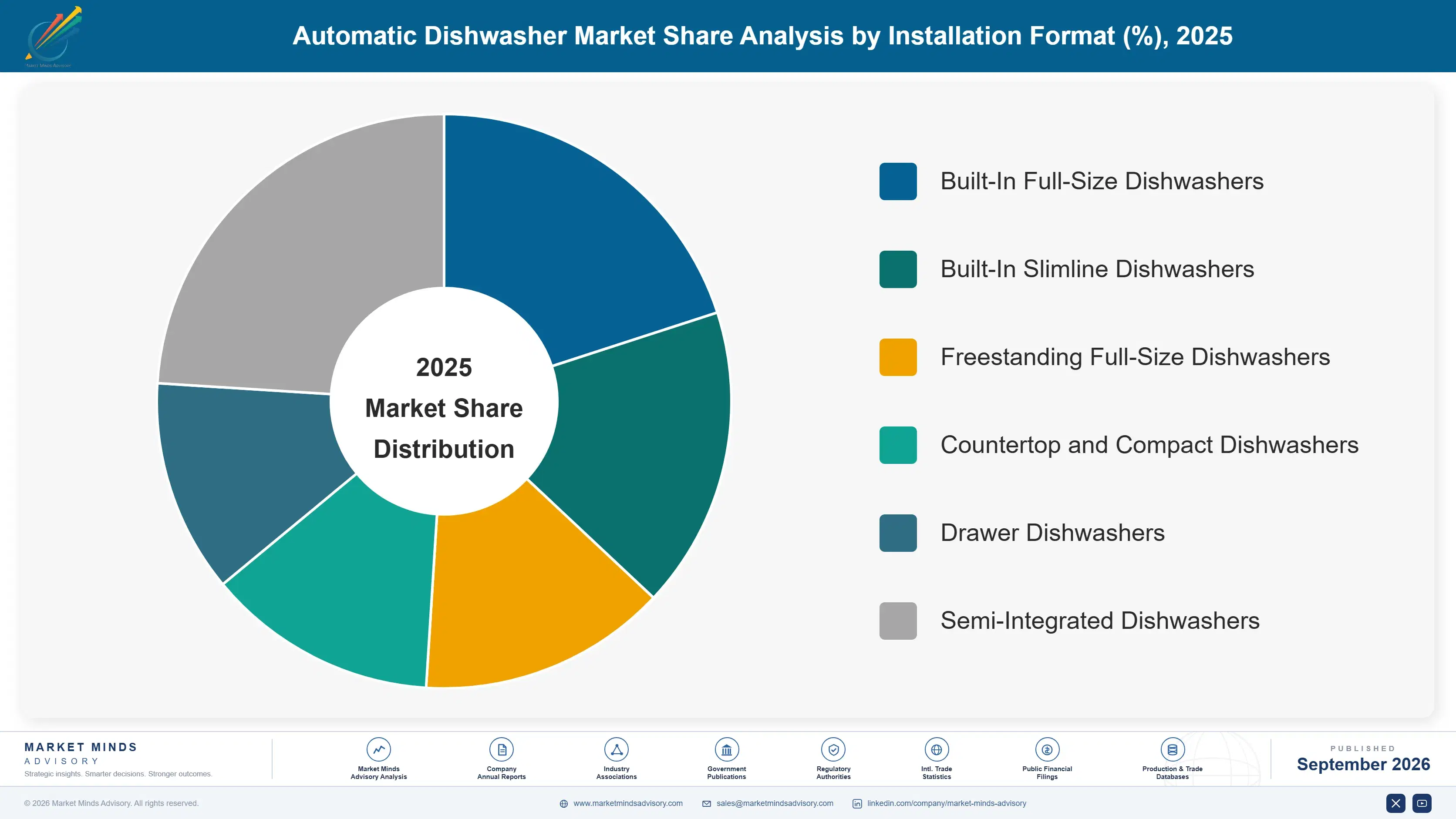
Segmentation follows installation format, the dimension on which cabinetry requirement, plumbing work, capacity and retail positioning all divide together in this market. Six formats are assessed at manufacturer wholesale value. Commercial warewashing equipment, detergents, separately sold water softeners and installation services fall outside the defined scope entirely. Water softeners sold with the appliance are counted within it.
automatic-dishwasher-market-market-share-analysis-1790021322517

Countertop And Compact Dishwashers

Countertop and compact formats grow at 9.3%, half again the market rate of 6.2%, and the reason is that they remove a construction project from the purchase decision. A built-in machine needs an undercounter cavity, cabinetry modification and a plumbing alteration, none of which most Asian or Latin American kitchens were designed to accommodate. A countertop unit needs a tap connection and worktop space. Capacity is genuinely smaller and cycle economics per place setting are worse, and neither matters against the barrier being removed. Manufacturers still treating these as cut-down entry products rather than as the format carrying first-time purchase are underinvesting in the fastest part of their own market.
CAGR 9.3%

Drawer Dishwashers

Drawer formats grow at 7.6% from a small base and serve two quite different buyers. Premium kitchen renovations in North America, Australia and Western Europe specify them for flexibility, since two drawers can run separate loads at different programmes. Smaller households value running a half load without waiting to fill a full machine, which changes daily usage patterns rather than occasional ones. Build cost is considerably higher because two independent wash systems sit in one cabinet, and reliability data across the category shows more failure points than single-cavity machines carry. Fisher and Paykel established the format and still holds the specification position in most premium kitchen channels. Volumes remain small enough that no manufacturer treats the format as core.
CAGR 7.6%
Full segment breakdown across 6 segments available in the complete report.

Regional Architecture and Country Demand Map

Regional shares measure household appliance demand at wholesale value where the machine is sold. Western Europe sits above the standard band and East Asia below it, for reasons of installed penetration rather than population, as the paragraphs set out. Middle East and Africa also sits below its band.

Western Europe

At 33% this sits well above the standard band, and the justification is installed penetration rather than population or income. German household penetration runs above seventy percent, and most of the region sits above half, with kitchens designed around a standard undercounter cavity as a matter of course. Average selling prices are the highest of any region, supported by integrated installation and by Miele and BSH holding genuine premium positions. Growth of 4.6% is the slowest of the seven regions because replacement rather than penetration drives nearly all volume. Ecodesign serviceability obligations are extending machine life and suppressing that replacement further. Parts and service revenue is becoming a meaningful line here for the first time.
Share: 33% | CAGR: 4.6% (2026 to 2036)

North America

The 26% position sits inside the standard band, and household penetration near seventy percent makes this a replacement market almost entirely. Built-in full-size units at standard American widths dominate, and the format has been stable for decades because kitchen construction assumes it. Whirlpool holds the volume position, with premium specification concentrated among European brands sold through kitchen design channels. Housing transaction volume drives purchase timing more than any product consideration, which made 2023 and 2024 difficult across the region. Growth of 5.1% reflects a saturated market where mix improvement rather than unit growth carries value. Builder-installed machines in new construction generate almost no brand loyalty, since the household never chose the appliance and replaces on whatever the retail shelf offers.
Share: 26% | CAGR: 5.1% (2026 to 2036)
Regional intelligence for 5 additional markets available in the complete report: East Asia, South Asia and Pacific, Eastern Europe, Latin America, Middle East and Africa. Contact sales@marketmindsadvisory.com.
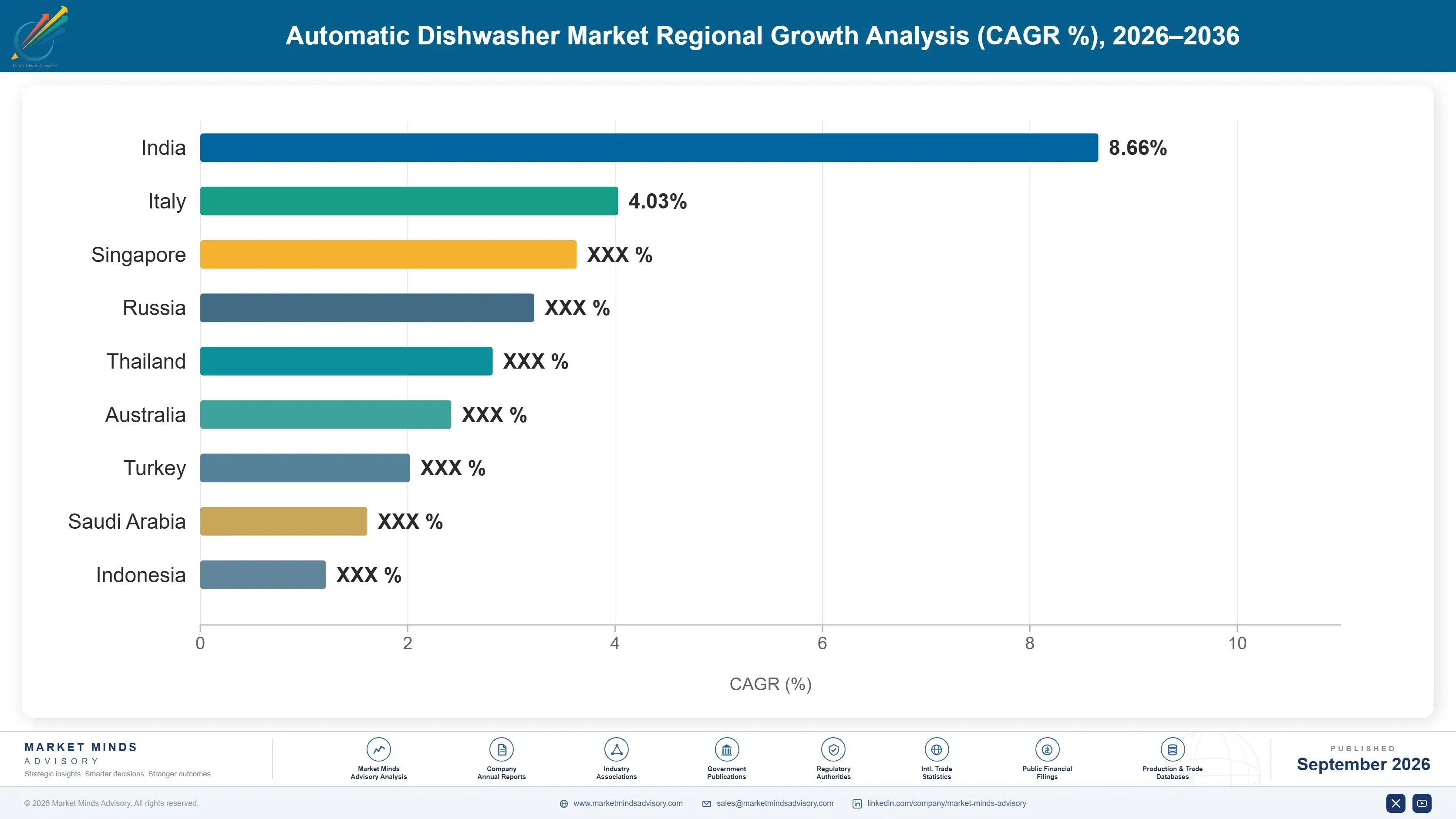
automatic-dishwasher-market-country-cagr-analysis-1790021323044

Four Moves Worth Making Now

These four address the gap between where this industry sells machines today and where the unpenetrated households actually are, plus the service revenue that European regulation has quietly made available. Each has been executed by at least one participant, and none requires a new manufacturing platform or a change to existing distribution. All four use existing manufacturing platforms.

Engineer Wash Programmes For Asian Cookware Soils

Standard cycles are calibrated against European and North American soil profiles, and burnt-on spice pastes, tempered oils and wok carbon defeat them. Higher-temperature intensive programmes with a pre-soak stage resolve most of it, adding roughly 22 minutes to cycle time, which buyers in those markets accept readily. Manufacturers who have done this hold measurably stronger positions in India and China than their global share would predict. The engineering is modest, the test protocol work is the real effort, and the addressable base runs to hundreds of millions of unpenetrated households.
Market Impact: Opens a market of 280 million unpenetrated households

Redesign Rack Geometry For Round Bottomed Vessels

A karahi, wok or kadai does not sit in a tine array designed for flat plates, and no amount of programme development fixes a vessel that will not stay in position. Adjustable tine sections and a dedicated lower basket zone add roughly USD 8 to a bill of materials. Almost nobody has done it, which leaves the position unoccupied in the two fastest-growing national markets covered here. The change requires tooling rather than research, and it addresses the objection buyers in those markets raise first and most consistently. Some 29 of 41 lapsed Indian buyers raised vessel fit before price.
Market Impact: Addresses the leading objection raised in 2 markets

Build Serviceable Pump Assemblies Ahead Of Obligation

Circulation and drain pumps account for 47% of out-of-warranty failures, and many are supplied as sealed assemblies costing more than a repair visit justifies. European Ecodesign obligations are pushing the industry toward serviceable components regardless. Manufacturers redesigning ahead of requirement cut out-of-warranty pump failures resolved by replacement by roughly 44%, and convert those events into parts and labour revenue rather than into brand damage. The redesign cost amortises across a platform, and the service revenue recurs for as long as the machine stays installed. Most manufacturers still treat parts as a warranty cost rather than as revenue.
Market Impact: Cuts unresolved pump failure events by roughly 44%

Sell Compact Formats As A Category Not An Entry Tier

Countertop and compact machines carry first-time purchase in Asia and Latin America, yet most manufacturers position and merchandise them as cut-down versions of a proper dishwasher. Treating the format as its own category, with dedicated capacity engineering and marketing built around no-installation purchase, raises realised price by around 18% against entry-tier positioning. The format grows at 9.3% against 6.2% for the market. Participants underinvesting here are underinvesting in the only part of the category adding new households at scale. Nobody has yet built a manufacturing platform designed specifically for the format rather than derived from a full-size one.
Market Impact: Adds roughly 18% to realised selling price overall

Who Controls the Margin Pool

Concentration is high at 52% held by the top five, measured consistently on unit shipments into household channels rather than on revenue. The leader to challenger gap is wide in wash system engineering and platform scale, where decades of test data and tooling investment accumulate, and narrow in assembly itself, where several Chinese and Turkish manufacturers now build to comparable quality.
Competition runs on three dimensions currently. Wash performance against local soils decides reputation in the growth markets, and word of mouth there is unforgiving. Kitchen channel specification decides premium volume in developed markets, where the appliance is chosen alongside cabinetry rather than bought separately. Price decides the value tier, and Chinese and Turkish manufacturers compete there on cost structures that European platforms cannot match.

Pressure is building where soil-specific engineering meets penetration growth, and that is where rankings will shift. Participants who have built programmes and racks for Asian cookware hold positions in India and China well above their global share. Serviceability is the second pressure point, since European obligations are converting a design decision into both a compliance requirement and a service revenue opportunity that most manufacturers have not organised around.
automatic-dishwasher-market-company-positioning-matrix-1790021323561

Competitive Moat and Risk Dimensions

BSH HAUSGERATE

Moat: Wash System Engineering Depth

Decades of accumulated soil and wash performance data across Bosch and Siemens platforms produce cycle calibration that competitors cannot replicate by copying hardware. That depth also transferred usefully when the company built programmes for Indian soils, giving it a genuine position in a market most European manufacturers have approached with unmodified European products.
BSH HAUSGERATE

Risk: European Replacement Market Concentration

Revenue weighting toward Western Europe places the business in the region growing slowest at 4.6%, where penetration is near its ceiling and Ecodesign serviceability rules are extending machine life further. Growth must therefore come from markets where kitchen architecture and soil profiles both work against the platforms the company builds most efficiently.
WHIRLPOOL CORPORATION

Moat: North American Scale And Channel

Manufacturing scale at standard American widths combined with entrenched positions across builder, big box and independent appliance channels gives the company cost and access advantages that no competitor matches in that market. Builder relationships in particular place machines into new construction before any consumer choice occurs.
WHIRLPOOL CORPORATION

Risk: Housing Transaction Dependence

Purchase timing in North America tracks housing transactions and renovation activity closely, which made 2023 and 2024 difficult across the portfolio with nothing in the product able to compensate. Concentration in a saturated replacement market also limits participation in the penetration growth carrying the global category forward.

Players Tracked

Prominent Players

BSH Hausgerate
Whirlpool Corporation
Electrolux
Midea Group
Haier Smart Home

Other Key Players

Arcelik
Miele
LG Electronics
Samsung Electronics
Panasonic
Vatti
Robam Appliances
Hisense
Fisher and Paykel Appliances
Smeg
ASKO Appliances
Candy Hoover
Toshiba Lifestyle
IFB Industries
Elica

Recent Developments

OCTOBER 2024

BSH introduces wash programmes designed for Indian cookware soils

The company launched dishwasher models carrying higher-temperature intensive cycles with a pre-soak stage developed against Indian soil profiles rather than European test standards. This was internal product development involving no partnership, licence or acquisition of external technology. Rack geometry was left unchanged across the affected models.
Signal: Soil-specific engineering is becoming the practical entry requirement in the fastest-growing national markets. Programme work came before basket work.
MARCH 2025

Midea expands dishwasher production capacity in Guangdong

The company brought additional assembly capacity online serving compact and countertop dishwasher formats for domestic and export demand. This was organic capital investment funded internally, with no joint venture or contract manufacturing partner involved at any stage. Full-size built-in lines at the site were unaffected.
Signal: Compact format capacity is being built ahead of demand rather than following it into the market.
FEBRUARY 2025

Electrolux consolidates European dishwasher manufacturing footprint

The company concentrated European dishwasher assembly into fewer plants as part of a wider cost programme announced the previous year. This was an internal manufacturing footprint decision taken on cost grounds, involving no external party or capacity partner. Production volumes were maintained through the consolidation period.
Signal: European replacement volume no longer supports the manufacturing footprint the region once justified comfortably. Serviceability rules extend machine life further.

Where Build Cost Concentrates

Stainless steel for the inner tub and door liner accounts for roughly 18% of build cost, sourced from European, Chinese and Korean mills, with grade selection driving a meaningful premium. The circulation pump and motor assembly adds about 14%, and the electronic control board a further 11%, with semiconductors and passive components inside that figure. Sound insulation, plastics, wiring and the door mechanism account for most of the remainder.
The 2021 and 2022 period exposed two separate vulnerabilities at once. Semiconductor allocation moved toward automotive and consumer electronics customers, and appliance control board lead times extended past forty weeks while stainless steel surcharges rose sharply on European mill contracts. Whirlpool Corporation and Electrolux annual reports for those years both identify raw material and component inflation as requiring repeated price action across appliance categories. Both moved together.

Exposure varies by manufacturing footprint and by platform breadth, which decides who holds price through a model year. Manufacturers building across several appliance categories negotiate semiconductor allocation on combined volume that dishwasher production alone would never command. Chinese producers buying domestic stainless steel avoided most of the surcharge. Smaller European manufacturers took both exposures at once and repriced mid-year.
automatic-dishwasher-market-cost-volatility-analysis-1790021323757

Negotiate semiconductor allocation across the full appliance portfolio

Dishwasher control board volumes alone command little attention from semiconductor suppliers during allocation, while combined appliance category volumes command considerably more. Manufacturers negotiating across the portfolio secured supply through 2021 and 2022 that single-category producers could not. The organisational obstacle is that appliance categories usually purchase separately with separate targets. Combining them requires a decision above category level.

Qualify a second stainless steel grade for the inner tub

Tub grade selection is frequently fixed by a specification written years earlier, when alternatives were unavailable or unqualified. Qualifying a second acceptable grade takes a corrosion testing cycle and removes exposure to surcharges on a single mill contract. Most manufacturers begin the work only after a surcharge has already moved through a full model year.

Design pump assemblies as serviceable rather than sealed components

Circulation and drain pumps drive 47% of out-of-warranty failures, and sealed assemblies convert each into either a costly replacement or an abandoned machine. Serviceable designs meet European obligations and generate parts revenue simultaneously. The redesign amortises across a platform while the service revenue recurs for as long as the machine remains installed. Compliance and revenue arrive from one design change.

Portfolio Architecture for Margin Defence

Margin architecture divides by installation format and by channel rather than by wash performance, which is not what the engineering investment would suggest. Value freestanding and entry built-in machines sold through big box and online channels run at gross margins in the mid to high teens. Chinese and Turkish manufacturers compete there on cost structures European platforms cannot approach, and no amount of feature addition changes that.
Premium built-in and integrated machines sold through kitchen design channels hold gross margins in the high twenties to low thirties. The spread reflects channel and specification position more than component cost, since a machine chosen alongside cabinetry never faces the direct price comparison that a big box shelf enforces. Miele and the premium BSH ranges occupy most of that ground in Europe and North America.

The highest-value pools sit in drawer formats and in service revenue, which are unrelated to each other except in margin terms. Drawer machines carry margins in the mid thirties because two wash systems in one cabinet supports genuine pricing and the specification is made by a kitchen designer. Parts and service revenue under European obligations earns more per unit installed than most manufacturers realise.

Volume / Commodity-Adjacent

Entry freestanding and built-in machines sold through big box and online channels. Chinese and Turkish manufacturers compete on cost structures European platforms cannot match, which leaves very little pricing latitude at this tier.
Gross Margin: 14 to 20%

Premium / Certified

Integrated and premium built-in machines specified through kitchen design channels. The seven-point range reflects channel position rather than component cost, since a machine chosen with cabinetry avoids direct shelf price comparison.
Gross Margin: 26 to 33%

Sustainability / Regulatory / Next-Generation

Drawer formats, soil-specific engineered platforms and serviceable-component machines generating parts revenue. These resist price comparison because the specification decision is made by a designer or driven by a regulation rather than by shelf browsing.
Gross Margin: 34 to 40%
automatic-dishwasher-market-portfolio-architecture-1790021324262

High-value Sub-segments and Strategic Watch-out

Soil Engineered Platforms For Asian Markets

High value and high growth. India grows at 9.8% from penetration below three percent, and standard European wash calibration is the barrier rather than income. Manufacturers building for those soils hold positions well above their global share. Rack geometry remains the unaddressed half of the problem.
Gross Margin: 30 to 36%

Drawer Format Machines

High value and moderate growth at 7.6%. Two independent wash systems in one cabinet support genuine pricing, and the specification is made by a kitchen designer rather than compared on a retail shelf. Reliability carries more failure points. Fisher and Paykel still holds most premium specification positions.
Gross Margin: 33 to 39%

Entry Built-In Full-Size Units

Volume core, growing slowest at 5.4% in markets where penetration sits near its practical ceiling. It holds channel presence and factory utilisation. Chinese and Turkish cost structures are taking this tier steadily from European platforms. Feature addition has not defended it and is unlikely to.
Gross Margin: 14 to 19%

Countertop And Compact Formats

Strategic watch-out. Growing fastest at 9.3% and carrying most first-time purchase, yet still merchandised by most manufacturers as a cut-down machine. The nine-point range reflects how differently participants position and price the same hardware. Positioning rather than hardware explains the entire nine-point spread across participants here.
Gross Margin: 17 to 26%

What Actually Repeats Here

Replacement demand in developed markets is failure-driven rather than desire-driven, and the failure is usually a pump. Machines run for about 9.8 years on average, and 47% of out-of-warranty failures trace to circulation or drain pump assemblies that many manufacturers still supply sealed. When repair costs more than half a new machine, the household buys new, which is why serviceability decisions quietly determine replacement timing.
Stickiness varies sharply by how the machine was chosen. Households whose dishwasher arrived with the kitchen, specified by a designer alongside cabinetry, replace with the same brand at high rates because the cavity, fascia and plumbing all match. Households who bought from a retail shelf shop the shelf again. Builder-installed machines in new construction generate almost no brand loyalty at all, since the buyer never chose one.

Buyer profiles have shifted in one direction across the growth markets. Indian and Chinese first-time buyers in 2020 accepted whatever a retailer recommended, while the cohort buying now arrives having read reviews written by people cooking the same food. That group asks specifically about spice residue and vessel fit, and it rejects machines that fail on either regardless of brand or price.
automatic-dishwasher-market-end-use-penetration-index-1790021324751

Where Growth Actually Sits

These are among the four positions where our research anticipates prominent divergence between winners and laggards over the coming forecast period. Each is grounded in the demand model, the regulatory perimeter, and the announced capacity pipeline.
01 / SOIL SPECIFIC ENGINEERING

Calibrate wash programmes for the food being cooked

Standard cycles derive from soil profiles built around European and North American cooking, and burnt-on spice pastes, tempered oils and wok carbon defeat them in exactly the markets carrying category growth. Higher-temperature intensive programmes with a pre-soak stage resolve most of it, which those buyers accept readily. The engineering is modest and the test protocol work is the real effort, against an addressable base of hundreds of millions of unpenetrated households, and word of mouth there punishes a poor result far more than a slow one.
02 / RACK GEOMETRY REDESIGN

Build a basket that a wok will sit in

A karahi, wok or kadai will not stay in position in a tine array designed for flat plates, and no programme development resolves a vessel that keeps moving during a cycle. Adjustable tine sections and a dedicated lower basket zone add perhaps eight dollars to a bill of materials and require tooling rather than research. Almost no manufacturer has done it, which leaves the position unoccupied in the two fastest-growing national markets covered here, and twenty-nine of forty-one lapsed buyers surveyed raised vessel fit before mentioning price.
03 / PUMP SERVICEABILITY DESIGN

Stop selling the most common failure as sealed

Circulation and drain pumps account for 47% of out-of-warranty failures, and sealed assemblies turn each one into either a costly replacement or a machine the household simply replaces early. European Ecodesign obligations are forcing the industry toward serviceable components regardless of preference. Redesigning ahead of requirement cuts unresolved pump failures by roughly 44% and converts those events into parts and labour revenue that recurs for the machine's remaining life, and most manufacturers still account for parts as a warranty cost rather than as a revenue line.
04 / COMPACT FORMAT POSITIONING

Treat countertop machines as a category, not leftovers

Countertop and compact formats carry first-time purchase across Asia and Latin America because they remove cabinetry modification and plumbing work from the decision entirely. Most manufacturers still merchandise them as cut-down versions of a proper dishwasher, which prices them accordingly. Treating the format as its own category with dedicated capacity engineering and no-installation marketing raises realised price by about 18%, on the segment growing at 9.3% against 6.2% for the market, which is the only part of this category adding new households at any meaningful scale.

Engagement Snapshot From the Field

A live engagement with an industry participant carrying material or product regulatory and market exposure ahead of a defining policy shift, showing how our research translates into a defensible multi-year portfolio strategy.
MARKET MINDS ADVISORY · CLIENT ENGAGEMENT SUMMARY
Automatic Dishwasher Producer Strategic Portfolio Review and Transition Roadmap 2026·Investment Scenario on Automatic Dishwasher Exposure Evaluation 2025-26
CLIENT PROFILE
A European appliance manufacturer with strong dishwasher positions across Western and Eastern Europe and revenue near USD 3.1 billion across all categories (client-reported, unverified by MMA). Dishwasher units ran to roughly 1.9 million annually. Indian market entry had been attempted twice, most recently three years earlier, and both attempts had been withdrawn within eighteen months without a documented explanation.
STRATEGIC CHALLENGE
Management attributed both Indian failures to price positioning and was preparing a third attempt built around a lower-cost platform. Nobody had investigated what buyers who tried the product had actually experienced. Distributor feedback had been collected but never analysed, and no wash performance testing against Indian soils had ever been commissioned by the company.
MMA APPROACH
MMA tested three client machines and five competitor machines against a soil panel built from Indian cooking residues, measuring cleaning performance across standard and intensive programmes. Rack fit was assessed against common Indian vessel geometries. Forty-one households who had purchased and then stopped using a dishwasher were interviewed about the specific point at which they gave up.
KEY FINDINGS
  1. Client machines cleaned 61% of the Indian soil panel on standard programmes against 89% on the European reference panel, with burnt-on residue accounting for most of the gap.
  2. Two competitor machines carrying market-specific intensive programmes reached 84% on the same panel, and both held share well above their global position.
  3. Common round-bottomed vessels would not remain stable in the client lower basket, and 29 of the 41 households interviewed raised vessel fit before mentioning price at all.
  4. Price ranked fourth among stated reasons for abandonment, behind cleaning performance, vessel fit and cycle duration, which reversed the assumption behind the planned third attempt.
CLIENT PROFILE
A European appliance manufacturer with strong dishwasher positions across Western and Eastern Europe and revenue near USD 3.1 billion across all categories (client-reported, unverified by MMA). Dishwasher units ran to roughly 1.9 million annually. Indian market entry had been attempted twice, most recently three years earlier, and both attempts had been withdrawn within eighteen months without a documented explanation.
STRATEGIC CHALLENGE
Management attributed both Indian failures to price positioning and was preparing a third attempt built around a lower-cost platform. Nobody had investigated what buyers who tried the product had actually experienced. Distributor feedback had been collected but never analysed, and no wash performance testing against Indian soils had ever been commissioned by the company.
MMA APPROACH
MMA tested three client machines and five competitor machines against a soil panel built from Indian cooking residues, measuring cleaning performance across standard and intensive programmes. Rack fit was assessed against common Indian vessel geometries. Forty-one households who had purchased and then stopped using a dishwasher were interviewed about the specific point at which they gave up.
KEY FINDINGS
  1. Client machines cleaned 61% of the Indian soil panel on standard programmes against 89% on the European reference panel, with burnt-on residue accounting for most of the gap.
  2. Two competitor machines carrying market-specific intensive programmes reached 84% on the same panel, and both held share well above their global position.
  3. Common round-bottomed vessels would not remain stable in the client lower basket, and 29 of the 41 households interviewed raised vessel fit before mentioning price at all.
  4. Price ranked fourth among stated reasons for abandonment, behind cleaning performance, vessel fit and cycle duration, which reversed the assumption behind the planned third attempt.
RECOMMENDED STRATEGY
Phase 1: Phase one: develop an intensive programme calibrated against Indian soils before committing any platform investment or relaunch marketing spend. Test against the soil panel first. Phase 2: Phase two: retool the lower basket with adjustable tine sections and a dedicated zone for round-bottomed vessels. Tooling cost is modest against platform investment. Phase 3: Phase three: relaunch on cleaning performance and vessel fit rather than on price, using the existing mid-tier platform. Price above the previous entry position.
OUTCOME
The lower-cost platform programme was cancelled and redirected into wash system development (client-reported, unverified by MMA). Panel cleaning performance on Indian soils reached 86% on the revised intensive programme, and the relaunch proceeded on the existing platform at a price point roughly 20% above what had been planned.

Frequently Asked Questions

Foundational context covering the market sizes, CAGR, scope, country, region and competition that inform every finding below. This section is provided to cover basics and most often pre-purchase conversations, answered from the MMA Primary Research Dataset.

What is the current size of the Automatic Dishwasher Market?

The market was valued at USD 8.9 billion in 2025, rising to USD 9.5 billion in 2026. Sizing is at manufacturer wholesale value across six installation formats.

How large will the Automatic Dishwasher Market be by 2036?

MMA forecasts USD 17.3 billion by 2036, an increase of USD 7.8 billion over the 2026 base. That represents expansion of 1.82 times across the forecast period.

What is the CAGR for the Automatic Dishwasher Market 2026 to 2036?

The base case CAGR is 6.2%, with a bull case of 7.4% and a bear case of 5.0%. Historical growth between 2020 and 2025 ran at 5.2%.

Which segment is growing fastest?

Countertop and compact dishwashers grow at 9.3%, half again the market rate, because they remove cabinetry and plumbing work from first-time purchase. Drawer dishwashers follow at 7.6%.

Who are the major companies in the Automatic Dishwasher Market?

BSH Hausgerate, Whirlpool Corporation, Electrolux, Midea Group and Haier Smart Home lead on unit shipments, holding a combined 52%. Chinese manufacturers dominate the compact formats carrying most penetration growth.

Which country is growing fastest?

India grows fastest at 9.8%, from household penetration still below three percent, as falling domestic service availability changes the arithmetic in metropolitan homes. Urban household formation adds potential buyers at scale.

Report Segmentation Architecture

The full report scope spans multiple orthogonal segmentation dimensions, with cross-tabulated demand data provided for each dimension pair. Coverage extends further to regional breakdowns, trend trajectories, and the competitive detail needed to support segment-level decision-making.

By Installation Format

  • Built-In Full-Size Dishwashers
  • Built-In Slimline Dishwashers
  • Freestanding Full-Size Dishwashers
  • Countertop and Compact Dishwashers
  • Drawer Dishwashers
  • Semi-Integrated Dishwashers

By End-Use Household Type

  • Single-Occupancy Households
  • Family Households
  • Multi-Generational Households
  • New Residential Construction
  • Kitchen Renovation
  • Rental and Landlord Supplied

By Distribution Channel

  • Kitchen Design and Specification
  • Big Box Appliance Retail
  • Independent Appliance Dealers
  • Online and Marketplace
  • Builder and Developer Supply
  • Department and General Retail

By Region

  • Western Europe
  • North America
  • East Asia
  • South Asia and Pacific
  • Eastern Europe
  • Latin America
  • Middle East and Africa

Scope, Methodology, and Coverage

Every figure in this report is reproducible from documented input assumptions. The scope below maps the historical period, the forecast horizon, the segmentation dimensions, and the countries covered, alongside the underlying primary and qualitative methodology.
Historical Period
2020 to 2025
Forecast Period
2026 to 2036
Base Year
2025 (USD billions; MMA Primary Research Dataset, September 2026)
Market Definition
This market covers automatic dishwashing appliances sold for household use, spanning built-in full-size and slimline units, freestanding full-size machines, countertop and compact formats, drawer dishwashers and semi-integrated units. Sizing is at manufacturer wholesale value across kitchen specification, retail, online and builder channels. Commercial and institutional warewashing equipment, dishwasher detergents and rinse aids, separately sold water softening systems, and installation or plumbing services are excluded from scope entirely.
Quantitative Units
USD billions at manufacturer wholesale value; volume in millions of units; water consumption in litres per cycle.
Segmentation Dimensions
Installation format, end-use household type, distribution channel, and geographic region.
Regions Covered
Western Europe, North America, East Asia, South Asia and Pacific, Eastern Europe, Latin America, Middle East and Africa
Countries Covered
Germany, United States, China, India, Poland, Brazil
Key Companies Profiled
BSH Hausgerate, Whirlpool Corporation, Electrolux, Midea Group, Haier Smart Home, Arcelik, Miele, LG Electronics, Samsung Electronics, Panasonic, Vatti, Robam Appliances, Hisense, Fisher and Paykel Appliances, Smeg, ASKO Appliances, Candy Hoover, Toshiba Lifestyle, IFB Industries, Elica
Quantitative Methodology
Primary survey, n=3,800 respondents, Q4 2025, six countries; demand-side model with trade association cross-validation
Qualitative Methodology
47 expert interviews, Q4 2025; applied to validate demand model assumptions, identify emerging dynamics, and assess competitive positioning
Report Format
PDF and XLSX data workbook (Word format preview document)
Publisher
Market Minds Advisory
Report Code
MMA-2026-CON-767
Published
September 2026
Contact
sales@marketmindsadvisory.com | www.marketmindsadvisory.com

Purchase the full Automatic Dishwasher Market Report (2026 to 2036).

The full report sizes the automatic dishwasher market across six installation formats, six household types and six distribution channels for all seven global regions. It includes comparative wash performance testing against regional soil panels, separating European reference results from Indian and Chinese cooking residues. Rack geometry is assessed against common vessel shapes in the growth markets. Failure mode analysis traces out-of-warranty repair events to component level across the installed base. Build cost is decomposed by platform, and competitive assessment covers 20 manufacturers on a consistent unit shipment basis.
Wash performance tested against regional soil panels
Rack geometry assessed against growth market vessels
Failure modes traced to component level
Build cost decomposed by manufacturing platform
Six installation formats sized through 2036
Twenty manufacturers assessed on unit shipments

Built For The People Who Decide

From boardroom strategy to bench-side execution, this report is read cover-to-cover by leaders shaping the next decade of their industry, turning demand scenarios, market dynamics and valuation benchmarks into decisions.
CXOs/ Presidents/ VPs/ Managers
M&A and Corporate Development
Strategy Teams and R&D Heads
Procurement and Product Directors
Regulatory and Compliance Leaders
Investor Relations and Equity Analysts