Market Minds Advisory
Automated Suturing Devices Market

Automated Suturing Devices Market: The Last Manual Task in Surgery, and What Ports Did to It

Stapling automated surgical joining decades ago while suturing stayed manual, because a surgeon could always do it faster by hand until the hand had to work through a five millimetre port.

Lead Analyst

Alice Ballenger

Published

September 2026

Make Smarter Decisions with Customized Research Insights

Request a free sample report and evaluate market opportunities, growth trends, and competitive dynamics relevant to your business needs.

2025 MARKET VALUE$3.4BMarket Size 2025
2036 FORECAST VALUE$9.3BBase Case , 2026 to 2036
CAGR 2026 TO 20369.6 %Bull 10.8% / Bear 8.4%
INCREMENTAL OPPORTUNITY$5.6BNet 10- year value creation
EXPANSION MULTIPLE2.50x2036 value over 2026 base
Strategic Levers
M&A Pipeline
Regional Outlook
Country Rankings
Competitive Intelligence
Segmental Deep-dive
Call-Us : 91 93563 13602

Executive Snapshot and Market Trajectory

Suturing resisted automation longer than any other surgical task, and the reason was simple: a competent surgeon working in an open field beats any device on speed and cost. Access changed that argument rather than technology did. Ports made hand-suturing genuinely hard, and hard is where devices sell.
Endoscopic suturing systems compound at 14.4%, a full 1.50x the market rate, because they enabled procedures that did not previously exist rather than improving ones that did. East Asia holds the largest share at 32%, on surgical volume no other region approaches and on Japanese endoscopic submucosal dissection practice that created the defect closure requirement in the first place. Roughly 68% of relevant procedures now go through ports.
Concentration is high at 67%. Medtronic holds the laparoscopic position, Abbott the vascular closure one, and Boston Scientific bought its way into endoscopic suturing in 2023. A device costing roughly 45 times a conventional suture must justify itself on theatre minutes, and that arithmetic decides every purchase. Substitution positions are squeezed from both sides at once. Enablement applications face no benchmark at all, which is the whole distinction that matters commercially here.
Market Definition
This market covers devices that place, pass or tie surgical sutures through mechanical or automated action, spanning laparoscopic automated suturing devices, endoscopic suturing systems, suture-mediated vascular closure devices, robotic-assisted suturing instruments, and open surgical automated suturing devices. Surgical staplers and clip appliers, conventional needle holders and manual instruments, suture material sold alone, tissue adhesives and sealants, collagen-plug vascular closure devices, and orthopaedic suture anchors are excluded.
Base Year Value
$3.4B in 2025 (MMA Primary Research Dataset, August 2026)
Forecast Period
2026 to 2036, eleven discrete annual values
CAGR
9.6% base case. Bull 10.8%. Bear 8.4%.
Fastest Growth Segment
Endoscopic Suturing Systems: 14.4% CAGR
Fastest Growth Country
India: 13.2% CAGR
Fastest Growth Region
South Asia and Pacific: 11.8% CAGR
Largest Region
East Asia: 32% of 2025 global value
Market Leaders
Medtronic, Abbott, Boston Scientific, Teleflex, and Johnson and Johnson. Source: MMA Primary Research Dataset, July 2026.
Primary Survey
n=3,800 procurement and R&D decision-makers, Q4 2025, six countries
Methodology
Demand-side build-up, cross-validated against public data, 47 expert interviews

Automated Suturing Devices Market Forecast Scenarios

automated-suturing-devices-market-size-forecast-scenario-1787306489070
Growth ran near 8.2% from 2020 to 2025 and two applications carried almost all of it. Large-bore vascular closure expanded alongside transcatheter structural heart volume, since percutaneous access of that calibre has to be closed reliably. Endoscopic suturing grew from a small base as bariatric and defect closure procedures reached regulatory authorisation. Laparoscopic and open suturing devices contributed very little.
Base case growth of 9.6% rests on three mechanisms. Transcatheter structural heart procedures keep expanding into younger and lower-risk patients, and each one requires large-bore closure. Endoscopic procedures that only exist because a suturing device exists continue moving from specialist centres into general practice. And robotic platform installation keeps growing, with each system consuming its own suturing instruments. None of the three depends on laparoscopic substitution devices recovering, which is where most of this market's installed familiarity still sits.
The bull case at 10.8% assumes endoscopic sleeve procedures reach general bariatric practice rather than remaining in specialist endoscopy centres, which would multiply the addressable procedure count. The bear case at 8.4% reflects a shift in vascular closure technique away from suture-mediated approaches toward plug-based alternatives, which would erode the segment currently carrying most of this market's growth.

Suturing Automation: Access, Minutes and Enablement

Surgical stapling automated cutting and joining decades ago and became one of the largest device categories in the theatre. Suturing did not follow, and the reason was never engineering difficulty. A trained surgeon working in an open abdomen places a suture faster and more precisely than any mechanism, and the suture itself costs a few dollars against a device costing roughly 45 times as much. In open surgery that comparison never favoured automation.
TOP FIVE CONCENTRATION67%Concentrated among surgical majors holding adjacent theatre portfolios
THEATRE TIME VALUE$62 per minuteValue of operating theatre time the device must save
DEVICE COST MULTIPLE45xDevice price against the conventional suture it replaces
MINIMALLY INVASIVE SHARE68%Procedures performed through ports rather than open access
LARGE-BORE CLOSURE RATE81%Large-bore arterial access closed percutaneously rather than surgically
DEVICE LEARNING CURVE24 casesProcedures before a surgeon reaches consistent placement times
Minimally invasive access broke the comparison. Working through a five millimetre port at an awkward angle, a surgeon's speed advantage disappears and consistency suffers, particularly below several hundred cases of experience. Around 68% of relevant procedures now go through ports. At roughly $62 per theatre minute, a device that removes ten minutes of frustrated needle-driving pays for itself several times over.
The most interesting applications went further and created procedures rather than improving them. Endoscopic sleeve gastroplasty exists because a device can place full-thickness sutures through a flexible endoscope; nobody was doing that procedure by hand. Suture-mediated large-bore closure exists because transcatheter valve access has to be closed without a vascular surgeon. Both are enablement rather than substitution, and both grow accordingly.
"The devices that substitute for something a surgeon already does well have a very hard commercial life, because the surgeon is the benchmark and the surgeon is cheap at the margin. The devices that made new procedures possible have a completely different one. Endoscopic sleeve gastroplasty is not a better way to do something; it is a thing that did not exist."
Principal Analyst, Surgical Devices and Interventional Therapies Practice · MMA

Market Trends

Enabling devices outperform substituting devices commercially

Devices that automate a task a surgeon already performs competently face the surgeon as a benchmark, and at roughly 45 times the cost of a conventional suture the comparison rarely favours them. Devices that made procedures possible face no benchmark at all. Endoscopic sleeve gastroplasty exists because a suturing system can place full-thickness sutures through a flexible scope, and suture-mediated large-bore closure exists because transcatheter access must be closed percutaneously. Both compound well above the market rate while laparoscopic substitution devices grow at 6.8%. The distinction predicts commercial outcomes here better than any technical property does.
Market Impact: Theatre time valued at $62 minutes
Structural heart volume pulls vascular closure with it

Every transcatheter aortic valve procedure creates a large-bore arterial access site that must be closed, and roughly 81% of those are now closed percutaneously rather than through surgical cutdown. That converts closure device demand into a direct function of structural heart procedure volume, which continues expanding as indications extend into younger and lower-risk patients. The relationship is unusually predictable for a device market, and it also means the segment carries whatever risk attaches to a change in closure technique preference. Operator preference also forms during a centre's first programme and persists for years afterward.
Market Impact: Robotic instruments compounding at

Market Opportunities and Growth Drivers

Port access removes the surgeon's speed advantage entirely

Roughly 68% of relevant procedures now go through ports, and hand-suturing through a five millimetre cannula at an awkward angle is genuinely difficult for anyone below several hundred cases of experience. Placement times vary enormously between surgeons, and variability rather than average time is what disrupts a theatre schedule. At around $62 per theatre minute a device that removes ten minutes of difficult needle work pays for itself several times over, which is an argument a theatre manager understands immediately. Surgeons who suture well by hand in open fields find the same task genuinely awkward through a cannula.
Market Impact: Devices costing 45x a suture

Robotic platform installation carries its own instrument demand

Each robotic surgical system installed consumes platform-specific suturing instruments that no third party supplies, which makes instrument demand a direct function of installed base rather than of any competitive selling. Console numbers continue rising across every region covered, and procedure mix on those systems increasingly includes reconstruction work requiring extensive suturing. The segment compounds at 10.2%, and the participants capturing it are platform owners rather than instrument specialists, which is a meaningful shift in who holds this revenue. No independent participant can supply into that demand at any price, which makes it a closed pool.
Market Impact: Consistency requiring roughly 24 ca

Market Restraints and Challenges

The surgeon remains a very cheap competitor

In open surgery and in the hands of an experienced laparoscopist, hand-suturing is fast, reliable and costs a few dollars in materials. The root cause is that surgical skill is already paid for and appears as no incremental cost against a disposable device priced at roughly 45 times a suture. Commercial impact falls hardest on open surgical devices, growing at 3.2%, and on laparoscopic substitution products. Participants respond by targeting difficult access, high-variability procedures and less experienced operators rather than competing on routine work. Nothing about that comparison improves with a better device.
Market Impact: Enabling segments growing above 11.

Learning curves delay adoption in exactly the wrong users

Reaching consistent placement times takes around 24 cases, and the surgeons who would benefit most from automation are the ones least likely to accumulate that volume quickly. The root cause is that these devices are marketed to less experienced operators while requiring experience to use well. Commercial impact is abandoned trials and devices sitting unused after evaluation. Participants respond with simulation training, proctoring programmes and design simplification, though none of those removes the underlying case volume requirement. Devices abandoned during evaluation are almost never reconsidered afterward. Structured case scheduling matters more than product design does.
Market Impact: Percutaneous closure reaching 81% s
3 additional market trends, 4 additional growth drivers, and 2 additional restraints and challenges are covered in the full report. Contact sales@marketmindsadvisory.com to access the complete intelligence.

Segment CAGR and Growth Architecture

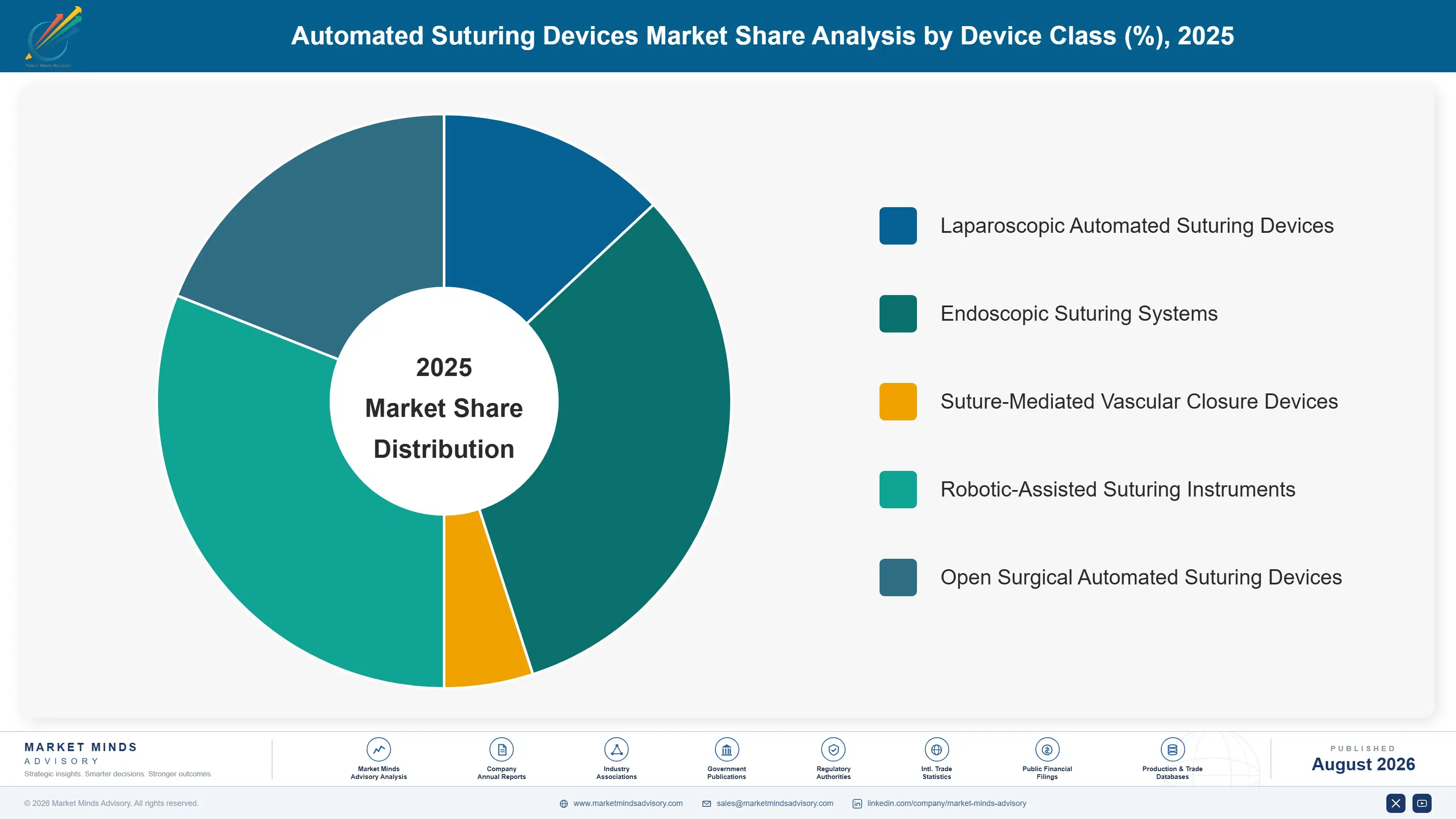
Five device classes divide this market by procedural approach, and the division separates something more useful than technique. Two classes substitute for a task surgeons already perform, two enabled procedures that did not previously exist, and the fifth follows robotic platform installation rather than any purchasing decision. That distinction predicts growth far better than device sophistication does.
automated-suturing-devices-market-market-share-analysis-1787306489659

Endoscopic Suturing Systems

Compounding at 14.4%, a full 1.50x the market rate, these systems place full-thickness sutures through a flexible endoscope and made procedures possible that nobody performed by hand. Endoscopic sleeve gastroplasty for obesity reached regulatory authorisation in 2022 and exists entirely because the device exists. Defect closure after endoscopic submucosal dissection is the other principal application, and it is largest where that technique is most established. Adoption remains concentrated in specialist endoscopy centres, so movement into general gastroenterology practice represents the substantial opportunity across the forecast period. Individual endoscopists champion these procedures and select systems without committee scrutiny, because the procedure generates revenue the hospital wants. That is an unusually direct purchase route.
CAGR 14.4%

Suture-Mediated Vascular Closure Devices

Growing at 11.0%, these devices close large-bore arterial access after transcatheter procedures, and roughly 81% of such access is now closed percutaneously rather than through surgical cutdown. Demand tracks structural heart procedure volume almost exactly, which makes forecasting unusually straightforward and concentration risk unusually high. The segment also carries technique risk that the others do not, since plug-based and collagen-based alternatives compete for the same closure decision. Operator preference forms early and persists, so the device used during a centre's first transcatheter programme tends to remain the default. Plug-based and collagen alternatives contest exactly the same closure decision with different handling characteristics, so the segment carries concentrated technique risk alongside its unusually predictable demand.
CAGR 11.0%
Full segment breakdown across 5 segments available in the complete report.

Regional Architecture and Country Demand Map

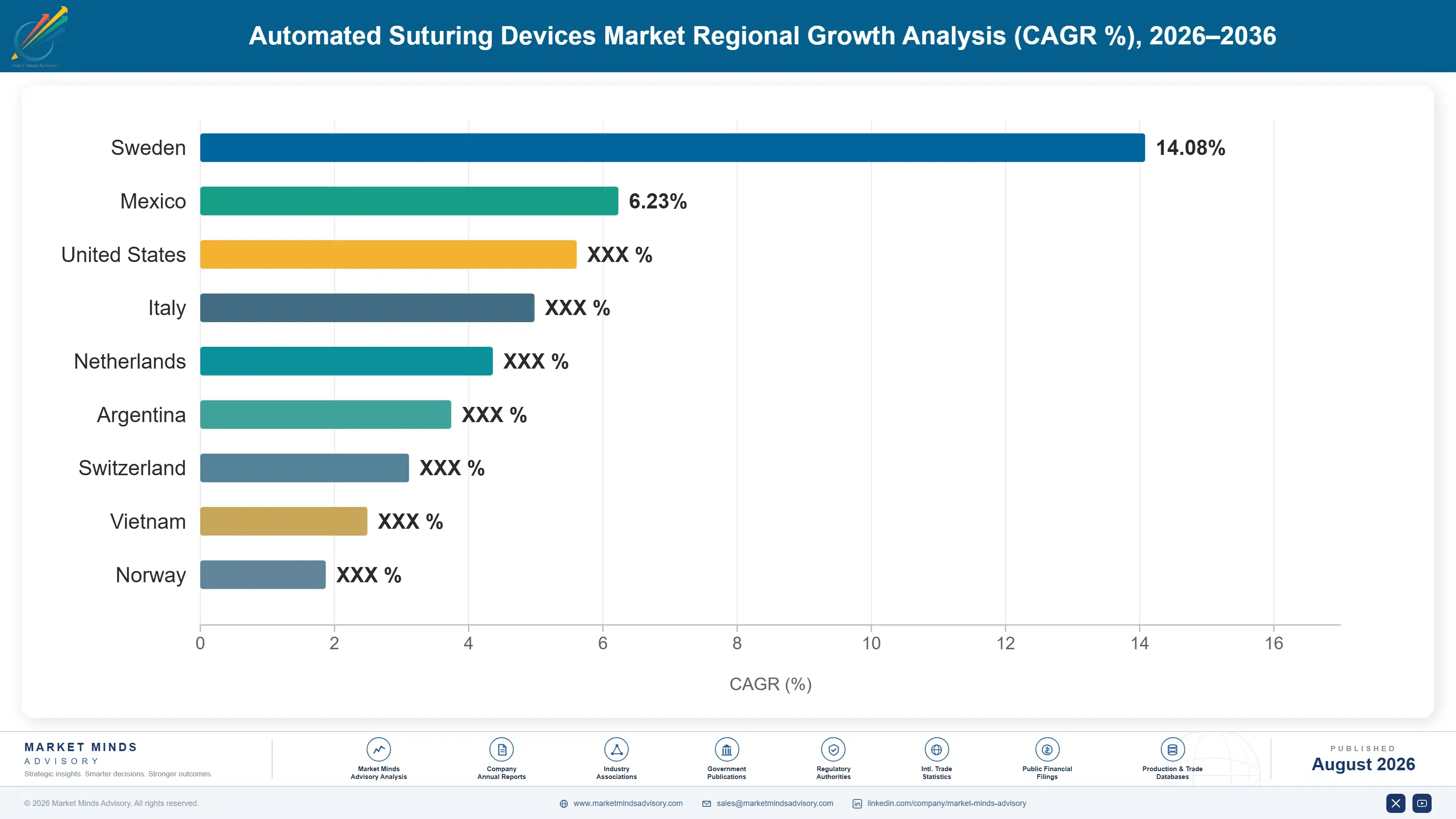
Regional distribution follows surgical volume and minimally invasive adoption, which diverge more than expected. Several very large surgical markets still perform most work through open access, where automated suturing has almost no commercial argument to make against a competent pair of hands. Access technique decides more than caseload does.

East Asia

Thirty-two per cent of global value, the largest regional position. Note: this exceeds the 22 to 30% band because China performs more surgical procedures than any other country and Japan established endoscopic submucosal dissection as routine practice, which created the defect closure application that endoscopic suturing serves. Japanese endoscopists drove that technique globally and remain its most experienced practitioners. Chinese minimally invasive adoption continues rising quickly across provincial hospitals, and domestic manufacturers compete on delivered price at the laparoscopic end while imported devices hold the endoscopic and vascular closure positions. Regional pricing sits well below North American levels across every device class covered. Endoscopic suturing adoption across Japan runs well ahead of any other market covered.
Share: 32% | CAGR: 10.6% (2026 to 2036)

North America

Twenty-eight per cent of value on far fewer procedures than East Asia, reflecting device pricing and adoption depth rather than volume. Transcatheter structural heart programmes are the most established anywhere, which makes suture-mediated large-bore closure a mature and substantial business here rather than an emerging one. Endoscopic sleeve gastroplasty received authorisation here first and adoption is furthest advanced, though still concentrated in specialist centres. Theatre time is also valued higher than in any other market, which strengthens the time-saving argument that these devices depend on. Value analysis committees scrutinise disposable device cost more rigorously here than anywhere else, which makes time-and-motion evidence a practical requirement rather than a supporting argument.
Share: 28% | CAGR: 9.2% (2026 to 2036)
Regional intelligence for 5 additional markets available in the complete report: Western Europe, South Asia and Pacific, Latin America, Middle East and Africa, Eastern Europe. Contact sales@marketmindsadvisory.com.
automated-suturing-devices-market-country-cagr-analysis-1787306490185

Where Suturing Device Value Concentrates

Competing against a surgeon's hands is a losing position, because the hands are already paid for and the device costs 45 times the suture. Value comes from procedures where hands cannot reach, from procedures that only exist because a device does, and from theatre minutes that a manager can count. All three of those avoid competing against the hands.

Target enablement rather than substitution deliberately

A device automating something a competent surgeon already does well competes against a benchmark that costs nothing incremental and rarely wins. A device making a procedure possible faces no benchmark at all, which is why endoscopic suturing compounds at 14.4% while open surgical devices manage 3.2%. Portfolio and development resource directed toward enablement applications returns several times what substitution work does. The identification is not difficult; the discipline to stop funding substitution products that engineering teams find interesting is considerably harder. Engineering teams find substitution problems more interesting, which is precisely the difficulty.
Market Impact: Enabling segment compounding at 14.

Price against theatre minutes, not against suture cost

Procurement comparing a device at 45 times the price of a suture will reject it on materials every time, and no clinical evidence changes that comparison. Theatre time valued near $62 per minute changes the arithmetic completely, and a device removing ten minutes of difficult needle work pays for itself several times over on a single case. Suppliers presenting time-and-motion data alongside a theatre cost model reported conversion roughly 50% higher than those leading with clinical outcomes. Theatre managers do this arithmetic willingly. Theatre managers do that arithmetic willingly when somebody supplies the inputs.
Market Impact: Conversion roughly 50% higher using

Win the centre during its first programme

Operator preference in vascular closure forms during a centre's first transcatheter programme and persists for years afterward, because the technique and the device are learned together under conditions nobody wants to change unnecessarily. Roughly 81% of large-bore access is now closed percutaneously, and the default device at each centre was usually chosen when that programme started. Engaging new structural heart programmes at establishment is worth several times what displacing an established default costs, and considerably more likely to succeed. Displacing an established default is expensive and rarely succeeds. Programme establishment is the only realistic entry point.
Market Impact: Closure default set across 81% of a

Solve the learning curve before it kills the trial

Consistent placement takes around 24 cases, and the surgeons who benefit most from automation are exactly those least likely to accumulate that volume quickly. Devices abandoned during evaluation are rarely reconsidered, so the first few cases decide the account. Simulation training, proctoring and structured case scheduling that concentrates early experience convert evaluations that would otherwise lapse. Participants running formal proctoring programmes reported evaluation-to-adoption conversion roughly double those relying on in-service demonstration alone. Concentrating early cases with one operator solves more than redesign would. Reaching consistent placement takes around 24 cases, and the operators who benefit most accumulate them slowest.
Market Impact: Adoption roughly 2x higher with for

Who Controls the Margin Pool

The top five hold 67% of the market measured on revenue from automated and mechanical suturing devices, the basis used throughout this section. Concentration reflects the fact that these devices reach theatres through commercial organisations already selling staplers, energy devices and access products to the same institutions. Medtronic leads on laparoscopic position while Abbott holds the deepest vascular closure franchise, and the two barely compete with each other.
Competitive activity runs along three lines. Majors are acquiring into enablement applications rather than developing substitution devices internally, with Boston Scientific's 2023 purchase of an endoscopic suturing business the clearest example. Robotic platform owners are capturing suturing instrument revenue as an automatic consequence of console installation. And vascular closure participants are competing on large-bore performance as transcatheter access calibres and volumes both increase.

Pressure comes from two directions. Plug-based and collagen alternatives contest the vascular closure decision that currently carries most of this market's growth. And laparoscopic substitution devices face competent surgeons plus low-cost manufacturers simultaneously. Rankings shift toward participants holding enablement positions, since substitution positions are squeezed from both the clinical and the cost side at once.
automated-suturing-devices-market-company-positioning-matrix-1787306490716

Competitive Moat and Risk Dimensions

MEDTRONIC

Moat: Theatre portfolio reaching same buyer

Suturing devices reach theatres through a commercial organisation already supplying staplers, energy instruments and access products to the same institutions under the same contracts, which means the device is discussed inside an existing relationship rather than requiring a new one. Surgeon familiarity built over decades also carries weight where technique and instrument are learned together.
MEDTRONIC

Risk: Slowest segment concentration

The strongest position sits in laparoscopic substitution, which grows at 6.8% and competes against experienced surgeons who suture perfectly well by hand alongside low-cost manufacturers offering comparable instruments. Robotic platforms also bring their own suturing instruments, which removes that procedure volume from open competition entirely as console installation continues expanding across every region.
ABBOTT

Moat: Vascular closure default position

Suture-mediated large-bore closure carries an operator preference that forms during a centre's first transcatheter programme and persists for years, and the company holds that default across a very large share of established structural heart programmes. Demand tracks transcatheter volume directly, which keeps growing as indications extend into younger and lower-risk patients across every developed market.
ABBOTT

Risk: Technique substitution risk concentrated

The position depends on suture-mediated closure remaining the preferred approach, and plug-based and collagen-based alternatives compete for exactly the same decision with different handling characteristics. A shift in operator preference would affect the whole franchise at once rather than gradually, and the concentration that makes the position strong also makes it exposed to a single technique judgement.

Players Tracked

Prominent Players

Medtronic
Abbott
Boston Scientific
Teleflex
Johnson and Johnson

Other Key Players

Intuitive Surgical
B. Braun
Cardinal Health
Olympus
Cook Medical
Terumo
LSI Solutions
Sutrue
Suturegard Medical
Vectec
CMR Surgical
Peters Surgical
Meril Life Sciences
Lepu Medical
MicroPort Scientific

Recent Developments

FEBRUARY 2019

First dedicated large-bore vascular closure device approved

United States regulators approved a device designed specifically for closing large-bore arterial access created by transcatheter valve and aortic procedures. The approval established that large-bore closure was a distinct clinical problem rather than an extension of standard access closure, and it opened a competitive contest that had not previously existed.
Signal: Large-bore closure became a defined device
JULY 2022

Endoscopic sleeve gastroplasty devices authorised for obesity

Regulators granted de novo authorisation to endoscopic suturing devices for endoscopic sleeve gastroplasty in the treatment of obesity, creating a procedure category that had no prior regulatory standing. The authorisation established a therapy that exists only because a device can place full-thickness sutures through a flexible endoscope.
Signal: A device authorisation created an entire p
APRIL 2023

Boston Scientific acquires endoscopic suturing business

Boston Scientific completed the acquisition of Apollo Endosurgery, bringing endoscopic suturing and the associated bariatric procedure portfolio into a large endoscopy commercial organisation. The transaction was an acquisition rather than a partnership or joint venture, and it placed an enablement technology behind considerably wider distribution.
Signal: Majors are now buying enablement positions

What Actually Costs Money Here

These are precision mechanical assemblies produced in high volume as single-use devices, which gives them an unusual cost profile. Machined and moulded components including needles, jaws, drive mechanisms and polymer housings account for roughly 38% of cost of goods, sourced from contract manufacturers in the United States, Costa Rica, Mexico and Southeast Asia. Sterilisation and validated assembly absorb around 21%, and neither scales down easily.
Medical-grade stainless steel and nitinol pricing rose materially through 2021 and 2022, and manufacturers holding fixed hospital contract prices absorbed the increase for a full cycle before repricing became possible. Device sector reporting documented that compression clearly. Ethylene oxide sterilisation capacity also tightened under emissions scrutiny, adding cost and lead time for participants dependent on external sterilisation providers with limited alternatives available. Freight and tariff exposure added a further layer.

Exposure varies by device complexity and by manufacturing footprint. Simple laparoscopic suturing instruments carry a cost structure that low-cost manufacturers can approach closely, which is why price competition is fiercest there. Endoscopic and vascular closure devices carry precision requirements and regulatory validation that meaningfully raise the barrier. Participants manufacturing in higher-cost regions without that complexity advantage face the worst of both positions simultaneously.
automated-suturing-devices-market-cost-volatility-analysis-1787306490913

Design complexity as a competitive barrier

Devices simple enough to copy attract low-cost competition quickly, and price then decides awards regardless of clinical performance. Concentrating development on mechanisms requiring precision assembly and substantial regulatory validation raises the entry cost meaningfully. The trade is manufacturing cost and yield, which has to be modelled honestly rather than assumed away during design. Few participants model it honestly.

Qualify alternative sterilisation modalities early

Ethylene oxide capacity has tightened under emissions scrutiny and participants dependent on a single external provider carry genuine lead-time exposure. Validating radiation or vaporised hydrogen peroxide alternatives requires material compatibility that is decided at design stage rather than afterward, so the option either exists from the beginning or does not exist at all. Retrofitting the choice later is rarely practical.

Index-linked terms in multi-year hospital contracts

Fixed-price commitments through recent metal price movement cost manufacturers a full contract cycle of compressed margin with no recourse. Index adjustment clauses transfer that risk, and hospital purchasing groups increasingly accept them because the alternative is suppliers pricing volatility into every bid. The index choice and trigger threshold decide most of the value. Purchasing groups increasingly accept them.

Portfolio Architecture for Margin Defence

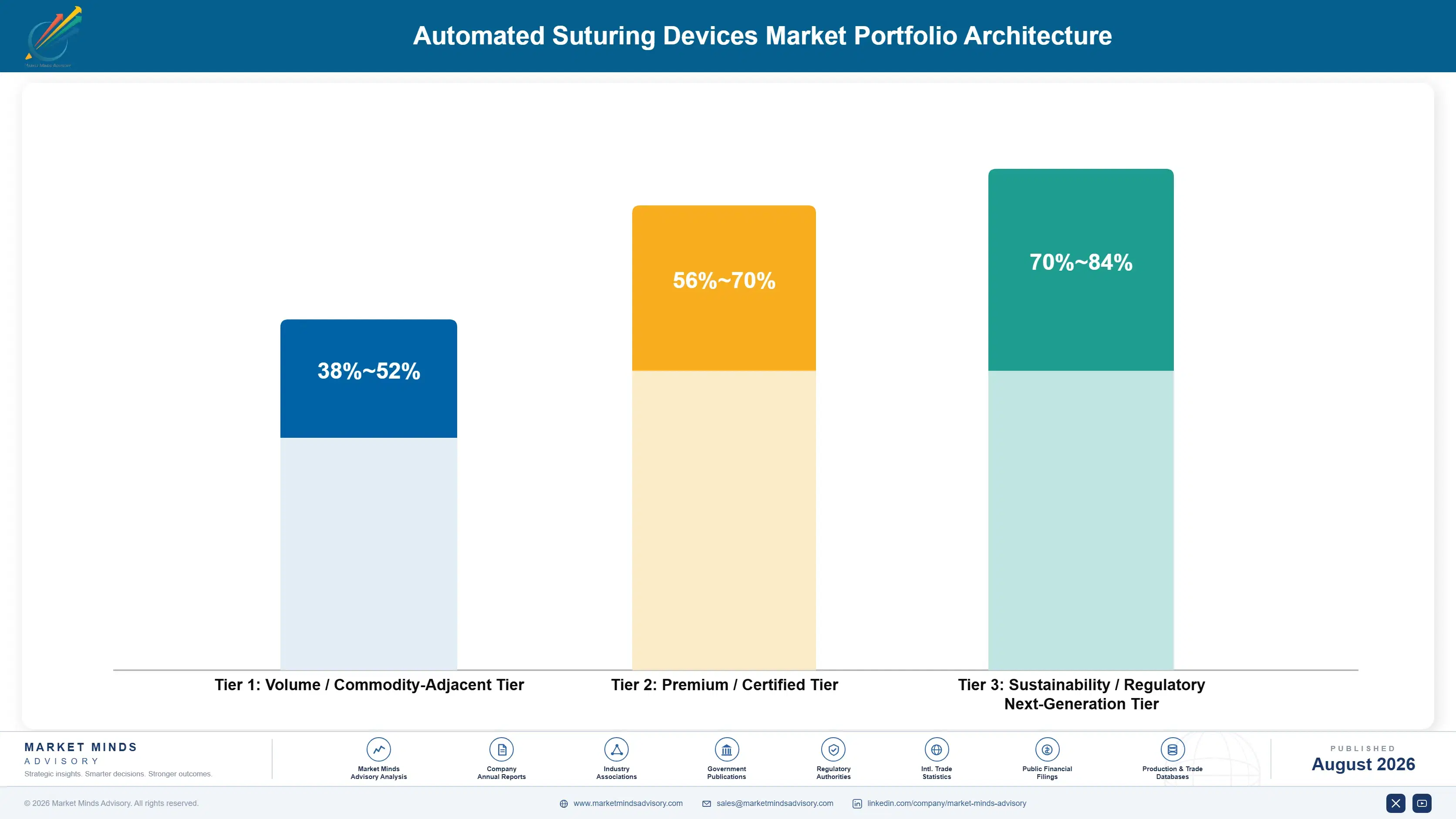
Margin architecture separates cleanly by whether the device competes against a surgeon or against nothing. Laparoscopic and open suturing instruments compete against hand technique and against low-cost manufacturers producing comparable mechanisms, holding gross margin in the forties. Endoscopic suturing and large-bore vascular closure face no manual alternative at all, and both clear well above seventy per cent on precision requirements competitors cannot approach quickly.
The tension is between installed familiarity and growth. Laparoscopic instruments carry the surgeon relationships, theatre presence and contract position that everything else reaches hospitals through, yet they grow at 6.8% under pressure from both directions. Enablement devices carry the growth and the margin but reach far fewer procedures. No participant has built a viable position on enablement alone. Robotic instruments sit outside that trade entirely, since platform ownership rather than commercial effort determines who captures them.

High-value pools concentrate where no manual technique exists to serve as a benchmark. Endoscopic full-thickness suturing, large-bore percutaneous closure and robotic platform instruments all sit there. Everything automating a task that a competent surgeon performs quickly and cheaply by hand competes against an operator whose skill is already paid for and appears as no incremental cost anywhere.

Volume / Commodity-Adjacent Tier

Open surgical and basic laparoscopic suturing instruments competing against hand technique and against low-cost manufacturers producing comparable mechanisms, where delivered price decides awards in most tender processes. Hand technique competes here as well.
Gross Margin: 38-52%

Premium / Certified Tier

Advanced laparoscopic suturing devices and robotic platform instruments, protected by surgeon familiarity, platform exclusivity and theatre contract position rather than by any manufacturing capability competitors lack. Platform ownership decides the robotic portion entirely.
Gross Margin: 56-70%

Sustainability / Regulatory / Next-Generation Tier

Endoscopic full-thickness suturing systems and large-bore vascular closure devices, defended by the absence of any manual alternative and by regulatory positions establishing procedures that did not previously exist. No manual alternative exists to serve as a benchmark.
Gross Margin: 70-84%
automated-suturing-devices-market-portfolio-architecture-1787306491416

High-value Sub-segments and Strategic Watch-out

Endoscopic Suturing Systems

High value and the fastest growth at 14.4%, enabling procedures that nobody performed by hand rather than improving existing technique. Movement from specialist endoscopy centres into general gastroenterology practice is the substantial opportunity ahead. Individual endoscopists select these systems without committee scrutiny, which is an unusually direct route.
Gross Margin: 72-84%

Suture-Mediated Vascular Closure

High value at 11.0%, tracking transcatheter structural heart volume almost exactly and closing roughly 81% of large-bore access. Predictable demand and concentrated technique risk arrive together in this segment. Plug-based alternatives contest the same decision, so concentration cuts both ways here. Defaults set at programme establishment persist for years.
Gross Margin: 70-82%

Laparoscopic Automated Suturing

The volume core at 6.8%, carrying surgeon relationships and theatre contract position that everything else reaches hospitals through. Squeezed by competent hand technique above and low-cost manufacturers below simultaneously. Theatre time evidence is the only argument that has held ground in this segment recently. Nothing else has held.
Gross Margin: 48-62%

Robotic-Assisted Suturing Instruments

The strategic watch-out at 10.2%. Growth is solid and entirely captured by platform owners, since consoles consume proprietary instruments that no independent participant can supply at any price. Independent participants cannot enter this pool at all, whatever they build or however they price it. Ownership decides it.
Gross Margin: 62-74%

Who Chooses and What Repeats

Revenue arrives per procedure through single-use devices, which produces genuine recurring demand once a technique is established. The economics turn on procedure volume rather than on account count, and a single high-volume bariatric or structural heart programme can be worth more than a dozen general surgical accounts. That makes account selection considerably more important than account quantity, and most commercial organisations underweight it.
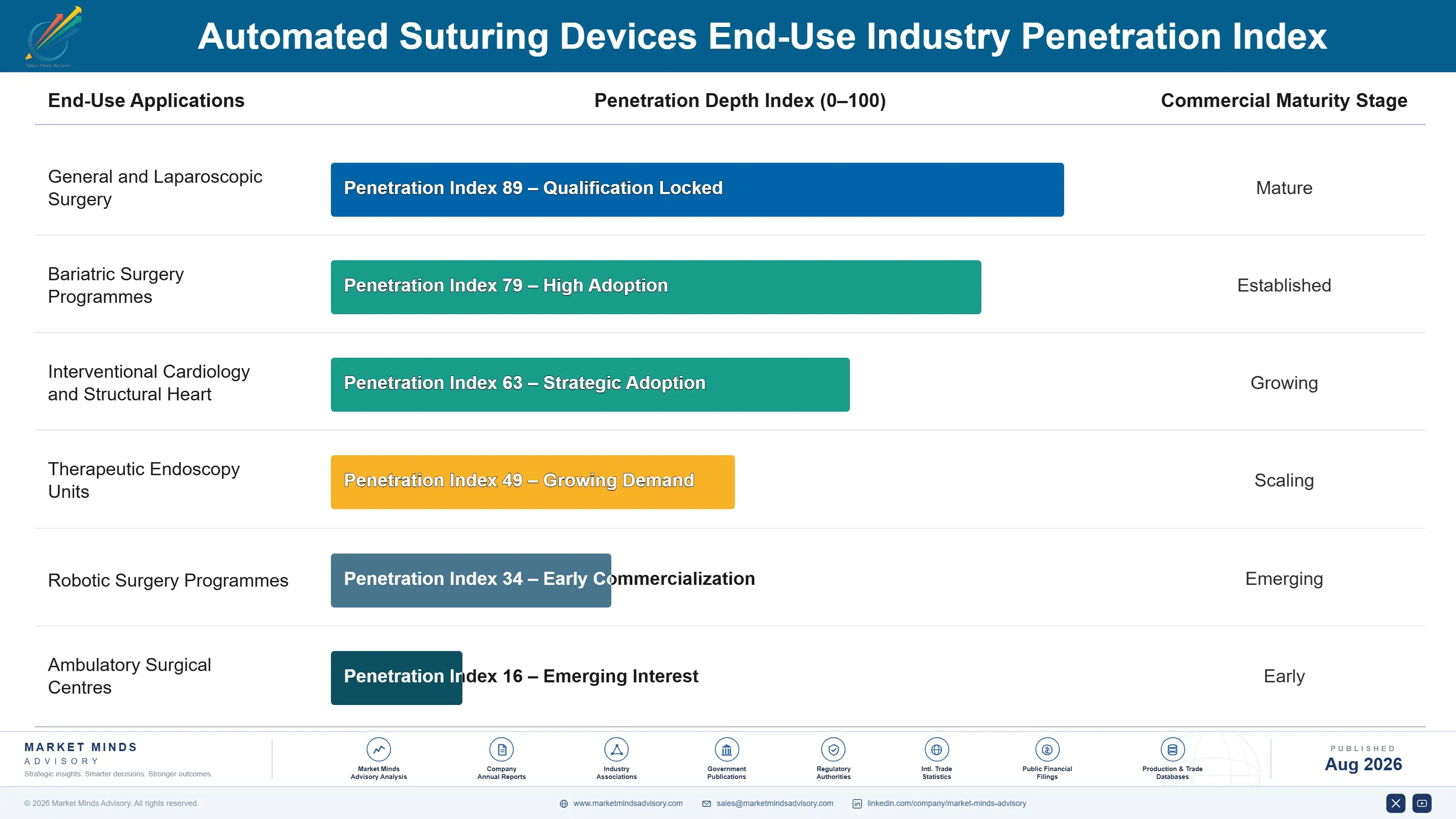
Adoption depth varies sharply by application. Vascular closure is the stickiest, since the device chosen during a centre's first transcatheter programme becomes the default and persists for years. Endoscopic suturing follows closely, because the procedure and the system are learned together. Laparoscopic suturing is the loosest by a wide margin, with surgeons switching between devices and hand technique case by case depending on what the situation requires.

The deciding voice differs by segment in a way that shapes commercial approach. Vascular closure is chosen by interventional cardiologists and set programme-wide. Endoscopic suturing is chosen by individual endoscopists who champion the procedure. Laparoscopic devices are increasingly decided by value analysis committees weighing disposable cost, where the surgeon recommends and finance decides. Selling all three through one commercial motion reaches none of them properly.
automated-suturing-devices-market-end-use-penetration-index-1787306491916

Where Value Actually Sits

These are among the four positions where our research anticipates prominent divergence between winners and laggards over the coming forecast period. Each is grounded in the demand model, the regulatory perimeter, and the announced capacity pipeline.
01 / ENABLEMENT PORTFOLIO PRIORITY

Never compete with a surgeon's hands

A device automating something a competent surgeon already performs quickly competes against surgical skill that is already paid for and appears as no incremental cost to anybody at all. A device making a procedure possible faces no benchmark whatsoever, which is exactly why endoscopic suturing compounds at 14.4% while open surgical devices manage only 3.2%. Development resource directed toward enablement applications returns several times what substitution work does, and finding the discipline to stop funding substitution is by far the harder part.
02 / THEATRE MINUTE PRICING

Materials arithmetic loses; time arithmetic wins

Procurement comparing a device priced at roughly 45 times a conventional suture will reject it on materials cost alone every single time, and no clinical evidence package alters that particular comparison. Theatre time valued near $62 per minute reverses the arithmetic completely, since removing ten minutes of difficult needle work pays for the device several times over. Suppliers presenting time-and-motion data alongside a theatre cost model reported conversion running roughly 50% higher than clinical-outcome selling had ever achieved for them.
03 / FIRST PROGRAMME CAPTURE

Defaults are set when the programme starts

Operator preference in vascular closure forms during a centre's very first transcatheter programme and then persists for years, because the technique and the device are learned together under conditions nobody wants to disturb. Roughly 81% of large-bore arterial access is now closed percutaneously, and each centre's default device was generally chosen at establishment. Engaging new structural heart programmes at that precise moment is worth several times what displacing an established default costs, and it is very much more likely to succeed.
04 / LEARNING CURVE MANAGEMENT

The first cases decide the account permanently

Reaching consistent placement takes around 24 cases, and the surgeons who would benefit most from automation are precisely those least likely to accumulate that case volume quickly enough to ever get there. Devices abandoned partway through an evaluation are almost never reconsidered by that institution afterward, so those very early cases decide the account outright and permanently. Participants that ran formal proctoring and structured simulation programmes reported evaluation-to-adoption conversion running roughly double what in-service demonstration alone had ever delivered them.

Engagement Snapshot From the Field

A live engagement with an industry participant carrying material or product regulatory and market exposure ahead of a defining policy shift, showing how our research translates into a defensible multi-year portfolio strategy.
MARKET MINDS ADVISORY · CLIENT ENGAGEMENT SUMMARY
Automated Suturing Devices Producer Strategic Portfolio Review and Transition Roadmap 2026·Investment Scenario on Automated Suturing Devices Exposure Evaluation 2025-26
CLIENT PROFILE
A surgical device manufacturer with annual revenue near $510 million (client-reported, unverified by MMA), holding a laparoscopic suturing instrument range sold across Europe and North America alongside general surgical instrumentation. Laparoscopic suturing revenue had been flat for four years under pressure from low-cost competitors and from surgeons reverting to hand technique, and leadership needed to decide where to redirect development investment.
STRATEGIC CHALLENGE
The engineering organisation favoured a next-generation laparoscopic device with improved ergonomics, while commercial leadership suspected the segment itself was the problem rather than the product within it. The company needed to establish whether any laparoscopic suturing device could escape competition from hand technique, and what an enablement position would cost to reach.
MMA APPROACH
We interviewed 52 laparoscopic surgeons, endoscopists and interventional cardiologists on device selection, hand technique preference and what would change their behaviour. Value analysis committee decisions were reviewed across 31 hospitals to identify how disposable cost was actually evaluated. We modelled a laparoscopic product refresh against acquisition or licensing into an enablement application.
KEY FINDINGS
  1. Thirty-eight of 52 laparoscopic surgeons said they reverted to hand suturing whenever the anatomy permitted, and none identified device ergonomics as the reason they did so.
  2. Value analysis committees rejected laparoscopic suturing devices on disposable cost in 24 of 31 hospitals reviewed, and time-and-motion evidence had been presented in only four of those cases.
  3. Endoscopists championing endoscopic sleeve procedures selected systems individually and faced no committee scrutiny at all, because the procedure generated revenue the hospital wanted.
  4. A next-generation laparoscopic device modelled at three years of development against a segment growing at 6.8%, with no mechanism identified for escaping hand technique competition.
CLIENT PROFILE
A surgical device manufacturer with annual revenue near $510 million (client-reported, unverified by MMA), holding a laparoscopic suturing instrument range sold across Europe and North America alongside general surgical instrumentation. Laparoscopic suturing revenue had been flat for four years under pressure from low-cost competitors and from surgeons reverting to hand technique, and leadership needed to decide where to redirect development investment.
STRATEGIC CHALLENGE
The engineering organisation favoured a next-generation laparoscopic device with improved ergonomics, while commercial leadership suspected the segment itself was the problem rather than the product within it. The company needed to establish whether any laparoscopic suturing device could escape competition from hand technique, and what an enablement position would cost to reach.
MMA APPROACH
We interviewed 52 laparoscopic surgeons, endoscopists and interventional cardiologists on device selection, hand technique preference and what would change their behaviour. Value analysis committee decisions were reviewed across 31 hospitals to identify how disposable cost was actually evaluated. We modelled a laparoscopic product refresh against acquisition or licensing into an enablement application.
KEY FINDINGS
  1. Thirty-eight of 52 laparoscopic surgeons said they reverted to hand suturing whenever the anatomy permitted, and none identified device ergonomics as the reason they did so.
  2. Value analysis committees rejected laparoscopic suturing devices on disposable cost in 24 of 31 hospitals reviewed, and time-and-motion evidence had been presented in only four of those cases.
  3. Endoscopists championing endoscopic sleeve procedures selected systems individually and faced no committee scrutiny at all, because the procedure generated revenue the hospital wanted.
  4. A next-generation laparoscopic device modelled at three years of development against a segment growing at 6.8%, with no mechanism identified for escaping hand technique competition.
RECOMMENDED STRATEGY
Phase 1: Phase one: halt the next-generation laparoscopic programme and redirect that development budget toward an enablement application with no manual alternative. Phase 2: Phase two: rebuild laparoscopic commercial argument around theatre time evidence rather than clinical performance, defending the existing base without further investment. Phase 3: Phase three: pursue licensing into endoscopic or closure applications rather than internal development, given the regulatory pathway length involved. Internal build takes too long.
OUTCOME
The laparoscopic development programme was cancelled and the budget redirected within one quarter. Theatre time positioning stabilised laparoscopic revenue for the first time in four years (client-reported, unverified by MMA). Licensing discussions opened with two endoscopic device developers, and one advanced to term sheet during the second year.

Frequently Asked Questions

Foundational context covering the market sizes, CAGR, scope, country, region and competition that inform every finding below. This section is provided to cover basics and most often pre-purchase conversations, answered from the MMA Primary Research Dataset.

What is the current size of the Automated Suturing Devices Market?

The global market is valued at $3.4 billion in 2025, rising to $3.73 billion in 2026. East Asia holds the largest share at 32%, reflecting surgical volume and established endoscopic submucosal dissection practice.

How large will the Automated Suturing Devices Market be by 2036?

MMA forecasts $9.32 billion by 2036, an increase of $5.59 billion over the 2026 base and an expansion multiple of 2.50x. Endoscopic suturing and vascular closure carry most of that growth.

What is the CAGR for the Automated Suturing Devices Market 2026 to 2036?

The base case compound annual growth rate is 9.6%, with a bull case at 10.8% and a bear case at 8.4%. Historical growth from 2020 to 2025 ran near 8.2%, carried almost entirely by two applications.

Which segment is growing fastest?

Endoscopic suturing systems compound at 14.4%, a full 1.50x the market rate. These devices enabled procedures nobody performed by hand rather than improving techniques surgeons already used.

Who are the major companies in the Automated Suturing Devices Market?

Medtronic, Abbott, Boston Scientific, Teleflex and Johnson and Johnson together hold 67% of revenue from automated and mechanical suturing devices. Medtronic leads laparoscopic while Abbott holds the vascular closure position.

Which country is growing fastest?

India compounds at 13.2%, faster than any other country covered, as private hospital groups expand minimally invasive capacity and bariatric volumes rise among urban populations. Device pricing remains a genuine constraint there.

Report Segmentation Architecture

The full report scope spans multiple orthogonal segmentation dimensions, with cross-tabulated demand data provided for each dimension pair. Coverage extends further to regional breakdowns, trend trajectories, and the competitive detail needed to support segment-level decision-making.

By Device Class

  • Laparoscopic Automated Suturing Devices
  • Endoscopic Suturing Systems
  • Suture-Mediated Vascular Closure Devices
  • Robotic-Assisted Suturing Instruments
  • Open Surgical Automated Suturing Devices

By End-Use Industry

  • General and Laparoscopic Surgery
  • Bariatric Surgery Programmes
  • Interventional Cardiology and Structural Heart
  • Therapeutic Endoscopy Units
  • Robotic Surgery Programmes
  • Ambulatory Surgical Centres

By Commercial Dimension

  • Hospital Tender Procurement
  • Group Purchasing Organisation Agreements
  • Value Analysis Committee Approval
  • Direct Surgeon-Led Adoption
  • Specialty Distributor Supply
  • Robotic Platform Bundled Supply

By Region

  • East Asia
  • North America
  • Western Europe
  • South Asia and Pacific
  • Latin America
  • Middle East and Africa
  • Eastern Europe

Scope, Methodology, and Coverage

Every figure in this report is reproducible from documented input assumptions. The scope below maps the historical period, the forecast horizon, the segmentation dimensions, and the countries covered, alongside the underlying primary and qualitative methodology.
Historical Period
2020 to 2025
Forecast Period
2026 to 2036
Base Year
2025 (USD billions; MMA Primary Research Dataset, August 2026)
Market Definition
This market comprises devices that place, pass, tie or secure surgical sutures through mechanical or automated action, measured at manufacturer revenue across hospital tender procurement, group purchasing organisation agreements, value analysis committee approved supply, direct surgeon-led adoption, specialty distributor supply, and robotic platform bundled supply. Coverage spans laparoscopic automated suturing devices operating through cannulae, endoscopic suturing systems placing full-thickness sutures through flexible endoscopes, suture-mediated vascular closure devices for large-bore and standard arterial access, robotic-assisted suturing instruments supplied exclusively for specific surgical platforms, and open surgical automated suturing devices. Surgical staplers, clip appliers and tissue-joining devices that do not place sutures, conventional needle holders and manual surgical instruments, suture material sold independently of a placement device, tissue adhesives, sealants and haemostatic agents, collagen-plug and non-suture vascular closure devices, orthopaedic suture anchors and their delivery systems, and endoscopic clipping devices fall outside scope.
Quantitative Units
USD millions (current prices); devices shipped by class; procedures performed; average selling price by class; percutaneous closure rate; theatre time saved per case; learning curve case count
Segmentation Dimensions
By Device Class; By End-Use Industry; By Commercial Dimension; By Region
Regions Covered
East Asia, North America, Western Europe, South Asia and Pacific, Latin America, Middle East and Africa, Eastern Europe
Countries Covered
China, Japan, South Korea, Taiwan, United States, Canada, Germany, France, Italy, Spain, United Kingdom, Netherlands, Belgium, Sweden, Switzerland, India, Australia, Singapore, Thailand, Malaysia, Indonesia, Brazil, Mexico, Argentina, Chile, Colombia, Saudi Arabia, United Arab Emirates, Israel, Egypt, South Africa, Poland, Czechia, Hungary, Romania, Turkey, and additional markets relevant to surgical device analysis
Key Companies Profiled
Medtronic, Abbott, Boston Scientific, Teleflex, Johnson and Johnson, Intuitive Surgical, B. Braun, Cardinal Health, Olympus, Cook Medical, Terumo, LSI Solutions, Sutrue, Suturegard Medical, Vectec, CMR Surgical, Peters Surgical, Meril Life Sciences, Lepu Medical, MicroPort Scientific
Quantitative Methodology
Primary survey, n=3,800 respondents, Q4 2025, six countries; demand-side model with trade association cross-validation
Qualitative Methodology
47 expert interviews, Q4 2025; applied to validate demand model assumptions, identify emerging dynamics, and assess competitive positioning
Report Format
PDF and XLSX data workbook (Word format preview document)
Publisher
Market Minds Advisory
Report Code
MMA-2026-MED-500
Published
August 2026
Contact
sales@marketmindsadvisory.com | www.marketmindsadvisory.com

Purchase the full Automated Suturing Devices Market Report (2026 to 2036).

The full MMA report separates devices that substitute for a surgeon's hands from those that made procedures possible, and shows why only the second group earns its price. It sizes five device classes and seven regions to 2036, modelling devices shipped, procedure volumes, pricing by class, percutaneous closure rates, theatre time saved and learning curve length separately. Competitive assessment covers twenty manufacturers on one consistent revenue basis. Cost exposure is traced through components, metals and sterilisation. Four commercial levers and a strategic verdict close the report, grounded in 47 expert interviews and a 3,800-respondent survey.
Five device classes sized separately through 2036
Enablement and substitution applications separated and modelled distinctly
Value analysis committee decisions reviewed across covered hospital systems
Twenty manufacturers assessed on one consistent revenue basis
Theatre time economics modelled against disposable device pricing
Anonymised manufacturer engagement with tested portfolio recommendations

Built For The People Who Decide

From boardroom strategy to bench-side execution, this report is read cover-to-cover by leaders shaping the next decade of their industry, turning demand scenarios, market dynamics and valuation benchmarks into decisions.
CXOs/ Presidents/ VPs/ Managers
M&A and Corporate Development
Strategy Teams and R&D Heads
Procurement and Product Directors
Regulatory and Compliance Leaders
Investor Relations and Equity Analysts