Market Minds Advisory
Automated Process Control System Market

Automated Process Control System Market: Obsolescence, Compliance Deadlines, And The Engineers Who Are Retiring

A distributed control system outlives the engineers who configured it. Roughly two-fifths of installed controllers now sit past vendor support, and the people who know what the logic actually does are retiring.

Lead Analyst

David Horsley

Published

September 2026

Make Smarter Decisions with Customized Research Insights

Request a free sample report and evaluate market opportunities, growth trends, and competitive dynamics relevant to your business needs.

2025 MARKET VALUE$32.6BMarket Size 2025
2036 FORECAST VALUE$67.9BBase Case , 2026 to 2036
CAGR 2026 TO 20366.9 %Bull 8.2% / Bear 5.7%
INCREMENTAL OPPORTUNITY$33.1BNet 10- year value creation
EXPANSION MULTIPLE1.95x2036 value over 2026 base
Strategic Levers
M&A Pipeline
Regional Outlook
Country Rankings
Competitive Intelligence
Segmental Deep-dive
Call-Us : 91 93563 13602

Executive Snapshot and Market Trajectory

A control system runs for 25 to 30 years, which makes this the stickiest installed base in industrial technology and one of the slowest to grow. About 38% of installed controllers now sit past vendor support. The market reaches USD 32.6 billion in 2025 at 6.9%.
Advanced process control software grows fastest at 12.8%, about 1.86 times the market rate, because an optimisation package costs a fraction of a system migration and delivers a measurable yield gain on the plant already installed. North America holds 29% of value on refining, chemicals, and an unusually old installed base. East Asia takes 25% on new process capacity, and Western Europe 22%. Regional weight follows plant age closely.
Concentration runs at 56%, held there by an installed base that almost never changes vendor, since replacing a control system means revalidating every interlock in the plant. Competition has therefore moved to migration economics, cybersecurity certification, and the scarce engineering capacity that any project consumes. Services already carry 43% of revenue. The binding constraint in this market is not technology or capital; it is the number of control engineers available to do the work.
Market Definition
The automated process control system market covers the control architectures that regulate continuous and batch process plants: distributed control systems, programmable controller based process control, supervisory control and data acquisition, safety instrumented systems, and advanced process control software, together with the engineering, migration, and lifecycle services supplied around them. Discrete factory automation, field instrumentation and sensors, valves and actuators, and enterprise planning software are excluded.
Base Year Value
$32.6B in 2025 (MMA Primary Research Dataset, August 2026)
Forecast Period
2026 to 2036, eleven discrete annual values
CAGR
6.9% base case. Bull 8.2%. Bear 5.7%.
Fastest Growth Segment
Advanced Process Control and Optimisation Software: 12.8% CAGR
Fastest Growth Country
India: 9.8% CAGR
Fastest Growth Region
South Asia and Pacific: 9.0% CAGR
Largest Region
North America: 29% of 2025 global value
Market Leaders
Honeywell, Emerson Electric, ABB, Yokogawa Electric, Siemens. Source: MMA Primary Research Dataset, July 2026.
Primary Survey
n=3,800 procurement and R&D decision-makers, Q4 2025, six countries
Methodology
Demand-side build-up, cross-validated against public data, 47 expert interviews

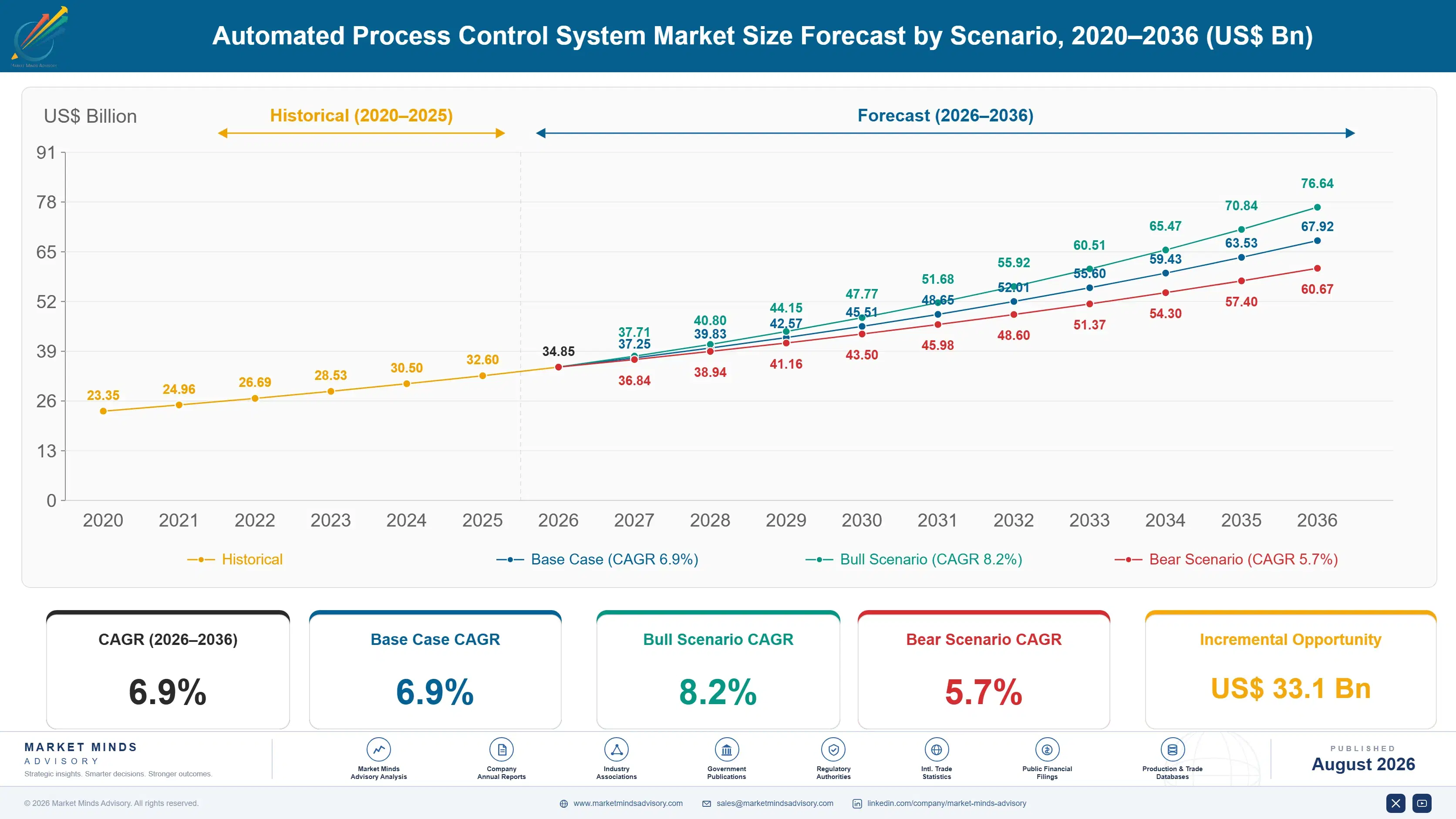
Automated Process Control System Market Forecast Scenarios

automated-process-control-system-market-size-forecast-scenario-1787332472625
Between 2020 and 2025 capital projects were deferred and the installed base aged anyway. Refining and chemical operators postponed migrations through the pandemic and then through expensive capital, while the controllers running their plants passed twenty-five years. Software and services grew steadily throughout because they needed no capital committee. A 5.6% historical CAGR is almost entirely those two lines carrying a flat hardware business.
Three mechanisms carry the 6.9% base case. Obsolescence is the largest and least avoidable: 38% of installed controllers sit past vendor support, spares come from brokers, and an unsupported system eventually stops a plant rather than worrying anybody. IEC 62443 cybersecurity certification is becoming a procurement condition, and a system designed in 1998 cannot be patched into compliance. And advanced process control keeps selling because it pays back inside a year on the existing plant.
The 8.2% bull case turns on the migration backlog releasing as process operators accept that deferral has become more expensive than the project. The 5.7% bear case is engineering capacity, not demand: there are not enough control engineers to execute the projects already committed, and a migration cannot be run by anybody who has not done one. Both scenarios are supply-side.

The Installed Base Nobody Wants To Touch

Nothing in industrial technology sticks like a control system. Replacing one means re-engineering every control loop, revalidating every interlock, retraining every operator, and shutting the plant to do it, which is why a distributed control system runs 25 to 30 years and changes vendor roughly never. A typical mid-size plant project runs USD 2.4 million, and the incumbent wins it because the alternative is unthinkable rather than because the product is better.
TOP FIVE CONCENTRATION56%Installed base lock keeps participation narrower than software markets
AVERAGE PROJECT VALUEUSD 2.4 millionTypical control system scope on a mid-size process plant
SYSTEM SERVICE LIFE25 to 30 yearsOperating years before a control system migration becomes unavoidable
PAST-SUPPORT INSTALLED SHARE38%Portion of installed controllers no longer covered by vendor support
SERVICES REVENUE SHARE43%Engineering, migration, and lifecycle support beyond the hardware sale
LEADING PRODUCER SHARE31%Manufacturing and engineering concentrate where process industries invest most
That stickiness has produced a genuine problem. Roughly 38% of installed controllers are past vendor support, running on brokered spares and undocumented logic whose authors are now retiring. Operators know this and defer anyway, because a migration is a capital project with a shutdown attached and the plant is currently running. The obsolescence gets resolved by a failure or by a regulator, rarely by a plan.
Services already carry 43% of revenue and the share keeps rising, which tells you where the business actually is. Engineering, migration execution, and lifecycle support recur across a thirty-year installation and cannot be bought from anybody who does not know the plant. The hardware is increasingly a commodity wrapped in an engineering relationship, and vendors who understand that price accordingly.
"The controller is not the asset. The asset is thirty years of control strategy that somebody worked out on a night shift in 1996 and never wrote down. When that person retires, the plant loses more than the vendor ever supplied."
Director, Process Automation Practice · MMA Technology Practice ·

Market Trends

Advanced Process Control Sells Without A Capital Committee

An optimisation package tightens control around a constraint the plant already operates near, which typically recovers one to three per cent of yield or throughput without touching hardware. The cost is a fraction of a migration and the payback lands inside a year, so it clears as operating expenditure rather than going to a capital committee that meets twice annually. That procurement difference explains more of the 12.8% growth rate than the technology does. Vendors have noticed and now lead with software on plants they have no chance of re-controlling for another decade.
Market Impact: About 38% past vendor support

Cybersecurity Certification Becomes A Procurement Condition

IEC 62443 compliance is moving from a differentiator to a requirement in operator specifications, insurance conditions, and increasingly in national critical infrastructure rules. The awkward part is that certification is architectural: a control system designed in 1998 has flat networks, shared credentials, and protocols with no authentication concept, and no patch programme changes any of that. Operators who assumed cybersecurity was a firewall project are discovering it is a migration trigger. That converts a deferred capital item into a compliance obligation with a date attached, which is the only argument that reliably moves a process plant.
Market Impact: Safety systems grow at 8.4%

Market Opportunities and Growth Drivers

Obsolescence Forces Migration On An Unavoidable Schedule

Roughly 38% of installed process controllers are past vendor support, which means no spares, no firmware fixes, and no engineering help when something behaves oddly at three in the morning. Plants run them anyway, sourcing boards from brokers and cannibalising decommissioned units, until an unrecoverable failure makes the decision for them. The cost of an unplanned shutdown in a refinery or a specialty chemical plant runs into millions per day, which dwarfs the migration nobody wanted to fund. This is the most dependable demand mechanism in the category and the one operators most consistently underestimate.
Market Impact: Delivery capacity trails demand by

Safety Instrumented System Rules Require Independent Architecture

IEC 61511 requires a safety instrumented system to be independent of the basic process control system, which means separate logic solvers, separate certification, and documented proof testing on a defined interval. Operators cannot satisfy that with a spare card in the DCS rack, however tempting the economics look. Regulatory inspection and insurance requirements both check the independence directly. As process plants add capacity and as older installations reach proof test intervals they cannot demonstrate, safety systems grow at 8.4% against a basic control layer growing at less than half that rate.
Market Impact: Turnaround windows planned 3 years

Market Restraints and Challenges

Control Engineering Capacity Constrains Every Migration Project

A control system migration needs engineers who can read three decades of accumulated logic, understand what the plant actually does, and rebuild it without losing a single interlock. Those people are scarce and getting scarcer, since the generation who configured these systems is retiring and the graduates entering the field learn software rather than process. The root cause is thirty years of low migration activity, which meant nobody was training migration engineers. Commercially this caps industry delivery capacity below committed demand. Vendors are mitigating with automated configuration conversion tools, offshore engineering centres, and their own training programmes.
Market Impact: Recovers 1 to 3 percent yield

Migration Requires A Shutdown Operators Will Not Schedule

Cutting over a control system means stopping the plant, and in a continuous process a planned outage costs production the operator has already sold forward. The root cause is that most process plants run at high utilisation with turnaround windows planned years ahead, so a migration must fit an existing shutdown or wait for the next one. Commercially this stretches project timelines and pushes revenue recognition years out. Vendors are mitigating with hot cutover techniques, phased migration that keeps field wiring in place, and interface layers that let old and new controllers coexist during transition.
Market Impact: IEC 62443 not achievable by patchin
3 additional market trends, 4 additional growth drivers, and 2 additional restraints and challenges are covered in the full report. Contact sales@marketmindsadvisory.com to access the complete intelligence.

Segment CAGR and Growth Architecture

Segmentation follows control architecture, meaning which layer of plant control a system performs and how independently it must operate. That distinction is not stylistic: safety systems are required by standard to sit apart from basic control, and optimisation software sits above both. End-use industry, plant size, and deployment model are handled separately in the framework.
automated-process-control-system-market-market-share-analysis-1787332473163

Advanced Process Control and Optimisation Software

Advanced process control grows fastest at 12.8%, about 1.86 times the market rate, and the reason is procurement rather than technology. An optimisation package runs on top of whatever control system the plant already has, recovers one to three per cent of yield or throughput by holding operation closer to a constraint, and pays back inside a year. That clears as operating expenditure rather than passing a capital committee, which is a different approval path entirely. Vendors sell it into plants they will not re-control for a decade, which keeps a commercial relationship alive on hardware they cannot replace. Data quality from ageing instrumentation is the practical limit. Bad measurements defeat good mathematics every time.
CAGR 12.8%

Safety Instrumented Systems

Safety instrumented systems grow at 8.4%, well ahead of the basic control layer, because a standard rather than a business case drives the purchase. IEC 61511 requires the safety function to be independent of process control, with separate logic solvers, separate certification, and documented proof testing at defined intervals. An operator cannot economise by folding it into the DCS, and both regulators and insurers check that directly. Older installations that cannot demonstrate their proof test history are being replaced regardless of whether the hardware still works. Demand here is set by inspection schedules rather than by production economics, which makes it unusually predictable. Nobody argues with a regulator about a proof test.
CAGR 8.4%
Full segment breakdown across 7 segments available in the complete report.

Regional Architecture and Country Demand Map

Regional shares split between two very different demand types: replacing controllers installed decades ago, and controlling process capacity being built now. North America and Western Europe supply the first, East Asia and South Asia the second, and the economics of the two barely resemble each other. Growth follows plant age.

North America

North America holds 29% of value, and the driver is age rather than growth. Gulf Coast refining and petrochemical capacity was largely controlled in the late 1980s and 1990s, which puts an unusually large installed population inside the obsolescence window at once. Shale gas processing added a newer layer that is now itself approaching first migration. Cybersecurity requirements under critical infrastructure rules add a compliance trigger that capital deferral cannot answer. Growth at 6.6% sits slightly below the global rate only because engineering capacity, not demand, limits how many migrations can actually be executed each year. The backlog here is considerably larger than the annual delivery rate can absorb at present.
Share: 29% | CAGR: 6.6% (2026 to 2036)

Western Europe

Regulation and plant age together explain Western Europe's 22% share. German, Dutch, and Belgian chemical clusters run installations of similar vintage to the American Gulf Coast, and European functional safety practice under IEC 61511 is applied more strictly than almost anywhere. The NIS2 Directive extends cybersecurity obligations across operators of essential services, which brings control system architecture into scope for facilities that had never treated it as a compliance question. Growth at 5.4% is the slowest of any region, reflecting limited new process capacity and chemical sector capital discipline that has tightened considerably since energy prices moved. Compliance is doing the work that any commercial argument here plainly cannot manage alone.
Share: 22% | CAGR: 5.4% (2026 to 2036)
Regional intelligence for 5 additional markets available in the complete report: East Asia, South Asia and Pacific, Latin America, Middle East and Africa, Eastern Europe. Contact sales@marketmindsadvisory.com.
automated-process-control-system-market-country-cagr-analysis-1787332473671

Where Control Vendors Actually Earn

Four levers matter, and none concerns controller specification, because every serious vendor's hardware does the job. Software that sells without capital approval, compliance triggers that overcome deferral, engineering capacity that limits delivery, and lifecycle service depth decide outcomes here. A vendor competing on control loop performance against three others whose loops all work is arguing about nothing.

Sell Software The Plant Manager Can Approve Alone

An advanced process control package recovers 1% to 3% of yield, pays back inside a year, and clears as operating expenditure rather than waiting for a capital committee that meets twice annually. That approval path is the entire commercial advantage, and it works on plants the vendor has no realistic chance of re-controlling for another decade. It also keeps an engineering relationship alive with an operator who would otherwise see the vendor only when something breaks. Vendors leading with migration proposals into deferral-minded operators are having a conversation nobody wants to have.
Market Impact: Recovers 1% to 3% of yield without

Use Compliance Dates To Break Capital Deferral

A process operator will defer a migration indefinitely on economics, because the plant is running and the project costs money and a shutdown. A compliance date does not negotiate. IEC 62443 cybersecurity requirements cannot be met by patching a system designed in 1998, and IEC 61511 proof test documentation cannot be produced retrospectively for a safety system nobody has tested properly. Vendors who frame migration as a compliance obligation with a deadline get budget that the same project framed as a productivity improvement never receives. It is the same work and a completely different conversation.
Market Impact: IEC 62443 compliance sets an unavoi

Industrialise Migration Engineering Before Demand Outruns Capacity

Delivery capacity, not order intake, limits this business, and it will keep doing so as the generation who configured these systems retires. Automated configuration conversion tools, standardised migration methodology, and offshore engineering centres each raise how much work a given headcount delivers. A vendor whose engineers complete a migration in 30% fewer hours than a competitor's can bid more projects at better margin and finish them sooner. Most vendors treat migration as bespoke craftsmanship, which is flattering to the engineers and expensive for everybody else. Method beats talent when talent is the scarce input.
Market Impact: Completes each migration in roughly

Document The Plant Logic Before The Engineer Retires

Some 30 years of control strategy sits in the heads of people approaching retirement, and when they leave the operator loses knowledge no vendor can reconstruct from the configuration files alone. A structured knowledge capture programme, run while those engineers are still employed, is a service operators will pay for and almost none have commissioned. It also positions the vendor as the party who understands the plant, which is worth more at migration time than any product advantage. The window on this closes person by person, and it does not reopen. Capturing it costs weeks and saves years.
Market Impact: Captures 30 years of undocumented p

Who Controls the Margin Pool

Concentration sits at 56% for the top five, held there by an installed base that changes vendor almost never, since replacement means re-engineering every loop and revalidating every interlock. The gap between leaders and challengers is installed base and engineering capacity rather than product capability, which converged long ago. All participants here are assessed on one basis, revenue from process control systems and the services sold around them.
Competition runs on four dimensions. Installed base position decides most migration work before any bid is written, because the incumbent knows the plant. Engineering capacity decides how much of that work a vendor can actually take. Compliance credibility on IEC 61511 and 62443 decides which projects get funded at all. Price decides new-build capacity in Asia, where domestic vendors have set the level.

Two pressures will shift positions. Chinese vendors are taking new-build capacity at prices the international majors cannot match, and their absence from Western migration work reflects installed base rather than capability. Meanwhile software vendors with no control hardware at all are selling optimisation into plants the majors control, and taking the relationship that migration work depends on. Rankings favour whoever holds engineering capacity and the software layer together.
automated-process-control-system-market-company-positioning-matrix-1787332474188

Competitive Moat and Risk Dimensions

HONEYWELL

Moat: Refining installed base and licences

Honeywell holds one of the largest process control installed bases in refining and petrochemicals, and its process licensing business means the control system is frequently specified alongside the technology itself. That combination reaches the plant before any procurement conversation begins. Advanced process control depth also gives it a route into plants controlled by competitors, which very few vendors have.
HONEYWELL

Risk: Ageing base and engineering scarcity

A large installed base past vendor support is an opportunity only if the engineering capacity exists to migrate it, and that capacity is the binding constraint across the industry. Every deferred migration is also a window for a competitor to enter through the software layer. Hydrocarbon sector exposure adds a further cycle risk that diversified automation vendors carry less of.
EMERSON ELECTRIC

Moat: Instrumentation and control together

Emerson supplies field instrumentation alongside the control system, which means the data reaching the controller and the controller itself come from one engineering relationship. That matters for advanced process control, where optimisation quality depends entirely on measurement quality. Lifecycle service depth across a very large installed base produces recurring revenue that competitors without the instrumentation position cannot match.
EMERSON ELECTRIC

Risk: Breadth invites more competitors

Supplying instrumentation and control together means competing against specialists in both, and a customer willing to split the scope removes the advantage entirely. Software vendors with no hardware at all sell optimisation into Emerson-controlled plants without any of the incumbency obligations. Exposure to hydrocarbon and chemical capital cycles runs deep, and those cycles have become harder to forecast.

Players Tracked

Prominent Players

Honeywell
Emerson Electric
ABB
Yokogawa Electric
Siemens

Other Key Players

Schneider Electric
Rockwell Automation
Mitsubishi Electric
Omron
Azbil
Hitachi
Toshiba
Valmet
Metso
HollySys
Supcon Technology
GE Vernova
Aspen Technology
AVEVA
NovaTech Automation

Recent Developments

MARCH 2025

Critical infrastructure cybersecurity rules extend to control architecture

Cybersecurity obligations for operators of essential services were extended in several jurisdictions to cover industrial control system architecture rather than perimeter defences alone. These were regulatory extensions rather than commercial events, and they place legacy control systems designed without any authentication concept into scope for replacement.
Signal: A compliance date achieves in one year wha
AUGUST 2024

Vendors expand automated migration conversion tooling

Several process automation vendors extended automated configuration conversion tooling designed to translate legacy control logic into current platforms with less manual engineering. These were product developments rather than transactions, and they address delivery capacity rather than demand, which is where the constraint in this market actually sits.
Signal: Solving a capacity constraint is worth mor
DECEMBER 2024

Chinese domestic control systems widen share of new capacity

Domestic Chinese process control vendors took a larger share of new refining and chemical plant awards, supported by pricing international vendors cannot approach and by procurement preference for local supply. These were competitive share movements rather than corporate transactions, and they concentrate in new build rather than migration work.
Signal: Winning new build today creates the instal

Engineers, Semiconductors, Software, And Certification

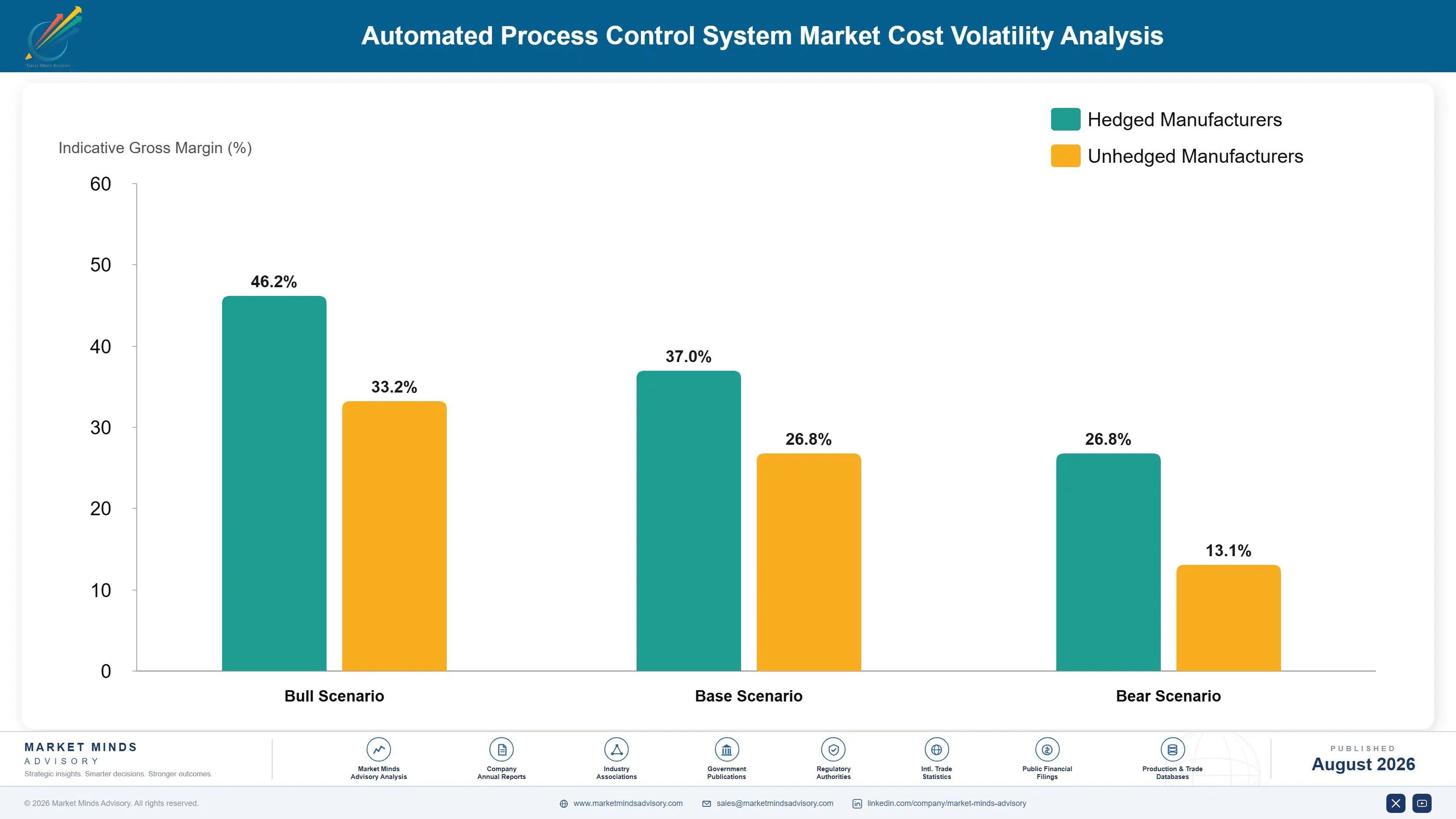
Cost structure here looks nothing like a hardware business. Engineering labour carries 38% to 52% of delivered project cost, and it is the input in shortest supply anywhere. Controller hardware, including processors, input and output modules, and redundant power, runs 18% to 26%, with semiconductors sourced from the same mature-node capacity that automotive competes for. Certification, testing, and documentation add 8% to 14%.
The 2021 and 2022 semiconductor shortage hit process controllers badly, because they use mature-node parts with qualification histories that cannot be substituted quickly in a safety-rated product. Lead times on some controller modules ran past 60 weeks, and projects with fixed dates absorbed the delay. Honeywell and Emerson both disclosed supply chain pressure across that period. Redesigning around available parts required functional safety recertification, judged slower than waiting.

Each range above exceeds three points because greenfield and brownfield work have entirely different engineering content on identical hardware. Exposure separates by project mix. A migration-weighted vendor carries wage inflation on work that cannot be fully offshored, since somebody must stand in the plant. A new-build vendor carries hardware and semiconductor exposure on fixed-price awards. Indian engineering capacity gives some vendors a cost position competitors have not built.
automated-process-control-system-market-cost-volatility-analysis-1787332474384

Build offshore engineering capacity before wages force it

Engineering labour carries 38% to 52% of delivered project cost and wages are rising because the people who can do this work are scarce. An offshore centre in India or Poland takes years to reach the quality level a safety-rated migration demands, so starting when the cost problem becomes urgent is starting far too late to help.

Hold controller module inventory against long qualification cycles

Mature-node semiconductors in safety-rated controllers cannot be substituted without functional safety recertification, which takes months a project timeline does not contain. Carrying strategic module inventory ties up working capital and looks inefficient in a good year. It also means a project completes on schedule during a shortage, which is worth considerably more than the carrying cost across any full cycle.

Automate configuration conversion instead of hiring more engineers

Migration engineering is largely the translation of legacy control logic into a current platform, and much of that translation is mechanical rather than creative. Tooling that converts configuration automatically raises output per engineer without recruiting anybody, which matters when recruiting is the thing that cannot be done. Vendors treating migration as craftsmanship pay for that view in delivery capacity.

Portfolio Architecture for Margin Defence

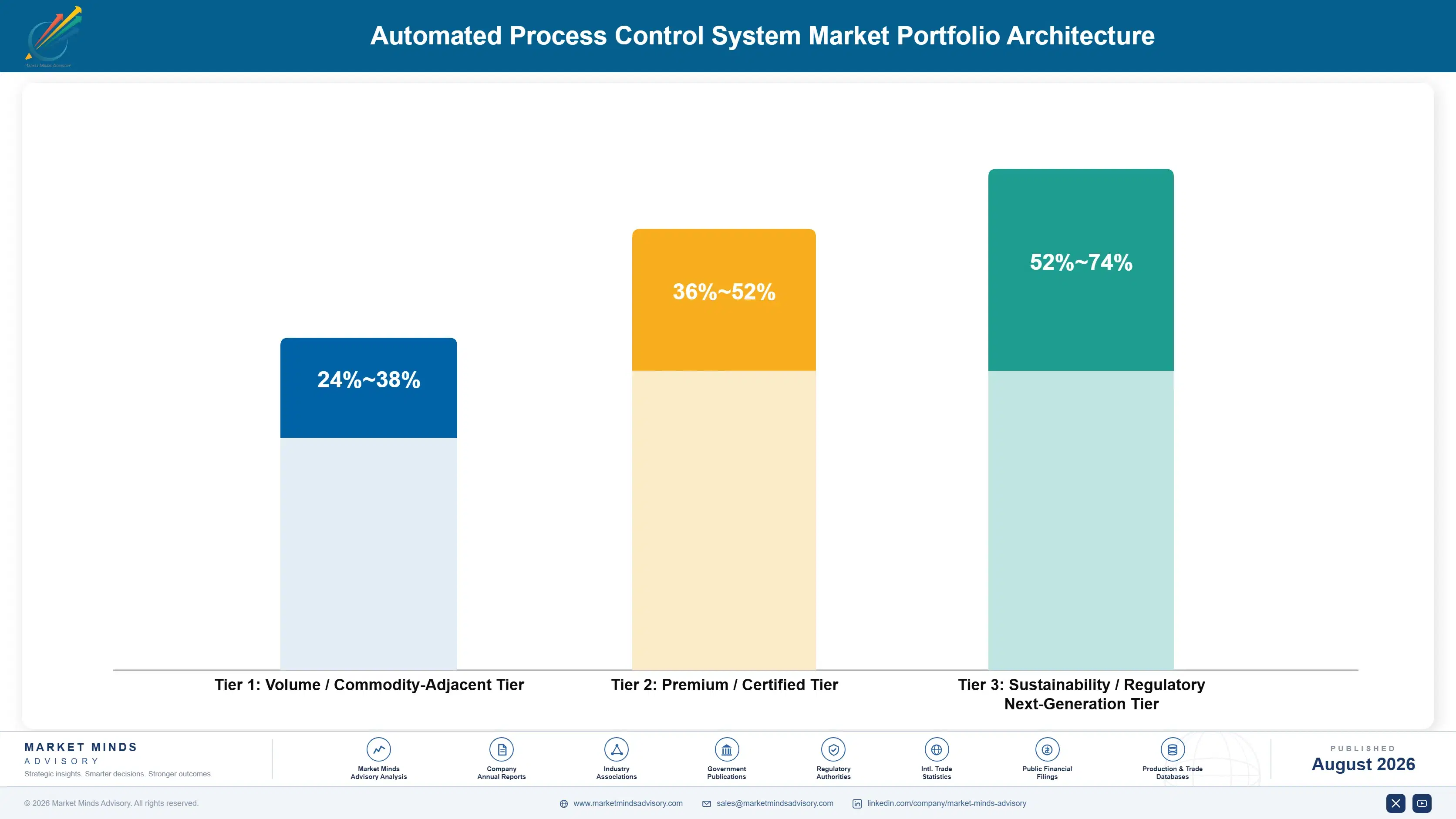
Three tiers sit inside this category and behave almost independently. Basic control hardware forms the volume tier, where Chinese vendors set new-build pricing and the majors compete on installed base. Safety systems and certified engineering earn more, because a standard rather than a buyer decides what is acceptable. Advanced process control software and lifecycle services price highest, since neither carries much marginal cost and both attach to plants nobody else reaches.
The tension is between hardware revenue that books at award and service revenue that accrues across thirty years. Sales organisations chase the project because it is large and visible. The lifecycle contract behind it is worth more and receives a fraction of the attention. Vendors who fixed that emphasis found service margin considerably better than anything the original award carried, and the customer relationship harder for a competitor to reach.

High-value pools concentrate where certification or knowledge limits competition: safety instrumented systems requiring functional safety credentials, advanced process control on plants the vendor understands, migration engineering nobody else can staff, and lifecycle service across a thirty-year installation. The commodity end is basic controller hardware into Asian new build, where domestic vendors set the price and international scale means nothing.

Volume / Commodity-Adjacent Tier

Basic controller hardware and standard input output modules sold into new-build process capacity. The range is wide because domestic Asian vendors and international majors carry entirely different engineering and support overheads behind the same delivered product.
Gross Margin: 24-38%

Premium / Certified Tier

Safety instrumented systems, certified functional safety engineering, and migration execution on live process plants. The range is wide because brownfield engineering hours vary by a factor of three between a documented installation and an undocumented one.
Gross Margin: 36-52%

Sustainability / Regulatory / Next-Generation Tier

Advanced process control software, optimisation packages, cybersecurity services, and multi-year lifecycle support contracts. The range is wide because software carries almost no marginal cost while service delivery carries engineering labour at scarcity wages.
Gross Margin: 52-74%
automated-process-control-system-market-portfolio-architecture-1787332474876

High-value Sub-segments and Strategic Watch-out

Advanced Process Control and Optimisation Software

High value and high growth at 12.8%, the fastest segment, because it clears as operating expenditure and pays back inside a year on the plant already installed. Data quality from ageing instrumentation is the practical constraint, not the mathematics or the licensing cost. Procurement path is the advantage.
Gross Margin: 52-74%

Safety Instrumented Systems

High value with strong growth at 8.4%, driven by IEC 61511 independence requirements and proof test documentation that older installations cannot produce. Demand follows inspection schedules rather than production economics, which makes it the most predictable line in the category. Regulators rather than buyers set this pace.
Gross Margin: 36-52%

Distributed Control Systems

The volume core by revenue at 4.8%, carrying the installed base that everything else in this market attaches to and growing slowest of all. Migration demand is enormous and constrained entirely by engineering capacity rather than by any shortage of plants needing the work. Slow growth, enormous strategic weight.
Gross Margin: 24-38%

PLC-Based Process Control

The strategic watch-out at 6.2%, sitting between discrete automation and true process control and squeezed from both directions as DCS pricing falls and PLC capability rises. Positioning is genuinely unclear, and vendors serving it well tend to serve smaller batch plants where neither alternative fits. A niche that keeps narrowing.
Gross Margin: 22-36%

How Control Demand Actually Locks

Demand commits at plant construction and repeats as service, spares, and eventual migration for 25 to 30 years. A control system specified into a plant becomes the operating environment every operator learns, so the vendor holds the account for a working lifetime rather than a contract term. Services already carry 43% of revenue on that basis. The initial award is really the entry price to a three-decade relationship.
Stickiness varies with how regulated the process is and how continuously it runs. Refining and petrochemicals stick hardest, because a continuous unit cannot be stopped to experiment and every interlock sits in a safety case. Pharmaceutical manufacturing sticks nearly as hard through validation. Pulp, paper, and metals stick moderately, where batch operation allows phased change. Water treatment sticks least, since a shutdown is manageable and budgets municipal.

The buyer has changed twice over. A plant engineer once specified a control system on loop performance. Then a procurement function bought it on price and lifecycle cost. Now a chief information security officer has a view on the architecture and a sustainability team wants energy data out of it. Vendors still presenting loop response curves address a person who left the decision years ago.
automated-process-control-system-market-end-use-penetration-index-1787332475371

Our Call On Process Control

These are among the four positions where our research anticipates prominent divergence between winners and laggards over the coming forecast period. Each is grounded in the demand model, the regulatory perimeter, and the announced capacity pipeline.
01 / INSTALLED BASE CUSTODY

The award buys thirty years, not one project

A control system specified into a plant runs 25 to 30 years, becomes the environment every operator learns, and generates service, spares, and eventual migration revenue that dwarfs the original award several times over. Services already carry 43% of category revenue on exactly that basis, and the share keeps climbing as hardware commoditises underneath it. Vendors compensating sales teams on project value rather than on lifetime account value have optimised their organisation for the smallest part of what they actually sell.
02 / COMPLIANCE TRIGGER SELLING

A deadline moves what economics cannot

Process operators defer migrations indefinitely on business case, because the plant runs and the project costs both money and a shutdown they would rather not schedule. IEC 62443 cybersecurity requirements cannot be satisfied by patching a system designed in 1998, and IEC 61511 proof test documentation cannot be produced retrospectively, which turns the same project into an obligation with a date. Vendors framing migration as productivity improvement are asking for a decision the operator has already declined several times before.
03 / ENGINEERING CAPACITY DISCIPLINE

Delivery capacity is the real constraint

Order intake is not the problem in this market and has not been for some years, because obsolescence and compliance are generating more committed work than the industry can staff. The engineers who can read three decades of accumulated control logic are retiring, and the graduates replacing them learn software rather than process, which leaves automated conversion tooling and standardised methodology as the only realistic answers. A vendor completing migrations in 30% fewer hours wins more work at better margin than one hiring against a shortage.
04 / SOFTWARE LAYER DEFENCE

Optimisation software is the competitor's route in

Advanced process control runs on top of whatever system the plant already has, which means a software vendor with no control hardware at all can build a relationship inside an installation the incumbent supposedly owns. That relationship is exactly what decides the migration award a decade later, when the operator asks who actually understands the plant. Incumbents treating optimisation software as an accessory to their hardware are leaving the door open to the only competitor who can walk through it.

Engagement Snapshot From the Field

A live engagement with an industry participant carrying material or product regulatory and market exposure ahead of a defining policy shift, showing how our research translates into a defensible multi-year portfolio strategy.
MARKET MINDS ADVISORY · CLIENT ENGAGEMENT SUMMARY
Automated Process Control System Producer Strategic Portfolio Review and Transition Roadmap 2026·Investment Scenario on Automated Process Control System Exposure Evaluation 2025-26
CLIENT PROFILE
A European specialty chemical producer operating eleven plants engaged MMA after an unplanned outage traced to a failed controller card sourced from a broker (client-reported, unverified by MMA). Seven of the eleven sites ran control systems past vendor support, and the company had deferred migration at every one of them for more than a decade on straightforward capital grounds.
STRATEGIC CHALLENGE
Operations wanted all seven migrated immediately. Finance pointed out that the combined capital request exceeded three years of the entire site improvement budget. Nobody had ranked the seven by actual risk, and nobody had checked whether the vendor could even deliver seven migrations in the timeframe operations assumed. The board needed a sequenced plan rather than a single unaffordable proposal.
MMA APPROACH
MMA scored all eleven sites on spares availability, configuration documentation quality, remaining engineer knowledge, cybersecurity exposure, and the production value at risk from an outage. We tested vendor delivery capacity directly rather than accepting the proposal timeline. We then modelled a sequenced programme against a full replacement programme, including what advanced process control could deliver at the sites waiting longest for their turn.
KEY FINDINGS
  1. Risk ranking put two sites far ahead of the other five, largely because their remaining configuration knowledge sat with engineers retiring within 18 months (client-reported, unverified by MMA).
  2. The vendor could deliver at most two migrations a year across this client's sites, which made the immediate seven-site request undeliverable regardless of funding.
  3. Advanced process control at three deferred sites recovered enough throughput to fund a meaningful share of the migration programme from operating budget rather than capital.
  4. Configuration documentation quality varied enormously between sites and correlated with nothing except which engineer had happened to run each plant during the 1990s.
CLIENT PROFILE
A European specialty chemical producer operating eleven plants engaged MMA after an unplanned outage traced to a failed controller card sourced from a broker (client-reported, unverified by MMA). Seven of the eleven sites ran control systems past vendor support, and the company had deferred migration at every one of them for more than a decade on straightforward capital grounds.
STRATEGIC CHALLENGE
Operations wanted all seven migrated immediately. Finance pointed out that the combined capital request exceeded three years of the entire site improvement budget. Nobody had ranked the seven by actual risk, and nobody had checked whether the vendor could even deliver seven migrations in the timeframe operations assumed. The board needed a sequenced plan rather than a single unaffordable proposal.
MMA APPROACH
MMA scored all eleven sites on spares availability, configuration documentation quality, remaining engineer knowledge, cybersecurity exposure, and the production value at risk from an outage. We tested vendor delivery capacity directly rather than accepting the proposal timeline. We then modelled a sequenced programme against a full replacement programme, including what advanced process control could deliver at the sites waiting longest for their turn.
KEY FINDINGS
  1. Risk ranking put two sites far ahead of the other five, largely because their remaining configuration knowledge sat with engineers retiring within 18 months (client-reported, unverified by MMA).
  2. The vendor could deliver at most two migrations a year across this client's sites, which made the immediate seven-site request undeliverable regardless of funding.
  3. Advanced process control at three deferred sites recovered enough throughput to fund a meaningful share of the migration programme from operating budget rather than capital.
  4. Configuration documentation quality varied enormously between sites and correlated with nothing except which engineer had happened to run each plant during the 1990s.
RECOMMENDED STRATEGY
Phase 1: Phase 1 (0 to 6 months): Run knowledge capture at all seven sites immediately, ahead of any migration decision or capital request. Phase 2: Phase 2 (6 to 30 months): Migrate the two highest-risk sites and deploy advanced process control at the five waiting. Phase 3: Phase 3 (30 to 72 months): Migrate the remaining five in risk order, funded partly by the throughput the software recovered.
OUTCOME
The board approved the sequenced plan and funded knowledge capture within a month, which the operations director described as the cheapest decision in the whole programme. Two migrations are complete, advanced process control is running at four of the deferred sites, and the client reports the recovered throughput covering a meaningful share of the remaining programme (client-reported, unverified by MMA).

Frequently Asked Questions

Foundational context covering the market sizes, CAGR, scope, country, region and competition that inform every finding below. This section is provided to cover basics and most often pre-purchase conversations, answered from the MMA Primary Research Dataset.

What is the current size of the Automated Process Control System Market?

The global market is valued at USD 32.6 billion in 2025, covering distributed control systems, process controllers, SCADA, safety instrumented systems, and optimisation software with their services. Discrete factory automation and field instrumentation are excluded.

How large will the Automated Process Control System Market be by 2036?

The market is forecast to reach USD 67.92 billion by 2036 in the base case, about 1.95 times the 2026 level. That represents incremental value of roughly USD 33.07 billion.

What is the CAGR for the Automated Process Control System Market 2026 to 2036?

The market grows at a 6.9% CAGR in the base case, with bull and bear scenarios at 8.2% and 5.7%. The spread turns on migration backlog release and on control engineering capacity.

Which segment is growing fastest?

Advanced process control software grows fastest at 12.8%, about 1.86 times the overall rate, because it clears as operating expenditure and pays back within a year. Safety instrumented systems follow at 8.4%.

Who are the major companies in the Automated Process Control System Market?

Leading participants include Honeywell, Emerson Electric, ABB, Yokogawa Electric, and Siemens. Concentration sits at roughly 56%, held there by an installed base that changes vendor almost never.

Which country is growing fastest?

India grows fastest at a 9.8% CAGR, driven by refining and petrochemical expansion and by the process engineering capacity based there. China follows on new plant construction.

Report Segmentation Architecture

The full report scope spans multiple orthogonal segmentation dimensions, with cross-tabulated demand data provided for each dimension pair. Coverage extends further to regional breakdowns, trend trajectories, and the competitive detail needed to support segment-level decision-making.

By Control Architecture

  • Distributed Control Systems
  • Safety Instrumented Systems
  • Supervisory Control and Data Acquisition Systems
  • Programmable Controller Based Process Control
  • Advanced Process Control and Optimisation Software

By End-Use Industry

  • Oil Gas and Refining
  • Chemicals and Petrochemicals
  • Power Generation and Water
  • Pulp Paper and Metals
  • Pharmaceutical and Food Processing

By Deployment Model

  • Greenfield Plant Project
  • Brownfield Migration Programme
  • Lifecycle Service Contract
  • Software Licence and Subscription

By Region

  • North America
  • Western Europe
  • East Asia
  • South Asia and Pacific
  • Latin America
  • Middle East and Africa
  • Eastern Europe

Scope, Methodology, and Coverage

Every figure in this report is reproducible from documented input assumptions. The scope below maps the historical period, the forecast horizon, the segmentation dimensions, and the countries covered, alongside the underlying primary and qualitative methodology.
Historical Period
2020 to 2025
Forecast Period
2026 to 2036
Base Year
2025 (USD billions; MMA Primary Research Dataset, August 2026)
Market Definition
The automated process control system market comprises the supply of control architectures that regulate continuous and batch process plants, valued at vendor selling prices to plant operators, engineering contractors, and technology licensors, and including the engineering, migration, commissioning, and lifecycle support services delivered around them. It spans distributed control systems, safety instrumented systems certified to functional safety standards, supervisory control and data acquisition platforms serving process facilities, programmable controller based process control, and advanced process control and optimisation software, together with operator interface stations, engineering workstations, redundant controller hardware, and control network infrastructure supplied as part of the system. Discrete factory automation including robotics, motion control and machine vision, field instrumentation and sensors sold separately, control valves and actuators, manufacturing execution and enterprise planning software, building automation systems, and electrical distribution switchgear are excluded. Independent systems integration services sold without vendor platform content are outside scope.
Quantitative Units
USD billions (current prices); volume in thousands of control loops commissioned
Segmentation Dimensions
By Control Architecture; By End-Use Industry; By Deployment Model; By Region
Regions Covered
North America, Western Europe, East Asia, South Asia and Pacific, Latin America, Middle East and Africa, Eastern Europe
Countries Covered
USA, Canada, Mexico, Germany, Netherlands, Belgium, France, Italy, Spain, UK, Norway, Sweden, China, Japan, South Korea, Taiwan, India, Australia, Singapore, Malaysia, Thailand, Indonesia, Vietnam, Brazil, Mexico, Chile, Peru, Argentina, Colombia, Saudi Arabia, United Arab Emirates, Qatar, Kuwait, Egypt, Nigeria, South Africa, Poland, Czechia, Hungary, Romania, and additional markets relevant to this sector
Key Companies Profiled
Honeywell, Emerson Electric, ABB, Yokogawa Electric, Siemens, Schneider Electric, Rockwell Automation, Mitsubishi Electric, Omron, Azbil, Hitachi, Toshiba, Valmet, Metso, HollySys, Supcon Technology, GE Vernova, Aspen Technology, AVEVA, NovaTech Automation
Quantitative Methodology
Primary survey, n=3,800 respondents, Q4 2025, six countries; demand-side model with trade association cross-validation
Qualitative Methodology
47 expert interviews, Q4 2025; applied to validate demand model assumptions, identify emerging dynamics, and assess competitive positioning
Report Format
PDF and XLSX data workbook (Word format preview document)
Publisher
Market Minds Advisory
Report Code
MMA-2026-TEC-456
Published
August 2026
Contact
sales@marketmindsadvisory.com | www.marketmindsadvisory.com

Purchase the full Automated Process Control System Market Report (2026 to 2036).

The full MMA Automated Process Control System report sizes the market across five control architectures, five end-use industries, four deployment models, and seven regions through 2036. It profiles 20 participants on a consistent basis of process control system and service revenue, scoring each on installed base position, engineering delivery capacity, functional safety credentials, and software layer depth. Scenario models quantify how migration backlog release, cybersecurity enforcement, and control engineering supply move both volume and achievable margin. The report also includes installed base age mapping by industry and region, obsolescence exposure modelling by vendor platform, engineering capacity benchmarking, and advanced process control penetration analysis across the major process sectors.
Five-architecture and four-model market sizing to 2036
Twenty-participant benchmark on system and service revenue
Installed base age mapping by industry and region
Obsolescence exposure modelling by vendor platform and vintage
Control engineering capacity benchmarking across major vendors
Advanced process control penetration analysis by process sector

Built For The People Who Decide

From boardroom strategy to bench-side execution, this report is read cover-to-cover by leaders shaping the next decade of their industry, turning demand scenarios, market dynamics and valuation benchmarks into decisions.
CXOs/ Presidents/ VPs/ Managers
M&A and Corporate Development
Strategy Teams and R&D Heads
Procurement and Product Directors
Regulatory and Compliance Leaders
Investor Relations and Equity Analysts