Automated Nucleic Acid Extraction Systems Market
Automated Nucleic Acid Extraction Systems Market: Extraction-Free Chemistry Challenges Two Decades of Column and Bead Workflow
Direct lysis chemistry that skips traditional purification steps is challenging the magnetic bead and silica column workflows that have anchored molecular diagnostics for two decades, forcing instrument makers to defend revenue against a simpler alternative.
2025 MARKET VALUE$4.6BMarket Size 2025
2036 FORECAST VALUE$12.5BBase Case , 2026 to 2036
CAGR 2026 TO 20369.5 %Bull 10.8% / Bear 8.2%
INCREMENTAL OPPORTUNITY$7.5BNet 10- year value creation
EXPANSION MULTIPLE2.48x2036 value over 2026 base
Strategic Levers
M&A Pipeline
Regional Outlook
Country Rankings
Competitive Intelligence
Segmental Deep-dive
Executive Snapshot and Market Trajectory
Direct lysis chemistry that eliminates the purification and wash steps traditional extraction requires is moving from research curiosity to commercial reality, threatening the consumables revenue model that has anchored magnetic bead and silica column instrument makers for two decades. That threat is already reshaping instrument pricing strategy.
Demand concentrates around clinical molecular diagnostics, where extraction quality directly determines downstream PCR and sequencing accuracy, and around high-throughput genomics and biobanking operations processing thousands of samples daily. Direct lysis extraction-free systems, still a small share of installed volume, are growing fastest as point-of-care diagnostics push toward simpler, faster sample preparation. North America holds the largest share on concentrated diagnostic testing volume and genomics research infrastructure. Diagnostic manufacturers not investing here risk losing relevance quickly.
Competitive intensity concentrates among large life sciences tool companies that bundle extraction instruments with proprietary consumable chemistry, locking customers into recurring reagent purchases across the instrument's service life. Newer extraction-free chemistry providers are challenging that consumables-driven model directly, forcing established manufacturers to defend a business structure built around selling instruments cheaply and reagents profitably for years afterward. Smaller consumables-only manufacturers face the sharpest pressure as this shift accelerates.
Market Definition
The automated nucleic acid extraction systems market covers instruments, consumables, and reagent kits used to automate the isolation and purification of DNA and RNA from biological samples for downstream molecular applications, including magnetic bead, silica column, and emerging extraction-free chemistries. It excludes manual, non-automated extraction methods, downstream amplification and sequencing instruments, and sample collection devices sold without integrated extraction functionality.
Base Year Value
$4.6B in 2025 (MMA Primary Research Dataset, August 2026)
Forecast Period
2026 to 2036, eleven discrete annual values
CAGR
9.5% base case. Bull 10.8%. Bear 8.2%.
Fastest Growth Segment
Direct Lysis Extraction-Free Sample Prep Systems: 17.0% CAGR
Fastest Growth Country
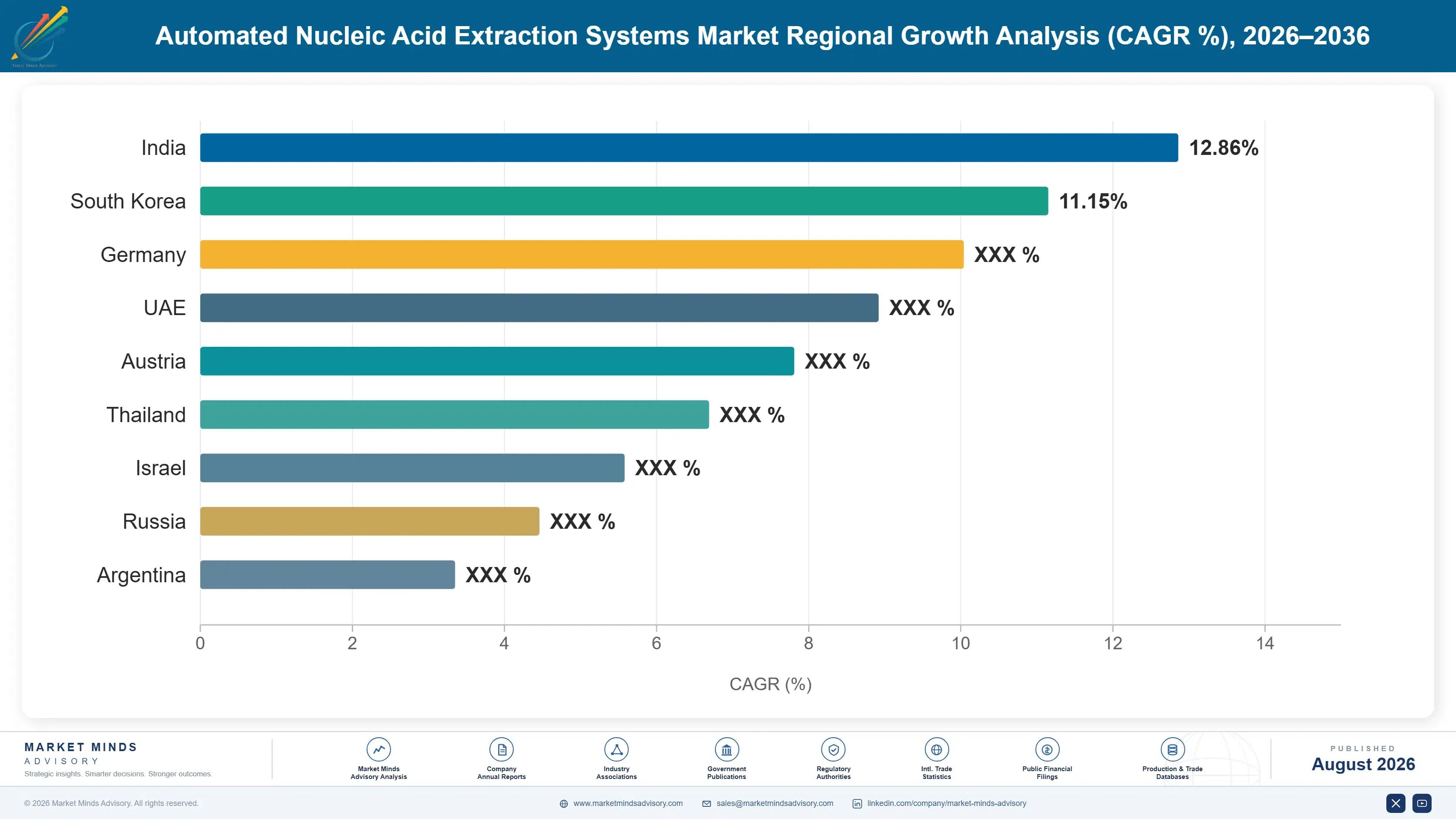
China: 16.0% CAGR
Fastest Growth Region
South Asia and Pacific: 11.6% CAGR
Largest Region
North America: 30% of 2025 global value
Market Leaders
Qiagen N.V., Thermo Fisher Scientific, Roche Diagnostics, Promega Corporation, Revvity Inc. Source: MMA Analysis based on company annual reports.
Primary Survey
n=3,800 procurement and R&D decision-makers, Q4 2025, six countries
Methodology
Demand-side build-up, cross-validated against public data, 47 expert interviews
Automated Nucleic Acid Extraction Systems Market Forecast Scenarios

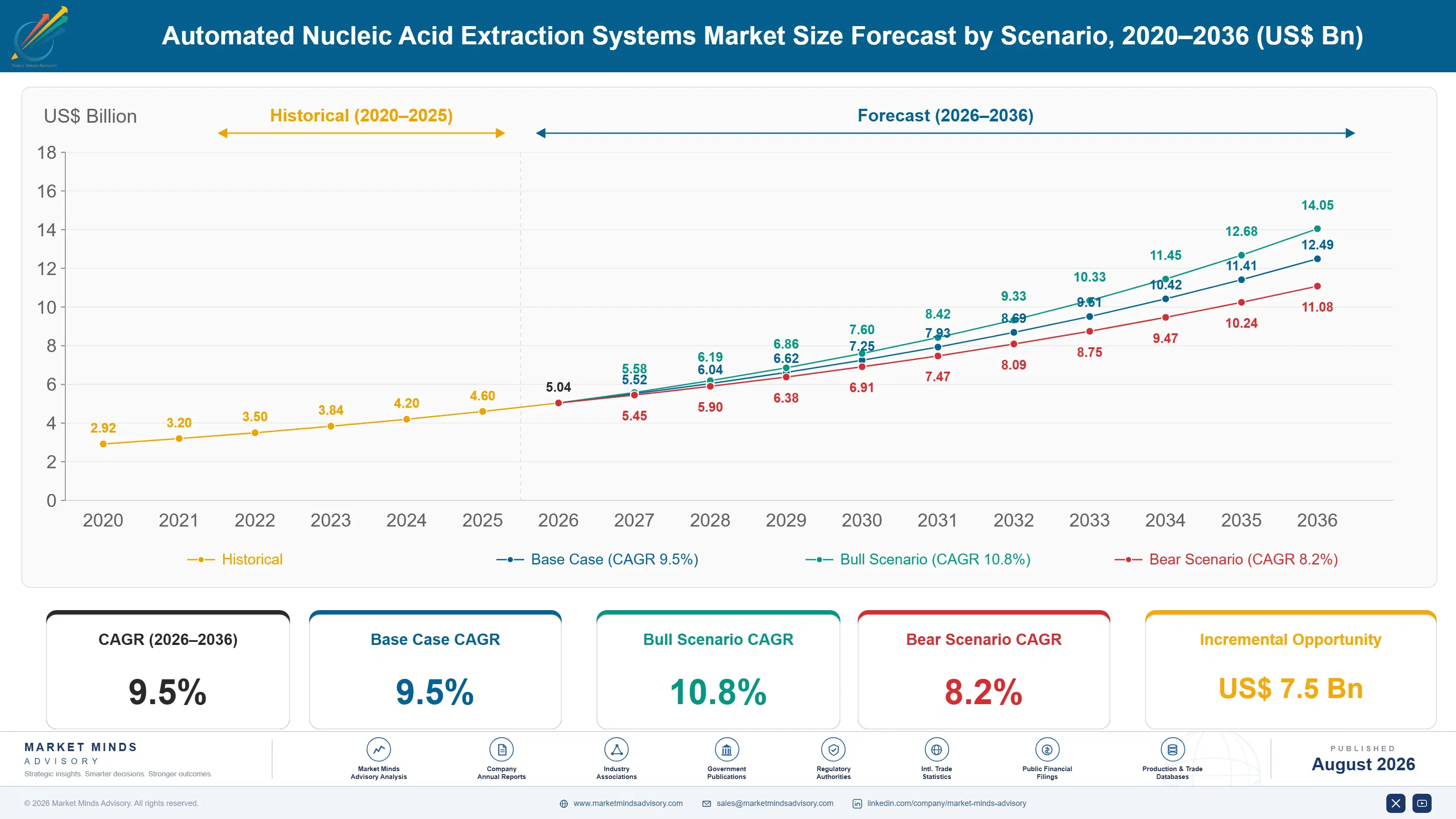
Between 2020 and 2025 the market grew at roughly 8.5% a year, driven initially by pandemic-era nucleic acid testing demand that pulled forward capacity investment, then sustained afterward by expanding routine molecular diagnostics and genomics research volume across both clinical and academic settings. That initial pandemic-driven surge tested manufacturing capacity in ways the industry had never previously faced.
The base case carries the market to a 9.5% CAGR on three mechanisms. First, molecular diagnostic testing volume keeps expanding as more disease areas adopt PCR and sequencing-based testing beyond infectious disease alone. Second, genomics and biobanking operations keep scaling sample throughput, favoring automated systems over manual methods that cannot match required processing volume. Third, extraction-free chemistry keeps maturing, pulling point-of-care and decentralized testing volume toward simpler workflows that traditional purification methods cannot match on speed.
The bull case reaches 10.8% if extraction-free chemistry achieves clinical-grade reliability fast enough to displace traditional methods across a meaningfully broader set of applications than currently proven. The bear case falls to 8.2% if reagent and consumables pricing pressure from new market entrants compresses instrument maker margins enough to slow research and development investment across the industry.
The base case carries the market to a 9.5% CAGR on three mechanisms. First, molecular diagnostic testing volume keeps expanding as more disease areas adopt PCR and sequencing-based testing beyond infectious disease alone. Second, genomics and biobanking operations keep scaling sample throughput, favoring automated systems over manual methods that cannot match required processing volume. Third, extraction-free chemistry keeps maturing, pulling point-of-care and decentralized testing volume toward simpler workflows that traditional purification methods cannot match on speed.
The bull case reaches 10.8% if extraction-free chemistry achieves clinical-grade reliability fast enough to displace traditional methods across a meaningfully broader set of applications than currently proven. The bear case falls to 8.2% if reagent and consumables pricing pressure from new market entrants compresses instrument maker margins enough to slow research and development investment across the industry.
Consumables Economics Are Facing Their First Real Challenge
Three forces converge on this market at once. Molecular diagnostic testing volume keeps expanding into new disease categories beyond infectious disease alone, genomics and biobanking operations keep scaling sample throughput requirements, and extraction-free chemistry keeps closing the reliability gap with traditional purification methods. Manufacturers still defending consumables-only revenue models risk losing share to instrument makers offering simpler, less reagent-dependent workflows. Manuf
MARKET CONCENTRATION (CR5)48%Top five companies hold just under half share
AVERAGE EXTRACTION COST$3.80/sampleTraditional chemistry pricing still reflects strong consumables lock-in
TOP PRODUCING COUNTRY SHARE26%United States still leads global installed instrument base
INSTRUMENT UTILIZATION RATE71%Automated platforms run well below full continuous capacity
TRADE INTENSITY33%About a third of consumables volume crosses borders
REAGENT COST SHARE41% of COGSEnzyme and magnetic bead inputs dominate production cost
Commercially, the market splits between bundled instrument and consumables systems, where manufacturers price instruments competitively to lock in years of recurring reagent purchases, and open-platform systems compatible with multiple reagent suppliers, priced on instrument performance rather than a captive consumables relationship. That bundled model still dominates clinical diagnostics specifically, where regulatory validation ties instruments and reagents together as a single approved system. That commercial difference is widening as clinical applications keep demanding tighter validated performance.
Over the next decade the defining question is whether extraction-free chemistry expands into regulated clinical diagnostics at meaningful scale, or whether it remains confined to research and point-of-care applications where regulatory validation burden is lower and traditional purification's proven reliability matters less than raw processing speed.
"Every instrument maker in this space built its business on the razor-and-blades model, cheap instrument, expensive reagents for a decade. Extraction-free chemistry is the first real threat to that model in twenty years, and most of the incumbents are still pricing as if it will not matter."
Market Trends
Direct lysis extraction-free chemistry, which releases nucleic acids from cells without the bind-wash-elute cycle traditional magnetic bead and column methods require, has moved from academic research protocols into commercial point-of-care diagnostic platforms since 2023, cutting sample preparation time meaningfully compared to traditional workflows. Several diagnostic platform developers have adopted the chemistry specifically for rapid infectious disease testing, where speed matters more than the marginal yield improvement traditional purification can offer. Clinical-grade validation for higher-stakes applications like oncology testing remains earlier stage, since extraction-free methods have not yet accumulated the multi-year reliability record traditional chemistry has built.
Market Impact: Adds 3 to 5 categories yearly
High-Throughput Biobanking Operations Scale Automated Processing
National and institutional biobanking initiatives, including expanding genomics research programs across multiple countries, are processing sample volumes that manual and semi-automated extraction simply cannot support, driving sustained demand for fully automated, high-throughput extraction platforms capable of running thousands of samples with minimal operator intervention. These programs typically sign multi-year instrument and consumables agreements tied to defined sample processing targets, giving manufacturers unusually predictable, large-volume recurring revenue relative to typical clinical diagnostic accounts that purchase reagents in smaller, less predictable increments over time. Manufacturers running these programs increasingly compete on throughput reliability and multi-year contract terms rather than per-sample pricing alone.
Market Impact: Supports replacement cycles across
Market Opportunities and Growth Drivers
Molecular Diagnostics Expand Beyond Infectious Disease Testing
Molecular testing volume has grown steadily beyond its historical concentration in infectious disease diagnostics into oncology companion diagnostics, prenatal screening, and pharmacogenomics, each requiring reliable nucleic acid extraction as a foundational workflow step before any downstream analysis can proceed. Every new molecular test approved for clinical use represents recurring extraction demand tied directly to that test's ordering volume over its full commercial life, giving extraction system manufacturers a durable growth driver independent of any single disease category's testing trends or reimbursement changes specifically. That durability matters as makers seek revenue less tied to any single disease cycle.
Market Impact: Adds 18 to 24 months delay
Genomics Research Funding Sustains Instrument Replacement Demand
Government and private genomics research funding has continued expanding across major markets, supporting both new laboratory buildouts and replacement purchases at institutions upgrading aging extraction infrastructure to handle growing sample throughput requirements. Academic and pharmaceutical research institutions typically replace extraction instruments on a five to seven year cycle as newer platforms offer meaningfully faster processing and improved yield consistency, creating steady, forecastable replacement demand layered on top of genuinely new capacity investment across the broader research funding landscape. That replacement cadence gives manufacturers unusually predictable baseline revenue even during years without major new technology adoption cycles.
Market Impact: Adds 6 to 12 months delay
Market Restraints and Challenges
Clinical Validation Burden Slows Extraction-Free Adoption in Diagnostics
Regulated clinical diagnostic applications require extensive validation demonstrating that a new extraction method performs equivalently to established chemistry across diverse sample types and disease states, and the root cause is that regulatory bodies reasonably prioritize patient safety over speed when evaluating a fundamentally different sample preparation approach. This validation burden slows extraction-free chemistry adoption specifically in the highest-value clinical diagnostic segment, even where the underlying technology has already proven reliable in lower-stakes research and point-of-care applications. Companies are mitigating the barrier by pursuing validation studies focused narrowly on specific high-volume test categories first.
Market Impact: Cuts prep time 60% to 75%
Consumables Lock-In Creates Switching Friction for Buyers
Laboratories that have validated workflows around a specific instrument and reagent combination face substantial switching cost to adopt a competing system, since revalidating an entire clinical or research workflow against new chemistry requires real time and expense the laboratory would rather avoid absent a compelling reason. The root cause is that regulatory and quality system requirements tie validated results to the specific reagent lot and instrument combination originally approved. This friction protects incumbent consumables revenue but also slows adoption of genuinely superior newer chemistry. Manufacturers are mitigating the barrier by offering parallel validation support programs that ease laboratory transition costs.
Market Impact: Processes over 5 million samples ye
3 additional market trends, 4 additional growth drivers, and 3 additional restraints and challenges are covered in the full report. Contact sales@marketmindsadvisory.com to access the complete intelligence.
Segment CAGR and Growth Architecture
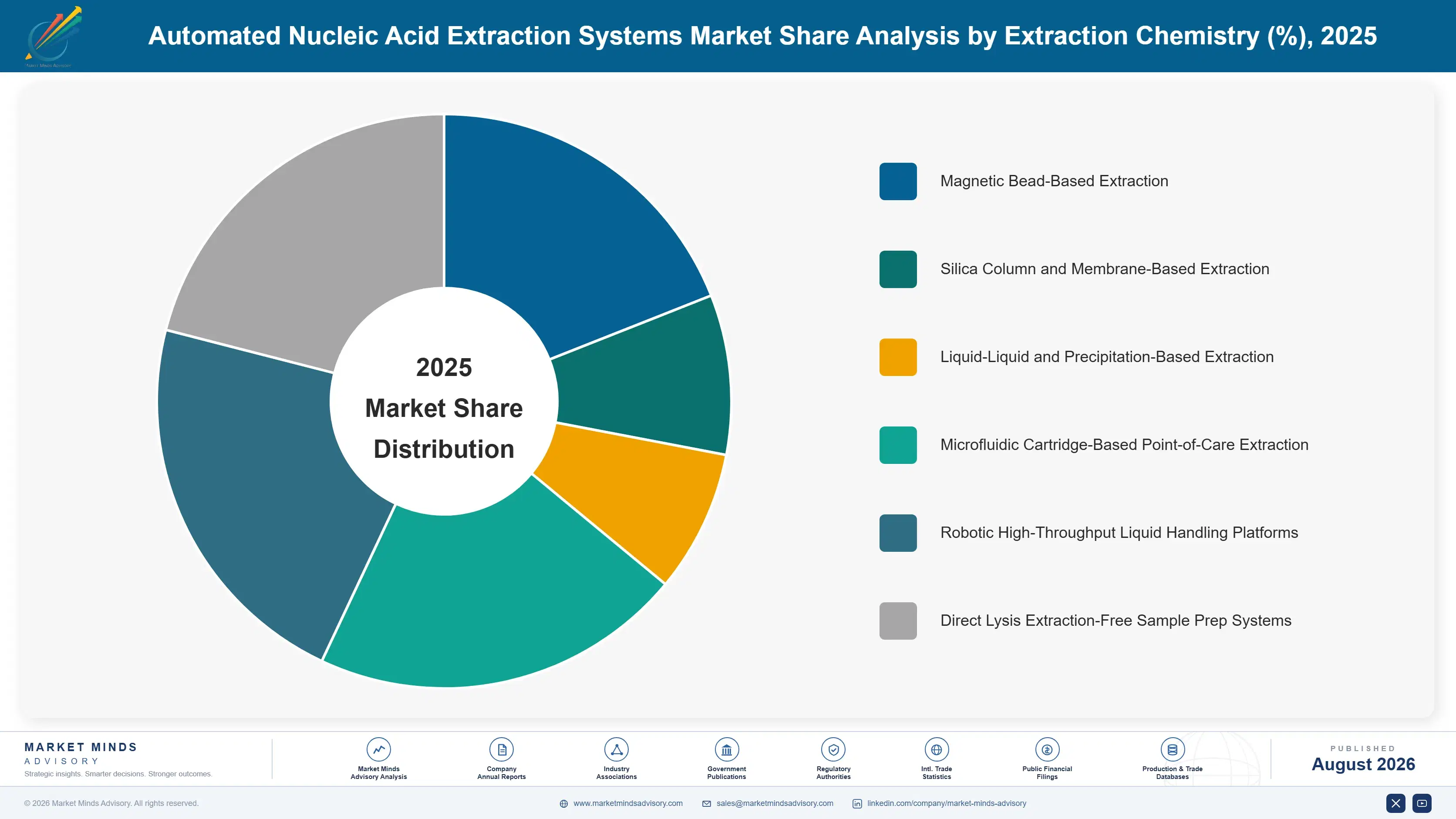
Segmentation follows extraction chemistry, a single method-based logic distinguishing how each system isolates nucleic acids from raw sample material. Downstream amplification and sequencing instrumentation are treated as separate commercial dimensions, not parallel segments here. Each chemistry carries its own cost structure, achievable purity, and processing speed, so commercial position tracks extraction method rather than end application.

Direct Lysis Extraction-Free Sample Prep Systems
Direct lysis extraction-free systems grow fastest at 17.0%, about 1.79 times the overall rate, from a small commercial base concentrated in point-of-care and rapid infectious disease diagnostic applications where speed matters more than the marginal yield improvement traditional purification provides. The chemistry eliminates the bind-wash-elute cycle entirely, cutting both processing time and consumables cost meaningfully compared to bead and column-based methods. Clinical-grade validation for higher-stakes applications remains earlier stage, since the chemistry has not yet accumulated the multi-year reliability record traditional methods have built across diverse sample types. Adoption is fastest where decentralized, rapid testing matters more than the marginal purity advantage traditional extraction still holds for the most demanding applications.
CAGR 17.0%
Robotic High-Throughput Liquid Handling Extraction Platforms
Robotic high-throughput platforms grow at 12.0%, the second-fastest technology, as biobanking, population genomics, and large pharmaceutical research programs scale sample processing volume beyond what manual or semi-automated systems can support reliably. These platforms integrate liquid handling robotics with magnetic bead or column chemistry to process large sample batches with minimal operator intervention, commanding premium pricing that reflects genuine throughput and consistency advantages over smaller benchtop systems. Commercial availability remains concentrated among a small number of manufacturers with the engineering depth to build reliable robotic integration at scale. Growth here reflects institutional capacity expansion rather than the broader market-creation dynamic driving extraction-free system adoption. Manufacturing partners with relevant robotic integration experience remain limited, a constraint shaping which companies can scale fastest.
CAGR 12.0%
Full segment breakdown across 6 segments available in the complete report.
Regional Architecture and Country Demand Map
North America leads on concentrated diagnostic testing volume and genomics research infrastructure, East Asia follows closely on expanding Chinese genomics manufacturing investment, and South Asia and Pacific compounds fastest off a smaller base. Latin America and the Middle East grow steadily off smaller current bases.
North America
United States clinical diagnostic testing volume, among the highest globally on a per-capita basis, anchors sustained extraction system demand across thousands of hospital, reference, and commercial laboratories running molecular tests daily. Thermo Fisher Scientific and Promega both run substantial domestic manufacturing and research and development operations, giving the region deep technical depth alongside its commercial market strength. The National Institutes of Health continues funding genomics research programs that drive both instrument purchases and consumables demand across major academic medical centers nationwide. Growth trails East Asia and South Asia and Pacific because the region's laboratory infrastructure is already extensively built out, leaving replacement and incremental capacity expansion as the primary demand driver going forward.
Share: 30% | CAGR: 8.9% (2026 to 2036)
Western Europe
Germany hosts substantial life sciences manufacturing capacity, with Qiagen's headquarters and primary research and development operations anchoring the region's deepest extraction chemistry expertise and a broad European customer base built over decades. The United Kingdom's genomics research infrastructure, including large-scale population sequencing initiatives, drives meaningful high-throughput extraction demand tied to national research funding commitments. France and the Nordic countries both maintain strong academic genomics research sectors contributing steady replacement and expansion demand across their respective national laboratory networks. Growth trails East Asia and South Asia and Pacific as the region's laboratory infrastructure and testing volume are both already comparatively mature relative to faster-growing markets. Switzerland's precision instrument manufacturing tradition also contributes meaningful regional extraction system export capacity.
Share: 23% | CAGR: 8.0% (2026 to 2036)
Regional intelligence for 5 additional markets available in the complete report: East Asia, South Asia and Pacific, Latin America, Middle East and Africa, Eastern Europe. Contact sales@marketmindsadvisory.com.

Where Extraction System Makers Can Defend Margin
Four commercial moves separate manufacturers defending durable share from those losing ground to extraction-free competition: consumables performance differentiation, biobank contracting scale, extraction-free platform investment, and clinical validation service bundling. Each move converts a technical or contracting advantage into a defensible commercial position competitors without matching chemistry depth or institutional reach cannot easily replicate quickly.
Differentiate Consumables on Yield and Downstream Performance
As extraction-free chemistry threatens pure price-based consumables competition, manufacturers who can demonstrate measurably better DNA and RNA yield, purity, and downstream PCR or sequencing performance defend premium consumables pricing on genuine technical merit rather than pure switching-cost lock-in alone. Qiagen and Promega both invest heavily in comparative performance data supporting this positioning. Laboratories running the most demanding applications, including low-input oncology samples, continue paying meaningfully more for consumables that measurably improve downstream results. Laboratories running low-input oncology samples report paying 15% to 25% more for consumables with proven downstream performance data.
Market Impact: Commands 15% to 25% premium for pro
Win Multi-Year Biobank and Population Genomics Contracts
National and institutional biobanking programs represent some of the industry's largest and most predictable revenue opportunities, since a single won contract can lock in years of instrument and consumables revenue tied to defined sample processing targets rather than the fragmented, harder-to-forecast purchasing pattern typical clinical laboratory accounts follow. Manufacturers dedicating specific commercial resources to large-scale genomics program contracting capture disproportionate volume relative to their broader market share, and these contracts typically span multiple years of guaranteed reagent purchasing. Contracts of this scale can span 5 to 10 years of guaranteed volume, insulating revenue from fragmented clinical account competition entirely.
Market Impact: Single contracts can span 5 to 10 y
Invest Directly in Extraction-Free Platform Development
Rather than only defending traditional chemistry, several manufacturers are developing their own extraction-free platforms internally or through acquisition, capturing the emerging category rather than ceding it entirely to newer entrants building extraction-free technology from scratch. This dual-track strategy lets incumbents serve both the traditional clinical diagnostics segment still requiring validated purification and the faster-growing point-of-care segment increasingly favoring extraction-free speed, hedging against either technology fully displacing the other within the forecast period. Companies pursuing this dual-track strategy typically capture 10% to 20% of segment revenue within three years of platform launch.
Market Impact: Adds a revenue line worth 10% to 20
Bundle Clinical Validation Support Services With Instrument Sales
Laboratories adopting a new extraction system, whether traditional or extraction-free, face real validation burden before clinical use, and manufacturers offering dedicated validation support services alongside instrument sales reduce that burden meaningfully while capturing additional service revenue beyond the instrument and consumables sale itself. This bundling also builds switching costs for the laboratory going forward, since the validation relationship reinforces the specific instrument and reagent combination the laboratory has already invested time and expense validating. Bundled validation packages typically add 8% to 15% to total contract value while shortening laboratory adoption timelines meaningfully.
Market Impact: Adds 8% to 15% in bundled service r
Who Controls the Margin Pool
Concentration sits at a moderate CR5 of 48%, with a gap separating large diversified life sciences tool companies from smaller specialist consumables makers. Qiagen and Thermo Fisher compete on chemistry breadth and instrument integration, while Roche and Promega anchor strong positions in clinical diagnostics and research consumables respectively. Numerous smaller manufacturers compete on price for standard extraction kits.
Current competitive activity runs along three lines: extraction-free chemistry development, where both incumbents and newer entrants race to prove clinical-grade reliability; biobank and population genomics contracting, increasingly central to large manufacturers' growth strategy; and consumables performance differentiation, as traditional chemistry makers defend margin against price competition. All participants are assessed on one consistent basis, annual revenue from extraction systems and related consumables.
Pressure is building from two directions. Extraction-free chemistry providers are winning point-of-care and decentralized testing accounts that never required the validated reliability traditional purification offers, expanding the market in ways incumbents cannot easily contest through pricing alone. Meanwhile Chinese manufacturers are scaling both price-competitive and increasingly technically capable traditional extraction systems, pressuring Western incumbents in cost-sensitive segments. Rankings over the next five years will likely shift toward companies combining extraction-free investment with genuine consumables performance depth.

Competitive Moat and Risk Dimensions
Moat: Broadest extraction chemistry portfolio
Qiagen's decades of extraction chemistry development have built the broadest portfolio of validated consumables across sample types and applications in the industry, giving it pricing power and customer switching costs that narrower competitors cannot easily replicate without comparable years of chemistry development and clinical validation investment across a similarly wide range of applications.
Risk: Instrument-independent consumables pricing pressure
Qiagen's revenue depends heavily on consumables sold across a broad open-platform instrument base, exposing it directly to price competition from lower-cost consumables makers offering compatible chemistry without the same instrument-tied validation relationship. Extraction-free competitors threaten this consumables-dependent model more directly than they threaten fully bundled competitors with tighter instrument-reagent integration.
Moat: End-to-end workflow integration scale
Thermo Fisher's ability to bundle extraction with downstream amplification, sequencing, and informatics tools under one commercial relationship gives it a total-workflow sales advantage narrower extraction-only competitors cannot match, particularly valuable for large institutional accounts seeking to consolidate vendor relationships across their full molecular biology workflow.
Risk: Broad portfolio complexity dilutes focus
Thermo Fisher's vast product portfolio spanning far beyond extraction systems means extraction-specific innovation competes internally for capital and management attention against many other business lines, potentially slowing its response to focused extraction-free competitors able to dedicate their entire organization to a single technology category. Extraction-focused specialists able to move faster within a single category could exploit that.
Players Tracked
Prominent Players
Qiagen N.V.
Thermo Fisher Scientific
Roche Diagnostics
Promega Corporation
Revvity Inc.
Other Key Players
Beckman Coulter Life Sciences
Bio-Rad Laboratories
Agilent Technologies
Macherey-Nagel
Zymo Research
Norgen Biotek
Analytik Jena
Tecan Group
Hamilton Company
Eppendorf SE
Takara Bio
MGI Tech
Maccura Biotechnology
Sansure Biotech
Omega Bio-tek
Recent Developments
Qiagen launches automated extraction platform for point-of-care diagnostics
Qiagen introduced a new compact automated extraction platform designed specifically for decentralized point-of-care diagnostic settings, combining rapid processing with validated chemistry performance. This was an organic product launch, not an acquisition or partnership, developed through internal research and development investment over several years. Early customer reception has been positive.
Signal: A major incumbent launching a point-of-car
Thermo Fisher signs multi-year supply agreement with national biobank program
Thermo Fisher signed a multi-year instrument and consumables supply agreement with a national biobank program covering several million planned sample extractions. This was a commercial supply agreement, not a joint venture or acquisition, securing predictable long-term recurring revenue tied to the program's defined processing targets.
Signal: Large, multi-year biobank contracts are be
MGI Tech expands extraction system manufacturing capacity in China
MGI Tech completed an expansion of its domestic manufacturing capacity for extraction instruments and consumables, adding production capability to serve both domestic and export demand. This was an organic capacity expansion funded from existing capital, not an acquisition or partnership, reflecting sustained demand growth across the company's genomics product portfolio.
Signal: Continued Chinese manufacturing capacity i
Enzymes and Magnetic Beads Drive Consumables Cost
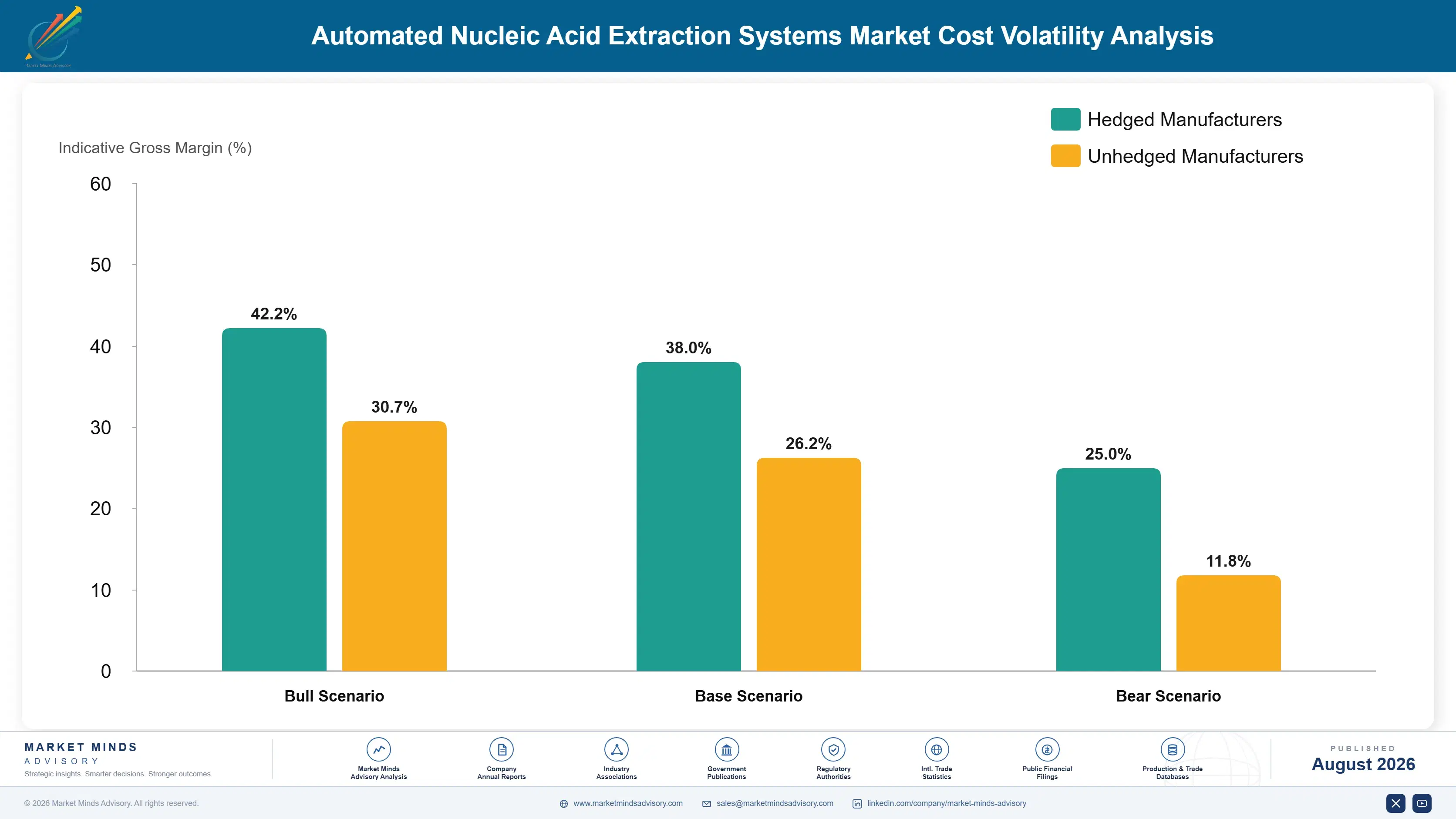
Proprietary enzymes, magnetic bead reagents, and silica membrane materials together account for roughly forty-one percent of production COGS, sourced from a concentrated group of specialty biochemical manufacturers with meaningful barriers to entry given the enzyme engineering expertise required. Plastic consumables including tips, plates, and cartridges add a further significant cost layer sensitive to broader petrochemical input pricing.
The clearest recent volatility event traces to 2021 and 2022, when the Biotechnology Innovation Organization documented widespread specialty reagent and plastic consumables shortages industry-wide, driven by surging pandemic-era diagnostic testing demand competing for the same limited global supplier capacity. Several extraction system manufacturers reported multi-month consumables backlogs during the worst of the shortage, directly constraining laboratory testing capacity across the industry. Those shortages left a lasting impression on how manufacturers now plan safety stock and supplier diversification.
Exposure varies by manufacturer scale and supplier relationships. Large manufacturers with direct, long-term enzyme and reagent supply agreements weathered the shortage with less disruption than smaller specialist consumables makers dependent on distributor inventory and spot purchasing. Manufacturers serving biobank and population genomics contracts faced pressure to maintain delivery commitments despite component shortages, absorbing cost increases rather than passing them through to institutional buyers.

Secure Direct Enzyme Supply Agreements With Manufacturers
Larger manufacturers are increasingly negotiating direct multi-year supply agreements with specialty enzyme producers, securing priority allocation and more predictable pricing ahead of future shortage events rather than relying on spot market purchasing during periods of industry-wide constraint. This mirrors sourcing discipline already standard across other biotechnology manufacturing categories facing comparable seasonal demand concentration risk.
Qualify Multiple Plastic Consumables Suppliers Across Regions
Manufacturers are qualifying second and third sourcing options for plastic tips, plates, and cartridges across different geographic regions rather than relying on single-supplier relationships, reducing exposure to any one facility disruption or regional trade policy shift affecting a concentrated supply base. Smaller manufacturers are increasingly pooling purchasing volume through industry consortia to negotiate comparable allocation priority.
Invest in Reagent Formulation Efficiency to Cut Input Volume
Several manufacturers are reformulating extraction chemistry to reduce enzyme and reagent volume required per sample without compromising yield, cutting raw material exposure per unit even as formulation development itself requires meaningful upfront research investment. This reformulation work increasingly favors manufacturers with strong chemistry development expertise over those relying purely on bulk reagent purchasing scale.
Portfolio Architecture for Margin Defence
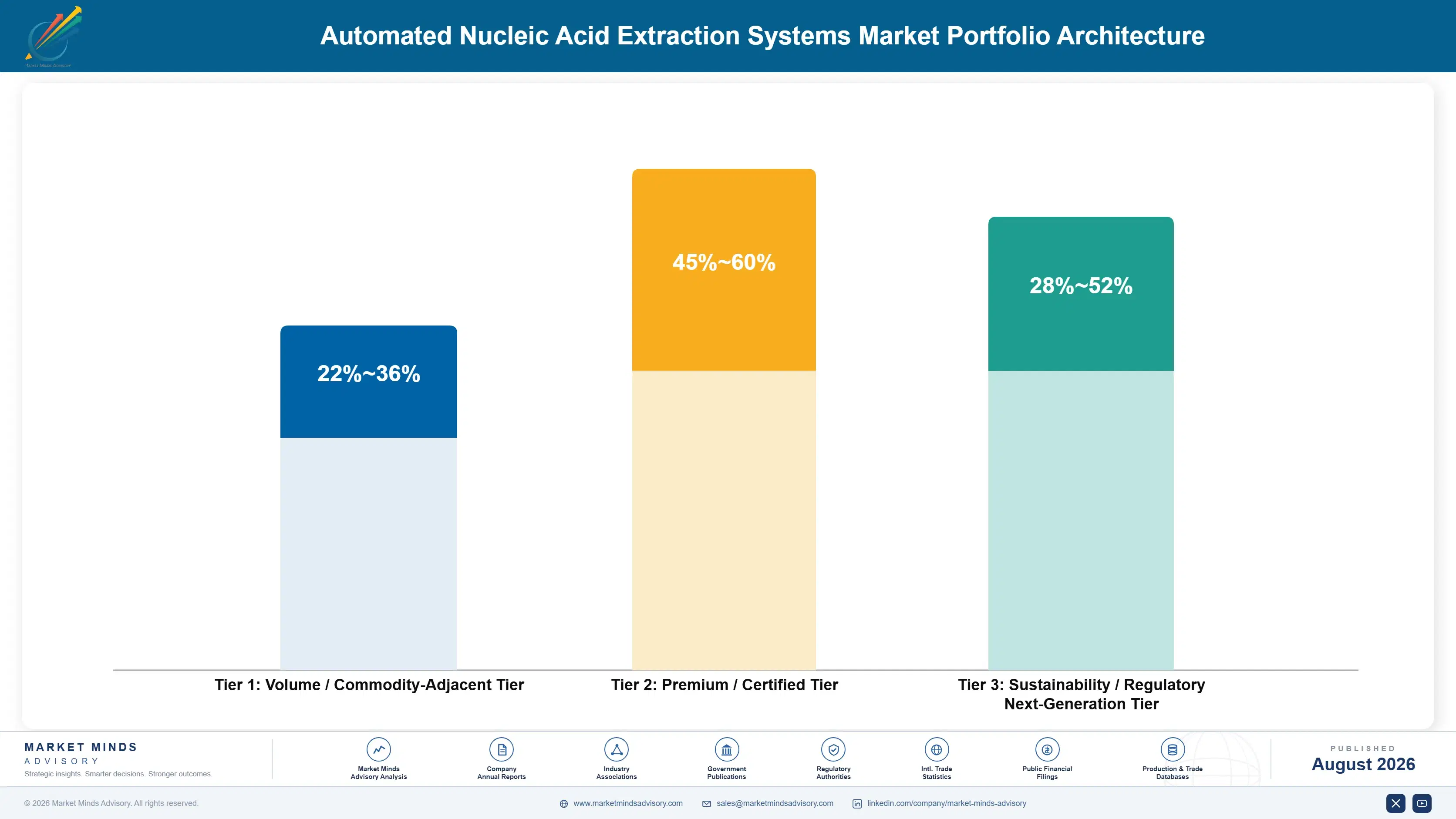
The portfolio splits into three tiers with real margin separation. Volume standard extraction kits compete largely on price for routine research and diagnostic applications, earning modest margins defended through production scale. Certified premium consumables, backed by demonstrated yield and downstream performance data, earn substantially more because laboratories running demanding applications pay for measurable reliability over price. That gap widens further as clinical accounts increasingl
The tension between volume consumables and premium performance positioning shapes manufacturer strategy directly: standard kits keep production lines running and build broad market presence, but manufacturers that let volume positioning crowd out premium chemistry investment risk losing the highest-margin clinical and research accounts to more performance-focused competitors. Manufacturers that manage this balance well capture both the volume and the margin.
High-value pools concentrate in clinical diagnostic consumables and biobank contracting, where validated reliability and contract scale justify premium economics few volume-focused competitors can match. The emerging extraction-free tier currently earns unevenly as manufacturers absorb development cost against still-maturing clinical adoption and validation. That unevenness should ease as extraction-free chemistry accumulates more mature clinical validation data across applications.
Volume / Commodity-Adjacent Tier
Standard extraction kits sold on price for routine research and diagnostic applications across academic and commercial laboratories., where production scale and formulation efficiency determine which manufacturers can sustain acceptable margin under price competition.
Gross Margin: 22-36%
Premium / Certified Tier
Clinical-grade consumables with demonstrated yield and downstream performance data commanding premium pricing from demanding accounts., who pay durable premiums for verified reliability rather than risk failed extractions on demanding, high-value samples.
Gross Margin: 45-60%
Sustainability / Regulatory / Next-Generation Tier
Extraction-free platforms and chemistry still absorbing development investment against developing clinical validation and adoption., where manufacturers are betting development capital on chemistry they expect laboratories to demand as standard within several years.
Gross Margin: 28-52%

High-value Sub-segments and Strategic Watch-out
Clinical Diagnostic Consumables
High value and high growth as molecular testing expands beyond infectious disease, commanding durable premium pricing once tied to validated, regulatory-approved instrument combinations. Manufacturers with the strongest regulatory validation track record increasingly win institutional accounts that competitors lacking comparable evidence simply cannot secure regardless of price.
Gross Margin: 48-60%
Biobank and Population Genomics Contracts
High value with strong current growth as national genomics programs scale, priced through multi-year agreements that lock in predictable, large-volume recurring consumables revenue. Multi-year contract structures increasingly determine which manufacturer wins renewal negotiations, regardless of short-term per-sample pricing competition from smaller regional rivals entirely today.
Gross Margin: 40-55%
Standard Research Extraction Kits
The volume core, sold on price to academic and commercial research laboratories, defended mainly through production scale and thin per-kit margin discipline. Competitive pressure here concentrates on production efficiency and reagent formulation cost rather than the chemistry differentiation reshaping premium and clinical tiers specifically overall.
Gross Margin: 22-36%
Legacy Manual and Semi-Automated Systems
The strategic watch-out, facing continued displacement as fully automated and extraction-free alternatives increasingly outperform on both speed and consistency. Manufacturers still dependent on this declining tier should be actively redirecting investment toward automated and extraction-free alternatives rather than defending workflows laboratories increasingly find too slow and labor-intensive to justify.
Gross Margin: 15-32%
How Extraction System Demand Actually Recurs
Demand here runs on continuous consumables consumption tied directly to sample processing volume rather than one-time purchase. A laboratory running a validated instrument consumes matched consumables with every sample processed, making a single instrument placement worth years of recurring reagent revenue rather than a standalone transaction. That recurring consumption pattern gives manufacturers unusually predictable, multi-year revenue visibility.
Adoption depth varies sharply by setting. Clinical diagnostic laboratories integrate extraction systems deeply into regulatory-validated workflows, making supplier switching costly and rare once a combination is approved for clinical use. Academic and research laboratories, by contrast, evaluate extraction options more flexibly based on specific project requirements, creating more frequent, though still meaningful, switching opportunities between competing manufacturers. That difference forces manufacturers to split strategy between validation depth and flexible responsiveness.
Buyer profiles are shifting generationally as laboratory directors trained on newer extraction-free and high-throughput robotic platforms during graduate training increasingly expect faster, less labor-intensive workflows as standard practice. Older laboratory managers trained on traditional column and manual bead-based methods are adapting more gradually, but that generational shift is accelerating steadily across both academic and clinical settings. That generational shift keeps accelerating steadily each year.

Where Extraction System Value Concentrates Next
These are among the four positions where our research anticipates prominent divergence between winners and laggards over the coming forecast period. Each is grounded in the demand model, the regulatory perimeter, and the announced capacity pipeline.
Invest in extraction-free technology before it disrupts from outside
Extraction-free chemistry is not a distant threat, it is already winning point-of-care and decentralized testing accounts that traditional purification never fully served well. Companies who develop credible extraction-free platforms internally, rather than watching newer entrants capture the category entirely, will be positioned to serve both traditional and emerging demand simultaneously. Waiting until extraction-free chemistry proves itself in clinical diagnostics specifically means competing from behind against companies who invested during the technology's earlier, less certain phase., a delay that only widens the gap for companies still waiting to commit.
Build dedicated commercial teams for large-scale genomics contracts
National and institutional biobanking programs represent some of the most predictable, largest-volume revenue opportunities in the industry, and manufacturers without dedicated account teams pursuing these contracts are ceding disproportionate volume to competitors who have already invested there. A single won contract can be worth years of guaranteed consumables revenue that fragmented clinical accounts cannot match individually. This concentration will only deepen as more countries launch national genomics initiatives over the coming decade., a concentration trend that shows no sign of slowing as more national genomics programs launch each year.
Defend premium pricing with data, not switching costs alone
Switching costs built purely on validation friction are eroding as extraction-free competitors offer genuinely simpler workflows that reduce the burden of switching in the first place. Manufacturers who instead defend premium consumables pricing with demonstrated yield and downstream performance data build a more durable competitive position than those relying on lock-in alone. This data-driven defense becomes more valuable, not less, as buyers grow more sophisticated about evaluating extraction chemistry claims., and that data advantage compounds as buyers grow more sophisticated about evaluating competing extraction chemistry claims each year.
Expect continued share pressure from cost-competitive Chinese entrants
Chinese extraction system manufacturers, backed by coordinated government genomics investment, are expanding both domestic and export capacity faster than most other national markets and increasingly compete on technical capability, not price alone. Western manufacturers should expect continued share erosion in cost-sensitive segments and should concentrate defensible value in the clinical validation and biobank contracting tiers Chinese manufacturers have not yet matched at comparable scale. Manufacturers who help laboratories plan sourcing around that competitive reality now will earn trust that outlasts any single pricing cycle.
Engagement Snapshot From the Field
A live engagement with an industry participant carrying material or product regulatory and market exposure ahead of a defining policy shift, showing how our research translates into a defensible multi-year portfolio strategy.
MARKET MINDS ADVISORY · CLIENT ENGAGEMENT SUMMARY
Automated Nucleic Acid Extraction Systems Producer Strategic Portfolio Review and Transition Roadmap 2026·Investment Scenario on Automated Nucleic Acid Extraction Systems Exposure Evaluation 2025-26
CLIENT PROFILE
A regional reference laboratory network processing molecular diagnostic tests across eight facilities approached MMA while evaluating a full extraction platform standardization ahead of planned volume growth. The client reported roughly USD 4.2 million in annual extraction consumables spending across its network, with inconsistent instrument specifications across legacy acquired facilities (client-reported, unverified by MMA). Leadership had not previously run a standardization initiative at this scale within the network's history.
STRATEGIC CHALLENGE
Management wanted to standardize on a single extraction platform to simplify validation, training, and consumables purchasing across all facilities, but needed to weigh traditional chemistry reliability against newer extraction-free options offering faster turnaround for the network's growing point-of-care testing volume specifically. The board wanted a defensible platform decision before the next budget cycle, not another year of fragmented facility-level purchasing.
MMA APPROACH
MMA benchmarked extraction performance and total cost of ownership across four manufacturers against the client's actual test mix and volume data by facility, modeled financing and consumables pricing under multi-year contract scenarios, and assessed each manufacturer's clinical validation support capability for the network's regulatory requirements. We also interviewed laboratory technicians directly to confirm real-world workflow constraints the quantitative model alone could not capture.
KEY FINDINGS
- A hybrid approach, traditional chemistry for core diagnostic panels and extraction-free platforms for point-of-care rapid testing, outperformed any single-platform standardization option on both cost and turnaround time across the network.
- One manufacturer's multi-year contract pricing would have reduced consumables cost meaningfully below the client's current fragmented purchasing pattern across its eight facilities combined.
- Two of four benchmarked manufacturers could not provide validation support adequate for the client's specific regulatory timeline, narrowing the credible shortlist considerably ahead of the final decision.
- Standardizing consumables purchasing across facilities under one contract was projected to improve the client's negotiating leverage meaningfully beyond what facility-level purchasing had achieved historically (client-reported, unverified by MMA).
CLIENT PROFILE
A regional reference laboratory network processing molecular diagnostic tests across eight facilities approached MMA while evaluating a full extraction platform standardization ahead of planned volume growth. The client reported roughly USD 4.2 million in annual extraction consumables spending across its network, with inconsistent instrument specifications across legacy acquired facilities (client-reported, unverified by MMA). Leadership had not previously run a standardization initiative at this scale within the network's history.
STRATEGIC CHALLENGE
Management wanted to standardize on a single extraction platform to simplify validation, training, and consumables purchasing across all facilities, but needed to weigh traditional chemistry reliability against newer extraction-free options offering faster turnaround for the network's growing point-of-care testing volume specifically. The board wanted a defensible platform decision before the next budget cycle, not another year of fragmented facility-level purchasing.
MMA APPROACH
MMA benchmarked extraction performance and total cost of ownership across four manufacturers against the client's actual test mix and volume data by facility, modeled financing and consumables pricing under multi-year contract scenarios, and assessed each manufacturer's clinical validation support capability for the network's regulatory requirements. We also interviewed laboratory technicians directly to confirm real-world workflow constraints the quantitative model alone could not capture.
KEY FINDINGS
- A hybrid approach, traditional chemistry for core diagnostic panels and extraction-free platforms for point-of-care rapid testing, outperformed any single-platform standardization option on both cost and turnaround time across the network.
- One manufacturer's multi-year contract pricing would have reduced consumables cost meaningfully below the client's current fragmented purchasing pattern across its eight facilities combined.
- Two of four benchmarked manufacturers could not provide validation support adequate for the client's specific regulatory timeline, narrowing the credible shortlist considerably ahead of the final decision.
- Standardizing consumables purchasing across facilities under one contract was projected to improve the client's negotiating leverage meaningfully beyond what facility-level purchasing had achieved historically (client-reported, unverified by MMA).
RECOMMENDED STRATEGY
Phase 1: Phase 1 (0 to 6 months): Standardize core diagnostic panel extraction on the selected traditional chemistry platform across all eight facilities. Phase 2: Phase 2 (6 to 14 months): Deploy the extraction-free platform for point-of-care rapid testing at facilities with the highest decentralized testing volume. Phase 3: Phase 3 (14 to 30 months): Consolidate consumables purchasing under the negotiated multi-year contract and extend standardization to newly added facilities.
OUTCOME
The client began Phase 1 standardization on schedule, reporting a projected reduction in annual consumables spending of roughly 18% once the multi-year contract took full effect across the network. The hybrid platform approach also cut average point-of-care test turnaround time meaningfully at pilot facilities (client-reported, unverified by MMA).
Frequently Asked Questions
Foundational context covering the market sizes, CAGR, scope, country, region and competition that inform every finding below. This section is provided to cover basics and most often pre-purchase conversations, answered from the MMA Primary Research Dataset.
What is the current size of the Automated Nucleic Acid Extraction Systems Market?
The automated nucleic acid extraction systems market was valued at USD 4.6 billion in 2025. Growth is driven by expanding molecular diagnostics, biobanking scale-up, and extraction-free chemistry adoption.
How large will the Automated Nucleic Acid Extraction Systems Market be by 2036?
The market is projected to reach USD 12.5 billion by 2036 under the base case scenario. That reflects an expansion multiple of roughly 2.48 times the 2026 value.
What is the CAGR for the Automated Nucleic Acid Extraction Systems Market 2026 to 2036?
The base case CAGR is 9.5%, with a bull case of 10.8% and a bear case of 8.2%. Extraction-free clinical validation progress is the main swing factor between scenarios.
Which segment is growing fastest?
Direct lysis extraction-free sample prep systems grow fastest at 17.0% CAGR, roughly 1.79 times the overall market rate. Robotic high-throughput liquid handling platforms follow as the second-fastest segment at 12.0%.
Who are the major companies in the Automated Nucleic Acid Extraction Systems Market?
Leading companies include Qiagen N.V., Thermo Fisher Scientific, Roche Diagnostics, Promega Corporation, and Revvity Inc. The top five hold a combined 48% of the market.
Which country is growing fastest?
China is the fastest-growing country at 16.0% CAGR, driven by expanding domestic genomics manufacturing and government-backed biotechnology investment. Domestic manufacturers anchor much of that buildout.
Report Segmentation Architecture
The full report scope spans multiple orthogonal segmentation dimensions, with cross-tabulated demand data provided for each dimension pair. Coverage extends further to regional breakdowns, trend trajectories, and the competitive detail needed to support segment-level decision-making.
By Extraction Chemistry
- Magnetic Bead-Based Extraction
- Silica Column and Membrane-Based Extraction
- Liquid-Liquid and Precipitation-Based Extraction
- Microfluidic Cartridge-Based Point-of-Care Extraction
- Robotic High-Throughput Liquid Handling Platforms
- Direct Lysis Extraction-Free Sample Prep Systems
By End-Use Application
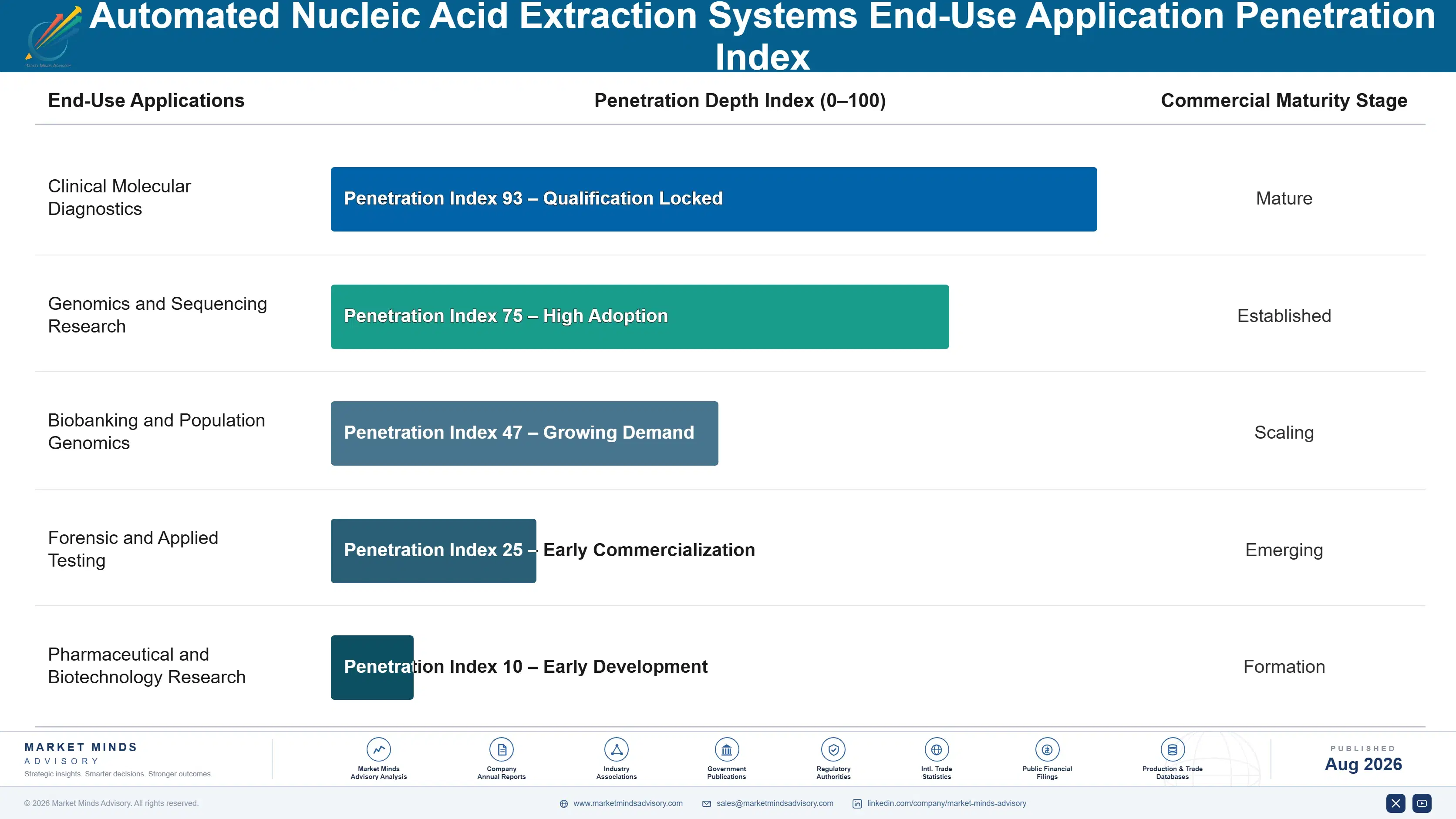
- Clinical Molecular Diagnostics
- Genomics and Sequencing Research
- Biobanking and Population Genomics
- Forensic and Applied Testing
- Pharmaceutical and Biotechnology Research
By Commercial Dimension
- Bundled Instrument and Consumables Sales
- Open-Platform Reagent Sales
- Biobank and Institutional Contracts
- Validation and Support Services
By Region
- North America
- Western Europe
- East Asia
- South Asia and Pacific
- Latin America
- Middle East and Africa
- Eastern Europe
Scope, Methodology, and Coverage
Every figure in this report is reproducible from documented input assumptions. The scope below maps the historical period, the forecast horizon, the segmentation dimensions, and the countries covered, alongside the underlying primary and qualitative methodology.
Historical Period
2020 to 2025
Forecast Period
2026 to 2036
Base Year
2025 (USD billions; MMA Primary Research Dataset, August 2026)
Market Definition
The automated nucleic acid extraction systems market comprises instruments, consumables, and reagent kits used to automate the isolation and purification of DNA and RNA from biological samples for downstream molecular applications, including magnetic bead, silica column, and emerging extraction-free chemistries. Manual, non-automated extraction methods, downstream amplification and sequencing instruments, and sample collection devices without integrated extraction functionality are excluded.
Quantitative Units
USD billions (current prices); samples processed and installed instrument units where applicable
Segmentation Dimensions
By Extraction Chemistry; By End-Use Application; By Commercial Dimension; By Region
Regions Covered
North America, Western Europe, East Asia, South Asia and Pacific, Latin America, Middle East and Africa, Eastern Europe
Countries Covered
USA, China, Germany, France, UK, Japan, South Korea, India, Australia, Canada, Brazil, Mexico, Indonesia, Vietnam, Thailand, Malaysia, UAE, Saudi Arabia, South Africa, Nigeria, Turkey, Poland, Netherlands, Italy, Spain, Sweden, Switzerland, Argentina, Colombia, Singapore, and additional markets relevant to this sector
Key Companies Profiled
Qiagen N.V., Thermo Fisher Scientific, Roche Diagnostics, Promega Corporation, Revvity Inc., Beckman Coulter Life Sciences, Bio-Rad Laboratories, Agilent Technologies, Macherey-Nagel, Zymo Research, Norgen Biotek, Analytik Jena, Tecan Group, Hamilton Company, Eppendorf SE, Takara Bio, MGI Tech, Maccura Biotechnology, Sansure Biotech, Omega Bio-tek
Quantitative Methodology
Primary survey, n=3,800 respondents, Q4 2025, six countries; demand-side model with trade association cross-validation
Qualitative Methodology
47 expert interviews, Q4 2025; applied to validate demand model assumptions, identify emerging dynamics, and assess competitive positioning
Report Format
PDF and XLSX data workbook (Word format preview document)
Publisher
Market Minds Advisory
Report Code
MMA-2026-HLT-101
Published
August 2026
Contact
sales@marketmindsadvisory.com | www.marketmindsadvisory.com
Purchase the full Automated Nucleic Acid Extraction Systems Market Report (2026 to 2036).
The full MMA Automated Nucleic Acid Extraction Systems Market report sizes demand across six extraction chemistries, five end-use applications, four commercial dimensions, and seven regions through 2036. It profiles twenty companies on a consistent revenue basis, scoring each on chemistry performance, extraction-free readiness, and biobank contracting depth. Scenario models quantify how extraction-free clinical validation and biobank program expansion move both demand and realizable pricing. The report includes delivered-cost modeling by extraction chemistry and a manufacturer performance-readiness screen built for laboratory procurement and research strategy teams.
Extraction chemistry performance benchmarking across platforms
Extraction-free clinical validation tracking by application
Biobank and population genomics contract database
Consumables cost exposure modeling by manufacturer scale
Regional manufacturing capacity investment tracking across all regions
Extraction-free adoption scenarios under bull and bear cases
Built For The People Who Decide
From boardroom strategy to bench-side execution, this report is read cover-to-cover by leaders shaping the next decade of their industry, turning demand scenarios, market dynamics and valuation benchmarks into decisions.
CXOs/ Presidents/ VPs/ Managers
M&A and Corporate Development
Strategy Teams and R&D Heads
Procurement and Product Directors
Regulatory and Compliance Leaders
Investor Relations and Equity Analysts