Market Minds Advisory
Autoimmune Disease Therapeutics Market

Autoimmune Disease Therapeutics Market: Biosimilars Took The Volume, Mechanism Keeps The Value

A commercial reading of immunology medicines, where biosimilar entry rewrote the largest franchise in pharmaceutical history, payers now decide adoption, and oral small molecules are attacking injected biologics from underneath in the earlier lines.

Lead Analyst

Alice Ballenger

Published

September 2026

Make Smarter Decisions with Customized Research Insights

Request a free sample report and evaluate market opportunities, growth trends, and competitive dynamics relevant to your business needs.

2025 MARKET VALUE$148.3BMarket Size 2025
2036 FORECAST VALUE$312.1BBase Case , 2026 to 2036
CAGR 2026 TO 20367.0 %Bull 8.2% / Bear 5.8%
INCREMENTAL OPPORTUNITY$153.5BNet 10- year value creation
EXPANSION MULTIPLE1.97x2036 value over 2026 base
Strategic Levers
M&A Pipeline
Regional Outlook
Country Rankings
Competitive Intelligence
Segmental Deep-dive
Call-Us : 91 93563 13602

Executive Snapshot and Market Trajectory

The largest medicine ever sold lost its exclusivity and the market barely paused. Biosimilar entry took the volume and collapsed the price, while prescribers moved to newer mechanisms that still hold patents, which is how a category absorbs a shock of that size and keeps growing.
The market stands at USD 148.3 billion in 2025 and reaches USD 312.15 billion by 2036 at a 7.0% CAGR. Oral small molecule immunomodulators grow fastest at 12.4%, about 1.77 times the overall rate, as patients and payers both prefer a tablet to an injection where efficacy is comparable. North America holds 32% of value on pricing no other system matches, while India posts the quickest national growth at 11.8% on biosimilar access.
Concentration is high, with the top five holding roughly 61% of immunology revenue and a long tail of biosimilar and specialty developers below them. Two forces are now reshaping the field. Payer formulary decisions rather than clinical preference increasingly determine which molecule a patient receives, and oral agents are attacking injected biologics from underneath in exactly the earlier treatment lines where patient volume actually concentrates today.
Market Definition
The autoimmune disease therapeutics market covers prescription medicines that modulate immune activity to treat autoimmune and immune-mediated inflammatory conditions, spanning anti-cytokine biologics, cell-depleting and co-stimulation biologics, oral small molecule immunomodulators, biosimilar versions of originator biologics, and conventional systemic immunosuppressants. Vaccines, transplant rejection prophylaxis, allergy immunotherapy, oncology immunotherapies, diagnostics and monitoring assays, and drug delivery devices sold separately are excluded.
Base Year Value
$148.3B in 2025 (MMA Primary Research Dataset, August 2026)
Forecast Period
2026 to 2036, eleven discrete annual values
CAGR
7.0% base case. Bull 8.2%. Bear 5.8%.
Fastest Growth Segment
Oral Small Molecule Immunomodulators: 12.4% CAGR
Fastest Growth Country
India: 11.8% CAGR
Fastest Growth Region
South Asia and Pacific: 9.2% CAGR
Largest Region
North America: 32% of 2025 global value
Market Leaders
AbbVie, Johnson and Johnson, Amgen, Eli Lilly, UCB. Source: MMA Analysis based on company annual reports.
Primary Survey
n=3,800 procurement and R&D decision-makers, Q4 2025, six countries
Methodology
Demand-side build-up, cross-validated against public data, 47 expert interviews

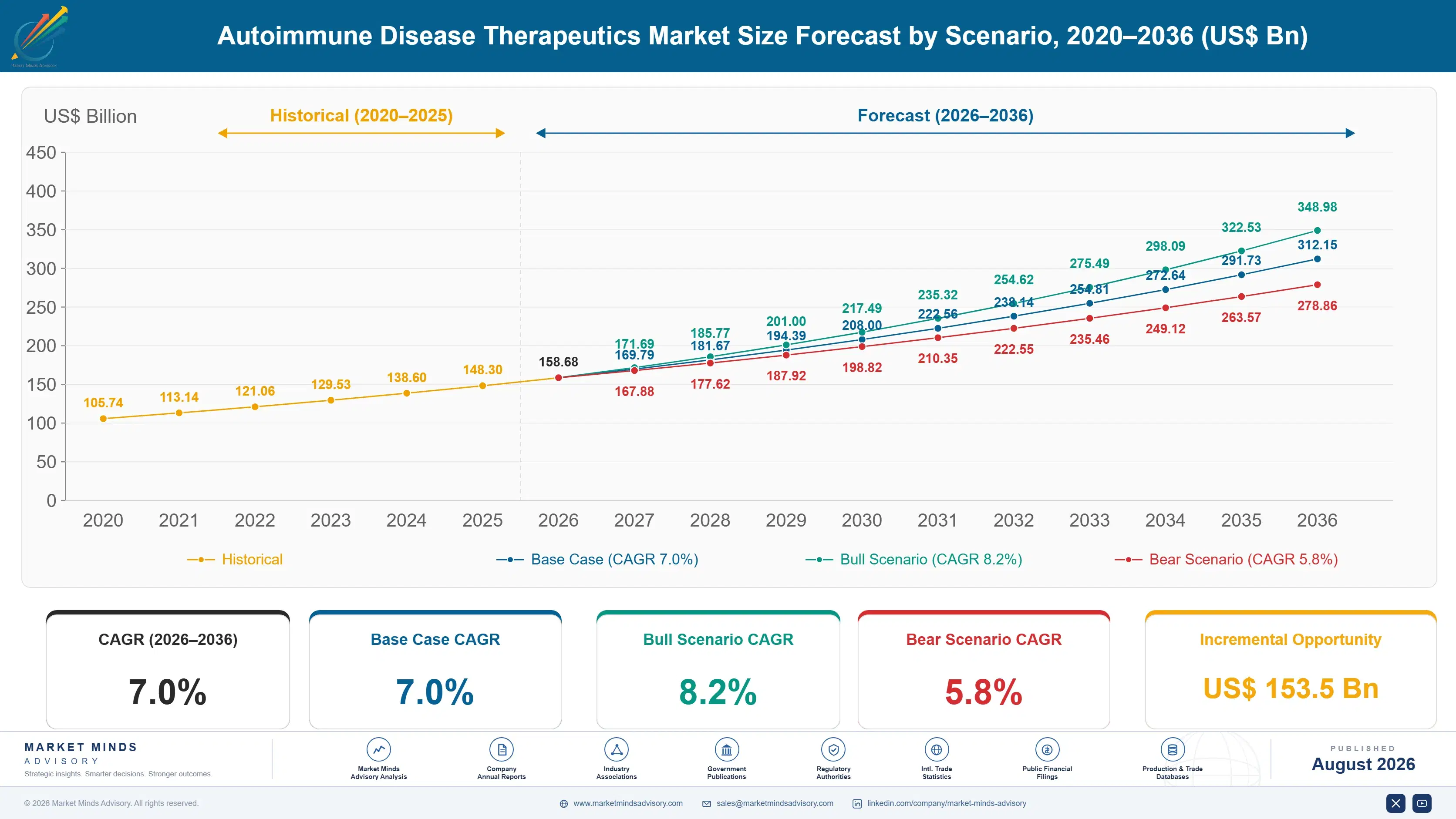
Autoimmune Disease Therapeutics Market Forecast Scenarios

autoimmune-disease-therapeutics-market-size-forecast-scenario-1787332102915
Growth from 2020 to 2025 compounded near 5.7%, and one patent expiry dominated the whole period. Adalimumab biosimilars entered the United States in 2023 after years in Europe, and net prices fell far faster than anyone modelled once formulary exclusion became the negotiating tool. Volume moved rather than disappeared. Newer interleukin and oral agents absorbed the prescribing shift and grew through the disruption.
Three mechanisms carry the base case to 7.0%. First, indication expansion: agents approved for one condition steadily add others, and each approval opens a patient population with no new molecule required. Second, oral small molecules, which reach earlier treatment lines where injection resistance keeps patients on conventional therapy longer than clinicians would choose. Third, emerging market access, as biosimilar pricing brings biologic treatment within reach of health systems that could never fund originator products.
The bull case at 8.2% assumes oral agents secure earlier-line positioning broadly and indication expansion continues at recent rates across the major franchises. The bear case at 5.8% assumes payers apply biosimilar-style pressure to newer mechanisms as they approach expiry, formulary exclusion spreads from adalimumab to interleukin agents, and safety labelling on oral agents continues restricting the earlier-line use their growth depends on.

Why The Formulary Decides More Than The Prescriber

Three forces set demand. Diagnosed prevalence provides the base, rising steadily as rheumatology, gastroenterology, and dermatology identify patients who previously went untreated. Indication expansion provides much of the growth, since each new approval opens a population without requiring a new molecule. And access provides the third layer, because biosimilar pricing has brought biologic therapy within reach of health systems that could never fund originator products.
MARKET CONCENTRATIONCR5: 61%Highly consolidated among large immunology-focused pharmaceutical groups worldwide
BIOSIMILAR PRICE EROSION60 to 85%Net price decline following competitive biosimilar entry at scale
GROSS TO NET DISCOUNTAbout 55%Rebates and concessions deducted from list price in America
TREATMENT PERSISTENCE RATEAbout 62%Patients remaining on initial biologic therapy after one year
INDICATIONS PER AGENT4 to 11 indicationsApproved conditions accumulated across a successful immunology molecule
DIAGNOSED PATIENT SHAREAbout 47%Eligible patients receiving advanced therapy in developed markets
The commercial character is decided by formulary rather than by prescriber. In the United States, rebates and concessions take roughly 55% off list price, and a pharmacy benefit manager willing to exclude a product entirely holds negotiating power no clinical argument overcomes. That is why adalimumab net prices collapsed while list prices barely moved. Manufacturers now plan around formulary access in ways that would have seemed peculiar two decades ago.
The next decade turns on two things. Whether oral small molecules secure earlier-line positioning, since injection resistance keeps many patients on conventional therapy longer than clinicians would choose and a tablet removes that objection. And whether payers apply adalimumab-style pressure to interleukin and newer mechanisms as their exclusivity approaches, because the industry has assumed newer classes would be treated more gently than the evidence supports.
"Everybody predicted the adalimumab cliff and almost everybody got the shape wrong. List price held, net price fell off a building, and the money moved sideways into whatever the formulary preferred that quarter. Patents set the timing here, but the rebate negotiation sets the number."
Director, Immunology and Specialty Therapeutics Practice · MMA Healthcare / Immu

Market Trends

Formulary Exclusion Became The Decisive Pricing Tool

Pharmacy benefit managers moved from tiering products to excluding them outright, which converts a negotiation about position into one about survival on the formulary at all. Adalimumab net prices fell far faster than list prices once that tool was used at scale, with erosion reaching 60% to 85% depending on channel. The commercial consequence is that manufacturers now design launch strategy around formulary access rather than around prescriber advocacy, and contracting teams carry weight that medical affairs once held. A superior molecule excluded from a major formulary reaches fewer patients than an inferior one included.
Market Impact: Agents reach 11 approved indication
Oral Agents Attack Injected Biologics From Underneath

Janus kinase inhibitors and newer oral mechanisms including allosteric TYK2 inhibitors offer tablet administration where efficacy approaches injected biologics, and patient preference for oral therapy is consistent and strong. That matters most in earlier treatment lines, where injection resistance keeps patients on conventional agents longer than guidelines suggest. Safety labelling on the earlier Janus kinase class restricted use in some populations and slowed the shift considerably. Newer selective oral agents carrying cleaner safety profiles are the ones now taking share, and they attack precisely the earlier lines where patient volume concentrates.
Market Impact: Prices fall 60% to 85%

Market Opportunities and Growth Drivers

Indication Expansion Multiplies Value Without New Molecules

A successful immunology agent accumulates four to eleven approved indications across rheumatology, gastroenterology, and dermatology, each opening a patient population that requires no new discovery programme. Development cost per additional indication is a fraction of an original approval, and the safety database strengthens with every trial completed. Manufacturers consequently plan indication sequencing as carefully as they plan the original submission. That strategy also extends commercial life, since a molecule entering its later patent years in a newly approved indication holds prescribing momentum that a mature indication would not sustain. The roadmap matters as much as the molecule.
Market Impact: Gross to net gap near 55%

Biosimilar Pricing Opens Health Systems That Could Not Pay

Originator biologic pricing put advanced immunology therapy beyond most public health systems outside the wealthiest countries, so patients received conventional immunosuppressants regardless of what guidelines recommended. Biosimilar competition has cut prices by 60% to 85% in competitive markets, which brings biologic treatment inside budgets that could never previously accommodate it. Indian, Brazilian, Turkish, and Southeast Asian systems have expanded access substantially as a result. Volume growth in these markets is genuine patient growth rather than value transfer, which distinguishes it from the biosimilar dynamic in developed systems entirely. That distinction is frequently missed in forecasts.
Market Impact: Only 62% persist past year

Market Restraints and Challenges

Payer Pressure Now Reaches Newer Mechanisms Earlier

The adalimumab experience taught payers that formulary exclusion works, and they have begun applying comparable pressure to interleukin agents well before exclusivity expires. The root cause is that multiple agents now treat the same conditions with broadly comparable outcomes, which converts clinical differentiation into a negotiating position rather than a protected one. Commercially this compresses the profitable window manufacturers assumed newer classes would enjoy. Companies respond with outcome-based contracts, indication-specific pricing, patient support programmes that improve persistence, and portfolio breadth that makes wholesale exclusion impractical for a payer. Nobody should assume newer classes get treated gently.
Market Impact: Erosion reaches 60% to 85%

Treatment Persistence Falls Well Below Trial Conditions

Roughly 62% of patients remain on their initial biologic after a year, and the rest switch, stop, or lapse for reasons of efficacy loss, tolerability, injection burden, or simple administrative friction. The root cause is that real-world adherence bears little relation to trial protocol conditions with study coordinators calling patients. Commercially this destroys revenue nobody forecast losing, since a discontinued patient generates nothing regardless of how well the product performed. Manufacturers respond with nurse support programmes, injection device improvement, longer dosing intervals, and switching studies that at least retain the patient within their own portfolio.
Market Impact: Oral agents grow at 12.4%
4 additional market trends, 3 additional growth drivers, and 2 additional restraints and challenges are covered in the full report. Contact sales@marketmindsadvisory.com to access the complete intelligence.

Segment CAGR and Growth Architecture

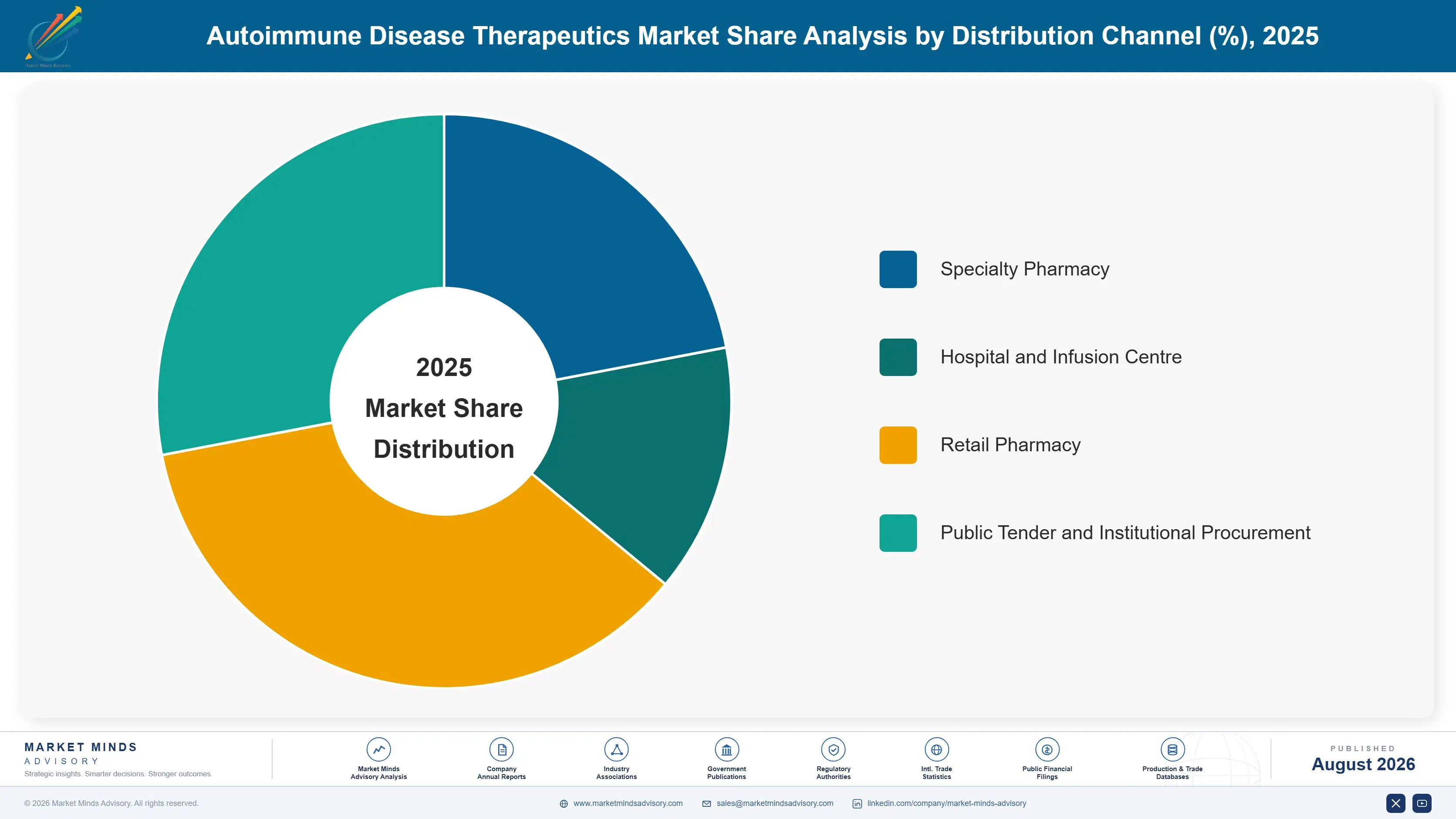
Segmentation follows therapeutic mechanism, a single pharmacological logic describing how the medicine modulates immune activity. Each mechanism carries its own patent position, administration route, safety profile, and payer treatment, so commercial position tracks the class rather than the condition treated. End-use indication area and distribution channel appear separately within the framework as distinct dimensions.
autoimmune-disease-therapeutics-market-market-share-analysis-1787332103464

Oral Small Molecule Immunomodulators

Oral small molecule immunomodulators grow fastest at 12.4%, about 1.77 times the overall 7.0% rate, covering Janus kinase inhibitors, allosteric TYK2 inhibitors, and newer selective oral agents entering across rheumatology, dermatology, and gastroenterology. Patient preference for a tablet over an injection is consistent and strong, and it matters most in earlier treatment lines where injection resistance keeps people on conventional therapy longer than guidelines intend. Safety labelling on the earlier Janus kinase class restricted use in older patients and those with cardiovascular risk, which slowed adoption considerably and taught the field how much a boxed warning costs. Newer selective agents carrying cleaner profiles are taking the share that first-generation products could not hold.
CAGR 12.4%

Biosimilar Biologics

Biosimilar biologics grow at 9.6%, the second-fastest class by value despite prices 60% to 85% below originator levels, because volume expansion more than compensates in markets that could never previously afford biologic therapy. Adalimumab, etanercept, infliximab, and increasingly ustekinumab all face established biosimilar competition. Two distinct commercial models operate: developed market competition where biosimilars capture volume through formulary exclusion and net price collapse, and emerging market access where they represent genuine new patient treatment rather than substitution. Manufacturing capability and regulatory experience separate credible developers from the many that announced programmes and never launched. Sandoz, Celltrion, Samsung Bioepis, and Biocon hold the strongest positions. Regulatory experience matters as much as manufacturing scale here.
CAGR 9.6%
Full segment breakdown across 5 segments available in the complete report.

Regional Architecture and Country Demand Map

Pricing and reimbursement rather than disease prevalence set this distribution almost entirely. North America leads because net prices remain far above every other system, while other shares track how each health technology assessment process treats immunology and how far biosimilar access has spread. Prevalence explains almost none of it.

North America

North America holds 32% of value on net prices that remain far above every other health system despite gross to net discounts near 55%. Pharmacy benefit manager formulary exclusion is the defining commercial mechanism, and the adalimumab experience showed how completely it can reset a franchise while list prices barely move. Medicare negotiation provisions under recent legislation extend that pressure into products the commercial channel had partly protected. Biosimilar uptake was slow initially and then accelerated sharply once exclusion was used at scale. Growth of 6.6% reflects newer mechanism uptake and indication expansion offsetting continued net price erosion across mature franchises. Formulary access strategy now outranks prescriber advocacy almost entirely here.
Share: 32% | CAGR: 6.6% (2026 to 2036)

Western Europe

Health technology assessment does the work here that rebate negotiation does elsewhere. Western Europe holds 25% of value, with national bodies assessing cost-effectiveness before funding, which slows initial adoption and produces durable positions once granted. Biosimilar penetration is far higher than in North America and arrived years earlier, with tendering systems in the Nordics and Netherlands achieving near-complete conversion within months of entry. Prices sit well below American levels for identical products, which is a persistent source of manufacturer frustration and reference pricing exposure. Growth of 5.4% is the slowest of the seven, reflecting mature biosimilar penetration and assessment processes that price newer agents cautiously. Reference pricing exposure spreads those prices outward.
Share: 25% | CAGR: 5.4% (2026 to 2036)
Regional intelligence for 5 additional markets available in the complete report: East Asia, South Asia and Pacific, Latin America, Middle East and Africa, Eastern Europe. Contact sales@marketmindsadvisory.com.
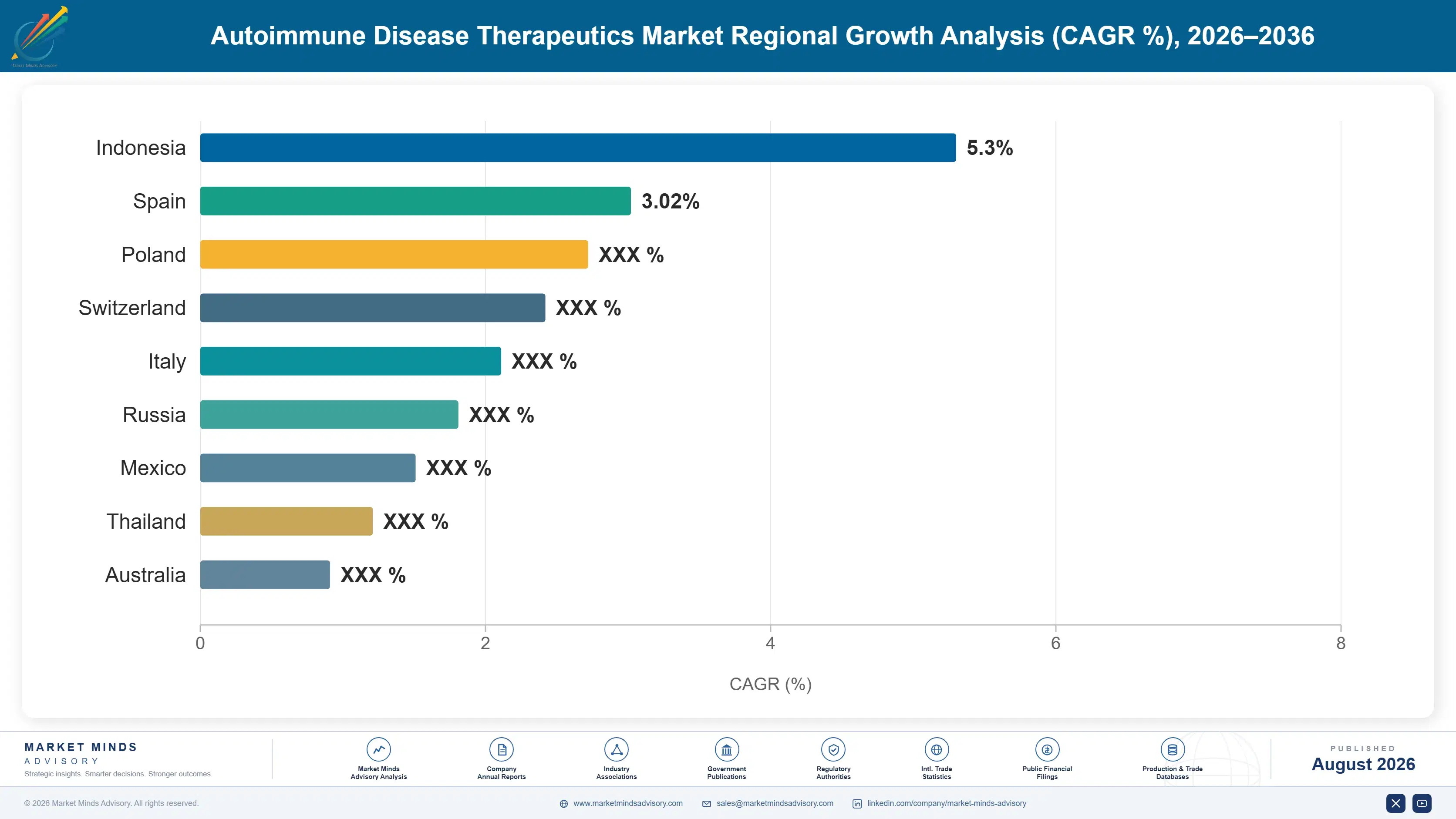
autoimmune-disease-therapeutics-market-country-cagr-analysis-1787332103978

Where Immunology Franchises Actually Hold Value

Defending a mature biologic on clinical differentiation is an argument that formulary exclusion settles in an afternoon. The four moves below shift value toward positions payers cannot simply negotiate away: indication breadth, oral formats reaching earlier lines, persistence that protects revenue already won, and emerging market volume where biosimilar pricing creates patients rather than transferring them.

Sequence Indication Expansion As A Value Programme

A successful immunology agent accumulates 4 to 11 approved indications, each opening a patient population at a fraction of the cost of an original approval while strengthening the safety database. Indication sequencing also extends commercial life, because a molecule entering late patent years in a newly approved indication holds prescribing momentum that a mature indication cannot sustain. Companies should plan the indication roadmap with the same rigour as the original submission, since it is the cheapest growth available and the least exposed to payer negotiation on the parent product. Sequencing beats opportunism every time.
Market Impact: Agents accumulate 4 to 11 approved

Build Oral Formats For Earlier Treatment Lines

Patient resistance to injection keeps people on conventional therapy longer than guidelines intend, which is a commercial opportunity disguised as an adherence problem. Oral agents growing at 12.4% against a market at 7.0% are winning precisely those earlier lines, where patient volume concentrates and no biologic has ever competed effectively. Safety labelling on first-generation Janus kinase inhibitors showed how much a boxed warning costs in this setting. Developers should prioritise selectivity and clean safety profiles over marginal efficacy gains, because earlier-line access depends entirely on tolerability. Tolerability, not efficacy, is the gate here.
Market Impact: Oral agents grow at 12.4% versus a

Invest In Persistence Rather Than New Patient Starts

Only about 62% of patients remain on their initial biologic after a year, and every discontinuation destroys revenue that acquisition spending already paid for. Nurse support programmes, longer dosing intervals, improved injection devices, and proactive tolerability management all measurably improve persistence at a fraction of what a new patient start costs to generate. Companies routinely fund promotion far ahead of support, which is the wrong allocation on any honest arithmetic. Retaining an existing patient is cheaper than acquiring a replacement in every commercial model we have examined. The arithmetic has never favoured the current allocation.
Market Impact: Persistence sits at only 62% after

Treat Emerging Market Volume As Growth, Not Erosion

Biosimilar pricing 60% to 85% below originator levels destroys value in developed markets and creates it everywhere else, because patients in those systems were receiving conventional immunosuppressants rather than a competing biologic. That volume is genuine new treatment rather than substitution, and it grows the treated population permanently. Originator companies should participate through their own biosimilar arms or local partnerships rather than ceding these markets entirely, since the patient base being established now determines prescribing habits for decades ahead. Prescribing habits established now will hold for decades in those systems.
Market Impact: Biosimilar pricing runs 60% to 85%

Who Controls the Margin Pool

Concentration is high: the top five hold roughly 61% of immunology revenue, with originator groups, biosimilar developers, and specialty entrants competing on quite different terms. The gap between leaders and challengers is one of indication breadth and payer contracting capability rather than molecular innovation, which is widely distributed. All participants here are assessed on one basis, revenue from prescription medicines treating autoimmune and immune-mediated inflammatory conditions, exc
Competition runs along four lines. First, formulary access, since exclusion from a major payer reaches fewer patients than any clinical disadvantage would. Second, indication breadth, which makes wholesale exclusion impractical and spreads exposure across therapy areas. Third, administration route, where oral agents attack injected biologics in earlier lines. Fourth, biosimilar manufacturing capability, now a genuine barrier given how many announced programmes never launched.

Pressure is building from two directions. Payers have learned that formulary exclusion works and are applying it to newer mechanisms well before exclusivity expires. Meanwhile Korean, Chinese, and Indian biosimilar manufacturers have built capability that supplies developed markets rather than only domestic ones. Rankings should favour companies with broad indication portfolios and genuine oral pipelines over those defending single injected franchises against approaching expiry.
autoimmune-disease-therapeutics-market-company-positioning-matrix-1787332104489

Competitive Moat and Risk Dimensions

ABBVIE

Moat: Portfolio succession and indication breadth

AbbVie managed the largest patent expiry in pharmaceutical history by launching Skyrizi and Rinvoq before adalimumab lost exclusivity, transferring prescribing rather than losing it. Indication breadth across rheumatology, dermatology, and gastroenterology makes wholesale formulary exclusion impractical for any payer. Contracting capability built through decades of adalimumab negotiation is genuinely difficult for competitors to replicate.
ABBVIE

Risk: Immunology concentration and expiry

Revenue depends heavily on immunology, so payer pressure applied across the category hits the whole business rather than one division. The successor products face their own exclusivity horizons, and payers who learned formulary exclusion on adalimumab are already applying it earlier to newer mechanisms. Oral competitors from other developers attack precisely the earlier lines its portfolio needs to hold.
JOHNSON AND JOHNSON

Moat: Gastroenterology depth and pipeline

Johnson and Johnson holds strong immunology positions built on Stelara and Tremfya, with particular depth in gastroenterology where switching is clinically conservative and prescriber loyalty runs high. Breadth across pharmaceutical and medical technology businesses spreads exposure beyond any single payer decision. Development capability across multiple mechanisms provides succession options as products approach exclusivity horizons.
JOHNSON AND JOHNSON

Risk: Ustekinumab erosion and litigation

Ustekinumab biosimilars have entered and net price erosion is following the pattern adalimumab established, with limited ability to defend on clinical grounds alone. Broader corporate litigation exposure absorbs management attention and capital that competitors direct at commercial execution. Oral agents from other developers also compete for the earlier-line positioning that its injected portfolio would otherwise expand into.

Players Tracked

Prominent Players

AbbVie
Johnson and Johnson
Amgen
Eli Lilly
UCB

Other Key Players

Pfizer
Novartis
Sanofi
Bristol Myers Squibb
Takeda
Roche
Boehringer Ingelheim
Celltrion
Samsung Bioepis
Sandoz
Biocon
Organon
Alumis
Innovent Biologics
Bio-Thera Solutions

Recent Developments

JANUARY 2025

Ustekinumab biosimilars launch across United States commercial channels

Multiple ustekinumab biosimilars became available in the United States following settlement agreements, entering a franchise worth several billion dollars annually across dermatology and gastroenterology indications. These were biosimilar launches under negotiated settlements rather than any corporate transaction, and net price erosion began immediately through formulary competition.
Signal: Each successive biosimilar wave erodes fas
AUGUST 2024

Medicare selects immunology products for price negotiation

United States drug pricing negotiation provisions covered immunology products among the selected medicines, establishing maximum fair prices for Medicare beneficiaries from a defined date. This was a statutory process rather than a commercial agreement, extending pricing pressure into a channel partly insulated from formulary exclusion.
Signal: Government negotiation reaches products wh
MARCH 2025

Selective TYK2 inhibitor advances in late-stage immunology trials

Late-stage clinical programmes for allosteric TYK2 inhibitors progressed across psoriasis, psoriatic arthritis, and inflammatory bowel disease, targeting oral administration with safety profiles distinct from earlier agents. This was clinical progress rather than any approval or transaction, and it advanced the oral challenge to injected biologics in earlier treatment lines.
Signal: Clean oral safety profiles are what open e

Biologics Manufacturing, Trials, Rebates, Commercial

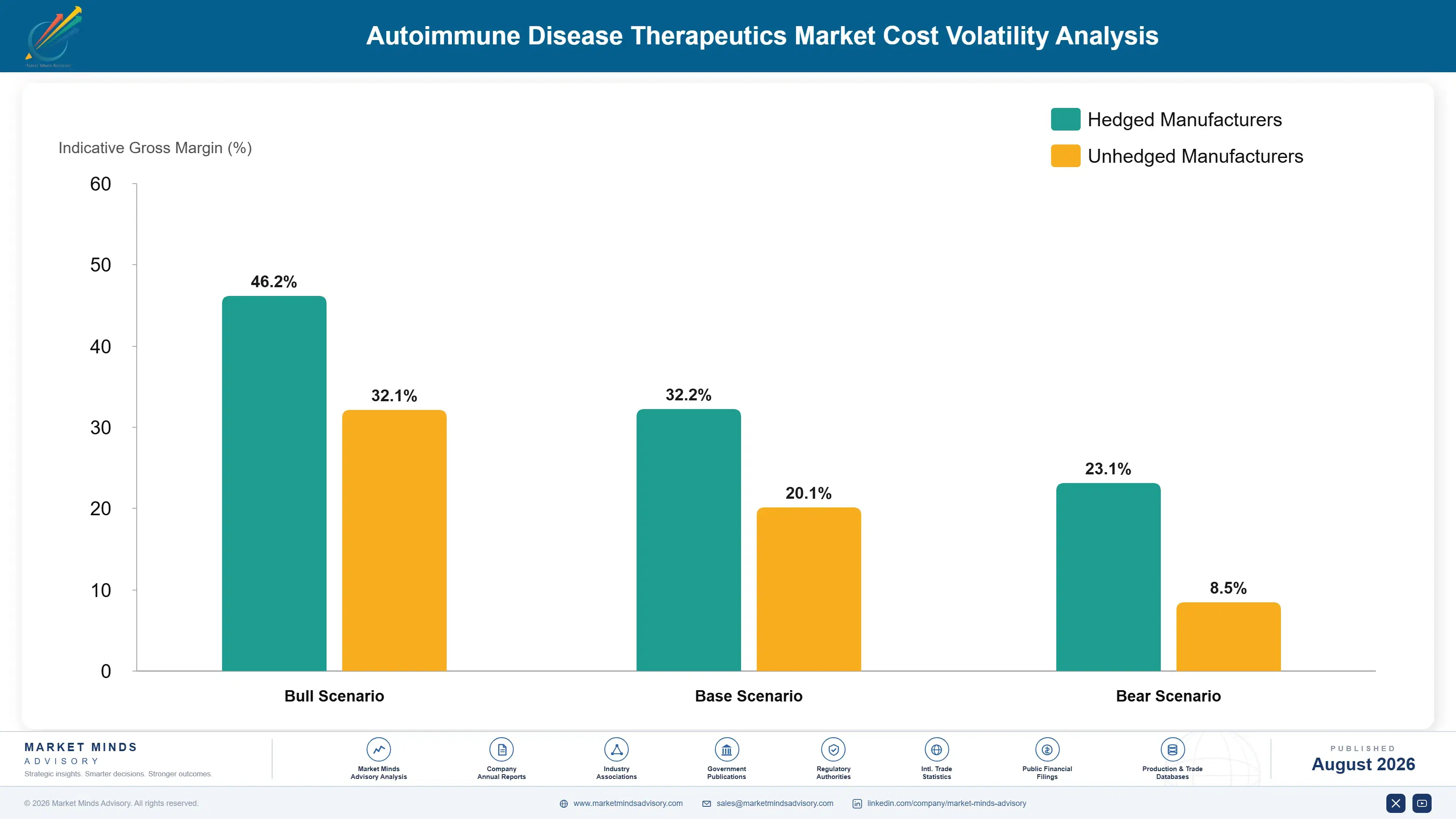
Rebates dwarf manufacturing in this category, which distinguishes it from almost any other. Gross to net concessions absorb roughly 55% of American list price before any cost of goods is counted. Within remaining cost, biologics manufacturing including cell culture, purification, and fill-finish accounts for 12% to 18%. Clinical development amortised across the portfolio takes 20% to 28%, and commercial and medical affairs a further 18% to 25%.
Manufacturing capacity rather than input pricing has been the operational pressure. Demand for mammalian cell culture capacity tightened sharply through 2021 and 2022 as biologics and biosimilar programmes competed for the same contract manufacturing slots, and lead times on fill-finish extended considerably. Amgen and Boehringer Ingelheim both disclosed capacity investment across that period. Single-use bioreactor consumables also faced allocation, which affected smaller biosimilar developers far more than integrated originators.

Exposure separates by manufacturing integration and portfolio breadth. A company owning its biologics capacity controls supply and cost through demand cycles, while one dependent on contract manufacturing competes for slots against everyone else during tight periods. Portfolio breadth matters equally, since a single-product company faces rebate pressure with no offsetting negotiation position while a broad portfolio makes wholesale exclusion impractical for the payer.
autoimmune-disease-therapeutics-market-cost-volatility-analysis-1787332104692

Own biologics capacity rather than contracting it

Contract manufacturing slots tighten exactly when a launch needs them, and a biosimilar developer competing against integrated originators loses that contest reliably. Owned capacity controls cost, supply, and launch timing together across the product life. The capital requirement is substantial and only justifies itself above a volume threshold, which is why so many announced biosimilar programmes never reached market.

Build portfolio breadth to resist wholesale formulary exclusion

A payer can exclude a single product easily and a broad portfolio only with difficulty, because excluding several therapy areas creates access problems the payer must defend. Breadth across rheumatology, dermatology, and gastroenterology makes each negotiation part of a larger one. Building it requires either sustained development investment or acquisition, neither available to a company already under rebate pressure.

Amortise development across indications, not single approvals

Each additional indication costs a fraction of an original approval while opening a full patient population, so economics improve considerably when the roadmap is planned from the outset. Trial design that anticipates later indications reduces duplicated work substantially. Companies treating indication expansion as lifecycle management arrive late, having designed the original programme without the later ones in view at all.

Portfolio Architecture for Margin Defence

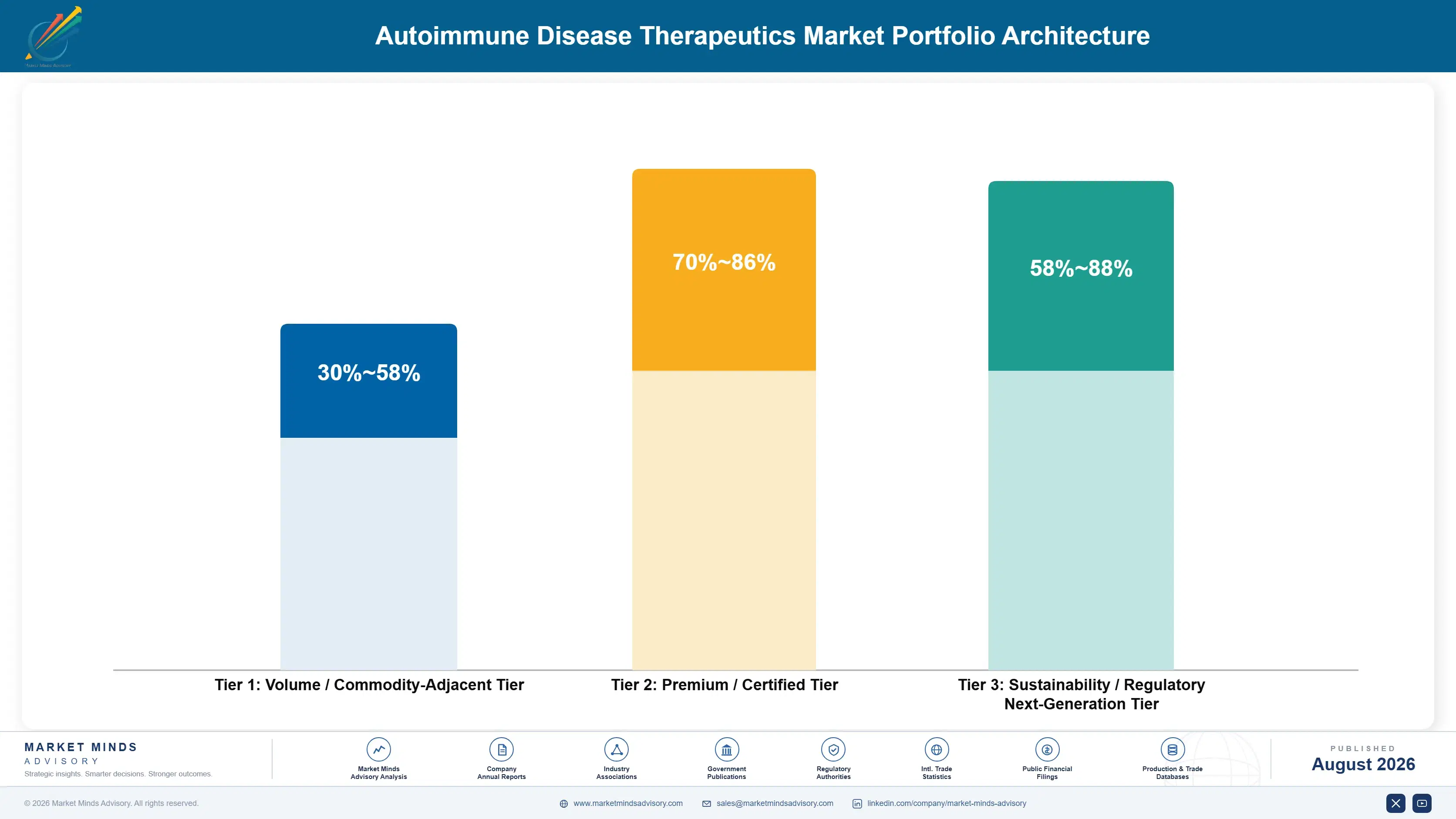
The portfolio splits into three tiers with sharply different economics. Biosimilars and conventional immunosuppressants form the volume tier, competing on price after exclusivity with margin set by manufacturing cost. Patent-protected biologics with broad indication coverage earn more because exclusivity and breadth both resist payer pressure. Oral agents in earlier lines and emerging market access volume sit differently again, priced against untreated populations rather than a competing product
The tension runs between franchises that generate cash now and pipelines that replace them later. A mature biologic funds development and holds the formulary relationships through which successors launch, so managing decline badly damages everything behind it. Yet every year of defence spends resource that succession needs. Companies handling this well launch successors before expiry rather than after, transferring prescribing deliberately rather than watching it disperse.

High-value pools concentrate where exclusivity, breadth, or format limits competition: patent-protected agents with wide indication coverage, oral products reaching lines no biologic serves, mechanisms with no biosimilar pathway yet established, and emerging market volume where treatment is genuinely new. All four escape the rebate negotiation that governs mature injected products. Off-patent biologics sit at the other end, competing on manufacturing cost against every approved biosimilar developer.

Volume / Commodity-Adjacent Tier

Biosimilar biologics after competitive entry and conventional systemic immunosuppressants long off patent. The range is wide because manufacturing integration decides everything, and developers dependent on contract capacity earn considerably less than integrated producers.
Gross Margin: 30-58%

Premium / Certified Tier

Patent-protected anti-cytokine and cell-depleting biologics with broad approved indication coverage. The range is wide because rebate exposure varies enormously between products a payer can exclude and those it genuinely cannot.
Gross Margin: 70-86%

Sustainability / Regulatory / Next-Generation Tier

Oral small molecules in earlier treatment lines, novel mechanisms without established biosimilar pathways, and emerging market access programmes. The range is wide because earlier-line oral agents price strongly while access programmes trade margin for permanent patient population.
Gross Margin: 58-88%
autoimmune-disease-therapeutics-market-portfolio-architecture-1787332105193

High-value Sub-segments and Strategic Watch-out

Oral Small Molecule Immunomodulators

High value and high growth at 12.4%, the fastest mechanism, reaching earlier treatment lines where injection resistance has kept patients on conventional therapy. Safety labelling on first-generation agents showed exactly how much a boxed warning costs in a setting that depends on tolerability. Selectivity is what the newer agents sell.
Gross Margin: 62-84%

Biosimilar Biologics

High value with strong growth at 9.6% despite prices 60% to 85% below originator, because emerging market volume expansion more than compensates. Manufacturing capability separates credible developers from the many programmes announced that never reached market at all. Two entirely different commercial models operate simultaneously.
Gross Margin: 30-58%

Anti-Cytokine Biologics

The volume core by revenue, growing at 5.4% as interleukin agents offset tumour necrosis factor erosion within the same class. Steady in aggregate but facing payers who now apply adalimumab-style exclusion pressure well before exclusivity actually expires. Interleukin agents are absorbing the displaced prescribing volume.
Gross Margin: 70-86%

Conventional Systemic Immunosuppressants

The strategic watch-out, growing at just 2.2% and steadily displaced wherever biologic or oral therapy becomes affordable. Volume persists mainly where budgets exclude advanced agents, which biosimilar pricing is progressively eliminating market by market. Displacement accelerates wherever biosimilar tendering reaches public procurement. Budget constraint is the only thing sustaining it.
Gross Margin: 24-44%

How Immunology Revenue Actually Persists

Revenue depends on patients staying rather than patients starting, and only about 62% remain on their initial biologic after a year. A retained patient generates revenue for years while acquisition is paid for once, which makes persistence the most valuable commercial variable and the least funded. Prescribing also concentrates among few specialists per market, so a small number of relationships carry disproportionate volume. Losing a centre matters more than losing a region.
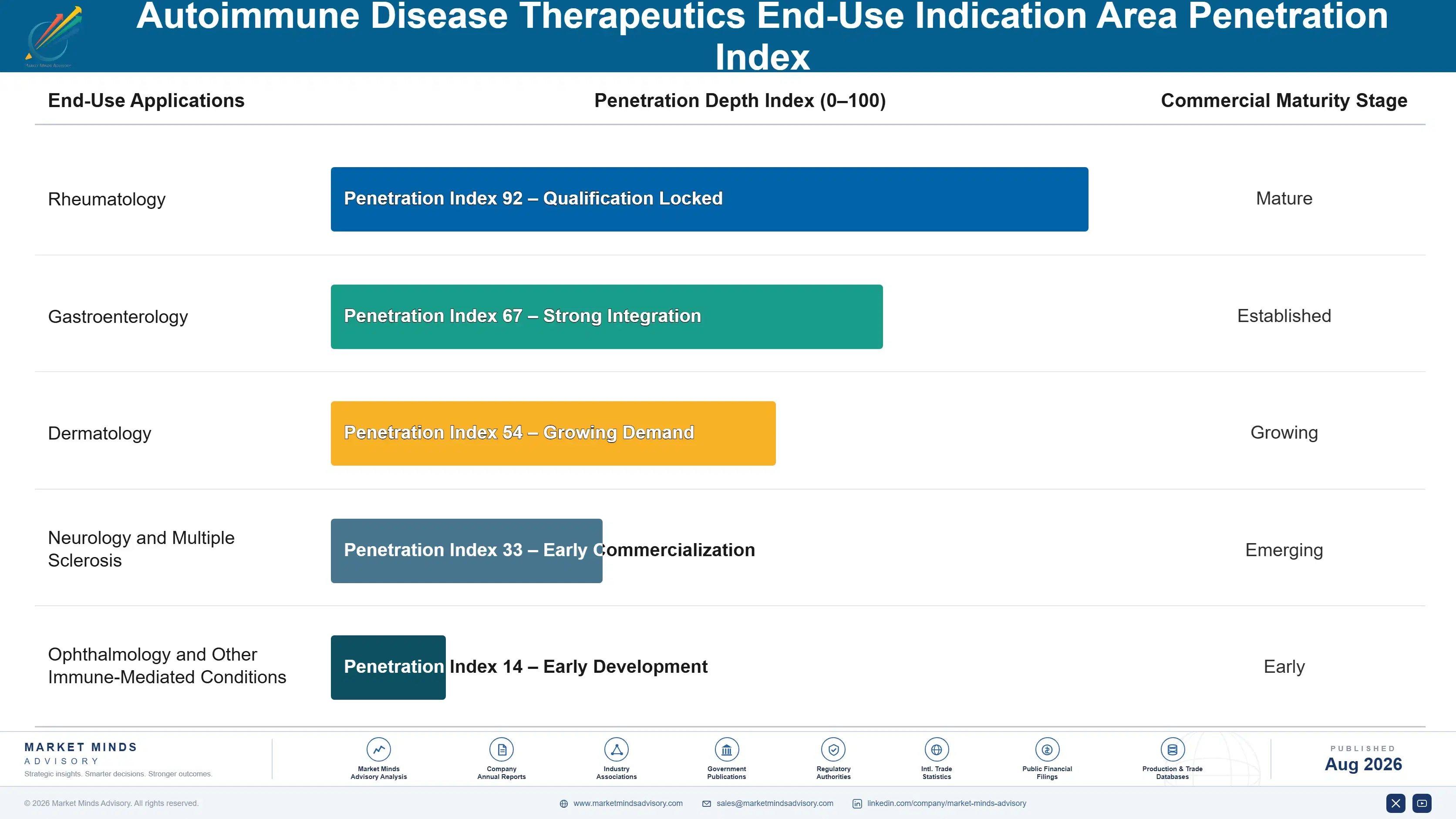
Stickiness varies sharply by indication. Gastroenterology sticks hardest, since inflammatory bowel disease patients who achieve remission are switched only reluctantly and prescribers are clinically conservative. Rheumatology sits in the middle, with more switching between agents as disease activity fluctuates. Dermatology switches most readily, because outcomes are visible, patients are vocal, and comparable agents are numerous. Payer-mandated switching cuts across all three whenever a formulary changes.

Buyer profiles have shifted from prescribing specialists toward payer committees, pharmacy benefit managers, and health technology assessment bodies who decide what a specialist may prescribe. Patient advocacy has grown more influential in parallel, particularly in challenging restrictive eligibility criteria across European systems. Younger specialists also weigh administration route more heavily than their predecessors did, which advantages oral agents before any formulary conversation begins.
autoimmune-disease-therapeutics-market-end-use-penetration-index-1787332105683

Our Call On Immunology Therapeutics

These are among the four positions where our research anticipates prominent divergence between winners and laggards over the coming forecast period. Each is grounded in the demand model, the regulatory perimeter, and the announced capacity pipeline.
01 / FORMULARY SETS PRICE

Exclusion settles arguments that clinical data cannot

Rebates and concessions take roughly 55% off American list prices, and a payer willing to exclude a product entirely holds negotiating power that no clinical differentiation overcomes at the moment of decision. Adalimumab demonstrated this precisely, with net prices collapsing 60% to 85% while list prices barely moved at all. Manufacturers should build launch strategy around formulary access and contracting capability rather than prescriber advocacy, because an excluded superior molecule reaches fewer patients than an included inferior one ever will.
02 / INDICATIONS COMPOUND CHEAPLY

Each approval opens a population without new discovery

A successful immunology agent accumulates 4 to 11 approved indications, each costing a fraction of an original approval while opening a full patient population and strengthening the safety database behind the molecule. Indication sequencing also extends commercial life, since a product entering late patent years in a fresh indication holds prescribing momentum a mature one cannot. Companies should plan the indication roadmap with the rigour of an original submission, because it is the cheapest growth available anywhere in the category.
03 / ORAL ATTACKS EARLIER LINES

A tablet reaches patients no injection ever will

Oral agents grow at 12.4% against a category at 7.0% because injection resistance keeps patients on conventional therapy longer than guidelines intend, and a tablet removes that objection entirely in exactly the earlier lines where patient volume concentrates. Safety labelling on first-generation Janus kinase inhibitors showed how completely a boxed warning closes that opportunity. Developers should prioritise selectivity and clean tolerability over marginal efficacy gains, since earlier-line access depends on safety rather than on any demonstration of superiority over existing agents.
04 / PERSISTENCE BEATS ACQUISITION

Retention is cheaper than replacing the patient lost

Only about 62% of patients remain on their initial biologic after the first twelve months, and every single discontinuation destroys revenue that acquisition spending has already paid to generate. Nurse support programmes, longer dosing intervals, better injection devices, and proactive tolerability management all improve persistence measurably at a fraction of what generating a new patient start costs. Companies consistently fund promotion far ahead of patient support, which is the wrong allocation on any honest arithmetic we have ever seen run.

Engagement Snapshot From the Field

A live engagement with an industry participant carrying material or product regulatory and market exposure ahead of a defining policy shift, showing how our research translates into a defensible multi-year portfolio strategy.
MARKET MINDS ADVISORY · CLIENT ENGAGEMENT SUMMARY
Autoimmune Disease Therapeutics Producer Strategic Portfolio Review and Transition Roadmap 2026·Investment Scenario on Autoimmune Disease Therapeutics Exposure Evaluation 2025-26
CLIENT PROFILE
A mid-sized pharmaceutical group with two marketed immunology biologics engaged MMA as biosimilar entry approached on its larger product. The client reported immunology revenue near USD 2.1 billion, with roughly 71% concentrated in a single agent holding three approved indications, and an oral candidate in mid-stage development with no defined launch strategy (client-reported, unverified by MMA).
STRATEGIC CHALLENGE
Commercial leadership planned to defend the maturing biologic on clinical differentiation, which the adalimumab experience suggested would fail against formulary exclusion. Meanwhile the oral candidate was being positioned as a later-line alternative rather than for the earlier lines where its administration advantage genuinely mattered. The board wanted a succession plan rather than a defence that would consume resource and lose anyway.
MMA APPROACH
MMA modelled net price erosion scenarios against payer behaviour on comparable expiries rather than against the client's internal assumptions, which had proven optimistic previously. We assessed indication expansion options on the mature agent for cost per incremental patient population. We then tested earlier-line positioning for the oral candidate against the tolerability evidence required to support it in that setting.
KEY FINDINGS
  1. Modelled net price erosion reached about 68% within eighteen months of biosimilar entry, considerably worse than the 40% the internal plan had assumed (client-reported, unverified by MMA).
  2. Two additional indications on the mature agent were achievable at roughly 22% of an original approval cost and would hold prescribing momentum through the erosion period.
  3. Earlier-line positioning for the oral candidate roughly doubled its addressable population, but required tolerability evidence the existing trial programme had not been designed to generate.
  4. Portfolio breadth across three therapy areas would make wholesale formulary exclusion impractical, which single-product exposure could never achieve (client-reported, unverified by MMA).
CLIENT PROFILE
A mid-sized pharmaceutical group with two marketed immunology biologics engaged MMA as biosimilar entry approached on its larger product. The client reported immunology revenue near USD 2.1 billion, with roughly 71% concentrated in a single agent holding three approved indications, and an oral candidate in mid-stage development with no defined launch strategy (client-reported, unverified by MMA).
STRATEGIC CHALLENGE
Commercial leadership planned to defend the maturing biologic on clinical differentiation, which the adalimumab experience suggested would fail against formulary exclusion. Meanwhile the oral candidate was being positioned as a later-line alternative rather than for the earlier lines where its administration advantage genuinely mattered. The board wanted a succession plan rather than a defence that would consume resource and lose anyway.
MMA APPROACH
MMA modelled net price erosion scenarios against payer behaviour on comparable expiries rather than against the client's internal assumptions, which had proven optimistic previously. We assessed indication expansion options on the mature agent for cost per incremental patient population. We then tested earlier-line positioning for the oral candidate against the tolerability evidence required to support it in that setting.
KEY FINDINGS
  1. Modelled net price erosion reached about 68% within eighteen months of biosimilar entry, considerably worse than the 40% the internal plan had assumed (client-reported, unverified by MMA).
  2. Two additional indications on the mature agent were achievable at roughly 22% of an original approval cost and would hold prescribing momentum through the erosion period.
  3. Earlier-line positioning for the oral candidate roughly doubled its addressable population, but required tolerability evidence the existing trial programme had not been designed to generate.
  4. Portfolio breadth across three therapy areas would make wholesale formulary exclusion impractical, which single-product exposure could never achieve (client-reported, unverified by MMA).
RECOMMENDED STRATEGY
Phase 1: Phase 1 (0 to 10 months): Abandon clinical defence of the maturing biologic and redirect that resource into indication expansion and succession launch. Phase 2: Phase 2 (10 to 26 months): Redesign the oral programme to generate the tolerability evidence earlier-line positioning requires before submission. Phase 3: Phase 3 (26 to 44 months): Launch the oral agent into earlier lines and build formulary contracting capability around portfolio breadth.
OUTCOME
The client stopped defending the maturing biologic and secured both additional indications before biosimilar entry, retaining prescribing momentum through a net price decline close to the modelled 68%. The oral programme was redesigned to support earlier-line positioning, which the board judged the more consequential of the two decisions (client-reported, unverified by MMA).

Frequently Asked Questions

Foundational context covering the market sizes, CAGR, scope, country, region and competition that inform every finding below. This section is provided to cover basics and most often pre-purchase conversations, answered from the MMA Primary Research Dataset.

What is the current size of the Autoimmune Disease Therapeutics Market?

The global autoimmune disease therapeutics market is valued at USD 148.3 billion in 2025, covering anti-cytokine and cell-depleting biologics, oral small molecules, biosimilars, and conventional immunosuppressants. Oncology immunotherapy and transplant products are excluded.

How large will the Autoimmune Disease Therapeutics Market be by 2036?

The market is forecast to reach USD 312.15 billion by 2036 in the base case, about 1.97 times the 2026 level. That represents incremental value of roughly USD 153.47 billion across the decade.

What is the CAGR for the Autoimmune Disease Therapeutics Market 2026 to 2036?

The market grows at a 7.0% CAGR in the base case, with bull and bear scenarios at 8.2% and 5.8%. The spread turns mainly on oral earlier-line positioning and how early payers pressure newer mechanisms.

Which segment is growing fastest?

Oral small molecule immunomodulators grow fastest at 12.4%, about 1.77 times the overall rate, because patients and payers prefer tablets where efficacy is comparable. Biosimilar biologics follow at 9.6%.

Who are the major companies in the Autoimmune Disease Therapeutics Market?

Leading companies include AbbVie, Johnson and Johnson, Amgen, Eli Lilly, and UCB. Concentration is high, with the top five holding roughly 61% of immunology revenue across originator and successor franchises.

Which country is growing fastest?

India grows fastest at an 11.8% CAGR, as domestically manufactured biosimilars bring biologic therapy within reach of patients previously receiving conventional immunosuppressants. China follows on reimbursement listing expansion.

Report Segmentation Architecture

The full report scope spans multiple orthogonal segmentation dimensions, with cross-tabulated demand data provided for each dimension pair. Coverage extends further to regional breakdowns, trend trajectories, and the competitive detail needed to support segment-level decision-making.

By Therapeutic Mechanism

  • Anti-Cytokine Biologics
  • Cell-Depleting and Co-Stimulation Biologics
  • Oral Small Molecule Immunomodulators
  • Biosimilar Biologics
  • Conventional Systemic Immunosuppressants

By End-Use Indication Area

  • Rheumatology
  • Gastroenterology
  • Dermatology
  • Neurology and Multiple Sclerosis
  • Ophthalmology and Other Immune-Mediated Conditions

By Distribution Channel

  • Specialty Pharmacy
  • Hospital and Infusion Centre
  • Retail Pharmacy
  • Public Tender and Institutional Procurement

By Region

  • North America
  • Western Europe
  • East Asia
  • South Asia and Pacific
  • Latin America
  • Middle East and Africa
  • Eastern Europe

Scope, Methodology, and Coverage

Every figure in this report is reproducible from documented input assumptions. The scope below maps the historical period, the forecast horizon, the segmentation dimensions, and the countries covered, alongside the underlying primary and qualitative methodology.
Historical Period
2020 to 2025
Forecast Period
2026 to 2036
Base Year
2025 (USD billions; MMA Primary Research Dataset, August 2026)
Market Definition
The autoimmune disease therapeutics market comprises prescription medicines that modulate immune system activity to treat autoimmune and immune-mediated inflammatory conditions, valued at manufacturer net revenue after rebates, discounts, and statutory concessions. It spans anti-cytokine biologics including tumour necrosis factor and interleukin inhibitors, cell-depleting and co-stimulation modulating biologics, oral small molecule immunomodulators including Janus kinase and TYK2 inhibitors, biosimilar versions of originator biologics, and conventional systemic immunosuppressants used in these indications. Preventive vaccines, transplant rejection prophylaxis, allergen immunotherapy, oncology immunotherapies including checkpoint inhibitors and cell therapies, diagnostic and disease monitoring assays, and autoinjector or infusion devices sold separately from the medicine are excluded.
Quantitative Units
USD billions (current prices, net of rebates); treated patient numbers where applicable
Segmentation Dimensions
By Therapeutic Mechanism; By End-Use Indication Area; By Distribution Channel; By Region
Regions Covered
North America, Western Europe, East Asia, South Asia and Pacific, Latin America, Middle East and Africa, Eastern Europe
Countries Covered
USA, China, Germany, France, UK, Japan, South Korea, India, Australia, Canada, Brazil, Mexico, Indonesia, Vietnam, Thailand, Malaysia, UAE, Saudi Arabia, South Africa, Nigeria, Turkey, Poland, Netherlands, Italy, Spain, Sweden, Switzerland, Argentina, Colombia, Singapore, and additional markets relevant to this sector
Key Companies Profiled
AbbVie, Johnson and Johnson, Amgen, Eli Lilly, UCB, Pfizer, Novartis, Sanofi, Bristol Myers Squibb, Takeda, Roche, Boehringer Ingelheim, Celltrion, Samsung Bioepis, Sandoz, Biocon, Organon, Alumis, Innovent Biologics, Bio-Thera Solutions
Quantitative Methodology
Primary survey, n=3,800 respondents, Q4 2025, six countries; demand-side model with trade association cross-validation
Qualitative Methodology
47 expert interviews, Q4 2025; applied to validate demand model assumptions, identify emerging dynamics, and assess competitive positioning
Report Format
PDF and XLSX data workbook (Word format preview document)
Publisher
Market Minds Advisory
Report Code
MMA-2026-HLT-183
Published
August 2026
Contact
sales@marketmindsadvisory.com | www.marketmindsadvisory.com

Purchase the full Autoimmune Disease Therapeutics Market Report (2026 to 2036).

The full MMA Autoimmune Disease Therapeutics report sizes the market across five therapeutic mechanisms, five indication areas, four distribution channels, and seven regions through 2036. It profiles 20 companies on a consistent basis of immunology net revenue, scoring each on indication breadth, payer contracting capability, oral pipeline depth, and biosimilar manufacturing position. Scenario models quantify how formulary exclusion, biosimilar entry timing, and oral earlier-line positioning move both treated volume and achievable net price by mechanism. The report also includes net price erosion modelling against comparable expiries, indication expansion cost benchmarking, treatment persistence analysis by indication, and emerging market access sizing for commercial and portfolio teams.
Five-mechanism and four-channel market sizing to 2036
Twenty-company benchmark on immunology net revenue basis
Net price erosion modelling against comparable biosimilar expiries
Indication expansion cost benchmarking per incremental patient population
Treatment persistence analysis by indication and administration route
Emerging market access sizing at biosimilar pricing levels

Built For The People Who Decide

From boardroom strategy to bench-side execution, this report is read cover-to-cover by leaders shaping the next decade of their industry, turning demand scenarios, market dynamics and valuation benchmarks into decisions.
CXOs/ Presidents/ VPs/ Managers
M&A and Corporate Development
Strategy Teams and R&D Heads
Procurement and Product Directors
Regulatory and Compliance Leaders
Investor Relations and Equity Analysts