Market Minds Advisory
Autocollimators Market

Autocollimators Market: Precision Optical Instruments for Angular Alignment and Calibration.

Semiconductor equipment calibration demands and machine tool precision requirements are pulling autocollimators past analog visual instruments into digital electronic designs, rewarding manufacturers who cut angular resolution below arc-second thresholds competitors cannot match.

Lead Analyst

Published

September 2026

Make Smarter Decisions with Customized Research Insights

Request a free sample report and evaluate market opportunities, growth trends, and competitive dynamics relevant to your business needs.

2025 MARKET VALUE$0.3BMarket Size 2025
2036 FORECAST VALUE$0.6BBase Case , 2026 to 2036
CAGR 2026 TO 20364.5 %Bull 5.6% / Bear 3.4%
INCREMENTAL OPPORTUNITY$0.2BNet 10- year value creation
EXPANSION MULTIPLE1.54x2036 value over 2026 base
Strategic Levers
M&A Pipeline
Regional Outlook
Country Rankings
Competitive Intelligence
Segmental Deep-dive
Call-Us : 91 93563 13602

Executive Snapshot and Market Trajectory.

Autocollimators have remained a genuinely niche precision instrument category for decades, but semiconductor equipment calibration and advanced machine tool alignment are steadily pulling demand toward digital electronic designs that measure angular deflection with resolution analog visual instruments were never built to achieve at comparable cost, repeatability, speed, or scale.
Machine tool manufacturing and semiconductor equipment calibration are the primary commercial forces here, concentrating volume in Western Europe, where precision machine tool manufacturing tradition and metrology expertise both run deeper than in most other regions worldwide and across decades. Digital electronic autocollimators absorb a meaningfully growing share of unit volume, since semiconductor lithography and inspection equipment require angular measurement precision that analog visual instruments cannot reliably deliver at production scale or repeatability.
Competitive intensity concentrates among a handful of specialized precision optics manufacturers holding decades of optomechanical design expertise, a structure considerably more concentrated than most general test and measurement equipment categories maintain across their broader product lines. Falling digital sensor costs are pulling advanced autocollimator capability into machine shop and quality control applications that previously could not justify the premium price these instruments traditionally commanded.
Market Definition
The Autocollimators Market covers precision optical instruments that measure small angular deflections using collimated light and a target reflector, sold as visual, digital electronic, or laser-based systems for alignment, calibration, and metrology applications. It excludes general-purpose laser levels, theodolites used primarily for surveying, and interferometers measuring linear rather than angular displacement.
Base Year Value
$0.3B in 2025 (MMA Primary Research Dataset, September 2026)
Forecast Period
2026 to 2036, eleven discrete annual values
CAGR
4.5% base case. Bull 5.6%. Bear 3.4%.
Fastest Growth Segment
Digital Autocollimators for Semiconductor Equipment Calibration: 8.0% CAGR
Fastest Growth Country
China: 7.0% CAGR
Fastest Growth Region
South Asia and Pacific: 7.0% CAGR
Largest Region
Western Europe: 28% of 2025 global value
Market Leaders
TRIOPTICS, Möller-Wedel Optical, Newport Corporation, Sagitta Engineering, and Micro-Radian Instruments lead the global Autocollimators Market. Source: MMA Primary Research Dataset, July 2026, and company disclosures.
Primary Survey
n=3,800 procurement and R&D decision-makers, Q4 2025, six countries
Methodology
Demand-side build-up, cross-validated against public data, 47 expert interviews

Autocollimators Market Forecast Scenarios

autocollimators-market-size-forecast-scenario-1790005222336
Autocollimator demand grew slowly but steadily between 2020 and 2025 as machine tool manufacturing and aerospace calibration sustained baseline unit volume across most developed markets, even as digital electronic designs gradually displaced analog visual instruments in premium applications. The historical growth rate of 4.5% reflects a genuinely mature category with no significant disruption during the period.
The base case rests on three commercial mechanisms: semiconductor equipment manufacturers specifying digital autocollimators for lithography and inspection tool calibration where legacy analog instruments cannot meet precision requirements, machine tool manufacturers upgrading alignment and calibration equipment as advanced manufacturing tolerances tighten across industries worldwide and product lines, and aerospace and defense optics testing programs sustaining steady procurement volume tied to platform certification cycles. Together these sustain modest but genuine growth through 2036.
A bull scenario centers on faster-than-expected semiconductor equipment capacity expansion pulling digital autocollimator volume forward across calibration applications where the technology remains essential and genuinely irreplaceable in most current designs. The principal bear risk is that alternative angular measurement technologies, including certain laser interferometry configurations, displace autocollimators from applications that have historically depended on the category exclusively.

Specialized Niche Sustains Autocollimator Pricing Power

Autocollimators occupy a genuinely specialized niche within the broader precision instrumentation market, commanding prices well above general-purpose alignment tools while delivering angular measurement precision that few alternative technologies can match at comparable cost or reliability over the equipment's operating life. This specialization keeps the addressable market concentrated among customers where measurement accuracy directly affects product quality or safety outcomes across their operations.
MARKET CONCENTRATION (CR5)62%share held by the five largest instrument manufacturers
DIGITAL ADOPTION SHARE48%shipment volume using digital rather than analog visual designs
SEMICONDUCTOR APPLICATION SHARE28%revenue flowing into semiconductor equipment calibration and inspection applications
ANGULAR RESOLUTION IMPROVEMENT5xmeasurement precision gain versus prior generation analog instruments
TOP PRODUCING COUNTRY SHARE38%instrument manufacturing output concentrated within a single leading country
AVERAGE INSTRUMENT SERVICE LIFE15 yearstypical operating lifespan before instrument replacement or upgrade
Pricing varies substantially by precision class and application: basic visual instruments for workshop alignment sell for a fraction of the cost of digital electronic systems calibrated for semiconductor equipment or aerospace optics testing requiring extreme angular resolution and repeatability across every measurement cycle. Semiconductor and aerospace customers negotiate meaningful volume discounts unavailable to smaller machine shop buyers purchasing single units at a time.
Manufacturing concentrates among a handful of specialized optics companies with decades of optomechanical design and precision manufacturing expertise, creating meaningful barriers to entry for new competitors lacking comparable intellectual property and production experience built up over many years. Semiconductor equipment qualification for autocollimators requires extensive reliability testing that favors established suppliers with proven track records over newer entrants lacking industry-specific certification history.
"Nobody outside precision metrology has heard of an autocollimator, yet half the lithography tools on earth would drift out of calibration within days without one quietly doing its job."
Director, Precision Instrumentation and Metrology Practice · MMA Technology Practice · September 2026

Market Trends

Digital Electronic Autocollimators Displace Analog Visual Designs

Digital electronic autocollimators equipped with CCD or CMOS sensors and software-based readout have moved from a premium alternative into the preferred architecture for new purchases, offering measurement repeatability and data logging capability that analog visual instruments cannot match. Digital units now account for roughly 48% of new autocollimator shipments, up from a small minority a decade ago, as customers value the elimination of subjective visual reading error. This transition is consolidating vendor share around companies that invested early in digital sensor integration, while legacy analog manufacturers work to retrofit their product lines or exit the category entirely.
Market Impact: 40% of installations now include verification

Semiconductor Equipment Calibration Drives New Precision Standards

Semiconductor lithography and precision inspection equipment manufacturers are now specifying autocollimators with sub-arc-second angular resolution to calibrate increasingly precise optical alignment systems as chip feature sizes continue shrinking toward physical limits across leading-edge process nodes and future generations. Industry standards bodies have issued updated calibration guidance within the past three years specifically addressing leading-edge lithography equipment requirements and testing protocols across the industry. Manufacturers without instruments meeting these updated precision standards risk losing qualification business to competitors who have already upgraded their product lines to match the new specification requirements.
Market Impact: 20% of revenue flows through defense

Market Opportunities and Growth Drivers

Machine Tool Precision Tolerances Continue Tightening Industry-Wide

Precision manufacturing tolerances continue tightening across aerospace, automotive, and industrial machining as customers increasingly demand higher part accuracy and consistency from suppliers competing on quality and reliability. Machine tool manufacturers worldwide now specify autocollimator-based alignment verification at roughly 40% of new premium machine tool installations, up from a smaller share a decade ago as tolerance requirements tightened across most manufacturing sectors and regions. This tolerance tightening sustains steady replacement and upgrade demand for calibration instrumentation entirely independent of overall machine tool unit shipment growth or broader economic cycles and conditions.
Market Impact: 45% of instruments exceed 10 years

Aerospace and Defense Optics Testing Sustains Steady Demand

Aerospace and defense optics manufacturers heavily rely on autocollimators for testing telescope mirrors, targeting systems, and other precision optical assemblies where angular alignment directly affects mission performance and safety outcomes for personnel, equipment, and platforms. Defense procurement programs consistently sustain multi-year testing equipment budgets tied to platform certification cycles that operate largely independent of broader commercial manufacturing spending patterns and prevailing economic conditions overall. Roughly 20% of total autocollimator revenue now flows through aerospace and defense procurement channels, providing manufacturers serving this niche segment meaningful revenue stability year after year.
Market Impact: 15% evaluate alternative technologies now

Market Restraints and Challenges

Long Instrument Service Life Suppresses Replacement Frequency

Autocollimators carry exceptionally long service lives, often exceeding fifteen years with proper maintenance and periodic recalibration, which suppresses refresh purchase frequency compared to faster-cycling electronic test equipment categories. The root cause is that the underlying optical and mechanical components degrade slowly and calibration services can extend usable service life well beyond initial design expectations for most instruments. Roughly 45% of installed autocollimators are more than ten years old, representing potential upgrade candidates that have not yet converted to purchases. Manufacturers are mitigating this by offering calibration and digital retrofit upgrade services that generate recurring revenue independent of new instrument sales.
Market Impact: 48% of shipments now digital electronic

Alternative Angular Measurement Technologies Compete for Applications

Certain laser interferometry and structured light measurement configurations can address some angular alignment applications that historically required dedicated autocollimators, creating competitive substitution risk in overlapping use cases. The root cause is that these alternative technologies have matured enough in specific applications to match autocollimator precision while offering additional measurement capabilities the specialized instrument cannot provide. Roughly 15% of surveyed machine shop customers report evaluating alternative measurement technologies for applications previously served exclusively by autocollimators. Vendors are mitigating this by emphasizing cost and simplicity advantages that multi-function alternative systems cannot match for pure angular measurement tasks.
Market Impact: New standards issued within 3 years
3 additional market trends, 4 additional growth drivers, and 2 additional restraints and challenges are covered in the full report. Contact sales@marketmindsadvisory.com to access the complete intelligence.

Segment CAGR and Growth Architecture

The Autocollimators Market segments by design technology across six categories spanning visual, digital electronic, and laser-based instruments for alignment and calibration applications, reflecting the primary purchasing decision customers make when specifying an instrument for a given task. Two segments outpace the market average, driven respectively by semiconductor equipment calibration and aerospace optics testing demand worldwide.
autocollimators-market-market-share-analysis-1790005222897

Digital Autocollimators for Semiconductor Equipment Calibration

Digital autocollimators for semiconductor equipment calibration are the fastest-growing segment, expanding rapidly as lithography and inspection tool manufacturers require sub-arc-second angular resolution that legacy visual instruments cannot reliably deliver at production scale or repeatability across shifts and manufacturing lines. These instruments command substantially higher prices than commodity visual designs, reflecting the specialized sensor integration and software calibration algorithms required to meet semiconductor equipment precision specifications consistently across every measurement cycle and tool. Suppliers with proven, established semiconductor industry qualification credentials benefit from multi-year design-in relationships that competitors without comparable track records struggle to displace, while new entrants face a genuinely lengthy validation gauntlet before earning comparable production volume at scale.
CAGR 8.0%

Digital Autocollimators for Aerospace and Defense Optics Testing

Digital autocollimators for aerospace and defense optics testing form the second-fastest segment, growing steadily as defense procurement programs specify precision testing equipment for telescope mirror and targeting system qualification tied to platform certification cycles and program milestones spanning many years. These instruments carry very stringent documentation and full traceability requirements that general commercial instruments rarely ever provide, reflecting the mission-critical nature of the optical assemblies being carefully tested and verified across their entire operational service life and deployment. Vendors serving this segment typically maintain dedicated defense industry security clearances and certification credentials that create meaningful, lasting barriers to entry for commercial instrument manufacturers lacking comparable government relationships and track records.
CAGR 6.5%
Full segment breakdown across 6 segments available in the complete report.

Regional Architecture and Country Demand Map

Autocollimator demand concentrates wherever precision machine tool manufacturing and aerospace metrology traditions run deepest, with Western Europe still leading on precision manufacturing heritage while North America and East Asia together anchor the remaining major demand centers found worldwide, spanning aerospace programs and semiconductor equipment production.

North America

North America broadly hosts extensive aerospace and defense optics testing programs tied to platform certification cycles, sustaining steady autocollimator demand independent of commercial manufacturing cycles entirely and across broader economic conditions and downturns. Semiconductor equipment manufacturers concentrated in the region specify digital autocollimators for lithography and inspection tool calibration as leading-edge chip fabrication capacity expands domestically under substantial government incentive programs and funding. Precision machine tool manufacturers serving both aerospace and automotive customers add further meaningful demand tied to tightening manufacturing tolerance requirements across the industry. The region's defense procurement programs provide a particularly stable demand floor given multi-year budget commitments that rarely reverse once platforms enter full production and deployment.
Share: 26% | CAGR: 4.5% (2026 to 2036)

Western Europe

Germany's precision machine tool manufacturing tradition, among the deepest and most established globally, sustains Western Europe's leading position in autocollimator demand tied to alignment verification for premium machine tool exports shipped worldwide. The region's specialized optics manufacturers, including several instrument makers with decades of optomechanical design heritage, anchor both supply and continued product innovation for customers across every major industry. The United Kingdom's metrology research institutions and precision instrumentation companies add further demand and manufacturing capability concentrated in specialized regional clusters near major research universities and laboratories. European aerospace programs, including collaborative multinational defense procurement initiatives, sustain steady testing equipment demand independent of any single national defense budget or election cycle.
Share: 28% | CAGR: 3.0% (2026 to 2036)
Regional intelligence for 5 additional markets available in the complete report: East Asia, South Asia and Pacific, Latin America, Middle East and Africa, Eastern Europe. Contact sales@marketmindsadvisory.com.
autocollimators-market-country-cagr-analysis-1790005223408

Where Autocollimator Vendors Actually Capture Margin

Autocollimator vendors capture value beyond raw instrument sales through four commercial mechanisms that reward calibration service depth and application expertise over one-time hardware margin alone in this niche market. Calibration and recertification contracts, digital retrofit upgrades, application engineering consulting, and multi-year defense and semiconductor supply agreements all matter more here than initial unit price.

Generating Recurring Revenue from Calibration Services

Precision autocollimators require periodic recalibration to maintain their measurement accuracy, and vendors offering dedicated calibration and recertification services capture recurring revenue across an instrument's fifteen-year-plus service life rather than a single equipment sale at purchase. Calibration service contracts typically generate 6 to 10% of a unit's original purchase price annually over its operating life, compounding into revenue that meaningfully supplements the initial hardware sale over time and across renewals. This recurring relationship also gives vendors early visibility into replacement timing well before customers begin evaluating competing instruments in the market.
Market Impact: Generates roughly 6 to 10% of purchase price

Selling Digital Retrofit Upgrades for Analog Instruments

Vendors that offer digital sensor retrofit kits for existing analog visual autocollimators capture meaningful incremental revenue from customers unwilling to purchase entirely new instruments but wanting improved measurement repeatability and data logging capability for their operations. These retrofit upgrades typically cost 30 to 40% of a comparable new digital instrument, offering customers a meaningful cost advantage while extending the useful life of existing optical components that remain fully functional and precise. This approach captures customers who would otherwise delay replacement indefinitely rather than fund a full new instrument purchase outright.
Market Impact: Retrofits cost 30 to 40% of new units

Providing Application Engineering Consulting for Custom Setups

Vendors that offer genuinely dedicated application engineering support helping customers integrate autocollimators into custom semiconductor equipment or aerospace test fixtures capture meaningful consulting revenue beyond the base instrument sale itself. This consulting relationship typically precedes an equipment purchase by 3 to 6 months, giving vendors early visibility into upcoming capital investment decisions and a genuinely strong advantage in the eventual competitive bid process that inevitably follows afterward. Customers value this specialized expertise highly since improper integration can compromise measurement accuracy entirely, expensively, and unpredictably over time and across use cases.
Market Impact: Consulting precedes purchase by 3 to 6 months

Securing Multi-Year Defense and Semiconductor Supply Contracts

Vendors that successfully negotiate multi-year supply agreements with defense programs or semiconductor equipment manufacturers lock in revenue predictability that spans platform certification or equipment production cycles far longer than typical commercial contracts allow. These agreements typically span 5 to 8 years tied to platform or equipment generation lifecycles, providing revenue visibility that helps vendors plan production capacity and research investment decisions with genuine long-term confidence and precision. This approach favors vendors with dedicated government contracting or semiconductor industry account teams over generalist instrument sellers lacking comparable relationships, credentials, and track records.
Market Impact: Supply contracts often span 5 to 8 years

Who Controls the Margin Pool

Revenue concentration in the Autocollimators Market sits at a CR5 of 62%, evaluated on autocollimator product line revenue disclosed or estimated across each vendor's instrument portfolio. TRIOPTICS and Möller-Wedel Optical lead by a meaningful margin over the next tier, drawing on decades of optomechanical design depth and precision manufacturing expertise smaller entrants cannot replicate quickly. The gap between the second and third-ranked vendor narrows given the category's genuine fragmentation.
Current competitive activity centers on digital sensor integration races, with vendors publicizing new precision and repeatability specifications ahead of semiconductor equipment qualification cycles. Several vendors have opened dedicated application engineering practices, treating this expertise as a genuine differentiator. Price competition remains most intense in the commodity visual instrument tier, where regional manufacturers compete aggressively on cost.

Emerging pressure comes from alternative angular measurement technologies, including certain laser interferometry configurations, that could displace autocollimators from applications where multi-function capability matters more than pure angular measurement. Rankings could shift meaningfully if a well-capitalized entrant secures broad semiconductor equipment qualification, since that volume carries multi-year exclusivity that reorders standing for years. Vendors without digital sensor capability risk losing share.
autocollimators-market-company-positioning-matrix-1790005223933

Competitive Moat and Risk Dimensions

TRIOPTICS

Moat: Decades of Optomechanical Design Depth

TRIOPTICS' decades of precision optical testing and alignment instrument design expertise give it credibility with semiconductor and aerospace customers that newer entrants cannot easily replicate. This design depth lets TRIOPTICS develop new digital sensor configurations faster than competitors building comparable optomechanical expertise from a standing start.
TRIOPTICS

Risk: Limited Emerging Market Manufacturing Presence

TRIOPTICS' European-centered manufacturing footprint leaves it less well positioned than regional Asian manufacturers to compete on price in cost-sensitive emerging market applications and volume tiers. Expanding manufacturing presence closer to Asian customers would require capital investment that competes against the company's core precision engineering priorities.
MÖLLER-WEDEL OPTICAL

Moat: Long-Standing Metrology Industry Relationships

Möller-Wedel Optical's decades-long relationships with European machine tool manufacturers and metrology laboratories give it design-in advantages that newer competitors struggle to displace without comparable trust built over many years of collaboration. This relationship depth translates into steady repeat business independent of aggressive marketing or price competition.
MÖLLER-WEDEL OPTICAL

Risk: Slower Digital Transition Pace

Möller-Wedel Optical's traditional strength in analog visual instruments has meant a somewhat slower transition to digital electronic designs compared to competitors that invested earlier in sensor integration capability and software development. Accelerating this transition requires engineering investment that competes against the company's established analog product line profitability.

Players Tracked

Prominent Players

TRIOPTICS
Möller-Wedel Optical
Newport Corporation
Sagitta Engineering
Micro-Radian Instruments

Other Key Players

Taylor Hobson
Zygo Corporation
Ealing Optics
Halma
Möller Precitec
Elcomat
Wyler AG
Wenzel Group
Precision Devices
Optikos Corporation
Trioptics Japan
Nikon Metrology
Chengdu Photon Technology
Beijing Optical Century
Guangzhou Everfine

Recent Developments

APRIL 2025

Wedel Facility Adds Digital Production Lines

TRIOPTICS expanded digital autocollimator production capacity at its Wedel, Germany manufacturing facility, adding dedicated lines for semiconductor equipment calibration instruments following rising order backlogs from lithography tool manufacturers worldwide. The organic capacity expansion supports anticipated demand growth as advanced node fabrication capacity continues expanding globally.
Signal: Signals sustained lithography industry demand pull for dedicated digital autocollimator production capacity across the entire country
SEPTEMBER 2025

Multi-Year Machine Tool Agreement Signed

Möller-Wedel Optical signed a multi-year supply agreement with a leading European machine tool manufacturer to provide alignment verification instruments across the manufacturer's expanding premium product line. The agreement, not a joint venture or equity arrangement, commits both parties to fixed volume and technical support terms extending across multiple product generations.
Signal: Locks in dedicated instrument supply and technical support ahead of the manufacturer's next major product expansion
FEBRUARY 2026

Acquisition Adds CMOS Readout Technology

Newport Corporation acquired a smaller digital sensor integration startup specializing in high-speed CMOS readout systems for precision optical instruments, adding specialized intellectual property to its existing autocollimator portfolio. The acquisition strengthens Newport's position in the fastest-growing digital segment without requiring years of internal development from a standing start.
Signal: Adds specialized CMOS readout intellectual property without years of costly internal development effort required elsewhere entirely

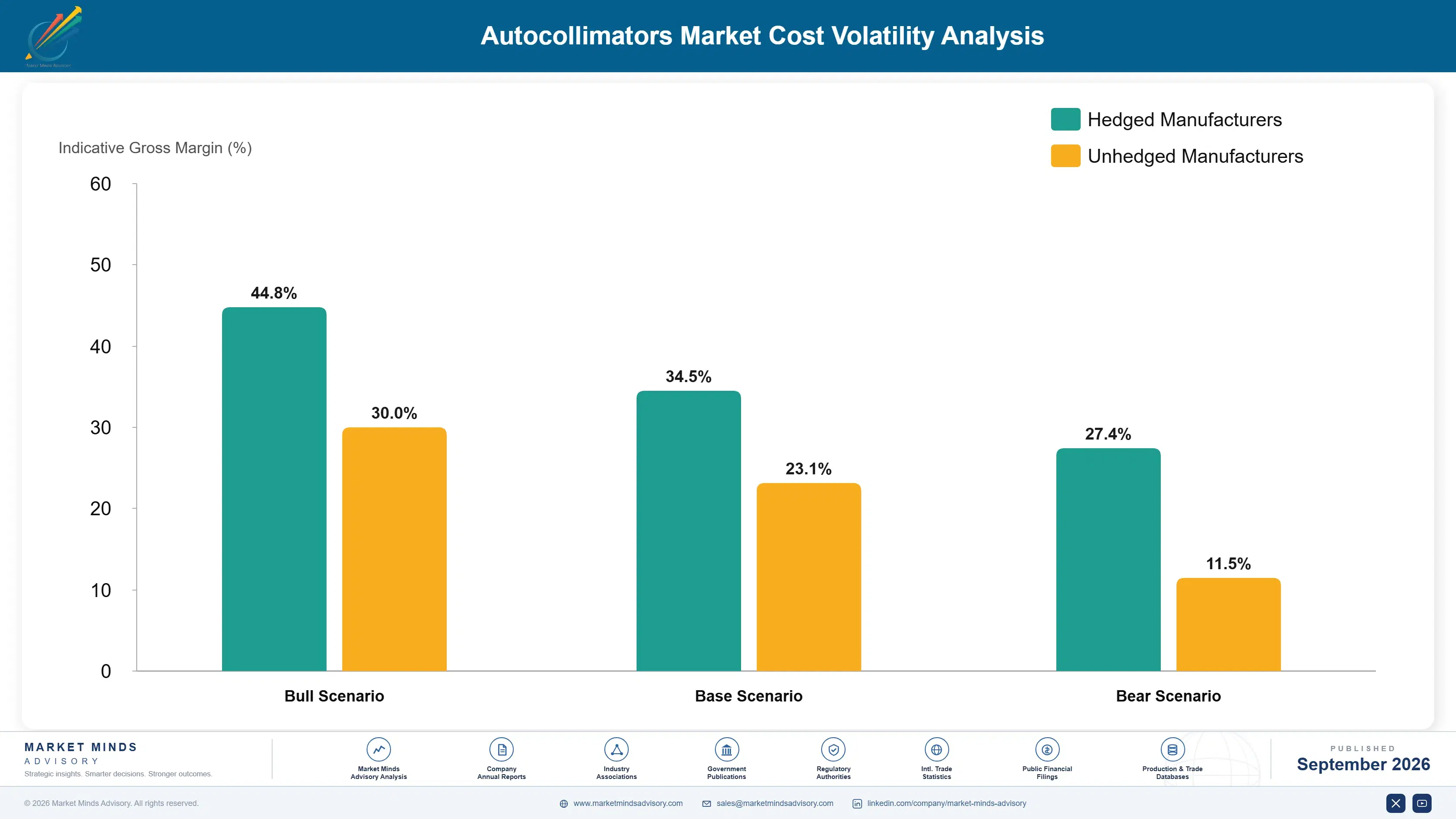
Precision Optical Glass Supply Exposure

Precision optical glass and lens elements account for roughly 30% of autocollimator production cost, sourced from a concentrated set of specialty glass manufacturers in Germany and Japan that few competitors can match at comparable optical quality. Digital sensor and electronic readout components represent a further 25% of cost, with fabrication capacity concentrated among specialized semiconductor sensor suppliers.
Precision optical glass pricing rose sharply during the 2021-2022 specialty materials supply disruption, when raw material shortages and energy cost spikes constrained European glass melting capacity, according to the German BMWK's industrial supply chain assessment. Lead times for certain precision optical glass grades stretched from a typical eight weeks to beyond twenty weeks at the peak, forcing several instrument manufacturers to delay new product launches by multiple quarters during the disruption.

Vendors without long-term optical glass supply agreements or in-house glass grinding capability face a lasting cost disadvantage during upcycles, since spot-market pricing for specialty optical materials can run well above contracted rates when capacity tightens industry-wide. Vertically integrated manufacturers with in-house optics fabrication absorb less margin pressure than smaller assemblers dependent entirely on external component sourcing decisions.
autocollimators-market-cost-volatility-analysis-1790005224131

Securing Multi-Year Optical Glass Supply Agreements

Large buyers are increasingly negotiating multi-year precision optical glass supply agreements directly with specialty manufacturers, trading committed volume for insulation against spot-market price swings during industry cycles and downturns. This approach worked well for vendors already under contract during the 2021-2022 disruption, avoiding the worst lead-time extensions that spot-market buyers experienced across the industry.

Dual-Sourcing Precision Optical Components Across Suppliers

Vendors are qualifying optical glass and digital sensor components from more than one manufacturer per product line, reducing exposure to any single supplier's capacity constraints or production disruptions. This raises qualification cost modestly but protects continuity when demand surges or energy cost spikes affect any single manufacturing region, a scenario buyers now weigh explicitly.

Developing In-House Optical Grinding and Assembly Capability

Some vendors are investing directly in optical grinding and lens assembly capability rather than relying entirely on external suppliers, reducing exposure to spot-market pricing during industry upcycles. This vertical integration took years to build for companies that now benefit most, giving early movers a durable cost advantage over assemblers during periods of tight supply.

Portfolio Architecture for Margin Defence

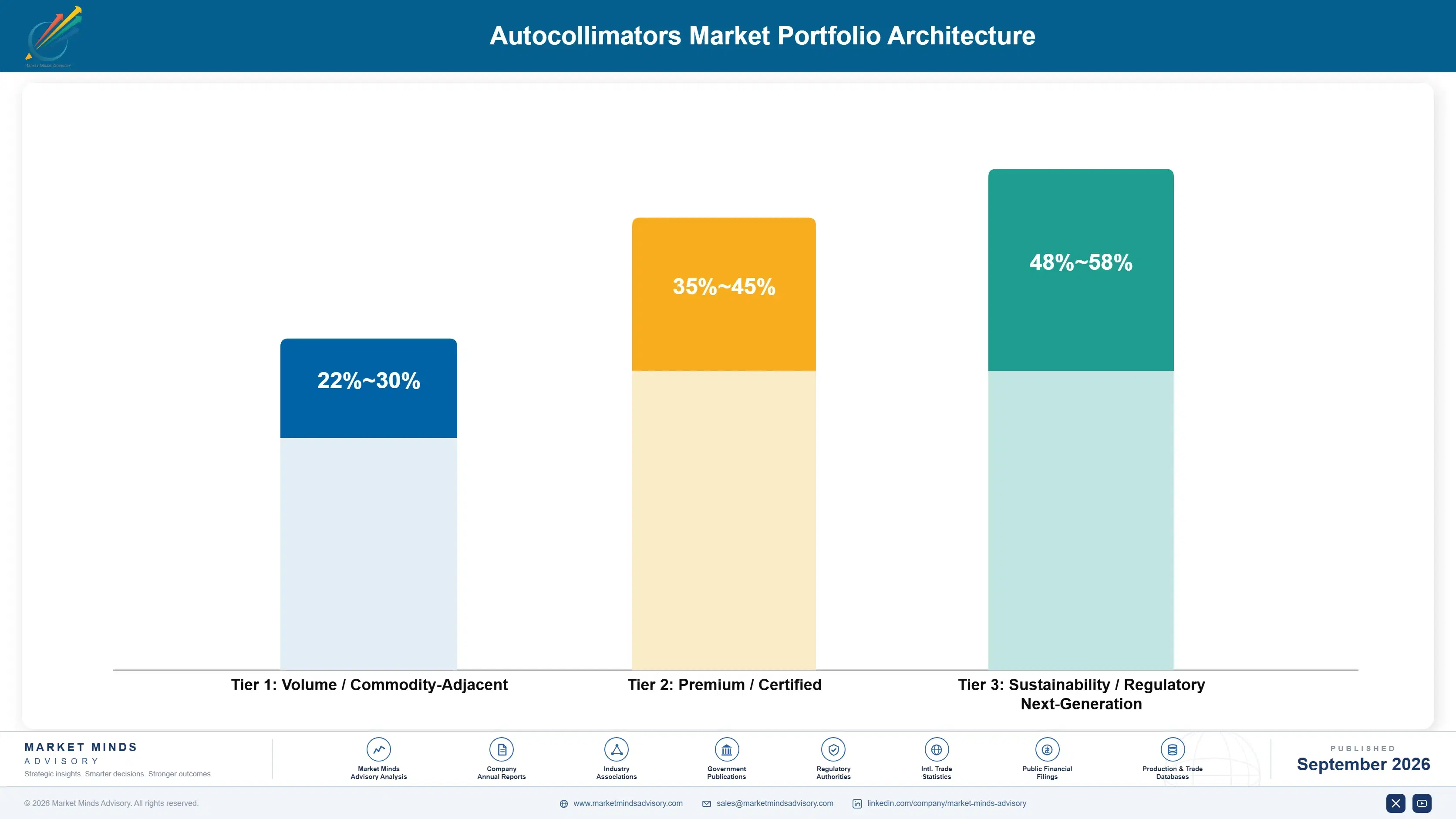
Autocollimator vendors organize their portfolios across three margin tiers reflecting genuinely different commercial relationships, from commodity visual instruments for workshop alignment up through digital electronic systems to specialized semiconductor and defense-grade instruments for the most demanding applications. Gross margin varies substantially across tiers, concentrating at the top where precision specifications and qualification barriers keep competition thin.
Volume tier products compete on unit cost and basic performance against a broad field of regional manufacturers, offering limited differentiation and correspondingly thin margin across most product lines. Premium tier digital electronic systems earn margin through demonstrated precision performance and semiconductor industry qualification history that customers value well beyond the marginal cost of the instrument itself, creating durable pricing power that commodity vendors cannot access.

The tension between commodity visual volume and premium digital product lines shapes research and development allocation decisions, since capital committed to legacy analog designs cannot easily flex toward digital sensor development during a sudden shift in customer requirements and specifications. Vendors maintaining strength in both categories use commodity volume revenue to fund the multi-year digital development investment needed to win premium semiconductor and defense contracts.

Volume / Commodity-Adjacent

Basic visual autocollimators for workshop alignment competing on unit cost against a broad field of regional manufacturers with limited differentiation across the product line, price points, and target markets worldwide.
Gross Margin: 22-30%

Premium / Certified

Digital electronic autocollimators with demonstrated precision and semiconductor industry qualification, priced for reliability and repeatability rather than raw unit cost alone across the entire product portfolio, customer base, and price tier.
Gross Margin: 35-45%

Sustainability / Regulatory / Next-Generation

Defense-grade and next-generation semiconductor calibration instruments, commanding the widest margin given limited qualified supplier counts and quite strict certification barriers across the entire category, buyer base, and application range worldwide.
Gross Margin: 48-58%
autocollimators-market-portfolio-architecture-1790005224625

High-value Sub-segments and Strategic Watch-out

Digital Autocollimators for Semiconductor Calibration

This segment combines the fastest unit growth in the category with strong gross margin, as fabs pay directly for demonstrated precision performance and a long semiconductor industry qualification history. Vendors with proven advanced calibration credentials are positioned to capture disproportionate value through the next decade.
Gross Margin: 42-52%

Digital Autocollimators for Aerospace Defense Testing

Defense procurement demand drives strong growth alongside healthy margin, since certification and full traceability requirements justify substantial price premiums over standard commercial-grade instruments generally available today. This combination of solid growth and above-average margin makes it a priority investment area for vendors serving government customers.
Gross Margin: 38-46%

Visual Autocollimators for Machine Shop Alignment

This segment remains the volume core of the market, generating the bulk of unit shipments even as growth slows and margin compresses under sustained price competition from regional manufacturers. It funds operating scale but contributes proportionally less to overall profit than its shipment volume suggests.
Gross Margin: 20-28%

Laser-Based Autocollimators for High-Precision Metrology

Growth here trails the market average today, but rising demand for extreme-precision measurement in advanced research and defense-related applications worldwide could well accelerate demand faster than currently modeled. Vendors should watch qualification activity in this adjacent segment closely over the next two to three years.
Gross Margin: 30-38%

Calibration Revenue Sustains Long Instrument Lifecycles

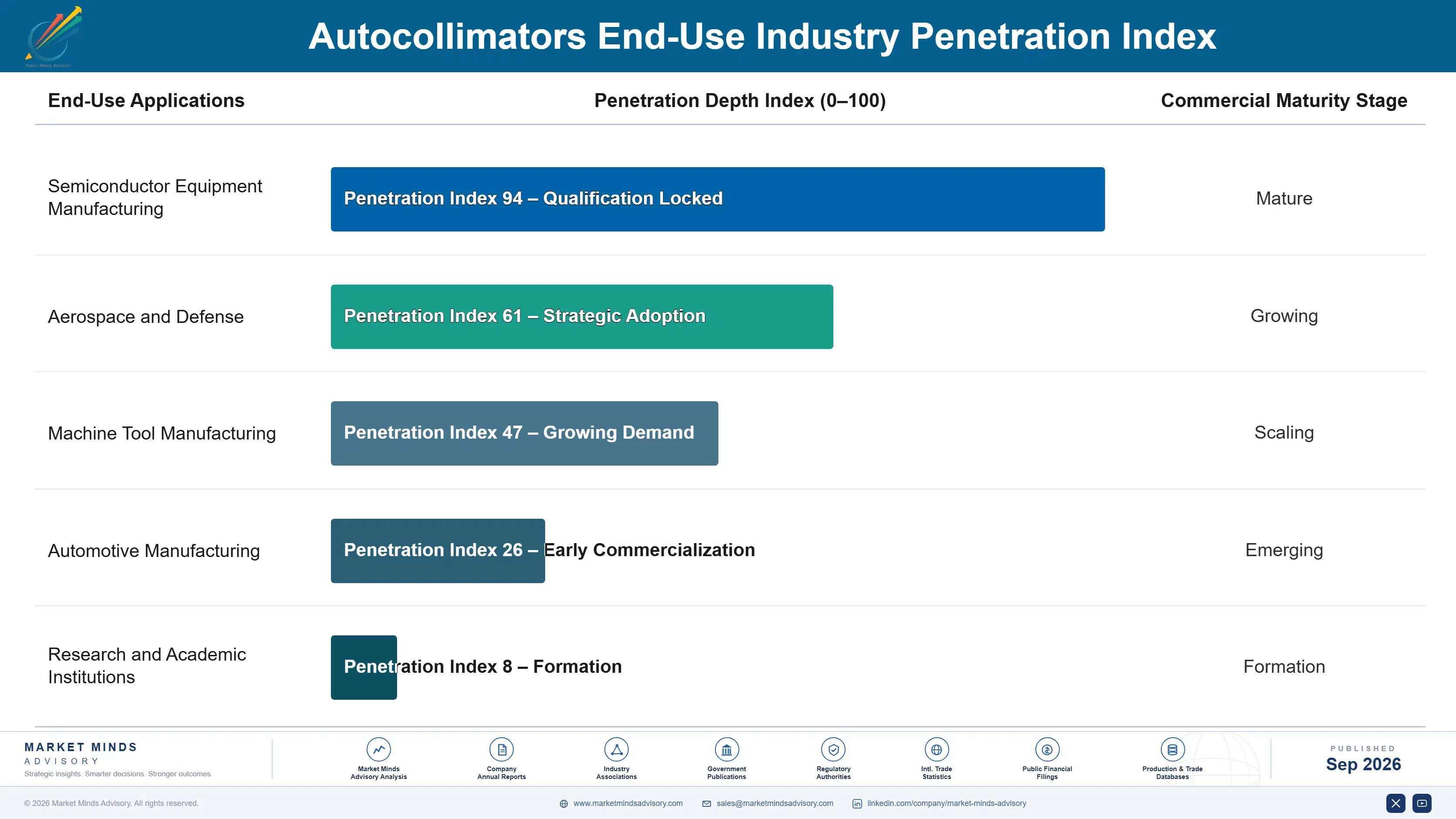
Autocollimator revenue behaves like an annuity once a vendor secures the initial equipment sale, since customers rarely switch calibration service providers mid-instrument-life given the switching cost and requalification burden involved in doing so. A single instrument sale generates recurring calibration and recertification revenue across a fifteen-year-plus service life without renewed sales effort, provided the vendor maintains service quality consistently.
Stickiness varies meaningfully by end-use vertical: semiconductor and defense customers carry the deepest lock-in given qualification requirements and the extensive validation burden of switching calibration service providers mid-certification-cycle, while machine shop customers turn over service providers more freely as basic calibration services commoditize across competing vendors. Aerospace optics testing sits between these extremes, tied to platform certification cycles rather than the extreme volume sensitivity of semiconductor equipment.

Buyer profiles are shifting generationally as quality engineers and metrology specialists increasingly hold purchasing authority once shared with generalist procurement teams, and they prioritize demonstrated precision performance data over vendor relationship history alone in most decisions. This shift favors vendors who invest in transparent calibration certification and traceability documentation over those relying on legacy distributor relationships built around basic instrument sales.
autocollimators-market-end-use-penetration-index-1790005225116

Where Autocollimator Strategy Focuses Next

These are among the four positions where our research anticipates prominent divergence between winners and laggards over the coming forecast period. Each is grounded in the demand model, the regulatory perimeter, and the announced capacity pipeline.
01 / DIGITAL SENSOR INVESTMENT PRIORITY

Prioritize Digital Sensor Development Over Legacy Visual Designs

Digital sensor development is the single highest-value investment available to autocollimator vendors today, since semiconductor equipment calibration and precision manufacturing applications are converting the entire premium segment away from analog visual instruments within a single product cycle. Vendors refining legacy visual designs instead protect a shrinking commodity segment with thinner margin and no meaningful precision moat against digital competitors already active there. The engineering investment required to build competitive digital sensor capability pays back many times over as semiconductor calibration becomes an increasingly important revenue driver.
02 / CALIBRATION SERVICE REVENUE EXPANSION

Build Recurring Revenue Through Calibration Service Contracts

Calibration service contracts typically generate 6 to 10% of a unit's original purchase price annually, compounding into revenue that meaningfully supplements the initial hardware sale over a fifteen-year-plus service life and often much longer. Vendors that build dedicated calibration and recertification practices now capture this recurring value rather than ceding it to third-party calibration labs lacking manufacturer-specific expertise and technical depth in the instrument's original design. Waiting risks losing this high-margin recurring relationship permanently once independent calibration providers establish customer trust.
03 / SEMICONDUCTOR INDUSTRY QUALIFICATION FOCUS

Pursue Semiconductor Equipment Qualification Before Competitors Do

Semiconductor equipment calibration is the fastest-growing segment in the category, commanding substantially higher prices than commercial visual instruments while requiring several years of dedicated qualification investment that most vendors have not yet completed or even seriously attempted to pursue. Vendors that establish semiconductor industry relationships now position themselves well ahead of the expanding leading-edge fabrication capacity driving segment growth across the entire industry. Waiting risks ceding this durable, high-margin qualification advantage permanently to competitors already investing heavily in this relationship.
04 / OPTICAL GLASS SUPPLY SECURITY

Secure Precision Glass Supply Before the Next Disruption

The 2021-2022 specialty materials disruption proved that vendors without secured precision optical glass supply face lead-time extensions that cost customer relationships for months afterward across the entire industry and supply chain as a whole. Securing multi-year supply agreements now, while negotiating leverage still favors buyers, protects against a repeat episode as semiconductor and aerospace demand both keep climbing steadily across every major region and vertical. Vendors that wait until the next disruption begins will negotiate from a materially weaker position.

Engagement Snapshot From the Field

A live engagement with an industry participant carrying material or product regulatory and market exposure ahead of a defining policy shift, showing how our research translates into a defensible multi-year portfolio strategy.
MARKET MINDS ADVISORY · CLIENT ENGAGEMENT SUMMARY
Autocollimators Producer Strategic Portfolio Review and Transition Roadmap 2026·Investment Scenario on Autocollimators Exposure Evaluation 2025-26
CLIENT PROFILE
The client is a mid-size precision machine tool manufacturer producing high-end grinding and milling equipment for aerospace and automotive customers across North America and Western Europe, with annual equipment revenue exceeding $180 million (client-reported, unverified by MMA). The company was upgrading its alignment verification process to meet tightening tolerance requirements from its largest aerospace customers.
STRATEGIC CHALLENGE
The client's quality engineering team relied on aging analog visual autocollimators that could not reliably demonstrate the measurement repeatability its newest aerospace customers required for supplier certification renewal each cycle. Leadership was uncertain whether digital electronic instruments would deliver sufficient accuracy improvement to justify the capital investment given existing budget constraints.
MMA APPROACH
MMA conducted structured interviews with the client's quality engineering and procurement leadership alongside primary survey benchmarking data on digital autocollimator adoption across comparable precision machine tool manufacturers nationally and internationally in scope. The analysis mapped available instrument options against the client's specific tolerance requirements, budget constraints, and customer certification needs.
KEY FINDINGS
  1. Digital electronic instruments demonstrated measurement repeatability roughly five times better than the client's existing analog visual instruments across all conducted test cycles.
  2. Two of four evaluated vendors offered calibration service contracts that reduced the client's internal metrology staffing burden meaningfully and measurably over time.
  3. Total cost of ownership over a full ten-year period favored digital instruments once eliminated recalibration labor costs were properly factored into the analysis.
  4. Certification documentation from digital instruments satisfied aerospace customer requirements more completely than analog alternatives ever could manage overall (client-reported, unverified by MMA).
CLIENT PROFILE
The client is a mid-size precision machine tool manufacturer producing high-end grinding and milling equipment for aerospace and automotive customers across North America and Western Europe, with annual equipment revenue exceeding $180 million (client-reported, unverified by MMA). The company was upgrading its alignment verification process to meet tightening tolerance requirements from its largest aerospace customers.
STRATEGIC CHALLENGE
The client's quality engineering team relied on aging analog visual autocollimators that could not reliably demonstrate the measurement repeatability its newest aerospace customers required for supplier certification renewal each cycle. Leadership was uncertain whether digital electronic instruments would deliver sufficient accuracy improvement to justify the capital investment given existing budget constraints.
MMA APPROACH
MMA conducted structured interviews with the client's quality engineering and procurement leadership alongside primary survey benchmarking data on digital autocollimator adoption across comparable precision machine tool manufacturers nationally and internationally in scope. The analysis mapped available instrument options against the client's specific tolerance requirements, budget constraints, and customer certification needs.
KEY FINDINGS
  1. Digital electronic instruments demonstrated measurement repeatability roughly five times better than the client's existing analog visual instruments across all conducted test cycles.
  2. Two of four evaluated vendors offered calibration service contracts that reduced the client's internal metrology staffing burden meaningfully and measurably over time.
  3. Total cost of ownership over a full ten-year period favored digital instruments once eliminated recalibration labor costs were properly factored into the analysis.
  4. Certification documentation from digital instruments satisfied aerospace customer requirements more completely than analog alternatives ever could manage overall (client-reported, unverified by MMA).
RECOMMENDED STRATEGY
Phase 1: Phase 1 (Instrument Evaluation and Vendor Selection): Compare digital electronic instruments against the client's specific tolerance and certification requirements closely. Phase 2: Phase 2 (Pilot Deployment and Validation): Deploy selected instruments on one production line to validate repeatability improvements before broader rollout. Phase 3: Phase 3 (Fleet-Wide Replacement): Replace remaining analog instruments across all production lines on a schedule tied to customer certification deadlines.
OUTCOME
The client selected a digital electronic instrument vendor offering bundled calibration services, completing fleet-wide replacement well ahead of its aerospace customer's certification deadline as originally planned and budgeted. The improved measurement repeatability satisfied all customer supplier certification requirements without further modification (client-reported, unverified by MMA).

Frequently Asked Questions

Foundational context covering the market sizes, CAGR, scope, country, region and competition that inform every finding below. This section is provided to cover basics and most often pre-purchase conversations, answered from the MMA Primary Research Dataset.

What is the current size of the Autocollimators Market?

The Autocollimators Market is valued at $0.35 billion in 2025. This reflects global shipment revenue for visual, digital electronic, and laser-based angular measurement instruments across all applications.

How large will the Autocollimators Market be by 2036?

The market is projected to reach $0.57 billion by 2036, up from $0.37 billion in 2026. That expansion represents a 1.54 times multiple over the eleven-year forecast period.

What is the CAGR for the Autocollimators Market 2026 to 2036?

The market is forecast to grow at a 4.5% compound annual growth rate between 2026 and 2036. Bull and bear scenarios range from 5.6% to 3.4%, reflecting semiconductor equipment capacity expansion uncertainty.

Which segment is growing fastest?

Digital autocollimators for semiconductor equipment calibration lead growth at 8.0% CAGR, roughly 1.78 times the overall market rate. Demand comes from lithography and inspection tool precision requirements.

Who are the major companies in the market?

TRIOPTICS, Möller-Wedel Optical, Newport Corporation, Sagitta Engineering, and Micro-Radian Instruments lead the global market. Together they hold a CR5 of 62% based on autocollimator instrument revenue.

Which country is growing fastest?

China leads country-level growth at a 7.0% CAGR, driven by its rapidly expanding domestic semiconductor equipment manufacturing base requiring precision calibration instruments. This outpaces the broader East Asia regional average.

Report Segmentation Architecture

The full report scope spans multiple orthogonal segmentation dimensions, with cross-tabulated demand data provided for each dimension pair. Coverage extends further to regional breakdowns, trend trajectories, and the competitive detail needed to support segment-level decision-making.

By Primary Market Dimension

  • Visual Autocollimators
  • Digital Electronic Autocollimators
  • Laser-Based Autocollimators
  • Portable Field Autocollimators
  • Autocollimator Accessories
  • Calibration Services

By End-Use Industry

  • Semiconductor Equipment Manufacturing
  • Aerospace and Defense
  • Machine Tool Manufacturing
  • Automotive Manufacturing
  • Research and Academic Institutions

By Commercial Dimension

  • Direct OEM Sourcing
  • Distributor and Channel Sales
  • Bundled Calibration Service Contracts
  • Government and Defense Procurement

By Region

  • North America
  • Western Europe
  • East Asia
  • South Asia and Pacific
  • Latin America
  • Middle East and Africa
  • Eastern Europe

Scope, Methodology, and Coverage

Every figure in this report is reproducible from documented input assumptions. The scope below maps the historical period, the forecast horizon, the segmentation dimensions, and the countries covered, alongside the underlying primary and qualitative methodology.
Historical Period
2020 to 2025
Forecast Period
2026 to 2036
Base Year
2025 (USD billions; MMA Primary Research Dataset, September 2026)
Market Definition
The Autocollimators Market covers precision optical instruments that measure small angular deflections using collimated light and a target reflector, sold as visual, digital electronic, or laser-based systems for alignment, calibration, and metrology applications. It excludes general-purpose laser levels, theodolites used primarily for surveying, and interferometers measuring linear rather than angular displacement.
Quantitative Units
USD billions (current prices); unit shipment volume where applicable
Segmentation Dimensions
By Primary Market Dimension; By End-Use Industry; By Commercial Dimension; By Region
Regions Covered
North America, Western Europe, East Asia, South Asia and Pacific, Latin America, Middle East and Africa, Eastern Europe
Countries Covered
USA, China, Germany, France, UK, Japan, South Korea, India, Australia, Canada, Brazil, Mexico, Indonesia, Vietnam, Thailand, Malaysia, UAE, Saudi Arabia, South Africa, Nigeria, Turkey, Poland, Netherlands, Italy, Spain, Sweden, Switzerland, Argentina, Colombia, Singapore, and additional markets relevant to this sector
Key Companies Profiled
TRIOPTICS, Möller-Wedel Optical, Newport Corporation, Sagitta Engineering, Micro-Radian Instruments, Taylor Hobson, Zygo Corporation, Ealing Optics, Halma, Möller Precitec, Elcomat, Wyler AG, Wenzel Group, Precision Devices, Optikos Corporation, Trioptics Japan, Nikon Metrology, Chengdu Photon Technology, Beijing Optical Century, Guangzhou Everfine
Quantitative Methodology
Primary survey, n=3,800 respondents, Q4 2025, six countries; demand-side model with trade association cross-validation
Qualitative Methodology
47 expert interviews, Q4 2025; applied to validate demand model assumptions, identify emerging dynamics, and assess competitive positioning
Report Format
PDF and XLSX data workbook (Word format preview document)
Publisher
Market Minds Advisory
Report Code
MMA-2026-TEC-974
Published
September 2026
Contact
sales@marketmindsadvisory.com | www.marketmindsadvisory.com

Purchase the full Autocollimators Market Report (2026 to 2036).

This report delivers a comprehensive assessment of the global Autocollimators Market, covering sizing, segmentation, competitive dynamics, and regional demand patterns through 2036. It profiles twenty leading vendors across precision optics specialists, digital sensor innovators, and diversified instrumentation companies, examining how semiconductor equipment calibration and aerospace testing are reshaping product economics. The analysis draws on primary survey data from 3,800 respondents and 47 expert interviews conducted in the fourth quarter of 2025. Readers gain a structured view of where qualification value concentrates and how sourcing strategy should evolve.
Detailed twenty-vendor competitive profiles and positioning
Full seven-region demand share and CAGR breakdown
Six-segment product growth and margin tier analysis
In-depth precision optical glass supply chain assessment
Semiconductor equipment qualification and strategy guidance
Anonymized client alignment verification engagement case study

Built For The People Who Decide

From boardroom strategy to bench-side execution, this report is read cover-to-cover by leaders shaping the next decade of their industry, turning demand scenarios, market dynamics and valuation benchmarks into decisions.
CXOs/ Presidents/ VPs/ Managers
M&A and Corporate Development
Strategy Teams and R&D Heads
Procurement and Product Directors
Regulatory and Compliance Leaders
Investor Relations and Equity Analysts