Market Minds Advisory
Australia Conveyor Maintenance Market

Australia Conveyor Maintenance Market: Belt Downtime Cost as the Real Purchasing Filter.

Mining operators now specify predictive condition monitoring ahead of unplanned belt failure costs, Australian iron ore producers expand overland conveyor maintenance contracts, and service providers without certified structural inspection capability lose multi-year site contracts outright.

Lead Analyst

David Horsley

Published

September 2026

Make Smarter Decisions with Customized Research Insights

Request a free sample report and evaluate market opportunities, growth trends, and competitive dynamics relevant to your business needs.

2025 MARKET VALUE$3.2BMarket Size 2025
2036 FORECAST VALUE$6.2BBase Case , 2026 to 2036
CAGR 2026 TO 20366.2 %Bull 7.4% / Bear 4.9%
INCREMENTAL OPPORTUNITY$2.8BNet 10- year value creation
EXPANSION MULTIPLE1.82x2036 value over 2026 base
Strategic Levers
M&A Pipeline
Regional Outlook
Country Rankings
Competitive Intelligence
Segmental Deep-dive
Call-Us : 91 93563 13602

Executive Snapshot and Market Trajectory

Mining operators increasingly treat unplanned belt failure cost as the deciding purchasing factor rather than routine service price alone, since documented predictive maintenance data now determines which providers actually qualify for long-term site contracts across most major bulk material handling operations simultaneously and without costly service interruption.
Condition monitoring and predictive maintenance systems lead growth at 9.8%, roughly 1.58 times the overall rate, as mining operators demand continuous belt health data that scheduled inspection alone cannot deliver across every duty cycle. East Asia now holds the largest regional share at 27%, driven by China's massive coal mining and port bulk material handling infrastructure requiring sustained conveyor maintenance investment across the region's expanding industrial base and its export logistics networks.
Competitive intensity stays fragmented at 34% held by five suppliers, since site-specific service relationships and equipment compatibility requirements fragment share across dozens of regional specialists rather than concentrating around a handful of global platforms the way more standardized equipment categories do. Buyers increasingly select providers on documented uptime performance rather than unit price alone across most major maintenance contract renewals and multi-year site agreements alike nationwide.
Market Definition
Base Year Value
$3.2B in 2025 (MMA Primary Research Dataset, August 2026)
Forecast Period
2026 to 2036, eleven discrete annual values
CAGR
6.2% base case. Bull 7.4%. Bear 4.9%.
Fastest Growth Segment
Condition Monitoring and Predictive Maintenance Systems: 9.8% CAGR
Fastest Growth Country
Australia: 8.7% CAGR
Fastest Growth Region
South Asia and Pacific: 8.5% CAGR
Largest Region
East Asia: 27% of 2025 global value
Market Leaders
Primary Survey
n=3,800 procurement and R&D decision-makers, Q4 2025, six countries
Methodology
Demand-side build-up, cross-validated against public data, 47 expert interviews

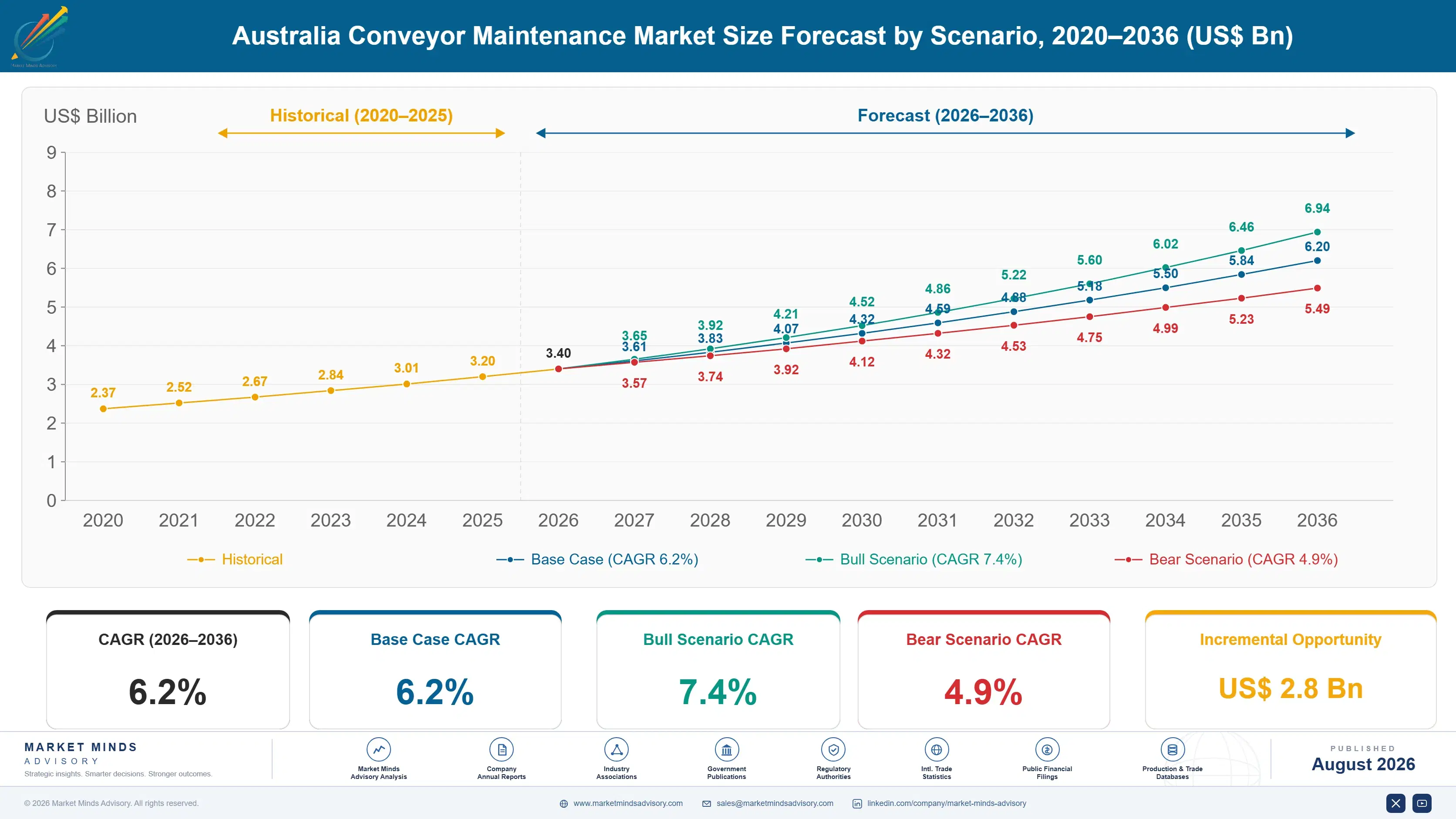
Australia Conveyor Maintenance Market Forecast Scenarios

australia-conveyor-maintenance-market-size-forecast-scenario-1787302805336
Between 2020 and 2025 the market grew at an estimated 5.5% annually, as post-pandemic mining production volumes and rising commodity prices pushed operators toward proactive maintenance contracts faster than the industry's typical reactive service cycle would otherwise dictate across most major mining regions worldwide, a pace that held steady even through broader commodity price volatility.
Three mechanisms carry the base case to 6.2%. First, global mining production keeps expanding, and every new or upgraded overland conveyor system requires ongoing maintenance to sustain operating reliability across every shift schedule. Second, port and bulk terminal operators keep expanding condition monitoring adoption as unplanned downtime costs continue rising across their logistics networks. Third, aging conveyor infrastructure across mature mining regions keeps requiring structural and alignment maintenance as belt systems reach end of design life.
The bull case at 7.4% assumes accelerating mining production and commodity price strength across additional major markets pulls forward maintenance contract demand faster than currently planned by most operators. The bear case at 4.9% assumes budget-constrained mining capital programs delay planned maintenance upgrades, slowing the pace of new service contract demand growth across affected sites and their broader capital budgets.

Belt Downtime Cost as the Real Purchasing Filter

Conveyor maintenance sits at the center of bulk material handling economics for any mining or port operation running overland belt systems, since unplanned downtime cost increasingly determines which service providers an operations manager can actually justify against production continuity requirements. Documented predictive maintenance data, not raw service price, increasingly separates competing providers across most major contract decisions and every subsequent renewal review.
MARKET CONCENTRATION (CR5)34%Five suppliers hold fragmented share across regional specialist field
AVERAGE BELT DOWNTIME COST50 to 150 thousand per eventTypical revenue loss range across unplanned conveyor failure incidents
TOP PRODUCING COUNTRY SHARE18%China supplies largest share of installed conveyor maintenance capacity
CONTRACT RENEWAL CYCLE3 to 5 yearsTypical interval before maintenance service contracts require renewal review
BELT COMPONENT COST SHARE28-38% of COGSRubber belting and replacement parts weigh heavily on service costs
TRADE INTENSITY31% cross-borderReplacement components frequently cross borders before final site installation
Commercially, the category behaves like a specialized reliability engineering business wrapped inside a broader industrial services supply relationship. Providers maintain condition monitoring data across dozens of site configurations simultaneously, which locks mining operators into providers holding the specific equipment history their sites require rather than encouraging contract-by-contract shopping on price. Switching maintenance providers requires costly site-specific requalification and equipment handover documentation.
Over the next decade, expect predictive condition monitoring and digital inspection technology to keep displacing conventional scheduled inspection methods as mining production volumes and unplanned downtime costs intensify across major bulk material handling regions worldwide. Iron ore, coal, and port terminal applications will keep driving the sharpest adoption activity as reliability and uptime requirements tighten further across the coming decade and beyond as operators raise minimum uptime performance thresholds.
"Nobody budgets for a belt failure until the first one happens. After that, predictive monitoring stops being optional and starts being the entire conversation."
Director, Mining Services and Industrial Maintenance Practice · MMA Industrial E

Market Trends

Predictive Monitoring Displaces Scheduled Inspection Cycles

Mining operators are increasingly specifying continuous condition monitoring over fixed-interval manual inspection, since sensor-based belt health data catches developing failures that scheduled walkdowns routinely miss between inspection cycles. Australia's major iron ore producers have pushed predictive monitoring adoption forward as unplanned downtime costs on their overland conveyor systems continue climbing with rising production volumes. Fenner Group and Metso have both expanded digital condition monitoring product lines specifically to meet this accelerating reliability transition. The shift is turning maintenance contracting into a data services decision as much as a mechanical repair one.
Market Impact: Adds 3,200 sites under contract
Port Bulk Terminal Expansion Sustains Maintenance Demand

Global port and bulk terminal capacity continues expanding to handle rising commodity export volumes, and each new or upgraded conveyor system requires ongoing maintenance to sustain the throughput reliability terminal operators contractually guarantee to shipping customers and their charter schedules. China's continued port infrastructure investment has expanded the installed base of terminals requiring certified maintenance supply across major coastal export hubs and their surrounding rail and road logistics networks. Suppliers with established port operator relationships are capturing disproportionate share of this expanding infrastructure-driven demand across every major producing region worldwide.
Market Impact: Adds 14% structural renewal contrac

Market Opportunities and Growth Drivers

Mining Production Expansion Sustains Baseline Maintenance Demand

Global mining production continues expanding across most major mining economies, and each active operation requires ongoing conveyor maintenance to sustain the continuous material handling reliability production targets depend on regardless of commodity type or region served. Australia's continued iron ore and coal production investment has expanded the installed base of overland conveyor systems requiring certified maintenance supply across major mining regions and their surrounding rail and port logistics chains. Suppliers with established mining operator relationships are capturing disproportionate share of this expanding production-driven demand base across every major producing region worldwide.
Market Impact: Requires 3 to 6 million

Aging Conveyor Infrastructure Requires Structural Renewal

Conveyor systems installed during the last major mining capacity expansion cycle are now reaching the end of their typical structural design life simultaneously, creating a maintenance wave concentrated within a relatively narrow window across mature mining regions worldwide and their extensive existing infrastructure. Operators facing simultaneous structural renewal needs across multiple conveyor lines increasingly consolidate maintenance programs with a single provider to secure fleet-wide inspection data and simplify contract administration across every affected site. Suppliers with strong service networks are capturing disproportionate share of this concentrated renewal demand across every affected mining district.
Market Impact: Delays upgrades 1 to 3 years

Market Restraints and Challenges

Remote Site Access Limits Smaller Provider Entry

Servicing conveyor systems at remote mining sites requires substantial logistics investment in fly-in fly-out staffing, remote equipment storage, and site-specific training, a cost burden smaller specialty maintenance providers often cannot justify against uncertain contract timelines. The root cause is geographic isolation: many of the largest mining operations sit hundreds of kilometers from population centers, requiring providers to maintain standing remote capability rather than dispatching on demand. That cost structure concentrates the highest-value site contracts among a handful of well-capitalized providers regardless of smaller competitors' technical capability. Providers are responding by pursuing shared regional depot networks to distribute logistics costs.
Market Impact: Converts 24% of new contracts

Commodity Price Cycles Delay Maintenance Budget Decisions

Mining capital and maintenance budgets typically follow commodity price cycles that constrain when conveyor upgrades can actually proceed, even when accumulated wear or aging structural condition would otherwise justify immediate investment. The root cause is budget allocation competition: mine operators must weigh maintenance spending against production expansion priorities competing for the same capital budget, and preventive maintenance rarely wins priority during downturns. That dynamic delays investment well past the point where condition data alone would justify the spend. Providers are responding by offering flexible contract structures tied to production volume rather than fixed annual fees.
Market Impact: Adds 15% terminal maintenance volum
3 additional market trends, 4 additional growth drivers, and 2 additional restraints and challenges are covered in the full report. Contact sales@marketmindsadvisory.com to access the complete intelligence.

Segment CAGR and Growth Architecture

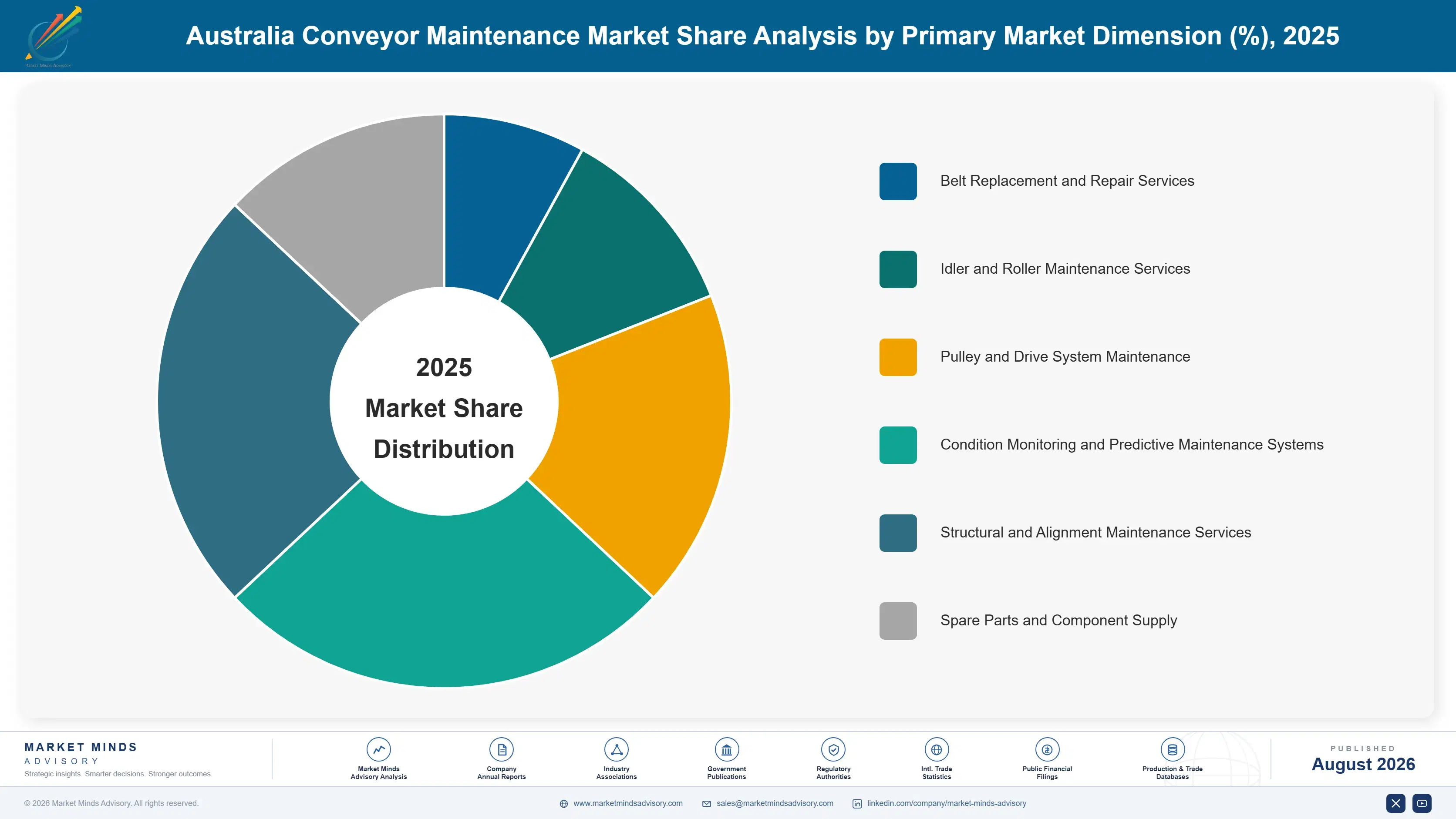
Segmentation follows service and component type, a single classification logic spanning belt replacement and repair, idler and roller maintenance, pulley and drive system maintenance, condition monitoring and predictive systems, structural and alignment maintenance, and spare parts and component supply. Each service carries distinct labor mechanism, certification pathway, and application context, so commercial position tracks service engineering rather than end-use industry.
australia-conveyor-maintenance-market-market-share-analysis-1787302805926

Condition Monitoring and Predictive Maintenance Systems

Condition monitoring and predictive maintenance systems grow fastest at 9.8%, about 1.58 times the overall market rate, as mining operators demand continuous belt health data that scheduled inspection alone cannot deliver without exposing operations to unplanned failure risk between visits. Adoption concentrates first in large overland conveyor systems where unplanned downtime cost directly threatens production targets, and port bulk terminals are increasingly following given comparable throughput reliability commitments to shipping customers. Providers with proven digital monitoring capability are capturing disproportionate share of new site contracts as procurement teams increasingly specify predictive maintenance explicitly in tender requirements, particularly across Australia, China, and the broader Asia-Pacific mining and port operator base worldwide.
CAGR 9.8%

Structural and Alignment Maintenance Services

Structural and alignment maintenance services grow second-fastest overall at 7.5%, driven by rapidly aging conveyor infrastructure across mature mining regions reaching the end of typical design life faster than replacement capital budgets can accommodate full system renewal in most cases. Mine operators worldwide increasingly specify structural assessment as a mandatory baseline for continued operation rather than an optional service, since regulators and insurers alike now treat documented structural inspection as a compliance requirement rather than a discretionary maintenance choice. Providers offering combined structural and alignment packages are capturing share from single-service specialists, since operators increasingly prefer a single accountable vendor for complete conveyor reliability across every managed system on site.
CAGR 7.5%
Full segment breakdown across 6 segments available in the complete report.

Regional Architecture and Country Demand Map

East Asia leads at 27% of global value on China's massive coal mining and port bulk material handling infrastructure, followed by North America at 25% and Western Europe at 19% on established industrial maintenance demand nationwide today. Remaining regions account for the balance of demand.

North America

The United States accounts for most North American demand, where large-scale coal, copper, and potash mining operations alongside expanding port terminal capacity shape which maintenance service model operators actually specify across most major mining and logistics sectors. Domestic mining production investment has pushed several operators toward accelerated condition monitoring adoption, sustaining elevated contract volume across major mining states. Canada's oil sands and mining sectors both follow comparable operational patterns at smaller absolute scale, anchored by its own reliability standards. Growth of 6.9% outpaces the global rate as production investment and aging fleet renewal compound across an already substantial installed customer base spanning multiple mining sectors and their extensive existing supplier networks nationwide.
Share: 25% | CAGR: 6.9% (2026 to 2036)

Western Europe

Germany and Poland host substantial industrial mining and quarrying operations supporting maintenance demand across the European Union's stringent workplace safety framework, which requires extensive documentation before approving continued conveyor operation across all member states simultaneously. Sweden's iron ore mining sector sustains steady demand tied to established maintenance relationships built over multiple decades. The United Kingdom maintains comparable safety requirements following its departure from the European Union's centralized regulatory system, creating some duplicative compliance burden for providers serving both markets separately. Growth of 4.8% trails the global average because the region's mining base, while technically sophisticated, has already driven most feasible predictive maintenance conversion across mature accounts and long-established mining maintenance relationships built over decades.
Share: 19% | CAGR: 4.8% (2026 to 2036)
Regional intelligence for 5 additional markets available in the complete report: East Asia, South Asia and Pacific, Latin America, Middle East and Africa, Eastern Europe. Contact sales@marketmindsadvisory.com.
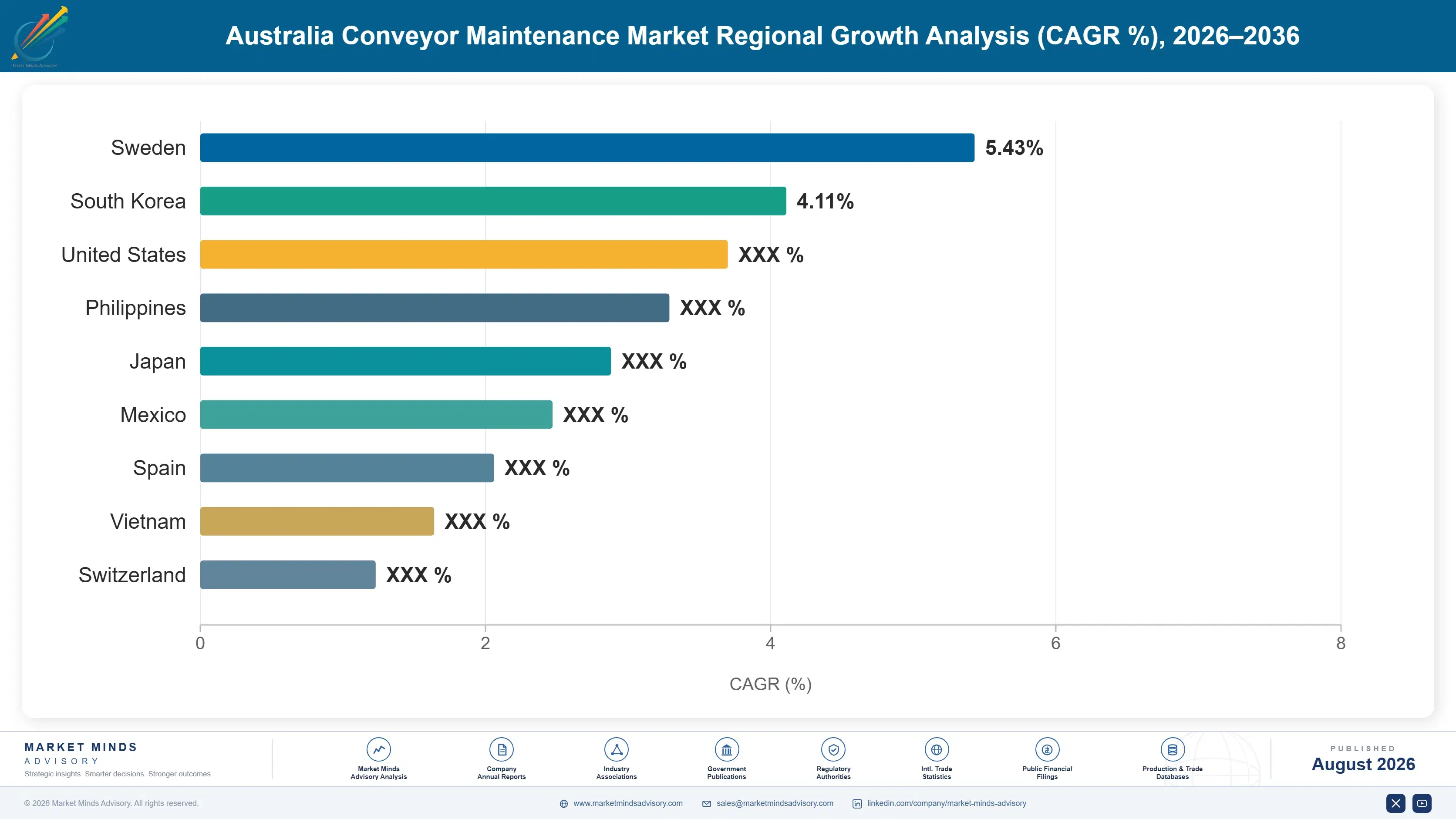
australia-conveyor-maintenance-market-country-cagr-analysis-1787302806480

Where Maintenance Providers Can Defend Margin

Providers can defend margin against commoditized service pricing in several distinct ways beyond simply servicing more sites at a growing rate. The three levers below identify genuine commercial advantage: predictive monitoring certification leadership, bundled structural and alignment packages, and remote site engineering support across regulated mining and port operator accounts worldwide, from remote pit sites to coastal terminals.

Lead Predictive Monitoring Certification Depth Now

Providers with the broadest documented condition monitoring data across multiple conveyor configurations and site types capture premium pricing of 15% to 25% over competitors with less rigorous monitoring capability, since mining operators increasingly specify minimum predictive documentation before approving contract renewal. This advantage compounds as uptime standards tighten industry-wide, since providers with the deepest monitoring libraries can respond to new site requests faster than competitors starting instrumentation from scratch. Fenner Group and Metso have both built durable monitoring leadership that smaller regional competitors cannot quickly or affordably replicate across comparable site configurations.
Market Impact: Commands a durable 15 to 25 percent

Bundle Structural Assessment With Routine Service Contracts

Mining operators increasingly want a single accountable provider for complete conveyor reliability spanning routine service and structural assessment, rather than sourcing each capability separately from different specialists across their production sites and shared logistics networks. Providers offering bundled contracts can charge premiums of 13% to 20% over service-only competitors, since customers value avoiding the integration risk of mismatched inspection standards across multiple vendors, reporting formats, and contract terms. Sandvik and FLSmidth have both built durable bundling advantages across dozens of site configurations that smaller specialists cannot quickly replicate at comparable scale.
Market Impact: Commands a durable 13 to 20 percent

Offer Embedded Remote Site Engineering Support

Providers moving beyond routine dispatched service toward embedded remote site engineering, spanning standing depot presence, dedicated site staff, and post-service performance monitoring under a single contract, capture engineering and logistics fees that a component-only service call never reaches. This shift matters most for remote mining customers running continuous operations, where embedded support can add 22% to 36% above the standalone service list price. It also deepens the customer relationship ahead of the next contract renewal, since the original provider typically wins the follow-on contract a decade or more later across the full site.
Market Impact: Adds 22 to 36 percent to embedded d

Who Controls the Margin Pool

Concentration stays fragmented at 34% held by the top five suppliers, evaluated on revenue from conveyor maintenance service and component supply specifically. Fenner Group and ContiTech lead on belt engineering breadth and service network depth, while Bridgestone, Habasit, and Metso compete across different application specialties and regional footprints. The gap between leader and challenger is meaningful but not decisive, since mining operators often qualify multiple providers per site.
Competitive activity currently runs along three dimensions. Predictive monitoring depth matters most, as providers race to demonstrate the most comprehensive condition data across every site type operators recognize. Bundled structural and alignment packaging runs a close second, as mining operators increasingly want a single accountable vendor. Embedded remote site engineering is the third, converting standalone service calls into deeper multi-year relationships.

Pressure is building from two directions. Chinese domestic providers are scaling rapidly and narrowing the technology gap on conventional belt maintenance service, threatening incumbents' share in price-sensitive emerging markets. Meanwhile digital reliability specialists are commercializing sensor-based predictive analytics platforms that could eventually challenge conventional maintenance providers on service revenue. Rankings will shift toward providers combining defensible monitoring portfolios with genuine bundling innovation.
australia-conveyor-maintenance-market-company-positioning-matrix-1787302807048

Competitive Moat and Risk Dimensions

FENNER GROUP

Moat: Broadest Belt Engineering Portfolio

Fenner Group maintains engineering and service data across more conveyor belt configurations than any other provider, giving it breadth that smaller regional competitors cannot match while also letting it serve multinational mining customers seeking a single provider across all target sites. That engineering depth took decades to build and cannot be quickly replicated.
FENNER GROUP

Risk: Exposure to Logistics Cost Inflation

Fenner Group's site-heavy service model makes it more exposed than smaller competitors to rising remote logistics and staffing costs, which keep climbing as skilled technician shortages persist across major mining regions. That cost inflation pressures margin on lower-volume remote site contracts specifically, a persistent cost trend affecting specialty industrial services broadly.
CONTITECH AG

Moat: Integrated Rubber Manufacturing Scale

ContiTech's integrated rubber and industrial component manufacturing base gives it cross-selling advantages that pure-play maintenance specialists cannot match, letting it bundle belt replacement into broader maintenance contracts while maintaining meaningful margin across its diversified product lines and adjacent industrial rubber categories it manufactures at meaningful scale.
CONTITECH AG

Risk: Conveyor Services a Smaller Slice

Conveyor maintenance represents a relatively small segment within ContiTech's much larger diversified industrial rubber portfolio, meaning specialized competitors sometimes out-innovate ContiTech on service-specific delivery since their entire operational focus concentrates there exclusively, without the competing internal capital priorities the broader portfolio must constantly balance across its many other global business units.

Players Tracked

Prominent Players

Fenner Group
ContiTech AG
Bridgestone Corporation
Habasit AG
Metso Corporation

Other Key Players

Sandvik AB
FLSmidth & Co. A/S
Voith GmbH & Co. KGaA
Yokohama Rubber Co., Ltd.
Bando Chemical Industries Ltd.
Phoenix Conveyor Belt Systems GmbH
Forbo Siegling GmbH
Continental Global Corporation
Precision Pulley & Idler Inc.
Superior Industries Inc.
ASGCO Complete Conveyor Solutions
Martin Engineering
Beltservice Corporation
Melco Conveyor Equipment
Kinder Australia Pty Ltd.

Recent Developments

MAY 2026

Fenner Group launches next-generation predictive monitoring platform for iron ore operators

Fenner Group released a new sensor-based predictive monitoring platform specifically engineered for high-throughput iron ore overland conveyor applications, expanding its digital service portfolio ahead of tightening uptime requirements. This was a product launch milestone, not a corporate transaction, extending Fenner Group's condition monitoring roadmap significantly.
Signal: Shows leading providers continuing to inve
OCTOBER 2025

ContiTech acquires specialty structural inspection technology developer

ContiTech acquired a privately held structural inspection technology developer specializing in conveyor gantry and support structure assessment systems for an undisclosed sum. The acquisition was a full corporate purchase, not a licensing arrangement or joint venture, giving ContiTech direct ownership of the underlying inspection technology and its intellectual property.
Signal: Indicates providers increasingly prefer ow
MARCH 2025

Bridgestone signs supply agreement with major Australian iron ore producer

Bridgestone entered a multi-year supply agreement to provide belt replacement and maintenance services to a major Australian iron ore producer expanding overland conveyor capacity across several Pilbara mine sites. The arrangement was a supply agreement, not an acquisition or joint venture, extending Bridgestone's mining customer relationships meaningfully.
Signal: Signals mining operators increasingly prio

Rubber Belting Supply Sets the Cost Ceiling

Rubber belting and steel replacement components together typically account for roughly 28% to 38% of maintenance service COGS, sourced primarily from specialty rubber producers in Germany, China, and the United States. Skilled labor and remote logistics add a further 22% to 30%, reflecting the standing site presence most remote mining contracts require before commercial deployment.
Natural rubber and synthetic elastomer prices rose meaningfully through 2024 as global demand for industrial belting competed directly with broader tire manufacturing uses for the same specialty rubber capacity, according to trade data. ContiTech's 2024 annual report disclosed higher input costs attributable to rubber and steel intermediate inflation, noting that raw material costs rose meaningfully faster than the company could pass through to mining customers without meaningful margin compression across its conveyor product segment specifically.

Smaller specialty maintenance providers carry more exposure than the largest diversified suppliers, since they lack the purchasing scale to negotiate favorable long-term rubber and steel supply contracts. Providers sourcing components from a concentrated set of producers face additional exposure to capacity and price volatility, while diversified suppliers absorb volatility more predictably across their broader, globally diversified supply chain relationships.
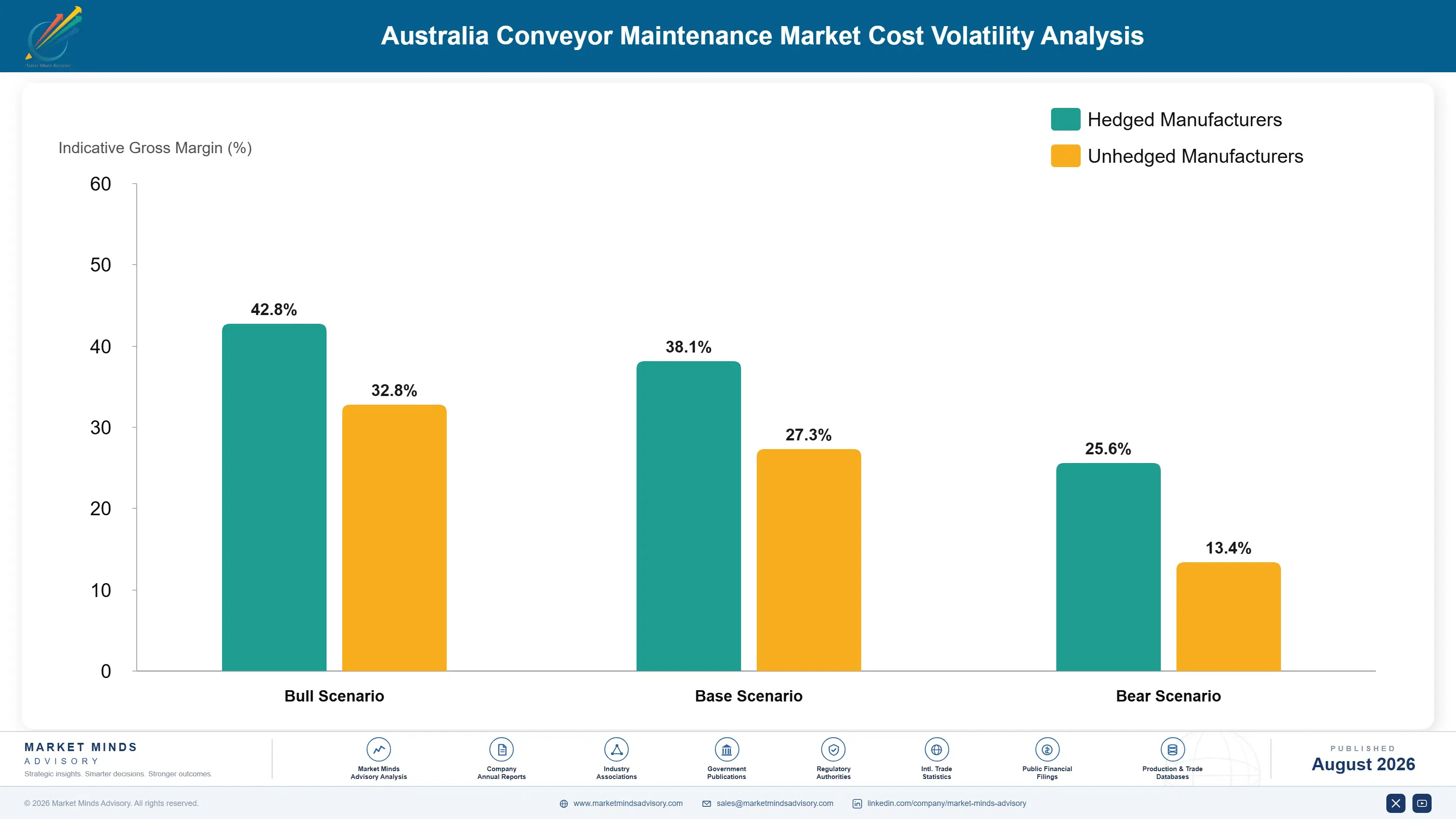
australia-conveyor-maintenance-market-cost-volatility-analysis-1787302807256

Lock Rubber Pricing Through Annual Contracts

Natural and synthetic rubber are the largest single volatile inputs across most conveyor belt product lines and increasingly competed for by broader tire and industrial rubber demand. Annual supply agreements with fixed or collared pricing, common practice among larger diversified suppliers, smooth quarter-to-quarter volatility and let commercial teams quote customer contracts with genuine confidence.

Diversify Component Sourcing Across Producers

Reliance on a single rubber or steel producer concentrates both price and availability risk unnecessarily across an entire maintenance service line. Qualifying secondary suppliers across multiple regions, even at modestly higher unit cost, protects continuity when any single producer faces capacity outage or a sudden demand spike from competing industrial sectors expanding simultaneously across multiple end markets.

Portfolio Architecture for Margin Defence

The portfolio splits into three tiers with meaningful margin separation tied to service depth and monitoring technology. Volume tier products carry standard scheduled belt replacement and repair services for conventional mining applications, competing largely on price against a crowded field of regional providers. Premium certified products carry predictive monitoring and structural assessment packages backed by documented reliability data. Sustainability products, including digitally integrated
The tension between volume and premium runs through nearly every provider's service roadmap. Volume contracts fund the technician base premium contracts eventually depend on, yet volume margins keep compressing as Chinese providers scale aggressively on conventional scheduled service. Providers that under-invest in premium monitoring breadth risk commoditization within their own category, while those chasing premium exclusively struggle to fund the technician base needed to serve routine mining demand.

High-value margin pools concentrate specifically in predictive monitoring and structural assessment services where documented reliability data and inspection depth carry the largest commercial stakes, and where certification breadth commands genuine pricing power. Conventional scheduled maintenance generates steadier volume but thinner margin, since that segment competes against a wider set of lower-cost regional providers with adequate but unremarkable service differentiation.

Volume / Commodity-Adjacent Tier

Standard scheduled belt replacement and repair services for conventional mining applications, competing largely on price against a crowded field of regional providers offering broadly comparable service coverage and response time.
Gross Margin: 14-22%

Premium / Certified Tier

Predictive monitoring and structural assessment packages backed by documented reliability data and formal customer qualification, commanding meaningful pricing premiums over scheduled equivalents across major regulated markets and multinational mining accounts.
Gross Margin: 26-38%

Sustainability / Regulatory / Next-Generation Tier

Digitally integrated fleet systems still scaling across automated mining and port terminal applications, targeting compliance outcomes conventional maintenance simply cannot achieve under current and anticipated future standards worldwide across every regulated market.
Gross Margin: 30-45%
australia-conveyor-maintenance-market-portfolio-architecture-1787302807776

The Annuity Behind Every Contract

Maintenance demand behaves like an annuity once a mining operator commits to a specific provider's condition monitoring data, since switching vendors requires costly site-specific requalification and equipment handover documentation across every affected conveyor line. That structure rewards incumbency heavily: a provider that wins the initial site contract keeps the customer relationship through multiple contract renewal cycles unless a competitor demonstrates a meaningful reliability or monito
Adoption stickiness varies meaningfully by end-use vertical once a provider's monitoring system is qualified into a site's reliability program. Iron ore and coal mining operators rarely switch maintenance providers mid-contract because requalifying monitoring against a new vendor risks production interruption during transition, so switching costs run high. Port terminal operators show similar loyalty tied to established service relationships, while general industrial applications switch more readily since specifications are less exacting and price competition dominates purchasing decisions.

Buyer profiles are shifting generationally as mining operations teams increasingly favor providers offering digital fleet monitoring and predictive reliability data over those selling labor hours alone. Younger reliability engineers trained on connected industrial systems expect service providers that report equipment condition continuously, a preference reshaping which providers win contract renewals as incumbent decision-makers retire.
australia-conveyor-maintenance-market-end-use-penetration-index-1787302808273

What Providers Should Do Next

These are among the four positions where our research anticipates prominent divergence between winners and laggards over the coming forecast period. Each is grounded in the demand model, the regulatory perimeter, and the announced capacity pipeline.
01 / PREDICTIVE MONITORING STRATEGY

Build the deepest condition monitoring library before rivals do

Buyers now pay a documented premium for predictive monitoring depth rather than raw service hours alone, and that premium is widening as mining operators increasingly specify minimum monitoring documentation before approving contract renewal across every affected site budget. Providers without comprehensive monitoring libraries will find themselves squeezed into commodity price competition, where ten points of margin separate documented leaders from untested followers across most mining accounts. The investment case favors monitoring depth over labor scale alone, particularly for providers targeting large multi-site accounts.
02 / BUNDLED SERVICE POSITIONING

Bundle structural and routine service ahead of integration mandates

Mining operators increasingly want a single accountable provider for complete conveyor reliability rather than sourcing routine and structural service separately from different specialists across their production sites and shared logistics networks and their surrounding rail infrastructure. Providers without bundling capability increasingly lose bids among operators standardizing on integrated service packages, regardless of individual component quality on either side of the sale. Those building bundled offerings now, ahead of rivals still selling components separately, will capture disproportionate share as integration mandates spread across every major regulated market.
03 / AUSTRALIAN MINING POSITIONING

Deepen Australian iron ore service networks ahead of rivals

Australia's dominant iron ore and coal mining sector and its expanding overland conveyor networks are creating a predictable demand wave that rewards providers who establish deeper site presence ahead of capacity expansion rather than scrambling once mining operators are already committed elsewhere and contractually locked in. Mining customers facing production ramp deadlines cannot wait for new provider qualification to complete elsewhere, which means late-moving providers miss the premium pricing window entirely regardless of eventual service performance. Providers positioning now will capture disproportionate share.
04 / REMOTE ENGINEERING POSITIONING

Offer embedded remote site engineering to capture full value

Engineering capacity for embedded remote site support has repeatedly struggled to keep pace with sudden demand spikes when mining production ramps take effect, creating temporary shortages that reward providers who invested in engineering capacity ahead of the wave rather than reactively scrambling once demand materializes. Providers with pre-positioned engineering teams can capture premium project pricing during production ramp cycles, since customers facing ramp deadlines cannot wait for capacity elsewhere. Providers investing ahead of the next production wave will capture disproportionate share.

Engagement Snapshot From the Field

A live engagement with an industry participant carrying material or product regulatory and market exposure ahead of a defining policy shift, showing how our research translates into a defensible multi-year portfolio strategy.
MARKET MINDS ADVISORY · CLIENT ENGAGEMENT SUMMARY
Australia Conveyor Maintenance Producer Strategic Portfolio Review and Transition Roadmap 2026·Investment Scenario on Australia Conveyor Maintenance Exposure Evaluation 2025-26
CLIENT PROFILE
A major Australian iron ore producer operating six overland conveyor systems across its Pilbara mining operations, transporting ore from pit to port across a dense rail and conveyor logistics network. The client generated approximately 640 million dollars in annual export revenue (client-reported, unverified by MMA) and faced rising unplanned downtime costs tied to an aging conveyor maintenance program relying primarily on scheduled inspection.
STRATEGIC CHALLENGE
The client needed to select maintenance providers for a fleet-wide predictive monitoring conversion program across six conveyor systems while minimizing production interruption during transition across multiple simultaneous mine sites. Leadership also questioned whether to prioritize established providers offering full monitoring certification depth or evaluate lower-cost alternatives with narrower documented reliability data.
MMA APPROACH
MMA conducted provider benchmarking across five maintenance vendors using primary interviews with site reliability engineers and operations management staff, alongside analysis of certified monitoring data and installation downtime requirements for each candidate provider under evaluation. The engagement mapped total cost of unplanned downtime across a ten-year operating horizon rather than upfront service price alone.
KEY FINDINGS
  1. Two of five candidate providers lacked sufficient predictive monitoring certification depth for the client's specific conveyor configurations, narrowing realistic options considerably ahead of the deadline.
  2. The leading candidate's sensor-based monitoring technology eliminated a costly scheduled shutdown inspection cycle the client's prior fleet would have otherwise required across every conveyor system.
  3. Bundled monitoring and structural assessment packages reduced total unplanned downtime by roughly 27 percent (client-reported, unverified by MMA) compared with separate sourcing.
  4. A phased conveyor-by-conveyor conversion approach, prioritizing the system closest to structural end of life first, reduced operational risk considerably compared with simultaneous conversion.
CLIENT PROFILE
A major Australian iron ore producer operating six overland conveyor systems across its Pilbara mining operations, transporting ore from pit to port across a dense rail and conveyor logistics network. The client generated approximately 640 million dollars in annual export revenue (client-reported, unverified by MMA) and faced rising unplanned downtime costs tied to an aging conveyor maintenance program relying primarily on scheduled inspection.
STRATEGIC CHALLENGE
The client needed to select maintenance providers for a fleet-wide predictive monitoring conversion program across six conveyor systems while minimizing production interruption during transition across multiple simultaneous mine sites. Leadership also questioned whether to prioritize established providers offering full monitoring certification depth or evaluate lower-cost alternatives with narrower documented reliability data.
MMA APPROACH
MMA conducted provider benchmarking across five maintenance vendors using primary interviews with site reliability engineers and operations management staff, alongside analysis of certified monitoring data and installation downtime requirements for each candidate provider under evaluation. The engagement mapped total cost of unplanned downtime across a ten-year operating horizon rather than upfront service price alone.
KEY FINDINGS
  1. Two of five candidate providers lacked sufficient predictive monitoring certification depth for the client's specific conveyor configurations, narrowing realistic options considerably ahead of the deadline.
  2. The leading candidate's sensor-based monitoring technology eliminated a costly scheduled shutdown inspection cycle the client's prior fleet would have otherwise required across every conveyor system.
  3. Bundled monitoring and structural assessment packages reduced total unplanned downtime by roughly 27 percent (client-reported, unverified by MMA) compared with separate sourcing.
  4. A phased conveyor-by-conveyor conversion approach, prioritizing the system closest to structural end of life first, reduced operational risk considerably compared with simultaneous conversion.
RECOMMENDED STRATEGY
Phase 1: Phase one: convert the conveyor system closest to structural end of life first using the leading monitoring and assessment bundle identified. Phase 2: Phase two: complete conversions across the remaining five systems, carefully sequencing all necessary installation work around planned production maintenance windows. Phase 3: Phase three: establish an internal fleet tracking process to flag future conversion needs well before end of life approaches at any site.
OUTCOME
The producer completed fleet-wide predictive monitoring conversion across all six conveyor systems within the planned eighteen-month window, avoiding any unplanned production suspension, and the bundled approach reduced total downtime cost meaningfully compared with the client's prior scheduled inspection history (client-reported, unverified by MMA). The fleet tracking process is now flagging future conversion needs earlier.

Frequently Asked Questions

Foundational context covering the market sizes, CAGR, scope, country, region and competition that inform every finding below. This section is provided to cover basics and most often pre-purchase conversations, answered from the MMA Primary Research Dataset.

What is the current size of the Australia Conveyor Maintenance Market?

The global conveyor maintenance market reached 3.2 billion dollars in 2025, with mining and port bulk material handling applications accounting for most of that demand base.

How large will the Australia Conveyor Maintenance Market be by 2036?

The market is projected to reach 6.2 billion dollars by 2036, representing a 1.82 times expansion over the eleven-year forecast period driven by predictive monitoring demand.

What is the CAGR for the Australia Conveyor Maintenance Market 2026 to 2036?

The market is forecast to grow at a 6.2% compound annual rate, with bull and bear scenarios ranging from 7.4% to 4.9% depending on mining production pace.

Which segment is growing fastest?

Condition monitoring and predictive maintenance systems lead at a 9.8% CAGR, roughly 1.58 times the overall market rate, as mining operators demand continuous belt health data.

Who are the major companies in the Australia Conveyor Maintenance Market?

Fenner Group, ContiTech, Bridgestone, Habasit, and Metso all lead this specific field today, together holding roughly 34% of global output on a consistent revenue basis.

Which country is growing fastest?

Australia leads national growth at an estimated 8.7% CAGR, driven by its dominant iron ore and coal mining sector and rapidly expanding overland conveyor networks.

Report Segmentation Architecture

The full report scope spans multiple orthogonal segmentation dimensions, with cross-tabulated demand data provided for each dimension pair. Coverage extends further to regional breakdowns, trend trajectories, and the competitive detail needed to support segment-level decision-making.

By Primary Market Dimension

  • Belt Replacement and Repair Services
  • Idler and Roller Maintenance Services
  • Pulley and Drive System Maintenance
  • Condition Monitoring and Predictive Maintenance Systems
  • Structural and Alignment Maintenance Services
  • Spare Parts and Component Supply

By End-Use Industry

  • Mining and Mineral Extraction
  • Port and Bulk Terminal Operations
  • Cement and Aggregate Processing
  • Power Generation
  • Agricultural Bulk Handling

By Commercial Dimension

  • Direct Site Contract Sales
  • Distributor and Wholesale Sales
  • Embedded Remote Site Engineering Services
  • Aftermarket Component Sales

By Region

  • North America
  • Western Europe
  • East Asia
  • South Asia and Pacific
  • Latin America
  • Middle East and Africa
  • Eastern Europe

Scope, Methodology, and Coverage

Every figure in this report is reproducible from documented input assumptions. The scope below maps the historical period, the forecast horizon, the segmentation dimensions, and the countries covered, alongside the underlying primary and qualitative methodology.
Historical Period
2020 to 2025
Forecast Period
2026 to 2036
Base Year
2025 (USD billions; MMA Primary Research Dataset, August 2026)
Market Definition
This report covers maintenance services and replacement components for belt conveyor systems used in mining, port, and bulk material handling applications, including belt, idler, pulley, structural, and condition monitoring services. It includes both scheduled and predictive maintenance service models. It excludes new conveyor system engineering and installation, along with standalone material handling equipment sold without accompanying maintenance service.
Quantitative Units
USD billions (current prices); service contract volume where applicable
Segmentation Dimensions
By Primary Market Dimension; By End-Use Industry; By Commercial Dimension; By Region
Regions Covered
North America, Western Europe, East Asia, South Asia and Pacific, Latin America, Middle East and Africa, Eastern Europe
Countries Covered
USA, China, Germany, France, UK, Japan, South Korea, India, Australia, Canada, Brazil, Mexico, Indonesia, Vietnam, Thailand, Malaysia, UAE, Saudi Arabia, South Africa, Nigeria, Turkey, Poland, Netherlands, Italy, Spain, Sweden, Switzerland, Argentina, Colombia, Singapore, and additional markets relevant to this sector
Key Companies Profiled
Fenner Group; ContiTech AG; Bridgestone Corporation; Habasit AG; Metso Corporation; Sandvik AB; FLSmidth & Co. A/S; Voith GmbH & Co. KGaA; Yokohama Rubber Co., Ltd.; Bando Chemical Industries Ltd.; Phoenix Conveyor Belt Systems GmbH; Forbo Siegling GmbH; Continental Global Corporation; Precision Pulley & Idler Inc.; Superior Industries Inc.; ASGCO Complete Conveyor Solutions; Martin Engineering; Beltservice Corporation; Melco Conveyor Equipment; Kinder Australia Pty Ltd.
Quantitative Methodology
Primary survey, n=3,800 respondents, Q4 2025, six countries; demand-side model with trade association cross-validation
Qualitative Methodology
47 expert interviews, Q4 2025; applied to validate demand model assumptions, identify emerging dynamics, and assess competitive positioning
Report Format
PDF and XLSX data workbook (Word format preview document)
Publisher
Market Minds Advisory
Report Code
MMA-2026-CON-401
Published
August 2026
Contact
sales@marketmindsadvisory.com | www.marketmindsadvisory.com

Purchase the full Australia Conveyor Maintenance Market Report (2026 to 2036).

The full report provides complete segmentation data across all six maintenance service segments, detailed profiles of the top twenty market participants, and country-level analysis across all seven global regions covered by this study. It includes a proprietary MMA predictive monitoring adoption index built from primary survey data collected across forty-seven expert interviews conducted throughout the fourth quarter of 2025. Buyers also receive quarterly market updates through the end of 2026. Direct analyst access is included for methodology questions or custom data requests specific to their strategic priorities.
Full seven-region CAGR and market share breakdown
Twenty-company competitive profile database included in full
Segment-level pricing and gross margin analysis
Rubber belting input cost exposure tracking model
Quarterly market update subscription through 2026
Direct analyst access for custom data queries

Built For The People Who Decide

From boardroom strategy to bench-side execution, this report is read cover-to-cover by leaders shaping the next decade of their industry, turning demand scenarios, market dynamics and valuation benchmarks into decisions.
CXOs/ Presidents/ VPs/ Managers
M&A and Corporate Development
Strategy Teams and R&D Heads
Procurement and Product Directors
Regulatory and Compliance Leaders
Investor Relations and Equity Analysts