Market Minds Advisory
Augmented Reality Glasses Market

Augmented Reality Glasses Market: Augmented Reality Glasses Market. Waveguide Display and Enterprise Industrial AR Wearables

Waveguide display miniaturization is pulling AR glasses out of bulky enterprise headsets into everyday consumer eyewear form factors faster than legacy optics makers can retool, forcing a costly component reset across the supply chain.

Lead Analyst

Published

September 2026

Make Smarter Decisions with Customized Research Insights

Request a free sample report and evaluate market opportunities, growth trends, and competitive dynamics relevant to your business needs.

2025 MARKET VALUE$3.2BMarket Size 2025
2036 FORECAST VALUE$18.0BBase Case , 2026 to 2036
CAGR 2026 TO 203617.0 %Bull 18.5% / Bear 15.5%
INCREMENTAL OPPORTUNITY$14.2BNet 10- year value creation
EXPANSION MULTIPLE4.81x2036 value over 2026 base
Strategic Levers
M&A Pipeline
Regional Outlook
Country Rankings
Competitive Intelligence
Segmental Deep-dive
Call-Us : 91 93563 13602

Executive Snapshot and Market Trajectory.

Waveguide display miniaturization is pulling AR glasses out of bulky enterprise headsets into everyday consumer eyewear form factors faster than legacy optics makers can retool, forcing a costly component reset across the supply chain this cycle, and adoption is spreading beyond early enterprise field service deployments into consumer eyewear buyers.
Consumer buyers increasingly demand lightweight glasses with all-day battery life and socially acceptable form factors rather than the bulky headsets that defined early enterprise AR deployments. Waveguide vendors are capturing this shift by offering thinner optical stacks that fit into standard eyewear frames, pulling mainstream consumer buyers who previously found AR glasses too bulky to wear into serious purchase consideration as designs improve.
Legacy enterprise-focused AR headset makers face genuine platform transition risk as consumer-focused waveguide vendors capture new design win budgets, while established players extending consumer form factors into their own product lines race to prove optical clarity that preserves existing enterprise customer relationships rather than requiring buyers to switch suppliers entirely. Design win cycles now run twelve to eighteen months from evaluation to volume production, rewarding vendors who committed engineering resources to waveguide miniaturization early.
Market Definition
The augmented reality glasses market covers wearable eyewear devices that overlay digital information onto the physical environment through waveguide, birdbath, or projector-based optical display technology, including consumer and enterprise industrial form factors. It excludes fully immersive virtual reality headsets that block outside vision entirely and audio-only smart glasses without any visual display capability.
Base Year Value
$3.2B in 2025 (MMA Primary Research Dataset, September 2026)
Forecast Period
2026 to 2036, eleven discrete annual values
CAGR
17.0% base case. Bull 18.5%. Bear 15.5%.
Fastest Growth Segment
Waveguide Display AR Glasses: 24.0% CAGR
Fastest Growth Country
India: 19.2% CAGR
Fastest Growth Region
South Asia and Pacific: 19.2% CAGR
Largest Region
North America: 32% of 2025 global value
Market Leaders
Meta, Google, Vuzix, RealWear, and Xreal lead the market. Source: MMA Analysis, July 2026.
Primary Survey
n=3,800 procurement and R&D decision-makers, Q4 2025, six countries
Methodology
Demand-side build-up, cross-validated against public data, 47 expert interviews

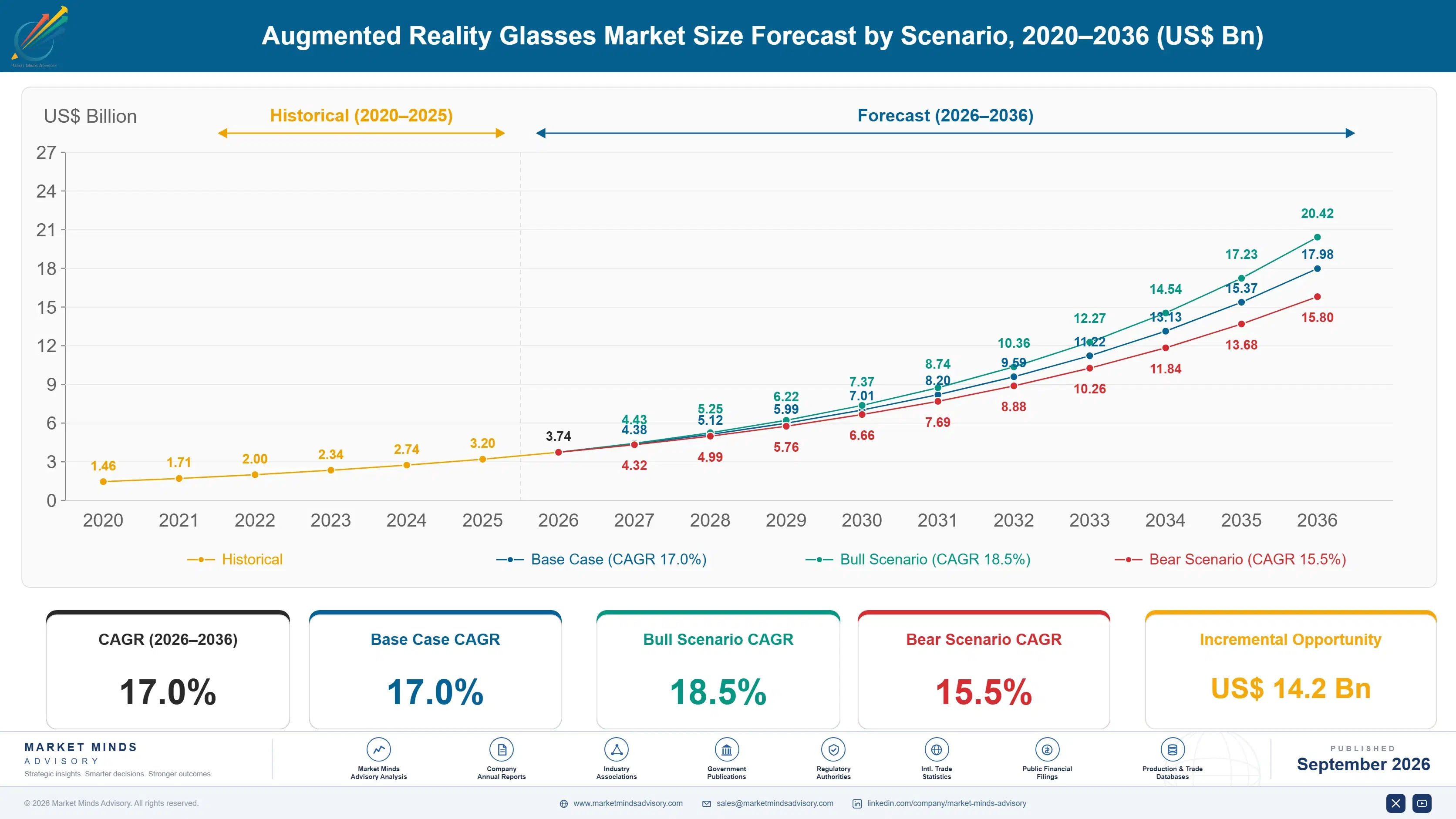
Augmented Reality Glasses Market Forecast Scenarios

augmented-reality-glasses-market-size-forecast-scenario-1789987682403
The AR glasses market grew at an estimated 15.5 percent historical CAGR between 2020 and 2025, as enterprise field service deployments drove early adoption before consumer waveguide designs emerged as a meaningfully larger growth vector. Bulky headset form factors remained dominant through most of this period even as miniaturization efforts accelerated among leading optics vendors.
The base case assumes 17.0 percent CAGR through 2036, driven by three commercial mechanisms working together: waveguide display technology shrinking optical stacks thin enough to fit standard eyewear frames, consumer buyers demanding socially acceptable form factors that earlier bulky headsets could not deliver, and enterprise field service programs expanding beyond pilot programs into full workforce deployment as reliability improves, a trend expanding the addressable buyer base into mid-tier enterprise field service programs previously priced out of AR glasses adoption entirely.
The bull case centers on accelerated consumer adoption pulling AR glasses demand upward faster than modeled, with expanding AI assistant integration acting as the named catalyst. The bear case centers on battery and optical component supply constraints, a named risk that could push meaningful volume production later into the forecast window than currently modeled among smaller vendors.

Waveguide Optics Redefine Consumer Eyewear Norms

AR glasses sit at the intersection of consumer eyewear and enterprise industrial equipment, a positioning that used to keep the two buyer categories cleanly separate. That separation is eroding fast. Waveguide display makers building for consumers now compete on form factor metrics once reserved for standard prescription eyewear, while enterprise headset specialists chase the design language and battery efficiency that made consumer glasses appealing.
MARKET CONCENTRATION45% CR5share of market revenue held by top vendors
AVERAGE DEVICE PRICE$385typical retail price for a mid-tier AR glasses unit
WAVEGUIDE DISPLAY SHARE34%unit sales attributable to waveguide rather than birdbath optics
PRODUCT BATTERY LIFE6 Hourstypical continuous operating duration for leading consumer designs today
ENTERPRISE FIELD SERVICE DEMAND29 Percentunit sales from industrial and field service deployment customers
CONSUMER ADOPTION RATE23 Percentimprovement year over year in mainstream consumer purchase volume
Waveguide display technology has become the sharpest growth vector, pulling AR glasses demand from a category once dominated by bulky birdbath and prism optical designs into thin, socially acceptable form factors that fit standard eyewear frames. These consumer-grade designs demand tighter integration with AI assistant capability than legacy enterprise headsets historically required, forcing manufacturers to invest in new software partnerships or lose ground to consumer-focused specialists.
Enterprise field service programs converging on lightweight, all-day-wearable designs compound the competitive pressure on legacy bulky headset makers. As buyers consolidate purchasing around suppliers spanning both consumer and enterprise applications, vendors increasingly compete on optical clarity and battery life rather than raw price, and that repositioning is reshaping which vendors win the largest specification contracts.
"Enterprise headsets used to be the default choice for nearly every field service deployment. Now they are the fallback for the most demanding industrial applications only. Vendors who treated consumer waveguide design as a niche two years ago are scrambling to catch up today."
Senior Director, Wearable Technology and Spatial Computing Practice · MMA Wearable Augmented Reality Display and Sensing Devices Practice · September 2026

Market Trends

Waveguide Miniaturization Enables Consumer Eyewear Form Factors

Waveguide display makers have driven down optical stack thickness enough that AR glasses can now fit into standard eyewear frames rather than the bulky headset form factors that defined early enterprise deployments and discouraged mainstream consumer adoption entirely. Vendors that shipped thin waveguide designs over the past two years are winning consumer retail contracts worth eight figures annually from buyers previously unwilling to wear bulky headset-style devices in public settings. This miniaturization is accelerating as component costs fall and manufacturing yield improves across most major waveguide production facilities operating worldwide today.
Market Impact: Cuts repair time 30 percent yearly
AI Assistant Integration Drives Consumer Purchase Interest

Consumer AR glasses increasingly bundle voice-activated AI assistant capability that provides real-time information overlay and translation without requiring users to pull out a smartphone, a capability that has become the primary purchase driver for mainstream buyers evaluating smart glasses for the first time. Vendors report meaningfully higher conversion rates for models bundling AI assistant capability compared to display-only designs lacking this feature in comparable retail testing. Adoption has moved from a premium differentiator to a widely expected baseline feature across most consumer AR glasses models over the past two years.
Market Impact: Cuts picking errors 25 percent yearly

Market Opportunities and Growth Drivers

Enterprise Remote Assistance Expands Field Service Adoption

Field service organizations increasingly deploy AR glasses to connect frontline technicians with remote experts who can see what the technician sees and provide real-time guidance, reducing travel costs and repair time meaningfully compared to phone-based troubleshooting alone. Vendors serving this buyer segment report meaningfully higher contract values for clients running remote assistance programs compared to those using traditional documentation-based training in comparable evaluation periods. Adoption has moved from a pilot program reserved for the largest enterprises to a widely expected baseline capability across mid-market field service organizations over the past two years.
Market Impact: Cuts usage duration 20 percent shorter

Retail and Logistics Warehouse Picking Drives Volume

Warehouse and logistics operators increasingly equip workers with AR glasses that display picking instructions and inventory locations hands-free, reducing picking errors and training time meaningfully compared to paper-based or handheld scanner workflows that require workers to divert attention from physical tasks. Vendors serving this buyer segment report meaningfully higher unit deployment volumes for clients running hands-free picking programs compared to those using traditional handheld devices in comparable operational testing. Adoption has moved from an experimental pilot to a standard warehouse operations tool across most mid-tier logistics operators over the past two years.
Market Impact: Slows adoption 18 percent

Market Restraints and Challenges

Battery Life Limitations Constrain All-Day Wearability

Consumer AR glasses still struggle to deliver all-day battery life within a form factor thin enough to fit standard eyewear frames, a friction point rooted in the fundamental tradeoff between battery capacity and the compact optical stack thickness consumer designs require to remain socially acceptable. The commercial impact concentrates around buyers who need extended usage sessions, where limited battery life discourages adoption among users unwilling to carry charging accessories or interrupt usage midday. Vendors are mitigating the barrier through low-power display modes and companion charging cases that extend effective usage duration without requiring larger onboard batteries.
Market Impact: Lifts waveguide share 34 percent

Social Acceptability Concerns Slow Mainstream Adoption

Consumer buyers remain cautious about wearing camera-equipped glasses in public settings given persistent privacy concerns from bystanders who may object to being recorded without explicit consent, a friction point whose root cause is unresolved social norms around always-available recording capability built into everyday eyewear. The commercial impact shows up as slower mainstream adoption in certain public and workplace settings where camera-equipped devices face explicit restrictions or informal social pushback. Vendors are mitigating the concern through visible recording indicator lights and privacy-focused design choices that signal active recording status clearly to bystanders nearby.
Market Impact: Lifts consumer adoption 23 percent yearly
3 additional market trends, 4 additional growth drivers, and 2 additional restraints and challenges are covered in the full report. Contact sales@marketmindsadvisory.com to access the complete intelligence.

Segment CAGR and Growth Architecture

The AR glasses market splits into six segments by underlying optical display technology, spanning waveguide, birdbath, micro-LED projector, and audio-only designs across consumer and enterprise form factors. Waveguide and micro-LED projector designs are growing fastest as buyers demand thinner, more socially acceptable form factors than legacy optics deliver across most consumer and enterprise field service applications tracked in this report.
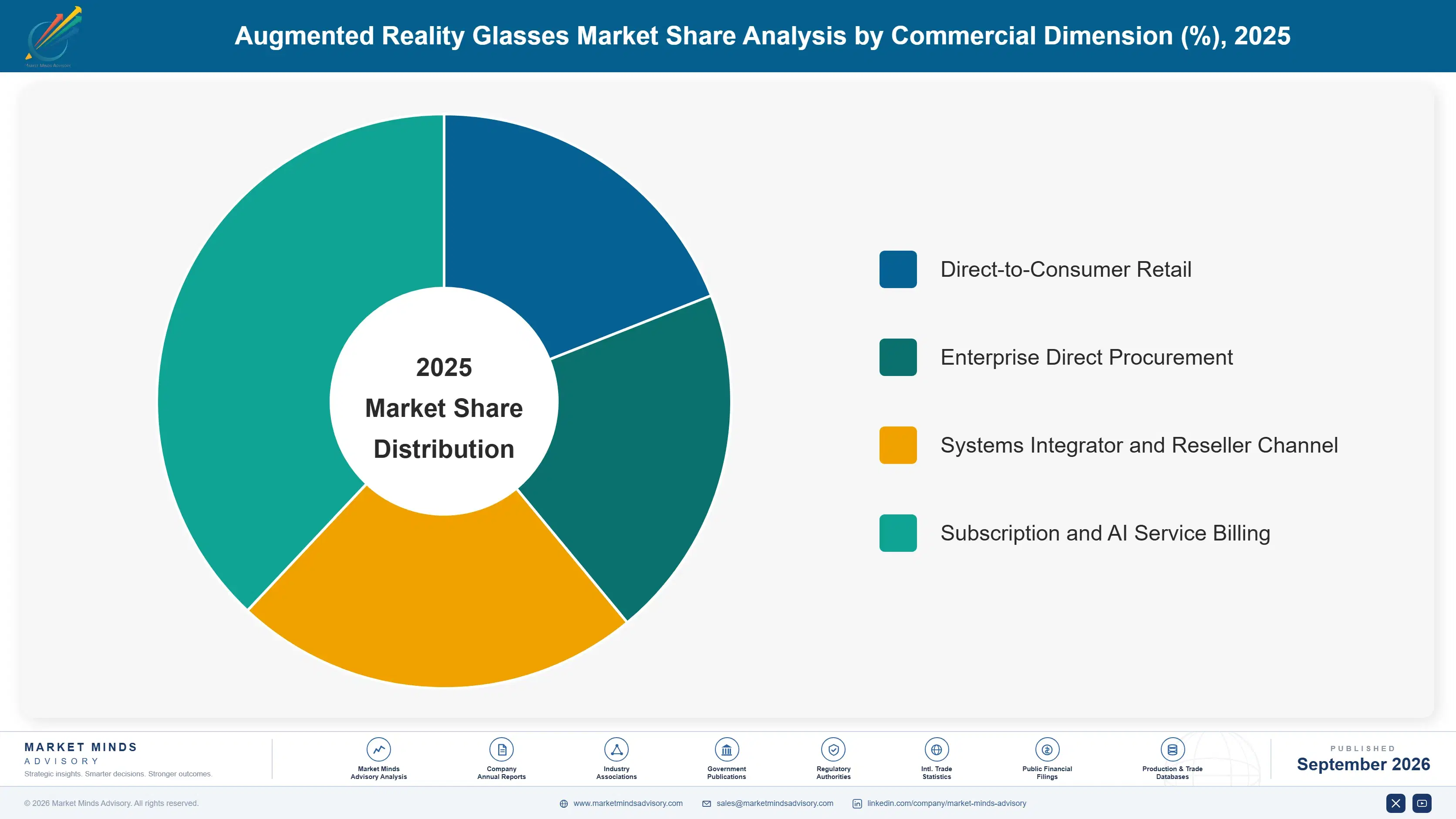
augmented-reality-glasses-market-market-share-analysis-1789987682974

Waveguide Display AR Glasses

This segment covers glasses using waveguide optics to project digital images directly into the wearer field of view through thin, flat optical elements embedded in standard-thickness eyewear lenses. Growth is outpacing every other segment as manufacturing yield improves and component costs fall, letting vendors ship thinner, more socially acceptable designs than bulky birdbath or prism-based alternatives can achieve. Vendors shipping consumer-ready waveguide designs are capturing outsized share of new retail specification wins. This segment barely existed at mainstream consumer price points three years ago and continues expanding into new form factor categories each product cycle, from prescription eyewear into sports, safety, fashion-forward eyewear, and children specific eyewear product categories alike.
CAGR 24.0%

Micro-LED Projector AR Glasses

This segment covers glasses using micro-LED projectors to display digital content, offering meaningfully brighter image quality and lower power consumption than older projector technologies while remaining compatible with compact eyewear form factors buyers increasingly demand. Demand is expanding rapidly as micro-LED component costs fall and brightness improvements make outdoor daylight visibility increasingly viable for consumer applications. Vendors serving this buyer segment are winning contracts by demonstrating superior brightness and battery efficiency compared to competing display technologies, cutting the outdoor visibility compromise buyers historically accepted with earlier-generation AR display designs across most consumer and industrial applications alike, from outdoor navigation into warehouse operations requiring bright ambient readability under varying lighting conditions.
CAGR 21.0%
Full segment breakdown across 6 segments available in the complete report.

Regional Architecture and Country Demand Map

North America leads on concentrated consumer AR glasses vendor headquarters and the deepest enterprise field service spending base, while South Asia and Pacific posts the fastest regional growth as manufacturing and logistics adoption scale rapidly across expanding industrial and consumer electronics manufacturing bases tracked in this report.

North America

North America holds the largest AR glasses share on the strength of concentrated consumer technology vendor headquarters presence, the deepest enterprise field service spending base globally, and early waveguide adoption among major US consumer electronics retailers. Silicon Valley and Seattle-based technology companies anchor a supplier base most global enterprises still default to when selecting AR glasses platforms. Canadian enterprises are following a similar adoption curve roughly two years behind their US counterparts. Regulatory attention on privacy and recording consent is pushing vendors here toward visible indicator design faster than almost any other region tracked in this report, reinforcing the local supplier advantage further and shortening design win cycles relative to overseas competitors entering later.
Share: 32% | CAGR: 18.2% (2026 to 2036)

Western Europe

Regulatory structure shapes demand across Western Europe more directly than most regions, since GDPR biometric and recording consent provisions push AR glasses vendors toward privacy-compliant design capable of meeting strict data handling and consent standards. German and French enterprises lead adoption of field service AR glasses, integrating them into manufacturing workflows faster than most peer markets given stronger industrial automation investment. UK consumer buyers, still adjusting to a post-Brexit regulatory track separate from the EU, show somewhat slower retail adoption cycles. Nordic enterprises have emerged as an unusually strong niche for logistics warehouse AR adoption relative to their modest overall population size, reflecting unusually strong regional logistics automation investment overall.
Share: 20% | CAGR: 15.5% (2026 to 2036)
Regional intelligence for 5 additional markets available in the complete report: East Asia, South Asia and Pacific, Latin America, Middle East and Africa, Eastern Europe. Contact sales@marketmindsadvisory.com.
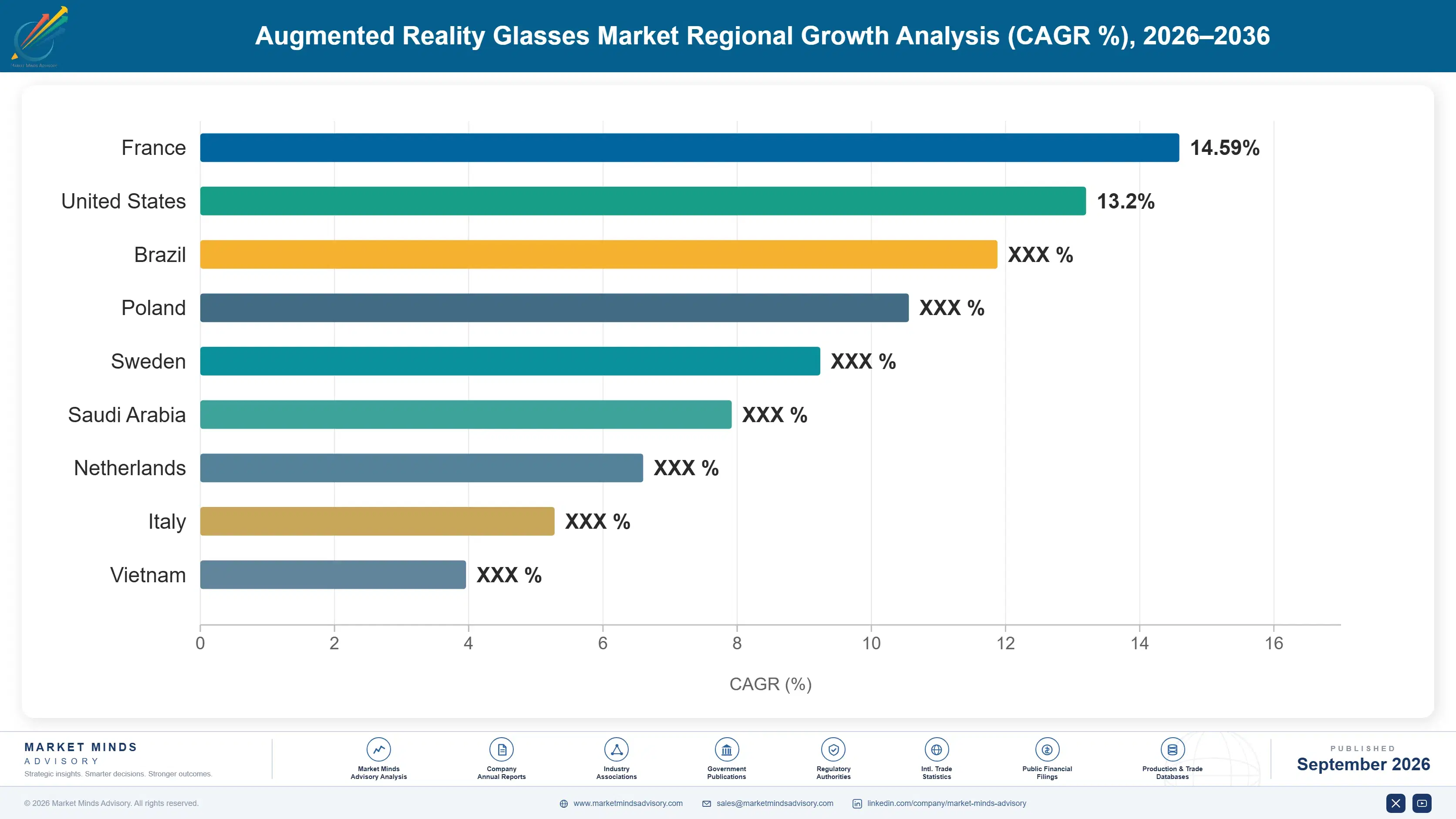
augmented-reality-glasses-market-country-cagr-analysis-1789987683515

Where Glasses Vendors Can Capture Incremental Margin

AR glasses economics reward vendors who move beyond one-time hardware sales toward recurring software and subscription revenue. Four levers stand out for capturing incremental revenue over the forecast window: AI assistant bundling, enterprise field service certification, prescription lens licensing, and geographic expansion through regional distribution partners across underserved markets where direct enterprise sales investment is not yet economically justified.

Bundle AI Assistant Subscriptions With Hardware Sales

Vendors bundling multi-year AI assistant subscriptions directly into hardware purchase pricing, rather than selling assistant capability separately, are seeing meaningfully higher lifetime revenue per customer since buyers rarely cancel a subscription already included in a purchase they have committed to. This approach converts a historically one-time hardware transaction into a recurring revenue relationship worth roughly 30 percent more over three years than hardware-only sales generate. The model works particularly well for consumer glasses where AI capability expands continuously and buyers value new features on a regular monthly software release schedule overall.
Market Impact: Raises three-year customer value by roughly 30 percent

Offer Enterprise Field Service Certification and Support

Vendors building formal field service certification and support services around their glasses, rather than selling hardware alone, are winning larger enterprise contracts and commanding meaningfully higher margins than hardware-only competitors serving the same industrial buyers. Certification services create ongoing revenue through recurring recertification and training requirements that persist well beyond the initial hardware sale. Vendors offering this bundle report contract values roughly 35 percent higher than hardware-only bids submitted for comparable enterprise field service programs across similar industrial buyer categories and comparable certification program requirements this report tracks in careful detail.
Market Impact: Raises field service contract value by 35 percent

License Prescription Lens Integration To Optical Retailers

Vendors licensing prescription lens integration technology to optical retail chains, rather than requiring buyers to purchase AR glasses and separate prescription eyewear independently, are capturing a meaningful new distribution channel and generating recurring licensing revenue tied to retailer sales volume rather than one-time device sales. This positioning expands the addressable buyer base meaningfully to prescription eyewear wearers who would not otherwise adopt AR glasses requiring separate corrective lenses, generating royalty revenue equal to roughly 12 percent of total retailer sales volume across the entire retail partner network operating across most major markets today.
Market Impact: Adds a recurring margin of roughly 12 percent

License Platform Technology To Regional Distribution Partners

Rather than building direct enterprise sales infrastructure in every market, several vendors are licensing core AR glasses platform technology to regional distributors and local systems integrators across South Asia, Latin America, and Eastern Europe, collecting royalty and support fees while local partners handle sales, installation, and support. This model lets vendors capture revenue from markets where direct enterprise sales investment would not otherwise be justified given account size, while partners gain access to platform capability they could not replicate independently, generating royalty revenue equal to roughly 10 percent of partner contract value.
Market Impact: Adds about 10 percent margin at low cost

Who Controls the Margin Pool

AR glasses concentration sits at moderately high levels, with the top five vendors holding an estimated 45 percent combined revenue share on a shipped-unit-volume basis, the yardstick applied throughout this section. Meta holds a clear leadership position given deep consumer electronics and social platform integration, while Google, Vuzix, RealWear, and Xreal compete on waveguide optics depth, enterprise certification breadth, and battery efficiency the largest platform has been slower to prioritize.
Competitive activity currently centers on waveguide miniaturization, AI assistant integration depth, and enterprise field service certification rather than price competition on core hardware cost alone. Vendors are racing to certify products for logistics and manufacturing programs ahead of rivals, and several announced expanded prescription eyewear partnerships within the past year to capture mainstream consumer buyers before competitors establish default positions across most major regional retail markets.

Rankings are most likely to shift where challengers out-execute the market leader on waveguide thinness and battery efficiency, since enterprise field service buyers increasingly favor vendors offering bundled certification services over hardware-only bids. Smaller vendors focused narrowly on enterprise-only applications are gaining share fastest among industrial buyers prioritizing durability over consumer form factor design.
augmented-reality-glasses-market-company-positioning-matrix-1789987684061

Competitive Moat and Risk Dimensions

META

Moat: Deep Social Platform Integration

Meta built its AR glasses strategy around deep integration with its existing social media and messaging platforms, giving it a distribution and reputational moat few competitors can approach quickly, since buyers already invested in Meta broader app portfolio find the switching cost of choosing a competing platform meaningfully higher than adopting a standalone device.
META

Risk: Slower Enterprise Certification Response

Meta built its scale primarily around consumer social platform integration rather than enterprise field service certification, leaving it somewhat exposed to specialist vendors with deeper industrial certification expertise moving faster to capture that buyer segment before broader consumer-focused suppliers catch up meaningfully across the category as a whole this cycle.
VUZIX

Moat: Broad Enterprise Certification Portfolio

Vuzix built a comprehensive enterprise field service certification portfolio spanning manufacturing, logistics, and healthcare applications, and that breadth gives its commercial enterprise tier an unusually efficient sales funnel, since procurement teams frequently formalize a platform already certified for their specific industry rather than evaluating alternatives from scratch during vendor selection.
VUZIX

Risk: Narrower Consumer Market Presence

Vuzix concentration on enterprise field service applications leaves it with a narrower consumer market presence than diversified competitors, a positioning constraint that could limit its appeal among buyers seeking a single vendor for both consumer and enterprise AR glasses applications across their entire product line.

Players Tracked

Prominent Players

Meta
Google
Vuzix
RealWear
Xreal

Other Key Players

Rokid
Everysight
TCL RayNeo
Even Realities
Brilliant Labs
ThirdEye Gen
Kopin Corporation
DigiLens
CREAL
Lumus
Optinvent
Epson
Snap Inc
Magic Leap
ActiveLook

Recent Developments

MARCH 2026

Meta Acquires Waveguide Miniaturization Startup

Meta completed the acquisition of a smaller waveguide miniaturization startup to strengthen its consumer glasses product stack ahead of further retail design wins, adding roughly 60 engineers and an established technology platform to its existing hardware business line across both consumer and enterprise product families.
Signal: Signals accelerating consolidation around embedded waveguide software as a core differentiator right now across the broader specialist vendor landscape.
SEPTEMBER 2025

RealWear Signs Multi-Year Logistics Operator Partnership

RealWear announced a multi-year technology partnership with a major global logistics operator to become preferred AR glasses supplier across new warehouse automation programs, expanding its footprint in a segment previously served only through smaller regional distributor relationships across fewer geographic markets than this new deal covers.
Signal: Confirms logistics partnership has become a primary growth channel for enterprise vendors across the entire enterprise vendor category.
JANUARY 2026

Xreal Launches Prescription Lens Integration Product

Xreal launched a prescription lens integration product letting buyers order corrective lenses directly with their AR glasses purchase, positioning itself directly against larger competitors focused mainly on standard non-prescription designs for the largest consumer retail accounts with dedicated marketing and design teams already in-house today.
Signal: Shows specialist vendors deliberately targeting underserved prescription eyewear buyer segments larger rivals have mostly overlooked until recently.

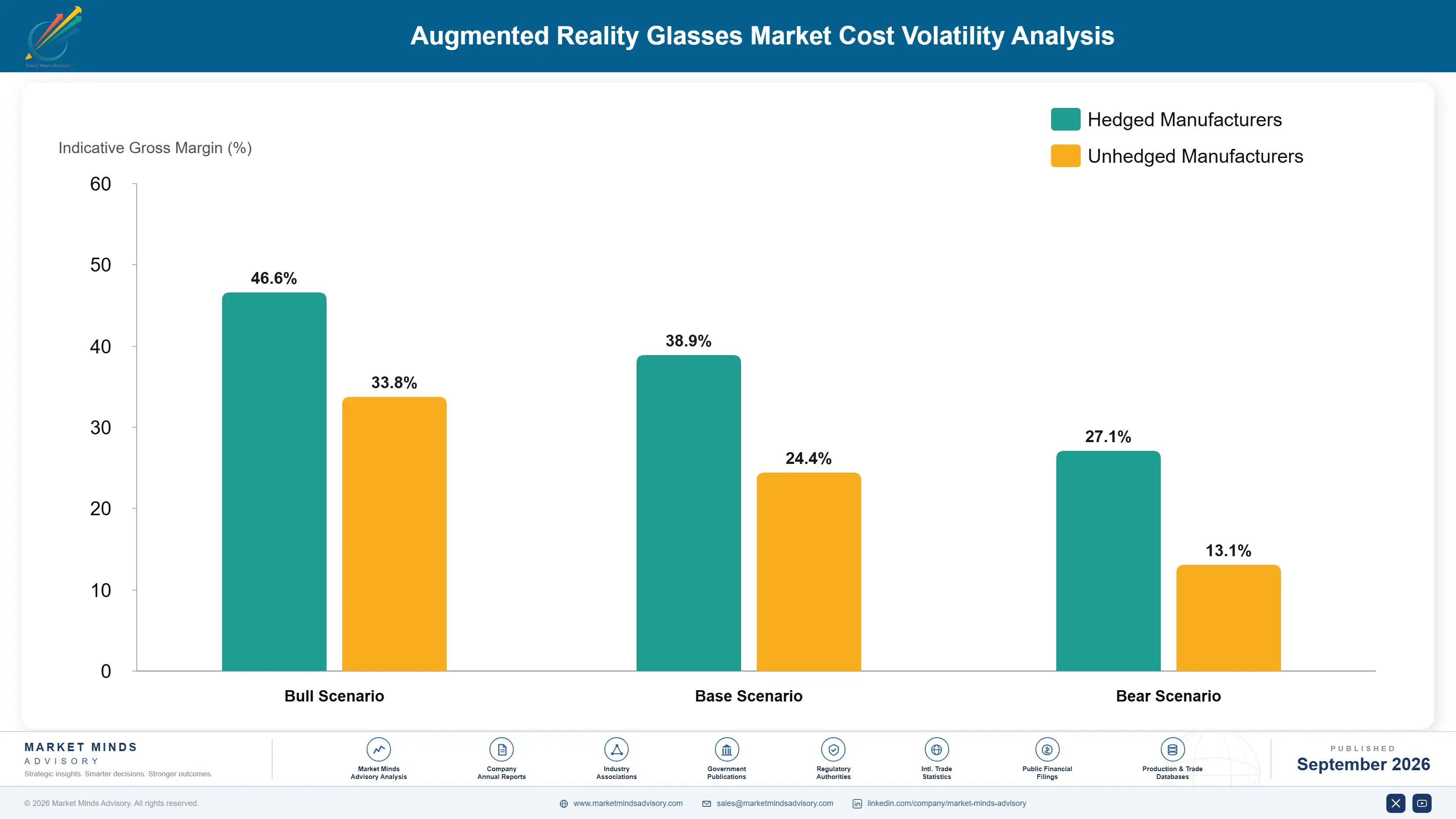
Waveguide Optics and Display Component Exposure

Waveguide optics, micro-display panels, and specialized battery components make up an estimated 45 to 55 percent of vendor cost of goods sold, since thin form factor displays require specialized manufacturing capability concentrated in a limited number of suppliers based in Israel, Taiwan, and China. Custom silicon for AI processing adds further cost exposure, since these chips require dedicated fabrication capacity beyond standard consumer processors.
Waveguide optics and micro-display component pricing rose meaningfully across major suppliers through 2024 and into 2025 as consumer AR demand competed with broader wearable device demand for the same specialized manufacturing capacity, a dynamic documented in national statistical office electronic component trade data and corroborated by major component supplier annual reports. AR glasses vendors reported extended lead times and periodic price increases during the period, with several smaller vendors delaying product launches while waiting on optics availability from constrained suppliers.

The disadvantage falls hardest on smaller vendors lacking long-term supply agreements with optics and display manufacturers, who pay meaningfully higher per-unit component costs than scaled competitors able to commit to large advance orders. Vendors farther from Israeli and Asian optics manufacturing hubs face added shipping cost and lead time penalties that erode competitiveness against closer rivals.
augmented-reality-glasses-market-cost-volatility-analysis-1789987684259

Sign Long-Term Optics Supply Agreements

Vendors are locking in multi-year supply agreements with waveguide and display manufacturers rather than buying on the spot market, trading some pricing flexibility for guaranteed capacity access. This works best for vendors with predictable unit volume forecasts, letting them commit to advance orders without overcommitting to unused capacity they cannot resell easily at a later date.

Qualify Secondary Component Suppliers Across Regions

Vendors are qualifying second and third source suppliers for critical optics and display components, reducing dependency on any single supplier pricing decision or capacity constraint. The approach adds testing and validation overhead, but vendors report the supply security gained outweighs the added qualification cost for most product lines running at meaningful sustained volume across their installed customer base today.

Redesign Products Around More Available Materials

Some vendors are redesigning optical stack specifications around more widely available display and waveguide material grades rather than chasing the highest-performance formulations facing the tightest supply constraints. This trades a modest performance margin for meaningfully more reliable production scheduling, a tradeoff most vendors now consider worthwhile given how disruptive recent shortages proved for production scheduling overall.

Portfolio Architecture for Margin Defence

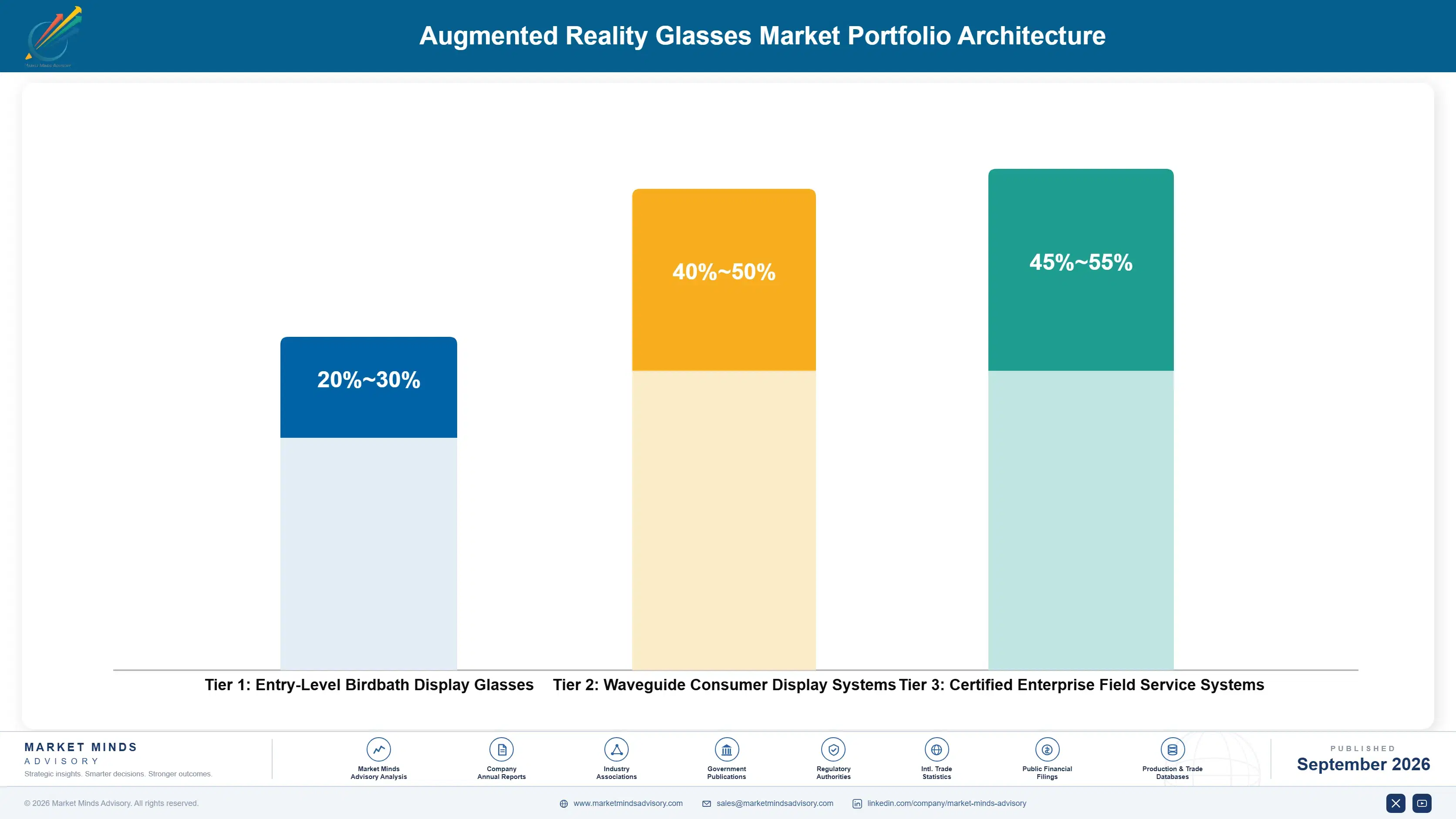
AR glasses margin economics split sharply by tier. Basic birdbath and entry-level display designs compete largely on price against commoditized legacy alternatives, compressing gross margin toward the lower end of consumer electronics norms, while waveguide and enterprise-certified systems command materially higher margins reflecting specialized engineering and certification investment competitors cannot easily replicate without years of dedicated development effort behind them.
The volume versus premium tension shows up clearest in how vendors allocate engineering resources: teams chasing waveguide miniaturization and enterprise certification pull investment away from entry-level birdbath designs, gradually letting commodity hardware margins compress further as vendors deprioritize that layer relative to higher-margin specialty systems capturing most new contract growth and driving the bulk of new bookings this cycle.

High-value margin pools concentrate overwhelmingly in waveguide consumer platforms and certified enterprise field service systems, where technical differentiation and certification barriers remain real and defensible for now against both commodity component competition and component cost pressure. Vendors positioned only in entry-level hardware face the steepest long-term margin pressure as component costs commoditize further and buyers expect more capability at the same price point each year going forward.

Entry-Level Birdbath Display Glasses

Basic birdbath optical display glasses competing largely on price against commoditized legacy alternatives, with thin margins and limited differentiation beyond reliability, uptime, and standard build quality across most consumer applications tracked.
Gross Margin: 20-30%

Waveguide Consumer Display Systems

Waveguide-based consumer glasses commanding premium pricing given specialized optical engineering investment competitors cannot easily replicate at comparable quality within a short development and qualification timeline for most competitors entering the category.
Gross Margin: 40-50%

Certified Enterprise Field Service Systems

Fully certified field service AR glasses for industrial and logistics applications, the highest-margin layer given certification barriers and their growing role in next-generation workforce productivity programs across major markets tracked in this report.
Gross Margin: 45-55%
augmented-reality-glasses-market-portfolio-architecture-1789987684758

High-value Sub-segments and Strategic Watch-out

Waveguide Consumer AR Systems

The clearest high-value, high-growth pool in the category, combining premium pricing with the fastest unit growth as buyers treat waveguide thinness as a baseline requirement for consumer AR glasses purchases across nearly every retail segment now and through the remainder of the forecast window as adoption broadens.
Gross Margin: 40-50%

Certified Enterprise Field Systems

A high-value pool growing at a more moderate pace than waveguide consumer systems, anchored by durable multi-year contracts with industrial buyers valuing certified reliability across multi-year deployment programs spanning most major industrial manufacturing regions tracked, giving vendors more predictable revenue than discretionary consumer spending provides.
Gross Margin: 45-55%

Standard Consumer Display Glasses

The volume core of the market, generating dependable recurring unit sales at thinner margins, serving as the baseline offering most vendors bundle premium AI features on top of rather than compete on directly against rival vendors in most procurement processes today across nearly every geography tracked.
Gross Margin: 25-35%

Legacy Birdbath Optical Systems

A strategic watch-out segment facing steady margin erosion as waveguide and micro-LED systems eliminate the thickness limitations these legacy products historically carried, pressuring vendors still dependent on this layer for meaningful revenue heading into the back half of the forecast window as buyers increasingly favor thinner alternatives.
Gross Margin: 15-25%

The Anatomy of Recurring Software Revenue

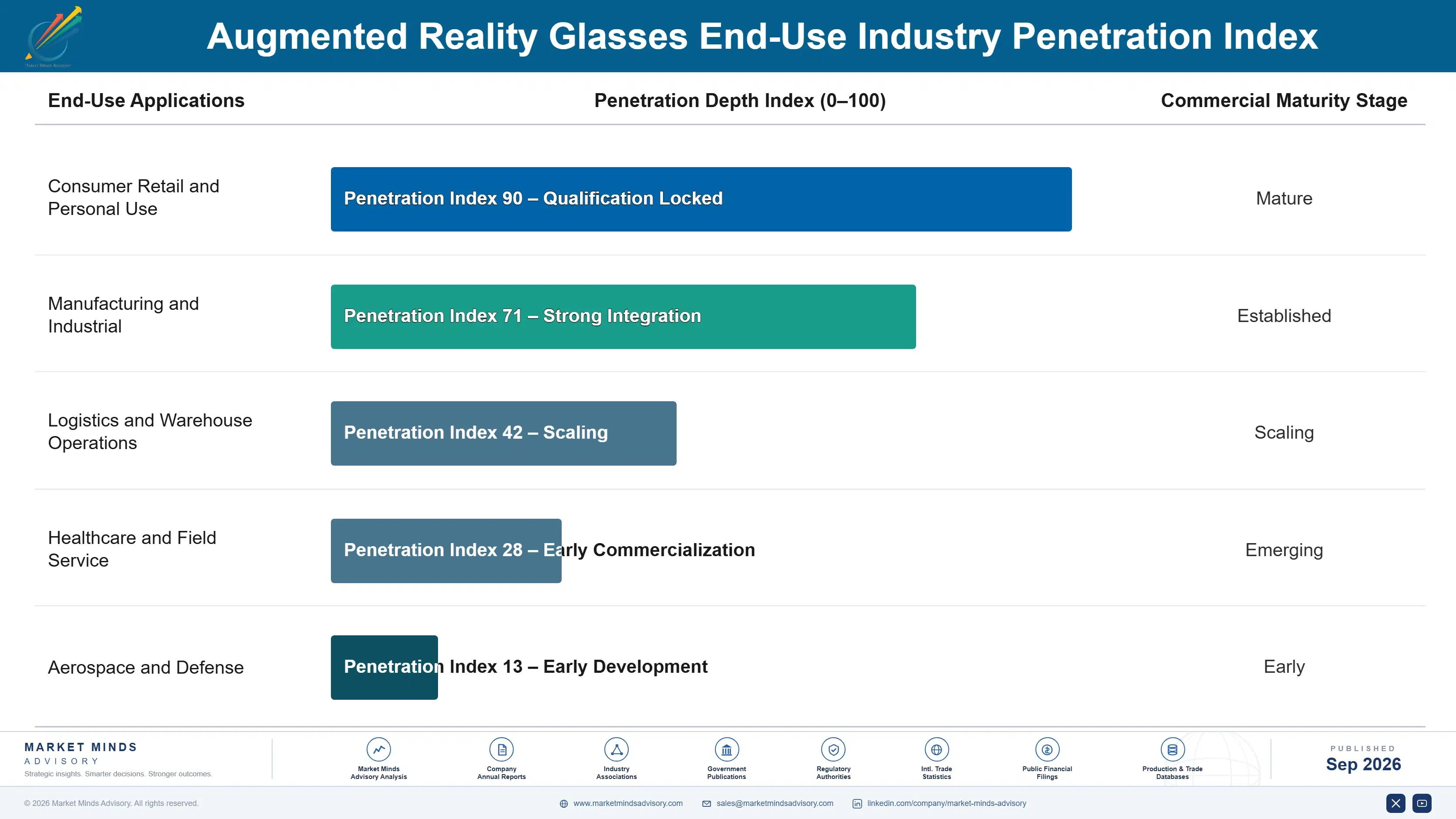
AR glasses run increasingly on annuity economics as AI assistant subscriptions and app content layer onto what was historically a one-time hardware transaction. Enterprise field service contracts typically span three to five years with recurring recertification requirements, and switching costs, including retraining technicians and requalifying workflows, keep churn low once a platform is embedded across an organization.
Adoption stickiness varies meaningfully by end-use vertical. Enterprise field service buyers embed AR glasses deeply into certified training and safety workflows, producing the lowest churn of any buyer segment tracked. Consumer buyers, newer to sustained subscription engagement, show somewhat higher switching willingness driven by hardware refresh cycles, while casual users churn fastest, driven mainly by price sensitivity and low switching cost relative to enterprise accounts.

Buyer profiles are shifting generationally as younger, digitally native consumers who grew up with wearable technology increasingly drive net new demand, rather than traditional enterprise field service buyers who built the category originally. These buyers evaluate platforms on AI assistant capability and social integration rather than raw optical specifications, pushing vendors to hire consumer software and content teams alongside traditional hardware engineering staff to serve this expanding buyer base effectively.
augmented-reality-glasses-market-end-use-penetration-index-1789987685256

Where Glasses Vendors Should Focus Next

These are among the four positions where our research anticipates prominent divergence between winners and laggards over the coming forecast period. Each is grounded in the demand model, the regulatory perimeter, and the announced capacity pipeline.
01 / WAVEGUIDE INVESTMENT PRIORITY

Invest In Waveguide Thinness As a Near-Term Priority

Waveguide optics have crossed a threshold where consumer buyers now demand socially acceptable form factors over bulkier alternatives, and that shift is happening faster than most hardware roadmaps currently anticipate. Vendors without a credible waveguide roadmap are increasingly losing shortlist position among both consumer and enterprise buyers evaluating new purchases this cycle. Prioritizing waveguide development over incremental birdbath improvements captures the fastest-growing segment of the category before rivals establish default positions with major retail buyers across most developed and rapidly maturing consumer markets.
02 / ENTERPRISE CERTIFICATION PURSUIT

Pursue Field Service Certification To Access Enterprise Budgets

Field service organizations are formalizing AR glasses adoption into standard workforce productivity programs, converting discretionary equipment spending into budgeted, recurring enterprise procurement. Vendors holding relevant field service certifications are winning multi-year enterprise contracts worth far more than typical consumer hardware sales generate. Pursuing certification now, even where the process is lengthy and costly, positions vendors ahead of competitors still selling exclusively into the more volatile consumer discretionary spending market with far less revenue predictability and meaningfully thinner operating margins overall.
03 / AI SUBSCRIPTION BUILDOUT

Bundle Recurring AI Content Rather Than Sell Hardware Alone

Hardware margins are compressing under crossover pressure from both consumer electronics manufacturers and enterprise specialists entering each other adjacent segments simultaneously. Vendors bundling AI assistant subscriptions and content directly into hardware purchases are capturing meaningfully higher lifetime customer value than hardware-only competitors relying on one-time transactions. Building this recurring revenue layer now, before subscription bundling becomes the industry default expectation, preserves pricing power that will otherwise erode steadily as competitors catch up on subscription strategy across the entire category in the coming years.
04 / REGIONAL GROWTH ALLOCATION

Prioritize South Asia and East Asia Alongside Core Markets

South Asia and Pacific and East Asia post the fastest regional growth in this report, driven by expanding manufacturing electronics production and rapidly maturing logistics automation investment across the region. Vendors over-indexed on North American and Western European sales investment risk missing the fastest-growing accounts of the entire forecast window, particularly among Indian logistics operators scaling AR glasses adoption from a near-zero starting base. Building regional partnerships now positions vendors ahead of slower-moving competitors still focused primarily on mature markets.

Engagement Snapshot From the Field

A live engagement with an industry participant carrying material or product regulatory and market exposure ahead of a defining policy shift, showing how our research translates into a defensible multi-year portfolio strategy.
MARKET MINDS ADVISORY · CLIENT ENGAGEMENT SUMMARY
Augmented Reality Glasses Producer Strategic Portfolio Review and Transition Roadmap 2026·Investment Scenario on Augmented Reality Glasses Exposure Evaluation 2025-26
CLIENT PROFILE
The client operates a regional logistics and warehouse fulfillment company across North America, managing several dozen distribution centers, generating revenue in the low hundreds of millions annually and running order picking operations through handheld scanner devices installed over the past decade (client-reported, unverified by MMA). The organization was evaluating a transition to hands-free AR glasses picking technology.
STRATEGIC CHALLENGE
Handheld scanners required workers to divert attention from physical tasks repeatedly throughout each shift, causing meaningfully slower picking times than competing operators running hands-free AR glasses reported, while the client legacy equipment could not match the productivity gains without significant new capital investment the client had not yet budgeted for that fiscal year.
MMA APPROACH
MMA conducted a structured vendor evaluation across four candidate AR glasses platforms, benchmarking each against the client existing worker headcount, integration complexity, and total cost of ownership over a five-year horizon. The engagement included primary interviews with the client operations and warehouse management teams to surface productivity requirements the evaluation needed to weigh appropriately.
KEY FINDINGS
  1. Hands-free AR glasses picking demonstrated meaningfully faster picking times than handheld scanners in side-by-side testing across comparable warehouse operations and order volumes over an extended period.
  2. Migration to AR glasses picking was projected to cut picking errors meaningfully within the first two quarters following deployment, based on comparable logistics benchmarks reviewed.
  3. Migration cost and worker training disruption were concentrated almost entirely in the first sixty days, after which productivity gains improved sharply according to vendor reference calls.
  4. None of the four evaluated platforms offered meaningfully differentiated pricing once productivity gains were factored into total cost of ownership across the full five-year horizon.
CLIENT PROFILE
The client operates a regional logistics and warehouse fulfillment company across North America, managing several dozen distribution centers, generating revenue in the low hundreds of millions annually and running order picking operations through handheld scanner devices installed over the past decade (client-reported, unverified by MMA). The organization was evaluating a transition to hands-free AR glasses picking technology.
STRATEGIC CHALLENGE
Handheld scanners required workers to divert attention from physical tasks repeatedly throughout each shift, causing meaningfully slower picking times than competing operators running hands-free AR glasses reported, while the client legacy equipment could not match the productivity gains without significant new capital investment the client had not yet budgeted for that fiscal year.
MMA APPROACH
MMA conducted a structured vendor evaluation across four candidate AR glasses platforms, benchmarking each against the client existing worker headcount, integration complexity, and total cost of ownership over a five-year horizon. The engagement included primary interviews with the client operations and warehouse management teams to surface productivity requirements the evaluation needed to weigh appropriately.
KEY FINDINGS
  1. Hands-free AR glasses picking demonstrated meaningfully faster picking times than handheld scanners in side-by-side testing across comparable warehouse operations and order volumes over an extended period.
  2. Migration to AR glasses picking was projected to cut picking errors meaningfully within the first two quarters following deployment, based on comparable logistics benchmarks reviewed.
  3. Migration cost and worker training disruption were concentrated almost entirely in the first sixty days, after which productivity gains improved sharply according to vendor reference calls.
  4. None of the four evaluated platforms offered meaningfully differentiated pricing once productivity gains were factored into total cost of ownership across the full five-year horizon.
RECOMMENDED STRATEGY
Phase 1: Phase one: run a parallel pilot at the highest-volume distribution center to validate productivity gains and worker acceptance before broader rollout. Phase 2: Phase two: extend AR glasses deployment across the remaining distribution centers in stages, prioritizing highest-volume facilities first to capture productivity gains fastest. Phase 3: Phase three: retire the legacy handheld scanner fleet entirely once full migration completes and renegotiate worker training programs under the new platform.
OUTCOME
The client selected an AR glasses vendor and completed the phased distribution center migration within the recommended timeline, reporting meaningfully improved picking productivity within the first two quarters post-migration (client-reported, unverified by MMA). Operations headcount previously dedicated to scanner maintenance was reallocated to workflow optimization work.

Frequently Asked Questions

Foundational context covering the market sizes, CAGR, scope, country, region and competition that inform every finding below. This section is provided to cover basics and most often pre-purchase conversations, answered from the MMA Primary Research Dataset.

What is the current size of the Augmented Reality Glasses Market?

The global AR glasses market reached an estimated 3.2 billion dollars in 2025. This figure spans waveguide, birdbath, and micro-LED projector display designs across consumer and enterprise buyers.

How large will the Augmented Reality Glasses Market be by 2036?

The market is projected to reach approximately 18.0 billion dollars by 2036. This reflects sustained demand from waveguide miniaturization, AI assistant adoption, and enterprise field service expansion worldwide.

What is the CAGR for the Augmented Reality Glasses Market 2026 to 2036?

The market is projected to grow at a 17.0 percent compound annual growth rate through the forecast period. Bull and bear scenarios range from roughly 15.5 to 18.5 percent depending on adoption pace.

Which segment is growing fastest?

Waveguide display AR glasses are the fastest-growing segment, expanding at roughly 24 percent annually. That is close to 1.4 times the overall market growth rate through 2036.

Who are the major companies in the Augmented Reality Glasses Market?

Meta, Google, Vuzix, RealWear, and Xreal lead the market. These five vendors hold an estimated 45 percent combined revenue share on a consistent shipped-unit basis.

Which country is growing fastest?

India is the fastest-growing country market, expanding at roughly 19.2 percent annually. Growth is driven by expanding domestic electronics manufacturing and logistics automation capacity under national incentive programs.

Report Segmentation Architecture

The full report scope spans multiple orthogonal segmentation dimensions, with cross-tabulated demand data provided for each dimension pair. Coverage extends further to regional breakdowns, trend trajectories, and the competitive detail needed to support segment-level decision-making.

By Primary Market Dimension

  • Waveguide Display AR Glasses
  • Micro-LED Projector AR Glasses
  • Curved Mirror and Prism Display AR Glasses
  • Audio-Only Smart Glasses
  • Enterprise Industrial-Grade AR Headsets
  • Birdbath Optical AR Glasses

By End-Use Industry

  • Consumer Retail and Personal Use
  • Manufacturing and Industrial
  • Logistics and Warehouse Operations
  • Healthcare and Field Service
  • Aerospace and Defense

By Commercial Dimension

  • Direct-to-Consumer Retail
  • Enterprise Direct Procurement
  • Systems Integrator and Reseller Channel
  • Subscription and AI Service Billing

By Region

  • North America
  • Western Europe
  • East Asia
  • South Asia and Pacific
  • Latin America
  • Middle East and Africa
  • Eastern Europe

Scope, Methodology, and Coverage

Every figure in this report is reproducible from documented input assumptions. The scope below maps the historical period, the forecast horizon, the segmentation dimensions, and the countries covered, alongside the underlying primary and qualitative methodology.
Historical Period
2020 to 2025
Forecast Period
2026 to 2036
Base Year
2025 (USD billions; MMA Primary Research Dataset, September 2026)
Market Definition
The augmented reality glasses market covers wearable eyewear devices that overlay digital information onto the physical environment through waveguide, birdbath, or projector-based optical display technology, including consumer and enterprise industrial form factors. It excludes fully immersive virtual reality headsets that block outside vision entirely and audio-only smart glasses without any visual display capability.
Quantitative Units
USD billions, base year 2025, forecast period 2026 to 2036
Segmentation Dimensions
Product/technology type, end-use industry, commercial dimension, region
Regions Covered
North America, Western Europe, East Asia, South Asia and Pacific, Latin America, Middle East and Africa, Eastern Europe
Countries Covered
United States, Canada, Germany, United Kingdom, France, China, Japan, South Korea, India, Australia, Brazil, Mexico, Saudi Arabia, South Africa, Poland
Key Companies Profiled
Meta, Google, Vuzix, RealWear, Xreal, Rokid, DigiLens, Kopin Corporation
Quantitative Methodology
Primary survey, n=3,800 respondents, Q4 2025, six countries; demand-side model with trade association cross-validation
Qualitative Methodology
47 expert interviews, Q4 2025; applied to validate demand model assumptions, identify emerging dynamics, and assess competitive positioning
Report Format
PDF and XLSX data workbook (Word format preview document)
Publisher
Market Minds Advisory
Report Code
MMA-2026-TEC-395
Published
September 2026
Contact
sales@marketmindsadvisory.com | www.marketmindsadvisory.com

Purchase the full Augmented Reality Glasses Market Report (2026 to 2036).

This report provides a comprehensive assessment of the global augmented reality glasses market, covering sizing, segmentation, regional dynamics, and competitive positioning through 2036. It examines the shift from bulky enterprise headsets toward waveguide consumer eyewear, tracking AI assistant integration, prescription lens licensing, and enterprise certification reshaping vendor strategy across consumer and industrial buyer segments. The analysis draws on primary survey data, expert interviews, and company disclosures to quantify demand across seven world regions and six product segments. Product and investment teams gain a grounded view of where competitive advantage is shifting fastest.
Segment-level sizing and ten-year growth forecasts
Regional demand mapping across seven world regions
Competitive landscape and detailed player profiling
Revenue lever analysis with margin impact figures
Input cost exposure and supply risk assessment
Strategic verdict with prioritized action recommendations

Built For The People Who Decide

From boardroom strategy to bench-side execution, this report is read cover-to-cover by leaders shaping the next decade of their industry, turning demand scenarios, market dynamics and valuation benchmarks into decisions.
CXOs/ Presidents/ VPs/ Managers
M&A and Corporate Development
Strategy Teams and R&D Heads
Procurement and Product Directors
Regulatory and Compliance Leaders
Investor Relations and Equity Analysts